SIMAD UNIVERSITY
Intergovernmental Relations IGR
Fiscal and Administrative aspects of IGR
Group (6)
1. Ahmed Mohamed Afi
2. Abdirahman Abdulkadir Hussein
3. Abdiwakil Ali Raage
4. Mohamed Abdulle Mohamud
5. Mohamed Osman Ali
6. Omar Haji Dirie
7. Safiya Abdi Mohamed
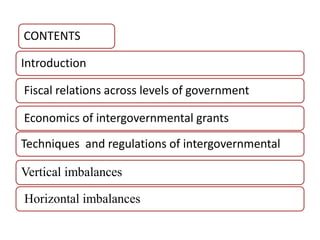
CONTENTS
Introduction
Fiscal relations across levels of government
Economics of intergovernmental grants
Techniques and regulations of intergovernmental
Vertical imbalances
Horizontal imbalances
Introduction
• Fiscal federalism - the devolution of taxing and
spending powers to lower levels of government.
• It has become an important theme of governance
in many developing countries in recent years.
Accordingly, restructuring of governmental
functions and finances between the national and
lower levels of government has entered the core
of the development debate.
Cont.
• intergovernmental fiscal relations is that sub-
national governments need to be given access to
adequate resources to do the job with which they
are entrusted. At the same time they must also be
accountable for what they do with these resources.
Moreover, like all public policies,
Intergovernmental fiscal policies must take into
account both the political constraints facing policy
makers, such as the strength of different provinces
and groups in political decisions, and economic
constraints such as the stage of development of
financial markets.
Definition
• Fiscal federalism consists primarily of
devolving revenue sources and expenditure
functions to lower tiers of government.
• By bringing the government closer to the
people, fiscal federalism is expected to boost
public sector efficiency, as well as
accountability and transparency in service
delivery and policy-making.
• four questions that must be answered with
respect to intergovernmental functions and
finances in any country:
(1) Who does what? This question is about
assignment of functions between levels of
government.
(2) Who levies what taxes? This question is
about revenue assignment.
The four questions
• (3) How to resolve the imbalance between
the revenues and expenditures of sub-
national governments? This question has to
do with vertical imbalances between levels
of government.
• (4) How to adjust for the differences in
capacities and needs among different
governmental units at the same level of
government? This question is about
horizontal imbalances or equalization.
Cont.
• A key issue in intergovernmental fiscal relations is
the assignment of functions and finances to different
levels of government. This can also be described as
the allocation of the authority and responsibility for
the public sector decisions among different power
centers.
• The traditional theory of fiscal federalism identifies
three major functions for the public sector:
(1)macroeconomic stabilization, (2)income
distribution and (3)resource allocation (Oates, 1972
and 1999).
Who does what? Assignment of functions between levels of
government
• The two main instruments of macroeconomic policy
are monetary policy and fiscal policy.
• Fiscal policy, i.e., control over the amount and
structure of taxes and expenditures, and the
management of the budget deficit or surplus, is a
powerful instrument for stabilizing the economy.
• The stabilization function is usually considered to be
inherently national in nature, partly because sub-
national authorities have few or no incentives to
undertake economic stabilization polices.
(1)Macroeconomic stabilization
• lower levels of government often are very dependent
on the national government for finance, it sometimes
makes more sense to think of them as part of the
national government rather than as independent
actors. However, in some federal countries where a
substantial share of national revenues are diverted to
lower-levels, the existence of several tiers of
government may give rise to difficulties in macro-
economic management (Bird, 1990).
There are two arguments
• In contrast, studies from other countries, including the United
States and Western Europe, conclude that decentralization has
not undermined stability (World Bank, 2000). Findings from
Canada even suggest that the growth of sub-national budgets
has had a stabilizing effect on the economy (Sewell, 1996).
This is explained by the observation that the major expenditure
responsibilities which often are assigned to larger sub-national
governments – such as public funding of health and education
– act as automatic stabilizers because they are recurrent and not
very flexible. Increased reliance on direct taxes, such as
personal income taxes in sub-national financing in some
countries has also been found to have stabilizing effects.
Cont.
(2)Income distribution
• A substantial share of the public finance literature holds
that the redistribution of income is primarily a national
government concern. Some scholars even argue that
attempts by local governments to redress income
differences are likely to be unfair (Prud’homme, 1995).
• if a jurisdiction adopts policies to redistribute income by
imposing high taxes on the rich and giving high benefits
to the poor, the rich will tend to ‘vote with their feet’ and
leave for more lightly taxed areas, and the poor will move
in from areas that tend to offer lower benefits.
Cont.
• some regulatory policies allocated to local
authorities in many countries, such as land use
and rent controls, have profound distributional
implications. Public health care, primary
education, water supply, housing and public
transportation which are assigned to sub-
national levels in many countries, also have
important re-distributional functions
• (Sewell, 1996).
Resource allocation
• The fiscal federalist model assigns a significant
role to sub-national governments in allocating
resources. The classic argument provided by the
theory of fiscal federalism (Oates, 1972) is that in
a democratic society decentralization will result in
a better match of supply and demand for local
public goods. Being closer to the people, it is
claimed, local authorities can more easily identify
people’s needs, and thus supply the appropriate
form and level of public services (Enemuo, 2000;
Rondinelli et al., 1989).
Fiscal Federalism
A decentralized or federal system of government
is not only a mechanism of power sharing
between the different levels of government, but
also of distributing the public revenues of the
country between them. This distribution is
necessary in order to enable the different levels
to fulfill their respective functions.
The fiscal design in decentralized states has to
answer to three essential questions:
Cont.
• How are revenues shared and imbalances
between lower levels equalized
(intergovernmental transfers)?
• Which level pays (expenditure responsibility)?
• Which level has the command over the
revenue sources (revenue-raising
responsibility)?
The assignment of expenditure
responsibility
• The responsibility for expenditure can only be
assigned if one has first looked into the question
of which level should provide which public
services. In this respect, it is argued that resources
are spent most efficiently if the level of
government that most closely represents the
beneficiaries of the public service is responsible
for it.
• This fosters transparency since citizens recognize
more easily who spends their money.
Cont.
• For certain public services, such as national defense or
foreign affairs, the level that most closely represents the
beneficiaries of the service will be the national level.
Typical lower level expenditure responsibilities on the
other hand include local infrastructures such as police,
fire prevention and sanitation.
• Another factor determining which level should provide
a certain public service is the efficient size of the
program: some programs might only function
efficiently if provided for the whole country by the
national level of government.
Cont.
 Regional preferences also affect the question
which level should deliver a certain public service.
For example, many sub-levels and their respective
populations might want primary education to
include the teaching of local languages. Here, a
nationwide program that defines the curriculum
for primary education might not serve them well
citizens should have equal access to some public
services, regardless of their origin, for reasons of
equity. Such programs (e.g. retirement pensions,
unemployment benefits, health care, the
curriculum of the education) would have to be
provided by the national level.
cont.
• The demand for minimum standards through
out the country concerning certain public
services (e.g. health, education) might call for
national regulation of policy guidelines for the
implementation of public service programs at a
lower level, but does not require the central
administration of these services.
Cont.
• In order to prevent the expenditure
responsibility of the sub-levels from causing
economic instability or imbalances, the
constitution should confer the responsibility
for expenditures that have a particularly strong
impact on demand or are particularly sensitive
to changes in the economic cycle (such as
unemployment benefits) to the national
government.
Provisional Constitution Article 122.
Principles of Public Finance
The Principles of public finance will be
discussed between the Federal Government
and Federal Member State in accordance with
the Constitution.
The assignment of revenue-raising
responsibility
Constitutional provisions that assign all or most
taxing powers to local or sub-units‘ governments
would deprive the national government of tax
instruments for macro-economic management and
hinder it in redistributive policies. For these
reasons, it is usually recommended that each level
of government be provided with its own sources of
revenue, and, additionally, that intergovernmental
transfers be used to overcome the remaining gaps
between the revenue sources assigned to a certain
level and its expenditure
responsibilities.
Cont.
 Two principles should guide constitutional provisions
that assign revenues to sub-national governments:
(1) The revenues assigned to the sub-national
governments should suffice for at least the richest sub-
national government to finance all locally provided
services that primarily benefit local residents from its
own resources.
• (2) The sub-national revenues should be collected
from local residents and should be related to the
benefits they receive from local services.
Cont.
Taxes with the following characteristics should be
assigned to the national government because sub-
level competences in these fields typically cause
economic imbalances between the sub- national
governments of a federal state.
I. Taxes levied on the more mobile tax bases, such
as income taxes on enterprises: The latter may
easily move from one state to another in order to
avoid the heavier tax load in the first state.
Cont.
II. Taxes that are especially sensitive to changes
in income, such as income tax on individuals:
This is to provide the federal government as the
protector of the federal state with economic
stabilization instruments and to shelter the sub-
national governments from fluctuations in their
income base.
CONT.
III. Taxes that are levied on tax bases that are
distributed unevenly across regions, such as taxes
on natural resources: By assigning this type of taxes
to the national government, one avoids that sub-
national levels differ greatly in income and thereby
in their standards of living. On the other hand,
where the exploitation of natural resources causes
damage to the environment of the state of origin,
much can be said for a sharing of revenues between
the national government and that state.
Cost recovery through user charges
• Taxes are not the best mechanism to obtain a
better relation between demand and supply of
public services. Better links can be achieved
through cost-recovery charging systems.
• In some countries, including South Africa,
charges on trading services such as electricity,
water, sanitation and solid waste, are the major
sources of urban and metropolitan revenues.
vertical imbalances
• The general nature of intergovernmental fiscal
relations is surprisingly similar across a wide range
of countries. Almost without exception countries
assign more expenditure functions to sub-national
governments than can be financed from the revenue
sources allocated to those governments. The result
of this mismatching of functions and finances –
often referred to as ‘vertical imbalances’ - is that
sub- national governments are generally dependent
upon transfers from higher levels of government.
Thus, Bird (1990) argues that ‘money is at the heart
of intergovernmental matters.
horizontal imbalances
The problem of ‘horizontal balance’ has to do with the
fact that geographical areas usually differ with respect to
resource capacity and needs. For instance, the tax base
per capita often differ substantially between urban
municipalities and district councils. Furthermore, the
needs for public services may differ because some areas,
for example, have a higher percentage of school children
and/or elderly people than others (Wolman, 1990).
Designing fiscal institutions to cope with this complex
reality is often problematic, and may be further
exacerbated by political imperatives of treating even the
most unequal jurisdictions uniformly, and by historically
rooted conflicts and rivalries between regions and
population groups (Bird, 1990).
Cont.
Whether fiscal decentralization aggravates income
differences among sub-national jurisdictions or
becomes a positive force in efforts to alleviate
poverty depends on two factors (World
Bank,2000:110): The first is horizontal equity,
which is the extent to which sub-national
governments have the fiscal capacity to deliver an
equivalent level of services to their population.
The second can be described as within-state equity,
which is the ability or willingness of sub-national
governments to improve income distribution
within their borders.
Economics of intergovernmental grants
• Macroeconomic stabilization
studies from other countries, including the United States and
Western Europe, conclude that decentralization has not
undermined stability (World Bank, 2000). Findings from Canada
even suggest that the growth of sub-national budgets has had a
stabilizing effect on the economy (Sewell, 1996). This is explained
by the observation that the major expenditure responsibilities
which often are assigned to larger sub-national governments –
such as public funding of health and education – act as automatic
stabilizers because they are recurrent and not very flexible.
Increased reliance on direct taxes, such as personal income taxes in
sub-national financing in some countries has also been found to
have stabilizing effects
Intergovernmental transfers (grants)
Grants are intergovernmental transfers from
higher to lower levels of government,
especially from the national level to the state
level.
I. Conditional grants
II. Unconditional grants
III. Equalization grants
IV. Special grants
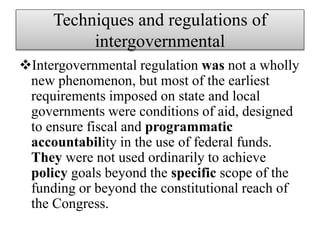
Techniques and regulations of
intergovernmental
Intergovernmental regulation was not a wholly
new phenomenon, but most of the earliest
requirements imposed on state and local
governments were conditions of aid, designed
to ensure fiscal and programmatic
accountability in the use of federal funds.
They were not used ordinarily to achieve
policy goals beyond the specific scope of the
funding or beyond the constitutional reach of
the Congress.
Cont.
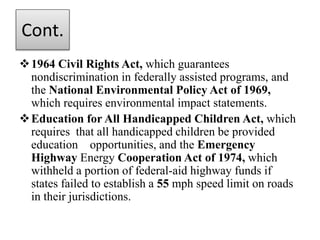
1964 Civil Rights Act, which guarantees
nondiscrimination in federally assisted programs, and
the National Environmental Policy Act of 1969,
which requires environmental impact statements.
Education for All Handicapped Children Act, which
requires that all handicapped children be provided
education opportunities, and the Emergency
Highway Energy Cooperation Act of 1974, which
withheld a portion of federal-aid highway funds if
states failed to establish a 55 mph speed limit on roads
in their jurisdictions.
Cont.
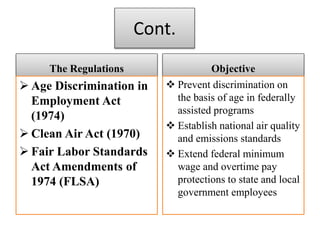
The Regulations
 Age Discrimination in
Employment Act
(1974)
 Clean Air Act (1970)
 Fair Labor Standards
Act Amendments of
1974 (FLSA)
Objective
 Prevent discrimination on
the basis of age in federally
assisted programs
 Establish national air quality
and emissions standards
 Extend federal minimum
wage and overtime pay
protections to state and local
government employees
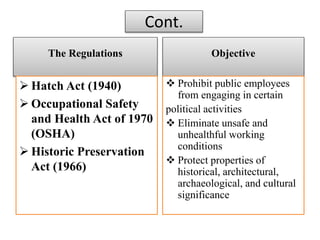
The Regulations
 Hatch Act (1940)
 Occupational Safety
and Health Act of 1970
(OSHA)
 Historic Preservation
Act (1966)
Objective
 Prohibit public employees
from engaging in certain
political activities
 Eliminate unsafe and
unhealthful working
conditions
 Protect properties of
historical, architectural,
archaeological, and cultural
significance
Cont.
Cont.
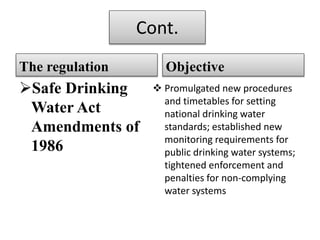
The regulation
Safe Drinking
Water Act
Amendments of
1986
Objective
 Promulgated new procedures
and timetables for setting
national drinking water
standards; established new
monitoring requirements for
public drinking water systems;
tightened enforcement and
penalties for non-complying
water systems
Cont.
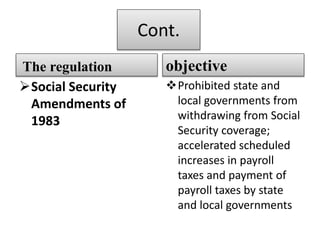
The regulation
Social Security
Amendments of
1983
objective
Prohibited state and
local governments from
withdrawing from Social
Security coverage;
accelerated scheduled
increases in payroll
taxes and payment of
payroll taxes by state
and local governments
Cont.
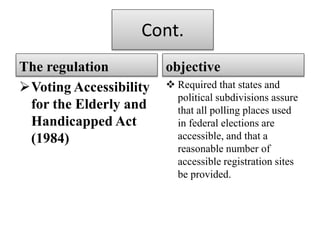
The regulation
Voting Accessibility
for the Elderly and
Handicapped Act
(1984)
objective
 Required that states and
political subdivisions assure
that all polling places used
in federal elections are
accessible, and that a
reasonable number of
accessible registration sites
be provided.
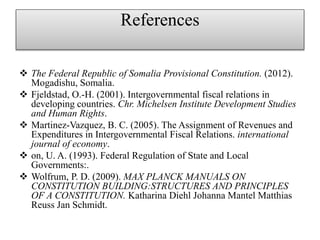
References
 The Federal Republic of Somalia Provisional Constitution. (2012).
Mogadishu, Somalia.
 Fjeldstad, O.-H. (2001). Intergovernmental fiscal relations in
developing countries. Chr. Michelsen Institute Development Studies
and Human Rights.
 Martinez-Vazquez, B. C. (2005). The Assignment of Revenues and
Expenditures in Intergovernmental Fiscal Relations. international
journal of economy.
 on, U. A. (1993). Federal Regulation of State and Local
Governments:.
 Wolfrum, P. D. (2009). MAX PLANCK MANUALS ON
CONSTITUTION BUILDING:STRUCTURES AND PRINCIPLES
OF A CONSTITUTION. Katharina Diehl Johanna Mantel Matthias
Reuss Jan Schmidt.
QUESTIONS
AND
COMMENTS

Group 6

  • 1.
  • 2.
    Intergovernmental Relations IGR Fiscaland Administrative aspects of IGR
  • 3.
    Group (6) 1. AhmedMohamed Afi 2. Abdirahman Abdulkadir Hussein 3. Abdiwakil Ali Raage 4. Mohamed Abdulle Mohamud 5. Mohamed Osman Ali 6. Omar Haji Dirie 7. Safiya Abdi Mohamed
  • 4.
    CONTENTS Introduction Fiscal relations acrosslevels of government Economics of intergovernmental grants Techniques and regulations of intergovernmental Vertical imbalances Horizontal imbalances
  • 5.
    Introduction • Fiscal federalism- the devolution of taxing and spending powers to lower levels of government. • It has become an important theme of governance in many developing countries in recent years. Accordingly, restructuring of governmental functions and finances between the national and lower levels of government has entered the core of the development debate.
  • 6.
    Cont. • intergovernmental fiscalrelations is that sub- national governments need to be given access to adequate resources to do the job with which they are entrusted. At the same time they must also be accountable for what they do with these resources. Moreover, like all public policies, Intergovernmental fiscal policies must take into account both the political constraints facing policy makers, such as the strength of different provinces and groups in political decisions, and economic constraints such as the stage of development of financial markets.
  • 7.
    Definition • Fiscal federalismconsists primarily of devolving revenue sources and expenditure functions to lower tiers of government. • By bringing the government closer to the people, fiscal federalism is expected to boost public sector efficiency, as well as accountability and transparency in service delivery and policy-making.
  • 8.
    • four questionsthat must be answered with respect to intergovernmental functions and finances in any country: (1) Who does what? This question is about assignment of functions between levels of government. (2) Who levies what taxes? This question is about revenue assignment. The four questions
  • 9.
    • (3) Howto resolve the imbalance between the revenues and expenditures of sub- national governments? This question has to do with vertical imbalances between levels of government. • (4) How to adjust for the differences in capacities and needs among different governmental units at the same level of government? This question is about horizontal imbalances or equalization. Cont.
  • 10.
    • A keyissue in intergovernmental fiscal relations is the assignment of functions and finances to different levels of government. This can also be described as the allocation of the authority and responsibility for the public sector decisions among different power centers. • The traditional theory of fiscal federalism identifies three major functions for the public sector: (1)macroeconomic stabilization, (2)income distribution and (3)resource allocation (Oates, 1972 and 1999). Who does what? Assignment of functions between levels of government
  • 11.
    • The twomain instruments of macroeconomic policy are monetary policy and fiscal policy. • Fiscal policy, i.e., control over the amount and structure of taxes and expenditures, and the management of the budget deficit or surplus, is a powerful instrument for stabilizing the economy. • The stabilization function is usually considered to be inherently national in nature, partly because sub- national authorities have few or no incentives to undertake economic stabilization polices. (1)Macroeconomic stabilization
  • 12.
    • lower levelsof government often are very dependent on the national government for finance, it sometimes makes more sense to think of them as part of the national government rather than as independent actors. However, in some federal countries where a substantial share of national revenues are diverted to lower-levels, the existence of several tiers of government may give rise to difficulties in macro- economic management (Bird, 1990). There are two arguments
  • 13.
    • In contrast,studies from other countries, including the United States and Western Europe, conclude that decentralization has not undermined stability (World Bank, 2000). Findings from Canada even suggest that the growth of sub-national budgets has had a stabilizing effect on the economy (Sewell, 1996). This is explained by the observation that the major expenditure responsibilities which often are assigned to larger sub-national governments – such as public funding of health and education – act as automatic stabilizers because they are recurrent and not very flexible. Increased reliance on direct taxes, such as personal income taxes in sub-national financing in some countries has also been found to have stabilizing effects. Cont.
  • 14.
    (2)Income distribution • Asubstantial share of the public finance literature holds that the redistribution of income is primarily a national government concern. Some scholars even argue that attempts by local governments to redress income differences are likely to be unfair (Prud’homme, 1995). • if a jurisdiction adopts policies to redistribute income by imposing high taxes on the rich and giving high benefits to the poor, the rich will tend to ‘vote with their feet’ and leave for more lightly taxed areas, and the poor will move in from areas that tend to offer lower benefits.
  • 15.
    Cont. • some regulatorypolicies allocated to local authorities in many countries, such as land use and rent controls, have profound distributional implications. Public health care, primary education, water supply, housing and public transportation which are assigned to sub- national levels in many countries, also have important re-distributional functions • (Sewell, 1996).
  • 16.
    Resource allocation • Thefiscal federalist model assigns a significant role to sub-national governments in allocating resources. The classic argument provided by the theory of fiscal federalism (Oates, 1972) is that in a democratic society decentralization will result in a better match of supply and demand for local public goods. Being closer to the people, it is claimed, local authorities can more easily identify people’s needs, and thus supply the appropriate form and level of public services (Enemuo, 2000; Rondinelli et al., 1989).
  • 17.
    Fiscal Federalism A decentralizedor federal system of government is not only a mechanism of power sharing between the different levels of government, but also of distributing the public revenues of the country between them. This distribution is necessary in order to enable the different levels to fulfill their respective functions. The fiscal design in decentralized states has to answer to three essential questions:
  • 18.
    Cont. • How arerevenues shared and imbalances between lower levels equalized (intergovernmental transfers)? • Which level pays (expenditure responsibility)? • Which level has the command over the revenue sources (revenue-raising responsibility)?
  • 19.
    The assignment ofexpenditure responsibility • The responsibility for expenditure can only be assigned if one has first looked into the question of which level should provide which public services. In this respect, it is argued that resources are spent most efficiently if the level of government that most closely represents the beneficiaries of the public service is responsible for it. • This fosters transparency since citizens recognize more easily who spends their money.
  • 20.
    Cont. • For certainpublic services, such as national defense or foreign affairs, the level that most closely represents the beneficiaries of the service will be the national level. Typical lower level expenditure responsibilities on the other hand include local infrastructures such as police, fire prevention and sanitation. • Another factor determining which level should provide a certain public service is the efficient size of the program: some programs might only function efficiently if provided for the whole country by the national level of government.
  • 21.
    Cont.  Regional preferencesalso affect the question which level should deliver a certain public service. For example, many sub-levels and their respective populations might want primary education to include the teaching of local languages. Here, a nationwide program that defines the curriculum for primary education might not serve them well citizens should have equal access to some public services, regardless of their origin, for reasons of equity. Such programs (e.g. retirement pensions, unemployment benefits, health care, the curriculum of the education) would have to be provided by the national level.
  • 22.
    cont. • The demandfor minimum standards through out the country concerning certain public services (e.g. health, education) might call for national regulation of policy guidelines for the implementation of public service programs at a lower level, but does not require the central administration of these services.
  • 23.
    Cont. • In orderto prevent the expenditure responsibility of the sub-levels from causing economic instability or imbalances, the constitution should confer the responsibility for expenditures that have a particularly strong impact on demand or are particularly sensitive to changes in the economic cycle (such as unemployment benefits) to the national government.
  • 24.
    Provisional Constitution Article122. Principles of Public Finance The Principles of public finance will be discussed between the Federal Government and Federal Member State in accordance with the Constitution.
  • 25.
    The assignment ofrevenue-raising responsibility Constitutional provisions that assign all or most taxing powers to local or sub-units‘ governments would deprive the national government of tax instruments for macro-economic management and hinder it in redistributive policies. For these reasons, it is usually recommended that each level of government be provided with its own sources of revenue, and, additionally, that intergovernmental transfers be used to overcome the remaining gaps between the revenue sources assigned to a certain level and its expenditure responsibilities.
  • 26.
    Cont.  Two principlesshould guide constitutional provisions that assign revenues to sub-national governments: (1) The revenues assigned to the sub-national governments should suffice for at least the richest sub- national government to finance all locally provided services that primarily benefit local residents from its own resources. • (2) The sub-national revenues should be collected from local residents and should be related to the benefits they receive from local services.
  • 27.
    Cont. Taxes with thefollowing characteristics should be assigned to the national government because sub- level competences in these fields typically cause economic imbalances between the sub- national governments of a federal state. I. Taxes levied on the more mobile tax bases, such as income taxes on enterprises: The latter may easily move from one state to another in order to avoid the heavier tax load in the first state.
  • 28.
    Cont. II. Taxes thatare especially sensitive to changes in income, such as income tax on individuals: This is to provide the federal government as the protector of the federal state with economic stabilization instruments and to shelter the sub- national governments from fluctuations in their income base.
  • 29.
    CONT. III. Taxes thatare levied on tax bases that are distributed unevenly across regions, such as taxes on natural resources: By assigning this type of taxes to the national government, one avoids that sub- national levels differ greatly in income and thereby in their standards of living. On the other hand, where the exploitation of natural resources causes damage to the environment of the state of origin, much can be said for a sharing of revenues between the national government and that state.
  • 30.
    Cost recovery throughuser charges • Taxes are not the best mechanism to obtain a better relation between demand and supply of public services. Better links can be achieved through cost-recovery charging systems. • In some countries, including South Africa, charges on trading services such as electricity, water, sanitation and solid waste, are the major sources of urban and metropolitan revenues.
  • 31.
    vertical imbalances • Thegeneral nature of intergovernmental fiscal relations is surprisingly similar across a wide range of countries. Almost without exception countries assign more expenditure functions to sub-national governments than can be financed from the revenue sources allocated to those governments. The result of this mismatching of functions and finances – often referred to as ‘vertical imbalances’ - is that sub- national governments are generally dependent upon transfers from higher levels of government. Thus, Bird (1990) argues that ‘money is at the heart of intergovernmental matters.
  • 32.
    horizontal imbalances The problemof ‘horizontal balance’ has to do with the fact that geographical areas usually differ with respect to resource capacity and needs. For instance, the tax base per capita often differ substantially between urban municipalities and district councils. Furthermore, the needs for public services may differ because some areas, for example, have a higher percentage of school children and/or elderly people than others (Wolman, 1990). Designing fiscal institutions to cope with this complex reality is often problematic, and may be further exacerbated by political imperatives of treating even the most unequal jurisdictions uniformly, and by historically rooted conflicts and rivalries between regions and population groups (Bird, 1990).
  • 33.
    Cont. Whether fiscal decentralizationaggravates income differences among sub-national jurisdictions or becomes a positive force in efforts to alleviate poverty depends on two factors (World Bank,2000:110): The first is horizontal equity, which is the extent to which sub-national governments have the fiscal capacity to deliver an equivalent level of services to their population. The second can be described as within-state equity, which is the ability or willingness of sub-national governments to improve income distribution within their borders.
  • 34.
    Economics of intergovernmentalgrants • Macroeconomic stabilization studies from other countries, including the United States and Western Europe, conclude that decentralization has not undermined stability (World Bank, 2000). Findings from Canada even suggest that the growth of sub-national budgets has had a stabilizing effect on the economy (Sewell, 1996). This is explained by the observation that the major expenditure responsibilities which often are assigned to larger sub-national governments – such as public funding of health and education – act as automatic stabilizers because they are recurrent and not very flexible. Increased reliance on direct taxes, such as personal income taxes in sub-national financing in some countries has also been found to have stabilizing effects
  • 35.
    Intergovernmental transfers (grants) Grantsare intergovernmental transfers from higher to lower levels of government, especially from the national level to the state level. I. Conditional grants II. Unconditional grants III. Equalization grants IV. Special grants
  • 36.
    Techniques and regulationsof intergovernmental Intergovernmental regulation was not a wholly new phenomenon, but most of the earliest requirements imposed on state and local governments were conditions of aid, designed to ensure fiscal and programmatic accountability in the use of federal funds. They were not used ordinarily to achieve policy goals beyond the specific scope of the funding or beyond the constitutional reach of the Congress.
  • 37.
    Cont. 1964 Civil RightsAct, which guarantees nondiscrimination in federally assisted programs, and the National Environmental Policy Act of 1969, which requires environmental impact statements. Education for All Handicapped Children Act, which requires that all handicapped children be provided education opportunities, and the Emergency Highway Energy Cooperation Act of 1974, which withheld a portion of federal-aid highway funds if states failed to establish a 55 mph speed limit on roads in their jurisdictions.
  • 38.
    Cont. The Regulations  AgeDiscrimination in Employment Act (1974)  Clean Air Act (1970)  Fair Labor Standards Act Amendments of 1974 (FLSA) Objective  Prevent discrimination on the basis of age in federally assisted programs  Establish national air quality and emissions standards  Extend federal minimum wage and overtime pay protections to state and local government employees
  • 39.
    The Regulations  HatchAct (1940)  Occupational Safety and Health Act of 1970 (OSHA)  Historic Preservation Act (1966) Objective  Prohibit public employees from engaging in certain political activities  Eliminate unsafe and unhealthful working conditions  Protect properties of historical, architectural, archaeological, and cultural significance Cont.
  • 40.
    Cont. The regulation Safe Drinking WaterAct Amendments of 1986 Objective  Promulgated new procedures and timetables for setting national drinking water standards; established new monitoring requirements for public drinking water systems; tightened enforcement and penalties for non-complying water systems
  • 41.
    Cont. The regulation Social Security Amendmentsof 1983 objective Prohibited state and local governments from withdrawing from Social Security coverage; accelerated scheduled increases in payroll taxes and payment of payroll taxes by state and local governments
  • 42.
    Cont. The regulation Voting Accessibility forthe Elderly and Handicapped Act (1984) objective  Required that states and political subdivisions assure that all polling places used in federal elections are accessible, and that a reasonable number of accessible registration sites be provided.
  • 43.
    References  The FederalRepublic of Somalia Provisional Constitution. (2012). Mogadishu, Somalia.  Fjeldstad, O.-H. (2001). Intergovernmental fiscal relations in developing countries. Chr. Michelsen Institute Development Studies and Human Rights.  Martinez-Vazquez, B. C. (2005). The Assignment of Revenues and Expenditures in Intergovernmental Fiscal Relations. international journal of economy.  on, U. A. (1993). Federal Regulation of State and Local Governments:.  Wolfrum, P. D. (2009). MAX PLANCK MANUALS ON CONSTITUTION BUILDING:STRUCTURES AND PRINCIPLES OF A CONSTITUTION. Katharina Diehl Johanna Mantel Matthias Reuss Jan Schmidt.
  • 44.