© 2015 Contact Solutions.1
Confidential and proprietary.
IMPROVING CONSTITUENT
ENGAGEMENT
David Scott
Sr. Director,
Government Sales
dscott@contactsolutions.com
© 2015 Contact Solutions.2
Confidential and proprietary. 2
Providing Constituent Engagement Insights
© 2015 Contact Solutions.3
Confidential and proprietary.
Program Coverage
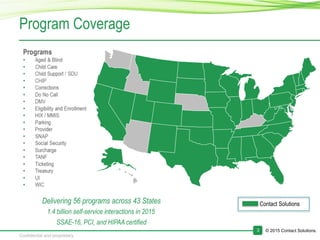
Delivering 56 programs across 43 States
SSAE-16, PCI, and HIPAA certified
1.4 billion self-service interactions in 2015
Contact Solutions
© 2015 Contact Solutions.4
Confidential and proprietary.
Government Program Functions
• Address, dependent
verifications
• Appointments
• Application status
• Authentication
• Beneficiary information,
inquiries
• Bill processing
• Case worker requests
• Claims/cases
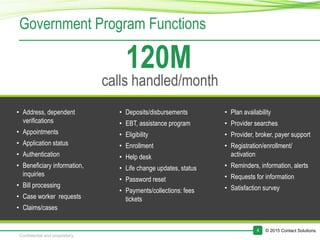
calls handled/month
120M
• Deposits/disbursements
• EBT, assistance program
• Eligibility
• Enrollment
• Help desk
• Life change updates, status
• Password reset
• Payments/collections: fees
tickets
• Plan availability
• Provider searches
• Provider, broker, payer support
• Registration/enrollment/
activation
• Reminders, information, alerts
• Requests for information
• Satisfaction survey
© 2015 Contact Solutions.5
Confidential and proprietary.
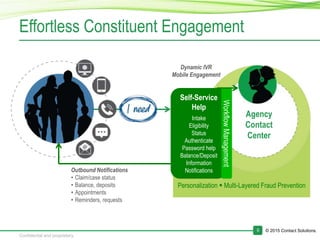
Effortless Constituent Engagement
Personalization  Multi-Layered Fraud Prevention
Dynamic IVR
Mobile Engagement
Outbound Notifications
• Claim/case status
• Balance, deposits
• Appointments
• Reminders, requests
Agency
Contact
Center
Cost-savings
Self-Service
Help
Intake
Eligibility
Status
Authenticate
Password help
Balance/Deposit
Information
Notifications
WorkflowManagement
© 2015 Contact Solutions.6
Confidential and proprietary.
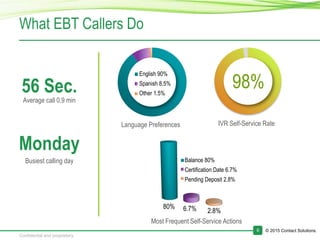
What EBT Callers Do
98%
IVR Self-Service Rate
Monday
Busiest calling day
56 Sec.
Average call 0.9 min
English 90%
Spanish 8.5%
Other 1.5%
80% 6.7% 2.8%
Balance 80%
Certification Date 6.7%
Pending Deposit 2.8%
Most Frequent Self-Service Actions
Language Preferences
© 2015 Contact Solutions.7
Confidential and proprietary.
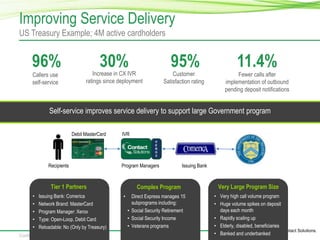
Improving Service Delivery
US Treasury Example; 4M active cardholders
IVR
Program ManagersRecipients Issuing Bank
Self-service improves service delivery to support large Government program
• Issuing Bank: Comerica
• Network Brand: MasterCard
• Program Manager: Xerox
• Type: Open-Loop, Debit Card
• Reloadable: No (Only by Treasury)
Tier 1 Partners
• Very high call volume program
• Huge volume spikes on deposit
days each month
• Rapidly scaling up
• Elderly, disabled, beneficiaries
• Banked and underbanked
Very Large Program Size
• Direct Express manages 15
subprograms including:
• Social Security Retirement
• Social Security Income
• Veterans programs
Complex Program
Debit MasterCard
Callers use
self-service
96% Increase in CX IVR
ratings since deployment
30%
Customer
Satisfaction rating
95%
Fewer calls after
implementation of outbound
pending deposit notifications
11.4%
© 2015 Contact Solutions.8
Confidential and proprietary.
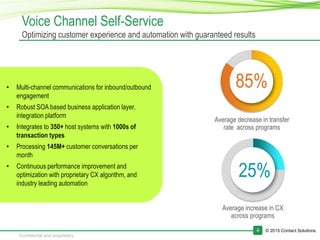
Voice Channel Self-Service
Optimizing customer experience and automation with guaranteed results
• Multi-channel communications for inbound/outbound
engagement
• Robust SOA based business application layer,
integration platform
• Integrates to 350+ host systems with 1000s of
transaction types
• Processing 145M+ customer conversations per
month
• Continuous performance improvement and
optimization with proprietary CX algorithm, and
industry leading automation
85%
Average decrease in transfer
rate across programs
Average increase in CX
across programs
25%
© 2015 Contact Solutions.9
Confidential and proprietary.
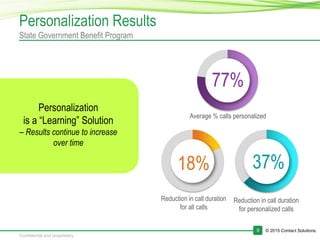
Personalization Results
State Government Benefit Program
18%
Reduction in call duration
for all calls
Reduction in call duration
for personalized calls
77%
Average % calls personalized
37%
Personalization
is a “Learning” Solution
– Results continue to increase
over time
© 2015 Contact Solutions.10
Confidential and proprietary.
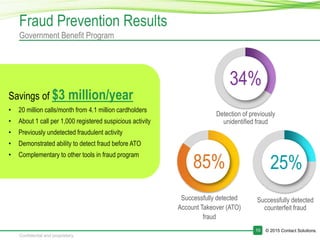
Fraud Prevention Results
Government Benefit Program
Savings of $3 million/year
• 20 million calls/month from 4.1 million cardholders
• About 1 call per 1,000 registered suspicious activity
• Previously undetected fraudulent activity
• Demonstrated ability to detect fraud before ATO
• Complementary to other tools in fraud program
85%
Successfully detected
Account Takeover (ATO)
fraud
Successfully detected
counterfeit fraud
34%
Detection of previously
unidentified fraud
25%
© 2015 Contact Solutions.11
Confidential and proprietary.
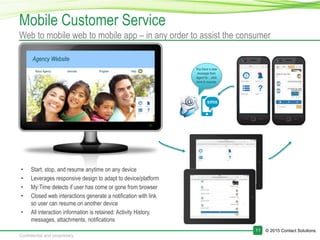
Mobile Customer Service
Web to mobile web to mobile app – in any order to assist the consumer
• Start, stop, and resume anytime on any device
• Leverages responsive design to adapt to device/platform
• My:Time detects if user has come or gone from browser
• Closed web interactions generate a notification with link
so user can resume on another device
• All interaction information is retained: Activity History,
messages, attachments, notifications
You have a new
message from
Agent for…click
here to resume
Agency Website
About Agency Services Program Help
© 2015 Contact Solutions.12
Confidential and proprietary.
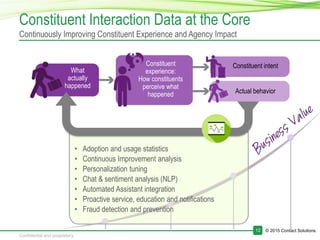
• Adoption and usage statistics
• Continuous Improvement analysis
• Personalization tuning
• Chat & sentiment analysis (NLP)
• Automated Assistant integration
• Proactive service, education and notifications
• Fraud detection and prevention
Constituent Interaction Data at the Core
Continuously Improving Constituent Experience and Agency Impact
What
actually
happened
Constituent
experience:
How constituents
perceive what
happened
Constituent intent
Actual behavior
© 2015 Contact Solutions.13
Confidential and proprietary.
Questions David Scott
Sr. Director,
Government Sales
Contact Solutions
dscott@contactsolutions.com

Improving Constituent Engagement

  • 1.
    © 2015 ContactSolutions.1 Confidential and proprietary. IMPROVING CONSTITUENT ENGAGEMENT David Scott Sr. Director, Government Sales dscott@contactsolutions.com
  • 2.
    © 2015 ContactSolutions.2 Confidential and proprietary. 2 Providing Constituent Engagement Insights
  • 3.
    © 2015 ContactSolutions.3 Confidential and proprietary. Program Coverage Delivering 56 programs across 43 States SSAE-16, PCI, and HIPAA certified 1.4 billion self-service interactions in 2015 Contact Solutions
  • 4.
    © 2015 ContactSolutions.4 Confidential and proprietary. Government Program Functions • Address, dependent verifications • Appointments • Application status • Authentication • Beneficiary information, inquiries • Bill processing • Case worker requests • Claims/cases calls handled/month 120M • Deposits/disbursements • EBT, assistance program • Eligibility • Enrollment • Help desk • Life change updates, status • Password reset • Payments/collections: fees tickets • Plan availability • Provider searches • Provider, broker, payer support • Registration/enrollment/ activation • Reminders, information, alerts • Requests for information • Satisfaction survey
  • 5.
    © 2015 ContactSolutions.5 Confidential and proprietary. Effortless Constituent Engagement Personalization  Multi-Layered Fraud Prevention Dynamic IVR Mobile Engagement Outbound Notifications • Claim/case status • Balance, deposits • Appointments • Reminders, requests Agency Contact Center Cost-savings Self-Service Help Intake Eligibility Status Authenticate Password help Balance/Deposit Information Notifications WorkflowManagement
  • 6.
    © 2015 ContactSolutions.6 Confidential and proprietary. What EBT Callers Do 98% IVR Self-Service Rate Monday Busiest calling day 56 Sec. Average call 0.9 min English 90% Spanish 8.5% Other 1.5% 80% 6.7% 2.8% Balance 80% Certification Date 6.7% Pending Deposit 2.8% Most Frequent Self-Service Actions Language Preferences
  • 7.
    © 2015 ContactSolutions.7 Confidential and proprietary. Improving Service Delivery US Treasury Example; 4M active cardholders IVR Program ManagersRecipients Issuing Bank Self-service improves service delivery to support large Government program • Issuing Bank: Comerica • Network Brand: MasterCard • Program Manager: Xerox • Type: Open-Loop, Debit Card • Reloadable: No (Only by Treasury) Tier 1 Partners • Very high call volume program • Huge volume spikes on deposit days each month • Rapidly scaling up • Elderly, disabled, beneficiaries • Banked and underbanked Very Large Program Size • Direct Express manages 15 subprograms including: • Social Security Retirement • Social Security Income • Veterans programs Complex Program Debit MasterCard Callers use self-service 96% Increase in CX IVR ratings since deployment 30% Customer Satisfaction rating 95% Fewer calls after implementation of outbound pending deposit notifications 11.4%
  • 8.
    © 2015 ContactSolutions.8 Confidential and proprietary. Voice Channel Self-Service Optimizing customer experience and automation with guaranteed results • Multi-channel communications for inbound/outbound engagement • Robust SOA based business application layer, integration platform • Integrates to 350+ host systems with 1000s of transaction types • Processing 145M+ customer conversations per month • Continuous performance improvement and optimization with proprietary CX algorithm, and industry leading automation 85% Average decrease in transfer rate across programs Average increase in CX across programs 25%
  • 9.
    © 2015 ContactSolutions.9 Confidential and proprietary. Personalization Results State Government Benefit Program 18% Reduction in call duration for all calls Reduction in call duration for personalized calls 77% Average % calls personalized 37% Personalization is a “Learning” Solution – Results continue to increase over time
  • 10.
    © 2015 ContactSolutions.10 Confidential and proprietary. Fraud Prevention Results Government Benefit Program Savings of $3 million/year • 20 million calls/month from 4.1 million cardholders • About 1 call per 1,000 registered suspicious activity • Previously undetected fraudulent activity • Demonstrated ability to detect fraud before ATO • Complementary to other tools in fraud program 85% Successfully detected Account Takeover (ATO) fraud Successfully detected counterfeit fraud 34% Detection of previously unidentified fraud 25%
  • 11.
    © 2015 ContactSolutions.11 Confidential and proprietary. Mobile Customer Service Web to mobile web to mobile app – in any order to assist the consumer • Start, stop, and resume anytime on any device • Leverages responsive design to adapt to device/platform • My:Time detects if user has come or gone from browser • Closed web interactions generate a notification with link so user can resume on another device • All interaction information is retained: Activity History, messages, attachments, notifications You have a new message from Agent for…click here to resume Agency Website About Agency Services Program Help
  • 12.
    © 2015 ContactSolutions.12 Confidential and proprietary. • Adoption and usage statistics • Continuous Improvement analysis • Personalization tuning • Chat & sentiment analysis (NLP) • Automated Assistant integration • Proactive service, education and notifications • Fraud detection and prevention Constituent Interaction Data at the Core Continuously Improving Constituent Experience and Agency Impact What actually happened Constituent experience: How constituents perceive what happened Constituent intent Actual behavior
  • 13.
    © 2015 ContactSolutions.13 Confidential and proprietary. Questions David Scott Sr. Director, Government Sales Contact Solutions dscott@contactsolutions.com

Editor's Notes

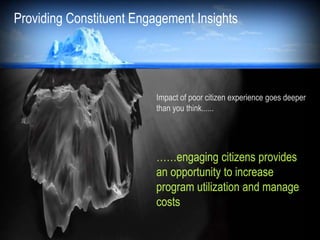
  • #2 Good afternoon everyone. I’m really excited to be here today and have the opportunity to present to you. I’ve been working in the Contact Center space for over 20 years now and for the last 12 years have been focused on the Public sector. I’ve seen a great deal of evolution over that time around ideas and innovations for how Government programs and services can be more easily available to constituents. Constituents are looking for on demand access in the manner they prefer, while you need to meet your budget and program constraints, manage technology and agency demands. This is a tall order, and agencies can’t do it alone. Which is where Contact Solutions comes in to help improve constituent engagement solutions, and its those technical solutions that I’m going to be talking about today.
  • #3 You work hard to provide the highest possible service and information to your constituents. But an outdated or unsupported technology can be your downfall, and you may not even know it. We’ve found that to be the case for some of the programs we support. If an individual struggles to access information from your agency, not only does that impact your agency’s reputation, it makes it harder or can even prevent the citizen and their family in many cases from receiving the services you provide. That’s not a result that anyone wants. Government constituent satisfaction scores have been evaluated to validate these gaps and needs. In a recent survey of over 17,000 individuals across 15 states, McKinsey and Associates found that state government customer service ranked on average 20-40% lower in Citizen customer satisfaction ratings, compared with other everyday services such as ecommerce, doctor’s office, credit card companies, banks, electric company, etc., with many scores in the single digits. That’s on a par with your local Cable company. On the plus side, the survey showed that citizens are looking for three things to make them happier, speed, simplicity and efficiency. http://www.mckinsey.com/insights/public_sector/how_us_state_governments_can_improve_customer_service
  • #4 So, how can we provide insight and help solve this engagement issue with effective solutions? Well, for the last 12 years we’ve been managing self-service interactions from multiple programs across 43 States, including 31 EBT programs.
  • #5 And though there are other methods of interaction, the predominant method is still voice and we have the opportunity to self-serve 120 million constituents a month. Though there are other channels available and mobile is fast approaching, voice is still dominant and we won’t see changes overnight. And you can see that there are a core set of functions that can be utilized by many different government programs. Not only do programs provide responses to similar inquiries but they often serve the same constituent. States are recognizing this and we are seeing this in various guises, such as integrated eligibility programs and ‘one case worker, one family’ models. And it goes further than just entitlement programs. Consider the family serviced by a Corrections Agency. The father is in prison; the mother is in drug rehab; the elder child is in juvenile detention and the younger child is at risk. That family will also most likely be on Medicaid and receiving SNAP. How do we best serve that family?
  • #6 So lets talk about how constituent engagement has been done to date. The call center is front-ended with an IVR and then the call is routed to an agent if the citizen doesn’t get the answer they needed from the IVR. The IVR is seen as a generic technology and the agent provides human or personalized service. But if over 90% of citizens self-serve, is that the correct approach to take? Thinking back to the survey we mentioned early, with sometimes single digit satisfaction scores, where is the best opportunity for citizen engagement? If we need to improve constituent experience and stop fraud, where is the earliest part in the conversation we can start to do that? I really want you to think about that last question because everything I talk about today will be about improved constituent experience and stopping fraud.
  • #7 So, lets talk about what most people do when they call in. Well, we can see from this summary that its both simple and repetitive. Calls are short at under one minute a call. Constituents typically know what they want when they call, and it doesn’t give us much contact time to improve those low satisfaction scores.
  • #8 So, to help gather ideas, one of the things we were able to do was look at other similar programs, such as the US Treasury Social Security Administration program, which is the largest prepaid program, government or commercial, in the U.S. And this program has a very high satisfaction rating at 95%, with 96% of callers using self-service, making it very relevant to EBT applications So, some specific results of note include customer experience ratings in the IVR increasing nearly 12% since deployment of the solution.  High self-service rates (94.54% over hundreds of millions of calls) are a sign that beneficiaries appreciate the ability to quickly and easily self-manage their inquiries. By independently accessing the information they need, recipients save time from having to request help from a live agent, though live agents are in place to serve the recipients who need them. Implementation of outbound pending deposit notifications resulted in 11.4% fewer calls by beneficiaries to verify deposits, and provided faster resolution rates that also decreased the need for call backs, creating an easier and more pleasing user experience. But while this is good, its still very standard, best practice self-service. So lets look at five areas of technology innovation that help move the ball forward in terms of constituent engagement.
  • #9 First of all, lets cover our bases on best of breed IVR practices. If all you do is implement a best in breed IVR and make it constituent friendly, it would improve automation and satisfaction would increase. I was in a State supported call center a few years ago doing agent observations and focus groups. When I asked the agents what they thought of the IVR, one of them told me about a time a customer had mistakenly opted out of the IVR and reached the agent. When the agent answered, the caller was surprised and said they were just using the IVR. The agent told the caller that they could answer their question but the caller asked to be put back in the IVR and said they preferred the service they got from the IVR rather than having to speak to an agent. A best in breed IVR is not just constantly maintained but constantly enhanced. In slide 6 we saw that 80% of all callers were just looking for a balance, so we took that data and implemented a change in our IVRs that immediately played a citizens balance upon authentication. No initial questions or complex menus, just “Hey, four out of five people that call us are looking for a balance, here’s yours, is there anything else you need from us today?” Simple and efficient, exactly what citizens asked for in the McKinsey survey. When implemented correctly, its worth remembering that an IVR is available 24 X 7 and is completely consistent. In other words, it never has a bad day, feels tired or struggles to find an answer. If it knows the answer it will tell you, quickly and accurately. And with how quickly technology evolves, constituents will expect to have their issue solved in an automated fashion more and more and be dissatisfied if they have to speak to a person. I observe many agent calls where the citizen starts out with “I tried to do this in the IVR” or “I was looking for this on your web page.” Constituents want to self-serve, they are primed to self-serve, so lets look at how we take the next leap forward and encourage and support their desire for empowered resolution.
  • #10 Typically, personalization happens when the constituent reaches the call center. Its often seen to start at the CTI stage, also known as ‘screen pop’. In other words, information we have collected about the caller in the IVR is passed to the agent desktop, so the agent is able to see who they are talking to and potentially which option the caller selected, so the agent has an idea what the call is about. But if we are automating 95% or more of EBT calls, that means less than 5% of callers get a personalized experience. Why leave 95% of your constituents in the cold? Personalization means many things in the market; to us it means we can adapt the self service application based on what we know or can gather from the customer. What we know comes from learned customer preferences, and from detected customer behavior. I’m going to introduce you to a concept that could be seen as Next Generation IVR, but our State Clients have coined it Dynamic IVR. So what does our dynamic IVR do? Its personalizes the call for the constituent. At a basic level, it can learn what language a caller selects and default to that language choice. If you always pick English, why play the option for Spanish. As a next step it can streamline authentication. This is the type of personalization we implemented for the State benefit program depicted on this slide. Previously a caller would select their language, then their program type; enter a 16 digit card number followed by a 4 digit PIN. We would track that information and the phone number used for the call. So the device becomes part of a physical security process. After two calls where the caller has correctly gone through the full authentication process, they are streamlined on the third call onwards. We recognize their phone number, know their language and program selection and so just ask for the last 4 digits of their phone number followed by their PIN. It takes a one minute call down to around 40 seconds; that’s a 37% reduction in call duration for personalized calls. What we also found was that we could personalize 77% of all calls. In other words, prior to personalization, 77% of all callers were not getting optimized service. They were adequately being self-serviced, but in order to improve constituent satisfaction we always need to be looking to be providing a quicker and simpler service and this type of dynamic IVR capability meets that. As a further step we then look to track constituent behavior as they continue to interact with the IVR. After they authenticate and receive their balance, if they select an option in the IVR, which one do they typically pick? Let’s reorder the IVR menu based on their preferences. And to take things a step further, we are working with various States on single sign-on initiatives. On slide four we talked about the fact that constituents are typically eligible for multiple State benefits. With single sign-on, a constituent can call a central or specific program phone number. We can authenticate that caller then use that to access integrated or disparate host systems and present the caller not only with information on the program they were inquiring about but also access to information on the other programs they have. Creating efficient personalized access to multiple constituent programs is excellent customer engagement As with all of our innovations, improved customer experience, and meeting high expectations for personalization in a sustainable way that lowers cost for the State. And in the process, we create a substantial amount of data that can be used to further optimize the application, and to combine with other constituent journey data, that I will talk about a little later.
  • #11 We’ve talked about the fact that around 95% of constituents are handled in the IVR. So if the IVR is where the bulk of your interactions are, its also an area that fraudsters can be found, and is somewhere we need to focus our fraud detection efforts. If we know where fraud is occurring, we can build a strategy around how we manage that fraud. We have always played a strong role in our customers fraud programs, where citizens receive a card with their benefits. The IVR is used by fraud rings for probing account information, eventually using stolen identity information to create counterfeit cards, or takeover accounts. An IVR fraud solution uses the same underlying real time analytics as personalization. So we detect fraudsters before they get to the agent, and before fraud is detectable by the payment processor. Call center fraud cost consumers $24.7 billion in 2012 alone, according to Bureau of Justice Statistics. That’s more than all other property crimes combined.   Our fraud offerings are based on successful prevention results from billions of interactions comprised of real-time caller analysis, detection, and intervention practices we support for government programs. The ability to now deliver multi-layered fraud prevention in the IVR makes it easier for both constituents and agents.   We conducted our own in-house analysis of sample data from several million IVR calls and it revealed some interesting results. On average one in every 360 calls we handled in the IVR were fraudulent, with each fraudster on average making 79 calls per month. I know it may sound obvious once its highlighted, but there are probably very few constituents who genuinely need to make 79 calls a month. An alarming 25% of those fraudulent calls led to successful compromise of an account. These criminals are very successful at what they do. Results from this IVR authentication and prevention analysis highlighted that fraudsters exploit compromised consumer identification information repeatedly, across multiple government programs.   To combat this we developed a suite of IVR based fraud tools. The first is Red Flag Detection. This utilizes IVR data to detect suspicious behavior, define recommendations, and take appropriate action. Using reputation, velocity, and behavioral data, we can provide valuable information to help States identify callers or accounts who require special action or to create custom blacklists. (can you explain reputation, velocity and behavioral data in more detail with examples)   We also use Automated ANI Verifications. This combines the powerful blacklist Phone Reputation Service (PRS) with dynamic, real-time call flow modifications in the IVR. PRS helps detect known fraudsters right away with ANI phone number verification and scoring, and the Adaptive IVR takes real-time action in the call flow to disposition calls according to your policies; stopping fraud and nuisance without additional burden on the contact center. (can you give an example of this)   Finally we have Automated Knowledge-Based Authentication. This verifies callers through a series of dynamically generated out-of-wallet questions derived from public information sources. The questions are non-credit based, making it easier to pass legitimate callers, and they do not require States to have an established relationship with the caller to evaluate the answers. Responses are verified in real-time to instantly authenticate the caller and disposition the call. (can you give an example of some of the questions that could be asked) In this slide we can see the results of implementing some of these solutions in a government benefit program. Firstly, we found 34% more fraud occurring in the program than could previously be detected. That represented over $3 million of unidentified fraud that the program could now tackle and save. We were also able to identify 85% of all attempted Account Takeover Fraud within the IVR. This is all in addition to other fraud activities the program conducts on a regular basis. Moving identification and tackling of fraud into the initial point of contact in the IVR also frees up resources within the program’s fraud team. Now we talked earlier about the same constituent being entitled to and using more that one government benefit program. This is also something we have seen from a fraud element. The same fraudster may try to access other non EBT benefits across multiple programs. In EBT programs we often get better initial indicators of a phone number being used for fraudulent access because of the volume of calls that are made. We can then check that number and caller behavior across other government programs and see how the fraud is being perpetuated. Being able to spot EBT fraud is a great initial alarm on fraud across program types. (Can you provide me some data on when you tracked fraud phone numbers across multiple programs) The combination of these tools provides multi-layer authentication, account access restriction after too many unsuccessful authentication attempts, and outbound notifications of transactions to constituents to help them detect when their account may have been compromised. Just as important, it also enables you to adapt and respond to changes in fraud patterns as criminals continually trial new ways to access accounts.  
  • #12 Mobility has permeated our way of life. In fact, according to Forbes, over 91% of people are within arm’s reach of their mobile phone around the clock. This is increasingly evident, for example, with the Millennial generation where 87% of Millennials say that their smart phone never leaves their side, and 80% say that the first thing they do in the morning is reach for their smart phone. This has created a trend and preference to move past more traditional customer service channels, with the desire to use their mobile devices for just about everything. To keep pace with the customer service needs of constituents, Contact Solutions developed a wide array of best-in-class, innovative, convenient, and secure self-service and agent chat interaction options. We recognized that just like an IVR, where constituents expect to have a simple path to live agent support, the same applies to mobility. To provide a better mobile experience and encourage adoption, citizens need a seamless way to connect with agents from a mobile application and that is the area we have addressed.   We built a product called My:Time. My:Time is a complete mobile engagement solution that supports agent and constituent needs. It is different than simple mobile applications because it personalizes the mobile experience in context of where, when, and how the user wants to interact. It is a safe, convenient, and easy way for constituents to access information and reach customer service through their mobile device. Constituents can access self-service options to manage most of their issues, and when they need to engage with an agent they can quickly start a chat with customer service representatives from within the app. My:Time gives constituents ultimate control of their customer service experience, including the time, pace, and mode of communication, all so they can better manage their interactions in a secure, convenient environment while on the go.   People who have used My:Time for self-service or agent chat interactions have found it an easier way to interact and solve their issues. We received some interesting feedback from various populations. With one elderly population, callers asked how to download My:Time, stating the mobile app interaction options were better than other ways to reach customer service. These elderly individuals disliked waiting on hold on the phone. Feedback from customers with hearing impairment, via relay calls through a third party, found that individuals who normally use relay calls prefer My:Time because it makes it easier to manage their account at their own pace, without worrying about phone communication. So let me go through some of the functionality that enables constituent engagement on a mobile device. Firstly we have what we call App2Agent™ Functionality. This seamlessly and immediately transfers the cardholder and associated data from an automated mobile app to a live agent. And it provides the ability to use all the native features of the phone and interaction methods from within the phone, including; chat, audio files, pictures and in-application calling. The agents can manage these interactions through a Full-featured Agent Desktop Portal. My:Time provides agents and their supervisors with a comprehensive view of current and past customer service interactions right on the desktop or can integrate into the existing chat capabilities with any standard CRM you may use. Probably one of the most exciting and constituent friendly aspects of the mobile solution is Start-Stop-Resume™ Functionality. This empowers constituents with the ability to start an interaction, stop for any reason, and resume from exactly where they left off with no loss of data; stay engaged throughout the service resolution; or start over. It also enables agents to efficiently manage multiple interactions at any time, and over time, without having constituents repeat themselves to restart their discussion. So for example, a constituent may access the mobile application during a short work break to check their EBT balance, but then notice there is some type of issue. They can start the chat interaction with the agent directly in the mobile application, but then stop at any time to return to work. When they get another break or finish work, they can open the application and resume exactly where they left off. They don’t have to repeat any information and any agent can continue with the issue resolution. If an issue requires some time to resolve, notifications are used. This again means the constituent can carry on with their life, instead of waiting on hold or having to call someone back. When the issue is resolved or a status updated, a proactive notification is sent to the constituent. Agencies can now create a persistent, cohesive mobile customer experience that traverses their website, mobile website, and mobile app, in any order or combination, ensuring meaningful engagement follows constituents throughout the lifecycle of interactions they have with the agency.   An engaging government experience is important to everyone. Like all support we receive as constituents and consumers, we want our interactions more convenient, mobile, and flexible to complete – and so do the constituents that you serve. In our digital world, that means engaging with your constituents in a way that meets their digital preferences and mobile lifestyle that increasingly revolve around smartphones and other handheld devices, while taking into account the data behind the interactions to best meet the needs of these constituents before, during, and after they interact with your agency’s programs. For a more in-depth review of what to expect from mobile solutions and to see a demo, my colleague Sameer Siddiqui will be presenting tomorrow morning at 10:30am in Breakout session 7.
  • #13 Constituent contact center interactions, especially self-service transactions, generate massive amounts of data that can help meet constituent needs and navigate the risks of fraud, but only if access to the data is easily and effectively delivered to meet your flexible needs. A Business Intelligence Gateway is a cloud-based analytics tool that offers greater visibility to customer self-service intelligence across interactions, helping you more effectively and accurately monitor performance, assess and improve constituent experience, and identify cost savings opportunities.   Business Intelligence enables a view and understanding of constituent activity, preferences, and program metrics within a specific program, and across multiple programs, to help States better meet the needs of its constituents. Key aspects of a Business Intelligence Gateway include precise reporting and analytics; flexible, dimensional data that can be “sliced and diced”; and a deeper understanding of constituent intent, behavior, and experience.   And I’d like to leave you with this thought. We’ve been doing this for 12 years and have been collecting over 1.2 billion transactions annually. If you think about Big Data and mining that data, there’s a lot of information there. What are constituents doing?, and how can you use that data to implement self-service best practices, provide a dynamic IVR experience, protect citizens and the State from Fraud, service your constituents across all emerging channels, such as mobility, all while continuously improving constituent engagement. I hope I’ve been able to give you some insight and ideas into how innovative self-service technologies can compliment your engagement strategies.