Improv and Discussion
exercises (for Testers)
STC Meetup Cambridge 08/09/2015
by Karo Stoltzenburg | @karostol | LinkedIn
How come?
A Tester can make really good use of …
● excellent communication and collaboration skills
● thinking outside the box
● a creative mindset
● flexibility and ability to adapt
● taking in different angles, viewpoints
● empathy, putting oneself in somebody else’s shoes
Now what?
These are rather soft skills ….
how can we train them?
Exercises, everywhere
● Puzzles (‘Spot the Difference’, Situation Puzzles, Logic
Puzzles)
● Improv activities and Improv games
● Lateral Thinking and problem solving strategies
● Testing Challenges / Software Testing Exercises
… train different skills, both in individual and group exercise.
Let’s look at Lateral Thinking and Improv in more detail.
Lateral Thinking
● Term coined by Edward de Bono (1967)
● basic focus is on solving problems
● in an unconventional, creative way
● by applying certain strategies, methods, techniques
● e.g. the group discussion technique:
‘Six Thinking Hats’
Six Thinking Hats: What for?
● Look at problems from a variety of angles
● Challenge and explore your brain’s distinct thinking
directions
● Get some inspiration on thinking tactics
● Collaborate within the group
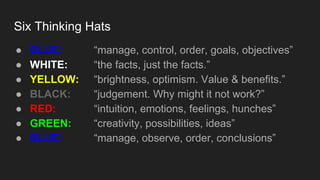
Six Thinking Hats
● BLUE: “manage, control, order, goals, objectives”
● WHITE: “the facts, just the facts.”
● YELLOW: “brightness, optimism. Value & benefits.”
● BLACK: “judgement. Why might it not work?”
● RED: “intuition, emotions, feelings, hunches”
● GREEN: “creativity, possibilities, ideas”
● BLUE: “manage, observe, order, conclusions”
Applying the ‘Six Thinking Hats’ exercise
● Group discussion exercise
● Six different flavors (“hats”) of distinct thinking directions
● Select a topic
● All discuss applying one thinking flavor at a time
● Time boxed
● You’re done when you have applied all flavors
Improv exercises: What for?
● Focus on being in the moment, awareness
● Train listening and communication skills
● Train storytelling, empathy, imagination
● Collaborate within the group
● Equal out individual dynamics in groups
● Create possibilities without fear of failing
● “Improv is innovation”
Improv exercise (I): “Yes, and ….”
● Tell a affirmative story, as group.
● First person starts with a sentence, and all following add
on to it applying “Yes, and …” to bring the story forward:
○ A: “Once upon a time, there was a castle.”
○ B: “Yes, and the castle was on a mountain.”
○ C: “Yes, and from the mountain you had a great view.”
● … and so forth. Up until a shiny story is told.
● Key is to collaborate, engage in the story
Improv exercise (II): “Conducted Story”
● Tell a coherent story, as group.
● One Person starts, and halts mid-word where the next
person picks it up, seemingly seamlessly.
○ A: “Once upon a time in the We--”
○ B: “--lington region, there was a big, loud cr----”
○ C: “--adle of filth concert taking place ar---”
● … and so forth. Up until a story is told.
● Listening is key. Engage, accept and go with the flow.
Some key points
● There is no winner in (improv) exercises
● Enjoy the feeling of exercising your brain
● Enjoy thinking outside the box, going crazy
● Are not afraid to fail
● If you are stuck, feel free to say “pass”
● Don’t ponder, engage
Thanks!
● Any questions?
● Interested in trying it out?
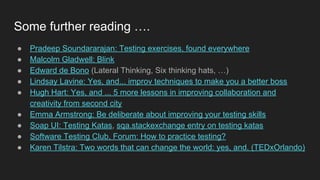
Some further reading ….
● Pradeep Soundararajan: Testing exercises, found everywhere
● Malcolm Gladwell: Blink
● Edward de Bono (Lateral Thinking, Six thinking hats, …)
● Lindsay Lavine: Yes, and... improv techniques to make you a better boss
● Hugh Hart: Yes, and ... 5 more lessons in improving collaboration and
creativity from second city
● Emma Armstrong: Be deliberate about improving your testing skills
● Soap UI: Testing Katas, sqa.stackexchange entry on testing katas
● Software Testing Club, Forum: How to practice testing?
● Karen Tilstra: Two words that can change the world: yes, and. (TEDxOrlando)
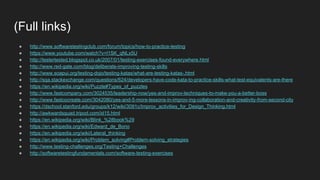
(Full links)
● http://www.softwaretestingclub.com/forum/topics/how-to-practice-testing
● https://www.youtube.com/watch?v=l1SK_qNLx5U
● http://testertested.blogspot.co.uk/2007/01/testing-exercises-found-everywhere.html
● http://www.red-gate.com/blog/deliberate-improving-testing-skills
● http://www.soapui.org/testing-dojo/testing-katas/what-are-testing-katas-.html
● http://sqa.stackexchange.com/questions/624/developers-have-code-kata-to-practice-skills-what-test-equivalents-are-there
● https://en.wikipedia.org/wiki/Puzzle#Types_of_puzzles
● http://www.fastcompany.com/3024535/leadership-now/yes-and-improv-techniques-to-make-you-a-better-boss
● http://www.fastcocreate.com/3042080/yes-and-5-more-lessons-in-improv-ing-collaboration-and-creativity-from-second-city
● https://dschool.stanford.edu/groups/k12/wiki/3091c/Improv_activities_for_Design_Thinking.html
● http://awkwardsquad.tripod.com/id15.html
● https://en.wikipedia.org/wiki/Blink_%28book%29
● https://en.wikipedia.org/wiki/Edward_de_Bono
● https://en.wikipedia.org/wiki/Lateral_thinking
● https://en.wikipedia.org/wiki/Problem_solving#Problem-solving_strategies
● http://www.testing-challenges.org/Testing+Challenges
● http://softwaretestingfundamentals.com/software-testing-exercises

Improv and discussion exercises (for testers)

  • 1.
    Improv and Discussion exercises(for Testers) STC Meetup Cambridge 08/09/2015 by Karo Stoltzenburg | @karostol | LinkedIn
  • 2.
    How come? A Testercan make really good use of … ● excellent communication and collaboration skills ● thinking outside the box ● a creative mindset ● flexibility and ability to adapt ● taking in different angles, viewpoints ● empathy, putting oneself in somebody else’s shoes
  • 3.
    Now what? These arerather soft skills …. how can we train them?
  • 4.
    Exercises, everywhere ● Puzzles(‘Spot the Difference’, Situation Puzzles, Logic Puzzles) ● Improv activities and Improv games ● Lateral Thinking and problem solving strategies ● Testing Challenges / Software Testing Exercises … train different skills, both in individual and group exercise. Let’s look at Lateral Thinking and Improv in more detail.
  • 5.
    Lateral Thinking ● Termcoined by Edward de Bono (1967) ● basic focus is on solving problems ● in an unconventional, creative way ● by applying certain strategies, methods, techniques ● e.g. the group discussion technique: ‘Six Thinking Hats’
  • 6.
    Six Thinking Hats:What for? ● Look at problems from a variety of angles ● Challenge and explore your brain’s distinct thinking directions ● Get some inspiration on thinking tactics ● Collaborate within the group
  • 7.
    Six Thinking Hats ●BLUE: “manage, control, order, goals, objectives” ● WHITE: “the facts, just the facts.” ● YELLOW: “brightness, optimism. Value & benefits.” ● BLACK: “judgement. Why might it not work?” ● RED: “intuition, emotions, feelings, hunches” ● GREEN: “creativity, possibilities, ideas” ● BLUE: “manage, observe, order, conclusions”
  • 8.
    Applying the ‘SixThinking Hats’ exercise ● Group discussion exercise ● Six different flavors (“hats”) of distinct thinking directions ● Select a topic ● All discuss applying one thinking flavor at a time ● Time boxed ● You’re done when you have applied all flavors
  • 9.
    Improv exercises: Whatfor? ● Focus on being in the moment, awareness ● Train listening and communication skills ● Train storytelling, empathy, imagination ● Collaborate within the group ● Equal out individual dynamics in groups ● Create possibilities without fear of failing ● “Improv is innovation”
  • 10.
    Improv exercise (I):“Yes, and ….” ● Tell a affirmative story, as group. ● First person starts with a sentence, and all following add on to it applying “Yes, and …” to bring the story forward: ○ A: “Once upon a time, there was a castle.” ○ B: “Yes, and the castle was on a mountain.” ○ C: “Yes, and from the mountain you had a great view.” ● … and so forth. Up until a shiny story is told. ● Key is to collaborate, engage in the story
  • 11.
    Improv exercise (II):“Conducted Story” ● Tell a coherent story, as group. ● One Person starts, and halts mid-word where the next person picks it up, seemingly seamlessly. ○ A: “Once upon a time in the We--” ○ B: “--lington region, there was a big, loud cr----” ○ C: “--adle of filth concert taking place ar---” ● … and so forth. Up until a story is told. ● Listening is key. Engage, accept and go with the flow.
  • 12.
    Some key points ●There is no winner in (improv) exercises ● Enjoy the feeling of exercising your brain ● Enjoy thinking outside the box, going crazy ● Are not afraid to fail ● If you are stuck, feel free to say “pass” ● Don’t ponder, engage
  • 13.
    Thanks! ● Any questions? ●Interested in trying it out?
  • 14.
    Some further reading…. ● Pradeep Soundararajan: Testing exercises, found everywhere ● Malcolm Gladwell: Blink ● Edward de Bono (Lateral Thinking, Six thinking hats, …) ● Lindsay Lavine: Yes, and... improv techniques to make you a better boss ● Hugh Hart: Yes, and ... 5 more lessons in improving collaboration and creativity from second city ● Emma Armstrong: Be deliberate about improving your testing skills ● Soap UI: Testing Katas, sqa.stackexchange entry on testing katas ● Software Testing Club, Forum: How to practice testing? ● Karen Tilstra: Two words that can change the world: yes, and. (TEDxOrlando)
  • 15.
    (Full links) ● http://www.softwaretestingclub.com/forum/topics/how-to-practice-testing ●https://www.youtube.com/watch?v=l1SK_qNLx5U ● http://testertested.blogspot.co.uk/2007/01/testing-exercises-found-everywhere.html ● http://www.red-gate.com/blog/deliberate-improving-testing-skills ● http://www.soapui.org/testing-dojo/testing-katas/what-are-testing-katas-.html ● http://sqa.stackexchange.com/questions/624/developers-have-code-kata-to-practice-skills-what-test-equivalents-are-there ● https://en.wikipedia.org/wiki/Puzzle#Types_of_puzzles ● http://www.fastcompany.com/3024535/leadership-now/yes-and-improv-techniques-to-make-you-a-better-boss ● http://www.fastcocreate.com/3042080/yes-and-5-more-lessons-in-improv-ing-collaboration-and-creativity-from-second-city ● https://dschool.stanford.edu/groups/k12/wiki/3091c/Improv_activities_for_Design_Thinking.html ● http://awkwardsquad.tripod.com/id15.html ● https://en.wikipedia.org/wiki/Blink_%28book%29 ● https://en.wikipedia.org/wiki/Edward_de_Bono ● https://en.wikipedia.org/wiki/Lateral_thinking ● https://en.wikipedia.org/wiki/Problem_solving#Problem-solving_strategies ● http://www.testing-challenges.org/Testing+Challenges ● http://softwaretestingfundamentals.com/software-testing-exercises