IMPROMPTU SPEECH
-are delivered with little or no time
for preparation.
in most instances, you are called to
speak at the spur of the moment
because you are expected to be
knowledgeable about the subject
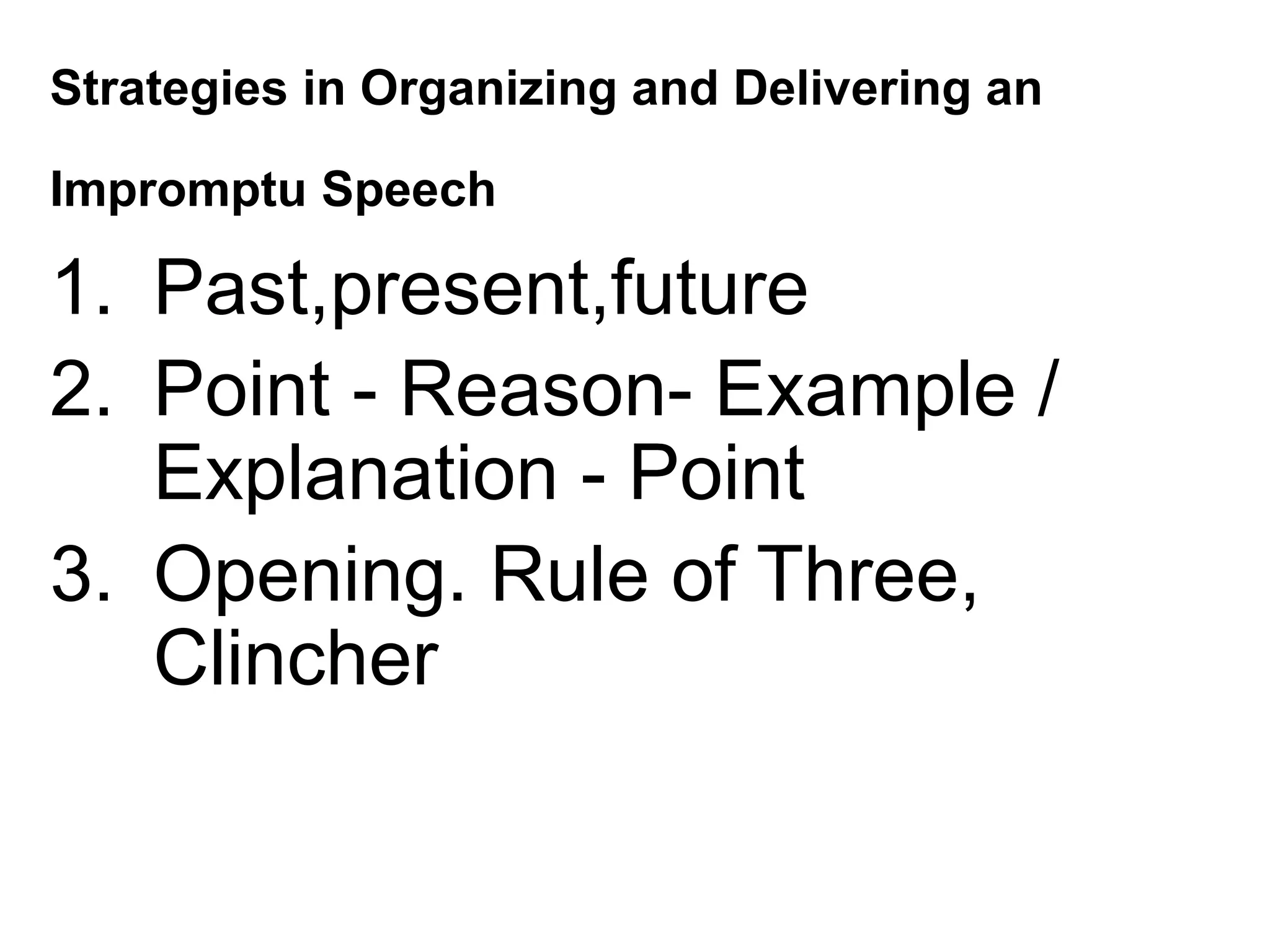
Strategies in Organizing and Delivering an
Impromptu Speech
1. Past,present,future
2. Point - Reason- Example /
Explanation - Point
3. Opening. Rule of Three,
Clincher
PAST, PRESENT, FUTURE
-In this case, we can use the
past, present and future
tenses, in delivering
impromptu speech this
strategy is meaningful and
monumental.
Ex.
In the past, I was not comfortable in making impromptu
speeches because I could not think right away of what to
say, maybe it was because of nervousness and lack of time
to prepare.
At present, however, I am enjoying it because I constantly
practice and keep on exposing myself to any speaking
situation.
In the future, I look forward to teaching others how to
survive impromptu speech situations.
POINT I Love facebook
REASON I have two reasons for this one, it helps me
easily reconnect with old friends and, two I
am updated on the happenings around me.
EXAMPLE/EXPLAINATIO N Through Facebook, I am able to contact my
old friends from other countries and
reminisce about wonderful memories 1 am
glad to be able to reconnect with friends
even if it's only through online means. Also,
through posts on Facebook, I learn about the
current events in the country fact which has
a bearing on my role as a citizen of this
nation.
POINT Facebook, indeed, is a useful social network
site. That is why I love it
EXAMPLE
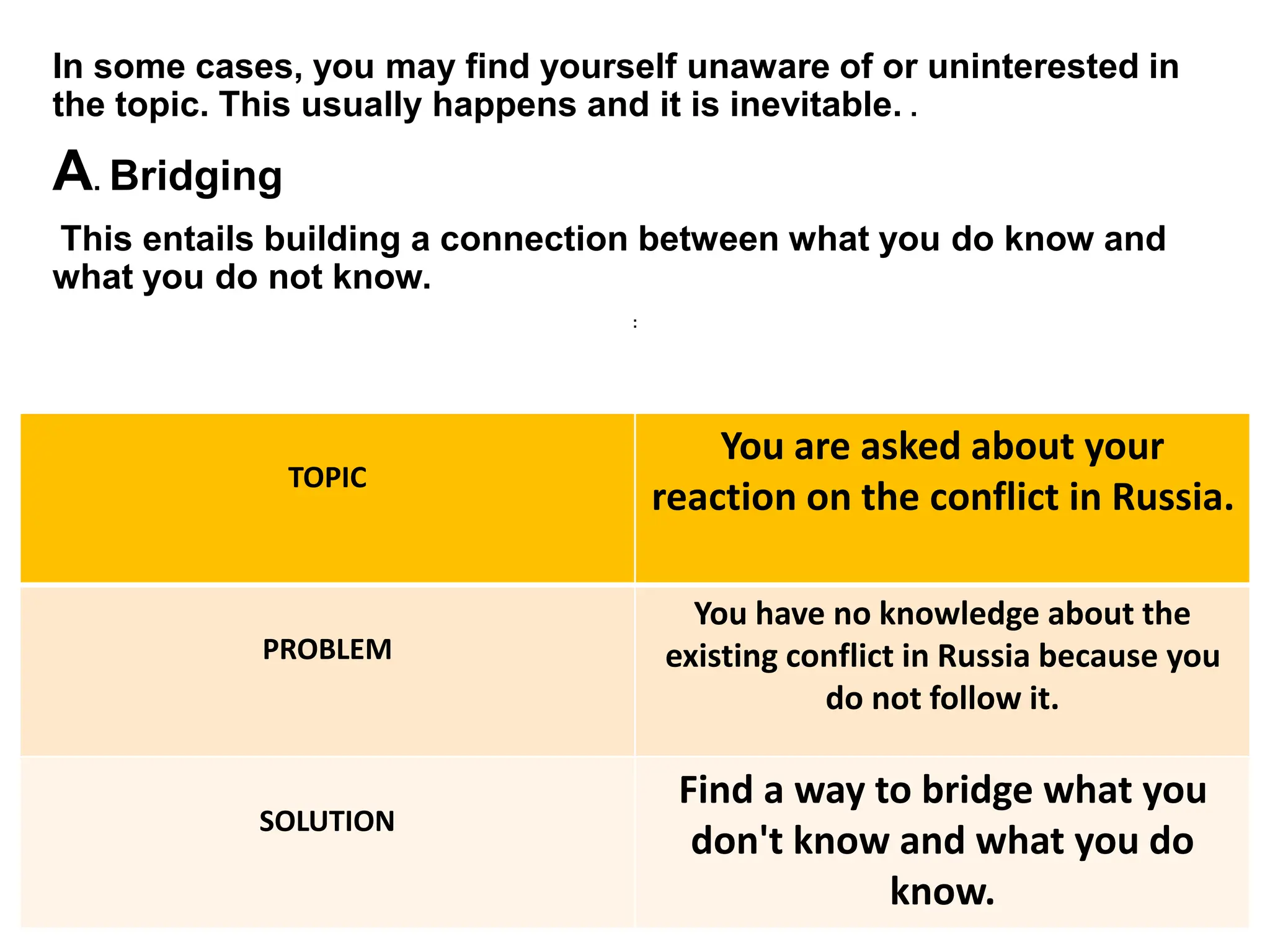
In some cases, you may find yourself unaware of or uninterested in
the topic. This usually happens and it is inevitable. .
A. Bridging
This entails building a connection between what you do know and
what you do not know.
:
TOPIC
You are asked about your
reaction on the conflict in Russia.
PROBLEM
You have no knowledge about the
existing conflict in Russia because you
do not follow it.
SOLUTION
Find a way to bridge what you
don't know and what you do
know.
RESPONSE
"I would imagine the conflict in
Russia to be like a conflict in my
own family. The following are
some steps that I observed in
patching up the conflict, which, in
a micro level, may be considered
by the Russian government...
b. Reframing. This means rephrasing or
redefining the topic into something that you want
to talk about. This usually occurs if you think the
topic is inappropriate or it is not meant for you. If
you are given a topic that you do not like or is not
right for you, don't despair. Simply reframe it as a
topic you'd like to respond to. Redefine the topic
as you believe it should be, or at least the way
you'd like it to be. Keep the structure but alter the
subject. Rephrase the question or even
challenge it; you can even argue why the
question given is not the right question at all.
EXAMPLE
TOPIC
You are asked to compare two
forms of government: democratic
and parliamentary
PROBLEM You think that it is not right for you
because you are a science major.
SOLUTION
Find a pair of anything that you think is
worth comparing. You can compare
natural science and social science in
terms of concepts and processes, or
computers and humans in terms of
capacity and efficiency.
RESPONSE
"This question reminds me of the
complexities in differentiating two
concepts in science. These are natural
science and social science. Just like
democractic and parliamentary, these two
differ in terms of concepts and
processes..."
c. Playing Devil's Advocate.
This refers to you
standing on the
opposite side.
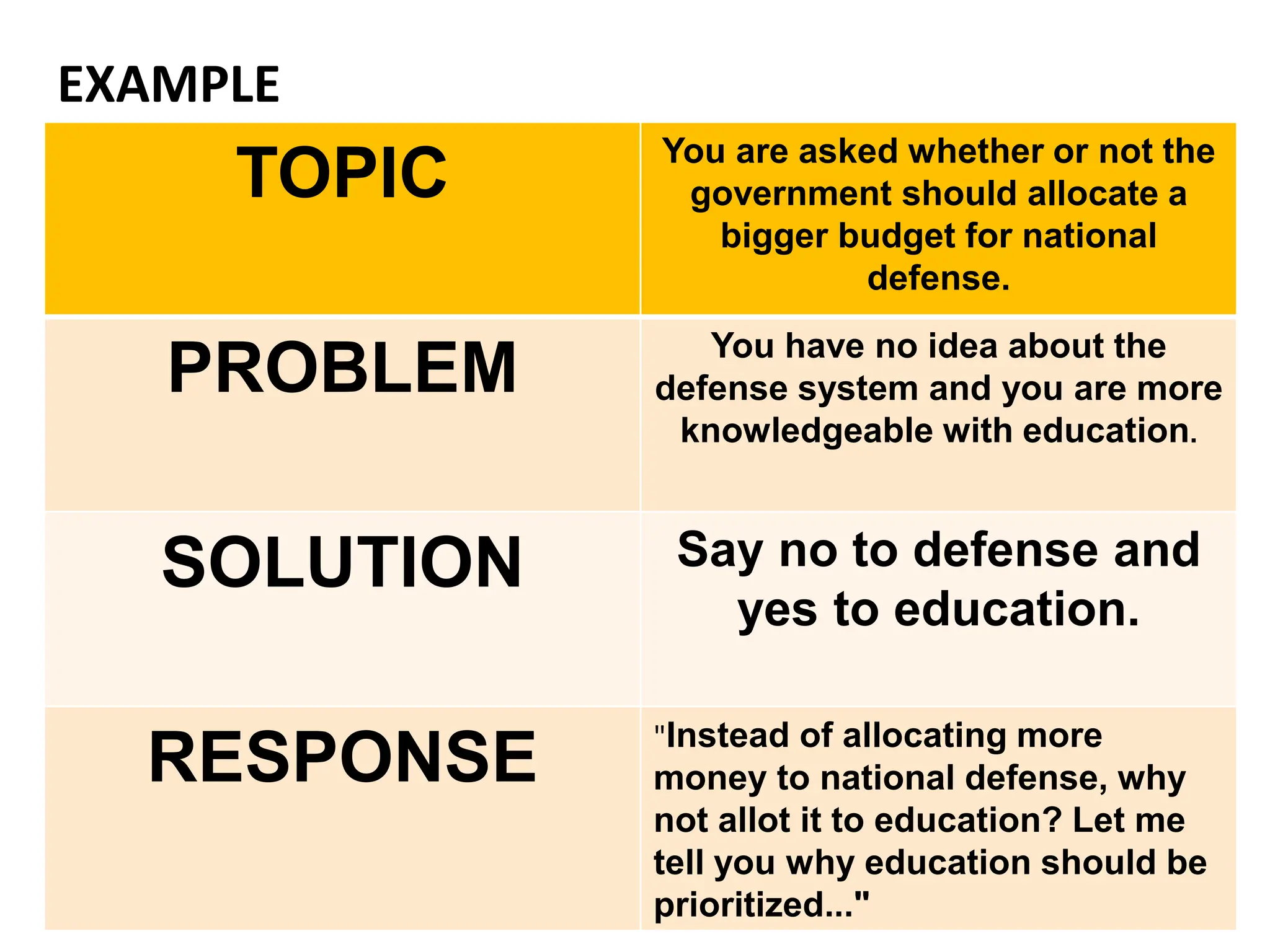
TOPIC You are asked whether or not the
government should allocate a
bigger budget for national
defense.
PROBLEM You have no idea about the
defense system and you are more
knowledgeable with education.
SOLUTION Say no to defense and
yes to education.
RESPONSE "Instead of allocating more
money to national defense, why
not allot it to education? Let me
tell you why education should be
prioritized..."
EXAMPLE
Before the
Speech
1.Smile.
2. Relax by thinking about positive
things. Keep telling yourself, "I am a
brilliant speaker I will nail this
presentation."
3. Identify your purpose. Is it to
inform, to entertain, to welcome, to
congratulate, to apologize, or to give
birthday greetings?
4. Think of one big word that can
serve as your main point. If you think
you have enough, think of the rule of
three.
5. Start outlining in your head. Focus
on what to say first. Be reminded that
your first few words are crucial, so
make them strong, powerful and
catchy.
Some Useful Tips in Effective Impromptu Speech
Delivery
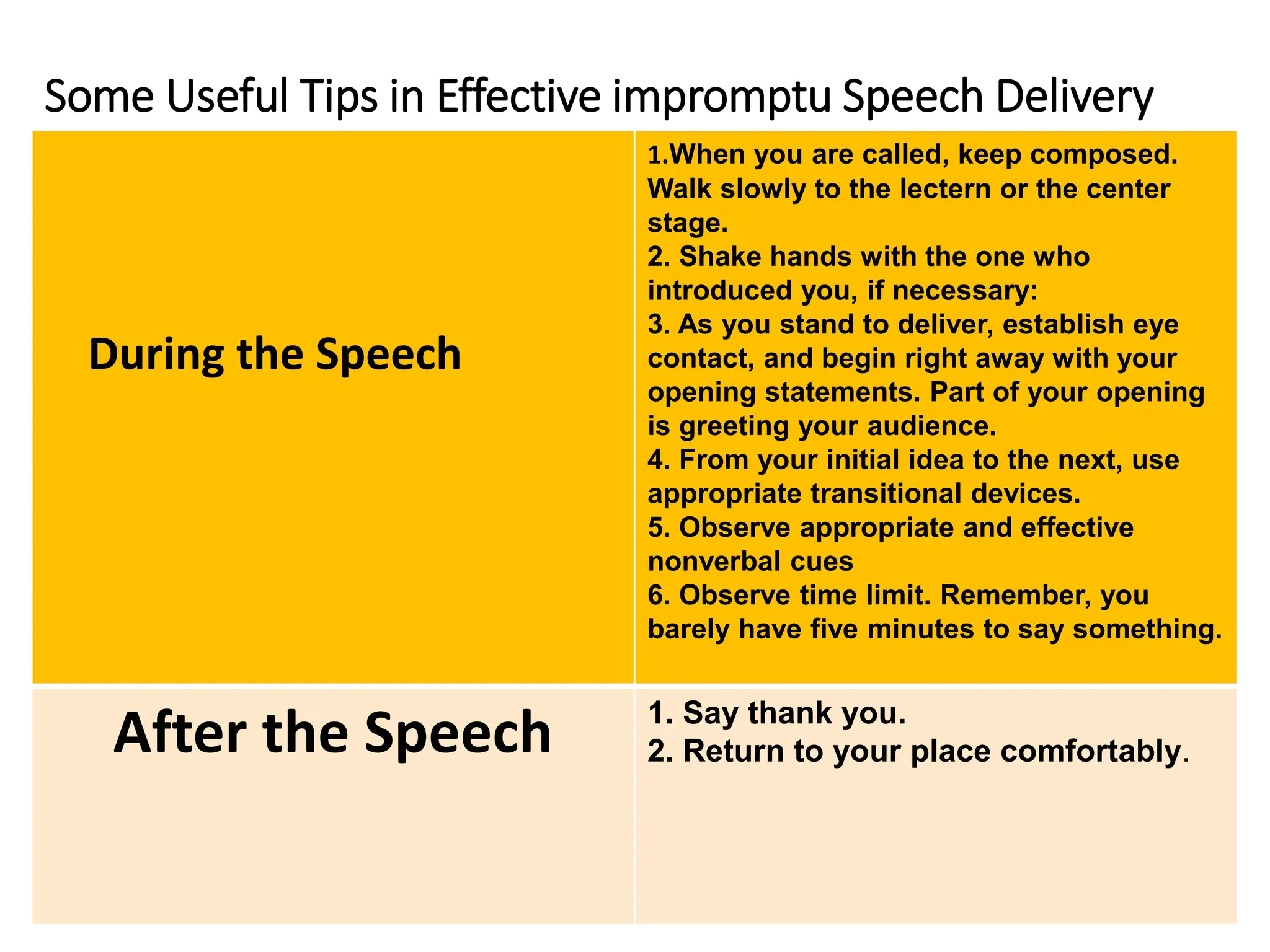
Some Useful Tips in Effective impromptu Speech Delivery
1.When you are called, keep composed.
Walk slowly to the lectern or the center
stage.
2. Shake hands with the one who
introduced you, if necessary:
3. As you stand to deliver, establish eye
contact, and begin right away with your
opening statements. Part of your opening
is greeting your audience.
4. From your initial idea to the next, use
appropriate transitional devices.
5. Observe appropriate and effective
nonverbal cues
6. Observe time limit. Remember, you
barely have five minutes to say something.
After the Speech 1. Say thank you.
2. Return to your place comfortably.
During the Speech
TOPIC You are asked to compare two forms of
government: democratic and parliamentary
PROBLEM You think that it is not right for you because
you are a science major.
SOLUTION Find a pair of anything that you think is worth
comparing. You can compare natural science
and social science in terms of concepts and
processes, or computers and humans in terms
of capacity and efficiency.
RESPONSE "This question reminds me of the complexities
in differentiating two concepts in science.
These are natural science and social science.
Just like democractic and parliamentary, these
two differ in terms of concepts and
processes..."

Impromptu speech in oral communication-WPS Office.pptx

  • 1.
    IMPROMPTU SPEECH -are deliveredwith little or no time for preparation. in most instances, you are called to speak at the spur of the moment because you are expected to be knowledgeable about the subject
  • 2.
    Strategies in Organizingand Delivering an Impromptu Speech 1. Past,present,future 2. Point - Reason- Example / Explanation - Point 3. Opening. Rule of Three, Clincher
  • 3.
    PAST, PRESENT, FUTURE -Inthis case, we can use the past, present and future tenses, in delivering impromptu speech this strategy is meaningful and monumental.
  • 4.
    Ex. In the past,I was not comfortable in making impromptu speeches because I could not think right away of what to say, maybe it was because of nervousness and lack of time to prepare. At present, however, I am enjoying it because I constantly practice and keep on exposing myself to any speaking situation. In the future, I look forward to teaching others how to survive impromptu speech situations.
  • 5.
    POINT I Lovefacebook REASON I have two reasons for this one, it helps me easily reconnect with old friends and, two I am updated on the happenings around me. EXAMPLE/EXPLAINATIO N Through Facebook, I am able to contact my old friends from other countries and reminisce about wonderful memories 1 am glad to be able to reconnect with friends even if it's only through online means. Also, through posts on Facebook, I learn about the current events in the country fact which has a bearing on my role as a citizen of this nation. POINT Facebook, indeed, is a useful social network site. That is why I love it
  • 6.
  • 8.
    In some cases,you may find yourself unaware of or uninterested in the topic. This usually happens and it is inevitable. . A. Bridging This entails building a connection between what you do know and what you do not know. : TOPIC You are asked about your reaction on the conflict in Russia. PROBLEM You have no knowledge about the existing conflict in Russia because you do not follow it. SOLUTION Find a way to bridge what you don't know and what you do know.
  • 9.
    RESPONSE "I would imaginethe conflict in Russia to be like a conflict in my own family. The following are some steps that I observed in patching up the conflict, which, in a micro level, may be considered by the Russian government...
  • 10.
    b. Reframing. Thismeans rephrasing or redefining the topic into something that you want to talk about. This usually occurs if you think the topic is inappropriate or it is not meant for you. If you are given a topic that you do not like or is not right for you, don't despair. Simply reframe it as a topic you'd like to respond to. Redefine the topic as you believe it should be, or at least the way you'd like it to be. Keep the structure but alter the subject. Rephrase the question or even challenge it; you can even argue why the question given is not the right question at all.
  • 11.
    EXAMPLE TOPIC You are askedto compare two forms of government: democratic and parliamentary PROBLEM You think that it is not right for you because you are a science major. SOLUTION Find a pair of anything that you think is worth comparing. You can compare natural science and social science in terms of concepts and processes, or computers and humans in terms of capacity and efficiency. RESPONSE "This question reminds me of the complexities in differentiating two concepts in science. These are natural science and social science. Just like democractic and parliamentary, these two differ in terms of concepts and processes..."
  • 12.
    c. Playing Devil'sAdvocate. This refers to you standing on the opposite side.
  • 13.
    TOPIC You areasked whether or not the government should allocate a bigger budget for national defense. PROBLEM You have no idea about the defense system and you are more knowledgeable with education. SOLUTION Say no to defense and yes to education. RESPONSE "Instead of allocating more money to national defense, why not allot it to education? Let me tell you why education should be prioritized..." EXAMPLE
  • 14.
    Before the Speech 1.Smile. 2. Relaxby thinking about positive things. Keep telling yourself, "I am a brilliant speaker I will nail this presentation." 3. Identify your purpose. Is it to inform, to entertain, to welcome, to congratulate, to apologize, or to give birthday greetings? 4. Think of one big word that can serve as your main point. If you think you have enough, think of the rule of three. 5. Start outlining in your head. Focus on what to say first. Be reminded that your first few words are crucial, so make them strong, powerful and catchy. Some Useful Tips in Effective Impromptu Speech Delivery
  • 15.
    Some Useful Tipsin Effective impromptu Speech Delivery 1.When you are called, keep composed. Walk slowly to the lectern or the center stage. 2. Shake hands with the one who introduced you, if necessary: 3. As you stand to deliver, establish eye contact, and begin right away with your opening statements. Part of your opening is greeting your audience. 4. From your initial idea to the next, use appropriate transitional devices. 5. Observe appropriate and effective nonverbal cues 6. Observe time limit. Remember, you barely have five minutes to say something. After the Speech 1. Say thank you. 2. Return to your place comfortably. During the Speech
  • 16.
    TOPIC You areasked to compare two forms of government: democratic and parliamentary PROBLEM You think that it is not right for you because you are a science major. SOLUTION Find a pair of anything that you think is worth comparing. You can compare natural science and social science in terms of concepts and processes, or computers and humans in terms of capacity and efficiency. RESPONSE "This question reminds me of the complexities in differentiating two concepts in science. These are natural science and social science. Just like democractic and parliamentary, these two differ in terms of concepts and processes..."