MUSIC OF THE 20TH
CENTURY
Expressionism
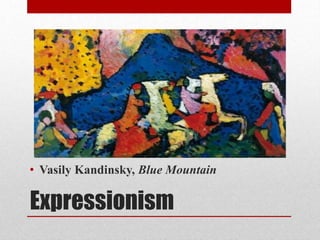
• Vasily Kandinsky, Blue Mountain
Expressionism
• Expressionism was a modernist movement,
initially in poetry and painting, originating in
Germany at the beginning of the 20th century.
• Its typical trait is to present the world solely from
a subjective perspective, distorting it radically
for emotional effect in order to evoke moods
or ideas.
• Expressionist artists sought to express meaning
or emotional experience rather than physical
reality.
Expressionism
• German movement
• Subjective look at an individual’s
internal struggles and strife
• Also started in painting
• Explored bold colors, harsh
dissonances, abstract (form
without content) images
Expressionism
Musical similarities
• Explored bold colors, harsh
dissonances - harsher instrumental
combinations, very weak sense of
tonality - sometimes “atonal” (absence
of tonality). Very abrupt harmonies
and melodies.
Expressionism
Goals of Expressionism
•Capture “being alive”
•Express emotional experience…
not physical reality
•Expressionism also in dance,
architecture, and movies
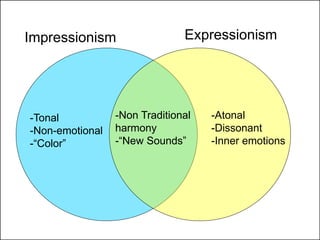
Impressionism Expressionism
-Atonal
-Dissonant
-Inner emotions
-Tonal
-Non-emotional
-“Color”
-Non Traditional
harmony
-“New Sounds”
Key points:
Impressionism was still mostly tonal.
It wasn’t about emotion, but about images.
Much of the music focused on creating new “colors” of
sound
Expressionism:
Was mostly atonal and very dissonant.
Focused on expressing inner emotions.
Similarities:
Free from previous time periods rules of traditional harmony.
Pushed the envelope.
Explored new sounds and musical ideas.
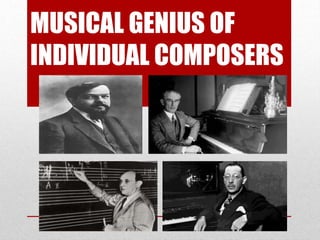
MUSICAL GENIUS OF
INDIVIDUAL COMPOSERS
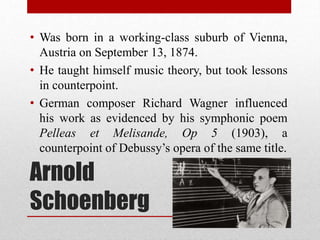
Arnold
Schoenberg
• Was born in a working-class suburb of Vienna,
Austria on September 13, 1874.
• He taught himself music theory, but took lessons
in counterpoint.
• German composer Richard Wagner influenced
his work as evidenced by his symphonic poem
Pelleas et Melisande, Op 5 (1903), a
counterpoint of Debussy’s opera of the same title.
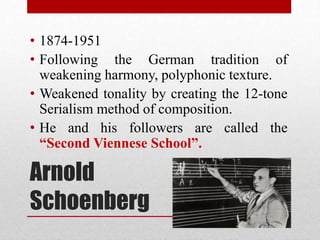
Arnold
Schoenberg
• 1874-1951
• Following the German tradition of
weakening harmony, polyphonic texture.
• Weakened tonality by creating the 12-tone
Serialism method of composition.
• He and his followers are called the
“Second Viennese School”.
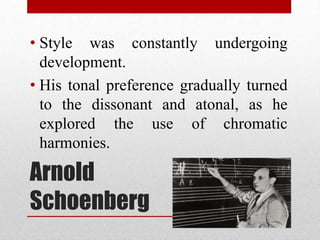
Arnold
Schoenberg
• Style was constantly undergoing
development.
• His tonal preference gradually turned
to the dissonant and atonal, as he
explored the use of chromatic
harmonies.
WORKS AND COMPOSITIONS
Schoenberg is credited with the establishment of the
twelve-tone system.
• Verklarte Nacht, Three Pieces for Piano, op. 11
• Pierrot Lunaire,
• Gurreleider
• Verklarte Nacht (Transfigured Night, 1899), one of his
earliest successful pieces, blends the lyricism,
instrumentation, and melodic beauty of Brahms with the
chromaticism and construction of Wagner.
Pierrot Lunaire
Verklarte Nacht, Three
Pieces for Piano, op. 11
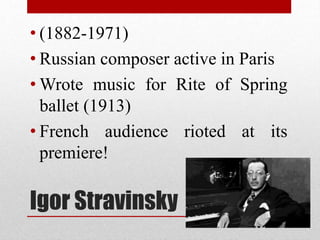
Igor Stravinsky
• (1882-1971)
• Russian composer active in Paris
• Wrote music for Rite of Spring
ballet (1913)
• French audience rioted at its
premiere!
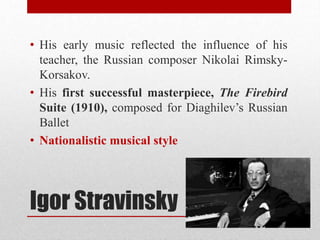
Igor Stravinsky
• His early music reflected the influence of his
teacher, the Russian composer Nikolai Rimsky-
Korsakov.
• His first successful masterpiece, The Firebird
Suite (1910), composed for Diaghilev’s Russian
Ballet
• Nationalistic musical style
WORKS AND COMPOSITIONS
Stravinsky adapted the forms of the 18th century with his
contemporary style of writing.
• Petrouchka (1911), featuring shifting rhythms and
polytonality, a signature device of the composer.
• The Rake’s Progress (1951), a full-length opera, alludes
heavily to the Baroque and Classical styles of Bach and
Mozart through the use of the harpsichord, small
orchestra, solo and ensemble numbers with recitatives
stringing together the different songs.
RITE OF SPRING
THE FIREBIRD SUITE
Tonal vs atonal
• Some 20th century art music is
still written with a heavy emphasis
and awareness of key. Key
relationships are still built and
explored.
• NOT ALL 20th CENTURY
MUSIC IS ATONAL!!

Expressionism Music.ppt

  • 1.
    MUSIC OF THE20TH CENTURY
  • 2.
  • 3.
    Expressionism • Expressionism wasa modernist movement, initially in poetry and painting, originating in Germany at the beginning of the 20th century. • Its typical trait is to present the world solely from a subjective perspective, distorting it radically for emotional effect in order to evoke moods or ideas. • Expressionist artists sought to express meaning or emotional experience rather than physical reality.
  • 4.
    Expressionism • German movement •Subjective look at an individual’s internal struggles and strife • Also started in painting • Explored bold colors, harsh dissonances, abstract (form without content) images
  • 5.
    Expressionism Musical similarities • Exploredbold colors, harsh dissonances - harsher instrumental combinations, very weak sense of tonality - sometimes “atonal” (absence of tonality). Very abrupt harmonies and melodies.
  • 6.
    Expressionism Goals of Expressionism •Capture“being alive” •Express emotional experience… not physical reality •Expressionism also in dance, architecture, and movies
  • 7.
  • 8.
    Key points: Impressionism wasstill mostly tonal. It wasn’t about emotion, but about images. Much of the music focused on creating new “colors” of sound Expressionism: Was mostly atonal and very dissonant. Focused on expressing inner emotions. Similarities: Free from previous time periods rules of traditional harmony. Pushed the envelope. Explored new sounds and musical ideas.
  • 9.
  • 10.
    Arnold Schoenberg • Was bornin a working-class suburb of Vienna, Austria on September 13, 1874. • He taught himself music theory, but took lessons in counterpoint. • German composer Richard Wagner influenced his work as evidenced by his symphonic poem Pelleas et Melisande, Op 5 (1903), a counterpoint of Debussy’s opera of the same title.
  • 11.
    Arnold Schoenberg • 1874-1951 • Followingthe German tradition of weakening harmony, polyphonic texture. • Weakened tonality by creating the 12-tone Serialism method of composition. • He and his followers are called the “Second Viennese School”.
  • 12.
    Arnold Schoenberg • Style wasconstantly undergoing development. • His tonal preference gradually turned to the dissonant and atonal, as he explored the use of chromatic harmonies.
  • 13.
    WORKS AND COMPOSITIONS Schoenbergis credited with the establishment of the twelve-tone system. • Verklarte Nacht, Three Pieces for Piano, op. 11 • Pierrot Lunaire, • Gurreleider • Verklarte Nacht (Transfigured Night, 1899), one of his earliest successful pieces, blends the lyricism, instrumentation, and melodic beauty of Brahms with the chromaticism and construction of Wagner.
  • 14.
  • 15.
  • 16.
    Igor Stravinsky • (1882-1971) •Russian composer active in Paris • Wrote music for Rite of Spring ballet (1913) • French audience rioted at its premiere!
  • 17.
    Igor Stravinsky • Hisearly music reflected the influence of his teacher, the Russian composer Nikolai Rimsky- Korsakov. • His first successful masterpiece, The Firebird Suite (1910), composed for Diaghilev’s Russian Ballet • Nationalistic musical style
  • 18.
    WORKS AND COMPOSITIONS Stravinskyadapted the forms of the 18th century with his contemporary style of writing. • Petrouchka (1911), featuring shifting rhythms and polytonality, a signature device of the composer. • The Rake’s Progress (1951), a full-length opera, alludes heavily to the Baroque and Classical styles of Bach and Mozart through the use of the harpsichord, small orchestra, solo and ensemble numbers with recitatives stringing together the different songs.
  • 19.
  • 20.
  • 21.
    Tonal vs atonal •Some 20th century art music is still written with a heavy emphasis and awareness of key. Key relationships are still built and explored. • NOT ALL 20th CENTURY MUSIC IS ATONAL!!