IMPORTANCE
OF
COMMUNICATION
What is Communication?
Communication is the effective sharing or
transmission of facts opinions or emotions by 2 or
more people. The 3 basic elements of
communication are :-
✓
✓
✓
The Sender
The Message
The Receiver.
Processof C
om
m
unication
Encoding into
Message.
Transmission
Channel.
Feedback
receives
Receiver
the
Message.
Idea of the
Sender.
Decodes into
meaningful
Idea
FunctionsorRoleofCo
m
m
unication
■ Inform
■ Instruct
■ Sharing of information
■ Motivating Workers
■ Leading the Organization
■ Control
■ Management
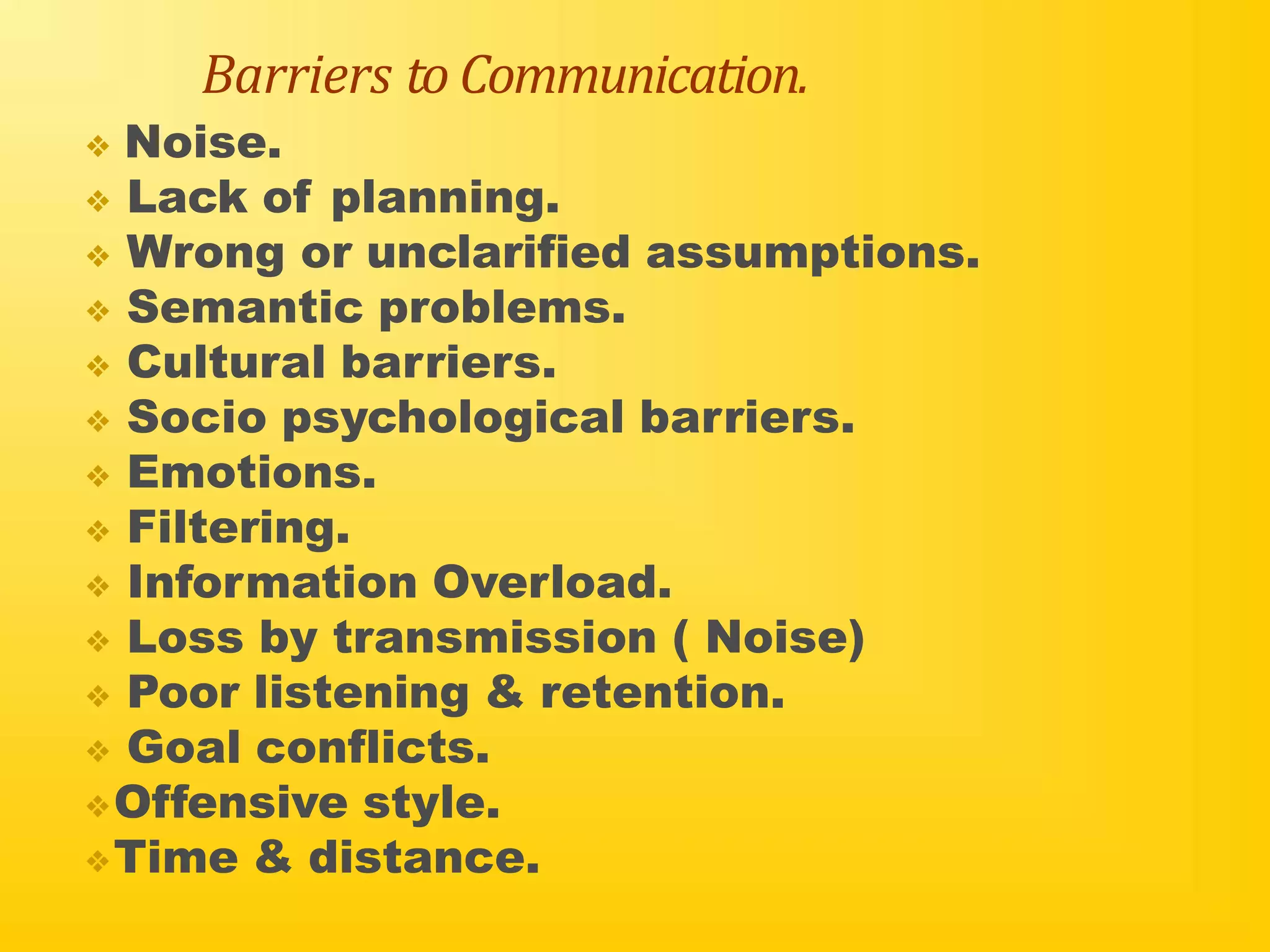
Barriers to Communication.
❖ Noise.
❖ Lack of planning.
❖ Wrong or unclarified assumptions.
❖ Semantic problems.
❖ Cultural barriers.
❖ Socio psychological barriers.
❖ Emotions.
❖ Filtering.
❖ Information Overload.
❖ Loss by transmission ( Noise)
❖ Poor listening & retention.
❖ Goal conflicts.
❖Offensive style.
❖Time & distance.
Overcoming
Barriers
➢ Sender
• Planning ideas
❑ Overcoming
a. Different perceptions
b. Language difference
c. Inconsistent verbal &
non verbal comm.
d. Emotionality
➢Receiver
❖Paying attention
❖Active listening
❖Open mind
❖Overcoming prejudicial
judgment & emotional
constraints.
➢Organization
✓Choosing right media
✓Overcoming noise barrier
✓Simplify org. structure
Methods of Communication.
Verbal Communications
Oral Communication
Written Communication
No
nVerb
a
l Co
mmunications:-
•Body Language
•Sign Language(Symbols)
•Para Language
•Circumstantial Language
Methods of Communication.
❑
❖ Facial expression
❖ Eye contact
❖ Posture
❖ Gesture
❑
Body Language Body Shape
❖ Ectomorph
❖ Mesomorph
❖ Endomorph
❑ Smell & Touch
❑ Silence
Importance
The implementation of policies and programmers of management
is possible only through effective communication. We can
understand the importance of communication from the
following point:
■
■
■
■
■
■
Smoothing running of the enterprise
Maximum productivity
Assist other function
Job satisfaction
Basis of leadership
Establishment of Human Relations
Advantages
■
■
■
■
■
Speedy flow:
Clear words and Language:
Flexibility
Proper co-ordination
A leadership quality:
Disadvantages
■
■
■
■
■
Lack of Planning:
Faulty Translation
Badly Expressed Messages
Unqualified Assumption:
Poor Listening and Premature evaluation :
Conclusion
❑ Communication is very important in every place of
business. Communication is exchanging information
among individuals working in any organization.
Communication is the process of passing information
and understanding from one person to another.
❑ At every place of business and firm where is large
production and various departments, communication is
of very much help in getting maximum production,
increasing business and building good relationship
between all in the company.
❑ Thus, communication plays vital role in all areas of
management and business.
Importance of communication.pptx

Importance of communication.pptx

  • 1.
  • 2.
    What is Communication? Communicationis the effective sharing or transmission of facts opinions or emotions by 2 or more people. The 3 basic elements of communication are :- ✓ ✓ ✓ The Sender The Message The Receiver.
  • 3.
  • 4.
    FunctionsorRoleofCo m m unication ■ Inform ■ Instruct ■Sharing of information ■ Motivating Workers ■ Leading the Organization ■ Control ■ Management
  • 5.
    Barriers to Communication. ❖Noise. ❖ Lack of planning. ❖ Wrong or unclarified assumptions. ❖ Semantic problems. ❖ Cultural barriers. ❖ Socio psychological barriers. ❖ Emotions. ❖ Filtering. ❖ Information Overload. ❖ Loss by transmission ( Noise) ❖ Poor listening & retention. ❖ Goal conflicts. ❖Offensive style. ❖Time & distance.
  • 6.
    Overcoming Barriers ➢ Sender • Planningideas ❑ Overcoming a. Different perceptions b. Language difference c. Inconsistent verbal & non verbal comm. d. Emotionality ➢Receiver ❖Paying attention ❖Active listening ❖Open mind ❖Overcoming prejudicial judgment & emotional constraints. ➢Organization ✓Choosing right media ✓Overcoming noise barrier ✓Simplify org. structure
  • 7.
    Methods of Communication. VerbalCommunications Oral Communication Written Communication No nVerb a l Co mmunications:- •Body Language •Sign Language(Symbols) •Para Language •Circumstantial Language
  • 8.
    Methods of Communication. ❑ ❖Facial expression ❖ Eye contact ❖ Posture ❖ Gesture ❑ Body Language Body Shape ❖ Ectomorph ❖ Mesomorph ❖ Endomorph ❑ Smell & Touch ❑ Silence
  • 9.
    Importance The implementation ofpolicies and programmers of management is possible only through effective communication. We can understand the importance of communication from the following point: ■ ■ ■ ■ ■ ■ Smoothing running of the enterprise Maximum productivity Assist other function Job satisfaction Basis of leadership Establishment of Human Relations
  • 11.
    Advantages ■ ■ ■ ■ ■ Speedy flow: Clear wordsand Language: Flexibility Proper co-ordination A leadership quality:
  • 12.
    Disadvantages ■ ■ ■ ■ ■ Lack of Planning: FaultyTranslation Badly Expressed Messages Unqualified Assumption: Poor Listening and Premature evaluation :
  • 13.
    Conclusion ❑ Communication isvery important in every place of business. Communication is exchanging information among individuals working in any organization. Communication is the process of passing information and understanding from one person to another. ❑ At every place of business and firm where is large production and various departments, communication is of very much help in getting maximum production, increasing business and building good relationship between all in the company. ❑ Thus, communication plays vital role in all areas of management and business.