Crop density and geometry
Dr. Niraj Biswakarma
Assistant professor, SoAS
GDGU
1
Plant Population or Plant Density:
2
Number of plants per unit area is called plant density.
Optimum plant population
It is the number of plants required to produce maximum output or yield per
unit area.
Any increase beyond this stage results in either no increase or reduction in
yield.
Approaches that help to maintain optimum population of plants.
• Preparation of seed bed
• Seed of good quality
• Maintenance of row spacing
• Accurate planting time and methods of sowing
3
Importance of plant population / crop geometry
1. Yield of any crop depends on final plant population
2. The plant population depends on germination percentage and survival
rate in the field
3. Under rainfed conditions, high plant population will deplete the soil
moisture before maturity, where as low plant population will leave the soil
moisture unutilized
4. Low plant population individual plant yield will be more
5. Yield per plant decreases gradually as plant population per unit area is
increased, but yield per unit area increases up to certain level of population,
that level of plant population is called as optimum population.
4
Plant geometry: Plant geometry refers the shape of
the plant / plant canopy.
Eg: Like vertical growth in sorghum, maize, paddy etc.
horizontal growth in cotton, tobacco, pulses etc.
Crop geometry: refers the shape of the land available to
individual plant to grow.
e.g. random, square, rectangular etc.
Different crop geometries
5
1. Random geometry: This type of geometry is observed
under broadcasting method of sowing, where no equal
space is maintained, resources are either under exploited or
over exploited.
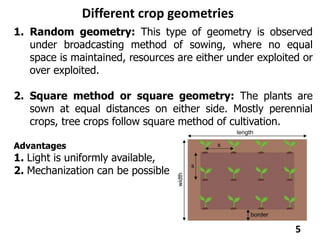
2. Square method or square geometry: The plants are
sown at equal distances on either side. Mostly perennial
crops, tree crops follow square method of cultivation.
Advantages
1. Light is uniformly available,
2. Mechanization can be possible
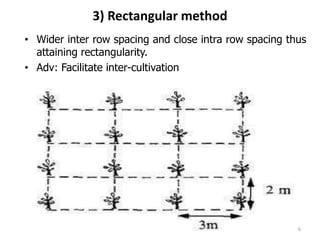
3) Rectangular method
• Wider inter row spacing and close intra row spacing thus
attaining rectangularity.
• Adv: Facilitate inter-cultivation
6
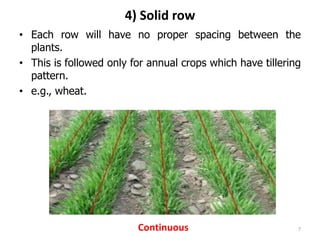
4) Solid row
• Each row will have no proper spacing between the
plants.
• This is followed only for annual crops which have tillering
pattern.
• e.g., wheat.
7
Continuous
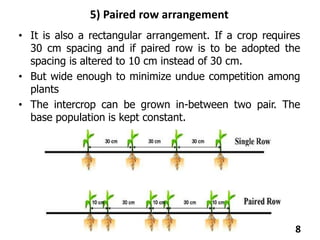
5) Paired row arrangement
• It is also a rectangular arrangement. If a crop requires
30 cm spacing and if paired row is to be adopted the
spacing is altered to 10 cm instead of 30 cm.
• But wide enough to minimize undue competition among
plants
• The intercrop can be grown in-between two pair. The
base population is kept constant.
8
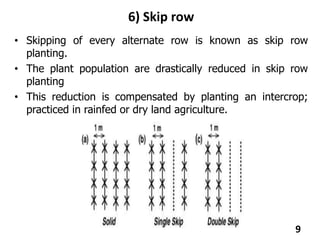
6) Skip row
• Skipping of every alternate row is known as skip row
planting.
• The plant population are drastically reduced in skip row
planting
• This reduction is compensated by planting an intercrop;
practiced in rainfed or dry land agriculture.
9
10
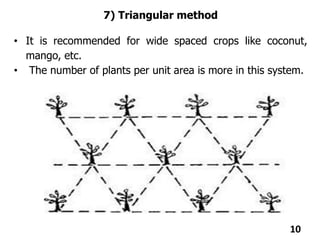
7) Triangular method
• It is recommended for wide spaced crops like coconut,
mango, etc.
• The number of plants per unit area is more in this system.
Factors affecting plant population / Plant density
11
1. Size of the plant
• The volume occupied by the plant at the time of flowering
decides the spacing of crop
• Plants of red gram, cotton, sugarcane etc occupy larger
volume of space in the field compared to rice, wheat, ragi
2) soil cover
• Should cover the soil as early as possible so as to intercept
maximum sunlight
• Higher the intercepted radiation more will be the dry
matter produced
Cont…
12
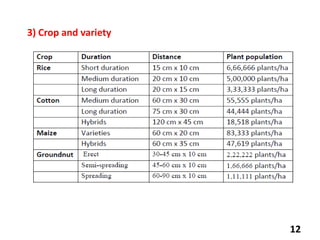
3) Crop and variety
4) Time of sowing:
• Among weather factors, day length and temperature
influence the plant population.
• As low temperature retards growth, high plant population
is required to cover the soil.
5) Rainfall / irrigation
• Plant population has to be less under rainfed than
irrigated condition as more plant densities, more water is
lost through transpiration
• Under adequate rainfall / irrigation, high plant population
is recommended.
13
14
7. Seed rate
• Quantity of seed sown/unit area, viability and
establishment rate decides the plant population
• Under broadcasting the seed rate is higher when
compared with line sowing / transplanting, e.g. for rice
• Direct sowing - 100 kg/ha
• Line sowing - 60 kg/ha
• Transplanting - 40 kg/ha
15
Any Doubts ?????
Thank You

Lecture 4 Plant density and geometry.pptx

  • 1.
    Crop density andgeometry Dr. Niraj Biswakarma Assistant professor, SoAS GDGU 1
  • 2.
    Plant Population orPlant Density: 2 Number of plants per unit area is called plant density. Optimum plant population It is the number of plants required to produce maximum output or yield per unit area. Any increase beyond this stage results in either no increase or reduction in yield. Approaches that help to maintain optimum population of plants. • Preparation of seed bed • Seed of good quality • Maintenance of row spacing • Accurate planting time and methods of sowing
  • 3.
    3 Importance of plantpopulation / crop geometry 1. Yield of any crop depends on final plant population 2. The plant population depends on germination percentage and survival rate in the field 3. Under rainfed conditions, high plant population will deplete the soil moisture before maturity, where as low plant population will leave the soil moisture unutilized 4. Low plant population individual plant yield will be more 5. Yield per plant decreases gradually as plant population per unit area is increased, but yield per unit area increases up to certain level of population, that level of plant population is called as optimum population.
  • 4.
    4 Plant geometry: Plantgeometry refers the shape of the plant / plant canopy. Eg: Like vertical growth in sorghum, maize, paddy etc. horizontal growth in cotton, tobacco, pulses etc. Crop geometry: refers the shape of the land available to individual plant to grow. e.g. random, square, rectangular etc.
  • 5.
    Different crop geometries 5 1.Random geometry: This type of geometry is observed under broadcasting method of sowing, where no equal space is maintained, resources are either under exploited or over exploited. 2. Square method or square geometry: The plants are sown at equal distances on either side. Mostly perennial crops, tree crops follow square method of cultivation. Advantages 1. Light is uniformly available, 2. Mechanization can be possible
  • 6.
    3) Rectangular method •Wider inter row spacing and close intra row spacing thus attaining rectangularity. • Adv: Facilitate inter-cultivation 6
  • 7.
    4) Solid row •Each row will have no proper spacing between the plants. • This is followed only for annual crops which have tillering pattern. • e.g., wheat. 7 Continuous
  • 8.
    5) Paired rowarrangement • It is also a rectangular arrangement. If a crop requires 30 cm spacing and if paired row is to be adopted the spacing is altered to 10 cm instead of 30 cm. • But wide enough to minimize undue competition among plants • The intercrop can be grown in-between two pair. The base population is kept constant. 8
  • 9.
    6) Skip row •Skipping of every alternate row is known as skip row planting. • The plant population are drastically reduced in skip row planting • This reduction is compensated by planting an intercrop; practiced in rainfed or dry land agriculture. 9
  • 10.
    10 7) Triangular method •It is recommended for wide spaced crops like coconut, mango, etc. • The number of plants per unit area is more in this system.
  • 11.
    Factors affecting plantpopulation / Plant density 11 1. Size of the plant • The volume occupied by the plant at the time of flowering decides the spacing of crop • Plants of red gram, cotton, sugarcane etc occupy larger volume of space in the field compared to rice, wheat, ragi 2) soil cover • Should cover the soil as early as possible so as to intercept maximum sunlight • Higher the intercepted radiation more will be the dry matter produced Cont…
  • 12.
  • 13.
    4) Time ofsowing: • Among weather factors, day length and temperature influence the plant population. • As low temperature retards growth, high plant population is required to cover the soil. 5) Rainfall / irrigation • Plant population has to be less under rainfed than irrigated condition as more plant densities, more water is lost through transpiration • Under adequate rainfall / irrigation, high plant population is recommended. 13
  • 14.
    14 7. Seed rate •Quantity of seed sown/unit area, viability and establishment rate decides the plant population • Under broadcasting the seed rate is higher when compared with line sowing / transplanting, e.g. for rice • Direct sowing - 100 kg/ha • Line sowing - 60 kg/ha • Transplanting - 40 kg/ha
  • 15.