International Research Journal of Engineering and Technology (IRJET) e-ISSN: 2395-0056
Volume: 09 Issue: 11 | Nov 2022 www.irjet.net p-ISSN: 2395-0072
© 2022, IRJET | Impact Factor value: 7.529 | ISO 9001:2008 Certified Journal | Page 600
Implementation of CAN on FPGA for Security Evaluation Purpose
Student, Dept. of Electronics Engineering,
Shri Ramdeobaba College of Engineering and Management, Nagpur, Maharashtra, India
---------------------------------------------------------------------***---------------------------------------------------------------------
Abstract - Controller Area Network (CAN) is a low-cost
communication protocol which is being used in various
applications like automotive, medical, military, aviation, etc.
Current CAN applications are based on the standard CAN 2.0
protocol. It was not designed for secure communication;
although, it offers built-in error detection, robustness, speed
and flexibility, the security side of CAN communication is
highly underdeveloped. Research on in-vehicle CAN security
primitives is difficult as it is hard to get a real vehicle for
evaluation and development of these security primitives. The
cost of research is considerably high, for some researchersthis
creates a barrier, acting as a deterrence. This paper presents
implementation of CAN on FPGA and evaluation of
cryptographic algorithms as a security measure in CAN bus
communication.
Key Words: FPGA, CAN bus, SJA1000, Xilinx Zynq,
PetaLinux, ZYBO, Evaluation, Security.
1. INTRODUCTION
If we consider only automobiles, there could be as many as
100 Electronic Control Units (ECUs) all communicating
through a single CAN bus system. Despite the functional
benefits, the CAN bus system is vulnerable to cyber-attacks
like replay attacks, denial-of-service,andman-in-the-middle
attacks. Security of any network can be assessed on three
attributes: confidentiality, integrity, andauthentication.Many
researchers have demonstrated various successful attacks
which showed that CAN bus fails in all these three
parameters [2,17,13]. Manufacturers understand these
vulnerabilities and have started implementing security
measures like, Network Segmentation, Intrusion Detection
System, Software-based encryption methods. But all these
are computation intensive, have their own vulnerabilities,
and are slower, thus reducing the data transferrateofsucha
time-critical system. And as pointed out by [3], considering
the lifetime of a vehicle, it is possibletofindvulnerabilities in
above mentioned measures and crack a static encryption
key. For high stake applications like military-equipment,
vehicles, aircraft such vulnerabilities are not acceptable. A
lot of research has been done in securing CAN
communications[14-18];however,these proposedsolutions
have their own limitations and vulnerabilities. Developing a
system that is able to meet resource constraints put by CAN
communication system is a real challenge. ModerndayECUs
are relatively efficient and fast compared to the ones used a
decade ago, hence some of the solutions proposed by some
authors could be a viable option with some performance
enhancing tweaks. However, a thorough evaluation of these
proposed methods is needed in order to explore the areasof
improvements. This is a laborious, complicated and time-
consuming process, to streamline this process a versatile
test-bed is needed that speeds up the entire chain of
implementation, evaluation, and development and
deployment. FPGAs based solutions can help to address
these challenges by enabling trueflexibilityandscalabilityto
address the security requirements of CAN bus with inherent
hardware and software programmability. Rather than
creating a bare-metal application to run on FPGA emulated
CAN controller, we rely on a test-bed thatrunsa light-weight
Linux kernel on top. Bare-metal application are difficult to
debug as there are no fault management and error
notifications unless they have been explicitly implemented
and validated. Given the scope of ourapplicationitisdifficult
to figure out what exactly could go wrong, hence the need of
a test-bed that has error handling and prompting abilities is
needed, this allows for speedy debugging and evaluation of
the proposed solutions, and speed up the development of
new ones. In our experimental test-bed, we have used
OpenCores SJA1000 controller, that has been modified to
ignore CAN FD frames. This version of SJA1000 is modified
by Czech Technical University, Prague (CTU) [1] and allows
this controller to co-exist and send data on CAN FD network.
2. SYSTEM DESIGN
The test-bed is built in two parts: hardware and software.
The design of hardware is done using Xilinx Vivado Design
Suite and is implemented on ZYBO (ZYnq BOard) that uses
Zynq All Programmable System on Chip Architecture. The
SoC design has two subsystems: Processing System (PS) and
Programmable Logic(PL).ThePS,isZynq-7000,hassoftware
programmability features and takes over the job of
controlling and communicating with PL. PL is Xilinx Artix-7
FPGA with configurable ports and buses, and has hardware
modules that are being emulated. The software design is
done with the help of PetaLinuxSDKtostreamlineembedded
Linux development. This tool helps us to develop a Bootable
System Image that consists ofa custom CPU-optimizedLinux
kernel, device drivers and bootloader configurations. The
test-bed is now ready forfurther implementation,evaluation
and development of security measures for CAN bus
communications.Thissectionfurtherdiscussestheimportant
elements of hardware and software design.
Rohit Pawar
International Research Journal of Engineering and Technology (IRJET) e-ISSN: 2395-0056
Volume: 09 Issue: 11 | Nov 2022 www.irjet.net p-ISSN: 2395-0072
© 2022, IRJET | Impact Factor value: 7.529 | ISO 9001:2008 Certified Journal | Page 601
2.1 Hardware Design
The hardware consists of SJA1000 controller, TJA1050
CAN trans-receiver, Zynq 7000 SoC, and other periphery
circuits required for implementation of test-bed. Multiple
instances of this test-bed can be used to connect and
communicate on a CAN bus line for analysis and evaluation
of different security measures. For the demonstration of
communication between two CAN nodes; Node1 and Node2
over the CAN bus, we perform a simple signal detection
experiment. When input is given to any one of the nodes by
pressing the switch, for instance consider Node1, CAN
communication is triggered and a data-framecorresponding
to the signal is transmitted over the CAN bus, this signal
data-frame is picked up by Node2, it interpretsitandtheLED
assigned to the switch, turns on or off. i.e., the LED of one
node is controlled by another node. Fig. 1 shows the block
diagram of a CAN node.
Fig -1: Block Diagram of Test-bed.
2.1.1 SJA1000
It is a stand-alone controller for the Controller Area
Network (CAN), mostly used within automotive and general
industrial environments. It has both CAN 2.0A (Standard
CAN) and 2.0B (Extended CAN) protocol support, with
bitrates up to 1 Mb/s. The SJA1000 that is used inthisproject
is CAN FD tolerant and is written in Verilog language [1]. It
contains transmission buffer (TXB), receiving buffer (RXB),
bit timing logic (BTL), acceptance filter (ACF), bit stream
processor (BSP), error management logic (EML), and
interface management logic (IML). It uses an APB interface
for on chip communication with master (i.e., the processing
system). SJA1000 appears to a master as a memory-mapped
I/O device. Independent operation of both devices is
guaranteed byaRAM-likeimplementationofitsregisters.Fig.
2 shows schematicdiagramoftheimplementedSJA1000CAN
controller.
Fig -2: Schematic of Implemented SJA1000 CAN
Controller
2.1.2 TJA1050 CAN transreceiver
It is an interface between CAN controller and physical
bus. It provides differential transmit and differential receive
capability to the CAN controller. It converts the Tx and Rx
signal of controller to CANH and CANL signal. It offers good
performance when it comes to optimal matching of output
signals (CANH, CANL). The figure below shows block
diagram of TJA1050.
2.1.3 Processing System
Zynq-7000 processing system (PS) is the master and an
instance of SJA1000 in PL is the slave. Communication
between master and slave on the SoC is done through AXI
and APB buses respectively. AXI is designed for
communication between blocks of IP on FPGA. AXI
interconnect IP is used to connect one or more AXI memory-
mapped master devices to one or more memory-mapped
slave devices. The SJA1000 IP has APB interface, suitable for
low-speed communication. An AXI-APB bridge is needed to
connect this APB slave to the AXI master. Interrupts coming
from the CAN controller is connected to the PL-PS interrupt
port of the processing system. Tx and Rx signals of the CAN
controller are mapped to IO pinsconnectedtothehighspeed
Pmod (peripheral module) ports on the board, it is an open
standard defined by Digilent Inc. for connecting peripheral
modules to FPGA. The Tx-Rx pair of the controller is
converted to CANH and CANL signal by the transceiver
module connected to Pmod port. Configuration and control
of CAN controller is done by the PS usinga drivercode which
accesses the controller using the virtual memory address.
Driver program is required for mode selection, reading and
writing messages to the controller, etc. A top-level
application is required to read sensor values, manage keys
and construct messages. A standalone application could be
created for this purpose but as discussed earlier our
application requires a different approach. The custom Linux
kernel in the system has support for Python, C, and C+, this
allows for rapid development anddeploymentofapplication
program. The interface circuit diagram of our system is
shown below.
International Research Journal of Engineering and Technology (IRJET) e-ISSN: 2395-0056
Volume: 09 Issue: 11 | Nov 2022 www.irjet.net p-ISSN: 2395-0072
© 2022, IRJET | Impact Factor value: 7.529 | ISO 9001:2008 Certified Journal | Page 602
Fig -3: Interface Diagram of the Test-bed not using
transreceiver
2.2 Software Design
The processor in the Processing System boots first, this
allows for a software centric approach for Programmable
Logic configuration which is managed by a programrunning
on the CPU. After it starts, the Linux kernel probes the
devices in the system, it gets to know about the devices
present in the system from the Device Tree. A device's
existence in the system, its location on the bus from which it
may be accessed, and its configuration—including its
registers, interrupts, and other settings—are all specified in
the device tree entry. Device tree entry of SJA1000 is shown
below. Field called ‘compatible’isusedtospecifythe nameof
the driver associated to the device, ‘interrupts-’ field
specifies on which pin number the interrupt of device is
connected and reg specifies the address of device.
Code Snippet:
sja1000_0: sja1000@43c00000 {
compatible = "nxp, sja1000";
interrupt-names="irq";
interrupt-parent = <&intc>;
interrupts = <0 29 4>;
reg = <0x43c00000 0x10000>;
reg-to-width = <4>;
status = "okay";
nxp, external-clock-frequency = <100000000>;
};
The software realization of CAN node communication is
done in two parts: Initializing the SJA1000 CAN controller
and creating an application program that can access the
controller for establishing communication with other nodes
on CAN bus.
2.2.1 Initializing SJA1000 CAN controller
The system at this stage is ready to send all data and
receive all data using default arbitration ID(0x001),without
filtering any messages, owing to the default filter register
values of the SJA1000 controllersetbytheSocketCAN device
driver. Without changingthe defaultfilterregistervalues, we
can directly access the controller through command line
interface (CLI) to send/receive data to/from the bus.
Another way is to set the values of filter register before
initializing the CAN controller. Both of these methods are
discussed below.
A. Direct access to CAN controller: This can be done at OS
level using CLI as well as at application program level. For
simplicity, we show this process done at OS level, by
executing the following command.
Fig -4: Initializing two instances of SJA1000 CAN
controller.
After initialization, the CAN controller can be now be
directly accessed to send and receivemessage,alongwith a
custom or default arbitration ID. The direct access method
is helpful when we wish to receive and analyse all the data
broadcasted over the CAN bus. The figure belowshowsthe
execution.
Fig -5: can1 (Node2) sending data over CAN bus using ID
(0x123)
Fig -6: can0 (Node1) receiving data over CAN bus from
CAN node having ID (0x123)
B. By changing filter register values: SocketCAN driverdoes
not have support for writing the filter registers of the CAN
controller by the user. Since the registersare writtenatthe
time of insertion of device driver module and can’t be
changed frequently, the values of all four Acceptance Code
Register (ACR) and all four Acceptance Mask Register
(ACR) are hard coded as all zeros and all ones respectively,
which means all the messages on the bus will be received
and sent in FIFO manner. In the SocketCAN driver,filtering
is done at the kernel layer which doesn’t make sense for
our application since we have actual CAN protocol
controller IP on the chip. We have modified he kernel
module code, which allows us to change values of filter
registers. The shell command below shows the process of
changing filter register values after kernel module code
modification.
International Research Journal of Engineering and Technology (IRJET) e-ISSN: 2395-0056
Volume: 09 Issue: 11 | Nov 2022 www.irjet.net p-ISSN: 2395-0072
© 2022, IRJET | Impact Factor value: 7.529 | ISO 9001:2008 Certified Journal | Page 603
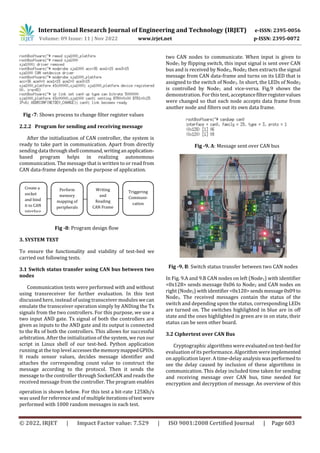
Fig -7: Shows process to change filter register values
2.2.2 Program for sending and receiving message
After the initialization of CAN controller, the system is
ready to take part in communication. Apart from directly
sending data throughshell command, writinganapplication-
based program helps in realizing autonomous
communication. The message that is written to or read from
CAN data-frame depends on the purpose of application.
Fig -8: Program design flow
3. SYSTEM TEST
To ensure the functionality and viability of test-bed we
carried out following tests.
3.1 Switch status transfer using CAN bus between two
nodes
Communication tests were performed with and without
using transreceiver for further evaluation. In this test
discussed here, instead of using transceiver modules wecan
emulate the transceiver operation simply by ANDing the Tx
signals from the two controllers. For this purpose, we use a
two input AND gate. Tx signal of both the controllers are
given as inputs to the AND gate and its output is connected
to the Rx of both the controllers. This allows for successful
arbitration. After the initialization of the system, we run our
script in Linux shell of our test-bed. Python application
running at the top level accessesthememorymappedGPIOs.
It reads sensor values, decides message identifier and
attaches the corresponding count value to construct the
message according to the protocol. Then it sends the
message to the controller through SocketCAN and reads the
received message from the controller. The program enables
two CAN nodes to communicate. When input is given to
Node1 by flipping switch, this input signal is sent over CAN
bus and is received by Node2, Node2 then extracts the signal
message from CAN data-frame and turns on its LED that is
assigned to the switch of Node1. In short, the LEDs of Node2
is controlled by Node1 and vice-versa. Fig.9 shows the
demonstration. For this test, acceptancefilterregistervalues
were changed so that each node accepts data frame from
another node and filters out its own data frame.
Fig -9. A: Message sent over CAN bus
Fig -9. B: Switch status transfer between two CAN nodes
In Fig. 9.A and 9.B CAN nodes on left (Node1) with identifier
<0x128> sends message 0x06 to Node2 and CAN nodes on
right (Node2) withidentifier <0x120>sendsmessage0x09to
Node1. The received messages contain the status of the
switch and depending upon the status, corresponding LEDs
are turned on. The switches highlighted in blue are in off
state and the ones highlighted in green are in on state, their
status can be seen other board.
3.2 Ciphertext over CAN Bus
Cryptographic algorithms were evaluatedontest-bedfor
evaluation of its performance. Algorithm wereimplemented
on application layer. A time-delay analysiswasperformedto
see the delay caused by inclusion of these algorithms in
communication. This delay included time taken for sending
and receiving message over CAN bus, time needed for
encryption and decryption of message. An overview of this
operation is shown below. For this test a bit-rate 125Kb/s
was used for reference and of multipleiterationsoftestwere
performed with 1000 random messages in each test.
Create a
socket
and bind
it to CAN
interface
Triggering
Communi-
cation
Writing
and
Reading
CAN Frame
Perform
memory
mapping of
peripherals
International Research Journal of Engineering and Technology (IRJET) e-ISSN: 2395-0056
Volume: 09 Issue: 11 | Nov 2022 www.irjet.net p-ISSN: 2395-0072
© 2022, IRJET | Impact Factor value: 7.529 | ISO 9001:2008 Certified Journal | Page 604
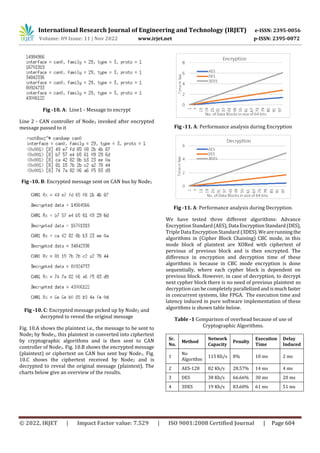
Fig -10. A: Line1 - Message to encrypt
Line 2 - CAN controller of Node1 invoked after encrypted
message passed to it
Fig -10. B: Encrypted message sent on CAN bus by Node1
Fig -10. C: Encrypted message picked up by Node2 and
decrypted to reveal the original message
Fig. 10.A shows the plaintext i.e., the message to be sent to
Node2 by Node1, this plaintext in converted into ciphertext
by cryptographic algorithms and is then sent to CAN
controller of Node1. Fig. 10.B shows the encrypted message
(plaintext) or ciphertext on CAN bus sent buy Node1. Fig.
10.C shows the ciphertext received by Node2 and is
decrypted to reveal the original message (plaintext). The
charts below give an overview of the results.
Fig -11. A: Performance analysis during Encryption
Fig -11. A: Performance analysis during Decryption.
We have tested three different algorithms: Advance
Encryption Standard(AES), Data EncryptionStandard(DES),
Triple Data Encryption Standard (3DES).Wearerunningthe
algorithms in (Cipher Block Chaining) CBC mode, in this
mode block of plaintext are XORed with ciphertext of
pervious of previous block and is then encrypted. The
difference in encryption and decryption time of these
algorithms is because in CBC mode encryption is done
sequentially, where each cypher block is dependent on
previous block. However, in case of decryption, to decrypt
next cypher block there is no need of previous plaintext so
decryption can be completely parallelizedandismuchfaster
in concurrent systems, like FPGA. The execution time and
latency induced in pure software implementation of these
algorithms is shown table below.
Table -1 Comparison of overhead because of use of
Cryptographic Algorithms.
Sr.
No.
Method
Network
Capacity
Penalty
Execution
Time
Delay
Induced
1
No
Algorithm
115 Kb/s 8% 10 ms 2 ms
2 AES-128 82 Kb/s 28.57% 14 ms 4 ms
3 DES 38 Kb/s 66.66% 30 ms 20 ms
4 3DES 19 Kb/s 83.60% 61 ms 51 ms
International Research Journal of Engineering and Technology (IRJET) e-ISSN: 2395-0056
Volume: 09 Issue: 11 | Nov 2022 www.irjet.net p-ISSN: 2395-0072
© 2022, IRJET | Impact Factor value: 7.529 | ISO 9001:2008 Certified Journal | Page 605
In Table 1, entry 1 shows the actual network load achieved
without use of any cryptographic algorithm. AES being the
fastest uses more computation power, followed by DES and
then 3DES. These implementedalgorithmscauseanincrease
in network load because of the limited data size of standard
CAN frame which is overcome by sending multiple CAN
frames for one message. This may not be a problem for low
traffic networks however with the advancement in modern
vehicles there is more integration of sophisticated
technology (Ex: ADAS) the number of ECUs are only goingto
go up. Hence, it is imperative to look for a solution that
satisfies the time-critical needs of CAN bus communication.
4. PRACTICAL IMPLICATIONS
The test-bed can be used to evaluate different proposed
security measures and carry out analysis for areas of
improvement. We have demonstrated test-bed’s
functionality and analysedtheperformanceofcryptographic
algorithms in CAN communication. This test-bed is a
versatile option that facilitates fast paced development and
deployment. Application program can be developedinother
system and then can be directly copied into the memory of
the test-bed. For any fine tuning or changes needed in
program, it can be done directly by accessing the program
through the Linux shell in test-bed. This is helpful when
iterative changes are made to program. The system does not
need to restart every time, all the changes can be made
directly to program while the test-bed is online. Moreover,
this system gives the ability to debug a program which isnot
possible when bare-metal application is created, the error
handling and prompting ability is just another advantage of
this test-bed. This test-bed is intended for evaluation and
development of security measures. Once a satisfactory
analysis is carried out, later a bare-metal application or
RTOS (Real Time Operating System) based solution can be
developed to improve execution speed.
5. CONCLUSION & FUTURE SCOPE
The functionality and viability of the test-bed has been
verified through different experiments. The test-bed is
simple, stable and practical, and thus can be used for further
studies and evaluations. Hardware-based solutions are
better when it comes to performance and security, but are
not versatile. Software based solutions are versatile but
effective only whenhighperformanceCPUsareavailableand
they induce communication delay. Taking advantage of high
level of parallelism offered by FPGA and flexibility of
Embedded Systems it is possibletocomewitha versatile and
high-performance security solutions. Based on the findings
of subsequent tests, the primary goal would be to
concentrate on creatinga workablesolutionforsafeguarding
CAN Bus communications.
REFERENCES
[1] OpenCores SJA1000 controller. Available at:
https://canbus.pages.fel.cvut.cz/
[2] Koscher, Karl, et al. "Experimental security analysis of a
modern automobile." 2010 IEEE Symposium on Security and
Privacy. IEEE Computer Society, 2010.
[3] Bozdal, Mehmet, et al. "Evaluation of can bus security
challenges." Sensors 20.8 (2020): 2364
[4] Lin, Chung-Wei, and Alberto Sangiovanni-Vincentelli.
"Cyber-security for the controller area network (CAN)
communication protocol." 2012 International Conference on
Cyber Security. IEEE, 2012.
[5] Szilagy, Chris, and Philip Koopman. "A flexible approach
to embedded network multicast authentication." (2008).
[6] Huang, Tianxiang, et al. " ATG: An Attack Traffic
Generation Tool for Security Testing of In-vehicle CAN
Bus"(2018)
[7] Payne, Bryson R. (2019) "Car Hacking: Accessing and
Exploiting the CAN Bus Protocol," Journal of Cybersecurity
Education, Research and Practice: Vol. 2019 : No. 1 , Article 5
[8] K. Koscher et al., ``Experimental security analysis of a
modern automobile,''in Proc. IEEE Symp. Secur. Privacy,
Oakland, CA, USA, May 2010,pp. 447_462.
[9] (2014). The Lockheed Martin Cyber Kill Chain. [Online].
Available
:http://cyber.lockheedmartin.com/hubfs/Gaining_the_Adva
ntage_Cyber_Kill_Chain.pdf
[10] H. Gustavsson and J. Axelsson, ``Evaluating _exibility in
embedded automotive product lines using real options,'' in
Proc. 12th Int. Softw. Product Line Conf., Sep. 2008, pp.
235_242.
[12] K. Koscher et al., ``Experimental security analysis of a
modern automobile,'' in Proc. IEEE Symp. Secur. Privacy,
Oakland, CA, USA, May 2010, pp. 447_462.
[13] S. Woo, H. J. Jo, and D. H. Lee, ``A practical wireless
attack on the connected car and security protocol for in-
vehicle CAN,'' IEEE Trans. Intell. Transp. Syst., vol. 16, no. 2,
pp. 993_1006, Apr. 2015.
[14] J. Schmandt, A. T. Sherman,andN.Banerjee,``Mini-MAC:
Raising the bar for vehicular security with a lightweight
message authentication protocol,'' Veh. Commun., vol. 9, pp.
188_196, Jul. 2017.
[15] H. Abdulmalik and B. Luo, ``Using ID-hopping to defend
against targeted DoS on CAN,'' in Proc. 1st Int. WorkshopSafe
Control Connected Auton. Vehicles, 2017, pp. 19_26.
International Research Journal of Engineering and Technology (IRJET) e-ISSN: 2395-0056
Volume: 09 Issue: 11 | Nov 2022 www.irjet.net p-ISSN: 2395-0072
© 2022, IRJET | Impact Factor value: 7.529 | ISO 9001:2008 Certified Journal | Page 606
[16] L. Martin, P. Mundhenk, and S. Steinhorst, ``Security-
aware obfuscated priority assignment for automotive CAN
platforms,'' ACM Trans. Des Automat. Electron. Syst., vol. 21,
no. 2, pp. 1_27, 2016.
[17] P.-S. Murvay and B. Groza, ``DoS attacks on controller
area networks by fault injectionsfromthesoftwarelayer,'' in
Proc. 12th Int. Conf.Availability, Rel. Secur., 2017, p. 71.
[19] Guido Bertoni, Joan Daemen, Michael Peeters,andGilles
Van Assche. Keccak Specifications, 2009.
[18] S. Woo, D. Moon, T. -Y. Youn, Y. Lee and Y. Kim, "CAN ID
Shuffling Technique (CIST): Moving Target DefenseStrategy
for Protecting In-Vehicle CAN," in IEEE Access, vol. 7, pp.
15521-15536, 2019, doi: 10.1109/ACCESS.2019.2892961.
[20] Bellare, M., Rogaway, P. (1994). Entity Authentication
and Key Distribution. In: Stinson, D.R. (eds) Advances in
Cryptology — CRYPTO’ 93. CRYPTO 1993. Lecture Notes in
Computer Science, vol 773. Springer, Berlin, Heidelberg.
https://doi.org/10.1007/3-540-48329-2_21
[21] Elinux.org. Available at:
https://elinux.org/index.php?title=Python_Can&action=edit
[22] Digilent, Inc. Available at:
https://digilent.com/reference/programmable-
logic/zybo/start

Implementation of CAN on FPGA for Security Evaluation Purpose

  • 1.
    International Research Journalof Engineering and Technology (IRJET) e-ISSN: 2395-0056 Volume: 09 Issue: 11 | Nov 2022 www.irjet.net p-ISSN: 2395-0072 © 2022, IRJET | Impact Factor value: 7.529 | ISO 9001:2008 Certified Journal | Page 600 Implementation of CAN on FPGA for Security Evaluation Purpose Student, Dept. of Electronics Engineering, Shri Ramdeobaba College of Engineering and Management, Nagpur, Maharashtra, India ---------------------------------------------------------------------***--------------------------------------------------------------------- Abstract - Controller Area Network (CAN) is a low-cost communication protocol which is being used in various applications like automotive, medical, military, aviation, etc. Current CAN applications are based on the standard CAN 2.0 protocol. It was not designed for secure communication; although, it offers built-in error detection, robustness, speed and flexibility, the security side of CAN communication is highly underdeveloped. Research on in-vehicle CAN security primitives is difficult as it is hard to get a real vehicle for evaluation and development of these security primitives. The cost of research is considerably high, for some researchersthis creates a barrier, acting as a deterrence. This paper presents implementation of CAN on FPGA and evaluation of cryptographic algorithms as a security measure in CAN bus communication. Key Words: FPGA, CAN bus, SJA1000, Xilinx Zynq, PetaLinux, ZYBO, Evaluation, Security. 1. INTRODUCTION If we consider only automobiles, there could be as many as 100 Electronic Control Units (ECUs) all communicating through a single CAN bus system. Despite the functional benefits, the CAN bus system is vulnerable to cyber-attacks like replay attacks, denial-of-service,andman-in-the-middle attacks. Security of any network can be assessed on three attributes: confidentiality, integrity, andauthentication.Many researchers have demonstrated various successful attacks which showed that CAN bus fails in all these three parameters [2,17,13]. Manufacturers understand these vulnerabilities and have started implementing security measures like, Network Segmentation, Intrusion Detection System, Software-based encryption methods. But all these are computation intensive, have their own vulnerabilities, and are slower, thus reducing the data transferrateofsucha time-critical system. And as pointed out by [3], considering the lifetime of a vehicle, it is possibletofindvulnerabilities in above mentioned measures and crack a static encryption key. For high stake applications like military-equipment, vehicles, aircraft such vulnerabilities are not acceptable. A lot of research has been done in securing CAN communications[14-18];however,these proposedsolutions have their own limitations and vulnerabilities. Developing a system that is able to meet resource constraints put by CAN communication system is a real challenge. ModerndayECUs are relatively efficient and fast compared to the ones used a decade ago, hence some of the solutions proposed by some authors could be a viable option with some performance enhancing tweaks. However, a thorough evaluation of these proposed methods is needed in order to explore the areasof improvements. This is a laborious, complicated and time- consuming process, to streamline this process a versatile test-bed is needed that speeds up the entire chain of implementation, evaluation, and development and deployment. FPGAs based solutions can help to address these challenges by enabling trueflexibilityandscalabilityto address the security requirements of CAN bus with inherent hardware and software programmability. Rather than creating a bare-metal application to run on FPGA emulated CAN controller, we rely on a test-bed thatrunsa light-weight Linux kernel on top. Bare-metal application are difficult to debug as there are no fault management and error notifications unless they have been explicitly implemented and validated. Given the scope of ourapplicationitisdifficult to figure out what exactly could go wrong, hence the need of a test-bed that has error handling and prompting abilities is needed, this allows for speedy debugging and evaluation of the proposed solutions, and speed up the development of new ones. In our experimental test-bed, we have used OpenCores SJA1000 controller, that has been modified to ignore CAN FD frames. This version of SJA1000 is modified by Czech Technical University, Prague (CTU) [1] and allows this controller to co-exist and send data on CAN FD network. 2. SYSTEM DESIGN The test-bed is built in two parts: hardware and software. The design of hardware is done using Xilinx Vivado Design Suite and is implemented on ZYBO (ZYnq BOard) that uses Zynq All Programmable System on Chip Architecture. The SoC design has two subsystems: Processing System (PS) and Programmable Logic(PL).ThePS,isZynq-7000,hassoftware programmability features and takes over the job of controlling and communicating with PL. PL is Xilinx Artix-7 FPGA with configurable ports and buses, and has hardware modules that are being emulated. The software design is done with the help of PetaLinuxSDKtostreamlineembedded Linux development. This tool helps us to develop a Bootable System Image that consists ofa custom CPU-optimizedLinux kernel, device drivers and bootloader configurations. The test-bed is now ready forfurther implementation,evaluation and development of security measures for CAN bus communications.Thissectionfurtherdiscussestheimportant elements of hardware and software design. Rohit Pawar
  • 2.
    International Research Journalof Engineering and Technology (IRJET) e-ISSN: 2395-0056 Volume: 09 Issue: 11 | Nov 2022 www.irjet.net p-ISSN: 2395-0072 © 2022, IRJET | Impact Factor value: 7.529 | ISO 9001:2008 Certified Journal | Page 601 2.1 Hardware Design The hardware consists of SJA1000 controller, TJA1050 CAN trans-receiver, Zynq 7000 SoC, and other periphery circuits required for implementation of test-bed. Multiple instances of this test-bed can be used to connect and communicate on a CAN bus line for analysis and evaluation of different security measures. For the demonstration of communication between two CAN nodes; Node1 and Node2 over the CAN bus, we perform a simple signal detection experiment. When input is given to any one of the nodes by pressing the switch, for instance consider Node1, CAN communication is triggered and a data-framecorresponding to the signal is transmitted over the CAN bus, this signal data-frame is picked up by Node2, it interpretsitandtheLED assigned to the switch, turns on or off. i.e., the LED of one node is controlled by another node. Fig. 1 shows the block diagram of a CAN node. Fig -1: Block Diagram of Test-bed. 2.1.1 SJA1000 It is a stand-alone controller for the Controller Area Network (CAN), mostly used within automotive and general industrial environments. It has both CAN 2.0A (Standard CAN) and 2.0B (Extended CAN) protocol support, with bitrates up to 1 Mb/s. The SJA1000 that is used inthisproject is CAN FD tolerant and is written in Verilog language [1]. It contains transmission buffer (TXB), receiving buffer (RXB), bit timing logic (BTL), acceptance filter (ACF), bit stream processor (BSP), error management logic (EML), and interface management logic (IML). It uses an APB interface for on chip communication with master (i.e., the processing system). SJA1000 appears to a master as a memory-mapped I/O device. Independent operation of both devices is guaranteed byaRAM-likeimplementationofitsregisters.Fig. 2 shows schematicdiagramoftheimplementedSJA1000CAN controller. Fig -2: Schematic of Implemented SJA1000 CAN Controller 2.1.2 TJA1050 CAN transreceiver It is an interface between CAN controller and physical bus. It provides differential transmit and differential receive capability to the CAN controller. It converts the Tx and Rx signal of controller to CANH and CANL signal. It offers good performance when it comes to optimal matching of output signals (CANH, CANL). The figure below shows block diagram of TJA1050. 2.1.3 Processing System Zynq-7000 processing system (PS) is the master and an instance of SJA1000 in PL is the slave. Communication between master and slave on the SoC is done through AXI and APB buses respectively. AXI is designed for communication between blocks of IP on FPGA. AXI interconnect IP is used to connect one or more AXI memory- mapped master devices to one or more memory-mapped slave devices. The SJA1000 IP has APB interface, suitable for low-speed communication. An AXI-APB bridge is needed to connect this APB slave to the AXI master. Interrupts coming from the CAN controller is connected to the PL-PS interrupt port of the processing system. Tx and Rx signals of the CAN controller are mapped to IO pinsconnectedtothehighspeed Pmod (peripheral module) ports on the board, it is an open standard defined by Digilent Inc. for connecting peripheral modules to FPGA. The Tx-Rx pair of the controller is converted to CANH and CANL signal by the transceiver module connected to Pmod port. Configuration and control of CAN controller is done by the PS usinga drivercode which accesses the controller using the virtual memory address. Driver program is required for mode selection, reading and writing messages to the controller, etc. A top-level application is required to read sensor values, manage keys and construct messages. A standalone application could be created for this purpose but as discussed earlier our application requires a different approach. The custom Linux kernel in the system has support for Python, C, and C+, this allows for rapid development anddeploymentofapplication program. The interface circuit diagram of our system is shown below.
  • 3.
    International Research Journalof Engineering and Technology (IRJET) e-ISSN: 2395-0056 Volume: 09 Issue: 11 | Nov 2022 www.irjet.net p-ISSN: 2395-0072 © 2022, IRJET | Impact Factor value: 7.529 | ISO 9001:2008 Certified Journal | Page 602 Fig -3: Interface Diagram of the Test-bed not using transreceiver 2.2 Software Design The processor in the Processing System boots first, this allows for a software centric approach for Programmable Logic configuration which is managed by a programrunning on the CPU. After it starts, the Linux kernel probes the devices in the system, it gets to know about the devices present in the system from the Device Tree. A device's existence in the system, its location on the bus from which it may be accessed, and its configuration—including its registers, interrupts, and other settings—are all specified in the device tree entry. Device tree entry of SJA1000 is shown below. Field called ‘compatible’isusedtospecifythe nameof the driver associated to the device, ‘interrupts-’ field specifies on which pin number the interrupt of device is connected and reg specifies the address of device. Code Snippet: sja1000_0: sja1000@43c00000 { compatible = "nxp, sja1000"; interrupt-names="irq"; interrupt-parent = <&intc>; interrupts = <0 29 4>; reg = <0x43c00000 0x10000>; reg-to-width = <4>; status = "okay"; nxp, external-clock-frequency = <100000000>; }; The software realization of CAN node communication is done in two parts: Initializing the SJA1000 CAN controller and creating an application program that can access the controller for establishing communication with other nodes on CAN bus. 2.2.1 Initializing SJA1000 CAN controller The system at this stage is ready to send all data and receive all data using default arbitration ID(0x001),without filtering any messages, owing to the default filter register values of the SJA1000 controllersetbytheSocketCAN device driver. Without changingthe defaultfilterregistervalues, we can directly access the controller through command line interface (CLI) to send/receive data to/from the bus. Another way is to set the values of filter register before initializing the CAN controller. Both of these methods are discussed below. A. Direct access to CAN controller: This can be done at OS level using CLI as well as at application program level. For simplicity, we show this process done at OS level, by executing the following command. Fig -4: Initializing two instances of SJA1000 CAN controller. After initialization, the CAN controller can be now be directly accessed to send and receivemessage,alongwith a custom or default arbitration ID. The direct access method is helpful when we wish to receive and analyse all the data broadcasted over the CAN bus. The figure belowshowsthe execution. Fig -5: can1 (Node2) sending data over CAN bus using ID (0x123) Fig -6: can0 (Node1) receiving data over CAN bus from CAN node having ID (0x123) B. By changing filter register values: SocketCAN driverdoes not have support for writing the filter registers of the CAN controller by the user. Since the registersare writtenatthe time of insertion of device driver module and can’t be changed frequently, the values of all four Acceptance Code Register (ACR) and all four Acceptance Mask Register (ACR) are hard coded as all zeros and all ones respectively, which means all the messages on the bus will be received and sent in FIFO manner. In the SocketCAN driver,filtering is done at the kernel layer which doesn’t make sense for our application since we have actual CAN protocol controller IP on the chip. We have modified he kernel module code, which allows us to change values of filter registers. The shell command below shows the process of changing filter register values after kernel module code modification.
  • 4.
    International Research Journalof Engineering and Technology (IRJET) e-ISSN: 2395-0056 Volume: 09 Issue: 11 | Nov 2022 www.irjet.net p-ISSN: 2395-0072 © 2022, IRJET | Impact Factor value: 7.529 | ISO 9001:2008 Certified Journal | Page 603 Fig -7: Shows process to change filter register values 2.2.2 Program for sending and receiving message After the initialization of CAN controller, the system is ready to take part in communication. Apart from directly sending data throughshell command, writinganapplication- based program helps in realizing autonomous communication. The message that is written to or read from CAN data-frame depends on the purpose of application. Fig -8: Program design flow 3. SYSTEM TEST To ensure the functionality and viability of test-bed we carried out following tests. 3.1 Switch status transfer using CAN bus between two nodes Communication tests were performed with and without using transreceiver for further evaluation. In this test discussed here, instead of using transceiver modules wecan emulate the transceiver operation simply by ANDing the Tx signals from the two controllers. For this purpose, we use a two input AND gate. Tx signal of both the controllers are given as inputs to the AND gate and its output is connected to the Rx of both the controllers. This allows for successful arbitration. After the initialization of the system, we run our script in Linux shell of our test-bed. Python application running at the top level accessesthememorymappedGPIOs. It reads sensor values, decides message identifier and attaches the corresponding count value to construct the message according to the protocol. Then it sends the message to the controller through SocketCAN and reads the received message from the controller. The program enables two CAN nodes to communicate. When input is given to Node1 by flipping switch, this input signal is sent over CAN bus and is received by Node2, Node2 then extracts the signal message from CAN data-frame and turns on its LED that is assigned to the switch of Node1. In short, the LEDs of Node2 is controlled by Node1 and vice-versa. Fig.9 shows the demonstration. For this test, acceptancefilterregistervalues were changed so that each node accepts data frame from another node and filters out its own data frame. Fig -9. A: Message sent over CAN bus Fig -9. B: Switch status transfer between two CAN nodes In Fig. 9.A and 9.B CAN nodes on left (Node1) with identifier <0x128> sends message 0x06 to Node2 and CAN nodes on right (Node2) withidentifier <0x120>sendsmessage0x09to Node1. The received messages contain the status of the switch and depending upon the status, corresponding LEDs are turned on. The switches highlighted in blue are in off state and the ones highlighted in green are in on state, their status can be seen other board. 3.2 Ciphertext over CAN Bus Cryptographic algorithms were evaluatedontest-bedfor evaluation of its performance. Algorithm wereimplemented on application layer. A time-delay analysiswasperformedto see the delay caused by inclusion of these algorithms in communication. This delay included time taken for sending and receiving message over CAN bus, time needed for encryption and decryption of message. An overview of this operation is shown below. For this test a bit-rate 125Kb/s was used for reference and of multipleiterationsoftestwere performed with 1000 random messages in each test. Create a socket and bind it to CAN interface Triggering Communi- cation Writing and Reading CAN Frame Perform memory mapping of peripherals
  • 5.
    International Research Journalof Engineering and Technology (IRJET) e-ISSN: 2395-0056 Volume: 09 Issue: 11 | Nov 2022 www.irjet.net p-ISSN: 2395-0072 © 2022, IRJET | Impact Factor value: 7.529 | ISO 9001:2008 Certified Journal | Page 604 Fig -10. A: Line1 - Message to encrypt Line 2 - CAN controller of Node1 invoked after encrypted message passed to it Fig -10. B: Encrypted message sent on CAN bus by Node1 Fig -10. C: Encrypted message picked up by Node2 and decrypted to reveal the original message Fig. 10.A shows the plaintext i.e., the message to be sent to Node2 by Node1, this plaintext in converted into ciphertext by cryptographic algorithms and is then sent to CAN controller of Node1. Fig. 10.B shows the encrypted message (plaintext) or ciphertext on CAN bus sent buy Node1. Fig. 10.C shows the ciphertext received by Node2 and is decrypted to reveal the original message (plaintext). The charts below give an overview of the results. Fig -11. A: Performance analysis during Encryption Fig -11. A: Performance analysis during Decryption. We have tested three different algorithms: Advance Encryption Standard(AES), Data EncryptionStandard(DES), Triple Data Encryption Standard (3DES).Wearerunningthe algorithms in (Cipher Block Chaining) CBC mode, in this mode block of plaintext are XORed with ciphertext of pervious of previous block and is then encrypted. The difference in encryption and decryption time of these algorithms is because in CBC mode encryption is done sequentially, where each cypher block is dependent on previous block. However, in case of decryption, to decrypt next cypher block there is no need of previous plaintext so decryption can be completely parallelizedandismuchfaster in concurrent systems, like FPGA. The execution time and latency induced in pure software implementation of these algorithms is shown table below. Table -1 Comparison of overhead because of use of Cryptographic Algorithms. Sr. No. Method Network Capacity Penalty Execution Time Delay Induced 1 No Algorithm 115 Kb/s 8% 10 ms 2 ms 2 AES-128 82 Kb/s 28.57% 14 ms 4 ms 3 DES 38 Kb/s 66.66% 30 ms 20 ms 4 3DES 19 Kb/s 83.60% 61 ms 51 ms
  • 6.
    International Research Journalof Engineering and Technology (IRJET) e-ISSN: 2395-0056 Volume: 09 Issue: 11 | Nov 2022 www.irjet.net p-ISSN: 2395-0072 © 2022, IRJET | Impact Factor value: 7.529 | ISO 9001:2008 Certified Journal | Page 605 In Table 1, entry 1 shows the actual network load achieved without use of any cryptographic algorithm. AES being the fastest uses more computation power, followed by DES and then 3DES. These implementedalgorithmscauseanincrease in network load because of the limited data size of standard CAN frame which is overcome by sending multiple CAN frames for one message. This may not be a problem for low traffic networks however with the advancement in modern vehicles there is more integration of sophisticated technology (Ex: ADAS) the number of ECUs are only goingto go up. Hence, it is imperative to look for a solution that satisfies the time-critical needs of CAN bus communication. 4. PRACTICAL IMPLICATIONS The test-bed can be used to evaluate different proposed security measures and carry out analysis for areas of improvement. We have demonstrated test-bed’s functionality and analysedtheperformanceofcryptographic algorithms in CAN communication. This test-bed is a versatile option that facilitates fast paced development and deployment. Application program can be developedinother system and then can be directly copied into the memory of the test-bed. For any fine tuning or changes needed in program, it can be done directly by accessing the program through the Linux shell in test-bed. This is helpful when iterative changes are made to program. The system does not need to restart every time, all the changes can be made directly to program while the test-bed is online. Moreover, this system gives the ability to debug a program which isnot possible when bare-metal application is created, the error handling and prompting ability is just another advantage of this test-bed. This test-bed is intended for evaluation and development of security measures. Once a satisfactory analysis is carried out, later a bare-metal application or RTOS (Real Time Operating System) based solution can be developed to improve execution speed. 5. CONCLUSION & FUTURE SCOPE The functionality and viability of the test-bed has been verified through different experiments. The test-bed is simple, stable and practical, and thus can be used for further studies and evaluations. Hardware-based solutions are better when it comes to performance and security, but are not versatile. Software based solutions are versatile but effective only whenhighperformanceCPUsareavailableand they induce communication delay. Taking advantage of high level of parallelism offered by FPGA and flexibility of Embedded Systems it is possibletocomewitha versatile and high-performance security solutions. Based on the findings of subsequent tests, the primary goal would be to concentrate on creatinga workablesolutionforsafeguarding CAN Bus communications. REFERENCES [1] OpenCores SJA1000 controller. Available at: https://canbus.pages.fel.cvut.cz/ [2] Koscher, Karl, et al. "Experimental security analysis of a modern automobile." 2010 IEEE Symposium on Security and Privacy. IEEE Computer Society, 2010. [3] Bozdal, Mehmet, et al. "Evaluation of can bus security challenges." Sensors 20.8 (2020): 2364 [4] Lin, Chung-Wei, and Alberto Sangiovanni-Vincentelli. "Cyber-security for the controller area network (CAN) communication protocol." 2012 International Conference on Cyber Security. IEEE, 2012. [5] Szilagy, Chris, and Philip Koopman. "A flexible approach to embedded network multicast authentication." (2008). [6] Huang, Tianxiang, et al. " ATG: An Attack Traffic Generation Tool for Security Testing of In-vehicle CAN Bus"(2018) [7] Payne, Bryson R. (2019) "Car Hacking: Accessing and Exploiting the CAN Bus Protocol," Journal of Cybersecurity Education, Research and Practice: Vol. 2019 : No. 1 , Article 5 [8] K. Koscher et al., ``Experimental security analysis of a modern automobile,''in Proc. IEEE Symp. Secur. Privacy, Oakland, CA, USA, May 2010,pp. 447_462. [9] (2014). The Lockheed Martin Cyber Kill Chain. [Online]. Available :http://cyber.lockheedmartin.com/hubfs/Gaining_the_Adva ntage_Cyber_Kill_Chain.pdf [10] H. Gustavsson and J. Axelsson, ``Evaluating _exibility in embedded automotive product lines using real options,'' in Proc. 12th Int. Softw. Product Line Conf., Sep. 2008, pp. 235_242. [12] K. Koscher et al., ``Experimental security analysis of a modern automobile,'' in Proc. IEEE Symp. Secur. Privacy, Oakland, CA, USA, May 2010, pp. 447_462. [13] S. Woo, H. J. Jo, and D. H. Lee, ``A practical wireless attack on the connected car and security protocol for in- vehicle CAN,'' IEEE Trans. Intell. Transp. Syst., vol. 16, no. 2, pp. 993_1006, Apr. 2015. [14] J. Schmandt, A. T. Sherman,andN.Banerjee,``Mini-MAC: Raising the bar for vehicular security with a lightweight message authentication protocol,'' Veh. Commun., vol. 9, pp. 188_196, Jul. 2017. [15] H. Abdulmalik and B. Luo, ``Using ID-hopping to defend against targeted DoS on CAN,'' in Proc. 1st Int. WorkshopSafe Control Connected Auton. Vehicles, 2017, pp. 19_26.
  • 7.
    International Research Journalof Engineering and Technology (IRJET) e-ISSN: 2395-0056 Volume: 09 Issue: 11 | Nov 2022 www.irjet.net p-ISSN: 2395-0072 © 2022, IRJET | Impact Factor value: 7.529 | ISO 9001:2008 Certified Journal | Page 606 [16] L. Martin, P. Mundhenk, and S. Steinhorst, ``Security- aware obfuscated priority assignment for automotive CAN platforms,'' ACM Trans. Des Automat. Electron. Syst., vol. 21, no. 2, pp. 1_27, 2016. [17] P.-S. Murvay and B. Groza, ``DoS attacks on controller area networks by fault injectionsfromthesoftwarelayer,'' in Proc. 12th Int. Conf.Availability, Rel. Secur., 2017, p. 71. [19] Guido Bertoni, Joan Daemen, Michael Peeters,andGilles Van Assche. Keccak Specifications, 2009. [18] S. Woo, D. Moon, T. -Y. Youn, Y. Lee and Y. Kim, "CAN ID Shuffling Technique (CIST): Moving Target DefenseStrategy for Protecting In-Vehicle CAN," in IEEE Access, vol. 7, pp. 15521-15536, 2019, doi: 10.1109/ACCESS.2019.2892961. [20] Bellare, M., Rogaway, P. (1994). Entity Authentication and Key Distribution. In: Stinson, D.R. (eds) Advances in Cryptology — CRYPTO’ 93. CRYPTO 1993. Lecture Notes in Computer Science, vol 773. Springer, Berlin, Heidelberg. https://doi.org/10.1007/3-540-48329-2_21 [21] Elinux.org. Available at: https://elinux.org/index.php?title=Python_Can&action=edit [22] Digilent, Inc. Available at: https://digilent.com/reference/programmable- logic/zybo/start