Article
Impact of di-(2-ethylhexyl) phthalate
on the uterus of adult Wistar rats
DB Somasundaram1,2
, K Manokaran1,2
, BC Selvanesan1,2
and RS Bhaskaran1,2
Abstract
Di-(2-ethylhexyl) phthalate (DEHP) is the most common plasticizer used in polyvinyl chloride-based plastics.
DEHP is not covalently bound to the plastics and is easily released to the environment, resulting in human
exposure. In this study, the adult rats were exposed to DEHP and its effects on the uterus was evaluated.
Healthy adult female rats were treated with DEHP orally (with dose level 0, 1, 10, and 100 mg/kg body
weight/day) for 30 days. No significant changes in the body weight and wet uterine weight were observed.
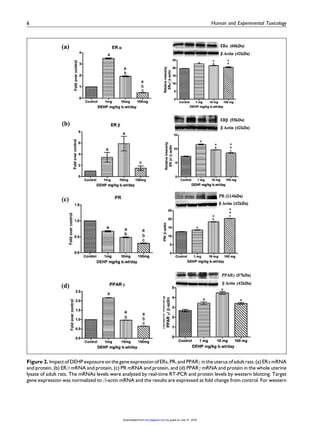
Ovarian hormones and their receptor levels in the uterus were increased. Histological studies exhibited the
structural abnormalities such as decrease in diameter, thinning of the layers and disruption in the glandular
epithelium.
Keywords
DEHP, estrogen receptors, progesterone receptors, PPAR, uterus
Introduction
Phthalates are alkyl diesters of phthalic acid, termed
based on the lengths of the alkyl chains, they are used
to impart flexibility in plastic or as a matrix in cos-
metic products. Phthalates are not covalently bound to
the plastic and thus leach into the environment over
time where they become ubiquitous contaminants.1
Phthalates, including the widely used plasticizer,
di-(2-ethylhexyl) phthalate (DEHP), are the most abun-
dant pollutants in our general environment. DEHP
remains to be components of food wraps, medical
devices, and many cosmetic products. The Agency
for Toxic Substances and Disease Registry evaluated
that the maximum daily exposure to DEHP for the
general population is about 2 mg/day.2
After ingestion
in rodents, DEHP is hydrolyzed by lipases to mono
2-ethyl hexyl phthalate (MEHP) and 2-ethylhexanol
in the digestive tract prior to absorption.3
In vivo studies demonstrated that ovary is the target
site for DEHP and hence decrease the estradiol pro-
duction. DEHP acts through peroxisome proliferator-
activated receptor (PPAR) and other aryl hydrogen
receptors. Decreased expression of aromatase as a
result of PPARg activation and increased 17
-HSD
expression as a result of PPARa activation may be
responsible for the change in steroidogenesis.3
A relative increase in estrone production and a
decrease in estradiol production from mouse follicles
were observed with MEHP treatment.4
DEHP (2 g/kg) treatment to Sprague-Dawley rats
decreased serum estradiol levels, prolonged estrous
cycles, and no ovulation.5
In vivo studies in rats
showed that DEHP (300 and 600 mg/kg) significantly
decreased the estradiol level and also the aromatase
mRNA and protein levels.6
In mice, Antral follicles
from adult mice cultured with DEHP and MEHP
inhibited follicle growth, estradiol production and
decreased aromatase mRNA levels. Interestingly,
estradiol co-treatment prevented phthaltes-induced
inhibition of follicle growth and estradiol production.7
1
Department of Endocrinology, Dr. ALM Post Graduate Institute
of Basic Medical Sciences, University of Madras, Taramani, Chennai,
Tamil Nadu, India
2
School of Allied Health Sciences, Manipal University, Manipal,
Karnataka, India
Corresponding author:
RS Bhaskaran, Department of Endocrinology, Dr. ALM PG IBMS,
University of Madras, Taramani Campus, Chennai, Tamil Nadu
600113, India.
Email: bravisankar@yahoo.com
Human and Experimental Toxicology
1–8
ª The Author(s) 2016
Reprints and permission:
sagepub.co.uk/journalsPermissions.nav
DOI: 10.1177/0960327116657601
het.sagepub.com
by guest on July 31, 2016het.sagepub.comDownloaded from
The perinatal exposure to estradiol compounds or
related endocrine disrupting chemicals (EDCs) pro-
duced lesions in adult uteri that including cystic endo-
metrial hyperplasia, squamous metaplasia,
adenomyosis, and myometrial and general uterine
hypoplasia.8
There are reports documenting the interactions
between PPARg and estrogen signaling or uterine
physiology. It has been shown that activation of
PPARg inhibits the growth of uterine leiomyoma,
which is also an estrogen-dependent disease.9
The major target organ for ovarian hormones is
uterus. When the ovary is the target for these EDCs,
eventually it will affect the uterus in bringing some
abnormal changes. The reports on DEHP affecting the
uterus of adult female rats during the cycling condi-
tion are very scarce. DEHP effect on the uterus at a
low concentration level is less clear, although it may
cause uterine related impairments. Several studies
proved DEHP-altered ovarian steroidogenesis and its
action on its target organs. The current study focuses
on the effects of DEHP on the uterus through ovarian
hormones action. In the present study, DEHP doses
were selected were within the range of normal to
occupational exposure levels in humans. Our data
suggests that the change in ovarian hormones levels
in DEHP-treated groups also altered steroid hormone
receptor expression in the uterus. Histoarchitecture of
uterine showed disintegrated epithelial cells, which
suggests that DEHP to affect the uterus through estro-
genic action.
Materials and methods
Chemicals
DEHP or dioctyl phthalate with !99.5% purity
(D201154; CAS no. 117-81-7; 500 ml) was purchased
from Sigma-Aldrich (St Louis, Missouri, USA). All
other chemicals and reagents used in this study were
of analytical grade and were purchased from Sisco
Research Laboratories (Mumbai, Maharashtra, India).
Antibodies were purchased from Santa Cruz Biotech-
nology Inc. (Santa Cruz, California, USA).
-Actin
antibody was purchased from Sigma-Aldrich.
Animals
Animals were maintained as per the National Guide-
lines and Protocols approved by the Institutional Ani-
mal Ethical Committee (IAEC No. 01/01/10). Female
Wistar adult rats, weighing around 150–200 g were
used in this study. Animals were housed in polypro-
pylene cages under specific humidity (65 + 5%) and
temperature (21 + 2
C) with constant 12-h light/12-h
dark schedule. They were fed with standard rat-
pelleted diet (Lipton India, Mumbai, Maharashtra,
India), and clean drinking water was made available
ad libitum.
Dose selection and treatment
The adult female rats were administered with DEHP
by gavage at different dose of 0 (olive oil), 1, 10, and
100 mg/kg body weight/day for 30 days. The dose
range was selected based on the reference value close
to the predictable, normal to occupational exposure to
the human population. This is based on the formula
that suggestively converse chemical exposure to var-
ious species by considering body surface area and
metabolism.10
Fresh solutions were prepared daily
according to the weight of rats. The dose volume was
0.2 ml in all groups. The rats in the vehicle control
group received olive oil in equal volume as in experi-
mental groups for 30 days. During the treatment
period, body weight and estrous cycles were moni-
tored. After treatment, the animals were weighed and
killed; trunk blood was collected, centrifuged at 3000
g for 10 min at 4
C and stored at À80
C for the
estimation of serum hormones. The uterus was
excised immediately and adjacent fat tissues were
removed, weighed, and immediately used for RNA
and protein isolation. One uterine horn from each rat
was fixed in 10% formalin for histopathological
evaluation.
Serum progesterone and estradiol assay
Serum progesterone and estradiol concentrations were
measured using Direct ELISA kits (Diagnostic Bio-
chem Canada Inc., Ontorio, Canada), according to the
manufacturer’s instructions. ELISA plates were read
in BioTek plate reader (Winooski, Vermont, USA).
Samples and standards were analyzed in duplicate.
The sensitivity of progesterone and estradiol ELISA
kits were 0.1 ng/ml and 10 pg/ml, respectively. The
intra- and inter-assay coefficients of variation were
10.6% and 12.6, respectively, for progesterone and
9.3% and 10.1% for estradiol.
Histology of uterine structure
The uterine tissue was fixed in 10% formalin and with
paraffin, sectioned at 7 mm, and stained with
2 Human and Experimental Toxicology
by guest on July 31, 2016het.sagepub.comDownloaded from
hematoxylin and eosin for microscopic examination.
Sections were then captured using a Nikon eclipse 80i
microscope and differentiated (Chiyoda, Tokyo,
Japan).
Total RNA extraction and real-time RT-PCR
Total RNA was extracted from the uterus by a single-
step technique using TRI Reagent (Sigma-Aldrich)
according to the manufacturer’s protocol. The quan-
tity and the integrity of total RNA was determined by
ultraviolet spectrophotometer and agarose gel electro-
phoresis, respectively. Reverse transcription (RT) was
done using M-MuLV Reverse Transcriptase enzyme
(NEB, Ipswich, Massachusetts, USA). For cDNA
synthesis, 2 mg of total RNA was reverse transcribed
using random hexamer primers and MMLV-RT
enzyme. The cDNA was subsequently used for real-
time reverse transcriptase polymerase chain reaction
(RT-PCR) using the Mesa Green qPCR kit (Eurogen-
tec, Fremont, California, USA) with gene-specific
primers (Table 1). The real-time RT-PCR was
performed on a CFX 96 Touch Real-Time PCR
(Bio-Rad, Hercules, California, USA) with the PCR
conditions as given in Table 2. The specificity of the
amplification product was determined by melting
curve analysis for each primer pairs. The data were
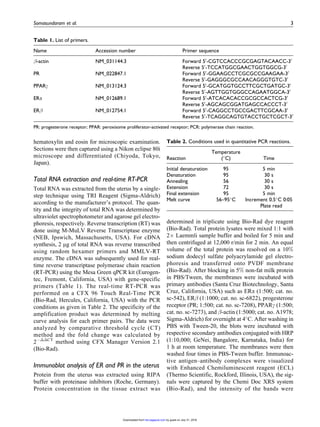
analyzed by comparative threshold cycle (CT)
method and the fold change was calculated by
2ÀÁÁCT
method using CFX Manager Version 2.1
(Bio-Rad).
Immunoblot analysis of ER and PR in the uterus
Protein from the uterus was extracted using RIPA
buffer with proteinase inhibitors (Roche, Germany).
Protein concentration in the tissue extract was
determined in triplicate using Bio-Rad dye reagent
(Bio-Rad). Total protein lysates were mixed 1:1 with
2Â Laemmli sample buffer and boiled for 5 min and
then centrifuged at 12,000 r/min for 2 min. An equal
volume of the total protein was resolved on a 10%
sodium dodecyl sulfate polyacrylamide gel electro-
phoresis and transferred onto PVDF membrane
(Bio-Rad). After blocking in 5% non-fat milk protein
in PBS/Tween, the membranes were incubated with
primary antibodies (Santa Cruz Biotechnology, Santa
Cruz, California, USA) such as ERa (1:500; cat. no.
sc-542), ER
(1:1000; cat. no. sc-6822), progesterone
receptor (PR; 1:500; cat. no. sc-7208), PPARg (1:500;
cat. no. sc-7273), and
-actin (1:5000; cat. no. A1978;
Sigma-Aldrich) for overnight at 4
C. After washing in
PBS with Tween-20, the blots were incubated with
respective secondary antibodies conjugated with HRP
(1:10,000; GeNei, Bangalore, Karnataka, India) for
1 h at room temperature. The membranes were then
washed four times in PBS-Tween buffer. Immunoac-
tive antigen–antibody complexes were visualized
with Enhanced Chemiluminescent reagent (ECL)
(Thermo Scientific, Rockford, Illinois, USA), the sig-
nals were captured by the Chemi Doc XRS system
(Bio-Rad), and the intensity of the bands were
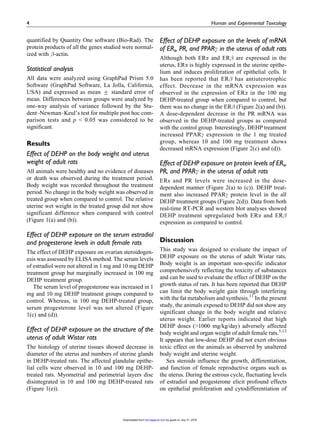
Table 1. List of primers.
Name Accession number Primer sequence
-actin NM_031144.3 Forward 50
-CGTCCACCCGCGAGTACAACC-30
Reverse 50
-TCCATGGCGAACTGGTGGCG-30
PR NM_022847.1 Forward 50
-GGAAGCCTCGCGCCGAAGAA-30
Reverse 50
-GAGGGCGCCAACAGGGTGTC-30
PPARg NM_013124.3 Forward 50
-GCATGGTGCCTTCGCTGATGC-30
Reverse 50
-AGTTGGTGGGCCAGAATGGCA-30
ERa NM_012689.1 Forward 50
-ATCACACACCGCGCCACTCG-30
Reverse 50
-AGCAGCGGATGAGCCACCCT-30
ER

Impact_of_di-_2-ethylhexyl_phthalate_on

  • 1.
    Article Impact of di-(2-ethylhexyl)phthalate on the uterus of adult Wistar rats DB Somasundaram1,2 , K Manokaran1,2 , BC Selvanesan1,2 and RS Bhaskaran1,2 Abstract Di-(2-ethylhexyl) phthalate (DEHP) is the most common plasticizer used in polyvinyl chloride-based plastics. DEHP is not covalently bound to the plastics and is easily released to the environment, resulting in human exposure. In this study, the adult rats were exposed to DEHP and its effects on the uterus was evaluated. Healthy adult female rats were treated with DEHP orally (with dose level 0, 1, 10, and 100 mg/kg body weight/day) for 30 days. No significant changes in the body weight and wet uterine weight were observed. Ovarian hormones and their receptor levels in the uterus were increased. Histological studies exhibited the structural abnormalities such as decrease in diameter, thinning of the layers and disruption in the glandular epithelium. Keywords DEHP, estrogen receptors, progesterone receptors, PPAR, uterus Introduction Phthalates are alkyl diesters of phthalic acid, termed based on the lengths of the alkyl chains, they are used to impart flexibility in plastic or as a matrix in cos- metic products. Phthalates are not covalently bound to the plastic and thus leach into the environment over time where they become ubiquitous contaminants.1 Phthalates, including the widely used plasticizer, di-(2-ethylhexyl) phthalate (DEHP), are the most abun- dant pollutants in our general environment. DEHP remains to be components of food wraps, medical devices, and many cosmetic products. The Agency for Toxic Substances and Disease Registry evaluated that the maximum daily exposure to DEHP for the general population is about 2 mg/day.2 After ingestion in rodents, DEHP is hydrolyzed by lipases to mono 2-ethyl hexyl phthalate (MEHP) and 2-ethylhexanol in the digestive tract prior to absorption.3 In vivo studies demonstrated that ovary is the target site for DEHP and hence decrease the estradiol pro- duction. DEHP acts through peroxisome proliferator- activated receptor (PPAR) and other aryl hydrogen receptors. Decreased expression of aromatase as a result of PPARg activation and increased 17
  • 2.
    -HSD expression as aresult of PPARa activation may be responsible for the change in steroidogenesis.3 A relative increase in estrone production and a decrease in estradiol production from mouse follicles were observed with MEHP treatment.4 DEHP (2 g/kg) treatment to Sprague-Dawley rats decreased serum estradiol levels, prolonged estrous cycles, and no ovulation.5 In vivo studies in rats showed that DEHP (300 and 600 mg/kg) significantly decreased the estradiol level and also the aromatase mRNA and protein levels.6 In mice, Antral follicles from adult mice cultured with DEHP and MEHP inhibited follicle growth, estradiol production and decreased aromatase mRNA levels. Interestingly, estradiol co-treatment prevented phthaltes-induced inhibition of follicle growth and estradiol production.7 1 Department of Endocrinology, Dr. ALM Post Graduate Institute of Basic Medical Sciences, University of Madras, Taramani, Chennai, Tamil Nadu, India 2 School of Allied Health Sciences, Manipal University, Manipal, Karnataka, India Corresponding author: RS Bhaskaran, Department of Endocrinology, Dr. ALM PG IBMS, University of Madras, Taramani Campus, Chennai, Tamil Nadu 600113, India. Email: bravisankar@yahoo.com Human and Experimental Toxicology 1–8 ª The Author(s) 2016 Reprints and permission: sagepub.co.uk/journalsPermissions.nav DOI: 10.1177/0960327116657601 het.sagepub.com by guest on July 31, 2016het.sagepub.comDownloaded from
  • 3.
    The perinatal exposureto estradiol compounds or related endocrine disrupting chemicals (EDCs) pro- duced lesions in adult uteri that including cystic endo- metrial hyperplasia, squamous metaplasia, adenomyosis, and myometrial and general uterine hypoplasia.8 There are reports documenting the interactions between PPARg and estrogen signaling or uterine physiology. It has been shown that activation of PPARg inhibits the growth of uterine leiomyoma, which is also an estrogen-dependent disease.9 The major target organ for ovarian hormones is uterus. When the ovary is the target for these EDCs, eventually it will affect the uterus in bringing some abnormal changes. The reports on DEHP affecting the uterus of adult female rats during the cycling condi- tion are very scarce. DEHP effect on the uterus at a low concentration level is less clear, although it may cause uterine related impairments. Several studies proved DEHP-altered ovarian steroidogenesis and its action on its target organs. The current study focuses on the effects of DEHP on the uterus through ovarian hormones action. In the present study, DEHP doses were selected were within the range of normal to occupational exposure levels in humans. Our data suggests that the change in ovarian hormones levels in DEHP-treated groups also altered steroid hormone receptor expression in the uterus. Histoarchitecture of uterine showed disintegrated epithelial cells, which suggests that DEHP to affect the uterus through estro- genic action. Materials and methods Chemicals DEHP or dioctyl phthalate with !99.5% purity (D201154; CAS no. 117-81-7; 500 ml) was purchased from Sigma-Aldrich (St Louis, Missouri, USA). All other chemicals and reagents used in this study were of analytical grade and were purchased from Sisco Research Laboratories (Mumbai, Maharashtra, India). Antibodies were purchased from Santa Cruz Biotech- nology Inc. (Santa Cruz, California, USA).
  • 4.
    -Actin antibody was purchasedfrom Sigma-Aldrich. Animals Animals were maintained as per the National Guide- lines and Protocols approved by the Institutional Ani- mal Ethical Committee (IAEC No. 01/01/10). Female Wistar adult rats, weighing around 150–200 g were used in this study. Animals were housed in polypro- pylene cages under specific humidity (65 + 5%) and temperature (21 + 2 C) with constant 12-h light/12-h dark schedule. They were fed with standard rat- pelleted diet (Lipton India, Mumbai, Maharashtra, India), and clean drinking water was made available ad libitum. Dose selection and treatment The adult female rats were administered with DEHP by gavage at different dose of 0 (olive oil), 1, 10, and 100 mg/kg body weight/day for 30 days. The dose range was selected based on the reference value close to the predictable, normal to occupational exposure to the human population. This is based on the formula that suggestively converse chemical exposure to var- ious species by considering body surface area and metabolism.10 Fresh solutions were prepared daily according to the weight of rats. The dose volume was 0.2 ml in all groups. The rats in the vehicle control group received olive oil in equal volume as in experi- mental groups for 30 days. During the treatment period, body weight and estrous cycles were moni- tored. After treatment, the animals were weighed and killed; trunk blood was collected, centrifuged at 3000 g for 10 min at 4 C and stored at À80 C for the estimation of serum hormones. The uterus was excised immediately and adjacent fat tissues were removed, weighed, and immediately used for RNA and protein isolation. One uterine horn from each rat was fixed in 10% formalin for histopathological evaluation. Serum progesterone and estradiol assay Serum progesterone and estradiol concentrations were measured using Direct ELISA kits (Diagnostic Bio- chem Canada Inc., Ontorio, Canada), according to the manufacturer’s instructions. ELISA plates were read in BioTek plate reader (Winooski, Vermont, USA). Samples and standards were analyzed in duplicate. The sensitivity of progesterone and estradiol ELISA kits were 0.1 ng/ml and 10 pg/ml, respectively. The intra- and inter-assay coefficients of variation were 10.6% and 12.6, respectively, for progesterone and 9.3% and 10.1% for estradiol. Histology of uterine structure The uterine tissue was fixed in 10% formalin and with paraffin, sectioned at 7 mm, and stained with 2 Human and Experimental Toxicology by guest on July 31, 2016het.sagepub.comDownloaded from
  • 5.
    hematoxylin and eosinfor microscopic examination. Sections were then captured using a Nikon eclipse 80i microscope and differentiated (Chiyoda, Tokyo, Japan). Total RNA extraction and real-time RT-PCR Total RNA was extracted from the uterus by a single- step technique using TRI Reagent (Sigma-Aldrich) according to the manufacturer’s protocol. The quan- tity and the integrity of total RNA was determined by ultraviolet spectrophotometer and agarose gel electro- phoresis, respectively. Reverse transcription (RT) was done using M-MuLV Reverse Transcriptase enzyme (NEB, Ipswich, Massachusetts, USA). For cDNA synthesis, 2 mg of total RNA was reverse transcribed using random hexamer primers and MMLV-RT enzyme. The cDNA was subsequently used for real- time reverse transcriptase polymerase chain reaction (RT-PCR) using the Mesa Green qPCR kit (Eurogen- tec, Fremont, California, USA) with gene-specific primers (Table 1). The real-time RT-PCR was performed on a CFX 96 Touch Real-Time PCR (Bio-Rad, Hercules, California, USA) with the PCR conditions as given in Table 2. The specificity of the amplification product was determined by melting curve analysis for each primer pairs. The data were analyzed by comparative threshold cycle (CT) method and the fold change was calculated by 2ÀÁÁCT method using CFX Manager Version 2.1 (Bio-Rad). Immunoblot analysis of ER and PR in the uterus Protein from the uterus was extracted using RIPA buffer with proteinase inhibitors (Roche, Germany). Protein concentration in the tissue extract was determined in triplicate using Bio-Rad dye reagent (Bio-Rad). Total protein lysates were mixed 1:1 with 2Â Laemmli sample buffer and boiled for 5 min and then centrifuged at 12,000 r/min for 2 min. An equal volume of the total protein was resolved on a 10% sodium dodecyl sulfate polyacrylamide gel electro- phoresis and transferred onto PVDF membrane (Bio-Rad). After blocking in 5% non-fat milk protein in PBS/Tween, the membranes were incubated with primary antibodies (Santa Cruz Biotechnology, Santa Cruz, California, USA) such as ERa (1:500; cat. no. sc-542), ER
  • 6.
    (1:1000; cat. no.sc-6822), progesterone receptor (PR; 1:500; cat. no. sc-7208), PPARg (1:500; cat. no. sc-7273), and
  • 7.
    -actin (1:5000; cat.no. A1978; Sigma-Aldrich) for overnight at 4 C. After washing in PBS with Tween-20, the blots were incubated with respective secondary antibodies conjugated with HRP (1:10,000; GeNei, Bangalore, Karnataka, India) for 1 h at room temperature. The membranes were then washed four times in PBS-Tween buffer. Immunoac- tive antigen–antibody complexes were visualized with Enhanced Chemiluminescent reagent (ECL) (Thermo Scientific, Rockford, Illinois, USA), the sig- nals were captured by the Chemi Doc XRS system (Bio-Rad), and the intensity of the bands were Table 1. List of primers. Name Accession number Primer sequence
  • 8.
    -actin NM_031144.3 Forward50 -CGTCCACCCGCGAGTACAACC-30 Reverse 50 -TCCATGGCGAACTGGTGGCG-30 PR NM_022847.1 Forward 50 -GGAAGCCTCGCGCCGAAGAA-30 Reverse 50 -GAGGGCGCCAACAGGGTGTC-30 PPARg NM_013124.3 Forward 50 -GCATGGTGCCTTCGCTGATGC-30 Reverse 50 -AGTTGGTGGGCCAGAATGGCA-30 ERa NM_012689.1 Forward 50 -ATCACACACCGCGCCACTCG-30 Reverse 50 -AGCAGCGGATGAGCCACCCT-30 ER