Welcome
Presentation on a Term Paper:
Impact of Cell Physiology
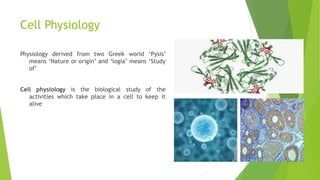
Cell Physiology
Physiology derived from two Greek world ‘Pysis’
means ‘Nature or origin’ and ‘logia’ means ‘Study
of’
Cell physiology is the biological study of the
activities which take place in a cell to keep it
alive
Objectives
 Define cellular physiology.
 Explain the different levels of function within the human body and plant
body.
 Explain the basic structure and functions of the cell.
 Describe the functions and characteristics of several tissue types.
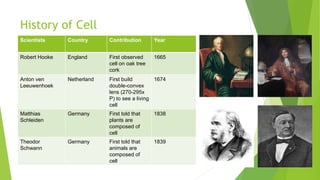
History of Cell
Scientists Country Contribution Year
Robert Hooke England First observed
cell on oak tree
cork
1665
Anton ven
Leeuwenhoek
Netherland First build
double-convex
lens (270-295x
P) to see a living
cell
1674
Matthias
Schleiden
Germany First told that
plants are
composed of
cell
1838
Theodor
Schwann
Germany First told that
animals are
composed of
cell
1839
Cell Theory
 Old version
 All living organisms are composed of one or more cells.
 The cell is the basic unit of structure and organization in organisms.
 Cells come from pre-existing cells.
 New/ Modern Version
 Energy flow occurs within cells.
 Heredity information (DNA) is passed on from cell to cell.
 All cells have the same basic chemical composition.
Methods and Materials
I collect all information by secondary source such as
 Class lecture
 Library book
 Internet
 Note book provided by our course instructors
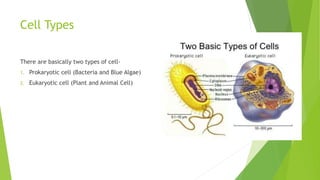
Cell Types
There are basically two types of cell-
1. Prokaryotic cell (Bacteria and Blue Algae)
2. Eukaryotic cell (Plant and Animal Cell)
Cell Components
 Cell Membrane
 Nucleus
 Cytoplasm
 Endoplasmic reticulum
 Golgi complex
 Mitochondria
 Lysosomes
 Microfilaments and microtubules
 Vesicles
Cell Components (Continued)
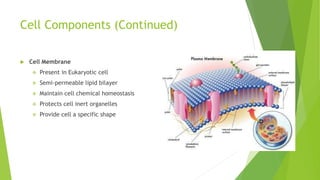
 Cell Membrane
 Present in Eukaryotic cell
 Semi-permeable lipid bilayer
 Maintain cell chemical homeostasis
 Protects cell inert organelles
 Provide cell a specific shape
Cell Components (Continued)
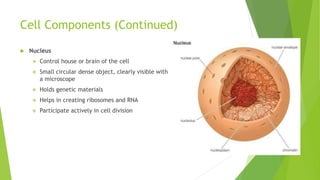
 Nucleus
 Control house or brain of the cell
 Small circular dense object, clearly visible with
a microscope
 Holds genetic materials
 Helps in creating ribosomes and RNA
 Participate actively in cell division
Cell Components (Continued)
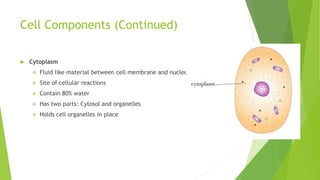
 Cytoplasm
 Fluid like material between cell membrane and nucleus
 Site of cellular reactions
 Contain 80% water
 Has two parts: Cytosol and organelles
 Holds cell organelles in place
Cell Components (Continued)
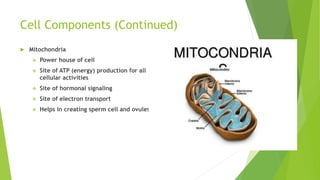
 Mitochondria
 Power house of cell
 Site of ATP (energy) production for all
cellular activities
 Site of hormonal signaling
 Site of electron transport
 Helps in creating sperm cell and ovules
Cell Components (Continued)
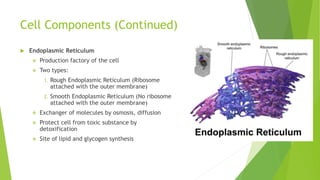
 Endoplasmic Reticulum
 Production factory of the cell
 Two types:
1. Rough Endoplasmic Reticulum (Ribosome
attached with the outer membrane)
2. Smooth Endoplasmic Reticulum (No ribosome
attached with the outer membrane)
 Exchanger of molecules by osmosis, diffusion
 Protect cell from toxic substance by
detoxification
 Site of lipid and glycogen synthesis
Cell Components (Continued)
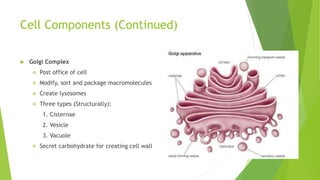
 Golgi Complex
 Post office of cell
 Modify, sort and package macromolecules
 Create lysosomes
 Three types (Structurally):
1. Cisternae
2. Vesicle
3. Vacuole
 Secret carbohydrate for creating cell wall
Cell Components (Continued)
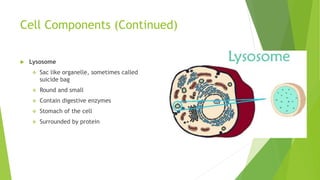
 Lysosome
 Sac like organelle, sometimes called
suicide bag
 Round and small
 Contain digestive enzymes
 Stomach of the cell
 Surrounded by protein
Cell Components (Continued)
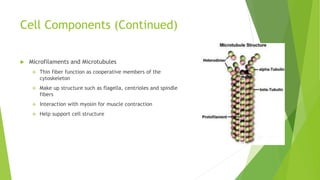
 Microfilaments and Microtubules
 Thin fiber function as cooperative members of the
cytoskeleton
 Make up structure such as flagella, centrioles and spindle
fibers
 Interaction with myosin for muscle contraction
 Help support cell structure
Cell Components (Continued)
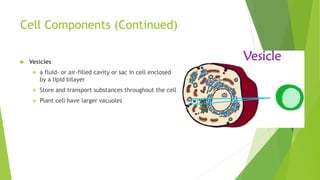
 Vesicles
 a fluid- or air-filled cavity or sac in cell enclosed
by a lipid bilayer
 Store and transport substances throughout the cell
 Plant cell have larger vacuoles
Physiological Processes
 Physiological processes that take place within the cell are given below:
 Autophagy- The process whereby cells "eat" their own internal
components or microbial invaders.
 Adhesion- Chemical process through which cells held together.
 Cell division- Process of reproduction through two major types- mitosis
(asexual reproduction) and meiosis (sexual reproduction).
 Cell signaling- Regulation and signaling of hormones and
neurotransmitters
 DNA repairing
 RNA and protein transcription
Cell Abnormalities
 It also can be termed as genetic disorder mainly caused by chromosomal
aberration, X-Y linked dominant and recessive, mitochondrial abnormalities.
Due to cell abnormalities different types of body disorder, disease, finally
result in cancer or cancer cell development in the body. Some common
examples are-
 Cancer- Abnormal cell growth with the potential to invade or spread to
other parts of the body
 Hemophilia- Hereditary genetic disorder that impairs the body ability to
control blood clotting.
 Canavan Disease: Progressive damage to nerve cells in the brain
 Menkes Disease: X-linked recessive disorder, affects copper level in the
body cause copper deficiency.
Summery
Cell physiology is a biological science in which one study about cells, tissues and
the functions of organs and organ system to learn how the body works. As a cell
physiologist, ones concern is with discovering disease mechanism to help develop
cures for neurodegenerative diseases, cancer, AIDS, tuberculosis and other body
disorder. These helps one to become a good research scientist. So this
presentation bearing a short introductory information about cell physiology
aiming the significance of it.
Conclusion
Cell physiology is the sub-division of biology that examines the mechanisms,
chemical processes and internal structure of cells. Cell physiologists focus on the
most complex processes happening in a cell to determine how it affects regular
body functions. The work of a physiologist includes discovering new treatments
for maladies and measuring species physiological tolerance to extreme
conditions. As cytology deals with the function and activities of cellular level and
molecular biology it is very much important for a cytologist to have a clear sense
or knowledge about cell physiology.
Thanks to All

Impact of cell physiology

  • 1.
  • 2.
    Presentation on aTerm Paper: Impact of Cell Physiology
  • 3.
    Cell Physiology Physiology derivedfrom two Greek world ‘Pysis’ means ‘Nature or origin’ and ‘logia’ means ‘Study of’ Cell physiology is the biological study of the activities which take place in a cell to keep it alive
  • 4.
    Objectives  Define cellularphysiology.  Explain the different levels of function within the human body and plant body.  Explain the basic structure and functions of the cell.  Describe the functions and characteristics of several tissue types.
  • 5.
    History of Cell ScientistsCountry Contribution Year Robert Hooke England First observed cell on oak tree cork 1665 Anton ven Leeuwenhoek Netherland First build double-convex lens (270-295x P) to see a living cell 1674 Matthias Schleiden Germany First told that plants are composed of cell 1838 Theodor Schwann Germany First told that animals are composed of cell 1839
  • 6.
    Cell Theory  Oldversion  All living organisms are composed of one or more cells.  The cell is the basic unit of structure and organization in organisms.  Cells come from pre-existing cells.  New/ Modern Version  Energy flow occurs within cells.  Heredity information (DNA) is passed on from cell to cell.  All cells have the same basic chemical composition.
  • 7.
    Methods and Materials Icollect all information by secondary source such as  Class lecture  Library book  Internet  Note book provided by our course instructors
  • 8.
    Cell Types There arebasically two types of cell- 1. Prokaryotic cell (Bacteria and Blue Algae) 2. Eukaryotic cell (Plant and Animal Cell)
  • 9.
    Cell Components  CellMembrane  Nucleus  Cytoplasm  Endoplasmic reticulum  Golgi complex  Mitochondria  Lysosomes  Microfilaments and microtubules  Vesicles
  • 10.
    Cell Components (Continued) Cell Membrane  Present in Eukaryotic cell  Semi-permeable lipid bilayer  Maintain cell chemical homeostasis  Protects cell inert organelles  Provide cell a specific shape
  • 11.
    Cell Components (Continued) Nucleus  Control house or brain of the cell  Small circular dense object, clearly visible with a microscope  Holds genetic materials  Helps in creating ribosomes and RNA  Participate actively in cell division
  • 12.
    Cell Components (Continued) Cytoplasm  Fluid like material between cell membrane and nucleus  Site of cellular reactions  Contain 80% water  Has two parts: Cytosol and organelles  Holds cell organelles in place
  • 13.
    Cell Components (Continued) Mitochondria  Power house of cell  Site of ATP (energy) production for all cellular activities  Site of hormonal signaling  Site of electron transport  Helps in creating sperm cell and ovules
  • 14.
    Cell Components (Continued) Endoplasmic Reticulum  Production factory of the cell  Two types: 1. Rough Endoplasmic Reticulum (Ribosome attached with the outer membrane) 2. Smooth Endoplasmic Reticulum (No ribosome attached with the outer membrane)  Exchanger of molecules by osmosis, diffusion  Protect cell from toxic substance by detoxification  Site of lipid and glycogen synthesis
  • 15.
    Cell Components (Continued) Golgi Complex  Post office of cell  Modify, sort and package macromolecules  Create lysosomes  Three types (Structurally): 1. Cisternae 2. Vesicle 3. Vacuole  Secret carbohydrate for creating cell wall
  • 16.
    Cell Components (Continued) Lysosome  Sac like organelle, sometimes called suicide bag  Round and small  Contain digestive enzymes  Stomach of the cell  Surrounded by protein
  • 17.
    Cell Components (Continued) Microfilaments and Microtubules  Thin fiber function as cooperative members of the cytoskeleton  Make up structure such as flagella, centrioles and spindle fibers  Interaction with myosin for muscle contraction  Help support cell structure
  • 18.
    Cell Components (Continued) Vesicles  a fluid- or air-filled cavity or sac in cell enclosed by a lipid bilayer  Store and transport substances throughout the cell  Plant cell have larger vacuoles
  • 19.
    Physiological Processes  Physiologicalprocesses that take place within the cell are given below:  Autophagy- The process whereby cells "eat" their own internal components or microbial invaders.  Adhesion- Chemical process through which cells held together.  Cell division- Process of reproduction through two major types- mitosis (asexual reproduction) and meiosis (sexual reproduction).  Cell signaling- Regulation and signaling of hormones and neurotransmitters  DNA repairing  RNA and protein transcription
  • 20.
    Cell Abnormalities  Italso can be termed as genetic disorder mainly caused by chromosomal aberration, X-Y linked dominant and recessive, mitochondrial abnormalities. Due to cell abnormalities different types of body disorder, disease, finally result in cancer or cancer cell development in the body. Some common examples are-  Cancer- Abnormal cell growth with the potential to invade or spread to other parts of the body  Hemophilia- Hereditary genetic disorder that impairs the body ability to control blood clotting.  Canavan Disease: Progressive damage to nerve cells in the brain  Menkes Disease: X-linked recessive disorder, affects copper level in the body cause copper deficiency.
  • 21.
    Summery Cell physiology isa biological science in which one study about cells, tissues and the functions of organs and organ system to learn how the body works. As a cell physiologist, ones concern is with discovering disease mechanism to help develop cures for neurodegenerative diseases, cancer, AIDS, tuberculosis and other body disorder. These helps one to become a good research scientist. So this presentation bearing a short introductory information about cell physiology aiming the significance of it.
  • 22.
    Conclusion Cell physiology isthe sub-division of biology that examines the mechanisms, chemical processes and internal structure of cells. Cell physiologists focus on the most complex processes happening in a cell to determine how it affects regular body functions. The work of a physiologist includes discovering new treatments for maladies and measuring species physiological tolerance to extreme conditions. As cytology deals with the function and activities of cellular level and molecular biology it is very much important for a cytologist to have a clear sense or knowledge about cell physiology.
  • 23.