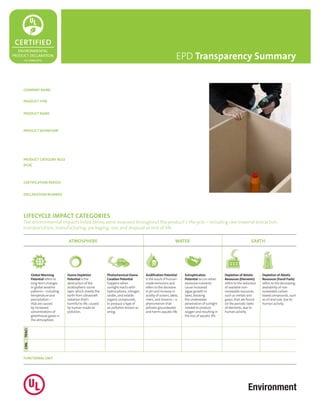
LIFECYCLE IMPACT CATEGORIES
The environmental impacts listed below were assessed throughout the product’s lifecycle – including raw material extraction,
transportation, manufacturing, packaging, use, and disposal at end of life.
Global Warming
Potential refers to
long-term changes
in global weather
patterns – including
temperature and
precipitation –
that are caused
by increased
concentrations of
greenhouse gases in
the atmosphere.
Photochemical Ozone
Creation Potential
happens when
sunlight reacts with
hydrocarbons, nitrogen
oxides, and volatile
organic compounds,
to produce a type of
air pollution known as
smog.
Eutrophication
Potential occurs when
excessive nutrients
cause increased
algae growth in
lakes, blocking
the underwater
penetration of sunlight
needed to produce
oxygen and resulting in
the loss of aquatic life.
Ozone Depletion
Potential is the
destruction of the
stratospheric ozone
layer, which shields the
earth from ultraviolet
radiation that’s
harmful to life, caused
by human-made air
pollution.
Acidification Potential
is the result of human-
made emissions and
refers to the decrease
in pH and increase in
acidity of oceans, lakes,
rivers, and streams – a
phenomenon that
pollutes groundwater
and harms aquatic life.
Depletion of Abiotic
Resources (Elements)
refers to the reduction
of available non-
renewable resources,
such as metals and
gases, that are found
on the periodic table
of elements, due to
human activity.
Depletion of Abiotic
Resources (Fossil Fuels)
refers to the decreasing
availability of non-
renewable carbon-
based compounds, such
as oil and coal, due to
human activity.
COMPANY NAME ­
PRODUCT TYPE
PRODUCT NAME
PRODUCT DEFINITION
PRODUCT CATEGORY RULE
(PCR)
CERTIFICATION PERIOD
DECLARATION NUMBER
TRACICML
FUNCTIONAL UNIT	
ATMOSPHERE	 WATER 	 EARTH
EPD Transparency Summary
American Wood Council
Canadian Wood Council
Wood Products
North American Medium Density Fiberboard
Medium Density Fiberboard (MDF) is manufactured from wood
residues that are generated as a coproduct of lumber milling. The
residues are combined with resins and pressed into sheets.
North American Structural and Architectural Wood Products
FP Innovations, Version 1 (UN CPC 31, NAICS 321), 8 November
2011.
November 13, 2013 - November 13, 2018
13CA24184
525.50 0
kg CO2 eq. kg CFC-11 eq.
64.48
kg O3 eq.
317.92 0.2128
H+ moles eq. kg N eq.
0.93
kg
9621.29
MJ
The declared unit is 1 cubic meter of MDF, which is equal to 565 square feet (3/4” thickness). The average density of North American MDF, including resins, is
745.95 kg/m3 excluding all moisture content. Results are expressed for a cradle-to-gate analysis and exclude use phase and end of life impacts.
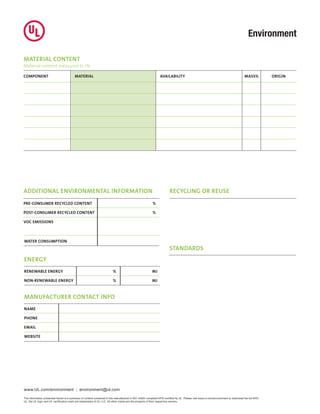
MATERIAL CONTENT
Material content measured to 1%.
COMPONENT 		 MATERIAL	 AVAILABILITY 	 MASS% 	 ORIGIN


www.UL.com/environment | environment@ul.com
The information presented herein is a summary of content contained in the manufacturer’s ISO 14025-compliant EPD certified by UL. Please visit www.ul.com/environment to download the full EPD.
UL, the UL logo, and UL certification mark are trademarks of UL LLC. All other marks are the property of their respective owners.
RECYCLING OR REUSE
STANDARDS								
PRE-CONSUMER RECYCLED CONTENT	 %
POST-CONSUMER RECYCLED CONTENT	 %
VOC EMISSIONS
WATER CONSUMPTION
ADDITIONAL ENVIRONMENTAL INFORMATION
MANUFACTURER CONTACT INFO
NAME
PHONE
EMAIL
WEBSITE
ENERGY
RENEWABLE ENERGY		 %		 MJ
NON-RENEWABLE ENERGY		 %		 MJ
Wood Wood Residues Renewable 89.5 US and Canada
Resin Urea formaldehyde resin Fossil resource, limited 9.9 US and Canada
Wax Slack wax Fossil resource, limited 0.6 US and Canada
0
0
Compliant to California Air Resources
Board’s (CARB) Airborne Toxic
Control Measure (ATCM) California
Code of Regulations 93120
This is a business to business EPD, based on cradle-to-gate LCA.
The delivery of the product to the customer, its use and eventual
end-of-life processing are excluded from this EPD.
1319.16 L Used
39.9 7,163.05
60.1 10,785.13
American Wood Council / Canadian Wood Council
202-463-2766 / 613-747-5544
info@awc.org / info@cwc.ca
www.awc.org / www.cwc.ca
ANSI A208.2-2009

iMovR EPD Transparency Summary, UL

  • 1.
    LIFECYCLE IMPACT CATEGORIES Theenvironmental impacts listed below were assessed throughout the product’s lifecycle – including raw material extraction, transportation, manufacturing, packaging, use, and disposal at end of life. Global Warming Potential refers to long-term changes in global weather patterns – including temperature and precipitation – that are caused by increased concentrations of greenhouse gases in the atmosphere. Photochemical Ozone Creation Potential happens when sunlight reacts with hydrocarbons, nitrogen oxides, and volatile organic compounds, to produce a type of air pollution known as smog. Eutrophication Potential occurs when excessive nutrients cause increased algae growth in lakes, blocking the underwater penetration of sunlight needed to produce oxygen and resulting in the loss of aquatic life. Ozone Depletion Potential is the destruction of the stratospheric ozone layer, which shields the earth from ultraviolet radiation that’s harmful to life, caused by human-made air pollution. Acidification Potential is the result of human- made emissions and refers to the decrease in pH and increase in acidity of oceans, lakes, rivers, and streams – a phenomenon that pollutes groundwater and harms aquatic life. Depletion of Abiotic Resources (Elements) refers to the reduction of available non- renewable resources, such as metals and gases, that are found on the periodic table of elements, due to human activity. Depletion of Abiotic Resources (Fossil Fuels) refers to the decreasing availability of non- renewable carbon- based compounds, such as oil and coal, due to human activity. COMPANY NAME ­ PRODUCT TYPE PRODUCT NAME PRODUCT DEFINITION PRODUCT CATEGORY RULE (PCR) CERTIFICATION PERIOD DECLARATION NUMBER TRACICML FUNCTIONAL UNIT ATMOSPHERE WATER EARTH EPD Transparency Summary American Wood Council Canadian Wood Council Wood Products North American Medium Density Fiberboard Medium Density Fiberboard (MDF) is manufactured from wood residues that are generated as a coproduct of lumber milling. The residues are combined with resins and pressed into sheets. North American Structural and Architectural Wood Products FP Innovations, Version 1 (UN CPC 31, NAICS 321), 8 November 2011. November 13, 2013 - November 13, 2018 13CA24184 525.50 0 kg CO2 eq. kg CFC-11 eq. 64.48 kg O3 eq. 317.92 0.2128 H+ moles eq. kg N eq. 0.93 kg 9621.29 MJ The declared unit is 1 cubic meter of MDF, which is equal to 565 square feet (3/4” thickness). The average density of North American MDF, including resins, is 745.95 kg/m3 excluding all moisture content. Results are expressed for a cradle-to-gate analysis and exclude use phase and end of life impacts.
  • 2.
    MATERIAL CONTENT Material contentmeasured to 1%. COMPONENT MATERIAL AVAILABILITY MASS% ORIGIN www.UL.com/environment | environment@ul.com The information presented herein is a summary of content contained in the manufacturer’s ISO 14025-compliant EPD certified by UL. Please visit www.ul.com/environment to download the full EPD. UL, the UL logo, and UL certification mark are trademarks of UL LLC. All other marks are the property of their respective owners. RECYCLING OR REUSE STANDARDS PRE-CONSUMER RECYCLED CONTENT % POST-CONSUMER RECYCLED CONTENT % VOC EMISSIONS WATER CONSUMPTION ADDITIONAL ENVIRONMENTAL INFORMATION MANUFACTURER CONTACT INFO NAME PHONE EMAIL WEBSITE ENERGY RENEWABLE ENERGY % MJ NON-RENEWABLE ENERGY % MJ Wood Wood Residues Renewable 89.5 US and Canada Resin Urea formaldehyde resin Fossil resource, limited 9.9 US and Canada Wax Slack wax Fossil resource, limited 0.6 US and Canada 0 0 Compliant to California Air Resources Board’s (CARB) Airborne Toxic Control Measure (ATCM) California Code of Regulations 93120 This is a business to business EPD, based on cradle-to-gate LCA. The delivery of the product to the customer, its use and eventual end-of-life processing are excluded from this EPD. 1319.16 L Used 39.9 7,163.05 60.1 10,785.13 American Wood Council / Canadian Wood Council 202-463-2766 / 613-747-5544 info@awc.org / info@cwc.ca www.awc.org / www.cwc.ca ANSI A208.2-2009