AIR POLLUTION
By,
Ms.Stephy Thomas
Ast.Professor
Community Health Nursing Dept.
Padmashree Institute of Nursing, Bangalore.
Definition
Presence of substances like gases,
dust particles, fumes (or smoke) or
odor in the atmosphere in amounts
that interfere with human health,
safety or comfort or injuries to
vegetation and animals.
Air Pollutants
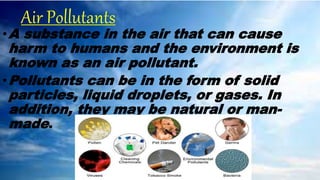
•A substance in the air that can cause
harm to humans and the environment is
known as an air pollutant.
•Pollutants can be in the form of solid
particles, liquid droplets, or gases. In
addition, they may be natural or man-
made.
Air pollutants are categorized in 2,
1.Chemical pollutants:
a)Gases: sulphur dioxide, carbon dioxide,
hydrocarbons, nitrogenoxide..
b)Particulate matter: dust, smoke, aerosols,
grit, sand, etc..
c)Metal: lead, mercury, copper, zinc, etc..
2. Biological pollutants:
Pathogenic microbes(tubercle bacilli), spores,
pollen grains, etc..
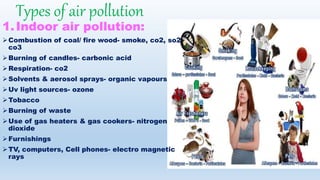
Types of air pollution
1.Indoor air pollution:
Combustion of coal/ fire wood- smoke, co2, so2,
co3
Burning of candles- carbonic acid
Respiration- co2
Solvents & aerosol sprays- organic vapours
Uv light sources- ozone
Tobacco
Burning of waste
Use of gas heaters & gas cookers- nitrogen
dioxide
Furnishings
TV, computers, Cell phones- electro magnetic
rays
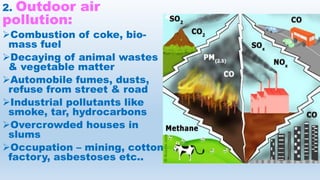
2. Outdoor air
pollution:
Combustion of coke, bio-
mass fuel
Decaying of animal wastes
& vegetable matter
Automobile fumes, dusts,
refuse from street & road
Industrial pollutants like
smoke, tar, hydrocarbons
Overcrowded houses in
slums
Occupation – mining, cotton
factory, asbestoses etc..
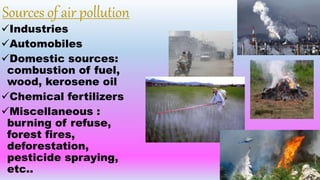
Sources of air pollution
Industries
Automobiles
Domestic sources:
combustion of fuel,
wood, kerosene oil
Chemical fertilizers
Miscellaneous :
burning of refuse,
forest fires,
deforestation,
pesticide spraying,
etc..
Effects of air pollution
1. EFFECTS ON HUMAN
HEALTH
a. Immediate effects:
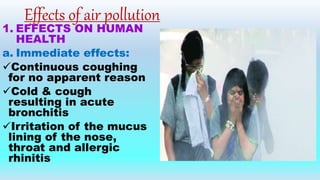
Continuous coughing
for no apparent reason
Cold & cough
resulting in acute
bronchitis
Irritation of the mucus
lining of the nose,
throat and allergic
rhinitis
b. Delayed effects:
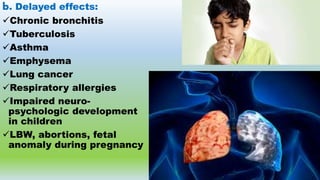
Chronic bronchitis
Tuberculosis
Asthma
Emphysema
Lung cancer
Respiratory allergies
Impaired neuro-
psychologic development
in children
LBW, abortions, fetal
anomaly during pregnancy
2. Effects on soil
& plants
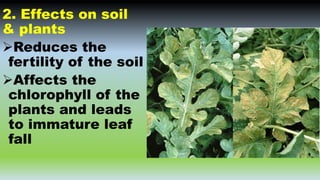
Reduces the
fertility of the soil
Affects the
chlorophyll of the
plants and leads
to immature leaf
fall
3. Effects on monuments & building
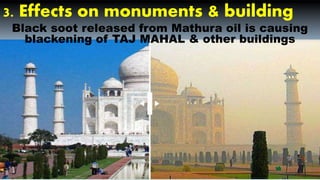
Black soot released from Mathura oil is causing
blackening of TAJ MAHAL & other buildings
4. socio-economic effects
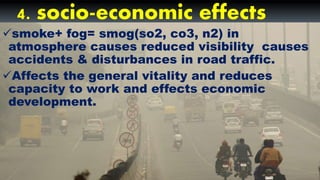
smoke+ fog= smog(so2, co3, n2) in
atmosphere causes reduced visibility causes
accidents & disturbances in road traffic.
Affects the general vitality and reduces
capacity to work and effects economic
development.
5. Other effects of air pollution
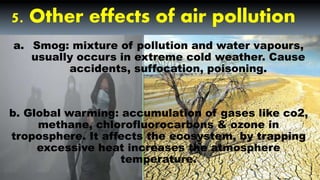
a. Smog: mixture of pollution and water vapours,
usually occurs in extreme cold weather. Cause
accidents, suffocation, poisoning.
b. Global warming: accumulation of gases like co2,
methane, chlorofluorocarbons & ozone in
troposphere. It affects the ecosystem, by trapping
excessive heat increases the atmosphere
temperature.
Prevention and control of air pollution
Its done by 3
measures:
1. Engineering
measures
2. Legislative
measures
3. General
measures
1. Engineering measures:
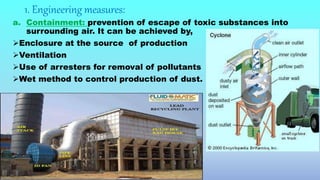
a. Containment: prevention of escape of toxic substances into
surrounding air. It can be achieved by,
Enclosure at the source of production
Ventilation
Use of arresters for removal of pollutants
Wet method to control production of dust.
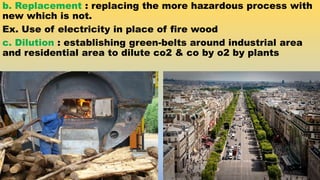
b. Replacement : replacing the more hazardous process with
new which is not.
Ex. Use of electricity in place of fire wood
c. Dilution : establishing green-belts around industrial area
and residential area to dilute co2 & co by o2 by plants
2. Legislative measures:
“The air (prevention and control ) pollution act in 1981”.
Saying, not allowing air pollutants to exceed the
permissible limits. CPCB has the authority to inspect the air
sample of the industries & take legal action.
Height of the chimney
Creation of smokeless zones
Research and education to reduce the nuisance of air
pollution
“Environment act 1986” for monitoring the air.
3. General measures
Dilution of polluted air with clean air
Vegetation
Proper maintenance of vehicles and using lead free petrol
Traffic control measures to prevent traffic congestion.
Health education about hazards of air pollution & measures
to control.
Air pollution and its preventive measures

Air pollution and its preventive measures

  • 1.
    AIR POLLUTION By, Ms.Stephy Thomas Ast.Professor CommunityHealth Nursing Dept. Padmashree Institute of Nursing, Bangalore.
  • 3.
    Definition Presence of substanceslike gases, dust particles, fumes (or smoke) or odor in the atmosphere in amounts that interfere with human health, safety or comfort or injuries to vegetation and animals.
  • 4.
    Air Pollutants •A substancein the air that can cause harm to humans and the environment is known as an air pollutant. •Pollutants can be in the form of solid particles, liquid droplets, or gases. In addition, they may be natural or man- made.
  • 5.
    Air pollutants arecategorized in 2, 1.Chemical pollutants: a)Gases: sulphur dioxide, carbon dioxide, hydrocarbons, nitrogenoxide.. b)Particulate matter: dust, smoke, aerosols, grit, sand, etc.. c)Metal: lead, mercury, copper, zinc, etc.. 2. Biological pollutants: Pathogenic microbes(tubercle bacilli), spores, pollen grains, etc..
  • 6.
    Types of airpollution 1.Indoor air pollution: Combustion of coal/ fire wood- smoke, co2, so2, co3 Burning of candles- carbonic acid Respiration- co2 Solvents & aerosol sprays- organic vapours Uv light sources- ozone Tobacco Burning of waste Use of gas heaters & gas cookers- nitrogen dioxide Furnishings TV, computers, Cell phones- electro magnetic rays
  • 7.
    2. Outdoor air pollution: Combustionof coke, bio- mass fuel Decaying of animal wastes & vegetable matter Automobile fumes, dusts, refuse from street & road Industrial pollutants like smoke, tar, hydrocarbons Overcrowded houses in slums Occupation – mining, cotton factory, asbestoses etc..
  • 8.
    Sources of airpollution Industries Automobiles Domestic sources: combustion of fuel, wood, kerosene oil Chemical fertilizers Miscellaneous : burning of refuse, forest fires, deforestation, pesticide spraying, etc..
  • 9.
    Effects of airpollution 1. EFFECTS ON HUMAN HEALTH a. Immediate effects: Continuous coughing for no apparent reason Cold & cough resulting in acute bronchitis Irritation of the mucus lining of the nose, throat and allergic rhinitis
  • 10.
    b. Delayed effects: Chronicbronchitis Tuberculosis Asthma Emphysema Lung cancer Respiratory allergies Impaired neuro- psychologic development in children LBW, abortions, fetal anomaly during pregnancy
  • 11.
    2. Effects onsoil & plants Reduces the fertility of the soil Affects the chlorophyll of the plants and leads to immature leaf fall
  • 12.
    3. Effects onmonuments & building Black soot released from Mathura oil is causing blackening of TAJ MAHAL & other buildings
  • 13.
    4. socio-economic effects smoke+fog= smog(so2, co3, n2) in atmosphere causes reduced visibility causes accidents & disturbances in road traffic. Affects the general vitality and reduces capacity to work and effects economic development.
  • 14.
    5. Other effectsof air pollution a. Smog: mixture of pollution and water vapours, usually occurs in extreme cold weather. Cause accidents, suffocation, poisoning. b. Global warming: accumulation of gases like co2, methane, chlorofluorocarbons & ozone in troposphere. It affects the ecosystem, by trapping excessive heat increases the atmosphere temperature.
  • 16.
    Prevention and controlof air pollution Its done by 3 measures: 1. Engineering measures 2. Legislative measures 3. General measures
  • 17.
    1. Engineering measures: a.Containment: prevention of escape of toxic substances into surrounding air. It can be achieved by, Enclosure at the source of production Ventilation Use of arresters for removal of pollutants Wet method to control production of dust.
  • 18.
    b. Replacement :replacing the more hazardous process with new which is not. Ex. Use of electricity in place of fire wood c. Dilution : establishing green-belts around industrial area and residential area to dilute co2 & co by o2 by plants
  • 19.
    2. Legislative measures: “Theair (prevention and control ) pollution act in 1981”. Saying, not allowing air pollutants to exceed the permissible limits. CPCB has the authority to inspect the air sample of the industries & take legal action. Height of the chimney Creation of smokeless zones Research and education to reduce the nuisance of air pollution “Environment act 1986” for monitoring the air.
  • 20.
    3. General measures Dilutionof polluted air with clean air Vegetation Proper maintenance of vehicles and using lead free petrol Traffic control measures to prevent traffic congestion. Health education about hazards of air pollution & measures to control.