The Rest of the Story
      Assessing and Specifying
Environmental Product Declarations
                   Presented by:
               Paul Bertram
                 FCSI, CDT, LEED AP
  Kingspan: Director, Environment & Sustainability
               CSI Institute President
          paul.bertram@kingspan.com
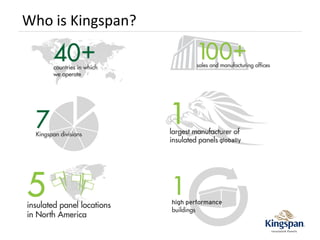
Who is Kingspan?
Kingspan Insulated Panels Ltd. is a Registered Provider with The American Institute of Architects
 Continuing Education Systems. Credit earned on completion of this program will be reported to CES
Records for AIA members. Certificates of Completion for non-AIA members are available upon request.

 This program is registered with AIA/CES for continuing professional registration. As such, it does not
include content that may be deemed or construed to be an approval or endorsement by the AIA of any
   material or construction or any method or manner of handling, using, distributing or dealing in any
material or product. Questions related to specific materials, methods and services should be directed to
                                         the program instructor.

   This presentation is protected by US and International copyright laws. Reproduction, distribution,
      display and use of the presentation without written permission of the speaker is prohibited.


                                         Copyright Materials

                This presentation is protected by US and International Copyright laws.
                    Reproduction, distribution, display and use of the presentation
                        without written permission of the speaker is prohibited.
Learning Objectives
1.   Learn how market influences such as LEED and other environmental and
     sustainability focused programs are driving the need for information on
     environmental impacts of a product over its life cycle.

2.   Summarize material environmental characteristics of a product in a way
     that is accessible, consistent, and ultimately comparable through
     Environmental Product Declarations.

3.   Realize the inter-relationship of Product Category Rules, Lifecycle
     Assessment and Environmental Product Declarations for transparency in
     environmental reporting.

4.   Explain what is not in an EPD and describe what proposed information a
     HPD (Health Product Declaration) includes. Learn how to evaluate and
     specify environmental performance requirements and EPDs in projects
     and where to find them.
Sustainable Design
• Sustainability is the concept of meeting present
  needs without compromising the ability of future
  generations to meet their own needs.
  – Includes the informed selection of materials and
    products to reduce product-cycle environmental
    impacts, improve performance, and optimize
    occupant health and comfort.
  – Seeks to enhance and increase ecological, social, and
    economic values over time.
  Source: AIA
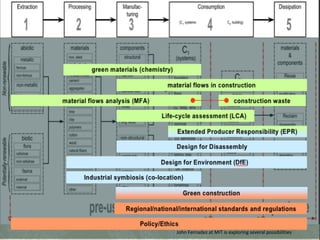
John Fernadez at MIT is exploring several possibilities
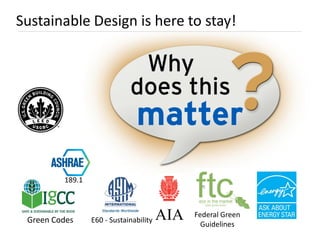
Sustainable Design is here to stay!


         189.1


 Green Codes     E60 - Sustainability   AIA   Federal Green
                                                Guidelines
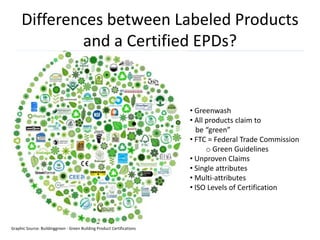
Differences between Labeled Products
             and a Certified EPDs?


                                                                        • Greenwash
                                                                        • All products claim to
                                                                          be “green”
                                                                        • FTC = Federal Trade Commission
                                                                              o Green Guidelines
                                                                        • Unproven Claims
                                                                        • Single attributes
                                                                        • Multi-attributes
                                                                        • ISO Levels of Certification


Graphic Source: Buildinggreen - Green Building Product Certifications
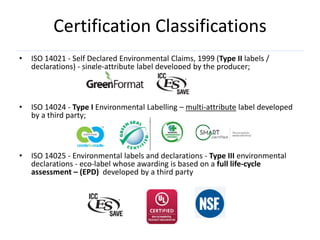
Certification Classifications
•   ISO 14021 - Self Declared Environmental Claims, 1999 (Type II labels /
    declarations) - single-attribute label developed by the producer;


•   ISO 14024 - Type I Environmental Labelling – multi-attribute label developed
    by a third party;


•   ISO 14025 - Environmental labels and declarations - Type III environmental
    declarations - eco-label whose awarding is based on a full life-cycle
    assessment – (EPD) developed by a third party
Proposed LCA LEED 2012 (V4) Credits
               Pilot Credit 61
MR CREDIT: MATERIAL LIFE CYCLE DISCLOSURE AND ASSESSMENT
OPTION 1. Assessment of Non-structural Products (1 point)
• Requirements
    – Use a minimum of 20%, by cost
    – Industry Wide (Generic) EPD Third party certified Type III Environmental Product
      Declaration (EPD), including external verification - calculated at cost
    – Product Specific Declaration Products with a publically available, critically reviewed Life
      Cycle Assessment compliant with ISO 21930 - calculated at twice their cost
OPTION 2. Assessment of Structure and Enclosure
    – Same requirements as option 1.
OPTION 3. Multi-Attribute Assessment
    – Use a minimum of 50%, by cost
    – Permanently installed non-structural products meeting at least one of the attributes
      below. Products may contribute toward multiple attributes listed

    The scope of any Environmental Product Declaration (EPD) is required to be at least
                                     cradle to gate.
Other LEED Pilot Credits that related to
         LCA/EPD reporting
• Pilot Credit 52: MR – Material Multi-Attribute
  Assessment
• Pilot Credit 53: Responsible Sourcing of Raw Materials
  – Chain of Custody on raw materials
• Pilot Credit 54: Avoidance of Chemicals of Concern –
• Pilot Credit 61: Material Disclosure and Assessment -
  EPD
• Pilot Credit 62: Disclosure of Chemicals of Concern -
• Pilot Credit 63: MR – Whole Building Life Cycle
  Assessment –EPDs may contribute to this credit- TBD
•
Why LCA?
• Market confusion: What is a Green Building Product?
   – Too many EcoLabels
      • How many EcoLabels does it take to make a “green” product?
• Current focus on single attribute environmental
  product reporting
   – Various Green Building and labeling programs
• Industry needs creditable environmental reporting
• Need for established multi-attribute & process
  assessment with “use-phase” & benefits
• Need for Scientific, 3rd Party Verified, Defendable
  methodology for environmental reporting
• Green Building Codes and NGO’s influence
Challenges of LCA
• Learning curve and research
   – Understanding LCA practioners, LCA tools and standards
• Lack of established US based PCRs (Product Category
  Rules)
   – Necessary for comparative LCAs and EPDs (Environmental
     Product Declarations)
   – Need for established US “Program Operator” network
      • Emerging market
   – Need for US based PCR/EPD registry
• Lack of building teams understanding LCA reporting
  and related data uncertainties
• Balancing environmental LCA reporting with
  functional performance and compliance product
  evaluation
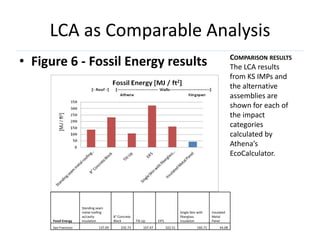
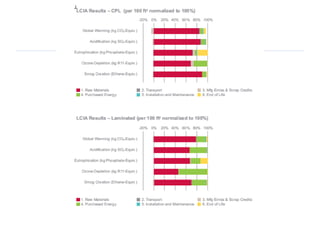
LCA as Comparable Analysis
• Figure 6 - Fossil Energy results                                                                                    COMPARISON RESULTS
                                                                                                                      The LCA results
                                                                                                                      from KS IMPs and
                                                                                                                      the alternative
                                                                                                                      assemblies are
                                                                                                                      shown for each of
                                                                                                                      the impact
                                                                                                                      categories
                                                                                                                      calculated by
                                                                                                                      Athena’s
                                                                                                                      EcoCalculator.


                      Standing seam
                      metal roofing                                                  Single Skin with    Insulated
                      w/cavity           8" Concrete                                 fiberglass          Metal
      Fossil Energy   insulation         Block         Tilt Up       EIFS            insulation          Panel
      San Francisco             137.09       232.73         107.47          322.51              160.71        44.08
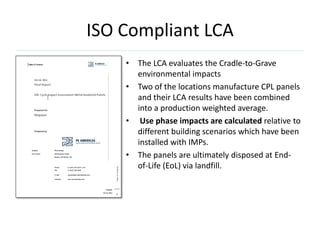
ISO Compliant LCA
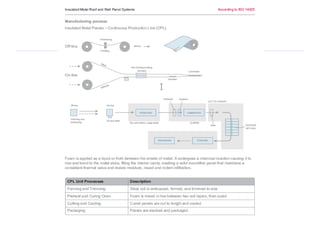
    • The LCA evaluates the Cradle-to-Grave
      environmental impacts
    • Two of the locations manufacture CPL panels
      and their LCA results have been combined
      into a production weighted average.
    • Use phase impacts are calculated relative to
      different building scenarios which have been
      installed with IMPs.
    • The panels are ultimately disposed at End-
      of-Life (EoL) via landfill.
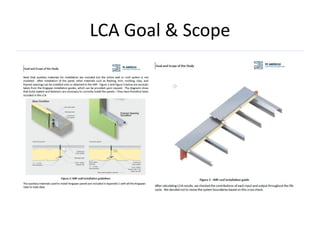
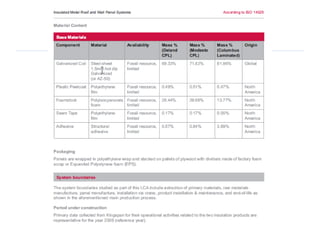
LCA Goal & Scope
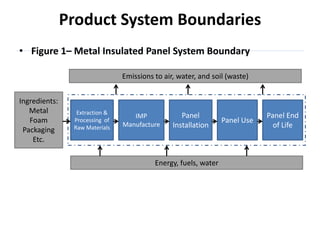
Product System Boundaries
• Figure 1– Metal Insulated Panel System Boundary

                                Emissions to air, water, and soil (waste)


Ingredients:
   Metal         Extraction &
                                   IMP             Panel                     Panel End
   Foam         Processing of
                                Manufacture
                                                                 Panel Use
                Raw Materials                   Installation                   of Life
 Packaging
    Etc.

                                          Energy, fuels, water
What is an EPD - Environmental Product Declaration?
            What is an EPD?
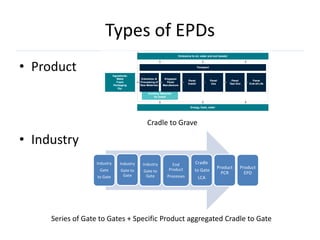
Types of EPDs
• Product


                                           Cradle to Grave

• Industry
                   Industry   Industry   Industry     End       Cradle
                                                    Product               Product   Product
                    Gate      Gate to    Gate to                to Gate
                               Gate
                                                                            PCR       EPD
                   to Gate                Gate      Processes    LCA


     Series of Gate to Gates + Specific Product aggregated Cradle to Gate
ISO 21930 – Product Category Rules
  Sustainability in building construction — Environmental declaration of
  building products
• ISO 21930:2007 provides a framework for and the basic requirements for
  product category rules
• Type III environmental declarations for building products, as described in
  ISO 21930:2007
• Complements ISO 14025 for EPDs of building products.
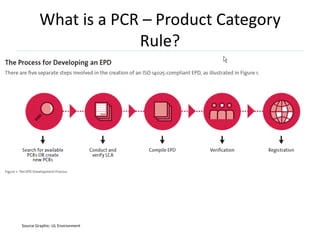
What is a PCR – Product Category
                      Rule?


Source Graphic: UL Environment
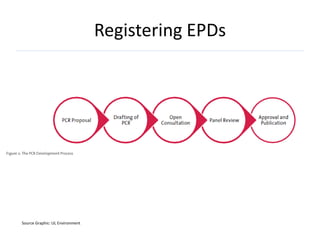
Registering EPDs


Source Graphic: UL Environment
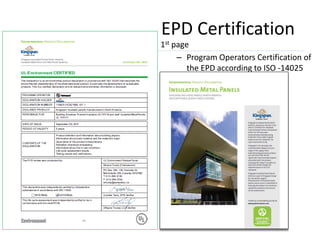
EPD Certification
1st page
     – Program Operators Certification of
       the EPD according to ISO -14025
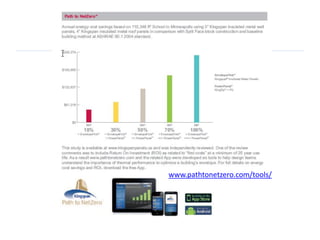
www.pathtonetzero.com/tools/
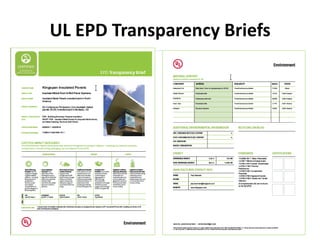
UL EPD Transparency Briefs
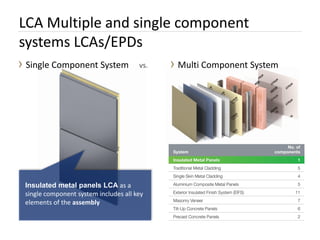
LCA Multiple and single component
systems LCAs/EPDs
› Single Component System              vs.   › Multi Component System


 Insulated metal panels LCA as a
 single component system includes all key
 elements of the assembly
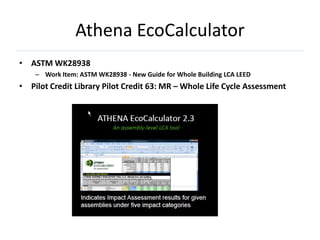
Athena EcoCalculator
• ASTM WK28938
    – Work Item: ASTM WK28938 - New Guide for Whole Building LCA LEED
• Pilot Credit Library Pilot Credit 63: MR – Whole Life Cycle Assessment
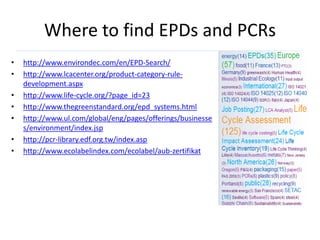
Where to find EPDs and PCRs
•   http://www.environdec.com/en/EPD-Search/
•   http://www.lcacenter.org/product-category-rule-
    development.aspx
•   http://www.life-cycle.org/?page_id=23
•   http://www.thegreenstandard.org/epd_systems.html
•   http://www.ul.com/global/eng/pages/offerings/businesse
    s/environment/index.jsp
•   http://pcr-library.edf.org.tw/index.asp
•   http://www.ecolabelindex.com/ecolabel/aub-zertifikat
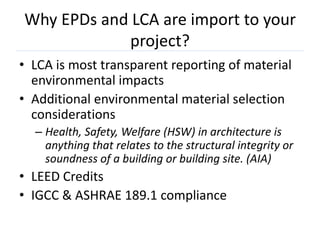
Why EPDs and LCA are import to your
             project?
• LCA is most transparent reporting of material
  environmental impacts
• Additional environmental material selection
  considerations
  – Health, Safety, Welfare (HSW) in architecture is
    anything that relates to the structural integrity or
    soundness of a building or building site. (AIA)
• LEED Credits
• IGCC & ASHRAE 189.1 compliance
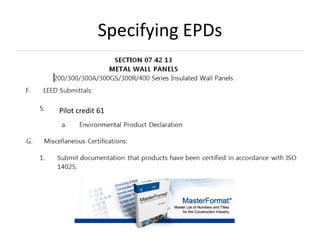
Specifying EPDs


Pilot credit 61
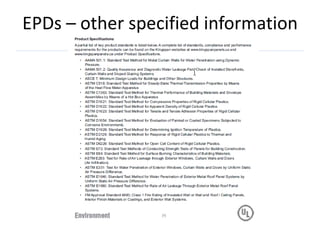
EPDs – other specified information
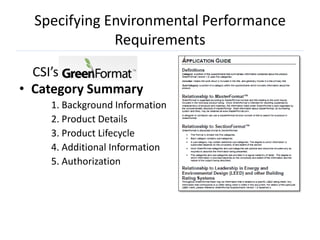
Specifying Environmental Performance
              Requirements
  CSI’s
• Category Summary
    1. Background Information
    2. Product Details
    3. Product Lifecycle
    4. Additional Information
    5. Authorization
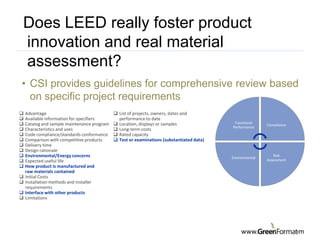
Does LEED really foster product
innovation and real material
assessment?
• CSI provides guidelines for comprehensive review based
  on specific project requirements
   Advantage                                 List of projects, owners, dates and
   Available information for specifiers       performance to date
   Catalog and sample maintenance program    Location, displays or samples                Functional
                                                                                                           Compliance
                                                                                           Performance
   Characteristics and uses                  Long-term costs
   Code compliance/standards conformance     Rated capacity
   Comparison with competitive products      Test or examinations (substantiated data)
   Delivery time
   Design rationale
   Environmental/Energy concerns                                                          Environmental
                                                                                                              Risk
   Expected useful life                                                                                   Assessment
   How product is manufactured and
    raw materials contained
   Initial Costs
   Installation methods and installer
    requirements
   Interface with other products
   Limitations


     The Construction Specifications Institute
                       www.csinet.org
                                                                                                www.                    .com
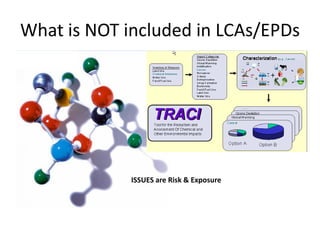
What is NOT included in LCAs/EPDs


             ISSUES are Risk & Exposure
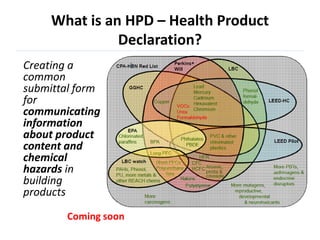
What is an HPD – Health Product
               Declaration?
Creating a
common
submittal form
for
communicating
information
about product
content and
chemical
hazards in
building
products
       Coming soon
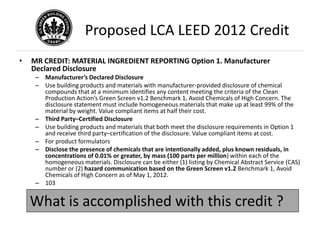
Proposed LCA LEED 2012 Credit
•   MR CREDIT: MATERIAL INGREDIENT REPORTING Option 1. Manufacturer
    Declared Disclosure
     – Manufacturer’s Declared Disclosure
     – Use building products and materials with manufacturer-provided disclosure of chemical
       compounds that at a minimum identifies any content meeting the criteria of the Clean
       Production Action’s Green Screen v1.2 Benchmark 1, Avoid Chemicals of High Concern. The
       disclosure statement must include homogeneous materials that make up at least 99% of the
       material by weight. Value compliant items at half their cost.
     – Third Party–Certified Disclosure
     – Use building products and materials that both meet the disclosure requirements in Option 1
       and receive third party–certification of the disclosure. Value compliant items at cost.
     – For product formulators
     – Disclose the presence of chemicals that are intentionally added, plus known residuals, in
       concentrations of 0.01% or greater, by mass (100 parts per million) within each of the
       homogeneous materials. Disclosure can be either (1) listing by Chemical Abstract Service (CAS)
       number or (2) hazard communication based on the Green Screen v1.2 Benchmark 1, Avoid
       Chemicals of High Concern as of May 1, 2012.
     – 103


    What is accomplished with this credit ?
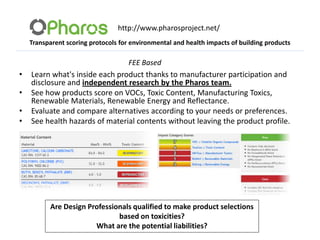
http://www.pharosproject.net/
    Transparent scoring protocols for environmental and health impacts of building products

                                     FEE Based
•   Learn what's inside each product thanks to manufacturer participation and
    disclosure and independent research by the Pharos team.
•   See how products score on VOCs, Toxic Content, Manufacturing Toxics,
    Renewable Materials, Renewable Energy and Reflectance.
•   Evaluate and compare alternatives according to your needs or preferences.
•   See health hazards of material contents without leaving the product profile.


          Are Design Professionals qualified to make product selections
                              based on toxicities?
                       What are the potential liabilities?
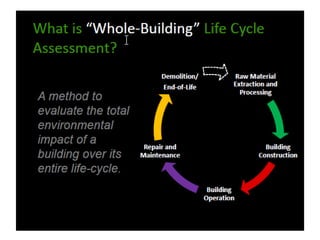
Whole Building LCA LEED 2012
 Pilot Credit 63: MR – Whole Building Life Cycle
                   Assessment
MR CREDIT: BUILDING REUSE AND WHOLE BUILDING LIFE CYCLE ASSESMENT
• Demonstrate reduced environmental impact during initial project decision
  making by reusing existing building resources and/or through Life Cycle
  Assessment.
    – Achieve one option according to criteria for existing building reuse and Life
      Cycle Assessment
         •   OPTION 1. Historic Building Reuse
         •   OPTION 2. Renovation of Abandoned or Blighted Building
         •   OPTION 3. Building and Material Reuse
         •   OPTION 4. Whole Building Life Cycle Assessment
               – For new construction buildings conduct a life cycle assessment of all the project’s structure and
                 enclosure that demonstrates a minimum of 10% reduction in at least 3 of the 6 impact categories l
         • Option 5. Building Reuse with Additions
Tools (Listing by Life-Cycle Costing /
                     Assessment Category)
•     ATHENA EcoCalculator for Assemblies
•     Architects, engineers and other design professionals can have instant access to instant life-cycle
      assessment (LCA) results for hundreds of common bui...
•     ATHENA Impact Estimator for Buildings
•     Architects, engineers and researchers can get life cycle assessment (LCA) answers about conceptual
      designs of new buildings or renovations to existing...
•     Building for Environmental and Economic Sustainability (BEES)
•     The BEES software brings to your fingertips a powerful technique for balancing the environmental
      and economic performance of building products. The to...
•     Building Life-Cycle Cost (BLCC)
•     BLCC5 is programmed in Java with an XML file format. The user's guide is part of the BLCC5 Help
      system. The program maintains the same basic approach ...
•     ECONPACK
•     A comprehensive economic analysis computer package incorporating economic analysis
      calculations, documentation and reporting capabilities.


Source: http://www.wbdg.org/tools/tools_cat.php?c=3
Acronyms & Terms You NEED to Know

•   Sustainable Design –
     –      Sustainability is the concept of meeting present needs without compromising the ability of future generations to meet their own
            needs. (AIA)
•   ISO –
     –      International Organization for Standardization
•   LCA – Life Cycle Assessment
     –      Technique to assess environmental impacts associated with all the stages of a product's life - ISO-14040
•   EPD - Environmental Product Declaration –
     –      Per ISO 14025, is quantified environmental data for a product with pre-set categories of parameters based on the ISO 14040
            series of standards, but not excluding additional environmental information.
•   PCR – Product Category Rules -
     –      Defines same scope, calculation rules and format for reporting LCAs in a given product category
•   Program Operator –
     –      ISO 14025. standard, requires a program operator is responsible for the administration of the entire EPD program
•   Life Cycle Assessment -
     –      Specific methodology that helps to quantify the impacts of products from extraction of raw materials through end of life
•   Cradle to Gate –
     –      Resource extraction (cradle) to the job site
•   Gate to Gate –
     –      Partial LCA looking at only one value-added process in the entire production chain
•   Cradle to Grave –
     –      Resource extraction ('cradle') to use phase and disposal phase ('grave').
•   Cradle to Cradle –
     –      Specific kind of cradle-to-grave assessment, where the end-of-life disposal step for the product is a recycling process
•   HPD – Health Product Declaration – (Proposed)
     –      Common submittal form for communicating information about product content and chemical hazards in building products
LCA Outcomes
• LCA - tool to measure and improve environmental impacts of
  products, materials and buildings.
    – Currently LCAs and EPDs do not address material toxicities
• EPDs are how LCAs are reported
• PCRs are required to allow comparable EPDs
• Product environment & sustainability certifications validate specific
  areas of environmental performance
    – VOC compliance
• Specify environmental performance requirements
    – Labels and certifications can be recognized for compliance of
      environmental performance requirements
• There are only a few EPDs and PCRs registered in the US
• Tools for Whole Building LCA are limited
    – http://www.wbdg.org/resources/greenproducts.php
The Rest of the Story
      Assessing and Specifying
Environmental Product Declarations


       Questions
                 Presented by:
             Paul Bertram
               FCSI, CDT, LEED AP
Kingspan: Director, Environment & Sustainability
             CSI Institute President
        paul.bertram@kingspan.com

The Rest of the Story: Assessing and Specifying Environmental Product Declarations

  • 1.
    The Rest ofthe Story Assessing and Specifying Environmental Product Declarations Presented by: Paul Bertram FCSI, CDT, LEED AP Kingspan: Director, Environment & Sustainability CSI Institute President paul.bertram@kingspan.com
  • 2.
  • 3.
    Kingspan Insulated PanelsLtd. is a Registered Provider with The American Institute of Architects Continuing Education Systems. Credit earned on completion of this program will be reported to CES Records for AIA members. Certificates of Completion for non-AIA members are available upon request. This program is registered with AIA/CES for continuing professional registration. As such, it does not include content that may be deemed or construed to be an approval or endorsement by the AIA of any material or construction or any method or manner of handling, using, distributing or dealing in any material or product. Questions related to specific materials, methods and services should be directed to the program instructor. This presentation is protected by US and International copyright laws. Reproduction, distribution, display and use of the presentation without written permission of the speaker is prohibited. Copyright Materials This presentation is protected by US and International Copyright laws. Reproduction, distribution, display and use of the presentation without written permission of the speaker is prohibited.
  • 4.
    Learning Objectives 1. Learn how market influences such as LEED and other environmental and sustainability focused programs are driving the need for information on environmental impacts of a product over its life cycle. 2. Summarize material environmental characteristics of a product in a way that is accessible, consistent, and ultimately comparable through Environmental Product Declarations. 3. Realize the inter-relationship of Product Category Rules, Lifecycle Assessment and Environmental Product Declarations for transparency in environmental reporting. 4. Explain what is not in an EPD and describe what proposed information a HPD (Health Product Declaration) includes. Learn how to evaluate and specify environmental performance requirements and EPDs in projects and where to find them.
  • 5.
    Sustainable Design • Sustainabilityis the concept of meeting present needs without compromising the ability of future generations to meet their own needs. – Includes the informed selection of materials and products to reduce product-cycle environmental impacts, improve performance, and optimize occupant health and comfort. – Seeks to enhance and increase ecological, social, and economic values over time. Source: AIA
  • 6.
    John Fernadez atMIT is exploring several possibilities
  • 7.
    Sustainable Design ishere to stay! 189.1 Green Codes E60 - Sustainability AIA Federal Green Guidelines
  • 9.
    Differences between LabeledProducts and a Certified EPDs? • Greenwash • All products claim to be “green” • FTC = Federal Trade Commission o Green Guidelines • Unproven Claims • Single attributes • Multi-attributes • ISO Levels of Certification Graphic Source: Buildinggreen - Green Building Product Certifications
  • 10.
    Certification Classifications • ISO 14021 - Self Declared Environmental Claims, 1999 (Type II labels / declarations) - single-attribute label developed by the producer; • ISO 14024 - Type I Environmental Labelling – multi-attribute label developed by a third party; • ISO 14025 - Environmental labels and declarations - Type III environmental declarations - eco-label whose awarding is based on a full life-cycle assessment – (EPD) developed by a third party
  • 11.
    Proposed LCA LEED2012 (V4) Credits Pilot Credit 61 MR CREDIT: MATERIAL LIFE CYCLE DISCLOSURE AND ASSESSMENT OPTION 1. Assessment of Non-structural Products (1 point) • Requirements – Use a minimum of 20%, by cost – Industry Wide (Generic) EPD Third party certified Type III Environmental Product Declaration (EPD), including external verification - calculated at cost – Product Specific Declaration Products with a publically available, critically reviewed Life Cycle Assessment compliant with ISO 21930 - calculated at twice their cost OPTION 2. Assessment of Structure and Enclosure – Same requirements as option 1. OPTION 3. Multi-Attribute Assessment – Use a minimum of 50%, by cost – Permanently installed non-structural products meeting at least one of the attributes below. Products may contribute toward multiple attributes listed The scope of any Environmental Product Declaration (EPD) is required to be at least cradle to gate.
  • 12.
    Other LEED PilotCredits that related to LCA/EPD reporting • Pilot Credit 52: MR – Material Multi-Attribute Assessment • Pilot Credit 53: Responsible Sourcing of Raw Materials – Chain of Custody on raw materials • Pilot Credit 54: Avoidance of Chemicals of Concern – • Pilot Credit 61: Material Disclosure and Assessment - EPD • Pilot Credit 62: Disclosure of Chemicals of Concern - • Pilot Credit 63: MR – Whole Building Life Cycle Assessment –EPDs may contribute to this credit- TBD •
  • 13.
    Why LCA? • Marketconfusion: What is a Green Building Product? – Too many EcoLabels • How many EcoLabels does it take to make a “green” product? • Current focus on single attribute environmental product reporting – Various Green Building and labeling programs • Industry needs creditable environmental reporting • Need for established multi-attribute & process assessment with “use-phase” & benefits • Need for Scientific, 3rd Party Verified, Defendable methodology for environmental reporting • Green Building Codes and NGO’s influence
  • 14.
    Challenges of LCA •Learning curve and research – Understanding LCA practioners, LCA tools and standards • Lack of established US based PCRs (Product Category Rules) – Necessary for comparative LCAs and EPDs (Environmental Product Declarations) – Need for established US “Program Operator” network • Emerging market – Need for US based PCR/EPD registry • Lack of building teams understanding LCA reporting and related data uncertainties • Balancing environmental LCA reporting with functional performance and compliance product evaluation
  • 15.
    LCA as ComparableAnalysis • Figure 6 - Fossil Energy results COMPARISON RESULTS The LCA results from KS IMPs and the alternative assemblies are shown for each of the impact categories calculated by Athena’s EcoCalculator. Standing seam metal roofing Single Skin with Insulated w/cavity 8" Concrete fiberglass Metal Fossil Energy insulation Block Tilt Up EIFS insulation Panel San Francisco 137.09 232.73 107.47 322.51 160.71 44.08
  • 16.
    ISO Compliant LCA • The LCA evaluates the Cradle-to-Grave environmental impacts • Two of the locations manufacture CPL panels and their LCA results have been combined into a production weighted average. • Use phase impacts are calculated relative to different building scenarios which have been installed with IMPs. • The panels are ultimately disposed at End- of-Life (EoL) via landfill.
  • 17.
  • 18.
    Product System Boundaries •Figure 1– Metal Insulated Panel System Boundary Emissions to air, water, and soil (waste) Ingredients: Metal Extraction & IMP Panel Panel End Foam Processing of Manufacture Panel Use Raw Materials Installation of Life Packaging Etc. Energy, fuels, water
  • 19.
    What is anEPD - Environmental Product Declaration? What is an EPD?
  • 20.
    Types of EPDs •Product Cradle to Grave • Industry Industry Industry Industry End Cradle Product Product Product Gate Gate to Gate to to Gate Gate PCR EPD to Gate Gate Processes LCA Series of Gate to Gates + Specific Product aggregated Cradle to Gate
  • 21.
    ISO 21930 –Product Category Rules Sustainability in building construction — Environmental declaration of building products • ISO 21930:2007 provides a framework for and the basic requirements for product category rules • Type III environmental declarations for building products, as described in ISO 21930:2007 • Complements ISO 14025 for EPDs of building products.
  • 22.
    What is aPCR – Product Category Rule? Source Graphic: UL Environment
  • 23.
  • 24.
    EPD Certification 1st page – Program Operators Certification of the EPD according to ISO -14025
  • 28.
  • 29.
  • 30.
    LCA Multiple andsingle component systems LCAs/EPDs › Single Component System vs. › Multi Component System Insulated metal panels LCA as a single component system includes all key elements of the assembly
  • 31.
    Athena EcoCalculator • ASTMWK28938 – Work Item: ASTM WK28938 - New Guide for Whole Building LCA LEED • Pilot Credit Library Pilot Credit 63: MR – Whole Life Cycle Assessment
  • 32.
    Where to findEPDs and PCRs • http://www.environdec.com/en/EPD-Search/ • http://www.lcacenter.org/product-category-rule- development.aspx • http://www.life-cycle.org/?page_id=23 • http://www.thegreenstandard.org/epd_systems.html • http://www.ul.com/global/eng/pages/offerings/businesse s/environment/index.jsp • http://pcr-library.edf.org.tw/index.asp • http://www.ecolabelindex.com/ecolabel/aub-zertifikat
  • 33.
    Why EPDs andLCA are import to your project? • LCA is most transparent reporting of material environmental impacts • Additional environmental material selection considerations – Health, Safety, Welfare (HSW) in architecture is anything that relates to the structural integrity or soundness of a building or building site. (AIA) • LEED Credits • IGCC & ASHRAE 189.1 compliance
  • 34.
  • 35.
    EPDs – otherspecified information
  • 36.
    Specifying Environmental Performance Requirements CSI’s • Category Summary 1. Background Information 2. Product Details 3. Product Lifecycle 4. Additional Information 5. Authorization
  • 37.
    Does LEED reallyfoster product innovation and real material assessment? • CSI provides guidelines for comprehensive review based on specific project requirements  Advantage  List of projects, owners, dates and  Available information for specifiers performance to date  Catalog and sample maintenance program  Location, displays or samples Functional Compliance Performance  Characteristics and uses  Long-term costs  Code compliance/standards conformance  Rated capacity  Comparison with competitive products  Test or examinations (substantiated data)  Delivery time  Design rationale  Environmental/Energy concerns Environmental Risk  Expected useful life Assessment  How product is manufactured and raw materials contained  Initial Costs  Installation methods and installer requirements  Interface with other products  Limitations The Construction Specifications Institute www.csinet.org www. .com
  • 38.
    What is NOTincluded in LCAs/EPDs ISSUES are Risk & Exposure
  • 39.
    What is anHPD – Health Product Declaration? Creating a common submittal form for communicating information about product content and chemical hazards in building products Coming soon
  • 40.
    Proposed LCA LEED2012 Credit • MR CREDIT: MATERIAL INGREDIENT REPORTING Option 1. Manufacturer Declared Disclosure – Manufacturer’s Declared Disclosure – Use building products and materials with manufacturer-provided disclosure of chemical compounds that at a minimum identifies any content meeting the criteria of the Clean Production Action’s Green Screen v1.2 Benchmark 1, Avoid Chemicals of High Concern. The disclosure statement must include homogeneous materials that make up at least 99% of the material by weight. Value compliant items at half their cost. – Third Party–Certified Disclosure – Use building products and materials that both meet the disclosure requirements in Option 1 and receive third party–certification of the disclosure. Value compliant items at cost. – For product formulators – Disclose the presence of chemicals that are intentionally added, plus known residuals, in concentrations of 0.01% or greater, by mass (100 parts per million) within each of the homogeneous materials. Disclosure can be either (1) listing by Chemical Abstract Service (CAS) number or (2) hazard communication based on the Green Screen v1.2 Benchmark 1, Avoid Chemicals of High Concern as of May 1, 2012. – 103 What is accomplished with this credit ?
  • 41.
    http://www.pharosproject.net/ Transparent scoring protocols for environmental and health impacts of building products FEE Based • Learn what's inside each product thanks to manufacturer participation and disclosure and independent research by the Pharos team. • See how products score on VOCs, Toxic Content, Manufacturing Toxics, Renewable Materials, Renewable Energy and Reflectance. • Evaluate and compare alternatives according to your needs or preferences. • See health hazards of material contents without leaving the product profile. Are Design Professionals qualified to make product selections based on toxicities? What are the potential liabilities?
  • 43.
    Whole Building LCALEED 2012 Pilot Credit 63: MR – Whole Building Life Cycle Assessment MR CREDIT: BUILDING REUSE AND WHOLE BUILDING LIFE CYCLE ASSESMENT • Demonstrate reduced environmental impact during initial project decision making by reusing existing building resources and/or through Life Cycle Assessment. – Achieve one option according to criteria for existing building reuse and Life Cycle Assessment • OPTION 1. Historic Building Reuse • OPTION 2. Renovation of Abandoned or Blighted Building • OPTION 3. Building and Material Reuse • OPTION 4. Whole Building Life Cycle Assessment – For new construction buildings conduct a life cycle assessment of all the project’s structure and enclosure that demonstrates a minimum of 10% reduction in at least 3 of the 6 impact categories l • Option 5. Building Reuse with Additions
  • 44.
    Tools (Listing byLife-Cycle Costing / Assessment Category) • ATHENA EcoCalculator for Assemblies • Architects, engineers and other design professionals can have instant access to instant life-cycle assessment (LCA) results for hundreds of common bui... • ATHENA Impact Estimator for Buildings • Architects, engineers and researchers can get life cycle assessment (LCA) answers about conceptual designs of new buildings or renovations to existing... • Building for Environmental and Economic Sustainability (BEES) • The BEES software brings to your fingertips a powerful technique for balancing the environmental and economic performance of building products. The to... • Building Life-Cycle Cost (BLCC) • BLCC5 is programmed in Java with an XML file format. The user's guide is part of the BLCC5 Help system. The program maintains the same basic approach ... • ECONPACK • A comprehensive economic analysis computer package incorporating economic analysis calculations, documentation and reporting capabilities. Source: http://www.wbdg.org/tools/tools_cat.php?c=3
  • 45.
    Acronyms & TermsYou NEED to Know • Sustainable Design – – Sustainability is the concept of meeting present needs without compromising the ability of future generations to meet their own needs. (AIA) • ISO – – International Organization for Standardization • LCA – Life Cycle Assessment – Technique to assess environmental impacts associated with all the stages of a product's life - ISO-14040 • EPD - Environmental Product Declaration – – Per ISO 14025, is quantified environmental data for a product with pre-set categories of parameters based on the ISO 14040 series of standards, but not excluding additional environmental information. • PCR – Product Category Rules - – Defines same scope, calculation rules and format for reporting LCAs in a given product category • Program Operator – – ISO 14025. standard, requires a program operator is responsible for the administration of the entire EPD program • Life Cycle Assessment - – Specific methodology that helps to quantify the impacts of products from extraction of raw materials through end of life • Cradle to Gate – – Resource extraction (cradle) to the job site • Gate to Gate – – Partial LCA looking at only one value-added process in the entire production chain • Cradle to Grave – – Resource extraction ('cradle') to use phase and disposal phase ('grave'). • Cradle to Cradle – – Specific kind of cradle-to-grave assessment, where the end-of-life disposal step for the product is a recycling process • HPD – Health Product Declaration – (Proposed) – Common submittal form for communicating information about product content and chemical hazards in building products
  • 46.
    LCA Outcomes • LCA- tool to measure and improve environmental impacts of products, materials and buildings. – Currently LCAs and EPDs do not address material toxicities • EPDs are how LCAs are reported • PCRs are required to allow comparable EPDs • Product environment & sustainability certifications validate specific areas of environmental performance – VOC compliance • Specify environmental performance requirements – Labels and certifications can be recognized for compliance of environmental performance requirements • There are only a few EPDs and PCRs registered in the US • Tools for Whole Building LCA are limited – http://www.wbdg.org/resources/greenproducts.php
  • 47.
    The Rest ofthe Story Assessing and Specifying Environmental Product Declarations Questions Presented by: Paul Bertram FCSI, CDT, LEED AP Kingspan: Director, Environment & Sustainability CSI Institute President paul.bertram@kingspan.com