IMMUNOTHERAPY
CHEMOTHERAPY
RADIATION THERAPY
RATHEESH R L
• Immunotherapy, also called biologic therapy,
is a type of cancer treatment designed to
boost the body's natural defenses to fight the
cancer.
• It uses substances either made by the body or
in a laboratory to improve or restore immune
system function.
• Immunotherapy may work in the following
ways:
– Stopping or slowing the growth of cancer cells
– Stopping cancer from spreading to other parts of
the body
– Helping the immune system work better
at destroying cancer cells
• There are several types of immunotherapy,
including:
– Monoclonal antibodies
– Non-specific immunotherapies
– Oncolytic virus therapy
– T-cell therapy
– Cancer vaccines
Monoclonal antibodies
• When the body’s immune system detects something
harmful, it produces antibodies. Antibodies are proteins
that fight infection.
• Monoclonal antibodies are a specific type of therapy
made in a laboratory. They may be used in a variety of
ways. For example, monoclonal antibodies can be used
as a targeted therapy to block an abnormal protein in a
cancer cell.
Non-specific immunotherapies
• Like monoclonal antibodies, non-specific
immunotherapies also help the immune
system destroy cancer cells.
• Two common non-specific immunotherapies
are Interferons and Interleukins.
Interferons
• Interferons help the immune system fight
cancer and may slow the growth of cancer
cells. An interferon made in a laboratory,
called interferon alpha (Roferon-A [2a], Intron
A [2b], Alferon [2a]), is the most common type
of interferon used in cancer treatment
Interleukins
• Interleukins help the immune system produce
cells that destroy cancer. An interleukin made
in a laboratory, called interleukin-2, IL-2, or
aldesleukin (Proleukin), is used to treat kidney
cancer and skin cancer, including melanoma.
Oncolytic virus therapy
• Oncolytic virus therapy is a new type of
immunotherapy that uses genetically modified
viruses to kill cancer cells. First, the doctor
injects a virus into the tumor. The virus enters
the cancer cells and makes copies of itself. As
a result, the cells burst and die.
T-cell therapy
• For this type of immunotherapy, some T cells
are removed from a patient’s blood. Then, the
cells are changed in a laboratory so they have
specific proteins called receptors. These
receptors allow those T cells to recognize the
cancer cells.
• The changed T cells are grown in large
numbers in the laboratory and returned to the
patient’s body. Once there, they seek out and
destroy cancer cells.
Cancer vaccines
• A vaccine is another method used to help the
body fight disease. A vaccine exposes the
immune system to an antigen.
• This triggers the immune system to recognize
and destroy that protein or related materials.
There are 2 types of cancer vaccines:
prevention vaccines and treatment vaccines.
CHEMOTHERAPY
• Chemotherapy is the use of medication
(chemicals) to treat disease. More specifically,
chemotherapy typically refers to the
destruction of cancer cells.
Goals of chemotherapy treatment
• If the doctor has recommended
chemotherapy to treat cancer, it’s important
to understand the goals of treatment when
making treatment decisions.
• There are three main goals for chemotherapy
(chemo) in cancer treatment:
– Cure
– Control
– Palliation
Cure
• If possible, chemo is used to cure cancer,
meaning that the cancer is destroyed – it goes
away and doesn’t come back.
Control
• If cure is not possible, the goal may be to
control the disease. Chemo is used to shrink
tumors and/or stop the cancer from growing
and spreading.
• This can help the person with cancer feel
better and live longer.
Palliation
• Chemo can also be used to ease symptoms
caused by the cancer. This is called palliative
chemotherapy or palliation.
• When the cancer is at an advanced
stage, meaning it’s not under control and has
spread from where it started to other parts of
the body, the goal may be to improve the
quality of life or help the person feel better.
ways of giving chemotherapy
• Depending on the type of cancer,
chemotherapy may be administered orally or
intravenously (directly into the vein).
• Oral chemotherapy (swallowing tablets)
• Intravenous chemotherapy (straight into the
vein)
Oral chemotherapy (swallowing
tablets)
• These will be in the form of tablets. If the
patient's health allows it he/she will be able to
take them at home. However, regular hospital
visits will still be needed to check on the
patient's health and response to treatment.
Intravenous chemotherapy (straight
into the vein)
• Intravenous chemotherapy may be given as:
• An injection straight into a vein.
• Through a drip (intravenous infusion).
• Through a drip or pump.
Side effects of chemotherapy
• Nausea and vomiting
• Alopecia (hair loss)
• Fatigue
• Hearing impairment (deafness, ototoxicity)
• Neutropenia (low white blood cells) -
Susceptibility to infections
• Thrombocytopenia (low blood platelet count)
• Anemia
RADIATION THERAPY
• Radiation therapy is one of the most common
treatments for cancer. It uses high-energy
particles or waves, such as x-rays, gamma rays,
electron beams, or protons, to destroy or
damage cancer cells.
• Other names for radiation therapy are
radiotherapy, irradiation, or x-ray therapy.
How does radiation therapy kill
cancer cells
• Radiation therapy kills cancer cells by
damaging their DNA (the molecules inside
cells that carry genetic information and pass it
from one generation to the next).
• Radiation therapy can either damage DNA
directly or create charged particles (free
radicals) within the cells that can in turn
damage the DNA.
TYPES
• External-beam radiation therapy
• Internal radiation therapy
External-beam radiation therapy
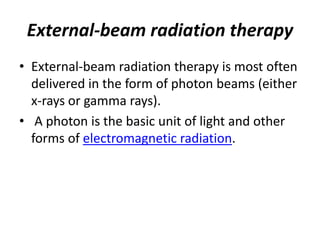
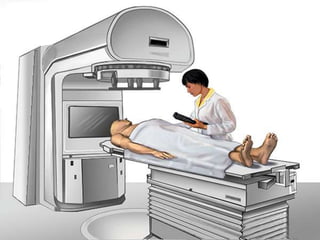
• External-beam radiation therapy is most often
delivered in the form of photon beams (either
x-rays or gamma rays).
• A photon is the basic unit of light and other
forms of electromagnetic radiation.
• Internal radiation therapy (brachytherapy) is
radiation delivered from radiation sources
(radioactive materials) placed inside or on the
body.
• Several brachytherapy techniques are used in
cancer treatment.
• Interstitial brachytherapy uses a radiation
source placed within tumor tissue, such as
within a prostate tumor.
• Intracavitary brachytherapy uses a source
placed within a surgical cavity or a body cavity,
such as the chest cavity, near a tumor.
• Episcleral brachytherapy, which is used to
treat melanoma inside the eye, uses a source
that is attached to the eye.
• In brachytherapy, radioactive isotopes are
sealed in tiny pellets or “seeds.” These seeds
are placed in patients using delivery devices,
such as needles, catheters, or some other type
of carrier.
• As the isotopes decay naturally, they give off
radiation that damages nearby cancer cells.
SIDE EFFECTS
• Fibrosis (the replacement of normal tissue
with scar tissue, leading to restricted
movement of the affected area).
• Damage to the bowels, causing diarrhea and
bleeding.
• Memory loss.
• Infertility (inability to have a child).
• Rarely, a second cancer caused by radiation
exposure.
Immunotherapy, radiation, chemotherapy

Immunotherapy, radiation, chemotherapy

  • 1.
  • 2.
    • Immunotherapy, alsocalled biologic therapy, is a type of cancer treatment designed to boost the body's natural defenses to fight the cancer. • It uses substances either made by the body or in a laboratory to improve or restore immune system function.
  • 3.
    • Immunotherapy maywork in the following ways: – Stopping or slowing the growth of cancer cells – Stopping cancer from spreading to other parts of the body – Helping the immune system work better at destroying cancer cells
  • 4.
    • There areseveral types of immunotherapy, including: – Monoclonal antibodies – Non-specific immunotherapies – Oncolytic virus therapy – T-cell therapy – Cancer vaccines
  • 5.
    Monoclonal antibodies • Whenthe body’s immune system detects something harmful, it produces antibodies. Antibodies are proteins that fight infection. • Monoclonal antibodies are a specific type of therapy made in a laboratory. They may be used in a variety of ways. For example, monoclonal antibodies can be used as a targeted therapy to block an abnormal protein in a cancer cell.
  • 6.
    Non-specific immunotherapies • Likemonoclonal antibodies, non-specific immunotherapies also help the immune system destroy cancer cells. • Two common non-specific immunotherapies are Interferons and Interleukins.
  • 7.
    Interferons • Interferons helpthe immune system fight cancer and may slow the growth of cancer cells. An interferon made in a laboratory, called interferon alpha (Roferon-A [2a], Intron A [2b], Alferon [2a]), is the most common type of interferon used in cancer treatment
  • 8.
    Interleukins • Interleukins helpthe immune system produce cells that destroy cancer. An interleukin made in a laboratory, called interleukin-2, IL-2, or aldesleukin (Proleukin), is used to treat kidney cancer and skin cancer, including melanoma.
  • 9.
    Oncolytic virus therapy •Oncolytic virus therapy is a new type of immunotherapy that uses genetically modified viruses to kill cancer cells. First, the doctor injects a virus into the tumor. The virus enters the cancer cells and makes copies of itself. As a result, the cells burst and die.
  • 10.
    T-cell therapy • Forthis type of immunotherapy, some T cells are removed from a patient’s blood. Then, the cells are changed in a laboratory so they have specific proteins called receptors. These receptors allow those T cells to recognize the cancer cells. • The changed T cells are grown in large numbers in the laboratory and returned to the patient’s body. Once there, they seek out and destroy cancer cells.
  • 11.
    Cancer vaccines • Avaccine is another method used to help the body fight disease. A vaccine exposes the immune system to an antigen. • This triggers the immune system to recognize and destroy that protein or related materials. There are 2 types of cancer vaccines: prevention vaccines and treatment vaccines.
  • 12.
  • 13.
    • Chemotherapy isthe use of medication (chemicals) to treat disease. More specifically, chemotherapy typically refers to the destruction of cancer cells.
  • 14.
    Goals of chemotherapytreatment • If the doctor has recommended chemotherapy to treat cancer, it’s important to understand the goals of treatment when making treatment decisions. • There are three main goals for chemotherapy (chemo) in cancer treatment: – Cure – Control – Palliation
  • 15.
    Cure • If possible,chemo is used to cure cancer, meaning that the cancer is destroyed – it goes away and doesn’t come back.
  • 16.
    Control • If cureis not possible, the goal may be to control the disease. Chemo is used to shrink tumors and/or stop the cancer from growing and spreading. • This can help the person with cancer feel better and live longer.
  • 17.
    Palliation • Chemo canalso be used to ease symptoms caused by the cancer. This is called palliative chemotherapy or palliation. • When the cancer is at an advanced stage, meaning it’s not under control and has spread from where it started to other parts of the body, the goal may be to improve the quality of life or help the person feel better.
  • 18.
    ways of givingchemotherapy • Depending on the type of cancer, chemotherapy may be administered orally or intravenously (directly into the vein). • Oral chemotherapy (swallowing tablets) • Intravenous chemotherapy (straight into the vein)
  • 19.
    Oral chemotherapy (swallowing tablets) •These will be in the form of tablets. If the patient's health allows it he/she will be able to take them at home. However, regular hospital visits will still be needed to check on the patient's health and response to treatment.
  • 20.
    Intravenous chemotherapy (straight intothe vein) • Intravenous chemotherapy may be given as: • An injection straight into a vein. • Through a drip (intravenous infusion). • Through a drip or pump.
  • 21.
    Side effects ofchemotherapy • Nausea and vomiting • Alopecia (hair loss) • Fatigue • Hearing impairment (deafness, ototoxicity) • Neutropenia (low white blood cells) - Susceptibility to infections • Thrombocytopenia (low blood platelet count) • Anemia
  • 22.
  • 23.
    • Radiation therapyis one of the most common treatments for cancer. It uses high-energy particles or waves, such as x-rays, gamma rays, electron beams, or protons, to destroy or damage cancer cells. • Other names for radiation therapy are radiotherapy, irradiation, or x-ray therapy.
  • 24.
    How does radiationtherapy kill cancer cells • Radiation therapy kills cancer cells by damaging their DNA (the molecules inside cells that carry genetic information and pass it from one generation to the next). • Radiation therapy can either damage DNA directly or create charged particles (free radicals) within the cells that can in turn damage the DNA.
  • 25.
    TYPES • External-beam radiationtherapy • Internal radiation therapy
  • 26.
    External-beam radiation therapy •External-beam radiation therapy is most often delivered in the form of photon beams (either x-rays or gamma rays). • A photon is the basic unit of light and other forms of electromagnetic radiation.
  • 28.
    • Internal radiationtherapy (brachytherapy) is radiation delivered from radiation sources (radioactive materials) placed inside or on the body. • Several brachytherapy techniques are used in cancer treatment.
  • 29.
    • Interstitial brachytherapyuses a radiation source placed within tumor tissue, such as within a prostate tumor. • Intracavitary brachytherapy uses a source placed within a surgical cavity or a body cavity, such as the chest cavity, near a tumor. • Episcleral brachytherapy, which is used to treat melanoma inside the eye, uses a source that is attached to the eye.
  • 30.
    • In brachytherapy,radioactive isotopes are sealed in tiny pellets or “seeds.” These seeds are placed in patients using delivery devices, such as needles, catheters, or some other type of carrier. • As the isotopes decay naturally, they give off radiation that damages nearby cancer cells.
  • 31.
    SIDE EFFECTS • Fibrosis(the replacement of normal tissue with scar tissue, leading to restricted movement of the affected area). • Damage to the bowels, causing diarrhea and bleeding. • Memory loss. • Infertility (inability to have a child). • Rarely, a second cancer caused by radiation exposure.