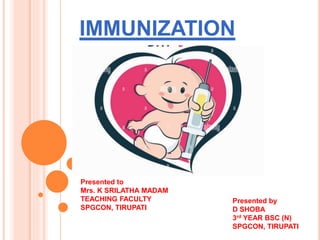
IMMUNIZATION
Presented by
D SHOBA
3rd YEAR BSC (N)
SPGCON, TIRUPATI
Presented to
Mrs. K SRILATHA MADAM
TEACHING FACULTY
SPGCON, TIRUPATI
WHAT IS IMMUNIZATION
o Immunization is a process of
protecting the individual from a
disease through the introduction of
live or killed or attenuated organisms
into the individual body system.
o It is one of the ‘BEST BUYS’ in
community health and one of the most
cost effective health intervention.
DEFINITION
 Immunization is the process where by
a person is made immune or resistant
to an infectious disease , typically by
the administration of a vaccine .
Vaccines stimulate the body’s own
immune system to protect the person
against subseqent infection or
disease.
World health organization
 Immunization is the world’s safest
method to protect children from life
threatening diseases.
UNICEF
TYPES OF IMMUNITY
There are mainly two types , that is
1. Active immunity
2. Passive immunity
IMMUNIZING AGENTS
1) Vaccines
2) Immunoglobulins
3) Antisera or anti toxines
IMPORTANCE OF IMMUNIZATION
 Immunization has helped reduce the
impact of the communicable disease
on health and wellbeing .
 Some disease have been well
controlled and other eliminated from
some parts of the world because of
vaccination .
 Stopping vaccination may again lead
to epidemic .
 Immunization protects future
generations .
NATIONAL IMMUNIZATION SCHEDULE
 Immunization schedule should be planned
according to the needs of coomunity . It
should be relevent with existing community
health problems .
 It must be effective , feasible and acceptlable
by the community . Every country has its own
immunization schedule .
 The WHO launched global immunization
programme in 1974 , known as expanded
program on immunization (EPI) to protect all
children of the world against six killer
diseases .
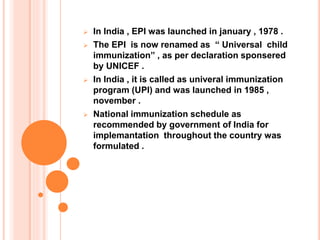
 In India , EPI was launched in january , 1978 .
 The EPI is now renamed as “ Universal child
immunization” , as per declaration sponsered
by UNICEF .
 In India , it is called as univeral immunization
program (UPI) and was launched in 1985 ,
november .
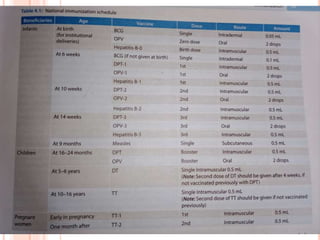
 National immunization schedule as
recommended by government of India for
implemantation throughout the country was
formulated .
CHILD MORTALITY
AND
CHILD MORBIDITY
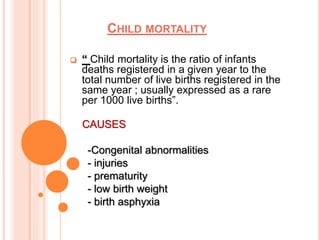
CHILD MORTALITY
 “ Child mortality is the ratio of infants
deaths registered in a given year to the
total number of live births registered in the
same year ; usually expressed as a rare
per 1000 live births”.
CAUSES
-Congenital abnormalities
- injuries
- prematurity
- low birth weight
- birth asphyxia
CHILD MORBIDITY
 “ Morbidity refers to ill health in child or
deviation from a state of physical or mental
well being as a result of disease , injury or
impairment .
CAUSES
*Infectious disease including
- Pneumonia
- malaria
* Pre term birth
* Birth asphyxia
* Trauma
* Congenital anomalies
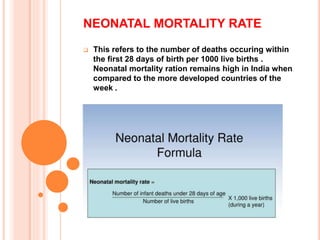
NEONATAL MORTALITY RATE
 This refers to the number of deaths occuring within
the first 28 days of birth per 1000 live births .
Neonatal mortality ration remains high in India when
compared to the more developed countries of the
week .
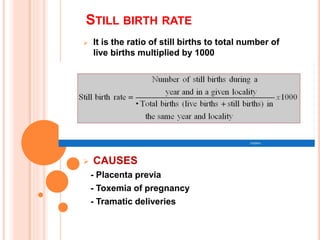
STILL BIRTH RATE
 It is the ratio of still births to total number of
live births multiplied by 1000
 CAUSES
- Placenta previa
- Toxemia of pregnancy
- Tramatic deliveries
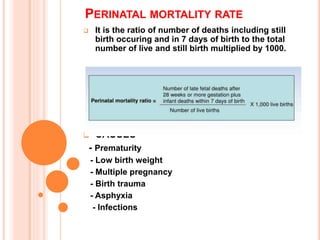
PERINATAL MORTALITY RATE
 It is the ratio of number of deaths including still
birth occuring and in 7 days of birth to the total
number of live and still birth multiplied by 1000.
 CAUSES
- Prematurity
- Low birth weight
- Multiple pregnancy
- Birth trauma
- Asphyxia
- Infections
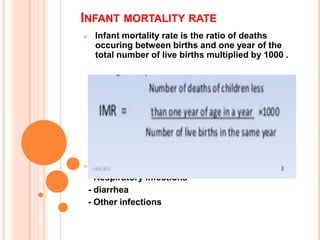
INFANT MORTALITY RATE
 Infant mortality rate is the ratio of deaths
occuring between births and one year of the
total number of live births multiplied by 1000 .
 CAUSES
- Respiratory infections
- diarrhea
- Other infections
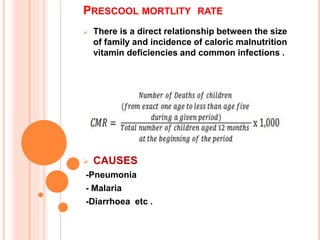
 There is a direct relationship between the size
of family and incidence of caloric malnutrition
vitamin deficiencies and common infections .
 CAUSES
-Pneumonia
- Malaria
-Diarrhoea etc .
PRESCOOL MORTLITY RATE
AGE SPECIFIC MORTALITY RATE
 It is the number of death in a year in age
specified age group per 1000 persons .
 The very high age specific mortality rate in the
0-4 years age groups under lines the need for
priority core for this group .
immunization

immunization

  • 2.
    IMMUNIZATION Presented by D SHOBA 3rdYEAR BSC (N) SPGCON, TIRUPATI Presented to Mrs. K SRILATHA MADAM TEACHING FACULTY SPGCON, TIRUPATI
  • 3.
    WHAT IS IMMUNIZATION oImmunization is a process of protecting the individual from a disease through the introduction of live or killed or attenuated organisms into the individual body system. o It is one of the ‘BEST BUYS’ in community health and one of the most cost effective health intervention.
  • 4.
    DEFINITION  Immunization isthe process where by a person is made immune or resistant to an infectious disease , typically by the administration of a vaccine . Vaccines stimulate the body’s own immune system to protect the person against subseqent infection or disease. World health organization
  • 5.
     Immunization isthe world’s safest method to protect children from life threatening diseases. UNICEF
  • 6.
    TYPES OF IMMUNITY Thereare mainly two types , that is 1. Active immunity 2. Passive immunity
  • 7.
    IMMUNIZING AGENTS 1) Vaccines 2)Immunoglobulins 3) Antisera or anti toxines
  • 8.
    IMPORTANCE OF IMMUNIZATION Immunization has helped reduce the impact of the communicable disease on health and wellbeing .  Some disease have been well controlled and other eliminated from some parts of the world because of vaccination .  Stopping vaccination may again lead to epidemic .  Immunization protects future generations .
  • 9.
    NATIONAL IMMUNIZATION SCHEDULE Immunization schedule should be planned according to the needs of coomunity . It should be relevent with existing community health problems .  It must be effective , feasible and acceptlable by the community . Every country has its own immunization schedule .  The WHO launched global immunization programme in 1974 , known as expanded program on immunization (EPI) to protect all children of the world against six killer diseases .
  • 10.
     In India, EPI was launched in january , 1978 .  The EPI is now renamed as “ Universal child immunization” , as per declaration sponsered by UNICEF .  In India , it is called as univeral immunization program (UPI) and was launched in 1985 , november .  National immunization schedule as recommended by government of India for implemantation throughout the country was formulated .
  • 16.
  • 17.
    CHILD MORTALITY  “Child mortality is the ratio of infants deaths registered in a given year to the total number of live births registered in the same year ; usually expressed as a rare per 1000 live births”. CAUSES -Congenital abnormalities - injuries - prematurity - low birth weight - birth asphyxia
  • 18.
    CHILD MORBIDITY  “Morbidity refers to ill health in child or deviation from a state of physical or mental well being as a result of disease , injury or impairment . CAUSES *Infectious disease including - Pneumonia - malaria * Pre term birth * Birth asphyxia * Trauma * Congenital anomalies
  • 19.
    NEONATAL MORTALITY RATE This refers to the number of deaths occuring within the first 28 days of birth per 1000 live births . Neonatal mortality ration remains high in India when compared to the more developed countries of the week .
  • 20.
    STILL BIRTH RATE It is the ratio of still births to total number of live births multiplied by 1000  CAUSES - Placenta previa - Toxemia of pregnancy - Tramatic deliveries
  • 21.
    PERINATAL MORTALITY RATE It is the ratio of number of deaths including still birth occuring and in 7 days of birth to the total number of live and still birth multiplied by 1000.  CAUSES - Prematurity - Low birth weight - Multiple pregnancy - Birth trauma - Asphyxia - Infections
  • 22.
    INFANT MORTALITY RATE Infant mortality rate is the ratio of deaths occuring between births and one year of the total number of live births multiplied by 1000 .  CAUSES - Respiratory infections - diarrhea - Other infections
  • 23.
     There isa direct relationship between the size of family and incidence of caloric malnutrition vitamin deficiencies and common infections .  CAUSES -Pneumonia - Malaria -Diarrhoea etc . PRESCOOL MORTLITY RATE
  • 24.
    AGE SPECIFIC MORTALITYRATE  It is the number of death in a year in age specified age group per 1000 persons .  The very high age specific mortality rate in the 0-4 years age groups under lines the need for priority core for this group .