 Most proven method to initiate or
stimulate uterine contractions
 Discovered in 1906- Sir Henry Dale
 Labor Induction:
› 1990- 9.5% of deliveries
› 2012- 23.3% of deliveries
 Labor Augmentation: 2015
› Nulliparus- 44-73%
› Multiparus- 28-45%
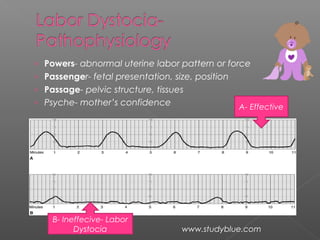
› Powers- abnormal uterine labor pattern or force
› Passenger- fetal presentation, size, position
› Passage- pelvic structure, tissues
› Psyche- mother’s confidence A- Effective
B- Ineffecive- Labor
Dystocia www.studyblue.com
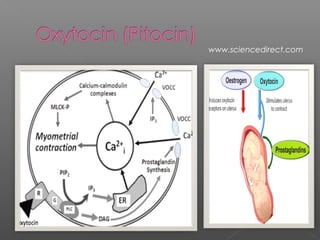
www.sciencedirect.com
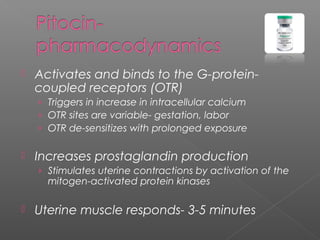
 Activates and binds to the G-protein-
coupled receptors (OTR)
› Triggers in increase in intracellular calcium
› OTR sites are variable- gestation, labor
› OTR de-sensitizes with prolonged exposure
 Increases prostaglandin production
› Stimulates uterine contractions by activation of the
mitogen-activated protein kinases
 Uterine muscle responds- 3-5 minutes
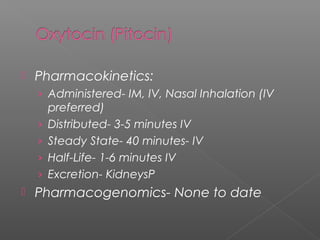
 Pharmacokinetics:
› Administered- IM, IV, Nasal Inhalation (IV
preferred)
› Distributed- 3-5 minutes IV
› Steady State- 40 minutes- IV
› Half-Life- 1-6 minutes IV
› Excretion- KidneysP
 Pharmacogenomics- None to date
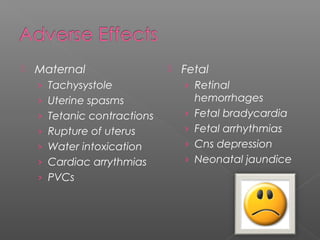
 Maternal
› Tachysystole
› Uterine spasms
› Tetanic contractions
› Rupture of uterus
› Water intoxication
› Cardiac arrythmias
› PVCs
 Fetal
› Retinal
hemorrhages
› Fetal bradycardia
› Fetal arrhythmias
› Cns depression
› Neonatal jaundice
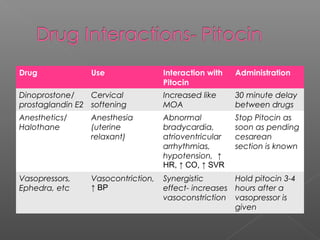
Drug Use Interaction with
Pitocin
Administration
Dinoprostone/
prostaglandin E2
Cervical
softening
Increased like
MOA
30 minute delay
between drugs
Anesthetics/
Halothane
Anesthesia
(uterine
relaxant)
Abnormal
bradycardia,
atrioventricular
arrhythmias,
hypotension, ↑
HR, ↑ CO, ↑ SVR
Stop Pitocin as
soon as pending
cesarean
section is known
Vasopressors,
Ephedra, etc
Vasocontriction,
↑ BP
Synergistic
effect- increases
vasoconstriction
Hold pitocin 3-4
hours after a
vasopressor is
given
 Oxytocin and tocolytic agents
› Tocolytics- oxytocin antagonists
 Used to inhibit uterine contractions
 Ritodrine, nitric oxide donors, calcium channel
blockers, COX-2 like inhibitors (Indomethacin)
 Atosiban- peptide OTR antagonist
› Synthesized drug created from oxytocin
› Used to block the binding of oxytocin to OTR
sites
› Not FDA approved in the United States*
› Used in Preterm Labor in Europe
 Pitocin- High Alert Medication- ISMP 2015
 National Quality Forum (2011)
› Serious Reportable Events- Medication Errors
resulting in patient harm
 Patient Safety Initiatives
› Red Rules- 2 Nurse Check with High Risk Meds
› Order of Administration- Pitocin and Magnesium
Sulfate
› Computer Physician Order Entry
› Medical Power Plans
 Understand the pharmacokinetics/
pharmacodynamics of Pitocin
 Recognize the impact of gestation on Pitocin use
 Monitor prolonged use or high dosage use of Pitocin
 Evaluate risk for each patient
› Gestation
› Labor patterns
› Maternal and fetal tolerance
› Health History affecting drug usage
 Communicate potential adverse events to the
interdisciplinary team
 Standardized Onboarding and
Remediation of employees
 Recognizing and Reacting to Pitocin as
a high alert/ high risk medication
 Escalation of real time safety events
 Utilizing Chain of Command to ensure
patient safety
 Safety as a Core Value
 Gilbert, E. S. (2010). Manual of High Risk Pregnancy and Delivery (5th ed.). St. Louis, MO: Mosby Elsevier.
 Halothane (2015). In Lexi-Comp Online®. Retrieved November 13, 2015@
http://www.nursingconsult.com/nursing/drugs/monograph?tab=generic&drug_id=288&monotype=full&first
page=&secondpage=&firstsort_by=&firstsort_order=&secondsort_by=&secondsort_order=&firsttitle=&sec
ondtitle=&firstdrugsRequestUri=&parentpage=search&searchId=&searchTerm=&page=&abstract=Pharm&
search_type=&bestBetId=&dropdown=$dropdown&area=$area&bestbet=true.
 Institute for Safe Medication Practices (2015). List of High Alert Medications in the Acute Care Setting. Retrieved November 13, 2015 @
http://www.ismp.org/tools/institutionalhighAlert.asp.
 Martin, E. J. & Kennedy, B. B. (2009). Overview of labor. (4th ed.) In B.B. Kennedy, D. J. Ruth, & E. J. Martin (Eds.), Intrapartum
Management Modules, 1-23. Philadelphia, PA: Lippincott Williams & Wilkins.
 National Quality Forum (2011). Serious Reportable Events. Retrieved November 13, 2015 @
http://www.qualityforum.org/Topics/SREs/Serious_Reportable_Events.aspx.
 Neal, J. M., Ryan, S. L., Lowe, N.K., Schorn, M. N., Buxton, M., Holley, S. L., & Wilson-Liverman, A. M. (2015). Labor dystocia: uses of
related nomenclature. Journal of Midwifery and Women’s Health, 60(5), 485-498.
 Oxytocin (2015). In Lexi-comp Online®. Retrieved November 9, 2015
@https://online.lexi.com/lco/action/doc/retrieve/docid/hermannhe
althcare_f/4129023.
 Oxytocin (2010). In Mosby Nursing Consult. Retrieved November 9, 2015
@http://www.nursingconsult.com/nursing/drugs/monograph?tab=g
eneric&drug_id=458&firstpage=1&secondpage=1&firstsort_by=title&
firstsort_order=asc&secondsort_by=&secondsort_order=&firsttitle=ox
ytocin&secondtitle=&firstdrugsRequestUri=quick-find&monotype=full.
 Simpson, K. R. (2011). Clinicians’ Guide to the Use of Oxytocin for Labor Induction and
Augmentation. Journal of Midwifery and Women’s Health, 56(3), 214-221.
 Ward, A. (2015, October 29). Interviewed by K. Pennington. Use of Pitocin in
Augmented Labor in Labor and Delivery. Memorial Hermann Health System,
Houston, Texas.
 Wing, D. (2015). Induction of labor. In C. J . Lockwood & V. A. A. Barss (Eds.), Uptodate.
Retrieved October 23, 2015 @http://www.uptodate.com/contents/induction-of-
labor?source=search_result&search=induction+of+labor&selectedTitle=1%7E114.
 Wing, D. A., & Sheibani, L. (2015). Pharmacotherapy options for labor induction. Expert
Opinion on Phamacotherapy,16(11). 1657-1658. Retrieved November 13, 2015 @
http://www.tandfonline.com/doi/abs/10.1517/14656566.2015.1060960.

Pitocin

  • 2.
     Most provenmethod to initiate or stimulate uterine contractions  Discovered in 1906- Sir Henry Dale  Labor Induction: › 1990- 9.5% of deliveries › 2012- 23.3% of deliveries  Labor Augmentation: 2015 › Nulliparus- 44-73% › Multiparus- 28-45%
  • 3.
    › Powers- abnormaluterine labor pattern or force › Passenger- fetal presentation, size, position › Passage- pelvic structure, tissues › Psyche- mother’s confidence A- Effective B- Ineffecive- Labor Dystocia www.studyblue.com
  • 4.
  • 5.
     Activates andbinds to the G-protein- coupled receptors (OTR) › Triggers in increase in intracellular calcium › OTR sites are variable- gestation, labor › OTR de-sensitizes with prolonged exposure  Increases prostaglandin production › Stimulates uterine contractions by activation of the mitogen-activated protein kinases  Uterine muscle responds- 3-5 minutes
  • 6.
     Pharmacokinetics: › Administered-IM, IV, Nasal Inhalation (IV preferred) › Distributed- 3-5 minutes IV › Steady State- 40 minutes- IV › Half-Life- 1-6 minutes IV › Excretion- KidneysP  Pharmacogenomics- None to date
  • 7.
     Maternal › Tachysystole ›Uterine spasms › Tetanic contractions › Rupture of uterus › Water intoxication › Cardiac arrythmias › PVCs  Fetal › Retinal hemorrhages › Fetal bradycardia › Fetal arrhythmias › Cns depression › Neonatal jaundice
  • 8.
    Drug Use Interactionwith Pitocin Administration Dinoprostone/ prostaglandin E2 Cervical softening Increased like MOA 30 minute delay between drugs Anesthetics/ Halothane Anesthesia (uterine relaxant) Abnormal bradycardia, atrioventricular arrhythmias, hypotension, ↑ HR, ↑ CO, ↑ SVR Stop Pitocin as soon as pending cesarean section is known Vasopressors, Ephedra, etc Vasocontriction, ↑ BP Synergistic effect- increases vasoconstriction Hold pitocin 3-4 hours after a vasopressor is given
  • 9.
     Oxytocin andtocolytic agents › Tocolytics- oxytocin antagonists  Used to inhibit uterine contractions  Ritodrine, nitric oxide donors, calcium channel blockers, COX-2 like inhibitors (Indomethacin)  Atosiban- peptide OTR antagonist › Synthesized drug created from oxytocin › Used to block the binding of oxytocin to OTR sites › Not FDA approved in the United States* › Used in Preterm Labor in Europe
  • 10.
     Pitocin- HighAlert Medication- ISMP 2015  National Quality Forum (2011) › Serious Reportable Events- Medication Errors resulting in patient harm  Patient Safety Initiatives › Red Rules- 2 Nurse Check with High Risk Meds › Order of Administration- Pitocin and Magnesium Sulfate › Computer Physician Order Entry › Medical Power Plans
  • 11.
     Understand thepharmacokinetics/ pharmacodynamics of Pitocin  Recognize the impact of gestation on Pitocin use  Monitor prolonged use or high dosage use of Pitocin  Evaluate risk for each patient › Gestation › Labor patterns › Maternal and fetal tolerance › Health History affecting drug usage  Communicate potential adverse events to the interdisciplinary team
  • 12.
     Standardized Onboardingand Remediation of employees  Recognizing and Reacting to Pitocin as a high alert/ high risk medication  Escalation of real time safety events  Utilizing Chain of Command to ensure patient safety  Safety as a Core Value
  • 13.
     Gilbert, E.S. (2010). Manual of High Risk Pregnancy and Delivery (5th ed.). St. Louis, MO: Mosby Elsevier.  Halothane (2015). In Lexi-Comp Online®. Retrieved November 13, 2015@ http://www.nursingconsult.com/nursing/drugs/monograph?tab=generic&drug_id=288&monotype=full&first page=&secondpage=&firstsort_by=&firstsort_order=&secondsort_by=&secondsort_order=&firsttitle=&sec ondtitle=&firstdrugsRequestUri=&parentpage=search&searchId=&searchTerm=&page=&abstract=Pharm& search_type=&bestBetId=&dropdown=$dropdown&area=$area&bestbet=true.  Institute for Safe Medication Practices (2015). List of High Alert Medications in the Acute Care Setting. Retrieved November 13, 2015 @ http://www.ismp.org/tools/institutionalhighAlert.asp.  Martin, E. J. & Kennedy, B. B. (2009). Overview of labor. (4th ed.) In B.B. Kennedy, D. J. Ruth, & E. J. Martin (Eds.), Intrapartum Management Modules, 1-23. Philadelphia, PA: Lippincott Williams & Wilkins.  National Quality Forum (2011). Serious Reportable Events. Retrieved November 13, 2015 @ http://www.qualityforum.org/Topics/SREs/Serious_Reportable_Events.aspx.  Neal, J. M., Ryan, S. L., Lowe, N.K., Schorn, M. N., Buxton, M., Holley, S. L., & Wilson-Liverman, A. M. (2015). Labor dystocia: uses of related nomenclature. Journal of Midwifery and Women’s Health, 60(5), 485-498.
  • 14.
     Oxytocin (2015).In Lexi-comp Online®. Retrieved November 9, 2015 @https://online.lexi.com/lco/action/doc/retrieve/docid/hermannhe althcare_f/4129023.  Oxytocin (2010). In Mosby Nursing Consult. Retrieved November 9, 2015 @http://www.nursingconsult.com/nursing/drugs/monograph?tab=g eneric&drug_id=458&firstpage=1&secondpage=1&firstsort_by=title& firstsort_order=asc&secondsort_by=&secondsort_order=&firsttitle=ox ytocin&secondtitle=&firstdrugsRequestUri=quick-find&monotype=full.  Simpson, K. R. (2011). Clinicians’ Guide to the Use of Oxytocin for Labor Induction and Augmentation. Journal of Midwifery and Women’s Health, 56(3), 214-221.  Ward, A. (2015, October 29). Interviewed by K. Pennington. Use of Pitocin in Augmented Labor in Labor and Delivery. Memorial Hermann Health System, Houston, Texas.  Wing, D. (2015). Induction of labor. In C. J . Lockwood & V. A. A. Barss (Eds.), Uptodate. Retrieved October 23, 2015 @http://www.uptodate.com/contents/induction-of- labor?source=search_result&search=induction+of+labor&selectedTitle=1%7E114.  Wing, D. A., & Sheibani, L. (2015). Pharmacotherapy options for labor induction. Expert Opinion on Phamacotherapy,16(11). 1657-1658. Retrieved November 13, 2015 @ http://www.tandfonline.com/doi/abs/10.1517/14656566.2015.1060960.

Editor's Notes

  • #3 A common medication used in the labor and delivery suites is Pitocin. Pitocin is used to initiate or stimulate muscle contractions in the uterus (Wing, 2015). Oxytocin was first discovered in 1906 by Sir Henry Dale as a hormone found in the pituitary gland of humans which caused contractions of the pregnant uterus (Simpson, 2011). The use of both synthetic (Pitocin) and artificial forms of oxytocin is the most proven method of inducing uterine contractions (Simpson, 2011; Wing, 2015). Labor induction has doubled from 9.5% in 1990 to 23.3% in 2012 (Wing, 2015). Augmentation of labor dystocia is internationally reported, ranging from 44-73% for nulliparous women and 28-45% for multiparous women (Neal, Ryan, Lowe, Schorn, Buxton, Holley, & Wilson-Liverman, 2015). The knowledge of the pharmacokinetics and pharmacodynamics of Pitocin are essential to safely managing the perinatal patient during episodes of labor dystocia.
  • #4 Labor Dystocia is defined by Simpson (2011) as “abnormal labor related to problems with uterine contractions or maternal expulsive forces (powers); problems with fetal position, size, or presentation (passenger); or problems with the pelvis and/or surrounding soft tissues (passage)” (p. 216).
  • #5 As the uterus prepares for labor, hormones from the placenta and maternal and fetal endocrine glands begin to make changes to the myometrium (Martin & Kennedy, 2009). The lining of the uterus (or decidua), the fetal membranes, and the uterine musculature create a tissue to tissue communication. The uterine fibers develop cell to cell communication pathways or gap junctions that are responsible for the transfer of electrical and chemical signals from muscle fiber cell to another (Martin & Kennedy, 2009). To make a coordinated contraction pattern, a majority of the fiber cells must respond in sync. The placenta also releases a hormone called corticotrophin-releasing factor (CRF) that increases the strength of the muscle contraction and the release of oxytocin and prostaglandins (Martin & Kennedy, 2009). Prostaglandins are responsible for smooth muscle contraction. The Calcium ion is accountable for the contractile process in the myometrial cells by transmitting signals of excitation from the cell membranes to the contraction process within the cell. When the internal muscular processes or external factors negatively influence this contractile process, as described by Simpson (2011), labor dystocia is diagnosed and augmentation with Pitocin may be needed.
  • #6 Pitocin is used to reinforce or stimulate (oxytocin agonist) uterine contractions when the uterine muscle does not exhibit an effective labor pattern (Oxytocin, 2015). The expected response is that the Pitocin stimulates the uterine muscle by activation G-protein-coupled receptors that trigger an increase in intracellular calcium in the myofibrils. Prostaglandin production is increased by the Pitocin which further stimulates uterine contractions (Oxytocin, 2015). Pitocin binds to the oxytocin receptor site (OTR) which activates many intracellular pathways that ultimately leads to muscle contraction (Vrachnis, Malamas, Sifakis, Deligeoroglou, & Iliodromiti, 2011). Vrachnis et al. (2011) also states that this increase production of prostaglandins, through the activation of the mitogen-activated protein kinases with the increased intracellular calcium, results in the contractile effects of the oxytocin/oxytocin receptor activation. The uterine muscle responds to the Pitocin within three to five minute of administration (Gilbert, 2010). OTR sites are variable during gestation and in labor. OTR sites are increased at the end of gestation and are more sensitive to levels of Pitocin (Vrachnis et al., 2011). As labor progresses and time lengthens, OTR sites become de-sensitized to Pitocin which impacts the long term effect and use of the drug.
  • #7 Pitocin can be administered intramuscularly, intravenously, or by nasal inhalation. The most effective route is intravenous (Oxytocin, 2010; Ward, 2015). Pitocin achieves a steady state in the plasma in 40 minutes when given IV. The half-life of the drug occurs within 1-6 minutes and is distributed throughout the extracellular fluid (Oxytocin, 2010; Ward, 2015). Excretion of the drug is through the kidneys (Oxytocin, 2015; Ward, 2015). Currently, there are no studies of pharmacogenomics related to Pitocin administration (Wing & Sheibani, 2015).
  • #8 The most common adverse effect of Pitocin in a mother is hypersensitivity to the drug and or excessive administration causing tachysystole, uterine spasms, tetanic contractions, or rupture of the uterus (Oxytocin, 2015; Ward, 2015). Oxytocin can have an antidiuretic effect that causes water intoxication if doses of 40-50 milliunits per minute are administered over long periods of time leading to seizures and coma. Oxytocin can also cause cardiac arrhythmias and premature ventricular contractions. In the fetus, Pitocin has been associated with neonatal retinal hemorrhages, fetal bradycardia, fetal arrhythmias, and central nervous system depression (Oxytocin, 2015; Ward, 2015). Neonatal jaundice has been associated with Pitocin-induced labors; hyperbilirubinemia is 1.6 times more likely in a baby whose mother received Pitocin (Oxytocin, 2015).
  • #9 Pitocin is occasionally given in close proximity to other oxytocic drugs such as dinoprostone or prostaglandin E2 agents during an augmented labor. It is recommended that there is a 30 minute delay between agents to prevent hypertonus of the uterus (Oxytocin, 2015; Ward, 2015). Anesthetics given concurrently with oxytocin can cause abnormal bradycardia, atrioventricular heart rhythms, hypotension, increased heart rate, cardiac output, and systemic venous return (Oxytocin, 2015), especially in patients with known valvular heart disease. Halothane is a general anesthetic that is a potent uterine relaxant that works directly against Pitocin’s mechanism of action (Halothane, 2015). This is significant in the event of a failed Pitocin augmentation that receives Halothane anesthetic during cesarean section. The risk of hemorrhage post-delivery is increased. Pitocin also interacts with prophylactic vasopressors through synergy causing an increased vasoconstrictive effect. It is recommended that the Pitocin be given 3-4 hours after a vasopressor to reduce this risk. Vasopressors such as Ephedra, which is commonly given to treat a hypotensive episode after an anesthesia introduction with epidural placement, require close observation if Pitocin is being used to augment labor. Oxytocin and vasopressins have similar structures and only differ by two amino acids (Vrachnis, Malamas, Sifakis, Deligeoroglou, & Iliodromiti, 2011; Ward, 2015).
  • #10 As previously discussed, OTR sites become de-sensitized with prolonged use of Pitocin. This de-sensitization is a mechanism that is thought to protect the cells from overstimulation by inhibiting the G-protein activation and by the binding of proteins called arrestins (Vrachnis, Malamas, Sifakis, Deligeoroglou, & Iliodromiti, 2011). Essentially, this long term administration reduces the available binding sites for the drug. This de-sensitization may last for hours or days and may influence the ongoing use of Pitocin to augment labor and manage uterine atony after delivery. This phenomenon explains why lower doses of Pitocin are needed when it is given in “pulses” to augment labor rather than choosing higher continuous doses of Pitocin (Vrachnis et al., 2011). There is also some research on tocolytic agents that are considered oxytocin antagonists. These medications are used to inhibit uterine contractions but have undesirable side effects: ritodrine, nitric oxide donors, calcium-channel blockers, and COX-2 inhibitors like Indomethacin (Vrachnis et al., 2011). Atosiban, a peptide OTR antagonist, is a synthesized drug created from oxytocin that is used to block the binding of oxytocin to OTR sites. Although this medication is not FDA approved in the United States, it is used as a treatment for preterm labor in Europe and other countries (Vrachnis, et al., 2011). The primary reason for its exclusion in the United States is that it has failed to reduce preterm births or improve neonatal outcomes in controlled studies. Other experimental studies are being conducted on other oxytocin antagonist tocolytics, but have not been successfully completed.
  • #11 In our organization, our System Services Pharmacy Director, A. Ward, analyzes cases where by adverse medication events have caused harm to our patients (Ward, 2015). Ms. Ward is involved in events that the National Quality Forum (2011) determines are Serious Reportable Events (SRE). Her focus is on events that are defined as “patient death or serious injury associated with a medication error (e.g., errors involving the wrong drug, wrong dose, wrong patient, wrong time, wrong rate, wrong preparation, or wrong route of administration” (NQF, 2011). Institute for Safe Medication Practices (2015) lists oxytocin as a “high alert medication” which is defined as any drug that has an increased risk of patient harm when used in error. In her analysis of our organization, we recognized that we had not instituted the two person check when initiating Pitocin in our labor and delivery units. This was a practice change that began with education and implementation of practice changes across nine hospitals that provided obstetrical services. Ms. Ward worked with the Chief Nursing officers and Obstetric Nursing Leadership to implement the two person check on initial administration of all Pitocin in regards to induction or augmentation. Another initiative to improve patient safety, while using Pitocin, was the order of drug administration when starting both Pitocin and Magnesium Sulfate. Both Pitocin and Magnesium Sulfate are prepared by pharmacy and stocked in a pyxis refrigerator on the nursing unit. When the medication therapy requires the initiation of both medications (pre-eclampsia), the practice is to obtain both medications from the pyxis refrigerator and administer intravenously per IV pump. We identified the potential risk of administering either medication at the wrong rate or on the wrong pump. Ms. Ward was part of a system decision to always administer the Pitocin first and then administering the Magnesium Sulfate according to our “red rule (two nurse check)” process as the second measure. This process assures safe medication administration of two medications that are considered high risk medications according to the Institute for Safe Medication Practices (ISMP, 2015; Ward, 2015). For interprofessional communication of safe medication practices, our system utilizes computerized physician order entry (CPOE) to communicate not only medical management, but medication management as well. Our obstetrical units were chosen to begin this process by allowing nurses to initiate medical power plans (MPP) that were standardized to include evidence based medical practice for induction of labor, planned cesarean delivery, and labor management. These MPPs are designed to include safe medication orders that the physician agree are applicable to a minimum of 80% of all obstetric patients (Ward, 2015). At admission, these orders are initiated by the nurse and electronically approved by the admitting physician. This process is in addition to the physician notification of the patient’s potential admission. If any adjustments are needed to the medication management or otherwise, they prompt an interdisciplinary conversation to further individualize the medical plan. Pitocin is a major player in the medical care of the obstetric patient and is well defined within our MPP so that a nurse may safely administer according to best practice under the physicians guidance (Ward, 2015).
  • #12 Labor Dystocia is a common condition within the obstetric patient demographic both in the United States and Internationally (Neal, Ryan, Lowe, Schorn, Buxton, Holley, & Wilson-Liverman, 2015) where the perinatal nurse requires medication knowledge related to the drug, Pitocin. Understanding the pharmacokinetics and pharmacodynamics are critical to safely administer the medication so that the expected drug response is achieved. The success of augmentation of labor begins with identifying the gestation of the pregnancy. As described by Vrachnis, Malamas, Sifakis, Deligeoroglou, & Iliodromiti (2011), OTR sites are increased at the end of gestation and more sensitive to Pitocin. There are times when an induction or augmentation of labor is required before the end of gestation related to an increased risk to the mother and or baby that presents itself preterm, such as pre-eclampsia. In this situation, the Pitocin may not be as effective as expected later in gestation. With prolonged augmentation, the OTR sites become de-sensitized therefore reduce the intended drug response and may not recommend Pitocin as an effective medication to treat uterine atony and hemorrhage post-delivery (Vrachnis et al., 2011). The nurse who understands this recognizes the need to proactively prepare for and have available additional medications to manage hemorrhage. Another critical piece of knowledge for the perinatal nurse is understanding the timing of the drug response and the half-life. In the case of augmentation, the nurse should expect that the uterine muscle will respond within 3-5 minutes and is cleared by the kidneys within 1-6 minutes (Oxytocin, 2010). The nurse with a late gestation would expect a response on the uterine monitoring recording within that time and in the case of fetal intolerance, would see fetal tolerance improving with removal of the drug quickly. Chronic conditions that may influence the pharmacokinetics of this drug would be pre-eclampsia and renal disease. If the kidneys have become impaired by these chronic conditions, the renal clearance of the Pitocin may not occur within the expected timeframes. These conditions may affect the pharmacodynamics of this drug providing untoward responses. The perinatal nurse must comprehend the danger of giving high doses of Pitocin to the patient. It is not hard to believe that there are physicians and nurses who believe that more Pitocin will yield a faster or timelier delivery. Doses of 40-50mu/minute over a prolonged period of time may induce water intoxication and a lesser response to any level of the drug (Oxytocin, 2010) due to de-sensitization of the OTR sites. Normal pathology of the hormone oxytocin is that it is released in “pulses”( Vrachnis et al., 2011) to accomplish uterine contractions. This knowledge helps the perinatal nurse to administer this medication at the lowest dose which meets an effective labor pattern and cervical change in labor augmentation.
  • #13 In our organization, patient safety is our primary core value in all patient handling, including pharmacologic intervention. Nurse and physicians are expected to have or obtain the knowledge necessary to safely care for the patients within their specialty. If any evidence of harm exists, all disciplines are expected to escalate their concerns through their chain of command until the situation is resolved and patient safety is secured (Ward, 2015). Standardization of onboarding specialty education by leading bedside interdisciplinary experts is required for all new graduate nurses and for experienced nurses who do not meet minimum competency for their specialty as a safety net for patients. Critically thinking through the use of Pitocin to augment or induce labor or manage postpartum hemorrhage is integral to providing safe care for our new mothers and their families.