Tonetti MS, Cortellini P, Graziani F, Cairo F, Lang NP , Abundo R, Conforti
GP, Marquardt S, Rasperini G, Silvestri M, Wallkamm B, Wetzel A
JOURNAL OF CLINICAL PERIODONTOLOGY
. FEB.2017
VOL.44(215-224)
by- Dr.KARUNA
Dept. of Periodontics
INTRODUCTION……
 Immediate implant placement may be advantageous
for both patients and practitioners, providing a
reduction in treatment time while maintaining high
survival rates and patient satisfaction. However, there
is limited evidence to determine the most favourable
timing and method for implant placement.
Furthermore, existing clinical trials have tended to be
limited to immediate placement into intact extraction
sockets.
AIM OF STUDY
 The aim of this multi-centre, practice-based,
randomised controlled clinical trial was to compare
immediate versus delayed implant placement in terms of
the need for bone augmentation at the time of implant
placement (primary outcome), surgical complications,
aesthetics, patient-based outcomes, and costs.
 This article reports 1-year follow-up on clinical
parameters including any surgical complications and an
initial 3-year evaluation of radiographic values.
OBJECTIVE
 The objective of this study to compare need for bone
augmentation, surgical complications, aesthetic and patient
reported outcomes in subjects receiving implant placement
at the time of extraction (Immediate Implant) or 12 weeks
thereafter.
MATERIALS &METHOD
 Systemically healthy adults requiring a single tooth
extraction in the non-molar region because of trauma, caries,
or periodontitis were included in the study. This included
cases where significant loss of both the buccal and palatal
wall was present.
 All study participants had a stable periodontium and
smoked <20 cigarettes/day.
 Conservative tooth extraction was performed utilising
periotomes and papilla preservation flaps exposing 2-3mm of
alveolar bone.
 Following extraction, each site was randomly assigned
to receive either:
 – Test group: Immediate implant placement;
 – Control group: Delayed implant placement –
denoted as placement following 12 weeks of healing.
 Implant placement was restoratively driven, using
tapered and screw-shaped implants of various lengths
and diameters (SPI Contact, Thommen Medical).
 • Augmentation was provided when:
 – The total horizontal distance from the implant surface to
the outer buccal bone was <2mm;
 • Augmentation utilised Bio-Oss and Bio-Gide, with the
membrane positioned at the level of the transmucosal
healing cap. Primary closure was attempted in all cases.
RESULTS
 A total of 124 patients were randomised; with 62 receiving
immediate implants and 62 receiving delayed implants (12
weeks post-extraction).
 One implant was lost through infection in the immediate
implant group and eight additional patients failed to comply
with follow-up.
 Both procedures were well tolerated by patients and were
associated with high levels of patient satisfaction.
RESULTS
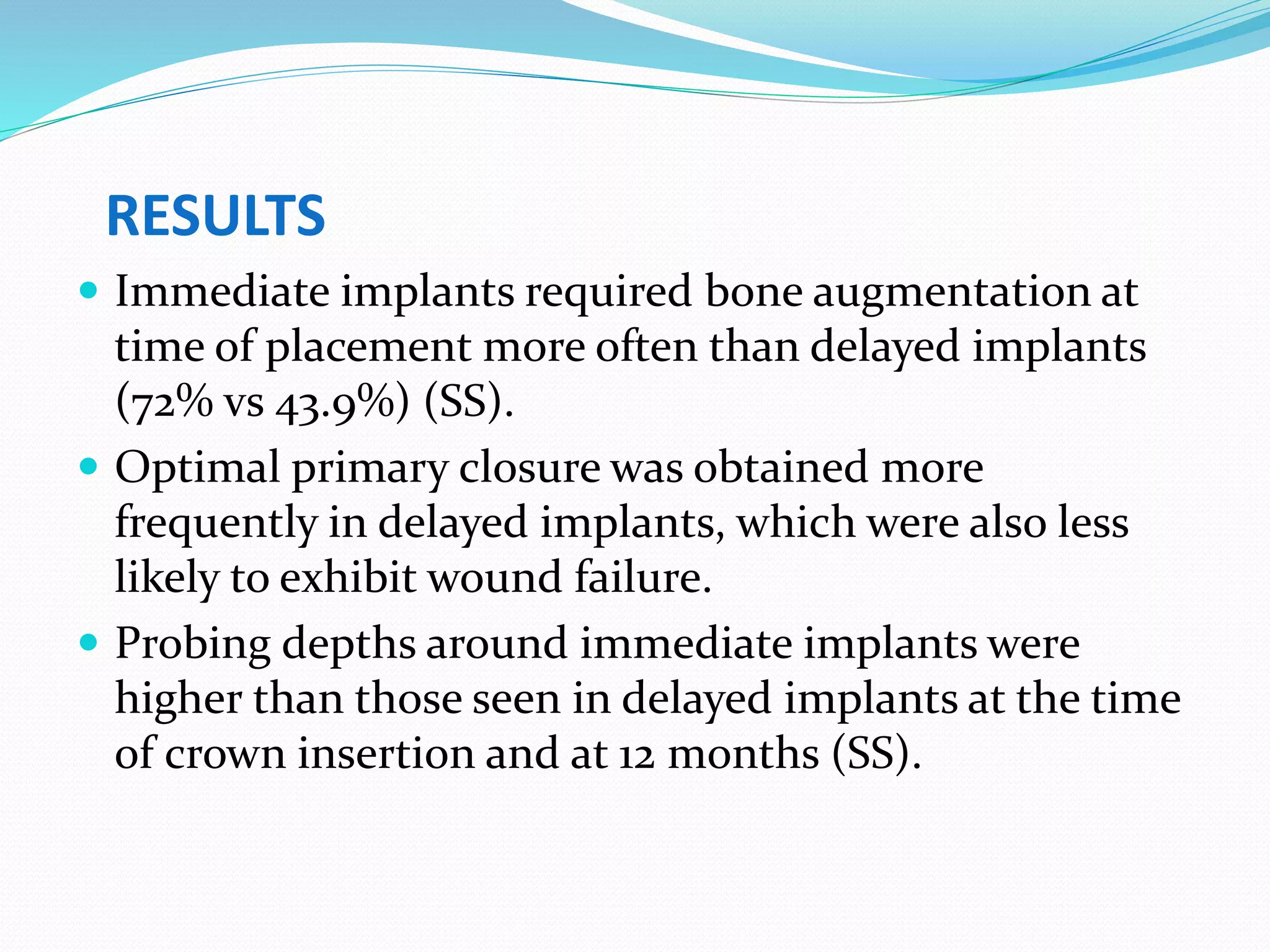
 Immediate implants required bone augmentation at
time of placement more often than delayed implants
(72% vs 43.9%) (SS).
 Optimal primary closure was obtained more
frequently in delayed implants, which were also less
likely to exhibit wound failure.
 Probing depths around immediate implants were
higher than those seen in delayed implants at the time
of crown insertion and at 12 months (SS).
RESULTS
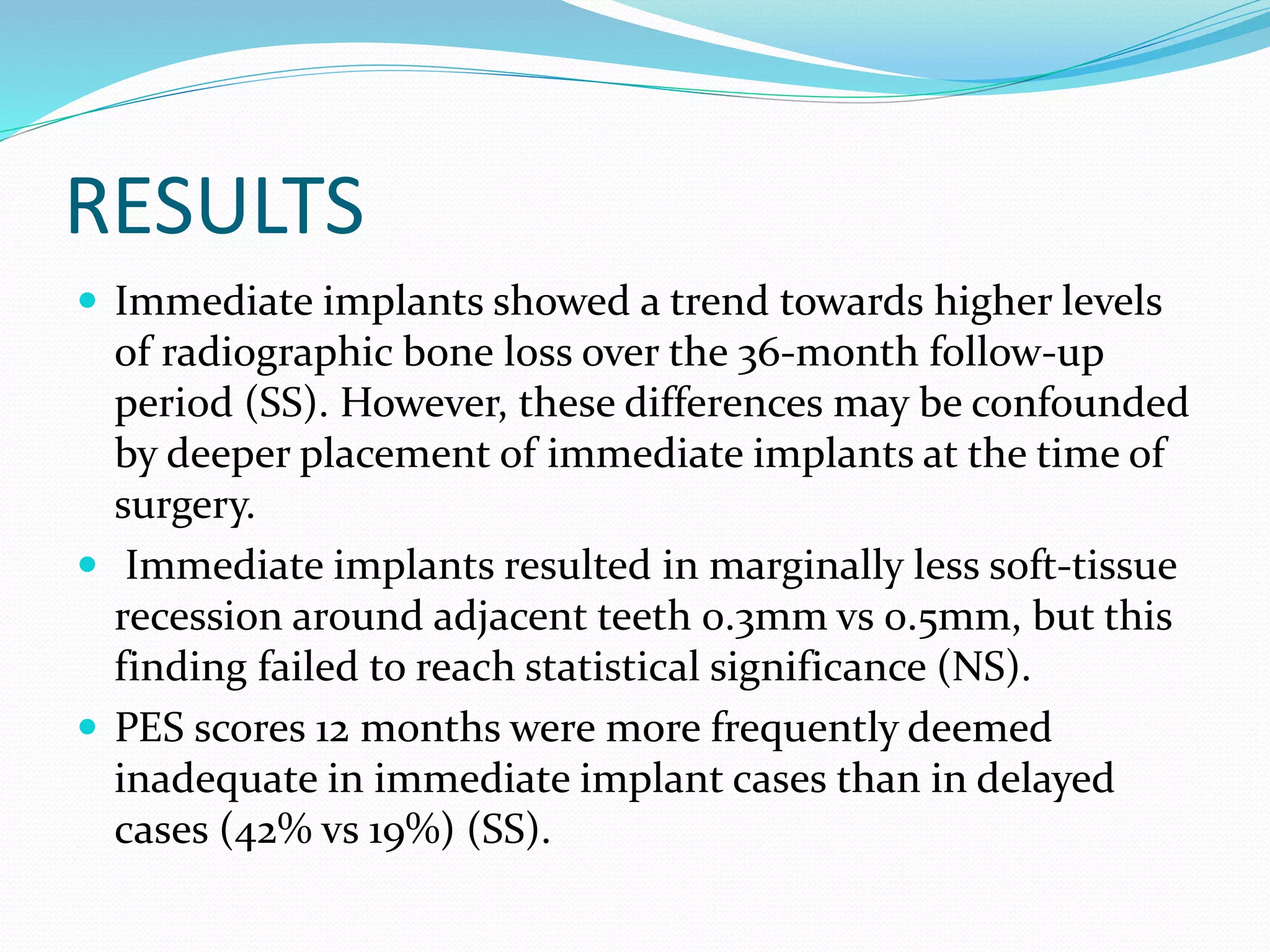
 Immediate implants showed a trend towards higher levels
of radiographic bone loss over the 36-month follow-up
period (SS). However, these differences may be confounded
by deeper placement of immediate implants at the time of
surgery.
 Immediate implants resulted in marginally less soft-tissue
recession around adjacent teeth 0.3mm vs 0.5mm, but this
finding failed to reach statistical significance (NS).
 PES scores 12 months were more frequently deemed
inadequate in immediate implant cases than in delayed
cases (42% vs 19%) (SS).
LIMITATIONS
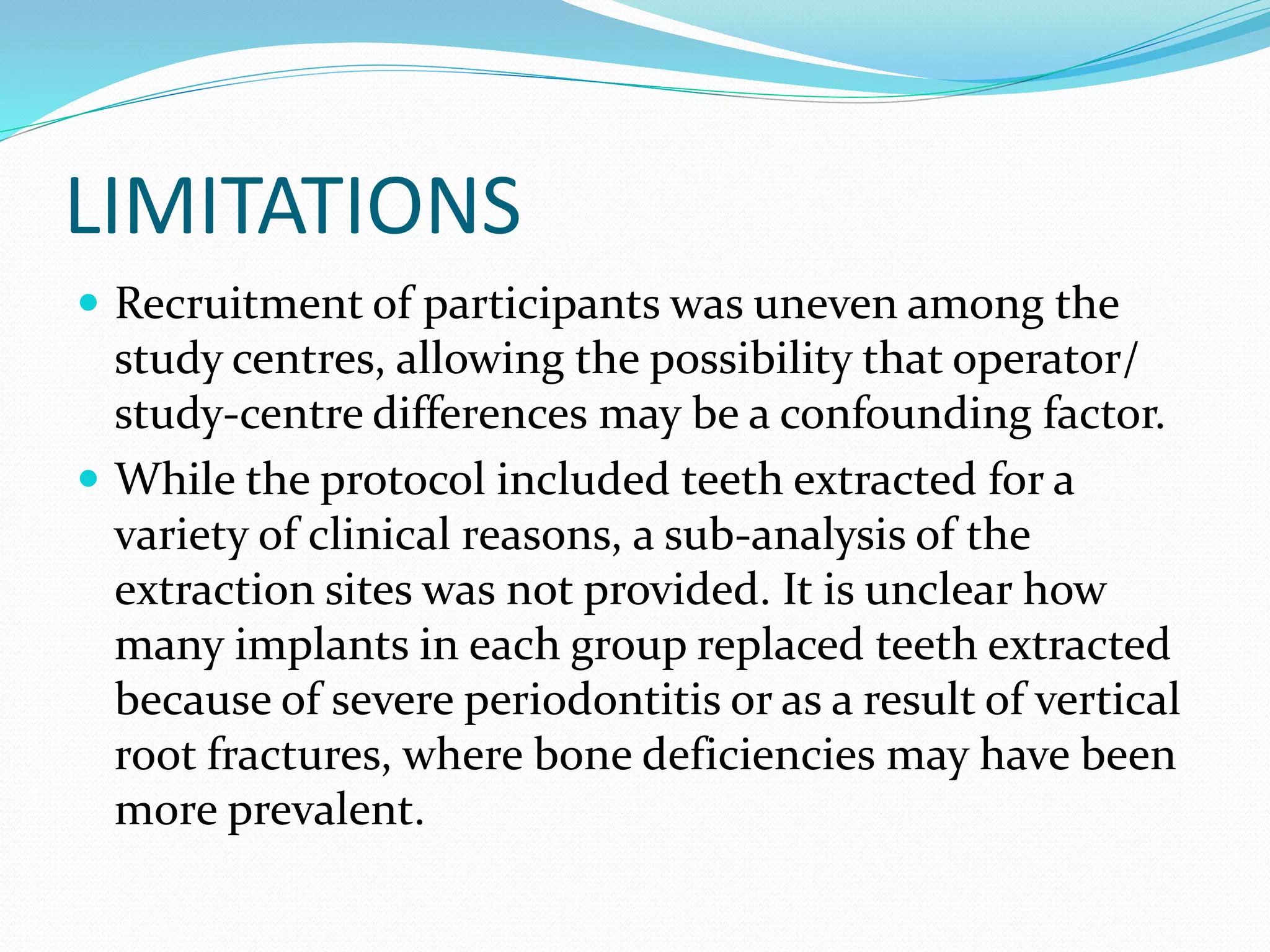
 Recruitment of participants was uneven among the
study centres, allowing the possibility that operator/
study-centre differences may be a confounding factor.
 While the protocol included teeth extracted for a
variety of clinical reasons, a sub-analysis of the
extraction sites was not provided. It is unclear how
many implants in each group replaced teeth extracted
because of severe periodontitis or as a result of vertical
root fractures, where bone deficiencies may have been
more prevalent.
CONCLUSION
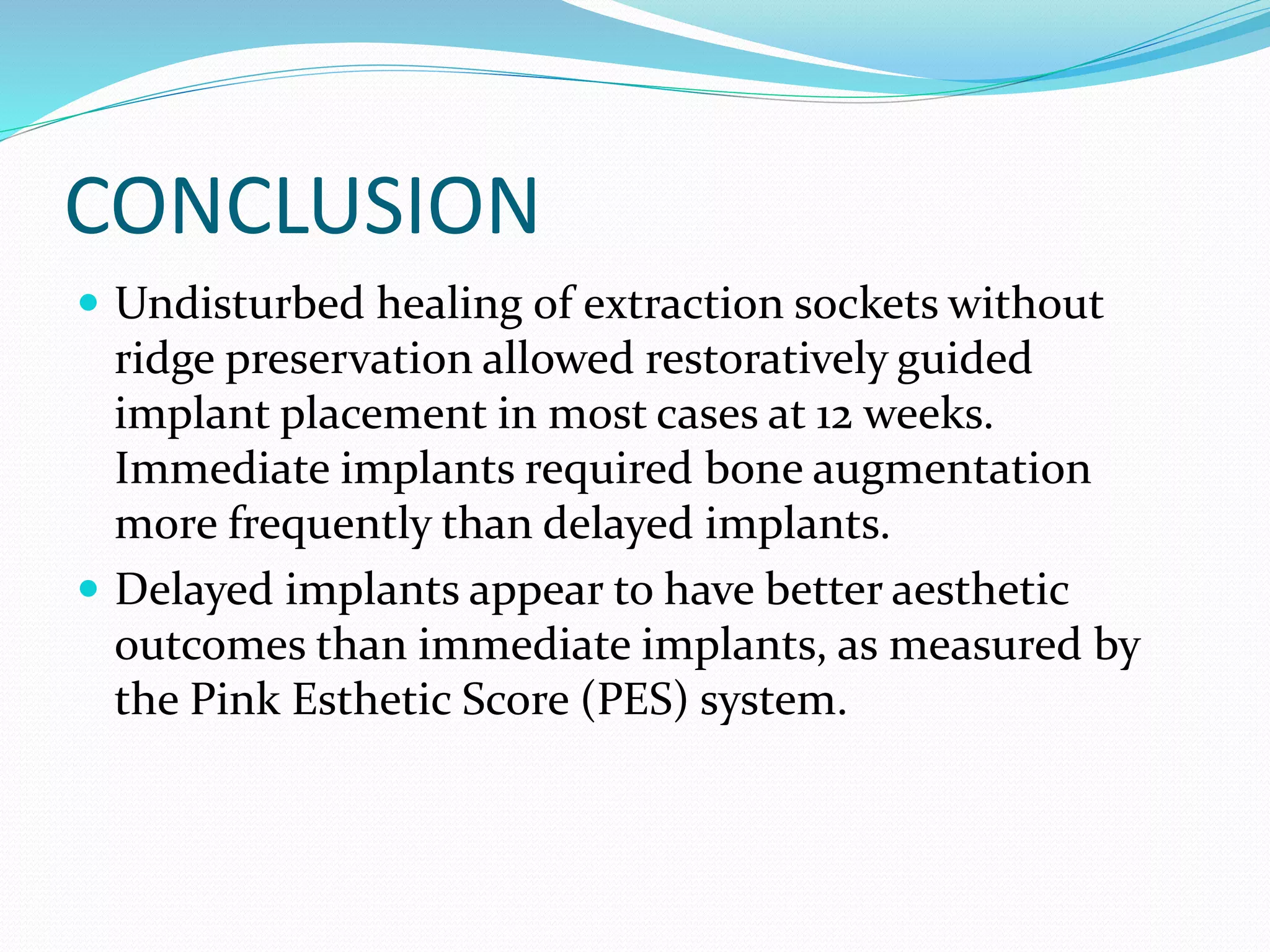
 Undisturbed healing of extraction sockets without
ridge preservation allowed restoratively guided
implant placement in most cases at 12 weeks.
Immediate implants required bone augmentation
more frequently than delayed implants.
 Delayed implants appear to have better aesthetic
outcomes than immediate implants, as measured by
the Pink Esthetic Score (PES) system.
 Based on the above surgical protocols, routine use of
immediate implants in anterior regions may be
inappropriate and delayed implant placement may be
considered favourable in the aesthetic zone.
THANK YOU

immediate vs delayed implant placement in anterior single tooth extraction.

  • 1.
    Tonetti MS, CortelliniP, Graziani F, Cairo F, Lang NP , Abundo R, Conforti GP, Marquardt S, Rasperini G, Silvestri M, Wallkamm B, Wetzel A JOURNAL OF CLINICAL PERIODONTOLOGY . FEB.2017 VOL.44(215-224) by- Dr.KARUNA Dept. of Periodontics
  • 2.
    INTRODUCTION……  Immediate implantplacement may be advantageous for both patients and practitioners, providing a reduction in treatment time while maintaining high survival rates and patient satisfaction. However, there is limited evidence to determine the most favourable timing and method for implant placement. Furthermore, existing clinical trials have tended to be limited to immediate placement into intact extraction sockets.
  • 3.
    AIM OF STUDY The aim of this multi-centre, practice-based, randomised controlled clinical trial was to compare immediate versus delayed implant placement in terms of the need for bone augmentation at the time of implant placement (primary outcome), surgical complications, aesthetics, patient-based outcomes, and costs.  This article reports 1-year follow-up on clinical parameters including any surgical complications and an initial 3-year evaluation of radiographic values.
  • 4.
    OBJECTIVE  The objectiveof this study to compare need for bone augmentation, surgical complications, aesthetic and patient reported outcomes in subjects receiving implant placement at the time of extraction (Immediate Implant) or 12 weeks thereafter.
  • 5.
    MATERIALS &METHOD  Systemicallyhealthy adults requiring a single tooth extraction in the non-molar region because of trauma, caries, or periodontitis were included in the study. This included cases where significant loss of both the buccal and palatal wall was present.  All study participants had a stable periodontium and smoked <20 cigarettes/day.  Conservative tooth extraction was performed utilising periotomes and papilla preservation flaps exposing 2-3mm of alveolar bone.
  • 6.
     Following extraction,each site was randomly assigned to receive either:  – Test group: Immediate implant placement;  – Control group: Delayed implant placement – denoted as placement following 12 weeks of healing.  Implant placement was restoratively driven, using tapered and screw-shaped implants of various lengths and diameters (SPI Contact, Thommen Medical).
  • 7.
     • Augmentationwas provided when:  – The total horizontal distance from the implant surface to the outer buccal bone was <2mm;  • Augmentation utilised Bio-Oss and Bio-Gide, with the membrane positioned at the level of the transmucosal healing cap. Primary closure was attempted in all cases.
  • 8.
    RESULTS  A totalof 124 patients were randomised; with 62 receiving immediate implants and 62 receiving delayed implants (12 weeks post-extraction).  One implant was lost through infection in the immediate implant group and eight additional patients failed to comply with follow-up.  Both procedures were well tolerated by patients and were associated with high levels of patient satisfaction.
  • 9.
    RESULTS  Immediate implantsrequired bone augmentation at time of placement more often than delayed implants (72% vs 43.9%) (SS).  Optimal primary closure was obtained more frequently in delayed implants, which were also less likely to exhibit wound failure.  Probing depths around immediate implants were higher than those seen in delayed implants at the time of crown insertion and at 12 months (SS).
  • 10.
    RESULTS  Immediate implantsshowed a trend towards higher levels of radiographic bone loss over the 36-month follow-up period (SS). However, these differences may be confounded by deeper placement of immediate implants at the time of surgery.  Immediate implants resulted in marginally less soft-tissue recession around adjacent teeth 0.3mm vs 0.5mm, but this finding failed to reach statistical significance (NS).  PES scores 12 months were more frequently deemed inadequate in immediate implant cases than in delayed cases (42% vs 19%) (SS).
  • 11.
    LIMITATIONS  Recruitment ofparticipants was uneven among the study centres, allowing the possibility that operator/ study-centre differences may be a confounding factor.  While the protocol included teeth extracted for a variety of clinical reasons, a sub-analysis of the extraction sites was not provided. It is unclear how many implants in each group replaced teeth extracted because of severe periodontitis or as a result of vertical root fractures, where bone deficiencies may have been more prevalent.
  • 12.
    CONCLUSION  Undisturbed healingof extraction sockets without ridge preservation allowed restoratively guided implant placement in most cases at 12 weeks. Immediate implants required bone augmentation more frequently than delayed implants.  Delayed implants appear to have better aesthetic outcomes than immediate implants, as measured by the Pink Esthetic Score (PES) system.
  • 13.
     Based onthe above surgical protocols, routine use of immediate implants in anterior regions may be inappropriate and delayed implant placement may be considered favourable in the aesthetic zone.
  • 14.