Image Translation with GAN
Presentor : Junho Cho
Junho Cho, Perception and Intelligence Lab, SNU 1
Problem statement of Image Translation
Learn
that convert an image of source domain to an image of target domain
Junho Cho, Perception and Intelligence Lab, SNU 2
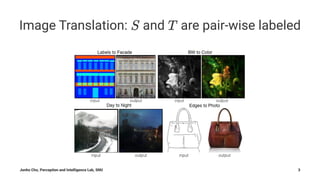
Image Translation: and are pair-wise labeled
Junho Cho, Perception and Intelligence Lab, SNU 3
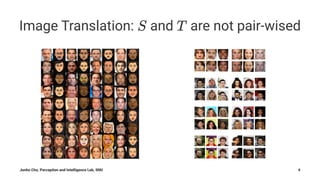
Image Translation: and are not pair-wised
Junho Cho, Perception and Intelligence Lab, SNU 4
Junho Cho, Perception and Intelligence Lab, SNU 5
Junho Cho, Perception and Intelligence Lab, SNU 6
Junho Cho, Perception and Intelligence Lab, SNU 7
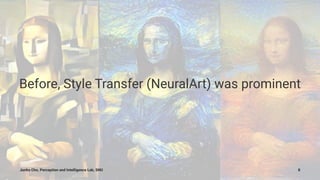
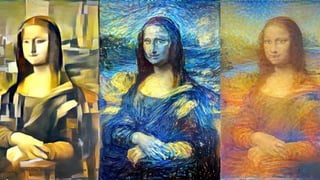
Before, Style Transfer (NeuralArt) was prominent
Junho Cho, Perception and Intelligence Lab, SNU 8
Junho Cho, Perception and Intelligence Lab, SNU 9
Junho Cho, Perception and Intelligence Lab, SNU 10
Perceptual Losses for Real-Time Style Transfer and Super-Resolution
Junho Cho, Perception and Intelligence Lab, SNU 11
But it largely depends on textual information of an target style
Junho Cho, Perception and Intelligence Lab, SNU 12
How to learn more general Image Translation?
Junho Cho, Perception and Intelligence Lab, SNU 13
Generative
Adversarial
Network
GAN!
Junho Cho, Perception and Intelligence Lab, SNU 14
Junho Cho, Perception and Intelligence Lab, SNU 15
Deep Convolutional GAN
(DCGAN)
Junho Cho, Perception and Intelligence Lab, SNU 16
Two major problems of Image Translation
1. Convert to which domain?
• learn which " "?
2. How to learn the dataset?
• how to properly form dataset?
• pair-wise Supervised? or Unsupervised?
Junho Cho, Perception and Intelligence Lab, SNU 17
Today, presenting SOTA of Image Translation papers of
- pix2pix: Image-to-Image Translation with Conditional Adversarial Networks (CVPR2017)
- Domain Transfer Network: Unsupervised Cross-Domain Image Generation (ICLR2017)
- CycleGAN: Unpaired Image-to-Image Translation using Cycle-Consistent Adversarial Networks
- DiscoGAN: Learning to Discover Cross-Domain Relations with Generative Adversarial Networks
Junho Cho, Perception and Intelligence Lab, SNU 18
1. Image-to-Image Translation with
Conditional Adversarial Networks
(pix2pix)
CVPR2017
Phillip Isola, Jun-Yan Zhu, Tinghui Zhou, Alexei A. Efros
Junho Cho, Perception and Intelligence Lab, SNU 19
Junho Cho, Perception and Intelligence Lab, SNU 20
Junho Cho, Perception and Intelligence Lab, SNU 21
Junho Cho, Perception and Intelligence Lab, SNU 22
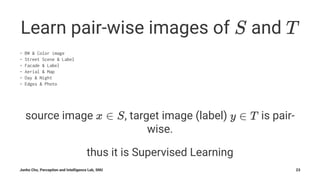
Learn pair-wise images of and
- BW & Color image
- Street Scene & Label
- Facade & Label
- Aerial & Map
- Day & Night
- Edges & Photo
source image , target image (label) is pair-
wise.
thus it is Supervised Learning
Junho Cho, Perception and Intelligence Lab, SNU 23
Generator of pix2pix
where : image and : noise
Use U-Net shaped network
- known to be powerful at segmentation
task
- use spatial information from features of
bottom layer
- use dropout as noise in decoder part
Junho Cho, Perception and Intelligence Lab, SNU 24
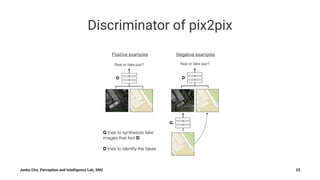
Discriminator of pix2pix
Junho Cho, Perception and Intelligence Lab, SNU 25
Loss function
: source image, : target image, : noise
Junho Cho, Perception and Intelligence Lab, SNU 26
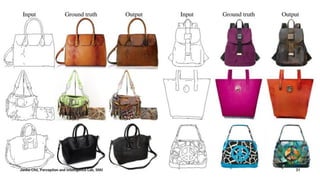
Result_
Junho Cho, Perception and Intelligence Lab, SNU 27
Junho Cho, Perception and Intelligence Lab, SNU 28
Junho Cho, Perception and Intelligence Lab, SNU 29
Junho Cho, Perception and Intelligence Lab, SNU 30
Junho Cho, Perception and Intelligence Lab, SNU 31
Junho Cho, Perception and Intelligence Lab, SNU 32
Do demo!
https://affinelayer.com/pixsrv/
Junho Cho, Perception and Intelligence Lab, SNU 33
2. Unsupervised Cross-Domain
Image Generation (DTN)
ICLR2017
Yaniv Taigman, Adam Polyak, Lior Wolf
Junho Cho, Perception and Intelligence Lab, SNU 34
Learn
of two related domains, and
without labels!
(labels of images are usually expensive)
Junho Cho, Perception and Intelligence Lab, SNU 35
Junho Cho, Perception and Intelligence Lab, SNU 36
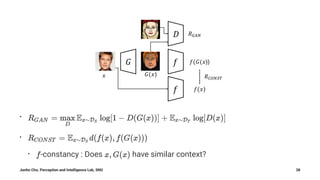
Baseline model
: discriminator, : generator,
: context encoder. outputs feature. (128-dim)
Junho Cho, Perception and Intelligence Lab, SNU 37
•
•
• -constancy : Does have similar context?
Junho Cho, Perception and Intelligence Lab, SNU 38
1.
2.
• : distance metric. ex) MSE
• : "Pretrained" context encoder. Parameter fixed.
• can be pretrained with classification task on
• Minimize two Risks : and
Junho Cho, Perception and Intelligence Lab, SNU 39
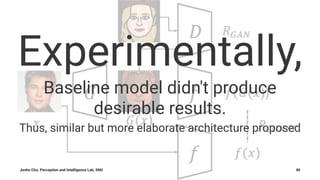
Experimentally,
Baseline model didn't produce
desirable results.
Thus, similar but more elaborate architecture proposed
Junho Cho, Perception and Intelligence Lab, SNU 40
Proposed "Domain Transfer Network (DTN)"
Junho Cho, Perception and Intelligence Lab, SNU 41
Two Difference from the Baseline
First, : the context encoder now encode as then will
generate from it :
- focuses to generate from given context
Junho Cho, Perception and Intelligence Lab, SNU 42
Two Difference from the Baseline
Second, for , is also encoded by and applied
- "Pretrained on " would not be good as much as on . But enough for context encoding purpose
- : should be similar to
- Also takes and performs ternary (3-class) classification. (one real, two fakes)
Junho Cho, Perception and Intelligence Lab, SNU 43
Losses
Junho Cho, Perception and Intelligence Lab, SNU 44
: generated from ? / : generated from ? / : sample from ?
Junho Cho, Perception and Intelligence Lab, SNU 45
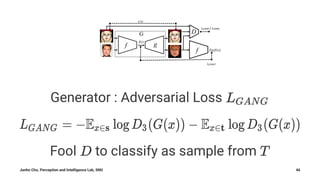
Generator : Adversarial Loss
Fool to classify as sample from
Junho Cho, Perception and Intelligence Lab, SNU 46
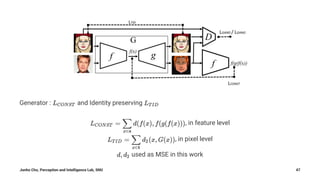
Generator : and Identity preserving
, in feature level
, in pixel level
used as MSE in this work
Junho Cho, Perception and Intelligence Lab, SNU 47
•
•
minimized over
minimized over
Junho Cho, Perception and Intelligence Lab, SNU 48
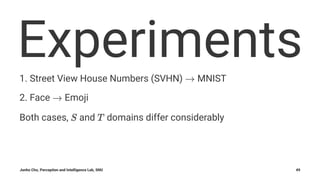
Experiments1. Street View House Numbers (SVHN) MNIST
2. Face Emoji
Both cases, and domains differ considerably
Junho Cho, Perception and Intelligence Lab, SNU 49
SVHN MNIST
Junho Cho, Perception and Intelligence Lab, SNU 50
• 4 convs (each filters 64,128,256,128) / max pooling / ReLU
• input RGB / output 128-dim vector.
• do not need to be very powerful classifier.
• achieves 4.95% error on SVHN test set
• Weaker in : 23.92% error on MNIST.
• Learn analogy of unlabeled examples
Junho Cho, Perception and Intelligence Lab, SNU 51
• Inspired by DCGAN
• SVHN-trained 's 128D representation
• four blocks of deconv, BN, ReLU. TanH at final.
•
•
Junho Cho, Perception and Intelligence Lab, SNU 52
Junho Cho, Perception and Intelligence Lab, SNU 53
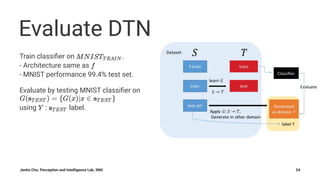
Evaluate DTN
Train classifier on .
- Architecture same as
- MNIST performance 99.4% test set.
Evaluate by testing MNIST classifier on
using : label.
Junho Cho, Perception and Intelligence Lab, SNU 54
Junho Cho, Perception and Intelligence Lab, SNU 55
Unseen Digits
Study the ability of DTN to overcome
omission of a class in samples.
For example, class '3'
Ablation applied on
- training DTN, domain
- training .
But '3' exists in testing DTN! Compare
results.
Junho Cho, Perception and Intelligence Lab, SNU 56
(a) The input images. (b) Results of our DTN. (c) 3 was not in SVNH. (d) 3 was not in MNIST. (e) 3 was
not shown in both SVHN and MNIST. (f) The digit 3 was not shown in SVHN, MNIST and during the
training of f.
Junho Cho, Perception and Intelligence Lab, SNU 57
Junho Cho, Perception and Intelligence Lab, SNU 58
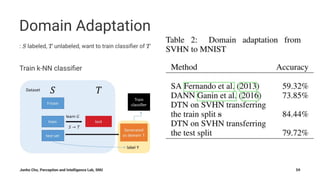
Domain Adaptation
: labeled, unlabeled, want to train classifier of
Train k-NN classifier
Junho Cho, Perception and Intelligence Lab, SNU 59
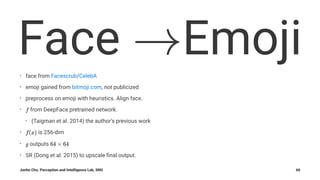
Face Emoji• face from Facescrub/CelebA
• emoji gained from bitmoji.com, not publicized
• preprocess on emoji with heuristics. Align face.
• from DeepFace pretrained network.
• (Taigman et al. 2014) the author's previous work
• is 256-dim
• outputs
• SR (Dong et al. 2015) to upscale final output.
Junho Cho, Perception and Intelligence Lab, SNU 60
Results !
choose via validation
Junho Cho, Perception and Intelligence Lab, SNU 61
Original style transfer can't solve it
DTN also can style transfer.
DTN is more general than Styler Transfer method.
Junho Cho, Perception and Intelligence Lab, SNU 62
Limitations
• usually can be trained in one domain,
thus asymmetric.
• Handle two domains differently.
• is bad.
• Bounded by . Needs pre-traied context
encoder.
• any better way to learn context without
pretraining?
• Any more tasks?
Junho Cho, Perception and Intelligence Lab, SNU 63
Conclusion1. Demonstrate Domain Transfer, as an unsupervised method.
• Can be generalized to various problems.
2. -constancy to maintain context of domain &
3. Simple domain adaptation and good performance
• inspiring work to future domain adaptation research
More open reviews at OpenReview.net
Junho Cho, Perception and Intelligence Lab, SNU 64
3. Unpaired Image-to-Image Translation using Cycle-Consistent Adversarial Networks (CycleGAN)
UC Berkeley (pix2pix upgrade)
&
Learning to Discover Cross-Domain Relations with Generative Adversarial Networks (DiscoGAN)
SK T-Brain
Junho Cho, Perception and Intelligence Lab, SNU 65
DiscoGAN & CycleGAN
Almost Identical concept.
DiscoGAN came 15 days earlier. Low resolution ( )
CycleGAN has better qualitative results ( ) and quantative experiments.
Difference from DTN
• No -constancy. Do not need pre-trained context encoder
• Only need dataset and
Junho Cho, Perception and Intelligence Lab, SNU 66
DiscoGAN
Junho Cho, Perception and Intelligence Lab, SNU 67
DiscoGAN
Junho Cho, Perception and Intelligence Lab, SNU 68
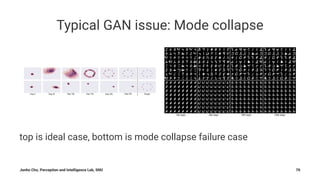
without cross domain matching, GAN has mode collapse
learn projection to mode in domain , while two domains have one-to-one relation
Junho Cho, Perception and Intelligence Lab, SNU 69
Typical GAN issue: Mode collapse
top is ideal case, bottom is mode collapse failure case
Junho Cho, Perception and Intelligence Lab, SNU 70
Toy problem of 2-dim Gaussian mixture model
• 5 modes of domain A to 10 modes of domain B
GAN, GAN + const show injective mapping & mode collapse
DiscoGAN shows bijective mapping & generate all 10 modes of B.
Junho Cho, Perception and Intelligence Lab, SNU 71
Junho Cho, Perception and Intelligence Lab, SNU 72
proposed DiscoGAN
Junho Cho, Perception and Intelligence Lab, SNU 73
CycleGAN has similar contribution on this point
Junho Cho, Perception and Intelligence Lab, SNU 74
Junho Cho, Perception and Intelligence Lab, SNU 75
Results
Junho Cho, Perception and Intelligence Lab, SNU 76
Junho Cho, Perception and Intelligence Lab, SNU 77
codes and more results in
https://github.com/SKTBrain/DiscoGAN
https://github.com/carpedm20/DiscoGAN-pytorch
Junho Cho, Perception and Intelligence Lab, SNU 78
CycleGAN
Use more GAN techniques: LSGAN, use image buffer of previous generated samples
Junho Cho, Perception and Intelligence Lab, SNU 79
Junho Cho, Perception and Intelligence Lab, SNU 80
Junho Cho, Perception and Intelligence Lab, SNU 81
Junho Cho, Perception and Intelligence Lab, SNU 82
Junho Cho, Perception and Intelligence Lab, SNU 83
Junho Cho, Perception and Intelligence Lab, SNU 84
failure case
Junho Cho, Perception and Intelligence Lab, SNU 85
CycleGAN demonstrates more experiments!
project page : https://junyanz.github.io/CycleGAN/
code available with Torch and PyTorch
Junho Cho, Perception and Intelligence Lab, SNU 86
Thank you!
Junho Cho, Perception and Intelligence Lab, SNU 87

Image Translation with GAN

  • 1.
    Image Translation withGAN Presentor : Junho Cho Junho Cho, Perception and Intelligence Lab, SNU 1
  • 2.
    Problem statement ofImage Translation Learn that convert an image of source domain to an image of target domain Junho Cho, Perception and Intelligence Lab, SNU 2
  • 3.
    Image Translation: andare pair-wise labeled Junho Cho, Perception and Intelligence Lab, SNU 3
  • 4.
    Image Translation: andare not pair-wised Junho Cho, Perception and Intelligence Lab, SNU 4
  • 5.
    Junho Cho, Perceptionand Intelligence Lab, SNU 5
  • 6.
    Junho Cho, Perceptionand Intelligence Lab, SNU 6
  • 7.
    Junho Cho, Perceptionand Intelligence Lab, SNU 7
  • 8.
    Before, Style Transfer(NeuralArt) was prominent Junho Cho, Perception and Intelligence Lab, SNU 8
  • 9.
    Junho Cho, Perceptionand Intelligence Lab, SNU 9
  • 10.
    Junho Cho, Perceptionand Intelligence Lab, SNU 10
  • 11.
    Perceptual Losses forReal-Time Style Transfer and Super-Resolution Junho Cho, Perception and Intelligence Lab, SNU 11
  • 12.
    But it largelydepends on textual information of an target style Junho Cho, Perception and Intelligence Lab, SNU 12
  • 13.
    How to learnmore general Image Translation? Junho Cho, Perception and Intelligence Lab, SNU 13
  • 14.
  • 15.
    Junho Cho, Perceptionand Intelligence Lab, SNU 15
  • 16.
    Deep Convolutional GAN (DCGAN) JunhoCho, Perception and Intelligence Lab, SNU 16
  • 17.
    Two major problemsof Image Translation 1. Convert to which domain? • learn which " "? 2. How to learn the dataset? • how to properly form dataset? • pair-wise Supervised? or Unsupervised? Junho Cho, Perception and Intelligence Lab, SNU 17
  • 18.
    Today, presenting SOTAof Image Translation papers of - pix2pix: Image-to-Image Translation with Conditional Adversarial Networks (CVPR2017) - Domain Transfer Network: Unsupervised Cross-Domain Image Generation (ICLR2017) - CycleGAN: Unpaired Image-to-Image Translation using Cycle-Consistent Adversarial Networks - DiscoGAN: Learning to Discover Cross-Domain Relations with Generative Adversarial Networks Junho Cho, Perception and Intelligence Lab, SNU 18
  • 19.
    1. Image-to-Image Translationwith Conditional Adversarial Networks (pix2pix) CVPR2017 Phillip Isola, Jun-Yan Zhu, Tinghui Zhou, Alexei A. Efros Junho Cho, Perception and Intelligence Lab, SNU 19
  • 20.
    Junho Cho, Perceptionand Intelligence Lab, SNU 20
  • 21.
    Junho Cho, Perceptionand Intelligence Lab, SNU 21
  • 22.
    Junho Cho, Perceptionand Intelligence Lab, SNU 22
  • 23.
    Learn pair-wise imagesof and - BW & Color image - Street Scene & Label - Facade & Label - Aerial & Map - Day & Night - Edges & Photo source image , target image (label) is pair- wise. thus it is Supervised Learning Junho Cho, Perception and Intelligence Lab, SNU 23
  • 24.
    Generator of pix2pix where: image and : noise Use U-Net shaped network - known to be powerful at segmentation task - use spatial information from features of bottom layer - use dropout as noise in decoder part Junho Cho, Perception and Intelligence Lab, SNU 24
  • 25.
    Discriminator of pix2pix JunhoCho, Perception and Intelligence Lab, SNU 25
  • 26.
    Loss function : sourceimage, : target image, : noise Junho Cho, Perception and Intelligence Lab, SNU 26
  • 27.
    Result_ Junho Cho, Perceptionand Intelligence Lab, SNU 27
  • 28.
    Junho Cho, Perceptionand Intelligence Lab, SNU 28
  • 29.
    Junho Cho, Perceptionand Intelligence Lab, SNU 29
  • 30.
    Junho Cho, Perceptionand Intelligence Lab, SNU 30
  • 31.
    Junho Cho, Perceptionand Intelligence Lab, SNU 31
  • 32.
    Junho Cho, Perceptionand Intelligence Lab, SNU 32
  • 33.
    Do demo! https://affinelayer.com/pixsrv/ Junho Cho,Perception and Intelligence Lab, SNU 33
  • 34.
    2. Unsupervised Cross-Domain ImageGeneration (DTN) ICLR2017 Yaniv Taigman, Adam Polyak, Lior Wolf Junho Cho, Perception and Intelligence Lab, SNU 34
  • 35.
    Learn of two relateddomains, and without labels! (labels of images are usually expensive) Junho Cho, Perception and Intelligence Lab, SNU 35
  • 36.
    Junho Cho, Perceptionand Intelligence Lab, SNU 36
  • 37.
    Baseline model : discriminator,: generator, : context encoder. outputs feature. (128-dim) Junho Cho, Perception and Intelligence Lab, SNU 37
  • 38.
    • • • -constancy :Does have similar context? Junho Cho, Perception and Intelligence Lab, SNU 38
  • 39.
    1. 2. • : distancemetric. ex) MSE • : "Pretrained" context encoder. Parameter fixed. • can be pretrained with classification task on • Minimize two Risks : and Junho Cho, Perception and Intelligence Lab, SNU 39
  • 40.
    Experimentally, Baseline model didn'tproduce desirable results. Thus, similar but more elaborate architecture proposed Junho Cho, Perception and Intelligence Lab, SNU 40
  • 41.
    Proposed "Domain TransferNetwork (DTN)" Junho Cho, Perception and Intelligence Lab, SNU 41
  • 42.
    Two Difference fromthe Baseline First, : the context encoder now encode as then will generate from it : - focuses to generate from given context Junho Cho, Perception and Intelligence Lab, SNU 42
  • 43.
    Two Difference fromthe Baseline Second, for , is also encoded by and applied - "Pretrained on " would not be good as much as on . But enough for context encoding purpose - : should be similar to - Also takes and performs ternary (3-class) classification. (one real, two fakes) Junho Cho, Perception and Intelligence Lab, SNU 43
  • 44.
    Losses Junho Cho, Perceptionand Intelligence Lab, SNU 44
  • 45.
    : generated from? / : generated from ? / : sample from ? Junho Cho, Perception and Intelligence Lab, SNU 45
  • 46.
    Generator : AdversarialLoss Fool to classify as sample from Junho Cho, Perception and Intelligence Lab, SNU 46
  • 47.
    Generator : andIdentity preserving , in feature level , in pixel level used as MSE in this work Junho Cho, Perception and Intelligence Lab, SNU 47
  • 48.
    • • minimized over minimized over JunhoCho, Perception and Intelligence Lab, SNU 48
  • 49.
    Experiments1. Street ViewHouse Numbers (SVHN) MNIST 2. Face Emoji Both cases, and domains differ considerably Junho Cho, Perception and Intelligence Lab, SNU 49
  • 50.
    SVHN MNIST Junho Cho,Perception and Intelligence Lab, SNU 50
  • 51.
    • 4 convs(each filters 64,128,256,128) / max pooling / ReLU • input RGB / output 128-dim vector. • do not need to be very powerful classifier. • achieves 4.95% error on SVHN test set • Weaker in : 23.92% error on MNIST. • Learn analogy of unlabeled examples Junho Cho, Perception and Intelligence Lab, SNU 51
  • 52.
    • Inspired byDCGAN • SVHN-trained 's 128D representation • four blocks of deconv, BN, ReLU. TanH at final. • • Junho Cho, Perception and Intelligence Lab, SNU 52
  • 53.
    Junho Cho, Perceptionand Intelligence Lab, SNU 53
  • 54.
    Evaluate DTN Train classifieron . - Architecture same as - MNIST performance 99.4% test set. Evaluate by testing MNIST classifier on using : label. Junho Cho, Perception and Intelligence Lab, SNU 54
  • 55.
    Junho Cho, Perceptionand Intelligence Lab, SNU 55
  • 56.
    Unseen Digits Study theability of DTN to overcome omission of a class in samples. For example, class '3' Ablation applied on - training DTN, domain - training DTN, domain - training . But '3' exists in testing DTN! Compare results. Junho Cho, Perception and Intelligence Lab, SNU 56
  • 57.
    (a) The inputimages. (b) Results of our DTN. (c) 3 was not in SVNH. (d) 3 was not in MNIST. (e) 3 was not shown in both SVHN and MNIST. (f) The digit 3 was not shown in SVHN, MNIST and during the training of f. Junho Cho, Perception and Intelligence Lab, SNU 57
  • 58.
    Junho Cho, Perceptionand Intelligence Lab, SNU 58
  • 59.
    Domain Adaptation : labeled,unlabeled, want to train classifier of Train k-NN classifier Junho Cho, Perception and Intelligence Lab, SNU 59
  • 60.
    Face Emoji• facefrom Facescrub/CelebA • emoji gained from bitmoji.com, not publicized • preprocess on emoji with heuristics. Align face. • from DeepFace pretrained network. • (Taigman et al. 2014) the author's previous work • is 256-dim • outputs • SR (Dong et al. 2015) to upscale final output. Junho Cho, Perception and Intelligence Lab, SNU 60
  • 61.
    Results ! choose viavalidation Junho Cho, Perception and Intelligence Lab, SNU 61
  • 62.
    Original style transfercan't solve it DTN also can style transfer. DTN is more general than Styler Transfer method. Junho Cho, Perception and Intelligence Lab, SNU 62
  • 63.
    Limitations • usually canbe trained in one domain, thus asymmetric. • Handle two domains differently. • is bad. • Bounded by . Needs pre-traied context encoder. • any better way to learn context without pretraining? • Any more tasks? Junho Cho, Perception and Intelligence Lab, SNU 63
  • 64.
    Conclusion1. Demonstrate DomainTransfer, as an unsupervised method. • Can be generalized to various problems. 2. -constancy to maintain context of domain & 3. Simple domain adaptation and good performance • inspiring work to future domain adaptation research More open reviews at OpenReview.net Junho Cho, Perception and Intelligence Lab, SNU 64
  • 65.
    3. Unpaired Image-to-ImageTranslation using Cycle-Consistent Adversarial Networks (CycleGAN) UC Berkeley (pix2pix upgrade) & Learning to Discover Cross-Domain Relations with Generative Adversarial Networks (DiscoGAN) SK T-Brain Junho Cho, Perception and Intelligence Lab, SNU 65
  • 66.
    DiscoGAN & CycleGAN AlmostIdentical concept. DiscoGAN came 15 days earlier. Low resolution ( ) CycleGAN has better qualitative results ( ) and quantative experiments. Difference from DTN • No -constancy. Do not need pre-trained context encoder • Only need dataset and Junho Cho, Perception and Intelligence Lab, SNU 66
  • 67.
    DiscoGAN Junho Cho, Perceptionand Intelligence Lab, SNU 67
  • 68.
    DiscoGAN Junho Cho, Perceptionand Intelligence Lab, SNU 68
  • 69.
    without cross domainmatching, GAN has mode collapse learn projection to mode in domain , while two domains have one-to-one relation Junho Cho, Perception and Intelligence Lab, SNU 69
  • 70.
    Typical GAN issue:Mode collapse top is ideal case, bottom is mode collapse failure case Junho Cho, Perception and Intelligence Lab, SNU 70
  • 71.
    Toy problem of2-dim Gaussian mixture model • 5 modes of domain A to 10 modes of domain B GAN, GAN + const show injective mapping & mode collapse DiscoGAN shows bijective mapping & generate all 10 modes of B. Junho Cho, Perception and Intelligence Lab, SNU 71
  • 72.
    Junho Cho, Perceptionand Intelligence Lab, SNU 72
  • 73.
    proposed DiscoGAN Junho Cho,Perception and Intelligence Lab, SNU 73
  • 74.
    CycleGAN has similarcontribution on this point Junho Cho, Perception and Intelligence Lab, SNU 74
  • 75.
    Junho Cho, Perceptionand Intelligence Lab, SNU 75
  • 76.
    Results Junho Cho, Perceptionand Intelligence Lab, SNU 76
  • 77.
    Junho Cho, Perceptionand Intelligence Lab, SNU 77
  • 78.
    codes and moreresults in https://github.com/SKTBrain/DiscoGAN https://github.com/carpedm20/DiscoGAN-pytorch Junho Cho, Perception and Intelligence Lab, SNU 78
  • 79.
    CycleGAN Use more GANtechniques: LSGAN, use image buffer of previous generated samples Junho Cho, Perception and Intelligence Lab, SNU 79
  • 80.
    Junho Cho, Perceptionand Intelligence Lab, SNU 80
  • 81.
    Junho Cho, Perceptionand Intelligence Lab, SNU 81
  • 82.
    Junho Cho, Perceptionand Intelligence Lab, SNU 82
  • 83.
    Junho Cho, Perceptionand Intelligence Lab, SNU 83
  • 84.
    Junho Cho, Perceptionand Intelligence Lab, SNU 84
  • 85.
    failure case Junho Cho,Perception and Intelligence Lab, SNU 85
  • 86.
    CycleGAN demonstrates moreexperiments! project page : https://junyanz.github.io/CycleGAN/ code available with Torch and PyTorch Junho Cho, Perception and Intelligence Lab, SNU 86
  • 87.
    Thank you! Junho Cho,Perception and Intelligence Lab, SNU 87