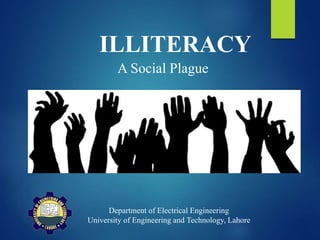
ILLITERACY
A Social Plague
Department of Electrical Engineering
University of Engineering and Technology, Lahore
TEAM MEMBERS
Shahkar Ul Hassan
(2017-EE-36)
Hamda Anees
(2017-EE-07)
Mehr Un Nisa
(2017-EE-02)
Rao Ali Khan
(2017-EE-37)
CONTEXT:
 Introduction
 Illiteracy and its types
 Islamic point of view
 Causes of illiteracy
 Facts and figures
 Effects of illiteracy
 Problems due to illiteracy
 Solutions to remove illiteracy
 Role of government
 Conclusion
3
UET-17
INTRODUCTION
 Illiteracy is one of biggest problems this world is
facing .
 It is mother of various other issues like Poverty,
population explosion, unemployment , child labor,
Early marriages, drug addiction etc.
4
UET-17
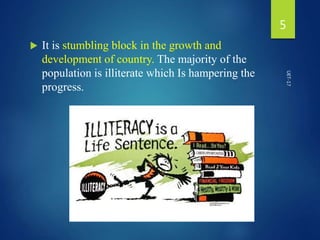
 It is stumbling block in the growth and
development of country. The majority of the
population is illiterate which Is hampering the
progress.
UET-17
5
ILLITERACY
 Illiteracy is defined as
“Lack of knowledge and the
inability to read and write ”
 Illiteracy is generally defined as inability of a
person to read or write either because of
inadequate reading skills or lack of any or
enough necessary knowledge.
6
UET-17
KINDS OF ILLITERACY
 Functional illiteracy:
“ Reading and Writing skills that are
inadequate to manage daily living and
employment tasks that require reading skills
beyond a basic level”
UET-17
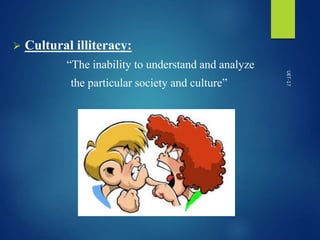
 Cultural illiteracy:
“The inability to understand and analyze
the particular society and culture”
UET-17
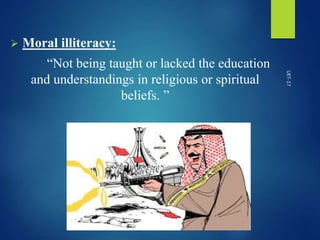
 Moral illiteracy:
“Not being taught or lacked the education
and understandings in religious or spiritual
beliefs. ”
UET-17
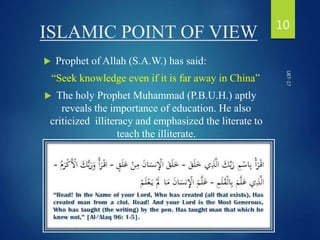
ISLAMIC POINT OF VIEW
 Prophet of Allah (S.A.W.) has said:
“Seek knowledge even if it is far away in China”
 The holy Prophet Muhammad (P.B.U.H.) aptly
reveals the importance of education. He also
criticized illiteracy and emphasized the literate to
teach the illiterate.
10
UET-17
UET-17
CAUSES OF
ILLITERACY
 Poverty
 Learning disabilities
 Lack of schools in
rural areas.
 Poor education
System.
 Corruption
 Lack of literacy within family
 Low budget of education
11
UET-17
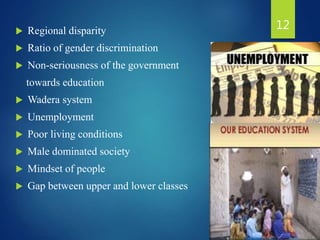
 Regional disparity
 Ratio of gender discrimination
 Non-seriousness of the government
towards education
 Wadera system
 Unemployment
 Poor living conditions
 Male dominated society
 Mindset of people
 Gap between upper and lower classes
12
ILLITERACY RATE IN
PAKISTAN
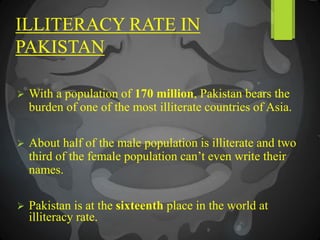
 With a population of 170 million, Pakistan bears the
burden of one of the most illiterate countries of Asia.
 About half of the male population is illiterate and two
third of the female population can’t even write their
names.
 Pakistan is at the sixteenth place in the world at
illiteracy rate.
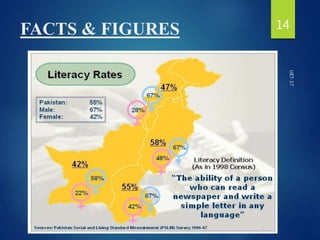
FACTS & FIGURES 14
UET-17
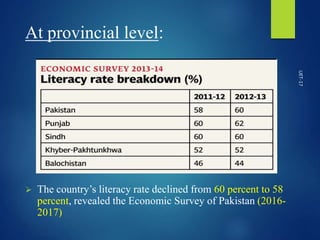
At provincial level:
 The country’s literacy rate declined from 60 percent to 58
percent, revealed the Economic Survey of Pakistan (2016-
2017)
UET-17
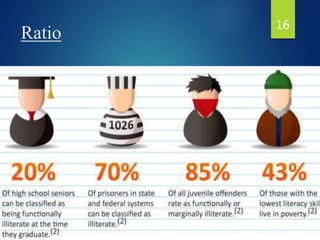
Ratio
16
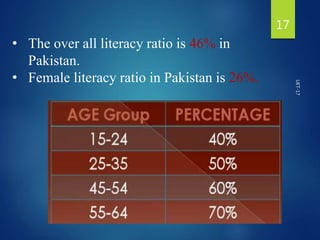
• The over all literacy ratio is 46% in
Pakistan.
• Female literacy ratio in Pakistan is 26%.
17
UET-17
 Moreover, English is fast spreading
in Pakistan, with 18 million Pakistanis having
a command over the language. On top of that,
Pakistan produces about 445,000 university
graduates and 10,000 computer science
graduates every year.
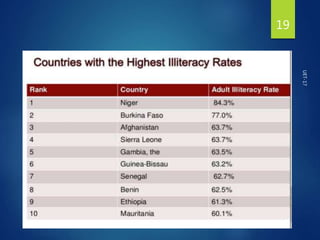
 Despite these statistics, Pakistan still has one
of the highest illiteracy rates in the world and
the second largest out-of-school population of
children after Nigeria
18
UET-17
19
UET-17
EFFECTS
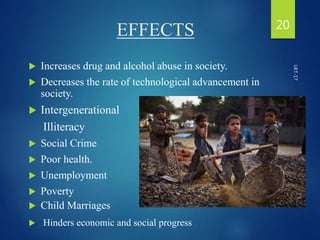
 Increases drug and alcohol abuse in society.
 Decreases the rate of technological advancement in
society.
 Intergenerational
Illiteracy
 Social Crime
 Poor health.
 Unemployment
 Poverty
 Child Marriages
 Hinders economic and social progress
20
UET-17
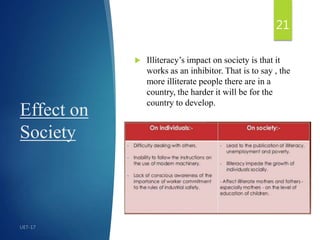
Effect on
Society
21
 Illiteracy’s impact on society is that it
works as an inhibitor. That is to say , the
more illiterate people there are in a
country, the harder it will be for the
country to develop.
PROBLEMS DUE TO
ILLITERACY
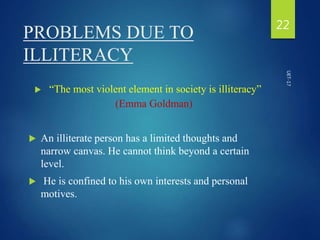
 “The most violent element in society is illiteracy”
(Emma Goldman)
 An illiterate person has a limited thoughts and
narrow canvas. He cannot think beyond a certain
level.
 He is confined to his own interests and personal
motives.
22
UET-17
 Illiteracy breeds crime.
 People who are not educated do not have a clear
idea of the importance of laws.
 They violate law for their petty benefits.
 Illiteracy is the greatest threat to the integrity of a
nation.
 He is unable to appreciate new aspects and
possibilities.
 Illiteracy hinders his personal as well as
collective growth.
23
UET-17
24
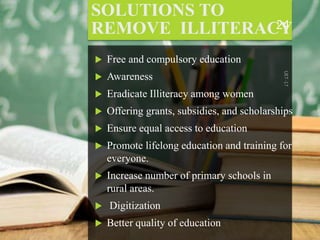
 Free and compulsory education
 Awareness
 Eradicate Illiteracy among women
 Offering grants, subsidies, and scholarships
 Ensure equal access to education
 Promote lifelong education and training for
everyone.
 Increase number of primary schools in
rural areas.
 Digitization
 Better quality of education
SOLUTIONS TO
REMOVE ILLITERACY
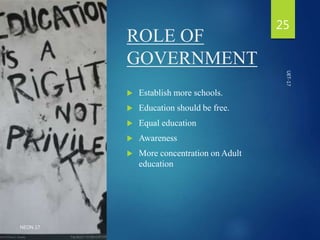
ROLE OF
GOVERNMENT
25
NEON 17
 Establish more schools.
 Education should be free.
 Equal education
 Awareness
 More concentration on Adult
education
UET-17
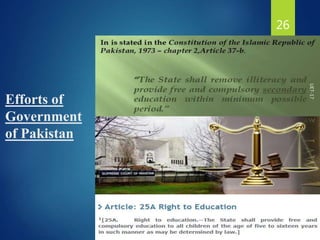
Efforts of
Government
of Pakistan
26
UET-17
27
28
29
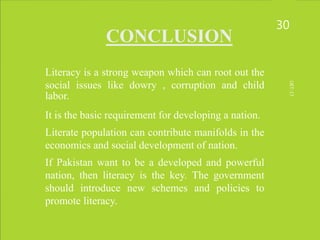
CONCLUSION
• Literacy is a strong weapon which can root out the
social issues like dowry , corruption and child
labor.
• It is the basic requirement for developing a nation.
• Literate population can contribute manifolds in the
economics and social development of nation.
• If Pakistan want to be a developed and powerful
nation, then literacy is the key. The government
should introduce new schemes and policies to
promote literacy.
30
UET-17
FAMOUS QUOTES 31
UET-17
32
33
34

Illiteracy

  • 1.
    ILLITERACY A Social Plague Departmentof Electrical Engineering University of Engineering and Technology, Lahore
  • 2.
    TEAM MEMBERS Shahkar UlHassan (2017-EE-36) Hamda Anees (2017-EE-07) Mehr Un Nisa (2017-EE-02) Rao Ali Khan (2017-EE-37)
  • 3.
    CONTEXT:  Introduction  Illiteracyand its types  Islamic point of view  Causes of illiteracy  Facts and figures  Effects of illiteracy  Problems due to illiteracy  Solutions to remove illiteracy  Role of government  Conclusion 3 UET-17
  • 4.
    INTRODUCTION  Illiteracy isone of biggest problems this world is facing .  It is mother of various other issues like Poverty, population explosion, unemployment , child labor, Early marriages, drug addiction etc. 4 UET-17
  • 5.
     It isstumbling block in the growth and development of country. The majority of the population is illiterate which Is hampering the progress. UET-17 5
  • 6.
    ILLITERACY  Illiteracy isdefined as “Lack of knowledge and the inability to read and write ”  Illiteracy is generally defined as inability of a person to read or write either because of inadequate reading skills or lack of any or enough necessary knowledge. 6 UET-17
  • 7.
    KINDS OF ILLITERACY Functional illiteracy: “ Reading and Writing skills that are inadequate to manage daily living and employment tasks that require reading skills beyond a basic level” UET-17
  • 8.
     Cultural illiteracy: “Theinability to understand and analyze the particular society and culture” UET-17
  • 9.
     Moral illiteracy: “Notbeing taught or lacked the education and understandings in religious or spiritual beliefs. ” UET-17
  • 10.
    ISLAMIC POINT OFVIEW  Prophet of Allah (S.A.W.) has said: “Seek knowledge even if it is far away in China”  The holy Prophet Muhammad (P.B.U.H.) aptly reveals the importance of education. He also criticized illiteracy and emphasized the literate to teach the illiterate. 10 UET-17
  • 11.
    UET-17 CAUSES OF ILLITERACY  Poverty Learning disabilities  Lack of schools in rural areas.  Poor education System.  Corruption  Lack of literacy within family  Low budget of education 11 UET-17
  • 12.
     Regional disparity Ratio of gender discrimination  Non-seriousness of the government towards education  Wadera system  Unemployment  Poor living conditions  Male dominated society  Mindset of people  Gap between upper and lower classes 12
  • 13.
    ILLITERACY RATE IN PAKISTAN With a population of 170 million, Pakistan bears the burden of one of the most illiterate countries of Asia.  About half of the male population is illiterate and two third of the female population can’t even write their names.  Pakistan is at the sixteenth place in the world at illiteracy rate.
  • 14.
    FACTS & FIGURES14 UET-17
  • 15.
    At provincial level: The country’s literacy rate declined from 60 percent to 58 percent, revealed the Economic Survey of Pakistan (2016- 2017) UET-17
  • 16.
  • 17.
    • The overall literacy ratio is 46% in Pakistan. • Female literacy ratio in Pakistan is 26%. 17 UET-17
  • 18.
     Moreover, Englishis fast spreading in Pakistan, with 18 million Pakistanis having a command over the language. On top of that, Pakistan produces about 445,000 university graduates and 10,000 computer science graduates every year.  Despite these statistics, Pakistan still has one of the highest illiteracy rates in the world and the second largest out-of-school population of children after Nigeria 18 UET-17
  • 19.
  • 20.
    EFFECTS  Increases drugand alcohol abuse in society.  Decreases the rate of technological advancement in society.  Intergenerational Illiteracy  Social Crime  Poor health.  Unemployment  Poverty  Child Marriages  Hinders economic and social progress 20 UET-17
  • 21.
    Effect on Society 21  Illiteracy’simpact on society is that it works as an inhibitor. That is to say , the more illiterate people there are in a country, the harder it will be for the country to develop.
  • 22.
    PROBLEMS DUE TO ILLITERACY “The most violent element in society is illiteracy” (Emma Goldman)  An illiterate person has a limited thoughts and narrow canvas. He cannot think beyond a certain level.  He is confined to his own interests and personal motives. 22 UET-17
  • 23.
     Illiteracy breedscrime.  People who are not educated do not have a clear idea of the importance of laws.  They violate law for their petty benefits.  Illiteracy is the greatest threat to the integrity of a nation.  He is unable to appreciate new aspects and possibilities.  Illiteracy hinders his personal as well as collective growth. 23 UET-17
  • 24.
    24  Free andcompulsory education  Awareness  Eradicate Illiteracy among women  Offering grants, subsidies, and scholarships  Ensure equal access to education  Promote lifelong education and training for everyone.  Increase number of primary schools in rural areas.  Digitization  Better quality of education SOLUTIONS TO REMOVE ILLITERACY
  • 25.
    ROLE OF GOVERNMENT 25 NEON 17 Establish more schools.  Education should be free.  Equal education  Awareness  More concentration on Adult education UET-17
  • 26.
  • 27.
  • 28.
  • 29.
  • 30.
    CONCLUSION • Literacy isa strong weapon which can root out the social issues like dowry , corruption and child labor. • It is the basic requirement for developing a nation. • Literate population can contribute manifolds in the economics and social development of nation. • If Pakistan want to be a developed and powerful nation, then literacy is the key. The government should introduce new schemes and policies to promote literacy. 30 UET-17
  • 31.
  • 32.
  • 33.
  • 34.