Amresh kushwaha
B. Sc Nursing

Social change refers to any significant
alteration in human interactions, relationship,
behavioural patterns, cultural values, norms,
social institutions and structures.
INTRODUCTION

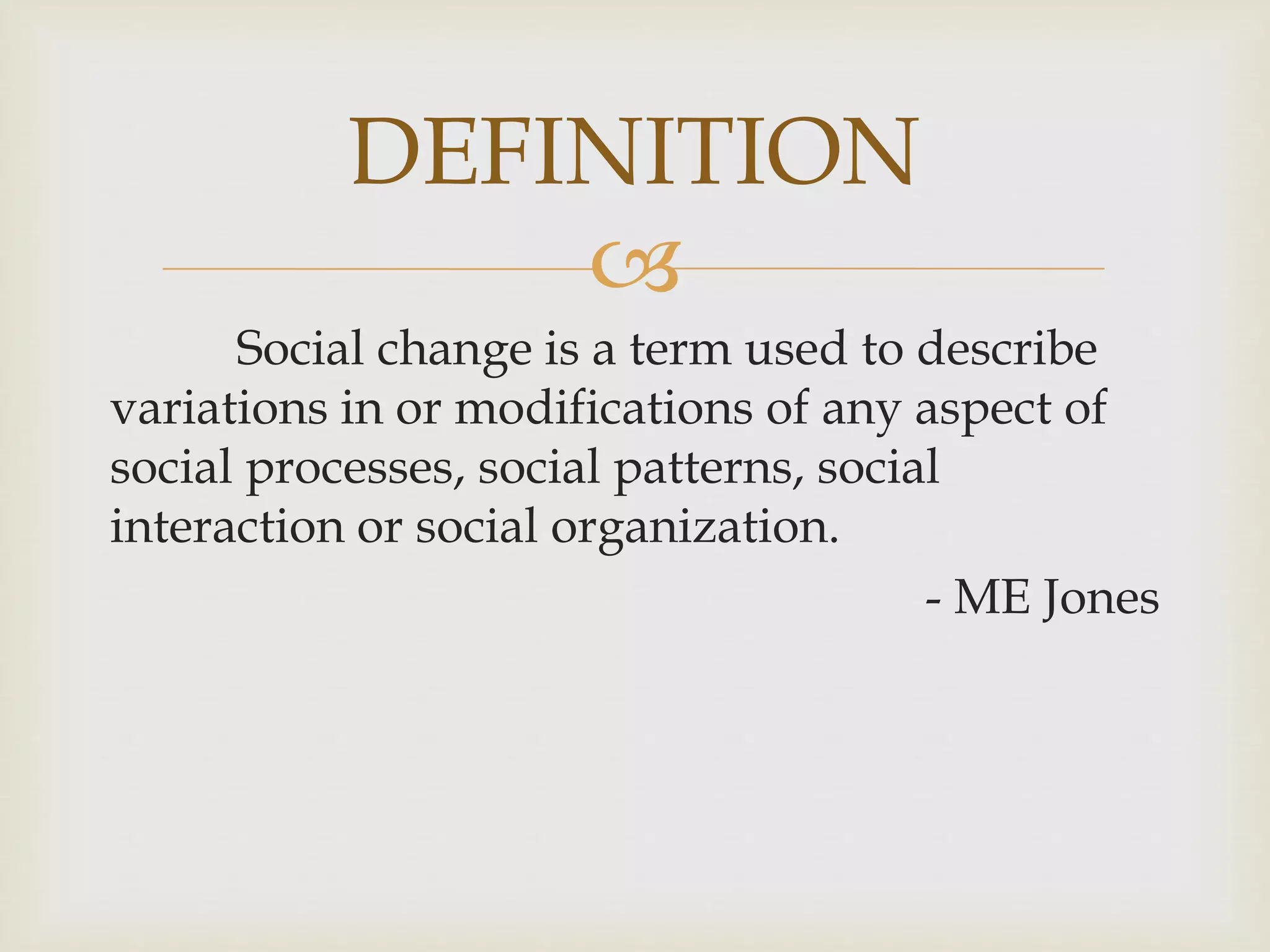
Social change is a term used to describe
variations in or modifications of any aspect of
social processes, social patterns, social
interaction or social organization.
- ME Jones
DEFINITION

It is
universal
It is
continuous
Speed and rate
of change is not
uniform
Natural or
planned
Chain
reaction
pattern
Prediction
is not
possible
It may be due
to interaction of
various factors
NATURE OF SOCIAL
CHANGE

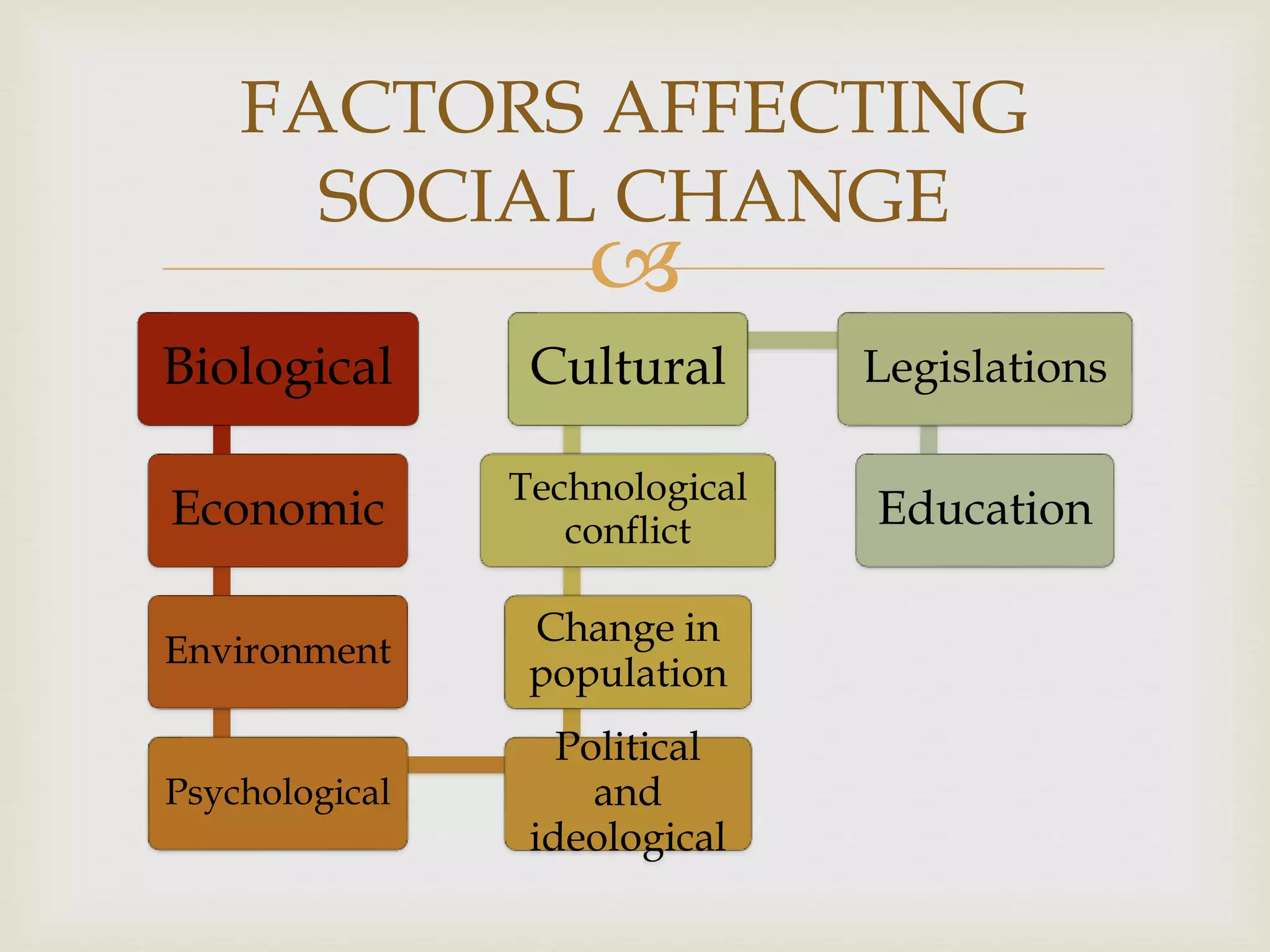
Biological
Economic
Environment
Psychological
Political
and
ideological
Change in
population
Technological
conflict
Cultural Legislations
Education
FACTORS AFFECTING
SOCIAL CHANGE

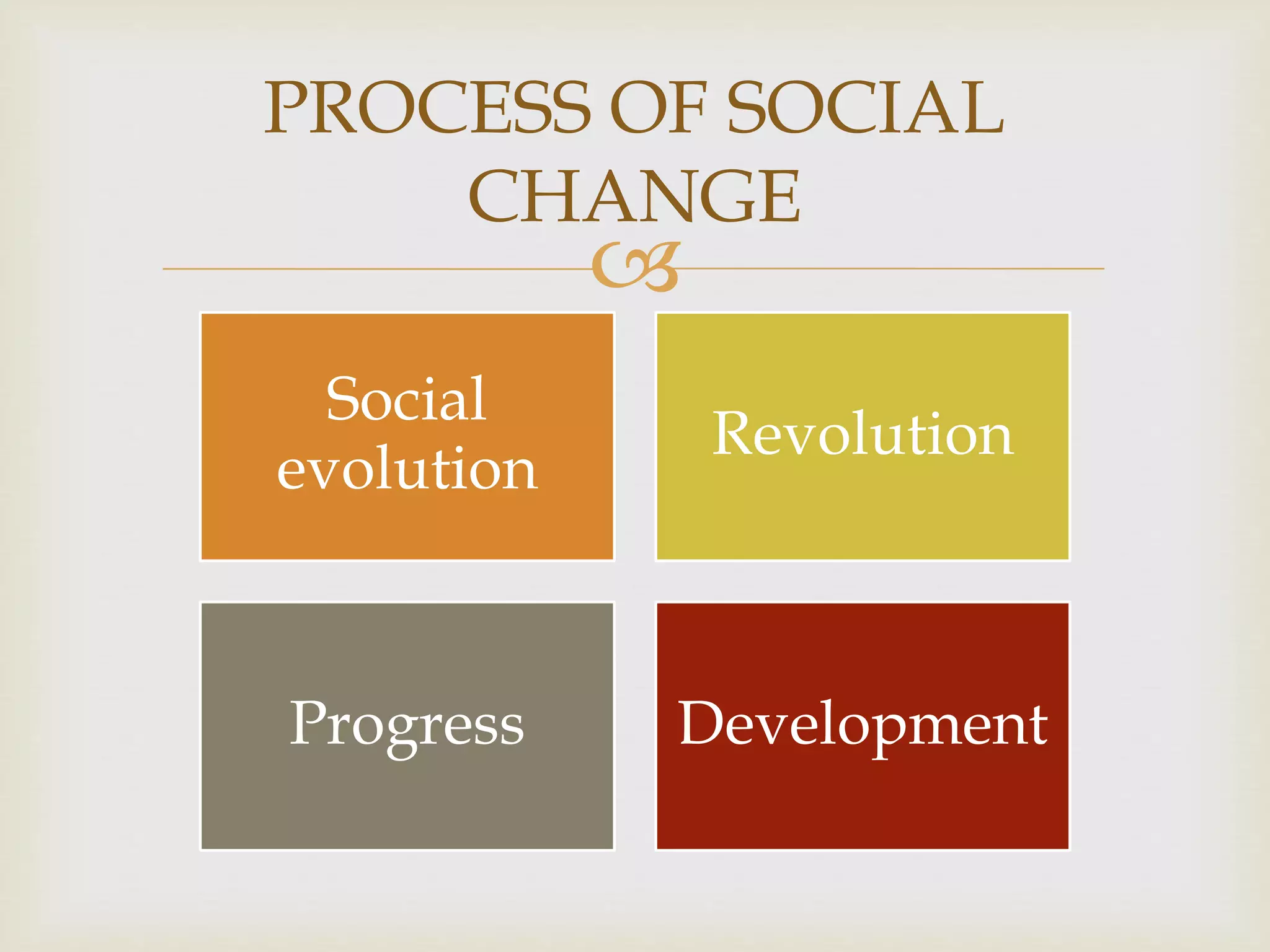
PROCESS OF SOCIAL
CHANGE
Social
evolution
Revolution
Progress Development

Westernization Modernization Secularization
Sanskritization Social mobility
PROCESS OF SOCIAL
CHANGE

STEPS IN PROCESS OF
SOCIAL CHANGE
Change in
Experience of
the individual
Change in
Attitude of the
individual
Change in
thought process
of the individual
Change in social
structures
Change in social
relationships
Change in social
interaction
Social
change

PROCESS OF CULTURAL CHANGE
CULTURAL LAG
Cultural lag is the phenomenon that
occurs when changes in material culture
occurs before or at a faster rate than the
changes in non-material culture.
- Katie McClellan
Cultural
inventions
Cultural
diffusion
Cultural
transmission

Improving the health aspects of individual,
family and community at various health
institutions and community.
Their interventions and communication trigger
positive behavioural and attitudinal changes in
patients.
Directly and indirectly effect the change process
Through health education, nurses teaches
healthy and safe health habits to the community.
ROLE OF A NURSE –
CHANGE AGENTS

To assess and diagnose social health problems
and offer interventions.
Overcoming resistance and organizing forces for
positive growth.
Nurses can advocate for an impartial society to
eradicate the social factors contributing to poor
health and uneven distribution of services.
Nurses improve wellbeing by modifying their
life style and change the system responsible for
causing health inequality.

Evolution theory
Functionalist theory
Cyclical theory
Conflict theory
THEORIES OF SOCIAL
CHANGE

Evolutionary theories are based on the
assumption that societies gradually change
from simple beginnings into even more
complex forms.
EVOLUTION THEORY

Unilinearevolutionary
theory
Herbert
spencer
All societies pass
through the same
successive stages of
evolution and reach
the same end.
Multi linear
theory
GerhardLenski
Change can occur in several
ways and does not inevitably
lead in the same direction.
TYPES OF EVOLUTIONARY
THEORIES:

Functionalist theory emphasises what
maintains society, not what changes it.
Talcott persons who is one of the main
functionalist saw society in its natural state as
being stable and balanced.
This theory mainly focuses on what
maintains a system, not what changes it.
FUNCTIONALIST THEORY

 Functionalist are primarily concerned with the
function of social stratification with its contribution
to the maintenance and well-being of society.
 Functionalist assumes that there are certain basic
needs of functional prerequisites which must
become, if society is to survive, social stratification
also fulfills certain basic needs.
 They maintain that a certain degree of order and
stability are essential for the operation of social
system and social stratification systems help to
maintain order and stability in society.

This theory focusses on the rise and fall of
civilizations attempting to discover and account
for these patterns of growth and decay.
Cyclic theories contended that changes are not
linear but cyclic.
Societies are undergoing period of growth,
maturity and decline.
Cultures pass through the stage of birth, growth,
maturity, decline and death like an individual.
CYCLICAL THEORY

senate culture means the value of sensory
experiences, experiment.
In contrast ideational cultures stress the
spiritual and religious factor.
In the history of mankind either of these
extreme culture dominates at one period, i.e.,
senate cultures dominate one period and
ideational cultures dominate another period.

 Marxian perspectives provide a radical alternative
to functionalists views, they regards stratification
as a divisive rather than an integrative structure.
 Marx used the term class refer the main strata in
all stratification systems.
 In all stratified societies there are two major social
groups or classes, a rulling class and a subject
class.
 The power of rulling class derives from its
ownership and control of the force of production.
MARXIAN THEORY

Subject class whose members own only their
labor which they hire to the capitalist in
return of wages.
Marx believed that all societies are divided
into two major classes.
Example: masters and slaves in ancient
society, lords and serfs in feudal society and
capitalist and wage labors in capitalist
society.

Conflict theorists emphasizes the role of
coercion and power in producing social
order. This perspective is derived from the
works of KARL MARX.
This theory holds that change has crucial
significance, since it is needed to correct
social injustices and inequalities.
CONFLICT THEORY


SOCIAL CHANGE(2nd year).pptx

  • 1.
  • 2.
     Social change refersto any significant alteration in human interactions, relationship, behavioural patterns, cultural values, norms, social institutions and structures. INTRODUCTION
  • 3.
     Social change isa term used to describe variations in or modifications of any aspect of social processes, social patterns, social interaction or social organization. - ME Jones DEFINITION
  • 4.
     It is universal It is continuous Speedand rate of change is not uniform Natural or planned Chain reaction pattern Prediction is not possible It may be due to interaction of various factors NATURE OF SOCIAL CHANGE
  • 5.
  • 6.
  • 7.
  • 8.
     STEPS IN PROCESSOF SOCIAL CHANGE Change in Experience of the individual Change in Attitude of the individual Change in thought process of the individual Change in social structures Change in social relationships Change in social interaction Social change
  • 9.
     PROCESS OF CULTURALCHANGE CULTURAL LAG Cultural lag is the phenomenon that occurs when changes in material culture occurs before or at a faster rate than the changes in non-material culture. - Katie McClellan Cultural inventions Cultural diffusion Cultural transmission
  • 10.
     Improving the healthaspects of individual, family and community at various health institutions and community. Their interventions and communication trigger positive behavioural and attitudinal changes in patients. Directly and indirectly effect the change process Through health education, nurses teaches healthy and safe health habits to the community. ROLE OF A NURSE – CHANGE AGENTS
  • 11.
     To assess anddiagnose social health problems and offer interventions. Overcoming resistance and organizing forces for positive growth. Nurses can advocate for an impartial society to eradicate the social factors contributing to poor health and uneven distribution of services. Nurses improve wellbeing by modifying their life style and change the system responsible for causing health inequality.
  • 12.
     Evolution theory Functionalist theory Cyclicaltheory Conflict theory THEORIES OF SOCIAL CHANGE
  • 13.
     Evolutionary theories arebased on the assumption that societies gradually change from simple beginnings into even more complex forms. EVOLUTION THEORY
  • 14.
     Unilinearevolutionary theory Herbert spencer All societies pass throughthe same successive stages of evolution and reach the same end. Multi linear theory GerhardLenski Change can occur in several ways and does not inevitably lead in the same direction. TYPES OF EVOLUTIONARY THEORIES:
  • 15.
     Functionalist theory emphasiseswhat maintains society, not what changes it. Talcott persons who is one of the main functionalist saw society in its natural state as being stable and balanced. This theory mainly focuses on what maintains a system, not what changes it. FUNCTIONALIST THEORY
  • 16.
      Functionalist areprimarily concerned with the function of social stratification with its contribution to the maintenance and well-being of society.  Functionalist assumes that there are certain basic needs of functional prerequisites which must become, if society is to survive, social stratification also fulfills certain basic needs.  They maintain that a certain degree of order and stability are essential for the operation of social system and social stratification systems help to maintain order and stability in society.
  • 17.
     This theory focusseson the rise and fall of civilizations attempting to discover and account for these patterns of growth and decay. Cyclic theories contended that changes are not linear but cyclic. Societies are undergoing period of growth, maturity and decline. Cultures pass through the stage of birth, growth, maturity, decline and death like an individual. CYCLICAL THEORY
  • 18.
     senate culture meansthe value of sensory experiences, experiment. In contrast ideational cultures stress the spiritual and religious factor. In the history of mankind either of these extreme culture dominates at one period, i.e., senate cultures dominate one period and ideational cultures dominate another period.
  • 19.
      Marxian perspectivesprovide a radical alternative to functionalists views, they regards stratification as a divisive rather than an integrative structure.  Marx used the term class refer the main strata in all stratification systems.  In all stratified societies there are two major social groups or classes, a rulling class and a subject class.  The power of rulling class derives from its ownership and control of the force of production. MARXIAN THEORY
  • 20.
     Subject class whosemembers own only their labor which they hire to the capitalist in return of wages. Marx believed that all societies are divided into two major classes. Example: masters and slaves in ancient society, lords and serfs in feudal society and capitalist and wage labors in capitalist society.
  • 21.
     Conflict theorists emphasizesthe role of coercion and power in producing social order. This perspective is derived from the works of KARL MARX. This theory holds that change has crucial significance, since it is needed to correct social injustices and inequalities. CONFLICT THEORY
  • 22.