Business Model
and Competitive
Strategy of IKEA
in India
Carlos R. Polanco
Matheus S. Cruz
Rory E. Maguire
Stella O. Kolawole
About IKEA
Company
IKEA’s globally
successful business
model is based on
eliminating the
worst aspect of
furniture shopping
• Items well-designed but not
especially long-lasting
• Fanciful name, a straightforward
style, and are tidy
• Reasonably priced without being
overly so, their price range is
ideal
Products
Stores
• A destination customers need a reason to visit
• Distinctive shopping location due to its
sophisticated showroom and cafeteria
• Long-term competitive advantage stems from
a variety of factors (operational effectiveness,
brand recognition, innovation, a strong
network of suppliers, a wide range of
products, and cost leadership)
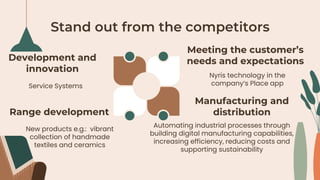
Stand out from the competitors
Service Systems
Nyris technology in the
company’s Place app
Development and
innovation
Meeting the customer’s
needs and expectations
New products e.g.: vibrant
collection of handmade
textiles and ceramics
Automating industrial processes through
building digital manufacturing capabilities,
increasing efficiency, reducing costs and
supporting sustainability
Range development
Manufacturing and
distribution
02
04
03
01
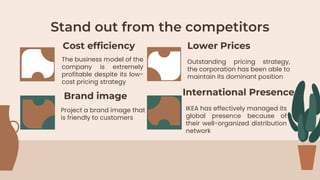
Stand out from the competitors
The business model of the
company is extremely
profitable despite its low-
cost pricing strategy
Outstanding pricing strategy,
the corporation has been able to
maintain its dominant position
IKEA has effectively managed its
global presence because of
their well-organized distribution
network
Lower Prices
International Presence
Cost efficiency
Project a brand image that
is friendly to customers
Brand image
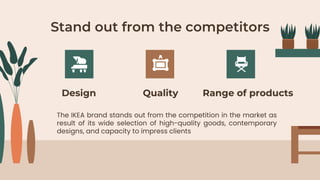
Stand out from the competitors
Design Quality
The IKEA brand stands out from the competition in the market as
result of its wide selection of high-quality goods, contemporary
designs, and capacity to impress clients
Range of products
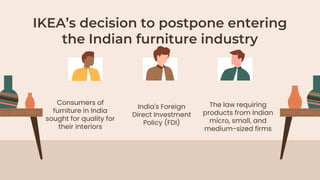
IKEA’s decision to postpone entering
the Indian furniture industry
Consumers of
furniture in India
sought for quality for
their interiors
India's Foreign
Direct Investment
Policy (FDI)
The law requiring
products from Indian
micro, small, and
medium-sized firms
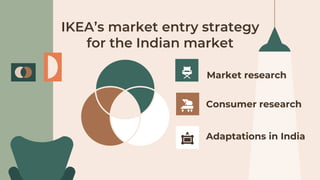
IKEA’s market entry strategy
for the Indian market
Market research
Consumer research
Adaptations in India
.
.
.
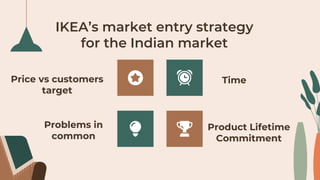
Price vs customers
target
Time
Problems in
common
Product Lifetime
Commitment
IKEA’s market entry strategy
for the Indian market
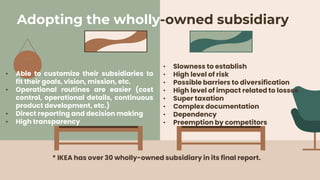
Adopting the wholly-owned subsidiary
• Able to customize their subsidiaries to
fit their goals, vision, mission, etc.
• Operational routines are easier (cost
control, operational details, continuous
product development, etc.)
• Direct reporting and decision making
• High transparency
• Slowness to establish
• High level of risk
• Possible barriers to diversification
• High level of impact related to losses
• Super taxation
• Complex documentation
• Dependency
• Preemption by competitors
* IKEA has over 30 wholly-owned subsidiary in its final report.
Whoa!
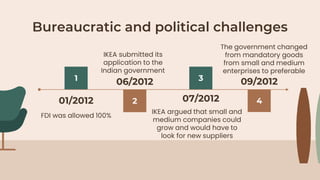
Bureaucratic and political challenges
2
1
4
3
01/2012
FDI was allowed 100%
06/2012
IKEA submitted its
application to the
Indian government
07/2012
IKEA argued that small and
medium companies could
grow and would have to
look for new suppliers
09/2012
The government changed
from mandatory goods
from small and medium
enterprises to preferable
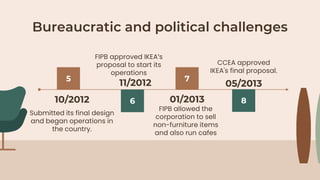
Bureaucratic and political challenges
7
6 8
11/2012
Submitted its final design
and began operations in
the country.
01/2013
FIPB approved IKEA’s
proposal to start its
operations
05/2013
CCEA approved
IKEA's final proposal.
5
10/2012
FIPB allowed the
corporation to sell
non-furniture items
and also run cafes
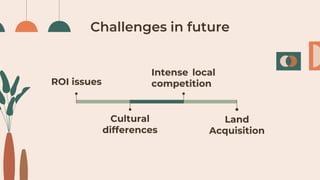
Challenges in future
Cultural
differences
ROI issues
Land
Acquisition
Intense local
competition
Future strategies to succed
● Hiring policies
● Key locations targeted
What
happened?
The huge Swedish furniture retailer entered India in 2018
IKEA visited more than 2,000 households
Discovered Indian’s older furniture
was frequently very heavy
As families ans living spaces shrink and mobility increases, IKEA
now has a better way to join this developing Indian market that is
compatible with the style of furniture the firm produces
The large corporation also had trouble with DIY label
The company’s furniture is not the cheapest in the country
Families all over India are now
sharing on Instagram and other
platforms how proud they are of
themselves for assembling their
own furniture
One of their best moves was to open
the furniture giant’s first ever online
store in Mumbai in 2019
Conclusion
CREDITS: This presentation template was created by Slidesgo,
including icons by Flaticon, infographics & images by Freepik
Thank You
Do you have any questions?

IKEA CASE PRESENTATION.pptx

  • 1.
    Business Model and Competitive Strategyof IKEA in India Carlos R. Polanco Matheus S. Cruz Rory E. Maguire Stella O. Kolawole
  • 2.
  • 3.
    IKEA’s globally successful business modelis based on eliminating the worst aspect of furniture shopping
  • 4.
    • Items well-designedbut not especially long-lasting • Fanciful name, a straightforward style, and are tidy • Reasonably priced without being overly so, their price range is ideal Products
  • 5.
    Stores • A destinationcustomers need a reason to visit • Distinctive shopping location due to its sophisticated showroom and cafeteria • Long-term competitive advantage stems from a variety of factors (operational effectiveness, brand recognition, innovation, a strong network of suppliers, a wide range of products, and cost leadership)
  • 6.
    Stand out fromthe competitors Service Systems Nyris technology in the company’s Place app Development and innovation Meeting the customer’s needs and expectations New products e.g.: vibrant collection of handmade textiles and ceramics Automating industrial processes through building digital manufacturing capabilities, increasing efficiency, reducing costs and supporting sustainability Range development Manufacturing and distribution
  • 7.
    02 04 03 01 Stand out fromthe competitors The business model of the company is extremely profitable despite its low- cost pricing strategy Outstanding pricing strategy, the corporation has been able to maintain its dominant position IKEA has effectively managed its global presence because of their well-organized distribution network Lower Prices International Presence Cost efficiency Project a brand image that is friendly to customers Brand image
  • 8.
    Stand out fromthe competitors Design Quality The IKEA brand stands out from the competition in the market as result of its wide selection of high-quality goods, contemporary designs, and capacity to impress clients Range of products
  • 9.
    IKEA’s decision topostpone entering the Indian furniture industry Consumers of furniture in India sought for quality for their interiors India's Foreign Direct Investment Policy (FDI) The law requiring products from Indian micro, small, and medium-sized firms
  • 10.
    IKEA’s market entrystrategy for the Indian market Market research Consumer research Adaptations in India . . .
  • 11.
    Price vs customers target Time Problemsin common Product Lifetime Commitment IKEA’s market entry strategy for the Indian market
  • 12.
    Adopting the wholly-ownedsubsidiary • Able to customize their subsidiaries to fit their goals, vision, mission, etc. • Operational routines are easier (cost control, operational details, continuous product development, etc.) • Direct reporting and decision making • High transparency • Slowness to establish • High level of risk • Possible barriers to diversification • High level of impact related to losses • Super taxation • Complex documentation • Dependency • Preemption by competitors * IKEA has over 30 wholly-owned subsidiary in its final report.
  • 13.
  • 14.
    Bureaucratic and politicalchallenges 2 1 4 3 01/2012 FDI was allowed 100% 06/2012 IKEA submitted its application to the Indian government 07/2012 IKEA argued that small and medium companies could grow and would have to look for new suppliers 09/2012 The government changed from mandatory goods from small and medium enterprises to preferable
  • 15.
    Bureaucratic and politicalchallenges 7 6 8 11/2012 Submitted its final design and began operations in the country. 01/2013 FIPB approved IKEA’s proposal to start its operations 05/2013 CCEA approved IKEA's final proposal. 5 10/2012 FIPB allowed the corporation to sell non-furniture items and also run cafes
  • 16.
    Challenges in future Cultural differences ROIissues Land Acquisition Intense local competition
  • 17.
    Future strategies tosucced ● Hiring policies ● Key locations targeted
  • 18.
  • 19.
    The huge Swedishfurniture retailer entered India in 2018 IKEA visited more than 2,000 households Discovered Indian’s older furniture was frequently very heavy As families ans living spaces shrink and mobility increases, IKEA now has a better way to join this developing Indian market that is compatible with the style of furniture the firm produces The large corporation also had trouble with DIY label The company’s furniture is not the cheapest in the country
  • 20.
    Families all overIndia are now sharing on Instagram and other platforms how proud they are of themselves for assembling their own furniture One of their best moves was to open the furniture giant’s first ever online store in Mumbai in 2019
  • 21.
  • 22.
    CREDITS: This presentationtemplate was created by Slidesgo, including icons by Flaticon, infographics & images by Freepik Thank You Do you have any questions?