International Association of Scientific Innovation
(An Association Unifying the Sciences, Engineering, and Applied Research)
International Journal of Emerging Technologies in Computational
and Applied Sciences
IJETCAS 14-319; © 2014, IJETCAS All Rights Reserved
Identifying Communication Intell
1
D.
1
Ranbaxy Research Laboratories,
2
Management Development Institute,
3
Institute of Technology Management
_______________________________________________________________________________________
Abstract: Most of the researches on drug adoption concentrat
development and diffusion. Very little research considers on understanding of intention of drug usage through
physician-patient interactions. This research investigates link between drug adoption and drug usage intention
through communication intensity of physicians and patients within their d
conceptual framework supports communication
of disease and patients’ lifestyle), physicians’ self
offered by pharmaceutical firms. An unstructured repertory grid survey
structured retrospective survey with two thousand patients
(NCR) were conducted to show the effects
used to analyse the data. The results show
adoption for challenging disease also improves
of-mouth communication operate through the
Keywords: Pharmaceutical branded drugs; communication strategies; intelligent framework; drug adoption
__________________________________________________________________________________________
Increasing R&D expenditure and strategic collaborations with international manufacturers in pharmaceutical
industry in India in recent years indicate a
high-value branded drugs (Porter and Lee 2013)
branded drugs is not very significant in the country
to explain the drug adoption level has primarily focused on the socio
(Rogers RG, Hummer RA et al. 2000; Goldman Dana and Smith James P. 2002), while overlooking the
development of communication infrastructure
(Denig and Petra et al. 2007). Examining behavioural intentions of physicians
communication intelligence address the challenges
2012). This study addresses the limitation
patient, doctors and firm has not been optimized in
Theories related to branded drug adoption recognize the
multiple stakeholders. For example, modern social capital theory accrues to firms’ engagement in social
relationships with influential stakeholders to gain access to
theory explores the role of communication
them about the usefulness of a new product
relationship between communication and new product adoption in
research on strategic communication network formation in
The present study uses data mining technique to check if there is any patient related influence in ARB branded
extension adoption. Secondly, the study shows how with increased complexity of diseases, communication
intelligence is required to support new brand acceptance. For the first ti
and cognitive map can be used to explain the findings of data mining technique
provides opportunity to identify factors for drug adoption
emergent market as well. The remainder of this paper is organized as follows. Following this introduction, the
next section of this paper presents literature review, methodology empirical results and discussion and future
directions.
Indian pharmaceutical firms are now
potentially challenge even multinational compan
Indian pharmaceutical industry is a destinat
skilled task force, cheap labour and state of
fragmented with over 23,000 companies (
ten largest Indian pharmaceutical companies
International Association of Scientific Innovation and Research (IASIR)
(An Association Unifying the Sciences, Engineering, and Applied Research)
ournal of Emerging Technologies in Computational
and Applied Sciences (IJETCAS)
www.iasir.net
, IJETCAS All Rights Reserved
ISSN (Print): 2279
ISSN (Online): 2279
Identifying Communication Intelligence for Drug Adoption in India
Goswami*, 2
N. Jain, 3
D. R. Agarwal
Ranbaxy Research Laboratories, Gurgaon, India
Management Development Institute, Gurgaon, India
of Technology Management University, Gurgaon, India
_______________________________________________________________________________________
on drug adoption concentrate on suppliers’ environment of new drug
research considers on understanding of intention of drug usage through
patient interactions. This research investigates link between drug adoption and drug usage intention
through communication intensity of physicians and patients within their drug usage relationships in India. A
communication strategies to be developed based on disease complexities (type
of disease and patients’ lifestyle), physicians’ self-confidence in the drug effectiveness and marketing incentiv
. An unstructured repertory grid survey involving fifteen physicians and a
two thousand patients at hospitals located in National Capital Region
effects of firms’ communication for drug usage. Data mining
show with increased marketing and word-of-mouth communication drug
also improves. An implication for managers is that both marketing and word
mouth communication operate through the firm’s communication programming.
Pharmaceutical branded drugs; communication strategies; intelligent framework; drug adoption
__________________________________________________________________________________________
I. Introduction
Increasing R&D expenditure and strategic collaborations with international manufacturers in pharmaceutical
industry in India in recent years indicate a shifting emphasis of the industry from high-volume generic drugs to
(Porter and Lee 2013). However, despite these efforts, the rate of increase of sales of
drugs is not very significant in the country (Dadhich and Upadhyay, 2011). Previous research seeking
to explain the drug adoption level has primarily focused on the socio-economic conditions of the patients
2000; Goldman Dana and Smith James P. 2002), while overlooking the
infrastructure, in determining branded drug adoption for treating hypertension
Examining behavioural intentions of physicians linking
communication intelligence address the challenges that branded drug adoption face (Gonul and Carter et al.
limitation in healthcare supply chain where relationship among stakeholders i.e.
has not been optimized in an emergent market like India.
adoption recognize the importance of relationship and communication among
multiple stakeholders. For example, modern social capital theory accrues to firms’ engagement in social
relationships with influential stakeholders to gain access to needed resources (Lin 2001). Information diffusion
theory explores the role of communication technologies to create awareness among the adopters and to persuade
them about the usefulness of a new product (Roger, 1995). Although literature abounds examining
relationship between communication and new product adoption in healthcare (Ranjan, 2009), there is paucity of
network formation in Indian medical community for treating hypertension
ng technique to check if there is any patient related influence in ARB branded
the study shows how with increased complexity of diseases, communication
intelligence is required to support new brand acceptance. For the first time, the study shows how
and cognitive map can be used to explain the findings of data mining technique. The mixed mode research
provides opportunity to identify factors for drug adoption in developing a framework that can be used in other
The remainder of this paper is organized as follows. Following this introduction, the
presents literature review, methodology empirical results and discussion and future
II. Literature Review
now emerging as third-world multinationals with capabilities that could
multinational companies (MNCs) from the developed world (Chittoor
Indian pharmaceutical industry is a destination for top tiered pharmaceutical MNCs of the world due to highly
skilled task force, cheap labour and state of the art facilities. However, Indian pharmaceutical industry remains
d with over 23,000 companies (Ramani 2012). Concentration occurs at the top-end of the industry: the
largest Indian pharmaceutical companies, with international marketing presence, control 36% of the market
ournal of Emerging Technologies in Computational
Page 74
ISSN (Print): 2279-0047
ISSN (Online): 2279-0055
igence for Drug Adoption in India
_______________________________________________________________________________________
on suppliers’ environment of new drug
research considers on understanding of intention of drug usage through
patient interactions. This research investigates link between drug adoption and drug usage intention
rug usage relationships in India. A
based on disease complexities (type
confidence in the drug effectiveness and marketing incentives
fifteen physicians and a
National Capital Region
ata mining technique is
mouth communication drug
oth marketing and word-
Pharmaceutical branded drugs; communication strategies; intelligent framework; drug adoption
__________________________________________________________________________________________
Increasing R&D expenditure and strategic collaborations with international manufacturers in pharmaceutical
volume generic drugs to
ts, the rate of increase of sales of
Previous research seeking
economic conditions of the patients
2000; Goldman Dana and Smith James P. 2002), while overlooking the
for treating hypertension
cognition with
Gonul and Carter et al.
in healthcare supply chain where relationship among stakeholders i.e.
importance of relationship and communication among
multiple stakeholders. For example, modern social capital theory accrues to firms’ engagement in social
(Lin 2001). Information diffusion
to create awareness among the adopters and to persuade
abounds examining the
, there is paucity of
for treating hypertension.
ng technique to check if there is any patient related influence in ARB branded
the study shows how with increased complexity of diseases, communication
w reparatory grid
The mixed mode research
developing a framework that can be used in other
The remainder of this paper is organized as follows. Following this introduction, the
presents literature review, methodology empirical results and discussion and future
world multinationals with capabilities that could
Chittoor and Ray 2007).
ion for top tiered pharmaceutical MNCs of the world due to highly
Indian pharmaceutical industry remains
end of the industry: the
control 36% of the market
Goswami et al., International Journal of Emerging Technologies in Computational and Applied Sciences, 8(1), March-May 2014, pp. 74-
82
IJETCAS 14-319; © 2014, IJETCAS All Rights Reserved Page 75
(Haley et al. 2012). Due to highly competitive market, success of internationalized pharmaceutical firms in
branded medicine segment is highly uncertain due to lack of intelligent communication practices or cognitive
conflicts among decision makers for new prescriptions. Gorini et al. (2011) also supported the theory that
human cognitive abilities are limited and cannot consider all the information available. One of the popular
qualitative approach, phenomological methods (Husserl, 1970; Moustakas, 1994), instrumental in dealing with
confounding issues can be applied for an inquiry on physician’s intention for drug adoption for both simple (for
example treating hypertension) and complex diseases (like cancer). This paper continues with a presentation of
the variety of qualitative analysis techniques, focusing on communication intensity of physicians and patients
within their drug usage relationships.
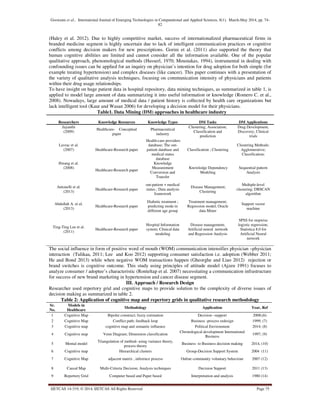
To have insight on huge patient data in hospital repository, data mining techniques, as summarized in table 1, is
applied to model large amount of data summarizing it into useful information or knowledge (Romero C. et al.,
2008). Nowadays, large amount of medical data / patient history is collected by health care organizations but
lack intelligent tool (Kaur and Wasan 2006) for developing a decision model for their physicians.
Table1. Data Mining (DM) approaches in healthcare industry
Researchers Knowledge Resources Knowledge Types DM Tasks DM Applications
Jayanthi
(2009)
Healthcare- Conceptual
paper
Pharmaceutical
industry
Clustering; Association;
Classification and
prediction
Drug Development,
Discovery, Clinical
trials
Lavrac et al.
(2007) Healthcare-Research paper
Health-care providers
database; The out-
patient database and
medical status
database
Classification ; Clustering
Clustering Methods:
Agglomerative;
Classification;
Hwang et al.
(2008)
Healthcare-Research paper
Knowledge
Measurement
Conversion and
Transfer
Knowledge Dependency
Modeling
Sequential pattern
Analysis
Antonelli et al.
(2013)
Healthcare-Research paper
out-patient + medical
status ; Data analysis
framework
Disease Management;
Clustering
Multiple-level
clustering; DBSCAN
algorithm
Abdullah A. et al.
(2013)
Healthcare-Research paper
Diabetic treatment ;
predicting mode in
different age group
Treatment management;
Regression model; Oracle
data Miner
Support vector
machine
Ting-Ting Lee et al.
(2011)
Healthcare-Research paper
Hospital Information
system; Clinical data
modeling
Disease management;
Artificial neural network
and Regression Analysis
SPSS for stepwise
logistic regression;
Statistica 8.0 for
Artificial Neural
network
The social influence in form of positive word of mouth (WOM) communication intensifies physician –physician
interaction (Tulikaa, 2011; Lee and Koo 2012) supporting consumer satisfaction i.e. adoption (Webber 2011;
He and Bond 2013) while when negative WOM transactions happen (Gheorghe and Liao 2012) rejection or
brand switches is cognitive outcome. This study using principles of attitude model (Ajzen 1991) focuses to
analyze consumer / adoptee’s characteristic (Ronteltap et al. 2007) necessitating a communication infrastructure
for success of new brand marketing in hypertension and cancer disease segment.
III. Approach / Research Design
Researcher used repertory grid and cognitive maps to provide solution to the complexity of diverse issues of
decision making as summarized in table 2.
Table 2: Application of cognitive map and repertory grids in qualitative research methodology
Sr.
No.
Models in
Healthcare
Methodology Application Year, Ref
1 Cognitive Map Bipolar construct; fuzzy estimation Decision –support 2008;(6)
2 Cognitive Map Conflict path; feedback loop Business -process redesign 1999; (7)
3 Cognitive map cognitive map and semantic influence Political Environment 2014; (8)
4 Cognitive map Venn Diagram; Dimension classification
Chronological development International
Business
1997; (9)
5 Mental model
Triangulation of method- using variance theory,
process theory
Business to Business decision making 2014, (10)
6 Cognitive map Hierarchical clusters Group-Decision Support System 2004 (11)
7 Cognitive Map adjacent matrix , inference process Online community voluntary behaviour 2007 (12)
8 Causal Map Multi-Criteria Decision; Analysis techniques Decision Support 2011 (13)
9 Repertory Grid Computer based and Paper based Interpretation and analysis 1980 (14)
Goswami et al., International Journal of Emerging Technologies in Computational and Applied Sciences, 8(1), March-May 2014, pp. 74-
82
IJETCAS 14-319; © 2014, IJETCAS All Rights Reserved Page 76
10 Repertory Grid Content and structure of construct Interpersonal skill of nurses 1989 (15)
11 Repertory Grid focus group; generalized Procrustes analysis food product technologies 2007 (16)
12 Repertory Grid Analysis , Validity Reliability interpretive; software engineering 2009 (17)
14 Repertory Grid
Content Analysis, generalized procrustes
analysis
tourist food consumption 2013 (18)
15 Repertory Grid
Systems Thinking Hierarchy (STH)-model-
Repertory Grid Maps
Student's thinking ; Ecological
complexity
2014 (19)
16 Repertory Grid Positive and negative syndrome scale Cognitive therapy model 2014 (20)
17 Repertory Grid Likert scale Questionnaire Clinical Mobile Learning System 2011 (21)
Implementing knowledge management framework, data mining is applied first on patient’s data to check if
medical decisions for simple disease like hypertension management is dependent on doctor-patient shared
decision making. Further, using focus group interview, employing repertory grid technique, causal map is
constructed to show how with increase in disease complexity scope of shared decision making increases.
A. Data mining method and its applications
The research objective has been targeted to propose a patient- centric medical solution for Indian healthcare
settings using knowledge mining (Jiawei H. and Kamber M. 2000) technique. Fayyad et.al. (1996) define six
main functions of data mining:
1. Classification is finding models that analyze and classify a data item into several predefined classes
2. Regression is mapping a data item to a real-valued prediction variable
3. Clustering is identifying a finite set of categories or clusters to describe the data
4. Dependency Modeling (Association Rule Learning) is finding a model which describes significant
dependencies between variables
5. Deviation Detection (Anomaly Detection) is discovering the most significant changes in the data
6. Summarization is finding a compact description for a subset of data
The integration of information and communication intelligence in healthcare practice will support physicians’
medical decision making (Lupiáñez-Villanuevaa et al. 2010). The exploratory research study is designed based
on convenience sampling method. It is a non-probability sampling technique where subjects are selected
because of their convenient accessibility and proximity to the researcher. Since physicians are easily available in
hospitals, clinic or dispensaries with prior appointment survey can be conducted with ease. Therefore we
preferred convenient sampling technique because it is fast, inexpensive, easy and the subjects are readily
available.
Seven years after Greving and Petitt et al. (2007) article however, there is still scant attention being paid to this
critical aspect of drug adoption scale development using physician–patient communication relationship. The
problem is further compounded when confounding issues persists while studying emerging market like India.
The importance of shared decision making to increase cancer treatment efficiency has been identified in recent
past (Olson and Bobinski et al. 2012; Frongillo and Feibelmann et al. 2013; Thorne and Oliffe et al. 2013).
Therefore studying the communication dynamics employing causal maps, to have insight on provider-consumer
partnership thereby improving cancer treating drug adoption, becomes imperative. The patient characteristic was
evaluated by data mining (Lee et al. 2011). In this paper, the application of data mining technique is discussed
such as Classification, Association Analysis and Outlier Analysis in healthcare.
IV. Methodology and Data Collection
Data Modeling technologies and applications
Data mining has two primary objectives of prediction and description. Prediction involves using some variables
in data sets in order to predict unknown values of other relevant variables (e.g. classification, regression, and
anomaly detection). Description involves finding human understandable patterns and trends in the data (e.g.
clustering, association rule learning, and summarization) as noted in earlier research summarized in table 7.
Methodology for data mining
Association analysis
Association analysis is the discovery of association rules showing attribute-value conditions that occur
frequently together in a given set of data. Association analysis is widely used for market basket or transaction
data analysis. The methodology for association rule is described briefly.
More formally, association rules are of the form X => Y, i.e., “A1 ^ _ _ _^Am B1 ^ _ _ _^ Bn", where Ai
(for i to m) and Bj (j to n) are attribute-value pairs. The association rule X=>Y is interpreted as database tuples
that satisfy the conditions in X are also likely to satisfy the conditions in Y "(Jiawei H. and Kamber M. 2000).
In the health care system it can be applied as follows:-
(Symptoms) (Previous--- history) ------- > (Cause—of--- disease)
Rule Induction Method has the potential to use retrieved cases for predictions and can be used to predict the
significant characteristic from a large set of population under study. The following example will predict whether
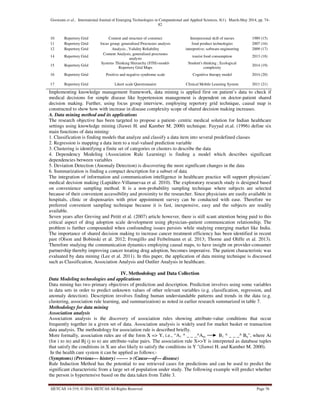
the person is hypertensive based on the data taken from Table 3.
Goswami et al., International Journal of Emerging Technologies in Computational and Applied Sciences, 8(1), March-May 2014, pp. 74-
82
IJETCAS 14-319; © 2014, IJETCAS All Rights Reserved Page 77
Table 3. The attributes which can cause hypertension
Age Gender Alcoholic Smoker Hypertensive
60 M Y Y Y
75 M Y Y Y
40 M N Y Y
40 F Y Y Y
56 F N N N
34 M Y Y Y
45 M N Y Y
The association rules that can be generated and we can predict whether the patient is hypertensive or not
depending on whether he is a smoker, an alcoholic or both. The support factor of the association rule shows that
1% of the persons are “alcoholic” and “smoker” is suffering from hypertension and confidence factor shows
that there is a chance that 50% of the persons who are “alcoholic” and “smoker” can suffer from hypertension.
Classification
Classification is the process of finding a set of models (or functions) which describe and distinguish data classes
or concepts, for the purposes of being able to use the model to predict the class of objects whose class label is
unknown. The derived model may be represented in various forms, such as classification (IF-THEN) rules,
decision trees, mathematical formulae, or neural networks. Classification can be used for predicting the class
label of data objects. Given below is an example where we can apply the Classification Technique to predict
whether the patient with the given symptoms will suffer from a particular disease or not. This data mining
technology has currently presented a platform for consultant physician to use computer based prescription
support system and survey report reveal that many young physicians are also comfortable with use.
There exist many possible models for classification, which can be expressed as rules, decision trees. Once the
model is built, unknown data can be classified. In order to test the quality of the model its accuracy can be tested
by using a test set. If a certain set of data is available for building a classifier, normally one splits this set into a
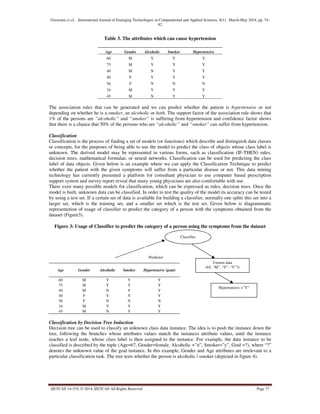
larger set, which is the training set, and a smaller set which is the test set. Given below is diagrammatic
representation of usage of classifier to predict the category of a person with the symptoms obtained from the
dataset (Figure3).
Figure 3: Usage of Classifier to predict the category of a person using the symptoms from the dataset
Age Gender Alcoholic Smoker Hypertensive (goal)
60 M Y Y Y
75 M Y Y Y
40 M N Y Y
40 F Y Y Y
56 F N N N
34 M Y Y Y
45 M N Y Y
Classification by Decision Tree Induction
Decision tree can be used to classify an unknown class data instance. The idea is to push the instance down the
tree, following the branches whose attributes values match the instances attribute values, until the instance
reaches a leaf node, whose class label is then assigned to the instance. For example, the data instance to be
classified is described by the tuple (Age=67, Gender=female, Alcoholic =”n”, Smoker=”y”, Goal =?), where “?”
denotes the unknown value of the goal instance. In this example, Gender and Age attributes are irrelevant to a
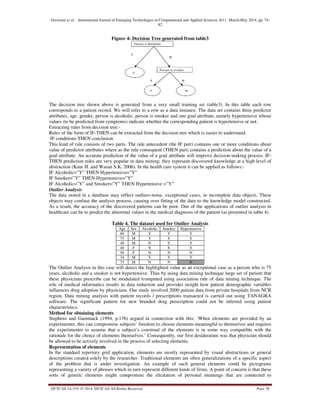
particular classification task. The tree tests whether the person is alcoholic / smoker (depicted in figure 4).
Predictor
Unseen data
(65, “M”, “Y”, “Y”?)
Hypertensive =”Y”
Classifier
Goswami et al., International Journal of Emerging Technologies in Co
IJETCAS 14-319; © 2014, IJETCAS All Rights Reserved
Figure 4
The decision tree shown above is generated from a very small
corresponds to a patient record. We will refer to a row as a data instance. The data set contains three predictor
attributes, age, gender, person is alcoholic, person is smoker and one goal
values (to be predicted from symptoms) indicate whether the corresp
Extracting rules from decision tree:-
Rules of the form of IF-THEN can be extracted from the decision tree which is easier to underst
IF conditions THEN conclusion
This kind of rule consists of two parts. The rule antecedent (the IF part) contains one or more conditions about
value of predictor attributes where as the rule consequent (THEN part) contains a prediction about the valu
goal attribute. An accurate prediction of the value of a goal attribute will improve decision
THEN prediction rules are very popular in data mining; they represent discovered knowledge at a high level of
abstraction (Kaur H. and Wasan S.K. 2006).
IF Alcoholic=”Y” THEN Hypertensive
IF Smoker=”Y” THEN Hypertensive=”Y”
IF Alcoholic=”Y” and Smoker=”Y” THEN Hypertensive
Outlier Analysis
The data stored in a database may reflect outliers
objects may confuse the analysis process, causing over fitting of the data to the knowledge model constructed.
As a result, the accuracy of the discovered patterns can be poor. One
healthcare can be to predict the abnormal values in the medical diagnosis of the
Table 4
Age
60
75
40
40
56
34
75
The Outlier Analysis in this case will detect the highlighted value as an exceptional case as a person who is 75
years, alcoholic and a smoker is not hypertensive
these physicians prescribe can be modulated /computed using association rule of data mining technique. The
role of medical informatics results in data reduction and provides insight how patient demographic va
influences drug adoption by physicians.
region. Data mining analysis with patient records
software. The significant pattern for new branded drug prescription could not be
characteristics.
Method for obtaining elements
Stephens and Gammack (1994, p.176) argued in connection with this: ‘When elements are provided by an
experimenter, this can compromise subjects’ freedom to choose elements meaningful to themselves and requires
the experimenter to assume that a subject’s construal of the elements is in some way compatible with the
rationale for the choice of elements themselves.’ Consequently, our first desi
be allowed to be actively involved in the process of selecting elements.
Representation of elements
In the standard repertory grid application, elements are mostly represented by visual abstractions or general
descriptions created solely by the researcher. Traditional elements are often generalizations of a specific aspect
of the problem that is under investigation.
representing a variety of phrases which in turn repre
sorts of generic elements might compromise the elicitation of personal meanings that are connected to
ournal of Emerging Technologies in Computational and Applied Sciences, 8(1), March
82
, IJETCAS All Rights Reserved
Figure 4: Decision Tree generated from table3
The decision tree shown above is generated from a very small training set (table3). In this table each row
corresponds to a patient record. We will refer to a row as a data instance. The data set contains three predictor
attributes, age, gender, person is alcoholic, person is smoker and one goal attribute, namely hypertensive
values (to be predicted from symptoms) indicate whether the corresponding patient is hypertensive
THEN can be extracted from the decision tree which is easier to understand.
This kind of rule consists of two parts. The rule antecedent (the IF part) contains one or more conditions about
value of predictor attributes where as the rule consequent (THEN part) contains a prediction about the valu
goal attribute. An accurate prediction of the value of a goal attribute will improve decision-making process. IF
THEN prediction rules are very popular in data mining; they represent discovered knowledge at a high level of
asan S.K. 2006). In the health care system it can be applied as follows:
lcoholic=”Y” THEN Hypertensive=”Y”
=”Y”
d Smoker=”Y” THEN Hypertensive =”Y”
eflect outliers-noise, exceptional cases, or incomplete data objects. These
objects may confuse the analysis process, causing over fitting of the data to the knowledge model constructed.
As a result, the accuracy of the discovered patterns can be poor. One of the applications of outlier analysis in
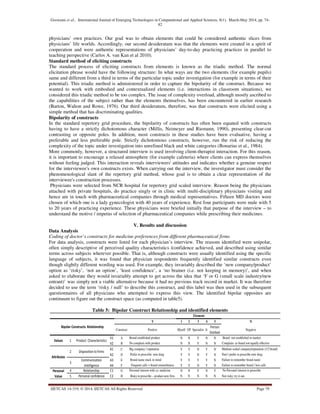
healthcare can be to predict the abnormal values in the medical diagnosis of the patient (as presented in table 4
4. The dataset used for Outlier Analysis
Sex Alcoholic Smoker Hypertensive
M Y Y Y
M Y Y Y
M N Y Y
F Y Y Y
F N N N
M Y Y Y
M N N N
The Outlier Analysis in this case will detect the highlighted value as an exceptional case as a person who is 75
hypertensive. Thus by using data mining technique large set of patient that
these physicians prescribe can be modulated /computed using association rule of data mining technique. The
role of medical informatics results in data reduction and provides insight how patient demographic va
influences drug adoption by physicians. Our study involved 2000 patient data from private hospitals from NCR
with patient records / prescriptions transacted is carried out using TANAGRA
for new branded drug prescription could not be inferred using patient
Stephens and Gammack (1994, p.176) argued in connection with this: ‘When elements are provided by an
bjects’ freedom to choose elements meaningful to themselves and requires
the experimenter to assume that a subject’s construal of the elements is in some way compatible with the
rationale for the choice of elements themselves.’ Consequently, our first desideratum was that physician should
be allowed to be actively involved in the process of selecting elements.
In the standard repertory grid application, elements are mostly represented by visual abstractions or general
created solely by the researcher. Traditional elements are often generalizations of a specific aspect
of the problem that is under investigation. An example of such general elements could be pictograms
representing a variety of phrases which in turn represent different kinds of firms. A point of concern is that these
sorts of generic elements might compromise the elicitation of personal meanings that are connected to
March-May 2014, pp. 74-
Page 78
). In this table each row
corresponds to a patient record. We will refer to a row as a data instance. The data set contains three predictor
pertensive whose
ypertensive or not.
and.
This kind of rule consists of two parts. The rule antecedent (the IF part) contains one or more conditions about
value of predictor attributes where as the rule consequent (THEN part) contains a prediction about the value of a
making process. IF-
THEN prediction rules are very popular in data mining; they represent discovered knowledge at a high level of
In the health care system it can be applied as follows:-
noise, exceptional cases, or incomplete data objects. These
objects may confuse the analysis process, causing over fitting of the data to the knowledge model constructed.
of the applications of outlier analysis in
patient (as presented in table 4).
The Outlier Analysis in this case will detect the highlighted value as an exceptional case as a person who is 75
data mining technique large set of patient that
these physicians prescribe can be modulated /computed using association rule of data mining technique. The
role of medical informatics results in data reduction and provides insight how patient demographic variables
Our study involved 2000 patient data from private hospitals from NCR
is carried out using TANAGRA
inferred using patient
Stephens and Gammack (1994, p.176) argued in connection with this: ‘When elements are provided by an
bjects’ freedom to choose elements meaningful to themselves and requires
the experimenter to assume that a subject’s construal of the elements is in some way compatible with the
deratum was that physician should
In the standard repertory grid application, elements are mostly represented by visual abstractions or general
created solely by the researcher. Traditional elements are often generalizations of a specific aspect
An example of such general elements could be pictograms
sent different kinds of firms. A point of concern is that these
sorts of generic elements might compromise the elicitation of personal meanings that are connected to
Goswami et al., International Journal of Emerging Technologies in Computational and Applied Sciences, 8(1), March-May 2014, pp. 74-
82
IJETCAS 14-319; © 2014, IJETCAS All Rights Reserved Page 79
physicians’ own practices. Our goal was to obtain elements that could be considered authentic slices from
physicians’ life worlds. Accordingly, our second desideratum was that the elements were created in a spirit of
cooperation and were authentic representations of physicians’ day-to-day practicing practices in parallel to
teaching perspective (Carlos A. van Kan et al 2010).
Standard method of eliciting constructs
The standard process of eliciting constructs from elements is known as the triadic method. The normal
elicitation phrase would have the following structure: In what ways are the two elements (for example pupils)
same and different from a third in terms of the particular topic under investigation (for example in terms of their
potential). This triadic method is administered in order to capture the bipolarity of the construct. Because we
wanted to work with embodied and contextualized elements (i.e. interactions in classroom situations), we
considered this triadic method to be too complex. The issue of complexity overload, although mostly ascribed to
the capabilities of the subject rather than the elements themselves, has been encountered in earlier research
(Barton, Walton and Rowe, 1976). Our third desideratum, therefore, was that constructs were elicited using a
simple method that has discriminating qualities.
Bipolarity of constructs
In the standard repertory grid procedure, the bipolarity of constructs has often been equated with constructs
having to have a strictly dichotomous character (Millis, Neimeyer and Riemann, 1990), presenting clear-cut
contrasting or opposite poles. In addition, most constructs in these studies have been evaluative, having a
preferable and less preferable pole. Strictly dichotomous constructs, however, run the risk of reducing the
complexity of the topic under investigation into unrefined black and white categories (Bonarius et al., 1984).
More commonly, however, a structured interview is used involving client-therapist interaction. For this reason,
it is important to encourage a relaxed atmosphere (for example cafeteria) where clients can express themselves
without feeling judged. This interaction reveals interviewers' attitudes and indicates whether a genuine respect
for the interviewee's own constructs exists. When carrying out the interview, the investigator must consider the
phenomenological slant of the repertory grid method, whose goal is to obtain a clear representation of the
interviewee's construction processes.
Physicians were selected from NCR hospital for repertory grid scaled interview. Reason being the physicians
attached with private hospitals, do practice singly or in clinic with multi-disciplinary physicians visiting and
hence are in touch with pharmaceutical companies through medical representatives. Fifteen MD doctors were
chosen of which one is a lady gynecologist with 40 years of experience. Rest four participants were male with 5
to 20 years of practicing experience. These physicians were briefed initially that purpose of the interview – to
understand the motive / impetus of selection of pharmaceutical companies while prescribing their medicines.
V. Results and discussion
Data Analysis
Coding of doctor’s constructs for medicine preferences from different pharmaceutical firms
For data analysis, constructs were listed for each physician’s interview. The reasons identified were unipolar,
often simply descriptive of perceived quality characteristics /confidence achieved, and described using similar
terms across subjects wherever possible. That is, although constructs were usually identified using the specific
language of subjects, it was found that physician respondents frequently identified similar constructs even
though slightly different wording was used. For example, they invariably described the ‘new company/product’
option as ‘risky’, ‘not an option’, ‘least confidence’, a ‘no brainer (i.e. not keeping in memory)’, and when
asked to elaborate they would invariably attempt to get across the idea that ‘F or G (small scale industry/new
entrant)’ was simply not a viable alternative because it had no previous track record in market. It was therefore
decided to use the term ‘risky / null’ to describe this construct, and this label was then used in the subsequent
questionnaires of all physicians who attempted to express this view. The identified bipolar opposites are
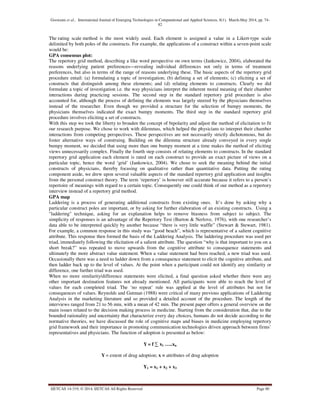
continuum to figure out the construct space (as computed in table5).
Table 5: Bipolar Construct Relationship and identified elements
Y 1 2 3 4 5 N
Construct Positive Myself GP Specialist Jr
Person
Disliked
Negative
V1 A Brand established product N N Y N N Brand not established in market
V2 B No complain with product N N Y N N Complain- as brand not equally effective
A1 C Big company / reputation Y Y N Y N Medium scaled company/reputation (1/2 brand)
A2 D Prefer to prescribe new drug Y Y N Y N Don’t prefer to prescribe new drug
A3 E Brand name stuck in mind Y Y Y Y N Failure to remember brand name
A4 F Frequent calls = brand remembrance Y Y N Y N Failure to remember brand / less calls
4 Relationship C1 G Personal interest with co. medicine N N Y N Y No Personal interest to prescribe
5 Personal confidence C2 H Risky to prescribe – product-new firm N N N N N Not risky; try it out.
Personal
Value
Elements
Bipolar Constructs- Relationship
Values 1 Product Characteristics
Attributes
2 Disposition to firms
3
Communication
Intelligence
Goswami et al., International Journal of Emerging Technologies in Computational and Applied Sciences, 8(1), March-May 2014, pp. 74-
82
IJETCAS 14-319; © 2014, IJETCAS All Rights Reserved Page 80
The rating scale method is the most widely used. Each element is assigned a value in a Likert-type scale
delimited by both poles of the constructs. For example, the applications of a construct within a seven-point scale
would be:
GPA consensus plot:
The repertory grid method, describing a like word perspective on own terms (Jankowicz, 2004), elaborated the
reasons underlying patient preferences—revealing individual differences not only in terms of treatment
preferences, but also in terms of the range of reasons underlying these. The basic aspects of the repertory grid
procedure entail: (a) formulating a topic of investigation; (b) defining a set of elements; (c) eliciting a set of
constructs that distinguish among these elements; and (d) relating elements to constructs. Clearly we did
formulate a topic of investigation i.e. the way physicians interpret the inherent moral meaning of their chamber
interactions during practicing sessions. The second step in the standard repertory grid procedure is also
accounted for, although the process of defining the elements was largely steered by the physicians themselves
instead of the researcher. Even though we provided a structure for the selection of bumpy moments, the
physicians themselves indicated the exact bumpy moments. The third step in the standard repertory grid
procedure involves eliciting a set of constructs.
With this step we took the liberty to broaden the concept of bipolarity and adjust the method of elicitation to fit
our research purpose. We chose to work with dilemmas, which helped the physicians to interpret their chamber
interactions from competing perspectives. These perspectives are not necessarily strictly dichotomous, but do
foster alternative ways of construing. Building on the dilemma structure already conveyed in every single
bumpy moment, we decided that using more than one bumpy moment at a time makes the method of eliciting
views unnecessarily complex. Finally the fourth step consists of relating elements to constructs. In the standard
repertory grid application each element is rated on each construct to provide an exact picture of views on a
particular topic, hence the word ‘grid’ (Jankowicz, 2004). We chose to seek the meaning behind the initial
constructs of physicians, thereby focusing on qualitative rather than quantitative data. Putting the rating
component aside, we drew upon several valuable aspects of the standard repertory grid application and insights
from the personal construct theory. The term ‘repertory’ is however still accurate because it refers to a person’s
repertoire of meanings with regard to a certain topic. Consequently one could think of our method as a repertory
interview instead of a repertory grid method.
GPA map
Laddering is a process of generating additional constructs from existing ones. It’s done by asking why a
particular construct poles are important, or by asking for further elaboration of an existing constructs. Using a
"laddering" technique, asking for an explanation helps to remove biasness from subject to subject. The
simplicity of responses is an advantage of the Repertory Test (Burton & Nerlove, 1976), with one researcher’s
data able to be interpreted quickly by another because “there is very little waffle” (Stewart & Stewart, 1981).
For example, a common response in this study was “good beach”, which is representative of a salient cognitive
attribute. This response then formed the basis of the Laddering Analysis. The laddering procedure was used per
triad, immediately following the elicitation of a salient attribute. The question “why is that important to you on a
short break?” was repeated to move upwards from the cognitive attribute to consequence statements and
ultimately the more abstract value statement. When a value statement had been reached, a new triad was used.
Occasionally there was a need to ladder down from a consequence statement to elicit the cognitive attribute, and
then ladder back up to the level of values. At the point when a participant could not identify any similarity or
difference, one further triad was used.
When no more similarity/difference statements were elicited, a final question asked whether there were any
other important destination features not already mentioned. All participants were able to reach the level of
values for each completed triad. The ‘no repeat’ rule was applied at the level of attributes but not for
consequences of values. Reynolds and Gutman (1988) were critical of many previous applications of Laddering
Analysis in the marketing literature and so provided a detailed account of the procedure. The length of the
interviews ranged from 21 to 56 min, with a mean of 42 min. The present paper offers a general overview on the
main issues related to the decision making process in medicine. Starting from the consideration that, due to the
bounded rationality and uncertainty that characterize every day choices, humans do not decide according to the
normative theories, we have discussed the role of cognitive maps and biases in medicine employing repertory
grid framework and their importance in promoting communication technologies driven approach between firms’
representatives and physicians. The function of adoption is presented as below:
Y= f ∑ x1 …..xn
Y = extent of drug adoption; x = attributes of drug adoption
Y1 = x1 + x2 + x3
Goswami et al., International Journal of Emerging Technologies in Computational and Applied Sciences, 8(1), March-May 2014, pp. 74-
82
IJETCAS 14-319; © 2014, IJETCAS All Rights Reserved Page 81
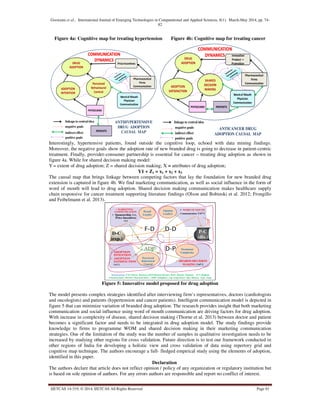
Figure 4a: Cognitive map for treating hypertension Figure 4b: Cognitive map for treating cancer
Perceived
Behavioural
Control
PriceIncentives
PHYSICIANS
PATIENTS
Pharmaceutical
Firms
Communication
Wordof Mouth
Physician
Communication
linkage to central idea
negative goals
indirect effect
positive goals
ADOPTION
INTENTION
DRUG
ADOPTION
ANTIHYPERTENSIVE
DRUG ADOPTION
CAUSAL MAP
SHARED
DECISION
MAKING
Innovation
Product +
Promotion
PHYSICIANS PATIENTS
Pharmaceutical
Firms
Communication
Wordof Mouth
Physician
Communication
linkage to central idea
negative goals
indirect effect
positive goals
ADOPTION
SATISFACTION
DRUG
ADOPTION
ANTICANCER DRUG
ADOPTION CAUSAL MAP
Interestingly, hypertensive patients, found outside the cognitive loop, echoed with data mining findings.
Moreover, the negative goals show the adoption rate of new branded drug is going to decrease in patient-centric
treatment. Finally, provider-consumer partnership is essential for cancer – treating drug adoption as shown in
figure 4a. While for shared decision making model:
Y = extent of drug adoption; Z = shared decision making; X = attributes of drug adoption;
Y1 + Z1 = x1 + x2 + x3
The causal map that brings linkage between competing factors that lay the foundation for new branded drug
extension is captured in figure 4b. We find marketing communication, as well as social influence in the form of
word of mouth will lead to drug adoption. Shared decision making communication makes healthcare supply
chain responsive for cancer treatment supporting literature findings (Olson and Bobinski et al. 2012; Frongillo
and Feibelmann et al. 2013).
• SHARED DECISION
MAKING (+/-)
• ADOPTION
INTENTION
• ADOPTION
SATISFACTION
(+/-)
• WORD OF MOUTH
Communication (+/-)
• MARKETING
COMMUNICATION
• Sponsorship (+),
Price Incentives
(+)
F-D D-D
D-PADP
Relationship: F-D =Firm- Doctors; D-D=Doctor-Doctor; D-P= Doctor- Patient; P-C=Patient
Characteristic; Doctor Characteristics ; ADP=Adoption; exp.=experience ;dis.=disease type, stage
P-C
(dis.)
D-C
(exp.)
Brand
Loyalty
Treatment
Complexity
Opinion
Leaders
Perceived
Behavioral
Control
Figure 5: Innovative model proposed for drug adoption
The model presents complex strategies identified after interviewing firm’s representatives, doctors (cardiologists
and oncologists) and patients (hypertension and cancer patients). Intelligent communication model is depicted in
figure 5 that can minimize variation of branded drug adoption. The research provides insight that both marketing
communication and social influence using word of mouth communication are driving factors for drug adoption.
With increase in complexity of disease, shared decision making (Thorne et al. 2013) between doctor and patient
becomes a significant factor and needs to be integrated in drug adoption model. The study findings provide
knowledge to firms to programme WOM and shared decision making in their marketing communication
strategies. One of the limitation of the study was the number of samples in qualitative investigation needs to be
increased by studying other regions for cross validation. Future direction is to test our framework conducted in
other regions of India for developing a holistic view and cross validation of data using repertory grid and
cognitive map technique. The authors encourage a full- fledged empirical study using the elements of adoption,
identified in this paper.
Declaration
The authors declare that article does not reflect opinion / policy of any organization or regulatory institution but
is based on sole opinion of authors. For any errors authors are responsible and report no conflict of interest.
Goswami et al., International Journal of Emerging Technologies in Computational and Applied Sciences, 8(1), March-May 2014, pp. 74-
82
IJETCAS 14-319; © 2014, IJETCAS All Rights Reserved Page 82
Acknowledgement
The authors acknowledge constructive feedback from Professor G. C. Saha at the Centre for Business Analytics
and Intelligence, Arthur Lok Jack Graduate School of Business, University of West Indies. The authors thank
the hospital staffs and physicians for their valuable time during various phases of investigation.
References
[1]. Raveendra Chittoor, Sougata Ray. Internationalization paths of Indian pharmaceutical firms — A strategic group analysis.
Journal of International Management 13, 2007, 338–355.
[2]. S.V. Ramani, Who is interested in biotech? R&D strategies, knowledge base and market sales of Indian biopharmaceutical firms,
Res. Policy 31, 2002, 381–398.
[3]. George T. Haley, Usha C.V. Haley. The effects of patent-law changes on innovation: The case of India's pharmaceutical
industry. Technological Forecasting and Social Change 79, 2011, 607–619.
[4]. Alessandra Gorini, Gabriella Pravettoni. An overview on cognitive aspects implicated in medical decisions. European Journal of
Internal Medicine 22, 2011, 547–553.
[5]. Lois Phillips-Pula, Julie Strunk, MS, and Rita H. Pickler, Understanding Phenomenological Approaches to Data Analysis, J
Pediatr. Health Care. 25, 2011, 67-71.
[6]. Husserl, E. Logical investigations, volume 1 (D. Carr, Trans.). New York, NY: Humanities Press. 1970.
[7]. Moustakas, C. Phenomenological research methods. Thousand Oaks, CA: Sage. 1994.
[8]. Douglas, B. G., & Moustakas, C. Heuristic inquiry: The internal search to know. Journal of Humanistic Psychology, 25, 39,
1985, 39-55.
[9]. Alejandro Pen˜a, Humberto Sossa, Agustı´n Gutie´rrez: Causal knowledge and reasoning by cognitive maps: Pursuing a holistic
approach, Expert Systems with Applications 35, 2008, 2–18.
[10]. Kee-Young Kwahk, Young-Gul Kim, Supporting business process redesign using cognitive maps, Decision Support Systems, 25,
1999, 155–178.
[11]. Heejung Lee , Soon Jae Kwon , Ontological semantic inference based on cognitive map, Expert Systems with Applications 41
(2014) 2981–2988.
[12]. Ramdas Chandra, William Newburry. A cognitive map of international business field , International Business Review, 6,4 387-
410, 1997.
[13]. Shieh-Liang Chen , Hao-An Liang , Cause mapping of simple and complex marketing strategies, Journal of Business Research
67, 2014, 2867–2876
[14]. Colin Eden, Decision Aiding Analyzing cognitive maps to help structure issues or problems, European Journal of Operational
Research 159, 2004, 673–686.
[15]. Inwon Kang , Kun Chang Lee, Sangjae Lee , Jiho Choi. Investigation of online community voluntary behavior using cognitive
map, Computers in Human Behavior 23, 2007, 111–126
[16]. T. Comes, M. Hiete, N. Wijngaards, F. Schultmann, Decision maps: A framework for multi-criteria decision support under
severe uncertainty. Decision Support Systems 52, 2011, 108–118.
[17]. Mark Easterby-Smith, The design, analysis and interpretation of repertory grids, Int. J. Man-Machine Studies (1980) 13, 3-24.
[18]. Melanie Mireaux, David N. Cox , Amy Cotton, Greg Evans. An adaptation of repertory grid methodology to evaluate Australian
consumers’ perceptions of food products produced by novel technologies. Food Quality and Preference 18, 2007, 834–848.
[19]. Helen M. Edwards, Sharon McDonald, S. Michelle Young, The repertory grid technique: Its place in empirical software
engineering research, Information and Software Technology 51, 2009, 785–798.
[20]. Carlos A. van Kan, Petra Ponte, Nico Verloop . How to conduct research on the inherent moral significance of teaching: A
phenomenological elaboration of the standard repertory grid application. Teaching and Teacher Education 26, 2010, 1553-1562.
[21]. Po-Han Wu, Gwo-Jen Hwang, Chin-Chung Tsai , Ya-Chun Chen , Yueh-Min Huang. A pilot study on conducting mobile
learning activities for clinical nursing courses based on the repertory grid approach. Nurse Education Today 31 (2011) e8–e15.
[22]. Sheila Simsarian Webber. Dual organizational identification impacting client satisfaction and word of mouth loyalty. Journal of
Business Research 64, 2011, 119–125.
[23]. Luliana-Raluca Gheorghe, Mei-Na Liao: Investigating Romanian healthcare consumer behaviour in online communities:
Qualitative research on negative eWOM. Procedia - Social and Behavioral Sciences 62, 2012, 268 – 274.
[24]. Kyung-Tag Lee, Dong-Mo Koo. Effects of attribute and valence of e-WOM on message adoption: Moderating roles of subjective
knowledge and regulatory focus. Computers in Human Behavior 28, 2012, 1974–1984.
[25]. Tulikaa Bhatia, Lei Wan. Identifying physician peer-to-peer effects using patient movement data. Intern. J. of Research in
Marketing 28, 2011, 51–61.
[26]. Stephen X. He, Samuel D. Bond. Word-of-mouth and the forecasting of consumption enjoyment. Journal of Consumer
Psychology 23, 4, 2013, 464–482.
[27]. Jacoba P. Greving, Petra Denig, Willem Jan van der Veenb, Frank W. Beltmanb, Miriam C.J.M. Sturkenboomc, Flora M.
Haaijer-Ruskampa. Determinants for the adoption of angiotensin II receptor blockers by general practitioners. Social Science &
Medicine 63, 2006, 2890–2898.
[28]. Sally Thorne, John L. Oliffe, Kelli I. Stajduhar. Communicating shared decision-making: Cancer patient perspectives, Patient
Education and Counseling 90, 2013, 291–296.
[29]. Robert A. Olson, Mary Ann Bobinski, Anita Ho, Karen J. Goddard. Oncologists’ view of informed consent and shared decision
making in paediatric radiation oncology. Radiotherapy and Oncology 102, 2012, 210–213.
[30]. Marissa Frongillo, Sandra Feibelmann, Jeff Belkora, Clara Lee, Karen Sepuch, Is there shared decision making when the
provider makes a recommendation? Patient Education and Counseling, 90, 2013, 69–73.
[31]. Jayanthi Ranjan, Data mining in pharma sector: benefits, International Journal of Health Care Quality Assurance Vol. 22 No. 1,
2009, pp. 82-92.
[32]. Lavrac, N., Bohanec, M., Pur, A., Cestnik, B., Debeljak, M. and Kobler, A. Data mining and visualization for decision support
and modeling of public health-care resources. Journal of Biomedical Informatics, 40, 2007, 438-447.
[33]. Hwang, H.G., Chang, I.C., Chen, F.J. and Wu, S.Y. Investigation of the application of KMS for diseases classifications: A study
in a Taiwanese hospital. Expert Systems with Applications, 34 (1), 2008, 725-733.
[34]. Antonelli D, Baralis E , Bruno G , Cerquitelli T, Chiusano S, Mahoto N. Analysis of diabetic patients through their examination
history. Expert Systems with Applications 40, 2013, 4672–4678.
[35]. Lee TT, Liu CY, Kuo YH, Mills ME, Fong JG, Hung C. Application of data mining to the identification of critical factors in
patient falls using a web-based reporting system. International Journal of Medical Informatics, 80, 2, 2011, 141-150.

Ijetcas14 319

  • 1.
    International Association ofScientific Innovation (An Association Unifying the Sciences, Engineering, and Applied Research) International Journal of Emerging Technologies in Computational and Applied Sciences IJETCAS 14-319; © 2014, IJETCAS All Rights Reserved Identifying Communication Intell 1 D. 1 Ranbaxy Research Laboratories, 2 Management Development Institute, 3 Institute of Technology Management _______________________________________________________________________________________ Abstract: Most of the researches on drug adoption concentrat development and diffusion. Very little research considers on understanding of intention of drug usage through physician-patient interactions. This research investigates link between drug adoption and drug usage intention through communication intensity of physicians and patients within their d conceptual framework supports communication of disease and patients’ lifestyle), physicians’ self offered by pharmaceutical firms. An unstructured repertory grid survey structured retrospective survey with two thousand patients (NCR) were conducted to show the effects used to analyse the data. The results show adoption for challenging disease also improves of-mouth communication operate through the Keywords: Pharmaceutical branded drugs; communication strategies; intelligent framework; drug adoption __________________________________________________________________________________________ Increasing R&D expenditure and strategic collaborations with international manufacturers in pharmaceutical industry in India in recent years indicate a high-value branded drugs (Porter and Lee 2013) branded drugs is not very significant in the country to explain the drug adoption level has primarily focused on the socio (Rogers RG, Hummer RA et al. 2000; Goldman Dana and Smith James P. 2002), while overlooking the development of communication infrastructure (Denig and Petra et al. 2007). Examining behavioural intentions of physicians communication intelligence address the challenges 2012). This study addresses the limitation patient, doctors and firm has not been optimized in Theories related to branded drug adoption recognize the multiple stakeholders. For example, modern social capital theory accrues to firms’ engagement in social relationships with influential stakeholders to gain access to theory explores the role of communication them about the usefulness of a new product relationship between communication and new product adoption in research on strategic communication network formation in The present study uses data mining technique to check if there is any patient related influence in ARB branded extension adoption. Secondly, the study shows how with increased complexity of diseases, communication intelligence is required to support new brand acceptance. For the first ti and cognitive map can be used to explain the findings of data mining technique provides opportunity to identify factors for drug adoption emergent market as well. The remainder of this paper is organized as follows. Following this introduction, the next section of this paper presents literature review, methodology empirical results and discussion and future directions. Indian pharmaceutical firms are now potentially challenge even multinational compan Indian pharmaceutical industry is a destinat skilled task force, cheap labour and state of fragmented with over 23,000 companies ( ten largest Indian pharmaceutical companies International Association of Scientific Innovation and Research (IASIR) (An Association Unifying the Sciences, Engineering, and Applied Research) ournal of Emerging Technologies in Computational and Applied Sciences (IJETCAS) www.iasir.net , IJETCAS All Rights Reserved ISSN (Print): 2279 ISSN (Online): 2279 Identifying Communication Intelligence for Drug Adoption in India Goswami*, 2 N. Jain, 3 D. R. Agarwal Ranbaxy Research Laboratories, Gurgaon, India Management Development Institute, Gurgaon, India of Technology Management University, Gurgaon, India _______________________________________________________________________________________ on drug adoption concentrate on suppliers’ environment of new drug research considers on understanding of intention of drug usage through patient interactions. This research investigates link between drug adoption and drug usage intention through communication intensity of physicians and patients within their drug usage relationships in India. A communication strategies to be developed based on disease complexities (type of disease and patients’ lifestyle), physicians’ self-confidence in the drug effectiveness and marketing incentiv . An unstructured repertory grid survey involving fifteen physicians and a two thousand patients at hospitals located in National Capital Region effects of firms’ communication for drug usage. Data mining show with increased marketing and word-of-mouth communication drug also improves. An implication for managers is that both marketing and word mouth communication operate through the firm’s communication programming. Pharmaceutical branded drugs; communication strategies; intelligent framework; drug adoption __________________________________________________________________________________________ I. Introduction Increasing R&D expenditure and strategic collaborations with international manufacturers in pharmaceutical industry in India in recent years indicate a shifting emphasis of the industry from high-volume generic drugs to (Porter and Lee 2013). However, despite these efforts, the rate of increase of sales of drugs is not very significant in the country (Dadhich and Upadhyay, 2011). Previous research seeking to explain the drug adoption level has primarily focused on the socio-economic conditions of the patients 2000; Goldman Dana and Smith James P. 2002), while overlooking the infrastructure, in determining branded drug adoption for treating hypertension Examining behavioural intentions of physicians linking communication intelligence address the challenges that branded drug adoption face (Gonul and Carter et al. limitation in healthcare supply chain where relationship among stakeholders i.e. has not been optimized in an emergent market like India. adoption recognize the importance of relationship and communication among multiple stakeholders. For example, modern social capital theory accrues to firms’ engagement in social relationships with influential stakeholders to gain access to needed resources (Lin 2001). Information diffusion theory explores the role of communication technologies to create awareness among the adopters and to persuade them about the usefulness of a new product (Roger, 1995). Although literature abounds examining relationship between communication and new product adoption in healthcare (Ranjan, 2009), there is paucity of network formation in Indian medical community for treating hypertension ng technique to check if there is any patient related influence in ARB branded the study shows how with increased complexity of diseases, communication intelligence is required to support new brand acceptance. For the first time, the study shows how and cognitive map can be used to explain the findings of data mining technique. The mixed mode research provides opportunity to identify factors for drug adoption in developing a framework that can be used in other The remainder of this paper is organized as follows. Following this introduction, the presents literature review, methodology empirical results and discussion and future II. Literature Review now emerging as third-world multinationals with capabilities that could multinational companies (MNCs) from the developed world (Chittoor Indian pharmaceutical industry is a destination for top tiered pharmaceutical MNCs of the world due to highly skilled task force, cheap labour and state of the art facilities. However, Indian pharmaceutical industry remains d with over 23,000 companies (Ramani 2012). Concentration occurs at the top-end of the industry: the largest Indian pharmaceutical companies, with international marketing presence, control 36% of the market ournal of Emerging Technologies in Computational Page 74 ISSN (Print): 2279-0047 ISSN (Online): 2279-0055 igence for Drug Adoption in India _______________________________________________________________________________________ on suppliers’ environment of new drug research considers on understanding of intention of drug usage through patient interactions. This research investigates link between drug adoption and drug usage intention rug usage relationships in India. A based on disease complexities (type confidence in the drug effectiveness and marketing incentives fifteen physicians and a National Capital Region ata mining technique is mouth communication drug oth marketing and word- Pharmaceutical branded drugs; communication strategies; intelligent framework; drug adoption __________________________________________________________________________________________ Increasing R&D expenditure and strategic collaborations with international manufacturers in pharmaceutical volume generic drugs to ts, the rate of increase of sales of Previous research seeking economic conditions of the patients 2000; Goldman Dana and Smith James P. 2002), while overlooking the for treating hypertension cognition with Gonul and Carter et al. in healthcare supply chain where relationship among stakeholders i.e. importance of relationship and communication among multiple stakeholders. For example, modern social capital theory accrues to firms’ engagement in social (Lin 2001). Information diffusion to create awareness among the adopters and to persuade abounds examining the , there is paucity of for treating hypertension. ng technique to check if there is any patient related influence in ARB branded the study shows how with increased complexity of diseases, communication w reparatory grid The mixed mode research developing a framework that can be used in other The remainder of this paper is organized as follows. Following this introduction, the presents literature review, methodology empirical results and discussion and future world multinationals with capabilities that could Chittoor and Ray 2007). ion for top tiered pharmaceutical MNCs of the world due to highly Indian pharmaceutical industry remains end of the industry: the control 36% of the market
  • 2.
    Goswami et al.,International Journal of Emerging Technologies in Computational and Applied Sciences, 8(1), March-May 2014, pp. 74- 82 IJETCAS 14-319; © 2014, IJETCAS All Rights Reserved Page 75 (Haley et al. 2012). Due to highly competitive market, success of internationalized pharmaceutical firms in branded medicine segment is highly uncertain due to lack of intelligent communication practices or cognitive conflicts among decision makers for new prescriptions. Gorini et al. (2011) also supported the theory that human cognitive abilities are limited and cannot consider all the information available. One of the popular qualitative approach, phenomological methods (Husserl, 1970; Moustakas, 1994), instrumental in dealing with confounding issues can be applied for an inquiry on physician’s intention for drug adoption for both simple (for example treating hypertension) and complex diseases (like cancer). This paper continues with a presentation of the variety of qualitative analysis techniques, focusing on communication intensity of physicians and patients within their drug usage relationships. To have insight on huge patient data in hospital repository, data mining techniques, as summarized in table 1, is applied to model large amount of data summarizing it into useful information or knowledge (Romero C. et al., 2008). Nowadays, large amount of medical data / patient history is collected by health care organizations but lack intelligent tool (Kaur and Wasan 2006) for developing a decision model for their physicians. Table1. Data Mining (DM) approaches in healthcare industry Researchers Knowledge Resources Knowledge Types DM Tasks DM Applications Jayanthi (2009) Healthcare- Conceptual paper Pharmaceutical industry Clustering; Association; Classification and prediction Drug Development, Discovery, Clinical trials Lavrac et al. (2007) Healthcare-Research paper Health-care providers database; The out- patient database and medical status database Classification ; Clustering Clustering Methods: Agglomerative; Classification; Hwang et al. (2008) Healthcare-Research paper Knowledge Measurement Conversion and Transfer Knowledge Dependency Modeling Sequential pattern Analysis Antonelli et al. (2013) Healthcare-Research paper out-patient + medical status ; Data analysis framework Disease Management; Clustering Multiple-level clustering; DBSCAN algorithm Abdullah A. et al. (2013) Healthcare-Research paper Diabetic treatment ; predicting mode in different age group Treatment management; Regression model; Oracle data Miner Support vector machine Ting-Ting Lee et al. (2011) Healthcare-Research paper Hospital Information system; Clinical data modeling Disease management; Artificial neural network and Regression Analysis SPSS for stepwise logistic regression; Statistica 8.0 for Artificial Neural network The social influence in form of positive word of mouth (WOM) communication intensifies physician –physician interaction (Tulikaa, 2011; Lee and Koo 2012) supporting consumer satisfaction i.e. adoption (Webber 2011; He and Bond 2013) while when negative WOM transactions happen (Gheorghe and Liao 2012) rejection or brand switches is cognitive outcome. This study using principles of attitude model (Ajzen 1991) focuses to analyze consumer / adoptee’s characteristic (Ronteltap et al. 2007) necessitating a communication infrastructure for success of new brand marketing in hypertension and cancer disease segment. III. Approach / Research Design Researcher used repertory grid and cognitive maps to provide solution to the complexity of diverse issues of decision making as summarized in table 2. Table 2: Application of cognitive map and repertory grids in qualitative research methodology Sr. No. Models in Healthcare Methodology Application Year, Ref 1 Cognitive Map Bipolar construct; fuzzy estimation Decision –support 2008;(6) 2 Cognitive Map Conflict path; feedback loop Business -process redesign 1999; (7) 3 Cognitive map cognitive map and semantic influence Political Environment 2014; (8) 4 Cognitive map Venn Diagram; Dimension classification Chronological development International Business 1997; (9) 5 Mental model Triangulation of method- using variance theory, process theory Business to Business decision making 2014, (10) 6 Cognitive map Hierarchical clusters Group-Decision Support System 2004 (11) 7 Cognitive Map adjacent matrix , inference process Online community voluntary behaviour 2007 (12) 8 Causal Map Multi-Criteria Decision; Analysis techniques Decision Support 2011 (13) 9 Repertory Grid Computer based and Paper based Interpretation and analysis 1980 (14)
  • 3.
    Goswami et al.,International Journal of Emerging Technologies in Computational and Applied Sciences, 8(1), March-May 2014, pp. 74- 82 IJETCAS 14-319; © 2014, IJETCAS All Rights Reserved Page 76 10 Repertory Grid Content and structure of construct Interpersonal skill of nurses 1989 (15) 11 Repertory Grid focus group; generalized Procrustes analysis food product technologies 2007 (16) 12 Repertory Grid Analysis , Validity Reliability interpretive; software engineering 2009 (17) 14 Repertory Grid Content Analysis, generalized procrustes analysis tourist food consumption 2013 (18) 15 Repertory Grid Systems Thinking Hierarchy (STH)-model- Repertory Grid Maps Student's thinking ; Ecological complexity 2014 (19) 16 Repertory Grid Positive and negative syndrome scale Cognitive therapy model 2014 (20) 17 Repertory Grid Likert scale Questionnaire Clinical Mobile Learning System 2011 (21) Implementing knowledge management framework, data mining is applied first on patient’s data to check if medical decisions for simple disease like hypertension management is dependent on doctor-patient shared decision making. Further, using focus group interview, employing repertory grid technique, causal map is constructed to show how with increase in disease complexity scope of shared decision making increases. A. Data mining method and its applications The research objective has been targeted to propose a patient- centric medical solution for Indian healthcare settings using knowledge mining (Jiawei H. and Kamber M. 2000) technique. Fayyad et.al. (1996) define six main functions of data mining: 1. Classification is finding models that analyze and classify a data item into several predefined classes 2. Regression is mapping a data item to a real-valued prediction variable 3. Clustering is identifying a finite set of categories or clusters to describe the data 4. Dependency Modeling (Association Rule Learning) is finding a model which describes significant dependencies between variables 5. Deviation Detection (Anomaly Detection) is discovering the most significant changes in the data 6. Summarization is finding a compact description for a subset of data The integration of information and communication intelligence in healthcare practice will support physicians’ medical decision making (Lupiáñez-Villanuevaa et al. 2010). The exploratory research study is designed based on convenience sampling method. It is a non-probability sampling technique where subjects are selected because of their convenient accessibility and proximity to the researcher. Since physicians are easily available in hospitals, clinic or dispensaries with prior appointment survey can be conducted with ease. Therefore we preferred convenient sampling technique because it is fast, inexpensive, easy and the subjects are readily available. Seven years after Greving and Petitt et al. (2007) article however, there is still scant attention being paid to this critical aspect of drug adoption scale development using physician–patient communication relationship. The problem is further compounded when confounding issues persists while studying emerging market like India. The importance of shared decision making to increase cancer treatment efficiency has been identified in recent past (Olson and Bobinski et al. 2012; Frongillo and Feibelmann et al. 2013; Thorne and Oliffe et al. 2013). Therefore studying the communication dynamics employing causal maps, to have insight on provider-consumer partnership thereby improving cancer treating drug adoption, becomes imperative. The patient characteristic was evaluated by data mining (Lee et al. 2011). In this paper, the application of data mining technique is discussed such as Classification, Association Analysis and Outlier Analysis in healthcare. IV. Methodology and Data Collection Data Modeling technologies and applications Data mining has two primary objectives of prediction and description. Prediction involves using some variables in data sets in order to predict unknown values of other relevant variables (e.g. classification, regression, and anomaly detection). Description involves finding human understandable patterns and trends in the data (e.g. clustering, association rule learning, and summarization) as noted in earlier research summarized in table 7. Methodology for data mining Association analysis Association analysis is the discovery of association rules showing attribute-value conditions that occur frequently together in a given set of data. Association analysis is widely used for market basket or transaction data analysis. The methodology for association rule is described briefly. More formally, association rules are of the form X => Y, i.e., “A1 ^ _ _ _^Am B1 ^ _ _ _^ Bn", where Ai (for i to m) and Bj (j to n) are attribute-value pairs. The association rule X=>Y is interpreted as database tuples that satisfy the conditions in X are also likely to satisfy the conditions in Y "(Jiawei H. and Kamber M. 2000). In the health care system it can be applied as follows:- (Symptoms) (Previous--- history) ------- > (Cause—of--- disease) Rule Induction Method has the potential to use retrieved cases for predictions and can be used to predict the significant characteristic from a large set of population under study. The following example will predict whether the person is hypertensive based on the data taken from Table 3.
  • 4.
    Goswami et al.,International Journal of Emerging Technologies in Computational and Applied Sciences, 8(1), March-May 2014, pp. 74- 82 IJETCAS 14-319; © 2014, IJETCAS All Rights Reserved Page 77 Table 3. The attributes which can cause hypertension Age Gender Alcoholic Smoker Hypertensive 60 M Y Y Y 75 M Y Y Y 40 M N Y Y 40 F Y Y Y 56 F N N N 34 M Y Y Y 45 M N Y Y The association rules that can be generated and we can predict whether the patient is hypertensive or not depending on whether he is a smoker, an alcoholic or both. The support factor of the association rule shows that 1% of the persons are “alcoholic” and “smoker” is suffering from hypertension and confidence factor shows that there is a chance that 50% of the persons who are “alcoholic” and “smoker” can suffer from hypertension. Classification Classification is the process of finding a set of models (or functions) which describe and distinguish data classes or concepts, for the purposes of being able to use the model to predict the class of objects whose class label is unknown. The derived model may be represented in various forms, such as classification (IF-THEN) rules, decision trees, mathematical formulae, or neural networks. Classification can be used for predicting the class label of data objects. Given below is an example where we can apply the Classification Technique to predict whether the patient with the given symptoms will suffer from a particular disease or not. This data mining technology has currently presented a platform for consultant physician to use computer based prescription support system and survey report reveal that many young physicians are also comfortable with use. There exist many possible models for classification, which can be expressed as rules, decision trees. Once the model is built, unknown data can be classified. In order to test the quality of the model its accuracy can be tested by using a test set. If a certain set of data is available for building a classifier, normally one splits this set into a larger set, which is the training set, and a smaller set which is the test set. Given below is diagrammatic representation of usage of classifier to predict the category of a person with the symptoms obtained from the dataset (Figure3). Figure 3: Usage of Classifier to predict the category of a person using the symptoms from the dataset Age Gender Alcoholic Smoker Hypertensive (goal) 60 M Y Y Y 75 M Y Y Y 40 M N Y Y 40 F Y Y Y 56 F N N N 34 M Y Y Y 45 M N Y Y Classification by Decision Tree Induction Decision tree can be used to classify an unknown class data instance. The idea is to push the instance down the tree, following the branches whose attributes values match the instances attribute values, until the instance reaches a leaf node, whose class label is then assigned to the instance. For example, the data instance to be classified is described by the tuple (Age=67, Gender=female, Alcoholic =”n”, Smoker=”y”, Goal =?), where “?” denotes the unknown value of the goal instance. In this example, Gender and Age attributes are irrelevant to a particular classification task. The tree tests whether the person is alcoholic / smoker (depicted in figure 4). Predictor Unseen data (65, “M”, “Y”, “Y”?) Hypertensive =”Y” Classifier
  • 5.
    Goswami et al.,International Journal of Emerging Technologies in Co IJETCAS 14-319; © 2014, IJETCAS All Rights Reserved Figure 4 The decision tree shown above is generated from a very small corresponds to a patient record. We will refer to a row as a data instance. The data set contains three predictor attributes, age, gender, person is alcoholic, person is smoker and one goal values (to be predicted from symptoms) indicate whether the corresp Extracting rules from decision tree:- Rules of the form of IF-THEN can be extracted from the decision tree which is easier to underst IF conditions THEN conclusion This kind of rule consists of two parts. The rule antecedent (the IF part) contains one or more conditions about value of predictor attributes where as the rule consequent (THEN part) contains a prediction about the valu goal attribute. An accurate prediction of the value of a goal attribute will improve decision THEN prediction rules are very popular in data mining; they represent discovered knowledge at a high level of abstraction (Kaur H. and Wasan S.K. 2006). IF Alcoholic=”Y” THEN Hypertensive IF Smoker=”Y” THEN Hypertensive=”Y” IF Alcoholic=”Y” and Smoker=”Y” THEN Hypertensive Outlier Analysis The data stored in a database may reflect outliers objects may confuse the analysis process, causing over fitting of the data to the knowledge model constructed. As a result, the accuracy of the discovered patterns can be poor. One healthcare can be to predict the abnormal values in the medical diagnosis of the Table 4 Age 60 75 40 40 56 34 75 The Outlier Analysis in this case will detect the highlighted value as an exceptional case as a person who is 75 years, alcoholic and a smoker is not hypertensive these physicians prescribe can be modulated /computed using association rule of data mining technique. The role of medical informatics results in data reduction and provides insight how patient demographic va influences drug adoption by physicians. region. Data mining analysis with patient records software. The significant pattern for new branded drug prescription could not be characteristics. Method for obtaining elements Stephens and Gammack (1994, p.176) argued in connection with this: ‘When elements are provided by an experimenter, this can compromise subjects’ freedom to choose elements meaningful to themselves and requires the experimenter to assume that a subject’s construal of the elements is in some way compatible with the rationale for the choice of elements themselves.’ Consequently, our first desi be allowed to be actively involved in the process of selecting elements. Representation of elements In the standard repertory grid application, elements are mostly represented by visual abstractions or general descriptions created solely by the researcher. Traditional elements are often generalizations of a specific aspect of the problem that is under investigation. representing a variety of phrases which in turn repre sorts of generic elements might compromise the elicitation of personal meanings that are connected to ournal of Emerging Technologies in Computational and Applied Sciences, 8(1), March 82 , IJETCAS All Rights Reserved Figure 4: Decision Tree generated from table3 The decision tree shown above is generated from a very small training set (table3). In this table each row corresponds to a patient record. We will refer to a row as a data instance. The data set contains three predictor attributes, age, gender, person is alcoholic, person is smoker and one goal attribute, namely hypertensive values (to be predicted from symptoms) indicate whether the corresponding patient is hypertensive THEN can be extracted from the decision tree which is easier to understand. This kind of rule consists of two parts. The rule antecedent (the IF part) contains one or more conditions about value of predictor attributes where as the rule consequent (THEN part) contains a prediction about the valu goal attribute. An accurate prediction of the value of a goal attribute will improve decision-making process. IF THEN prediction rules are very popular in data mining; they represent discovered knowledge at a high level of asan S.K. 2006). In the health care system it can be applied as follows: lcoholic=”Y” THEN Hypertensive=”Y” =”Y” d Smoker=”Y” THEN Hypertensive =”Y” eflect outliers-noise, exceptional cases, or incomplete data objects. These objects may confuse the analysis process, causing over fitting of the data to the knowledge model constructed. As a result, the accuracy of the discovered patterns can be poor. One of the applications of outlier analysis in healthcare can be to predict the abnormal values in the medical diagnosis of the patient (as presented in table 4 4. The dataset used for Outlier Analysis Sex Alcoholic Smoker Hypertensive M Y Y Y M Y Y Y M N Y Y F Y Y Y F N N N M Y Y Y M N N N The Outlier Analysis in this case will detect the highlighted value as an exceptional case as a person who is 75 hypertensive. Thus by using data mining technique large set of patient that these physicians prescribe can be modulated /computed using association rule of data mining technique. The role of medical informatics results in data reduction and provides insight how patient demographic va influences drug adoption by physicians. Our study involved 2000 patient data from private hospitals from NCR with patient records / prescriptions transacted is carried out using TANAGRA for new branded drug prescription could not be inferred using patient Stephens and Gammack (1994, p.176) argued in connection with this: ‘When elements are provided by an bjects’ freedom to choose elements meaningful to themselves and requires the experimenter to assume that a subject’s construal of the elements is in some way compatible with the rationale for the choice of elements themselves.’ Consequently, our first desideratum was that physician should be allowed to be actively involved in the process of selecting elements. In the standard repertory grid application, elements are mostly represented by visual abstractions or general created solely by the researcher. Traditional elements are often generalizations of a specific aspect of the problem that is under investigation. An example of such general elements could be pictograms representing a variety of phrases which in turn represent different kinds of firms. A point of concern is that these sorts of generic elements might compromise the elicitation of personal meanings that are connected to March-May 2014, pp. 74- Page 78 ). In this table each row corresponds to a patient record. We will refer to a row as a data instance. The data set contains three predictor pertensive whose ypertensive or not. and. This kind of rule consists of two parts. The rule antecedent (the IF part) contains one or more conditions about value of predictor attributes where as the rule consequent (THEN part) contains a prediction about the value of a making process. IF- THEN prediction rules are very popular in data mining; they represent discovered knowledge at a high level of In the health care system it can be applied as follows:- noise, exceptional cases, or incomplete data objects. These objects may confuse the analysis process, causing over fitting of the data to the knowledge model constructed. of the applications of outlier analysis in patient (as presented in table 4). The Outlier Analysis in this case will detect the highlighted value as an exceptional case as a person who is 75 data mining technique large set of patient that these physicians prescribe can be modulated /computed using association rule of data mining technique. The role of medical informatics results in data reduction and provides insight how patient demographic variables Our study involved 2000 patient data from private hospitals from NCR is carried out using TANAGRA inferred using patient Stephens and Gammack (1994, p.176) argued in connection with this: ‘When elements are provided by an bjects’ freedom to choose elements meaningful to themselves and requires the experimenter to assume that a subject’s construal of the elements is in some way compatible with the deratum was that physician should In the standard repertory grid application, elements are mostly represented by visual abstractions or general created solely by the researcher. Traditional elements are often generalizations of a specific aspect An example of such general elements could be pictograms sent different kinds of firms. A point of concern is that these sorts of generic elements might compromise the elicitation of personal meanings that are connected to
  • 6.
    Goswami et al.,International Journal of Emerging Technologies in Computational and Applied Sciences, 8(1), March-May 2014, pp. 74- 82 IJETCAS 14-319; © 2014, IJETCAS All Rights Reserved Page 79 physicians’ own practices. Our goal was to obtain elements that could be considered authentic slices from physicians’ life worlds. Accordingly, our second desideratum was that the elements were created in a spirit of cooperation and were authentic representations of physicians’ day-to-day practicing practices in parallel to teaching perspective (Carlos A. van Kan et al 2010). Standard method of eliciting constructs The standard process of eliciting constructs from elements is known as the triadic method. The normal elicitation phrase would have the following structure: In what ways are the two elements (for example pupils) same and different from a third in terms of the particular topic under investigation (for example in terms of their potential). This triadic method is administered in order to capture the bipolarity of the construct. Because we wanted to work with embodied and contextualized elements (i.e. interactions in classroom situations), we considered this triadic method to be too complex. The issue of complexity overload, although mostly ascribed to the capabilities of the subject rather than the elements themselves, has been encountered in earlier research (Barton, Walton and Rowe, 1976). Our third desideratum, therefore, was that constructs were elicited using a simple method that has discriminating qualities. Bipolarity of constructs In the standard repertory grid procedure, the bipolarity of constructs has often been equated with constructs having to have a strictly dichotomous character (Millis, Neimeyer and Riemann, 1990), presenting clear-cut contrasting or opposite poles. In addition, most constructs in these studies have been evaluative, having a preferable and less preferable pole. Strictly dichotomous constructs, however, run the risk of reducing the complexity of the topic under investigation into unrefined black and white categories (Bonarius et al., 1984). More commonly, however, a structured interview is used involving client-therapist interaction. For this reason, it is important to encourage a relaxed atmosphere (for example cafeteria) where clients can express themselves without feeling judged. This interaction reveals interviewers' attitudes and indicates whether a genuine respect for the interviewee's own constructs exists. When carrying out the interview, the investigator must consider the phenomenological slant of the repertory grid method, whose goal is to obtain a clear representation of the interviewee's construction processes. Physicians were selected from NCR hospital for repertory grid scaled interview. Reason being the physicians attached with private hospitals, do practice singly or in clinic with multi-disciplinary physicians visiting and hence are in touch with pharmaceutical companies through medical representatives. Fifteen MD doctors were chosen of which one is a lady gynecologist with 40 years of experience. Rest four participants were male with 5 to 20 years of practicing experience. These physicians were briefed initially that purpose of the interview – to understand the motive / impetus of selection of pharmaceutical companies while prescribing their medicines. V. Results and discussion Data Analysis Coding of doctor’s constructs for medicine preferences from different pharmaceutical firms For data analysis, constructs were listed for each physician’s interview. The reasons identified were unipolar, often simply descriptive of perceived quality characteristics /confidence achieved, and described using similar terms across subjects wherever possible. That is, although constructs were usually identified using the specific language of subjects, it was found that physician respondents frequently identified similar constructs even though slightly different wording was used. For example, they invariably described the ‘new company/product’ option as ‘risky’, ‘not an option’, ‘least confidence’, a ‘no brainer (i.e. not keeping in memory)’, and when asked to elaborate they would invariably attempt to get across the idea that ‘F or G (small scale industry/new entrant)’ was simply not a viable alternative because it had no previous track record in market. It was therefore decided to use the term ‘risky / null’ to describe this construct, and this label was then used in the subsequent questionnaires of all physicians who attempted to express this view. The identified bipolar opposites are continuum to figure out the construct space (as computed in table5). Table 5: Bipolar Construct Relationship and identified elements Y 1 2 3 4 5 N Construct Positive Myself GP Specialist Jr Person Disliked Negative V1 A Brand established product N N Y N N Brand not established in market V2 B No complain with product N N Y N N Complain- as brand not equally effective A1 C Big company / reputation Y Y N Y N Medium scaled company/reputation (1/2 brand) A2 D Prefer to prescribe new drug Y Y N Y N Don’t prefer to prescribe new drug A3 E Brand name stuck in mind Y Y Y Y N Failure to remember brand name A4 F Frequent calls = brand remembrance Y Y N Y N Failure to remember brand / less calls 4 Relationship C1 G Personal interest with co. medicine N N Y N Y No Personal interest to prescribe 5 Personal confidence C2 H Risky to prescribe – product-new firm N N N N N Not risky; try it out. Personal Value Elements Bipolar Constructs- Relationship Values 1 Product Characteristics Attributes 2 Disposition to firms 3 Communication Intelligence
  • 7.
    Goswami et al.,International Journal of Emerging Technologies in Computational and Applied Sciences, 8(1), March-May 2014, pp. 74- 82 IJETCAS 14-319; © 2014, IJETCAS All Rights Reserved Page 80 The rating scale method is the most widely used. Each element is assigned a value in a Likert-type scale delimited by both poles of the constructs. For example, the applications of a construct within a seven-point scale would be: GPA consensus plot: The repertory grid method, describing a like word perspective on own terms (Jankowicz, 2004), elaborated the reasons underlying patient preferences—revealing individual differences not only in terms of treatment preferences, but also in terms of the range of reasons underlying these. The basic aspects of the repertory grid procedure entail: (a) formulating a topic of investigation; (b) defining a set of elements; (c) eliciting a set of constructs that distinguish among these elements; and (d) relating elements to constructs. Clearly we did formulate a topic of investigation i.e. the way physicians interpret the inherent moral meaning of their chamber interactions during practicing sessions. The second step in the standard repertory grid procedure is also accounted for, although the process of defining the elements was largely steered by the physicians themselves instead of the researcher. Even though we provided a structure for the selection of bumpy moments, the physicians themselves indicated the exact bumpy moments. The third step in the standard repertory grid procedure involves eliciting a set of constructs. With this step we took the liberty to broaden the concept of bipolarity and adjust the method of elicitation to fit our research purpose. We chose to work with dilemmas, which helped the physicians to interpret their chamber interactions from competing perspectives. These perspectives are not necessarily strictly dichotomous, but do foster alternative ways of construing. Building on the dilemma structure already conveyed in every single bumpy moment, we decided that using more than one bumpy moment at a time makes the method of eliciting views unnecessarily complex. Finally the fourth step consists of relating elements to constructs. In the standard repertory grid application each element is rated on each construct to provide an exact picture of views on a particular topic, hence the word ‘grid’ (Jankowicz, 2004). We chose to seek the meaning behind the initial constructs of physicians, thereby focusing on qualitative rather than quantitative data. Putting the rating component aside, we drew upon several valuable aspects of the standard repertory grid application and insights from the personal construct theory. The term ‘repertory’ is however still accurate because it refers to a person’s repertoire of meanings with regard to a certain topic. Consequently one could think of our method as a repertory interview instead of a repertory grid method. GPA map Laddering is a process of generating additional constructs from existing ones. It’s done by asking why a particular construct poles are important, or by asking for further elaboration of an existing constructs. Using a "laddering" technique, asking for an explanation helps to remove biasness from subject to subject. The simplicity of responses is an advantage of the Repertory Test (Burton & Nerlove, 1976), with one researcher’s data able to be interpreted quickly by another because “there is very little waffle” (Stewart & Stewart, 1981). For example, a common response in this study was “good beach”, which is representative of a salient cognitive attribute. This response then formed the basis of the Laddering Analysis. The laddering procedure was used per triad, immediately following the elicitation of a salient attribute. The question “why is that important to you on a short break?” was repeated to move upwards from the cognitive attribute to consequence statements and ultimately the more abstract value statement. When a value statement had been reached, a new triad was used. Occasionally there was a need to ladder down from a consequence statement to elicit the cognitive attribute, and then ladder back up to the level of values. At the point when a participant could not identify any similarity or difference, one further triad was used. When no more similarity/difference statements were elicited, a final question asked whether there were any other important destination features not already mentioned. All participants were able to reach the level of values for each completed triad. The ‘no repeat’ rule was applied at the level of attributes but not for consequences of values. Reynolds and Gutman (1988) were critical of many previous applications of Laddering Analysis in the marketing literature and so provided a detailed account of the procedure. The length of the interviews ranged from 21 to 56 min, with a mean of 42 min. The present paper offers a general overview on the main issues related to the decision making process in medicine. Starting from the consideration that, due to the bounded rationality and uncertainty that characterize every day choices, humans do not decide according to the normative theories, we have discussed the role of cognitive maps and biases in medicine employing repertory grid framework and their importance in promoting communication technologies driven approach between firms’ representatives and physicians. The function of adoption is presented as below: Y= f ∑ x1 …..xn Y = extent of drug adoption; x = attributes of drug adoption Y1 = x1 + x2 + x3
  • 8.
    Goswami et al.,International Journal of Emerging Technologies in Computational and Applied Sciences, 8(1), March-May 2014, pp. 74- 82 IJETCAS 14-319; © 2014, IJETCAS All Rights Reserved Page 81 Figure 4a: Cognitive map for treating hypertension Figure 4b: Cognitive map for treating cancer Perceived Behavioural Control PriceIncentives PHYSICIANS PATIENTS Pharmaceutical Firms Communication Wordof Mouth Physician Communication linkage to central idea negative goals indirect effect positive goals ADOPTION INTENTION DRUG ADOPTION ANTIHYPERTENSIVE DRUG ADOPTION CAUSAL MAP SHARED DECISION MAKING Innovation Product + Promotion PHYSICIANS PATIENTS Pharmaceutical Firms Communication Wordof Mouth Physician Communication linkage to central idea negative goals indirect effect positive goals ADOPTION SATISFACTION DRUG ADOPTION ANTICANCER DRUG ADOPTION CAUSAL MAP Interestingly, hypertensive patients, found outside the cognitive loop, echoed with data mining findings. Moreover, the negative goals show the adoption rate of new branded drug is going to decrease in patient-centric treatment. Finally, provider-consumer partnership is essential for cancer – treating drug adoption as shown in figure 4a. While for shared decision making model: Y = extent of drug adoption; Z = shared decision making; X = attributes of drug adoption; Y1 + Z1 = x1 + x2 + x3 The causal map that brings linkage between competing factors that lay the foundation for new branded drug extension is captured in figure 4b. We find marketing communication, as well as social influence in the form of word of mouth will lead to drug adoption. Shared decision making communication makes healthcare supply chain responsive for cancer treatment supporting literature findings (Olson and Bobinski et al. 2012; Frongillo and Feibelmann et al. 2013). • SHARED DECISION MAKING (+/-) • ADOPTION INTENTION • ADOPTION SATISFACTION (+/-) • WORD OF MOUTH Communication (+/-) • MARKETING COMMUNICATION • Sponsorship (+), Price Incentives (+) F-D D-D D-PADP Relationship: F-D =Firm- Doctors; D-D=Doctor-Doctor; D-P= Doctor- Patient; P-C=Patient Characteristic; Doctor Characteristics ; ADP=Adoption; exp.=experience ;dis.=disease type, stage P-C (dis.) D-C (exp.) Brand Loyalty Treatment Complexity Opinion Leaders Perceived Behavioral Control Figure 5: Innovative model proposed for drug adoption The model presents complex strategies identified after interviewing firm’s representatives, doctors (cardiologists and oncologists) and patients (hypertension and cancer patients). Intelligent communication model is depicted in figure 5 that can minimize variation of branded drug adoption. The research provides insight that both marketing communication and social influence using word of mouth communication are driving factors for drug adoption. With increase in complexity of disease, shared decision making (Thorne et al. 2013) between doctor and patient becomes a significant factor and needs to be integrated in drug adoption model. The study findings provide knowledge to firms to programme WOM and shared decision making in their marketing communication strategies. One of the limitation of the study was the number of samples in qualitative investigation needs to be increased by studying other regions for cross validation. Future direction is to test our framework conducted in other regions of India for developing a holistic view and cross validation of data using repertory grid and cognitive map technique. The authors encourage a full- fledged empirical study using the elements of adoption, identified in this paper. Declaration The authors declare that article does not reflect opinion / policy of any organization or regulatory institution but is based on sole opinion of authors. For any errors authors are responsible and report no conflict of interest.
  • 9.
    Goswami et al.,International Journal of Emerging Technologies in Computational and Applied Sciences, 8(1), March-May 2014, pp. 74- 82 IJETCAS 14-319; © 2014, IJETCAS All Rights Reserved Page 82 Acknowledgement The authors acknowledge constructive feedback from Professor G. C. Saha at the Centre for Business Analytics and Intelligence, Arthur Lok Jack Graduate School of Business, University of West Indies. The authors thank the hospital staffs and physicians for their valuable time during various phases of investigation. References [1]. Raveendra Chittoor, Sougata Ray. Internationalization paths of Indian pharmaceutical firms — A strategic group analysis. Journal of International Management 13, 2007, 338–355. [2]. S.V. Ramani, Who is interested in biotech? R&D strategies, knowledge base and market sales of Indian biopharmaceutical firms, Res. Policy 31, 2002, 381–398. [3]. George T. Haley, Usha C.V. Haley. The effects of patent-law changes on innovation: The case of India's pharmaceutical industry. Technological Forecasting and Social Change 79, 2011, 607–619. [4]. Alessandra Gorini, Gabriella Pravettoni. An overview on cognitive aspects implicated in medical decisions. European Journal of Internal Medicine 22, 2011, 547–553. [5]. Lois Phillips-Pula, Julie Strunk, MS, and Rita H. Pickler, Understanding Phenomenological Approaches to Data Analysis, J Pediatr. Health Care. 25, 2011, 67-71. [6]. Husserl, E. Logical investigations, volume 1 (D. Carr, Trans.). New York, NY: Humanities Press. 1970. [7]. Moustakas, C. Phenomenological research methods. Thousand Oaks, CA: Sage. 1994. [8]. Douglas, B. G., & Moustakas, C. Heuristic inquiry: The internal search to know. Journal of Humanistic Psychology, 25, 39, 1985, 39-55. [9]. Alejandro Pen˜a, Humberto Sossa, Agustı´n Gutie´rrez: Causal knowledge and reasoning by cognitive maps: Pursuing a holistic approach, Expert Systems with Applications 35, 2008, 2–18. [10]. Kee-Young Kwahk, Young-Gul Kim, Supporting business process redesign using cognitive maps, Decision Support Systems, 25, 1999, 155–178. [11]. Heejung Lee , Soon Jae Kwon , Ontological semantic inference based on cognitive map, Expert Systems with Applications 41 (2014) 2981–2988. [12]. Ramdas Chandra, William Newburry. A cognitive map of international business field , International Business Review, 6,4 387- 410, 1997. [13]. Shieh-Liang Chen , Hao-An Liang , Cause mapping of simple and complex marketing strategies, Journal of Business Research 67, 2014, 2867–2876 [14]. Colin Eden, Decision Aiding Analyzing cognitive maps to help structure issues or problems, European Journal of Operational Research 159, 2004, 673–686. [15]. Inwon Kang , Kun Chang Lee, Sangjae Lee , Jiho Choi. Investigation of online community voluntary behavior using cognitive map, Computers in Human Behavior 23, 2007, 111–126 [16]. T. Comes, M. Hiete, N. Wijngaards, F. Schultmann, Decision maps: A framework for multi-criteria decision support under severe uncertainty. Decision Support Systems 52, 2011, 108–118. [17]. Mark Easterby-Smith, The design, analysis and interpretation of repertory grids, Int. J. Man-Machine Studies (1980) 13, 3-24. [18]. Melanie Mireaux, David N. Cox , Amy Cotton, Greg Evans. An adaptation of repertory grid methodology to evaluate Australian consumers’ perceptions of food products produced by novel technologies. Food Quality and Preference 18, 2007, 834–848. [19]. Helen M. Edwards, Sharon McDonald, S. Michelle Young, The repertory grid technique: Its place in empirical software engineering research, Information and Software Technology 51, 2009, 785–798. [20]. Carlos A. van Kan, Petra Ponte, Nico Verloop . How to conduct research on the inherent moral significance of teaching: A phenomenological elaboration of the standard repertory grid application. Teaching and Teacher Education 26, 2010, 1553-1562. [21]. Po-Han Wu, Gwo-Jen Hwang, Chin-Chung Tsai , Ya-Chun Chen , Yueh-Min Huang. A pilot study on conducting mobile learning activities for clinical nursing courses based on the repertory grid approach. Nurse Education Today 31 (2011) e8–e15. [22]. Sheila Simsarian Webber. Dual organizational identification impacting client satisfaction and word of mouth loyalty. Journal of Business Research 64, 2011, 119–125. [23]. Luliana-Raluca Gheorghe, Mei-Na Liao: Investigating Romanian healthcare consumer behaviour in online communities: Qualitative research on negative eWOM. Procedia - Social and Behavioral Sciences 62, 2012, 268 – 274. [24]. Kyung-Tag Lee, Dong-Mo Koo. Effects of attribute and valence of e-WOM on message adoption: Moderating roles of subjective knowledge and regulatory focus. Computers in Human Behavior 28, 2012, 1974–1984. [25]. Tulikaa Bhatia, Lei Wan. Identifying physician peer-to-peer effects using patient movement data. Intern. J. of Research in Marketing 28, 2011, 51–61. [26]. Stephen X. He, Samuel D. Bond. Word-of-mouth and the forecasting of consumption enjoyment. Journal of Consumer Psychology 23, 4, 2013, 464–482. [27]. Jacoba P. Greving, Petra Denig, Willem Jan van der Veenb, Frank W. Beltmanb, Miriam C.J.M. Sturkenboomc, Flora M. Haaijer-Ruskampa. Determinants for the adoption of angiotensin II receptor blockers by general practitioners. Social Science & Medicine 63, 2006, 2890–2898. [28]. Sally Thorne, John L. Oliffe, Kelli I. Stajduhar. Communicating shared decision-making: Cancer patient perspectives, Patient Education and Counseling 90, 2013, 291–296. [29]. Robert A. Olson, Mary Ann Bobinski, Anita Ho, Karen J. Goddard. Oncologists’ view of informed consent and shared decision making in paediatric radiation oncology. Radiotherapy and Oncology 102, 2012, 210–213. [30]. Marissa Frongillo, Sandra Feibelmann, Jeff Belkora, Clara Lee, Karen Sepuch, Is there shared decision making when the provider makes a recommendation? Patient Education and Counseling, 90, 2013, 69–73. [31]. Jayanthi Ranjan, Data mining in pharma sector: benefits, International Journal of Health Care Quality Assurance Vol. 22 No. 1, 2009, pp. 82-92. [32]. Lavrac, N., Bohanec, M., Pur, A., Cestnik, B., Debeljak, M. and Kobler, A. Data mining and visualization for decision support and modeling of public health-care resources. Journal of Biomedical Informatics, 40, 2007, 438-447. [33]. Hwang, H.G., Chang, I.C., Chen, F.J. and Wu, S.Y. Investigation of the application of KMS for diseases classifications: A study in a Taiwanese hospital. Expert Systems with Applications, 34 (1), 2008, 725-733. [34]. Antonelli D, Baralis E , Bruno G , Cerquitelli T, Chiusano S, Mahoto N. Analysis of diabetic patients through their examination history. Expert Systems with Applications 40, 2013, 4672–4678. [35]. Lee TT, Liu CY, Kuo YH, Mills ME, Fong JG, Hung C. Application of data mining to the identification of critical factors in patient falls using a web-based reporting system. International Journal of Medical Informatics, 80, 2, 2011, 141-150.