Second FAO Workshop on Statistics for Greenhouse Gas Emissions,
3-4 June 2013, Port of Spain (Trinidad and Tobago)
Importance of agricultural
statistics for estimating GHG
emissions from Agriculture
Rocío Cóndor
MAGHG team
Outline
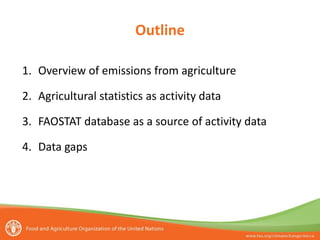
1. Overview of emissions from agriculture
2. Agricultural statistics as activity data
3. FAOSTAT database as a source of activity data
4. Data gaps
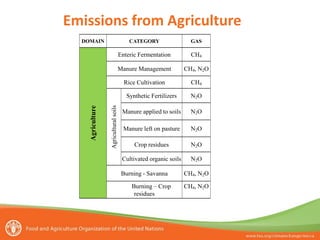
Emissions from Agriculture
DOMAIN CATEGORY GAS
Agriculture
Enteric Fermentation CH4
Manure Management CH4, N2O
Rice Cultivation CH4
Agriculturalsoils
Synthetic Fertilizers N2O
Manure applied to soils N2O
Manure left on pasture N2O
Crop residues N2O
Cultivated organic soils N2O
Burning - Savanna CH4, N2O
Burning – Crop
residues
CH4, N2O
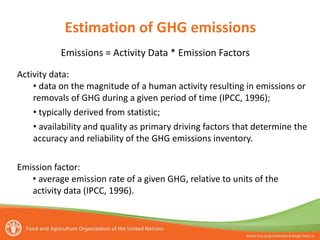
Emissions = Activity Data * Emission Factors
Estimation of GHG emissions
Activity data:
• data on the magnitude of a human activity resulting in emissions or
removals of GHG during a given period of time (IPCC, 1996);
• typically derived from statistic;
• availability and quality as primary driving factors that determine the
accuracy and reliability of the GHG emissions inventory.
Emission factor:
• average emission rate of a given GHG, relative to units of the
activity data (IPCC, 1996).
From IPCC, 2006
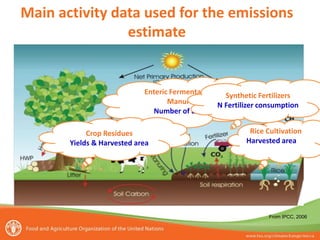
Main activity data used for the emissions
estimate
Rice Cultivation
Harvested area
Enteric Fermentation
Manure
Number of animals
Synthetic Fertilizers
N Fertilizer consumption
Crop Residues
Yields & Harvested area
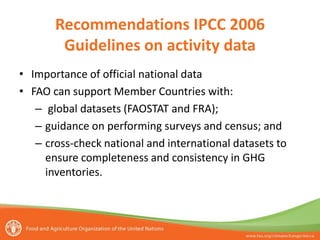
Recommendations IPCC 2006
Guidelines on activity data
• Importance of official national data
• FAO can support Member Countries with:
– global datasets (FAOSTAT and FRA);
– guidance on performing surveys and census; and
– cross-check national and international datasets to
ensure completeness and consistency in GHG
inventories.
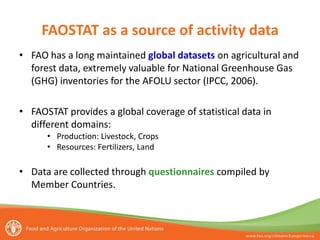
FAOSTAT as a source of activity data
• FAO has a long maintained global datasets on agricultural and
forest data, extremely valuable for National Greenhouse Gas
(GHG) inventories for the AFOLU sector (IPCC, 2006).
• FAOSTAT provides a global coverage of statistical data in
different domains:
• Production: Livestock, Crops
• Resources: Fertilizers, Land
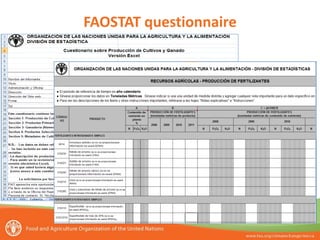
• Data are collected through questionnaires compiled by
Member Countries.
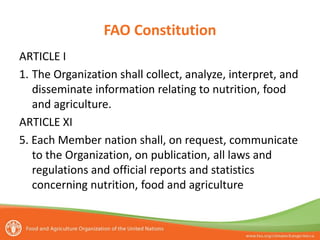
FAO Constitution
ARTICLE I
1. The Organization shall collect, analyze, interpret, and
disseminate information relating to nutrition, food
and agriculture.
ARTICLE XI
5. Each Member nation shall, on request, communicate
to the Organization, on publication, all laws and
regulations and official reports and statistics
concerning nutrition, food and agriculture
FAOSTAT questionnaire
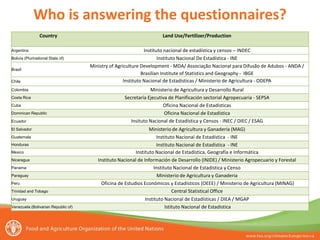
Who is answering the questionnaires?
Country Land Use/Fertilizer/Production
Argentina Instituto nacional de estadística y censos – INDEC
Bolivia (Plurinational State of) Instituto Nacional De Estadística - INE
Brazil
Ministry of Agriculture Development - MDA/ Associação Nacional para Difusão de Adubos - ANDA /
Brasilian Institute of Statistics and Geography - IBGE
Chile Instituto Nacional de Estadisticas / Ministerio de Agricultura - ODEPA
Colombia Ministerio de Agricultura y Desarrollo Rural
Costa Rica Secretaría Ejecutiva de Planificación sectorial Agropecuaria - SEPSA
Cuba Oficina Nacional de Estadísticas
Dominican Republic Oficina Nacional de Estadística
Ecuador Insituto Nacional de Estadística y Censos - INEC / DIEC / ESAG
El Salvador Ministerio de Agricultura y Ganadería (MAG)
Guatemala Instituto Nacional de Estadística - INE
Honduras Instituto Nacional de Estadística - INE
Mexico Instituto Nacional de Estadística, Geografía e Informática
Nicaragua Instituto Nacional de Información de Desarrollo (INIDE) / Ministerio Agropecuario y Forestal
Panama Instituto Nacional de Estadística y Censo
Paraguay Ministerio de Agricultura y Ganaderia
Peru Oficina de Estudios Económicos y Estadísticos (OEEE) / Ministerio de Agricultura (MINAG)
Trinidad and Tobago Central Statistical Office
Uruguay Instituto Nacional de Estadísticas / DIEA / MGAP
Venezuela (Bolivarian Republic of) Istituto Nacional de Estadistica
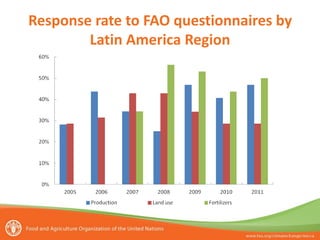
Response rate to FAO questionnaires by
Latin America Region
What is not covered in FAOSTAT?
– Burned areas (savanna, grassland, peat and forest)
– Organic soils
How did we solve it?
… We will see tomorrow!!
FAOSTAT
• Let’s see FAOSTAT together
http://faostat.fao.org/
Thank you!
Contacto: MAGHG@fao.org
Sitio web MAGHG: www.fao.org/climatechange/micca/ghg
Sitio web FAOSTAT: http://faostat.fao.org
Financiado por:

Importance of agricultural statistics for estimating GHG emissions from Agriculture

  • 1.
    Second FAO Workshopon Statistics for Greenhouse Gas Emissions, 3-4 June 2013, Port of Spain (Trinidad and Tobago) Importance of agricultural statistics for estimating GHG emissions from Agriculture Rocío Cóndor MAGHG team
  • 2.
    Outline 1. Overview ofemissions from agriculture 2. Agricultural statistics as activity data 3. FAOSTAT database as a source of activity data 4. Data gaps
  • 3.
    Emissions from Agriculture DOMAINCATEGORY GAS Agriculture Enteric Fermentation CH4 Manure Management CH4, N2O Rice Cultivation CH4 Agriculturalsoils Synthetic Fertilizers N2O Manure applied to soils N2O Manure left on pasture N2O Crop residues N2O Cultivated organic soils N2O Burning - Savanna CH4, N2O Burning – Crop residues CH4, N2O
  • 4.
    Emissions = ActivityData * Emission Factors Estimation of GHG emissions Activity data: • data on the magnitude of a human activity resulting in emissions or removals of GHG during a given period of time (IPCC, 1996); • typically derived from statistic; • availability and quality as primary driving factors that determine the accuracy and reliability of the GHG emissions inventory. Emission factor: • average emission rate of a given GHG, relative to units of the activity data (IPCC, 1996).
  • 5.
    From IPCC, 2006 Mainactivity data used for the emissions estimate Rice Cultivation Harvested area Enteric Fermentation Manure Number of animals Synthetic Fertilizers N Fertilizer consumption Crop Residues Yields & Harvested area
  • 6.
    Recommendations IPCC 2006 Guidelineson activity data • Importance of official national data • FAO can support Member Countries with: – global datasets (FAOSTAT and FRA); – guidance on performing surveys and census; and – cross-check national and international datasets to ensure completeness and consistency in GHG inventories.
  • 7.
    FAOSTAT as asource of activity data • FAO has a long maintained global datasets on agricultural and forest data, extremely valuable for National Greenhouse Gas (GHG) inventories for the AFOLU sector (IPCC, 2006). • FAOSTAT provides a global coverage of statistical data in different domains: • Production: Livestock, Crops • Resources: Fertilizers, Land • Data are collected through questionnaires compiled by Member Countries.
  • 8.
    FAO Constitution ARTICLE I 1.The Organization shall collect, analyze, interpret, and disseminate information relating to nutrition, food and agriculture. ARTICLE XI 5. Each Member nation shall, on request, communicate to the Organization, on publication, all laws and regulations and official reports and statistics concerning nutrition, food and agriculture
  • 9.
  • 10.
    Who is answeringthe questionnaires? Country Land Use/Fertilizer/Production Argentina Instituto nacional de estadística y censos – INDEC Bolivia (Plurinational State of) Instituto Nacional De Estadística - INE Brazil Ministry of Agriculture Development - MDA/ Associação Nacional para Difusão de Adubos - ANDA / Brasilian Institute of Statistics and Geography - IBGE Chile Instituto Nacional de Estadisticas / Ministerio de Agricultura - ODEPA Colombia Ministerio de Agricultura y Desarrollo Rural Costa Rica Secretaría Ejecutiva de Planificación sectorial Agropecuaria - SEPSA Cuba Oficina Nacional de Estadísticas Dominican Republic Oficina Nacional de Estadística Ecuador Insituto Nacional de Estadística y Censos - INEC / DIEC / ESAG El Salvador Ministerio de Agricultura y Ganadería (MAG) Guatemala Instituto Nacional de Estadística - INE Honduras Instituto Nacional de Estadística - INE Mexico Instituto Nacional de Estadística, Geografía e Informática Nicaragua Instituto Nacional de Información de Desarrollo (INIDE) / Ministerio Agropecuario y Forestal Panama Instituto Nacional de Estadística y Censo Paraguay Ministerio de Agricultura y Ganaderia Peru Oficina de Estudios Económicos y Estadísticos (OEEE) / Ministerio de Agricultura (MINAG) Trinidad and Tobago Central Statistical Office Uruguay Instituto Nacional de Estadísticas / DIEA / MGAP Venezuela (Bolivarian Republic of) Istituto Nacional de Estadistica
  • 11.
    Response rate toFAO questionnaires by Latin America Region
  • 12.
    What is notcovered in FAOSTAT? – Burned areas (savanna, grassland, peat and forest) – Organic soils How did we solve it? … We will see tomorrow!!
  • 13.
    FAOSTAT • Let’s seeFAOSTAT together http://faostat.fao.org/
  • 14.
    Thank you! Contacto: MAGHG@fao.org Sitioweb MAGHG: www.fao.org/climatechange/micca/ghg Sitio web FAOSTAT: http://faostat.fao.org Financiado por: