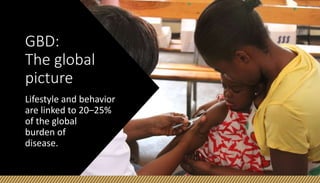
GBD:
The global
picture
Lifestyle and behavior
are linked to 20–25%
of the global
burden of
disease.
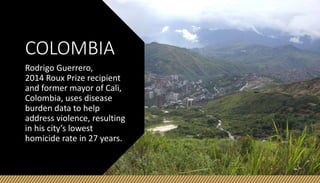
COLOMBIA
Rodrigo Guerrero,
2014 Roux Prize recipient
and former mayor of Cali,
Colombia, uses disease
burden data to help
address violence, resulting
in his city’s lowest
homicide rate in 27 years.
“GBD is super-helpful
when we’re talking to
developing countries…
So I’ve been taking
GBD charts with me when
I’ve met with people in
Cambodia, or Indonesia,
or even at the French aid
agency about trends in
francophone Africa… It’s a
very important tool for me.
Before I go into strategy meetings,
I sometimes look at the GBD to
remind myself of the numbers.”
Bill Gates
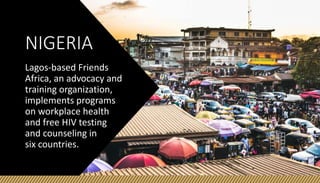
NIGERIA
Lagos-based Friends
Africa, an advocacy and
training organization,
implements programs
on workplace health
and free HIV testing
and counseling in
six countries.
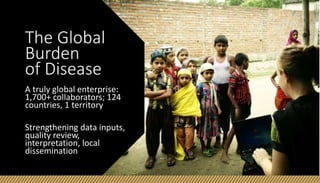
The Global
Burden
of Disease
A truly global enterprise:
1,700+ collaborators; 124
countries, 1 territory
Strengthening data inputs,
quality review,
interpretation, local
dissemination
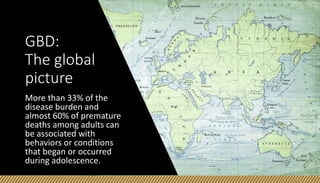
GBD:
The global
picture
More than 33% of the
disease burden and
almost 60% of premature
deaths among adults can
be associated with
behaviors or conditions
that began or occurred
during adolescence.
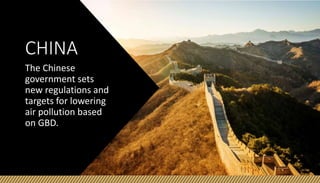
CHINA
The Chinese
government sets
new regulations and
targets for lowering
air pollution based
on GBD.
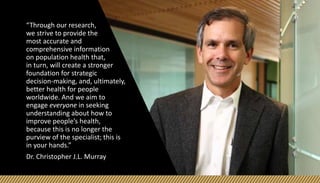
“Through our research,
we strive to provide the
most accurate and
comprehensive information
on population health that,
in turn, will create a stronger
foundation for strategic
decision-making, and, ultimately,
better health for people
worldwide. And we aim to
engage everyone in seeking
understanding about how to
improve people’s health,
because this is no longer the
purview of the specialist; this is
in your hands.”
Dr. Christopher J.L. Murray
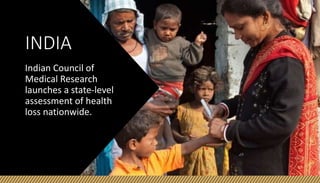
INDIA
Indian Council of
Medical Research
launches a state-level
assessment of health
loss nationwide.
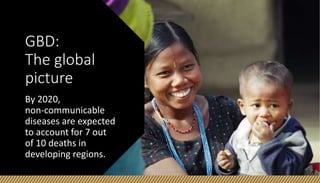
GBD:
The global
picture
By 2020,
non-communicable
diseases are expected
to account for 7 out
of 10 deaths in
developing regions.
“[This research]
makes clear that
poor nutrition is the
single greatest cause of
preventable diseases and
ailments in this country —
the single greatest
cause. Simply what we put
into our bodies — seems
obvious, but we still resist
that truth.”
Michelle Obama
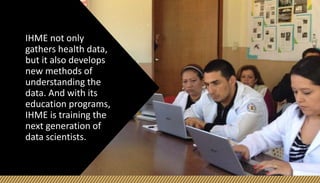
IHME not only
gathers health data,
but it also develops
new methods of
understanding the
data. And with its
education programs,
IHME is training the
next generation of
data scientists.
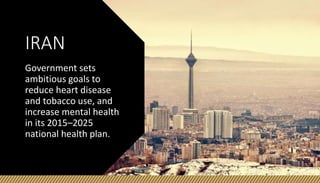
IRAN
Government sets
ambitious goals to
reduce heart disease
and tobacco use, and
increase mental health
in its 2015–2025
national health plan.
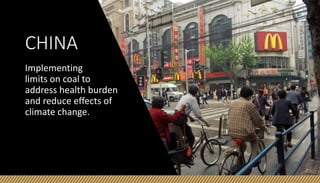
CHINA
Implementing
limits on coal to
address health burden
and reduce effects of
climate change.
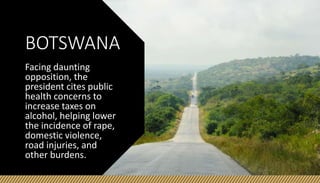
BOTSWANA
Facing daunting
opposition, the
president cites public
health concerns to
increase taxes on
alcohol, helping lower
the incidence of rape,
domestic violence,
road injuries, and
other burdens.
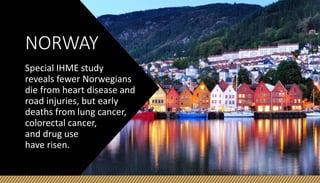
NORWAY
Special IHME study
reveals fewer Norwegians
die from heart disease and
road injuries, but early
deaths from lung cancer,
colorectal cancer,
and drug use
have risen.
U.S.
The National
Institutes of
Health uses the GBD
to determine how
best to direct public
funding for cancer
and other diseases.
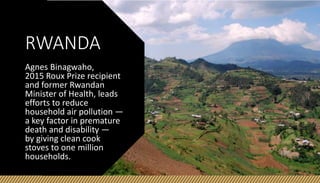
RWANDA
Agnes Binagwaho,
2015 Roux Prize recipient
and former Rwandan
Minister of Health, leads
efforts to reduce
household air pollution —
a key factor in premature
death and disability —
by giving clean cook
stoves to one million
households.
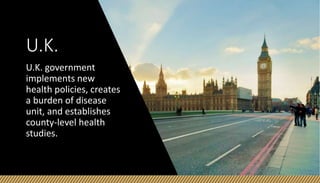
U.K. government
implements new
health policies, creates
a burden of disease
unit, and establishes
county-level health
studies.
U.K.
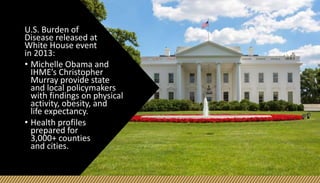
U.S. Burden of
Disease released at
White House event
in 2013:
• Michelle Obama and
IHME’s Christopher
Murray provide state
and local policymakers
with findings on physical
activity, obesity, and
life expectancy.
• Health profiles
prepared for
3,000+ counties
and cities.
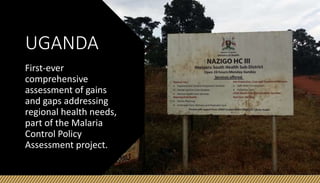
UGANDA
First-ever
comprehensive
assessment of gains
and gaps addressing
regional health needs,
part of the Malaria
Control Policy
Assessment project.
NIGERIA
There are stark
geographic disparities
for malnutrition,
vaccines, and other
childhood health
concerns.
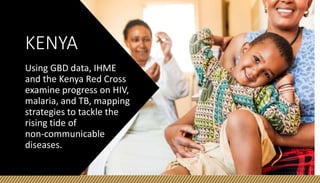
KENYA
Using GBD data, IHME
and the Kenya Red Cross
examine progress on HIV,
malaria, and TB, mapping
strategies to tackle the
rising tide of
non-communicable
diseases.

IHME Impact

  • 1.
    GBD: The global picture Lifestyle andbehavior are linked to 20–25% of the global burden of disease.
  • 2.
    COLOMBIA Rodrigo Guerrero, 2014 RouxPrize recipient and former mayor of Cali, Colombia, uses disease burden data to help address violence, resulting in his city’s lowest homicide rate in 27 years.
  • 3.
    “GBD is super-helpful whenwe’re talking to developing countries… So I’ve been taking GBD charts with me when I’ve met with people in Cambodia, or Indonesia, or even at the French aid agency about trends in francophone Africa… It’s a very important tool for me. Before I go into strategy meetings, I sometimes look at the GBD to remind myself of the numbers.” Bill Gates
  • 4.
    NIGERIA Lagos-based Friends Africa, anadvocacy and training organization, implements programs on workplace health and free HIV testing and counseling in six countries.
  • 5.
    The Global Burden of Disease Atruly global enterprise: 1,700+ collaborators; 124 countries, 1 territory Strengthening data inputs, quality review, interpretation, local dissemination
  • 6.
    GBD: The global picture More than33% of the disease burden and almost 60% of premature deaths among adults can be associated with behaviors or conditions that began or occurred during adolescence.
  • 7.
    CHINA The Chinese government sets newregulations and targets for lowering air pollution based on GBD.
  • 8.
    “Through our research, westrive to provide the most accurate and comprehensive information on population health that, in turn, will create a stronger foundation for strategic decision-making, and, ultimately, better health for people worldwide. And we aim to engage everyone in seeking understanding about how to improve people’s health, because this is no longer the purview of the specialist; this is in your hands.” Dr. Christopher J.L. Murray
  • 9.
    INDIA Indian Council of MedicalResearch launches a state-level assessment of health loss nationwide.
  • 10.
    GBD: The global picture By 2020, non-communicable diseasesare expected to account for 7 out of 10 deaths in developing regions.
  • 11.
    “[This research] makes clearthat poor nutrition is the single greatest cause of preventable diseases and ailments in this country — the single greatest cause. Simply what we put into our bodies — seems obvious, but we still resist that truth.” Michelle Obama
  • 12.
    IHME not only gathershealth data, but it also develops new methods of understanding the data. And with its education programs, IHME is training the next generation of data scientists.
  • 13.
    IRAN Government sets ambitious goalsto reduce heart disease and tobacco use, and increase mental health in its 2015–2025 national health plan.
  • 14.
    CHINA Implementing limits on coalto address health burden and reduce effects of climate change.
  • 15.
    BOTSWANA Facing daunting opposition, the presidentcites public health concerns to increase taxes on alcohol, helping lower the incidence of rape, domestic violence, road injuries, and other burdens.
  • 16.
    NORWAY Special IHME study revealsfewer Norwegians die from heart disease and road injuries, but early deaths from lung cancer, colorectal cancer, and drug use have risen.
  • 17.
    U.S. The National Institutes of Healthuses the GBD to determine how best to direct public funding for cancer and other diseases.
  • 18.
    RWANDA Agnes Binagwaho, 2015 RouxPrize recipient and former Rwandan Minister of Health, leads efforts to reduce household air pollution — a key factor in premature death and disability — by giving clean cook stoves to one million households.
  • 19.
    U.K. government implements new healthpolicies, creates a burden of disease unit, and establishes county-level health studies. U.K.
  • 20.
    U.S. Burden of Diseasereleased at White House event in 2013: • Michelle Obama and IHME’s Christopher Murray provide state and local policymakers with findings on physical activity, obesity, and life expectancy. • Health profiles prepared for 3,000+ counties and cities.
  • 21.
    UGANDA First-ever comprehensive assessment of gains andgaps addressing regional health needs, part of the Malaria Control Policy Assessment project.
  • 22.
    NIGERIA There are stark geographicdisparities for malnutrition, vaccines, and other childhood health concerns.
  • 23.
    KENYA Using GBD data,IHME and the Kenya Red Cross examine progress on HIV, malaria, and TB, mapping strategies to tackle the rising tide of non-communicable diseases.

Editor's Notes

  • #4 This quote is rather long – how many seconds does it get? Maybe delete the second reference to “it’s a very important tool.”
  • #14 2015-2015 doesn’t seem correct
  • #16 Lower case president (or add his or her name).
  • #19 Spell out one
  • #21 I added periods in US.