WHO Global Conference: Connecting Health and Labour       (29 Nov.-1 Dec.2011, the Hague)


   Labour and social protection policies and primary health care


                              Igor FEDOTOV, M.D., Ph.D,
  Coordinator, Occupational and Environmental Health, ILO Progamme SAFEWORK, Geneva,
                                        Switerland
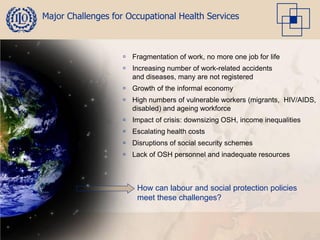
Major Challenges for Occupational Health Services


                     Fragmentation of work, no more one job for life
                     Increasing number of work-related accidents
                      and diseases, many are not registered
                     Growth of the informal economy
                     High numbers of vulnerable workers (migrants, HIV/AIDS,
                      disabled) and ageing workforce
                     Impact of crisis: downsizing OSH, income inequalities
                     Escalating health costs
                     Disruptions of social security schemes
                     Lack of OSH personnel and inadequate resources


                        How can labour and social protection policies
                        meet these challenges?
Investment in occupational health

Worker Health:
- added value for productivity and sustainable development
- indicator of success of social and economic policies
- critical economic factor at enterprise and nationally


Policies should aim at:
- risk management, disease prevention & health promotion
- reduction of social costs through prevention

Policies be based on:
principles of equity, affordability and accessibility
ILO Occupational Health Services Convention 161


          Primary task

Entrusted with essentially preventive functions and responsible
for advising employers and workers on requirements for
establishing and maintaining a safe and healthy work
environment and adaptation of work to the capabilities of
workers

-   Requires the establishment of comprehensive national
    policy on OH Services
-   Determines functions, organization and conditions of
    operation
Labour policies – national labour codes

Solid OSH legislation

Employer liability in case of work-related accidents and diseases

Enforcement of law – labour inspection

Tripartite cooperation (collective agreements)

National safety and health tripartite body


Main goals
Reduction of risks, prevention of occupational injuries and diseases, health promotion, medical
rehabilitation, and return to work
Labour policies strengthening legal OSH frameworks


Occupational Safety and Health C. 155 requires:
-   to formulate and implement a coherent national policy (Art.4)
-   policy shall include the respective functions and responsibilities for OSH of public authorities,
    employers, workers … (Art. 6)
-   the necessary coordination between various authorities and bodies (Art.15)

Promotional Framework for OSH C. 187 requires:
-   development of national OSH policy, system, programme and profile

National system includes:
-   occupational health services
-   collaboration with insurance or social security schemes to cover work injuries and diseases
-    support mechanisms for progressive improvement of OSH conditions in SMEs and in the informal
    economy

National programme:
to be endorsed and launched by the highest national authorities
Social security policies – national social security codes


Social security legislation

Health insurance (general) to cover medical care of any mobid condition and
sickness benefit

Employment injury insurance to cover medical, sickness, disability and
survivors benefits in case of occupational accidents and diseases

Main goal
Social protection of victims of work related injuries and diseases and social
rehabilitation
Social polcies strengthening social protection


Minimum Standards of Social Security C. 102
Part VI. Employment Injury Benefit – to preserve minimum contingencies to be covered due to accident
or disease resulting from employment

Employment Injury Benefits C. 121
National legislation on employment injury benefit shall protect all employees
It includes Schedule I. List of occupational diseases
- ILO adopted Rec. 194, 2002, that requires a national list of occupational diseases for the purposes of
     prevention, recording, notification and compensation to be established by the competent authority
- national list to be reviewed in line with the most up-to-date list of ILO
- ILO revised the list of occupational diseases in 2010

Medical Care and Sickness Benefit C.130
Part II. Medical care: requires to secure to the persons protected the provision of medical care of
curative and preventive nature in case of contingencies, including incapacity to work resulting from
sickness
Part III. Sickness benefit: requires to secure to the persons protected the provision of sickness benefit in
case of contingencies, including incapacity to work resulting from sickness
Synergies of Labour and Social Policies


To be effective, the policies should aim at:
- keeping labour and social protection high on technical and political
     agendas
- establishing OH Services and social security institutions
- developing overall infrastructure for OH practice
- promoting creation of safety culture at the level of society, enterprise
and individual

The policies should address risks:
- in humans (biological) – to prevent ill-health, loss of working capacity,
     temporary or permanent disability
- in society (economic) – to prevent loss of income due to occupational
     injuries and diseases
UN Initiative on Social Protection Floor


•   ILO and WHO the lead agencies

•   WHO – basic health protection and medical care services
    development

•   ILO – basic income protection (disability, maternity, pension,
    unemployment)

•   Standard setting item for International Labour Conference, 2012
          “Recommendation on the social protection floor”
Conclusions


 Labour and social protection policies are in the
  core of the ILO Decent Work Agenda

 Effective labour and social policies are critical for
  good governance and sustainable development

 Countries need to recognize a critical importance
  of developing OH Services to cover all workers

 To create synergies: labour, health and social
  policies should be comprehensive, consistent and
  complimentary
Recommendations


1.
 Develop:
      a. Mechanisms for multi-channel provision of OH
         services, especially through PHC system, and
         indicators for measuring progress

      b. Cooperation between labour and health sectors
         on OH Services and their expansion into the
         informal economy

      c. Training tools and good practice guides to assist
         countries in stepwise development of OH
         Services


2.
 Promote: ratification and application of the ILO
     Conventions 161 and 187
Recommendations


3Link the development of OH Services with the
    establishment of comprehensive national OSH
    action programs and countries’ profiles


.Build up wide partnerships to strengthen ILO and


4.  WHO actions to influence decision-making
    and provision of resources at national and
    international levels
WHO Global Conference: Connecting Health and Labour    (29 Nov.-1 Dec.2011, the Hague)


                                       Igor FEDOTOV, M.D., Ph.D
                                       Coordinator, Occupational and Environmental
                                       Health
 Thank You!                            ILO Programme SAFEWORK
                                       Geneva, Switzerland


 More from:
 www.ilo.org/safework

Labour and social protection policies and primary health care

  • 1.
    WHO Global Conference:Connecting Health and Labour (29 Nov.-1 Dec.2011, the Hague) Labour and social protection policies and primary health care Igor FEDOTOV, M.D., Ph.D, Coordinator, Occupational and Environmental Health, ILO Progamme SAFEWORK, Geneva, Switerland
  • 2.
    Major Challenges forOccupational Health Services
  • 3.
    Major Challenges forOccupational Health Services  Fragmentation of work, no more one job for life  Increasing number of work-related accidents and diseases, many are not registered  Growth of the informal economy  High numbers of vulnerable workers (migrants, HIV/AIDS, disabled) and ageing workforce  Impact of crisis: downsizing OSH, income inequalities  Escalating health costs  Disruptions of social security schemes  Lack of OSH personnel and inadequate resources How can labour and social protection policies meet these challenges?
  • 4.
    Investment in occupationalhealth Worker Health: - added value for productivity and sustainable development - indicator of success of social and economic policies - critical economic factor at enterprise and nationally Policies should aim at: - risk management, disease prevention & health promotion - reduction of social costs through prevention Policies be based on: principles of equity, affordability and accessibility
  • 5.
    ILO Occupational HealthServices Convention 161 Primary task Entrusted with essentially preventive functions and responsible for advising employers and workers on requirements for establishing and maintaining a safe and healthy work environment and adaptation of work to the capabilities of workers - Requires the establishment of comprehensive national policy on OH Services - Determines functions, organization and conditions of operation
  • 6.
    Labour policies –national labour codes Solid OSH legislation Employer liability in case of work-related accidents and diseases Enforcement of law – labour inspection Tripartite cooperation (collective agreements) National safety and health tripartite body Main goals Reduction of risks, prevention of occupational injuries and diseases, health promotion, medical rehabilitation, and return to work
  • 7.
    Labour policies strengtheninglegal OSH frameworks Occupational Safety and Health C. 155 requires: - to formulate and implement a coherent national policy (Art.4) - policy shall include the respective functions and responsibilities for OSH of public authorities, employers, workers … (Art. 6) - the necessary coordination between various authorities and bodies (Art.15) Promotional Framework for OSH C. 187 requires: - development of national OSH policy, system, programme and profile National system includes: - occupational health services - collaboration with insurance or social security schemes to cover work injuries and diseases - support mechanisms for progressive improvement of OSH conditions in SMEs and in the informal economy National programme: to be endorsed and launched by the highest national authorities
  • 8.
    Social security policies– national social security codes Social security legislation Health insurance (general) to cover medical care of any mobid condition and sickness benefit Employment injury insurance to cover medical, sickness, disability and survivors benefits in case of occupational accidents and diseases Main goal Social protection of victims of work related injuries and diseases and social rehabilitation
  • 9.
    Social polcies strengtheningsocial protection Minimum Standards of Social Security C. 102 Part VI. Employment Injury Benefit – to preserve minimum contingencies to be covered due to accident or disease resulting from employment Employment Injury Benefits C. 121 National legislation on employment injury benefit shall protect all employees It includes Schedule I. List of occupational diseases - ILO adopted Rec. 194, 2002, that requires a national list of occupational diseases for the purposes of prevention, recording, notification and compensation to be established by the competent authority - national list to be reviewed in line with the most up-to-date list of ILO - ILO revised the list of occupational diseases in 2010 Medical Care and Sickness Benefit C.130 Part II. Medical care: requires to secure to the persons protected the provision of medical care of curative and preventive nature in case of contingencies, including incapacity to work resulting from sickness Part III. Sickness benefit: requires to secure to the persons protected the provision of sickness benefit in case of contingencies, including incapacity to work resulting from sickness
  • 10.
    Synergies of Labourand Social Policies To be effective, the policies should aim at: - keeping labour and social protection high on technical and political agendas - establishing OH Services and social security institutions - developing overall infrastructure for OH practice - promoting creation of safety culture at the level of society, enterprise and individual The policies should address risks: - in humans (biological) – to prevent ill-health, loss of working capacity, temporary or permanent disability - in society (economic) – to prevent loss of income due to occupational injuries and diseases
  • 11.
    UN Initiative onSocial Protection Floor • ILO and WHO the lead agencies • WHO – basic health protection and medical care services development • ILO – basic income protection (disability, maternity, pension, unemployment) • Standard setting item for International Labour Conference, 2012 “Recommendation on the social protection floor”
  • 12.
    Conclusions  Labour andsocial protection policies are in the core of the ILO Decent Work Agenda  Effective labour and social policies are critical for good governance and sustainable development  Countries need to recognize a critical importance of developing OH Services to cover all workers  To create synergies: labour, health and social policies should be comprehensive, consistent and complimentary
  • 13.
    Recommendations 1. Develop: a. Mechanisms for multi-channel provision of OH services, especially through PHC system, and indicators for measuring progress b. Cooperation between labour and health sectors on OH Services and their expansion into the informal economy c. Training tools and good practice guides to assist countries in stepwise development of OH Services 2. Promote: ratification and application of the ILO Conventions 161 and 187
  • 14.
    Recommendations 3Link the developmentof OH Services with the establishment of comprehensive national OSH action programs and countries’ profiles .Build up wide partnerships to strengthen ILO and 4. WHO actions to influence decision-making and provision of resources at national and international levels
  • 15.
    WHO Global Conference:Connecting Health and Labour (29 Nov.-1 Dec.2011, the Hague) Igor FEDOTOV, M.D., Ph.D Coordinator, Occupational and Environmental Health Thank You! ILO Programme SAFEWORK Geneva, Switzerland More from: www.ilo.org/safework