PARALLEL WORKING SESSIONS

ROUND TABLE 1: UNIVERSAL COVERAGE
Chairs: Prof. Mostafa Ghaffari, Iran; Prof. Frank van Dijk, Amsterdam University
Rapporteurs: Joost van Genabeek, TNO; Julietta Rodriguez-Guzman, WHO/AMRO

ROUND TABLE 2: PEOPLE-CENTRED CARE
Chairs: S. Al-Haddad, MoH Bahrain; Arno Timmermans, President Dutch College of GPs
Rapporteurs: Romy Steenbeek, TNO; Said Arnaout, WHO/EMRO

ROUND TABLE 3: PARTICIPATORY GOVERNANCE
Chairs: Tran Thi Ngoc Lan, MoH Viet Nam; Sonja Bleuland van Oordt- Dröge, Head of
   Department General OHS Policy, Dutch Ministry of Social Affairs and Employment
Rapporteurs: Dick van Putten, TNO; Rokho Kim, WHO/EURO

ROUND TABLE 4: HEALTH IN OTHER POLICIES
Chairs: Ahmed Al-Shatti, MoH Kuwait; Lejo van der Heiden, Dutch Ministry of Health
   Welfare and Sport
Rapporteurs: Cees Wevers, TNO; Salma Burton WHO/SEARO
                                                                                     1
PARALLEL WORKING SESSIONS

ROUND TABLE 1: UNIVERSAL COVERAGE

Objective:
  To identify strategies, policy directions and main actions needed to move
  towards universal coverage with essential interventions for prevention of
  occupational and work-related diseases
Suggested questions:
• How to finance universal coverage and ensuring equity, the role of social
  security and insurance
• Which are the most essential interventions for prevention of occupational
  and work-related diseases that need to be provided to all workers
• What are the options for moving towards universal coverage when
  expertise is insufficient?
• What actions should be undertaken to move to universal coverage at the
  local, national and international level, including research to fill knowledge
  gaps?
                                                                                  2
Presentations
•   Laura Flores, Paraguay
•   Hanifa Denny, Indonesia
•   Jan De Maeseneer, Belgium
•   Jorma Rantanen, Finland
•   Joseph Birago, Tanzania
•   Z. Leopando, Filipines
•   A. Elsharif, Namibia
How to finance universal coverage and ensuring equity, the
           role of social security and insurance


•   Insurance mostly limited to the formal work and excluding informality
•   Highest risk populations should be targeted universally
•   Basic level of OHS should be in the primary health care and governement
    should ensure universal coverage and appropriate mechanisms to financing
    it.
•   Coverage for the informal sector with primary care is limited, so other
    funding systems should be putted in stake eg associations / corporations or
    other collective organisations for groups of informal workers
•   State supporting PHC including OHS for all
•   Selected coverage seems to be inequitable vs universal coverage although
    it might be a transitional situation to limited and poor countries
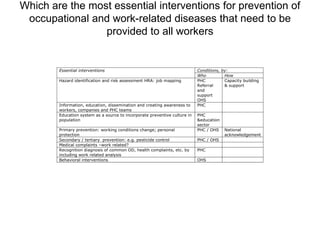
Which are the most essential interventions for prevention of
 occupational and work-related diseases that need to be
                 provided to all workers


        Essential interventions                                             Conditions, by:
                                                                            Who          How
        Hazard identification and risk assessment HRA: job mapping          PHC          Capacity building
                                                                            Referral     & support
                                                                            and
                                                                            support
                                                                            OHS
        Information, education, dissemination and creating awareness to     PHC
        workers, companies and PHC teams
        Education system as a source to incorporate preventive culture in   PHC
        population                                                          &education
                                                                            sector
        Primary prevention: working conditions change; personal             PHC / OHS    National
        protection                                                                       acknowledgement
        Secondary / tertiary prevention: e.g. pesticide control             PHC / OHS
        Medical complaints –work related?
        Recognition diagnosis of common OD, health complaints, etc. by      PHC
        including work related analysis
        Behavioral interventions                                            OHS
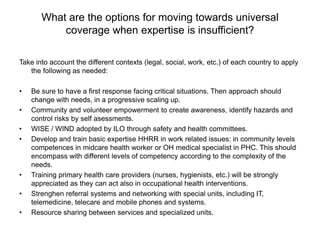
What are the options for moving towards universal
           coverage when expertise is insufficient?

Take into account the different contexts (legal, social, work, etc.) of each country to apply
   the following as needed:

•   Be sure to have a first response facing critical situations. Then approach should
    change with needs, in a progressive scaling up.
•   Community and volunteer empowerment to create awareness, identify hazards and
    control risks by self asessments.
•   WISE / WIND adopted by ILO through safety and health committees.
•   Develop and train basic expertise HHRR in work related issues: in community levels
    competences in midcare health worker or OH medical specialist in PHC. This should
    encompass with different levels of competency according to the complexity of the
    needs.
•   Training primary health care providers (nurses, hygienists, etc.) will be strongly
    appreciated as they can act also in occupational health interventions.
•   Strenghen referral systems and networking with special units, including IT,
    telemedicine, telecare and mobile phones and systems.
•   Resource sharing between services and specialized units.
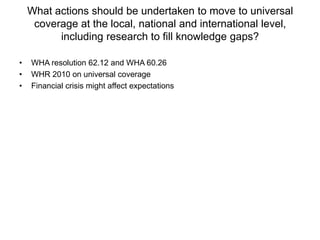
What actions should be undertaken to move to universal
     coverage at the local, national and international level,
          including research to fill knowledge gaps?

•   WHA resolution 62.12 and WHA 60.26
•   WHR 2010 on universal coverage
•   Financial crisis might affect expectations
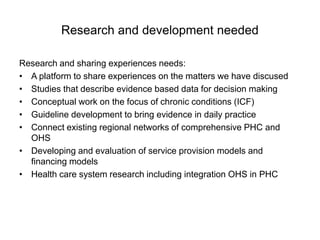
Research and development needed

Research and sharing experiences needs:
• A platform to share experiences on the matters we have discused
• Studies that describe evidence based data for decision making
• Conceptual work on the focus of chronic conditions (ICF)
• Guideline development to bring evidence in daily practice
• Connect existing regional networks of comprehensive PHC and
  OHS
• Developing and evaluation of service provision models and
  financing models
• Health care system research including integration OHS in PHC
PARALLEL WORKING SESSIONS

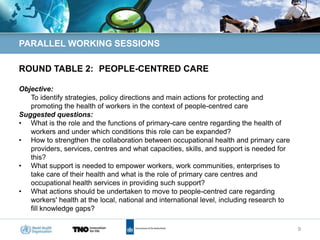
ROUND TABLE 2: PEOPLE-CENTRED CARE

Objective:
   To identify strategies, policy directions and main actions for protecting and
   promoting the health of workers in the context of people-centred care
Suggested questions:
• What is the role and the functions of primary-care centre regarding the health of
   workers and under which conditions this role can be expanded?
• How to strengthen the collaboration between occupational health and primary care
   providers, services, centres and what capacities, skills, and support is needed for
   this?
• What support is needed to empower workers, work communities, enterprises to
   take care of their health and what is the role of primary care centres and
   occupational health services in providing such support?
• What actions should be undertaken to move to people-centred care regarding
   workers' health at the local, national and international level, including research to
   fill knowledge gaps?

                                                                                           9
PARALLEL WORKING SESSIONS

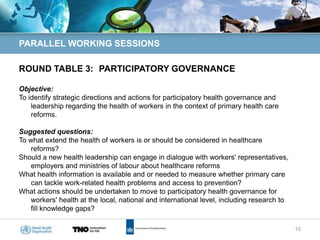
ROUND TABLE 3: PARTICIPATORY GOVERNANCE

Objective:
To identify strategic directions and actions for participatory health governance and
    leadership regarding the health of workers in the context of primary health care
    reforms.

Suggested questions:
To what extend the health of workers is or should be considered in healthcare
    reforms?
Should a new health leadership can engage in dialogue with workers' representatives,
    employers and ministries of labour about healthcare reforms
What health information is available and or needed to measure whether primary care
    can tackle work-related health problems and access to prevention?
What actions should be undertaken to move to participatory health governance for
    workers' health at the local, national and international level, including research to
    fill knowledge gaps?

                                                                                            10
PARALLEL WORKING SESSIONS

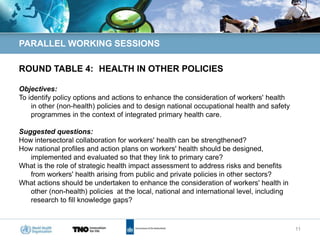
ROUND TABLE 4: HEALTH IN OTHER POLICIES

Objectives:
To identify policy options and actions to enhance the consideration of workers' health
    in other (non-health) policies and to design national occupational health and safety
    programmes in the context of integrated primary health care.

Suggested questions:
How intersectoral collaboration for workers' health can be strengthened?
How national profiles and action plans on workers' health should be designed,
   implemented and evaluated so that they link to primary care?
What is the role of strategic health impact assessment to address risks and benefits
   from workers' health arising from public and private policies in other sectors?
What actions should be undertaken to enhance the consideration of workers' health in
   other (non-health) policies at the local, national and international level, including
   research to fill knowledge gaps?


                                                                                           11

Rt 1 results

  • 1.
    PARALLEL WORKING SESSIONS ROUNDTABLE 1: UNIVERSAL COVERAGE Chairs: Prof. Mostafa Ghaffari, Iran; Prof. Frank van Dijk, Amsterdam University Rapporteurs: Joost van Genabeek, TNO; Julietta Rodriguez-Guzman, WHO/AMRO ROUND TABLE 2: PEOPLE-CENTRED CARE Chairs: S. Al-Haddad, MoH Bahrain; Arno Timmermans, President Dutch College of GPs Rapporteurs: Romy Steenbeek, TNO; Said Arnaout, WHO/EMRO ROUND TABLE 3: PARTICIPATORY GOVERNANCE Chairs: Tran Thi Ngoc Lan, MoH Viet Nam; Sonja Bleuland van Oordt- Dröge, Head of Department General OHS Policy, Dutch Ministry of Social Affairs and Employment Rapporteurs: Dick van Putten, TNO; Rokho Kim, WHO/EURO ROUND TABLE 4: HEALTH IN OTHER POLICIES Chairs: Ahmed Al-Shatti, MoH Kuwait; Lejo van der Heiden, Dutch Ministry of Health Welfare and Sport Rapporteurs: Cees Wevers, TNO; Salma Burton WHO/SEARO 1
  • 2.
    PARALLEL WORKING SESSIONS ROUNDTABLE 1: UNIVERSAL COVERAGE Objective: To identify strategies, policy directions and main actions needed to move towards universal coverage with essential interventions for prevention of occupational and work-related diseases Suggested questions: • How to finance universal coverage and ensuring equity, the role of social security and insurance • Which are the most essential interventions for prevention of occupational and work-related diseases that need to be provided to all workers • What are the options for moving towards universal coverage when expertise is insufficient? • What actions should be undertaken to move to universal coverage at the local, national and international level, including research to fill knowledge gaps? 2
  • 3.
    Presentations • Laura Flores, Paraguay • Hanifa Denny, Indonesia • Jan De Maeseneer, Belgium • Jorma Rantanen, Finland • Joseph Birago, Tanzania • Z. Leopando, Filipines • A. Elsharif, Namibia
  • 4.
    How to financeuniversal coverage and ensuring equity, the role of social security and insurance • Insurance mostly limited to the formal work and excluding informality • Highest risk populations should be targeted universally • Basic level of OHS should be in the primary health care and governement should ensure universal coverage and appropriate mechanisms to financing it. • Coverage for the informal sector with primary care is limited, so other funding systems should be putted in stake eg associations / corporations or other collective organisations for groups of informal workers • State supporting PHC including OHS for all • Selected coverage seems to be inequitable vs universal coverage although it might be a transitional situation to limited and poor countries
  • 5.
    Which are themost essential interventions for prevention of occupational and work-related diseases that need to be provided to all workers Essential interventions Conditions, by: Who How Hazard identification and risk assessment HRA: job mapping PHC Capacity building Referral & support and support OHS Information, education, dissemination and creating awareness to PHC workers, companies and PHC teams Education system as a source to incorporate preventive culture in PHC population &education sector Primary prevention: working conditions change; personal PHC / OHS National protection acknowledgement Secondary / tertiary prevention: e.g. pesticide control PHC / OHS Medical complaints –work related? Recognition diagnosis of common OD, health complaints, etc. by PHC including work related analysis Behavioral interventions OHS
  • 6.
    What are theoptions for moving towards universal coverage when expertise is insufficient? Take into account the different contexts (legal, social, work, etc.) of each country to apply the following as needed: • Be sure to have a first response facing critical situations. Then approach should change with needs, in a progressive scaling up. • Community and volunteer empowerment to create awareness, identify hazards and control risks by self asessments. • WISE / WIND adopted by ILO through safety and health committees. • Develop and train basic expertise HHRR in work related issues: in community levels competences in midcare health worker or OH medical specialist in PHC. This should encompass with different levels of competency according to the complexity of the needs. • Training primary health care providers (nurses, hygienists, etc.) will be strongly appreciated as they can act also in occupational health interventions. • Strenghen referral systems and networking with special units, including IT, telemedicine, telecare and mobile phones and systems. • Resource sharing between services and specialized units.
  • 7.
    What actions shouldbe undertaken to move to universal coverage at the local, national and international level, including research to fill knowledge gaps? • WHA resolution 62.12 and WHA 60.26 • WHR 2010 on universal coverage • Financial crisis might affect expectations
  • 8.
    Research and developmentneeded Research and sharing experiences needs: • A platform to share experiences on the matters we have discused • Studies that describe evidence based data for decision making • Conceptual work on the focus of chronic conditions (ICF) • Guideline development to bring evidence in daily practice • Connect existing regional networks of comprehensive PHC and OHS • Developing and evaluation of service provision models and financing models • Health care system research including integration OHS in PHC
  • 9.
    PARALLEL WORKING SESSIONS ROUNDTABLE 2: PEOPLE-CENTRED CARE Objective: To identify strategies, policy directions and main actions for protecting and promoting the health of workers in the context of people-centred care Suggested questions: • What is the role and the functions of primary-care centre regarding the health of workers and under which conditions this role can be expanded? • How to strengthen the collaboration between occupational health and primary care providers, services, centres and what capacities, skills, and support is needed for this? • What support is needed to empower workers, work communities, enterprises to take care of their health and what is the role of primary care centres and occupational health services in providing such support? • What actions should be undertaken to move to people-centred care regarding workers' health at the local, national and international level, including research to fill knowledge gaps? 9
  • 10.
    PARALLEL WORKING SESSIONS ROUNDTABLE 3: PARTICIPATORY GOVERNANCE Objective: To identify strategic directions and actions for participatory health governance and leadership regarding the health of workers in the context of primary health care reforms. Suggested questions: To what extend the health of workers is or should be considered in healthcare reforms? Should a new health leadership can engage in dialogue with workers' representatives, employers and ministries of labour about healthcare reforms What health information is available and or needed to measure whether primary care can tackle work-related health problems and access to prevention? What actions should be undertaken to move to participatory health governance for workers' health at the local, national and international level, including research to fill knowledge gaps? 10
  • 11.
    PARALLEL WORKING SESSIONS ROUNDTABLE 4: HEALTH IN OTHER POLICIES Objectives: To identify policy options and actions to enhance the consideration of workers' health in other (non-health) policies and to design national occupational health and safety programmes in the context of integrated primary health care. Suggested questions: How intersectoral collaboration for workers' health can be strengthened? How national profiles and action plans on workers' health should be designed, implemented and evaluated so that they link to primary care? What is the role of strategic health impact assessment to address risks and benefits from workers' health arising from public and private policies in other sectors? What actions should be undertaken to enhance the consideration of workers' health in other (non-health) policies at the local, national and international level, including research to fill knowledge gaps? 11