Adjustment to ParenthoodShea Lammers, Abigail Ritsch, & Alexis Sliva
Faculty Advisor – Dr. Melanie Ayres
University of Wisconsin – River Falls
Introduction
Our research was aimed at determining how parents adjust in
the year following the birth of a baby. Research shows this
period of life is associated with positive and negative affects,
but that this period is a stressful one for most parents (Deater-
Deckard, 1998). In the current study we collaborated with a
community organization offering classes to parents of children
ages 0-1 year in order to assess whether or not the class helped
in the adjustment to parenthood. According to Kaminski et al.
(2008) parenting classes serve as a valuable source of
information for new parents. In particular, applied or hands-on
classes, seem to show the largest effects. We compared parents
partaking in the class to a control group of parents who did not
attend the class.
One source of stress for new parents may be work. However,
research shows there are benefits for working mothers and
their children including increased social support, better mental
health, and positive parenting (Kim & Wickrama, 2014).
The goal of our study was to examine the affects of a parental
education class and parental work status has on the adjustment
to parenthood.
Research Questions:
1. Does attending a parenting class help in the adjustment to
parenthood?
2. How does work status affect adjustment to parenthood?
Results
RQ 1: Parenting Class vs. Control Group’
ANOVA analyses were done to examine group differences.
Contrary to our expectations, we found no significant differences
between the control group and the parenting class group in terms
of parental self-efficacy, spousal involvement, parenting
behaviors, knowledge of infant development, spousal social
support, and general social support.
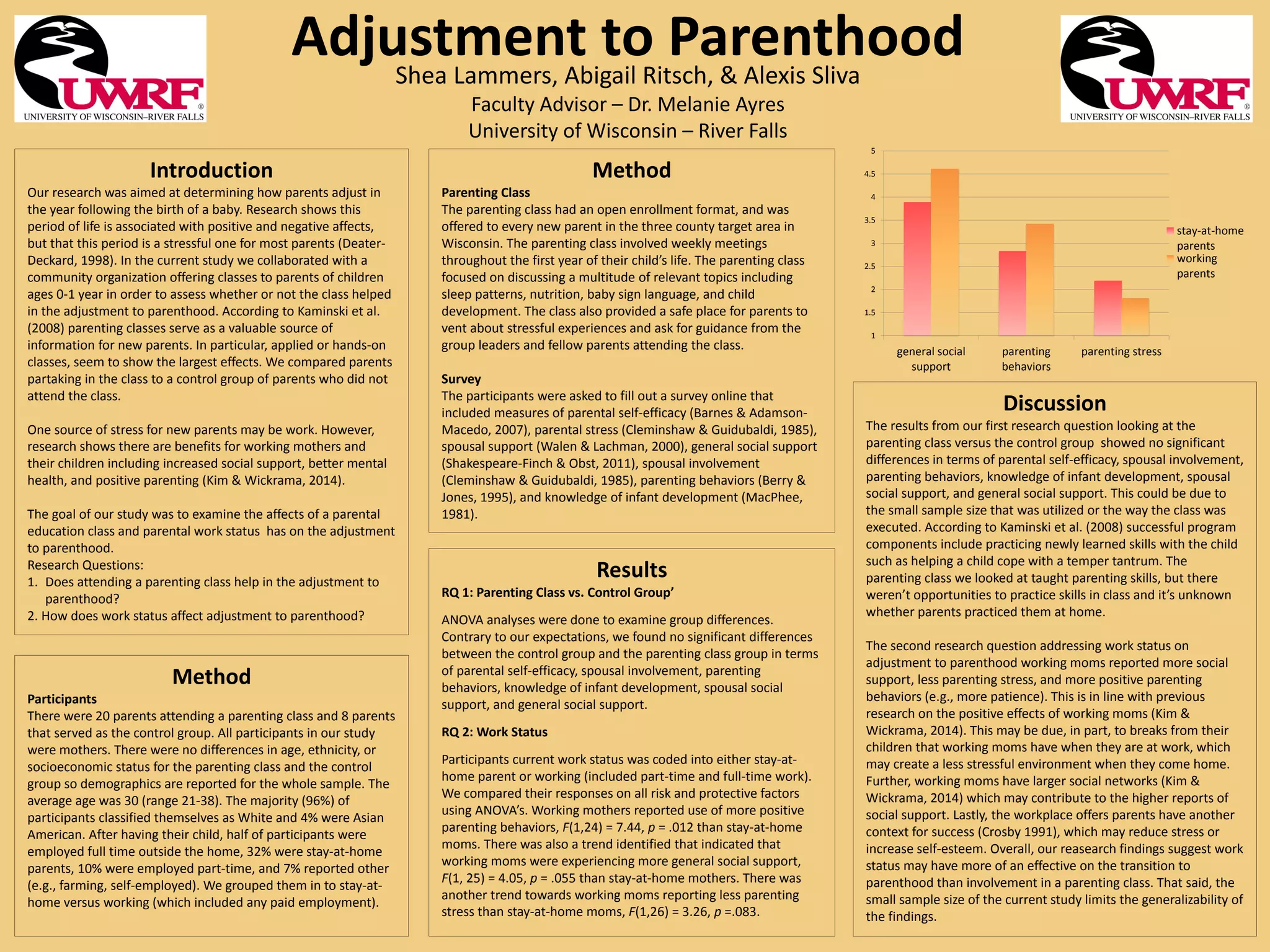
RQ 2: Work Status
Participants current work status was coded into either stay-at-
home parent or working (included part-time and full-time work).
We compared their responses on all risk and protective factors
using ANOVA’s. Working mothers reported use of more positive
parenting behaviors, F(1,24) = 7.44, p = .012 than stay-at-home
moms. There was also a trend identified that indicated that
working moms were experiencing more general social support,
F(1, 25) = 4.05, p = .055 than stay-at-home mothers. There was
another trend towards working moms reporting less parenting
stress than stay-at-home moms, F(1,26) = 3.26, p =.083.
Method
Parenting Class
The parenting class had an open enrollment format, and was
offered to every new parent in the three county target area in
Wisconsin. The parenting class involved weekly meetings
throughout the first year of their child’s life. The parenting class
focused on discussing a multitude of relevant topics including
sleep patterns, nutrition, baby sign language, and child
development. The class also provided a safe place for parents to
vent about stressful experiences and ask for guidance from the
group leaders and fellow parents attending the class.
Survey
The participants were asked to fill out a survey online that
included measures of parental self-efficacy (Barnes & Adamson-
Macedo, 2007), parental stress (Cleminshaw & Guidubaldi, 1985),
spousal support (Walen & Lachman, 2000), general social support
(Shakespeare-Finch & Obst, 2011), spousal involvement
(Cleminshaw & Guidubaldi, 1985), parenting behaviors (Berry &
Jones, 1995), and knowledge of infant development (MacPhee,
1981).
Discussion
The results from our first research question looking at the
parenting class versus the control group showed no significant
differences in terms of parental self-efficacy, spousal involvement,
parenting behaviors, knowledge of infant development, spousal
social support, and general social support. This could be due to
the small sample size that was utilized or the way the class was
executed. According to Kaminski et al. (2008) successful program
components include practicing newly learned skills with the child
such as helping a child cope with a temper tantrum. The
parenting class we looked at taught parenting skills, but there
weren’t opportunities to practice skills in class and it’s unknown
whether parents practiced them at home.
The second research question addressing work status on
adjustment to parenthood working moms reported more social
support, less parenting stress, and more positive parenting
behaviors (e.g., more patience). This is in line with previous
research on the positive effects of working moms (Kim &
Wickrama, 2014). This may be due, in part, to breaks from their
children that working moms have when they are at work, which
may create a less stressful environment when they come home.
Further, working moms have larger social networks (Kim &
Wickrama, 2014) which may contribute to the higher reports of
social support. Lastly, the workplace offers parents have another
context for success (Crosby 1991), which may reduce stress or
increase self-esteem. Overall, our reasearch findings suggest work
status may have more of an effective on the transition to
parenthood than involvement in a parenting class. That said, the
small sample size of the current study limits the generalizability of
the findings.
Method
Participants
There were 20 parents attending a parenting class and 8 parents
that served as the control group. All participants in our study
were mothers. There were no differences in age, ethnicity, or
socioeconomic status for the parenting class and the control
group so demographics are reported for the whole sample. The
average age was 30 (range 21-38). The majority (96%) of
participants classified themselves as White and 4% were Asian
American. After having their child, half of participants were
employed full time outside the home, 32% were stay-at-home
parents, 10% were employed part-time, and 7% reported other
(e.g., farming, self-employed). We grouped them in to stay-at-
home versus working (which included any paid employment).
1
1.5
2
2.5
3
3.5
4
4.5
5
general social
support
parenting
behaviors
parenting stress
stay-at-home
parents
working
parents

Abigail Ritsch Poster Presentation 2016

  • 1.
    Adjustment to ParenthoodSheaLammers, Abigail Ritsch, & Alexis Sliva Faculty Advisor – Dr. Melanie Ayres University of Wisconsin – River Falls Introduction Our research was aimed at determining how parents adjust in the year following the birth of a baby. Research shows this period of life is associated with positive and negative affects, but that this period is a stressful one for most parents (Deater- Deckard, 1998). In the current study we collaborated with a community organization offering classes to parents of children ages 0-1 year in order to assess whether or not the class helped in the adjustment to parenthood. According to Kaminski et al. (2008) parenting classes serve as a valuable source of information for new parents. In particular, applied or hands-on classes, seem to show the largest effects. We compared parents partaking in the class to a control group of parents who did not attend the class. One source of stress for new parents may be work. However, research shows there are benefits for working mothers and their children including increased social support, better mental health, and positive parenting (Kim & Wickrama, 2014). The goal of our study was to examine the affects of a parental education class and parental work status has on the adjustment to parenthood. Research Questions: 1. Does attending a parenting class help in the adjustment to parenthood? 2. How does work status affect adjustment to parenthood? Results RQ 1: Parenting Class vs. Control Group’ ANOVA analyses were done to examine group differences. Contrary to our expectations, we found no significant differences between the control group and the parenting class group in terms of parental self-efficacy, spousal involvement, parenting behaviors, knowledge of infant development, spousal social support, and general social support. RQ 2: Work Status Participants current work status was coded into either stay-at- home parent or working (included part-time and full-time work). We compared their responses on all risk and protective factors using ANOVA’s. Working mothers reported use of more positive parenting behaviors, F(1,24) = 7.44, p = .012 than stay-at-home moms. There was also a trend identified that indicated that working moms were experiencing more general social support, F(1, 25) = 4.05, p = .055 than stay-at-home mothers. There was another trend towards working moms reporting less parenting stress than stay-at-home moms, F(1,26) = 3.26, p =.083. Method Parenting Class The parenting class had an open enrollment format, and was offered to every new parent in the three county target area in Wisconsin. The parenting class involved weekly meetings throughout the first year of their child’s life. The parenting class focused on discussing a multitude of relevant topics including sleep patterns, nutrition, baby sign language, and child development. The class also provided a safe place for parents to vent about stressful experiences and ask for guidance from the group leaders and fellow parents attending the class. Survey The participants were asked to fill out a survey online that included measures of parental self-efficacy (Barnes & Adamson- Macedo, 2007), parental stress (Cleminshaw & Guidubaldi, 1985), spousal support (Walen & Lachman, 2000), general social support (Shakespeare-Finch & Obst, 2011), spousal involvement (Cleminshaw & Guidubaldi, 1985), parenting behaviors (Berry & Jones, 1995), and knowledge of infant development (MacPhee, 1981). Discussion The results from our first research question looking at the parenting class versus the control group showed no significant differences in terms of parental self-efficacy, spousal involvement, parenting behaviors, knowledge of infant development, spousal social support, and general social support. This could be due to the small sample size that was utilized or the way the class was executed. According to Kaminski et al. (2008) successful program components include practicing newly learned skills with the child such as helping a child cope with a temper tantrum. The parenting class we looked at taught parenting skills, but there weren’t opportunities to practice skills in class and it’s unknown whether parents practiced them at home. The second research question addressing work status on adjustment to parenthood working moms reported more social support, less parenting stress, and more positive parenting behaviors (e.g., more patience). This is in line with previous research on the positive effects of working moms (Kim & Wickrama, 2014). This may be due, in part, to breaks from their children that working moms have when they are at work, which may create a less stressful environment when they come home. Further, working moms have larger social networks (Kim & Wickrama, 2014) which may contribute to the higher reports of social support. Lastly, the workplace offers parents have another context for success (Crosby 1991), which may reduce stress or increase self-esteem. Overall, our reasearch findings suggest work status may have more of an effective on the transition to parenthood than involvement in a parenting class. That said, the small sample size of the current study limits the generalizability of the findings. Method Participants There were 20 parents attending a parenting class and 8 parents that served as the control group. All participants in our study were mothers. There were no differences in age, ethnicity, or socioeconomic status for the parenting class and the control group so demographics are reported for the whole sample. The average age was 30 (range 21-38). The majority (96%) of participants classified themselves as White and 4% were Asian American. After having their child, half of participants were employed full time outside the home, 32% were stay-at-home parents, 10% were employed part-time, and 7% reported other (e.g., farming, self-employed). We grouped them in to stay-at- home versus working (which included any paid employment). 1 1.5 2 2.5 3 3.5 4 4.5 5 general social support parenting behaviors parenting stress stay-at-home parents working parents