Igneous Rocks
Petroleum Geology 2
Molten rock or liquid usually
mostly silica. The liquid may
contain dissolved gases as well
and some solid material
It forms by partial melting in the crust
and uppermost mantle to a depth of ~250
km at high temperature and low pressure
MAGMA
[Greek=“paste”] i.e., molten rock
Igneous Rocks
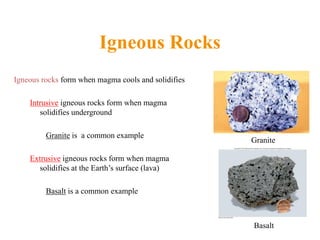
Igneous rocks form when magma cools and solidifies
Intrusive igneous rocks form when magma
solidifies underground
Granite is a common example
Extrusive igneous rocks form when magma
solidifies at the Earth’s surface (lava)
Basalt is a common example
Granite
Basalt
Igneous rocks
Intrusive rocks and Extrusive Rocks
Intrusive Rocks
Rocks which are formed by the solidification or crystallization of magma inside the
earth’s surface.
Exposed to us only after erosion or Uplift.
Intrusive rocks ranges from small bodies filling cracks to huge volumes like granite.
Evidences for underground solidification of magma into granite and other
intrusive rocks
1” Mineralogically and chemically, identical to volcanic rocks (but are of
different textures)
Igneous Rock Textures
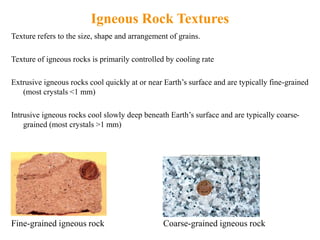
Texture refers to the size, shape and arrangement of grains.
Texture of igneous rocks is primarily controlled by cooling rate
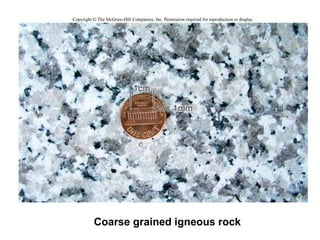
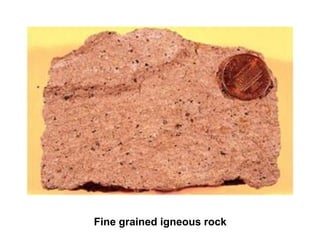
Extrusive igneous rocks cool quickly at or near Earth’s surface and are typically fine-grained
(most crystals <1 mm)
Intrusive igneous rocks cool slowly deep beneath Earth’s surface and are typically coarse-
grained (most crystals >1 mm)
Fine-grained igneous rock Coarse-grained igneous rock
Coarse grained igneous rock
Fine grained igneous rock
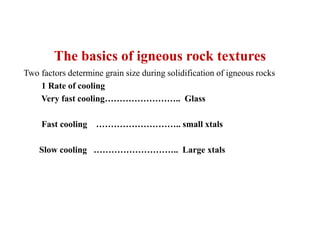
The basics of igneous rock textures
Two factors determine grain size during solidification of igneous rocks
1 Rate of cooling
Very fast cooling…………………….. Glass
Fast cooling ……………………….. small xtals
Slow cooling ……………………….. Large xtals
Petroleum Geology 10
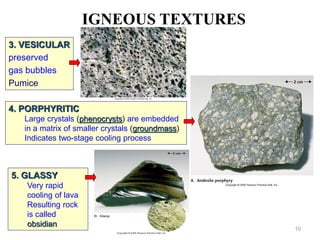
IGNEOUS TEXTURES
3. VESICULAR
preserved
gas bubbles
Pumice
4. PORPHYRITIC
Large crystals (phenocrysts) are embedded
in a matrix of smaller crystals (groundmass)
Indicates two-stage cooling process
5. GLASSY
Very rapid
cooling of lava
Resulting rock
is called
obsidian
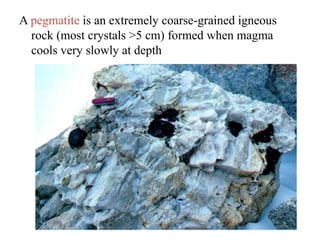
A pegmatite is an extremely coarse-grained igneous
rock (most crystals >5 cm) formed when magma
cools very slowly at depth
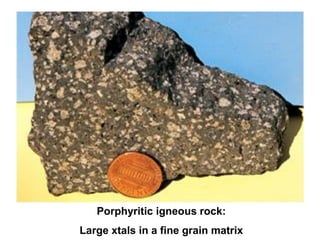
Porphyritic igneous rock:
Large xtals in a fine grain matrix
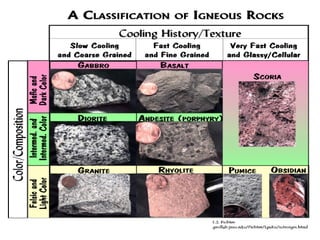
Igneous Rock Identification
Igneous rock names are based on texture (grain size) and mineralogic composition
Igneous rocks are classified according to mode of occurrence, texture, and mineralogical
composition
Textural classification
Plutonic rocks (gabbro-diorite-granite) are coarse-grained and cooled slowly at depth
Volcanic rocks (basalt- andesite- rhyolite) are typically fine-grained and cooled rapidly at the
Earth’s surface
Compositional classification
Mafic rocks (gabbro-basalt) contain abundant dark-colored ferromagnesian minerals
Intermediate rocks (diorite-andesite) contain roughly equal amounts of dark- and light-colored
minerals
Felsic rocks (granite-rhyolite) contain abundant light-colored minerals
Igneous Rock Chemistry
Rock chemistry, particularly silica (SiO2) content, determines mineral content
and general color of igneous rocks
Mafic rocks have 45-55% silica, by weight, and contain dark-colored minerals that are
abundant in iron, magnesium and calcium, also called basic igneous rocks
Intrusive/extrusive Mafic rocks - gabbro/basalt. Basic ign rocks
Felsic (silicic) rocks have >65% silica, by weight, and contain light-colored minerals
that are abundant in silica, aluminum, sodium and potassium, also called acidic
igneous rocks
Intrusive/extrusive Felsic rocks - granite/rhyolite also called acidic ign rocks
Intermediate rocks have silica contents between 55-65% e:g diorite/andesite.
Ultramafic rocks have <45% silica, by weight, and are composed almost entirely of
dark-colored ferromagnesian minerals. Ultra basic ign rocks
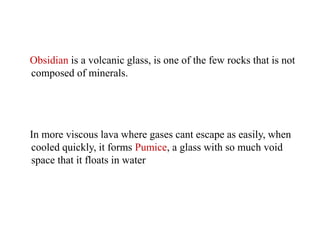
Obsidian is a volcanic glass, is one of the few rocks that is not
composed of minerals.
In more viscous lava where gases cant escape as easily, when
cooled quickly, it forms Pumice, a glass with so much void
space that it floats in water
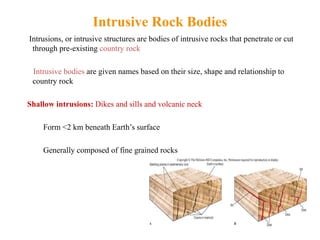
Intrusive Rock Bodies
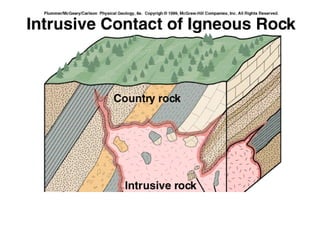
Intrusions, or intrusive structures are bodies of intrusive rocks that penetrate or cut
through pre-existing country rock
Intrusive bodies are given names based on their size, shape and relationship to
country rock
Shallow intrusions: Dikes and sills and volcanic neck
Form <2 km beneath Earth’s surface
Generally composed of fine grained rocks
Intrusive Rock Bodies
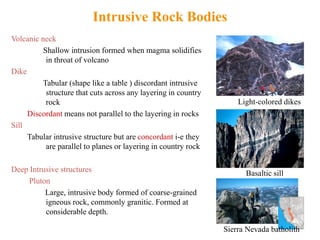
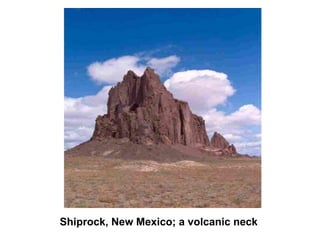
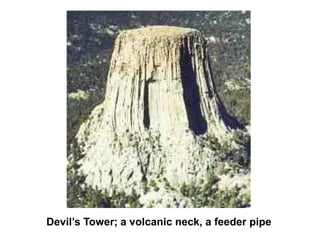
Volcanic neck
Shallow intrusion formed when magma solidifies
in throat of volcano
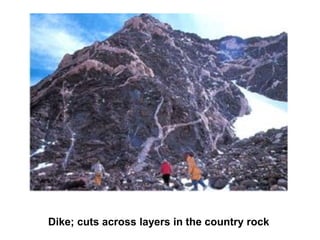
Dike
Tabular (shape like a table ) discordant intrusive
structure that cuts across any layering in country
rock
Discordant means not parallel to the layering in rocks
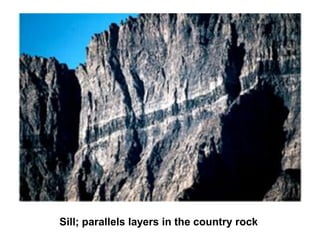
Sill
Tabular intrusive structure but are concordant i-e they
are parallel to planes or layering in country rock
Deep Intrusive structures
Pluton
Large, intrusive body formed of coarse-grained
igneous rock, commonly granitic. Formed at
considerable depth.
Light-colored dikes
Basaltic sill
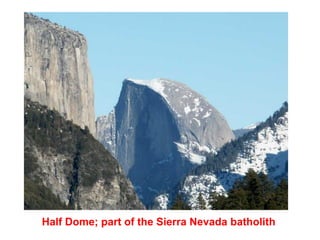
Sierra Nevada batholith
Small plutons (exposed over <100 km2) are called stocks, large
plutons (exposed over >100 km2) are called batholiths. Division
simply on the basis of size.
Batholith and stock both are discordant means they cut
across or are perpendicular to the surrounding country
rocks
Although batholiths often contain mafic and intermediate
rocks, they almost always are predominantly composed
of granite
Shiprock, New Mexico; a volcanic neck
Devil’s Tower; a volcanic neck, a feeder pipe
Dike; cuts across layers in the country rock
Sill; parallels layers in the country rock
Half Dome; part of the Sierra Nevada batholith
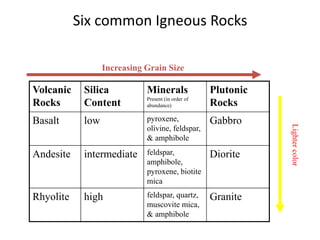
Six common Igneous Rocks
Volcanic
Rocks
Silica
Content
Minerals
Present (in order of
abundance)
Plutonic
Rocks
Basalt low pyroxene,
olivine, feldspar,
& amphibole
Gabbro
Andesite intermediate feldspar,
amphibole,
pyroxene, biotite
mica
Diorite
Rhyolite high feldspar, quartz,
muscovite mica,
& amphibole
Granite
Increasing Grain Size
Lighter
color

Igneous rocks

  • 1.
  • 2.
    Petroleum Geology 2 Moltenrock or liquid usually mostly silica. The liquid may contain dissolved gases as well and some solid material It forms by partial melting in the crust and uppermost mantle to a depth of ~250 km at high temperature and low pressure MAGMA [Greek=“paste”] i.e., molten rock
  • 3.
    Igneous Rocks Igneous rocksform when magma cools and solidifies Intrusive igneous rocks form when magma solidifies underground Granite is a common example Extrusive igneous rocks form when magma solidifies at the Earth’s surface (lava) Basalt is a common example Granite Basalt
  • 4.
    Igneous rocks Intrusive rocksand Extrusive Rocks Intrusive Rocks Rocks which are formed by the solidification or crystallization of magma inside the earth’s surface. Exposed to us only after erosion or Uplift. Intrusive rocks ranges from small bodies filling cracks to huge volumes like granite. Evidences for underground solidification of magma into granite and other intrusive rocks 1” Mineralogically and chemically, identical to volcanic rocks (but are of different textures)
  • 6.
    Igneous Rock Textures Texturerefers to the size, shape and arrangement of grains. Texture of igneous rocks is primarily controlled by cooling rate Extrusive igneous rocks cool quickly at or near Earth’s surface and are typically fine-grained (most crystals <1 mm) Intrusive igneous rocks cool slowly deep beneath Earth’s surface and are typically coarse- grained (most crystals >1 mm) Fine-grained igneous rock Coarse-grained igneous rock
  • 7.
  • 8.
  • 9.
    The basics ofigneous rock textures Two factors determine grain size during solidification of igneous rocks 1 Rate of cooling Very fast cooling…………………….. Glass Fast cooling ……………………….. small xtals Slow cooling ……………………….. Large xtals
  • 10.
    Petroleum Geology 10 IGNEOUSTEXTURES 3. VESICULAR preserved gas bubbles Pumice 4. PORPHYRITIC Large crystals (phenocrysts) are embedded in a matrix of smaller crystals (groundmass) Indicates two-stage cooling process 5. GLASSY Very rapid cooling of lava Resulting rock is called obsidian
  • 11.
    A pegmatite isan extremely coarse-grained igneous rock (most crystals >5 cm) formed when magma cools very slowly at depth
  • 12.
    Porphyritic igneous rock: Largextals in a fine grain matrix
  • 13.
    Igneous Rock Identification Igneousrock names are based on texture (grain size) and mineralogic composition Igneous rocks are classified according to mode of occurrence, texture, and mineralogical composition Textural classification Plutonic rocks (gabbro-diorite-granite) are coarse-grained and cooled slowly at depth Volcanic rocks (basalt- andesite- rhyolite) are typically fine-grained and cooled rapidly at the Earth’s surface Compositional classification Mafic rocks (gabbro-basalt) contain abundant dark-colored ferromagnesian minerals Intermediate rocks (diorite-andesite) contain roughly equal amounts of dark- and light-colored minerals Felsic rocks (granite-rhyolite) contain abundant light-colored minerals
  • 14.
    Igneous Rock Chemistry Rockchemistry, particularly silica (SiO2) content, determines mineral content and general color of igneous rocks Mafic rocks have 45-55% silica, by weight, and contain dark-colored minerals that are abundant in iron, magnesium and calcium, also called basic igneous rocks Intrusive/extrusive Mafic rocks - gabbro/basalt. Basic ign rocks Felsic (silicic) rocks have >65% silica, by weight, and contain light-colored minerals that are abundant in silica, aluminum, sodium and potassium, also called acidic igneous rocks Intrusive/extrusive Felsic rocks - granite/rhyolite also called acidic ign rocks Intermediate rocks have silica contents between 55-65% e:g diorite/andesite. Ultramafic rocks have <45% silica, by weight, and are composed almost entirely of dark-colored ferromagnesian minerals. Ultra basic ign rocks
  • 16.
    Obsidian is avolcanic glass, is one of the few rocks that is not composed of minerals. In more viscous lava where gases cant escape as easily, when cooled quickly, it forms Pumice, a glass with so much void space that it floats in water
  • 17.
    Intrusive Rock Bodies Intrusions,or intrusive structures are bodies of intrusive rocks that penetrate or cut through pre-existing country rock Intrusive bodies are given names based on their size, shape and relationship to country rock Shallow intrusions: Dikes and sills and volcanic neck Form <2 km beneath Earth’s surface Generally composed of fine grained rocks
  • 18.
    Intrusive Rock Bodies Volcanicneck Shallow intrusion formed when magma solidifies in throat of volcano Dike Tabular (shape like a table ) discordant intrusive structure that cuts across any layering in country rock Discordant means not parallel to the layering in rocks Sill Tabular intrusive structure but are concordant i-e they are parallel to planes or layering in country rock Deep Intrusive structures Pluton Large, intrusive body formed of coarse-grained igneous rock, commonly granitic. Formed at considerable depth. Light-colored dikes Basaltic sill Sierra Nevada batholith
  • 19.
    Small plutons (exposedover <100 km2) are called stocks, large plutons (exposed over >100 km2) are called batholiths. Division simply on the basis of size. Batholith and stock both are discordant means they cut across or are perpendicular to the surrounding country rocks Although batholiths often contain mafic and intermediate rocks, they almost always are predominantly composed of granite
  • 20.
    Shiprock, New Mexico;a volcanic neck
  • 21.
    Devil’s Tower; avolcanic neck, a feeder pipe
  • 22.
    Dike; cuts acrosslayers in the country rock
  • 23.
    Sill; parallels layersin the country rock
  • 24.
    Half Dome; partof the Sierra Nevada batholith
  • 25.
    Six common IgneousRocks Volcanic Rocks Silica Content Minerals Present (in order of abundance) Plutonic Rocks Basalt low pyroxene, olivine, feldspar, & amphibole Gabbro Andesite intermediate feldspar, amphibole, pyroxene, biotite mica Diorite Rhyolite high feldspar, quartz, muscovite mica, & amphibole Granite Increasing Grain Size Lighter color