© APT Initiatives Ltd, 2020
apt4Maths
Minimising Workloads
Maximising Performance
GCSE (& Key Stage 3)
MATHEMATICS
Number; Algebra
Types of Number & Sequences
Geometric Sequences – Finding terms
and the nth term
© APT Initiatives Ltd, 2020
Lesson Objectives
• To investigate geometric sequences.
• To teach you how to find the next or
previous terms of a geometric sequence.
• To teach you how to find the expression for
the nth term of a geometric sequence.
© APT Initiatives Ltd, 2020
Types of Sequences
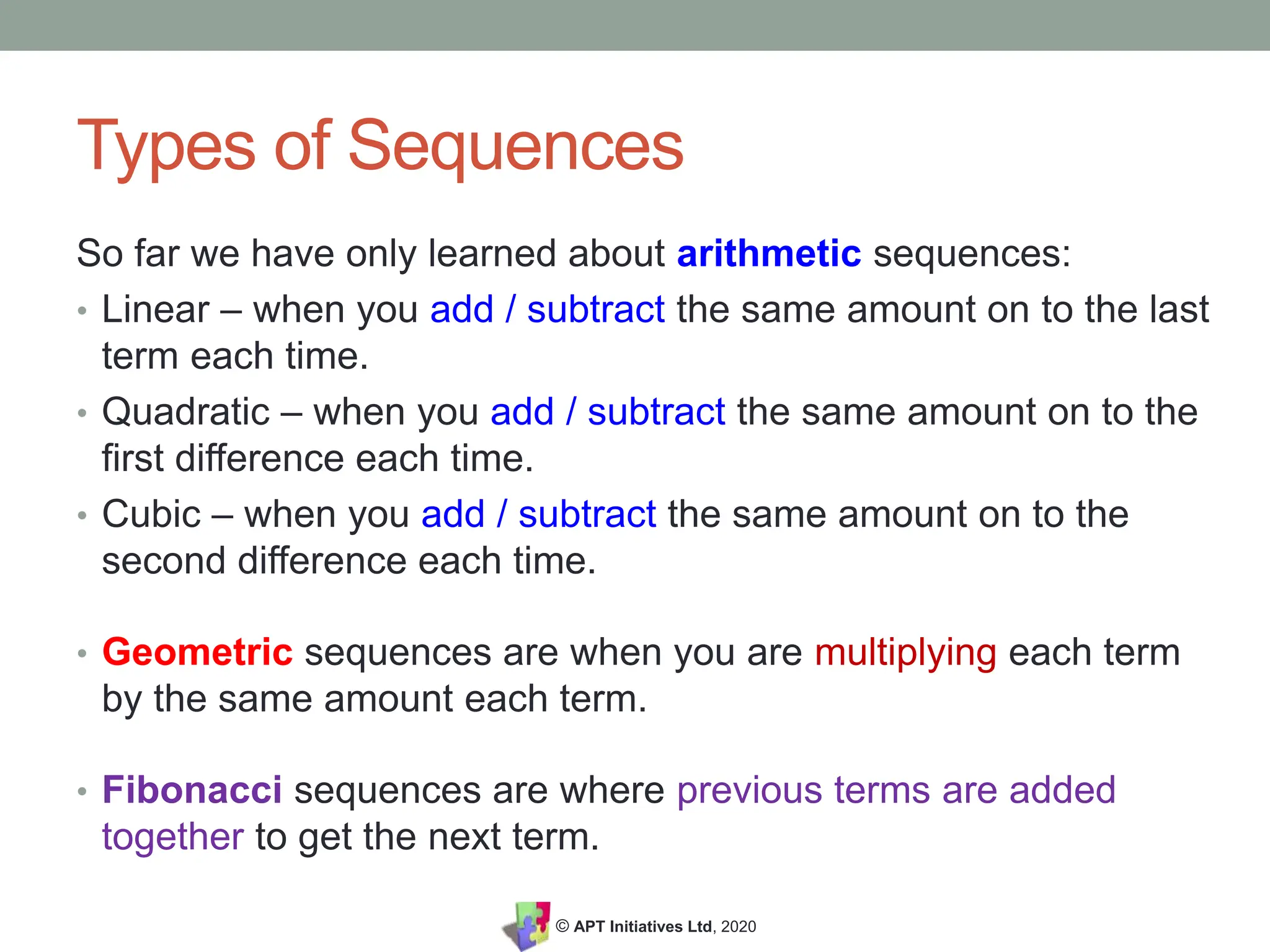
So far we have only learned about arithmetic sequences:
• Linear – when you add / subtract the same amount on to the last
term each time.
• Quadratic – when you add / subtract the same amount on to the
first difference each time.
• Cubic – when you add / subtract the same amount on to the
second difference each time.
• Geometric sequences are when you are multiplying each term
by the same amount each term.
• Fibonacci sequences are where previous terms are added
together to get the next term.
© APT Initiatives Ltd, 2020
Examples
Arithmetic seq: 6 13 20 27 34…
Common difference: +7 +7 +7 +7…
Geometric seq: 2 6 18 54 162…
Common ratio: ×3 ×3 ×3 ×3…
Fibonacci seq: 1 3 4 7 11…
(1+3) (3+4) (4+7)
Rule: Add the last two terms together…
© APT Initiatives Ltd, 2020
Finding Terms of Geometric Sequences
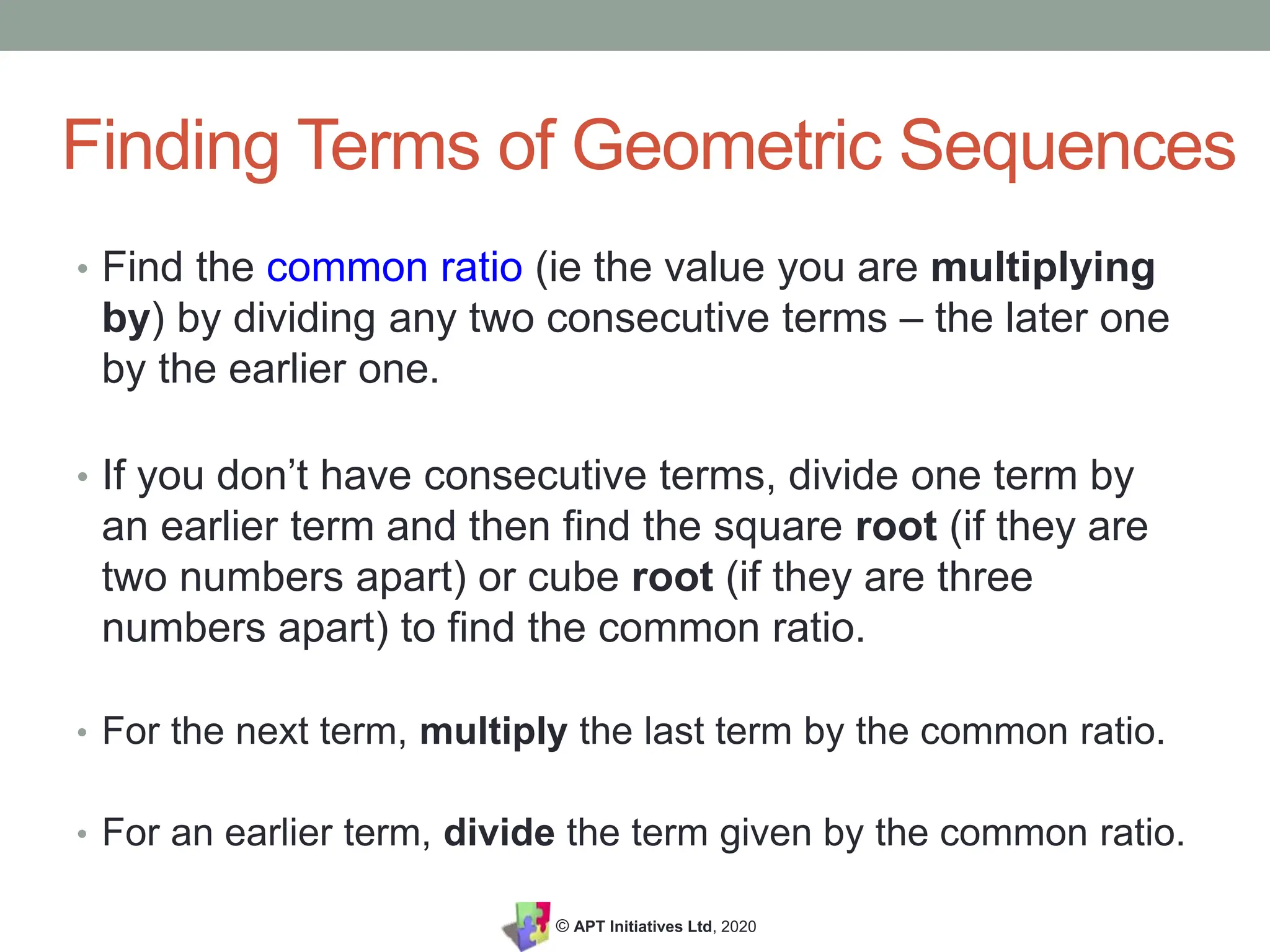
• Find the common ratio (ie the value you are multiplying
by) by dividing any two consecutive terms – the later one
by the earlier one.
• If you don’t have consecutive terms, divide one term by
an earlier term and then find the square root (if they are
two numbers apart) or cube root (if they are three
numbers apart) to find the common ratio.
• For the next term, multiply the last term by the common ratio.
• For an earlier term, divide the term given by the common ratio.
© APT Initiatives Ltd, 2020
Example 1
Find the next and missing term of this sequence:
20000 4000 .….. 160 32…
• Ratio: × 0.2 × 0.2…
• Common ratio = × 0.2 (which is the same as ÷ 5)
• Next term = 32 × 0.2 = 6.4
• Missing term is either…
4000 × 0.2 = 800 (Going forward apply ratio)
or 160 ÷ 0.2 = 800 (Going backward apply inverse)
© APT Initiatives Ltd, 2020
Example 2
Find the next and missing terms of this sequence:
7 .….. 28 …… 112
• Ratio × Ratio: × 4
• Common ratio = √4 = × 2
• Next term = 112 × 2 = 228
• Second term = 7 × 2 = 14 (or 28 ÷ 2 = 14)
• Fourth term = 28 × 2 = 56 (or 112 ÷ 2 = 56)
© APT Initiatives Ltd, 2020
Practice
Find the missing terms in these geometric sequences:
1) 4 20 100 500 ___
2) ___ 5 10 ___ 40
3) 4000 400 ___ 4 ___
When you have worked out the answers, click on to the next slide to check them.
© APT Initiatives Ltd, 2020
Answers
1) 4 20 100 500
×5 ×5 ×5
r = 20 ÷ 4 = 5
2) ___ 5 10 ___ 40
×2
r = 10 ÷ 5 = 2
3) 4000 400 ___ 4 ___
×0.1
r = 400 ÷ 4000 = 0.1
2500
2.5 20
40 0.4
×5
×2
÷2
×0.1
×0.1
×2
×0.1
© APT Initiatives Ltd, 2020
Finding the nth Term – Geometric
To find the nth term of a GEOMETRIC sequence…
Use the general formula: ar(n – 1) or a × r(n – 1)
Where… a = first term and r = common ratio
Eg 3 6 12 24…
a = 3
r = ×2
Expression for the nth term = 3 × 2(n – 1)
Check by substituting n=4, evaluating and checking that the
answer gives the 4th term value of 24…
3 × 2(4 – 1)  3 × 23  3 × 8 = 24
© APT Initiatives Ltd, 2020
Practice
Find the expression for the nth term of these sequences:
1) 5 20 80 320…
2) ? 60 30 15…
3) 1 ? 1 1
16 ? 4 2…
When you have worked out the answers, click on to the next slide to check them.
© APT Initiatives Ltd, 2020
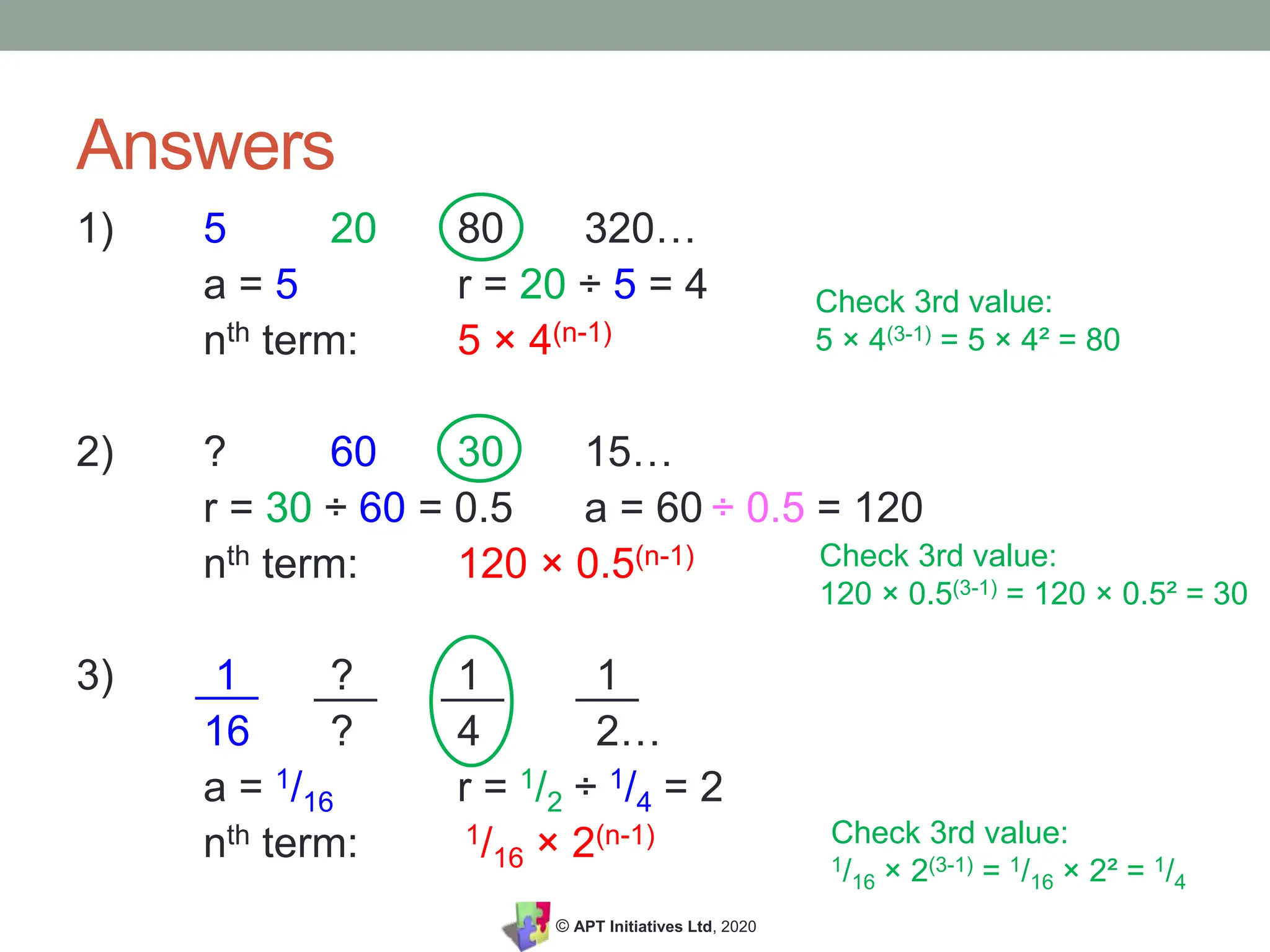
Answers
1) 5 20 80 320…
a = 5 r = 20 ÷ 5 = 4
nth term: 5 × 4(n-1)
2) ? 60 30 15…
r = 30 ÷ 60 = 0.5 a = 60 ÷ 0.5 = 120
nth term: 120 × 0.5(n-1)
3) 1 ? 1 1
16 ? 4 2…
a = 1/16 r = 1/2 ÷ 1/4 = 2
nth term: 1/16 × 2(n-1)
Check 3rd value:
5 × 4(3-1) = 5 × 4² = 80
Check 3rd value:
120 × 0.5(3-1) = 120 × 0.5² = 30
Check 3rd value:
1/16 × 2(3-1) = 1/16 × 2² = 1/4
© APT Initiatives Ltd, 2020
What next?
• It would be wise to make some notes and write down
some examples.
• We haven’t really done many practice questions, and
so you may like to do a few more - using online
resources or past paper questions.
• You could now put together an A4 revision sheet on
the first half of this module (based on types of
number and number sequences) and then move on
to the work on co-ordinates and graphs.

Igcse/ grade 9/ 10 Math 10-Geometric-Sequences.ppsx

  • 1.
    © APT InitiativesLtd, 2020 apt4Maths Minimising Workloads Maximising Performance GCSE (& Key Stage 3) MATHEMATICS Number; Algebra Types of Number & Sequences Geometric Sequences – Finding terms and the nth term
  • 2.
    © APT InitiativesLtd, 2020 Lesson Objectives • To investigate geometric sequences. • To teach you how to find the next or previous terms of a geometric sequence. • To teach you how to find the expression for the nth term of a geometric sequence.
  • 3.
    © APT InitiativesLtd, 2020 Types of Sequences So far we have only learned about arithmetic sequences: • Linear – when you add / subtract the same amount on to the last term each time. • Quadratic – when you add / subtract the same amount on to the first difference each time. • Cubic – when you add / subtract the same amount on to the second difference each time. • Geometric sequences are when you are multiplying each term by the same amount each term. • Fibonacci sequences are where previous terms are added together to get the next term.
  • 4.
    © APT InitiativesLtd, 2020 Examples Arithmetic seq: 6 13 20 27 34… Common difference: +7 +7 +7 +7… Geometric seq: 2 6 18 54 162… Common ratio: ×3 ×3 ×3 ×3… Fibonacci seq: 1 3 4 7 11… (1+3) (3+4) (4+7) Rule: Add the last two terms together…
  • 5.
    © APT InitiativesLtd, 2020 Finding Terms of Geometric Sequences • Find the common ratio (ie the value you are multiplying by) by dividing any two consecutive terms – the later one by the earlier one. • If you don’t have consecutive terms, divide one term by an earlier term and then find the square root (if they are two numbers apart) or cube root (if they are three numbers apart) to find the common ratio. • For the next term, multiply the last term by the common ratio. • For an earlier term, divide the term given by the common ratio.
  • 6.
    © APT InitiativesLtd, 2020 Example 1 Find the next and missing term of this sequence: 20000 4000 .….. 160 32… • Ratio: × 0.2 × 0.2… • Common ratio = × 0.2 (which is the same as ÷ 5) • Next term = 32 × 0.2 = 6.4 • Missing term is either… 4000 × 0.2 = 800 (Going forward apply ratio) or 160 ÷ 0.2 = 800 (Going backward apply inverse)
  • 7.
    © APT InitiativesLtd, 2020 Example 2 Find the next and missing terms of this sequence: 7 .….. 28 …… 112 • Ratio × Ratio: × 4 • Common ratio = √4 = × 2 • Next term = 112 × 2 = 228 • Second term = 7 × 2 = 14 (or 28 ÷ 2 = 14) • Fourth term = 28 × 2 = 56 (or 112 ÷ 2 = 56)
  • 8.
    © APT InitiativesLtd, 2020 Practice Find the missing terms in these geometric sequences: 1) 4 20 100 500 ___ 2) ___ 5 10 ___ 40 3) 4000 400 ___ 4 ___ When you have worked out the answers, click on to the next slide to check them.
  • 9.
    © APT InitiativesLtd, 2020 Answers 1) 4 20 100 500 ×5 ×5 ×5 r = 20 ÷ 4 = 5 2) ___ 5 10 ___ 40 ×2 r = 10 ÷ 5 = 2 3) 4000 400 ___ 4 ___ ×0.1 r = 400 ÷ 4000 = 0.1 2500 2.5 20 40 0.4 ×5 ×2 ÷2 ×0.1 ×0.1 ×2 ×0.1
  • 10.
    © APT InitiativesLtd, 2020 Finding the nth Term – Geometric To find the nth term of a GEOMETRIC sequence… Use the general formula: ar(n – 1) or a × r(n – 1) Where… a = first term and r = common ratio Eg 3 6 12 24… a = 3 r = ×2 Expression for the nth term = 3 × 2(n – 1) Check by substituting n=4, evaluating and checking that the answer gives the 4th term value of 24… 3 × 2(4 – 1)  3 × 23  3 × 8 = 24
  • 11.
    © APT InitiativesLtd, 2020 Practice Find the expression for the nth term of these sequences: 1) 5 20 80 320… 2) ? 60 30 15… 3) 1 ? 1 1 16 ? 4 2… When you have worked out the answers, click on to the next slide to check them.
  • 12.
    © APT InitiativesLtd, 2020 Answers 1) 5 20 80 320… a = 5 r = 20 ÷ 5 = 4 nth term: 5 × 4(n-1) 2) ? 60 30 15… r = 30 ÷ 60 = 0.5 a = 60 ÷ 0.5 = 120 nth term: 120 × 0.5(n-1) 3) 1 ? 1 1 16 ? 4 2… a = 1/16 r = 1/2 ÷ 1/4 = 2 nth term: 1/16 × 2(n-1) Check 3rd value: 5 × 4(3-1) = 5 × 4² = 80 Check 3rd value: 120 × 0.5(3-1) = 120 × 0.5² = 30 Check 3rd value: 1/16 × 2(3-1) = 1/16 × 2² = 1/4
  • 13.
    © APT InitiativesLtd, 2020 What next? • It would be wise to make some notes and write down some examples. • We haven’t really done many practice questions, and so you may like to do a few more - using online resources or past paper questions. • You could now put together an A4 revision sheet on the first half of this module (based on types of number and number sequences) and then move on to the work on co-ordinates and graphs.