Prototyping GOES-R
    Albedo Algorithm Based
        on MODIS Data
         Tao Hea, Shunlin Lianga, Dongdong Wanga
a. Department of Geography, University of Maryland, College Park, USA
                           Hongyi Wub
  b. University of Electronic Science and Technology of China, China
                            Yunyue Yuc
                    c. NOAA/NESDIS/STAR, USA
                      Presented by Tao He
                           the@umd.edu
                             Jul 29, 2011
Contents


  1    Introduction


  2    Methodology


  3    Data and Results


  4    Summary and Conclusions
Introduction

§  Surface albedo is defined as the ratio of
  outgoing and incoming radiation at Earth
  surface.
  §    Essential in energy budget
  §    Climate change studies
  §    Hydrology cycle
  §    Weather forcast
  §    …
§  Current satellite albedo products
  §  MODIS, MISR, MERIS, MSG/SEVIRI, …
GOES-R ABI

§  The Advanced Baseline Imager (ABI) is the
  primary instrument onboard GOES-R for
  weather, climate and environmental studies.
  §  Temporal resolution: 15min
  §  Spatial resolution: 0.5 – 2km
  §  Spectral bands: 6 bands in solar range (0.4 – 2.3
      µm)
§  Abundant spectral and angular information
  can be available within a small time period
  to derive surface spectral BRDF and
  broadband albedo.
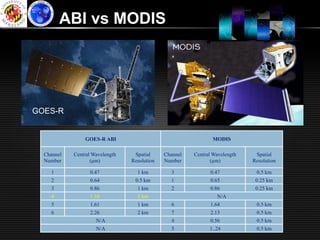
ABI vs MODIS


GOES-R


                GOES-R ABI                                     MODIS

  Channel   Central Wavelength    Spatial     Channel   Central Wavelength    Spatial
  Number           (µm)          Resolution   Number           (µm)          Resolution

    1              0.47            1 km         3              0.47           0.5 km
    2              0.64           0.5 km        1              0.65           0.25 km
    3              0.86            1 km         2              0.86           0.25 km
    4              1.38            2 km                          N/A
    5              1.61            1 km         6              1.64           0.5 km
    6              2.26            2 km         7              2.13           0.5 km
                     N/A                        4              0.56           0.5 km
                     N/A                        5             1..24           0.5 km
Existing Methods

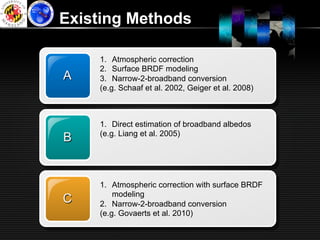
    1.  Atmospheric correction
    2.  Surface BRDF modeling
A   3.  Narrow-2-broadband conversion
    (e.g. Schaaf et al. 2002, Geiger et al. 2008)


    1.  Direct estimation of broadband albedos
    (e.g. Liang et al. 2005)
B


    1.  Atmospheric correction with surface BRDF
        modeling
C   2.  Narrow-2-broadband conversion
    (e.g. Govaerts et al. 2010)
Objectives

§  Using MODIS TOA data as proxy to prototype
    the future GOES-R albedo algorithm based on
    atmospheric correction with BRDF modeling;
§  Estimating instantaneous albedo/reflectance as
    well as instantaneous aerosol optical depth;
§  Improving the albedo estimation over rapidly-
    changing surfaces;
§  Validating/verifying albedo/reflectance estimates
    with multiple datasets.
Methodology
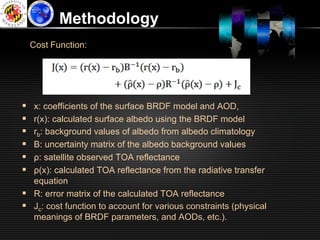
      Cost Function:


§  x: coefficients of the surface BRDF model and AOD,
§  r(x): calculated surface albedo using the BRDF model
§  rb: background values of albedo from albedo climatology
§  B: uncertainty matrix of the albedo background values
§  ρ: satellite observed TOA reflectance
§  ρ(x): calculated TOA reflectance from the radiative transfer
    equation
§  R: error matrix of the calculated TOA reflectance
§  Jc: cost function to account for various constraints (physical
    meanings of BRDF parameters, and AODs, etc.).
Atmospheric Radiative Transfer Solution
               with Land Surface BRDF Modeling
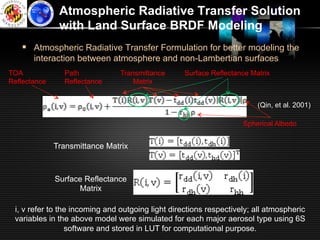
   §  Atmospheric Radiative Transfer Formulation for better modeling the
       interaction between atmosphere and non-Lambertian surfaces
TOA             Path            Transmittance      Surface Reflectance Matrix
Reflectance     Reflectance         Matrix


                                                                         (Qin, et al. 2001)

                                                                    Spherical Albedo


              Transmittance Matrix


              Surface Reflectance
                    Matrix

 i, v refer to the incoming and outgoing light directions respectively; all atmospheric
 variables in the above model were simulated for each major aerosol type using 6S
                 software and stored in LUT for computational purpose.
Atmospheric Radiative Transfer Solution
      with Land Surface BRDF Modeling (cont.)

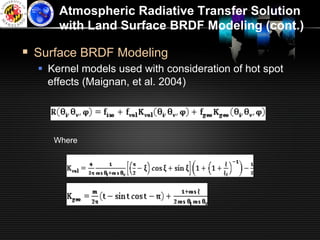
§  Surface BRDF Modeling
  §  Kernel models used with consideration of hot spot
      effects (Maignan, et al. 2004)


     Where
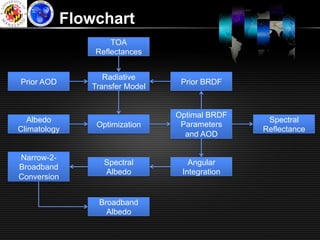
Flowchart
                     TOA
                 Reflectances


                   Radiative
Prior AOD                         Prior BRDF
                Transfer Model


                                 Optimal BRDF
  Albedo                                         Spectral
                 Optimization     Parameters
Climatology                                     Reflectance
                                   and AOD

Narrow-2-
                   Spectral         Angular
Broadband
                   Albedo         Integration
Conversion


                 Broadband
                   Albedo
Data

§  Satellite data & products
   §  MODIS L1B data (TOA radiance, geometry)
   §  MODIS cloud mask
§  Ancillary data
   §  Albedo climatology maps from multi-year MODIS
       albedo products (2000 – 2009)
   §  NCEP water vapor
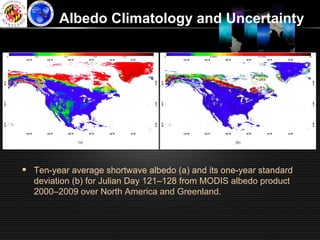
Albedo Climatology and Uncertainty


§  Ten-year average shortwave albedo (a) and its one-year standard
  deviation (b) for Julian Day 121–128 from MODIS albedo product
  2000–2009 over North America and Greenland.
Validation Datasets

§  Ground measurements
   §  AmeriFlux
   §  Surface Radiation (SURFRAD) Network
   §  Greenland Climate Network (GC-Net)
§  Satellite data calibrated with in-situ aerosol data
   §  MODASRVN (Wang et al. 2009)
§  Finer resolution satellite data
   §  Landsat data from LEDAPS (Vermote et al. 2007)
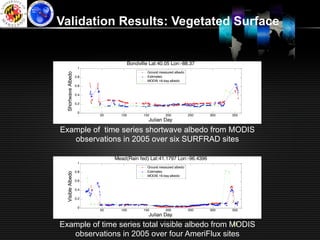
Validation Results: Vegetated Surface


                                        Bondville Lat:40.05 Lon:-88.37
                      1
                                                 Ground measured albedo
  Shortwave Albedo
                     0.8                         Estimates
                                                 MODIS 16-day albedo
                     0.6

                     0.4

                     0.2

                      0
                           50     100          150         200            250   300   350
                                                 Julian Day

Example of time series shortwave albedo from MODIS
   observations in 2005 over six SURFRAD sites

                                Mead(Rain fed) Lat:41.1797 Lon:-96.4396
                      1
                                                 Ground measured albedo
                     0.8                         Estimates
  Visible Albedo


                                                 MODIS 16-day albedo
                     0.6

                     0.4

                     0.2

                      0
                           50     100          150         200            250   300   350
                                                 Julian Day

Example of time series total visible albedo from MODIS
                                                  15

   observations in 2005 over four AmeriFlux sites
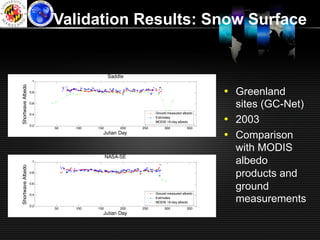
Validation Results: Snow Surface


                                          Saddle
                    1
Shortwave Albedo


                   0.8                                                              •  Greenland
                   0.6
                                                                                       sites (GC-Net)
                   0.4                                     Ground measured albedo


                   0.2
                                                           Estimates
                                                           MODIS 16-day albedo      •  2003
                         50   100   150        200   250        300          350
                                      Julian Day
                                                                                    •  Comparison
                                                                                       with MODIS
                                                                                       albedo
                                          NASA-SE
                    1
Shortwave Albedo


                   0.8
                                                                                       products and
                   0.6

                                                           Ground measured albedo
                                                                                       ground
                                                                                       measurements
                   0.4
                                                           Estimates
                                                           MODIS 16-day albedo
                   0.2
                         50   100   150        200   250        300          350
                                      Julian Day
.

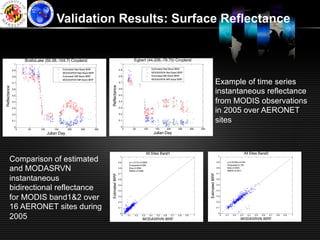
                                           Validation Results: Surface Reflectance


                        BrattsLake (50.28,-104.7) Cropland                                                       Egbert (44.226,-79.75) Cropland
               1                                                                                   1

                                                Estimated Red Band IBRF                          0.9                              Estimated Red Band IBRF
              0.9
                                                MODASRVN Red Band IBRF                                                            MODASRVN Red Band IBRF
              0.8                               Estimated NIR Band IBRF                          0.8                              Estimated NIR Band IBRF


                                                                                                                                                                                                         Example of time series
                                                MODASRVN NIR Band IBRF                                                            MODASRVN NIR Band IBRF
              0.7                                                                                0.7


                                                                                Reflectance
Reflectance


              0.6

              0.5
                                                                                                 0.6

                                                                                                 0.5
                                                                                                                                                                                                         instantaneous reflectance
              0.4                                                                                0.4                                                                                                     from MODIS observations
                                                                                                                                                                                                         in 2005 over AERONET
              0.3                                                                                0.3

              0.2                                                                                0.2

              0.1                                                                                0.1
                                                                                                                                                                                                         sites
               0                                                                                   0
                    0    50     100       150      200       250          300                          0         50      100           150      200         250         300       350

                                      Julian Day                                                                                      Julian Day


                                                                                                                              All Sites Band1                                                                                        All Sites Band2
        Comparison of estimated
                                                                                                  1                                                                                                       1

                                                                                                 0.9        y=1.0177x+0.0065                                                                             0.9        y=0.91535x+0.024


        and MODASRVN
                                                                                                            R-squared=0.698                                                                                         R-squared=0.732
                                                                                                 0.8        Bias=0.0084                                                                                  0.8        Bias=0.0025
                                                                                                            RMSE=0.0269                                                                                             RMSE=0.0471
                                                                                                                                                                                                         0.7


                                                                                                                                                                                        Estimated IBRF
                                                                                                 0.7
                                                                                Estimated IBRF


        instantaneous                                                                            0.6                                                                                                     0.6


        bidirectional reflectance
                                                                                                 0.5                                                                                                     0.5

                                                                                                 0.4                                                                                                     0.4


        for MODIS band1&2 over                                                                   0.3

                                                                                                 0.2
                                                                                                                                                                                                         0.3

                                                                                                                                                                                                         0.2

        16 AERONET sites during                                                                  0.1                                                                                                     0.1


        2005
                                                                                                  0                                                                                                       0
                                                                                                       0   0.1    0.2   0.3     0.4     0.5   0.6     0.7   0.8   0.9         1                                0   0.1   0.2   0.3     0.4   0.5   0.6   0.7   0.8   0.9   1
                                                                                                                        MODASRVN IBRF                                                                                          MODASRVN IBRF
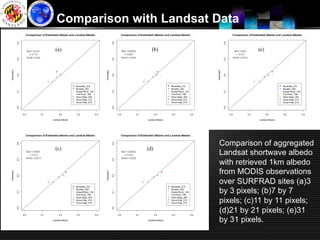
Comparison with Landsat Data


                        Comparison of aggregated
                        Landsat shortwave albedo
                        with retrieved 1km albedo
                        from MODIS observations
                        over SURFRAD sites (a)3
                        by 3 pixels; (b)7 by 7
                        pixels; (c)11 by 11 pixels;
                        (d)21 by 21 pixels; (e)31
                        by 31 pixels.
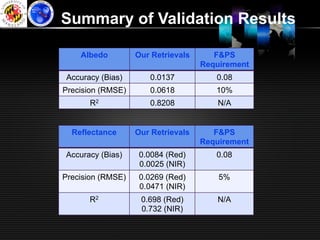
Summary of Validation Results

    Albedo	
       Our Retrievals      F&PS
                                    Requirement
Accuracy (Bias)       0.0137           0.08
Precision (RMSE)      0.0618           10%
      R2              0.8208            N/A


  Reflectance	
    Our Retrievals      F&PS
                                    Requirement
Accuracy (Bias)     0.0084 (Red)       0.08
                    0.0025 (NIR)
Precision (RMSE)    0.0269 (Red)        5%
                    0.0471 (NIR)
      R2            0.698 (Red)        N/A
                    0.732 (NIR)
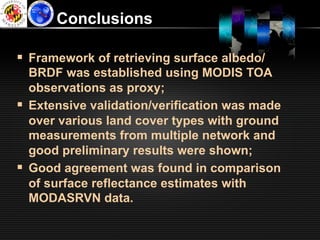
Conclusions

§  Framework of retrieving surface albedo/
    BRDF was established using MODIS TOA
    observations as proxy;
§  Extensive validation/verification was made
    over various land cover types with ground
    measurements from multiple network and
    good preliminary results were shown;
§  Good agreement was found in comparison
    of surface reflectance estimates with
    MODASRVN data.
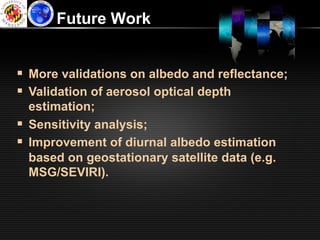
Future Work


§  More validations on albedo and reflectance;
§  Validation of aerosol optical depth
    estimation;
§  Sensitivity analysis;
§  Improvement of diurnal albedo estimation
    based on geostationary satellite data (e.g.
    MSG/SEVIRI).
Questions?

FR3TO5.1.pdf

  • 1.
    Prototyping GOES-R Albedo Algorithm Based on MODIS Data Tao Hea, Shunlin Lianga, Dongdong Wanga a. Department of Geography, University of Maryland, College Park, USA Hongyi Wub b. University of Electronic Science and Technology of China, China Yunyue Yuc c. NOAA/NESDIS/STAR, USA Presented by Tao He the@umd.edu Jul 29, 2011
  • 2.
    Contents 1 Introduction 2 Methodology 3 Data and Results 4 Summary and Conclusions
  • 3.
    Introduction §  Surface albedois defined as the ratio of outgoing and incoming radiation at Earth surface. §  Essential in energy budget §  Climate change studies §  Hydrology cycle §  Weather forcast §  … §  Current satellite albedo products §  MODIS, MISR, MERIS, MSG/SEVIRI, …
  • 4.
    GOES-R ABI §  TheAdvanced Baseline Imager (ABI) is the primary instrument onboard GOES-R for weather, climate and environmental studies. §  Temporal resolution: 15min §  Spatial resolution: 0.5 – 2km §  Spectral bands: 6 bands in solar range (0.4 – 2.3 µm) §  Abundant spectral and angular information can be available within a small time period to derive surface spectral BRDF and broadband albedo.
  • 5.
    ABI vs MODIS GOES-R GOES-R ABI MODIS Channel Central Wavelength Spatial Channel Central Wavelength Spatial Number (µm) Resolution Number (µm) Resolution 1 0.47 1 km 3 0.47 0.5 km 2 0.64 0.5 km 1 0.65 0.25 km 3 0.86 1 km 2 0.86 0.25 km 4 1.38 2 km N/A 5 1.61 1 km 6 1.64 0.5 km 6 2.26 2 km 7 2.13 0.5 km N/A 4 0.56 0.5 km N/A 5 1..24 0.5 km
  • 6.
    Existing Methods 1.  Atmospheric correction 2.  Surface BRDF modeling A 3.  Narrow-2-broadband conversion (e.g. Schaaf et al. 2002, Geiger et al. 2008) 1.  Direct estimation of broadband albedos (e.g. Liang et al. 2005) B 1.  Atmospheric correction with surface BRDF modeling C 2.  Narrow-2-broadband conversion (e.g. Govaerts et al. 2010)
  • 7.
    Objectives §  Using MODISTOA data as proxy to prototype the future GOES-R albedo algorithm based on atmospheric correction with BRDF modeling; §  Estimating instantaneous albedo/reflectance as well as instantaneous aerosol optical depth; §  Improving the albedo estimation over rapidly- changing surfaces; §  Validating/verifying albedo/reflectance estimates with multiple datasets.
  • 8.
    Methodology Cost Function: §  x: coefficients of the surface BRDF model and AOD, §  r(x): calculated surface albedo using the BRDF model §  rb: background values of albedo from albedo climatology §  B: uncertainty matrix of the albedo background values §  ρ: satellite observed TOA reflectance §  ρ(x): calculated TOA reflectance from the radiative transfer equation §  R: error matrix of the calculated TOA reflectance §  Jc: cost function to account for various constraints (physical meanings of BRDF parameters, and AODs, etc.).
  • 9.
    Atmospheric Radiative TransferSolution with Land Surface BRDF Modeling §  Atmospheric Radiative Transfer Formulation for better modeling the interaction between atmosphere and non-Lambertian surfaces TOA Path Transmittance Surface Reflectance Matrix Reflectance Reflectance Matrix (Qin, et al. 2001) Spherical Albedo Transmittance Matrix Surface Reflectance Matrix i, v refer to the incoming and outgoing light directions respectively; all atmospheric variables in the above model were simulated for each major aerosol type using 6S software and stored in LUT for computational purpose.
  • 10.
    Atmospheric Radiative TransferSolution with Land Surface BRDF Modeling (cont.) §  Surface BRDF Modeling §  Kernel models used with consideration of hot spot effects (Maignan, et al. 2004) Where
  • 11.
    Flowchart TOA Reflectances Radiative Prior AOD Prior BRDF Transfer Model Optimal BRDF Albedo Spectral Optimization Parameters Climatology Reflectance and AOD Narrow-2- Spectral Angular Broadband Albedo Integration Conversion Broadband Albedo
  • 12.
    Data §  Satellite data& products §  MODIS L1B data (TOA radiance, geometry) §  MODIS cloud mask §  Ancillary data §  Albedo climatology maps from multi-year MODIS albedo products (2000 – 2009) §  NCEP water vapor
  • 13.
    Albedo Climatology andUncertainty §  Ten-year average shortwave albedo (a) and its one-year standard deviation (b) for Julian Day 121–128 from MODIS albedo product 2000–2009 over North America and Greenland.
  • 14.
    Validation Datasets §  Groundmeasurements §  AmeriFlux §  Surface Radiation (SURFRAD) Network §  Greenland Climate Network (GC-Net) §  Satellite data calibrated with in-situ aerosol data §  MODASRVN (Wang et al. 2009) §  Finer resolution satellite data §  Landsat data from LEDAPS (Vermote et al. 2007)
  • 15.
    Validation Results: VegetatedSurface Bondville Lat:40.05 Lon:-88.37 1 Ground measured albedo Shortwave Albedo 0.8 Estimates MODIS 16-day albedo 0.6 0.4 0.2 0 50 100 150 200 250 300 350 Julian Day Example of time series shortwave albedo from MODIS observations in 2005 over six SURFRAD sites Mead(Rain fed) Lat:41.1797 Lon:-96.4396 1 Ground measured albedo 0.8 Estimates Visible Albedo MODIS 16-day albedo 0.6 0.4 0.2 0 50 100 150 200 250 300 350 Julian Day Example of time series total visible albedo from MODIS 15 observations in 2005 over four AmeriFlux sites
  • 16.
    Validation Results: SnowSurface Saddle 1 Shortwave Albedo 0.8 •  Greenland 0.6 sites (GC-Net) 0.4 Ground measured albedo 0.2 Estimates MODIS 16-day albedo •  2003 50 100 150 200 250 300 350 Julian Day •  Comparison with MODIS albedo NASA-SE 1 Shortwave Albedo 0.8 products and 0.6 Ground measured albedo ground measurements 0.4 Estimates MODIS 16-day albedo 0.2 50 100 150 200 250 300 350 Julian Day
  • 17.
    . Validation Results: Surface Reflectance BrattsLake (50.28,-104.7) Cropland Egbert (44.226,-79.75) Cropland 1 1 Estimated Red Band IBRF 0.9 Estimated Red Band IBRF 0.9 MODASRVN Red Band IBRF MODASRVN Red Band IBRF 0.8 Estimated NIR Band IBRF 0.8 Estimated NIR Band IBRF Example of time series MODASRVN NIR Band IBRF MODASRVN NIR Band IBRF 0.7 0.7 Reflectance Reflectance 0.6 0.5 0.6 0.5 instantaneous reflectance 0.4 0.4 from MODIS observations in 2005 over AERONET 0.3 0.3 0.2 0.2 0.1 0.1 sites 0 0 0 50 100 150 200 250 300 0 50 100 150 200 250 300 350 Julian Day Julian Day All Sites Band1 All Sites Band2 Comparison of estimated 1 1 0.9 y=1.0177x+0.0065 0.9 y=0.91535x+0.024 and MODASRVN R-squared=0.698 R-squared=0.732 0.8 Bias=0.0084 0.8 Bias=0.0025 RMSE=0.0269 RMSE=0.0471 0.7 Estimated IBRF 0.7 Estimated IBRF instantaneous 0.6 0.6 bidirectional reflectance 0.5 0.5 0.4 0.4 for MODIS band1&2 over 0.3 0.2 0.3 0.2 16 AERONET sites during 0.1 0.1 2005 0 0 0 0.1 0.2 0.3 0.4 0.5 0.6 0.7 0.8 0.9 1 0 0.1 0.2 0.3 0.4 0.5 0.6 0.7 0.8 0.9 1 MODASRVN IBRF MODASRVN IBRF
  • 18.
    Comparison with LandsatData Comparison of aggregated Landsat shortwave albedo with retrieved 1km albedo from MODIS observations over SURFRAD sites (a)3 by 3 pixels; (b)7 by 7 pixels; (c)11 by 11 pixels; (d)21 by 21 pixels; (e)31 by 31 pixels.
  • 19.
    Summary of ValidationResults Albedo Our Retrievals F&PS Requirement Accuracy (Bias) 0.0137 0.08 Precision (RMSE) 0.0618 10% R2 0.8208 N/A Reflectance Our Retrievals F&PS Requirement Accuracy (Bias) 0.0084 (Red) 0.08 0.0025 (NIR) Precision (RMSE) 0.0269 (Red) 5% 0.0471 (NIR) R2 0.698 (Red) N/A 0.732 (NIR)
  • 20.
    Conclusions §  Framework ofretrieving surface albedo/ BRDF was established using MODIS TOA observations as proxy; §  Extensive validation/verification was made over various land cover types with ground measurements from multiple network and good preliminary results were shown; §  Good agreement was found in comparison of surface reflectance estimates with MODASRVN data.
  • 21.
    Future Work §  Morevalidations on albedo and reflectance; §  Validation of aerosol optical depth estimation; §  Sensitivity analysis; §  Improvement of diurnal albedo estimation based on geostationary satellite data (e.g. MSG/SEVIRI).
  • 22.