1
Introduction
• What is IFRS?
– International financial reporting standards are
a set of accounting standards developed by
the international accounting standard board
that is becoming the global standard for the
presentation of public company financial
statements
2
Introduction
• Why IFRS?
– Demand for one set of common global
reporting Standards
– International Companies desire to use one set
of financial standards throughout the world
– Growth in capital markets ( IFRS enhances
the ability of filers to raise capital outside their
borders)
– Reducing Capital Cost and Reporting Costs
3
How India is Converging?
• Specified approach
• Thirty Five IND AS
• Date of Implementation
• Comparatives
4
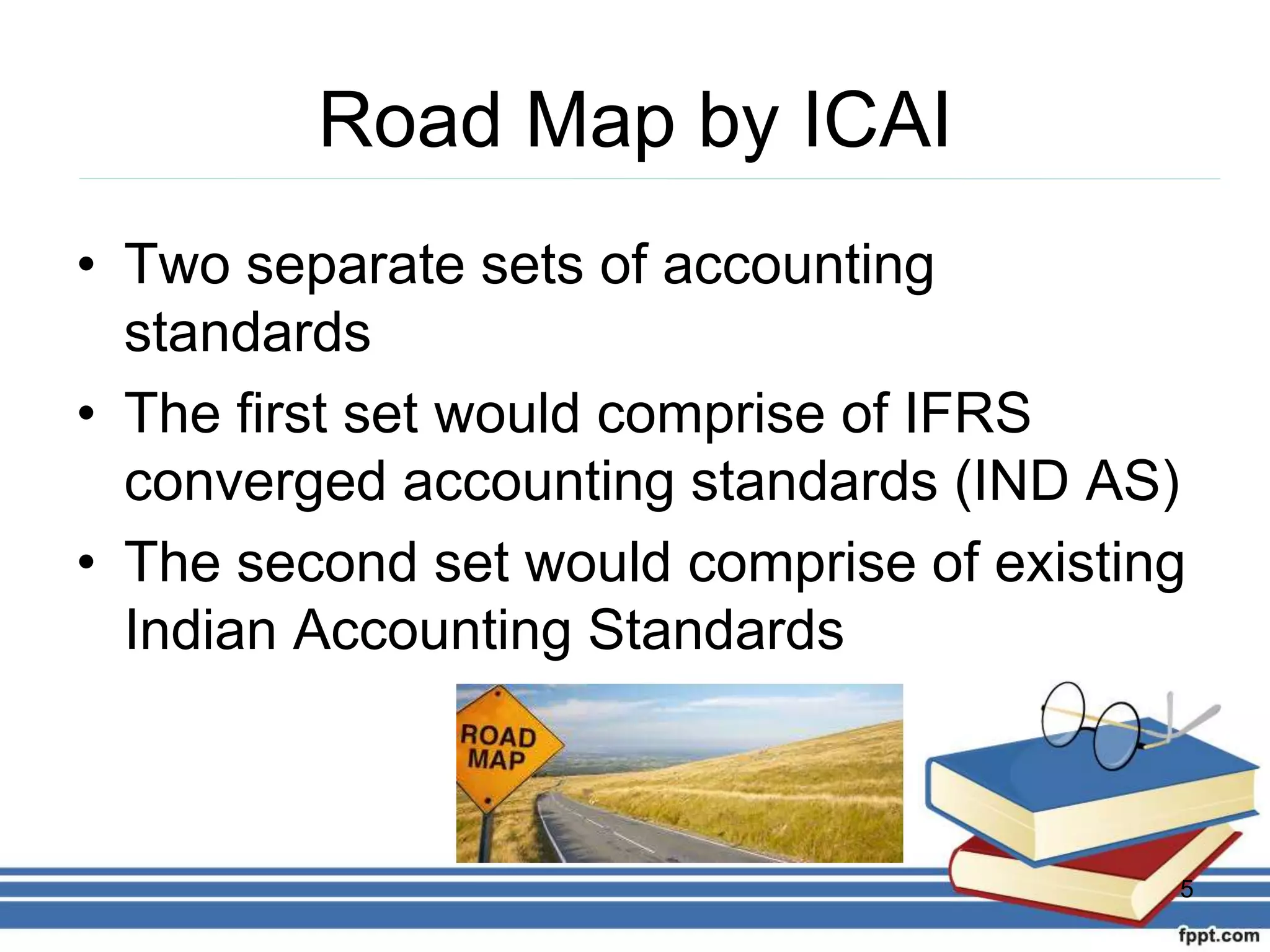
Road Map by ICAI
• Two separate sets of accounting
standards
• The first set would comprise of IFRS
converged accounting standards (IND AS)
• The second set would comprise of existing
Indian Accounting Standards
5
Specified Approach
• Specified class of companies
• Listed Companies
• Un listed companies having networth of 500
Cr INR or more
• Holding & Subsidiaries of companies covered
above
6
Comparatives
For this purpose an entity should in its op IND AS B/s
A)All assets and liabilities whose recognition is required by IND AS
B)Not recognize items as assets or liabilities if IND AS do not permit
such recognition
C) Reclassify the items that it recognized in accordance with IND AS
D) Apply IND AS in measuring all recognizing assets and liabilites
• It may also be noted that the op. balance Sheet is to be prepared on
the date of transition ie., the beginning of the earliest comparative
period presented eg: If an entity adopted IND AS from 2016-17 its
date of transition will be 1st April 2015 and thus it required to prepare
its opening IND AS balance sheet on 1st April, 2015
7
Other Clarifications …….
• Voluntary Adoption
– Option for Other than specified companies
• Net worth
– Share Capital + Reserve less revaluation
reserve
8
Impact of IFRS
• IFRS is heavy on Transparency and
impact accounting
• All the events that have impact on
company’s finances have to be accounted
• It also stringent income recognition rules
• Global Benchmarking
9
Benefits of Global Compatibility
– The Economy
– Corporate world
– Investors
– Accounting Professionals
– Bank/Financial Institutions
– Regulators
10
Major Changes of AS/IFRS
• Principal Based Vs Rule Based Standards
• Standards Vs Local Laws
• Presentation of Financial Statements
• Depreciation on Fixed assets
• Cash Flow Statements
• Valuations
• Changing in Accounting policy
• Adoption Methodology
11
Key Challenges….!!
• Economic Environment
• SME’s problems
• Training to preparers
• Interpretation
12
IND AS & Carve Outs
What is Carve Out??
Difference between IND
AS and equivalent requirement under
IFRS
13
Categorization….
• Mandatory Deviations from IFRS
• Optional Deviations from IFRS
• Removal of Choices
• Others
14
Mandatory Deviations…..
• Recognition
– Revenues from sales of real estate on a
percentage basis
– embedded foreign currency conversion option
as equity
– Bargain purchase gains as capital reserves
– Mandatory use of Govt. securities yields
– Fair value of financial liabilities
15
Optional deviations….
• Choice to
– Defer exchange differences
– Deemed Cost for fixed assets
– De recognition provisions prospectively
– Exemption for financial instruments
16
Removal of Choices…
• Single Statement presentation
• Classification of
– Expenses
– Interest and Dividend
• Carry investment property at fair value
• Govt. grants should be classified as
deferred income
• Recognition of actuarial gains in reserves
17
Others ….
• No Separate guidance on accounting for
biological assets
• Deferral of accounting for embedded
leases
• Deferral of accounting for service
concession arrangements
• Goodwill may be recognized
18
Statutory’s Initiatives
• Providing education and training
– Certification courses offered
– IFRS e-learning course has been launched
– Large scale IFRS awareness drive with MCA
collaboration
– Conceptual differences with IASB
– Organizing of Workshops
19
Conclusion
• Irrespective of challenges adoption of
IFRS in INDIA will significantly change the
contents of corporate financial statements
as a result of :
More refined measurements
Enhanced disclosures
20
Truthful remarks….
A small truth to make our Life 100%
successful ..........
If
A B C D E F G H I J K L M N O P Q R S T U V
W X Y Z
Is equal to
1 2 3 4 5 6 7 8 9 10 11 12 13 14 15 16 17 18 19 20 21
22 23 24 25 26
21
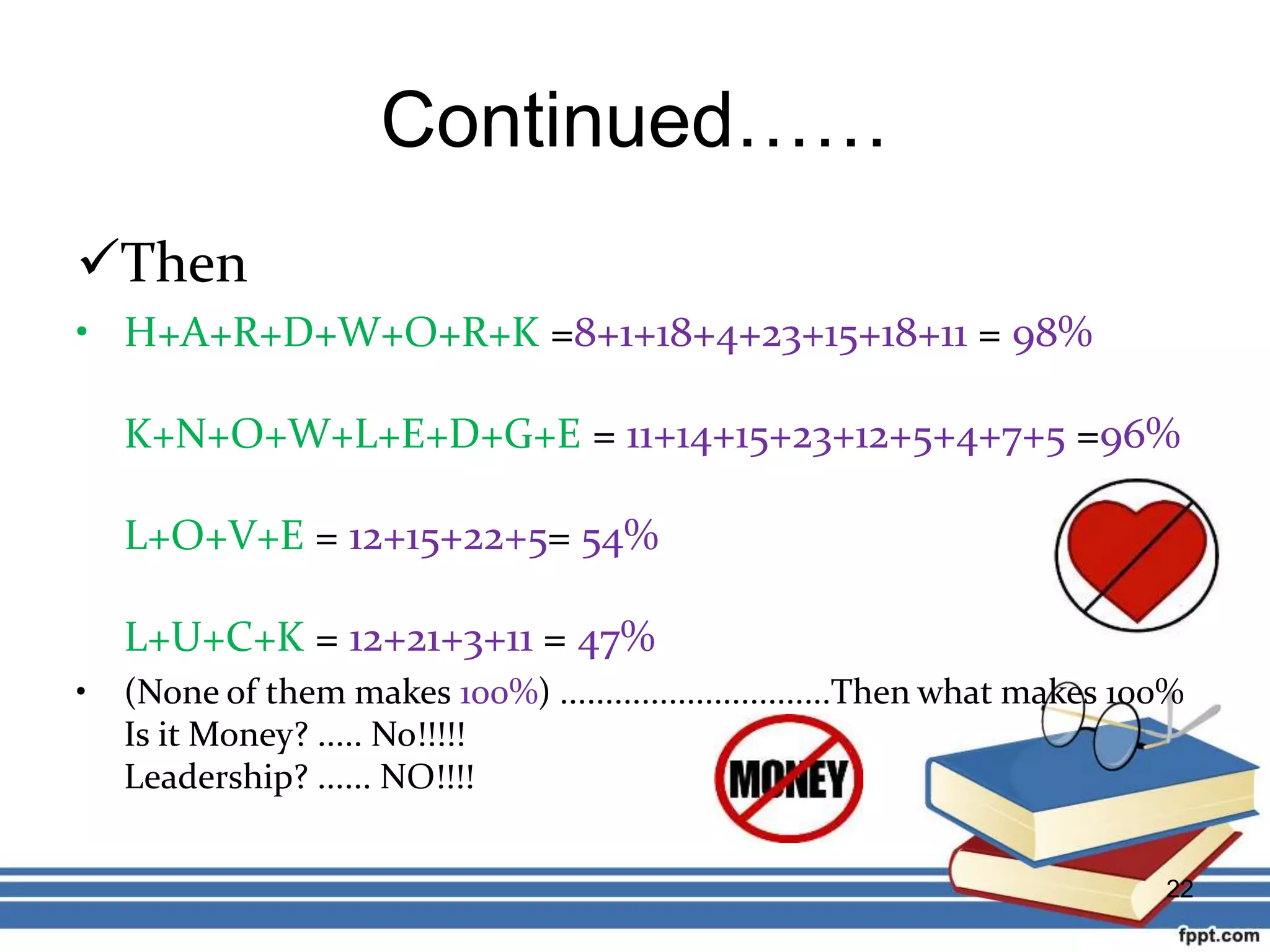
Continued……
Then
• H+A+R+D+W+O+R+K =8+1+18+4+23+15+18+11 = 98%
K+N+O+W+L+E+D+G+E = 11+14+15+23+12+5+4+7+5 =96%
L+O+V+E = 12+15+22+5= 54%
L+U+C+K = 12+21+3+11 = 47%
• (None of them makes 100%) ..............................Then what makes 100%
Is it Money? ..... No!!!!!
Leadership? ...... NO!!!!
22
Continued…..
Every problem has a solution, only if we
perhaps change our "ATTITUDE". It is OUR
ATTITUDE towards Life and Work that
makes OUR Life 100% Successful..
A+T+T+I+T+U+D+E =
1+20+20+9+20+21+4+5 =
23
24

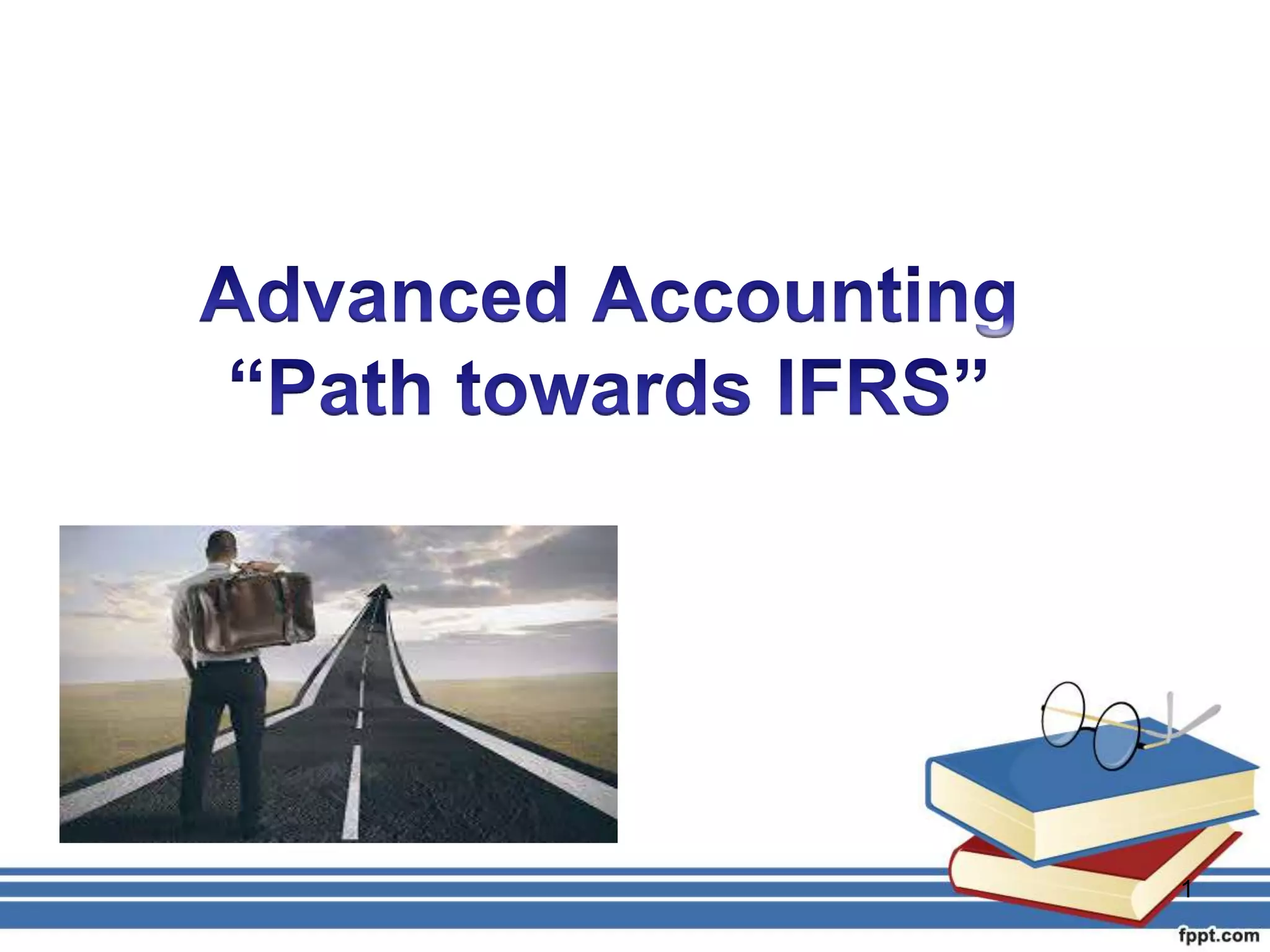
A Path towards IFRS

  • 1.
  • 2.
    Introduction • What isIFRS? – International financial reporting standards are a set of accounting standards developed by the international accounting standard board that is becoming the global standard for the presentation of public company financial statements 2
  • 3.
    Introduction • Why IFRS? –Demand for one set of common global reporting Standards – International Companies desire to use one set of financial standards throughout the world – Growth in capital markets ( IFRS enhances the ability of filers to raise capital outside their borders) – Reducing Capital Cost and Reporting Costs 3
  • 4.
    How India isConverging? • Specified approach • Thirty Five IND AS • Date of Implementation • Comparatives 4
  • 5.
    Road Map byICAI • Two separate sets of accounting standards • The first set would comprise of IFRS converged accounting standards (IND AS) • The second set would comprise of existing Indian Accounting Standards 5
  • 6.
    Specified Approach • Specifiedclass of companies • Listed Companies • Un listed companies having networth of 500 Cr INR or more • Holding & Subsidiaries of companies covered above 6
  • 7.
    Comparatives For this purposean entity should in its op IND AS B/s A)All assets and liabilities whose recognition is required by IND AS B)Not recognize items as assets or liabilities if IND AS do not permit such recognition C) Reclassify the items that it recognized in accordance with IND AS D) Apply IND AS in measuring all recognizing assets and liabilites • It may also be noted that the op. balance Sheet is to be prepared on the date of transition ie., the beginning of the earliest comparative period presented eg: If an entity adopted IND AS from 2016-17 its date of transition will be 1st April 2015 and thus it required to prepare its opening IND AS balance sheet on 1st April, 2015 7
  • 8.
    Other Clarifications ……. •Voluntary Adoption – Option for Other than specified companies • Net worth – Share Capital + Reserve less revaluation reserve 8
  • 9.
    Impact of IFRS •IFRS is heavy on Transparency and impact accounting • All the events that have impact on company’s finances have to be accounted • It also stringent income recognition rules • Global Benchmarking 9
  • 10.
    Benefits of GlobalCompatibility – The Economy – Corporate world – Investors – Accounting Professionals – Bank/Financial Institutions – Regulators 10
  • 11.
    Major Changes ofAS/IFRS • Principal Based Vs Rule Based Standards • Standards Vs Local Laws • Presentation of Financial Statements • Depreciation on Fixed assets • Cash Flow Statements • Valuations • Changing in Accounting policy • Adoption Methodology 11
  • 12.
    Key Challenges….!! • EconomicEnvironment • SME’s problems • Training to preparers • Interpretation 12
  • 13.
    IND AS &Carve Outs What is Carve Out?? Difference between IND AS and equivalent requirement under IFRS 13
  • 14.
    Categorization…. • Mandatory Deviationsfrom IFRS • Optional Deviations from IFRS • Removal of Choices • Others 14
  • 15.
    Mandatory Deviations….. • Recognition –Revenues from sales of real estate on a percentage basis – embedded foreign currency conversion option as equity – Bargain purchase gains as capital reserves – Mandatory use of Govt. securities yields – Fair value of financial liabilities 15
  • 16.
    Optional deviations…. • Choiceto – Defer exchange differences – Deemed Cost for fixed assets – De recognition provisions prospectively – Exemption for financial instruments 16
  • 17.
    Removal of Choices… •Single Statement presentation • Classification of – Expenses – Interest and Dividend • Carry investment property at fair value • Govt. grants should be classified as deferred income • Recognition of actuarial gains in reserves 17
  • 18.
    Others …. • NoSeparate guidance on accounting for biological assets • Deferral of accounting for embedded leases • Deferral of accounting for service concession arrangements • Goodwill may be recognized 18
  • 19.
    Statutory’s Initiatives • Providingeducation and training – Certification courses offered – IFRS e-learning course has been launched – Large scale IFRS awareness drive with MCA collaboration – Conceptual differences with IASB – Organizing of Workshops 19
  • 20.
    Conclusion • Irrespective ofchallenges adoption of IFRS in INDIA will significantly change the contents of corporate financial statements as a result of : More refined measurements Enhanced disclosures 20
  • 21.
    Truthful remarks…. A smalltruth to make our Life 100% successful .......... If A B C D E F G H I J K L M N O P Q R S T U V W X Y Z Is equal to 1 2 3 4 5 6 7 8 9 10 11 12 13 14 15 16 17 18 19 20 21 22 23 24 25 26 21
  • 22.
    Continued…… Then • H+A+R+D+W+O+R+K =8+1+18+4+23+15+18+11= 98% K+N+O+W+L+E+D+G+E = 11+14+15+23+12+5+4+7+5 =96% L+O+V+E = 12+15+22+5= 54% L+U+C+K = 12+21+3+11 = 47% • (None of them makes 100%) ..............................Then what makes 100% Is it Money? ..... No!!!!! Leadership? ...... NO!!!! 22
  • 23.
    Continued….. Every problem hasa solution, only if we perhaps change our "ATTITUDE". It is OUR ATTITUDE towards Life and Work that makes OUR Life 100% Successful.. A+T+T+I+T+U+D+E = 1+20+20+9+20+21+4+5 = 23
  • 24.

Editor's Notes

  • #5 On Voluntary Basis from effective from 1st April, 2015 and Complusory basis from 1st April, 2016