PROTOCOLS
IEC 101 – IEC 104
What is protocol ?
• Protocol is set of rule’s it is used for communication between two
devices.
• His can be applied to various fields, such as diplomatic procedures,
scientific experiments, or organizational behavior.
Technology and Networking :
In technology, particularly in computer networking, a protocol is
a standardized set of rules for communicating between devices. These
rules determine how data is formatted, transmitted, and processed.
Technology and Networking
• HTTP (HyperText Transfer Protocol): Used for transmitting web
pages over the internet.
• TCP/IP (Transmission Control Protocol/Internet Protocol): A suite
of protocols used for data transmission over networks.
• SMTP (Simple Mail Transfer Protocol): Used for sending emails.
Tele-control protocols
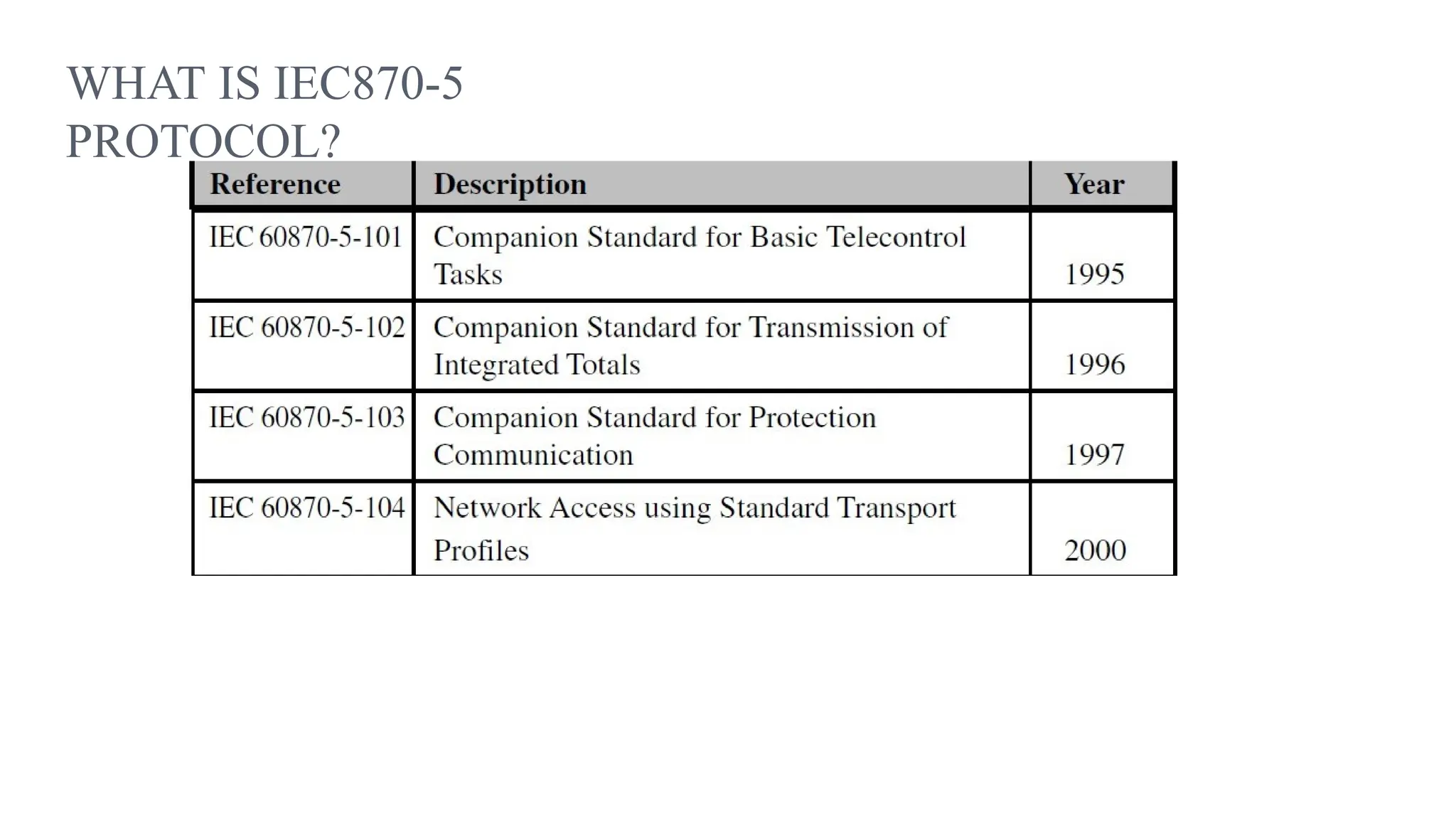
IEC 60870 5 101
‐ ‐ protocol (Serial mode communication from RTU to
Control Center)
IEC 60870 5 104
‐ ‐ protocol (network mode communication from RTU to
Control Center)
IEC 60870 6 502
‐ ‐ ( ICCP) protocol (between two Control Canters)
IEC 60870 5 103
‐ ‐ protocol (for communication between IEDs in a
Substation)
DNP 3.0 Protocol (Serial)
DNP 3.0 Protocol (TCP/IP)
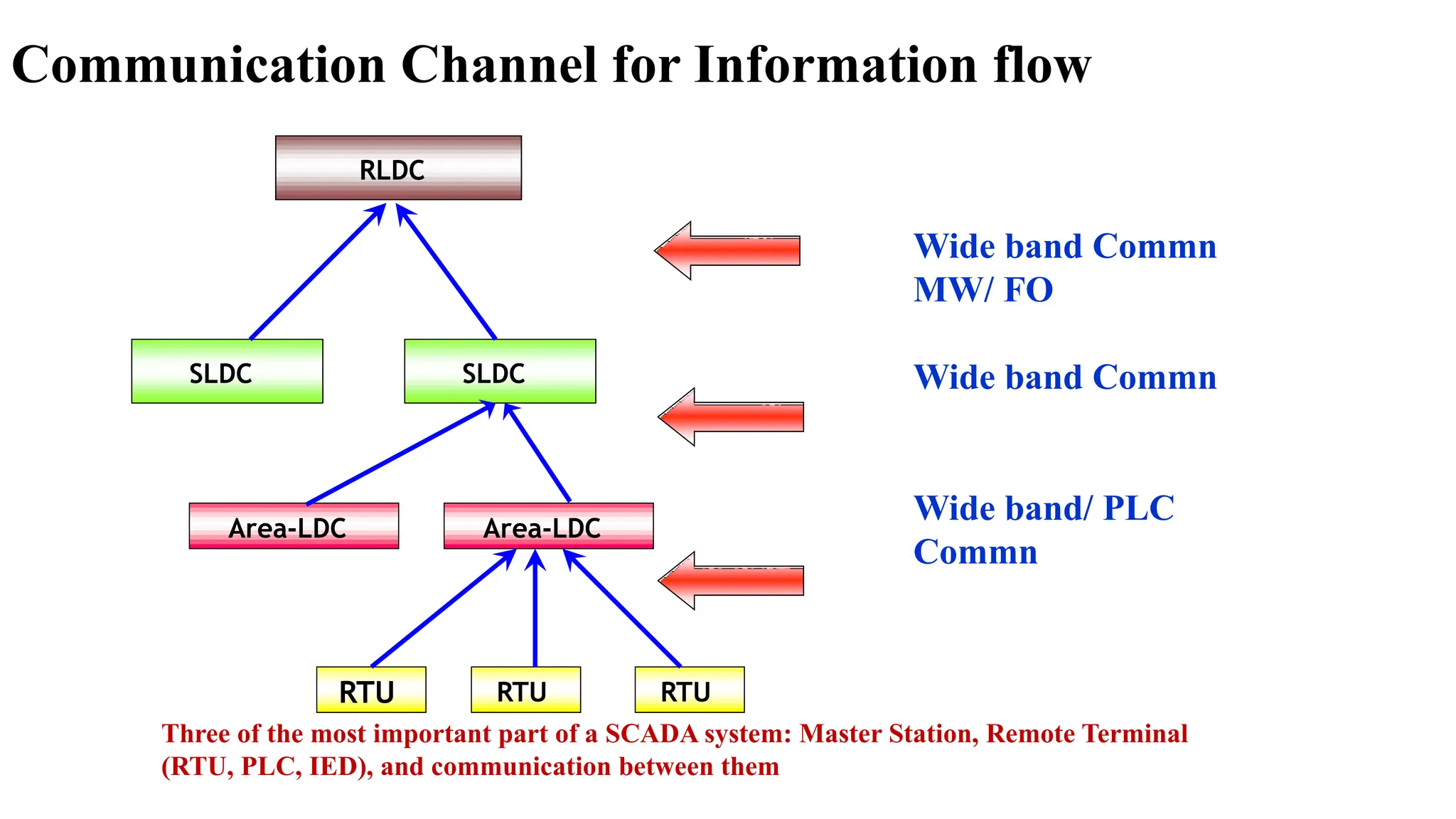
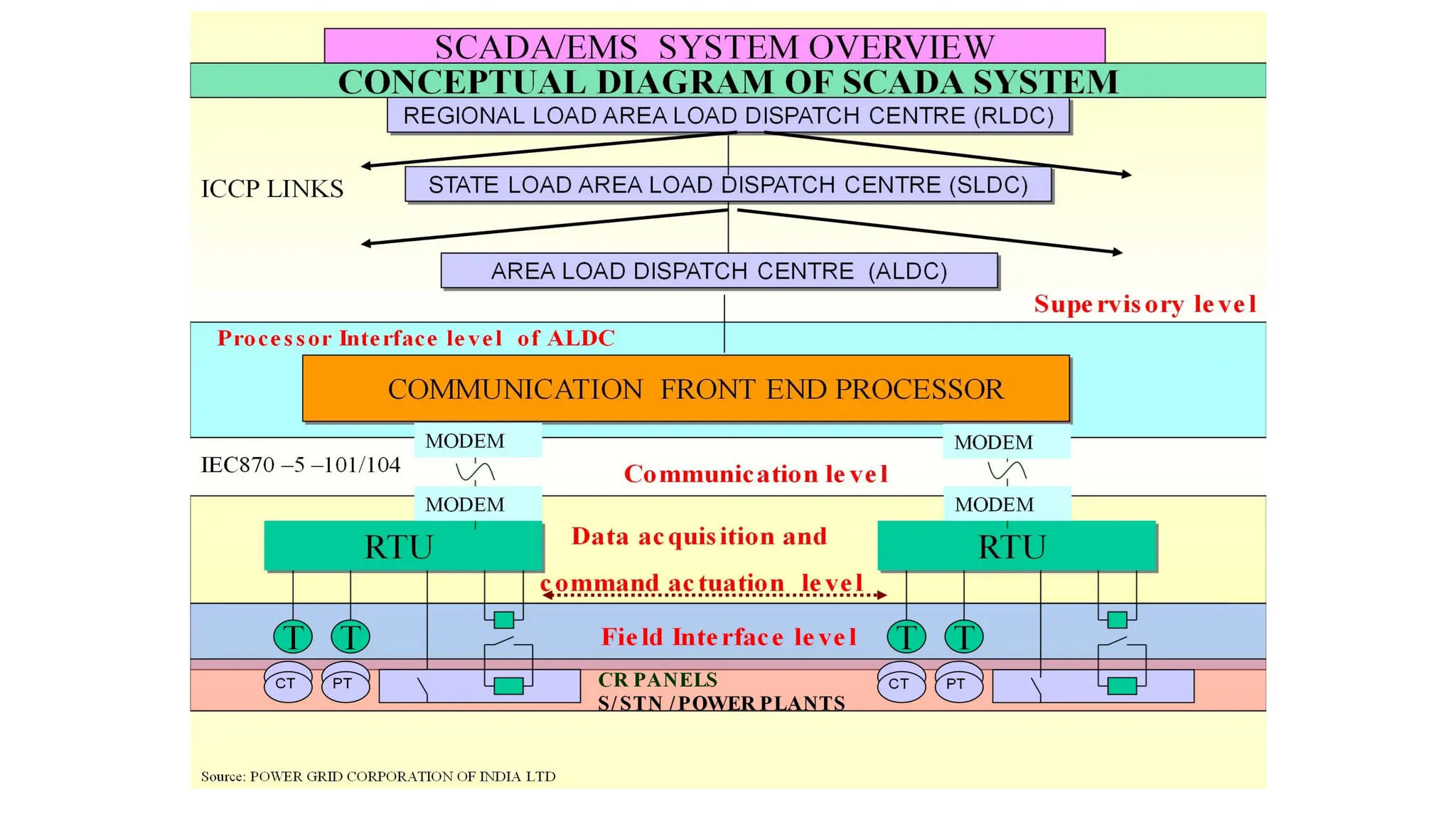
RLDC
SLDC SLDC
Area-LDC Area-LDC
RTU RTU RTU
Communication Channel for Information flow
Wide band Commn
MW/ FO
Wide band Commn
Wide band/ PLC
Commn
Three of the most important part of a SCADA system: Master Station, Remote Terminal
(RTU, PLC, IED), and communication between them
WHAT IS IEC-870-5 ?
WHAT IS IEC870-5
PROTOCOL?
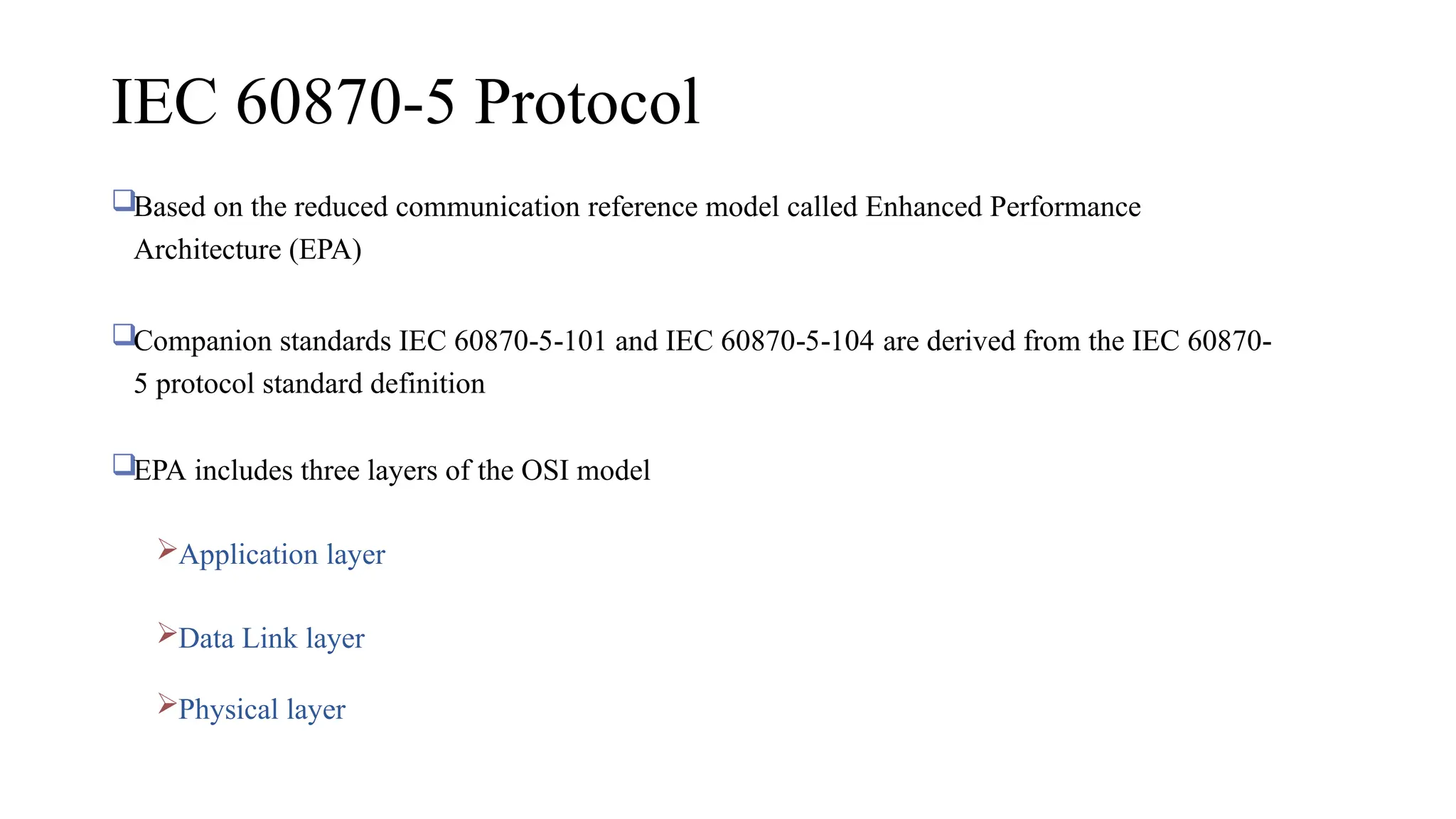
IEC 60870-5 Protocol
Based on the reduced communication reference model called Enhanced Performance
Architecture (EPA)
Companion standards IEC 60870 5 101 and IEC 60870 5 104
‐ ‐ ‐ ‐ are derived from the IEC 60870‐
5 protocol standard definition
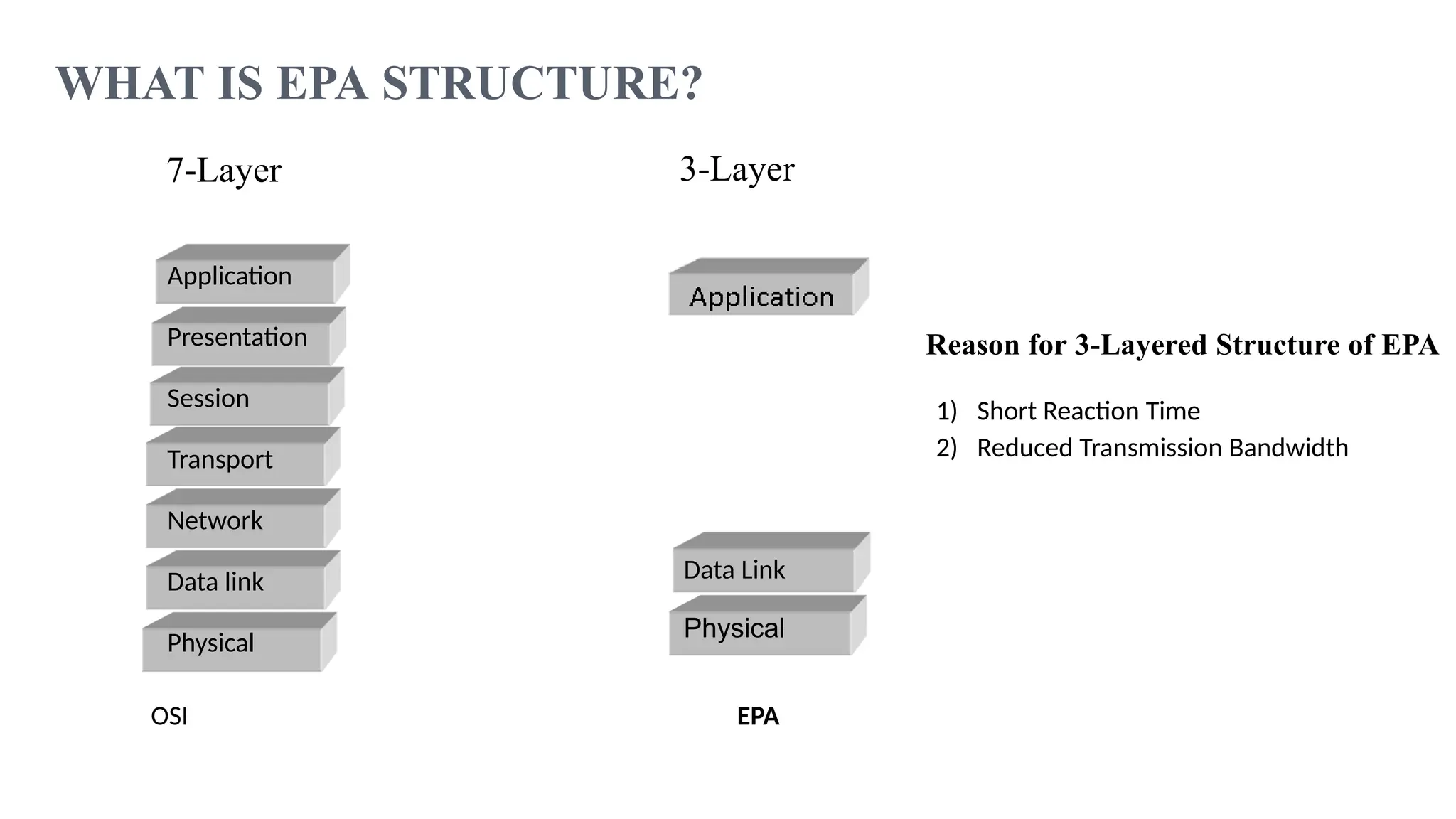
EPA includes three layers of the OSI model
Application layer
Data Link layer
Physical layer
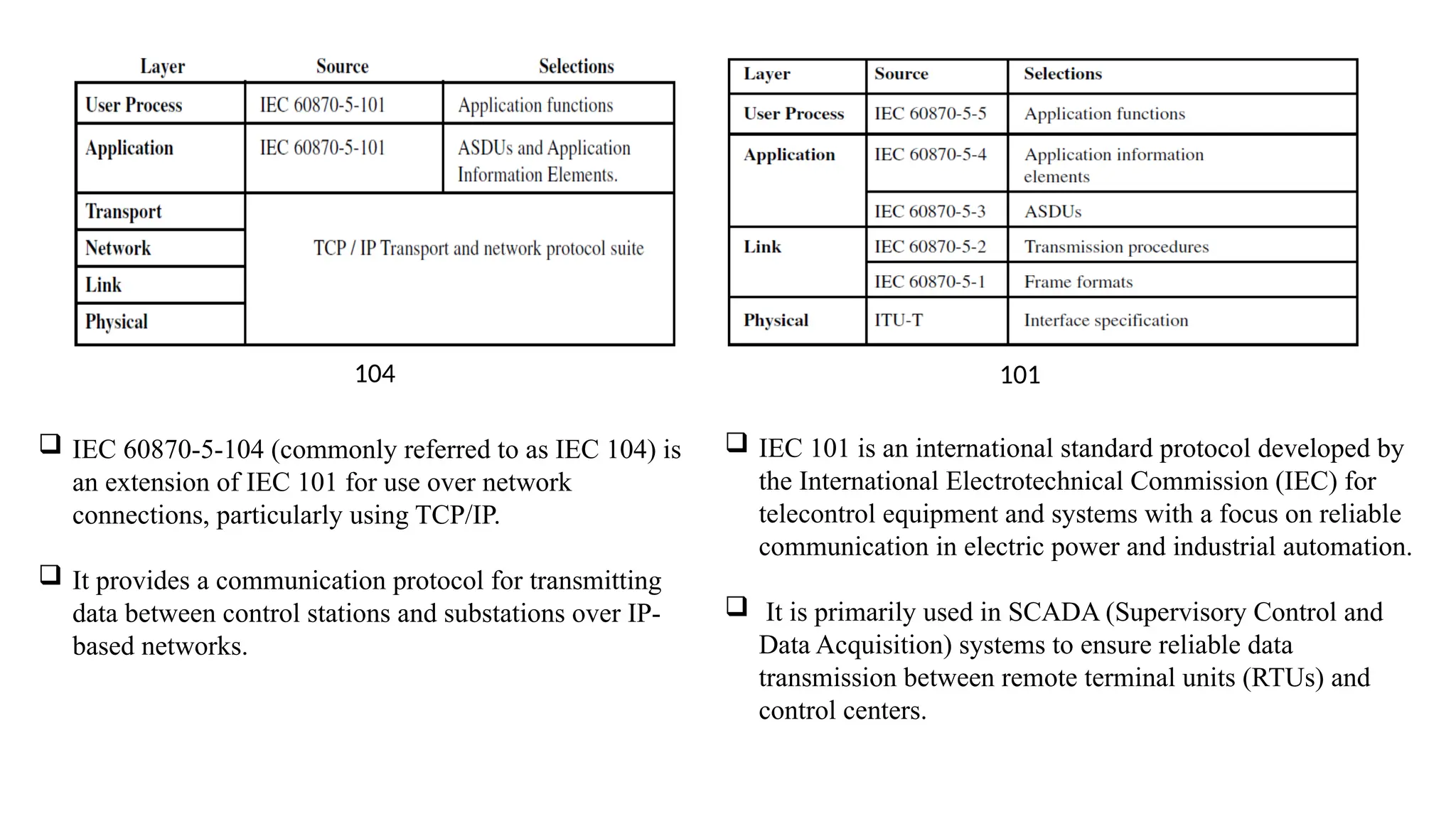
101
104
 IEC 101 is an international standard protocol developed by
the International Electrotechnical Commission (IEC) for
telecontrol equipment and systems with a focus on reliable
communication in electric power and industrial automation.
 It is primarily used in SCADA (Supervisory Control and
Data Acquisition) systems to ensure reliable data
transmission between remote terminal units (RTUs) and
control centers.
 IEC 60870-5-104 (commonly referred to as IEC 104) is
an extension of IEC 101 for use over network
connections, particularly using TCP/IP.
 It provides a communication protocol for transmitting
data between control stations and substations over IP-
based networks.
WHAT IS EPA STRUCTURE?
Application
Presentation
Session
Transport
Network
Data link
Physical
Data Link
Physical
3 Layer
‐
7 Layer
‐
EPA
OSI
1) Short Reaction Time
2) Reduced Transmission Bandwidth
Reason for 3 Layered
‐ Structure of EPA
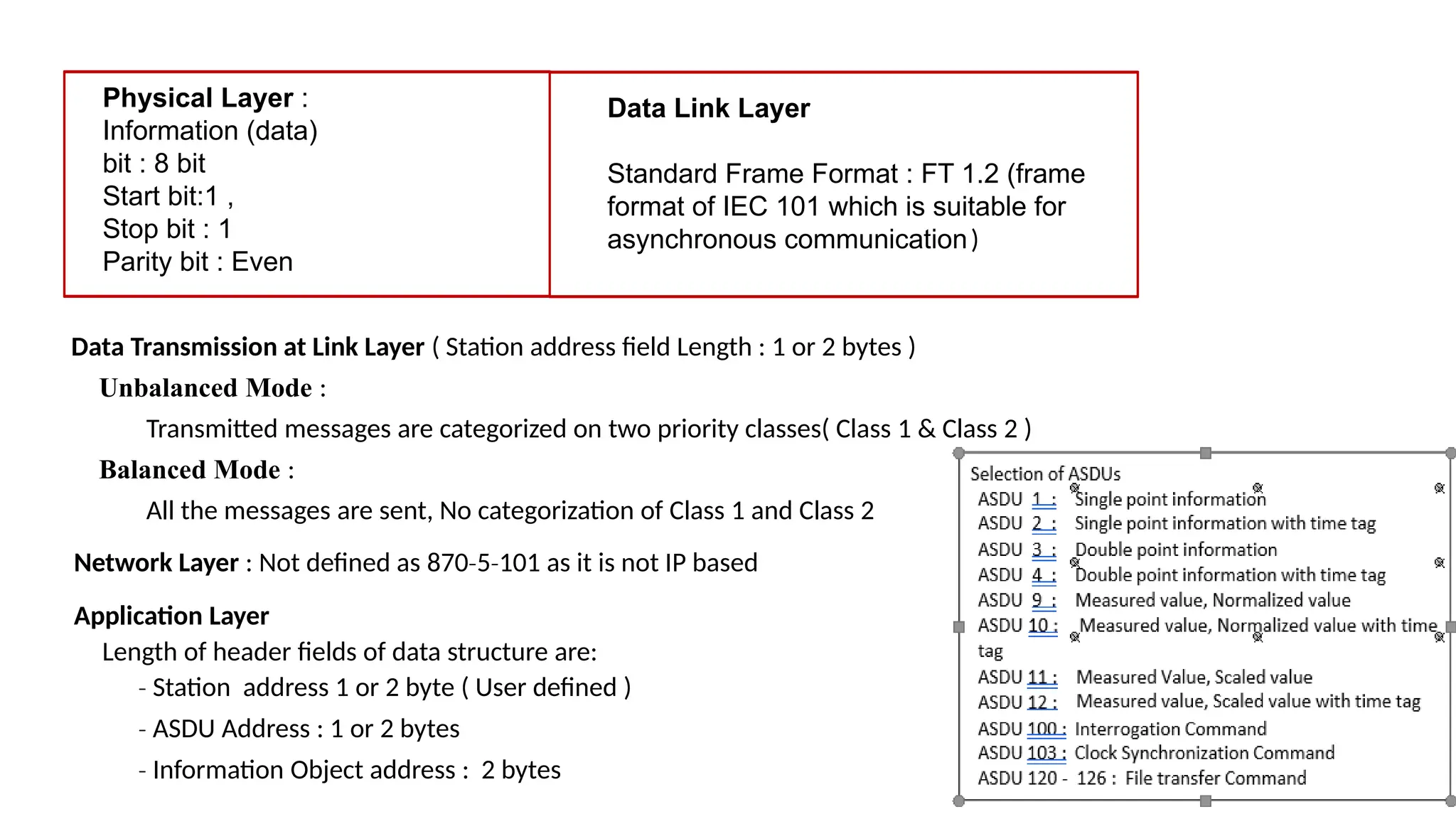
Physical Layer :
Information (data)
bit : 8 bit
Start bit:1 ,
Stop bit : 1
Parity bit : Even
Data Link Layer
Standard Frame Format : FT 1.2 (frame
format of IEC 101 which is suitable for
asynchronous communication)
Data Transmission at Link Layer ( Station address field Length : 1 or 2 bytes )
Unbalanced Mode :
Transmitted messages are categorized on two priority classes( Class 1 & Class 2 )
Balanced Mode :
All the messages are sent, No categorization of Class 1 and Class 2
Network Layer : Not defined as 870 5 101 as it is not IP based
‐ ‐
Application Layer
Length of header fields of data structure are:
‐ Station address 1 or 2 byte ( User defined )
‐ ASDU Address : 1 or 2 bytes
‐ Information Object address : 2 bytes
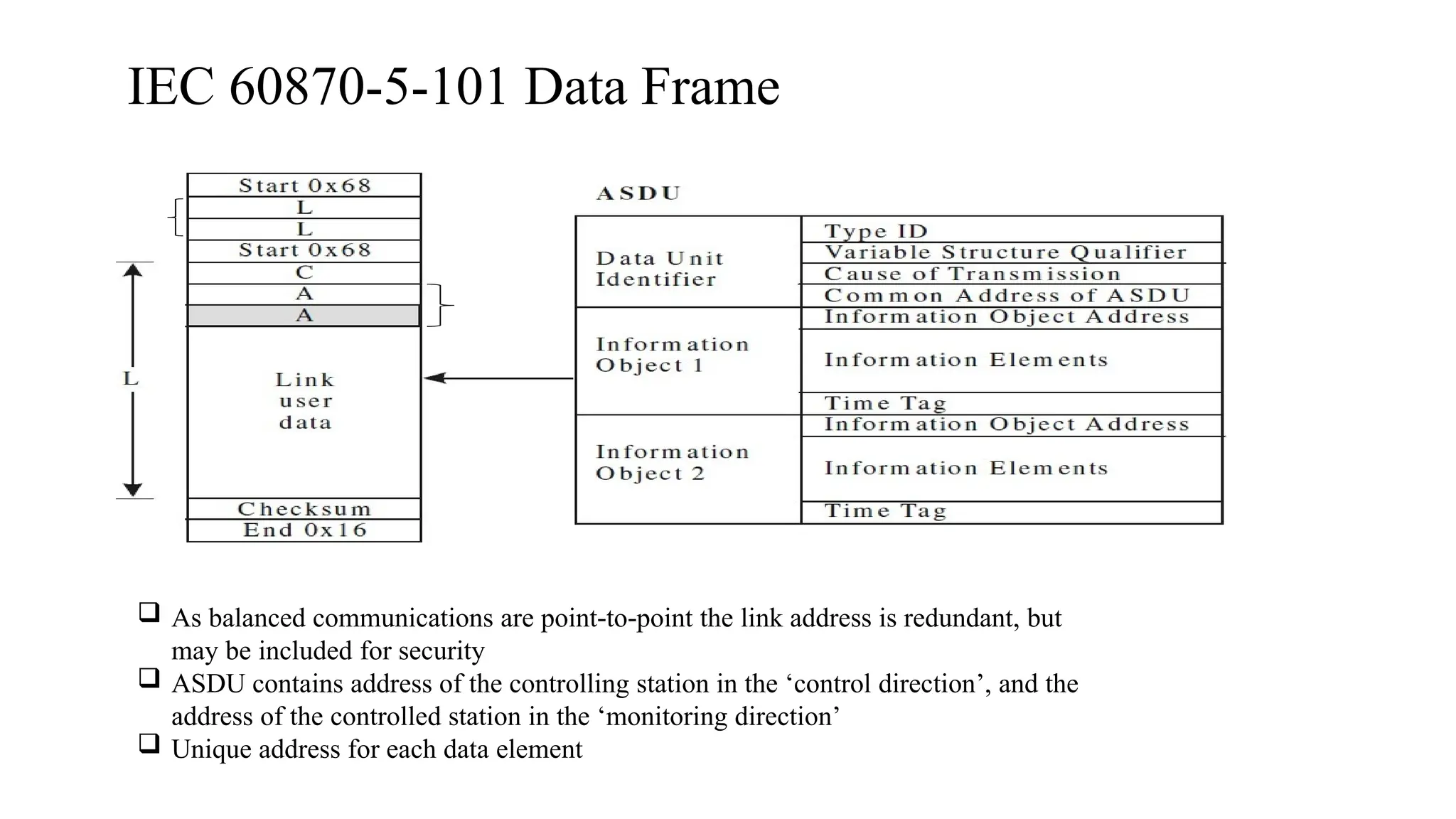
 As balanced communications are point to point
‐ ‐ the link address is redundant, but
may be included for security
 ASDU contains address of the controlling station in the ‘control direction’, and the
address of the controlled station in the ‘monitoring direction’
 Unique address for each data element
IEC 60870-5-101 Data Frame
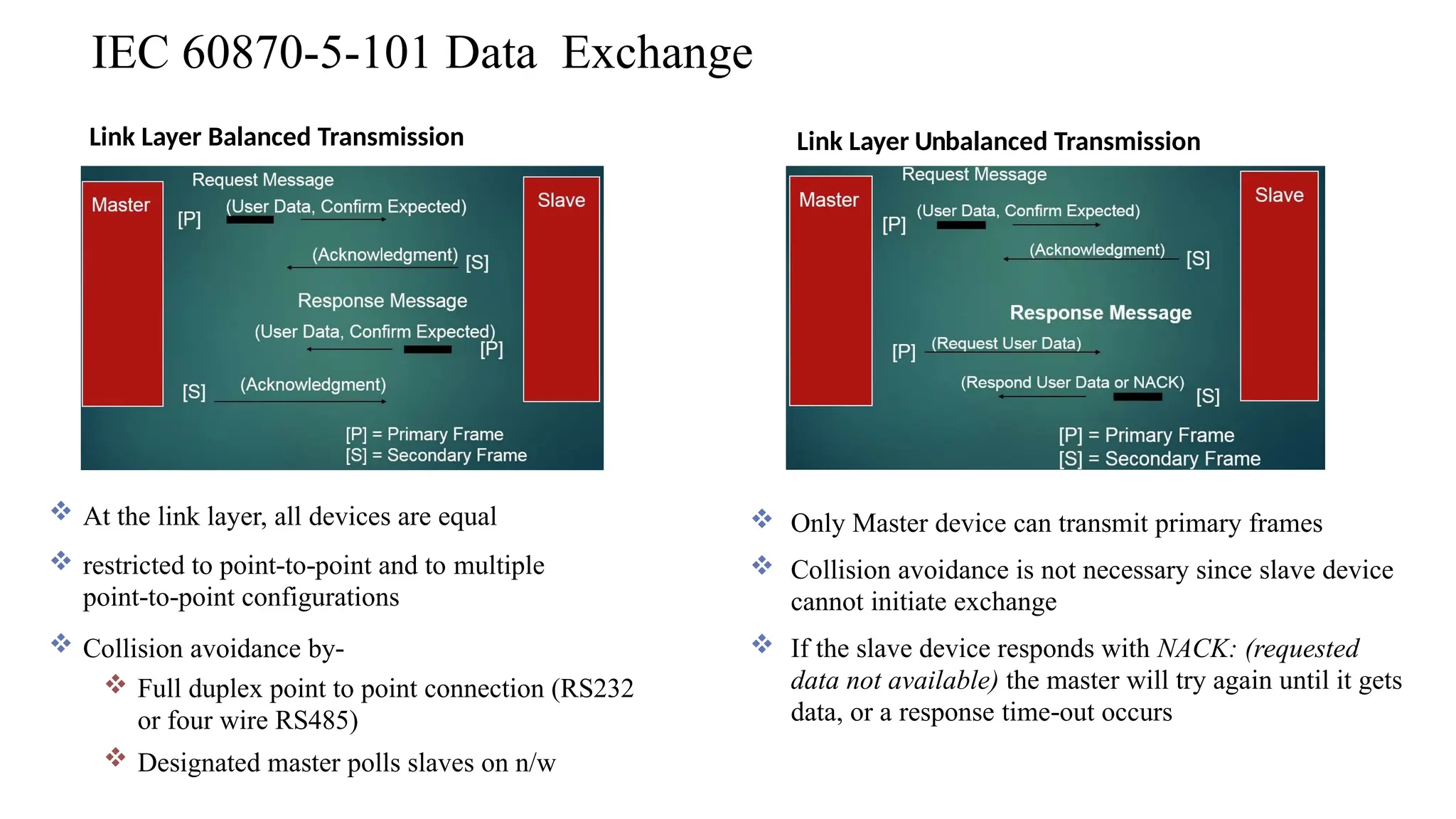
 At the link layer, all devices are equal
 restricted to point to point and to
‐ ‐ multiple
point to point
‐ ‐ configurations
 Collision avoidance by‐
 Full duplex point to point connection (RS232
or four wire RS485)
 Designated master polls slaves on n/w
 Only Master device can transmit primary frames
 Collision avoidance is not necessary since slave device
cannot initiate exchange
 If the slave device responds with NACK: (requested
data not available) the master will try again until it gets
data, or a response time out
‐ occurs
Link Layer Balanced Transmission Link Layer Unbalanced Transmission
IEC 60870-5-101 Data Exchange
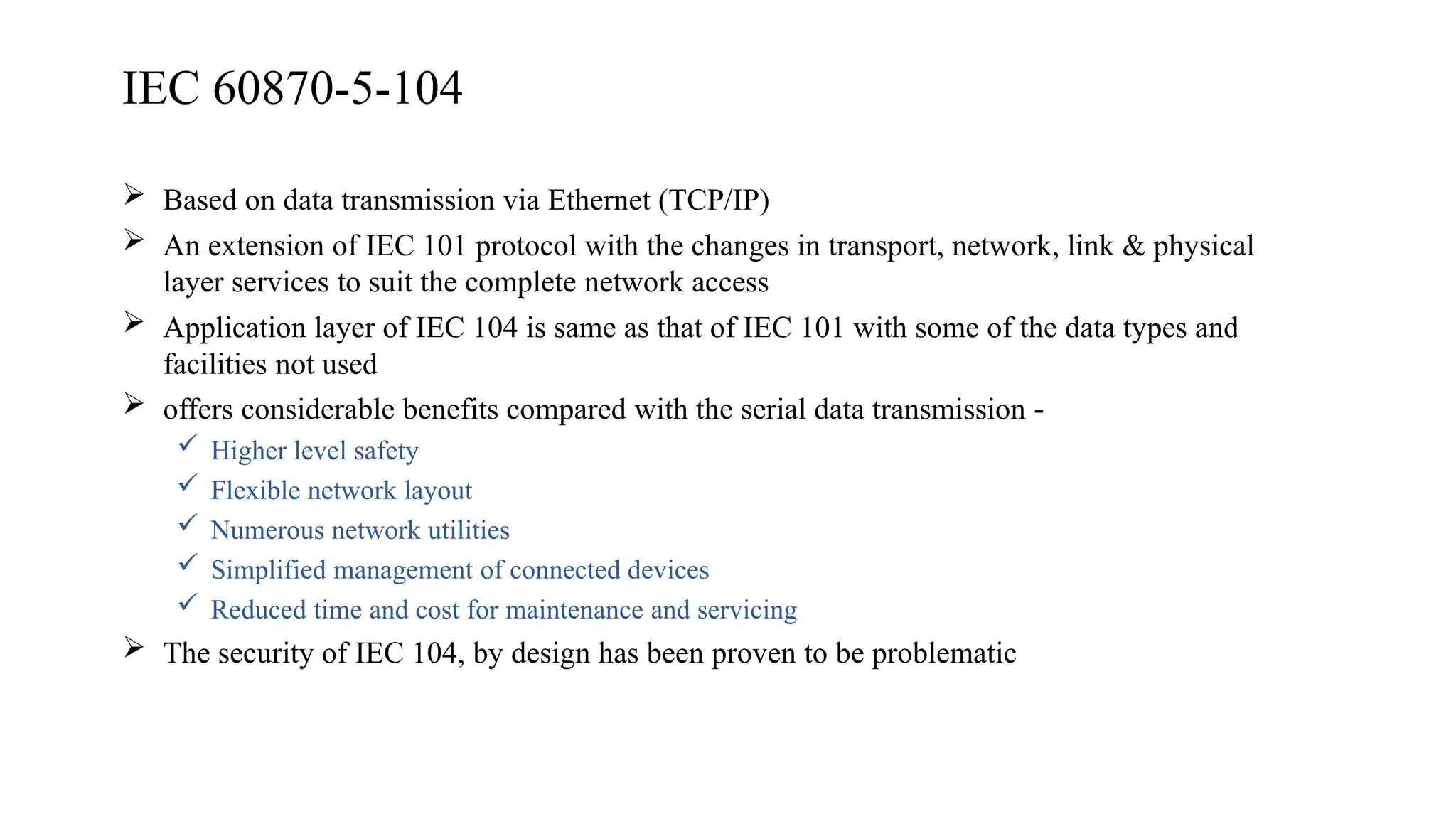
 Based on data transmission via Ethernet (TCP/IP)
 An extension of IEC 101 protocol with the changes in transport, network, link & physical
layer services to suit the complete network access
 Application layer of IEC 104 is same as that of IEC 101 with some of the data types and
facilities not used
 offers considerable benefits compared with the serial data transmission ‐
 Higher level safety
 Flexible network layout
 Numerous network utilities
 Simplified management of connected devices
 Reduced time and cost for maintenance and servicing
 The security of IEC 104, by design has been proven to be problematic
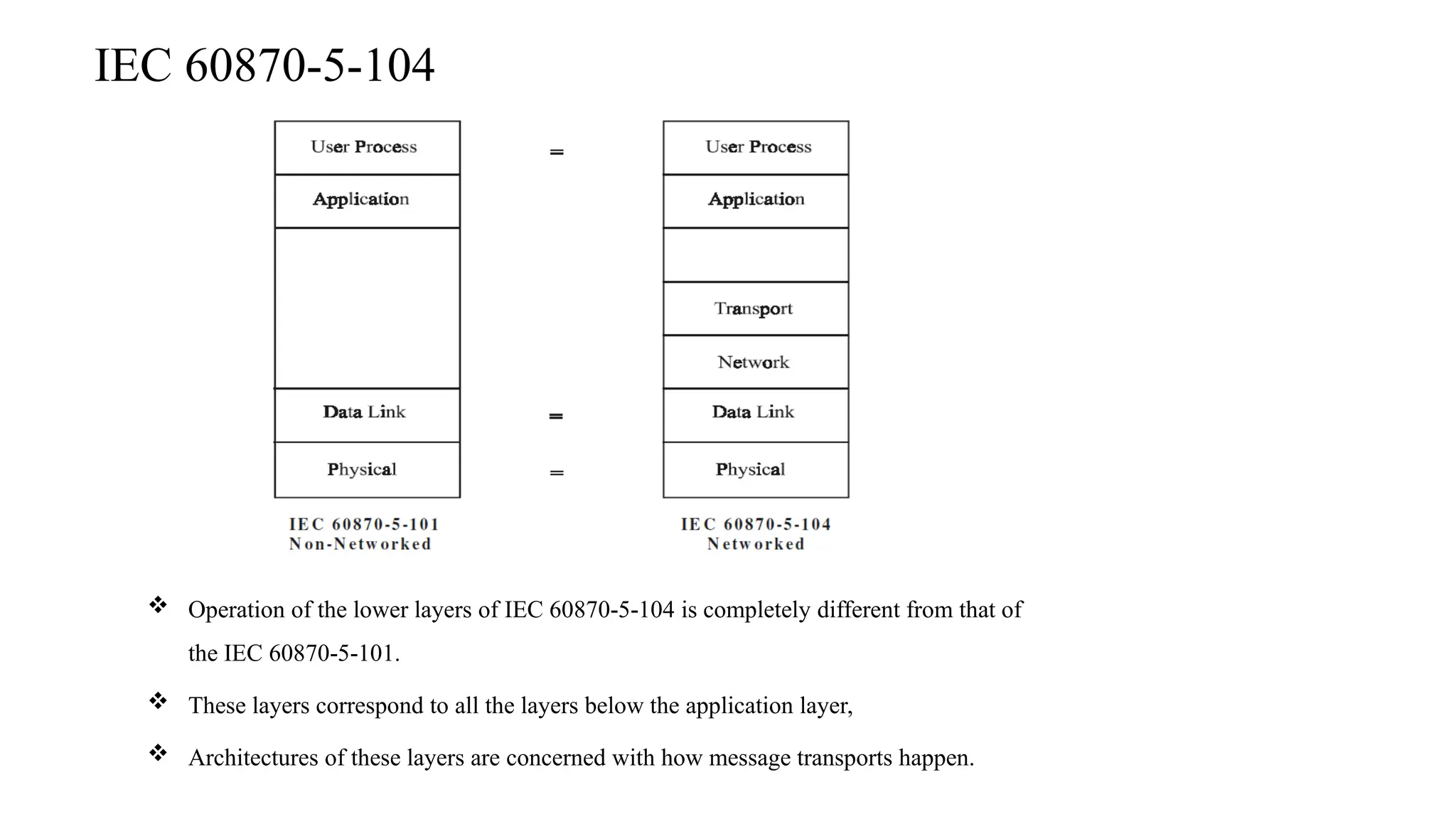
IEC 60870-5-104
IEC 60870-5-104
 Operation of the lower layers of IEC 60870 5 104
‐ ‐ is completely different from that of
the IEC 60870 5 101.
‐ ‐
 These layers correspond to all the layers below the application layer,
 Architectures of these layers are concerned with how message transports happen.
Thank you

IEC 101 AND 104 protocols TCP/IP and OSI

  • 1.
  • 2.
    What is protocol? • Protocol is set of rule’s it is used for communication between two devices. • His can be applied to various fields, such as diplomatic procedures, scientific experiments, or organizational behavior. Technology and Networking : In technology, particularly in computer networking, a protocol is a standardized set of rules for communicating between devices. These rules determine how data is formatted, transmitted, and processed.
  • 3.
    Technology and Networking •HTTP (HyperText Transfer Protocol): Used for transmitting web pages over the internet. • TCP/IP (Transmission Control Protocol/Internet Protocol): A suite of protocols used for data transmission over networks. • SMTP (Simple Mail Transfer Protocol): Used for sending emails.
  • 4.
    Tele-control protocols IEC 608705 101 ‐ ‐ protocol (Serial mode communication from RTU to Control Center) IEC 60870 5 104 ‐ ‐ protocol (network mode communication from RTU to Control Center) IEC 60870 6 502 ‐ ‐ ( ICCP) protocol (between two Control Canters) IEC 60870 5 103 ‐ ‐ protocol (for communication between IEDs in a Substation) DNP 3.0 Protocol (Serial) DNP 3.0 Protocol (TCP/IP)
  • 5.
    RLDC SLDC SLDC Area-LDC Area-LDC RTURTU RTU Communication Channel for Information flow Wide band Commn MW/ FO Wide band Commn Wide band/ PLC Commn Three of the most important part of a SCADA system: Master Station, Remote Terminal (RTU, PLC, IED), and communication between them
  • 7.
  • 8.
  • 9.
    IEC 60870-5 Protocol Basedon the reduced communication reference model called Enhanced Performance Architecture (EPA) Companion standards IEC 60870 5 101 and IEC 60870 5 104 ‐ ‐ ‐ ‐ are derived from the IEC 60870‐ 5 protocol standard definition EPA includes three layers of the OSI model Application layer Data Link layer Physical layer
  • 10.
    101 104  IEC 101is an international standard protocol developed by the International Electrotechnical Commission (IEC) for telecontrol equipment and systems with a focus on reliable communication in electric power and industrial automation.  It is primarily used in SCADA (Supervisory Control and Data Acquisition) systems to ensure reliable data transmission between remote terminal units (RTUs) and control centers.  IEC 60870-5-104 (commonly referred to as IEC 104) is an extension of IEC 101 for use over network connections, particularly using TCP/IP.  It provides a communication protocol for transmitting data between control stations and substations over IP- based networks.
  • 11.
    WHAT IS EPASTRUCTURE? Application Presentation Session Transport Network Data link Physical Data Link Physical 3 Layer ‐ 7 Layer ‐ EPA OSI 1) Short Reaction Time 2) Reduced Transmission Bandwidth Reason for 3 Layered ‐ Structure of EPA
  • 12.
    Physical Layer : Information(data) bit : 8 bit Start bit:1 , Stop bit : 1 Parity bit : Even Data Link Layer Standard Frame Format : FT 1.2 (frame format of IEC 101 which is suitable for asynchronous communication) Data Transmission at Link Layer ( Station address field Length : 1 or 2 bytes ) Unbalanced Mode : Transmitted messages are categorized on two priority classes( Class 1 & Class 2 ) Balanced Mode : All the messages are sent, No categorization of Class 1 and Class 2 Network Layer : Not defined as 870 5 101 as it is not IP based ‐ ‐ Application Layer Length of header fields of data structure are: ‐ Station address 1 or 2 byte ( User defined ) ‐ ASDU Address : 1 or 2 bytes ‐ Information Object address : 2 bytes
  • 13.
     As balancedcommunications are point to point ‐ ‐ the link address is redundant, but may be included for security  ASDU contains address of the controlling station in the ‘control direction’, and the address of the controlled station in the ‘monitoring direction’  Unique address for each data element IEC 60870-5-101 Data Frame
  • 14.
     At thelink layer, all devices are equal  restricted to point to point and to ‐ ‐ multiple point to point ‐ ‐ configurations  Collision avoidance by‐  Full duplex point to point connection (RS232 or four wire RS485)  Designated master polls slaves on n/w  Only Master device can transmit primary frames  Collision avoidance is not necessary since slave device cannot initiate exchange  If the slave device responds with NACK: (requested data not available) the master will try again until it gets data, or a response time out ‐ occurs Link Layer Balanced Transmission Link Layer Unbalanced Transmission IEC 60870-5-101 Data Exchange
  • 15.
     Based ondata transmission via Ethernet (TCP/IP)  An extension of IEC 101 protocol with the changes in transport, network, link & physical layer services to suit the complete network access  Application layer of IEC 104 is same as that of IEC 101 with some of the data types and facilities not used  offers considerable benefits compared with the serial data transmission ‐  Higher level safety  Flexible network layout  Numerous network utilities  Simplified management of connected devices  Reduced time and cost for maintenance and servicing  The security of IEC 104, by design has been proven to be problematic IEC 60870-5-104
  • 16.
    IEC 60870-5-104  Operationof the lower layers of IEC 60870 5 104 ‐ ‐ is completely different from that of the IEC 60870 5 101. ‐ ‐  These layers correspond to all the layers below the application layer,  Architectures of these layers are concerned with how message transports happen.
  • 17.