Description And Analysis Of Iec 104 Protocol Petr Matouek
Description And Analysis Of Iec 104 Protocol Petr Matouek
Description And Analysis Of Iec 104 Protocol Petr Matouek
Description And Analysis Of Iec 104 Protocol Petr Matouek
Description And Analysis Of Iec 104 Protocol Petr Matouek
1.
Description And AnalysisOf Iec 104 Protocol
Petr Matouek download
https://ebookbell.com/product/description-and-analysis-of-
iec-104-protocol-petr-matouek-54769344
Explore and download more ebooks at ebookbell.com
2.
Here are somerecommended products that we believe you will be
interested in. You can click the link to download.
The Writing Culture Of Ancient Dadan A Description And Quantitative
Analysis Of Linguistic Variation Fokelien Kootstra
https://ebookbell.com/product/the-writing-culture-of-ancient-dadan-a-
description-and-quantitative-analysis-of-linguistic-variation-
fokelien-kootstra-49192862
Dukhan A Turkic Variety Of Northern Mongolia Description And Analysis
1st Edition Elisabetta Ragagnin
https://ebookbell.com/product/dukhan-a-turkic-variety-of-northern-
mongolia-description-and-analysis-1st-edition-elisabetta-
ragagnin-50489544
Guidelines For Analysis And Description Of Soil And Regolith Thin
Sections 2nd Edition Georges Stoops
https://ebookbell.com/product/guidelines-for-analysis-and-description-
of-soil-and-regolith-thin-sections-2nd-edition-georges-stoops-38394546
Defense Related Smes Analysis And Description Of Current Conditions
Fernando Duarte Carvalho
https://ebookbell.com/product/defense-related-smes-analysis-and-
description-of-current-conditions-fernando-duarte-carvalho-1554108
3.
Analysis Of BiologicalProcesses Verbal Description Schemes And
Mathematical Models 1st Edition Alfonsas Juka Auth
https://ebookbell.com/product/analysis-of-biological-processes-verbal-
description-schemes-and-mathematical-models-1st-edition-alfonsas-juka-
auth-5358906
Analysis Of Catastrophes And Their Public Health Consequences
Descriptions Predictions And Aggregation Of Expert Judgment Supporting
Science Policy 1st Ed Paolo F Ricci
https://ebookbell.com/product/analysis-of-catastrophes-and-their-
public-health-consequences-descriptions-predictions-and-aggregation-
of-expert-judgment-supporting-science-policy-1st-ed-paolo-f-
ricci-22505704
Descriptive Topology And Functional Analysis In Honour Of Jerzy Kakols
60th Birthday 1st Edition Juan Carlos Ferrando
https://ebookbell.com/product/descriptive-topology-and-functional-
analysis-in-honour-of-jerzy-kakols-60th-birthday-1st-edition-juan-
carlos-ferrando-4930600
The Mystic Experience A Descriptive And Comparative Analysis Jordan
Paper
https://ebookbell.com/product/the-mystic-experience-a-descriptive-and-
comparative-analysis-jordan-paper-5285076
Descriptive Topology And Functional Analysis Ii In Honour Of Manuel
Lpezpellicer Mathematical Work Elche Spain June 78 2018 1st Ed Juan
Carlos Ferrando
https://ebookbell.com/product/descriptive-topology-and-functional-
analysis-ii-in-honour-of-manuel-lpezpellicer-mathematical-work-elche-
spain-june-78-2018-1st-ed-juan-carlos-ferrando-10487490
5.
Description and analysisof IEC
104 Protocol
Technical Report
Petr Matoušek
Technical Report no. FIT-TR-2017-12
Faculty of Information Technology
Brno University of Technology
Brno, Czech Republic
December , 2017
he heard thathe was to go on; that he should have a chance to make
his dream true, he was full of joy. "I see yet," he said, "the great hill up
which we went that day in the snow. When I heard the news, I could
not speak for joy. There were such a crowd of young ones in our home,
I did not see how they could spare the funds. A warm glow ran through
me; I had to weep."
When he was through school, he at once rose to a high place. He
was at the head of all who spoke in the House. He was grand and great,
but he had a sense of fun in him. Once some one came to him with one
of those books where the names of friends or great men are kept, with
the wish that he would write his name by the side of John Ad-ams. He
wrote:
"If by his name I write my own,
'Twill take me where I am not known;
And the cold words will meet my ear,
Why, friend, and how did you come here?"
When his death was known, there was grief in the length and
breadth of the land. No death since that of Wash-ing-ton was made such
a theme for speech.
11.
CHAPTER XI.
A NEWWAR.
In the time of James K. Polk, a war rose in which our States were
not of one mind. Our folk in Tex-as laid claim to a large tract of land
which those in Mex-i-co said was theirs. The States at the North did not
wish to go in to this war; but those at the South did. This was in 1846.
Gen-er-al Tay-lor went with his troops at once in to the land of the foe,
and built a fort on a stream there. He gave it the name of Fort Brown.
On his way he met the troops of the foe drawn up in the road. They had
three to one of his small band; but he had the good luck to rout them,
with loss of but nine men on our side.
Then he took up his march on their great town, which had the
name of Mon-te-rey. This town had high hills and deep gulfs round it,
and strong forts. Its streets were full of men with arms. Gen-er-al Tay-
lor made a grand move on the town. To get out of the fire that would
seem to pour on them from the roofs, the troops went in and dug their
way through stone walls from house to house, or they would pass from
roof to roof. Ere they came to the grand place of the town, it was in
their hands, the foe gave up the fight.
12.
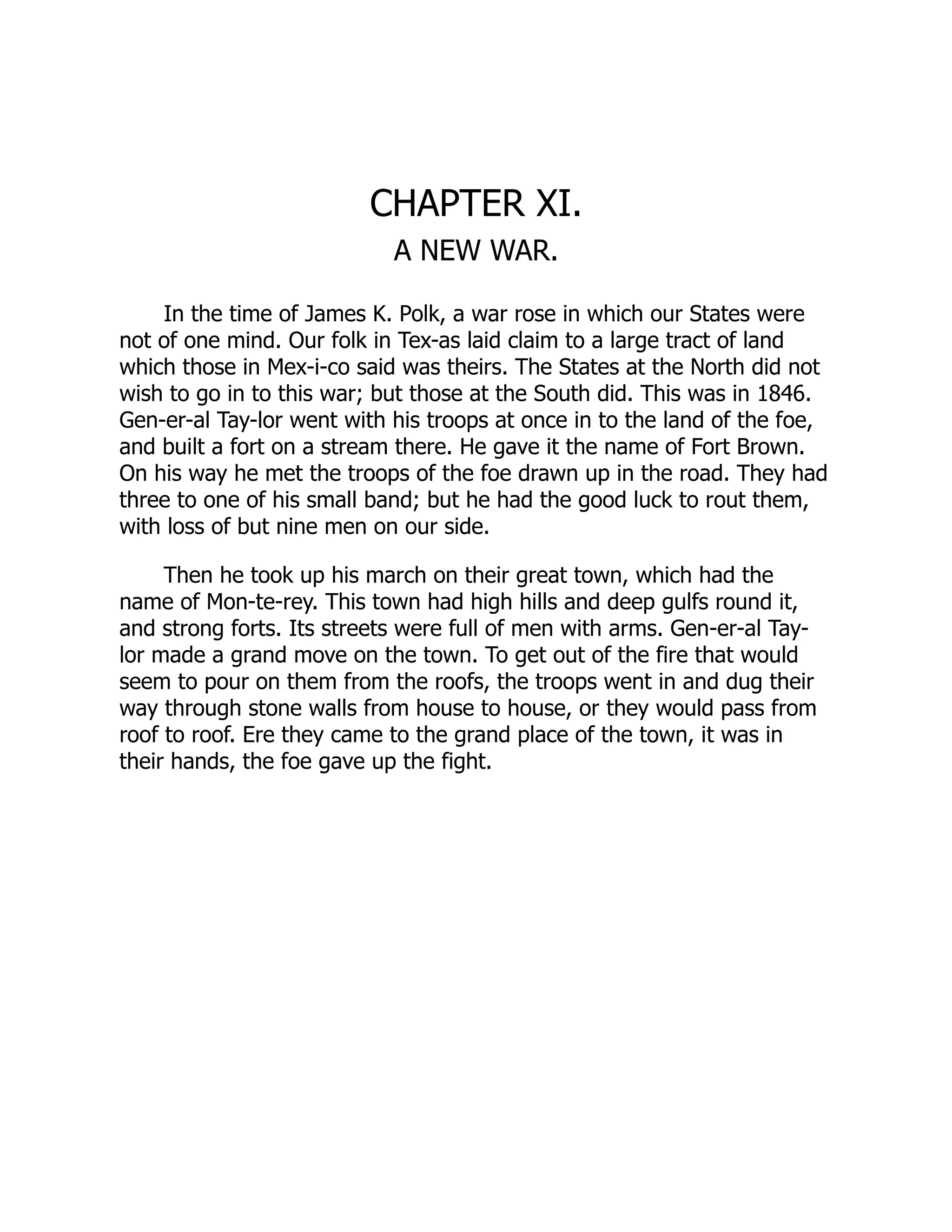
CAP-TURE OF MON-TE-REY.
Atthis time San-ta An-na, who was chief of the Mex-i-can troops,
heard that most of our men had been drawn off to help Gen-er-al Scott;
so he thought it would be a good time to crush us. They laid in wait with
all their best troops, and the fight went on from the rise of the sun till
dark. It grew hard to hold our ground, and the day would have been lost
but for the guns of Cap-tain Bragg, who came to our help. He made a
13.
dash up toa few yards from the foe, and let fire. Their ranks were seen
to shake. "Some more grape. Cap-tain Bragg," said Gen-er-al Tay-lor.
One more round, and then a third came, and the Mex-i-cans broke and
fled. In the night San-ta An-na drew all his troops off.
Gen-er-al Scott, at the head of our troops, made a march through
the land of Mex-i-co, and took all that came in his way. He drew siege
lines round the town of Ve-ra Cruz, and sent bombs in to it, and in four
days the town, with its strong hold, gave up the fight. A week from that
time our troops took up their march for the chief town. At one pass in
the hills, the foe had a strong hold. Gen-er-al Scott had a road cut round
the base of those hills and through the woods; and then he was in a
place to pour out fire on the rear of the foe, while more troops took him
in front. The foe fled in such haste that San-ta An-na, who was lame,
left his leg of wood on the ground, and got off on his wheel mule.
The town of Mex-i-co is in the midst of a grand plain, with green
fields and cloud capt mounts round it. The foe had made a strong stand
here, with forts and men. Our men made a move in the night. It was so
dark they had to feel their way; but they took their stand on a height
from which they could storm the strong points of the foe. At last they
took some of the guns, and the roads were laid bare to the gates of the
town.
There was some talk of a peace then, but Gen-er-al Scott found
that it was not in good faith. The foe did it to gain time, to make things
strong once more. So the next day, he took up his march on the great
town of Mex-i-co. A strong fort, on a high rock by the town, was made
ours; each out work fell one by one, and at last our troops took the
great Ci-ty of Mex-i-co, and the next morn our flag with its stripes and
stars was seen to float in the light from those grand old piles, which had
been the home of more than one prince of Mex-i-co. So the war came to
an end in just two years.
Till this time, Cal-i-for-nia had been known as a far off land, to
which men went by sea, round Cape Horn, to buy hides and fur. But in
1848, came news to the East-ern States that there were gold mines in
that place. It was said that a Swiss had found, as he dug in the sand, a
14.
bright sort ofdust, and it was thought to be gold. All at once, on this
news, there was a great rush from all parts of the land to the gold mines
of Cal-i-for-nia, and there was a great sum won the first year. In two
years the town of San Fran-cis-co had grown to quite a large place. The
name of Cal-i-for-nia is said to have been found in an old book in Spain,
and means an isle full of gold.
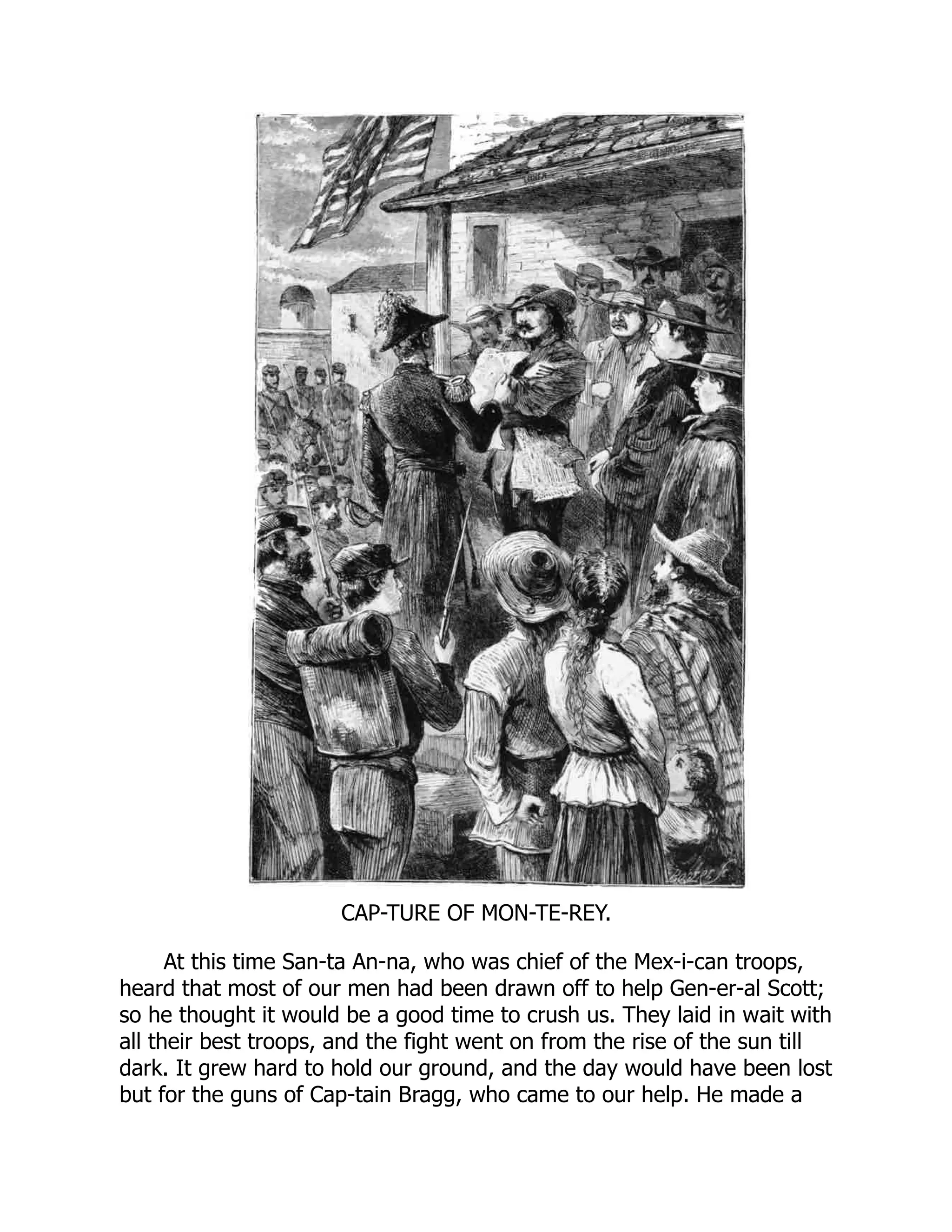
SAN FRAN-CIS-CO IN 1849.
Three more States were brought in while Polk was our chief, and
two of them were free States. It was shown that those who came to us
from the old world, chose the free States for their homes, and those at
the South felt sure that the North would grow too fast if they did not
gain more ground. There was a great piece of land which both North
and South laid claim to, and there were high words on both sides. At last
a band of men by the name of Free Soil men, took a stand that slaves
should be kept out of all new land which the U-nit-ed States might gain
in all time to come.
The next man who was the choice of the land was Tay-lor, the one
who led part of our troops in the war with Mex-i-co. He was put in by
the Whigs. The Free Soil men did not vote for him. He did not live but
one year, and then Fill-more took his place.
16.
CHAPTER XII.
THE WAROF NORTH AND SOUTH.
Once more the talk on free States and slave States was heard on all
sides, and Hen-ry Clay had made more than one great speech to try and
keep the peace. Cal-i-for-nia came in as a free State; but a bill went in
force which made it a crime to help or keep a slave who had run off
from his home. A man could go in to a free State and take back his slave
by force, and no court or Judge in the land could stop him. In fact, they
were bound to help him. This was thought harsh and wrong by most of
the men at the North; but it was made a law. This law made more stir
than aught else had done till this time. Men would help the slaves, spite
of the law; and in some States they made laws of their own, that no one
could claim a slave if he did not bring the case in to court, that they
might see if he had a just claim.
When Pierce was made Pres-i-dent, the strife still went on; and this
was made worse by a wish on the part of those who held slaves to bring
them North of the line, in to a great tract of land—so large that two
States could be made out of it—Kan-sas and Ne-bras-ka.
The South said all they would ask, would be that those who had
their homes on the soil should say how they would like things to be, and
put it to vote. Con-gress did at last pass a bill to give them their own
choice, to be free or slave States. But this did not bring peace; for they
had fights when they went to vote. At last they were all at war, and
would burn a town or sack a house, or steal the cows and goods of
those they thought foes. The whole land was a scene of blood, but in
the end Kan-sas was brought in as a free State.
In the time of Pierce a great tract of land was bought from Mexico.
It is now known as New Mex-i-co. In his time, too, trade with Japan was
first made free to our ships.
17.
When Bu-chan-an cameto take the place of chief in our land, the
talk on the slaves was by no means at rest. In the great Court of our
land, the "Dred Scott" case was brought up in the first year of his rule,
and it was said that those who held slaves had the right to take them
with them where they chose, through all the free States. Then came
John Brown's raid, which was like a fire brand in all the slave States.
John Brown was a man who had fought on the side of the Free Soil
men in Kan-sas, and now all was at peace there. He had a plan to go in
to the slave States and free the slaves. He had been in Vir-gin-ia when
he was a boy, and knew there were strong holds in the hills, where he
thought the slaves could make a stand and fight till they were free. He
got a small band of men and went to a place by the name of Har-per's
Fer-ry, and took the town. Those who had their homes there fled in
fright; so he took the great place where arms were made for our troops.
He thought he would give these arms to the black men, whom he had
no doubt would flock to his side. He had a small force, but fear made all
think it was a great one. The news of the raid went like a flash on the
wires to all parts of the States, and men were sent to fight him and take
him. His small force were brave, and did not give up till death or wounds
made them do so.
It is said by those who held him as their foe, that John Brown was
cool and firm in the face of death. With one son dead by his side, and
one shot through, he felt the pulse of the son so near to death with one
hand, but held fast to his gun, and spoke words of cheer to his men. He
fell at last with six wounds, but did not die of them. He was brought in
to Court, and they set to work to try him. The head man of Vir-gin-ia, by
the name of Wise, said, "Those who think John Brown is a mad man, do
not know him. He is a man of clear head and a brave heart. I would
trust him to be a man of truth."
But he was led out to be hung. On his way there, his last act was to
kiss a slave child. Six of his friends were hung on the same spot. Some
few of the band got off to the free States. All this made the talk of North
and South on the slave trade more and more fierce; and when a new
man was to be made Pres-i-dent, those who went for free soil, that is,
no slaves, chose their own man, and he got the most votes. These Free
18.
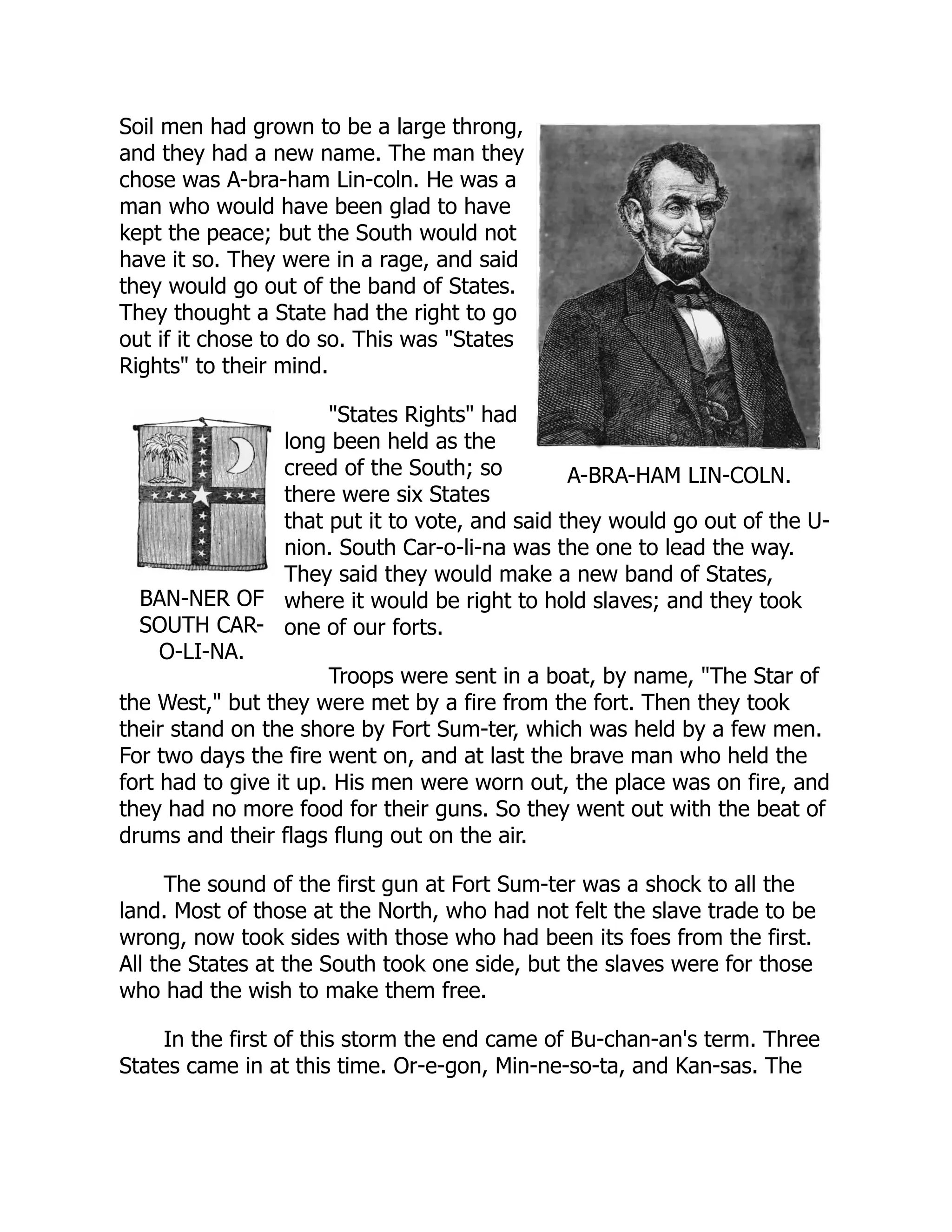
A-BRA-HAM LIN-COLN.
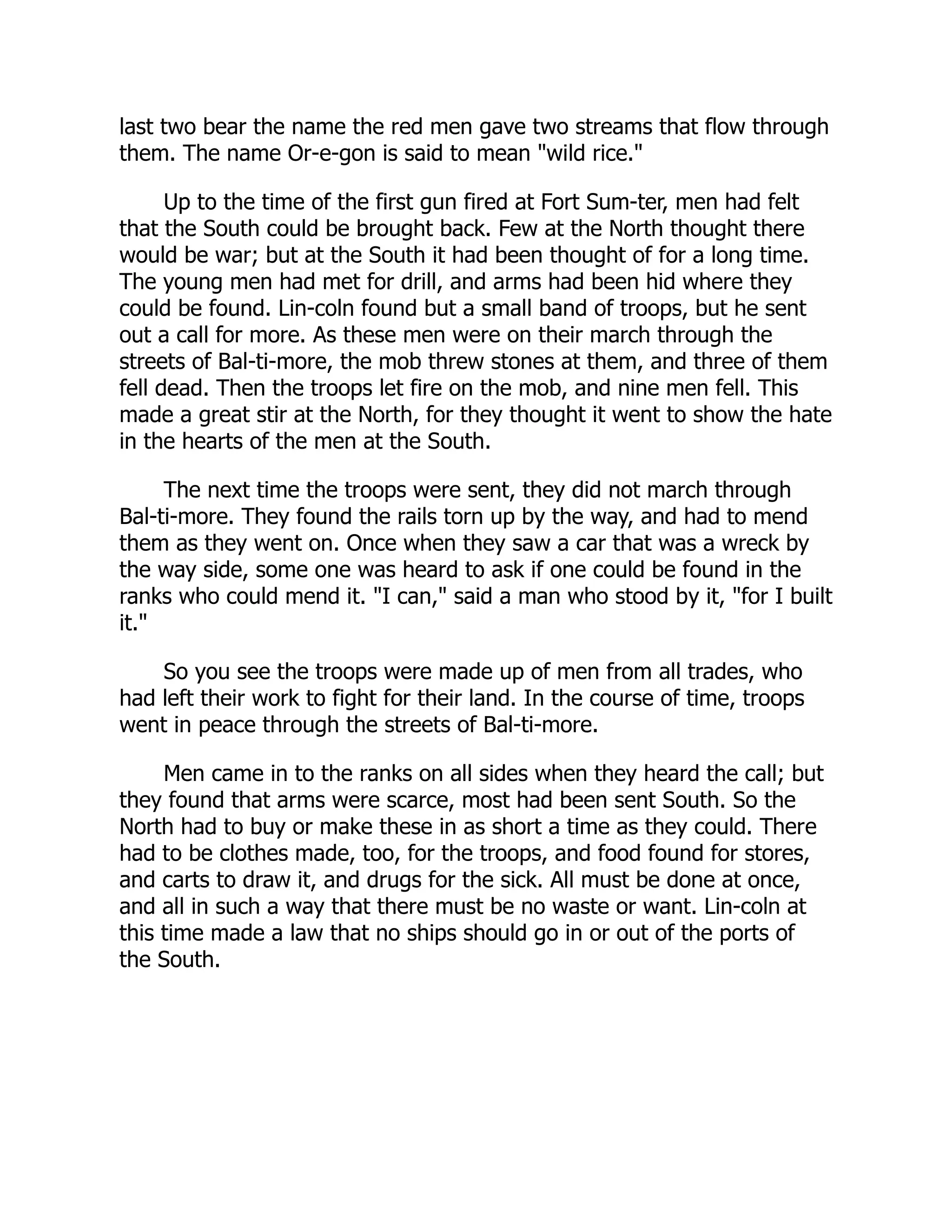
BAN-NER OF
SOUTHCAR-
O-LI-NA.
Soil men had grown to be a large throng,
and they had a new name. The man they
chose was A-bra-ham Lin-coln. He was a
man who would have been glad to have
kept the peace; but the South would not
have it so. They were in a rage, and said
they would go out of the band of States.
They thought a State had the right to go
out if it chose to do so. This was "States
Rights" to their mind.
"States Rights" had
long been held as the
creed of the South; so
there were six States
that put it to vote, and said they would go out of the U-
nion. South Car-o-li-na was the one to lead the way.
They said they would make a new band of States,
where it would be right to hold slaves; and they took
one of our forts.
Troops were sent in a boat, by name, "The Star of
the West," but they were met by a fire from the fort. Then they took
their stand on the shore by Fort Sum-ter, which was held by a few men.
For two days the fire went on, and at last the brave man who held the
fort had to give it up. His men were worn out, the place was on fire, and
they had no more food for their guns. So they went out with the beat of
drums and their flags flung out on the air.
The sound of the first gun at Fort Sum-ter was a shock to all the
land. Most of those at the North, who had not felt the slave trade to be
wrong, now took sides with those who had been its foes from the first.
All the States at the South took one side, but the slaves were for those
who had the wish to make them free.
In the first of this storm the end came of Bu-chan-an's term. Three
States came in at this time. Or-e-gon, Min-ne-so-ta, and Kan-sas. The
19.
last two bearthe name the red men gave two streams that flow through
them. The name Or-e-gon is said to mean "wild rice."
Up to the time of the first gun fired at Fort Sum-ter, men had felt
that the South could be brought back. Few at the North thought there
would be war; but at the South it had been thought of for a long time.
The young men had met for drill, and arms had been hid where they
could be found. Lin-coln found but a small band of troops, but he sent
out a call for more. As these men were on their march through the
streets of Bal-ti-more, the mob threw stones at them, and three of them
fell dead. Then the troops let fire on the mob, and nine men fell. This
made a great stir at the North, for they thought it went to show the hate
in the hearts of the men at the South.
The next time the troops were sent, they did not march through
Bal-ti-more. They found the rails torn up by the way, and had to mend
them as they went on. Once when they saw a car that was a wreck by
the way side, some one was heard to ask if one could be found in the
ranks who could mend it. "I can," said a man who stood by it, "for I built
it."
So you see the troops were made up of men from all trades, who
had left their work to fight for their land. In the course of time, troops
went in peace through the streets of Bal-ti-more.
Men came in to the ranks on all sides when they heard the call; but
they found that arms were scarce, most had been sent South. So the
North had to buy or make these in as short a time as they could. There
had to be clothes made, too, for the troops, and food found for stores,
and carts to draw it, and drugs for the sick. All must be done at once,
and all in such a way that there must be no waste or want. Lin-coln at
this time made a law that no ships should go in or out of the ports of
the South.
20.
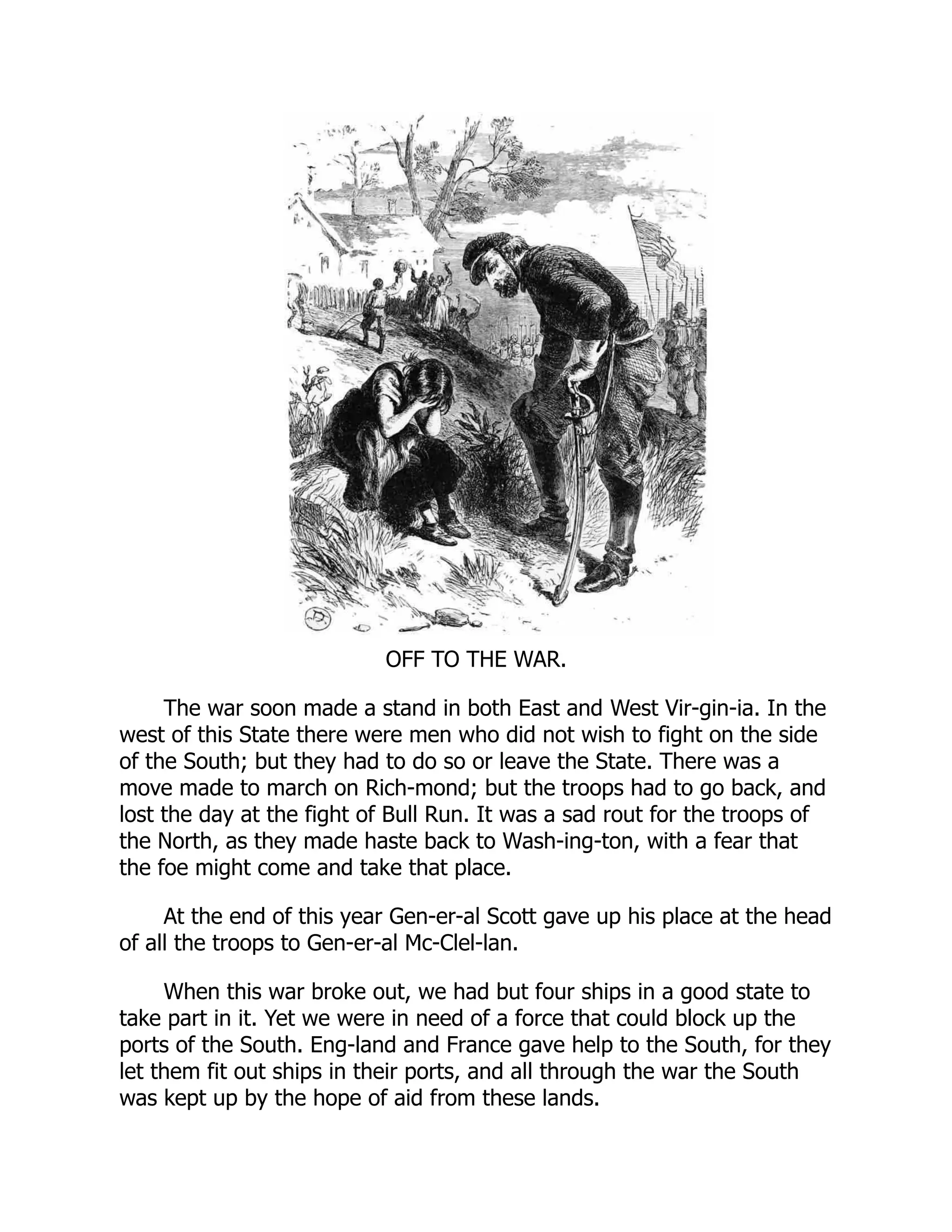
OFF TO THEWAR.
The war soon made a stand in both East and West Vir-gin-ia. In the
west of this State there were men who did not wish to fight on the side
of the South; but they had to do so or leave the State. There was a
move made to march on Rich-mond; but the troops had to go back, and
lost the day at the fight of Bull Run. It was a sad rout for the troops of
the North, as they made haste back to Wash-ing-ton, with a fear that
the foe might come and take that place.
At the end of this year Gen-er-al Scott gave up his place at the head
of all the troops to Gen-er-al Mc-Clel-lan.
When this war broke out, we had but four ships in a good state to
take part in it. Yet we were in need of a force that could block up the
ports of the South. Eng-land and France gave help to the South, for they
let them fit out ships in their ports, and all through the war the South
was kept up by the hope of aid from these lands.
21.
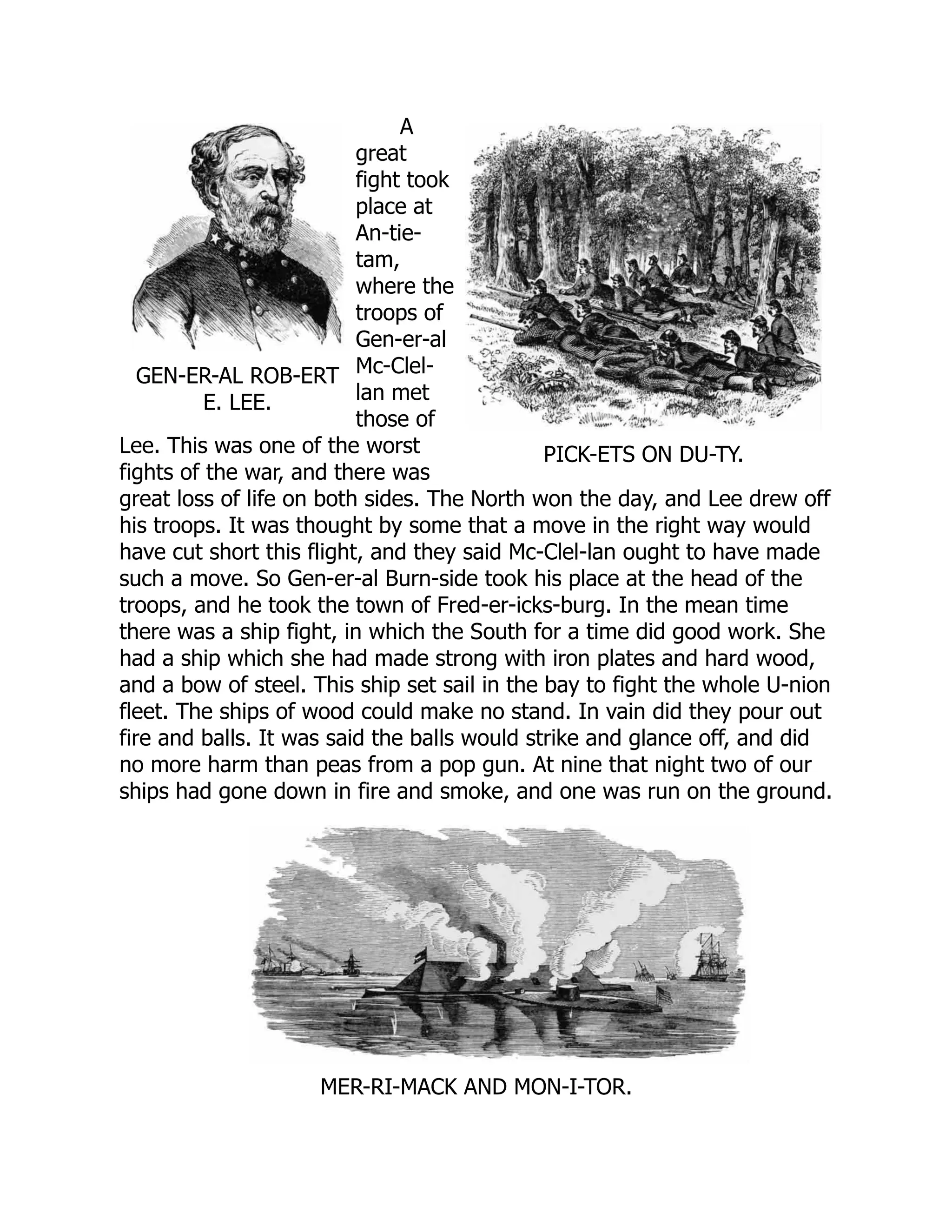
GEN-ER-AL ROB-ERT
E. LEE.
PICK-ETSON DU-TY.
A
great
fight took
place at
An-tie-
tam,
where the
troops of
Gen-er-al
Mc-Clel-
lan met
those of
Lee. This was one of the worst
fights of the war, and there was
great loss of life on both sides. The North won the day, and Lee drew off
his troops. It was thought by some that a move in the right way would
have cut short this flight, and they said Mc-Clel-lan ought to have made
such a move. So Gen-er-al Burn-side took his place at the head of the
troops, and he took the town of Fred-er-icks-burg. In the mean time
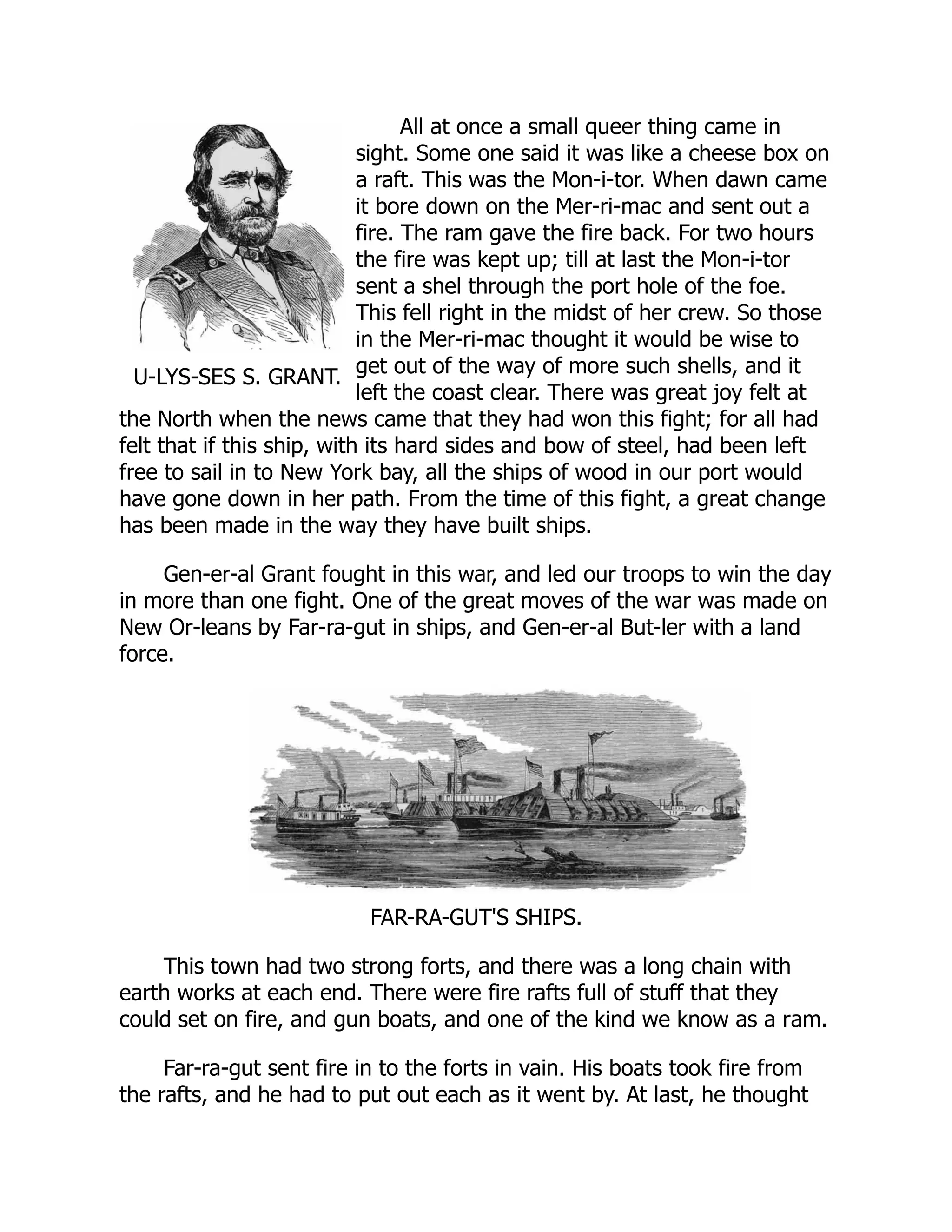
there was a ship fight, in which the South for a time did good work. She
had a ship which she had made strong with iron plates and hard wood,
and a bow of steel. This ship set sail in the bay to fight the whole U-nion
fleet. The ships of wood could make no stand. In vain did they pour out
fire and balls. It was said the balls would strike and glance off, and did
no more harm than peas from a pop gun. At nine that night two of our
ships had gone down in fire and smoke, and one was run on the ground.
MER-RI-MACK AND MON-I-TOR.
22.
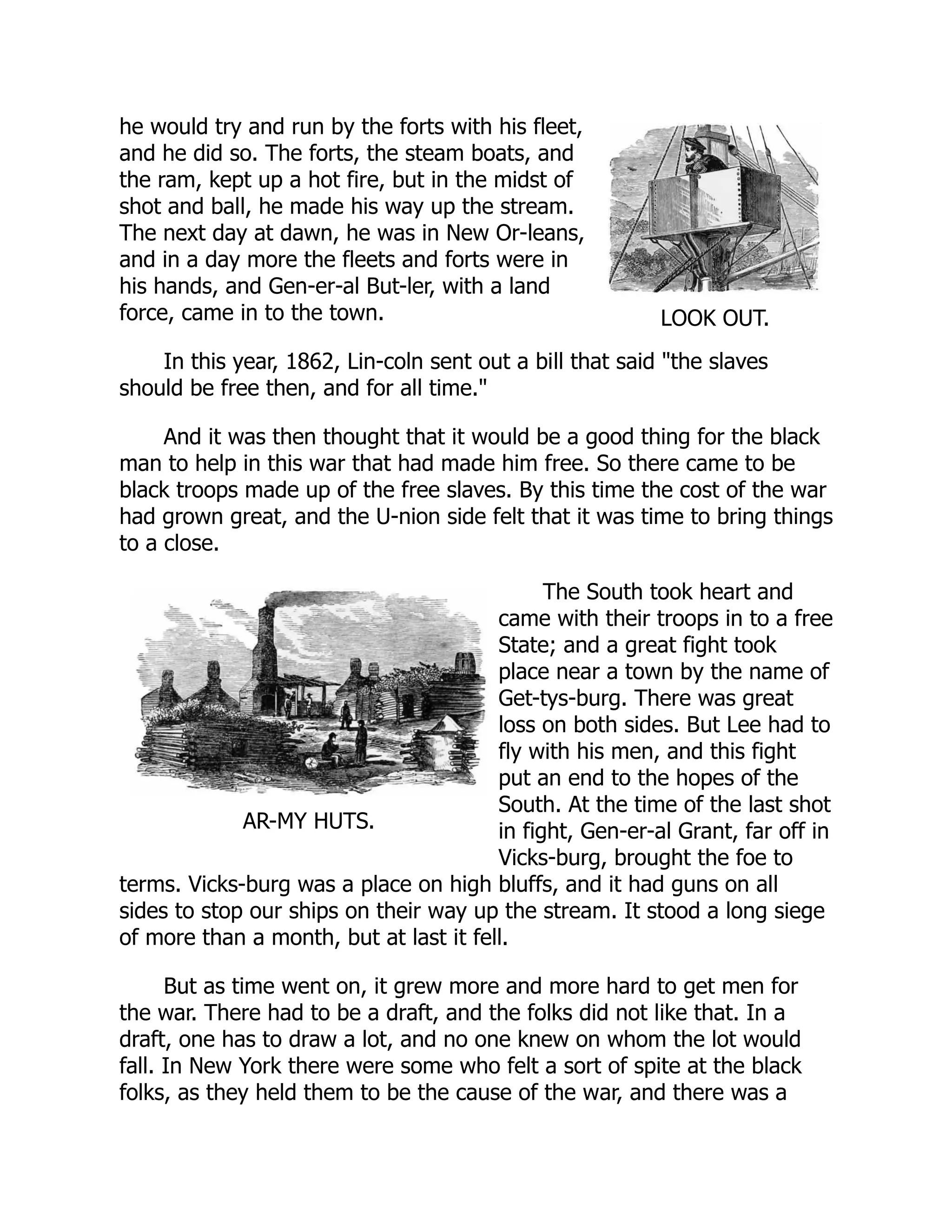
U-LYS-SES S. GRANT.
Allat once a small queer thing came in
sight. Some one said it was like a cheese box on
a raft. This was the Mon-i-tor. When dawn came
it bore down on the Mer-ri-mac and sent out a
fire. The ram gave the fire back. For two hours
the fire was kept up; till at last the Mon-i-tor
sent a shel through the port hole of the foe.
This fell right in the midst of her crew. So those
in the Mer-ri-mac thought it would be wise to
get out of the way of more such shells, and it
left the coast clear. There was great joy felt at
the North when the news came that they had won this fight; for all had
felt that if this ship, with its hard sides and bow of steel, had been left
free to sail in to New York bay, all the ships of wood in our port would
have gone down in her path. From the time of this fight, a great change
has been made in the way they have built ships.
Gen-er-al Grant fought in this war, and led our troops to win the day
in more than one fight. One of the great moves of the war was made on
New Or-leans by Far-ra-gut in ships, and Gen-er-al But-ler with a land
force.
FAR-RA-GUT'S SHIPS.
This town had two strong forts, and there was a long chain with
earth works at each end. There were fire rafts full of stuff that they
could set on fire, and gun boats, and one of the kind we know as a ram.
Far-ra-gut sent fire in to the forts in vain. His boats took fire from
the rafts, and he had to put out each as it went by. At last, he thought
23.
LOOK OUT.
AR-MY HUTS.
hewould try and run by the forts with his fleet,
and he did so. The forts, the steam boats, and
the ram, kept up a hot fire, but in the midst of
shot and ball, he made his way up the stream.
The next day at dawn, he was in New Or-leans,
and in a day more the fleets and forts were in
his hands, and Gen-er-al But-ler, with a land
force, came in to the town.
In this year, 1862, Lin-coln sent out a bill that said "the slaves
should be free then, and for all time."
And it was then thought that it would be a good thing for the black
man to help in this war that had made him free. So there came to be
black troops made up of the free slaves. By this time the cost of the war
had grown great, and the U-nion side felt that it was time to bring things
to a close.
The South took heart and
came with their troops in to a free
State; and a great fight took
place near a town by the name of
Get-tys-burg. There was great
loss on both sides. But Lee had to
fly with his men, and this fight
put an end to the hopes of the
South. At the time of the last shot
in fight, Gen-er-al Grant, far off in
Vicks-burg, brought the foe to
terms. Vicks-burg was a place on high bluffs, and it had guns on all
sides to stop our ships on their way up the stream. It stood a long siege
of more than a month, but at last it fell.
But as time went on, it grew more and more hard to get men for
the war. There had to be a draft, and the folks did not like that. In a
draft, one has to draw a lot, and no one knew on whom the lot would
fall. In New York there were some who felt a sort of spite at the black
folks, as they held them to be the cause of the war, and there was a
24.
WIL-LIAM T. SHER-MAN.
mobthat set on them in the streets. It went on for three days, and
some black men fell struck by stones from the mob. But at last it was
brought to an end.
The next year Grant made some good moves, and, on the whole,
the sky grew more clear. Lin-coln said, "Peace does not seem so far off
as it did. I hope it will come soon and come to stay, and come so that it
will be worth all we have done for it."
In 1864, Gen-er-al Grant was put at the head of all the troops. He
had shown that he knew a great deal of war, and he had done good
work. He soon made a plan of two great moves that should go on at the
same time. One of these was to march on Rich-mond with one branch of
the troops, while Gen-er-al Sher-man should take one branch through
the States of the South, from mount to sea.
Gen-er-al Grant did not swerve from
the course he had laid out. He said, "I
will fight it out on this line," and he did,
spite of all loss. He laid siege to Rich-
mond, but for a time they held out. At
sea the ships of the South at first won on
all sides. They drove our ships out, and
got off with no harm, till the time that
the Al-a-ba-ma was sunk. One more
grand fight with ships took place in Mo-
bile Bay.
This bay was a great place for boats
to run in with food and stores to the foe.
Our ships could not make their way there, for there were two forts, a
ram of great strength, and shells that would blow them up set in the
way. Far-ra-gut put false bows on his ships, so that they might charge
the ram, and at last it was sunk.
Sher-man had a hard work to do; for he must take his troops
through the land of the foe, by their strong forts, through hill and dale
and pass. He meant to cut off their chance to get food, and to break up
25.
the rail roads.He first took the town of At-lan-ta, and from that point set
out on the "March to the Sea," which has won him so much fame. He
had to feed his troops for the most part on what he could find in the
land he went through. He took Sa-van-nah and wrote to Lin-coln, "I beg
to give you the gift of the town of Sa-van-nah, with all its guns and
stores."
Then he took up his march once more through swamp and bog, or
up the high steep hills and rocks. The cold days had come, but on they
went, through storms of sleet and snow, or in the face of floods of rain,
with a foe on all sides. Such a march had not been known in all the wars
of the past. Long will the fame of that March to the Sea live in our land.
He had found, as he said, that all the men in the South had been drawn
out to aid the troops, and that there were no more left, and the land
was a "mere shell."
Charles-ton gave up at the end of a long siege; but it was set on
fire in all parts by its own folk, so that it might not be worth much when
it fell in our hands.
The last move was made by Grant on Rich-mond. He felt that one
more blow would bring the war to a close. He sent out word to Sher-i-
dan, "When day dawns push round the foe, and get to his rear." Two
days more our troops were in the streets of Rich-mond. When Lee found
he could not hold his place, he sent word by the wires to Jef-fer-son Da-
vis at Rich-mond. Da-vis was the man the South had made their chief,
and he was in church when the news came to him. He read these
words: "My lines are cut at three points. Rich-mond must be left to
night."
Da-vis left the church, and the news spread at once that the town
was lost. There was fright on all sides, and the streets were soon full of
men who knew not what to do. The means for flight were small, and a
poor cart and horse would have brought a large sum of gold. The ships
were set on fire or blown up, and some of the stores of the town were in
a blaze. Oh, what a night! All sought to fly, but few had means to go.
26.
The next daysome black troops were the first to march in the town.
This was the real end of the war. Gen-er-al Lee did all he could to save
his men; but they were so faint with want of food that they could not
march, and so weak they could not hold their guns. So he gave up all at
last to Gen-er-al Grant, and the whole South had to yield.
This war had cost the land more than you could count in gold and
lives. But it had made the slave free; and we know that we shall have
the curse of the slave trade in our land no more. And it had shown that
the creed of States Rights was not the best one, for if we were cut up in
parts we would be weak, while if we stay as one, we will be strong. Our
true strength, then, is to hold fast the bond that binds all the States,
North and South, East and West, in one.
There was great joy, and all gave thanks at the North when the
news that the war had come to an end was borne on the wires. Lin-coln
had held his course in a firm, brave way. He had said in a speech in New
York, when he was on his way to take his place, "When the time comes
for me to speak, I shall then take the ground that I think is right—right
for the North, for the South, for the East, for the West, for all our land."
And so he had done. The war was a grief to him. He said, "We did
not think this war would last so long. Both sides read the same Word of
God, and both pray to Him to aid in a war on those who are bound to
them by near ties. We hope, we pray, that this scourge of war may soon
pass. But if God wills it should stay till each drop of blood drawn by the
lash shall be paid with one drawn with the sword, it must be said, 'Shall
not the Judge of all the world do right?'"
Five days from the time that the news of joy came in a flash on the
wires, Lin-coln was dead. He had been shot while he sat in his box, at
the play, by a man of the name of Wilkes Booth. This man had by some
means got in the box and made the door fast. When he had shot Lin-
coln, he sprang from the box to the stage, but caught his foot in one of
our flags, and broke his leg. He had a horse at the door, and got off; but
was at last found in a barn, where he stood at bay. They set the barn on
fire to drive him out; but he still stood his ground, and fought till the
last, when he fell, shot by one of our men.
27.
Those who stoodby the bed side of Lin-coln saw that there was no
hope. All the land was full of gloom, when the sad news came. As his
corpse was borne in a train to his old home, the towns were hung with
black on the whole route, and most men wore the badge of grief. Those
who had not been warm friends of Lin-coln in his life, felt a shock at his
death, for they knew a brave, true man had gone.
28.
CHAPTER XIII.
PEACE ONCEMORE.
At the time of Lin-coln's death, there had been a sort of plot to kill
more of the head men of the land. Sew-ard had been shot in his own
house, and there was a great fear in Wash-ing-ton; for no one knew
how far this plot might reach.
When An-drew John-son took the place at the head of the land,
there was some fear that those who had spent so long a time in the war
would not know how to live in time of peace. But they soon made their
way to their old homes, and were glad to lay down their arms and take
up the old trades once more. There was a vast debt, and all sorts of
loans to be got. Then there were those who thought that the States,
which were the cause of the war, should not have the right to come back
on their own terms; and some thought they could come back when they
would, and in their own way.
But John-son brought out a Bill which gave back all their rights to
most of those who had made the war. The States could come back if
they would say that they would have no more slaves, and that they
would be true to the U-nit-ed States in all time to come. John-son did
not act in a way to suit those who had cast their votes for him, and Con-
gress made a move that he should give up his place. When they came to
try him, they found there was one vote short. That one vote kept him in
his place; but he did not get a new term.
The next man who was the choice of the land was U-lys-ses S.
Grant, whose work in the war had won him such fame. In his time all
the States of the South came back in to the U-nion. Great tracts of land
were made ours; the debt was made less; and there was a law made
which said that men of all races and hues should have a right to vote. In
his last term a grand show took place in Phil-a-del-phia. All the lands in
29.
the world sentthings to be shown there, and all the trades of the world
had place in those great halls.
When Hayes came in there was talk that there had not been a fair
vote for him; but in time he won his way. He was fair to both North and
South, and his rule was mild but firm. He drew all troops out of the
South, that those States might put their own laws in force, with no help
from Wash-ing-ton; so that if their own folks had wrongs, their own
courts must set the thing right.
Time has shown that this course was wise. The States at the South
have grown in peace and good will to us since that time, and the white
men there now seem quite glad to have the black men vote. Rail ways
have been built so fast that it is thought in a few years there will be four
or five of these great lines through the whole length and breadth of the
land. Our debt has been paid off at such a quick rate that if we go on it
will be gone ere long, and the tax on all things can be made less. We
have shown, too, that we have not stood still.
In old times each watch in use here came from the old lands, but
now a watch is made here that might win the prize from those on that
side of the sea. So, too, in glass, tools, knives, soap, combs, and all
sorts of things, we have made a name. The beef and grain we send out
bring in vast wealth.
James A. Gar-field was our choice in 1881. A great shock was felt in
the land, just two months from the time he came to the White House,
when we heard he had been shot while on his way to take a train for the
North. A man by the name of Gui-teau, who had some sort of strange
craze, was the one who did the black deed.
They bore Gar-field at once to his home in the White House, and for
a long time he lay there in great pain. Day by day the news would flash
on the wires that told his state, how his pulse beat, how he had slept,
and what hope there was for his life. All would seize the news and read
it each day, with the wish that he might yet live. They took him to Long
Branch in the hope that the sea breeze might help him; but though his
life held out for near the space of three months, it came to an end, and
30.
his last breathwas drawn in that sweet home by the sea, Sep-tem-ber
19, 1881. Great grief was felt at his death, and all lands strove to say a
kind word. The Court of Eng-land put on black for him, and the Queen
sent a wreath for his grave. Gui-teau was hung for his crime.
Ches-ter A. Ar-thur is now our Pres-i-dent. We are at peace with all
the world. The same flag, with the old stars and stripes, floats now in
the South as in the North. Long may it wave, "On the land of the free
and the home of the brave."
31.
*** END OFTHE PROJECT GUTENBERG EBOOK HISTORY OF THE
UNITED STATES IN WORDS OF ONE SYLLABLE ***
Updated editions will replace the previous one—the old editions will
be renamed.
Creating the works from print editions not protected by U.S.
copyright law means that no one owns a United States copyright in
these works, so the Foundation (and you!) can copy and distribute it
in the United States without permission and without paying
copyright royalties. Special rules, set forth in the General Terms of
Use part of this license, apply to copying and distributing Project
Gutenberg™ electronic works to protect the PROJECT GUTENBERG™
concept and trademark. Project Gutenberg is a registered trademark,
and may not be used if you charge for an eBook, except by following
the terms of the trademark license, including paying royalties for use
of the Project Gutenberg trademark. If you do not charge anything
for copies of this eBook, complying with the trademark license is
very easy. You may use this eBook for nearly any purpose such as
creation of derivative works, reports, performances and research.
Project Gutenberg eBooks may be modified and printed and given
away—you may do practically ANYTHING in the United States with
eBooks not protected by U.S. copyright law. Redistribution is subject
to the trademark license, especially commercial redistribution.
START: FULL LICENSE
PLEASE READ THISBEFORE YOU DISTRIBUTE OR USE THIS WORK
To protect the Project Gutenberg™ mission of promoting the free
distribution of electronic works, by using or distributing this work (or
any other work associated in any way with the phrase “Project
Gutenberg”), you agree to comply with all the terms of the Full
Project Gutenberg™ License available with this file or online at
www.gutenberg.org/license.
Section 1. General Terms of Use and
Redistributing Project Gutenberg™
electronic works
1.A. By reading or using any part of this Project Gutenberg™
electronic work, you indicate that you have read, understand, agree
to and accept all the terms of this license and intellectual property
(trademark/copyright) agreement. If you do not agree to abide by all
the terms of this agreement, you must cease using and return or
destroy all copies of Project Gutenberg™ electronic works in your
possession. If you paid a fee for obtaining a copy of or access to a
Project Gutenberg™ electronic work and you do not agree to be
bound by the terms of this agreement, you may obtain a refund
from the person or entity to whom you paid the fee as set forth in
paragraph 1.E.8.
1.B. “Project Gutenberg” is a registered trademark. It may only be
used on or associated in any way with an electronic work by people
who agree to be bound by the terms of this agreement. There are a
few things that you can do with most Project Gutenberg™ electronic
works even without complying with the full terms of this agreement.
See paragraph 1.C below. There are a lot of things you can do with
Project Gutenberg™ electronic works if you follow the terms of this
agreement and help preserve free future access to Project
Gutenberg™ electronic works. See paragraph 1.E below.
34.
1.C. The ProjectGutenberg Literary Archive Foundation (“the
Foundation” or PGLAF), owns a compilation copyright in the
collection of Project Gutenberg™ electronic works. Nearly all the
individual works in the collection are in the public domain in the
United States. If an individual work is unprotected by copyright law
in the United States and you are located in the United States, we do
not claim a right to prevent you from copying, distributing,
performing, displaying or creating derivative works based on the
work as long as all references to Project Gutenberg are removed. Of
course, we hope that you will support the Project Gutenberg™
mission of promoting free access to electronic works by freely
sharing Project Gutenberg™ works in compliance with the terms of
this agreement for keeping the Project Gutenberg™ name associated
with the work. You can easily comply with the terms of this
agreement by keeping this work in the same format with its attached
full Project Gutenberg™ License when you share it without charge
with others.
1.D. The copyright laws of the place where you are located also
govern what you can do with this work. Copyright laws in most
countries are in a constant state of change. If you are outside the
United States, check the laws of your country in addition to the
terms of this agreement before downloading, copying, displaying,
performing, distributing or creating derivative works based on this
work or any other Project Gutenberg™ work. The Foundation makes
no representations concerning the copyright status of any work in
any country other than the United States.
1.E. Unless you have removed all references to Project Gutenberg:
1.E.1. The following sentence, with active links to, or other
immediate access to, the full Project Gutenberg™ License must
appear prominently whenever any copy of a Project Gutenberg™
work (any work on which the phrase “Project Gutenberg” appears,
or with which the phrase “Project Gutenberg” is associated) is
accessed, displayed, performed, viewed, copied or distributed:
35.
This eBook isfor the use of anyone anywhere in the United
States and most other parts of the world at no cost and with
almost no restrictions whatsoever. You may copy it, give it away
or re-use it under the terms of the Project Gutenberg License
included with this eBook or online at www.gutenberg.org. If you
are not located in the United States, you will have to check the
laws of the country where you are located before using this
eBook.
1.E.2. If an individual Project Gutenberg™ electronic work is derived
from texts not protected by U.S. copyright law (does not contain a
notice indicating that it is posted with permission of the copyright
holder), the work can be copied and distributed to anyone in the
United States without paying any fees or charges. If you are
redistributing or providing access to a work with the phrase “Project
Gutenberg” associated with or appearing on the work, you must
comply either with the requirements of paragraphs 1.E.1 through
1.E.7 or obtain permission for the use of the work and the Project
Gutenberg™ trademark as set forth in paragraphs 1.E.8 or 1.E.9.
1.E.3. If an individual Project Gutenberg™ electronic work is posted
with the permission of the copyright holder, your use and distribution
must comply with both paragraphs 1.E.1 through 1.E.7 and any
additional terms imposed by the copyright holder. Additional terms
will be linked to the Project Gutenberg™ License for all works posted
with the permission of the copyright holder found at the beginning
of this work.
1.E.4. Do not unlink or detach or remove the full Project
Gutenberg™ License terms from this work, or any files containing a
part of this work or any other work associated with Project
Gutenberg™.
1.E.5. Do not copy, display, perform, distribute or redistribute this
electronic work, or any part of this electronic work, without
prominently displaying the sentence set forth in paragraph 1.E.1
36.
with active linksor immediate access to the full terms of the Project
Gutenberg™ License.
1.E.6. You may convert to and distribute this work in any binary,
compressed, marked up, nonproprietary or proprietary form,
including any word processing or hypertext form. However, if you
provide access to or distribute copies of a Project Gutenberg™ work
in a format other than “Plain Vanilla ASCII” or other format used in
the official version posted on the official Project Gutenberg™ website
(www.gutenberg.org), you must, at no additional cost, fee or
expense to the user, provide a copy, a means of exporting a copy, or
a means of obtaining a copy upon request, of the work in its original
“Plain Vanilla ASCII” or other form. Any alternate format must
include the full Project Gutenberg™ License as specified in
paragraph 1.E.1.
1.E.7. Do not charge a fee for access to, viewing, displaying,
performing, copying or distributing any Project Gutenberg™ works
unless you comply with paragraph 1.E.8 or 1.E.9.
1.E.8. You may charge a reasonable fee for copies of or providing
access to or distributing Project Gutenberg™ electronic works
provided that:
• You pay a royalty fee of 20% of the gross profits you derive
from the use of Project Gutenberg™ works calculated using the
method you already use to calculate your applicable taxes. The
fee is owed to the owner of the Project Gutenberg™ trademark,
but he has agreed to donate royalties under this paragraph to
the Project Gutenberg Literary Archive Foundation. Royalty
payments must be paid within 60 days following each date on
which you prepare (or are legally required to prepare) your
periodic tax returns. Royalty payments should be clearly marked
as such and sent to the Project Gutenberg Literary Archive
Foundation at the address specified in Section 4, “Information
37.
about donations tothe Project Gutenberg Literary Archive
Foundation.”
• You provide a full refund of any money paid by a user who
notifies you in writing (or by e-mail) within 30 days of receipt
that s/he does not agree to the terms of the full Project
Gutenberg™ License. You must require such a user to return or
destroy all copies of the works possessed in a physical medium
and discontinue all use of and all access to other copies of
Project Gutenberg™ works.
• You provide, in accordance with paragraph 1.F.3, a full refund of
any money paid for a work or a replacement copy, if a defect in
the electronic work is discovered and reported to you within 90
days of receipt of the work.
• You comply with all other terms of this agreement for free
distribution of Project Gutenberg™ works.
1.E.9. If you wish to charge a fee or distribute a Project Gutenberg™
electronic work or group of works on different terms than are set
forth in this agreement, you must obtain permission in writing from
the Project Gutenberg Literary Archive Foundation, the manager of
the Project Gutenberg™ trademark. Contact the Foundation as set
forth in Section 3 below.
1.F.
1.F.1. Project Gutenberg volunteers and employees expend
considerable effort to identify, do copyright research on, transcribe
and proofread works not protected by U.S. copyright law in creating
the Project Gutenberg™ collection. Despite these efforts, Project
Gutenberg™ electronic works, and the medium on which they may
be stored, may contain “Defects,” such as, but not limited to,
incomplete, inaccurate or corrupt data, transcription errors, a
copyright or other intellectual property infringement, a defective or
38.
Welcome to ourwebsite – the perfect destination for book lovers and
knowledge seekers. We believe that every book holds a new world,
offering opportunities for learning, discovery, and personal growth.
That’s why we are dedicated to bringing you a diverse collection of
books, ranging from classic literature and specialized publications to
self-development guides and children's books.
More than just a book-buying platform, we strive to be a bridge
connecting you with timeless cultural and intellectual values. With an
elegant, user-friendly interface and a smart search system, you can
quickly find the books that best suit your interests. Additionally,
our special promotions and home delivery services help you save time
and fully enjoy the joy of reading.
Join us on a journey of knowledge exploration, passion nurturing, and
personal growth every day!
ebookbell.com