IE BUSINESS SCHOOL APPLICATION
By Ngonya Kalango
FRAMEWORK
QUESTION
You have just participated in an important meeting with your superior. How will you
ensure that every part of the instructions you received will properly reach all
subordinates, suppliers and clients, located in different parts of the world?
OBJECTIVE
Ensure receipt of all relevant information from meeting with my superior to all
subordinates, supplies and clients from all over the world.
ASSUMPTIONS
- Minutes of the meeting have been documented.
- All entities have access to basic infrastructure/technology.
- The company has no communication plan in place and there is sufficient time and
resources available for an adequate plan to be created and implemented.
WHAT IS COMMUNICATION
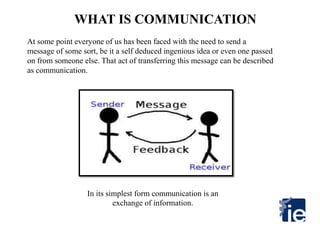
In its simplest form communication is an
exchange of information.
At some point everyone of us has been faced with the need to send a
message of some sort, be it a self deduced ingenious idea or even one passed
on from someone else. That act of transferring this message can be described
as communication.
WHERE DO WE COMMUNICATE
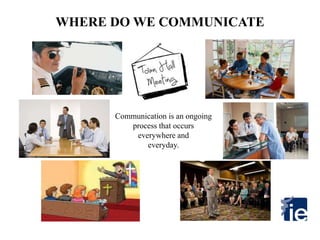
Communication is an ongoing
process that occurs
everywhere and
everyday.
WHY DO WE COMMUNICATE
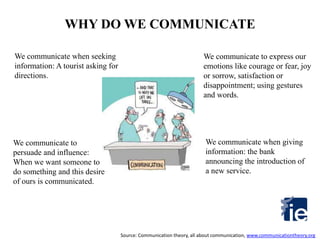
We communicate when seeking
information: A tourist asking for
directions.
We communicate to
persuade and influence:
When we want someone to
do something and this desire
of ours is communicated.
We communicate when giving
information: the bank
announcing the introduction of
a new service.
We communicate to express our
emotions like courage or fear, joy
or sorrow, satisfaction or
disappointment; using gestures
and words.
Source: Communication theory, all about communication, www.communicationtheory.org
DIFFICULTIES WITH COMMUNICATION
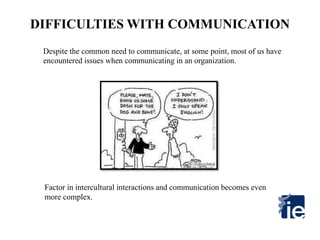
Despite the common need to communicate, at some point, most of us have
encountered issues when communicating in an organization.
Factor in intercultural interactions and communication becomes even
more complex.
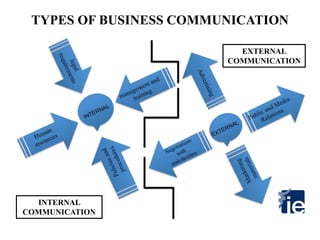
TYPES OF BUSINESS COMMUNICATION
INTERNAL
COMMUNICATION
EXTERNAL
COMMUNICATION
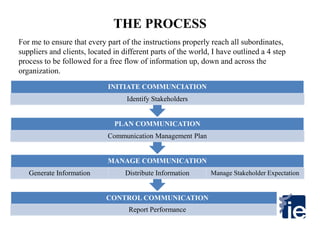
THE PROCESS
CONTROL COMMUNICATION
Report Performance
MANAGE COMMUNICATION
Generate Information Distribute Information Manage Stakeholder Expectation
PLAN COMMUNICATION
Communication Management Plan
INITIATE COMMUNCIATION
Identify Stakeholders
For me to ensure that every part of the instructions properly reach all subordinates,
suppliers and clients, located in different parts of the world, I have outlined a 4 step
process to be followed for a free flow of information up, down and across the
organization.
INITIATE COMMUNICATION
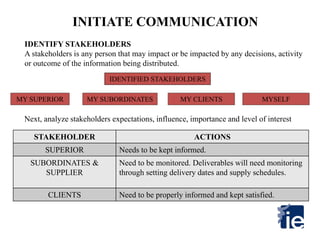
IDENTIFY STAKEHOLDERS
A stakeholders is any person that may impact or be impacted by any decisions, activity
or outcome of the information being distributed.
MY SUPERIOR MY SUBORDINATES MY CLIENTS MYSELF
IDENTIFIED STAKEHOLDERS
Next, analyze stakeholders expectations, influence, importance and level of interest
STAKEHOLDER ACTIONS
SUPERIOR Needs to be kept informed.
SUBORDINATES &
SUPPLIER
Need to be monitored. Deliverables will need monitoring
through setting delivery dates and supply schedules.
CLIENTS Need to be properly informed and kept satisfied.
PLAN COMMUNICATION
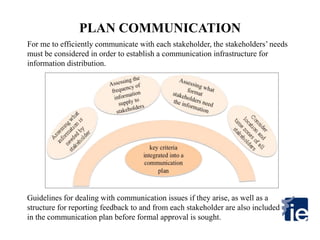
For me to efficiently communicate with each stakeholder, the stakeholders’ needs
must be considered in order to establish a communication infrastructure for
information distribution.
Guidelines for dealing with communication issues if they arise, as well as a
structure for reporting feedback to and from each stakeholder are also included
in the communication plan before formal approval is sought.
MANAGE COMMUNCATION
The execution of the communication plan is implemented in this phase, in order to
ensure a timely and productive flow of information between my supervisor,
subordinates, suppliers, clients and I.
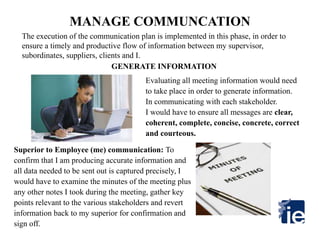
GENERATE INFORMATION
Evaluating all meeting information would need
to take place in order to generate information.
In communicating with each stakeholder.
I would have to ensure all messages are clear,
coherent, complete, concise, concrete, correct
and courteous.
Superior to Employee (me) communication: To
confirm that I am producing accurate information and
all data needed to be sent out is captured precisely, I
would have to examine the minutes of the meeting plus
any other notes I took during the meeting, gather key
points relevant to the various stakeholders and revert
information back to my superior for confirmation and
sign off.
MANAGE COMMUNCATION
DISTRIBUTE INFORMATION
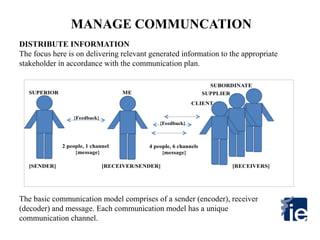
The focus here is on delivering relevant generated information to the appropriate
stakeholder in accordance with the communication plan.
The basic communication model comprises of a sender (encoder), receiver
(decoder) and message. Each communication model has a unique
communication channel.
MANAGE COMMUNCATION
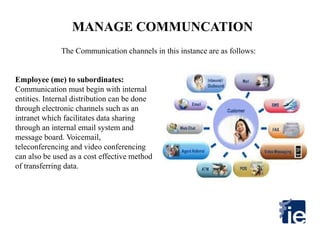
Employee (me) to subordinates:
Communication must begin with internal
entities. Internal distribution can be done
through electronic channels such as an
intranet which facilitates data sharing
through an internal email system and
message board. Voicemail,
teleconferencing and video conferencing
can also be used as a cost effective method
of transferring data.
The Communication channels in this instance are as follows:
MANAGE COMMUNCATION
Employee (me) to Supplier: The
need to record communication with
external parties such as suppliers
means written communication is
essential. Mediums like emails are a
reliable means of communication. Fax
and postal delivery of letters can be
sent where original documents are
required to attain sign off.
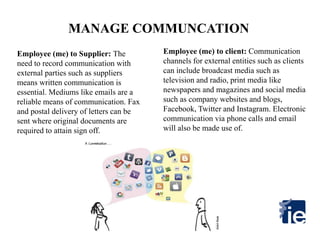
Employee (me) to client: Communication
channels for external entities such as clients
can include broadcast media such as
television and radio, print media like
newspapers and magazines and social media
such as company websites and blogs,
Facebook, Twitter and Instagram. Electronic
communication via phone calls and email
will also be made use of.
MANAGE COMMUNCATION
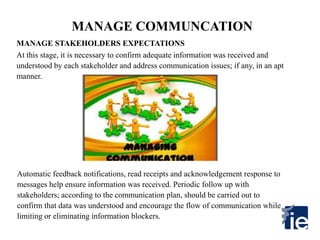
Automatic feedback notifications, read receipts and acknowledgement response to
messages help ensure information was received. Periodic follow up with
stakeholders; according to the communication plan, should be carried out to
confirm that data was understood and encourage the flow of communication while
limiting or eliminating information blockers.
At this stage, it is necessary to confirm adequate information was received and
understood by each stakeholder and address communication issues; if any, in an apt
manner.
MANAGE STAKEHOLDERS EXPECTATIONS
CONTROL COMMUNCATION
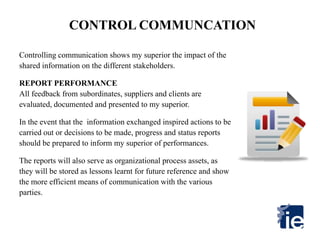
Controlling communication shows my superior the impact of the
shared information on the different stakeholders.
REPORT PERFORMANCE
All feedback from subordinates, suppliers and clients are
evaluated, documented and presented to my superior.
In the event that the information exchanged inspired actions to be
carried out or decisions to be made, progress and status reports
should be prepared to inform my superior of performances.
The reports will also serve as organizational process assets, as
they will be stored as lessons learnt for future reference and show
the more efficient means of communication with the various
parties.
CONCLUSION
Following these steps, all subordinates,
suppliers and clients in different parts of the
world would have received and understood all
important and relevant information sent out to
them. This should leave all parties; the
organization, my superior, subordinates,
suppliers and clients with all their needs and
expectations fulfilled and satisfied.

IE Business School Application - Question F

  • 1.
    IE BUSINESS SCHOOLAPPLICATION By Ngonya Kalango
  • 2.
    FRAMEWORK QUESTION You have justparticipated in an important meeting with your superior. How will you ensure that every part of the instructions you received will properly reach all subordinates, suppliers and clients, located in different parts of the world? OBJECTIVE Ensure receipt of all relevant information from meeting with my superior to all subordinates, supplies and clients from all over the world. ASSUMPTIONS - Minutes of the meeting have been documented. - All entities have access to basic infrastructure/technology. - The company has no communication plan in place and there is sufficient time and resources available for an adequate plan to be created and implemented.
  • 3.
    WHAT IS COMMUNICATION Inits simplest form communication is an exchange of information. At some point everyone of us has been faced with the need to send a message of some sort, be it a self deduced ingenious idea or even one passed on from someone else. That act of transferring this message can be described as communication.
  • 4.
    WHERE DO WECOMMUNICATE Communication is an ongoing process that occurs everywhere and everyday.
  • 5.
    WHY DO WECOMMUNICATE We communicate when seeking information: A tourist asking for directions. We communicate to persuade and influence: When we want someone to do something and this desire of ours is communicated. We communicate when giving information: the bank announcing the introduction of a new service. We communicate to express our emotions like courage or fear, joy or sorrow, satisfaction or disappointment; using gestures and words. Source: Communication theory, all about communication, www.communicationtheory.org
  • 6.
    DIFFICULTIES WITH COMMUNICATION Despitethe common need to communicate, at some point, most of us have encountered issues when communicating in an organization. Factor in intercultural interactions and communication becomes even more complex.
  • 7.
    TYPES OF BUSINESSCOMMUNICATION INTERNAL COMMUNICATION EXTERNAL COMMUNICATION
  • 8.
    THE PROCESS CONTROL COMMUNICATION ReportPerformance MANAGE COMMUNICATION Generate Information Distribute Information Manage Stakeholder Expectation PLAN COMMUNICATION Communication Management Plan INITIATE COMMUNCIATION Identify Stakeholders For me to ensure that every part of the instructions properly reach all subordinates, suppliers and clients, located in different parts of the world, I have outlined a 4 step process to be followed for a free flow of information up, down and across the organization.
  • 9.
    INITIATE COMMUNICATION IDENTIFY STAKEHOLDERS Astakeholders is any person that may impact or be impacted by any decisions, activity or outcome of the information being distributed. MY SUPERIOR MY SUBORDINATES MY CLIENTS MYSELF IDENTIFIED STAKEHOLDERS Next, analyze stakeholders expectations, influence, importance and level of interest STAKEHOLDER ACTIONS SUPERIOR Needs to be kept informed. SUBORDINATES & SUPPLIER Need to be monitored. Deliverables will need monitoring through setting delivery dates and supply schedules. CLIENTS Need to be properly informed and kept satisfied.
  • 10.
    PLAN COMMUNICATION For meto efficiently communicate with each stakeholder, the stakeholders’ needs must be considered in order to establish a communication infrastructure for information distribution. Guidelines for dealing with communication issues if they arise, as well as a structure for reporting feedback to and from each stakeholder are also included in the communication plan before formal approval is sought.
  • 11.
    MANAGE COMMUNCATION The executionof the communication plan is implemented in this phase, in order to ensure a timely and productive flow of information between my supervisor, subordinates, suppliers, clients and I. GENERATE INFORMATION Evaluating all meeting information would need to take place in order to generate information. In communicating with each stakeholder. I would have to ensure all messages are clear, coherent, complete, concise, concrete, correct and courteous. Superior to Employee (me) communication: To confirm that I am producing accurate information and all data needed to be sent out is captured precisely, I would have to examine the minutes of the meeting plus any other notes I took during the meeting, gather key points relevant to the various stakeholders and revert information back to my superior for confirmation and sign off.
  • 12.
    MANAGE COMMUNCATION DISTRIBUTE INFORMATION Thefocus here is on delivering relevant generated information to the appropriate stakeholder in accordance with the communication plan. The basic communication model comprises of a sender (encoder), receiver (decoder) and message. Each communication model has a unique communication channel.
  • 13.
    MANAGE COMMUNCATION Employee (me)to subordinates: Communication must begin with internal entities. Internal distribution can be done through electronic channels such as an intranet which facilitates data sharing through an internal email system and message board. Voicemail, teleconferencing and video conferencing can also be used as a cost effective method of transferring data. The Communication channels in this instance are as follows:
  • 14.
    MANAGE COMMUNCATION Employee (me)to Supplier: The need to record communication with external parties such as suppliers means written communication is essential. Mediums like emails are a reliable means of communication. Fax and postal delivery of letters can be sent where original documents are required to attain sign off. Employee (me) to client: Communication channels for external entities such as clients can include broadcast media such as television and radio, print media like newspapers and magazines and social media such as company websites and blogs, Facebook, Twitter and Instagram. Electronic communication via phone calls and email will also be made use of.
  • 15.
    MANAGE COMMUNCATION Automatic feedbacknotifications, read receipts and acknowledgement response to messages help ensure information was received. Periodic follow up with stakeholders; according to the communication plan, should be carried out to confirm that data was understood and encourage the flow of communication while limiting or eliminating information blockers. At this stage, it is necessary to confirm adequate information was received and understood by each stakeholder and address communication issues; if any, in an apt manner. MANAGE STAKEHOLDERS EXPECTATIONS
  • 16.
    CONTROL COMMUNCATION Controlling communicationshows my superior the impact of the shared information on the different stakeholders. REPORT PERFORMANCE All feedback from subordinates, suppliers and clients are evaluated, documented and presented to my superior. In the event that the information exchanged inspired actions to be carried out or decisions to be made, progress and status reports should be prepared to inform my superior of performances. The reports will also serve as organizational process assets, as they will be stored as lessons learnt for future reference and show the more efficient means of communication with the various parties.
  • 17.
    CONCLUSION Following these steps,all subordinates, suppliers and clients in different parts of the world would have received and understood all important and relevant information sent out to them. This should leave all parties; the organization, my superior, subordinates, suppliers and clients with all their needs and expectations fulfilled and satisfied.