Question F: You have just participated in an important
meeting with your superior. How will you ensure that every
part of the instructions you received will properly reach all
subordinates, suppliers and clients, located in different
parts of the world?
Prepared By: Rishi Singla
1
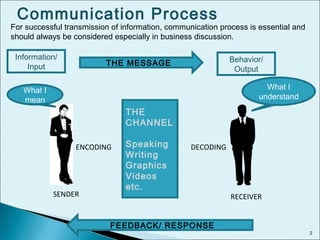
Communication Process
SENDER RECEIVER
What I
mean
Information/
Input THE MESSAGE Behavior/
Output
What I
understand
THE
CHANNEL
Speaking
Writing
Graphics
Videos
etc.
ENCODING DECODING
FEEDBACK/ RESPONSE
For successful transmission of information, communication process is essential and
should always be considered especially in business discussion.
2
Telecom
3g/4g services
Data Services
Voice call
Cell handover
-Objective
-Acton plan
-Communicate
-Whom to concern
-Follow up
-Deadline
Supervisor explaining about
the project
During the meeting
Employee writing down
the important points
3
4
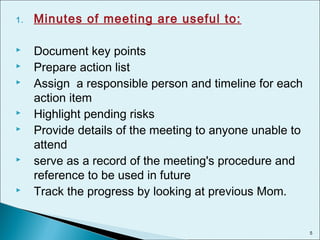
1. Minutes of meeting are useful to:
 Document key points
 Prepare action list
 Assign a responsible person and timeline for each
action item
 Highlight pending risks
 Provide details of the meeting to anyone unable to
attend
 serve as a record of the meeting's procedure and
reference to be used in future
 Track the progress by looking at previous Mom.
5
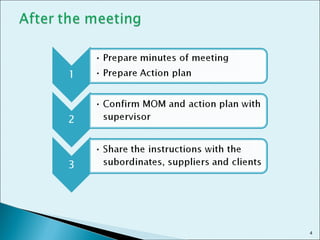
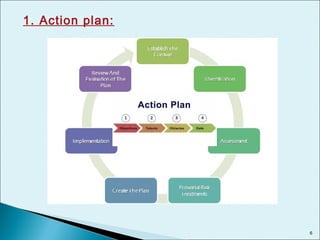
1. Action plan:
6
2. Check MOM and Action plan with
supervisor:
 Minutes of meeting and the action plan prepared
should be checked with the supervisor to confirm
accuracy and completeness.
 It also helps in avoiding future risks and in turn
save time.
 It is like taking the feedback from the supervisor
and ensuring the same understanding between the
two of us.
7
3. Share the instructions with others:
 Now that I am confident about the accuracy of
instructions received, it could be shared easily.
To share it locally:
 Call all the locally available people for a meeting.
 Prepare a detailed blue print of the instructions to
be distributed before the meeting starts.
 During the meeting make use of power point
presentations, graphs, tables etc.
 Do take feedback in the end and allow for open
questions, suggestions to ensure the same
understanding between all of us.
8
 Example:
9
To share it globally:
 Firstly know your audience background and the
common language else translate your content as
per their understanding.
Different mediums to share the information
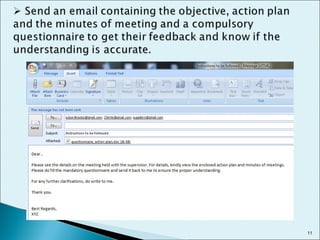
 Send an email.
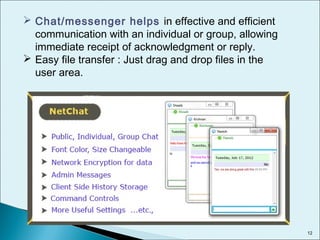
 Chat-IP messenger.
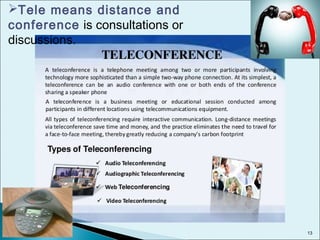
 Teleconferencing.
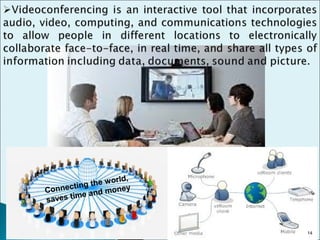
 Video Conferencing.
10
11
 Chat/messenger helps in effective and efficient
communication with an individual or group, allowing
immediate receipt of acknowledgment or reply.
 Easy file transfer : Just drag and drop files in the
user area.
12
Tele means distance and
conference is consultations or
discussions.
13
Connecting the world,
saves time and money
14
 4. Receiving feedback
• It is really a crucial step in the communication
process as it ensures that the information
delivered is correctly transmitted, decoded and
understood by the receiver.
• It is important to make sure that there are no
disagreements in future regarding the instructions
once shared.
• It could be done by asking questions, assigning
related tasks and responsibilities to achieve the
expected outcome as per the instructions
delivered.
15
16

IE BUSINESS SCHOOL ADMISSION ESSAY: QUESTION F

  • 1.
    Question F: Youhave just participated in an important meeting with your superior. How will you ensure that every part of the instructions you received will properly reach all subordinates, suppliers and clients, located in different parts of the world? Prepared By: Rishi Singla 1
  • 2.
    Communication Process SENDER RECEIVER WhatI mean Information/ Input THE MESSAGE Behavior/ Output What I understand THE CHANNEL Speaking Writing Graphics Videos etc. ENCODING DECODING FEEDBACK/ RESPONSE For successful transmission of information, communication process is essential and should always be considered especially in business discussion. 2
  • 3.
    Telecom 3g/4g services Data Services Voicecall Cell handover -Objective -Acton plan -Communicate -Whom to concern -Follow up -Deadline Supervisor explaining about the project During the meeting Employee writing down the important points 3
  • 4.
  • 5.
    1. Minutes ofmeeting are useful to:  Document key points  Prepare action list  Assign a responsible person and timeline for each action item  Highlight pending risks  Provide details of the meeting to anyone unable to attend  serve as a record of the meeting's procedure and reference to be used in future  Track the progress by looking at previous Mom. 5
  • 6.
  • 7.
    2. Check MOMand Action plan with supervisor:  Minutes of meeting and the action plan prepared should be checked with the supervisor to confirm accuracy and completeness.  It also helps in avoiding future risks and in turn save time.  It is like taking the feedback from the supervisor and ensuring the same understanding between the two of us. 7
  • 8.
    3. Share theinstructions with others:  Now that I am confident about the accuracy of instructions received, it could be shared easily. To share it locally:  Call all the locally available people for a meeting.  Prepare a detailed blue print of the instructions to be distributed before the meeting starts.  During the meeting make use of power point presentations, graphs, tables etc.  Do take feedback in the end and allow for open questions, suggestions to ensure the same understanding between all of us. 8
  • 9.
  • 10.
    To share itglobally:  Firstly know your audience background and the common language else translate your content as per their understanding. Different mediums to share the information  Send an email.  Chat-IP messenger.  Teleconferencing.  Video Conferencing. 10
  • 11.
  • 12.
     Chat/messenger helpsin effective and efficient communication with an individual or group, allowing immediate receipt of acknowledgment or reply.  Easy file transfer : Just drag and drop files in the user area. 12
  • 13.
    Tele means distanceand conference is consultations or discussions. 13
  • 14.
    Connecting the world, savestime and money 14
  • 15.
     4. Receivingfeedback • It is really a crucial step in the communication process as it ensures that the information delivered is correctly transmitted, decoded and understood by the receiver. • It is important to make sure that there are no disagreements in future regarding the instructions once shared. • It could be done by asking questions, assigning related tasks and responsibilities to achieve the expected outcome as per the instructions delivered. 15
  • 16.