Intrusion Detection System for
Wireless Sensor Networks:
Design, Implementation and Evaluation
Dr. Huirong Fu
Outline
• Overview of Wireless Sensor Network
(WSN)
• Project Objective:
– how to detect attacks on WSN?
• Project Tasks:
– Intrusion detection system
• More Information
UnCoRe 2007
3
WSN Overview
• Applications of WSNs
• Components of a Sensor
• WSN Communication Models
• Attacks on WSN
UnCoRe 2007
4
Overview: Applications of WSNs
• Military
• Disaster Detection and Relief
• Industry
• Agriculture
• Environmental Monitoring
• Intelligent Buildings
• Health/Medical
• Law Enforcement
• Transportation
• Space Exploration
UnCoRe 2007
5
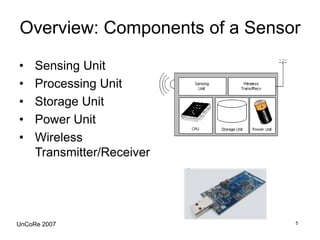
Overview: Components of a Sensor
• Sensing Unit
• Processing Unit
• Storage Unit
• Power Unit
• Wireless
Transmitter/Receiver
UnCoRe 2007
6
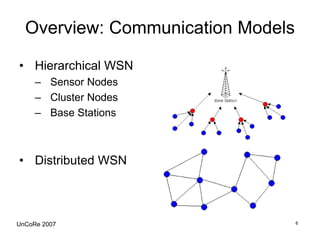
Overview: Communication Models
• Hierarchical WSN
– Sensor Nodes
– Cluster Nodes
– Base Stations
• Distributed WSN
UnCoRe 2007
Overview: Attacks on WSN (1/3)
• DoS, DDoS attacks which affect network
availability
• Eavesdropping, sniffing which can threaten
confidential data
• Man-in-the-middle attacks which can affect
packet integrity
• Signal jamming which affects communication
UnCoRe 2007
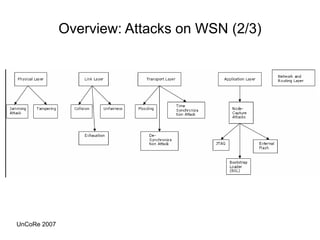
Overview: Attacks on WSN (2/3)
UnCoRe 2007
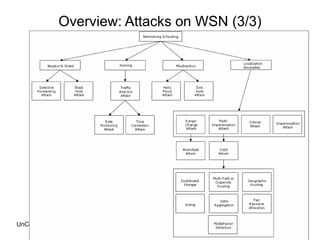
Overview: Attacks on WSN (3/3)
UnCoRe 2007
Project Objective
• How to detect attacks on WSN?
– Intrusion Detection System (IDS): Design,
implementation and evaluation
UnCoRe 2007
Project Tasks
• Literature survey on IDS for WSN
– What have been proposed?
– Have they been implemented and evaluated?
– What are the Pros and Cons of each?
UnCoRe 2007
Project Tasks
• Make decision
– Shall we extend some of the works, or
– Design a novel IDS?
• Design, implementation and evaluation
– What are the requirements for an ideal IDS?
– What are the challenges?
– What are the hardware and software
available?
UnCoRe 2007
Existing security measures
• 2Intrusion detection based on AODV (Ad hoc
On-Demand Distance Vector Routing
Protocol)
– Pros
• Sophisticated algorithm for detecting and reacting to
a great variety of potential wireless network attacks
using an anomaly detection pattern
• Works well for ad-hoc wireless networks
– Cons
• Computationally expensive
• Currently not deployed on wireless sensor networks
UnCoRe 2007
Existing security measures
• 4Effective Intrusion Detection using Multiple Sensors
in Wireless Ad Hoc Networks
– Pros
• Mobile agent based intrusion detection
• Intelligent routing of intrusion data throughout the
network
• Lightweight implementation
– Cons
• Agent only deployed on a fraction of the network nodes
• Not deployed on completely wireless sensor networks
UnCoRe 2007
Existing security measures
• 3INSENS (Intrusion Tolerant Routing
Protocol for Wireless Sensor Networks)
– Pros
• Allows an alternative network route to be
established between non-malicious nodes
– Cons
• Does not provide intrusion detection, but rather
intrusion tolerance
• Still requires the sacrifice of a small number of
wireless sensor nodes
UnCoRe 2007
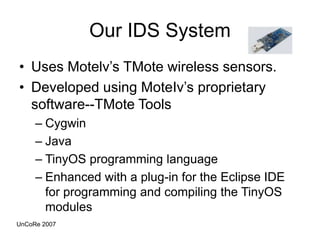
Our IDS System
• Uses Motelv’s TMote wireless sensors.
• Developed using MoteIv’s proprietary
software--TMote Tools
– Cygwin
– Java
– TinyOS programming language
– Enhanced with a plug-in for the Eclipse IDE
for programming and compiling the TinyOS
modules
UnCoRe 2007
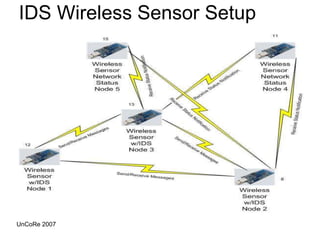
IDS Wireless Sensor Setup
UnCoRe 2007
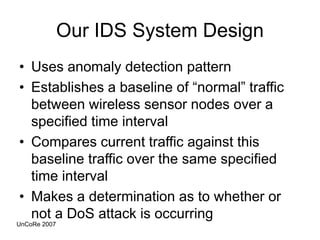
Our IDS System Design
• Uses anomaly detection pattern
• Establishes a baseline of “normal” traffic
between wireless sensor nodes over a
specified time interval
• Compares current traffic against this
baseline traffic over the same specified
time interval
• Makes a determination as to whether or
not a DoS attack is occurring
UnCoRe 2007
Our IDS System Design
• Communication
between wireless
sensor nodes
•Activity diagram for
Wireless Sensor Node
communication
UnCoRe 2007
Our IDS System Design cont’d
• Emulation of a DoS
attack
• Activity design for
Emulation of a DoS
attack
UnCoRe 2007
References
• 1Denial of Service in Sensor Networks
• 2Wireless Sensor Networks for Intrusion
Detection: Packet Traffic Modeling
• 3INSENS: Intrusion-Tolerant Routing in
Wireless Sensor Networks
• 4Effective Intrusion Detection Using
Multiple Sensors in Wireless Ad Hoc
Networks
UnCoRe 2007
References
• MoteIv
– http://www.moteiv.com/community/Moteiv_Co
mmunity
• TMote Tutorial
– http://cents.cs.berkeley.edu/tinywiki/index.php/
Tmote_Windows_install
• TinyOS
– http://www.tinyos.net/tinyos-
1.x/doc/tutorial/index.html
UnCoRe 2007

IDS WSN.ppt

  • 1.
    Intrusion Detection Systemfor Wireless Sensor Networks: Design, Implementation and Evaluation Dr. Huirong Fu
  • 2.
    Outline • Overview ofWireless Sensor Network (WSN) • Project Objective: – how to detect attacks on WSN? • Project Tasks: – Intrusion detection system • More Information UnCoRe 2007
  • 3.
    3 WSN Overview • Applicationsof WSNs • Components of a Sensor • WSN Communication Models • Attacks on WSN UnCoRe 2007
  • 4.
    4 Overview: Applications ofWSNs • Military • Disaster Detection and Relief • Industry • Agriculture • Environmental Monitoring • Intelligent Buildings • Health/Medical • Law Enforcement • Transportation • Space Exploration UnCoRe 2007
  • 5.
    5 Overview: Components ofa Sensor • Sensing Unit • Processing Unit • Storage Unit • Power Unit • Wireless Transmitter/Receiver UnCoRe 2007
  • 6.
    6 Overview: Communication Models •Hierarchical WSN – Sensor Nodes – Cluster Nodes – Base Stations • Distributed WSN UnCoRe 2007
  • 7.
    Overview: Attacks onWSN (1/3) • DoS, DDoS attacks which affect network availability • Eavesdropping, sniffing which can threaten confidential data • Man-in-the-middle attacks which can affect packet integrity • Signal jamming which affects communication UnCoRe 2007
  • 8.
    Overview: Attacks onWSN (2/3) UnCoRe 2007
  • 9.
    Overview: Attacks onWSN (3/3) UnCoRe 2007
  • 10.
    Project Objective • Howto detect attacks on WSN? – Intrusion Detection System (IDS): Design, implementation and evaluation UnCoRe 2007
  • 11.
    Project Tasks • Literaturesurvey on IDS for WSN – What have been proposed? – Have they been implemented and evaluated? – What are the Pros and Cons of each? UnCoRe 2007
  • 12.
    Project Tasks • Makedecision – Shall we extend some of the works, or – Design a novel IDS? • Design, implementation and evaluation – What are the requirements for an ideal IDS? – What are the challenges? – What are the hardware and software available? UnCoRe 2007
  • 13.
    Existing security measures •2Intrusion detection based on AODV (Ad hoc On-Demand Distance Vector Routing Protocol) – Pros • Sophisticated algorithm for detecting and reacting to a great variety of potential wireless network attacks using an anomaly detection pattern • Works well for ad-hoc wireless networks – Cons • Computationally expensive • Currently not deployed on wireless sensor networks UnCoRe 2007
  • 14.
    Existing security measures •4Effective Intrusion Detection using Multiple Sensors in Wireless Ad Hoc Networks – Pros • Mobile agent based intrusion detection • Intelligent routing of intrusion data throughout the network • Lightweight implementation – Cons • Agent only deployed on a fraction of the network nodes • Not deployed on completely wireless sensor networks UnCoRe 2007
  • 15.
    Existing security measures •3INSENS (Intrusion Tolerant Routing Protocol for Wireless Sensor Networks) – Pros • Allows an alternative network route to be established between non-malicious nodes – Cons • Does not provide intrusion detection, but rather intrusion tolerance • Still requires the sacrifice of a small number of wireless sensor nodes UnCoRe 2007
  • 16.
    Our IDS System •Uses Motelv’s TMote wireless sensors. • Developed using MoteIv’s proprietary software--TMote Tools – Cygwin – Java – TinyOS programming language – Enhanced with a plug-in for the Eclipse IDE for programming and compiling the TinyOS modules UnCoRe 2007
  • 17.
    IDS Wireless SensorSetup UnCoRe 2007
  • 18.
    Our IDS SystemDesign • Uses anomaly detection pattern • Establishes a baseline of “normal” traffic between wireless sensor nodes over a specified time interval • Compares current traffic against this baseline traffic over the same specified time interval • Makes a determination as to whether or not a DoS attack is occurring UnCoRe 2007
  • 19.
    Our IDS SystemDesign • Communication between wireless sensor nodes •Activity diagram for Wireless Sensor Node communication UnCoRe 2007
  • 20.
    Our IDS SystemDesign cont’d • Emulation of a DoS attack • Activity design for Emulation of a DoS attack UnCoRe 2007
  • 21.
    References • 1Denial ofService in Sensor Networks • 2Wireless Sensor Networks for Intrusion Detection: Packet Traffic Modeling • 3INSENS: Intrusion-Tolerant Routing in Wireless Sensor Networks • 4Effective Intrusion Detection Using Multiple Sensors in Wireless Ad Hoc Networks UnCoRe 2007
  • 22.
    References • MoteIv – http://www.moteiv.com/community/Moteiv_Co mmunity •TMote Tutorial – http://cents.cs.berkeley.edu/tinywiki/index.php/ Tmote_Windows_install • TinyOS – http://www.tinyos.net/tinyos- 1.x/doc/tutorial/index.html UnCoRe 2007