HEPATITIS B-ANTENATAL
SCREENING ALGORITHMS AND
REPORTING
Dr Samir Dervisevic
Norfolk and Norwich University Hospitals/ University of East Anglia
NHS Infectious Diseases in Pregnancy Screening
Programme (IDPS) National Laboratory Workshop
Birmingham, 13 March 2019
INFECTIOUS DISEASES IN PREGNANCY
SCREENING PROGRAMME (IDPS)
• Executed by midwives, obstetricians, virologists, PHE;
• In addition: specialist MDT teams (neonatologists, virologists,
hepatologists and Genitourinary Medicine specialists) provide care as part
of the screening programme;
• Clinical conditions for which the screening is organised have a clearly
defined care pathway;
• The IDPS programme includes data collection;
• KPI measure how the screening programme is performing;
• The IDPS programme currently collects 4 KPIs.
2 Hepatitis B-Antenatal Screening Algorithms and Reporting
STANDARS FOR INFECTIOUS DISEASES IN
PREGNANCY
National standards: to insure a consistent approach across screening
programmes:
Viral Hepatitis B infection:
• HBsAg prevalence in pregnant women in the UK: 0.5% (ECDC 2016);
• All antenatal women in England offered screening for hepatitis B virus;
The purpose is to:
a) Enable early detection of acute or chronic infection;
b) Offer treatment to antenatal mothers who require it for their health;
c) Reduce the risk of MTCT of infection;
d) Offer postnatal prophylaxis to a newborn.
3 Hepatitis B-Antenatal Screening Algorithms and Reporting
VIRAL HEPATITIS B: THE BIGGER PICTURE
• The estimated prevalence of chronic HBV infection is at around 0.9% in
the countries of the European Union and European Economic Area;
• Prevalence of chronic HBV infection in the UK is 0.1-0.5%;
• It is estimated that 4.7 million Europeans may have chronic HBV;
• 180,000 people in the UK are chronically infected with HBV;
• The World Health Organisation calling on countries to continue to translate
their commitments to eliminate hepatitis (Geneva, 27 July 2017);
• “The global effort to eliminate viral hepatitis and HIV as public health
threats by 2030 (WHO 2017)”
4 Hepatitis B-Antenatal Screening Algorithms and Reporting
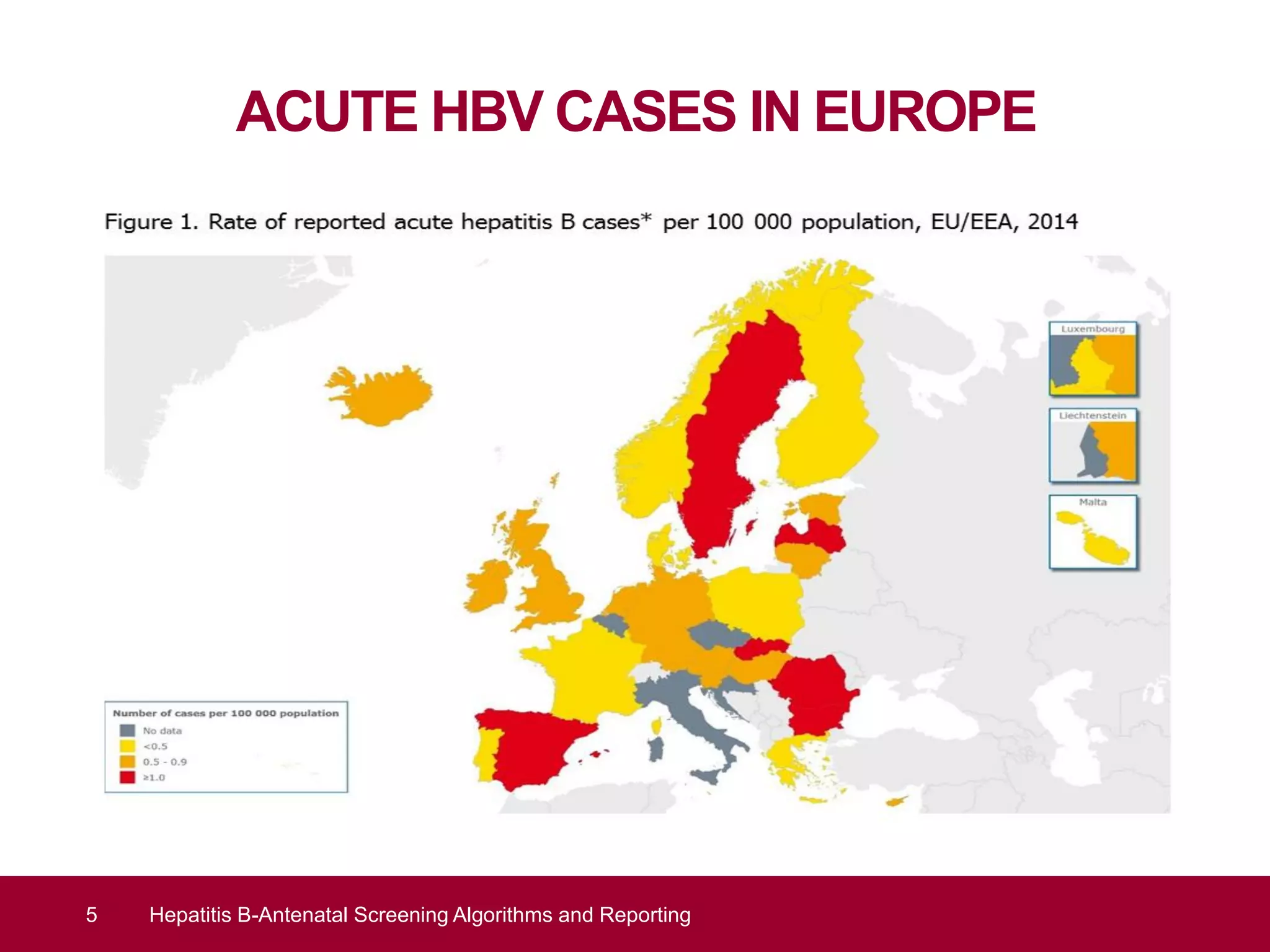
ACUTE HBV CASES IN EUROPE
5 Hepatitis B-Antenatal Screening Algorithms and Reporting
ACUTE HEPATITIS B IN ENGLAND
• Surveillance of acute hepatitis B is essential to target prevention and control
activities such as the selective immunisation programme;
• Public Health England implemented national surveillance standards for
hepatitis B in 2007 which provided the framework for more consistent
reporting of cases from individual Specialist Virology Centres;
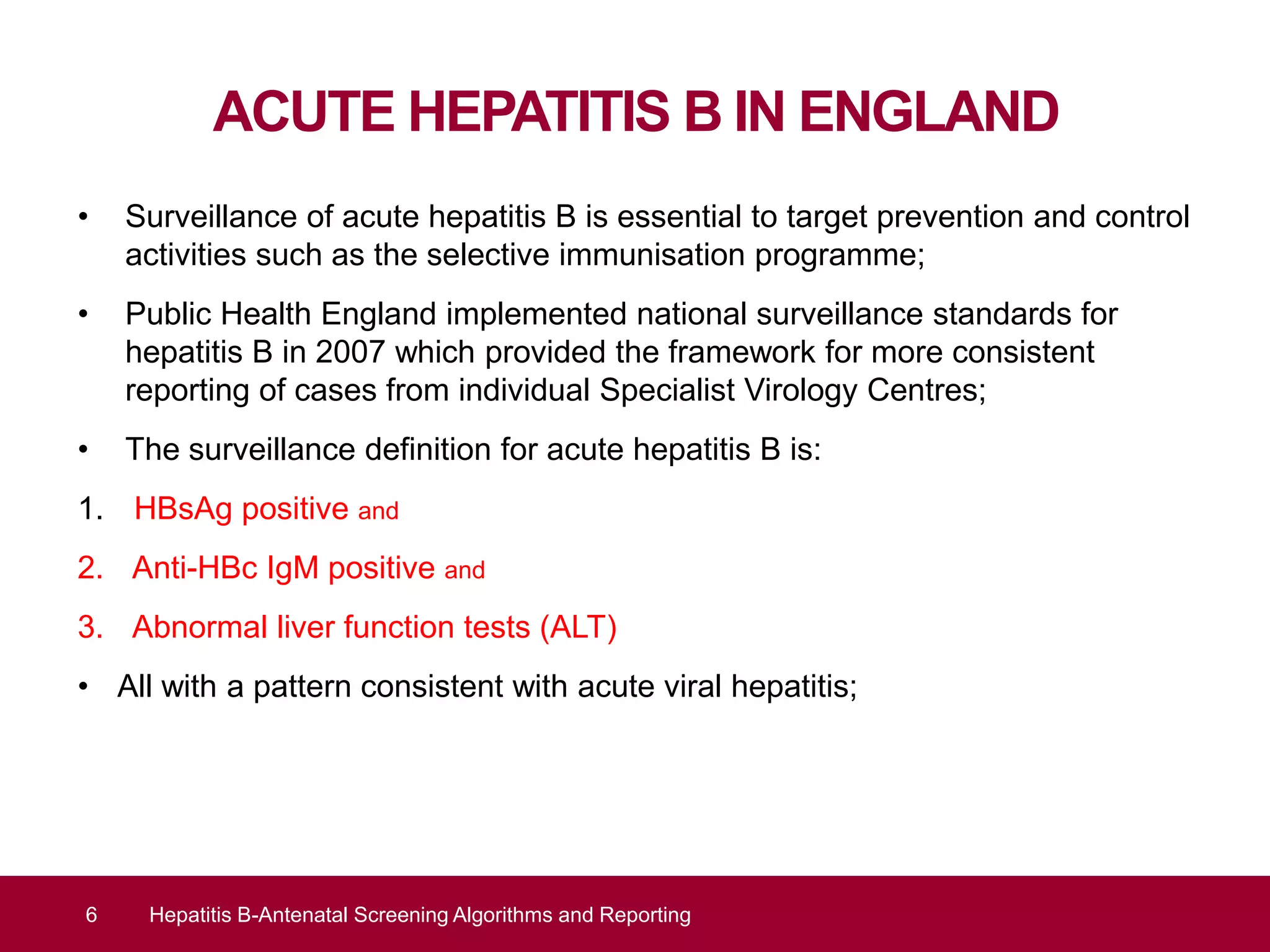
• The surveillance definition for acute hepatitis B is:
1. HBsAg positive and
2. Anti-HBc IgM positive and
3. Abnormal liver function tests (ALT)
• All with a pattern consistent with acute viral hepatitis;
6 Hepatitis B-Antenatal Screening Algorithms and Reporting
ACUTE HEPATITIS B IN ENGLAND
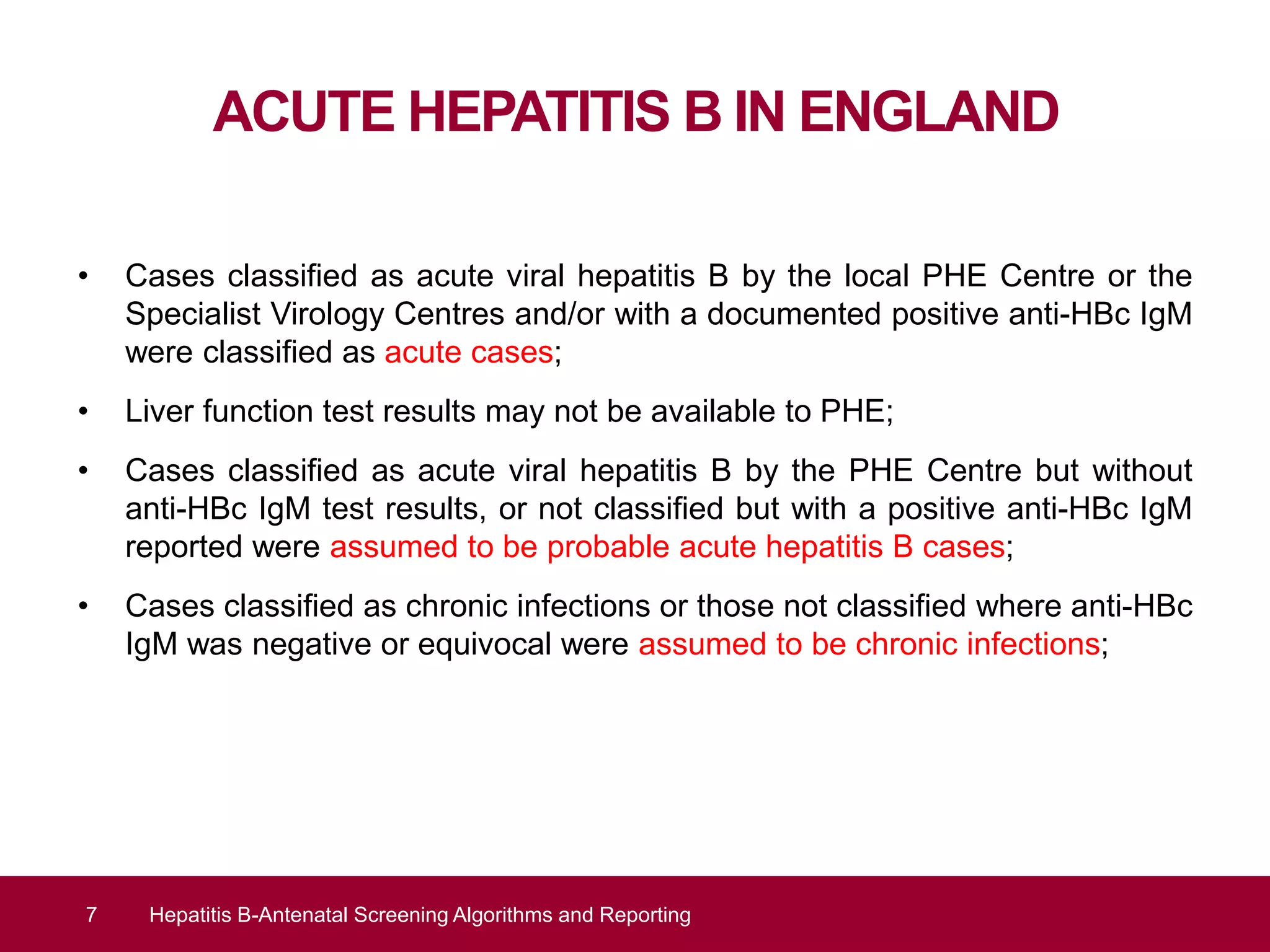
• Cases classified as acute viral hepatitis B by the local PHE Centre or the
Specialist Virology Centres and/or with a documented positive anti-HBc IgM
were classified as acute cases;
• Liver function test results may not be available to PHE;
• Cases classified as acute viral hepatitis B by the PHE Centre but without
anti-HBc IgM test results, or not classified but with a positive anti-HBc IgM
reported were assumed to be probable acute hepatitis B cases;
• Cases classified as chronic infections or those not classified where anti-HBc
IgM was negative or equivocal were assumed to be chronic infections;
7 Hepatitis B-Antenatal Screening Algorithms and Reporting
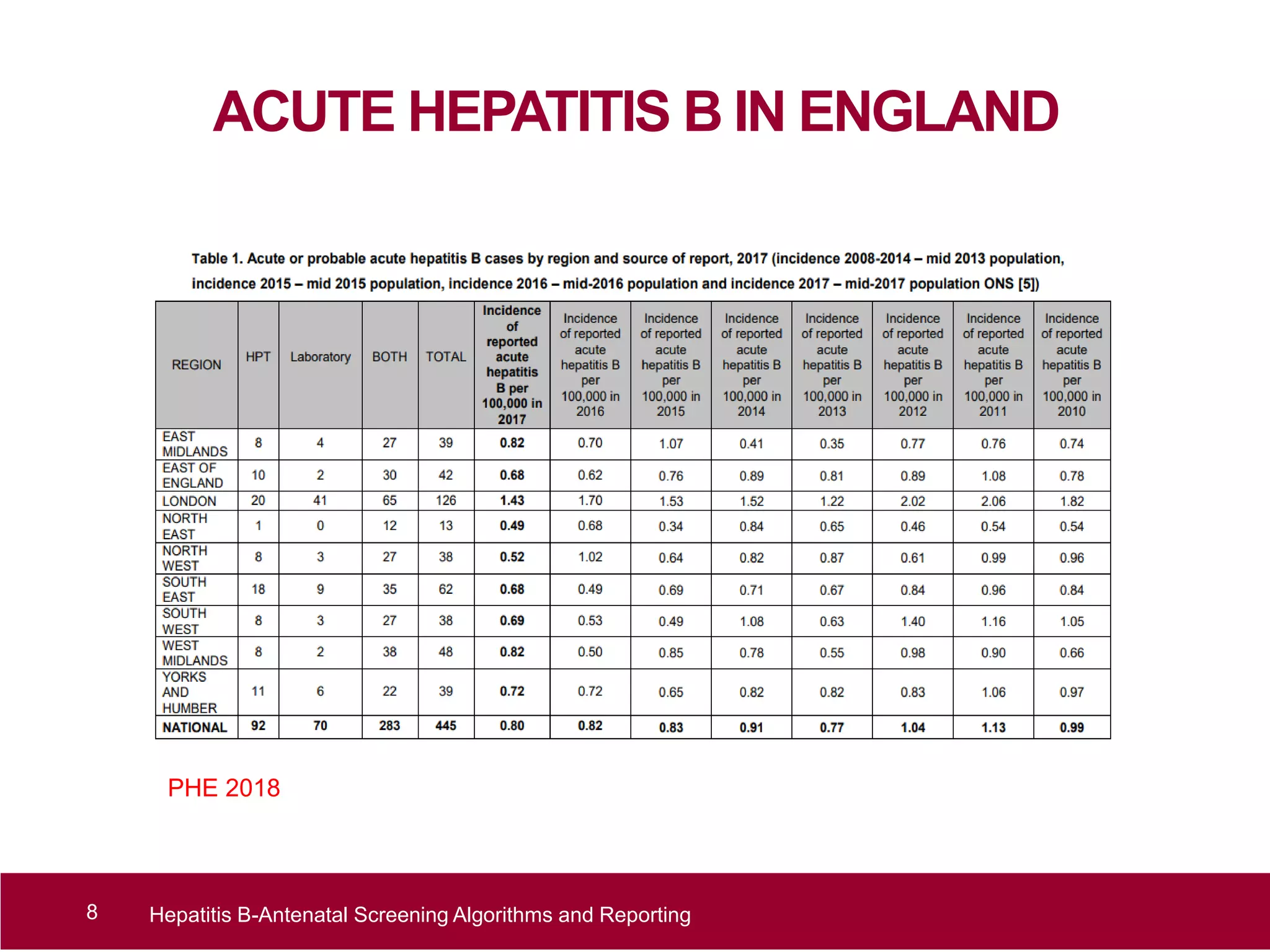
ACUTE HEPATITIS B IN ENGLAND
8 Hepatitis B-Antenatal Screening Algorithms and Reporting
PHE 2018
EPIDEMIOLOGY OF HBV IN ENGLAND
• A total of 9,774 confirmed hepatitis B infections were reported from Specialist
Virology Laboratories in England in 2017 (PHE 2018);
• Out of those, a total of 445 (4.5%) were acute or probable acute cases of
hepatitis B;
• This gave an annual incidence of 0.8 per 100,000 populations;
• London is still the region with the highest incidence (1.43 per 100,000);
• The highest increase in incidence was reported from West Midlands (from
0.50 to 0.82 per 100,000 in 2016 and 2017 respectively) and South East
(from 0.49 to 0.68 per 100,000);
• The largest decrease was reported from North West (from 1.02 to 0.52 per
100,000 in 2016 and 2017 respectively) and London (from 1.70 to 1.43 per
100,000 in 2016 and 2017 respectively).
9 Hepatitis B-Antenatal Screening Algorithms and Reporting
EPIDEMIOLOGY OF HBV IN ENGLAND
• The majority of HBV cases in 2017 were in men (70.4%) with overall
incidence of 1.14 per 100,000;
• The corresponding incidence in women in 2017 was 0.47 per 100,000;
• Only 68 cases (15.3%) of the total acute or probable acute hepatitis B
cases had their ethnicity recorded:
1. 67% White;
2. 14.7% Black British;
3. 8.8% Asian British;
• The commonest reported risk attributed was heterosexual exposure,
implicated as the probable route of exposure in 54.8% of cases;
10 Hepatitis B-Antenatal Screening Algorithms and Reporting
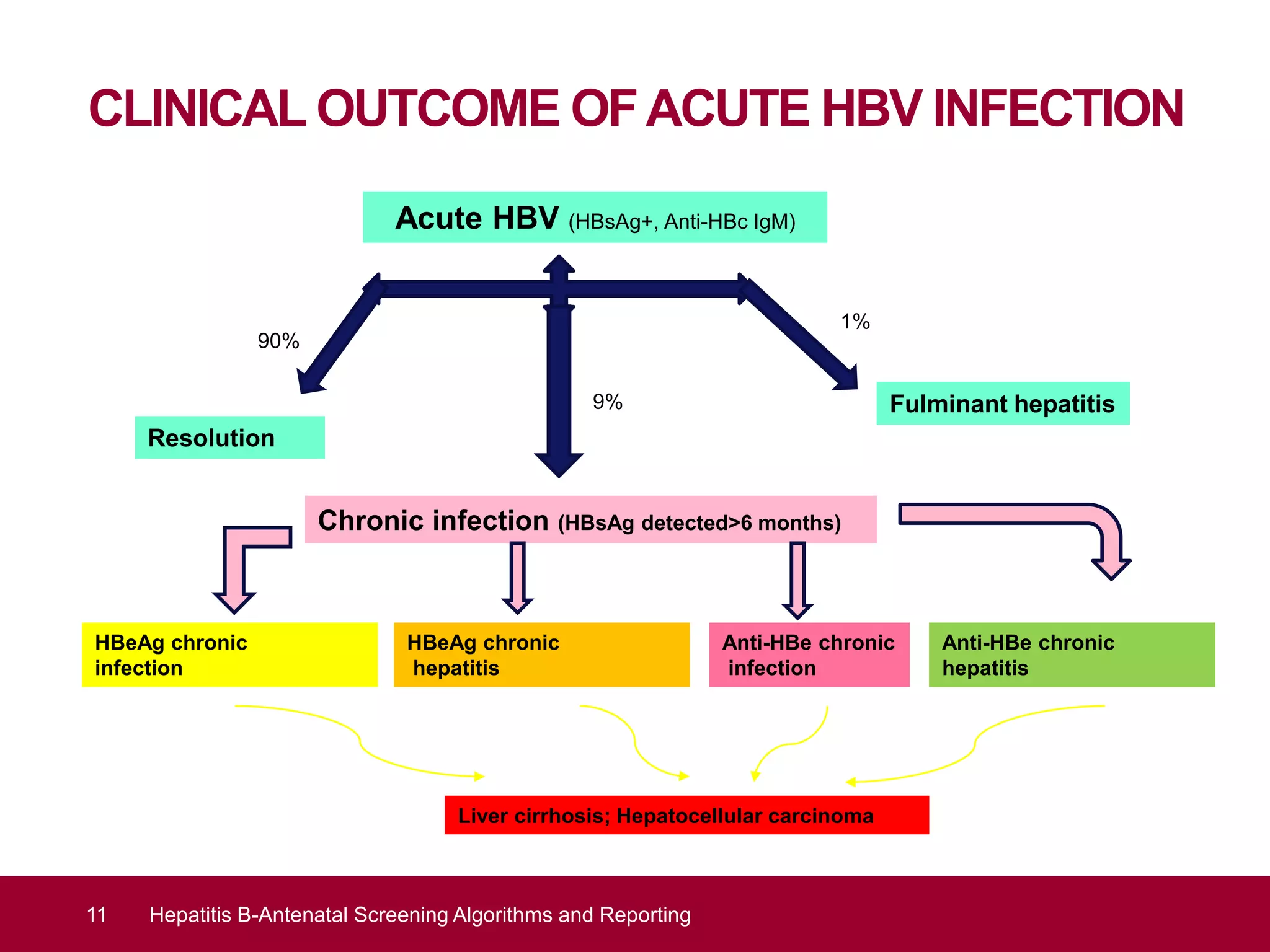
CLINICAL OUTCOME OFACUTE HBV INFECTION
11 Hepatitis B-Antenatal Screening Algorithms and Reporting
Acute HBV (HBsAg+, Anti-HBc IgM)
Resolution
Fulminant hepatitis
90%
1%
Chronic infection (HBsAg detected>6 months)
9%
HBeAg chronic
infection
HBeAg chronic
hepatitis
Anti-HBe chronic
infection
Anti-HBe chronic
hepatitis
Liver cirrhosis; Hepatocellular carcinoma
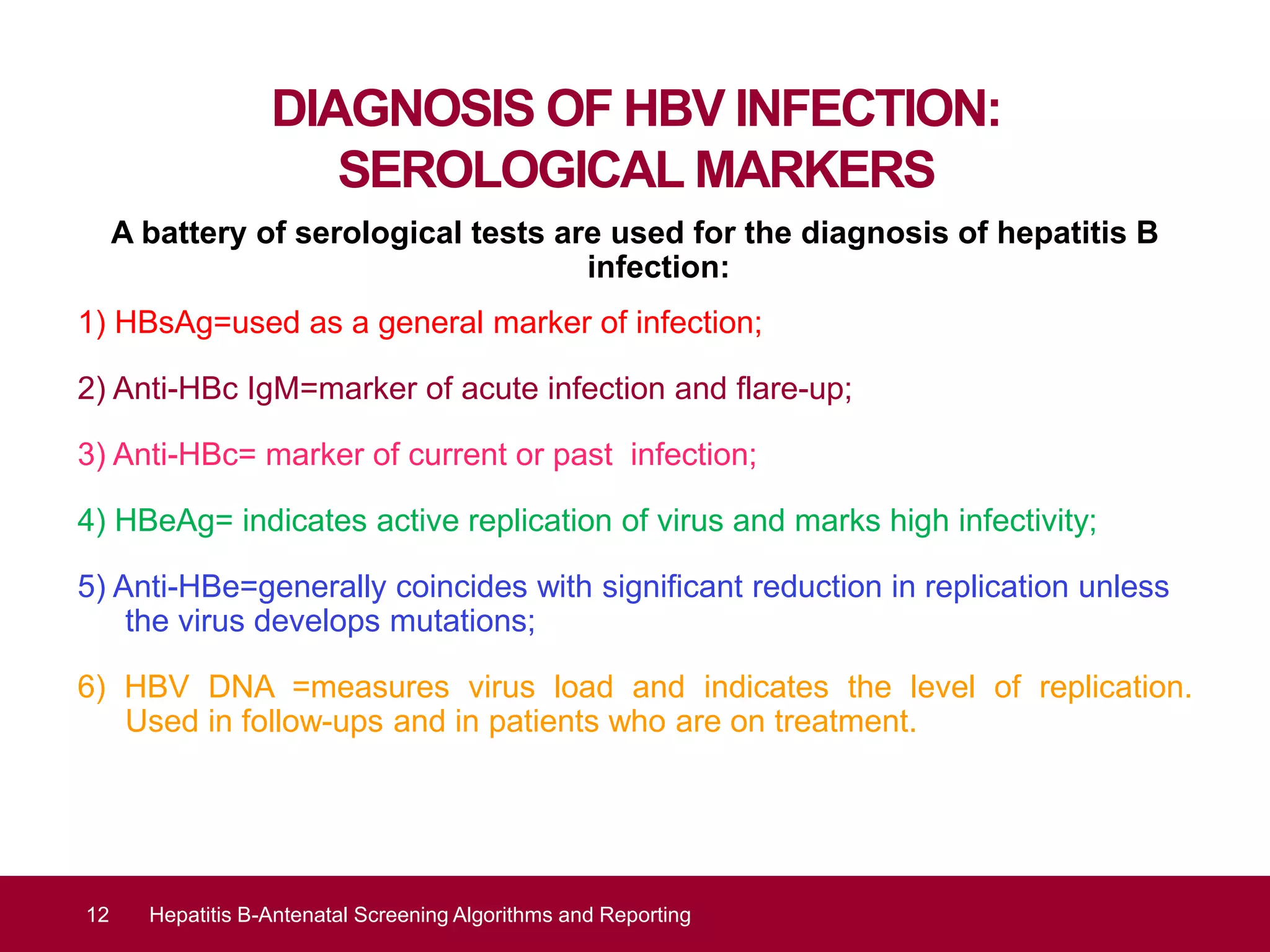
DIAGNOSIS OF HBV INFECTION:
SEROLOGICAL MARKERS
A battery of serological tests are used for the diagnosis of hepatitis B
infection:
1) HBsAg=used as a general marker of infection;
2) Anti-HBc IgM=marker of acute infection and flare-up;
3) Anti-HBc= marker of current or past infection;
4) HBeAg= indicates active replication of virus and marks high infectivity;
5) Anti-HBe=generally coincides with significant reduction in replication unless
the virus develops mutations;
6) HBV DNA =measures virus load and indicates the level of replication.
Used in follow-ups and in patients who are on treatment.
12 Hepatitis B-Antenatal Screening Algorithms and Reporting
HBsAg assay
(min. sensitivity level
0.05 IU/mL)
Detected Not detected
Perform
neutralisation /
alternative assay
Detected Not detected
Test other markers
Test Anti-HBc (total)
Detected Not detected
Test other markers
REPORT
Likely non-specific
reactivity. Please
send another
sample.
REPORT
Hepatitis B surface
antigen not
detected
See reporting hepatitis B screening test
results table
Day 1 – receipt of
sample in the
laboratory
Day 8 – reporting
of screening
results
13 Hepatitis B-Antenatal Screening Algorithms and Reporting
HEPATITIS B TESTING ALGORITHM
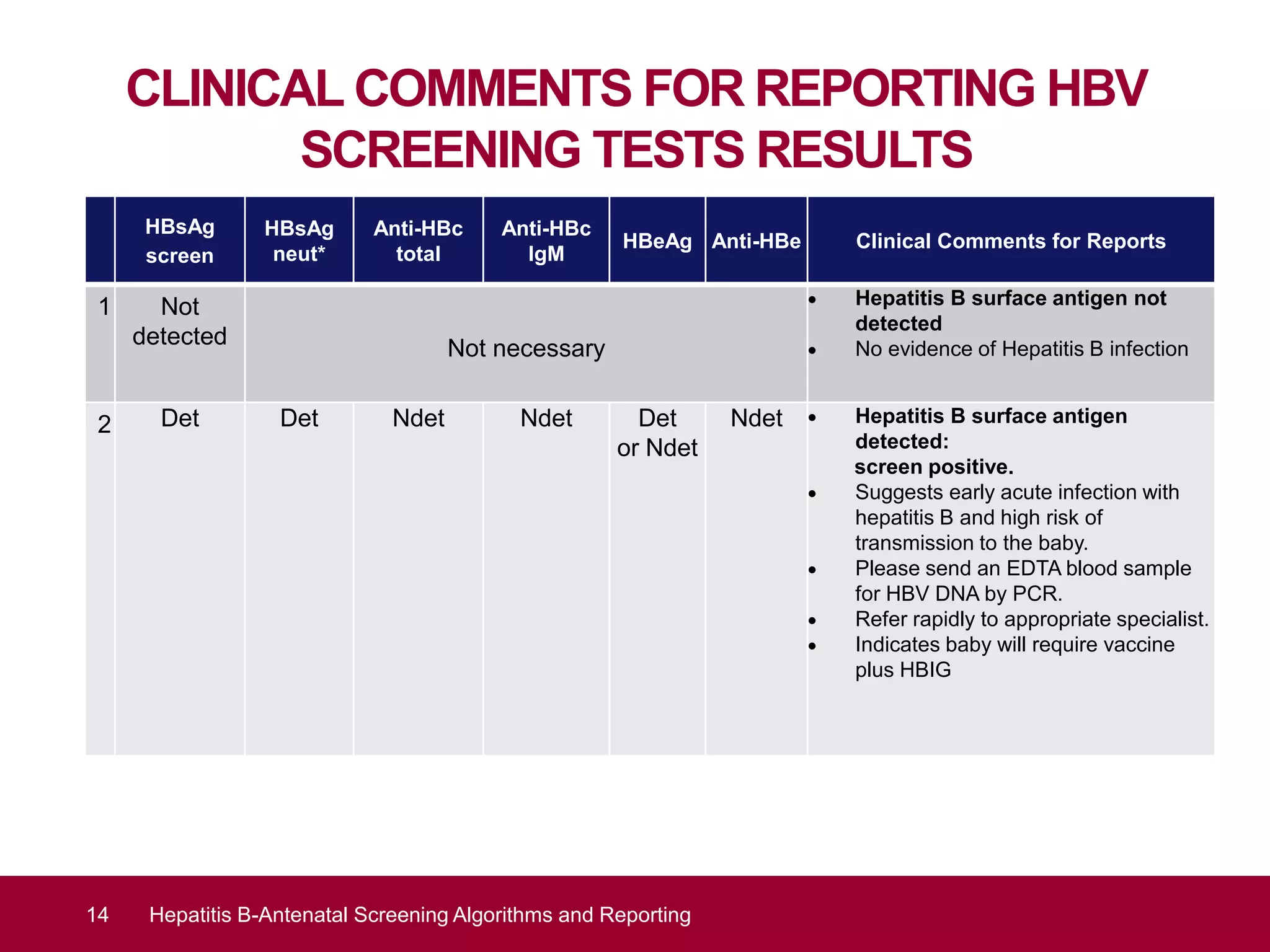
CLINICAL COMMENTS FOR REPORTING HBV
SCREENING TESTS RESULTS
HBsAg
screen
HBsAg
neut*
Anti-HBc
total
Anti-HBc
IgM
HBeAg Anti-HBe Clinical Comments for Reports
1 Not
detected Not necessary
• Hepatitis B surface antigen not
detected
• No evidence of Hepatitis B infection
2 Det Det Ndet Ndet Det
or Ndet
Ndet • Hepatitis B surface antigen
detected:
screen positive.
• Suggests early acute infection with
hepatitis B and high risk of
transmission to the baby.
• Please send an EDTA blood sample
for HBV DNA by PCR.
• Refer rapidly to appropriate specialist.
• Indicates baby will require vaccine
plus HBIG
14 Hepatitis B-Antenatal Screening Algorithms and Reporting
CLINICAL COMMENTS FOR REPORTING
HBV SCREENING TESTS RESULTS
15 Hepatitis B-Antenatal Screening Algorithms and Reporting
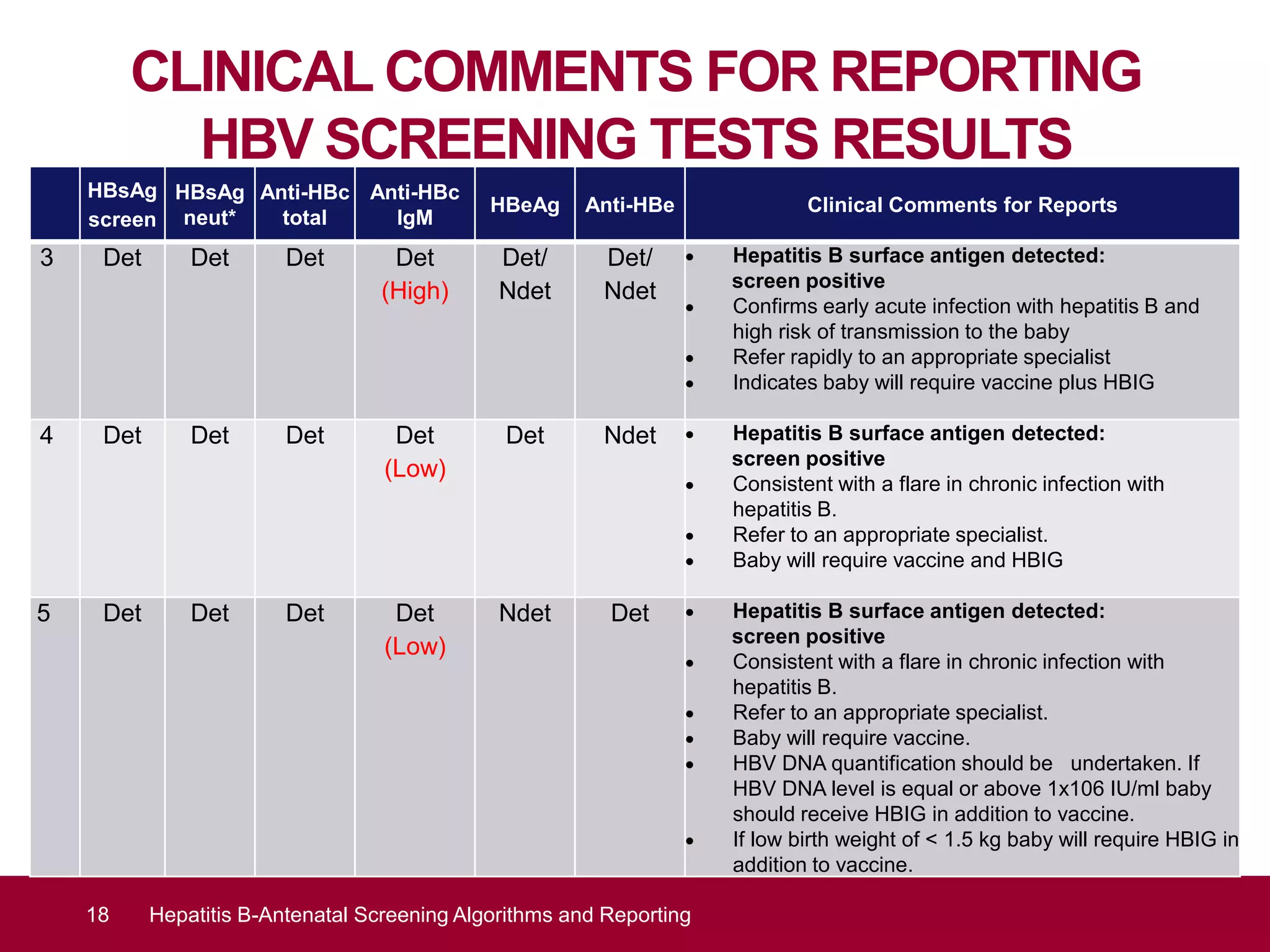
HBsAg
screen
HBsAg
neut*
Anti-HBc
total
Anti-HBc
IgM
HBeAg Anti-HBe Clinical Comments for Reports
3 Det Det Det Det
(High)
Det/
Ndet
Det/
Ndet
• Hepatitis B surface antigen detected:
screen positive
• Confirms early acute infection with hepatitis B and
high risk of transmission to the baby
• Refer rapidly to an appropriate specialist
• Indicates baby will require vaccine plus HBIG
4 Det Det Det Det
(Low)
Det Ndet • Hepatitis B surface antigen detected:
screen positive
• Consistent with a flare in chronic infection with
hepatitis B.
• Refer to an appropriate specialist.
• Baby will require vaccine and HBIG
5 Det Det Det Det
(Low)
Ndet Det • Hepatitis B surface antigen detected:
screen positive
• Consistent with a flare in chronic infection with
hepatitis B.
• Refer to an appropriate specialist.
• Baby will require vaccine.
• HBV DNA quantification should be undertaken. If
HBV DNA level is equal or above 1x10⁶ IU/ml baby
should receive HBIG in addition to vaccine.
• If low birth weight of < 1.5 kg baby will require HBIG in
addition to vaccine.
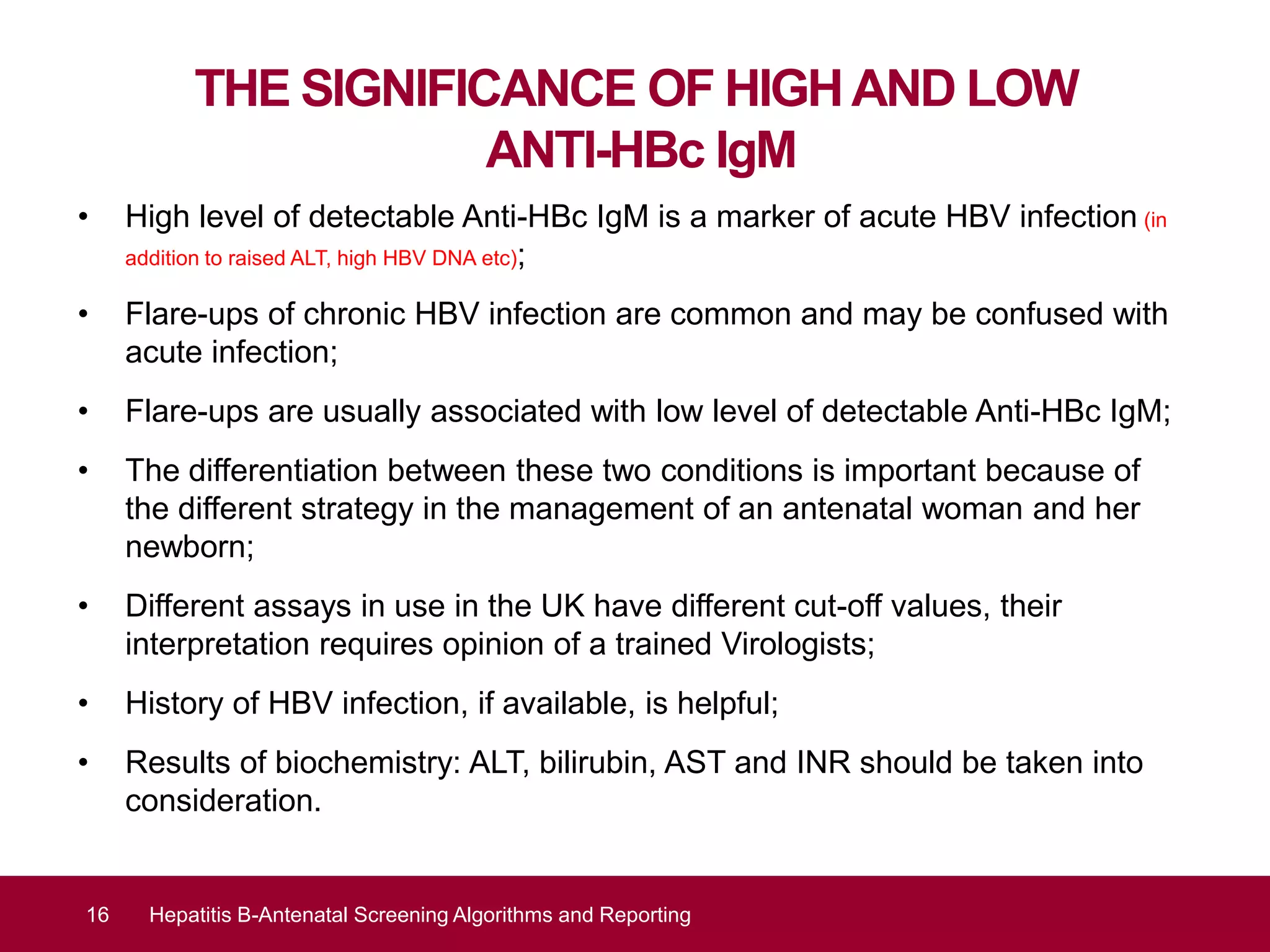
THE SIGNIFICANCE OF HIGHAND LOW
ANTI-HBc IgM
• High level of detectable Anti-HBc IgM is a marker of acute HBV infection (in
addition to raised ALT, high HBV DNA etc);
• Flare-ups of chronic HBV infection are common and may be confused with
acute infection;
• Flare-ups are usually associated with low level of detectable Anti-HBc IgM;
• The differentiation between these two conditions is important because of
the different strategy in the management of an antenatal woman and her
newborn;
• Different assays in use in the UK have different cut-off values, their
interpretation requires opinion of a trained Virologists;
• History of HBV infection, if available, is helpful;
• Results of biochemistry: ALT, bilirubin, AST and INR should be taken into
consideration.
16 Hepatitis B-Antenatal Screening Algorithms and Reporting
THE SIGNIFICANCE OF HIGHAND LOW
ANTI-HBc IgM
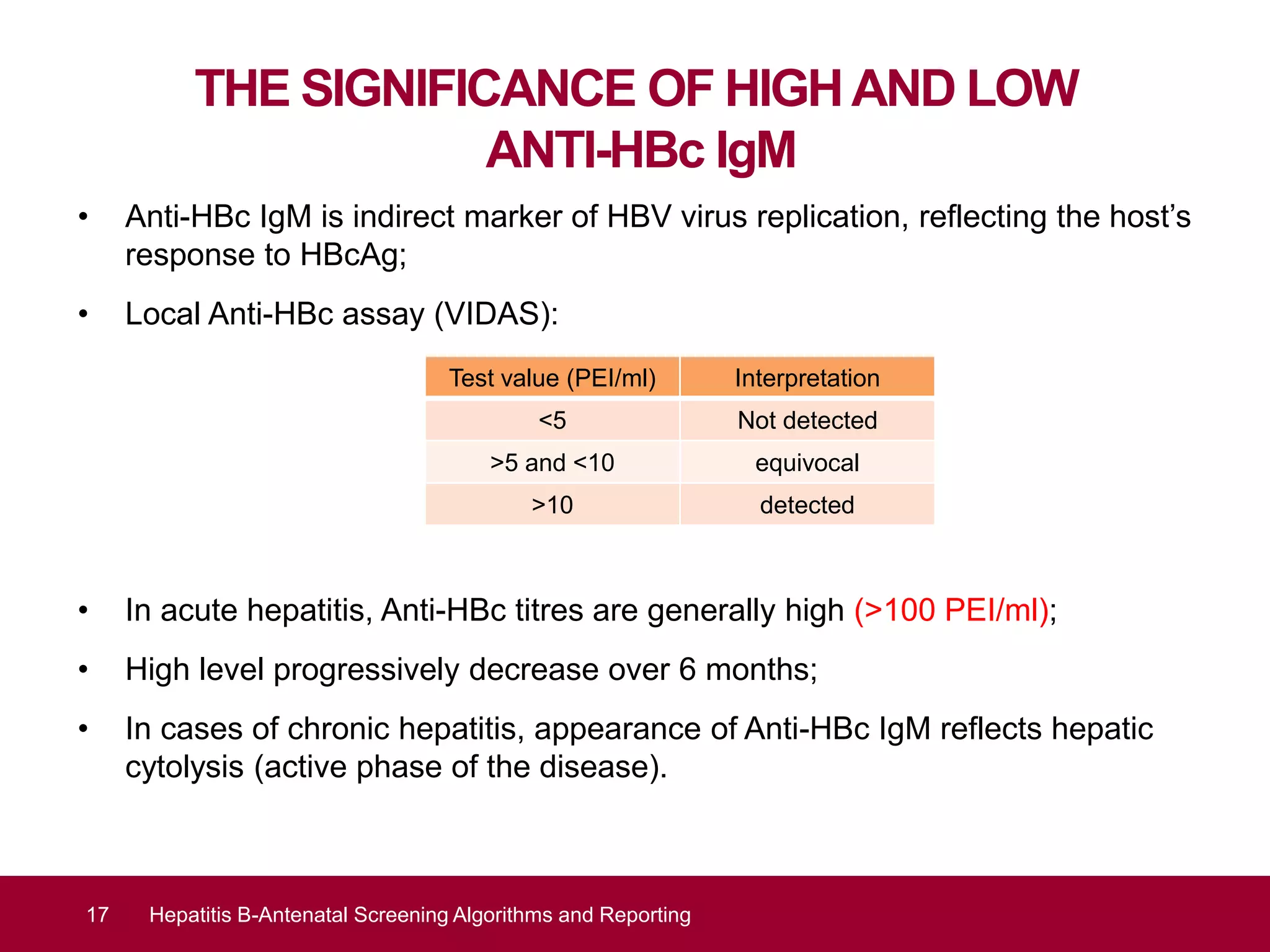
• Anti-HBc IgM is indirect marker of HBV virus replication, reflecting the host’s
response to HBcAg;
• Local Anti-HBc assay (VIDAS):
• In acute hepatitis, Anti-HBc titres are generally high (>100 PEI/ml);
• High level progressively decrease over 6 months;
• In cases of chronic hepatitis, appearance of Anti-HBc IgM reflects hepatic
cytolysis (active phase of the disease).
17 Hepatitis B-Antenatal Screening Algorithms and Reporting
Test value (PEI/ml) Interpretation
<5 Not detected
>5 and <10 equivocal
>10 detected
CLINICAL COMMENTS FOR REPORTING
HBV SCREENING TESTS RESULTS
18 Hepatitis B-Antenatal Screening Algorithms and Reporting
HBsAg
screen
HBsAg
neut*
Anti-HBc
total
Anti-HBc
IgM
HBeAg Anti-HBe Clinical Comments for Reports
3 Det Det Det Det
(High)
Det/
Ndet
Det/
Ndet
• Hepatitis B surface antigen detected:
screen positive
• Confirms early acute infection with hepatitis B and
high risk of transmission to the baby
• Refer rapidly to an appropriate specialist
• Indicates baby will require vaccine plus HBIG
4 Det Det Det Det
(Low)
Det Ndet • Hepatitis B surface antigen detected:
screen positive
• Consistent with a flare in chronic infection with
hepatitis B.
• Refer to an appropriate specialist.
• Baby will require vaccine and HBIG
5 Det Det Det Det
(Low)
Ndet Det • Hepatitis B surface antigen detected:
screen positive
• Consistent with a flare in chronic infection with
hepatitis B.
• Refer to an appropriate specialist.
• Baby will require vaccine.
• HBV DNA quantification should be undertaken. If
HBV DNA level is equal or above 1x10⁶ IU/ml baby
should receive HBIG in addition to vaccine.
• If low birth weight of < 1.5 kg baby will require HBIG in
addition to vaccine.
CLINICAL COMMENTS FOR REPORTING HBV
SCREENING TESTS RESULTS
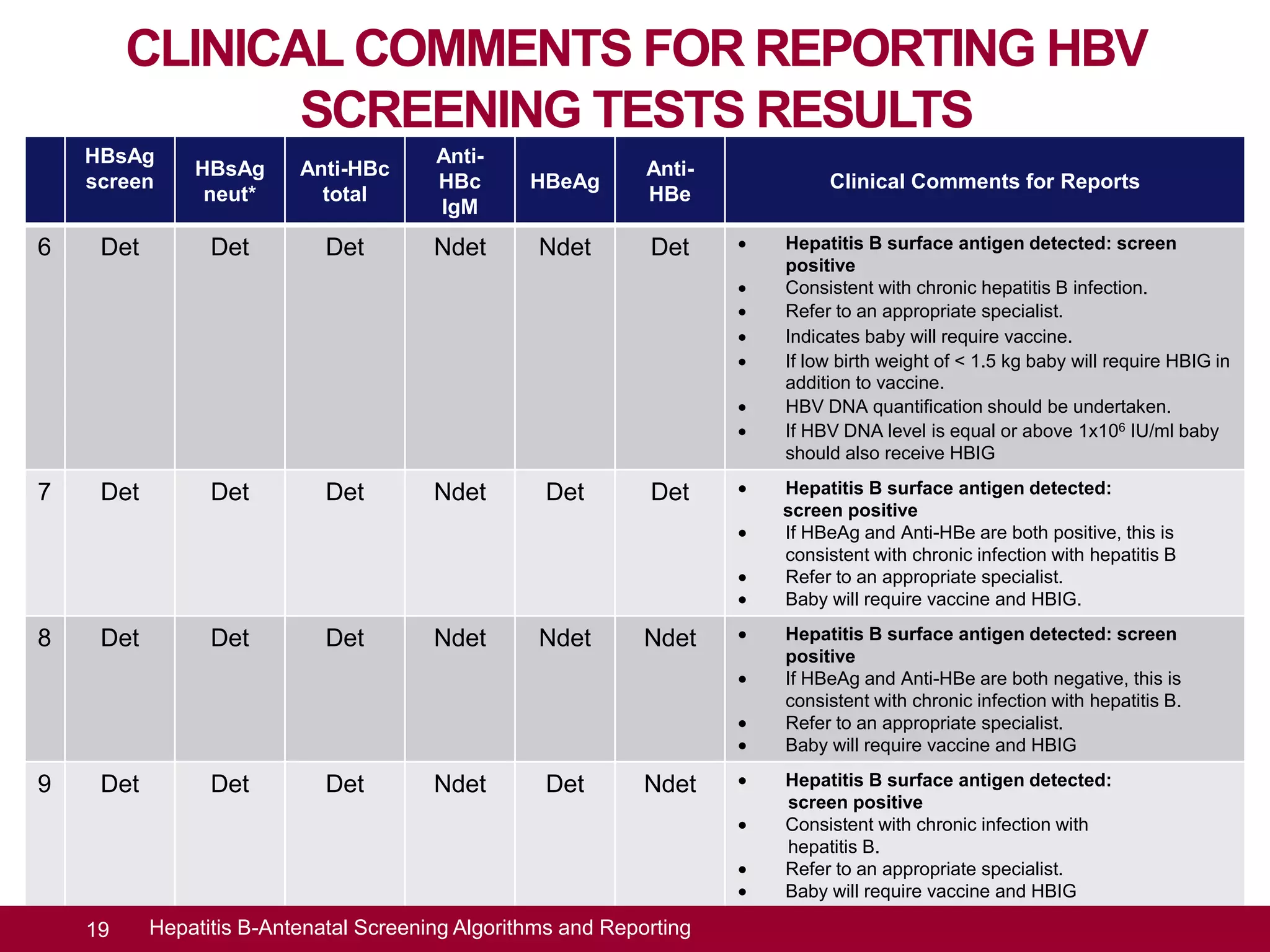
HBsAg
screen
HBsAg
neut*
Anti-HBc
total
Anti-
HBc
IgM
HBeAg
Anti-
HBe
Clinical Comments for Reports
6 Det Det Det Ndet Ndet Det • Hepatitis B surface antigen detected: screen
positive
• Consistent with chronic hepatitis B infection.
• Refer to an appropriate specialist.
• Indicates baby will require vaccine.
• If low birth weight of < 1.5 kg baby will require HBIG in
addition to vaccine.
• HBV DNA quantification should be undertaken.
• If HBV DNA level is equal or above 1x10⁶ IU/ml baby
should also receive HBIG
7 Det Det Det Ndet Det Det • Hepatitis B surface antigen detected:
screen positive
• If HBeAg and Anti-HBe are both positive, this is
consistent with chronic infection with hepatitis B
• Refer to an appropriate specialist.
• Baby will require vaccine and HBIG.
8 Det Det Det Ndet Ndet Ndet • Hepatitis B surface antigen detected: screen
positive
• If HBeAg and Anti-HBe are both negative, this is
consistent with chronic infection with hepatitis B.
• Refer to an appropriate specialist.
• Baby will require vaccine and HBIG
9 Det Det Det Ndet Det Ndet • Hepatitis B surface antigen detected:
screen positive
• Consistent with chronic infection with
hepatitis B.
• Refer to an appropriate specialist.
• Baby will require vaccine and HBIG
19 Hepatitis B-Antenatal Screening Algorithms and Reporting
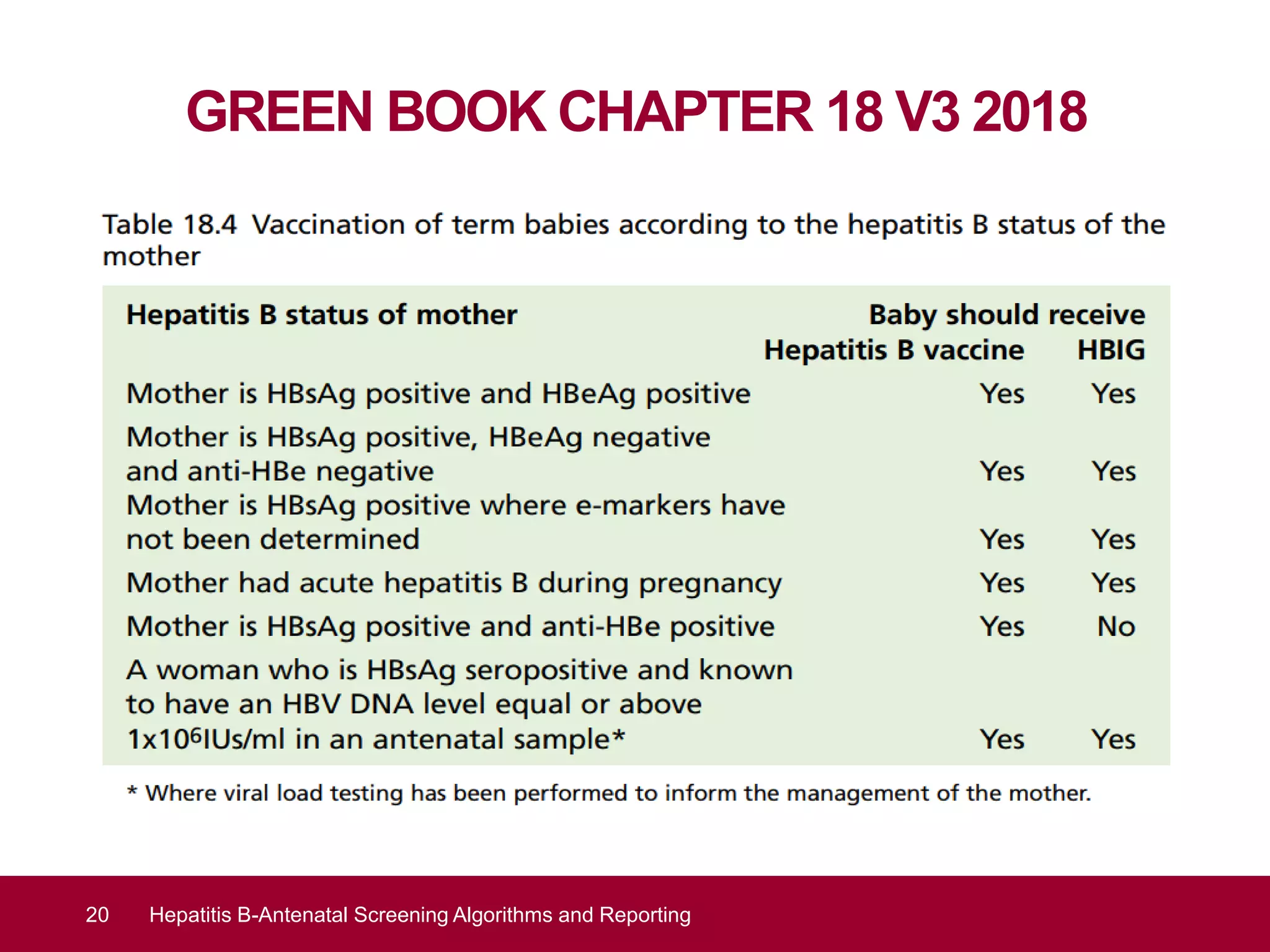
GREEN BOOK CHAPTER 18 V3 2018
20 Hepatitis B-Antenatal Screening Algorithms and Reporting
ACKNOWLEDGEMENT
a. Samreen Ijaz, PHE;
b. Judith Timms, IDPS Laboratory Advisor;
c. Nadia Permalloo, PHE;
d. Sonia Segalini, PHE;
e. Sharon Webb;
f. IDPS Laboratory Task Group
21 Hepatitis B-Antenatal Screening Algorithms and Reporting

4. Samir Dervisevic hepatitis b antenatal screening algorithms and reporting

  • 1.
    HEPATITIS B-ANTENATAL SCREENING ALGORITHMSAND REPORTING Dr Samir Dervisevic Norfolk and Norwich University Hospitals/ University of East Anglia NHS Infectious Diseases in Pregnancy Screening Programme (IDPS) National Laboratory Workshop Birmingham, 13 March 2019
  • 2.
    INFECTIOUS DISEASES INPREGNANCY SCREENING PROGRAMME (IDPS) • Executed by midwives, obstetricians, virologists, PHE; • In addition: specialist MDT teams (neonatologists, virologists, hepatologists and Genitourinary Medicine specialists) provide care as part of the screening programme; • Clinical conditions for which the screening is organised have a clearly defined care pathway; • The IDPS programme includes data collection; • KPI measure how the screening programme is performing; • The IDPS programme currently collects 4 KPIs. 2 Hepatitis B-Antenatal Screening Algorithms and Reporting
  • 3.
    STANDARS FOR INFECTIOUSDISEASES IN PREGNANCY National standards: to insure a consistent approach across screening programmes: Viral Hepatitis B infection: • HBsAg prevalence in pregnant women in the UK: 0.5% (ECDC 2016); • All antenatal women in England offered screening for hepatitis B virus; The purpose is to: a) Enable early detection of acute or chronic infection; b) Offer treatment to antenatal mothers who require it for their health; c) Reduce the risk of MTCT of infection; d) Offer postnatal prophylaxis to a newborn. 3 Hepatitis B-Antenatal Screening Algorithms and Reporting
  • 4.
    VIRAL HEPATITIS B:THE BIGGER PICTURE • The estimated prevalence of chronic HBV infection is at around 0.9% in the countries of the European Union and European Economic Area; • Prevalence of chronic HBV infection in the UK is 0.1-0.5%; • It is estimated that 4.7 million Europeans may have chronic HBV; • 180,000 people in the UK are chronically infected with HBV; • The World Health Organisation calling on countries to continue to translate their commitments to eliminate hepatitis (Geneva, 27 July 2017); • “The global effort to eliminate viral hepatitis and HIV as public health threats by 2030 (WHO 2017)” 4 Hepatitis B-Antenatal Screening Algorithms and Reporting
  • 5.
    ACUTE HBV CASESIN EUROPE 5 Hepatitis B-Antenatal Screening Algorithms and Reporting
  • 6.
    ACUTE HEPATITIS BIN ENGLAND • Surveillance of acute hepatitis B is essential to target prevention and control activities such as the selective immunisation programme; • Public Health England implemented national surveillance standards for hepatitis B in 2007 which provided the framework for more consistent reporting of cases from individual Specialist Virology Centres; • The surveillance definition for acute hepatitis B is: 1. HBsAg positive and 2. Anti-HBc IgM positive and 3. Abnormal liver function tests (ALT) • All with a pattern consistent with acute viral hepatitis; 6 Hepatitis B-Antenatal Screening Algorithms and Reporting
  • 7.
    ACUTE HEPATITIS BIN ENGLAND • Cases classified as acute viral hepatitis B by the local PHE Centre or the Specialist Virology Centres and/or with a documented positive anti-HBc IgM were classified as acute cases; • Liver function test results may not be available to PHE; • Cases classified as acute viral hepatitis B by the PHE Centre but without anti-HBc IgM test results, or not classified but with a positive anti-HBc IgM reported were assumed to be probable acute hepatitis B cases; • Cases classified as chronic infections or those not classified where anti-HBc IgM was negative or equivocal were assumed to be chronic infections; 7 Hepatitis B-Antenatal Screening Algorithms and Reporting
  • 8.
    ACUTE HEPATITIS BIN ENGLAND 8 Hepatitis B-Antenatal Screening Algorithms and Reporting PHE 2018
  • 9.
    EPIDEMIOLOGY OF HBVIN ENGLAND • A total of 9,774 confirmed hepatitis B infections were reported from Specialist Virology Laboratories in England in 2017 (PHE 2018); • Out of those, a total of 445 (4.5%) were acute or probable acute cases of hepatitis B; • This gave an annual incidence of 0.8 per 100,000 populations; • London is still the region with the highest incidence (1.43 per 100,000); • The highest increase in incidence was reported from West Midlands (from 0.50 to 0.82 per 100,000 in 2016 and 2017 respectively) and South East (from 0.49 to 0.68 per 100,000); • The largest decrease was reported from North West (from 1.02 to 0.52 per 100,000 in 2016 and 2017 respectively) and London (from 1.70 to 1.43 per 100,000 in 2016 and 2017 respectively). 9 Hepatitis B-Antenatal Screening Algorithms and Reporting
  • 10.
    EPIDEMIOLOGY OF HBVIN ENGLAND • The majority of HBV cases in 2017 were in men (70.4%) with overall incidence of 1.14 per 100,000; • The corresponding incidence in women in 2017 was 0.47 per 100,000; • Only 68 cases (15.3%) of the total acute or probable acute hepatitis B cases had their ethnicity recorded: 1. 67% White; 2. 14.7% Black British; 3. 8.8% Asian British; • The commonest reported risk attributed was heterosexual exposure, implicated as the probable route of exposure in 54.8% of cases; 10 Hepatitis B-Antenatal Screening Algorithms and Reporting
  • 11.
    CLINICAL OUTCOME OFACUTEHBV INFECTION 11 Hepatitis B-Antenatal Screening Algorithms and Reporting Acute HBV (HBsAg+, Anti-HBc IgM) Resolution Fulminant hepatitis 90% 1% Chronic infection (HBsAg detected>6 months) 9% HBeAg chronic infection HBeAg chronic hepatitis Anti-HBe chronic infection Anti-HBe chronic hepatitis Liver cirrhosis; Hepatocellular carcinoma
  • 12.
    DIAGNOSIS OF HBVINFECTION: SEROLOGICAL MARKERS A battery of serological tests are used for the diagnosis of hepatitis B infection: 1) HBsAg=used as a general marker of infection; 2) Anti-HBc IgM=marker of acute infection and flare-up; 3) Anti-HBc= marker of current or past infection; 4) HBeAg= indicates active replication of virus and marks high infectivity; 5) Anti-HBe=generally coincides with significant reduction in replication unless the virus develops mutations; 6) HBV DNA =measures virus load and indicates the level of replication. Used in follow-ups and in patients who are on treatment. 12 Hepatitis B-Antenatal Screening Algorithms and Reporting
  • 13.
    HBsAg assay (min. sensitivitylevel 0.05 IU/mL) Detected Not detected Perform neutralisation / alternative assay Detected Not detected Test other markers Test Anti-HBc (total) Detected Not detected Test other markers REPORT Likely non-specific reactivity. Please send another sample. REPORT Hepatitis B surface antigen not detected See reporting hepatitis B screening test results table Day 1 – receipt of sample in the laboratory Day 8 – reporting of screening results 13 Hepatitis B-Antenatal Screening Algorithms and Reporting HEPATITIS B TESTING ALGORITHM
  • 14.
    CLINICAL COMMENTS FORREPORTING HBV SCREENING TESTS RESULTS HBsAg screen HBsAg neut* Anti-HBc total Anti-HBc IgM HBeAg Anti-HBe Clinical Comments for Reports 1 Not detected Not necessary • Hepatitis B surface antigen not detected • No evidence of Hepatitis B infection 2 Det Det Ndet Ndet Det or Ndet Ndet • Hepatitis B surface antigen detected: screen positive. • Suggests early acute infection with hepatitis B and high risk of transmission to the baby. • Please send an EDTA blood sample for HBV DNA by PCR. • Refer rapidly to appropriate specialist. • Indicates baby will require vaccine plus HBIG 14 Hepatitis B-Antenatal Screening Algorithms and Reporting
  • 15.
    CLINICAL COMMENTS FORREPORTING HBV SCREENING TESTS RESULTS 15 Hepatitis B-Antenatal Screening Algorithms and Reporting HBsAg screen HBsAg neut* Anti-HBc total Anti-HBc IgM HBeAg Anti-HBe Clinical Comments for Reports 3 Det Det Det Det (High) Det/ Ndet Det/ Ndet • Hepatitis B surface antigen detected: screen positive • Confirms early acute infection with hepatitis B and high risk of transmission to the baby • Refer rapidly to an appropriate specialist • Indicates baby will require vaccine plus HBIG 4 Det Det Det Det (Low) Det Ndet • Hepatitis B surface antigen detected: screen positive • Consistent with a flare in chronic infection with hepatitis B. • Refer to an appropriate specialist. • Baby will require vaccine and HBIG 5 Det Det Det Det (Low) Ndet Det • Hepatitis B surface antigen detected: screen positive • Consistent with a flare in chronic infection with hepatitis B. • Refer to an appropriate specialist. • Baby will require vaccine. • HBV DNA quantification should be undertaken. If HBV DNA level is equal or above 1x10⁶ IU/ml baby should receive HBIG in addition to vaccine. • If low birth weight of < 1.5 kg baby will require HBIG in addition to vaccine.
  • 16.
    THE SIGNIFICANCE OFHIGHAND LOW ANTI-HBc IgM • High level of detectable Anti-HBc IgM is a marker of acute HBV infection (in addition to raised ALT, high HBV DNA etc); • Flare-ups of chronic HBV infection are common and may be confused with acute infection; • Flare-ups are usually associated with low level of detectable Anti-HBc IgM; • The differentiation between these two conditions is important because of the different strategy in the management of an antenatal woman and her newborn; • Different assays in use in the UK have different cut-off values, their interpretation requires opinion of a trained Virologists; • History of HBV infection, if available, is helpful; • Results of biochemistry: ALT, bilirubin, AST and INR should be taken into consideration. 16 Hepatitis B-Antenatal Screening Algorithms and Reporting
  • 17.
    THE SIGNIFICANCE OFHIGHAND LOW ANTI-HBc IgM • Anti-HBc IgM is indirect marker of HBV virus replication, reflecting the host’s response to HBcAg; • Local Anti-HBc assay (VIDAS): • In acute hepatitis, Anti-HBc titres are generally high (>100 PEI/ml); • High level progressively decrease over 6 months; • In cases of chronic hepatitis, appearance of Anti-HBc IgM reflects hepatic cytolysis (active phase of the disease). 17 Hepatitis B-Antenatal Screening Algorithms and Reporting Test value (PEI/ml) Interpretation <5 Not detected >5 and <10 equivocal >10 detected
  • 18.
    CLINICAL COMMENTS FORREPORTING HBV SCREENING TESTS RESULTS 18 Hepatitis B-Antenatal Screening Algorithms and Reporting HBsAg screen HBsAg neut* Anti-HBc total Anti-HBc IgM HBeAg Anti-HBe Clinical Comments for Reports 3 Det Det Det Det (High) Det/ Ndet Det/ Ndet • Hepatitis B surface antigen detected: screen positive • Confirms early acute infection with hepatitis B and high risk of transmission to the baby • Refer rapidly to an appropriate specialist • Indicates baby will require vaccine plus HBIG 4 Det Det Det Det (Low) Det Ndet • Hepatitis B surface antigen detected: screen positive • Consistent with a flare in chronic infection with hepatitis B. • Refer to an appropriate specialist. • Baby will require vaccine and HBIG 5 Det Det Det Det (Low) Ndet Det • Hepatitis B surface antigen detected: screen positive • Consistent with a flare in chronic infection with hepatitis B. • Refer to an appropriate specialist. • Baby will require vaccine. • HBV DNA quantification should be undertaken. If HBV DNA level is equal or above 1x10⁶ IU/ml baby should receive HBIG in addition to vaccine. • If low birth weight of < 1.5 kg baby will require HBIG in addition to vaccine.
  • 19.
    CLINICAL COMMENTS FORREPORTING HBV SCREENING TESTS RESULTS HBsAg screen HBsAg neut* Anti-HBc total Anti- HBc IgM HBeAg Anti- HBe Clinical Comments for Reports 6 Det Det Det Ndet Ndet Det • Hepatitis B surface antigen detected: screen positive • Consistent with chronic hepatitis B infection. • Refer to an appropriate specialist. • Indicates baby will require vaccine. • If low birth weight of < 1.5 kg baby will require HBIG in addition to vaccine. • HBV DNA quantification should be undertaken. • If HBV DNA level is equal or above 1x10⁶ IU/ml baby should also receive HBIG 7 Det Det Det Ndet Det Det • Hepatitis B surface antigen detected: screen positive • If HBeAg and Anti-HBe are both positive, this is consistent with chronic infection with hepatitis B • Refer to an appropriate specialist. • Baby will require vaccine and HBIG. 8 Det Det Det Ndet Ndet Ndet • Hepatitis B surface antigen detected: screen positive • If HBeAg and Anti-HBe are both negative, this is consistent with chronic infection with hepatitis B. • Refer to an appropriate specialist. • Baby will require vaccine and HBIG 9 Det Det Det Ndet Det Ndet • Hepatitis B surface antigen detected: screen positive • Consistent with chronic infection with hepatitis B. • Refer to an appropriate specialist. • Baby will require vaccine and HBIG 19 Hepatitis B-Antenatal Screening Algorithms and Reporting
  • 20.
    GREEN BOOK CHAPTER18 V3 2018 20 Hepatitis B-Antenatal Screening Algorithms and Reporting
  • 21.
    ACKNOWLEDGEMENT a. Samreen Ijaz,PHE; b. Judith Timms, IDPS Laboratory Advisor; c. Nadia Permalloo, PHE; d. Sonia Segalini, PHE; e. Sharon Webb; f. IDPS Laboratory Task Group 21 Hepatitis B-Antenatal Screening Algorithms and Reporting