HIV- antenatal screening
algorithms and reporting
Judith Timms
Consultant Virologist and IDPS laboratory
advisor
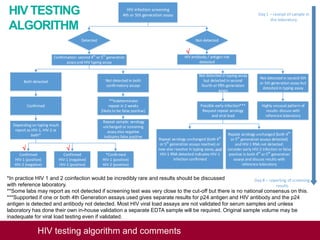
HIV infection screening
4th or 5th generation assay
Detected Not-detected
Confirmation: second 4th
or 5th
generation
assayand HIV typing assay
HIV antibody / antigen not
detected
Both detected
Confirmed
Depending on typing result
report as HIV-1, HIV-2 or
both*
Confirmed
HIV-1 (positive)
HIV-2 (negative)
Confirmed
HIV-1 (negative)
HIV-2 (positive)
*Confirmed
HIV-1 (positive)
HIV-2 (positive)
Not detected in both
confirmatory assays
Not detected in typing assay
but detected in second
fourth or fifth generation
assay
Not detected in second 4th
or 5th generation assay but
detected in typing assay
**Indeterminate:
repeat in 2 weeks
(likelyto be false positive)
Repeat sample: serology
unchanged or screening
assayalso negative
indicates false positive
Possible early infection***
Request repeat serology
and viral load
Repeat serology unchanged (both 4th
or 5th
generation assays reactive) or
now also reactive in typing assay, and
HIV-1 RNA detected indicates HIV-1
infection confirmed
Highly unusual pattern of
results: discuss with
reference laboratory
Repeat serology unchanged (both 4th
or 5th
generation assays detected)
and HIV-1 RNA not detected:
consider early HIV-2 infection or false
positive in both 4th
or 5th
generation
assays and discuss results with
reference laboratory
Day 1 – receipt of sample in
the laboratory
Day 8 – reporting of screening
results
HIV testing algorithm and comments
HIV TESTING
ALGORITHM
*In practice HIV 1 and 2 coinfection would be incredibly rare and results should be discussed
with reference laboratory.
**Some labs may report as not detected if screening test was very close to the cut-off but there is no national consensus on this.
***Supported if one or both 4th Generation assays used gives separate results for p24 antigen and HIV antibody and the p24
antigen is detected and antibody not detected. Most HIV viral load assays are not validated for serum samples and unless
laboratory has done their own in-house validation a separate EDTA sample will be required. Original sample volume may be
inadequate for viral load testing even if validated.
HIV infection screening
4th or 5th generation assay
Detected Not-detected
Confirmation: second 4th
or 5th
generation
assayand HIV typing assay
HIV antibody / antigen not
detected
Both detected
Confirmed
Depending on typing result
report as HIV-1, HIV-2 or
both*
Confirmed
HIV-1 (positive)
HIV-2 (negative)
Confirmed
HIV-1 (negative)
HIV-2 (positive)
*Confirmed
HIV-1 (positive)
HIV-2 (positive)
Not detected in both
confirmatory assays
Not detected in typing assay
but detected in second
fourth or fifth generation
assay
Not detected in second 4th
or 5th generation assay but
detected in typing assay
**Indeterminate:
repeat in 2 weeks
(likelyto be false positive)
Repeat sample: serology
unchanged or screening
assayalso negative
indicates false positive
Possible early infection***
Request repeat serology
and viral load
Repeat serology unchanged (both 4th
or 5th
generation assays reactive) or
now also reactive in typing assay, and
HIV-1 RNA detected indicates HIV-1
infection confirmed
Highly unusual pattern of
results: discuss with
reference laboratory
Repeat serology unchanged (both 4th
or 5th
generation assays detected)
and HIV-1 RNA not detected:
consider early HIV-2 infection or false
positive in both 4th
or 5th
generation
assays and discuss results with
reference laboratory
Day 1 – receipt of sample in
the laboratory
Day 8 – reporting of screening
results
HIV testing algorithm and comments
HIV TESTING
ALGORITHM
*In practice HIV 1 and 2 coinfection would be incredibly rare and results should be discussed
with reference laboratory.
**Some labs may report as not detected if screening test was very close to the cut-off but there is no national consensus on this.
***Supported if one or both 4th Generation assays used gives separate results for p24 antigen and HIV antibody and the p24
antigen is detected and antibody not detected. Most HIV viral load assays are not validated for serum samples and unless
laboratory has done their own in-house validation a separate EDTA sample will be required. Original sample volume may be
inadequate for viral load testing even if validated.
√ √
√
HIV testing algorithm and comments
INTERPRETATIONAND CLINICALCOMMENTS FOR
REPORTING HIV SCREENING TESTS
HIV testing algorithm and comments
INTERPRETATIONAND CLINICALCOMMENTS FOR
REPORTING HIV SCREENING TESTS
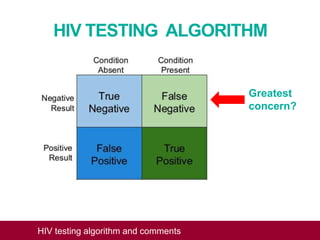
HIV TESTING ALGORITHM
Greatest
concern?
HIV testing algorithm and comments
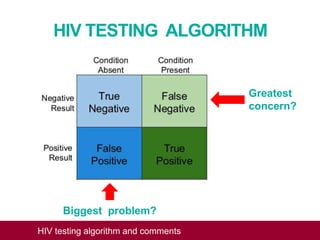
HIV TESTING ALGORITHM
HIV testing algorithm and comments
Greatest
concern?
Biggest problem?
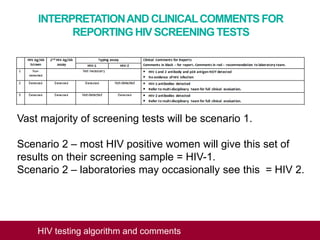
Vast majority of screening tests will be scenario 1.
Scenario 2 – most HIV positive women will give this set of
results on their screening sample = HIV-1.
Scenario 2 – laboratories may occasionally see this = HIV 2.
INTERPRETATIONAND CLINICALCOMMENTS FOR
REPORTING HIV SCREENING TESTS
HIV testing algorithm and comments
INTERPRETATIONAND CLINICALCOMMENTS FOR
REPORTING HIV SCREENING TESTS
HIV testing algorithm and comments
Question 1
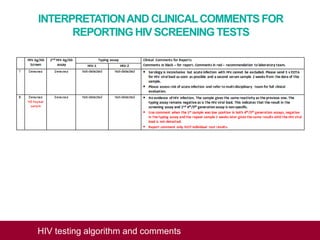
Has anyone seen a genuine co-infection?
INTERPRETATIONAND CLINICALCOMMENTS FOR
REPORTING HIV SCREENING TESTS
HIV testing algorithm and comments
INTERPRETATIONAND CLINICALCOMMENTS FOR
REPORTING HIV SCREENING TESTS
HIV testing algorithm and comments
Most false positive HIV results fall into this category
Question 2
Some labs may report as negative if screening test was very close to the
cut-off but there is no national consensus on this.
Is your laboratory happy to report as negative if screening test very close
to the cut-off?
INTERPRETATIONAND CLINICALCOMMENTS FOR
REPORTING HIV SCREENING TESTS
HIV testing algorithm and comments
INTERPRETATIONAND CLINICALCOMMENTS FOR
REPORTING HIV SCREENING TESTS
HIV testing algorithm and comments
INTERPRETATIONAND CLINICALCOMMENTS FOR
REPORTING HIV SCREENING TESTS
HIV testing algorithm and comments
Question 3
Neither Ag/Ab assay gives separate results for antibody and p24.
(a) Would you report like this or send away urgently for p24 testing?
(b) Would you want to report this more strongly? eg Serology suggests
acute HIV infection?
INTERPRETATIONAND CLINICALCOMMENTS FOR
REPORTING HIV SCREENING TESTS
HIV testing algorithm and comments
INTERPRETATIONAND CLINICALCOMMENTS FOR
REPORTING HIV SCREENING TESTS
HIV testing algorithm and comments
Question 4
Would you want to ask for a viral load at this point?
INTERPRETATIONAND CLINICALCOMMENTS FOR
REPORTING HIV SCREENING TESTS
HIV testing algorithm and comments
INTERPRETATIONAND CLINICALCOMMENTS FOR
REPORTING HIV SCREENING TESTS
HIV testing algorithm and comments
Question 5
Has anyone seen this pattern of results?
INTERPRETATIONAND CLINICALCOMMENTS FOR
REPORTING HIV SCREENING TESTS
HIV testing algorithm and comments
SOMETHING SLIGHTLY DIFFERENT
Sample storage: draft comment
When the screening tests are complete an aliquot (a suggested minimum
volume of 300 microliters) from the screening specimen must be stored
frozen at a minimum temperature of -20 OC for at least 2 years.
HIV testing algorithm and comments
SOMETHING SLIGHTLY DIFFERENT
Sample storage: draft comment
When the screening tests are complete an aliquot (a suggested minimum
volume of 300 microliters) from the screening specimen must be stored
frozen at a minimum temperature of -20 OC for at least 2 years.
Is the wording correct here?
HIV testing algorithm and comments
SOMETHING SLIGHTLY DIFFERENT
Sample storage: draft comment
When the screening tests are complete an aliquot (a suggested minimum
volume of 300 microliters) from the screening specimen must be stored
frozen at a minimum temperature of -20 OC for at least 2 years.
In cases where there is insufficient volume to store an aliquot of the
screening specimen then a local process should be in place to document,
monitor and manage this, for example by requesting a second sample
and informing the women of the reason.
Laboratories should consider reporting the proportion of samples where it
is not possible to store an aliquot of the screening specimen to maternity
services.
HIV testing algorithm and comments
SOMETHING SLIGHTLY DIFFERENT
Sample storage: draft comment
When the screening tests are complete an aliquot (a suggested minimum
volume of 300 microliters) from the screening specimen must be stored
frozen at a minimum temperature of -20 OC for at least 2 years.
In cases where there is insufficient volume to store an aliquot of the
screening specimen then a local process should be in place to document,
monitor and manage this, for example by requesting a second sample
and informing the women of the reason.
Laboratories should consider reporting the proportion of samples where it
is not possible to store an aliquot of the screening specimen to maternity
services.
How feasible are these last 2 statements?
HIV testing algorithm and comments

5. Judith Timms hiv algorithm talk

  • 1.
    HIV- antenatal screening algorithmsand reporting Judith Timms Consultant Virologist and IDPS laboratory advisor
  • 2.
    HIV infection screening 4thor 5th generation assay Detected Not-detected Confirmation: second 4th or 5th generation assayand HIV typing assay HIV antibody / antigen not detected Both detected Confirmed Depending on typing result report as HIV-1, HIV-2 or both* Confirmed HIV-1 (positive) HIV-2 (negative) Confirmed HIV-1 (negative) HIV-2 (positive) *Confirmed HIV-1 (positive) HIV-2 (positive) Not detected in both confirmatory assays Not detected in typing assay but detected in second fourth or fifth generation assay Not detected in second 4th or 5th generation assay but detected in typing assay **Indeterminate: repeat in 2 weeks (likelyto be false positive) Repeat sample: serology unchanged or screening assayalso negative indicates false positive Possible early infection*** Request repeat serology and viral load Repeat serology unchanged (both 4th or 5th generation assays reactive) or now also reactive in typing assay, and HIV-1 RNA detected indicates HIV-1 infection confirmed Highly unusual pattern of results: discuss with reference laboratory Repeat serology unchanged (both 4th or 5th generation assays detected) and HIV-1 RNA not detected: consider early HIV-2 infection or false positive in both 4th or 5th generation assays and discuss results with reference laboratory Day 1 – receipt of sample in the laboratory Day 8 – reporting of screening results HIV testing algorithm and comments HIV TESTING ALGORITHM *In practice HIV 1 and 2 coinfection would be incredibly rare and results should be discussed with reference laboratory. **Some labs may report as not detected if screening test was very close to the cut-off but there is no national consensus on this. ***Supported if one or both 4th Generation assays used gives separate results for p24 antigen and HIV antibody and the p24 antigen is detected and antibody not detected. Most HIV viral load assays are not validated for serum samples and unless laboratory has done their own in-house validation a separate EDTA sample will be required. Original sample volume may be inadequate for viral load testing even if validated.
  • 3.
    HIV infection screening 4thor 5th generation assay Detected Not-detected Confirmation: second 4th or 5th generation assayand HIV typing assay HIV antibody / antigen not detected Both detected Confirmed Depending on typing result report as HIV-1, HIV-2 or both* Confirmed HIV-1 (positive) HIV-2 (negative) Confirmed HIV-1 (negative) HIV-2 (positive) *Confirmed HIV-1 (positive) HIV-2 (positive) Not detected in both confirmatory assays Not detected in typing assay but detected in second fourth or fifth generation assay Not detected in second 4th or 5th generation assay but detected in typing assay **Indeterminate: repeat in 2 weeks (likelyto be false positive) Repeat sample: serology unchanged or screening assayalso negative indicates false positive Possible early infection*** Request repeat serology and viral load Repeat serology unchanged (both 4th or 5th generation assays reactive) or now also reactive in typing assay, and HIV-1 RNA detected indicates HIV-1 infection confirmed Highly unusual pattern of results: discuss with reference laboratory Repeat serology unchanged (both 4th or 5th generation assays detected) and HIV-1 RNA not detected: consider early HIV-2 infection or false positive in both 4th or 5th generation assays and discuss results with reference laboratory Day 1 – receipt of sample in the laboratory Day 8 – reporting of screening results HIV testing algorithm and comments HIV TESTING ALGORITHM *In practice HIV 1 and 2 coinfection would be incredibly rare and results should be discussed with reference laboratory. **Some labs may report as not detected if screening test was very close to the cut-off but there is no national consensus on this. ***Supported if one or both 4th Generation assays used gives separate results for p24 antigen and HIV antibody and the p24 antigen is detected and antibody not detected. Most HIV viral load assays are not validated for serum samples and unless laboratory has done their own in-house validation a separate EDTA sample will be required. Original sample volume may be inadequate for viral load testing even if validated. √ √ √
  • 4.
    HIV testing algorithmand comments INTERPRETATIONAND CLINICALCOMMENTS FOR REPORTING HIV SCREENING TESTS
  • 5.
    HIV testing algorithmand comments INTERPRETATIONAND CLINICALCOMMENTS FOR REPORTING HIV SCREENING TESTS
  • 6.
    HIV TESTING ALGORITHM Greatest concern? HIVtesting algorithm and comments
  • 7.
    HIV TESTING ALGORITHM HIVtesting algorithm and comments Greatest concern? Biggest problem?
  • 8.
    Vast majority ofscreening tests will be scenario 1. Scenario 2 – most HIV positive women will give this set of results on their screening sample = HIV-1. Scenario 2 – laboratories may occasionally see this = HIV 2. INTERPRETATIONAND CLINICALCOMMENTS FOR REPORTING HIV SCREENING TESTS HIV testing algorithm and comments
  • 9.
    INTERPRETATIONAND CLINICALCOMMENTS FOR REPORTINGHIV SCREENING TESTS HIV testing algorithm and comments
  • 10.
    Question 1 Has anyoneseen a genuine co-infection? INTERPRETATIONAND CLINICALCOMMENTS FOR REPORTING HIV SCREENING TESTS HIV testing algorithm and comments
  • 11.
    INTERPRETATIONAND CLINICALCOMMENTS FOR REPORTINGHIV SCREENING TESTS HIV testing algorithm and comments
  • 12.
    Most false positiveHIV results fall into this category Question 2 Some labs may report as negative if screening test was very close to the cut-off but there is no national consensus on this. Is your laboratory happy to report as negative if screening test very close to the cut-off? INTERPRETATIONAND CLINICALCOMMENTS FOR REPORTING HIV SCREENING TESTS HIV testing algorithm and comments
  • 13.
    INTERPRETATIONAND CLINICALCOMMENTS FOR REPORTINGHIV SCREENING TESTS HIV testing algorithm and comments
  • 14.
    INTERPRETATIONAND CLINICALCOMMENTS FOR REPORTINGHIV SCREENING TESTS HIV testing algorithm and comments
  • 15.
    Question 3 Neither Ag/Abassay gives separate results for antibody and p24. (a) Would you report like this or send away urgently for p24 testing? (b) Would you want to report this more strongly? eg Serology suggests acute HIV infection? INTERPRETATIONAND CLINICALCOMMENTS FOR REPORTING HIV SCREENING TESTS HIV testing algorithm and comments
  • 16.
    INTERPRETATIONAND CLINICALCOMMENTS FOR REPORTINGHIV SCREENING TESTS HIV testing algorithm and comments
  • 17.
    Question 4 Would youwant to ask for a viral load at this point? INTERPRETATIONAND CLINICALCOMMENTS FOR REPORTING HIV SCREENING TESTS HIV testing algorithm and comments
  • 18.
    INTERPRETATIONAND CLINICALCOMMENTS FOR REPORTINGHIV SCREENING TESTS HIV testing algorithm and comments
  • 19.
    Question 5 Has anyoneseen this pattern of results? INTERPRETATIONAND CLINICALCOMMENTS FOR REPORTING HIV SCREENING TESTS HIV testing algorithm and comments
  • 20.
    SOMETHING SLIGHTLY DIFFERENT Samplestorage: draft comment When the screening tests are complete an aliquot (a suggested minimum volume of 300 microliters) from the screening specimen must be stored frozen at a minimum temperature of -20 OC for at least 2 years. HIV testing algorithm and comments
  • 21.
    SOMETHING SLIGHTLY DIFFERENT Samplestorage: draft comment When the screening tests are complete an aliquot (a suggested minimum volume of 300 microliters) from the screening specimen must be stored frozen at a minimum temperature of -20 OC for at least 2 years. Is the wording correct here? HIV testing algorithm and comments
  • 22.
    SOMETHING SLIGHTLY DIFFERENT Samplestorage: draft comment When the screening tests are complete an aliquot (a suggested minimum volume of 300 microliters) from the screening specimen must be stored frozen at a minimum temperature of -20 OC for at least 2 years. In cases where there is insufficient volume to store an aliquot of the screening specimen then a local process should be in place to document, monitor and manage this, for example by requesting a second sample and informing the women of the reason. Laboratories should consider reporting the proportion of samples where it is not possible to store an aliquot of the screening specimen to maternity services. HIV testing algorithm and comments
  • 23.
    SOMETHING SLIGHTLY DIFFERENT Samplestorage: draft comment When the screening tests are complete an aliquot (a suggested minimum volume of 300 microliters) from the screening specimen must be stored frozen at a minimum temperature of -20 OC for at least 2 years. In cases where there is insufficient volume to store an aliquot of the screening specimen then a local process should be in place to document, monitor and manage this, for example by requesting a second sample and informing the women of the reason. Laboratories should consider reporting the proportion of samples where it is not possible to store an aliquot of the screening specimen to maternity services. How feasible are these last 2 statements? HIV testing algorithm and comments