Crecimiento Urbano Inteligente en Latinoamérica
Smart Urban Growth in Latin America
Marc Potard, IDOM
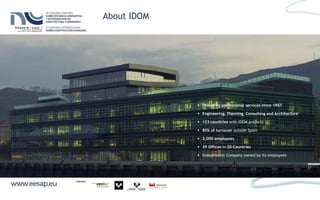
 Delivering professional services since 1957
 Engineering, Planning, Consulting and Architecture
 123 countries with IDOM projects
 80% of turnover outside Spain
 3,000 employees
 39 Offices in 20 Countries
 Independent Company owned by its employees
About IDOM
http://image.guardian.co.uk/sys-files/Guardian/documents/2007/06/27/URBAN_WORLD_2806.pdf
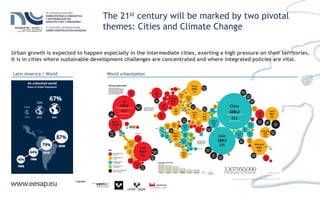
World urbanization
The 21st century will be marked by two pivotal
themes: Cities and Climate Change
An urbanized world
Share of Urban Population
Urban growth is expected to happen especially in the intermediate cities, exerting a high pressure on their territories.
It is in cities where sustainable development challenges are concentrated and where integrated policies are vital.
Latin America / World
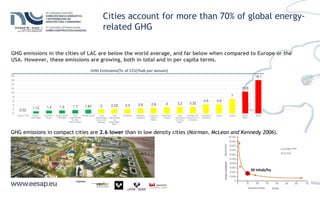
Cities account for more than 70% of global energy-
related GHG
GHG emissions in the cities of LAC are below the world average, and far below when compared to Europe or the
USA. However, these emissions are growing, both in total and in per capita terms.
GHG emissions in compact cities are 2.6 lower than in low density cities (Norman, McLean and Kennedy 2006).
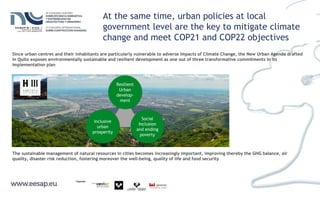
At the same time, urban policies at local
government level are the key to mitigate climate
change and meet COP21 and COP22 objectives
Since urban centres and their inhabitants are particularly vulnerable to adverse impacts of Climate Change, the New Urban Agenda drafted
in Quito exposes environmentally sustainable and resilient development as one out of three transformative commitments in its
implementation plan
Social
Inclusion
and ending
poverty
Inclusive
urban
prosperity
Resilient
Urban
develop-
ment
The sustainable management of natural resources in cities becomes increasingly important, improving thereby the GHG balance, air
quality, disaster risk reduction, fostering moreover the well-being, quality of life and food security
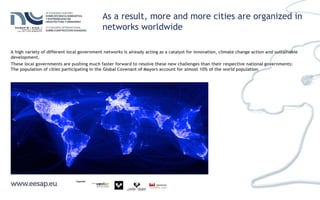
As a result, more and more cities are organized in
networks worldwide
A high variety of different local government networks is already acting as a catalyst for innovation, climate change action and sustainable
development.
These local governments are pushing much faster forward to resolve these new challenges than their respective national governments:
The population of cities participating in the Global Covenant of Mayors account for almost 10% of the world population
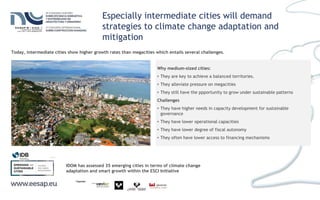
Especially intermediate cities will demand
strategies to climate change adaptation and
mitigation
Why medium-sized cities:
• They are key to achieve a balanced territories.
• They alleviate pressure on megacities
• They still have the ppportunity to grow under sustainable patterns
Challenges
• They have higher needs in capacity development for sustainable
governance
• They have lower operational capacities
• They have lower degree of fiscal autonomy
• They often have lower access to financing mechanisms
IDOM has assessed 35 emerging cities in terms of climate change
adaptation and smart growth within the ESCI Initiative
www.iadb.org
Today, intermediate cities show higher growth rates than megacities which entails several challenges.
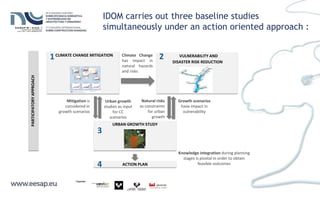
CLIMATE CHANGE MITIGATION
1 VULNERABILITY AND
DISASTER RISK REDUCTION
2
URBAN GROWTH STUDY
3
Climate Change
has impact in
natural hazards
and risks
Urban growth
studies as input
for CC
scenarios
Mitigation is
considered in
growth scenarios
Natural risks
as constraints
for urban
growth
Growth scenarios
have impact in
vulnerability
PARTICIPATORYAPPROACH
Knowledge integration during planning
stages is pivotal in order to obtain
feasible outcomesACTION PLAN4
IDOM carries out three baseline studies
simultaneously under an action oriented approach :
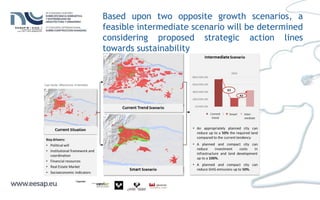
Based upon two opposite growth scenarios, a
feasible intermediate scenario will be determined
considering proposed strategic action lines
towards sustainability
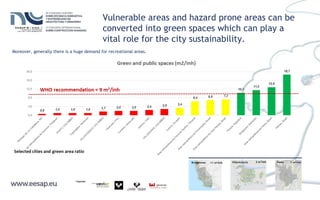
Pasto 1 m2/inhBridgetown 11 m2/inh Villavicencio 2 m2/inh
Vulnerable areas and hazard prone areas can be
converted into green spaces which can play a
vital role for the city sustainability.
Moreover, generally there is a huge demand for recreational areas.
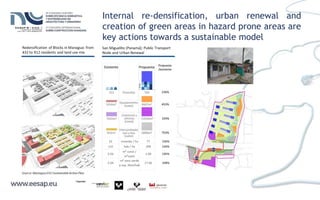
Internal re-densification, urban renewal and
creation of green areas in hazard prone areas are
key actions towards a sustainable model
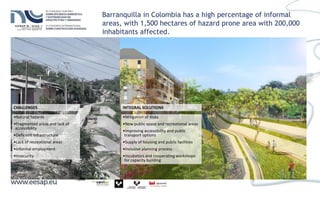
CHALLENGES INTEGRAL SOLUTIONS
•Mitigation of Risks
•New public space and recreational areas
•Improving accessibility and public
transport options
•Supply of housing and public facilities
•Inclusive planning process
•Incubators and cooperating workshops
for capacity building
•Natural hazards
•Fragmented areas and lack of
accessibility
•Deficient Infrastructure
•Lack of recreational areas
•Informal employment
•Insecurity
Barranquilla in Colombia has a high percentage of informal
areas, with 1,500 hectares of hazard prone area with 200,000
inhabitants affected.
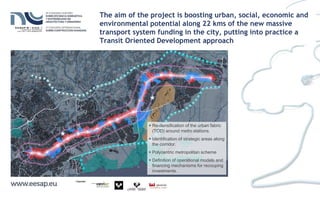
 Re-densification of the urban fabric
(TOD) around metro stations.
 Identification of strategic areas along
the corridor.
 Polycentric metropolitan scheme
 Definition of operational models and
financing mechanisms for recouping
investments.
The aim of the project is boosting urban, social, economic and
environmental potential along 22 kms of the new massive
transport system funding in the city, putting into practice a
Transit Oriented Development approach
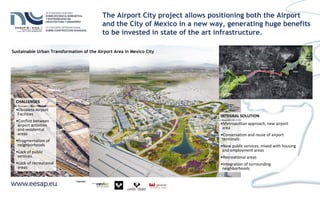
CHALLENGES
•Obsolete Airport
Facilities
•Conflict between
airport activities
and residential
areas
•Fragmentation of
neighborhoods
•Lack of public
services.
•Lack of recreational
areas
INTEGRAL SOLUTION
•Metropolitan approach, new airport
area
•Conservation and reuse of airport
terminals
•New public services, mixed with housing
and employment areas
•Recreational areas
•Integration of surrounding
neighborhoods
Sustainable Urban Transformation of the Airport Area in Mexico City
The Airport City project allows positioning both the Airport
and the City of Mexico in a new way, generating huge benefits
to be invested in state of the art infrastructure.
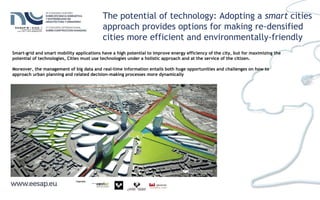
The potential of technology: Adopting a smart cities
approach provides options for making re-densified
cities more efficient and environmentally-friendly
Smart-grid and smart mobility applications have a high potential to improve energy efficiency of the city, but for maximizing the
potential of technologies, Cities must use technologies under a holistic approach and at the service of the citizen.
Moreover, the management of big data and real-time information entails both huge opportunities and challenges on how to
approach urban planning and related decision-making processes more dynamically
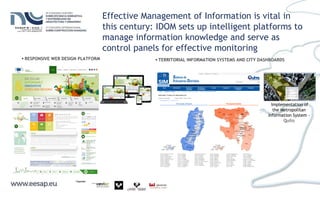
Effective Management of Information is vital in
this century: IDOM sets up intelligent platforms to
manage information knowledge and serve as
control panels for effective monitoring
 RESPONSIVE WEB DESIGN PLATFORM  TERRITORIAL INFORMATION SYSTEMS AND CITY DASHBOARDS
Implementation of
the Metropolitan
Information System -
Quito
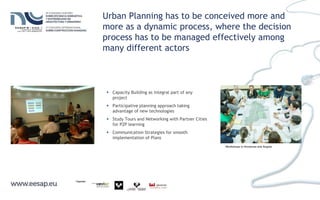
Urban Planning has to be conceived more and
more as a dynamic process, where the decision
process has to be managed effectively among
many different actors
Workshops in Honduras and Angola
 Capacity Building as integral part of any
project
 Participative planning approach taking
advantage of new technologies
 Study Tours and Networking with Partner Cities
for P2P learning
 Communication Strategies for smooth
implementation of Plans
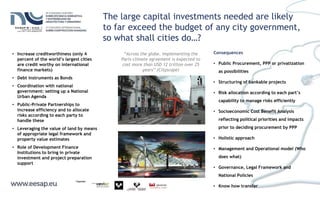
The large capital investments needed are likely
to far exceed the budget of any city government,
so what shall cities do…?
• Increase creditworthiness (only 4
percent of the world’s largest cities
are credit worthy on international
finance markets)
• Debt instruments as Bonds
• Coordination with national
government: setting up a National
Urban Agenda
• Public-Private Partnerships to
increase efficiency and to allocate
risks according to each party to
handle these
• Leveraging the value of land by means
of appropriate legal framework and
property value estimates
• Role of Development Finance
Institutions to bring in private
investment and project preparation
support
“Across the globe, implementing the
Paris climate agreement is expected to
cost more than USD 12 trillion over 25
years” (Cityscope)
Consequences
• Public Procurement, PPP or privatization
as possibilities
• Structuring of bankable projects
• Risk allocation according to each part’s
capability to manage risks efficiently
• Socioeconomic Cost Benefit Analysis
reflecting political priorities and impacts
prior to deciding procurement by PPP
• Holistic approach
• Management and Operational model (Who
does what)
• Governance, Legal Framework and
National Policies
• Know how transfer
 Networking and partnership among local governments is already a powerful tool to interchange
best practices and to find innovative approaches.
 Governance and institutional leadership under a clear vision is required, under a National Urban
Agenda.
 Climate change is a huge challenge for cities and particularly vulnerable groups, but shall be
conceived as an opportunity
 Compact cities are more efficient in their resources and emit lower GHG, which shifts urban
growth towards internal areas: urban renewal
 Urban renewal entails micro interventions as well as huge projects catalyzed by infrastructure
projects
 For the appropriate decision making process, Big data and Smart Technologies are useful tools and
can make cities increase their efficiency
 Due to modern technologies, the urban planning process in itself becomes more dynamic and
continuous
 Huge demand in financing these interventions is an additional challenge, where innovative tools
are still challenging the capacities of municipal governments in Latin American countries
Concluding remarks: the role of smart Urban
growth depends on several key aspects:
ESKERRIK ASKO
GRACIAS
THANK YOU

4. IDOM_Miércoles_5

  • 1.
    Crecimiento Urbano Inteligenteen Latinoamérica Smart Urban Growth in Latin America Marc Potard, IDOM
  • 2.
     Delivering professionalservices since 1957  Engineering, Planning, Consulting and Architecture  123 countries with IDOM projects  80% of turnover outside Spain  3,000 employees  39 Offices in 20 Countries  Independent Company owned by its employees About IDOM
  • 3.
    http://image.guardian.co.uk/sys-files/Guardian/documents/2007/06/27/URBAN_WORLD_2806.pdf World urbanization The 21stcentury will be marked by two pivotal themes: Cities and Climate Change An urbanized world Share of Urban Population Urban growth is expected to happen especially in the intermediate cities, exerting a high pressure on their territories. It is in cities where sustainable development challenges are concentrated and where integrated policies are vital. Latin America / World
  • 4.
    Cities account formore than 70% of global energy- related GHG GHG emissions in the cities of LAC are below the world average, and far below when compared to Europe or the USA. However, these emissions are growing, both in total and in per capita terms. GHG emissions in compact cities are 2.6 lower than in low density cities (Norman, McLean and Kennedy 2006).
  • 5.
    At the sametime, urban policies at local government level are the key to mitigate climate change and meet COP21 and COP22 objectives Since urban centres and their inhabitants are particularly vulnerable to adverse impacts of Climate Change, the New Urban Agenda drafted in Quito exposes environmentally sustainable and resilient development as one out of three transformative commitments in its implementation plan Social Inclusion and ending poverty Inclusive urban prosperity Resilient Urban develop- ment The sustainable management of natural resources in cities becomes increasingly important, improving thereby the GHG balance, air quality, disaster risk reduction, fostering moreover the well-being, quality of life and food security
  • 6.
    As a result,more and more cities are organized in networks worldwide A high variety of different local government networks is already acting as a catalyst for innovation, climate change action and sustainable development. These local governments are pushing much faster forward to resolve these new challenges than their respective national governments: The population of cities participating in the Global Covenant of Mayors account for almost 10% of the world population
  • 7.
    Especially intermediate citieswill demand strategies to climate change adaptation and mitigation Why medium-sized cities: • They are key to achieve a balanced territories. • They alleviate pressure on megacities • They still have the ppportunity to grow under sustainable patterns Challenges • They have higher needs in capacity development for sustainable governance • They have lower operational capacities • They have lower degree of fiscal autonomy • They often have lower access to financing mechanisms IDOM has assessed 35 emerging cities in terms of climate change adaptation and smart growth within the ESCI Initiative www.iadb.org Today, intermediate cities show higher growth rates than megacities which entails several challenges.
  • 8.
    CLIMATE CHANGE MITIGATION 1VULNERABILITY AND DISASTER RISK REDUCTION 2 URBAN GROWTH STUDY 3 Climate Change has impact in natural hazards and risks Urban growth studies as input for CC scenarios Mitigation is considered in growth scenarios Natural risks as constraints for urban growth Growth scenarios have impact in vulnerability PARTICIPATORYAPPROACH Knowledge integration during planning stages is pivotal in order to obtain feasible outcomesACTION PLAN4 IDOM carries out three baseline studies simultaneously under an action oriented approach :
  • 9.
    Based upon twoopposite growth scenarios, a feasible intermediate scenario will be determined considering proposed strategic action lines towards sustainability
  • 10.
    Pasto 1 m2/inhBridgetown11 m2/inh Villavicencio 2 m2/inh Vulnerable areas and hazard prone areas can be converted into green spaces which can play a vital role for the city sustainability. Moreover, generally there is a huge demand for recreational areas.
  • 11.
    Internal re-densification, urbanrenewal and creation of green areas in hazard prone areas are key actions towards a sustainable model
  • 12.
    CHALLENGES INTEGRAL SOLUTIONS •Mitigationof Risks •New public space and recreational areas •Improving accessibility and public transport options •Supply of housing and public facilities •Inclusive planning process •Incubators and cooperating workshops for capacity building •Natural hazards •Fragmented areas and lack of accessibility •Deficient Infrastructure •Lack of recreational areas •Informal employment •Insecurity Barranquilla in Colombia has a high percentage of informal areas, with 1,500 hectares of hazard prone area with 200,000 inhabitants affected.
  • 13.
     Re-densification ofthe urban fabric (TOD) around metro stations.  Identification of strategic areas along the corridor.  Polycentric metropolitan scheme  Definition of operational models and financing mechanisms for recouping investments. The aim of the project is boosting urban, social, economic and environmental potential along 22 kms of the new massive transport system funding in the city, putting into practice a Transit Oriented Development approach
  • 14.
    CHALLENGES •Obsolete Airport Facilities •Conflict between airportactivities and residential areas •Fragmentation of neighborhoods •Lack of public services. •Lack of recreational areas INTEGRAL SOLUTION •Metropolitan approach, new airport area •Conservation and reuse of airport terminals •New public services, mixed with housing and employment areas •Recreational areas •Integration of surrounding neighborhoods Sustainable Urban Transformation of the Airport Area in Mexico City The Airport City project allows positioning both the Airport and the City of Mexico in a new way, generating huge benefits to be invested in state of the art infrastructure.
  • 15.
    The potential oftechnology: Adopting a smart cities approach provides options for making re-densified cities more efficient and environmentally-friendly Smart-grid and smart mobility applications have a high potential to improve energy efficiency of the city, but for maximizing the potential of technologies, Cities must use technologies under a holistic approach and at the service of the citizen. Moreover, the management of big data and real-time information entails both huge opportunities and challenges on how to approach urban planning and related decision-making processes more dynamically
  • 16.
    Effective Management ofInformation is vital in this century: IDOM sets up intelligent platforms to manage information knowledge and serve as control panels for effective monitoring  RESPONSIVE WEB DESIGN PLATFORM  TERRITORIAL INFORMATION SYSTEMS AND CITY DASHBOARDS Implementation of the Metropolitan Information System - Quito
  • 17.
    Urban Planning hasto be conceived more and more as a dynamic process, where the decision process has to be managed effectively among many different actors Workshops in Honduras and Angola  Capacity Building as integral part of any project  Participative planning approach taking advantage of new technologies  Study Tours and Networking with Partner Cities for P2P learning  Communication Strategies for smooth implementation of Plans
  • 18.
    The large capitalinvestments needed are likely to far exceed the budget of any city government, so what shall cities do…? • Increase creditworthiness (only 4 percent of the world’s largest cities are credit worthy on international finance markets) • Debt instruments as Bonds • Coordination with national government: setting up a National Urban Agenda • Public-Private Partnerships to increase efficiency and to allocate risks according to each party to handle these • Leveraging the value of land by means of appropriate legal framework and property value estimates • Role of Development Finance Institutions to bring in private investment and project preparation support “Across the globe, implementing the Paris climate agreement is expected to cost more than USD 12 trillion over 25 years” (Cityscope) Consequences • Public Procurement, PPP or privatization as possibilities • Structuring of bankable projects • Risk allocation according to each part’s capability to manage risks efficiently • Socioeconomic Cost Benefit Analysis reflecting political priorities and impacts prior to deciding procurement by PPP • Holistic approach • Management and Operational model (Who does what) • Governance, Legal Framework and National Policies • Know how transfer
  • 19.
     Networking andpartnership among local governments is already a powerful tool to interchange best practices and to find innovative approaches.  Governance and institutional leadership under a clear vision is required, under a National Urban Agenda.  Climate change is a huge challenge for cities and particularly vulnerable groups, but shall be conceived as an opportunity  Compact cities are more efficient in their resources and emit lower GHG, which shifts urban growth towards internal areas: urban renewal  Urban renewal entails micro interventions as well as huge projects catalyzed by infrastructure projects  For the appropriate decision making process, Big data and Smart Technologies are useful tools and can make cities increase their efficiency  Due to modern technologies, the urban planning process in itself becomes more dynamic and continuous  Huge demand in financing these interventions is an additional challenge, where innovative tools are still challenging the capacities of municipal governments in Latin American countries Concluding remarks: the role of smart Urban growth depends on several key aspects:
  • 20.