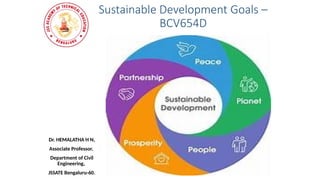
Sustainable Development Goals–
BCV654D
Dr. HEMALATHA H N,
Associate Professor,
Department of Civil
Engineering,
JSSATE Bengaluru-60.
2.
MODULE 2- SYLLABUS
SustainableDevelopment:
• Introduction to Sustainable Development
• Economic Growth and Progress, Continuing Poverty, Environmental
Threats, Business as Usual Versus
• Sustainable Development
3.
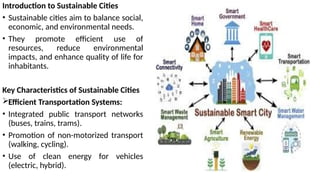
Introduction to SustainableCities
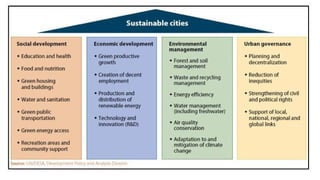
• Sustainable cities aim to balance social,
economic, and environmental needs.
• They promote efficient use of
resources, reduce environmental
impacts, and enhance quality of life for
inhabitants.
Key Characteristics of Sustainable Cities
Efficient Transportation Systems:
• Integrated public transport networks
(buses, trains, trams).
• Promotion of non-motorized transport
(walking, cycling).
• Use of clean energy for vehicles
(electric, hybrid).
5.
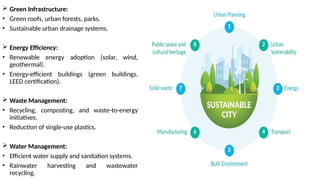
Green Infrastructure:
•Green roofs, urban forests, parks.
• Sustainable urban drainage systems.
Energy Efficiency:
• Renewable energy adoption (solar, wind,
geothermal).
• Energy-efficient buildings (green buildings,
LEED certification).
Waste Management:
• Recycling, composting, and waste-to-energy
initiatives.
• Reduction of single-use plastics.
Water Management:
• Efficient water supply and sanitation systems.
• Rainwater harvesting and wastewater
recycling.
6.
Smart Technologies:
• Smartgrids, IoT for resource
management.
• Digital services for citizen
engagement.
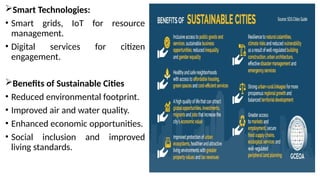
Benefits of Sustainable Cities
• Reduced environmental footprint.
• Improved air and water quality.
• Enhanced economic opportunities.
• Social inclusion and improved
living standards.
7.
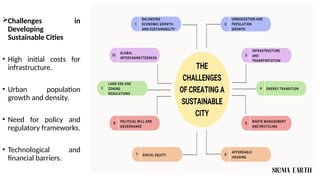
Challenges in
Developing
Sustainable Cities
•High initial costs for
infrastructure.
• Urban population
growth and density.
• Need for policy and
regulatory frameworks.
• Technological and
financial barriers.
8.
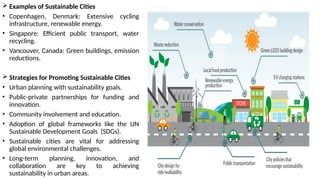
Examples ofSustainable Cities
• Copenhagen, Denmark: Extensive cycling
infrastructure, renewable energy.
• Singapore: Efficient public transport, water
recycling.
• Vancouver, Canada: Green buildings, emission
reductions.
Strategies for Promoting Sustainable Cities
• Urban planning with sustainability goals.
• Public-private partnerships for funding and
innovation.
• Community involvement and education.
• Adoption of global frameworks like the UN
Sustainable Development Goals (SDGs).
• Sustainable cities are vital for addressing
global environmental challenges.
• Long-term planning, innovation, and
collaboration are key to achieving
sustainability in urban areas.
10.
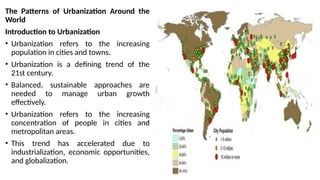
The Patterns ofUrbanization Around the
World
Introduction to Urbanization
• Urbanization refers to the increasing
population in cities and towns.
• Urbanization is a defining trend of the
21st century.
• Balanced, sustainable approaches are
needed to manage urban growth
effectively.
• Urbanization refers to the increasing
concentration of people in cities and
metropolitan areas.
• This trend has accelerated due to
industrialization, economic opportunities,
and globalization.
11.
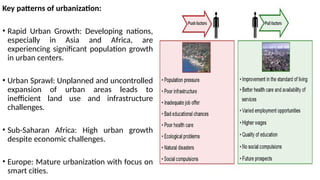
Key patterns ofurbanization:
• Rapid Urban Growth: Developing nations,
especially in Asia and Africa, are
experiencing significant population growth
in urban centers.
• Urban Sprawl: Unplanned and uncontrolled
expansion of urban areas leads to
inefficient land use and infrastructure
challenges.
• Sub-Saharan Africa: High urban growth
despite economic challenges.
• Europe: Mature urbanization with focus on
smart cities.
12.
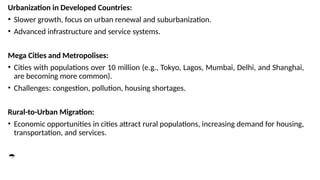
Urbanization in DevelopedCountries:
• Slower growth, focus on urban renewal and suburbanization.
• Advanced infrastructure and service systems.
Mega Cities and Metropolises:
• Cities with populations over 10 million (e.g., Tokyo, Lagos, Mumbai, Delhi, and Shanghai,
are becoming more common).
• Challenges: congestion, pollution, housing shortages.
Rural-to-Urban Migration:
• Economic opportunities in cities attract rural populations, increasing demand for housing,
transportation, and services.
13.
Informal Settlements andSlums:
• In many developing cities, rapid urbanization leads to overcrowded, unplanned
settlements with poor infrastructure.
Urban Sprawl:
• Uncontrolled expansion of cities into peripheral areas.
• Leads to environmental degradation and high infrastructure costs.
Smart Cities:
• Use of technology for efficient city management.
• Focus on sustainability, innovation, and quality of life.
14.
Factors Influencing UrbanizationPatterns
• Economic development, industrialization.
• Migration, demographic shifts.
• Government policies and urban planning.
Impacts of Urbanization
• Positive: Economic growth, cultural diversity, innovation.
• Negative: Overcrowding, pollution, resource strain.
Examples of Urbanization Trends
• China: Rapid urbanization due to economic reforms.
• Sub-Saharan Africa: High urban growth despite economic challenges.
• Europe: Mature urbanization with focus on smart cities.
15.
Challenges of Urbanization
•Infrastructure deficits, informal settlements.
• Traffic congestion, pollution.
• Social inequality and access to services.
Strategies for Sustainable Urbanization
• Inclusive urban planning, affordable housing.
• Investment in infrastructure and public services.
• Embracing smart city technologies.
16.
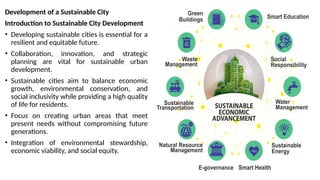
Development of aSustainable City
Introduction to Sustainable City Development
• Developing sustainable cities is essential for a
resilient and equitable future.
• Collaboration, innovation, and strategic
planning are vital for sustainable urban
development.
• Sustainable cities aim to balance economic
growth, environmental conservation, and
social inclusivity while providing a high quality
of life for residents.
• Focus on creating urban areas that meet
present needs without compromising future
generations.
• Integration of environmental stewardship,
economic viability, and social equity.
17.
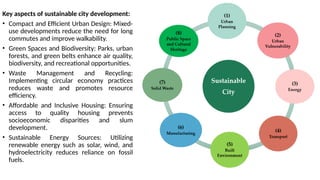
Key aspects ofsustainable city development:
• Compact and Efficient Urban Design: Mixed-
use developments reduce the need for long
commutes and improve walkability.
• Green Spaces and Biodiversity: Parks, urban
forests, and green belts enhance air quality,
biodiversity, and recreational opportunities.
• Waste Management and Recycling:
Implementing circular economy practices
reduces waste and promotes resource
efficiency.
• Affordable and Inclusive Housing: Ensuring
access to quality housing prevents
socioeconomic disparities and slum
development.
• Sustainable Energy Sources: Utilizing
renewable energy such as solar, wind, and
hydroelectricity reduces reliance on fossil
fuels.
18.
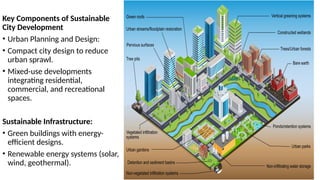
Key Components ofSustainable
City Development
• Urban Planning and Design:
• Compact city design to reduce
urban sprawl.
• Mixed-use developments
integrating residential,
commercial, and recreational
spaces.
Sustainable Infrastructure:
• Green buildings with energy-
efficient designs.
• Renewable energy systems (solar,
wind, geothermal).
19.
Efficient Transportation Systems:
•Public transportation networks with low emissions.
• Pedestrian and cycling-friendly infrastructure.
Resource Management:
• Sustainable water supply systems, rainwater harvesting.
• Waste reduction through recycling, composting, and circular economy models.
Smart Technology Integration:
• Smart grids, IoT-based resource monitoring.
• Digital governance platforms for citizen participation.
Social Inclusion and Equity:
• Affordable housing and equitable access to services.
• Community engagement in decision-making.
20.
Benefits of DevelopingSustainable Cities
• Reduced environmental impact and carbon footprint.
• Enhanced quality of life with green spaces and clean air.
• Economic growth through green industries and innovation.
• Social cohesion and resilience.
Challenges in Sustainable City Development
• High initial costs for infrastructure development.
• Balancing rapid urbanization with sustainability.
• Need for comprehensive policies and governance.
Global Examples of Sustainable City Development
• Freiburg, Germany: Renewable energy, eco-friendly transport.
• Stockholm, Sweden: Smart city technologies, waste-to-energy systems.
• Masdar City, UAE: Zero-carbon city model with sustainable design.
21.
Strategies for SustainableCity Development
• Long-term urban planning with sustainability at the core.
• Investment in green infrastructure and technologies.
• Public-private partnerships and community participation.
• Alignment with international sustainability frameworks like the UN SDGs.
Smart Infrastructure
Introduction to Smart Infrastructure
• Smart infrastructure is critical for modern, resilient, and sustainable cities.
Collaborative efforts and technological advancements are essential for its successful
implementation. Smart infrastructure leverages technology and innovation to enhance
urban efficiency, sustainability, and resilience.
• Smart infrastructure refers to systems and facilities integrated with advanced
technologies for efficient operation and management.
• Enhances sustainability, reliability, and quality of urban services.
22.
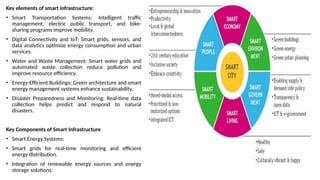
Key elements ofsmart infrastructure:
• Smart Transportation Systems: Intelligent traffic
management, electric public transport, and bike-
sharing programs improve mobility.
• Digital Connectivity and IoT: Smart grids, sensors, and
data analytics optimize energy consumption and urban
services.
• Water and Waste Management: Smart water grids and
automated waste collection reduce pollution and
improve resource efficiency.
• Energy-Efficient Buildings: Green architecture and smart
energy management systems enhance sustainability.
• Disaster Preparedness and Monitoring: Real-time data
collection helps predict and respond to natural
disasters.
Key Components of Smart Infrastructure
• Smart Energy Systems:
• Smart grids for real-time monitoring and efficient
energy distribution.
• Integration of renewable energy sources and energy
storage solutions.
23.
Smart Transportation Infrastructure:
•Intelligent traffic management systems to reduce congestion.
• Electric vehicle charging networks and autonomous vehicle infrastructure.
Smart Water Management:
• IoT-enabled water meters for efficient usage monitoring.
• Leak detection systems and automated water quality control.
Smart Buildings:
• Automated energy management systems (HVAC, lighting).
• Building Information Modeling (BIM) for efficient design and maintenance.
24.
Waste Management Systems:
•Sensor-based waste collection and recycling systems.
• Data-driven waste reduction strategies.
Telecommunication Infrastructure:
• High-speed internet and 5G networks for seamless connectivity.
• IoT platforms for smart city management and services.
Benefits of Smart Infrastructure
• Enhanced operational efficiency and reduced costs.
• Improved quality of life through smart services.
• Environmental sustainability through resource optimization.
• Increased resilience to disasters and infrastructure failures.
25.
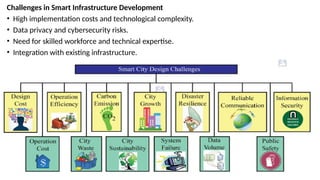
Challenges in SmartInfrastructure Development
• High implementation costs and technological complexity.
• Data privacy and cybersecurity risks.
• Need for skilled workforce and technical expertise.
• Integration with existing infrastructure.
26.
Global Examples ofSmart Infrastructure
• Barcelona, Spain: Smart traffic, lighting, and waste systems.
• Singapore: Integrated smart city platform with real-time data.
• Tokyo, Japan: Advanced transport systems and disaster management
infrastructure.
Strategies for Developing Smart Infrastructure
• Investment in research, innovation, and technology.
• Public-private partnerships for funding and development.
• Adoption of open data policies and digital governance frameworks.
• Capacity building and training programs.
27.
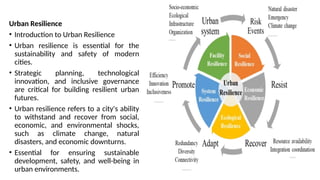
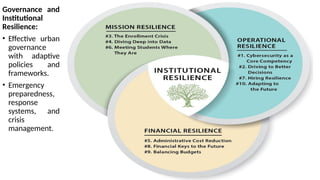
Urban Resilience
• Introductionto Urban Resilience
• Urban resilience is essential for the
sustainability and safety of modern
cities.
• Strategic planning, technological
innovation, and inclusive governance
are critical for building resilient urban
futures.
• Urban resilience refers to a city's ability
to withstand and recover from social,
economic, and environmental shocks,
such as climate change, natural
disasters, and economic downturns.
• Essential for ensuring sustainable
development, safety, and well-being in
urban environments.
28.
Key Components ofUrban
Resilience
• Infrastructure Resilience:
• Robust infrastructure that
withstands natural disasters
(floods, earthquakes).
• Redundant systems to ensure
continuity of essential
services.
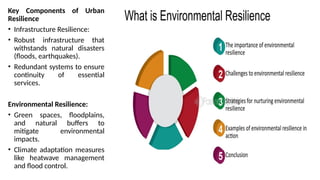
Environmental Resilience:
• Green spaces, floodplains,
and natural buffers to
mitigate environmental
impacts.
• Climate adaptation measures
like heatwave management
and flood control.
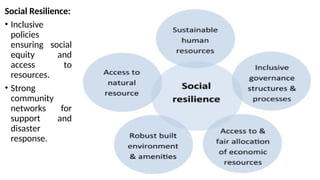
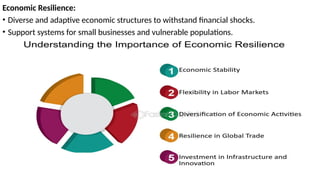
Economic Resilience:
• Diverseand adaptive economic structures to withstand financial shocks.
• Support systems for small businesses and vulnerable populations.
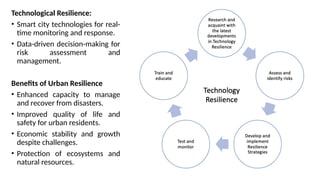
Technological Resilience:
• Smartcity technologies for real-
time monitoring and response.
• Data-driven decision-making for
risk assessment and
management.
Benefits of Urban Resilience
• Enhanced capacity to manage
and recover from disasters.
• Improved quality of life and
safety for urban residents.
• Economic stability and growth
despite challenges.
• Protection of ecosystems and
natural resources.
33.
Challenges in BuildingUrban Resilience
• Financial constraints and high investment costs.
• Rapid urbanization and informal settlements.
• Coordination among stakeholders and governance bodies.
• Data management and technological gaps.
Global Examples of Urban Resilience
• Rotterdam, Netherlands: Innovative water management and climate
adaptation.
• New Orleans, USA: Disaster recovery and flood defense systems post-
Hurricane Katrina.
• Bangkok, Thailand: Flood mitigation infrastructure and community-based
resilience programs.
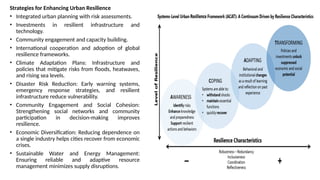
34.
Strategies for EnhancingUrban Resilience
• Integrated urban planning with risk assessments.
• Investments in resilient infrastructure and
technology.
• Community engagement and capacity building.
• International cooperation and adoption of global
resilience frameworks.
• Climate Adaptation Plans: Infrastructure and
policies that mitigate risks from floods, heatwaves,
and rising sea levels.
• Disaster Risk Reduction: Early warning systems,
emergency response strategies, and resilient
infrastructure reduce vulnerability.
• Community Engagement and Social Cohesion:
Strengthening social networks and community
participation in decision-making improves
resilience.
• Economic Diversification: Reducing dependence on
a single industry helps cities recover from economic
crises.
• Sustainable Water and Energy Management:
Ensuring reliable and adaptive resource
management minimizes supply disruptions.
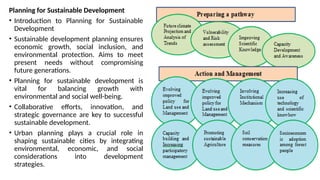
35.
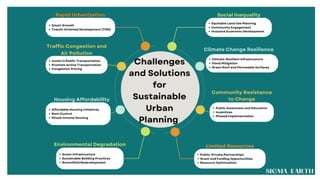
Planning for SustainableDevelopment
• Introduction to Planning for Sustainable
Development
• Sustainable development planning ensures
economic growth, social inclusion, and
environmental protection. Aims to meet
present needs without compromising
future generations.
• Planning for sustainable development is
vital for balancing growth with
environmental and social well-being.
• Collaborative efforts, innovation, and
strategic governance are key to successful
sustainable development.
• Urban planning plays a crucial role in
shaping sustainable cities by integrating
environmental, economic, and social
considerations into development
strategies.
36.
Key Principles ofSustainable Development Planning
• Integrated Land Use Planning: Public Transportation Networks: Expanding
and improving public transit systems to reduce congestion and emissions.
• Participatory Urban Governance: Involving local communities in decision-
making ensures that policies address public needs.
• Sustainable Building Codes and Regulations: Enforcing eco-friendly
construction standards reduces carbon footprints.
• Smart Growth Strategies: Encouraging high-density, mixed-use developments
enhances urban efficiency and sustainability.
Integrated Approach:
• Balances economic, social, and environmental objectives.
• Encourages cross-sectoral collaboration in planning.
37.
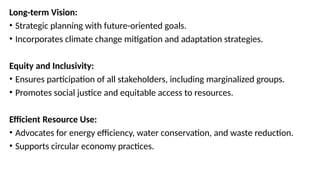
Long-term Vision:
• Strategicplanning with future-oriented goals.
• Incorporates climate change mitigation and adaptation strategies.
Equity and Inclusivity:
• Ensures participation of all stakeholders, including marginalized groups.
• Promotes social justice and equitable access to resources.
Efficient Resource Use:
• Advocates for energy efficiency, water conservation, and waste reduction.
• Supports circular economy practices.
38.
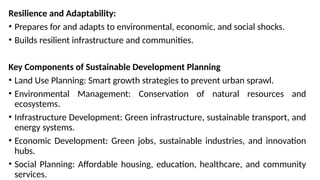
Resilience and Adaptability:
•Prepares for and adapts to environmental, economic, and social shocks.
• Builds resilient infrastructure and communities.
Key Components of Sustainable Development Planning
• Land Use Planning: Smart growth strategies to prevent urban sprawl.
• Environmental Management: Conservation of natural resources and
ecosystems.
• Infrastructure Development: Green infrastructure, sustainable transport, and
energy systems.
• Economic Development: Green jobs, sustainable industries, and innovation
hubs.
• Social Planning: Affordable housing, education, healthcare, and community
services.
39.
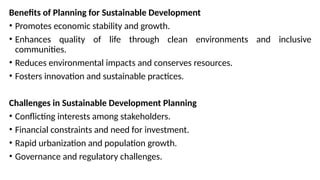
Benefits of Planningfor Sustainable Development
• Promotes economic stability and growth.
• Enhances quality of life through clean environments and inclusive
communities.
• Reduces environmental impacts and conserves resources.
• Fosters innovation and sustainable practices.
Challenges in Sustainable Development Planning
• Conflicting interests among stakeholders.
• Financial constraints and need for investment.
• Rapid urbanization and population growth.
• Governance and regulatory challenges.
40.
Global Examples ofSustainable Development
Planning
• Curitiba, Brazil: Integrated transport and green
space planning.
• Stockholm, Sweden: Sustainable urban design
and energy efficiency.
• Portland, USA: Smart growth and land use
planning.
Strategies for Effective Sustainable Development
Planning
• Comprehensive policies and regulatory
frameworks.
• Public participation and community
engagement.
• Investment in sustainable infrastructure and
technology.
• Monitoring, evaluation, and adaptive



![SYNTHESE COURS PLANIFICATION STRATEGIQUE ET VILLES DURABLES.fr.en[1].pdf](https://cdn.slidesharecdn.com/ss_thumbnails/synthesecoursplanificationstrategiqueetvillesdurables-250910031136-531e1ee0-thumbnail.jpg?width=640&height=640&fit=bounds)


