—
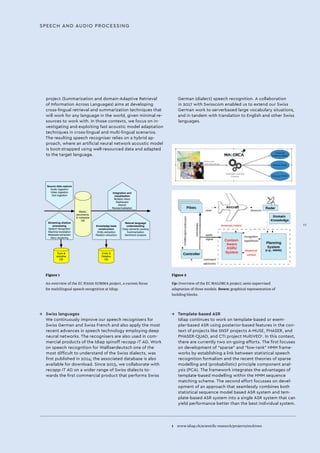
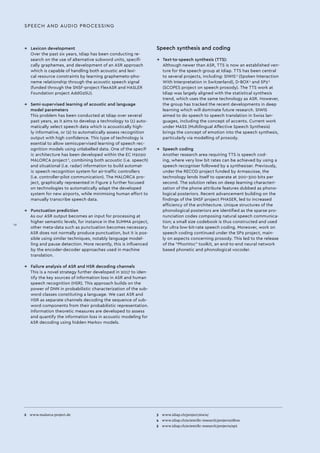
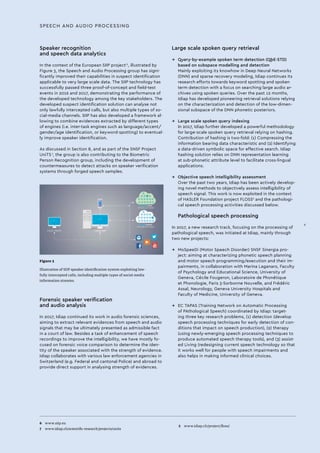
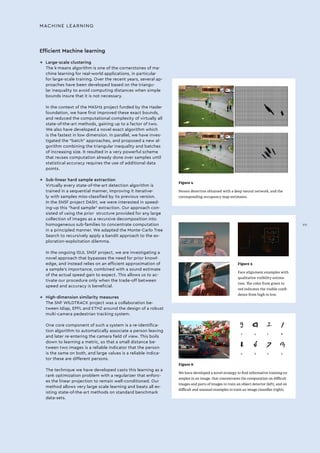
ANNUAL
REPORT 2017
—
Production Martina Fellay, Léonore Miauton, Project Management Team
Drafting Laurence Facelli, Marie Rumignani, Idiap Project Management Team
Translation and correction Dave Brooks, ELCS.ch
Photographic credits Céline Ribordy, Sion ∙ Sedrik Nemeth, Sion ∙ Vincent Spano ∙ Idiap, Martigny
Graphic Design Formaz — Andenmatten, Sion Typographies Cera ∙ Franziska Paper PlanoJet® FSC
Printing ronquozgraphix.ch, Sion Print run 1,500 copies
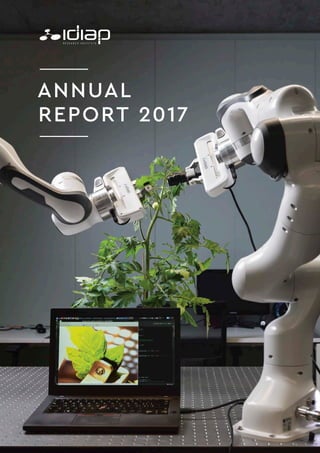
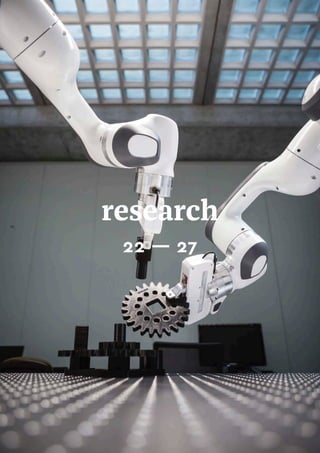
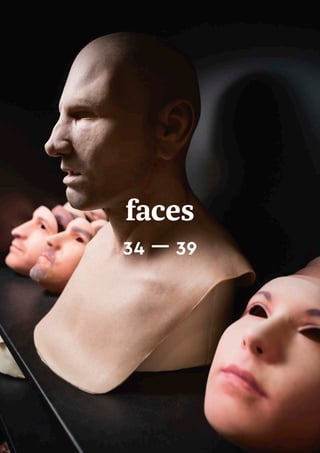
The cover page shows the MMD PLATFORM: a reproducible research platform
tested at Idiap to detect plant diseases, by learning from user demonstration
how to manipulate and inspect leaves.
MAIN PARTNERS
CITY OF MARTIGNY
CANTON OF VALAIS
SWISS CONFEDERATION
The State Secretariat for Education, Research and Innovation (SERI)
www.loro.ch www.swisscom.ch
www.theark.ch
www.epfl.ch
www.ideark.ch www.snf.ch
www.kti.admin.ch www.haslerstiftung.ch
1
Messages
04	 Artificial intelligence—Idiap at the forefront
	 of research
05	 What makes Idiap so successful?
	Organization
07	 Idiap in profile
10	 Application domains
11	 Organization chart
12	 Research groups
14	 Foundation Council
15	 Advisory Board
15	Employees
	Finances
19	 Profit and loss statement
20	 Sources of financing
21	 Balance sheet
	Research
23	 MEMMO—Memory of motion to enable rapid
	 adaptation in robots
24	 Martigny, the heart of a European
	 language-study network
25	 Idiap knows all the moves
26	 Artificial intelligence in the research spotlight
CONTENTS
	Network
29	 International Create Challenge: 6th
edition
30	 Reaching out to the wider public—a vocation
	 for Idiap
31	 Activities for young people
32	 Idiap spin-offs—influence without frontiers
	Faces
35	 From MIT to Martigny—the odyssey of a 		
	 globe-trotting researcher with a fascination
	 for language
36	 Mélanie Huck and Guillaume Clivaz celebrate the
	 first anniversary of their joining Idiap
37	 Marie-Constance Kaiflin: a jurist at the
	 crossroads of artificial intelligence
38	Distinctions
39	Theses
		 Scientific inserts
II		 Scientific Report
XXVII	 Main projects in progress
XXXII	 Major publications / Conferences
2
→ 25 → 37
→ 31
→ 26→ 36
→ 23
3
T he financial year 2017 is marked by further
growth in the Institute's turnover largely due
to the diversity of revenue sources, including
North American projects and the rising reputation of
the Biometrics Center. Our dynamic commitment and
the excellence of our management and employees
should also be underlined.
For a long time now, we have been able to count on
public sector funding and we thank the political au-
thorities and the members of the various administra-
tions who thus permit us to pursue the fundamental
research activities that enable us to secure mandates,
particularly in the industrial world.
The Institute is developing—proof that the areas of ac-
tivity in which it is engaged are expanding. No one can
dispute the opportunities that artificial intelligence
(AI) now offers, particularly if one factors in machines’
ability to develop a form of thinking that enables them
to achieve real autonomy. The latest industrial ro-
bots and applications in medicine are the forerunners
of an era in which the entire tertiary sector is already
engaged.
It is not without pride that Idiap participates in these
developments. Certain conditions are required, how-
ever, if we are to ride the wave of our success. In
particular, there is a compelling need for computer
development engineers who are able to “set to music”
the results of the research undertaken at the Institute.
To sustain our activities and render them viable in
the longer term it is essential to strengthen the at-
tractiveness of this particular career path, and a spe-
cific internal training program for young talent will
soon be set up.
In addition to fundamental research, Idiap pursues im-
portant activities in the field of technology transfer,
Artificial intelligence—
Idiap at the forefront
of research
and many start-ups have flourished thanks to this. And
an additional path is opening up: the application of
Idiap's technological expertise beyond the doors of the
Institute. Following the creation of the Swiss Center
for Biometrics in 2014, Idiap is now collaborating with
the Centre de recherches énergetiques et municipales
(CREM)—a non-profit body active in the field of ener-
gy in the urban domain—thus combining the know-
how of the two bodies. Further, Idiap now offers CREM
its services and skills in a number of areas: human re-
sources, communication, project management, and ac-
counting and financial services.
More than ever before we are convinced of the rele-
vance of our activities within the AI community. While
some see the onset of an enslavement of humankind,
we are convinced that artificial intelligence poses no
specific threat. The only real danger lies in its misuse,
and we should not forget that each time society ac-
quires a more advanced technology science is accused
of a multitude of evils. For our part, we dare to believe
that humanity will, as before, be wise enough to not
fall into unfortunate ways.
MESSAGE FROM THE PRESIDENT
"We are convinced of the
relevance of our activities
within the AI community"
Olivier Dumas
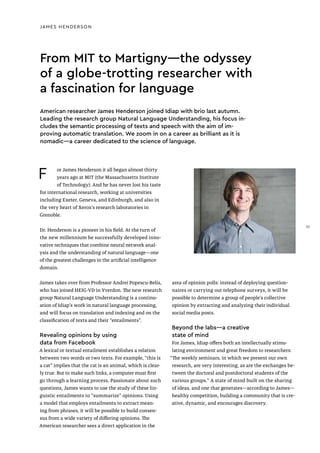
President of the Foundation Council, Idiap4
What makes Idiap
so successful?
MESSAGE FROM THE DIRECTOR
A t the invitation of a large European industrial
group, I recently gave a presentation on the
Idiap Research Institute, in the process
learning that the group’s extensive needs regarding
artificial intelligence (AI) matched perfectly our own
R&D offering.
This is true because today’s Idiap is the result of build-
ing on solid foundations. Each stone that makes up
those foundations is the result of the work of our re-
searchers, research assistants, and doctoral students,
and these foundation stones have been patiently laid
for more than 25 years. The Institute ceaselessly offers
newcomers the opportunity to develop their own ac-
tivities, building them upon these foundations. Thanks
to its long experience and the effective exploitation of
knowledge acquired—in terms both of basic research
and of the transfer of technology to industry—Idiap
has become a reference when it comes to placing artifi-
cial intelligence (AI) at the service of society. The origin
of a large number of software packages and databases
used all over the world, Idiap demonstrates an exem-
plary command of the resources at its disposal.
At the level of fundamental research into AI, recent
breakthroughs have proved no match for the ground-
breaking findings of the 80s and 90s. Yet new oppor-
tunities and the renewal of interest in the domain lie
in the exploitation of advances in ever-expanding stor-
age and calculation capacities. And we can add to this
the virtually unlimited amount of available data—Big
Data. So now, what was conceived of more than twenty
years ago is gently becoming reality, at the same time
raising new challenges, both scientific and ethical.
One of the Institute's strengths is the coherence and
independence of its research groups. Currently nine
in number, they cover the majority of areas key to AI,
which makes them particularly productive and com-
petitive when they have the chance to work together
on joint projects.
"Idiap, a one-stop shop for
artificial intelligence"
Hervé Bourlard
Director, Idiap; Professor, EPFL
Thus, choosing to create a new group is always a risk.
Idiap does not wish to simply follow fashion regarding
the direction its research takes. To maintain its level of
excellence, it must diversify in and around its chosen
areas of expertise, while simultaneously anticipating
future needs.
The creation in 2015 of the Uncertainty Quantification
and Optimal Design group is a case in point. While the
current trend exploits Big Data in particular, this re-
search group is interested in solving problems with
only a small amount of data available—“small data”—
where one must develop a model from only a small
quantity of indications. The knowledge developed in
this area should be applicable in a large number of sit-
uations, including in the optimal placement of sensors
for the evaluation of environmental risk, for example.
And this is how Idiap—based on its in-depth knowl-
edge, the dynamism of each of its research groups, and
its R&D team, which ensures the quality of its software
packages and their transfer to industry—has created a
unique offering in the field of AI.
5
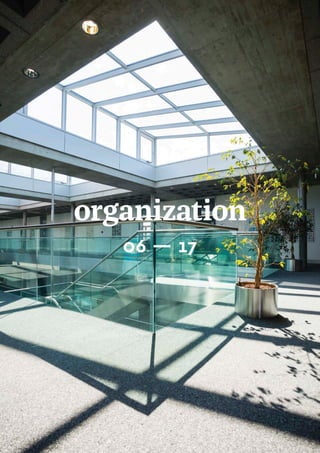
organization
06 — 17
6
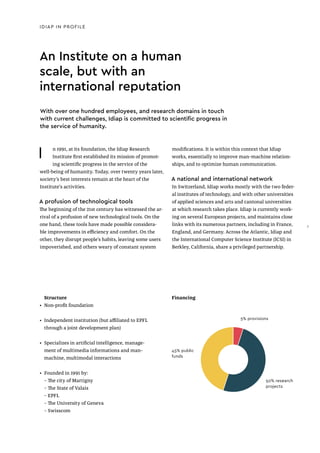
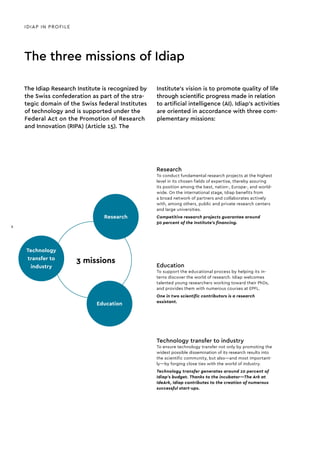
50% research
projects
45% public
funds
5% provisions
An Institute on a human
scale, but with an
international reputation
IDIAP IN PROFILE
I n 1991, at its foundation, the Idiap Research
Institute first established its mission of promot-
ing scientific progress in the service of the
well-being of humanity. Today, over twenty years later,
society’s best interests remain at the heart of the
Institute's activities.
A profusion of technological tools
The beginning of the 21st century has witnessed the ar-
rival of a profusion of new technological tools. On the
one hand, these tools have made possible considera-
ble improvements in efficiency and comfort. On the
other, they disrupt people’s habits, leaving some users
impoverished, and others weary of constant system
Structure
•	 Non-profit foundation
•	 Independent institution (but affiliated to EPFL
through a joint development plan)
•	 Specializes in artificial intelligence, manage-
ment of multimedia informations and man–
machine, multimodal interactions
•	 Founded in 1991 by:
– The city of Martigny
– The State of Valais
– EPFL
– The University of Geneva
– Swisscom
modifications. It is within this context that Idiap
works, essentially to improve man–machine relation-
ships, and to optimize human communication.
A national and international network
In Switzerland, Idiap works mostly with the two feder-
al institutes of technology, and with other universities
of applied sciences and arts and cantonal universities
at which research takes place. Idiap is currently work-
ing on several European projects, and maintains close
links with its numerous partners, including in France,
England, and Germany. Across the Atlantic, Idiap and
the International Computer Science Institute (ICSI) in
Berkley, California, share a privileged partnership.
With over one hundred employees, and research domains in touch
with current challenges, Idiap is committed to scientific progress in
the service of humanity.
Financing
7
Research
Technology
transfer to
industry
Education
3 missions
Education
To support the educational process by helping its in-
terns discover the world of research. Idiap welcomes
talented young researchers working toward their PhDs,
and provides them with numerous courses at EPFL.
One in two scientific contributors is a research
assistant.
Technology transfer to industry
To ensure technology transfer not only by promoting the
widest possible dissemination of its research results into
the scientific community, but also—and most important-
ly—by forging close ties with the world of industry.
Technology transfer generates around 10 percent of
Idiap’s budget. Thanks to the incubator—The Ark at
IdeArk, Idiap contributes to the creation of numerous
successful start-ups.
Research
To conduct fundamental research projects at the highest
level in its chosen fields of expertise, thereby assuring
its position among the best, nation-, Europe-, and world-
wide. On the international stage, Idiap benefits from
a broad network of partners and collaborates actively
with, among others, public and private research centers
and large universities.
Competitive research projects guarantee around
50 percent of the Institute’s financing.
IDIAP IN PROFILE
The three missions of Idiap
The Idiap Research Institute is recognized by
the Swiss confederation as part of the stra-
tegic domain of the Swiss federal Institutes
of technology and is supported under the
Federal Act on the Promotion of Research
and Innovation (RIPA) (Article 15). The
Institute’s vision is to promote quality of life
through scientific progress made in relation
to artificial intelligence (AI). Idiap’s activities
are oriented in accordance with three com-
plementary missions:
8
Theses
completed
64
30
5
3
Conference
articles
Book chapters
Scientific
articles
52 projects
submitted in 2017
65 active
projects in 2017
0
10
20
30
40
EU
10
EU
19
INT
1
INT
3
CH
22
CH
32
IND
20
IND
10
Switzerland
Stateless,
4 robots
Rest of Asia
42%
7%
19%
10%
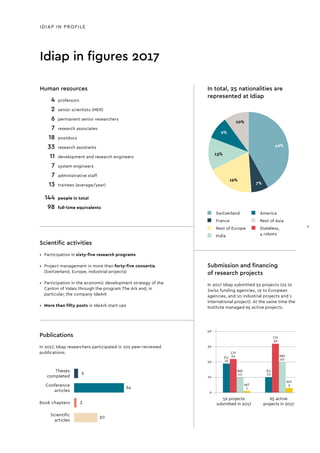
Idiap in figures 2017
IDIAP IN PROFILE
Human resources
	4	professors
	2	 senior scientists (MER)
	6	 permanent senior researchers
	7	 research associates
	18	postdocs
	33	 research assistants
	11	development and research engineers
	7	system engineers
	7	administrative staff
	13	 trainees (average/year)
	144	people in total
	98	 full-time equivalents
In total, 25 nationalities are
represented at Idiap
Publications
In 2017, Idiap researchers participated in 102 peer-reviewed
publications.
Submission and financing
of research projects
In 2017 Idiap submitted 52 projects (22 to
Swiss funding agencies, 19 to European
agencies, and 10 industrial projects and 1
international project). At the same time the
Institute managed 65 active projects.
India
Rest of Europe
France
America
13%
9%
Scientific activities
•	 Participation in sixty-five research programs
•	 Project management in more than forty-five consortia
	 (Switzerland, Europe, industrial projects)
•	 Participation in the economic development strategy of the
	 Canton of Valais through the program The Ark and, in
	 particular, the company IdeArk
•	 More than fifty posts in IdeArk start-ups
9
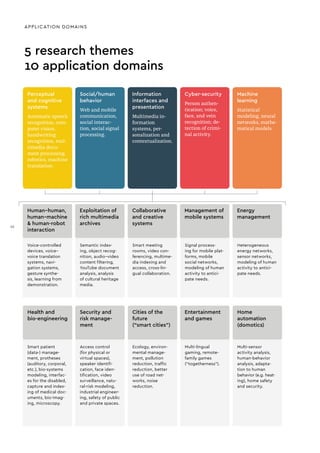
5 research themes
10 application domains
Voice-controlled
devices, voice–
voice translation
systems, navi-
gation systems,
gesture synthe-
sis, learning from
demonstration.
Smart patient
(data-) manage-
ment, protheses
(auditory, corporal,
etc.), bio-systems
modeling, interfac-
es for the disabled,
capture and index-
ing of medical doc-
uments, bio-imag-
ing, microscopy.
Semantic index-
ing, object recog-
nition, audio–video
content filtering,
YouTube document
analysis, analysis
of cultural heritage
media.
Access control
(for physical or
virtual spaces),
speaker identifi-
cation, face iden-
tification, video
surveillance, natu-
ral-risk modeling,
industrial engineer-
ing, safety of public
and private spaces.
Smart meeting
rooms, video con-
ferencing, multime-
dia indexing and
access, cross-lin-
gual collaboration.
Ecology, environ-
mental manage-
ment, pollution
reduction, traffic
reduction, better
use of road net-
works, noise
reduction.
Signal process-
ing for mobile plat-
forms, mobile
social networks,
modeling of human
activity to antici-
pate needs.
Multi-lingual
gaming, remote-
family games
(“togetherness”).
Heterogeneous
energy networks,
sensor networks,
modeling of human
activity to antici-
pate needs.
Multi-sensor
activity analysis,
human-behavior
analysis, adapta-
tion to human
behavior (e.g. heat-
ing), home safety
and security.
APPLICATION DOMAINS
Perceptual
and cognitive
systems
Automatic speech
recognition, com-
puter vision,
handwriting
recognition, mul-
timedia docu-
ment processing,
robotics, machine
translation.
Social/human
behavior
Web and mobile
communication,
social interac-
tion, social signal
processing.
Information
interfaces and
presentation
Multimedia in-
formation
systems, per-
sonalization and
contextualization.
Cyber-security
Person authen-
tication; voice,
face, and vein
recognition; de-
tection of crimi-
nal activity.
Machine
learning
Statistical
modeling, neural
networks, mathe-
matical models.
Human–human,
human–machine
& human-robot
interaction
Exploitation of
rich multimedia
archives
Collaborative
and creative
systems
Management of
mobile systems
Energy
management
Health and
bio-engineering
Security and
risk manage-
ment
Cities of the
future
(“smart cities”)
Entertainment
and games
Home
automation
(domotics)
10
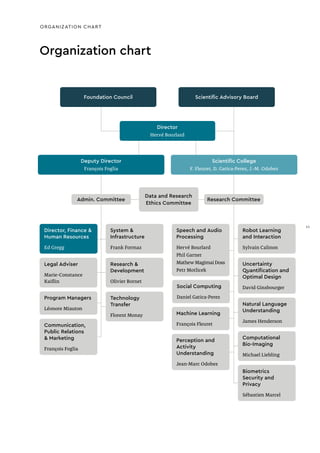
Organization chart
Robot Learning
and Interaction
Sylvain Calinon
Computational
Bio-Imaging
Michael Liebling
Uncertainty
Quantification and
Optimal Design
David Ginsbourger
Biometrics
Security and
Privacy
Sébastien Marcel
Natural Language
Understanding
James Henderson
Speech and Audio
Processing
Hervé Bourlard
Phil Garner
Mathew Magimai Doss
Petr Motlicek
Machine Learning
François Fleuret
Social Computing
Daniel Gatica-Perez
Perception and
Activity
Understanding
Jean-Marc Odobez
System &
Infrastructure
Frank Formaz
Research &
Development
Olivier Bornet
Director, Finance &
Human Resources
Ed Gregg
Communication,
Public Relations
& Marketing
François Foglia
Technology
Transfer
Florent Monay
Foundation Council
Director
Hervé Bourlard
Deputy Director
François Foglia
Admin. Committee
Scientific Advisory Board
Scientific College
F. Fleuret, D. Gatica-Perez, J.-M. Odobez
Research Committee
Data and Research
Ethics Committee
ORGANIZATION CHART
Legal Adviser
Marie-Constance
Kaiflin
Program Managers
Léonore Miauton
11
Nine groups, each led by one or more
top-level scientists, divide the Institute's
research activities between them. The
group responsible for speech- and audio
processing is led by the Institute's direc-
tor - Hervé Bourlard - and three perma-
nent researchers. The remaining groups
are all headed by permanent researchers,
including one tenured professor and two
senior scientists.
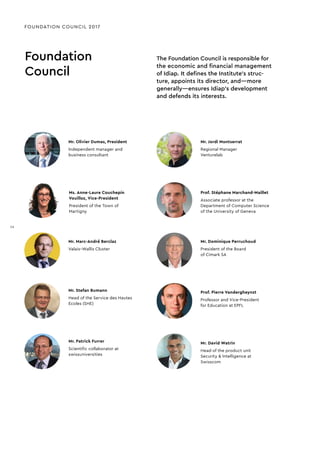
The scientific objective of this group is the development
of new statistical learning techniques, mainly for comput-
er vision, with a particular interest in their computation-
al properties. Application domains include image rec-
ognition and scene analysis, the tracking of people and
biological structures, and the understanding of images in
general.
Research groups
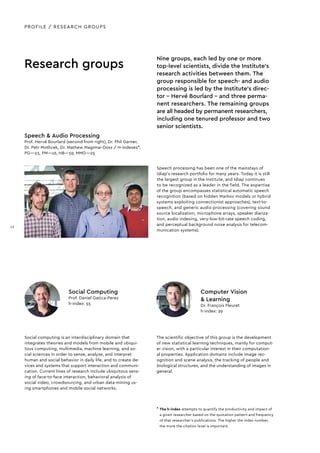
Speech processing has been one of the mainstays of
Idiap’s research portfolio for many years. Today it is still
the largest group in the Institute, and Idiap continues
to be recognized as a leader in the field. The expertise
of the group encompasses statistical automatic speech
recognition (based on hidden Markov models or hybrid
systems exploiting connectionist approaches), text-to-
speech, and generic audio processing (covering sound
source localization, microphone arrays, speaker diariza-
tion, audio indexing, very-low-bit-rate speech coding,
and perceptual background noise analysis for telecom-
munication systems).
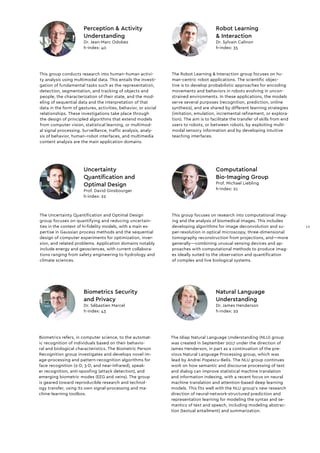
Social computing is an interdisciplinary domain that
integrates theories and models from mobile and ubiqui-
tous computing, multimedia, machine learning, and so-
cial sciences in order to sense, analyze, and interpret
human and social behavior in daily life, and to create de-
vices and systems that support interaction and communi-
cation. Current lines of research include ubiquitous sens-
ing of face-to-face interaction, behavioral analysis of
social video, crowdsourcing, and urban data-mining us-
ing smartphones and mobile social networks.
Social Computing
Prof. Daniel Gatica-Perez
h-index: 55
Computer Vision
& Learning
Dr. François Fleuret
h-index: 29
Speech & Audio Processing
Prof. Hervé Bourlard (second from right), Dr. Phil Garner,
Dr. Petr Motlicek, Dr. Mathew Magimai-Doss / H-indexes*:
PG—23, PM—16, HB—59, MMD—25
PROFILE / RESEARCH GROUPS
*	The h-index attempts to quantify the productivity and impact of
a given researcher based on the quotation pattern and frequency
of that researcher’s publications. The higher the index number,
the more the citation level is important.
12
This group conducts research into human–human activi-
ty analysis using multimodal data. This entails the investi-
gation of fundamental tasks such as the representation,
detection, segmentation, and tracking of objects and
people, the characterization of their state, and the mod-
eling of sequential data and the interpretation of that
data in the form of gestures, activities, behavior, or social
relationships. These investigations take place through
the design of principled algorithms that extend models
from computer vision, statistical learning, or multimod-
al signal processing. Surveillance, traffic analysis, analy-
sis of behavior, human–robot interfaces, and multimedia
content analysis are the main application domains.
Perception & Activity
Understanding
Dr. Jean-Marc Odobez
h-index: 40
This group focuses on research into computational imag-
ing and the analysis of biomedical images. This includes
developing algorithms for image deconvolution and su-
per-resolution in optical microscopy, three-dimensional
tomography reconstruction from projections, and—more
generally—combining unusual sensing devices and ap-
proaches with computational methods to produce imag-
es ideally suited to the observation and quantification
of complex and live biological systems.
The Uncertainty Quantification and Optimal Design
group focuses on quantifying and reducing uncertain-
ties in the context of hi-fidelity models, with a main ex-
pertise in Gaussian process methods and the sequential
design of computer experiments for optimization, inver-
sion, and related problems. Application domains notably
include energy and geosciences, with current collabora-
tions ranging from safety engineering to hydrology and
climate sciences.
The Robot Learning & Interaction group focuses on hu-
man-centric robot applications. The scientific objec-
tive is to develop probabilistic approaches for encoding
movements and behaviors in robots evolving in uncon-
strained environments. In these applications, the models
serve several purposes (recognition, prediction, online
synthesis), and are shared by different learning strategies
(imitation, emulation, incremental refinement, or explora-
tion). The aim is to facilitate the transfer of skills from end
users to robots, or between robots, by exploiting multi-
modal sensory information and by developing intuitive
teaching interfaces.
The Idiap Natural Language Understanding (NLU) group
was created in September 2017 under the direction of
James Henderson, in part as a continuation of the pre-
vious Natural Language Processing group, which was
lead by Andrei Popescu-Belis. The NLU group continues
work on how semantic and discourse processing of text
and dialog can improve statistical machine translation
and information indexing, with a recent focus on neural
machine translation and attention-based deep learning
models. This fits well with the NLU group's new research
direction of neural-network-structured prediction and
representation learning for modeling the syntax and se-
mantics of text and speech, including modeling abstrac-
tion (textual entailment) and summarization.
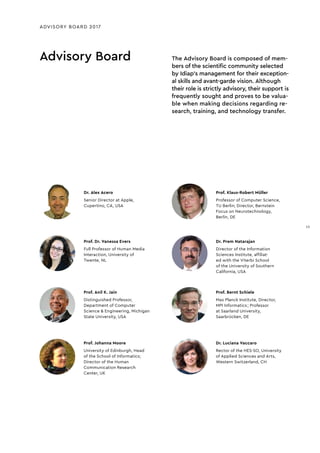
Biometrics refers, in computer science, to the automat-
ic recognition of individuals based on their behavio-
ral and biological characteristics. The Biometric Person
Recognition group investigates and develops novel im-
age-processing and pattern-recognition algorithms for
face recognition (2-D, 3-D, and near-infrared), speak-
er recognition, anti-spoofing (attack detection), and
emerging biometric modes (EEG and veins). The group
is geared toward reproducible research and technol-
ogy transfer, using its own signal-processing and ma-
chine-learning toolbox.
Biometrics Security
and Privacy
Dr. Sébastien Marcel
h-index: 43
Natural Language
Understanding
Dr. James Henderson
h-index: 22
Computational
Bio-Imaging Group
Prof. Michael Liebling
h-index: 21
Uncertainty
Quantification and
Optimal Design
Prof. David Ginsbourger
h-index: 22
Robot Learning
& Interaction
Dr. Sylvain Calinon
h-index: 35
13
FOUNDATION COUNCIL 2017
Foundation
Council
The Foundation Council is responsible for
the economic and financial management
of Idiap. It defines the Institute’s struc-
ture, appoints its director, and—more
generally—ensures Idiap’s development
and defends its interests.
Mr. Olivier Dumas, President
Independent manager and
business consultant
Mr. Patrick Furrer
Scientific collaborator at
swissuniversities
Ms. Anne-Laure Couchepin
Vouilloz, Vice-President
President of the Town of
Martigny
Mr. Jordi Montserrat
Regional Manager
Venturelab
Prof. Stéphane Marchand-Maillet
Associate professor at the
Department of Computer Science
of the University of Geneva
Mr. Dominique Perruchoud
President of the Board
of Cimark SA
Prof. Pierre Vandergheynst
Professor and Vice-President
for Education at EPFL
Mr. David Watrin
Head of the product unit
Security & Intelligence at
Swisscom
Mr. Marc-André Berclaz
Valais–Wallis Cluster
Mr. Stefan Bumann
Head of the Service des Hautes
Ecoles (SHE)
14
ADVISORY BOARD 2017
Advisory Board The Advisory Board is composed of mem-
bers of the scientific community selected
by Idiap’s management for their exception-
al skills and avant-garde vision. Although
their role is strictly advisory, their support is
frequently sought and proves to be valua-
ble when making decisions regarding re-
search, training, and technology transfer.
Prof. Klaus-Robert Müller
Professor of Computer Science,
TU Berlin; Director, Bernstein
Focus on Neurotechnology,
Berlin, DE
Dr. Prem Natarajan
Director of the Information
Sciences Institute, affiliat-
ed with the Viterbi School
of the University of Southern
California, USA
Prof. Bernt Schiele
Max Planck Institute, Director,
MPI Informatics ; Professor
at Saarland University,
Saarbrücken, DE
Dr. Luciana Vaccaro
Rector of the HES-SO, University
of Applied Sciences and Arts,
Western Switzerland, CH
Dr. Alex Acero
Senior Director at Apple,
Cupertino, CA, USA
Prof. Dr. Vanessa Evers
Full Professor of Human Media
Interaction, University of
Twente, NL
Prof. Anil K. Jain
Distinguished Professor,
Department of Computer
Science & Engineering, Michigan
State University, USA
Prof. Johanna Moore
University of Edinburgh, Head
of the School of Informatics;
Director of the Human
Communication Research
Center, UK
15
EMPLOYEES 2017
Employees
Scientists
First name, last name, position, country of origin,
year of arrival
Afsaneh Asaei, postdoc, Iran, 2008
Sushil Bhattacharjee, research associate, Switzerland, 2016
Hervé Bourlard, director, Belgium/Switzerland, 1996
Sylvain Calinon, researcher, Switzerland, 2014
Yuanzhouhan Cao, postdoc, China, 2017
Gülcan Can, research assistant, Turkey, 2013
Olivier Canévet, research assistant, France, 2012
Tatjana Chavdarova, research assistant, Macedonia, 2014
Tiago De Freitas Pereira, research assistant, Brazil, 2014
Subhadeep Dey, research assistant, India, 2014
Pranay Dighe, research assistant, India, 2013
Pavankumar Dubagunta, research assistant, India, 2017
François Fleuret, senior researcher, France, 2007
Philip Garner, senior researcher, United Kingdom, 2007
Daniel Gatica-Perez, senior researcher, Mexico, 2002
David Geissbuhler, postdoc, Switzerland, 2017
Anjith George, postdoc, India, 2017
David Ginsbourger, senior researcher, France, 2015
Weipeng He, research assistant, China, 2016
James Henderson, senior researcher, United States of
Amercia, 2017
Guillaume Heusch, research associate, Switzerland, 2015
Rui Hu, postdoc, China, 2013
David Imseng, postdoc, Switzerland, 2009
Christian Jaques, research assistant, Switzerland, 2016
Noémie Jaquier, research assistant, Switzerland, 2016
Cijo Jose, research assistant, India, 2013
Angelos Katharopoulos, research assistant, Greece, 2017
Ina Kodrasi, postdoc, Albania, 2017
Alain Komaty, postdoc, France, 2016
Pavel Korshunov, postdoc, Estonia, 2015
Vedrana Krivokuca, postdoc, New Zealand, 2017
Thibaut Kulak, research assistant, France, 2017
Andras Kupcsik, postdoc, Hungary, 2017
Florian Labhart, research assistant, Switzerland, 2017
Nam Le, research assistant, Vietnam, 2015
Yann Lepoittevin, postdoc, France, 2016
Michael Liebling, senior researcher, Switzerland, 2014
Gang Liu, postdoc, China, 2017
Srikanth Madikeri, postdoc, India, 2013
Mathew Magimai Doss, researcher, India, 2007
Sébastien Marcel, senior researcher, France/Switzerland, 2000
Olivia Mariani, research assistant, Switzerland, 2016
Angel Martinez Gonzalez, research assistant, Mexico, 2016
Amir Mohammadi, research assistant, Iran, 2016
Petr Motlicek, researcher, Czech Republic, 2005
Hannah Muckenhirn, research assistant, France, 2015
Skanda Muralidhar, research assistant, India, 2014
James Newling, research assistant, United Kingdom, 2013
Laurent Nguyen, postdoc, Switzerland, 2011
Olegs Nikisins, postdoc, Latvia, 2017
Jean-Marc Odobez, senior researcher, France/Switzerland, 2001
Nikolaos Pappas, research assistant, Greece, 2012
Trung Phan, research assistant, Vietnam, 2015
Emmanuel Pignat, research assistant, Switzerland, 2016
Xiao Pu, research assistant, China, 2014	
André Rabello Dos Anjos, research associate, Brazil, 2010
Dhananjay Ram, research assistant, India, 2014
Ramya Rasipuram, postdoc, India, 2010
Marzieh Razavi, research assistant, Iran, 2013
Bastian Schnell, research assistant, Germany, 2017
Jilt Sebastian, research assistant, India, 2017
Adrian Shajkofci, research assistant, Switzerland, 2016
Rémy Siegfried, research assistant, Switzerland, 2017
Suraj Srinivas, research assistant, India, 2017
Ajay Srinivasamurthy, postdoc, India, 2017
Ajay Tanwani, research assistant, Pakistan, 2015
Sibo Tong, research assistant, China, 2016
Sandrine Tornay, research assistant, Switzerland, 2016
Michael Villamizar, postdoc, Spain, 2017
Bogdan Vlasenko, postdoc, Germany, 2017
Yu Yu, research assistant, China, 2015
Research & Development Engineers
Philip Abbet, senior development engineer, Switzerland, 2006
Olivier Bornet, head of development team, Switzerland, 2004
Milos Cernak, senior development engineer, Slovakia, 2011
Guillaume Clivaz, development engineer, Switzerland, 2017
Samuel Gaist, development engineer, Switzerland, 2013
Mélanie Huck, development engineer, Switzerland, 2017
Salim Kayal, development engineer, Switzerland, 2011
Christine Marcel, development engineer, France/
Switzerland, 2007
Florent Monay, tech transfer officer, Switzerland, 2008
Alexandre Nanchen, senior development engineer,
Switzerland, 2008
Flavio Tarsetti, senior development engineer, Switzerland, 2008
16
Administrative staff
First name, last name, position, country of origin,
year of arrival
Elisa Bovio, junior program manager and financial assistant,
Switzerland 2015
Martina Fellay, program manager, Austria, 2012
François Foglia, deputy director, Switzerland, 2006
Edward-Lee Gregg, chief financial officer, United States of
America, 2004
Marie-Constance Kaiflin, legal adviser, Switzerland, 2017
Léonore Miauton, head of program management,
Switzerland, 2012
Sylvie Millius, secretary, Switzerland, 1996
Nadine Rousseau, secretary, Belgium/Switzerland, 1998
System engineers
Bastien Crettol, system administrator, Switzerland, 2005
Norbert Crettol, senior system administrator, Switzerland, 2002
Cédric Dufour, system engineer, Switzerland, 2007
Frank Formaz, system manager, Switzerland, 1998
Louis-Marie Plumel, senior system administrator, France, 2011
Vincent Spano, webmaster, Switzerland, 2004
Laurent Tomas, senior system administrator, Switzerland, 2017
Interns
First name, last name, country of origin, home institution
Interns generally spend between six and ten months at
the research Institute. Some are students at the Ecole
Polytechnique Fédérale de Lausanne (EPFL) and spend
time at Idiap as part of their degree studies. Others come
on student exchange programs set up with European pro-
jects in which Idiap participates.
Dylan Bourgeois, France, EPFL
Jaden Diefenbaugh, USA, Oregon Univ, Corvallis, USA
Selen Kabil, Turkey, Middle East Technical Univ, Ankara, Turkey
Wei Ma, India, Nanjing Univ, China
Luis Emmanuel Medina Rios, Mexico, EPFL
Zohreh Mostaani, Iran, Ozgegin Univ, Istanbul, Turkey
Amrutha Prasad, India, Karnataka, India
Alain Rossier, Switzerland, EPFL
Florian Standaert, Switzerland, EPFL
17
finances
18 — 21
18
PROFIT AND LOSS STATEMENT
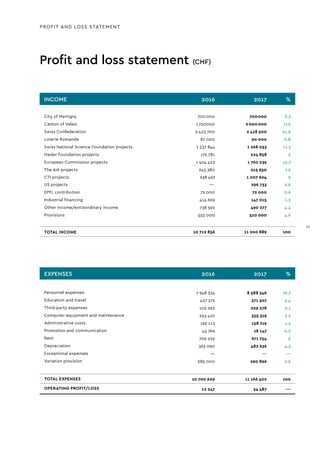
Profit and loss statement (CHF)
INCOME 2016 2017 %
City of Martigny 700 000 700 000 6.3
Canton of Valais 1 720 000 2 000 000 17.9
Swiss Confederation 2 423 700 2 418 500 21.6
Loterie Romande 87 000 90 000 0.8
Swiss National Science Foundation projects 1 537 844 1 268 033 11.3
Hasler Foundation projects 175 781 224 838 2
European Commission projects 1 404 423 1 760 239 15.7
The Ark projects 245 380 215 650 1.9
CTI projects 638 467 1 007 604 9
US projects —
-
296 733 2.6
EPFL contribution 72 000 72 000 0.6
Industrial financing 414 669 147 015 1.3
Other income/extraordinary income 738 592 490 277 4.4
Provisions 555 000 510 000 4.6
TOTAL INCOME 10 712 856 11 200 889 100
EXPENSES 2016 2017 %
Personnel expenses 7 948 334 8 588 346 76.7
Education and travel 427 372 371 307 3.4
Third-party expenses 102 292 229 278 2.1
Computer equipment and maintenance 253 410 355 319 3.2
Administrative costs 166 113 158 719 1.5
Promotion and communication 45 769 18 147 0.2
Rent 709 229 671 754 6
Depreciation 363 090 482 636 4.3
Exceptional expenses — — —
Variation provision 685 000 290 896 2.6
TOTAL EXPENSES 10 700 609 11 166 402 100
OPERATING PROFIT/LOSS 12 247 34 487 —
19
SOURCES OF FINANCING
1%
2%
2%
3%
1%
6%
18%
9%
21%
11%
16%
2%
3%
3%
2%
77%
3%
6%
4%
1%
4%
5%
Accounting
analysis 2017
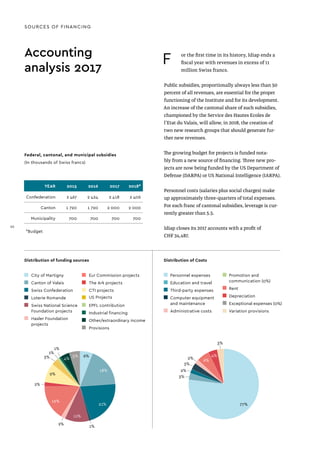
F or the first time in its history, Idiap ends a
fiscal year with revenues in excess of 11
million Swiss francs.
Public subsidies, proportionally always less than 50
percent of all revenues, are essential for the proper
functioning of the Institute and for its development.
An increase of the cantonal share of such subsidies,
championed by the Service des Hautes Ecoles de
l'Etat du Valais, will allow, in 2018, the creation of
two new research groups that should generate fur-
ther new revenues.
The growing budget for projects is funded nota-
bly from a new source of financing. Three new pro-
jects are now being funded by the US Department of
Defense (DARPA) or US National Intelligence (IARPA).
Personnel costs (salaries plus social charges) make
up approximately three-quarters of total expenses.
For each franc of cantonal subsidies, leverage is cur-
rently greater than 5.5.
Idiap closes its 2017 accounts with a profit of
CHF 34,487.
Federal, cantonal, and municipal subsidies
(In thousands of Swiss francs)
*Budget
Distribution of funding sources Distribution of Costs
YEAR 2015 2016 2017 2018*
Confederation 2 467 2 424 2 418 2 406
Canton 1 720 1 720 2 000 2 000
Municipality 700 700 700 700
Personnel expenses
Education and travel
Third-party expenses
Computer equipment
and maintenance
Administrative costs
Promotion and
communication (0%)
Rent
Depreciation
Exceptional expenses (0%)
Variation provisions
City of Martigny
Canton of Valais
Swiss Confederation
Loterie Romande
Swiss National Science
Foundation projects
Hasler Foundation
projects
Eur Commission projects
The Ark projects
CTI projects
US Projects
EPFL contribution
Industrial financing
Other/extraordinary income
Provisions
20
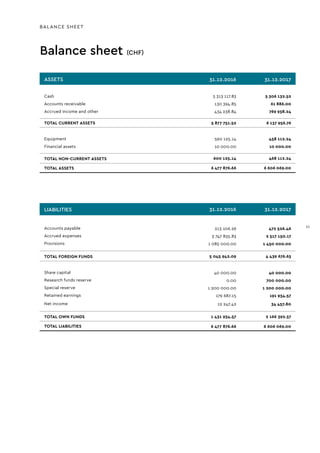
Balance sheet (CHF)
BALANCE SHEET
ASSETS 31.12.2016 31.12.2017
Cash 5 313 117.83 5 306 132.52
Accounts receivable 130 394.85 61 886.00
Accrued income and other 434 238.84 769 938.24
TOTAL CURRENT ASSETS 5 877 751.52 6 137 956.76
Equipment 590 125.14 458 112.24
Financial assets 10 000.00 10 000.00
TOTAL NON-CURRENT ASSETS 600 125.14 468 112.24
TOTAL ASSETS 6 477 876.66 6 606 069.00
LIABILITIES 31.12.2016 31.12.2017
Accounts payable 213 106.26 472 526.46
Accrued expenses 3 747 835.83 2 517 150.17
Provisions 1 085 000.00 1 450 000.00
TOTAL FOREIGN FUNDS 5 045 942.09 4 439 676.63
Share capital 40 000.00 40 000.00
Research funds reserve 0.00 700 000.00
Special reserve 1 200 000.00 1 200 000.00
Retained earnings 179 687.15 191 934.57
Net income 12 247.42 34 457.80
TOTAL OWN FUNDS 1 431 934.57 2 166 392.37
TOTAL LIABILITIES 6 477 876.66 6 606 069.00
21
research
22 — 27
22
NEW ICT PROJECT—MEMMO
MEMMO—Memory of
motion to enable rapid
adaptation in robots
M EMMO (Memory of Motion) is a major
European project with a budget of EUR 4
million. Lasting 48 months, it brings together
a consortium of academic and industrial stakeholders,
who will work on finding ways to “give” robots memory.
Under the coordination of an independent unit of the
French National Center for Scientific Research (CNRS),
Dr. Sylvain Calinon, senior researcher and head of
Idiap’s Robot Learning and Interaction group, will lead
the Idiap teams. The other academic partners are the
universities of Edinburgh and Oxford, as well as the
Max Planck Institute, Tübingen.
But the consortium doesn’t confine itself to univer-
sity labs; it also involves industrial partners from
across Europe, each with its know-how, but also its
specific goals. PAL Robotics, from Barcelona, special-
izes in the creation of humanoid robots; Wandercraft,
based in Paris, develops exoskeletons special-
ly designed for paraplegic people. Airbus, too, has
joined the project—the aircraft manufacturer needs
anthropomorphic robots to perform certain opera-
tions inside the cabins of its aircraft. And Britain’s
Costain Group wants to develop quadruped robots
to inspect piping networks.
What are the project’s challenges? It’s difficult for a
robot to learn when it only has limited experience of
the real world. This learning is all the more vital for
humanoid robots, which will certainly be required to
perform varied tasks in a range of different environ-
ments. Fortunately, further experience can be gained
via simulations, in which the robot—safe in a virtual
environment—"imagines" incidents that might occur
and tries to cope with them. Successful experiences
are then analyzed and stored as a memory of motion.
So, thanks to the research carried out in the MEMMO
project, these and other robots will be able to better
handle both changes to their environments and un-
foreseen events.
For each of us, navigating around obstacles
that we find in our path is a natural activi-
ty. But for an exoskeleton used, for example,
by a paraplegic person, or for a quadruped
robot this is much more of a challenge. To
maintain its balance and control it has to
rapidly calculate its options. A response
that is too slow in coming or a poor choice
made inevitably results in a fall. The solu-
tion? Integrate, into the robot’s program-
ming, memories of similar experiences of
maintaining balance. And this is precisely
what Idiap is addressing in the European
program MEMMO.
23
Martigny, the heart of a European
language-study network
T he idea for the project emerged from the
long-standing collaboration between
Dr. Mathew Magimai-Doss, senior researcher
at Idiap and coordinator of TAPAS, and Dr. Heidi
Christensen of Sheffield University. To accompany
them on this significant adventure and to enable them
to meet the project’s various research objectives,
twelve academic and industrial institutions and nine
partner organizations have joined the consortium—
with Idiap at the helm.
A project of exceptional size requires exceptional fi-
nancing: TAPAS has attracted funding from the well-
known Marie Skłodowska-Curie Actions (MSCA)
grant program, which particularly encourages train-
ing networks in cutting-edge scientific fields, focus-
ing on both geographical and cross-sectoral mobility.
Something that Dr. Magimai-Doss is extremely proud
of: “MSCA-type financing is highly sought after and
involves fierce competition between the projects
submitted.”
Speech impairment and the need for
a multidimensional approach
A number of pathologies can affect a person’s ability to
express themselves, including Alzheimer’s, Parkinson’s,
and stroke. Those concerned often lead a life hall-
marked by exclusion.
The TAPAS project will study this problematic from
three main angles: detection of language impairment,
evaluation and therapeutic tools, and rehabilitation.
Dr. Magimai-Doss and the project partners have de-
vised a multidisciplinary approach that ranges from
the most fundamental research to the most practical of
applications. The common goal of all of these elements
is, as the coordinator of TAPAS puts it, “to understand
how a pathology affects the production and the per-
ception of spoken language.”
Fifteen doctoral students, fifteen facets
of speech processing
As part of the project, a consortium of clinicians, re-
search groups, and industrial partners will engage fif-
teen PhD students across a range of European locations.
In addition to their three-year course of scientific study,
these students will receive theoretical and practical
training, ranging from questions of ethics and legal,
data-centered issues to entrepreneurship training. The
scientific objective will be to study the different facets
of speech impairment and the condition’s impact on
communication.
A first group of students will measure the intelligibility
of people suffering from a pathology. As the traditional
methods of evaluating human speech do not give satis-
factory results in cases of disability, this will involve—
for example—developing new intelligibility scores.
Another group will use the study of language, and es-
pecially of the underlying causes of problems with
speech, to detect degenerative diseases and measure
their evolution.
Finally, at the heart of another research theme we find
the question of how best to help those affected by a pa-
thology through speech technology. For example, the
modeling of children's language will enable the crea-
tion of a therapeutic tool in the form of a game for chil-
dren with speech disorders.
H2020 MARIE CURIE PROJECT
TAPAS (Training Network on Automatic Processing of Pathological Speech) is an un-
usual project. Supported by a highly selective financing mechanism established
by the European Union, the Idiap-led speech research program focuses on the in-
ternational and cross-sectoral mobility of researchers from all walks of life. A ma-
jor, ambitious challenge that has propelled IDIAP into the very heart of advanced
“Made-in-Europe” science.
24
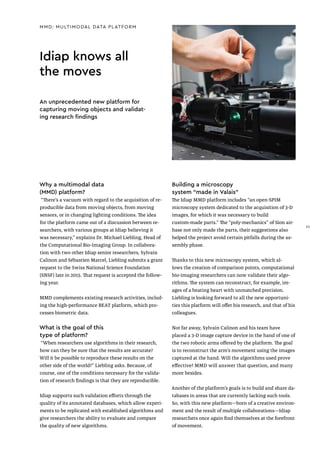
Idiap knows all
the moves
Why a multimodal data
(MMD) platform?
“There’s a vacuum with regard to the acquisition of re-
producible data from moving objects, from moving
sensors, or in changing lighting conditions. The idea
for the platform came out of a discussion between re-
searchers, with various groups at Idiap believing it
was necessary,” explains Dr. Michael Liebling, Head of
the Computational Bio-Imaging Group. In collabora-
tion with two other Idiap senior researchers, Sylvain
Calinon and Sébastien Marcel, Liebling submits a grant
request to the Swiss National Science Foundation
(SNSF) late in 2015. That request is accepted the follow-
ing year.
MMD complements existing research activities, includ-
ing the high-performance BEAT platform, which pro-
cesses biometric data.
What is the goal of this
type of platform?
“When researchers use algorithms in their research,
how can they be sure that the results are accurate?
Will it be possible to reproduce these results on the
other side of the world?” Liebling asks. Because, of
course, one of the conditions necessary for the valida-
tion of research findings is that they are reproducible.
Idiap supports such validation efforts through the
quality of its annotated databases, which allow experi-
ments to be replicated with established algorithms and
give researchers the ability to evaluate and compare
the quality of new algorithms.
Building a microscopy
system “made in Valais”
The Idiap MMD platform includes “an open-SPIM
microscopy system dedicated to the acquisition of 3-D
images, for which it was necessary to build
custom-made parts.” The “poly-mechanics” of Sion air-
base not only made the parts, their suggestions also
helped the project avoid certain pitfalls during the as-
sembly phase.
Thanks to this new microscopy system, which al-
lows the creation of comparison points, computational
bio-imaging researchers can now validate their algo-
rithms. The system can reconstruct, for example, im-
ages of a beating heart with unmatched precision.
Liebling is looking forward to all the new opportuni-
ties this platform will offer his research, and that of his
colleagues.
Not far away, Sylvain Calinon and his team have
placed a 3-D image capture device in the hand of one of
the two robotic arms offered by the platform. The goal
is to reconstruct the arm’s movement using the images
captured at the hand. Will the algorithms used prove
effective? MMD will answer that question, and many
more besides.
Another of the platform’s goals is to build and share da-
tabases in areas that are currently lacking such tools.
So, with this new platform—born of a creative environ-
ment and the result of multiple collaborations—Idiap
researchers once again find themselves at the forefront
of movement.
MMD: MULTIMODAL DATA PLATFORM
An unprecedented new platform for
capturing moving objects and validat-
ing research findings
25
Artificial
intelligence
in the research
spotlight
Machine learning makes
for a full house
Machine learning, the “field of study that gives com-
puters the ability to learn without being explicitly pro-
grammed”, is nothing new—American Arthur Samuel
already laid down a provisional definition in 1962.
More than half a century later, artificial intelligence
(AI) has once more become a topic of interest in re-
search circles, and a central issue for society. François
Fleuret, Head of the Machine Learning group at Idiap
and a lecturer at EPFL specializing in neural networks,
has organized the Swiss Machine Learning Day every
year since 2012. The event brings Swiss researchers to-
gether to explore the theme and attracts, year after
year, an ever larger audience. Last November, a vic-
tim of its own success, one of the largest halls of the
SwissTech Convention Center in Lausanne was re-
quired to welcome the many guests.
Torch, the Swiss army knife of machine
learning—developed at Idiap
In order to solve complex issues involving large
amounts of data, machine learning algorithms re-
quire a very flexible support. In 2001, Idiap answered
this need, developing Torch—a network of “deep learn-
ing” libraries, ideal for “simulating neural networks”.
Almost two decades later, Torch is a fully operational
tool, used in particular by Facebook. And Facebook has
also developed a direct descendant of Torch—Pytorch—
adopted among others by Uber, and many researchers
around the world.
Idiap and HES-SO Valais/Wallis—working
hand in hand
Open to the public and the scientific community, re-
searchers from the two Valais institutes organize joint
workshops on artificial intelligence, offering—with the
aim of stimulating collaboration and exchange—two
sessions each year. These free-of-charge initiatives are
intended as universal platforms for the dissemina-
tion of knowledge. And the company Klewel, an Idiap
spin-off, makes the events available to a broader pub-
lic online, with the option of watching them speaker
by speaker.
The theme of the first workshop of the year was is-
sues related to the reproducibility of scientific research.
Initiated by Dr. Sebastien Marcel, Head of the research
group Biometrics Security and Privacy, this hot topic
was discussed and debated throughout the day. A dis-
tinguished guest, EPFL’s Vice-President for Education
Prof. Pierre Vandergheynst, presented the EPFL po-
sition and the Federal Institute of Technology's ap-
proaches to meeting this challenge.
ARTIFICIAL INTELLIGENCE
26
The second workshop was organized by Professor
David Ginsbourger, Head of Uncertainty Quantification
and Optimal Design at Idiap. This time the focus was
on “Small Data” and the issue of how research some-
times has to deal with constraints on data availability,
as is the case with research in the field of rare diseas-
es, or regarding ecological, climate, or financial disas-
ters and crises. Even Idiap's robotics researchers are
confronted with the obstacles created by Small Data.
An unusual subject, and one that touches on models of
pure mathematics.
300 people at Martigny for
“AI in all its forms”
Representatives of the private and public sectors of the
regions crossed by the Rhône river met in Martigny
at the Vatel Hotel on September 15, 2017 for the 17th
edition of the Rhône Forum. The goal: to promote the
exchange of ideas and to support project opportu-
nities involving economic actors from Switzerland
and neighboring France. The event, sponsored by
Business Valais and the city of Martigny, focused on
the technological innovations brought about by AI.
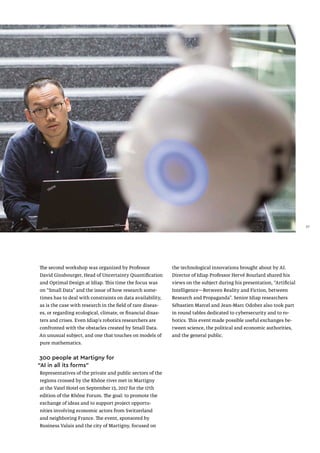
Director of Idiap Professor Hervé Bourlard shared his
views on the subject during his presentation, “Artificial
Intelligence—Between Reality and Fiction, between
Research and Propaganda”. Senior Idiap researchers
Sébastien Marcel and Jean-Marc Odobez also took part
in round tables dedicated to cybersecurity and to ro-
botics. This event made possible useful exchanges be-
tween science, the political and economic authorities,
and the general public.
27
network
28 — 33
28
ICC’2017
International Create
Challenge: 6th
edition
This three-week, total-immersion program enables young entrepreneurs to trans-
form their ideas into commercial prototypes. Running from 30 August to 20
September 2017 at the Idiap Research Institute in Martigny, it brought together
participants from a number of countries, including Brazil, Ukraine, China,
and Argentina. The ICC jury—made up of a dozen internationally renowned fig-
ures from the worlds of research, venture capital, and innovation—awarded
prizes to the following teams. Each win a CHF 5,000 cash prize:
•	 Forensic Voice Recognition System (Srikanth
Madikeri, Idiap) is developing a tool to facilitate the
identification of individuals based on vocal biomet-
rics. In addition to the aforementioned prize, the pro-
ject qualifies for free access to the incubator The Ark.
•	 Robobay (Yaroslav Pishta, Ukraine) is an Internet
platform that allows its clients to deploy their
own trading bots to interface with the market for
crypto-currency.
•	 TOP DOWN (Renato Rodrigues, Brazil) is developing
a payment and use-monitoring technology that facil-
itates use of public transport.
The ICC, a proven technology
transfer tool
The International Create Challenge (ICC) is at the ori-
gin of companies such as Recapp, Biowatch, EyeWare,
and Anemomind. With regard to the 2017 edition, nego-
tiations are under way with several teams concerning
their integration into the incubator The Ark, situated on
the IdeArk site in Martigny.
François Foglia, deputy director of Idiap and creator
of the ICC, highlights the important role played by the
experts who have been involved in this adventure for
the past six years. On each day of the Challenge, one of
these experts graciously shares his or her knowledge or
coaches the teams of budding entrepreneurs.
Christophe Saam (P&TS) is present every year to ex-
plain the rules of intellectual property. Gaspard
Couchepin, barrister, notary, and Doctor of Law, ex-
plains the various types of company. Laurent Bischof
and Guillaume Dubret (Polytech Ventures) talk on ven-
ture capital practices. Nadine Reichenthal, anoth-
er expert and a lecturer in Strategy at the University
of Lausanne, talks about the “business canvas” and
the value proposition. Jordi Montserrat (Venture Kick)
shares his experience of launching start-ups. Jung Park
(IMD), Joel Rossier and Daniel Rüfle (The Ark), Jasmine
Abarca-Golay (InnoPark), Patrick Biro (Venture Kick),
and Stéphane Marchand-Maillet (University of Geneva)
also support the participants each year or contribute to
the work of the jury.
“The Challenge is
made possible by the
commitment of
those experts that
assist its participants”
29
Reaching out to the wider
public—a vocation for Idiap
The “Carnotzet Scientifique”—research
in good company
Free and open to all, the “Carnotzet Scientifique
Valaisan” places the wider public and invited ex-
perts on an equal, friendly footing. A panel of ex-
perts met at the bookstore La Liseuse in Sion on May
10, 2017 to discuss the theme “Serious Game: Using
a Playful Approach to Solve Very Serious Problems”.
This Carnotzet Scientifique was the perfect opportu-
nity for researchers to interact with members of the
general public in a relaxed, informal atmosphere.
Professor Daniel Gatica-Perez—Director of Idiap’s
Social Computing group—also gave a presentation, on
the smartphone as an often-underestimated tool of
civic participation, an approach based on observations
made during his research at Idiap, at the crossroads of
computers, social media, machine learning, and the so-
cial sciences.
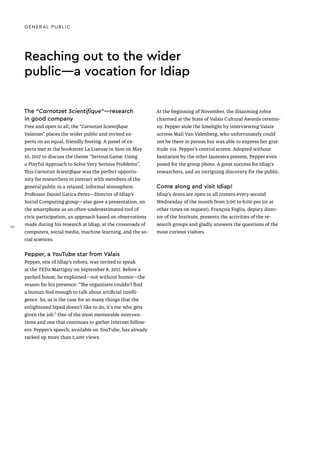
Pepper, a YouTube star from Valais
Pepper, one of Idiap’s robots, was invited to speak
at the TEDx Martigny on September 8, 2017. Before a
packed house, he explained—not without humor—the
reason for his presence: “The organizers couldn’t find
a human fool enough to talk about artificial intelli-
gence. So, as is the case for so many things that the
enlightened biped doesn’t like to do, it's me who gets
given the job.” One of the most memorable interven-
tions and one that continues to gather Internet follow-
ers: Pepper’s speech, available on YouTube, has already
racked up more than 2,400 views.
At the beginning of November, the disarming robot
charmed at the State of Valais Cultural Awards ceremo-
ny. Pepper stole the limelight by interviewing Valais
actress Mali Van Valenberg, who unfortunately could
not be there in person but was able to express her grat-
itude via Pepper’s control screen. Adopted without
hesitation by the other laureates present, Pepper even
posed for the group photo. A great success for Idiap’s
researchers, and an intriguing discovery for the public.
Come along and visit Idiap!
Idiap’s doors are open to all comers every second
Wednesday of the month from 5:00 to 6:00 pm (or at
other times on request). François Foglia, deputy direc-
tor of the Institute, presents the activities of the re-
search groups and gladly answers the questions of the
most curious visitors.
GENERAL PUBLIC
30
GENERAL PUBLIC
The future of research meets
Future en tout genre
Since 2012, the Institute has been welcoming chil-
dren for one morning each year as part of the program
“Future en tout genre”. Last November, nineteen chil-
dren aged 11 or 12 came to Idiap to explore different el-
ements of the jobs of researchers, developers, network
managers, or project managers. And as well as par-
ticipating in the workshops organized for them, the
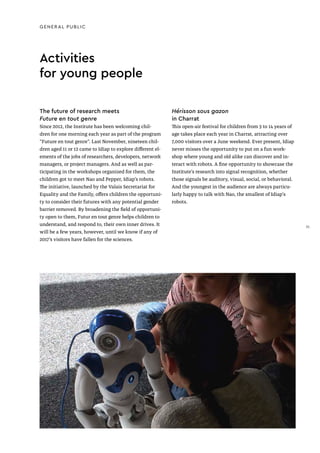
children got to meet Nao and Pepper, Idiap’s robots.
The initiative, launched by the Valais Secretariat for
Equality and the Family, offers children the opportuni-
ty to consider their futures with any potential gender
barrier removed. By broadening the field of opportuni-
ty open to them, Futur en tout genre helps children to
understand, and respond to, their own inner drives. It
will be a few years, however, until we know if any of
2017’s visitors have fallen for the sciences.
Activities
for young people
Hérisson sous gazon
in Charrat
This open-air festival for children from 3 to 14 years of
age takes place each year in Charrat, attracting over
7,000 visitors over a June weekend. Ever present, Idiap
never misses the opportunity to put on a fun work-
shop where young and old alike can discover and in-
teract with robots. A fine opportunity to showcase the
Institute’s research into signal recognition, whether
those signals be auditory, visual, social, or behavioral.
And the youngest in the audience are always particu-
larly happy to talk with Nao, the smallest of Idiap's
robots.
31
Idiap spin-offs—influence
without frontiers
B iowatch (www.biowatch.ch/), Recapp (www.
recapp.ch/), Eyeware (eyeware.tech/), and
Koemei. Four start-ups, four success stories,
one thing in common: Idiap labs. Spotlight on 2017, a
year synonymous with success, for these spin-offs and
for the Institute as a whole.
All doors are opening for Biowatch
It all began in 2014. Matthias Vanoni, working on his
doctoral thesis, takes on a crazy challenge: to create a
system that opens any door, even virtual, thanks to a
sensor placed on the veins of the wrist (a technique de-
veloped in the laboratories at Martigny). After a first
phase, in which the project receives support via the
International Create Challenge program (http://www.
createchallenge.org/), Biowatch tastes real success in
2017: it wins first prize at the Swiss Fintech Convention
in Geneva, and—on the fringes of the renowned World
Mobile Congress in Barcelona—Visa’s Everywhere
Initiative, which aims to identify the next big thing
in payments. The spin-off has also won several other
prestigious awards, including from Thales, LVMH,
Accenture, and Credit Suisse. Another piece of news
that’s proving appealing to potential investors: in 2017
Biowatch was awarded the CTI Start-up Label, proof of
its solidity and maturity, despite its young age.
Valais at the Swiss ICT awards
ceremony 2017
In Lucerne last November, two Idiap spin-offs distin-
guished themselves at the Swiss ICT awards ceremony,
an annual event that recognizes the most innova-
tive ICT products and services in Switzerland. Recapp,
which specializes in latest-generation audio record-
ing and transcription, picked up the Newcomer Award
and climbed to second place in the organizers’ top
100. The spin-off is no stranger to the Swiss market,
collaborating with the Canton of Valais’ Parliament
(MediaParl project) and Swisscom, among others.
Finally, Eyeware, an innovative solution enabling
visual interaction between computers and people with
disabilities (ICC’2015 award), received a nomination.
A buy that will make itself heard
The Swiss company Crealogix, specialist in FinTech
solutions for banks, has chosen to use the technolo-
gy developed by Idiap spin-off Koemei. Created in 2010,
Koemei was built on the Institute’s research into voice
recognition, text analysis, and natural language, and
sorts content automatically. The solution has been used
by several universities in the context of higher educa-
tion offerings.
SPIN-OFFS
32
SPIN-OFFS
T o go from labs to industry takes only one step.
And several at Idiap have not hesitated to take
that step, and have done so with great success.
Milos Cernak, for example, is now Technical Director at
Logitech, and Alexandros Lazaridis is Director of Speech
Processing in the Artificial Intelligence and Machine
Learning division at Swisscom.
Idiap’s dynamic ecosystem provides a fertile ground
for collaborations between researchers. Beyond a sim-
ple “atmosphere”, there is a genuine entrepreneurial
mindset omnipresent throughout the corridors of the
Institute—a mindset that also reaches out from those
corridors, as is the case for Hugues Salamin and Yann
Rodriguez, both currently at KeyLemon.
Cooperation and proximity—two vital
factors in Idiap’s success
At the time—from 2007 to 2009—a PhD student in Social
Signal Processing, Salamin meets Rodriguez, one of the
founders of KeyLemon. Rodriguez has completed his
PhD and is already working with developers on the pro-
ject. The two researchers hit it off immediately, and no
one doubts that this first meeting will influence their
respective futures, and that of the spin-off.
Salamin leaves for a while for Scotland, but returns
to the Institute in 2014 in the role of developer, taking
charge of the technology transfer office—a post that
gives him solid experience of developing projects with
industry and enables him to enrich his professional
network. That profile appeals to KeyLemon, then grow-
ing rapidly, and the spin-off brings Salamin on board
in 2017.
Idiap alumni, a strong
bridge between research
and industry
Now a product manager, the Valaisan extols the vir-
tues of the proximity created and nurtured at Idiap:
“Everyone knows each other, and that significantly fa-
cilitates collaboration because the expectations from
all sides are so clear. We needed an outside evaluation
of our mobile phone solution, and it was an Idiap post-
doc who carried that out. It allowed us to move faster.”
And Salamin also underlines the significance of him
having found a post in Valais in his field of expertise—
proof that the Institute is an attractive recruitment
pool for companies in the canton.
33
faces
34 — 39
34
JAMES HENDERSON
From MIT to Martigny—the odyssey
of a globe-trotting researcher with
a fascination for language
F or James Henderson it all began almost thirty
years ago at MIT (the Massachusetts Institute
of Technology). And he has never lost his taste
for international research, working at universities
including Exeter, Geneva, and Edinburgh, and also in
the very heart of Xerox’s research laboratories in
Grenoble.
Dr. Henderson is a pioneer in his field. At the turn of
the new millennium he successfully developed inno-
vative techniques that combine neural network anal-
ysis and the understanding of natural language—one
of the greatest challenges in the artificial intelligence
domain.
James takes over from Professor Andrei Popescu-Belis,
who has joined HEIG-VD in Yverdon. The new research
group Natural Language Understanding is a continu-
ation of Idiap's work in natural language processing,
and will focus on translation and indexing and on the
classification of texts and their “entailments”.
Revealing opinions by using
data from Facebook
A lexical or textual entailment establishes a relation
between two words or two texts. For example, “this is
a cat” implies that the cat is an animal, which is clear-
ly true. But to make such links, a computer must first
go through a learning process. Passionate about such
questions, James wants to use the study of these lin-
guistic entailments to “summarize” opinions. Using
a model that employs entailments to extract mean-
ing from phrases, it will be possible to build consen-
sus from a wide variety of differing opinions. The
American researcher sees a direct application in the
area of opinion polls: instead of deploying question-
naires or carrying out telephone surveys, it will be
possible to determine a group of people’s collective
opinion by extracting and analyzing their individual
social media posts.
Beyond the labs—a creative
state of mind
For James, Idiap offers both an intellectually stimu-
lating environment and great freedom to researchers:
“The weekly seminars, in which we present our own
research, are very interesting, as are the exchanges be-
tween the doctoral and postdoctoral students of the
various groups.” A state of mind built on the sharing
of ideas, and one that generates—according to James—
healthy competition, building a community that is cre-
ative, dynamic, and encourages discovery.
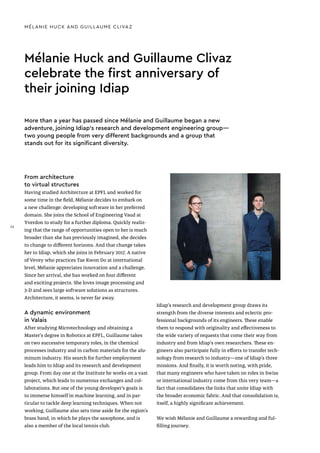
American researcher James Henderson joined Idiap with brio last autumn.
Leading the research group Natural Language Understanding, his focus in-
cludes the semantic processing of texts and speech with the aim of im-
proving automatic translation. We zoom in on a career as brilliant as it is
nomadic—a career dedicated to the science of language.
35
Mélanie Huck and Guillaume Clivaz
celebrate the first anniversary of
their joining Idiap
MÉLANIE HUCK AND GUILLAUME CLIVAZ
From architecture
to virtual structures
Having studied Architecture at EPFL and worked for
some time in the field, Mélanie decides to embark on
a new challenge: developing software in her preferred
domain. She joins the School of Engineering Vaud at
Yverdon to study for a further diploma. Quickly realiz-
ing that the range of opportunities open to her is much
broader than she has previously imagined, she decides
to change to different horizons. And that change takes
her to Idiap, which she joins in February 2017. A native
of Vevey who practices Tae Kwon Do at international
level, Mélanie appreciates innovation and a challenge.
Since her arrival, she has worked on four different
and exciting projects. She loves image processing and
3-D and sees large software solutions as structures.
Architecture, it seems, is never far away.
A dynamic environment
in Valais
After studying Microtechnology and obtaining a
Master's degree in Robotics at EPFL, Guillaume takes
on two successive temporary roles, in the chemical
processes industry and in carbon materials for the alu-
minum industry. His search for further employment
leads him to Idiap and its research and development
group. From day one at the Institute he works on a vast
project, which leads to numerous exchanges and col-
laborations. But one of the young developer’s goals is
to immerse himself in machine learning, and in par-
ticular to tackle deep learning techniques. When not
working, Guillaume also sets time aside for the region’s
brass band, in which he plays the saxophone, and is
also a member of the local tennis club.
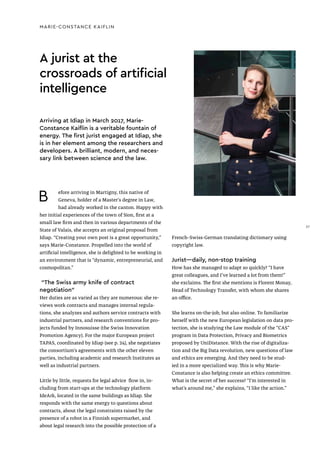
More than a year has passed since Mélanie and Guillaume began a new
adventure, joining Idiap's research and development engineering group—
two young people from very different backgrounds and a group that
stands out for its significant diversity.
Idiap's research and development group draws its
strength from the diverse interests and eclectic pro-
fessional backgrounds of its engineers. These enable
them to respond with originality and effectiveness to
the wide variety of requests that come their way from
industry and from Idiap’s own researchers. These en-
gineers also participate fully in efforts to transfer tech-
nology from research to industry—one of Idiap’s three
missions. And finally, it is worth noting, with pride,
that many engineers who have taken on roles in Swiss
or international industry come from this very team—a
fact that consolidates the links that unite Idiap with
the broader economic fabric. And that consolidation is,
itself, a highly significant achievement.
We wish Mélanie and Guillaume a rewarding and ful-
filling journey.
36
A jurist at the
crossroads of artificial
intelligence
MARIE-CONSTANCE KAIFLIN
B efore arriving in Martigny, this native of
Geneva, holder of a Master's degree in Law,
had already worked in the canton. Happy with
her initial experiences of the town of Sion, first at a
small law firm and then in various departments of the
State of Valais, she accepts an original proposal from
Idiap. “Creating your own post is a great opportunity,”
says Marie-Constance. Propelled into the world of
artificial intelligence, she is delighted to be working in
an environment that is “dynamic, entrepreneurial, and
cosmopolitan.”
“The Swiss army knife of contract
negotiation”
Her duties are as varied as they are numerous: she re-
views work contracts and manages internal regula-
tions, she analyzes and authors service contracts with
industrial partners, and research conventions for pro-
jects funded by Innosuisse (the Swiss Innovation
Promotion Agency). For the major European project
TAPAS, coordinated by Idiap (see p. 24), she negotiates
the consortium’s agreements with the other eleven
parties, including academic and research Institutes as
well as industrial partners.
Little by little, requests for legal advice flow in, in-
cluding from start-ups at the technology platform
IdeArk, located in the same buildings as Idiap. She
responds with the same energy to questions about
contracts, about the legal constraints raised by the
presence of a robot in a Finnish supermarket, and
about legal research into the possible protection of a
Arriving at Idiap in March 2017, Marie-
Constance Kaiflin is a veritable fountain of
energy. The first jurist engaged at Idiap, she
is in her element among the researchers and
developers. A brilliant, modern, and neces-
sary link between science and the law.
French–Swiss-German translating dictionary using
copyright law.
Jurist—daily, non-stop training
How has she managed to adapt so quickly? “I have
great colleagues, and I’ve learned a lot from them!”
she exclaims. The first she mentions is Florent Monay,
Head of Technology Transfer, with whom she shares
an office.
She learns on-the-job, but also online. To familiarize
herself with the new European legislation on data pro-
tection, she is studying the Law module of the “CAS”
program in Data Protection, Privacy and Biometrics
proposed by UniDistance. With the rise of digitaliza-
tion and the Big Data revolution, new questions of law
and ethics are emerging. And they need to be stud-
ied in a more specialized way. This is why Marie-
Constance is also helping create an ethics committee.
What is the secret of her success? “I’m interested in
what’s around me,” she explains, “I like the action.”
37
DISTINCTIONS
Idiap Awards
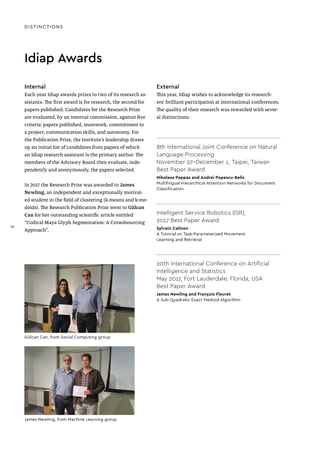
Internal
Each year Idiap awards prizes to two of its research as-
sistants. The first award is for research, the second for
papers published. Candidates for the Research Prize
are evaluated, by an internal commission, against five
criteria: papers published, teamwork, commitment to
a project, communication skills, and autonomy. For
the Publication Prize, the Institute’s leadership draws
up an initial list of candidates from papers of which
an Idiap research assistant is the primary author. The
members of the Advisory Board then evaluate, inde-
pendently and anonymously, the papers selected.
In 2017 the Research Prize was awarded to James
Newling, an independent and exceptionally motivat-
ed student in the field of clustering (k-means and k-me-
doids). The Research Publication Prize went to Gülcan
Can for her outstanding scientific article entitled
“Codical Maya Glyph Segmentation: A Crowdsourcing
Approach”.
External
This year, Idiap wishes to acknowledge its research-
ers’ brilliant participation at international conferences.
The quality of their research was rewarded with sever-
al distinctions.
8th International Joint Conference on Natural
Language Processing
November 27–December 1, Taipei, Taiwan
Best Paper Award
Nikolaos Pappas and Andrei Popescu-Belis
Multilingual Hierarchical Attention Networks for Document
Classification
Intelligent Service Robotics (ISR),
2017 Best Paper Award
Sylvain Calinon
A Tutorial on Task-Parameterized Movement
Learning and Retrieval
20th International Conference on Artificial
Intelligence and Statistics
May 2017, Fort Lauderdale, Florida, USA
Best Paper Award
James Newling and François Fleuret
A Sub-Quadratic Exact Medoid Algorithm
Gülcan Can, from Social Computing group
James Newling, from Machine Learning group
38
THESES
Theses completed
Intonation Modelling for Speech Synthesis
and Emphasis Preservation
Pierre-Edouard HONNET
January 2017
Thesis director: Prof. Hervé Bourlard
Members of the jury committee: Dr. Jean-Marc Vesin,
Dr. Philip N. Garner, Prof. Jean-Philippe Thiran,
Dr. Junichi Yamagishi, and Dr. Antonio Bonafonte
Large-Scale Image Segmentation with
Convolutional Networks
Pedro Henrique OLIVEIRA PINHEIRO
January 2017
Thesis directors: Prof. Hervé Bourlard and
Dr. Ronan Collobert
Members of the jury committee: Prof. Jean-Philippe Thiran,
Prof. Rob Fergus, Dr. Cordelia Schmid,
and Dr. Mathieu Salzmann
Object Detection with Active Sample
Harvesting
Olivier CANÉVET
February 2017
Thesis director: Dr. François Fleuret
Members of the jury commitee: Prof. Pascal Frossard,
Prof. Gilles Blanchard, Prof. Raphael Salzmann,
and Dr. Mathieu Salzmann
On Modeling the Synergy Between Acoustic
and Lexical Information for Pronunciation
Lexicon Development
Marzieh RAZAVI
August 2017
Thesis directors: Prof. Hervé Bourlard
and Dr. Mathew Magimai-Doss
Members of the jury committee: Prof. S. Süsstrunk,
Dr. K. Knill, Prof. M. Davel, and Prof. J.-Ph. Thiran
Visual Analysis of Maya Glyphs via
Crowdsourcing and Deep Learning
Gülcan CAN
September 2017
Thesis directors: Prof. Daniel Gatica-Perez
and Dr. Jean-Marc Odobez
Members of the jury committee: Dr. Denis Gillet,
Prof. Alberto del Bimbo, Prof. Rolf Ingold,
and Prof. Jean-Philippe Thiran
Five students completed their (EPFL) thesis in 2017:
Pierre-Edouard Honnet, Pedro Henrique Oliveira Pinheiro,
Olivier Canévet, Marzieh Razavi, and Gülcan Can.
39
Centre du Parc, Rue Marconi 19,
case postale 592, CH - 1920 Martigny
T +41 27 721 77 11
F +41 27 721 77 12
M info@idiap.ch
www.idiap.ch
40
scientific inserts
I — XL
SCIENTIFIC REPORT
Speech and Audio
Processing
Overview
Heads: Prof. Hervé Bourlard (MS and
PhD, Polytechnic University, Mons,
Belgium, 1982 and 1992), Dr. Philip
N. Garner (MEng, University of
Southampton, UK, 1991; PhD, University
of East Anglia, UK, 2011), Dr. Mathew
Magimai-Doss (MS by Research, Indian
Institute of Technology Madras,
India, 1999; PhD, Ecole Polytechnique
Fédérale de Lausanne, Switzerland,
2005), Dr. Petr Motlicek (MS and PhD,
Brno University of Technology, Czech
Republic, 1999 and 2003).
Group overview
Speech processing has been one of the mainstays of Idiap’s
research portfolio for many years, covering most of the as-
pects of speech processing such as multilingual automatic
speech recognition (ASR), speech synthesis, speech co-
ding, speaker identification, automatic speech intelligibi-
lity evaluation, or speech processing for classification of
motor speech disorders. The expertise and activities of the
group encompass statistical automatic speech recognition
(based on Hidden Markov Models-HMM, or hybrid systems
exploiting Deep Neural Networks-DNN and new deep lear-
ning architectures), text-to-speech (TTS), speaker recogni-
tion (with extensions towards text-dependent and forensics
scenarios) and generic audio processing (covering sound
source localization, microphone arrays, speaker diarization,
audio indexing, very low bit-rate speech coding, perceptual
background noise analysis for telecommunication systems)
and, more recently, Compressive Sensing (CS) and Sparse
Recovering theories applied to ASR.
The Speech and Audio Processing group in 2017 was com-
posed of 1 head of group, 3 principal investigators, 3 re-
search associates, 6 postdocs, 9 PhD students and 4 interns.
Key scientific outputs
Idiap has always significantly contributed to both Hidden
Markov Model (HMM) and Deep Neural Network (DNN) based
approaches applied in acoustic modelling for various speech
processing tasks. Use of techniques from HMM and HMM-
DNN based speech recognition in HMM and HMM-DNN based
speech synthesis resulted in a unified approach to speech
recognition and synthesis. The group was well placed to
take full advantage of recent advances in new architec-
tures of deep learning, studied in particular through PyTorch
and other open source frameworks. Advances in Automatic
Speech Recognition (ASR) are usually researched through
Kaldi toolkit, now used by most of the international speech
community.
In 2017, several key contributions were achieved by the
group, including: (1) multilingual speech recognition, espe-
cially in cross-lingual adaptation, and speech recognition in
low-resourced language conditions, (2) speaker recognition,
through both text-independent and particularly text-de-
pendent speaker verification scenarios and information fu-
sion for large-scale speaker identification, (3) large scale
media processing, including multilingual broadcast news re-
cognition, and spoken query for spoken term detection, and
(4) development of novel deep neural network (DNN) archi-
tectures for multilingual speech recognition.
The group has also started exploiting new Compressive
Sensing (CS) and Sparse Recovering theories to automa-
tic speech recognition, developing new theoretical links
between CS and statistical/HMMDNN approaches, resulting
in improved ASR performance, as well as new spoken term
query detection algorithms.
• 	Additional information and a list of projects are
available from www.idiap.ch/speech.
Automatic speech recognition
In recent years, our ASR research activities have been ex-
panded from mono-lingual to cross-/multilingual proces-
sing. More specifically, in addition to focusing on “majority”
languages other than English such as, French, German,
Idiap is actively carrying research in several ASR directions,
including:
→→ Robust parametrisation and acoustic modelling
We are still investigating new features (e.g., posteri-
or-based features) and new acoustic models (new forms
of hidden Markov models, such as KL-HMM, or artifi-
cial neural networks) that are more robust to noise and
acoustic environments, as well as to speaker variability
(e.g., accented speech, or dialect).
→→ Cross-lingual and multi-lingual speech recognition
The EC SUMMA project (Scalable Understanding of
Multilingual Media), as illustrated in Figure 1, aims at inte-
grating stream-based media processing tools (including
speech recognition and machine translation) with deep
language understanding capabilities (including named
entity relation extraction and semantic parsing), for
open-source applications and implemented in use cases
at the BBC and DeutscheWelle. The US IARPA SARAL
II
SPEECH AND AUDIO PROCESSING
project (Summarization and domain-Adaptive Retrieval
of Information Across Languages) aims at developing
cross-lingual retrieval and summarization techniques that
will work for any language in the world, given minimal re-
sources to work with. In those contexts, we focus on in-
vestigating and exploiting fast acoustic model adaptation
techniques in cross-lingual and multi-lingual scenarios.
The resulting speech recogniser relies on a hybrid ap-
proach, where an artificial neural network acoustic model
is boot-strapped using well-resourced data and adapted
to the target language.
→→ Swiss languages
We continuously improve our speech recognisers for
Swiss German and Swiss French and also apply the most
recent advances in speech technology employing deep
neural networks. The recognisers are also used in com-
mercial products of the Idiap spinoff recapp IT AG. Work
on speech recognition for Walliserdeutsch one of the
most difficult to understand of the Swiss dialects, was
first published in 2014; the associated database is also
available for download. Since 2015, we collaborate with
recapp IT AG on a wider range of Swiss dialects to-
wards the first commercial product that performs Swiss
Figure 1
An overview of the EC H2020 SUMMA project, a current focus
for multilingual speech recognition at Idiap.
Figure 2
Up: Overview of the EC MALORCA project; semi-supervised
adaptation of three models. Down: graphical representation of
building blocks.
Topic &
storyline
DB
Entity &
Relation
DB
Media,
documents,
& metadata
DB
Source data capture
Audio ingestion
Video ingestion
Text ingestion
Streaming shallow
processing
Speech recognition
Machine translation
Metadata extraction
Story clustering
Integration and
visualisation
Multiple views
Dashboard
Search
Review/validation
Knowledge base
construction
Entity extraction
Relation extraction
Natural language
understanding
Deep semantic parsing
Summarisation
Sentiment analysis
German (dialect) speech recognition. A collaboration
in 2017 with Swisscom enabled us to extend our Swiss
German work to serverbased large vocabulary situations,
and in tandem with translation to English and other Swiss
languages.
→→ Template-based ASR
Idiap continues to work on template-based or exem-
plar-based ASR using posterior-based features in the con-
text of projects like SNSF projects A-MUSE, PHASER, and
PHASER-QUAD, and CTI project MultiVEO1
. In this context,
there are currently two on-going efforts. The first focuses
on development of “sparse” and “low-rank” HMM frame-
works by establishing a link between statistical speech
recognition formalism and the recent theories of sparse
modelling and (probabilistic) principle component anal-
ysis (PCA). The framework integrates the advantages of
template-based modelling within the HMM sequence
matching scheme. The second effort focusses on devel-
opment of an approach that seamlessly combines both
statistical sequence model based ASR system and tem-
plate-based ASR system into a single ASR system that can
yield performance better than the best individual system.
1 	 www.idiap.ch/scientific-research/projects/multiveo
III
→→ Lexicon development
Over the past six years, Idiap has been conducting re-
search on the use of alternative subword units, specifi-
cally graphemes, and development of an ASR approach
which is capable of handling both acoustic and lexi-
cal resource constraints by learning graphemeto-pho-
neme relationship through the acoustic speech signal
(funded through the SNSF-project FlexASR and HASLER
Foundation project AddG2SU).
→→ Semi-supervised learning of acoustic and language
	 model parameters
This problem has been conducted at Idiap over several
past years, as it aims to develop a technology to (1) auto-
matically select speech data which is acoustically high-
ly informative, or (2) to automatically assess recognition
output with high confidence. This type of technology is
esential to allow semisupervised learning of speech rec-
ognition models using unlabelled data. One of the specif-
ic architecture has been developed within the EC H2020
MALORCA project 2
, combining both acoustic (i.e. speech)
and situational (i.e. radar) information to build automat-
ic speech recognition system for air-traffic controllers
(i.e. controller-pilot communication). The MALORCA pro-
ject, graphically represented in Figure 2 further focused
on technologies to automatically adapt the developed
system for new airports, while minimising human effort to
manually transcribe speech data.
→→ Punctuation prediction
As our ASR output becomes an input for processing at
higher semantic levels, for instance in the SUMMA project,
other meta-data such as punctuation becomes necessary.
ASR does not normally produce punctuation, but it is pos-
sible using similar techniques, notably language model-
ling and pause detection. More recently, this is influenced
by the encoder-decoder approaches used in machine
translation.
→→ Failure analysis of ASR and HSR decoding channels
This is a novel strategy further developed in 2017 to iden-
tify the key sources of information loss in ASR and human
speech recognition (HSR). This approach builds on the
power of DNN in probabilistic characterization of the sub-
word classes constituting a language. We cast ASR and
HSR as separate channels decoding the sequence of sub-
word components from their probabilistic representation.
Information theoretic measures are developed to assess
and quantify the information loss in acoustic modeling for
ASR decoding using hidden Markov models.
2 	 www.malorca-project.de 3 	 www.idiap.ch/project/siwis/
4 	 www.idiap.ch/scientific-research/projects/dbox
5 	 www.idiap.ch/scientific-research/projects/sp2
Speech synthesis and coding
→→ Text-to-speech synthesis (TTS):
Although newer than ASR, TTS is now an established ven-
ture for the speech group at Idiap. TTS has been central
to several projects, including: SIWIS 3
(Spoken Interaction
With Interpretation in Switzerland), D-BOX 4
and SP2 5
(SCOPES project on speech prosody). The TTS work at
Idiap was largely aligned with the statistical synthesis
trend, which uses the same technology as ASR. However,
the group has tracked the recent developments in deep
learning which will dominate future research. SIWIS
aimed to do speech to speech translation in Swiss lan-
guages, including the concept of accents. Current work
under MASS (Multilingual Affective Speech Synthesis)
brings the concept of emotion into the speech synthesis,
particularly via modelling of prosody.
→→ Speech coding
Another research area requiring TTS is speech cod-
ing, where very low bit rates can be achieved by using a
speech recogniser followed by a synthesiser. Previously,
under the RECOD project funded by Armasuisse, the
technology lends itself to operate at 200–300 bits per
second. The solution relies on deep learning characteri-
zation of the phone attribute features dubbed as phono-
logical posteriors. Recent advancement building on the
findings of the SNSF project PHASER, led to increased
efficiency of the architecture. Unique structures of the
phonological posteriors are identified as the sparse pro-
nunciation codes composing natural speech communica-
tion; a small size codebook is thus constructed and used
for ultra low-bit-rate speech coding. Moreover, work on
speech coding continued under the SP2 project, main-
ly on aspects concerning prosody. This led to the release
of the “PhonVoc” toolkit, an end-to-end neural network
based phonetic and phonological vocoder.
SPEECH AND AUDIO PROCESSING
IV
2 	 www.idiap.ch/project/floss/
6 	 www.siip.eu
7 	 www.idiap.ch/scientific-research/projects/units
Speaker recognition
and speech data analytics
In the context of the European SIIP project 6
, illustrated by
Figure 3, the Speech and Audio Processing group has signi-
ficantly improved their capabilities in suspect identification
applicable to very large scale data. The SIIP technology has
successfully passed three proof-of-concept and field-test
events in 2016 and 2017, demonstrating the performance of
the developed technology among the key stakeholders. The
developed suspect identification solution can analyse not
only lawfully intercepted calls, but also multiple types of so-
cial-media channels. SIIP has also developed a framework al-
lowing to combine evidences extracted by different types
of engines (i.e. inter-task engines such as language/accent/
gender/age identification, or keyword-spotting) to eventual-
ly improve speaker identification.
As discussed in Section 8, and as part of the SNSF Project
UniTS 7
, the group is also contributing to the Biometric
Person Recognition group, including the development of
countermeasures to detect attacks on speaker verification
systems through forged speech samples.
Figure 3
Illustration of SIIP speaker identification system exploiting law-
fully intercepted calls, including multiple types of social-media
information streams.
Forensic speaker verification
and audio analysis
In 2017, Idiap continued its work in audio forensic sciences,
aiming to extract relevant evidences from speech and audio
signals that may be ultimately presented as admissible fact
in a court of law. Besides a task of enhancement of speech
recordings to improve the intelligibility, we have mostly fo-
cused on forensic voice comparison to determine the iden-
tity of the speaker associated with the strength of evidence.
Idiap collaborates with various law enforcement agencies in
Switzerland (e.g. Federal and cantonal Police) and abroad to
provide direct support in analysing strength of evidences.
Large scale spoken query retrieval
→→ Query-by-example spoken term detection (QbE-STD) 	
	 based on subspace modelling and detection
Mainly exploiting its knowhow in Deep Neural Networks
(DNN) and sparse recovery modeling, Idiap continues its
research efforts towards keyword spotting and spoken
term detection with a focus on searching large audio ar-
chives using spoken queries. Over the past 12 months,
Idiap has developed pioneering retrieval solutions relying
on the characterization and detection of the low-dimen-
sional subspace of the DNN phonetic posteriors.
→→ Large scale spoken query indexing
In 2017, Idiap further developed a powerful methodology
for large-scale spoken query retrieval relying on hashing.
Contribution of hashing is two-fold: (1) Compressing the
information bearing data characteristic and (2) Identifying
a data-driven symbolic space for effective search. Idiap
hashing solution relies on DNN representation learning
at sub-phonetic attribute level to facilitate cross-lingual
applications.
→→ Objective speech intelligibility assessment
Over the past two years, Idiap has been actively develop-
ing novel methods to objectively assess intelligibility of
speech signal. This work is now exploited in the context
of HASLER Foundation project FLOSS2
and the pathologi-
cal speech processing activities discussed below.
Pathological speech processing
In 2017, a new research track, focusing on the processing of
pathological speech, was initiated at Idiap, mainly through
two new projects:
→→ MoSpeeDi (Motor Speech Disorder) SNSF Sinergia pro-
ject: aiming at characterizing phonetic speech planning
and motor speech programming/execution and their im-
pairments, in collaboration with Marina Laganaro, Faculty
of Psychology and Educational Science, University of
Geneva, Cécile Fougeron, Laboratoire de Phonétique
et Phonologie, Paris 3-Sorbonne Nouvelle, and Frédéric
Assal, Neurology, Geneva University Hospitals and
Faculty of Medicine, University of Geneva.
→→ EC TAPAS (Training Network on Automatic Processing
of PAthological Speech) coordinated by Idiap: target-
ing three key research problems, (1) detection (develop
speech processing techniques for early detection of con-
ditions that impact on speech production), (2) therapy
(using newly-emerging speech processing techniques to
produce automated speech therapy tools), and (3) assist-
ed Living (redesigning current speech technology so that
it works well for people with speech impairments and
also helps in making informed clinical choices.
SPEECH AND AUDIO PROCESSING
V
8 	 www.idiap.ch/scientific-research/projects/smile
Sign language recognition
and assessment
In the context of SNSF Sinergia project SMILE,8
Idiap has
been conducting research on sign language recognition and
assessment. The consortium project coordinated by Idiap in-
volves partners from HfH, Zurich and University of Surrey,
UK. The end goal of the project is to develop a sign lan-
guage assessment system that can assist Swiss German sign
language learners as well as aid in standardizing a vocabu-
lary production test that can be aligned with levels A1 and
A2 of the Common European Framework of Reference for
Languages (CEFR).
Sound localization
and microphone array
In 2017, our research activities in the area of microphone
array based speech processing and speaker diarization were
mainly addressing the problem pf source localization and
speech detection and also reconstruction through binary
sparse coding framework. In 2017, the group has also contri-
buted to the Perception and Activity Understanding group
through EC H2020 MuMMER project, focusing on audio
source localization applied in robotics.
Key publications
[1]	 P.-E. Honnet, B. Gerazov, A. Gjoreski, and P. N. Garner,
“Intonation modelling using a muscle model and-
perceptually weighted matching pursuit”, Speech
Communication, Vol. 97, 2018.
[2]	 D. Ram, A. Asaei, and H. Bourlard, “Sparse Subspace
Modeling for Query by Example Spoken Term
Detection,” to be published in IEEE/ACM Transactions
on Audio, Speech, and Language Processing, March
2018.
[3]	 A. Asaei, C. Milos, and H. Bourlard, “Perceptual
Information Loss due to Impaired Speech Production”,
IEEE/ACM Transactions on Audio, Speech, and
Language Processing, Issue: 99, August 2017.
[4]	 M. Razavi, R. Rasipuram and M. Magimai-Doss,
"Towards Weakly Supervised Acoustic Subword Unit
Discovery and Lexicon Development Using Hidden
Markov Models", Speech Communication, Volume 96,
February 2018, Pages 168-183
[5]	 S. Tong, P. Garner, and Bourlard, “An Investigation
of Deep Neural Networks for Multilingual Speech
Recognition Training and Adaptation”, Proc. of
Interspeech”, Proceedings of Interspeech, Stockholm,
Sweden, 2017.
[6]	 S. Dey, P. Motlicek, S. Madikeri, and M. Ferras,
“Exploiting Sequence Information for Text-Dependent
Speaker Vefirication”, Proc. of 2017 IEEE Intl.Conference
on Acoustics, Speech, and Signal Processing (ICASSP),
New Orleans, pages 5370-5374, 2017.
SCIENTIFIC REPORT
Machine Learning
Overview
Head: Dr. François Fleuret (MS École
Normale Supérieure and University of
Paris VI, 1995; PhD, University of Paris
VI, 2000; Habilitation, University of
Paris XIII, 2006; EPFL MER)
Group overview
Machine learning encompasses computer techniques that
aim at learning automatically representations and decision
rules from data. It lies at the intersection between statistics,
algorithmics, and signal processing. The main objective of
the Machine Learning group is the development of novel ma-
chine-learning and statistical methods, with a strong empha-
sis on their algorithmic efficiency.
The application domain for the methods we develop in-
cludes image and video processing, but also industrial sen-
sor analysis and sequence modeling.
The group was composed in 2017 of one head of group, two
post-doctoral researchers, five PhD students, one intern,
and it had strong interactions with the software develop-
ment team. François Fleuret is also the supervisor of one phd
student from the EPFL Space Engineering Center, and the
co-supervisor of two phd students from the EPFL Computer
Vision lab.
Key scientific outputs
In 2017, our work has resulted in contributions that improved
the state-of-theart for large-scale clustering, planetary sur-
face reconstruction from stereo images, knowledge transfer
between large neural networks, training of generative ad-
versarial models, and modeling of sequences with recurrent
neural networks.
• 	Additional information and a list of projects are
available from www.idiap.ch/ml.
VI
MACHINE LEARNING
Efficient Machine learning
→→ Large-scale clustering
The k-means algorithm is one of the cornerstones of ma-
chine learning for real-world applications, in particular
for large-scale training. Over the recent years, several ap-
proaches have been developed based on the triangu-
lar inequality to avoid computing distances when simple
bounds insure that it is not necessary.
In the context of the MASH2 project funded by the Hasler
foundation, we have first improved these exact bounds,
and reduced the computational complexity of virtually all
state-of-the-art methods, gaining up to a factor of two.
We also have developed a novel exact algorithm which
is the fastest in low dimension. In parallel, we have inves-
tigated the “batch” approaches, and proposed a new al-
gorithm combining the triangular inequality and batches
of increasing size. It resulted in a very powerful scheme
that reuses computation already done over samples until
statistical accuracy requires the use of additional data
points.
→→ Sub-linear hard sample extraction
Virtually every state-of-the-art detection algorithm is
trained in a sequential manner, improving it iterative-
ly with samples miss-classified by its previous version.
In the SNSF project DASH, we were interested in speed-
ing-up this "hard sample" extraction. Our approach con-
sisted of using the prior structure provided for any large
collection of images as a recursive decomposition into
homogeneous sub-families to concentrate computation
in a principled manner. We adapted the Monte-Carlo Tree
Search to recursively apply a bandit approach to the ex-
ploration-exploitation dilemma.
In the ongoing ISUL SNSF project, we are investigating a
novel approach that bypasses the need for prior knowl-
edge, and instead relies on an efficient approximation of
a sample’s importance, combined with a sound estimate
of the actual speed gain to expect. This allows us to ac-
tivate our procedure only when the trade-off between
speed and accuracy is beneficial.
→→ High-dimension similarity measures
The SNF WILDTRACK project was a collaboration be-
tween Idiap, EPFL and ETHZ around the design of a robust
multi-camera pedestrian tracking system.
One core component of such a system is a re-identifica-
tion algorithm to automatically associate a person leaving
and later re-entering the camera field of view. This boils
down to learning a metric, so that a small distance be-
tween two images is a reliable indicator that the person
is the same on both, and large values is a reliable indica-
tor these are different persons.
The technique we have developed casts this learning as a
rank optimization problem with a regularizer that enforc-
es the linear projection to remain well-conditioned. Our
method allows very large scale learning and beats all ex-
isting state-of-the-art methods on standard benchmark
data-sets.
Figure 4
Person detection obtained with a deep neural network, and the
corresponding occupancy map estimates.
Figure 5
Face alignment examples with
qualitative visibility estima-
tion. The color from green to
red indicates the visible confi-
dence from high to low.
Figure 6
We have developed a novel strategy to find informative training ex-
amples in an image, that concentrates the computation on difficult
images and parts of images to train an object detector (left), and on
difficult and unusual examples to train an image classifier (right).
3
4
4
5
1
4
8
3
VII
Deep learning
→→ Depth estimation for planetary surface reconstruction
In the framework of the NCCR PlanetS, and in collabora-
tion with the EPFL eSpace center, we are developing a
new algorithm to reconstruct the surface of Mars, given
images provided by the ExoMars Trace Gas Orbiter. State-
of-the-art methods use machine-learning to automatical-
ly match corresponding pairs of images, to estimate the
depth of the surface that has been imaged. We improve
upon existing technique by relaxing the need for a super-
vised training set, and using instead crude prior knowl-
edge about the general topography of the planet. This
will allow in the future to leverage very large unlabeled
training sets.
→→ Deep learning for multi-camera detection
We have developed in the MEMUDE project funded by
the Hasler Foundation a new approach to adapt a monoc-
ular deep-learning detector to a multi-camera context.
We first fine-tune it to the problem of person detection,
and then fine-tune a Siamese network with one such mo-
nocular structure per view on a small multi-view data-set.
This staging from a very large generic data-base to a
small specific multi-view person data-set allows to beat
existing state-of-the art multi-view methods.
→→ Generative Adversarial Networks
A very promising family of methods are the so called
“Generative Adversarial Networks”, which rely on training
jointly two models, one synthesizing realistic signals (im-
ages, sound, text) and another trying to discriminate the
synthetic signal from the genuine one. Such techniques
have demonstrated striking performance in many applica-
tion domains, but involve a complex and unstable optimi-
zation problem.
We have developed a new method that consists of train-
ing several such pairs in parallel, and maintaining carefully
their statistical independence. This insures that their joint
behavior has a good “covering” property, and we show
experimentally that the resulting synthesis is less likely to
miss sub-families of samples.
→→ Manufacturing quality control
High-end manufacturing requires accurate quality con-
trol, which results in a difficult computer vision problem:
while “good” examples are plentiful and quite predicta-
ble, the failures are rare and diverse.
We have developed a model able to learn from the cor-
rect examples a efficient representation, specific to their
appearance. The poor performance of this representa-
tion when it encodes a defective example provides an ef-
ficient detection criterion.
→→ Multi-modal accurate face localization for identification
A standard pre-processing used to improve face recog-
nition consists of localizing accurately face landmarks in
order to register feature extraction with respect to them.
In recent works, we have extended a state-of-art proce-
dure to a multi-modal context where both a RGB image,
near-infrared image, and a depth-map are available.
Doing so improves performance drastically, in particular
when dealing with poor lighting conditions.
→→ Low-computation Drone Detection
In a collaboration with ArmaSuisse, we have investigated
the development of efficient neural networks for drone
detection in video feeds captured by in-flight drones. The
main objective of this project was to adapt object detec-
tors to the limited computation capabilities of embedded
hardware, usually one order of magnitude less power-
ful than standard hardware for machine learning. Our ap-
proach consists in penalizing during training the use of
large number of parameters, pushing the process toward
the removal of certain sub-structures of the model identi-
fied as less useful in the inference.
Key publications
[1]	 J. Newling and F. Fleuret. K-Medoids For K-Means
Seeding. In Proceedings of the international confer-
ence on Neural Information Processing Systems (NIPS),
2017.
[2]	 S. Tulyakov, A. Ivanov, and F. Fleuret. Weakly
Supervised Learning of Deep Metrics for Stereo
Reconstruction. In Proceedings of the IEEE
International Conference on Computer Vision (ICCV),
pages 1348–1357, 2017.
[3]	 P. Baqué, F. Fleuret, and P. Fua. Deep Occlusion
Reasoning for Multi-Camera Multi-Target Detection. In
Proceedings of the IEEE International Conference on
Computer Vision (ICCV), pages 271–279, 2017.
[4]	 T. Chavdarova and F. Fleuret. Deep Multi-Camera
People Detection. In Proceedings of the IEEE
International Conference on Machine Learning and
Applications (ICMLA), pages 848–853, 2017.
[5]	 J. Newling and F. Fleuret. A Sub-Quadratic Exact
Medoid Algorithm. In Proceedings of the internation-
al conference on Artificial Intelligence and Statistics
(AISTATS), pages 185–193, 2017. (Best paper award).
MACHINE LEARNING
VIII
SCIENTIFIC REPORT
Social Computing
Overview
Head: Prof. Daniel Gatica-Perez (PhD,
University of Washington, USA, 2001;
EPFL Adjunct Professor)
Social computing is an interdisciplinary domain that inte-
grates theory and models from ubiquitous computing, so-
cial media, machine learning, and social sciences to analyze
human and social behavior in everyday life, and to create de-
vices and systems that support social interaction.
The Social Computing group in 2017 was composed of one
group head, four postdoctoral researchers, three PhD stu-
dents, one intern, and three EPFL master students. Research
lines investigated in 2017 included: social media analytics
and mobile crowdsourcing for cities and health, ubiquitous
conversational interaction analysis, and analysis of Maya hie-
roglyphic media.
→→ Key scientific outputs
Publications on (1) social media analytics and mobile and
online crowdsourcing to understand youth nightlife pat-
terns, urban perception in cities, and eating patterns in
everyday life; (2) multimodal analysis of soft skills in face-
to-face employment interviews and hospitality service en-
counters; and (3) Maya hieroglyphic visual analysis. 13 EPFL
PhD students have graduated from the group since 2002.
• 	Additional information and a list of projects are
available from www.idiap.ch/socialcomputing.
Social media analytics and mobile
crowdsourcing for cities and health
Our work in this domain spans several research lines. First,
as part of the SNSF Youth@Night and Dusk2Dawn pro-
jects 9
(Multidisciplinary Study of Young People’s Going Out
and Drinking Behaviors, in collaboration with Addiction
Switzerland and the University of Zurich), we investigated
the use of mobile crowdsourcing and social media analytics
to characterize urban phenomena, both in Switzerland and
other world regions.10
This included the automatic recogni-
tion of place ambiance from social media images using deep
learning [1] (Figure 7), and automatic recognition of drinking
activity from smartphone sensor data, for a population of
200 young volunteers in Switzerland.
Regarding mobile crowdsourcing and health, in the context
of the Bites-n-Bits project 11
(Understanding Eating Routines
in Context, in collaboration with Nestle Research Center), we
developed a smartphone sensing app to collect everyday
life data about eating and drinking for a population of 120
college students, and used it to build an approach for re-
cognition of eating occasions [2]. Furthermore, using visual
social media (Instagram) as data source, we analyzed ea-
ting and drinking patterns in the context of the Social Food
and People project 12
. (supported by EPFL Integrative Food
Science and Nutrition Center.)
Regarding mobile crowdsourcing for social innovation, we
continued our work using the Civique platform 13
(Mobile
Data for Local Causes), which included its use for teaching
students about humanitarian technologies 14
, and to collect
multimedia data from Swiss heritage speakers living in the
USA 15
(in a collaboration with the University of Lausanne,
supported by the UNIL-EPFL Program on Collaborative
Research on Science and Society). Finally, our work in Latin
America on mobile crowdsourcing for youth engagement
on local urban issues was expanded through a collaboration
with institutions in Mexico and Colombia [3]. Other collabo-
rations using the Civique platform are under development.
9 	 www.youth-night.ch
10 	www.youtube.com/watch?v=71ht15VAoLw
11 	 www.bitesnbits.org
12 	www.idiap.ch/en/allnews/what-does-instagram-reveal-about-
food-consumption-in-switzerland
13 	www.civique.org
12 	www.idiap.ch/en/allnews/
what-does-instagram-reveal-about-food-consumption-in-switzerland
14 	www.idiap.ch/en/allnews/understanding-how-technology-
can-revolutionize-humanitarian-work
15	 wp.unil.ch/sina/
Figure 7
Up: Youth@Night survey logger app. Down: Social media
images classified as Restaurant and Stage by convolution-
al neural network.
IX
SOCIAL COMPUTING
Ubiquitous interaction analytics
In the context of the SNSF UBImpressed project 16
(Ubiquitous Frist Impressions and Ubiquitous Awareness), we
have developed methods to analyze dyadic interactions in
the workplace using multiple sensors (cameras, Kinect de-
vices, microphone arrays, smartphones, and wearables), and
to infer variables like perceived hirability and performance
(Figure 8). This is joint work with the University of Lausanne
and Cornell University, in partnership with Vatel Switzerland
Hotel Management School. Specifically, we found connec-
tions between automatically measured nonverbal beha-
vior (including speaking activity, prosody, head activity, and
body motion) and impressions in job interviews and hospita-
lity service encounters [4]. Some of this work will be transfe-
red to industry in the context of a new CTI project.
Figure 8
Sensors available in the social sensing lab. Kinect V2,
Microcone, Q-Sensor, Android smartphone, Google Glass.
Figure 9
Left: Convex hull of the segmentation ground truth for the target glyph (red
line, blue filling). Center: Gray-scale image of aggregated segmentations
generated by online crowdworkers. Right: Final aggregated segmentation.
16 	www.idiap.ch/project/ubimpressed
17 	www.idiap.ch/project/maaya
18	 lab.idiap.ch/maaya/
19	 www.idiap.ch/en/allnews/maya-glyph-analysis-on-horizons-magazine
Visual analysis of Maya hieroglyphs
In the context of the SNSF MAAYA project 17
(Multimedia
Analysis and Access for Documentation and Decipherment
of Maya Epigraphy), we developed methods for visual ana-
lysis of hieroglyphs in ancient codices 18
. Specifically, we de-
signed a methodology that included crowdsourced glyph
localization and segmentation by non-experts for data labe-
ling, and deep learning for visual recognition [5] (Figure 9).
This included visualization of the output of deep networks
for interpretation of the learned visual representations. Our
work was covered by Horizons Magazine, the scientific mag-
azine of the SNSF and the Swiss Academies of Arts and
Sciences 19
.
Key publications
[1]	 Y. Benkhedda, D. Santani, and D. Gatica-Perez, “Venues
in Social Media: Examining Ambiance Perception
Through Scene Semantics,” in Proc. ACM Int. Conf. on
Multimedia (MM), Mountain View, Oct. 2017.
[2]	 J.-I. Biel, N. Martin, D. Labbe, and D. Gatica-Perez,
“Bites’n’Bits: Eating Behavior in Context from Mobile
Data,” PACM on Interactive, Mobile, Wearable, and
Ubiquitous Technologies (IMWUT), Vol. 1, No. 4, Dec.
2017.
[3]	 S. Ruiz-Correa, D. Santani, B. Ramirez Salazar, I. Ruiz
Correa, F. Alba Rendon-Huerta, C. Olmos Carrillo, B.
C. Sandoval Mexicano, A. H. Arcos Garcia, R. Hasimoto
Beltran, and D. Gatica-Perez, “SenseCityVity: Mobile
Sensing, Urban Awareness, and Collective Action in
Mexico,” IEEE Pervasive Computing, Special Issue on
Smart Cities, pp. 44-53, Apr.-Jun. 2017.
[4]	 S. Muralidhar, M. Schmid Mast, and D. Gatica-Perez,
“How May I Help You? Behavior and Impressions in
Hospitality Service Encounters,” in Proc. ACM Int. Conf.
on Multimodal Interaction (ICMI), Glasgow, Nov. 2017.
[5]	 G. Can, J.-M. Odobez, and D. Gatica-Perez, “Codical
Maya Glyph Segmentation: A Crowdsourcing
Approach,” IEEE Trans. on Multimedia, published online
Sep. 2017, Vol. 20, No. 3, pp. pp. 711-725, Mar. 2018.
X
SCIENTIFIC REPORT
Perception
and Activity
Understanding
Overview
Head: Dr. Jean-Marc Odobez (Engineer
degree, ENST Bretagne, 1990; Ms in
Signal Processing, Rennes University,
1990; PhD, University of Rennes, France,
1994; EPFL MER)
Group overview
The Perception and Activity Understanding group conducts
research in human activities analysis from multi-modal data.
This entails the investigation of fundamental tasks like the
detection and tracking of people, the estimation of their
pose or the detection of non-verbal behaviors, and the tem-
poral interpretation of this information in forms of ges-
tures, activities, behavior or social relationships. These
tasks are addressed through the design of principled algo-
rithms extending models from computer vision, multimodal
signal processing, and machine learning, in particular pro-
babilistic graphical models and deep learning techniques.
Surveillance, traffic and human behavior analysis, human-ro-
bot interactions, and multimedia content analysis are the
main application domains.
In 2017, the group was composed of one group head, four
post-doctoral researchers, six PhD students.
Key scientific outputs
The group is well known for its work on video sequence ana-
lysis, probabilistic tracking, non-verbal behavior extraction
(in particular attention modeling), and temporal motif dis-
covery. In 2007, the Klewel company was created using its
OCR technology. In 2015 and 2016, the PAU team ranked
first at the MediaEval Person discovery challenge. In 2016, its
work on 3D face and gaze tracking from cheap RGB-Depth
sensors has been patented and has led to the creation of the
Eyeware start-up company. Besides the consolidation of his
ground work, the group has investigated deep learning me-
thods for several tasks like gesture recognition, audio-visual
speaking activity modeling, gaze, joint audio localization
and speech/non-speech detection, body landmark detec-
tion using depth data, and multimedia processing (cross-mo-
dal transfer learning, shape recognition, text localization).
It is also working on the integration of its sensing techno-
logy and algorithms into real-time perceptual systems for
human-robot interaction (Pepper platform, EU MuMMER pro-
ject), or to companies (e.g. anti-tailgating detection system).
During the period 2013-2017, the group published 17 journal
papers and more than 40 conference papers.
• 	Additional information and a list of projects are
available from www.idiap.ch/perception.
Deep learning
→→ Gesture Recognition. In [5] we studied multimodal Deep
Dynamic Neural Networks (DDNN) for the segmentation
and recognition of short spontaneous communicative
gestures, as illustrated in Fig. 10a. We adopted a semi-su-
pervised hierarchical approach based on statistical
temporal models relying on high-level spatio-temporal
gesture representations trained using deep neural net-
works suited to the input modalities (dynamics of skeletal
joint information (Fig. 10b), fusion of batches of depth
and RGB images (Fig. 10c).
Figure 10
Multimodal gesture recognition from RGB-D data, using deep-learn-
ing methods. a) Spontaneous communicative gestures to be
recognized. b) Encoding of the skeleton information with Restricted
Bolzman Machines. c) CNN models of visual and depth hand data.
a b
c
XI
Figure 11
Up: Semantic Text Segmentation Network (STSN) trained with
synthetic and real data, that apart from localizing text in images
with high accuracy also classifies text regions in different se-
mantic categories (title, bullets, standard text), and then further
recognizes text (OCR). Down: Heads are tracked, eye localized
and aligned before inferring gaze and attention towards people or
other semantic labels (all information analysed in 3D).
Figure 12
Multiple sound source localization for HRI. a) Encoding the
network outpout as likelihood. b) Neural network architecture,
mapping pairwise generalized-cross-correlation features to the
direction of arrival. c) Sample result on real HRI data from the
pepper robot.
a b
c
→→ Semantic text recognition (OCR). In the context of the
CTI funded VIEW project, we investigated deep learning
methods for the detection, segmentation, categoriza-
tion and recognition of text content in presentations,
allowing further semantic tagging (see Fig. 11). Models
and systems are being transfered to the Klewel company,
improving the internet referencing and visibiliy of the
recorded and broadcast presentations of its client.
→→ Audio analysis. In the context of the EU MuMMER project
on social robotics, we have investigated the use of dif-
ferent DNN architectures for the localization of multiple
speech sources, a situation that can often arise when the
robot has to deal with multiple people. By encoding the
potential sound source locations using a likelihood ap-
proach (Fig. 12a), exploiting a hierarchical approach (per
band prediction, then fusion, Fig. 12b), the network can
learn to simultaneously localize multiple sound sources
(Fig. 12c). Methods were demonstrated to perform much
better than state-of-the-art signal-processing based
approaches (GCC or SRP-PHAT and other models or
variants).
We also investigated deep-temporal representations for
the modeling of audio-visual speaking activities, e.g. for
differentiate dubbing from genuine talking situations for
instance.
→→ Shape representation of Maya glyphs. In the context
of the SNSF MAYA project and in collaboration with the
Social Computing group we investigated crowdsourcing,
vizualisation and deep learning methods for the data
labeling, shape representation, and glyph analysis in
ancient Codices (see Fig. 9).
Multiple object tracking
Our previous works resulted in an enhanced Conditional
Random Field tracking-by-detection framework with impor-
tant characteristics making it successful for person or face
tracking in challenging conditions: long-term pairwise links,
pairwise cue measurement costs sensitive to the time inter-
val between two detections, integration of multi-cue asso-
ciation reliability factors, and unsupervised learning.
PERCEPTION AND ACTIVITY UNDERSTANDING
XII
Figure 13
Robust head pose tracking. a) Example of automatically re-
constructed heads. b) Tracking results in adverse conditions
(UBImpressed registration desk set-up). c) Tracking results in an
HRI situation (image taken from the Pepper robot).
a b
c
Gaze, non-nerbal behavior extraction,
human-robot interactions
Our long-standing work on NVB perception has been
extended in several ways. In the context of the Swiss
UBImpressed project, In [1] we have worked on robust and
accurate head pose tracking from RGB-D data. Combining
the benefits of the online fitting of a 3D face morphable
model with the online 3D reconstruction of the full head (Fig.
13a), the approach provides more support when handling
extreme head poses, like for the analysis of difficult registra-
tion desk sequences (SNSF Sinergia UBImpressed project,
Fig. 13b), or multiple interacting people in HRI (MuMMER pro-
ject, Fig. 13c).
Our long-term research on gaze estimation from cheap
RGB-D (depth) cameras like Kinect [4] has been pursued. We
investigated online techniques leveraging social situations
to compute parameters of a gaze bias correction model. This
improved gaze coding from 56% accuracy to 85% on seve-
ral dozen hours of data. Figure 11 illustrates the result of ap-
plying our tools for gaze coding in multiparty situations.
We continue improving our real-time multi-person percep-
tion system (Pepper robot in the EU MuMMER project), with
features including tracking, pose estimation, re-identifica-
tion, extraction of non-verbal cues (attention, head ges-
tures), as well as speech sound localization.
Multimodal face and person
diarization and naming
Identifying people appearing and speaking in multimedia
data as we have done in the EUMSSI EU project allows to
monitor who said what and when and is thus important for
the design of search and fast browsing tools of or broadcast
programs. On addition to face tracking, clustering, audio-vi-
sual association, and dubbing detection, we investigated this
year domain cross-modal domain adaptation and transfer
learning methods for improving the estimation of short utte-
rance speaker embedding leveraging face embeddings [3].
Key publications
[1]	 Y. Yu, K. Funes and J.-M Odobez. HeadFusion:
360oHead Pose tracking combining 3D Morphable
Mode and 3D Reconstruction IEEE Trans. Pattern Anal.
Mach. Intell., accepted for publication, 2017.
[2]	 G. Can, J.-M. Odobez, and D. Gatica-Perez. Codical
Maya Glyph Segmentation: A Crowdsourcing
Approach, IEEE Trans. on Multimedia, published online
Sep. 2017, Vol. 20, No. 3, pp. pp. 711-725, Mars 2018.
[3]	 N. Le and J.-M. Odobez. A Domain Adaptation
Approach to Improve Speaker Turn Embedding Using
Face Representation, In Int. Conf. on Multimodal
Interactions (ICMI), 2017.
[4]	 K. Funes and J.-M Odobez. Gaze estimation in the
3d space using rgb-d sensors: Towards head-pose
and user invariance. Int. Journal of Computer Vision,
118(2):194–216, june 2016.
[5]	 D. Wu, L. Pigou, P.-J. Kindermans, N. Le, L. Shao, J.
Dambre, and J.-M. Odobez. Deep dynamic neural
networks for multimodal gesture segmentation and
recognition, IEEE Trans. Pattern Anal. Mach. Intell.,
38(8):1583–1597, 2016.
PERCEPTION AND ACTIVITY UNDERSTANDING
XIII
Robot Learning
and Interaction
Overview
Head: Dr. Sylvain Calinon (MS and PhD,
EPFL, 2003 and 2007)
Group overview
The Robot Learning and Interaction group, created in 2014,
focuses on humancentric robotic applications in which the
robots can learn new skills by interacting with the end-users.
From a machine learning perspective, the challenge is to ac-
quire skills from only few demonstrations and interactions,
with strong generalization demands. It requires the develop-
ment of intuitive active learning interfaces to acquire mea-
ningful demonstrations, the development of models that can
exploit the structure and geometry of the acquired data in
an efficient way, and the development of adaptive control
techniques that can exploit the learned task variations and
coordination patterns.
The Robot Learning and Interaction group in 2017 was com-
posed of one postdoctoral fellow, four PhD students, three
MSc students, five BSc students and one trainee.
Key scientific outputs
Development of robot learning and adaptive control algo-
rithms that can be applied to a wide range of applications,
for robots that are either close to us (assistive robots in
IDRESS), parts of us (prosthetic hands in TACT-HAND), or far
away from us (manipulation skills in deep water in DexROV).
Attentive to reproducible research, the group regularly re-
leases open source codes accompanying its publications at
www.idiap.ch/software/pbdlib/.
• 	Additional information and a list of projects are
available from www.idiap.ch/rli.
Probabilistic models of
movements and skills
In many robotics applications, demonstrations or expe-
riences are sparse. In such situation, it is important to get
as much information as possible from each demonstration.
We explore approaches encoding demonstrations from the
perspective of multiple coordinate systems. This is achieved
by providing a list of observers that could potentially be re-
levant for the movement or the task to transfer. A statistical
learning approach is then used to determine the variability
and coordination patterns in the movement by considering
different coordinate systems simultaneously. This approach
allows the orchestration of multiple coordinate systems to
reproduce movements in new situations (typically, to adapt
a movement to new positions of objects). The proposed
task-parameterized model exploits the structure of the
Figure 14
Human-centric robotic applications. a) Teleoperation assistance
for the control of a bimanual robot (DexROV project), where the
robot assists the teleoperator when repetitive or structured tasks
are detected, as a form of human-robot collaboration. For example,
if the robot observes that the task of drilling requires the drill to
be perpendicular when it approaches a surface, the robot will then
automatically orient the drill when it approaches another surface,
letting the teleoperator concentrate on the position to drill while
letting the robot maintain the correct orientation. b) Personalized
assistance in dressing (IDRESS project), where the robot learns by
demonstration the preferences and type of assistance required by
each user. This is achieved by extending the movement primitives
frequently employed in robotics to a wider repertoire of skills com-
posed of reactive behaviors based on force, impedance, position and
orientation. c) Online learning and adaptive control of a prosthetic
hand (TACT-HAND project), where electromyography and tactile
sensing data are combined to control a prosthetic hand.
a b
c
A distinctive view of optimal control
Model predictive control (MPC) is ubiquitous in robot
control, but the core formulation of this control problem and
its associated algorithms can be extended to a wider range
of problems, which has often been overlooked in robot lear-
ning. In particular, the most simple form of MPC (uncons-
trained and linear, with a homogeneous double integrator
system) already has advantage for motion synthesis and
planning problems, where it can be combined elegantly
task, which can in many robotics problems be expressed in
the form of coordinate systems or local projections. It was
shown that such approach provides better generalization
capability than conventional regression.
SCIENTIFIC REPORT
XIV
Figure 15
Task-parameterized model to synthesize movements in new situ-
ations. a) Observation in different situations to extract the under-
lying structure of the task. b) Probabilistic encoding of the task in
multiple coordinate systems. c) The cross-situational observations
are used to adapt the motion to new situations. d) Model predic-
tive control strategy to reproduce the movement by exploiting the
retrieved variability and correlation information.
Figure 16
Statistics and control on Riemannian manifold. From left to
right and top to bottom: Encoding as Gaussian mixture model,
fusion of information with product of Gaussians, linear quadratic
tracking, and example of application consisting of learning and
tracking manipulability ellipsoids (symmetric positive definite
matrices), which are used to find poses that a robot should adopt
to face external perturbations.
Geometry-aware statistical
learning and control
The data encountered in robotics are characterized by
simple but varied geometries, which are often underex-
ploited when developing learning and control algorithms.
Such data range from joint angles in revolving articulations,
rigid body motions, orientations represented as unit quater-
nions, sensory data processed as spatial covariance features,
or other forms of symmetric positive definite matrices such
as inertia or manipulability ellipsoids. Moreover, many appli-
cations require these data to be handled altogether.
We exploit Riemannian manifold techniques to extend algo-
rithms initially developed for Euclidean data, by efficiently
taking into account prior knowledge about these mani-
folds and by modeling joint distributions among these he-
terogeneous data. The use of these differential geometry
with probabilistic representations of movements. This meth-
od allows the retrieval of smooth and natural trajectories an-
alytically, by taking into account variation and coordination
constraints. Instead of learning trajectories directly, the ap-
proach allows the learning of the underlying controllers to
drive the robot. Namely, it learns to reject perturbations only
in the directions that would affect task performance (min-
imal intervention control). This can typically be exploited
with torque-controlled robots to regulate the tracking gain
and compliance required to reproduce a task in an adaptive
manner.
techniques allow us to treat data of various forms in a unified
manner (including data in standard Euclidean spaces). It can
typically be used to revisit common optimization problems
in robotics formulated in standard Euclidean spaces, by trea-
ting them as unconstrained problems inherently taking into
account the geometry of the data.
ROBOT LEARNING AND INTERACTION
Key publications
[1]	 Pignat, E. and Calinon, S. (2017). Learning adaptive
dressing assistance from human demonstration.
Robotics and Autonomous Systems, 93, 61–75.
[2]	 Jaquier, N., Connan, M., Castellini, C. and Calinon,
S. (2017). Combining Electromyography and Tactile
Myography to Improve Hand and Wrist Activity
Detection in Prostheses. Technologies, 5:4, Special
Issue on Assistive Robotics.
[3]	 Zeestraten, M.J.A., Havoutis, I., Silvério, J., Calinon, S.
and Caldwell, D.G. (2017). An Approach for Imitation
Learning on Riemannian Manifolds. IEEE Robotics and
Automation Letters (RA-L), 2:3, 1240–1247.
[4]	 Calinon, S. (2016). A Tutorial on Task-Parameterized
Movement Learning and Retrieval. Intelligent Service
Robotics, 9:1, 1–29.
[5]	 Berio, D., Calinon, S. and Leymarie, F.F. (2017).
Generating Calligraphic Trajectories with Model
Predictive Control. In Proc. of the 43rd Conf. on
Graphics Interface, pp. 132–139.
XV
Uncertainty
Quantification and
Optimal Design
Overview
Head: Prof. David Ginsbourger (Ph.D.
Mines Saint-Etienne 2009, Habilitation
Universität Bern 2014, Titularprofessor
Universität Bern 2018)
Group overview
The Uncertainty Quantification and Optimal Design
group focuses on quantifying and reducing uncertainties
in the context of natural and artificial complex systems.
Application domains notably include energy and geos-
ciences, with a number of collaborations ranging from safety
engineering to hydrology and climate sciences. In all these
fields the study of complex systems often relies on expen-
sive data acquisition and model runs, calling for adapted ex-
perimental design strategies.
UQOD started at Idiap in September 2015, with members
coming from and keeping strong academic ties to the
Institute of Mathematical Statistics and Actuarial Science
(IMSV) of the University of Bern (UniBE). During the year 2017,
the UQOD group has been composed of a permanent senior
researcher, an Idiap postdoctoral researcher (now at IDSIA),
an intern, and two UniBE students occasionally visiting the
group (one master student and a PhD student who was in
“co-tutelle” with Marseille).
Key scientific outputs
Current contributions include efficient algorithms for
Bayesian set estimation, notably for estimating and quanti-
fying uncertainties on overcritical parameter regions with
Gaussian Process (GP) models. In 2017, the project “Learning
and visualizing dangerous regions in multivariate parameter
spaces” funded by the Hasler foundation has been conduct-
ed within the UQOD group. Other recent results deal with
the interplay between covariance kernels and properties
of associated GPs, with implications in function prediction
under structural constraints and beyond. Ongoing work also
encompasses novel algorithms for non-stationary modelling
of extremes with application in climate sciences, contribu-
tions to statistical modelling of hail, as well as collaborations
with geoscientists in uncertainty quantification and simula-
tion-based optimization.
• 	Additional information and a list of projects are
available from www.idiap.ch/uqod.
SCIENTIFIC REPORT
Bayesian optimization and emulation
with Gaussian Process models
Bayesian global optimization relying on GPs has become
a standard for optimizing prohibitively expensive to eva-
luate systems, e.g. with response(s) of interest stemmi-
ng from heavy numerical simulations. It constitutes one of
the core domains of expertise of the UQOD group, with re-
cent contributions ranging from theoretical to methodolo-
gical questions (such as parallelization, handling large data
sets, coping with high-dimensional inputs, etc.) and applica-
tions. Notably, the group has been involved in a collabora-
tion with researchers in hydrogeology from the universities
of Lausanne and Neuchâtel, with the aim to investigate
Bayesian optimization for contaminant source localiza-
tion relying on flow simulations. The preprint “Contaminant
source localization via Bayesian global optimization” (cur-
rently available online as a Hydrology and Earth System
Sciences discussion paper) illustrates some first optimization
results based on a fixed geology: Bayesian optimization au-
tomatically selects the ground truth contamination source
much more efficiently than brute force grid search. This on-
going work has also lead to generate objective functions
that are publicly available for algorithm benchmarking.
The UQOD group also investigates GP emulation per se, with
a particular focus on the incorporation of expert knowledge
and the identification of structural properties of objective
functions through the specification of covariance kernels
and the estimation of their parameters.
Recent work includes non-stationary GP modelling using
warping approaches and also connections to multiresolu-
tion analysis and wavelet modelling, see for instance [3].
Ongoing work (presented at the ISI World Statistic Congress
2017) also concerns the estimation of weights by maximum
likelihood in multiple kernel Gaussian Process modelling.
Computer experiments for the quantification
and the reduction of uncertainties
Besides global optimization, UQOD has also been focusing
on strategies dedicated to other goals such as locating pa-
rameter regions leading to a response exceeding a given
threshold, corresponding e.g. to an abnormal behaviour of
the considered system.
In the project “Learning and visualizing dangerous regions
in multivariate parameter spaces”, novel approaches based
on profile extrema have been developed for visualizing and
quantifying uncertainties on excursion regions with applica-
tion to a coastal flooding test case provided by colleagues
from BRGM (Bureau de Recherches Géologiques et Minières,
Orléans, France).
XVI
UNCERTAINTY QUANTIFICATION AND OPTIMAL DESIGN
Figure 17
Estimating profile optima on a coastal flooding BRGM application
Figure 18
Environmental variables and their anomalies, used for hail
prediction
0.0 0.2 0.4 0.6 0.8 1.0
-100010003000
Coordinate S
η
f
0.0 0.2 0.4 0.6 0.8 1.0
-20000100030005000
Coordinate t_o
η
f
Figure 17 represents the kind of output delivered by the de-
veloped approach: for each individual parameter of interest,
maximum/minimum responses with respect to all remaining
parameters are estimated (with confidence statements) in
function the individual parameter in question.
More generally, the combination of GP modelling and sto-
chastic simulation techniques have been investigated within
UQOD for quantifying and reducing uncertainties on sets,
with example applications in safety engineering, where the
typical goal is to identify the set of dangerous and/or safe
configurations of a complex system and if possible to provi-
de some measures of confidence along with the estimate(s).
Motivated by the estimation of such sets, a research work
has been conducted leading to a class of algorithms called
“asymmetric nested Monte Carlo”, that prove useful for com-
puting conservative estimates of excursion sets and more
generally for efficiently estimating orthant probabilities of
high-dimensional Gaussian vectors [2].
These results have been used to derive conservative set
estimates on a neutronic criticality safety test case (from
IRSN, the French Institut de Radioprotection et de Sûreté
Nucléaire) starting from a initial experiments, and also to
derive sequential design strategies dedicated to this class
of conservative set estimation problem, that were ap-
plied to this IRSN test case and also to another BRGM test
case. This ongoing work, in collaboration with collea-
gues from Neuchâtel, CentraleSupélec and IRSN, is summa-
rized in the preprint “Adaptive Design of Experiments for
Conservative Estimation of Excursion Sets” now available
online (arXiv:1611.07256).
UQOD has also been active in a collaboration with collea-
gues from CentraleSupélec and Toulouse University towards
establishing convergence results (See arXiv:1608.01118) for
some important classes of Sequential Uncertainty Reduction
strategies, with links to Bayesian optimization.
Statistical analysis of non-stationary
time series arising in climate sciences
Extreme value analysis is a key approach to a number of phe-
nomena from nature, economic and industry activities. The
theory of extreme value distributions has been studied for de-
cades, and adequate statistical distributions are known for
dealing with maxima and quantify how severe and with what
probability extreme events may occur. However, many me-
thods in use require a sample of independent identically dis-
tributed maxima in order for the underlying mathematical
theory to be valid. This poses serious challenges to climate
scientists and beyond, as phenomena exhibit dependencies
and also change over time. In approaches that have been re-
cently developed within UQOD and in collaboration with the
Oeschger Center for Climate Change Research, e.g. within the
Internship of Alan Maître, the main focus has been on extreme
value analysis of non-stationary climatological times series.
Also, UQOD has been involved in statistical modelling of mon-
thly numbers of hail days based on monthly averaged, large-
scale environmental variables. A Poisson regression model
coping with non-stationarity via a month categorical variable
and continuous anomalies of environmental variables (See
Figure 18) enabled producing useful predictions [1] despite
the loss of information occasioned by focusing on monthly
quantities and neglecting higher-frequency phenomena.
XVII
SCIENTIFIC REPORT
Computational
Bioimaging
Overview
Head: Dr. Michael Liebling (MS, EPFL,
2000; PhD, EPFL 2004; postdoc, Caltech,
2004–2007; Assistant Prof (2007–2013),
Associate Prof (2013–2017), Adjunct Prof
(2017–) University of California Santa
Barbara (UCSB)
Group overview
Research in the Computational Bioimaging Group focuses on
developing image acquisition, reconstruction and analysis
algorithms to study live biological systems. Practical tools
aim at (i) extending the physical limits of imaging hardware
via techniques including super-resolution and multi-view,
space variant deconvolution, and (ii) quantitative analysis of
complex biological systems: motion-based image analysis,
cell tracking, microscopic fluid flow estimation, and integra-
tion of multimodality images.
In 2017, the Computational Bioimaging Group was com-
posed of the head of group and three PhD students.
Key scientific outputs
Recent milestones include the reconstruction of 3D volumes
of the beating embryonic heart at frame rates above 1000
volumes per second, temporal super-resolution for sensitive
fluorescence cameras, and observation and quantitation of
heart development in animal models.
• 	Additional information and a list of projects are
available from www.idiap.ch/cbi.
Direct inversion algorithm for focal plane
scanning optical projection tomography
To achieve approximately parallel projection geometry, tra-
ditional optical projection tomography (OPT) requires the
use of low numerical aperture (NA) objectives, which have a
long depth-of-field at the expense of poor lateral resolution.
Particularly promising methods to improve spatial resolu-
tion include ad-hoc post-processing filters that limit the ef-
fect of the systems’ modulation transfer function (MTF) and
focal-plane-scanning OPT (FPS-OPT), an alternative acquisi-
tion procedure that allows the use of higher NA objectives
by limiting the effect of their shallow depth of field yet still
assumes parallel projection rays during reconstruction. We
have established the existence of a direct inversion formula
for FPS-OPT and, based on this formula, we have proposed a
Key publications
[1]	 A Poisson regression approach to model monthly
hail occurrence in Northern Switzerland using large-
scale environmental variables, Erica Madonna, David
Ginsbourger and Olivia Martius, in: Atmospheric
Research, 203:261-274, 2018.
[2]	 Estimating orthant probabilities of high dimensional
Gaussian vectors with an application to set estimation,
Dario Azzimonti and David Ginsbourger, in: Journal
of Computational and Graphical Statistics, Accepted
author version posted online: 03 Aug 2017.
[3]	 Non-parametric warping via local scale estimation
for non-stationary Gaussian process modelling,
Sébastien Marmin, Jean Baccou, Jacques Liandrat and
David Ginsbourger, in: Wavelets and Sparsity XVII,
International Society for Optics and Photonics, 2017.
[4]	 On uncertainty quantification in hydrogeology and hy-
drogeophysics, Niklas Linde, David Ginsbourger, James
Iriving, Fabio Nobile and Arnaud Doucet, in: Advances
in Water Resources, 110:166–181, 2017.
XVIII
COMPUTATIONAL BIOIMAGING
point spread function-aware algorithm that is similar in form
and complexity to traditional filtered backprojection (FBP).
With simulations, we have demonstrated that the point
spread-function aware FBP for FPS-OPT leads to more accu-
rate images than both traditional OPT with deconvolution
and FPS-OPT with naive FBP reconstruction. We further illus-
trated the technique on experimental zebrafish data, which
showed that our approach reduces out-of-focus blur com-
pared to a direct FBP reconstruction with FPS-OPT.
Figure 19
We used focal plane scanning OPT (FPS-OPT) to image the head
of a Tg(fli1a:eGFP) zebrafish in 3D fluorescence with a 10×/0.3NA
air objective. Under such conditions, single-plane OPT would be
unable to produce an acceptable reconstruction due to the large
sample thickness and shallow depth-of-field. With FPS-OPT, we
compare 3D reconstructions from a) standard filtered backpro-
jection (FBP) and b) our proposed PSF-aware FBP. Our proposed
PSF-aware FBP algorithm reconstructs an image with less out-of-
focus blur. Scale bar is 100 µm. Adapted from [1].
Figure 20
Photograph of the reproducible acquisition platform. Two-color
Open-SPIM microscope in foreground, with robotic arms (Panda,
Franka Emika, GmbH, Munich, Germany) in background; in ad-
dition to the data acquisition platform visible here, the platform
relies on dedicated data processing, storage and serving backend.
Right two frames, Demonstration data (Wing of a common
housefly) acquired with microscopy platform. (data: Christian
Jacques). Width of detail rectangle is 100 µm.
Platform for Reproducible Acquisition,
Processing, and Sharing of Dynamic,
Multi-Modal Data
In this project, a joint effort between the Computational
Bioimaging group, the Robotics and Interaction group and
the Biometrics Security and Privacy group, we assembled a
platform for reproducible acquisition, processing, and sha-
ring of dynamic, multi-modal data. This modular platform
consists of four layers: sensing, positioning, computing, and
storage. It accepts a wide range of sensing devices and
complements Idiap’s already existing infrastructure for col-
lecting data in the areas of computer vision, biometry, and
speech processing. Concretely the platform consists of the
following components (Figure 20):
Key publications
[1]	 Kevin G. Chan and Michael Liebling, “Direct inversion
algorithm for focal plane scanning optical projection
tomography,” Biomed. Optics Express, Vol. 8, Issue 11,
pp. 5349-5358 (2017).
→→ Two 7-axis backdrivable robotic arms (Panda, Franka
Emika), computer-driven
→→ Pneumatic gripper system
→→ Two-color Open-SPIM light-sheet microscope (20-water
immersion microscope object, 488 et 561 nm laser
excitation for green and red fluorescence imaging),
computer-driven
→→ Dedicated data processing, storage and serving backend
(4GPU NVidia K80 (19968 GPU cores), 8CPU Intel (112 CPU
cores), 40TB storage)
The platform is connected to Idiap’s computing and storage
infrastructure, with platform-dedicated computing and sto-
rage nodes that were integrated within Idiap’s computing
facility. During setup and calibration, we have used the plat-
form to acquire preliminary evaluation data. In particular,
we adjusted the microscope’s 3D sample positioning stage
and acquired image series of fixed samples (Figs. 20). We fo-
resee that the platform will enable new research projects
both within Idiap and with outside research groups in Valais,
Switzerland, and beyond.
XIX
SCIENTIFIC REPORT
Biometrics Security
and Privacy
Overview
Head: Dr. Sébastien Marcel (PhD,
University of Rennes, France, 2000;
Visiting Professor, University of Cagliari,
2010; Lecturer, EPFL, 2013-)
Group overview
Biometrics refers to the automatic recognition of individuals
based on their physiological and/or behavioral characte-
ristics. The Biometrics Security and Privacy (BSP) group at
Idiap focuses on three main areas of research:
→→ Biometric recognition: We investigate and develop new
biometrics based recognition algorithms, notably for
face, voice, and vein biometric modalities.
→→ Presentation attack detection: We look for new and bet-
ter ways of detecting presentation attacks on face, voice,
and vein biometric recognition systems.
→→ Biometric template protection: We research effective
methods of preserving both the security of biometric
recognition systems and the privacy of their users by
protecting the biometric models ("templates") that are
employed by the system for recognition purposes.
The BSP group prioritizes reproducibility in research. This is
important for ensuring that our work can be both verified
and built upon by the wider research community. To enable
reproducibility, we mainly make use of our Python-based si-
gnal-processing and machine-learning toolbox, Bob (http://
www.idiap.ch/software/bob/), which we make freely avai-
lable for academic purposes. The group also develops and
maintains the BEAT platform (https://www.beat-eu.org/
platform/) – a MLaaS platform compliant with Swiss and
European data-security norms.
The group participates in several large-scale biometrics pro-
jects at Swiss (SNSF), European (H2020) or world-wide levels
(eg. IARPA/DARPA) but also conducts projects directly with
companies.
The BSP group provides also expertise to the Swiss Center
for Biometrics Research and Testing, which, among other
things, carries out tests and evaluations on commercial pro-
ducts related to biometrics.
The BSP group in 2017 was composed of 1 head of group, 4
research associates, 5 postdocs, 3 PhD students, 1 intern and
1 engineer.
Key scientific outputs
The BSP group has been pioneering the work on mobile bio-
metrics (face and speaker recognition) and on PAD in face
and speaker recognition by sharing the first open databases,
organising the first International competitions and produ-
cing the first reproducible research studies in the domain.
Regarding face PAD in mobile scenario, the group confirmed
that the current trend using discriminant classifiers is prone
to over-fitting hence resulting in a lack of generalisation on
unseen presentation attacks. Regarding voice PAD we de-
monstrated that the existing methods generalise poorly
when different databases or different types of attacks are
used for training and testing. These results question the ef-
ficiency and practicality of the existing PAD systems, as well
as, call for creation of databases with larger variety of realis-
tic speech presentation attacks. The BSP group also investi-
gated approaches for heterogeneous face recognition and
vein recognition.
• 	Additional information and a list of projects are
available from www.idiap.ch/biometric.
Face and speaker recognition
We leveraged prior work on distribution modelling for part-
based face recognition using session variability modelling
techniques. Session variability modelling aims to explicitly
model and suppress detrimental within-class (inter-session)
variation. We examined two techniques to do this, inter-ses-
sion variability modelling (ISV) and joint factor analysis (JFA),
which were initially developed for speaker recognition.
Next, we explored Total Variability modelling (TV), so called
i-Vectors originally proposed for speaker recognition, for the
task of face recognition. We also developed recently a sca-
lable formulation of Probabilistic Linear Discriminant Analysis
(PLDA). PLDA is a probabilistic model that has been shown
to provide state-of-the-art performance for both face and
speaker recognition.
Figure 21
Illustration of the heterogeneous face recognition problem:
matching Visible spectra and Near-Infrared spectra (left), match-
ing Visible spectra and sketch (middle), matching Visible spectra
and Thermal spectra (right).
XX
BIOMETRICS SECURITY AND PRIVACY
Figure 22
Illustration of video and audio presentation attacks.
Figure 24
Illustration of remote photoplethysmography: colors from the
video signal are filtered to produce an estimation of the heart beat
signal.
Figure 23
Spectrograms of genuine
samples (a) vs. attack (b and
c) samples.
Heterogeneous face recognition
The task of Heterogeneous Face Recognition (Figure 21)
consists in to match face images that were sensed in diffe-
rent modalities, such as sketches to photographs, thermal
images to photographs or near infrared to photographs. We
we proposed a novel and generic approach based on Inter-
session Variability Modelling to handle this task.
Presentation attack detection
One important aspect of biometric systems is their reliability
not only when assaulted by impostors, but also under diffe-
rent types of attacks. One possible security treat is presen-
tation attacks (aka spoofing attacks): an action of outwitting
a biometric sensor by presenting a counterfeit biometric evi-
dence of a valid user (Figure 22). It is a direct attack to the
sensory input of the biometric system and the attacker does
not need previous knowledge about the recognition algo-
rithm. Most of the biometric modalities are not resistant to
presentation attacks: a biometric system is usually designed
to only recognise identities without concern whether the
sample comes from a live person or not. Despite the exis-
tence of very sophisticated biometric systems nowadays,
the task of implementing presentation attack detection (PAD
aka anti-spoofing) schemes for them has attracted much less
attention.
Speaker recognition (SR) systems are highly vulnerable to
presentation attacks (Figure 23) limiting their wide practical
deployment. Therefore, to protect against such attacks, ef-
fective PAD techniques, need to be developed. We focused
on the integration of PAD and SR systems, demonstrating
the effect of score-based integration on recognition and at-
tack detection performance.
Remote photoplethysmography
Photoplethysmography (PPG) consists in measuring the va-
riation in volume inside a tissue, using a light source. The
aim of remote photoplethysmography (rPPG) is to measure
the same variations, but using ambient light instead of struc-
tured light and widely available sensors such as a simple
webcam (Figure 24).
We presented a new, publicly available database contain-
ing a relatively large number of subjects recorded under
two different lighting conditions. Also, three state-of-the-
art rPPG algorithms from the literature were selected, imple-
mented and released as open source free software.
a b
c
XXI
Vein biometrics
Vein recognition relies on the complex network of blood
vessels located under the human skin. The vascular image
of veins, that are located about 3 mm below the surface
of the skin, is typically captured under near infra-red (NIR,
wavelength between 700 and 1000 nm) illumination. The
vein pattern can then be extracted with image pre-proces-
sing techniques (Figure 25) and used for recognition by any
pattern recognition method.
BIOMETRICS SECURITY AND PRIVACY
Figure 25
Illustration of image processing for vein biometrics (first row
for data subject 1 and second row for data subject 2): the original
image (left) is geometrically normalised (middle left) and binarised
with maximum curvature (middle right) or repeated line tracking
(right).
Swiss Centre for Biometrics
Research and Testing
In 2014, the Idiap Research Institute launched the “Swiss
Centre for Biometrics Research and Testing” (www.biome-
trics-center.ch), a competence centre within the Institute
following recent successes in coordinating International re-
search projects in Biometrics (MOBIO, TABULA RASA and
BEAT). The aim of this centre is to serve as a legacy for these
projects and to push for industry-driven research and testing
in biometrics.
The centre attracted the attention of large companies (li-
cense, research and testing agreements) and led to many
new projects (DARPA, IARPA, CTI). In 2017, the centre has de-
veloped over 3 directions:
→→ Improving the security of the BEAT platform: an external
IT security company conducted an audit to identify vul-
nerabilities of the infrastructure, allowing our engineers
to strengthen the platform.
→→ Enriching the BEAT platform: our researchers and engi-
neers developed Deep Learning and speech processing
technologies to enrich the BEAT platform with new
content. More particularly our engineers developed a
new feature to execute GPU simulations at the heart of
modern AI tools.
→→ Testing: our researchers conducted the independ-
ent testing of biometrics products from SMEs (e.g.,
KeyLemon now acquired by AMS) and the evaluation of a
prototype for a large corporation.
Key publications
[1]	 A. Mohammadi, S. Bhattacharjee and S. Marcel, “Deeply
Vulnerable – a study of the robustness of face recog-
nition to presentation attacks”, IET Biometrics, 1–13,
2017.
[2]	 P. Korshunov and S. Marcel, “Impact of score fusion on
voice biometrics and presentation attack detection in
cross-database evaluations”, IEEE Journal of Selected
Topics in Signal Processing, 695–705, 2017.
[3]	 H. Muckenhirn, P. Korshunov, M. Magimai-Doss and
S. Marcel, “Long-Term Spectral Statistics for Voice
Presentation Attack Detection”, IEEE/ACM Transactions
on Audio, Speech and Language Processing, 2017.
[4]	 S. Bhattacharjee and S. Marcel, “What you can’t see
can help you: extended-range imaging for 3D-mask
presentation attack detection”, IEEE International
Conference of the Biometrics Special Interest Group
(BIOSIG), 2017.
[5]	 A. Anjos, L. El-Shafey and S. Marcel, “BEAT: An Open-
Science Web Platform”, International Conference on
Machine Learning, 2017.
XXII
SCIENTIFIC REPORT
Natural Language
Processing
Overview
Head: Dr. Andrei Popescu-Belis (MEng,
École Polytechnique, France, 1995; MSc,
Université Pierre et Marie Curie, France,
1996; PhD, Université Paris-Sud, France,
1999)
Group overview
The Natural Language Processing group studies text analysis
at the semantic and pragmatic levels for two main applica-
tions: machine translation (MT) and information retrieval (IR).
The group aims to improve the state of the art on core se-
mantic and pragmatic analysis problems, such as the disam-
biguation of nouns and pronouns, topic labeling, keyword
extraction, or sentiment analysis – so that they improve in
turn MT and IR. Regarding MT, we combine text-level proces-
sing techniques with statistical and neural MT systems to im-
prove translation quality. Regarding IR, we design models
of document content and sentiment to improve multimedia
classification and recommendation.
In 2017, the NLP group had the following members: the head
of the group, one postdoctoral student, two PhD students,
and two interns. In September 2017, the head of the group
started a professorship at HEIG-VD / HES-SO, while a new
senior researcher was recruited in the same field. Therefore,
the NLP group became the NLU group, which is covered in a
different section of this report.
Key scientific outputs
In 2017, we have demonstrated that the semantic analysis
of noun phrases is also beneficial to neural MT (in additional
to statistical phrase-based MT). We have shown that word
sense disambiguation could be combined with statistical
and neural MT, and that coreference resolution was helpful
to statistical MT, using source/target coreference similarity
as a component of the objective function. The hierarchical
neural networks with attention proposed for cross-lingual
transfer on a document classification in 8 languages have
met with considerable success, earning a best paper award
at one of the main NLP conferences (IJCNLP 2017, Taiwan).
Document-level machine translation
We focus on the translation of words that depend on long-
range relationships between sentences. The main examples
are discourse connectives (which have been our main focus
in 2010–2014),20
verb tenses (studied in 2013–2014), and pro-
nouns and noun phrases (our current focus).21
The NLP group
coordinates a consortium with teams from Geneva, Zürich
and Utrecht, which has reached an end in 2017. Our main
2017 achievements in document-level MT were the follow-
ing ones. We designed a method to enforce the consisten-
cy of noun translation, as illustrated in Fig. 26. The method
is based on a classifier that decides whether two occurrenc-
es of the same noun in a source text should be translated
consistently. We combined these classifiers with phrase-
based SMT for Chineseto- English and German-to-English, in
two ways: automatic post-editing of noun translations vs. re-
ranking of MT hypotheses. Our method closes up to 50% of
the gap in BLEU scores between the baseline and the oracle
classifier.
In addition to noun consistency, we proposed two methods
to improve the translation of pronouns based on corefe-
rence links. First, we built a coreference model, which cap-
tures the probabilistic connection between a pronoun and
the features of its antecedent (gender, number and hu-
manness) by learning from the output of an anaphora reso-
lution system on parallel texts. When used in combination
with a phrase-based MT decoder, our method improves pro-
noun translation for English-French and Spanish-English MT.
Second, we generalized our studies and started to improve
the translation of entity mentions (nouns or pronouns) with
the help of coreference resolution. We implemented a core-
ference-aware translation system that helps to disambiguate
the translation of mentions by optimizing the similarity of
mention-grouping in source and target documents, either
by re-ranking entire sentence, or by post-editing mentions
only. Again, this improved Spanish-English translation of pro-
nominal mentions. Finally, using results from the DiscoMT
2015 shared task, we showed that a reference-based metric
for the translation of pronouns correlates well with human
judgments.
20 	Supported by the COMTIS SNSF Sinergia project, 2010-2013, see www.idiap.ch/project/comtis.
21 	Supported by the MODERN SNSF Sinergia project, 2013-2017, see www.idiap.ch/project/modern.
Figure 26
Inconsistent translations of repeated nouns, in blue, from German
(Ex. 1) and Chinese (Ex. 2) into English. Only Ex. 1 is truly mistak-
en, and is corrected by our MT system.
XXIII
Text analysis for multilingual document
representations
We develop methods for text and multimedia information
retrieval, classification and recommendation, based on the
analysis of content and sentiment, and on the networked
structure of (social) media repositories. This work was sup-
ported by the SUMMA EU project22
.
Within a weighted multiple-instance framework, we showed
how to jointly learn to focus on relevant parts of documents
and to classify them into categories. The model can ope-
rate on various sentence and document representations, in-
cluding intermediate hidden states of a neural network, and
has state-of-the-art results for aspect rating prediction (i.e.
multi-aspect sentiment analysis). Generalizing our previous
work on sentiment analysis, we demonstrated the expla-
natory power of our model by comparing its predicted as-
pect saliency values with those assigned by humans, and we
showed that the aspect saliencies benefit text segmenta-
tion and summarization. We also showed that this model is
mathematically equivalent to attention mechanisms recently
proposed for neural networks.
We developed a state-of-the-art architecture for multilingual
document modeling, based on hierarchical neural networks.
We explored 3 options for multilingual training over disjoint
label spaces: sharing the parameters at each layer of the
network, sharing the attention mechanisms at each layer,
and sharing both. We demonstrated that these architectures
are useful for transferring knowledge to low-resource lan-
guages, and that they also improve over monolingual mo-
dels on the full-scale data. The models were applied to topic
labeling in the SUMMA project, using 600k articles from
Deutsche Welle, in 8 languages, with multiple topic labels.
We thus delivered a deep multilingual tagging library for the
SUMMA demonstrator, illustrated in Fig. 27 for one test ar-
ticle. This work received the Best Paper Award at the IJCNLP
2017 Conference in Taiwan.
NATURAL LANGUAGE PROCESSING
22 	See www.summa-project.eu.
Key publications
[1]	 Pappas N. & Popescu-Belis A. (2017) – Multilingual
Hierarchical Attention Networks for Document
Classification. Proceedings of the 8th International
Joint Conference on Natural Language Translation
(WMT), Copenhagen, Denmark. Processing (IJCNLP),
Taipei, Taiwan. Best paper award.
[2]	 Pu X., Pappas N. & Popescu-Belis A. (2017) – Sense-
Aware Statistical Machine Translation using Adaptive
Context-Dependent Clustering. Proceedings of the
2nd Conference on Machine Translation (WMT),
Copenhagen, Denmark.
[3]	 Pu X., Mascarell L. & Popescu-Belis A. (2017) –
Consistent Translation of Repeated Nouns using
Syntactic and Semantic Cues. Proceedings of the 15th
Conference of the European Chapter of the Association
for Computational Linguistics (EACL), Valencia, Spain.
[4]	 MiculicichWerlen L. & and Popescu-Belis A. (2017)
– Using Coreference Links to Improve Spanishto-
English Machine Translation. Proceedings of the
EACL Workshop on Coreference Resolution Beyond
OntoNotes (CORBON), Valencia, Spain.
[5]	 Pappas N. & Popescu-Belis A. (2017) – Explicit
Document Modeling through Weighted Multiple-
Instance Learning. Journal of Artificial Intelligence
Research (JAIR), vol. 58, p. 591-626.
Figure 27
Multilingual topic labeling in 8 languages of a news article from
Deutsche Welle.
XXIV
SCIENTIFIC REPORT
Natural Language
Understanding
Overview
Head: Dr. James Henderson (BSc,
Massachusetts Inst. Technology, USA,
1987; MSE & PhD, Univ. Pennsylvania,
USA, 1991,1994; MER & Chargé de Cours,
Univ. Geneva, 2008–2012,2012–)
Group overview
The Natural Language Understanding group was created in
September 2017, in part as a continuation of the previous
Natural Language Processing group. The NLU group studies
deep learning for natural language processing tasks, focu-
sing on models with learned representations of the meaning
of text. These tasks include machine translation, informa-
tion retrieval, language modelling, syntactic and semantic
parsing, sentiment analysis, text classification and entail-
ment detection, applied to both text and speech. We focus
on recurrent and attention-based neural network models,
vector-space representations for entailment (rather than si-
milarity), unsupervised learning of semantic representations,
and multi-task learning.
From September until December 2017, the NLU group had
the following members: the head of the group, one postdoc-
toral student, and two PhD students.
Key scientific outputs
From September to December 2017 the work of the NLU
group has included both work started within the previous
Natural Language Processing group and work developing
new lines of research. Notable in the former is work showing
improvements in neural machine translation by adding an at-
tention mechanism over the previous target-side words, and
label-aware text classification, where text descriptions of
output classes are used in deep learning models to not only
generalise to classes with no training data (“zero-shot” lear-
ning) but, for the first time, to improve accuracies on classes
that have training data. The new lines of research build on
recent results by the head of group on the unsupervised
learning of word embeddings that predict entailment. Two
grant proposals were submitted that develop this entail-
ment-vectors framework for sentence-level textual entail-
ment and its application in opinion summarisation and the
analysis of the interpretation of official announcements.
Neural Network Architectures for NLP Tasks
The impressive initial results from using deep learning archi-
tectures in NLP tasks, such as for neural machine translation,
are now being improved by modifying the architectures to
better embody inductive biases that are important for NLP
tasks. This is manifested in our work on self-attention in the
decoder for neural machine translation. Instead of genera-
ting the translation with the standard LSTM decoder, we add
an attention mechanism over the prefix of generated words.
This better models non-local correlations in the output sen-
tence. We find that this mechanism works best if the atten-
tion applies directly to the word embeddings, rather than
the LSTM states at each word.
Another way to import inductive biases into a deep lear-
ning architecture is to explicitly model the similarity be-
tween output classes. This can be done with what we call
label-aware models, where the text of the output class label
is used to compute a vector for each output class, such that
similarity between classes is represented as similarity be-
tween their vectors. Previously such models have general-
ised well in “zero-shot” learning, where the output classes
at test time do not occur at all in the training data. With our
proposed use of cross-entropy loss in our attention-based la-
bel-aware architecture for text classification, we showed for
the first time that such models can also show improvement
for the output classes which do occur in the training data,
where previously non-label-aware classification has per-
formed better. This effect is particularly marked with very
large label sets, where our model also our model also trains
faster, in time independent of the label set size.
Vector-Space Models of Entailment
Entailment is the relation which reflects adding informa-
tion or abstracting away from information, and is fundamen-
tal to many theories of semantics. But typically vector-space
models, such as word embeddings and deep learning ar-
chitectures, are based on similarity between vectors, not
entailment. Prior to joining Idiap, the head of group has de-
veloped a vector-space framework for modelling entailment.
Unprecedented results have been achieved on the unsuper-
vised learning of word embeddings that predict entailment
between words (hyponymy), using a novel entailment-based
distributional semantic model. This framework extends to
entailment between larger texts (textual entailment), and
has particular relevance to large-scale summarisation tasks.
Textual entailment is important for summarisation because
the summary must abstract away from unimportant informa-
tion but still contain as much information as possible from
the text.
XXV
This line of work has been the basis of two grant propos-
als submitted at Idiap in 2017. The first grant proposal in-
cludes exploiting the entailment-vectors framework and the
word embedding results to build models of the fundamen-
tal problem of textual entailment. In parallel, the project
would apply textual entailment to developing models and
resources for large-scale opinion summarisation. Opinion
summarisation is where a large collection of texts must be
summarised, including the popularity of different opinions.
The second grant proposal is for an inter-disciplinary pro-
ject investigating the interpretation of official announce-
ments. The interpretation text is a form of summary of the
announcement text, so textual entailment is again relevant.
But typically interpretation involves more complex reason-
ing and background knowledge, making it a challenging
testbed.
Key publications
[1]	 Lesly Miculicich Werlen, Nikolaos Pappas, Dhananjay
Ram & Andrei Popescu-Belis (to appear) – Self-
Attentive Residual Decoder for Neural Machine
Translation. Proceedings of the 16th Annual Conference
of the North American Chapter of the Association
for Computational Linguistics: Human Language
Technologies (NAACL 2018), New Orleans, Louisiana,
USA.
NATURAL LANGUAGE UNDERSTANDING
XXVI
Active and Granted
Projects in 2017
An overview of the projects that have been active during the
year 2017 is presented below. The projects are grouped by
funding agencies, starting with European and International
Agencies, then Swiss Agencies to finish with the projects
funded by industrial partners. Finally the list of projects ac-
cepted during 2017 but starting in 2018 is presented.
Projects in Progress during 2017
Projects Funded by European
and International Agencies
SCIENTIFIC REPORT
Name 	 MACADAMS (Modifying Adhoc Centralised
Advertisement with Digit Arena Multicast
over Satellite)
Funding 	 Eurostars Program
Coordinator 	 Digit Arena
Duration 	 2016.09.01 - 2018.08.30
Partner(s) 	 Idiap Research Institute, Ecole Centrale de
Lyon, Eurovision (European Broadcast Union)
		
Name 	 SIIP (Speaker Identification Integrated Project)
Funding 	FP7
Coordinator 	 Verint System Ltd
Duration 	 2014.05.01 - 2018.04.30
Partner(s) 	 Idiap Research Institute, SAil Labs
Technology AG, Singularlogic Anonymos
etairia Pliroforiakon Systimaton & Efarmogon
Pliroforikis, Green Fusion Limited (Data Fusion
International), Synthema S.R.L., Ok2Go,
Loquendo Spa, International Biometric Group
(Uk) Limited, Cassidian SAs, Rijksuniversiteit
Groningen, Inov Inesc Inovacao - Instituto de
Novas Tecnologias, University of Warwick,
Laboratorio Di Scienze della Cittadinanza, The
International Criminal Police Organization,
Police Service of Northern Ireland, Ministério
Da Justiça, Lisboa
		
Name 	 DEXROV (Effective Dexterous ROV Operations
in Presence of Communications Latencies)
Funding 	H2020-BG
Coordinator 	 Space Applications Services
Duration 	 2015.03.01 - 2018.08.31
Partner(s) 	 Idiap Research Institute, Jacobs University
Bremen, Comex SA., Interuniversity Center
of Integrated Systems For The Marine
Environment, Graal Tech S.R.L.
Name 	 TESLA (An Adaptive Trust-based e-assesment
System for Learning)
Funding 	H2020-ICT
Coordinator 	 Fundacio Per A La Universitat Oberta de
Catalunya
Duration 	 2016.01.01 - 2018.12.31
Partner(s) 	 Idiap Research Institute, Imperial College
London, The Open University, Télécom
Sudparis, Open Universiteit Nederland,
European Association For Quality Assurance
In Higher Education Aisbl, Universite de
Namur Asbl, AGència Per A La Qualitat del
Sistema Universitari de Catalunya, Lplus
Gmbh, Sofiiski Universitet Sveti Kliment
Ohridski, Protos Sistemas de Información,
S.L., Technical University of Sofia, Anadolu
University, Jyvaskylan Yliopisto, European
Quality Assurance Network For Informatics
Education E.V., Instituto Nacional de
Astrofisica, Optica Y Electronica, Wfsw, SA,
Institut Mines-Telecom
		
Name 	 MUMMER (MultiModal Mall Entertainment
Robot)
Funding 	 H2020-ICT
Coordinator 	 University of Glasgow
Duration 	 2016.03.01 - 2020.02.28
Partner(s) 	 Idiap Research Institute, Centre National
de La Recherche Scientifique, Aldebaran
Robotics, Teknologian Tutkimuskeskus Vtt,
Kiinteistö Oy Ideapark Ab
		
Name 	 SUMMA (Scalable Understanding of
Multilingual Media)
Funding 	H2020-ICT
Coordinator 	 University of Edinburgh
Duration 	 2016.02.01 - 2019.01.31
Partner(s) 	 Idiap Research Institute, University College
London, British Broadcasting Corporation,
deutsche Welle, Priberam Informatica S.A.,
Leta, Qatar Computing Research Institute
XXVII
Name 	 4DHEART (4D analysis of heart develop-
ment and regeneration using advanced light
microscopy)
Funding 	H2020-MSCA
Coordinator 	 Fundacion Centro Nacional de
Investigaciones Cardiovasculares Carlos Iii
Duration 	 2016.10.01 - 2020.09.30
Partner(s) 	 Idiap Research Institute, Centre National de
La Recherche Scientifique, Universität Bern,
Acquifer AG, Bitplane AG, Leica Microsystems
Cms Gmbh, 4D-Nature ImAGing Consulting,
S. L., Centre Europeen de Recherche En
Biologie et Medecine
		
Name 	 TAPAS (Training Network on Automatic
Processing of PAthological Speech)
Funding 	H2020-MSCA
Coordinator	 Idiap Research Institute
Duration 	 2017.11.01 - 2021.10.31
Partner(s) 	 University of Sheffield, Philips, Radboud
University Nijmegen - Stichting Katholieke
Universiteit, Ludwig-Maximilians-Universität
München, Institut de Recherche En Informatique
de Toulouse, Antwerpen University Hospital,
Friedrich-Alexander-Universität Erlangen
Nuernberg, Instituto de Engenharia de Sistemas
E Computadores, Investigacao E desenvolvi-
mento Em Lisboa, Interuniversitair Micro-
Electronica Centrum Imec Vzw, Stichting
Het Nederlands Kanker Instituut - Antoni Van
Leeuwenhoek Ziekenhuis, Universitaet Augsburg
		
Name 	 MALORCA (Machine Learning of Speech
Recognition Models for Controller Assistance)
Funding 	 H2020-SESAR
Coordinator 	 Deutsches Zentrum Fuer Luft -
Und Raumfahrt Ev
Duration 	 2016.04.01 - 2018.03.31
Partner(s) 	 Idiap Research Institute, Universität des
SAarlandes, Rízení Letového Provozu Ceské
Republiky, Austro Control Osterreichische
Gesellschaft Fur Zivilluftfahrt Mbh
		
Name 	 SWAN (Secure Access Control over Wide
Area Network)
Funding 	 Research Council of Norway
Coordinator 	 Hogskolen I Gjovik
Duration 	 2016.01.01 - 2019.12.31
Partner(s) 	 Idiap Research Institute, Morpho,
Bankenverband, Universitetet I Oslo,
Zwipe As
Name 	 SAVI (Spotting Audio-Visual Inconsistencies)
Funding 	 USA DARPA
Coordinator 	 Sri International
Duration 	 2016.05.19 - 2020.05.18
Partner(s) 	 Idiap Research Institute
		
Name 	 BATL (Biometric Authentification with
Timeless Learner)
Funding 	 USA IARPA
Coordinator 	 University of Southern California
Duration 	 2017.03.01 - 2021.02.28
Partner(s) 	 Idiap Research Institute
ACTIVE AND GRANTED PROJECTS IN 2017
Projects Funded by Swiss Agencies
Name 	 SOCIALFOOD (Social Food and People:
Characterizing Food Consumption Behaviour
on Visual Social Media)
Funding 	 EPFL Collaboration
Coordinator	 Idiap Research Institute
Duration 	 2017.01.01 - 2017.12.31
Partner(s) 	 École Polytechnique Fédérale de Lausanne
		
Name 	 MULTI-CROWD (Tracing Swiss Heritage
Speakers’ Identities in North America)
Funding 	 EPFL Collaboration
Coordinator 	 University of Lausanne
Duration 	 2017.02.01 - 2018.02.28
Partner(s) 	 Idiap Research Institute
		
Name 	 CREM-IDIAP (Pour une recherche fondamen-
tale et appliquée au service des systèmes
énergétiques territoriaux en Valais)
Funding 	 Etat du Valais
Coordinator 	 Centre de Recherches Energetiques et
Municipales
Duration 	 2016.11.01 - 2017.03.31
Partner(s) 	 Idiap Research Institute
		
Name 	 ADDG2SU-EXT. (Flexible Acoustic data-driven
Grapheme to Subword Unit Conversion)
Funding 	 Hasler Foundation
Coordinator 	 Idiap Research Institute
Duration 	 2016.03.01 - 2017.02.28
		
Name 	 DCROWDLENS (Crowdsourcing the
Assessment of Deep Visual Explanations for
Subjective Variables)
Funding 	 Hasler Foundation
Coordinator 	 Idiap Research Institute
Duration 	 2017.05.15 - 2018.01.15
		
Name 	 FLOSS (Flexible Linguistically-guided
Objective Speech aSessment)
Funding 	 Hasler Foundation
Coordinator 	 Idiap Research Institute
Duration 	 2017.03.01 - 2020.02.29
Name 	 SARAL (Summarization and domain-Adaptive
Retrieval of Information Across Languages)
Funding 	 USA IARPA
Coordinator 	 University of Southern California
Duration 	 2017.10.01 - 2019.03.31
Partner(s) 	 Idiap Research Institute, Massachusetts
Institute of Technology, Raytheon Company,
Reenselaer Polytechnic Institute, University
of Massachusetts Amherst, Northeastern
University
		
Name 	 SAVI (Spotting Audio-Visual Inconsistencies)
Funding	 USA DARPA
Coordinator	 Sri International
Duration	 2016.05.19 - 2020.05.18
Partner(s)	 Idiap Research Institute
XXVIII
ACTIVE AND GRANTED PROJECTS IN 2017
Name 	 MASH-2 (Massive Sets of Heuristics for
Machine Learning II)
Funding 	 Hasler Foundation
Coordinator 	 Idiap Research Institute
Duration 	 2013.07.01 - 2017.09.30
		
Name 	 MEMUDE (Multi-view Detection with Metric-
learning for Deep Network Fusion)
Funding 	 Hasler Foundation
Coordinator 	 Idiap Research Institute
Duration 	 2017.06.01 - 2019.05.31
		
Name 	 SETVISU	 (Learning and visualizing dangerous
regions in multivariate parameter spaces)
Funding 	 Hasler Foundation
Coordinator 	 Idiap Research Institute
Duration 	 2016.12.01 - 2017.08.31
		
Name 	 GPUS (Acquisition d’un cluster de calcul
dédié à l’Intelligence Artificielle)
Funding 	 Loterie Romande
Coordinator 	 Idiap Research Institute
Duration 	 2017.09.01 - 2018.08.31
		
Name 	 VALAIS+ (Une plateforme pour mieux
connaître l’espace de vie du canton)
Funding 	 Loterie Romande
Coordinator 	 Idiap Research Institute
Duration 	 2015.09.01 - 2017.03.31
		
Name 	 ODESSA (Online Diarization Enhanced by re-
cent Speaker identification and Sequential
learning Approaches)
Funding 	 SNF - ANR
Coordinator 	 Centre National de La Recherche Scientifique
Duration 	 2016.03.01 - 2019.02.28
Partner(s) 	 Idiap Research Institute, Eurecom
		
Name 	 LIVEHEART (The Cellular Basis of Cardiac
Development Revealead by Live Imaging)
Funding 	 SNF - ANR
Coordinator 	 Institut de Génétique et de Biologie
Moléculaire et Cellulaire
Duration 	 2016.06.01 - 2019.05.31
Partner(s) 	 Idiap Research Institute, University of Bern,
École Polytechnique Paris
		
Name 	 TACT-HAND (Improving control of prosthetic
hands using tactile sensors and realistic ma-
chine learning)
Funding 	 SNF - DACH
Coordinator 	 deutsches Zentrum Fuer Luft -
Und Raumfahrt Ev
Duration 	 2016.04.01 - 2019.03.31
Partner(s) 	 Idiap Research Institute, Universitaet Bielefeld
		
Name 	 MAAYA (Multimedia Analysis and Access for
Documentation and Decipherment of Maya
Epigraphy)
Funding 	 SNF - DACH
Coordinator 	 Idiap Research Institute
Duration 	 2013.09.01 - 2017.04.30
Partner(s)	 University of Geneva, University of Bonn
Name 	 COMETS-M (Computational Methods for
Temporal Super-resolution Microscopy)
Funding 	 SNF - Division II
Coordinator 	 Idiap Research Institute
Duration 	 2016.04.01 - 2019.03.30
		
Name 	 HFACE (HeterogeneousFace Recognition)
Funding 	 SNF - Division II
Coordinator 	 Idiap Research Institute
Duration 	 2014.07.01 - 2018.06.30
		
Name 	 ISUL (Importance sampling for large-scale
	 unsupervised learning)
Funding 	 SNF - Division II
Coordinator 	 Idiap Research Institute
Duration 	 2017.03.01 - 2020.02.28
		
Name 	 MASS (Multilingual Affective Speech
Synthesis)
Funding 	 SNF - Division II
Coordinator 	 Idiap Research Institute
Duration 	 2017.05.01 - 2020.04.30
		
Name 	 PHASER-QUAD (Parsimonious Hierarchical
Automatic Speech Recognition and Query
Detection)
Funding 	 SNF - Division II
Coordinator 	 Idiap Research Institute
Duration 	 2016.10.01 - 2018.09.30
		
Name 	 UNITS (Unified Speech Processing Framework
for Trustworthy Speaker Recognition)
Funding 	 SNF - Division II
Coordinator	 Idiap Research Institute
Duration 	 2015.07.01 - 2018.06.30
		
Name	 I-DRESS (Assistive Interactive robotic system
for support in DRESSing)
Funding 	 SNF - ERA NET
Coordinator 	 Idiap Research Institute
Duration 	 2015.12.01 - 2018.11.30
		
Name 	 PLATFORM-MMD (Platform for Reproducible
Acquisition, Processing, and Sharing of
Dynamic, Multi-Modal Data)
Funding 	 SNF - R’equip
Coordinator 	 Idiap Research Institute
Duration 	 2016.07.01 - 2017.12.31
		
Name 	 WILDTRACK (Tracking in the Wild)
Funding 	 SNF - Sinergia
Coordinator 	 Idiap Research Institute
Duration 	 2014.01.01 - 2017.12.31
Partner(s) 	 École Polytechnique Fédérale de Lausanne,
Eidgenoessische Technische Hochschule
Zuerich
		
Name 	 MOSPEEDI (Motor Speech Disorders)
Funding 	 SNF - Sinergia
Coordinator 	 University of Geneva
Duration	 2017.10.01 - 2020.09.30
Partner(s) 	 Idiap Research Institute, University Hospitals
of Geneva, Université Paris 3
XXIX
Name 	 YOUTH@NIGHT (A multi-disciplinary mul-
ti-method study of young people’s outgoing
and drinking behaviors)
Funding 	 SNF - Sinergia
Coordinator 	 Sucht Schweiz - Research Institute
Duration 	 2014.01.01 - 2017.12.31
Partner(s) 	 Idiap Research Institute, University of Zurich
		
Name 	 UBIMPRESSED (Ubiquitous First Impressions
and Ubiquitous Awareness)
Funding	 SNF - Sinergia
Coordinator 	 Idiap Research Institute
Duration 	 2014.01.01 - 2017.12.31
Partner(s) 	 Université de Neuchâtel, Cornell University
		
Name 	 MODERN (Modeling discourse entities and re-
lations for coherent machine translation)
Funding 	 SNF - Sinergia
Coordinator 	 Idiap Research Institute
Duration 	 2013.08.01 - 2017.07.31
Partner(s)	 University of Geneva, Universiteit Utrecht,
University of Zurich
		
Name 	 SMILE (Scalable Multimodal sign language
Technology for sIgn language Learning and
assessmEnt)
Funding 	 SNF - Sinergia
Coordinator 	 Idiap Research Institute
Duration 	 2016.03.01 - 2019.02.28
Partner(s) 	 University of Surrey, University of Applied
Sciences of Special Needs Education
		
Name 	 DUSK2DAWN (Characterizing Youth Nightlife
Spaces, Activities, and Drinks)
Funding 	 SNF - Sinergia
Coordinator 	 Idiap Research Institute
Duration 	 2017.07.01 - 2019.12.31
Partner(s) 	 University of Zurich, La Trobe University
		
Name 	 ALLIES (Autonomous Lifelong learnIng intelLi-
gent Systems) Funding SNF -ERA-NET
Coordinator 	 Idiap Research Institute
Duration 	 2017.12.01 - 2020.11.30
Partner(s) 	 Laboratoire national de métrologie et
d’essais, Université du Maine, Universitat
Politecnica de Catalunya
		
Name 	 DEEPCHARISMA (Deep Learning Charisma)
Funding UNIL Collaboration
Coordinator 	 Idiap Research Institute
Duration 	 2017.04.01 - 2017.12.31
Projects Funded by Industrial Partners
Name 	 CUAV (Feasibility Study "Countering Mini-
UAVs with Mini-UAVs")
Funding 	 ArmaSuisse
Coordinator 	 Idiap Research Institute
Duration 	 2017.06.01 - 2017.08.31
		
Name 	 CAMPRO (Camera de profondeur)
Funding 	 Fondation The Ark
Coordinator 	 Idiap Research Institute
Duration 	 2017.08.01 - 2018.01.31
Partner(s)	 Digit Arena
		
Name 	 RECOMEDIND (RecoMed Industrialisation)
Funding 	 Fondation The Ark
Coordinator 	 Recapp
Duration 	 2017.04.01 - 2017.08.31
Partner(s) 	 Idiap Research Institute, Clinique Romande
de Réadaptation
		
Name 	 ELEARNING-VALAIS-3.0 (eLearning-Valais 3.0)
Funding 	 Fondation The Ark
Coordinator 	 Formation Universitaire à Distance
Duration 	 2016.03.01 - 2018.01.31
Partner(s) 	 Idiap Research Institute, Klewel
		
Name 	LIFE (PdG-fatigue)
Funding 	 Fondation The Ark
Coordinator 	 Clinique Romande de Réadaptation
Duration 	 2016.08.01 - 2017.03.31
Partner(s) 	 Idiap Research Institute, Life
		
Name 	 COBALT (Content Based Call Filtering)
Funding 	 Fondation The Ark
Coordinator 	 Idiap Research Institute
Duration 	 2017.07.01 - 2018.06.30
Partner(s) 	 Katia SA
		
Name 	 NMTBENCHMARK (Training and Benchmarking
Neural MT and ASR Systems for Swiss Languages)
Funding 	 Industrial Project
Coordinator 	 Idiap Research Institute
Duration 	 2017.01.01 - 2017.12.31
Partner(s) 	 École Polytechnique Fédérale de LauSAnne
		
Name 	 SNACK (Bites’n’Bits: Understanding Eating
Routines in Context)
Funding 	 Industrial Project
Coordinator 	 École Polytechnique Fédérale de Lausanne
Duration 	 2016.03.01 - 2018.05.31
Partner(s) 	 Idiap Research Institute
		
Name 	 BBC-BOB (Adapting bespoke speaker iden-
tification models to be used in IDIAP’s ’Bob.
Spear’ speaker recognition software)
Funding 	 Industrial Project
Coordinator 	 Idiap Research Institute
Duration 	 2017.05.01 - 2017.06.30
		
Name 	 SWISKO (Swiss-Korean project to develop
and integrate new wearable sensors into the
existing DomoSafety ambient sensor system.)
Funding 	 CTI
Coordinator 	 Idiap Research Institute
Duration 	 2016.01.01 - 2018.02.28
Partner(s) 	 DomoSafety S.A., University of Bern, Hes-So Vaud
ACTIVE AND GRANTED PROJECTS IN 2017
XXX
Name 	 REGENN (Robust Eye-Gaze Estimation Deep
Neural Network)
Funding 	CTI
Coordinator 	 Idiap Research Institute
Duration 	 2017.09.01 - 2018.12.31
Partner(s) 	Eyeware
		
Name 	 UNICITY (3D scene understanding through
machine learning to secure entrance zones)
Funding 	 CTI
Coordinator 	 Idiap Research Institute
Duration 	 2017.03.01 - 2018.11.30
Partner(s) 	 Hes-So Fribourg, Fastcom Technology SA
		
Name 	 IMIM (Intelligent Monitoring for In-line
Manufacturing)
Funding	CTI
Coordinator 	 AiSA Automation Industrielle SA
Duration 	 2016.07.01 - 2018.05.31
Partner(s) 	 Idiap Research Institute
		
Name 	 BIOWAVE (A BIOmetric Watch Activated by
VEins)
Funding 	 CTI
Coordinator 	 Centre Suisse D’Electronique et de
Microtechnique
Duration 	 2016.02.01 - 2017.12.31
Partner(s)	 Idiap Research Institute, Biowatch SA
		
Name 	 3DFINGERVEIN (3D FingerVein Biometrics)
Funding 	 CTI
Coordinator 	 Hes-So Valais
Duration 	 2016.06.01 - 2018.03.31
Partner(s) 	 Idiap Research Institute, Itservices Sonna Sàrl
		
Name	 VIEW-2 (Visibility Improvement for Events
Webcasting)
Funding 	 CTI
Coordinator 	 Hes-So Valais
Duration 	 2016.08.01 - 2018.03.31
Partner(s) 	 Idiap Research Institute, Klewel
		
Name 	 FARGO (Convenient and Secure 3D Face
Recognition based on RGB-D Cameras)
Funding 	 CTI
Coordinator 	 Idiap Research Institute
Duration 	 2016.05.01 - 2018.02.28
Partner(s) 	 Keylemon SA
		
Name 	 ESGEM (Enhanced Swiss German mEdia
Monitoring)
Funding 	 CTI
Coordinator 	 Idiap Research Institute
Duration 	 2016.06.01 - 2018.01.31
Partner(s) 	 Recapp, Argus der Presse AG
		
Name 	 MULTIVEO (High Accuracy Speaker-
Independent Multilingual Automatic Speech
Recognition System)
Funding 	 CTI
Coordinator 	 Idiap Research Institute
Duration 	 2013.11.01 - 2018.03.31
Partner(s) 	 Veovox
Projects Awarded in 2017 and Starting in 2018
Name 	 SHAPED (Speech Hybrid Analytics Platform
for consumer and Enterprise Devices)
Funding 	 CTI
Coordinator 	 Idiap Research Institute
Duration 	 2018.03.01 - 2020.02.29
Partner(s) 	 Logitech S.A.
		
Name 	 RISE (Rich Interpersonal Skill analytics for
rEcruitment)
Funding 	 CTI
Coordinator 	 Idiap Research Institute
Duration 	 2018.05.01 - 2020.04.30
Partner(s) 	 University of Lausanne
		
Name 	 MEMMO (Memory of Motion)
Funding 	 H2020-RIA-ICT
Coordinator 	 Centre national de la recherche scientifique
Duration 	 2018.01.01 - 2021.12.31
Partner(s) 	 Idiap Research Institute, University of
Edinburgh, Max Planck Society for the
Advancement of Sciences, University of
Oxford, PAL ROBOTICS SL, AIRBUS SAS,
Wandercraft, Centre de médecine physique
et de réadaptation, Costain Group PLC
		
Name 	 MPM (Multimodal People Monitoring)
Funding 	 Idiap-CSEM Program
Coordinator	 Idiap Research Institute
Duration 	 2018.02.01 - 2019.01.31
Partner(s) 	 Centre Suisse d’Electronique et de
Microtechnique
		
Name 	 RAPPS (Reinforced audio processing via phys-
iological signals)
Funding 	 Idiap-CSEM Program
Coordinator 	 Idiap Research Institute
Duration 	 2018.03.01 - 2019.02.28
Partner(s) 	 Centre Suisse d’Electronique et de
Microtechnique
		
Name 	 DOMAT (On-demand Knowledge for
Document-level Machine Translation) Funding
SNF - Division II
Coordinator 	 Idiap Research Institute
Duration 	 2018.01.01 - 2018.12.31
Partner(s) 	 HES-SO Vaud
		
Name 	 ROSALIS (Robot skills acquisition through ac-
tive learning and social interaction strategies)
Funding 	 SNF - Division II
Coordinator 	 Idiap Research Institute
Duration 	 2018.04.01 - 2022.03.31
		
Name 	 SHISSM (Sparse and hierarchical Structures
for Speech Modeling)
Funding 	 SNF - Division II
Coordinator	 Idiap Research Institute
Duration 	 2018.01.01 - 2021.12.31
ACTIVE AND GRANTED PROJECTS IN 2017
XXXI
XXXII
SCIENTIFIC REPORT
Articles in scientific
journal 2017
[1]	 Erica Madonna, David Ginsbourger and Olivia Martius,
A Poisson regression approach to model monthly hail
occurrence in Northern Switzerland using large-scale
environmental variables, in: Atmospheric Research,
2017
[2]	 Marzieh Razavi and Mathew Magimai.-Doss, A Posterior-
Based Multi-Stream Formulation for G2P Conversion, in:
IEEE Signal Processing Letters, 2017
[3]	 Guillaume Heusch, André Anjos and Sébastien Marcel,
A reproducible study on remote heart rate measure-
ment, in: arXiv, 2017
[4]	 Zeestraten, I. Havoutis, J. Silverio, S. Calinon and
D. G. Caldwell, An Approach for Imitation Learning
on Riemannian Manifolds, in: IEEE Robotics and
Automation Letters (RA-L), 2(3):1240-1247, 2017
[5]	 Rui Hu, Carlos Pallan Gayol, Jean-Marc Odobez and
Daniel Gatica-Perez, Analyzing and Visualizing Ancient
Maya Hieroglyphics Using Shape: from Computer
Vision to Digital Humanities, in: Digital Scholarship in
the Humanities, 32:179-194, 2017
[6]	 Zahid Akhtar, Abdenour Hadid, Mark Nixon, Massimo
Tistarelli, Jean-Luc Dugelay and Sébastien Marcel,
Biometrics: In Search of Identity and Security (Q & A),
in: IEEE MultiMedia, PP, 2017
[7]	 Joan-Isaac Biel, Nathalie Martin, David Labbe and Daniel
Gatica-Perez, Bites'n'Bits: Inferring Eating Behavior
from Contextual Mobile Data, in: Proceedings of the
ACM on Interactive, Mobile, Wearable and Ubiquitous
Technologies (PACM IMWUT), 1(4):125-157, 2017
[8]	 Milos Cernak, Juan Rafael Orozco-Arroyave, Frank
Rudzicz, Heidi Christensen, Juan Camilo Vasquez-
Correa and Elmar Nöth, Characterisation of voice quali-
ty of Parkinson's disease using differential phonological
posterior features, in: Computer Speech and Language,
2017
[9]	 Laurent Son Nguyen, Salvador Ruiz-Correa, Marianne
Schmid Mast and Daniel Gatica-Perez, Check Out This
Place: Inferring Ambiance from Airbnb Photos, in: IEEE
transactions on Multimedia, PP(99), 2017
[10]	 Milos Cernak, Afsaneh Asaei and Alexandre Hyafil,
Cognitive Speech Coding, in: IEEE Signal Processing
Magazine, 2017
[11]	 N. Jaquier, M. Connan, C. Castellini and S. Calinon,
Combining Electromyography and Tactile Myography
to Improve Hand and Wrist Activity Detection in
Prostheses, in: Technologies, 5(4), 2017
[12]	 Amir Mohammadi, Sushil Bhattacharjee and Sébastien
Marcel, Deeply Vulnerable -- a study of the robustness
of face recognition to presentation attacks, in: IET
(The Institution of Engineering and Technology) --
Biometrics:1--13, 2017
[13]	 Florian Labhart, Flavio Tarsetti, Olivier Bornet, Darshan
Santani, Jasmine Truong, Sara Landolt, Daniel Gatica-
Perez and Emmanuel Kuntsche, Development of the
Geographical Proportional-to-size Street-Intercept
Sampling (GPSIS) method for recruiting urban night-
life-goers in an entire city, in: International Journal of
Social Research Methodology, 20(6):721-736, 2017
[14]	 Kevin G. Chan and Michael Liebling, Direct inversion
algorithm for focal plane scanning optical projection
tomography, in: Biomedical Optics Express, 2017
[15]	 Dario Azzimonti and David Ginsbourger, Estimating
orthant probabilities of high dimensional Gaussian vec-
tors with an application to set estimation, in: Journal of
Computational and Graphical Statistics, 2017
[16]	 Nikolaos Pappas and Andrei Popescu-Belis, Explicit
Document Modeling through Weighted Multiple-
Instance Learning, in: Journal of Artificial Intelligence
Research, 58:591--626, 2017
[17]	 Rui Hu, Jean-Marc Odobez and Daniel Gatica-Perez,
Extracting Maya Glyphs from Degraded Ancient
Documents via Image Segmentation, in: Journal on
Computing and Cultural Heritage, 10, 2017
[18]	 Pavel Korshunov and Sébastien Marcel, Impact of score
fusion on voice biometrics and presentation attack de-
tection in cross-database evaluations, in: IEEE Journal
of Selected Topics in Signal Processing, 11(4):695 - 705,
2017
[19]	 E. Pignat and S. Calinon, Learning adaptive dressing
assistance from human demonstration, in: Robotics and
Autonomous Systems, 93:61-75, 2017
[20]	 D. Bruno, S. Calinon and D. G. Caldwell, Learning
Autonomous Behaviours for the Body of a Flexible
Surgical Robot, in: Autonomous Robots, 41(2):333-347,
2017
[21]	 Hannah Muckenhirn, Pavel Korshunov, Mathew
Magimai.-Doss and Sébastien Marcel, Long-Term
Spectral Statistics for Voice Presentation Attack
Detection, in: IEEE/ACM Transactions on Audio, Speech
and Language Processing, 25(11):2098-2111, 2017
[22]	 Riwal Lefort, L. Fusco, O. Pertz and Francois Fleuret,
Machine learning-based tools to model and to re-
move the off-target effect, in: Pattern Analysis and
Applications, 20(1):87-100, 2017
XXXIII
LIST OF PUBLICATIONS IN 2017
[23]	 Nikolaos Pappas, Miriam Redi, Mercan Topkara,
Hongyi Liu, Brendan Jou, Tao Chen and Shih-Fu Chang,
Multilingual Visual Sentiment Concept Clustering
and Analysis, in: International Journal of Multimedia
Information Retrieval, 2017
[24]	 Juan Rafael Orozco-Arroyave, Juan Camilo Vasquez-
Correa, Jesús Francisco Vargas-Bonilla, Raman
Arora, Najim Dehak, Phani Sankar Nidadavolu, Heidi
Christensen, Frank Rudzicz, Maria Yancheva, Alyssa
Vann, Nikolai Vogler, Tobias Bocklet, Milos Cernak,
Julius Hannink and Elmar Nöth, NeuroSpeech: An open-
source software for Parkinson's speech analysis, in:
Digital Signal Processing, 2017
[25]	 Niklas Linde, David Ginsbourger, James Iriving, Fabio
Nobile and Arnaud Doucet, On uncertainty quanti-
fication in hydrogeology and hydrogeophysics, in:
Advances in Water Resources, 110:166–181, 2017
[26]	 Afsaneh Asaei, Milos Cernak and Hervé Bourlard,
Perceptual Information Loss due to Impaired Speech
Production, in: IEEE/ACM Transactions on Audio,
Speech, and Language Processing, 2017
[27]	 Aleksandra Cerekovic, Oya Aran and Daniel Gatica-
Perez, Rapport with Virtual Agents: What do
Human Social Cues and Personality Explain?, in: IEEE
Transactions on Affective Computing, 8(3):382-395,
2017
[28]	 Salvador Ruiz-Correa, Darshan Santani, Beatriz Ramirez
Salazar, Itzia Ruiz-Correa, Fatima Rendon-Huerta, Carlo
Olmos Carrillo, Brisa Sandoval Mexicano, Angel Arcos
Garcia, Rogelio Hasimoto-Beltran and Daniel Gatica-
Perez, SenseCityVity: Mobile Crowdsourcing, Urban
Awareness, and Collective Action in Mexico, in: IEEE
Pervasive Computingg, Special Issue on Smart Cities,
16(2):44-53, 2017
[29]	 Subhadeep Dey, Petr Motlicek, Srikanth Madikeri and
Marc Ferras, Template-matching for Text-dependent
Speaker Verification, in: Speech Communication, 2017
[30]	 R. Reiter-Palmon, T. Sinha, J. Gevers, Jean-Marc Odobez
and G. Volpe, Theories and Models of Teams and
Group, in: Small Group Research, 48(5):544--567, 2017
Book and book
chapters 2017
[1]	 Daniel Gatica-Perez, Oya Aran and Dinesh Babu
Jayagopi, Analysis of Small Groups, in: Social Signal
Processing, pages 349-367, Cambridge University
Press. Editors J. Burgoon, N. Magnenat-Thalmann, M.
Pantic, and A. Vinciarelli, 2017
[2]	 Daniel Gatica-Perez, Gulcan Can, Rui Hu, Stephane
Marchand-Maillet, Jean-Marc Odobez, Carlos Pallan
Gayol and Edgar Roman-Rangel, MAAYA: Multimedia
Methods to Support Maya Epigraphic Analysis, in:
Arqueologia computacional: Nuevos enfoques para
el analisis y la difusion del patrimonio cultural, INAH-
RedTDPC, 2017
[3]	 Pavel Korshunov and Sébastien Marcel, Presentation
attack detection in voice biometrics, in: User-Centric
Privacy and Security in Biometrics, The Institution of
Engineering and Technology, 2017
XXXIV
Articles in conferences
proceedings 2017
[1]	 Trung Phan Thanh and Daniel Gatica-Perez, #Healthy
#Fondue #Dinner: Analysis and Inference of Food
and Drink Consumption Patterns on Instagram, in:
Proceedings of the 16th International Conference on
Mobile and Ubiquitous Multimedia, 2017
[2]	 Z. Boulkenafet, J. Komulainen, Z. Akhtar, A. Benlamoudi,
SE. Bekhouche, F. Dornaika, A. Ouafi, Amir Mohammadi,
Sushil Bhattacharjee and Sébastien Marcel, A
Competition on Generalized Software-based Face
Presentation Attack Detection in Mobile Scenarios, in:
Proceedings of the International Joint Conference on
Biometrics, 2017, 2017
[3]	 Youssef Oualil, Dietrich Klakow, Gyorgy Szaszak, Ajay
Srinivasamurthy, Hartmut Helmke and Petr Motlicek, A
Context-Aware Speech recognition and Understanding
System for Air Traffic Control Domain, in: Proceedings
of the IEEE Automatic Speech Recognition and
Understanding Workshop, Okinawa, Japan, 2017
[4]	 Nam Le and Jean-Marc Odobez, A Domain Adaptation
Approach to Improve Speaker Turn Embedding Using
Face Representation, in: ACM International Conference
on Multimodal Interaction, Glasgow, Scotland, ACM,
2017
[5]	 Ajay Kumar Tanwani and S. Calinon, A Generative
Model for Intention Recognition and Manipulation
Assistance in Teleoperation, in: IEEE/RSJ International
Conference on Intelligent Robots and Systems, 2017
[6]	 James Newling and Francois Fleuret, A Sub-Quadratic
Exact Medoid Algorithm, in: Proceedings of the 20th
International Conference on Artificial Intelligence and
Statistics, 2017
[7]	 Jagannadan Varadarajan, R Subramanian, Narendra
Ahuja, Pierre Moulin and Jean-Marc Odobez, Active
Online Anomaly Detection using Dirichlet Process
Mixture Model and Gaussian Process Classification, in:
IEEE Winter Conference on Applications of Computer
Vision (WACV), Washington, 2017
[8]	 Sibo Tong, Philip N. Garner and Hervé Bourlard, An
Investigation of Deep Neural Networks for Multilingual
Speech Recognition Training and Adaptation, in: Proc.
of Interspeech, 2017
[9]	 André Anjos, Laurent El Shafey and Sébastien Marcel,
BEAT: An Open-Science Web Platform, in: Thirty-fourth
International Conference on Machine Learning, Sydney,
Australia, 2017
[10]	 Milos Cernak, Alain Komaty, Amir Mohammadi, André
Anjos and Sébastien Marcel, Bob Speaks Kaldi, in: Proc.
of Interspeech, 2017
[11]	 Samaneh Abbasi-Sureshjani, Behdad Dasht Bozorg,
Bart ter Haar Romeny and Francois Fleuret, Boosted
Exudate Segmentation in Retinal Images using Residual
Nets, in: Proceedings of the MICCAI Workshop on
Ophthalmic Medical Image Analysis, 2017
[12]	 Xiao Pu, Laura Mascarell and Andrei Popescu-Belis,
Consistent Translation of Repeated Nouns using
Syntactic and Semantic Cues, in: Proceedings of
the 15th Conference of the European Chapter of the
Association for Computational Linguistics (EACL),
Valencia, Spain, Association for Computational
Linguistics, 2017
[13]	 Subhadeep Dey, Srikanth Madikeri, Petr Motlicek and
Marc Ferras, Content Normalization for Text-dependent
Speaker Verification, in: Proc. of Interspeech, 2017
[14]	 André Anjos, Manuel Günther, Tiago de Freitas Pereira,
Pavel Korshunov, Amir Mohammadi and Sébastien
Marcel, Continuously Reproducing Toolchains
in Pattern Recognition and Machine Learning
Experiments, in: Thirty-fourth International Conference
on Machine Learning, Sidney, Australia, 2017
[15]	 Ana Sequeira, Lulu Chen, James Ferryman, Peter
Wild, Fernando Alonso-Fernandez, Josef Bigün, Kiran
B. Raja, R. Raghavendra, Christoph Busch, Tiago de
Freitas Pereira, Sébastien Marcel, Sushree Sangeeta
Behera, Mahesh Gour and Vivek Kanhangad, Cross-
Eyed 2017: Cross-Spectral Iris/Periocular Recognition
Competition., in: IEEE/IAPR International Joint
Conference on Biometrics, Denver, Colorado, USA,
IEEE, 2017
[16]	 Tatjana Chavdarova and Francois Fleuret, Deep Multi-
Camera People Detection, in: Proceedings of the IEEE
International Conference on Machine Learning and
Applications, 2017
[17]	 Pierre Baqué, Francois Fleuret and Pascal Fua, Deep
Occlusion Reasoning for Multi-Camera Multi-Target
Detection, in: Proceedings of the IEEE International
Conference on Computer Vision, 2017
[18]	 D. Berio, S. Calinon and F. F. Leymarie, Dynamic Graffiti
Stylisation with Stochastic Optimal Control, in: Intl
Workshop on movement and computing (MOCO),
London, UK, pages 1-8, ACM, 2017
[19]	 Rui Hu, Hieu Pham, Philipp Buluschek and Daniel
Gatica-Perez, Elderly People Living Alone: Detecting
Home Visits with Ambient and Wearable Sensing, in: In
Proceedings of MMHealth, 2017
[20]	 Hannah Muckenhirn, Mathew Magimai.-Doss and
Sébastien Marcel, End-to-End Convolutional Neural
Network-based Voice Presentation Attack Detection,
in: International Joint Conference on Biometrics,
Denver, Colorado, USA, 2017
LIST OF PUBLICATIONS IN 2017
XXXV
LIST OF PUBLICATIONS IN 2017
[21]	 Skanda Muralidhar and Daniel Gatica-Perez, Examining
Linguistic Content and Skill Impression Structure for
Job Interview Analytics in Hospitality, in: Proceedings
of the 16th International Conference on Mobile and
Ubiquitous Multimedia, 2017
[22]	 Pranay Dighe, Afsaneh Asaei and Hervé Bourlard,
Exploiting Eigenposteriors for Semi-supervised Training
of DNN Acoustic Models with Sequence Discrimination,
in: Proceedings of Interspeech, 2017
[23]	 Subhadeep Dey, Petr Motlicek, Srikanth Madikeri and
Marc Ferras, EXPLOITING SEQUENCE INFORMATION
FOR TEXT-DEPENDENT SPEAKER VERIFICATION, in:
Proceedings of 2017 IEEE International Conference
on Acoustics, Speech, and Signal Processing, New
Orleans, pages 5370-5374, 2017
[24]	 Samaneh Abbasi-Sureshjani, Behdad Dasht Bozorg,
Bart ter Haar Romeny and Francois Fleuret, Exploratory
Study on Direct Prediction of Diabetes using Deep
Residual Networks, in: Proceedings of the thematic
conference on computational vision and medical image
processing, 2017
[25]	 N. Jaquier and S. Calinon, Gaussian Mixture Regression
on Symmetric Positive Definite Matrices Manifolds:
Application to Wrist Motion Estimation with sEMG,
in: Proc. IEEE/RSJ Intl Conf. on Intelligent Robots and
Systems, 2017
[26]	 D. Berio, S. Calinon and F. F. Leymarie, Generating
Calligraphic Trajectories with Model Predictive Control,
in: Proc. 43rd Conf. on Graphics Interface, Edmonton,
AL, Canada, pages 132-139, 2017
[27]	 Skanda Muralidhar, Marianne Schmid Mast and Daniel
Gatica-Perez, How May I Help You? Behavior and
Impressions in Hospitality Service Encounters, in:
Proceddings of 19th ACM International Conference on
Multimodal Interaction, 2017
[28]	 N. Jaquier, C. Castellini and S. Calinon, Improving hand
and wrist activity detection using tactile sensors and
tensor regression methods on Riemannian manifolds,
in: Proc. of the Myoelectric Control Symposium, 2017
[29]	 Nam Le and Jean-Marc Odobez, Improving speaker turn
embedding by crossmodal transfer learning from face
embedding, in: ICCV Workshop on Computer Vision for
Audio-Visual Media, 2017
[30]	 Darshan Santani, Salvador Ruiz-Correa and Daniel
Gatica-Perez, Insiders and Outsiders: Comparing
Urban Impressions between Population Groups, in:
International Conference on Multimedia Retrieval, ACM,
2017
[31]	 Srikanth Madikeri, Marc Ferras, Petr Motlicek and
Subhadeep Dey, INTRA-CLASS COVARIANCE
ADAPTATION IN PLDA BACK-ENDS FOR SPEAKER
VERIFICATION, in: Proceedings of International
Conference on Acoustics, Speech and Signal
Processing, pages 5365-5369, 2017
[32]	 James Newling and Francois Fleuret, K-Medoids For
K-Means Seeding, in: Proceedings of the international
conference on Neural Information Processing Systems,
2017
[33]	 L. Rozo, N. Jaquier, S. Calinon and D. G. Caldwell,
Learning Manipulability Ellipsoids for Task Compatibility
in Robot Manipulation, in: Proc. IEEE/RSJ Intl Conf. on
Intelligent Robots and Systems, 2017
[34]	 M. Zeestraten, I. Havoutis, S. Calinon and D. G.
Caldwell, Learning Task-Space Synergies using
Riemannian Geometry, in: Proc. IEEE/RSJ Intl Conf.
on Intelligent Robots and Systems (IROS), Vancouver,
Canada, pages 73-78, IEEE, 2017
[35]	 Pranay Dighe, Afsaneh Asaei and Hervé Bourlard,
Low-rank and Sparse Soft Targets to Learn Better
DNN Acoustic Models, in: Proceedings of 2017 IEEE
International Conference on Acoustics, Speech, and
Signal Processing (ICASSP 2017), 2017
[36]	 Matthias Kleinert, Hartmut Helmke, Gerald Siol,
heiko Ehr, Michael Finke, Youssef Oualil and Ajay
Srinivasamurthy, Machine Learning of Controller
Command Prediction Models from Recorded
Radar Data and Controller Speech Utterances, in:
Proceedings of the 7th SESAR Innovation Days (SID),
University of Belgrade, Belgrade, Serbia, 2017
[37]	 Ngoc-Quang Luong and Andrei Popescu-Belis, Machine
translation of Spanish personal and possessive pro-
nouns using anaphora probabilities, in: Proceedings
of the 15th Conference of the European Chapter of
the Association for Computational Linguistics (EACL),
Valencia, Spain, Association for Computational
Linguistics, 2017
[38]	 Pierre Baqué, Francois Fleuret and Pascal Fua, Multi-
Modal Mean-Fields via Cardinality-Based Clamping, in:
Proceedings of the IEEE international conference on
Computer Vision and Pattern Recognition, 2017
[39]	 Juan Camilo Vasquez-Correa, Juan Rafael Orozco-
Arroyave, Raman Arora, Elmar Nöth, Najim Dehak,
Heidi Christensen, Frank Rudzicz, Tobias Bocklet,
Milos Cernak, Hamidreza Chinaei, Julius Hannink, Phani
Sankar Nidadavolu, Maria Yancheva, Alyssa Vann and
Nikolai Vogler, Multi-view Representation Learning Via
GCCA for Multimodal Analysis of Parkinson's Disease,
in: Proceedings of 2017 IEEE International Conference
on Acoustics, Speech, and Signal Processing (ICASSP
2017), 2017
[40]	 Nikolaos Pappas and Andrei Popescu-Belis, Multilingual
Hierarchical Attention Networks for Document
Classification, in: 8th International Joint Conference on
Natural Language Processing (IJCNLP), pages 1015-
1025, 2017
[41]	 Andrii Maksai, Xinchao Wang, Francois Fleuret and
Pascal Fua, Non-Markovian Globally Consistent
Multi-Object Tracking, in: Proceedings of the IEEE
International Conference on Computer Vision, 2017
XXXVI
LIST OF PUBLICATIONS IN 2017
[42]	 Sébastien Marmin, Jean Baccou, Jacques Liandrat
and David Ginsbourger, Non-parametric warping via
local scale estimation for non-stationary Gaussian
process modelling, in: Wavelets and Sparsity XVII,
pages 1039421, International Society for Optics and
Photonics, 2017
[43]	 Skanda Muralidhar, On Job Training: Automated
Interpersonal Behavior Assessment & Real-Time
Feedback, in: Proceedings of the 25th ACM
International Conference on Multimedia, 2017, 2017
[44]	 Andreé R. Goncalves, Pavel Korshunov, Ricardo P. V.
Violato, Flávio O. Simões and Sébastien Marcel, On the
Generalization of Fused Systems in Voice Presentation
Attack Detection, in: 16th International Conference of
the Biometrics Special Interest Group, 2017
[45]	 Milos Cernak, Elmar Nöth, Frank Rudzicz, Heidi
Christensen, Juan Rafael Orozco-Arroyave, Raman
Arora, Tobias Bocklet, Hamidreza Chinaei, Julius
Hannink, Phani Sankar Nidadavolu, Juan Camilo
Vasquez, Maria Yancheva, Alyssa Vann and Nikolai
Vogler, On the Impact of Non-modal Phonation On
Phonological Features, in: Proceedings of 2017 IEEE
International Conference on Acoustics, Speech, and
Signal Processing (ICASSP 2017), 2017
[46]	 Sébastien Marmin, Jean Baccou, Frédéric Perales, David
Ginsbourger and Jacques Liandrat, Planification adap-
tative d'expériences numériques par paquets en con-
texte non stationnaire pour une étude de fissuration
mécanique, in: 23eme Congres Francais de Mecanique,
28 aout - 1er septembre 2017, Lille, France (FR), AFM,
2017
[47]	 Yu Yu, Kenneth Alberto Funes Mora and Jean-
Marc Odobez, Robust and Accurate 3D Head Pose
Estimation through 3DMM and Online Head Model
Reconstruction, in: Proceedings of the 12th IEEE
International Conference on Automatic Face and
Gesture Recognition (FG 2017), 2017
[48]	 Ajay Srinivasamurthy, Petr Motlicek, Ivan Himawan,
Gyorgy Szaszak, Youssef Oualil and Hartmut Helmke,
Semi-supervised Learning with Semantic Knowledge
Extraction for Improved Speech Recognition in Air
Traffic Control, in: Proceedings of Interspeech 2017,
Stockholm, Sweden, pages 2406-2410, 2017
[49]	 Xiao Pu, Nikolaos Pappas and Andrei Popescu-
Belis, Sense-Aware Statistical Machine Translation
using Adaptive Context-Dependent Clustering, in:
Proceedings of Second Conference on Machine
Translation (WMT17), 2017
[50]	 Gulcan Can, Jean-Marc Odobez and Daniel Gatica-
Perez, Shape Representations for Maya Codical Glyphs:
Knowledge-driven or Deep?, in: 15th International
Workshop on Content-Based Multimedia Indexing, 2017
[51]	 Timur Bagautdinov, Alexandre Alahi, Francois
Fleuret, Pascal Fua and Sylvio Savarese, Social Scene
Understanding: End-to-End Multi-Person Action
Localization and Collective Activity Recognition, in:
Proceedings of the IEEE international conference on
Computer Vision and Pattern Recognition, 2017
[52]	 Afsaneh Asaei, Milos Cernak, Hervé Bourlard and
Dhananjay Ram, Sparse Pronunciation Codes for
Perceptual Phonetic Information Assessment, in:
Workshop on Signal Processing with Adaptive Sparse
Structured Representations (SPARS), 2017
[53]	 Dhananjay Ram, Afsaneh Asaei and Hervé Bourlard,
Subspace Regularized Dynamic Time Warping
for Spoken Query Detection, in: Workshop on
Signal Processing with Adaptive Sparse Structured
Representations (SPARS), 2017
[54]	 I. Havoutis and S. Calinon, Supervisory teleoperation
with online learning and optimal control, in: Proc.
IEEE Intl Conf. on Robotics and Automation (ICRA),
Singapore, pages 1534-1540, IEEE, 2017
[55]	 Renars Liepins and et al., The SUMMA Platform
Prototype, in: Proceedings of the EACL 2017 Software
Demonstrations, Valencia, Spain, pages 116--119, 2017
[56]	 Khaled Khelif, yann Mombrun, Gerhard Backfried,
Farhan Sahito, Luca Scarpatto, Petr Motlicek, Damien
Kelly, Gideon Hazzani, Emmanouil Chatzigavriil and
Srikanth Madikeri, Towards a breakthrough Speaker
Identification approach for Law Enforcement Agencies:
SIIP, in: European Intelligence and Security Informatics
Conference (EISIC) 2017, Athenes, Greece, pages 32-39,
IEEE Computer Society, 2017
[57]	 Nam Le, Jean-Marc Odobez and et al., Towards large
scale multimedia indexing: A case study on person
discovery in broadcast news, in: 15th International
Workshop on Content-Based Multimedia Indexing, 2017
[58]	 Remy Siegfried, Yu Yu and Jean-Marc Odobez, Towards
the Use of Social Interaction Conventions as Prior for
Gaze Model Adaptation, in: Proceedings of 19th ACM
International Conference on Multimodal Interaction,
pages 9, ACM, 2017
[59]	 C. Mastalli, M. Focchi, I. Havoutis, A. Radulescu,
S. Calinon, J. Buchli, D. G. Caldwell and C. Semini,
Trajectory and Foothold Optimization using Low-
Dimensional Models for Rough Terrain Locomotion,
in: Proc. IEEE Intl Conf. on Robotics and Automation
(ICRA), Singapore, pages 1096-1103, IEEE, 2017
[60]	 Lesly Miculicich Werlen and Andrei Popescu-Belis,
Using Coreference Links to Improve Spanish-to-
English Machine Translation, in: Proceedings of the
2nd Workshop on Coreference Resolution Beyond
OntoNotes (CORBON 2017), Valencia, Spain, pages 30-
40, Association for Computational Linguistics, 2017
XXXVII
LIST OF PUBLICATIONS IN 2017
[61]	 Lesly Miculicich Werlen and Andrei Popescu-Belis,
Validation of an Automatic Metric for the Accuracy
of Pronoun Translation (APT), in: Proceedings of the
Third Workshop on Discourse in Machine Translation
(DiscoMT), Denmark, Copenhagen, Association for
Computational Linguistics (ACL), 2017
[62]	 Yassir Benkhedda, Darshan Santani and Daniel Gatica-
Perez, Venues in Social Media: Examining Ambiance
Perception Through Scene Semantics, in: Proceedings
of the 25th ACM International Conference on
Multimedia, ACM, 2017, 2017
[63]	 Stepan Tulyakov, Anton Ivanov and Francois Fleuret,
Weakly Supervised Learning of Deep Metrics for
Stereo Reconstruction, in: Proceedings of the IEEE
International Conference on Computer Vision, 2017
[64]	 Sushil Bhattacharjee and Sébastien Marcel, What you
can't see can help you -- extended-range imaging for
3D-mask presentation attack detection, in: Proceedings
of the 16th International Conference on Biometrics
Special Interest Group., Darmstadt (Germany),
Gesellschaft fuer Informatik e.V. (GI), 2017
PHD THESES 2017
[1]	 Pierre-Edouard Honnet, Intonation Modelling for
Speech Synthesis and Emphasis Preservation, École
Polytechnique Fédérale de Lausanne, 2017
[2]	 Pedro H. O. Pinheiro, Large-Scale Image Segmentation
with Convolutional Networks, Sciences et Techniques
de l’Ingénieur (STI), 2017
[3]	 Olivier Canévet, Object Detection with Active Sample
Harvesting, École Polytechnique Fédérale de Lausanne,
2017
[4]	 Marzieh Razavi, On Modeling the Synergy Between
Acoustic and Lexical Information for Pronunciation
Lexicon Development, École polytechnique fédérale de
Lausanne (EPFL), 2017
[5]	 Gulcan Can, Visual Analysis of Maya Glyphs
via Crowdsourcing and Deep Learning, École
Polytechnique Fédérale de Lausanne, 2017
XXXVIII

Idiap Annual Report 2017

  • 1.
  • 2.
    Production Martina Fellay,Léonore Miauton, Project Management Team Drafting Laurence Facelli, Marie Rumignani, Idiap Project Management Team Translation and correction Dave Brooks, ELCS.ch Photographic credits Céline Ribordy, Sion ∙ Sedrik Nemeth, Sion ∙ Vincent Spano ∙ Idiap, Martigny Graphic Design Formaz — Andenmatten, Sion Typographies Cera ∙ Franziska Paper PlanoJet® FSC Printing ronquozgraphix.ch, Sion Print run 1,500 copies The cover page shows the MMD PLATFORM: a reproducible research platform tested at Idiap to detect plant diseases, by learning from user demonstration how to manipulate and inspect leaves.
  • 3.
    MAIN PARTNERS CITY OFMARTIGNY CANTON OF VALAIS SWISS CONFEDERATION The State Secretariat for Education, Research and Innovation (SERI) www.loro.ch www.swisscom.ch www.theark.ch www.epfl.ch www.ideark.ch www.snf.ch www.kti.admin.ch www.haslerstiftung.ch 1
  • 4.
    Messages 04 Artificial intelligence—Idiapat the forefront of research 05 What makes Idiap so successful? Organization 07 Idiap in profile 10 Application domains 11 Organization chart 12 Research groups 14 Foundation Council 15 Advisory Board 15 Employees Finances 19 Profit and loss statement 20 Sources of financing 21 Balance sheet Research 23 MEMMO—Memory of motion to enable rapid adaptation in robots 24 Martigny, the heart of a European language-study network 25 Idiap knows all the moves 26 Artificial intelligence in the research spotlight CONTENTS Network 29 International Create Challenge: 6th edition 30 Reaching out to the wider public—a vocation for Idiap 31 Activities for young people 32 Idiap spin-offs—influence without frontiers Faces 35 From MIT to Martigny—the odyssey of a globe-trotting researcher with a fascination for language 36 Mélanie Huck and Guillaume Clivaz celebrate the first anniversary of their joining Idiap 37 Marie-Constance Kaiflin: a jurist at the crossroads of artificial intelligence 38 Distinctions 39 Theses Scientific inserts II Scientific Report XXVII Main projects in progress XXXII Major publications / Conferences 2
  • 5.
  • 6.
    T he financialyear 2017 is marked by further growth in the Institute's turnover largely due to the diversity of revenue sources, including North American projects and the rising reputation of the Biometrics Center. Our dynamic commitment and the excellence of our management and employees should also be underlined. For a long time now, we have been able to count on public sector funding and we thank the political au- thorities and the members of the various administra- tions who thus permit us to pursue the fundamental research activities that enable us to secure mandates, particularly in the industrial world. The Institute is developing—proof that the areas of ac- tivity in which it is engaged are expanding. No one can dispute the opportunities that artificial intelligence (AI) now offers, particularly if one factors in machines’ ability to develop a form of thinking that enables them to achieve real autonomy. The latest industrial ro- bots and applications in medicine are the forerunners of an era in which the entire tertiary sector is already engaged. It is not without pride that Idiap participates in these developments. Certain conditions are required, how- ever, if we are to ride the wave of our success. In particular, there is a compelling need for computer development engineers who are able to “set to music” the results of the research undertaken at the Institute. To sustain our activities and render them viable in the longer term it is essential to strengthen the at- tractiveness of this particular career path, and a spe- cific internal training program for young talent will soon be set up. In addition to fundamental research, Idiap pursues im- portant activities in the field of technology transfer, Artificial intelligence— Idiap at the forefront of research and many start-ups have flourished thanks to this. And an additional path is opening up: the application of Idiap's technological expertise beyond the doors of the Institute. Following the creation of the Swiss Center for Biometrics in 2014, Idiap is now collaborating with the Centre de recherches énergetiques et municipales (CREM)—a non-profit body active in the field of ener- gy in the urban domain—thus combining the know- how of the two bodies. Further, Idiap now offers CREM its services and skills in a number of areas: human re- sources, communication, project management, and ac- counting and financial services. More than ever before we are convinced of the rele- vance of our activities within the AI community. While some see the onset of an enslavement of humankind, we are convinced that artificial intelligence poses no specific threat. The only real danger lies in its misuse, and we should not forget that each time society ac- quires a more advanced technology science is accused of a multitude of evils. For our part, we dare to believe that humanity will, as before, be wise enough to not fall into unfortunate ways. MESSAGE FROM THE PRESIDENT "We are convinced of the relevance of our activities within the AI community" Olivier Dumas President of the Foundation Council, Idiap4
  • 7.
    What makes Idiap sosuccessful? MESSAGE FROM THE DIRECTOR A t the invitation of a large European industrial group, I recently gave a presentation on the Idiap Research Institute, in the process learning that the group’s extensive needs regarding artificial intelligence (AI) matched perfectly our own R&D offering. This is true because today’s Idiap is the result of build- ing on solid foundations. Each stone that makes up those foundations is the result of the work of our re- searchers, research assistants, and doctoral students, and these foundation stones have been patiently laid for more than 25 years. The Institute ceaselessly offers newcomers the opportunity to develop their own ac- tivities, building them upon these foundations. Thanks to its long experience and the effective exploitation of knowledge acquired—in terms both of basic research and of the transfer of technology to industry—Idiap has become a reference when it comes to placing artifi- cial intelligence (AI) at the service of society. The origin of a large number of software packages and databases used all over the world, Idiap demonstrates an exem- plary command of the resources at its disposal. At the level of fundamental research into AI, recent breakthroughs have proved no match for the ground- breaking findings of the 80s and 90s. Yet new oppor- tunities and the renewal of interest in the domain lie in the exploitation of advances in ever-expanding stor- age and calculation capacities. And we can add to this the virtually unlimited amount of available data—Big Data. So now, what was conceived of more than twenty years ago is gently becoming reality, at the same time raising new challenges, both scientific and ethical. One of the Institute's strengths is the coherence and independence of its research groups. Currently nine in number, they cover the majority of areas key to AI, which makes them particularly productive and com- petitive when they have the chance to work together on joint projects. "Idiap, a one-stop shop for artificial intelligence" Hervé Bourlard Director, Idiap; Professor, EPFL Thus, choosing to create a new group is always a risk. Idiap does not wish to simply follow fashion regarding the direction its research takes. To maintain its level of excellence, it must diversify in and around its chosen areas of expertise, while simultaneously anticipating future needs. The creation in 2015 of the Uncertainty Quantification and Optimal Design group is a case in point. While the current trend exploits Big Data in particular, this re- search group is interested in solving problems with only a small amount of data available—“small data”— where one must develop a model from only a small quantity of indications. The knowledge developed in this area should be applicable in a large number of sit- uations, including in the optimal placement of sensors for the evaluation of environmental risk, for example. And this is how Idiap—based on its in-depth knowl- edge, the dynamism of each of its research groups, and its R&D team, which ensures the quality of its software packages and their transfer to industry—has created a unique offering in the field of AI. 5
  • 8.
  • 9.
    50% research projects 45% public funds 5%provisions An Institute on a human scale, but with an international reputation IDIAP IN PROFILE I n 1991, at its foundation, the Idiap Research Institute first established its mission of promot- ing scientific progress in the service of the well-being of humanity. Today, over twenty years later, society’s best interests remain at the heart of the Institute's activities. A profusion of technological tools The beginning of the 21st century has witnessed the ar- rival of a profusion of new technological tools. On the one hand, these tools have made possible considera- ble improvements in efficiency and comfort. On the other, they disrupt people’s habits, leaving some users impoverished, and others weary of constant system Structure • Non-profit foundation • Independent institution (but affiliated to EPFL through a joint development plan) • Specializes in artificial intelligence, manage- ment of multimedia informations and man– machine, multimodal interactions • Founded in 1991 by: – The city of Martigny – The State of Valais – EPFL – The University of Geneva – Swisscom modifications. It is within this context that Idiap works, essentially to improve man–machine relation- ships, and to optimize human communication. A national and international network In Switzerland, Idiap works mostly with the two feder- al institutes of technology, and with other universities of applied sciences and arts and cantonal universities at which research takes place. Idiap is currently work- ing on several European projects, and maintains close links with its numerous partners, including in France, England, and Germany. Across the Atlantic, Idiap and the International Computer Science Institute (ICSI) in Berkley, California, share a privileged partnership. With over one hundred employees, and research domains in touch with current challenges, Idiap is committed to scientific progress in the service of humanity. Financing 7
  • 10.
    Research Technology transfer to industry Education 3 missions Education Tosupport the educational process by helping its in- terns discover the world of research. Idiap welcomes talented young researchers working toward their PhDs, and provides them with numerous courses at EPFL. One in two scientific contributors is a research assistant. Technology transfer to industry To ensure technology transfer not only by promoting the widest possible dissemination of its research results into the scientific community, but also—and most important- ly—by forging close ties with the world of industry. Technology transfer generates around 10 percent of Idiap’s budget. Thanks to the incubator—The Ark at IdeArk, Idiap contributes to the creation of numerous successful start-ups. Research To conduct fundamental research projects at the highest level in its chosen fields of expertise, thereby assuring its position among the best, nation-, Europe-, and world- wide. On the international stage, Idiap benefits from a broad network of partners and collaborates actively with, among others, public and private research centers and large universities. Competitive research projects guarantee around 50 percent of the Institute’s financing. IDIAP IN PROFILE The three missions of Idiap The Idiap Research Institute is recognized by the Swiss confederation as part of the stra- tegic domain of the Swiss federal Institutes of technology and is supported under the Federal Act on the Promotion of Research and Innovation (RIPA) (Article 15). The Institute’s vision is to promote quality of life through scientific progress made in relation to artificial intelligence (AI). Idiap’s activities are oriented in accordance with three com- plementary missions: 8
  • 11.
    Theses completed 64 30 5 3 Conference articles Book chapters Scientific articles 52 projects submittedin 2017 65 active projects in 2017 0 10 20 30 40 EU 10 EU 19 INT 1 INT 3 CH 22 CH 32 IND 20 IND 10 Switzerland Stateless, 4 robots Rest of Asia 42% 7% 19% 10% Idiap in figures 2017 IDIAP IN PROFILE Human resources 4 professors 2 senior scientists (MER) 6 permanent senior researchers 7 research associates 18 postdocs 33 research assistants 11 development and research engineers 7 system engineers 7 administrative staff 13 trainees (average/year) 144 people in total 98 full-time equivalents In total, 25 nationalities are represented at Idiap Publications In 2017, Idiap researchers participated in 102 peer-reviewed publications. Submission and financing of research projects In 2017 Idiap submitted 52 projects (22 to Swiss funding agencies, 19 to European agencies, and 10 industrial projects and 1 international project). At the same time the Institute managed 65 active projects. India Rest of Europe France America 13% 9% Scientific activities • Participation in sixty-five research programs • Project management in more than forty-five consortia (Switzerland, Europe, industrial projects) • Participation in the economic development strategy of the Canton of Valais through the program The Ark and, in particular, the company IdeArk • More than fifty posts in IdeArk start-ups 9
  • 12.
    5 research themes 10application domains Voice-controlled devices, voice– voice translation systems, navi- gation systems, gesture synthe- sis, learning from demonstration. Smart patient (data-) manage- ment, protheses (auditory, corporal, etc.), bio-systems modeling, interfac- es for the disabled, capture and index- ing of medical doc- uments, bio-imag- ing, microscopy. Semantic index- ing, object recog- nition, audio–video content filtering, YouTube document analysis, analysis of cultural heritage media. Access control (for physical or virtual spaces), speaker identifi- cation, face iden- tification, video surveillance, natu- ral-risk modeling, industrial engineer- ing, safety of public and private spaces. Smart meeting rooms, video con- ferencing, multime- dia indexing and access, cross-lin- gual collaboration. Ecology, environ- mental manage- ment, pollution reduction, traffic reduction, better use of road net- works, noise reduction. Signal process- ing for mobile plat- forms, mobile social networks, modeling of human activity to antici- pate needs. Multi-lingual gaming, remote- family games (“togetherness”). Heterogeneous energy networks, sensor networks, modeling of human activity to antici- pate needs. Multi-sensor activity analysis, human-behavior analysis, adapta- tion to human behavior (e.g. heat- ing), home safety and security. APPLICATION DOMAINS Perceptual and cognitive systems Automatic speech recognition, com- puter vision, handwriting recognition, mul- timedia docu- ment processing, robotics, machine translation. Social/human behavior Web and mobile communication, social interac- tion, social signal processing. Information interfaces and presentation Multimedia in- formation systems, per- sonalization and contextualization. Cyber-security Person authen- tication; voice, face, and vein recognition; de- tection of crimi- nal activity. Machine learning Statistical modeling, neural networks, mathe- matical models. Human–human, human–machine & human-robot interaction Exploitation of rich multimedia archives Collaborative and creative systems Management of mobile systems Energy management Health and bio-engineering Security and risk manage- ment Cities of the future (“smart cities”) Entertainment and games Home automation (domotics) 10
  • 13.
    Organization chart Robot Learning andInteraction Sylvain Calinon Computational Bio-Imaging Michael Liebling Uncertainty Quantification and Optimal Design David Ginsbourger Biometrics Security and Privacy Sébastien Marcel Natural Language Understanding James Henderson Speech and Audio Processing Hervé Bourlard Phil Garner Mathew Magimai Doss Petr Motlicek Machine Learning François Fleuret Social Computing Daniel Gatica-Perez Perception and Activity Understanding Jean-Marc Odobez System & Infrastructure Frank Formaz Research & Development Olivier Bornet Director, Finance & Human Resources Ed Gregg Communication, Public Relations & Marketing François Foglia Technology Transfer Florent Monay Foundation Council Director Hervé Bourlard Deputy Director François Foglia Admin. Committee Scientific Advisory Board Scientific College F. Fleuret, D. Gatica-Perez, J.-M. Odobez Research Committee Data and Research Ethics Committee ORGANIZATION CHART Legal Adviser Marie-Constance Kaiflin Program Managers Léonore Miauton 11
  • 14.
    Nine groups, eachled by one or more top-level scientists, divide the Institute's research activities between them. The group responsible for speech- and audio processing is led by the Institute's direc- tor - Hervé Bourlard - and three perma- nent researchers. The remaining groups are all headed by permanent researchers, including one tenured professor and two senior scientists. The scientific objective of this group is the development of new statistical learning techniques, mainly for comput- er vision, with a particular interest in their computation- al properties. Application domains include image rec- ognition and scene analysis, the tracking of people and biological structures, and the understanding of images in general. Research groups Speech processing has been one of the mainstays of Idiap’s research portfolio for many years. Today it is still the largest group in the Institute, and Idiap continues to be recognized as a leader in the field. The expertise of the group encompasses statistical automatic speech recognition (based on hidden Markov models or hybrid systems exploiting connectionist approaches), text-to- speech, and generic audio processing (covering sound source localization, microphone arrays, speaker diariza- tion, audio indexing, very-low-bit-rate speech coding, and perceptual background noise analysis for telecom- munication systems). Social computing is an interdisciplinary domain that integrates theories and models from mobile and ubiqui- tous computing, multimedia, machine learning, and so- cial sciences in order to sense, analyze, and interpret human and social behavior in daily life, and to create de- vices and systems that support interaction and communi- cation. Current lines of research include ubiquitous sens- ing of face-to-face interaction, behavioral analysis of social video, crowdsourcing, and urban data-mining us- ing smartphones and mobile social networks. Social Computing Prof. Daniel Gatica-Perez h-index: 55 Computer Vision & Learning Dr. François Fleuret h-index: 29 Speech & Audio Processing Prof. Hervé Bourlard (second from right), Dr. Phil Garner, Dr. Petr Motlicek, Dr. Mathew Magimai-Doss / H-indexes*: PG—23, PM—16, HB—59, MMD—25 PROFILE / RESEARCH GROUPS * The h-index attempts to quantify the productivity and impact of a given researcher based on the quotation pattern and frequency of that researcher’s publications. The higher the index number, the more the citation level is important. 12
  • 15.
    This group conductsresearch into human–human activi- ty analysis using multimodal data. This entails the investi- gation of fundamental tasks such as the representation, detection, segmentation, and tracking of objects and people, the characterization of their state, and the mod- eling of sequential data and the interpretation of that data in the form of gestures, activities, behavior, or social relationships. These investigations take place through the design of principled algorithms that extend models from computer vision, statistical learning, or multimod- al signal processing. Surveillance, traffic analysis, analy- sis of behavior, human–robot interfaces, and multimedia content analysis are the main application domains. Perception & Activity Understanding Dr. Jean-Marc Odobez h-index: 40 This group focuses on research into computational imag- ing and the analysis of biomedical images. This includes developing algorithms for image deconvolution and su- per-resolution in optical microscopy, three-dimensional tomography reconstruction from projections, and—more generally—combining unusual sensing devices and ap- proaches with computational methods to produce imag- es ideally suited to the observation and quantification of complex and live biological systems. The Uncertainty Quantification and Optimal Design group focuses on quantifying and reducing uncertain- ties in the context of hi-fidelity models, with a main ex- pertise in Gaussian process methods and the sequential design of computer experiments for optimization, inver- sion, and related problems. Application domains notably include energy and geosciences, with current collabora- tions ranging from safety engineering to hydrology and climate sciences. The Robot Learning & Interaction group focuses on hu- man-centric robot applications. The scientific objec- tive is to develop probabilistic approaches for encoding movements and behaviors in robots evolving in uncon- strained environments. In these applications, the models serve several purposes (recognition, prediction, online synthesis), and are shared by different learning strategies (imitation, emulation, incremental refinement, or explora- tion). The aim is to facilitate the transfer of skills from end users to robots, or between robots, by exploiting multi- modal sensory information and by developing intuitive teaching interfaces. The Idiap Natural Language Understanding (NLU) group was created in September 2017 under the direction of James Henderson, in part as a continuation of the pre- vious Natural Language Processing group, which was lead by Andrei Popescu-Belis. The NLU group continues work on how semantic and discourse processing of text and dialog can improve statistical machine translation and information indexing, with a recent focus on neural machine translation and attention-based deep learning models. This fits well with the NLU group's new research direction of neural-network-structured prediction and representation learning for modeling the syntax and se- mantics of text and speech, including modeling abstrac- tion (textual entailment) and summarization. Biometrics refers, in computer science, to the automat- ic recognition of individuals based on their behavio- ral and biological characteristics. The Biometric Person Recognition group investigates and develops novel im- age-processing and pattern-recognition algorithms for face recognition (2-D, 3-D, and near-infrared), speak- er recognition, anti-spoofing (attack detection), and emerging biometric modes (EEG and veins). The group is geared toward reproducible research and technol- ogy transfer, using its own signal-processing and ma- chine-learning toolbox. Biometrics Security and Privacy Dr. Sébastien Marcel h-index: 43 Natural Language Understanding Dr. James Henderson h-index: 22 Computational Bio-Imaging Group Prof. Michael Liebling h-index: 21 Uncertainty Quantification and Optimal Design Prof. David Ginsbourger h-index: 22 Robot Learning & Interaction Dr. Sylvain Calinon h-index: 35 13
  • 16.
    FOUNDATION COUNCIL 2017 Foundation Council TheFoundation Council is responsible for the economic and financial management of Idiap. It defines the Institute’s struc- ture, appoints its director, and—more generally—ensures Idiap’s development and defends its interests. Mr. Olivier Dumas, President Independent manager and business consultant Mr. Patrick Furrer Scientific collaborator at swissuniversities Ms. Anne-Laure Couchepin Vouilloz, Vice-President President of the Town of Martigny Mr. Jordi Montserrat Regional Manager Venturelab Prof. Stéphane Marchand-Maillet Associate professor at the Department of Computer Science of the University of Geneva Mr. Dominique Perruchoud President of the Board of Cimark SA Prof. Pierre Vandergheynst Professor and Vice-President for Education at EPFL Mr. David Watrin Head of the product unit Security & Intelligence at Swisscom Mr. Marc-André Berclaz Valais–Wallis Cluster Mr. Stefan Bumann Head of the Service des Hautes Ecoles (SHE) 14
  • 17.
    ADVISORY BOARD 2017 AdvisoryBoard The Advisory Board is composed of mem- bers of the scientific community selected by Idiap’s management for their exception- al skills and avant-garde vision. Although their role is strictly advisory, their support is frequently sought and proves to be valua- ble when making decisions regarding re- search, training, and technology transfer. Prof. Klaus-Robert Müller Professor of Computer Science, TU Berlin; Director, Bernstein Focus on Neurotechnology, Berlin, DE Dr. Prem Natarajan Director of the Information Sciences Institute, affiliat- ed with the Viterbi School of the University of Southern California, USA Prof. Bernt Schiele Max Planck Institute, Director, MPI Informatics ; Professor at Saarland University, Saarbrücken, DE Dr. Luciana Vaccaro Rector of the HES-SO, University of Applied Sciences and Arts, Western Switzerland, CH Dr. Alex Acero Senior Director at Apple, Cupertino, CA, USA Prof. Dr. Vanessa Evers Full Professor of Human Media Interaction, University of Twente, NL Prof. Anil K. Jain Distinguished Professor, Department of Computer Science & Engineering, Michigan State University, USA Prof. Johanna Moore University of Edinburgh, Head of the School of Informatics; Director of the Human Communication Research Center, UK 15
  • 18.
    EMPLOYEES 2017 Employees Scientists First name,last name, position, country of origin, year of arrival Afsaneh Asaei, postdoc, Iran, 2008 Sushil Bhattacharjee, research associate, Switzerland, 2016 Hervé Bourlard, director, Belgium/Switzerland, 1996 Sylvain Calinon, researcher, Switzerland, 2014 Yuanzhouhan Cao, postdoc, China, 2017 Gülcan Can, research assistant, Turkey, 2013 Olivier Canévet, research assistant, France, 2012 Tatjana Chavdarova, research assistant, Macedonia, 2014 Tiago De Freitas Pereira, research assistant, Brazil, 2014 Subhadeep Dey, research assistant, India, 2014 Pranay Dighe, research assistant, India, 2013 Pavankumar Dubagunta, research assistant, India, 2017 François Fleuret, senior researcher, France, 2007 Philip Garner, senior researcher, United Kingdom, 2007 Daniel Gatica-Perez, senior researcher, Mexico, 2002 David Geissbuhler, postdoc, Switzerland, 2017 Anjith George, postdoc, India, 2017 David Ginsbourger, senior researcher, France, 2015 Weipeng He, research assistant, China, 2016 James Henderson, senior researcher, United States of Amercia, 2017 Guillaume Heusch, research associate, Switzerland, 2015 Rui Hu, postdoc, China, 2013 David Imseng, postdoc, Switzerland, 2009 Christian Jaques, research assistant, Switzerland, 2016 Noémie Jaquier, research assistant, Switzerland, 2016 Cijo Jose, research assistant, India, 2013 Angelos Katharopoulos, research assistant, Greece, 2017 Ina Kodrasi, postdoc, Albania, 2017 Alain Komaty, postdoc, France, 2016 Pavel Korshunov, postdoc, Estonia, 2015 Vedrana Krivokuca, postdoc, New Zealand, 2017 Thibaut Kulak, research assistant, France, 2017 Andras Kupcsik, postdoc, Hungary, 2017 Florian Labhart, research assistant, Switzerland, 2017 Nam Le, research assistant, Vietnam, 2015 Yann Lepoittevin, postdoc, France, 2016 Michael Liebling, senior researcher, Switzerland, 2014 Gang Liu, postdoc, China, 2017 Srikanth Madikeri, postdoc, India, 2013 Mathew Magimai Doss, researcher, India, 2007 Sébastien Marcel, senior researcher, France/Switzerland, 2000 Olivia Mariani, research assistant, Switzerland, 2016 Angel Martinez Gonzalez, research assistant, Mexico, 2016 Amir Mohammadi, research assistant, Iran, 2016 Petr Motlicek, researcher, Czech Republic, 2005 Hannah Muckenhirn, research assistant, France, 2015 Skanda Muralidhar, research assistant, India, 2014 James Newling, research assistant, United Kingdom, 2013 Laurent Nguyen, postdoc, Switzerland, 2011 Olegs Nikisins, postdoc, Latvia, 2017 Jean-Marc Odobez, senior researcher, France/Switzerland, 2001 Nikolaos Pappas, research assistant, Greece, 2012 Trung Phan, research assistant, Vietnam, 2015 Emmanuel Pignat, research assistant, Switzerland, 2016 Xiao Pu, research assistant, China, 2014 André Rabello Dos Anjos, research associate, Brazil, 2010 Dhananjay Ram, research assistant, India, 2014 Ramya Rasipuram, postdoc, India, 2010 Marzieh Razavi, research assistant, Iran, 2013 Bastian Schnell, research assistant, Germany, 2017 Jilt Sebastian, research assistant, India, 2017 Adrian Shajkofci, research assistant, Switzerland, 2016 Rémy Siegfried, research assistant, Switzerland, 2017 Suraj Srinivas, research assistant, India, 2017 Ajay Srinivasamurthy, postdoc, India, 2017 Ajay Tanwani, research assistant, Pakistan, 2015 Sibo Tong, research assistant, China, 2016 Sandrine Tornay, research assistant, Switzerland, 2016 Michael Villamizar, postdoc, Spain, 2017 Bogdan Vlasenko, postdoc, Germany, 2017 Yu Yu, research assistant, China, 2015 Research & Development Engineers Philip Abbet, senior development engineer, Switzerland, 2006 Olivier Bornet, head of development team, Switzerland, 2004 Milos Cernak, senior development engineer, Slovakia, 2011 Guillaume Clivaz, development engineer, Switzerland, 2017 Samuel Gaist, development engineer, Switzerland, 2013 Mélanie Huck, development engineer, Switzerland, 2017 Salim Kayal, development engineer, Switzerland, 2011 Christine Marcel, development engineer, France/ Switzerland, 2007 Florent Monay, tech transfer officer, Switzerland, 2008 Alexandre Nanchen, senior development engineer, Switzerland, 2008 Flavio Tarsetti, senior development engineer, Switzerland, 2008 16
  • 19.
    Administrative staff First name,last name, position, country of origin, year of arrival Elisa Bovio, junior program manager and financial assistant, Switzerland 2015 Martina Fellay, program manager, Austria, 2012 François Foglia, deputy director, Switzerland, 2006 Edward-Lee Gregg, chief financial officer, United States of America, 2004 Marie-Constance Kaiflin, legal adviser, Switzerland, 2017 Léonore Miauton, head of program management, Switzerland, 2012 Sylvie Millius, secretary, Switzerland, 1996 Nadine Rousseau, secretary, Belgium/Switzerland, 1998 System engineers Bastien Crettol, system administrator, Switzerland, 2005 Norbert Crettol, senior system administrator, Switzerland, 2002 Cédric Dufour, system engineer, Switzerland, 2007 Frank Formaz, system manager, Switzerland, 1998 Louis-Marie Plumel, senior system administrator, France, 2011 Vincent Spano, webmaster, Switzerland, 2004 Laurent Tomas, senior system administrator, Switzerland, 2017 Interns First name, last name, country of origin, home institution Interns generally spend between six and ten months at the research Institute. Some are students at the Ecole Polytechnique Fédérale de Lausanne (EPFL) and spend time at Idiap as part of their degree studies. Others come on student exchange programs set up with European pro- jects in which Idiap participates. Dylan Bourgeois, France, EPFL Jaden Diefenbaugh, USA, Oregon Univ, Corvallis, USA Selen Kabil, Turkey, Middle East Technical Univ, Ankara, Turkey Wei Ma, India, Nanjing Univ, China Luis Emmanuel Medina Rios, Mexico, EPFL Zohreh Mostaani, Iran, Ozgegin Univ, Istanbul, Turkey Amrutha Prasad, India, Karnataka, India Alain Rossier, Switzerland, EPFL Florian Standaert, Switzerland, EPFL 17
  • 20.
  • 21.
    PROFIT AND LOSSSTATEMENT Profit and loss statement (CHF) INCOME 2016 2017 % City of Martigny 700 000 700 000 6.3 Canton of Valais 1 720 000 2 000 000 17.9 Swiss Confederation 2 423 700 2 418 500 21.6 Loterie Romande 87 000 90 000 0.8 Swiss National Science Foundation projects 1 537 844 1 268 033 11.3 Hasler Foundation projects 175 781 224 838 2 European Commission projects 1 404 423 1 760 239 15.7 The Ark projects 245 380 215 650 1.9 CTI projects 638 467 1 007 604 9 US projects — - 296 733 2.6 EPFL contribution 72 000 72 000 0.6 Industrial financing 414 669 147 015 1.3 Other income/extraordinary income 738 592 490 277 4.4 Provisions 555 000 510 000 4.6 TOTAL INCOME 10 712 856 11 200 889 100 EXPENSES 2016 2017 % Personnel expenses 7 948 334 8 588 346 76.7 Education and travel 427 372 371 307 3.4 Third-party expenses 102 292 229 278 2.1 Computer equipment and maintenance 253 410 355 319 3.2 Administrative costs 166 113 158 719 1.5 Promotion and communication 45 769 18 147 0.2 Rent 709 229 671 754 6 Depreciation 363 090 482 636 4.3 Exceptional expenses — — — Variation provision 685 000 290 896 2.6 TOTAL EXPENSES 10 700 609 11 166 402 100 OPERATING PROFIT/LOSS 12 247 34 487 — 19
  • 22.
    SOURCES OF FINANCING 1% 2% 2% 3% 1% 6% 18% 9% 21% 11% 16% 2% 3% 3% 2% 77% 3% 6% 4% 1% 4% 5% Accounting analysis2017 F or the first time in its history, Idiap ends a fiscal year with revenues in excess of 11 million Swiss francs. Public subsidies, proportionally always less than 50 percent of all revenues, are essential for the proper functioning of the Institute and for its development. An increase of the cantonal share of such subsidies, championed by the Service des Hautes Ecoles de l'Etat du Valais, will allow, in 2018, the creation of two new research groups that should generate fur- ther new revenues. The growing budget for projects is funded nota- bly from a new source of financing. Three new pro- jects are now being funded by the US Department of Defense (DARPA) or US National Intelligence (IARPA). Personnel costs (salaries plus social charges) make up approximately three-quarters of total expenses. For each franc of cantonal subsidies, leverage is cur- rently greater than 5.5. Idiap closes its 2017 accounts with a profit of CHF 34,487. Federal, cantonal, and municipal subsidies (In thousands of Swiss francs) *Budget Distribution of funding sources Distribution of Costs YEAR 2015 2016 2017 2018* Confederation 2 467 2 424 2 418 2 406 Canton 1 720 1 720 2 000 2 000 Municipality 700 700 700 700 Personnel expenses Education and travel Third-party expenses Computer equipment and maintenance Administrative costs Promotion and communication (0%) Rent Depreciation Exceptional expenses (0%) Variation provisions City of Martigny Canton of Valais Swiss Confederation Loterie Romande Swiss National Science Foundation projects Hasler Foundation projects Eur Commission projects The Ark projects CTI projects US Projects EPFL contribution Industrial financing Other/extraordinary income Provisions 20
  • 23.
    Balance sheet (CHF) BALANCESHEET ASSETS 31.12.2016 31.12.2017 Cash 5 313 117.83 5 306 132.52 Accounts receivable 130 394.85 61 886.00 Accrued income and other 434 238.84 769 938.24 TOTAL CURRENT ASSETS 5 877 751.52 6 137 956.76 Equipment 590 125.14 458 112.24 Financial assets 10 000.00 10 000.00 TOTAL NON-CURRENT ASSETS 600 125.14 468 112.24 TOTAL ASSETS 6 477 876.66 6 606 069.00 LIABILITIES 31.12.2016 31.12.2017 Accounts payable 213 106.26 472 526.46 Accrued expenses 3 747 835.83 2 517 150.17 Provisions 1 085 000.00 1 450 000.00 TOTAL FOREIGN FUNDS 5 045 942.09 4 439 676.63 Share capital 40 000.00 40 000.00 Research funds reserve 0.00 700 000.00 Special reserve 1 200 000.00 1 200 000.00 Retained earnings 179 687.15 191 934.57 Net income 12 247.42 34 457.80 TOTAL OWN FUNDS 1 431 934.57 2 166 392.37 TOTAL LIABILITIES 6 477 876.66 6 606 069.00 21
  • 24.
  • 25.
    NEW ICT PROJECT—MEMMO MEMMO—Memoryof motion to enable rapid adaptation in robots M EMMO (Memory of Motion) is a major European project with a budget of EUR 4 million. Lasting 48 months, it brings together a consortium of academic and industrial stakeholders, who will work on finding ways to “give” robots memory. Under the coordination of an independent unit of the French National Center for Scientific Research (CNRS), Dr. Sylvain Calinon, senior researcher and head of Idiap’s Robot Learning and Interaction group, will lead the Idiap teams. The other academic partners are the universities of Edinburgh and Oxford, as well as the Max Planck Institute, Tübingen. But the consortium doesn’t confine itself to univer- sity labs; it also involves industrial partners from across Europe, each with its know-how, but also its specific goals. PAL Robotics, from Barcelona, special- izes in the creation of humanoid robots; Wandercraft, based in Paris, develops exoskeletons special- ly designed for paraplegic people. Airbus, too, has joined the project—the aircraft manufacturer needs anthropomorphic robots to perform certain opera- tions inside the cabins of its aircraft. And Britain’s Costain Group wants to develop quadruped robots to inspect piping networks. What are the project’s challenges? It’s difficult for a robot to learn when it only has limited experience of the real world. This learning is all the more vital for humanoid robots, which will certainly be required to perform varied tasks in a range of different environ- ments. Fortunately, further experience can be gained via simulations, in which the robot—safe in a virtual environment—"imagines" incidents that might occur and tries to cope with them. Successful experiences are then analyzed and stored as a memory of motion. So, thanks to the research carried out in the MEMMO project, these and other robots will be able to better handle both changes to their environments and un- foreseen events. For each of us, navigating around obstacles that we find in our path is a natural activi- ty. But for an exoskeleton used, for example, by a paraplegic person, or for a quadruped robot this is much more of a challenge. To maintain its balance and control it has to rapidly calculate its options. A response that is too slow in coming or a poor choice made inevitably results in a fall. The solu- tion? Integrate, into the robot’s program- ming, memories of similar experiences of maintaining balance. And this is precisely what Idiap is addressing in the European program MEMMO. 23
  • 26.
    Martigny, the heartof a European language-study network T he idea for the project emerged from the long-standing collaboration between Dr. Mathew Magimai-Doss, senior researcher at Idiap and coordinator of TAPAS, and Dr. Heidi Christensen of Sheffield University. To accompany them on this significant adventure and to enable them to meet the project’s various research objectives, twelve academic and industrial institutions and nine partner organizations have joined the consortium— with Idiap at the helm. A project of exceptional size requires exceptional fi- nancing: TAPAS has attracted funding from the well- known Marie Skłodowska-Curie Actions (MSCA) grant program, which particularly encourages train- ing networks in cutting-edge scientific fields, focus- ing on both geographical and cross-sectoral mobility. Something that Dr. Magimai-Doss is extremely proud of: “MSCA-type financing is highly sought after and involves fierce competition between the projects submitted.” Speech impairment and the need for a multidimensional approach A number of pathologies can affect a person’s ability to express themselves, including Alzheimer’s, Parkinson’s, and stroke. Those concerned often lead a life hall- marked by exclusion. The TAPAS project will study this problematic from three main angles: detection of language impairment, evaluation and therapeutic tools, and rehabilitation. Dr. Magimai-Doss and the project partners have de- vised a multidisciplinary approach that ranges from the most fundamental research to the most practical of applications. The common goal of all of these elements is, as the coordinator of TAPAS puts it, “to understand how a pathology affects the production and the per- ception of spoken language.” Fifteen doctoral students, fifteen facets of speech processing As part of the project, a consortium of clinicians, re- search groups, and industrial partners will engage fif- teen PhD students across a range of European locations. In addition to their three-year course of scientific study, these students will receive theoretical and practical training, ranging from questions of ethics and legal, data-centered issues to entrepreneurship training. The scientific objective will be to study the different facets of speech impairment and the condition’s impact on communication. A first group of students will measure the intelligibility of people suffering from a pathology. As the traditional methods of evaluating human speech do not give satis- factory results in cases of disability, this will involve— for example—developing new intelligibility scores. Another group will use the study of language, and es- pecially of the underlying causes of problems with speech, to detect degenerative diseases and measure their evolution. Finally, at the heart of another research theme we find the question of how best to help those affected by a pa- thology through speech technology. For example, the modeling of children's language will enable the crea- tion of a therapeutic tool in the form of a game for chil- dren with speech disorders. H2020 MARIE CURIE PROJECT TAPAS (Training Network on Automatic Processing of Pathological Speech) is an un- usual project. Supported by a highly selective financing mechanism established by the European Union, the Idiap-led speech research program focuses on the in- ternational and cross-sectoral mobility of researchers from all walks of life. A ma- jor, ambitious challenge that has propelled IDIAP into the very heart of advanced “Made-in-Europe” science. 24
  • 27.
    Idiap knows all themoves Why a multimodal data (MMD) platform? “There’s a vacuum with regard to the acquisition of re- producible data from moving objects, from moving sensors, or in changing lighting conditions. The idea for the platform came out of a discussion between re- searchers, with various groups at Idiap believing it was necessary,” explains Dr. Michael Liebling, Head of the Computational Bio-Imaging Group. In collabora- tion with two other Idiap senior researchers, Sylvain Calinon and Sébastien Marcel, Liebling submits a grant request to the Swiss National Science Foundation (SNSF) late in 2015. That request is accepted the follow- ing year. MMD complements existing research activities, includ- ing the high-performance BEAT platform, which pro- cesses biometric data. What is the goal of this type of platform? “When researchers use algorithms in their research, how can they be sure that the results are accurate? Will it be possible to reproduce these results on the other side of the world?” Liebling asks. Because, of course, one of the conditions necessary for the valida- tion of research findings is that they are reproducible. Idiap supports such validation efforts through the quality of its annotated databases, which allow experi- ments to be replicated with established algorithms and give researchers the ability to evaluate and compare the quality of new algorithms. Building a microscopy system “made in Valais” The Idiap MMD platform includes “an open-SPIM microscopy system dedicated to the acquisition of 3-D images, for which it was necessary to build custom-made parts.” The “poly-mechanics” of Sion air- base not only made the parts, their suggestions also helped the project avoid certain pitfalls during the as- sembly phase. Thanks to this new microscopy system, which al- lows the creation of comparison points, computational bio-imaging researchers can now validate their algo- rithms. The system can reconstruct, for example, im- ages of a beating heart with unmatched precision. Liebling is looking forward to all the new opportuni- ties this platform will offer his research, and that of his colleagues. Not far away, Sylvain Calinon and his team have placed a 3-D image capture device in the hand of one of the two robotic arms offered by the platform. The goal is to reconstruct the arm’s movement using the images captured at the hand. Will the algorithms used prove effective? MMD will answer that question, and many more besides. Another of the platform’s goals is to build and share da- tabases in areas that are currently lacking such tools. So, with this new platform—born of a creative environ- ment and the result of multiple collaborations—Idiap researchers once again find themselves at the forefront of movement. MMD: MULTIMODAL DATA PLATFORM An unprecedented new platform for capturing moving objects and validat- ing research findings 25
  • 28.
    Artificial intelligence in the research spotlight Machinelearning makes for a full house Machine learning, the “field of study that gives com- puters the ability to learn without being explicitly pro- grammed”, is nothing new—American Arthur Samuel already laid down a provisional definition in 1962. More than half a century later, artificial intelligence (AI) has once more become a topic of interest in re- search circles, and a central issue for society. François Fleuret, Head of the Machine Learning group at Idiap and a lecturer at EPFL specializing in neural networks, has organized the Swiss Machine Learning Day every year since 2012. The event brings Swiss researchers to- gether to explore the theme and attracts, year after year, an ever larger audience. Last November, a vic- tim of its own success, one of the largest halls of the SwissTech Convention Center in Lausanne was re- quired to welcome the many guests. Torch, the Swiss army knife of machine learning—developed at Idiap In order to solve complex issues involving large amounts of data, machine learning algorithms re- quire a very flexible support. In 2001, Idiap answered this need, developing Torch—a network of “deep learn- ing” libraries, ideal for “simulating neural networks”. Almost two decades later, Torch is a fully operational tool, used in particular by Facebook. And Facebook has also developed a direct descendant of Torch—Pytorch— adopted among others by Uber, and many researchers around the world. Idiap and HES-SO Valais/Wallis—working hand in hand Open to the public and the scientific community, re- searchers from the two Valais institutes organize joint workshops on artificial intelligence, offering—with the aim of stimulating collaboration and exchange—two sessions each year. These free-of-charge initiatives are intended as universal platforms for the dissemina- tion of knowledge. And the company Klewel, an Idiap spin-off, makes the events available to a broader pub- lic online, with the option of watching them speaker by speaker. The theme of the first workshop of the year was is- sues related to the reproducibility of scientific research. Initiated by Dr. Sebastien Marcel, Head of the research group Biometrics Security and Privacy, this hot topic was discussed and debated throughout the day. A dis- tinguished guest, EPFL’s Vice-President for Education Prof. Pierre Vandergheynst, presented the EPFL po- sition and the Federal Institute of Technology's ap- proaches to meeting this challenge. ARTIFICIAL INTELLIGENCE 26
  • 29.
    The second workshopwas organized by Professor David Ginsbourger, Head of Uncertainty Quantification and Optimal Design at Idiap. This time the focus was on “Small Data” and the issue of how research some- times has to deal with constraints on data availability, as is the case with research in the field of rare diseas- es, or regarding ecological, climate, or financial disas- ters and crises. Even Idiap's robotics researchers are confronted with the obstacles created by Small Data. An unusual subject, and one that touches on models of pure mathematics. 300 people at Martigny for “AI in all its forms” Representatives of the private and public sectors of the regions crossed by the Rhône river met in Martigny at the Vatel Hotel on September 15, 2017 for the 17th edition of the Rhône Forum. The goal: to promote the exchange of ideas and to support project opportu- nities involving economic actors from Switzerland and neighboring France. The event, sponsored by Business Valais and the city of Martigny, focused on the technological innovations brought about by AI. Director of Idiap Professor Hervé Bourlard shared his views on the subject during his presentation, “Artificial Intelligence—Between Reality and Fiction, between Research and Propaganda”. Senior Idiap researchers Sébastien Marcel and Jean-Marc Odobez also took part in round tables dedicated to cybersecurity and to ro- botics. This event made possible useful exchanges be- tween science, the political and economic authorities, and the general public. 27
  • 30.
  • 31.
    ICC’2017 International Create Challenge: 6th edition Thisthree-week, total-immersion program enables young entrepreneurs to trans- form their ideas into commercial prototypes. Running from 30 August to 20 September 2017 at the Idiap Research Institute in Martigny, it brought together participants from a number of countries, including Brazil, Ukraine, China, and Argentina. The ICC jury—made up of a dozen internationally renowned fig- ures from the worlds of research, venture capital, and innovation—awarded prizes to the following teams. Each win a CHF 5,000 cash prize: • Forensic Voice Recognition System (Srikanth Madikeri, Idiap) is developing a tool to facilitate the identification of individuals based on vocal biomet- rics. In addition to the aforementioned prize, the pro- ject qualifies for free access to the incubator The Ark. • Robobay (Yaroslav Pishta, Ukraine) is an Internet platform that allows its clients to deploy their own trading bots to interface with the market for crypto-currency. • TOP DOWN (Renato Rodrigues, Brazil) is developing a payment and use-monitoring technology that facil- itates use of public transport. The ICC, a proven technology transfer tool The International Create Challenge (ICC) is at the ori- gin of companies such as Recapp, Biowatch, EyeWare, and Anemomind. With regard to the 2017 edition, nego- tiations are under way with several teams concerning their integration into the incubator The Ark, situated on the IdeArk site in Martigny. François Foglia, deputy director of Idiap and creator of the ICC, highlights the important role played by the experts who have been involved in this adventure for the past six years. On each day of the Challenge, one of these experts graciously shares his or her knowledge or coaches the teams of budding entrepreneurs. Christophe Saam (P&TS) is present every year to ex- plain the rules of intellectual property. Gaspard Couchepin, barrister, notary, and Doctor of Law, ex- plains the various types of company. Laurent Bischof and Guillaume Dubret (Polytech Ventures) talk on ven- ture capital practices. Nadine Reichenthal, anoth- er expert and a lecturer in Strategy at the University of Lausanne, talks about the “business canvas” and the value proposition. Jordi Montserrat (Venture Kick) shares his experience of launching start-ups. Jung Park (IMD), Joel Rossier and Daniel Rüfle (The Ark), Jasmine Abarca-Golay (InnoPark), Patrick Biro (Venture Kick), and Stéphane Marchand-Maillet (University of Geneva) also support the participants each year or contribute to the work of the jury. “The Challenge is made possible by the commitment of those experts that assist its participants” 29
  • 32.
    Reaching out tothe wider public—a vocation for Idiap The “Carnotzet Scientifique”—research in good company Free and open to all, the “Carnotzet Scientifique Valaisan” places the wider public and invited ex- perts on an equal, friendly footing. A panel of ex- perts met at the bookstore La Liseuse in Sion on May 10, 2017 to discuss the theme “Serious Game: Using a Playful Approach to Solve Very Serious Problems”. This Carnotzet Scientifique was the perfect opportu- nity for researchers to interact with members of the general public in a relaxed, informal atmosphere. Professor Daniel Gatica-Perez—Director of Idiap’s Social Computing group—also gave a presentation, on the smartphone as an often-underestimated tool of civic participation, an approach based on observations made during his research at Idiap, at the crossroads of computers, social media, machine learning, and the so- cial sciences. Pepper, a YouTube star from Valais Pepper, one of Idiap’s robots, was invited to speak at the TEDx Martigny on September 8, 2017. Before a packed house, he explained—not without humor—the reason for his presence: “The organizers couldn’t find a human fool enough to talk about artificial intelli- gence. So, as is the case for so many things that the enlightened biped doesn’t like to do, it's me who gets given the job.” One of the most memorable interven- tions and one that continues to gather Internet follow- ers: Pepper’s speech, available on YouTube, has already racked up more than 2,400 views. At the beginning of November, the disarming robot charmed at the State of Valais Cultural Awards ceremo- ny. Pepper stole the limelight by interviewing Valais actress Mali Van Valenberg, who unfortunately could not be there in person but was able to express her grat- itude via Pepper’s control screen. Adopted without hesitation by the other laureates present, Pepper even posed for the group photo. A great success for Idiap’s researchers, and an intriguing discovery for the public. Come along and visit Idiap! Idiap’s doors are open to all comers every second Wednesday of the month from 5:00 to 6:00 pm (or at other times on request). François Foglia, deputy direc- tor of the Institute, presents the activities of the re- search groups and gladly answers the questions of the most curious visitors. GENERAL PUBLIC 30
  • 33.
    GENERAL PUBLIC The futureof research meets Future en tout genre Since 2012, the Institute has been welcoming chil- dren for one morning each year as part of the program “Future en tout genre”. Last November, nineteen chil- dren aged 11 or 12 came to Idiap to explore different el- ements of the jobs of researchers, developers, network managers, or project managers. And as well as par- ticipating in the workshops organized for them, the children got to meet Nao and Pepper, Idiap’s robots. The initiative, launched by the Valais Secretariat for Equality and the Family, offers children the opportuni- ty to consider their futures with any potential gender barrier removed. By broadening the field of opportuni- ty open to them, Futur en tout genre helps children to understand, and respond to, their own inner drives. It will be a few years, however, until we know if any of 2017’s visitors have fallen for the sciences. Activities for young people Hérisson sous gazon in Charrat This open-air festival for children from 3 to 14 years of age takes place each year in Charrat, attracting over 7,000 visitors over a June weekend. Ever present, Idiap never misses the opportunity to put on a fun work- shop where young and old alike can discover and in- teract with robots. A fine opportunity to showcase the Institute’s research into signal recognition, whether those signals be auditory, visual, social, or behavioral. And the youngest in the audience are always particu- larly happy to talk with Nao, the smallest of Idiap's robots. 31
  • 34.
    Idiap spin-offs—influence without frontiers Biowatch (www.biowatch.ch/), Recapp (www. recapp.ch/), Eyeware (eyeware.tech/), and Koemei. Four start-ups, four success stories, one thing in common: Idiap labs. Spotlight on 2017, a year synonymous with success, for these spin-offs and for the Institute as a whole. All doors are opening for Biowatch It all began in 2014. Matthias Vanoni, working on his doctoral thesis, takes on a crazy challenge: to create a system that opens any door, even virtual, thanks to a sensor placed on the veins of the wrist (a technique de- veloped in the laboratories at Martigny). After a first phase, in which the project receives support via the International Create Challenge program (http://www. createchallenge.org/), Biowatch tastes real success in 2017: it wins first prize at the Swiss Fintech Convention in Geneva, and—on the fringes of the renowned World Mobile Congress in Barcelona—Visa’s Everywhere Initiative, which aims to identify the next big thing in payments. The spin-off has also won several other prestigious awards, including from Thales, LVMH, Accenture, and Credit Suisse. Another piece of news that’s proving appealing to potential investors: in 2017 Biowatch was awarded the CTI Start-up Label, proof of its solidity and maturity, despite its young age. Valais at the Swiss ICT awards ceremony 2017 In Lucerne last November, two Idiap spin-offs distin- guished themselves at the Swiss ICT awards ceremony, an annual event that recognizes the most innova- tive ICT products and services in Switzerland. Recapp, which specializes in latest-generation audio record- ing and transcription, picked up the Newcomer Award and climbed to second place in the organizers’ top 100. The spin-off is no stranger to the Swiss market, collaborating with the Canton of Valais’ Parliament (MediaParl project) and Swisscom, among others. Finally, Eyeware, an innovative solution enabling visual interaction between computers and people with disabilities (ICC’2015 award), received a nomination. A buy that will make itself heard The Swiss company Crealogix, specialist in FinTech solutions for banks, has chosen to use the technolo- gy developed by Idiap spin-off Koemei. Created in 2010, Koemei was built on the Institute’s research into voice recognition, text analysis, and natural language, and sorts content automatically. The solution has been used by several universities in the context of higher educa- tion offerings. SPIN-OFFS 32
  • 35.
    SPIN-OFFS T o gofrom labs to industry takes only one step. And several at Idiap have not hesitated to take that step, and have done so with great success. Milos Cernak, for example, is now Technical Director at Logitech, and Alexandros Lazaridis is Director of Speech Processing in the Artificial Intelligence and Machine Learning division at Swisscom. Idiap’s dynamic ecosystem provides a fertile ground for collaborations between researchers. Beyond a sim- ple “atmosphere”, there is a genuine entrepreneurial mindset omnipresent throughout the corridors of the Institute—a mindset that also reaches out from those corridors, as is the case for Hugues Salamin and Yann Rodriguez, both currently at KeyLemon. Cooperation and proximity—two vital factors in Idiap’s success At the time—from 2007 to 2009—a PhD student in Social Signal Processing, Salamin meets Rodriguez, one of the founders of KeyLemon. Rodriguez has completed his PhD and is already working with developers on the pro- ject. The two researchers hit it off immediately, and no one doubts that this first meeting will influence their respective futures, and that of the spin-off. Salamin leaves for a while for Scotland, but returns to the Institute in 2014 in the role of developer, taking charge of the technology transfer office—a post that gives him solid experience of developing projects with industry and enables him to enrich his professional network. That profile appeals to KeyLemon, then grow- ing rapidly, and the spin-off brings Salamin on board in 2017. Idiap alumni, a strong bridge between research and industry Now a product manager, the Valaisan extols the vir- tues of the proximity created and nurtured at Idiap: “Everyone knows each other, and that significantly fa- cilitates collaboration because the expectations from all sides are so clear. We needed an outside evaluation of our mobile phone solution, and it was an Idiap post- doc who carried that out. It allowed us to move faster.” And Salamin also underlines the significance of him having found a post in Valais in his field of expertise— proof that the Institute is an attractive recruitment pool for companies in the canton. 33
  • 36.
  • 37.
    JAMES HENDERSON From MITto Martigny—the odyssey of a globe-trotting researcher with a fascination for language F or James Henderson it all began almost thirty years ago at MIT (the Massachusetts Institute of Technology). And he has never lost his taste for international research, working at universities including Exeter, Geneva, and Edinburgh, and also in the very heart of Xerox’s research laboratories in Grenoble. Dr. Henderson is a pioneer in his field. At the turn of the new millennium he successfully developed inno- vative techniques that combine neural network anal- ysis and the understanding of natural language—one of the greatest challenges in the artificial intelligence domain. James takes over from Professor Andrei Popescu-Belis, who has joined HEIG-VD in Yverdon. The new research group Natural Language Understanding is a continu- ation of Idiap's work in natural language processing, and will focus on translation and indexing and on the classification of texts and their “entailments”. Revealing opinions by using data from Facebook A lexical or textual entailment establishes a relation between two words or two texts. For example, “this is a cat” implies that the cat is an animal, which is clear- ly true. But to make such links, a computer must first go through a learning process. Passionate about such questions, James wants to use the study of these lin- guistic entailments to “summarize” opinions. Using a model that employs entailments to extract mean- ing from phrases, it will be possible to build consen- sus from a wide variety of differing opinions. The American researcher sees a direct application in the area of opinion polls: instead of deploying question- naires or carrying out telephone surveys, it will be possible to determine a group of people’s collective opinion by extracting and analyzing their individual social media posts. Beyond the labs—a creative state of mind For James, Idiap offers both an intellectually stimu- lating environment and great freedom to researchers: “The weekly seminars, in which we present our own research, are very interesting, as are the exchanges be- tween the doctoral and postdoctoral students of the various groups.” A state of mind built on the sharing of ideas, and one that generates—according to James— healthy competition, building a community that is cre- ative, dynamic, and encourages discovery. American researcher James Henderson joined Idiap with brio last autumn. Leading the research group Natural Language Understanding, his focus in- cludes the semantic processing of texts and speech with the aim of im- proving automatic translation. We zoom in on a career as brilliant as it is nomadic—a career dedicated to the science of language. 35
  • 38.
    Mélanie Huck andGuillaume Clivaz celebrate the first anniversary of their joining Idiap MÉLANIE HUCK AND GUILLAUME CLIVAZ From architecture to virtual structures Having studied Architecture at EPFL and worked for some time in the field, Mélanie decides to embark on a new challenge: developing software in her preferred domain. She joins the School of Engineering Vaud at Yverdon to study for a further diploma. Quickly realiz- ing that the range of opportunities open to her is much broader than she has previously imagined, she decides to change to different horizons. And that change takes her to Idiap, which she joins in February 2017. A native of Vevey who practices Tae Kwon Do at international level, Mélanie appreciates innovation and a challenge. Since her arrival, she has worked on four different and exciting projects. She loves image processing and 3-D and sees large software solutions as structures. Architecture, it seems, is never far away. A dynamic environment in Valais After studying Microtechnology and obtaining a Master's degree in Robotics at EPFL, Guillaume takes on two successive temporary roles, in the chemical processes industry and in carbon materials for the alu- minum industry. His search for further employment leads him to Idiap and its research and development group. From day one at the Institute he works on a vast project, which leads to numerous exchanges and col- laborations. But one of the young developer’s goals is to immerse himself in machine learning, and in par- ticular to tackle deep learning techniques. When not working, Guillaume also sets time aside for the region’s brass band, in which he plays the saxophone, and is also a member of the local tennis club. More than a year has passed since Mélanie and Guillaume began a new adventure, joining Idiap's research and development engineering group— two young people from very different backgrounds and a group that stands out for its significant diversity. Idiap's research and development group draws its strength from the diverse interests and eclectic pro- fessional backgrounds of its engineers. These enable them to respond with originality and effectiveness to the wide variety of requests that come their way from industry and from Idiap’s own researchers. These en- gineers also participate fully in efforts to transfer tech- nology from research to industry—one of Idiap’s three missions. And finally, it is worth noting, with pride, that many engineers who have taken on roles in Swiss or international industry come from this very team—a fact that consolidates the links that unite Idiap with the broader economic fabric. And that consolidation is, itself, a highly significant achievement. We wish Mélanie and Guillaume a rewarding and ful- filling journey. 36
  • 39.
    A jurist atthe crossroads of artificial intelligence MARIE-CONSTANCE KAIFLIN B efore arriving in Martigny, this native of Geneva, holder of a Master's degree in Law, had already worked in the canton. Happy with her initial experiences of the town of Sion, first at a small law firm and then in various departments of the State of Valais, she accepts an original proposal from Idiap. “Creating your own post is a great opportunity,” says Marie-Constance. Propelled into the world of artificial intelligence, she is delighted to be working in an environment that is “dynamic, entrepreneurial, and cosmopolitan.” “The Swiss army knife of contract negotiation” Her duties are as varied as they are numerous: she re- views work contracts and manages internal regula- tions, she analyzes and authors service contracts with industrial partners, and research conventions for pro- jects funded by Innosuisse (the Swiss Innovation Promotion Agency). For the major European project TAPAS, coordinated by Idiap (see p. 24), she negotiates the consortium’s agreements with the other eleven parties, including academic and research Institutes as well as industrial partners. Little by little, requests for legal advice flow in, in- cluding from start-ups at the technology platform IdeArk, located in the same buildings as Idiap. She responds with the same energy to questions about contracts, about the legal constraints raised by the presence of a robot in a Finnish supermarket, and about legal research into the possible protection of a Arriving at Idiap in March 2017, Marie- Constance Kaiflin is a veritable fountain of energy. The first jurist engaged at Idiap, she is in her element among the researchers and developers. A brilliant, modern, and neces- sary link between science and the law. French–Swiss-German translating dictionary using copyright law. Jurist—daily, non-stop training How has she managed to adapt so quickly? “I have great colleagues, and I’ve learned a lot from them!” she exclaims. The first she mentions is Florent Monay, Head of Technology Transfer, with whom she shares an office. She learns on-the-job, but also online. To familiarize herself with the new European legislation on data pro- tection, she is studying the Law module of the “CAS” program in Data Protection, Privacy and Biometrics proposed by UniDistance. With the rise of digitaliza- tion and the Big Data revolution, new questions of law and ethics are emerging. And they need to be stud- ied in a more specialized way. This is why Marie- Constance is also helping create an ethics committee. What is the secret of her success? “I’m interested in what’s around me,” she explains, “I like the action.” 37
  • 40.
    DISTINCTIONS Idiap Awards Internal Each yearIdiap awards prizes to two of its research as- sistants. The first award is for research, the second for papers published. Candidates for the Research Prize are evaluated, by an internal commission, against five criteria: papers published, teamwork, commitment to a project, communication skills, and autonomy. For the Publication Prize, the Institute’s leadership draws up an initial list of candidates from papers of which an Idiap research assistant is the primary author. The members of the Advisory Board then evaluate, inde- pendently and anonymously, the papers selected. In 2017 the Research Prize was awarded to James Newling, an independent and exceptionally motivat- ed student in the field of clustering (k-means and k-me- doids). The Research Publication Prize went to Gülcan Can for her outstanding scientific article entitled “Codical Maya Glyph Segmentation: A Crowdsourcing Approach”. External This year, Idiap wishes to acknowledge its research- ers’ brilliant participation at international conferences. The quality of their research was rewarded with sever- al distinctions. 8th International Joint Conference on Natural Language Processing November 27–December 1, Taipei, Taiwan Best Paper Award Nikolaos Pappas and Andrei Popescu-Belis Multilingual Hierarchical Attention Networks for Document Classification Intelligent Service Robotics (ISR), 2017 Best Paper Award Sylvain Calinon A Tutorial on Task-Parameterized Movement Learning and Retrieval 20th International Conference on Artificial Intelligence and Statistics May 2017, Fort Lauderdale, Florida, USA Best Paper Award James Newling and François Fleuret A Sub-Quadratic Exact Medoid Algorithm Gülcan Can, from Social Computing group James Newling, from Machine Learning group 38
  • 41.
    THESES Theses completed Intonation Modellingfor Speech Synthesis and Emphasis Preservation Pierre-Edouard HONNET January 2017 Thesis director: Prof. Hervé Bourlard Members of the jury committee: Dr. Jean-Marc Vesin, Dr. Philip N. Garner, Prof. Jean-Philippe Thiran, Dr. Junichi Yamagishi, and Dr. Antonio Bonafonte Large-Scale Image Segmentation with Convolutional Networks Pedro Henrique OLIVEIRA PINHEIRO January 2017 Thesis directors: Prof. Hervé Bourlard and Dr. Ronan Collobert Members of the jury committee: Prof. Jean-Philippe Thiran, Prof. Rob Fergus, Dr. Cordelia Schmid, and Dr. Mathieu Salzmann Object Detection with Active Sample Harvesting Olivier CANÉVET February 2017 Thesis director: Dr. François Fleuret Members of the jury commitee: Prof. Pascal Frossard, Prof. Gilles Blanchard, Prof. Raphael Salzmann, and Dr. Mathieu Salzmann On Modeling the Synergy Between Acoustic and Lexical Information for Pronunciation Lexicon Development Marzieh RAZAVI August 2017 Thesis directors: Prof. Hervé Bourlard and Dr. Mathew Magimai-Doss Members of the jury committee: Prof. S. Süsstrunk, Dr. K. Knill, Prof. M. Davel, and Prof. J.-Ph. Thiran Visual Analysis of Maya Glyphs via Crowdsourcing and Deep Learning Gülcan CAN September 2017 Thesis directors: Prof. Daniel Gatica-Perez and Dr. Jean-Marc Odobez Members of the jury committee: Dr. Denis Gillet, Prof. Alberto del Bimbo, Prof. Rolf Ingold, and Prof. Jean-Philippe Thiran Five students completed their (EPFL) thesis in 2017: Pierre-Edouard Honnet, Pedro Henrique Oliveira Pinheiro, Olivier Canévet, Marzieh Razavi, and Gülcan Can. 39
  • 42.
    Centre du Parc,Rue Marconi 19, case postale 592, CH - 1920 Martigny T +41 27 721 77 11 F +41 27 721 77 12 M info@idiap.ch www.idiap.ch 40
  • 43.
  • 44.
    SCIENTIFIC REPORT Speech andAudio Processing Overview Heads: Prof. Hervé Bourlard (MS and PhD, Polytechnic University, Mons, Belgium, 1982 and 1992), Dr. Philip N. Garner (MEng, University of Southampton, UK, 1991; PhD, University of East Anglia, UK, 2011), Dr. Mathew Magimai-Doss (MS by Research, Indian Institute of Technology Madras, India, 1999; PhD, Ecole Polytechnique Fédérale de Lausanne, Switzerland, 2005), Dr. Petr Motlicek (MS and PhD, Brno University of Technology, Czech Republic, 1999 and 2003). Group overview Speech processing has been one of the mainstays of Idiap’s research portfolio for many years, covering most of the as- pects of speech processing such as multilingual automatic speech recognition (ASR), speech synthesis, speech co- ding, speaker identification, automatic speech intelligibi- lity evaluation, or speech processing for classification of motor speech disorders. The expertise and activities of the group encompass statistical automatic speech recognition (based on Hidden Markov Models-HMM, or hybrid systems exploiting Deep Neural Networks-DNN and new deep lear- ning architectures), text-to-speech (TTS), speaker recogni- tion (with extensions towards text-dependent and forensics scenarios) and generic audio processing (covering sound source localization, microphone arrays, speaker diarization, audio indexing, very low bit-rate speech coding, perceptual background noise analysis for telecommunication systems) and, more recently, Compressive Sensing (CS) and Sparse Recovering theories applied to ASR. The Speech and Audio Processing group in 2017 was com- posed of 1 head of group, 3 principal investigators, 3 re- search associates, 6 postdocs, 9 PhD students and 4 interns. Key scientific outputs Idiap has always significantly contributed to both Hidden Markov Model (HMM) and Deep Neural Network (DNN) based approaches applied in acoustic modelling for various speech processing tasks. Use of techniques from HMM and HMM- DNN based speech recognition in HMM and HMM-DNN based speech synthesis resulted in a unified approach to speech recognition and synthesis. The group was well placed to take full advantage of recent advances in new architec- tures of deep learning, studied in particular through PyTorch and other open source frameworks. Advances in Automatic Speech Recognition (ASR) are usually researched through Kaldi toolkit, now used by most of the international speech community. In 2017, several key contributions were achieved by the group, including: (1) multilingual speech recognition, espe- cially in cross-lingual adaptation, and speech recognition in low-resourced language conditions, (2) speaker recognition, through both text-independent and particularly text-de- pendent speaker verification scenarios and information fu- sion for large-scale speaker identification, (3) large scale media processing, including multilingual broadcast news re- cognition, and spoken query for spoken term detection, and (4) development of novel deep neural network (DNN) archi- tectures for multilingual speech recognition. The group has also started exploiting new Compressive Sensing (CS) and Sparse Recovering theories to automa- tic speech recognition, developing new theoretical links between CS and statistical/HMMDNN approaches, resulting in improved ASR performance, as well as new spoken term query detection algorithms. • Additional information and a list of projects are available from www.idiap.ch/speech. Automatic speech recognition In recent years, our ASR research activities have been ex- panded from mono-lingual to cross-/multilingual proces- sing. More specifically, in addition to focusing on “majority” languages other than English such as, French, German, Idiap is actively carrying research in several ASR directions, including: →→ Robust parametrisation and acoustic modelling We are still investigating new features (e.g., posteri- or-based features) and new acoustic models (new forms of hidden Markov models, such as KL-HMM, or artifi- cial neural networks) that are more robust to noise and acoustic environments, as well as to speaker variability (e.g., accented speech, or dialect). →→ Cross-lingual and multi-lingual speech recognition The EC SUMMA project (Scalable Understanding of Multilingual Media), as illustrated in Figure 1, aims at inte- grating stream-based media processing tools (including speech recognition and machine translation) with deep language understanding capabilities (including named entity relation extraction and semantic parsing), for open-source applications and implemented in use cases at the BBC and DeutscheWelle. The US IARPA SARAL II
  • 45.
    SPEECH AND AUDIOPROCESSING project (Summarization and domain-Adaptive Retrieval of Information Across Languages) aims at developing cross-lingual retrieval and summarization techniques that will work for any language in the world, given minimal re- sources to work with. In those contexts, we focus on in- vestigating and exploiting fast acoustic model adaptation techniques in cross-lingual and multi-lingual scenarios. The resulting speech recogniser relies on a hybrid ap- proach, where an artificial neural network acoustic model is boot-strapped using well-resourced data and adapted to the target language. →→ Swiss languages We continuously improve our speech recognisers for Swiss German and Swiss French and also apply the most recent advances in speech technology employing deep neural networks. The recognisers are also used in com- mercial products of the Idiap spinoff recapp IT AG. Work on speech recognition for Walliserdeutsch one of the most difficult to understand of the Swiss dialects, was first published in 2014; the associated database is also available for download. Since 2015, we collaborate with recapp IT AG on a wider range of Swiss dialects to- wards the first commercial product that performs Swiss Figure 1 An overview of the EC H2020 SUMMA project, a current focus for multilingual speech recognition at Idiap. Figure 2 Up: Overview of the EC MALORCA project; semi-supervised adaptation of three models. Down: graphical representation of building blocks. Topic & storyline DB Entity & Relation DB Media, documents, & metadata DB Source data capture Audio ingestion Video ingestion Text ingestion Streaming shallow processing Speech recognition Machine translation Metadata extraction Story clustering Integration and visualisation Multiple views Dashboard Search Review/validation Knowledge base construction Entity extraction Relation extraction Natural language understanding Deep semantic parsing Summarisation Sentiment analysis German (dialect) speech recognition. A collaboration in 2017 with Swisscom enabled us to extend our Swiss German work to serverbased large vocabulary situations, and in tandem with translation to English and other Swiss languages. →→ Template-based ASR Idiap continues to work on template-based or exem- plar-based ASR using posterior-based features in the con- text of projects like SNSF projects A-MUSE, PHASER, and PHASER-QUAD, and CTI project MultiVEO1 . In this context, there are currently two on-going efforts. The first focuses on development of “sparse” and “low-rank” HMM frame- works by establishing a link between statistical speech recognition formalism and the recent theories of sparse modelling and (probabilistic) principle component anal- ysis (PCA). The framework integrates the advantages of template-based modelling within the HMM sequence matching scheme. The second effort focusses on devel- opment of an approach that seamlessly combines both statistical sequence model based ASR system and tem- plate-based ASR system into a single ASR system that can yield performance better than the best individual system. 1 www.idiap.ch/scientific-research/projects/multiveo III
  • 46.
    →→ Lexicon development Overthe past six years, Idiap has been conducting re- search on the use of alternative subword units, specifi- cally graphemes, and development of an ASR approach which is capable of handling both acoustic and lexi- cal resource constraints by learning graphemeto-pho- neme relationship through the acoustic speech signal (funded through the SNSF-project FlexASR and HASLER Foundation project AddG2SU). →→ Semi-supervised learning of acoustic and language model parameters This problem has been conducted at Idiap over several past years, as it aims to develop a technology to (1) auto- matically select speech data which is acoustically high- ly informative, or (2) to automatically assess recognition output with high confidence. This type of technology is esential to allow semisupervised learning of speech rec- ognition models using unlabelled data. One of the specif- ic architecture has been developed within the EC H2020 MALORCA project 2 , combining both acoustic (i.e. speech) and situational (i.e. radar) information to build automat- ic speech recognition system for air-traffic controllers (i.e. controller-pilot communication). The MALORCA pro- ject, graphically represented in Figure 2 further focused on technologies to automatically adapt the developed system for new airports, while minimising human effort to manually transcribe speech data. →→ Punctuation prediction As our ASR output becomes an input for processing at higher semantic levels, for instance in the SUMMA project, other meta-data such as punctuation becomes necessary. ASR does not normally produce punctuation, but it is pos- sible using similar techniques, notably language model- ling and pause detection. More recently, this is influenced by the encoder-decoder approaches used in machine translation. →→ Failure analysis of ASR and HSR decoding channels This is a novel strategy further developed in 2017 to iden- tify the key sources of information loss in ASR and human speech recognition (HSR). This approach builds on the power of DNN in probabilistic characterization of the sub- word classes constituting a language. We cast ASR and HSR as separate channels decoding the sequence of sub- word components from their probabilistic representation. Information theoretic measures are developed to assess and quantify the information loss in acoustic modeling for ASR decoding using hidden Markov models. 2 www.malorca-project.de 3 www.idiap.ch/project/siwis/ 4 www.idiap.ch/scientific-research/projects/dbox 5 www.idiap.ch/scientific-research/projects/sp2 Speech synthesis and coding →→ Text-to-speech synthesis (TTS): Although newer than ASR, TTS is now an established ven- ture for the speech group at Idiap. TTS has been central to several projects, including: SIWIS 3 (Spoken Interaction With Interpretation in Switzerland), D-BOX 4 and SP2 5 (SCOPES project on speech prosody). The TTS work at Idiap was largely aligned with the statistical synthesis trend, which uses the same technology as ASR. However, the group has tracked the recent developments in deep learning which will dominate future research. SIWIS aimed to do speech to speech translation in Swiss lan- guages, including the concept of accents. Current work under MASS (Multilingual Affective Speech Synthesis) brings the concept of emotion into the speech synthesis, particularly via modelling of prosody. →→ Speech coding Another research area requiring TTS is speech cod- ing, where very low bit rates can be achieved by using a speech recogniser followed by a synthesiser. Previously, under the RECOD project funded by Armasuisse, the technology lends itself to operate at 200–300 bits per second. The solution relies on deep learning characteri- zation of the phone attribute features dubbed as phono- logical posteriors. Recent advancement building on the findings of the SNSF project PHASER, led to increased efficiency of the architecture. Unique structures of the phonological posteriors are identified as the sparse pro- nunciation codes composing natural speech communica- tion; a small size codebook is thus constructed and used for ultra low-bit-rate speech coding. Moreover, work on speech coding continued under the SP2 project, main- ly on aspects concerning prosody. This led to the release of the “PhonVoc” toolkit, an end-to-end neural network based phonetic and phonological vocoder. SPEECH AND AUDIO PROCESSING IV
  • 47.
    2 www.idiap.ch/project/floss/ 6 www.siip.eu 7 www.idiap.ch/scientific-research/projects/units Speaker recognition and speech data analytics In the context of the European SIIP project 6 , illustrated by Figure 3, the Speech and Audio Processing group has signi- ficantly improved their capabilities in suspect identification applicable to very large scale data. The SIIP technology has successfully passed three proof-of-concept and field-test events in 2016 and 2017, demonstrating the performance of the developed technology among the key stakeholders. The developed suspect identification solution can analyse not only lawfully intercepted calls, but also multiple types of so- cial-media channels. SIIP has also developed a framework al- lowing to combine evidences extracted by different types of engines (i.e. inter-task engines such as language/accent/ gender/age identification, or keyword-spotting) to eventual- ly improve speaker identification. As discussed in Section 8, and as part of the SNSF Project UniTS 7 , the group is also contributing to the Biometric Person Recognition group, including the development of countermeasures to detect attacks on speaker verification systems through forged speech samples. Figure 3 Illustration of SIIP speaker identification system exploiting law- fully intercepted calls, including multiple types of social-media information streams. Forensic speaker verification and audio analysis In 2017, Idiap continued its work in audio forensic sciences, aiming to extract relevant evidences from speech and audio signals that may be ultimately presented as admissible fact in a court of law. Besides a task of enhancement of speech recordings to improve the intelligibility, we have mostly fo- cused on forensic voice comparison to determine the iden- tity of the speaker associated with the strength of evidence. Idiap collaborates with various law enforcement agencies in Switzerland (e.g. Federal and cantonal Police) and abroad to provide direct support in analysing strength of evidences. Large scale spoken query retrieval →→ Query-by-example spoken term detection (QbE-STD) based on subspace modelling and detection Mainly exploiting its knowhow in Deep Neural Networks (DNN) and sparse recovery modeling, Idiap continues its research efforts towards keyword spotting and spoken term detection with a focus on searching large audio ar- chives using spoken queries. Over the past 12 months, Idiap has developed pioneering retrieval solutions relying on the characterization and detection of the low-dimen- sional subspace of the DNN phonetic posteriors. →→ Large scale spoken query indexing In 2017, Idiap further developed a powerful methodology for large-scale spoken query retrieval relying on hashing. Contribution of hashing is two-fold: (1) Compressing the information bearing data characteristic and (2) Identifying a data-driven symbolic space for effective search. Idiap hashing solution relies on DNN representation learning at sub-phonetic attribute level to facilitate cross-lingual applications. →→ Objective speech intelligibility assessment Over the past two years, Idiap has been actively develop- ing novel methods to objectively assess intelligibility of speech signal. This work is now exploited in the context of HASLER Foundation project FLOSS2 and the pathologi- cal speech processing activities discussed below. Pathological speech processing In 2017, a new research track, focusing on the processing of pathological speech, was initiated at Idiap, mainly through two new projects: →→ MoSpeeDi (Motor Speech Disorder) SNSF Sinergia pro- ject: aiming at characterizing phonetic speech planning and motor speech programming/execution and their im- pairments, in collaboration with Marina Laganaro, Faculty of Psychology and Educational Science, University of Geneva, Cécile Fougeron, Laboratoire de Phonétique et Phonologie, Paris 3-Sorbonne Nouvelle, and Frédéric Assal, Neurology, Geneva University Hospitals and Faculty of Medicine, University of Geneva. →→ EC TAPAS (Training Network on Automatic Processing of PAthological Speech) coordinated by Idiap: target- ing three key research problems, (1) detection (develop speech processing techniques for early detection of con- ditions that impact on speech production), (2) therapy (using newly-emerging speech processing techniques to produce automated speech therapy tools), and (3) assist- ed Living (redesigning current speech technology so that it works well for people with speech impairments and also helps in making informed clinical choices. SPEECH AND AUDIO PROCESSING V
  • 48.
    8 www.idiap.ch/scientific-research/projects/smile Signlanguage recognition and assessment In the context of SNSF Sinergia project SMILE,8 Idiap has been conducting research on sign language recognition and assessment. The consortium project coordinated by Idiap in- volves partners from HfH, Zurich and University of Surrey, UK. The end goal of the project is to develop a sign lan- guage assessment system that can assist Swiss German sign language learners as well as aid in standardizing a vocabu- lary production test that can be aligned with levels A1 and A2 of the Common European Framework of Reference for Languages (CEFR). Sound localization and microphone array In 2017, our research activities in the area of microphone array based speech processing and speaker diarization were mainly addressing the problem pf source localization and speech detection and also reconstruction through binary sparse coding framework. In 2017, the group has also contri- buted to the Perception and Activity Understanding group through EC H2020 MuMMER project, focusing on audio source localization applied in robotics. Key publications [1] P.-E. Honnet, B. Gerazov, A. Gjoreski, and P. N. Garner, “Intonation modelling using a muscle model and- perceptually weighted matching pursuit”, Speech Communication, Vol. 97, 2018. [2] D. Ram, A. Asaei, and H. Bourlard, “Sparse Subspace Modeling for Query by Example Spoken Term Detection,” to be published in IEEE/ACM Transactions on Audio, Speech, and Language Processing, March 2018. [3] A. Asaei, C. Milos, and H. Bourlard, “Perceptual Information Loss due to Impaired Speech Production”, IEEE/ACM Transactions on Audio, Speech, and Language Processing, Issue: 99, August 2017. [4] M. Razavi, R. Rasipuram and M. Magimai-Doss, "Towards Weakly Supervised Acoustic Subword Unit Discovery and Lexicon Development Using Hidden Markov Models", Speech Communication, Volume 96, February 2018, Pages 168-183 [5] S. Tong, P. Garner, and Bourlard, “An Investigation of Deep Neural Networks for Multilingual Speech Recognition Training and Adaptation”, Proc. of Interspeech”, Proceedings of Interspeech, Stockholm, Sweden, 2017. [6] S. Dey, P. Motlicek, S. Madikeri, and M. Ferras, “Exploiting Sequence Information for Text-Dependent Speaker Vefirication”, Proc. of 2017 IEEE Intl.Conference on Acoustics, Speech, and Signal Processing (ICASSP), New Orleans, pages 5370-5374, 2017. SCIENTIFIC REPORT Machine Learning Overview Head: Dr. François Fleuret (MS École Normale Supérieure and University of Paris VI, 1995; PhD, University of Paris VI, 2000; Habilitation, University of Paris XIII, 2006; EPFL MER) Group overview Machine learning encompasses computer techniques that aim at learning automatically representations and decision rules from data. It lies at the intersection between statistics, algorithmics, and signal processing. The main objective of the Machine Learning group is the development of novel ma- chine-learning and statistical methods, with a strong empha- sis on their algorithmic efficiency. The application domain for the methods we develop in- cludes image and video processing, but also industrial sen- sor analysis and sequence modeling. The group was composed in 2017 of one head of group, two post-doctoral researchers, five PhD students, one intern, and it had strong interactions with the software develop- ment team. François Fleuret is also the supervisor of one phd student from the EPFL Space Engineering Center, and the co-supervisor of two phd students from the EPFL Computer Vision lab. Key scientific outputs In 2017, our work has resulted in contributions that improved the state-of-theart for large-scale clustering, planetary sur- face reconstruction from stereo images, knowledge transfer between large neural networks, training of generative ad- versarial models, and modeling of sequences with recurrent neural networks. • Additional information and a list of projects are available from www.idiap.ch/ml. VI
  • 49.
    MACHINE LEARNING Efficient Machinelearning →→ Large-scale clustering The k-means algorithm is one of the cornerstones of ma- chine learning for real-world applications, in particular for large-scale training. Over the recent years, several ap- proaches have been developed based on the triangu- lar inequality to avoid computing distances when simple bounds insure that it is not necessary. In the context of the MASH2 project funded by the Hasler foundation, we have first improved these exact bounds, and reduced the computational complexity of virtually all state-of-the-art methods, gaining up to a factor of two. We also have developed a novel exact algorithm which is the fastest in low dimension. In parallel, we have inves- tigated the “batch” approaches, and proposed a new al- gorithm combining the triangular inequality and batches of increasing size. It resulted in a very powerful scheme that reuses computation already done over samples until statistical accuracy requires the use of additional data points. →→ Sub-linear hard sample extraction Virtually every state-of-the-art detection algorithm is trained in a sequential manner, improving it iterative- ly with samples miss-classified by its previous version. In the SNSF project DASH, we were interested in speed- ing-up this "hard sample" extraction. Our approach con- sisted of using the prior structure provided for any large collection of images as a recursive decomposition into homogeneous sub-families to concentrate computation in a principled manner. We adapted the Monte-Carlo Tree Search to recursively apply a bandit approach to the ex- ploration-exploitation dilemma. In the ongoing ISUL SNSF project, we are investigating a novel approach that bypasses the need for prior knowl- edge, and instead relies on an efficient approximation of a sample’s importance, combined with a sound estimate of the actual speed gain to expect. This allows us to ac- tivate our procedure only when the trade-off between speed and accuracy is beneficial. →→ High-dimension similarity measures The SNF WILDTRACK project was a collaboration be- tween Idiap, EPFL and ETHZ around the design of a robust multi-camera pedestrian tracking system. One core component of such a system is a re-identifica- tion algorithm to automatically associate a person leaving and later re-entering the camera field of view. This boils down to learning a metric, so that a small distance be- tween two images is a reliable indicator that the person is the same on both, and large values is a reliable indica- tor these are different persons. The technique we have developed casts this learning as a rank optimization problem with a regularizer that enforc- es the linear projection to remain well-conditioned. Our method allows very large scale learning and beats all ex- isting state-of-the-art methods on standard benchmark data-sets. Figure 4 Person detection obtained with a deep neural network, and the corresponding occupancy map estimates. Figure 5 Face alignment examples with qualitative visibility estima- tion. The color from green to red indicates the visible confi- dence from high to low. Figure 6 We have developed a novel strategy to find informative training ex- amples in an image, that concentrates the computation on difficult images and parts of images to train an object detector (left), and on difficult and unusual examples to train an image classifier (right). 3 4 4 5 1 4 8 3 VII
  • 50.
    Deep learning →→ Depthestimation for planetary surface reconstruction In the framework of the NCCR PlanetS, and in collabora- tion with the EPFL eSpace center, we are developing a new algorithm to reconstruct the surface of Mars, given images provided by the ExoMars Trace Gas Orbiter. State- of-the-art methods use machine-learning to automatical- ly match corresponding pairs of images, to estimate the depth of the surface that has been imaged. We improve upon existing technique by relaxing the need for a super- vised training set, and using instead crude prior knowl- edge about the general topography of the planet. This will allow in the future to leverage very large unlabeled training sets. →→ Deep learning for multi-camera detection We have developed in the MEMUDE project funded by the Hasler Foundation a new approach to adapt a monoc- ular deep-learning detector to a multi-camera context. We first fine-tune it to the problem of person detection, and then fine-tune a Siamese network with one such mo- nocular structure per view on a small multi-view data-set. This staging from a very large generic data-base to a small specific multi-view person data-set allows to beat existing state-of-the art multi-view methods. →→ Generative Adversarial Networks A very promising family of methods are the so called “Generative Adversarial Networks”, which rely on training jointly two models, one synthesizing realistic signals (im- ages, sound, text) and another trying to discriminate the synthetic signal from the genuine one. Such techniques have demonstrated striking performance in many applica- tion domains, but involve a complex and unstable optimi- zation problem. We have developed a new method that consists of train- ing several such pairs in parallel, and maintaining carefully their statistical independence. This insures that their joint behavior has a good “covering” property, and we show experimentally that the resulting synthesis is less likely to miss sub-families of samples. →→ Manufacturing quality control High-end manufacturing requires accurate quality con- trol, which results in a difficult computer vision problem: while “good” examples are plentiful and quite predicta- ble, the failures are rare and diverse. We have developed a model able to learn from the cor- rect examples a efficient representation, specific to their appearance. The poor performance of this representa- tion when it encodes a defective example provides an ef- ficient detection criterion. →→ Multi-modal accurate face localization for identification A standard pre-processing used to improve face recog- nition consists of localizing accurately face landmarks in order to register feature extraction with respect to them. In recent works, we have extended a state-of-art proce- dure to a multi-modal context where both a RGB image, near-infrared image, and a depth-map are available. Doing so improves performance drastically, in particular when dealing with poor lighting conditions. →→ Low-computation Drone Detection In a collaboration with ArmaSuisse, we have investigated the development of efficient neural networks for drone detection in video feeds captured by in-flight drones. The main objective of this project was to adapt object detec- tors to the limited computation capabilities of embedded hardware, usually one order of magnitude less power- ful than standard hardware for machine learning. Our ap- proach consists in penalizing during training the use of large number of parameters, pushing the process toward the removal of certain sub-structures of the model identi- fied as less useful in the inference. Key publications [1] J. Newling and F. Fleuret. K-Medoids For K-Means Seeding. In Proceedings of the international confer- ence on Neural Information Processing Systems (NIPS), 2017. [2] S. Tulyakov, A. Ivanov, and F. Fleuret. Weakly Supervised Learning of Deep Metrics for Stereo Reconstruction. In Proceedings of the IEEE International Conference on Computer Vision (ICCV), pages 1348–1357, 2017. [3] P. Baqué, F. Fleuret, and P. Fua. Deep Occlusion Reasoning for Multi-Camera Multi-Target Detection. In Proceedings of the IEEE International Conference on Computer Vision (ICCV), pages 271–279, 2017. [4] T. Chavdarova and F. Fleuret. Deep Multi-Camera People Detection. In Proceedings of the IEEE International Conference on Machine Learning and Applications (ICMLA), pages 848–853, 2017. [5] J. Newling and F. Fleuret. A Sub-Quadratic Exact Medoid Algorithm. In Proceedings of the internation- al conference on Artificial Intelligence and Statistics (AISTATS), pages 185–193, 2017. (Best paper award). MACHINE LEARNING VIII
  • 51.
    SCIENTIFIC REPORT Social Computing Overview Head:Prof. Daniel Gatica-Perez (PhD, University of Washington, USA, 2001; EPFL Adjunct Professor) Social computing is an interdisciplinary domain that inte- grates theory and models from ubiquitous computing, so- cial media, machine learning, and social sciences to analyze human and social behavior in everyday life, and to create de- vices and systems that support social interaction. The Social Computing group in 2017 was composed of one group head, four postdoctoral researchers, three PhD stu- dents, one intern, and three EPFL master students. Research lines investigated in 2017 included: social media analytics and mobile crowdsourcing for cities and health, ubiquitous conversational interaction analysis, and analysis of Maya hie- roglyphic media. →→ Key scientific outputs Publications on (1) social media analytics and mobile and online crowdsourcing to understand youth nightlife pat- terns, urban perception in cities, and eating patterns in everyday life; (2) multimodal analysis of soft skills in face- to-face employment interviews and hospitality service en- counters; and (3) Maya hieroglyphic visual analysis. 13 EPFL PhD students have graduated from the group since 2002. • Additional information and a list of projects are available from www.idiap.ch/socialcomputing. Social media analytics and mobile crowdsourcing for cities and health Our work in this domain spans several research lines. First, as part of the SNSF Youth@Night and Dusk2Dawn pro- jects 9 (Multidisciplinary Study of Young People’s Going Out and Drinking Behaviors, in collaboration with Addiction Switzerland and the University of Zurich), we investigated the use of mobile crowdsourcing and social media analytics to characterize urban phenomena, both in Switzerland and other world regions.10 This included the automatic recogni- tion of place ambiance from social media images using deep learning [1] (Figure 7), and automatic recognition of drinking activity from smartphone sensor data, for a population of 200 young volunteers in Switzerland. Regarding mobile crowdsourcing and health, in the context of the Bites-n-Bits project 11 (Understanding Eating Routines in Context, in collaboration with Nestle Research Center), we developed a smartphone sensing app to collect everyday life data about eating and drinking for a population of 120 college students, and used it to build an approach for re- cognition of eating occasions [2]. Furthermore, using visual social media (Instagram) as data source, we analyzed ea- ting and drinking patterns in the context of the Social Food and People project 12 . (supported by EPFL Integrative Food Science and Nutrition Center.) Regarding mobile crowdsourcing for social innovation, we continued our work using the Civique platform 13 (Mobile Data for Local Causes), which included its use for teaching students about humanitarian technologies 14 , and to collect multimedia data from Swiss heritage speakers living in the USA 15 (in a collaboration with the University of Lausanne, supported by the UNIL-EPFL Program on Collaborative Research on Science and Society). Finally, our work in Latin America on mobile crowdsourcing for youth engagement on local urban issues was expanded through a collaboration with institutions in Mexico and Colombia [3]. Other collabo- rations using the Civique platform are under development. 9 www.youth-night.ch 10 www.youtube.com/watch?v=71ht15VAoLw 11 www.bitesnbits.org 12 www.idiap.ch/en/allnews/what-does-instagram-reveal-about- food-consumption-in-switzerland 13 www.civique.org 12 www.idiap.ch/en/allnews/ what-does-instagram-reveal-about-food-consumption-in-switzerland 14 www.idiap.ch/en/allnews/understanding-how-technology- can-revolutionize-humanitarian-work 15 wp.unil.ch/sina/ Figure 7 Up: Youth@Night survey logger app. Down: Social media images classified as Restaurant and Stage by convolution- al neural network. IX
  • 52.
    SOCIAL COMPUTING Ubiquitous interactionanalytics In the context of the SNSF UBImpressed project 16 (Ubiquitous Frist Impressions and Ubiquitous Awareness), we have developed methods to analyze dyadic interactions in the workplace using multiple sensors (cameras, Kinect de- vices, microphone arrays, smartphones, and wearables), and to infer variables like perceived hirability and performance (Figure 8). This is joint work with the University of Lausanne and Cornell University, in partnership with Vatel Switzerland Hotel Management School. Specifically, we found connec- tions between automatically measured nonverbal beha- vior (including speaking activity, prosody, head activity, and body motion) and impressions in job interviews and hospita- lity service encounters [4]. Some of this work will be transfe- red to industry in the context of a new CTI project. Figure 8 Sensors available in the social sensing lab. Kinect V2, Microcone, Q-Sensor, Android smartphone, Google Glass. Figure 9 Left: Convex hull of the segmentation ground truth for the target glyph (red line, blue filling). Center: Gray-scale image of aggregated segmentations generated by online crowdworkers. Right: Final aggregated segmentation. 16 www.idiap.ch/project/ubimpressed 17 www.idiap.ch/project/maaya 18 lab.idiap.ch/maaya/ 19 www.idiap.ch/en/allnews/maya-glyph-analysis-on-horizons-magazine Visual analysis of Maya hieroglyphs In the context of the SNSF MAAYA project 17 (Multimedia Analysis and Access for Documentation and Decipherment of Maya Epigraphy), we developed methods for visual ana- lysis of hieroglyphs in ancient codices 18 . Specifically, we de- signed a methodology that included crowdsourced glyph localization and segmentation by non-experts for data labe- ling, and deep learning for visual recognition [5] (Figure 9). This included visualization of the output of deep networks for interpretation of the learned visual representations. Our work was covered by Horizons Magazine, the scientific mag- azine of the SNSF and the Swiss Academies of Arts and Sciences 19 . Key publications [1] Y. Benkhedda, D. Santani, and D. Gatica-Perez, “Venues in Social Media: Examining Ambiance Perception Through Scene Semantics,” in Proc. ACM Int. Conf. on Multimedia (MM), Mountain View, Oct. 2017. [2] J.-I. Biel, N. Martin, D. Labbe, and D. Gatica-Perez, “Bites’n’Bits: Eating Behavior in Context from Mobile Data,” PACM on Interactive, Mobile, Wearable, and Ubiquitous Technologies (IMWUT), Vol. 1, No. 4, Dec. 2017. [3] S. Ruiz-Correa, D. Santani, B. Ramirez Salazar, I. Ruiz Correa, F. Alba Rendon-Huerta, C. Olmos Carrillo, B. C. Sandoval Mexicano, A. H. Arcos Garcia, R. Hasimoto Beltran, and D. Gatica-Perez, “SenseCityVity: Mobile Sensing, Urban Awareness, and Collective Action in Mexico,” IEEE Pervasive Computing, Special Issue on Smart Cities, pp. 44-53, Apr.-Jun. 2017. [4] S. Muralidhar, M. Schmid Mast, and D. Gatica-Perez, “How May I Help You? Behavior and Impressions in Hospitality Service Encounters,” in Proc. ACM Int. Conf. on Multimodal Interaction (ICMI), Glasgow, Nov. 2017. [5] G. Can, J.-M. Odobez, and D. Gatica-Perez, “Codical Maya Glyph Segmentation: A Crowdsourcing Approach,” IEEE Trans. on Multimedia, published online Sep. 2017, Vol. 20, No. 3, pp. pp. 711-725, Mar. 2018. X
  • 53.
    SCIENTIFIC REPORT Perception and Activity Understanding Overview Head:Dr. Jean-Marc Odobez (Engineer degree, ENST Bretagne, 1990; Ms in Signal Processing, Rennes University, 1990; PhD, University of Rennes, France, 1994; EPFL MER) Group overview The Perception and Activity Understanding group conducts research in human activities analysis from multi-modal data. This entails the investigation of fundamental tasks like the detection and tracking of people, the estimation of their pose or the detection of non-verbal behaviors, and the tem- poral interpretation of this information in forms of ges- tures, activities, behavior or social relationships. These tasks are addressed through the design of principled algo- rithms extending models from computer vision, multimodal signal processing, and machine learning, in particular pro- babilistic graphical models and deep learning techniques. Surveillance, traffic and human behavior analysis, human-ro- bot interactions, and multimedia content analysis are the main application domains. In 2017, the group was composed of one group head, four post-doctoral researchers, six PhD students. Key scientific outputs The group is well known for its work on video sequence ana- lysis, probabilistic tracking, non-verbal behavior extraction (in particular attention modeling), and temporal motif dis- covery. In 2007, the Klewel company was created using its OCR technology. In 2015 and 2016, the PAU team ranked first at the MediaEval Person discovery challenge. In 2016, its work on 3D face and gaze tracking from cheap RGB-Depth sensors has been patented and has led to the creation of the Eyeware start-up company. Besides the consolidation of his ground work, the group has investigated deep learning me- thods for several tasks like gesture recognition, audio-visual speaking activity modeling, gaze, joint audio localization and speech/non-speech detection, body landmark detec- tion using depth data, and multimedia processing (cross-mo- dal transfer learning, shape recognition, text localization). It is also working on the integration of its sensing techno- logy and algorithms into real-time perceptual systems for human-robot interaction (Pepper platform, EU MuMMER pro- ject), or to companies (e.g. anti-tailgating detection system). During the period 2013-2017, the group published 17 journal papers and more than 40 conference papers. • Additional information and a list of projects are available from www.idiap.ch/perception. Deep learning →→ Gesture Recognition. In [5] we studied multimodal Deep Dynamic Neural Networks (DDNN) for the segmentation and recognition of short spontaneous communicative gestures, as illustrated in Fig. 10a. We adopted a semi-su- pervised hierarchical approach based on statistical temporal models relying on high-level spatio-temporal gesture representations trained using deep neural net- works suited to the input modalities (dynamics of skeletal joint information (Fig. 10b), fusion of batches of depth and RGB images (Fig. 10c). Figure 10 Multimodal gesture recognition from RGB-D data, using deep-learn- ing methods. a) Spontaneous communicative gestures to be recognized. b) Encoding of the skeleton information with Restricted Bolzman Machines. c) CNN models of visual and depth hand data. a b c XI
  • 54.
    Figure 11 Up: SemanticText Segmentation Network (STSN) trained with synthetic and real data, that apart from localizing text in images with high accuracy also classifies text regions in different se- mantic categories (title, bullets, standard text), and then further recognizes text (OCR). Down: Heads are tracked, eye localized and aligned before inferring gaze and attention towards people or other semantic labels (all information analysed in 3D). Figure 12 Multiple sound source localization for HRI. a) Encoding the network outpout as likelihood. b) Neural network architecture, mapping pairwise generalized-cross-correlation features to the direction of arrival. c) Sample result on real HRI data from the pepper robot. a b c →→ Semantic text recognition (OCR). In the context of the CTI funded VIEW project, we investigated deep learning methods for the detection, segmentation, categoriza- tion and recognition of text content in presentations, allowing further semantic tagging (see Fig. 11). Models and systems are being transfered to the Klewel company, improving the internet referencing and visibiliy of the recorded and broadcast presentations of its client. →→ Audio analysis. In the context of the EU MuMMER project on social robotics, we have investigated the use of dif- ferent DNN architectures for the localization of multiple speech sources, a situation that can often arise when the robot has to deal with multiple people. By encoding the potential sound source locations using a likelihood ap- proach (Fig. 12a), exploiting a hierarchical approach (per band prediction, then fusion, Fig. 12b), the network can learn to simultaneously localize multiple sound sources (Fig. 12c). Methods were demonstrated to perform much better than state-of-the-art signal-processing based approaches (GCC or SRP-PHAT and other models or variants). We also investigated deep-temporal representations for the modeling of audio-visual speaking activities, e.g. for differentiate dubbing from genuine talking situations for instance. →→ Shape representation of Maya glyphs. In the context of the SNSF MAYA project and in collaboration with the Social Computing group we investigated crowdsourcing, vizualisation and deep learning methods for the data labeling, shape representation, and glyph analysis in ancient Codices (see Fig. 9). Multiple object tracking Our previous works resulted in an enhanced Conditional Random Field tracking-by-detection framework with impor- tant characteristics making it successful for person or face tracking in challenging conditions: long-term pairwise links, pairwise cue measurement costs sensitive to the time inter- val between two detections, integration of multi-cue asso- ciation reliability factors, and unsupervised learning. PERCEPTION AND ACTIVITY UNDERSTANDING XII
  • 55.
    Figure 13 Robust headpose tracking. a) Example of automatically re- constructed heads. b) Tracking results in adverse conditions (UBImpressed registration desk set-up). c) Tracking results in an HRI situation (image taken from the Pepper robot). a b c Gaze, non-nerbal behavior extraction, human-robot interactions Our long-standing work on NVB perception has been extended in several ways. In the context of the Swiss UBImpressed project, In [1] we have worked on robust and accurate head pose tracking from RGB-D data. Combining the benefits of the online fitting of a 3D face morphable model with the online 3D reconstruction of the full head (Fig. 13a), the approach provides more support when handling extreme head poses, like for the analysis of difficult registra- tion desk sequences (SNSF Sinergia UBImpressed project, Fig. 13b), or multiple interacting people in HRI (MuMMER pro- ject, Fig. 13c). Our long-term research on gaze estimation from cheap RGB-D (depth) cameras like Kinect [4] has been pursued. We investigated online techniques leveraging social situations to compute parameters of a gaze bias correction model. This improved gaze coding from 56% accuracy to 85% on seve- ral dozen hours of data. Figure 11 illustrates the result of ap- plying our tools for gaze coding in multiparty situations. We continue improving our real-time multi-person percep- tion system (Pepper robot in the EU MuMMER project), with features including tracking, pose estimation, re-identifica- tion, extraction of non-verbal cues (attention, head ges- tures), as well as speech sound localization. Multimodal face and person diarization and naming Identifying people appearing and speaking in multimedia data as we have done in the EUMSSI EU project allows to monitor who said what and when and is thus important for the design of search and fast browsing tools of or broadcast programs. On addition to face tracking, clustering, audio-vi- sual association, and dubbing detection, we investigated this year domain cross-modal domain adaptation and transfer learning methods for improving the estimation of short utte- rance speaker embedding leveraging face embeddings [3]. Key publications [1] Y. Yu, K. Funes and J.-M Odobez. HeadFusion: 360oHead Pose tracking combining 3D Morphable Mode and 3D Reconstruction IEEE Trans. Pattern Anal. Mach. Intell., accepted for publication, 2017. [2] G. Can, J.-M. Odobez, and D. Gatica-Perez. Codical Maya Glyph Segmentation: A Crowdsourcing Approach, IEEE Trans. on Multimedia, published online Sep. 2017, Vol. 20, No. 3, pp. pp. 711-725, Mars 2018. [3] N. Le and J.-M. Odobez. A Domain Adaptation Approach to Improve Speaker Turn Embedding Using Face Representation, In Int. Conf. on Multimodal Interactions (ICMI), 2017. [4] K. Funes and J.-M Odobez. Gaze estimation in the 3d space using rgb-d sensors: Towards head-pose and user invariance. Int. Journal of Computer Vision, 118(2):194–216, june 2016. [5] D. Wu, L. Pigou, P.-J. Kindermans, N. Le, L. Shao, J. Dambre, and J.-M. Odobez. Deep dynamic neural networks for multimodal gesture segmentation and recognition, IEEE Trans. Pattern Anal. Mach. Intell., 38(8):1583–1597, 2016. PERCEPTION AND ACTIVITY UNDERSTANDING XIII
  • 56.
    Robot Learning and Interaction Overview Head:Dr. Sylvain Calinon (MS and PhD, EPFL, 2003 and 2007) Group overview The Robot Learning and Interaction group, created in 2014, focuses on humancentric robotic applications in which the robots can learn new skills by interacting with the end-users. From a machine learning perspective, the challenge is to ac- quire skills from only few demonstrations and interactions, with strong generalization demands. It requires the develop- ment of intuitive active learning interfaces to acquire mea- ningful demonstrations, the development of models that can exploit the structure and geometry of the acquired data in an efficient way, and the development of adaptive control techniques that can exploit the learned task variations and coordination patterns. The Robot Learning and Interaction group in 2017 was com- posed of one postdoctoral fellow, four PhD students, three MSc students, five BSc students and one trainee. Key scientific outputs Development of robot learning and adaptive control algo- rithms that can be applied to a wide range of applications, for robots that are either close to us (assistive robots in IDRESS), parts of us (prosthetic hands in TACT-HAND), or far away from us (manipulation skills in deep water in DexROV). Attentive to reproducible research, the group regularly re- leases open source codes accompanying its publications at www.idiap.ch/software/pbdlib/. • Additional information and a list of projects are available from www.idiap.ch/rli. Probabilistic models of movements and skills In many robotics applications, demonstrations or expe- riences are sparse. In such situation, it is important to get as much information as possible from each demonstration. We explore approaches encoding demonstrations from the perspective of multiple coordinate systems. This is achieved by providing a list of observers that could potentially be re- levant for the movement or the task to transfer. A statistical learning approach is then used to determine the variability and coordination patterns in the movement by considering different coordinate systems simultaneously. This approach allows the orchestration of multiple coordinate systems to reproduce movements in new situations (typically, to adapt a movement to new positions of objects). The proposed task-parameterized model exploits the structure of the Figure 14 Human-centric robotic applications. a) Teleoperation assistance for the control of a bimanual robot (DexROV project), where the robot assists the teleoperator when repetitive or structured tasks are detected, as a form of human-robot collaboration. For example, if the robot observes that the task of drilling requires the drill to be perpendicular when it approaches a surface, the robot will then automatically orient the drill when it approaches another surface, letting the teleoperator concentrate on the position to drill while letting the robot maintain the correct orientation. b) Personalized assistance in dressing (IDRESS project), where the robot learns by demonstration the preferences and type of assistance required by each user. This is achieved by extending the movement primitives frequently employed in robotics to a wider repertoire of skills com- posed of reactive behaviors based on force, impedance, position and orientation. c) Online learning and adaptive control of a prosthetic hand (TACT-HAND project), where electromyography and tactile sensing data are combined to control a prosthetic hand. a b c A distinctive view of optimal control Model predictive control (MPC) is ubiquitous in robot control, but the core formulation of this control problem and its associated algorithms can be extended to a wider range of problems, which has often been overlooked in robot lear- ning. In particular, the most simple form of MPC (uncons- trained and linear, with a homogeneous double integrator system) already has advantage for motion synthesis and planning problems, where it can be combined elegantly task, which can in many robotics problems be expressed in the form of coordinate systems or local projections. It was shown that such approach provides better generalization capability than conventional regression. SCIENTIFIC REPORT XIV
  • 57.
    Figure 15 Task-parameterized modelto synthesize movements in new situ- ations. a) Observation in different situations to extract the under- lying structure of the task. b) Probabilistic encoding of the task in multiple coordinate systems. c) The cross-situational observations are used to adapt the motion to new situations. d) Model predic- tive control strategy to reproduce the movement by exploiting the retrieved variability and correlation information. Figure 16 Statistics and control on Riemannian manifold. From left to right and top to bottom: Encoding as Gaussian mixture model, fusion of information with product of Gaussians, linear quadratic tracking, and example of application consisting of learning and tracking manipulability ellipsoids (symmetric positive definite matrices), which are used to find poses that a robot should adopt to face external perturbations. Geometry-aware statistical learning and control The data encountered in robotics are characterized by simple but varied geometries, which are often underex- ploited when developing learning and control algorithms. Such data range from joint angles in revolving articulations, rigid body motions, orientations represented as unit quater- nions, sensory data processed as spatial covariance features, or other forms of symmetric positive definite matrices such as inertia or manipulability ellipsoids. Moreover, many appli- cations require these data to be handled altogether. We exploit Riemannian manifold techniques to extend algo- rithms initially developed for Euclidean data, by efficiently taking into account prior knowledge about these mani- folds and by modeling joint distributions among these he- terogeneous data. The use of these differential geometry with probabilistic representations of movements. This meth- od allows the retrieval of smooth and natural trajectories an- alytically, by taking into account variation and coordination constraints. Instead of learning trajectories directly, the ap- proach allows the learning of the underlying controllers to drive the robot. Namely, it learns to reject perturbations only in the directions that would affect task performance (min- imal intervention control). This can typically be exploited with torque-controlled robots to regulate the tracking gain and compliance required to reproduce a task in an adaptive manner. techniques allow us to treat data of various forms in a unified manner (including data in standard Euclidean spaces). It can typically be used to revisit common optimization problems in robotics formulated in standard Euclidean spaces, by trea- ting them as unconstrained problems inherently taking into account the geometry of the data. ROBOT LEARNING AND INTERACTION Key publications [1] Pignat, E. and Calinon, S. (2017). Learning adaptive dressing assistance from human demonstration. Robotics and Autonomous Systems, 93, 61–75. [2] Jaquier, N., Connan, M., Castellini, C. and Calinon, S. (2017). Combining Electromyography and Tactile Myography to Improve Hand and Wrist Activity Detection in Prostheses. Technologies, 5:4, Special Issue on Assistive Robotics. [3] Zeestraten, M.J.A., Havoutis, I., Silvério, J., Calinon, S. and Caldwell, D.G. (2017). An Approach for Imitation Learning on Riemannian Manifolds. IEEE Robotics and Automation Letters (RA-L), 2:3, 1240–1247. [4] Calinon, S. (2016). A Tutorial on Task-Parameterized Movement Learning and Retrieval. Intelligent Service Robotics, 9:1, 1–29. [5] Berio, D., Calinon, S. and Leymarie, F.F. (2017). Generating Calligraphic Trajectories with Model Predictive Control. In Proc. of the 43rd Conf. on Graphics Interface, pp. 132–139. XV
  • 58.
    Uncertainty Quantification and Optimal Design Overview Head:Prof. David Ginsbourger (Ph.D. Mines Saint-Etienne 2009, Habilitation Universität Bern 2014, Titularprofessor Universität Bern 2018) Group overview The Uncertainty Quantification and Optimal Design group focuses on quantifying and reducing uncertainties in the context of natural and artificial complex systems. Application domains notably include energy and geos- ciences, with a number of collaborations ranging from safety engineering to hydrology and climate sciences. In all these fields the study of complex systems often relies on expen- sive data acquisition and model runs, calling for adapted ex- perimental design strategies. UQOD started at Idiap in September 2015, with members coming from and keeping strong academic ties to the Institute of Mathematical Statistics and Actuarial Science (IMSV) of the University of Bern (UniBE). During the year 2017, the UQOD group has been composed of a permanent senior researcher, an Idiap postdoctoral researcher (now at IDSIA), an intern, and two UniBE students occasionally visiting the group (one master student and a PhD student who was in “co-tutelle” with Marseille). Key scientific outputs Current contributions include efficient algorithms for Bayesian set estimation, notably for estimating and quanti- fying uncertainties on overcritical parameter regions with Gaussian Process (GP) models. In 2017, the project “Learning and visualizing dangerous regions in multivariate parameter spaces” funded by the Hasler foundation has been conduct- ed within the UQOD group. Other recent results deal with the interplay between covariance kernels and properties of associated GPs, with implications in function prediction under structural constraints and beyond. Ongoing work also encompasses novel algorithms for non-stationary modelling of extremes with application in climate sciences, contribu- tions to statistical modelling of hail, as well as collaborations with geoscientists in uncertainty quantification and simula- tion-based optimization. • Additional information and a list of projects are available from www.idiap.ch/uqod. SCIENTIFIC REPORT Bayesian optimization and emulation with Gaussian Process models Bayesian global optimization relying on GPs has become a standard for optimizing prohibitively expensive to eva- luate systems, e.g. with response(s) of interest stemmi- ng from heavy numerical simulations. It constitutes one of the core domains of expertise of the UQOD group, with re- cent contributions ranging from theoretical to methodolo- gical questions (such as parallelization, handling large data sets, coping with high-dimensional inputs, etc.) and applica- tions. Notably, the group has been involved in a collabora- tion with researchers in hydrogeology from the universities of Lausanne and Neuchâtel, with the aim to investigate Bayesian optimization for contaminant source localiza- tion relying on flow simulations. The preprint “Contaminant source localization via Bayesian global optimization” (cur- rently available online as a Hydrology and Earth System Sciences discussion paper) illustrates some first optimization results based on a fixed geology: Bayesian optimization au- tomatically selects the ground truth contamination source much more efficiently than brute force grid search. This on- going work has also lead to generate objective functions that are publicly available for algorithm benchmarking. The UQOD group also investigates GP emulation per se, with a particular focus on the incorporation of expert knowledge and the identification of structural properties of objective functions through the specification of covariance kernels and the estimation of their parameters. Recent work includes non-stationary GP modelling using warping approaches and also connections to multiresolu- tion analysis and wavelet modelling, see for instance [3]. Ongoing work (presented at the ISI World Statistic Congress 2017) also concerns the estimation of weights by maximum likelihood in multiple kernel Gaussian Process modelling. Computer experiments for the quantification and the reduction of uncertainties Besides global optimization, UQOD has also been focusing on strategies dedicated to other goals such as locating pa- rameter regions leading to a response exceeding a given threshold, corresponding e.g. to an abnormal behaviour of the considered system. In the project “Learning and visualizing dangerous regions in multivariate parameter spaces”, novel approaches based on profile extrema have been developed for visualizing and quantifying uncertainties on excursion regions with applica- tion to a coastal flooding test case provided by colleagues from BRGM (Bureau de Recherches Géologiques et Minières, Orléans, France). XVI
  • 59.
    UNCERTAINTY QUANTIFICATION ANDOPTIMAL DESIGN Figure 17 Estimating profile optima on a coastal flooding BRGM application Figure 18 Environmental variables and their anomalies, used for hail prediction 0.0 0.2 0.4 0.6 0.8 1.0 -100010003000 Coordinate S η f 0.0 0.2 0.4 0.6 0.8 1.0 -20000100030005000 Coordinate t_o η f Figure 17 represents the kind of output delivered by the de- veloped approach: for each individual parameter of interest, maximum/minimum responses with respect to all remaining parameters are estimated (with confidence statements) in function the individual parameter in question. More generally, the combination of GP modelling and sto- chastic simulation techniques have been investigated within UQOD for quantifying and reducing uncertainties on sets, with example applications in safety engineering, where the typical goal is to identify the set of dangerous and/or safe configurations of a complex system and if possible to provi- de some measures of confidence along with the estimate(s). Motivated by the estimation of such sets, a research work has been conducted leading to a class of algorithms called “asymmetric nested Monte Carlo”, that prove useful for com- puting conservative estimates of excursion sets and more generally for efficiently estimating orthant probabilities of high-dimensional Gaussian vectors [2]. These results have been used to derive conservative set estimates on a neutronic criticality safety test case (from IRSN, the French Institut de Radioprotection et de Sûreté Nucléaire) starting from a initial experiments, and also to derive sequential design strategies dedicated to this class of conservative set estimation problem, that were ap- plied to this IRSN test case and also to another BRGM test case. This ongoing work, in collaboration with collea- gues from Neuchâtel, CentraleSupélec and IRSN, is summa- rized in the preprint “Adaptive Design of Experiments for Conservative Estimation of Excursion Sets” now available online (arXiv:1611.07256). UQOD has also been active in a collaboration with collea- gues from CentraleSupélec and Toulouse University towards establishing convergence results (See arXiv:1608.01118) for some important classes of Sequential Uncertainty Reduction strategies, with links to Bayesian optimization. Statistical analysis of non-stationary time series arising in climate sciences Extreme value analysis is a key approach to a number of phe- nomena from nature, economic and industry activities. The theory of extreme value distributions has been studied for de- cades, and adequate statistical distributions are known for dealing with maxima and quantify how severe and with what probability extreme events may occur. However, many me- thods in use require a sample of independent identically dis- tributed maxima in order for the underlying mathematical theory to be valid. This poses serious challenges to climate scientists and beyond, as phenomena exhibit dependencies and also change over time. In approaches that have been re- cently developed within UQOD and in collaboration with the Oeschger Center for Climate Change Research, e.g. within the Internship of Alan Maître, the main focus has been on extreme value analysis of non-stationary climatological times series. Also, UQOD has been involved in statistical modelling of mon- thly numbers of hail days based on monthly averaged, large- scale environmental variables. A Poisson regression model coping with non-stationarity via a month categorical variable and continuous anomalies of environmental variables (See Figure 18) enabled producing useful predictions [1] despite the loss of information occasioned by focusing on monthly quantities and neglecting higher-frequency phenomena. XVII
  • 60.
    SCIENTIFIC REPORT Computational Bioimaging Overview Head: Dr.Michael Liebling (MS, EPFL, 2000; PhD, EPFL 2004; postdoc, Caltech, 2004–2007; Assistant Prof (2007–2013), Associate Prof (2013–2017), Adjunct Prof (2017–) University of California Santa Barbara (UCSB) Group overview Research in the Computational Bioimaging Group focuses on developing image acquisition, reconstruction and analysis algorithms to study live biological systems. Practical tools aim at (i) extending the physical limits of imaging hardware via techniques including super-resolution and multi-view, space variant deconvolution, and (ii) quantitative analysis of complex biological systems: motion-based image analysis, cell tracking, microscopic fluid flow estimation, and integra- tion of multimodality images. In 2017, the Computational Bioimaging Group was com- posed of the head of group and three PhD students. Key scientific outputs Recent milestones include the reconstruction of 3D volumes of the beating embryonic heart at frame rates above 1000 volumes per second, temporal super-resolution for sensitive fluorescence cameras, and observation and quantitation of heart development in animal models. • Additional information and a list of projects are available from www.idiap.ch/cbi. Direct inversion algorithm for focal plane scanning optical projection tomography To achieve approximately parallel projection geometry, tra- ditional optical projection tomography (OPT) requires the use of low numerical aperture (NA) objectives, which have a long depth-of-field at the expense of poor lateral resolution. Particularly promising methods to improve spatial resolu- tion include ad-hoc post-processing filters that limit the ef- fect of the systems’ modulation transfer function (MTF) and focal-plane-scanning OPT (FPS-OPT), an alternative acquisi- tion procedure that allows the use of higher NA objectives by limiting the effect of their shallow depth of field yet still assumes parallel projection rays during reconstruction. We have established the existence of a direct inversion formula for FPS-OPT and, based on this formula, we have proposed a Key publications [1] A Poisson regression approach to model monthly hail occurrence in Northern Switzerland using large- scale environmental variables, Erica Madonna, David Ginsbourger and Olivia Martius, in: Atmospheric Research, 203:261-274, 2018. [2] Estimating orthant probabilities of high dimensional Gaussian vectors with an application to set estimation, Dario Azzimonti and David Ginsbourger, in: Journal of Computational and Graphical Statistics, Accepted author version posted online: 03 Aug 2017. [3] Non-parametric warping via local scale estimation for non-stationary Gaussian process modelling, Sébastien Marmin, Jean Baccou, Jacques Liandrat and David Ginsbourger, in: Wavelets and Sparsity XVII, International Society for Optics and Photonics, 2017. [4] On uncertainty quantification in hydrogeology and hy- drogeophysics, Niklas Linde, David Ginsbourger, James Iriving, Fabio Nobile and Arnaud Doucet, in: Advances in Water Resources, 110:166–181, 2017. XVIII
  • 61.
    COMPUTATIONAL BIOIMAGING point spreadfunction-aware algorithm that is similar in form and complexity to traditional filtered backprojection (FBP). With simulations, we have demonstrated that the point spread-function aware FBP for FPS-OPT leads to more accu- rate images than both traditional OPT with deconvolution and FPS-OPT with naive FBP reconstruction. We further illus- trated the technique on experimental zebrafish data, which showed that our approach reduces out-of-focus blur com- pared to a direct FBP reconstruction with FPS-OPT. Figure 19 We used focal plane scanning OPT (FPS-OPT) to image the head of a Tg(fli1a:eGFP) zebrafish in 3D fluorescence with a 10×/0.3NA air objective. Under such conditions, single-plane OPT would be unable to produce an acceptable reconstruction due to the large sample thickness and shallow depth-of-field. With FPS-OPT, we compare 3D reconstructions from a) standard filtered backpro- jection (FBP) and b) our proposed PSF-aware FBP. Our proposed PSF-aware FBP algorithm reconstructs an image with less out-of- focus blur. Scale bar is 100 µm. Adapted from [1]. Figure 20 Photograph of the reproducible acquisition platform. Two-color Open-SPIM microscope in foreground, with robotic arms (Panda, Franka Emika, GmbH, Munich, Germany) in background; in ad- dition to the data acquisition platform visible here, the platform relies on dedicated data processing, storage and serving backend. Right two frames, Demonstration data (Wing of a common housefly) acquired with microscopy platform. (data: Christian Jacques). Width of detail rectangle is 100 µm. Platform for Reproducible Acquisition, Processing, and Sharing of Dynamic, Multi-Modal Data In this project, a joint effort between the Computational Bioimaging group, the Robotics and Interaction group and the Biometrics Security and Privacy group, we assembled a platform for reproducible acquisition, processing, and sha- ring of dynamic, multi-modal data. This modular platform consists of four layers: sensing, positioning, computing, and storage. It accepts a wide range of sensing devices and complements Idiap’s already existing infrastructure for col- lecting data in the areas of computer vision, biometry, and speech processing. Concretely the platform consists of the following components (Figure 20): Key publications [1] Kevin G. Chan and Michael Liebling, “Direct inversion algorithm for focal plane scanning optical projection tomography,” Biomed. Optics Express, Vol. 8, Issue 11, pp. 5349-5358 (2017). →→ Two 7-axis backdrivable robotic arms (Panda, Franka Emika), computer-driven →→ Pneumatic gripper system →→ Two-color Open-SPIM light-sheet microscope (20-water immersion microscope object, 488 et 561 nm laser excitation for green and red fluorescence imaging), computer-driven →→ Dedicated data processing, storage and serving backend (4GPU NVidia K80 (19968 GPU cores), 8CPU Intel (112 CPU cores), 40TB storage) The platform is connected to Idiap’s computing and storage infrastructure, with platform-dedicated computing and sto- rage nodes that were integrated within Idiap’s computing facility. During setup and calibration, we have used the plat- form to acquire preliminary evaluation data. In particular, we adjusted the microscope’s 3D sample positioning stage and acquired image series of fixed samples (Figs. 20). We fo- resee that the platform will enable new research projects both within Idiap and with outside research groups in Valais, Switzerland, and beyond. XIX
  • 62.
    SCIENTIFIC REPORT Biometrics Security andPrivacy Overview Head: Dr. Sébastien Marcel (PhD, University of Rennes, France, 2000; Visiting Professor, University of Cagliari, 2010; Lecturer, EPFL, 2013-) Group overview Biometrics refers to the automatic recognition of individuals based on their physiological and/or behavioral characte- ristics. The Biometrics Security and Privacy (BSP) group at Idiap focuses on three main areas of research: →→ Biometric recognition: We investigate and develop new biometrics based recognition algorithms, notably for face, voice, and vein biometric modalities. →→ Presentation attack detection: We look for new and bet- ter ways of detecting presentation attacks on face, voice, and vein biometric recognition systems. →→ Biometric template protection: We research effective methods of preserving both the security of biometric recognition systems and the privacy of their users by protecting the biometric models ("templates") that are employed by the system for recognition purposes. The BSP group prioritizes reproducibility in research. This is important for ensuring that our work can be both verified and built upon by the wider research community. To enable reproducibility, we mainly make use of our Python-based si- gnal-processing and machine-learning toolbox, Bob (http:// www.idiap.ch/software/bob/), which we make freely avai- lable for academic purposes. The group also develops and maintains the BEAT platform (https://www.beat-eu.org/ platform/) – a MLaaS platform compliant with Swiss and European data-security norms. The group participates in several large-scale biometrics pro- jects at Swiss (SNSF), European (H2020) or world-wide levels (eg. IARPA/DARPA) but also conducts projects directly with companies. The BSP group provides also expertise to the Swiss Center for Biometrics Research and Testing, which, among other things, carries out tests and evaluations on commercial pro- ducts related to biometrics. The BSP group in 2017 was composed of 1 head of group, 4 research associates, 5 postdocs, 3 PhD students, 1 intern and 1 engineer. Key scientific outputs The BSP group has been pioneering the work on mobile bio- metrics (face and speaker recognition) and on PAD in face and speaker recognition by sharing the first open databases, organising the first International competitions and produ- cing the first reproducible research studies in the domain. Regarding face PAD in mobile scenario, the group confirmed that the current trend using discriminant classifiers is prone to over-fitting hence resulting in a lack of generalisation on unseen presentation attacks. Regarding voice PAD we de- monstrated that the existing methods generalise poorly when different databases or different types of attacks are used for training and testing. These results question the ef- ficiency and practicality of the existing PAD systems, as well as, call for creation of databases with larger variety of realis- tic speech presentation attacks. The BSP group also investi- gated approaches for heterogeneous face recognition and vein recognition. • Additional information and a list of projects are available from www.idiap.ch/biometric. Face and speaker recognition We leveraged prior work on distribution modelling for part- based face recognition using session variability modelling techniques. Session variability modelling aims to explicitly model and suppress detrimental within-class (inter-session) variation. We examined two techniques to do this, inter-ses- sion variability modelling (ISV) and joint factor analysis (JFA), which were initially developed for speaker recognition. Next, we explored Total Variability modelling (TV), so called i-Vectors originally proposed for speaker recognition, for the task of face recognition. We also developed recently a sca- lable formulation of Probabilistic Linear Discriminant Analysis (PLDA). PLDA is a probabilistic model that has been shown to provide state-of-the-art performance for both face and speaker recognition. Figure 21 Illustration of the heterogeneous face recognition problem: matching Visible spectra and Near-Infrared spectra (left), match- ing Visible spectra and sketch (middle), matching Visible spectra and Thermal spectra (right). XX
  • 63.
    BIOMETRICS SECURITY ANDPRIVACY Figure 22 Illustration of video and audio presentation attacks. Figure 24 Illustration of remote photoplethysmography: colors from the video signal are filtered to produce an estimation of the heart beat signal. Figure 23 Spectrograms of genuine samples (a) vs. attack (b and c) samples. Heterogeneous face recognition The task of Heterogeneous Face Recognition (Figure 21) consists in to match face images that were sensed in diffe- rent modalities, such as sketches to photographs, thermal images to photographs or near infrared to photographs. We we proposed a novel and generic approach based on Inter- session Variability Modelling to handle this task. Presentation attack detection One important aspect of biometric systems is their reliability not only when assaulted by impostors, but also under diffe- rent types of attacks. One possible security treat is presen- tation attacks (aka spoofing attacks): an action of outwitting a biometric sensor by presenting a counterfeit biometric evi- dence of a valid user (Figure 22). It is a direct attack to the sensory input of the biometric system and the attacker does not need previous knowledge about the recognition algo- rithm. Most of the biometric modalities are not resistant to presentation attacks: a biometric system is usually designed to only recognise identities without concern whether the sample comes from a live person or not. Despite the exis- tence of very sophisticated biometric systems nowadays, the task of implementing presentation attack detection (PAD aka anti-spoofing) schemes for them has attracted much less attention. Speaker recognition (SR) systems are highly vulnerable to presentation attacks (Figure 23) limiting their wide practical deployment. Therefore, to protect against such attacks, ef- fective PAD techniques, need to be developed. We focused on the integration of PAD and SR systems, demonstrating the effect of score-based integration on recognition and at- tack detection performance. Remote photoplethysmography Photoplethysmography (PPG) consists in measuring the va- riation in volume inside a tissue, using a light source. The aim of remote photoplethysmography (rPPG) is to measure the same variations, but using ambient light instead of struc- tured light and widely available sensors such as a simple webcam (Figure 24). We presented a new, publicly available database contain- ing a relatively large number of subjects recorded under two different lighting conditions. Also, three state-of-the- art rPPG algorithms from the literature were selected, imple- mented and released as open source free software. a b c XXI
  • 64.
    Vein biometrics Vein recognitionrelies on the complex network of blood vessels located under the human skin. The vascular image of veins, that are located about 3 mm below the surface of the skin, is typically captured under near infra-red (NIR, wavelength between 700 and 1000 nm) illumination. The vein pattern can then be extracted with image pre-proces- sing techniques (Figure 25) and used for recognition by any pattern recognition method. BIOMETRICS SECURITY AND PRIVACY Figure 25 Illustration of image processing for vein biometrics (first row for data subject 1 and second row for data subject 2): the original image (left) is geometrically normalised (middle left) and binarised with maximum curvature (middle right) or repeated line tracking (right). Swiss Centre for Biometrics Research and Testing In 2014, the Idiap Research Institute launched the “Swiss Centre for Biometrics Research and Testing” (www.biome- trics-center.ch), a competence centre within the Institute following recent successes in coordinating International re- search projects in Biometrics (MOBIO, TABULA RASA and BEAT). The aim of this centre is to serve as a legacy for these projects and to push for industry-driven research and testing in biometrics. The centre attracted the attention of large companies (li- cense, research and testing agreements) and led to many new projects (DARPA, IARPA, CTI). In 2017, the centre has de- veloped over 3 directions: →→ Improving the security of the BEAT platform: an external IT security company conducted an audit to identify vul- nerabilities of the infrastructure, allowing our engineers to strengthen the platform. →→ Enriching the BEAT platform: our researchers and engi- neers developed Deep Learning and speech processing technologies to enrich the BEAT platform with new content. More particularly our engineers developed a new feature to execute GPU simulations at the heart of modern AI tools. →→ Testing: our researchers conducted the independ- ent testing of biometrics products from SMEs (e.g., KeyLemon now acquired by AMS) and the evaluation of a prototype for a large corporation. Key publications [1] A. Mohammadi, S. Bhattacharjee and S. Marcel, “Deeply Vulnerable – a study of the robustness of face recog- nition to presentation attacks”, IET Biometrics, 1–13, 2017. [2] P. Korshunov and S. Marcel, “Impact of score fusion on voice biometrics and presentation attack detection in cross-database evaluations”, IEEE Journal of Selected Topics in Signal Processing, 695–705, 2017. [3] H. Muckenhirn, P. Korshunov, M. Magimai-Doss and S. Marcel, “Long-Term Spectral Statistics for Voice Presentation Attack Detection”, IEEE/ACM Transactions on Audio, Speech and Language Processing, 2017. [4] S. Bhattacharjee and S. Marcel, “What you can’t see can help you: extended-range imaging for 3D-mask presentation attack detection”, IEEE International Conference of the Biometrics Special Interest Group (BIOSIG), 2017. [5] A. Anjos, L. El-Shafey and S. Marcel, “BEAT: An Open- Science Web Platform”, International Conference on Machine Learning, 2017. XXII
  • 65.
    SCIENTIFIC REPORT Natural Language Processing Overview Head:Dr. Andrei Popescu-Belis (MEng, École Polytechnique, France, 1995; MSc, Université Pierre et Marie Curie, France, 1996; PhD, Université Paris-Sud, France, 1999) Group overview The Natural Language Processing group studies text analysis at the semantic and pragmatic levels for two main applica- tions: machine translation (MT) and information retrieval (IR). The group aims to improve the state of the art on core se- mantic and pragmatic analysis problems, such as the disam- biguation of nouns and pronouns, topic labeling, keyword extraction, or sentiment analysis – so that they improve in turn MT and IR. Regarding MT, we combine text-level proces- sing techniques with statistical and neural MT systems to im- prove translation quality. Regarding IR, we design models of document content and sentiment to improve multimedia classification and recommendation. In 2017, the NLP group had the following members: the head of the group, one postdoctoral student, two PhD students, and two interns. In September 2017, the head of the group started a professorship at HEIG-VD / HES-SO, while a new senior researcher was recruited in the same field. Therefore, the NLP group became the NLU group, which is covered in a different section of this report. Key scientific outputs In 2017, we have demonstrated that the semantic analysis of noun phrases is also beneficial to neural MT (in additional to statistical phrase-based MT). We have shown that word sense disambiguation could be combined with statistical and neural MT, and that coreference resolution was helpful to statistical MT, using source/target coreference similarity as a component of the objective function. The hierarchical neural networks with attention proposed for cross-lingual transfer on a document classification in 8 languages have met with considerable success, earning a best paper award at one of the main NLP conferences (IJCNLP 2017, Taiwan). Document-level machine translation We focus on the translation of words that depend on long- range relationships between sentences. The main examples are discourse connectives (which have been our main focus in 2010–2014),20 verb tenses (studied in 2013–2014), and pro- nouns and noun phrases (our current focus).21 The NLP group coordinates a consortium with teams from Geneva, Zürich and Utrecht, which has reached an end in 2017. Our main 2017 achievements in document-level MT were the follow- ing ones. We designed a method to enforce the consisten- cy of noun translation, as illustrated in Fig. 26. The method is based on a classifier that decides whether two occurrenc- es of the same noun in a source text should be translated consistently. We combined these classifiers with phrase- based SMT for Chineseto- English and German-to-English, in two ways: automatic post-editing of noun translations vs. re- ranking of MT hypotheses. Our method closes up to 50% of the gap in BLEU scores between the baseline and the oracle classifier. In addition to noun consistency, we proposed two methods to improve the translation of pronouns based on corefe- rence links. First, we built a coreference model, which cap- tures the probabilistic connection between a pronoun and the features of its antecedent (gender, number and hu- manness) by learning from the output of an anaphora reso- lution system on parallel texts. When used in combination with a phrase-based MT decoder, our method improves pro- noun translation for English-French and Spanish-English MT. Second, we generalized our studies and started to improve the translation of entity mentions (nouns or pronouns) with the help of coreference resolution. We implemented a core- ference-aware translation system that helps to disambiguate the translation of mentions by optimizing the similarity of mention-grouping in source and target documents, either by re-ranking entire sentence, or by post-editing mentions only. Again, this improved Spanish-English translation of pro- nominal mentions. Finally, using results from the DiscoMT 2015 shared task, we showed that a reference-based metric for the translation of pronouns correlates well with human judgments. 20 Supported by the COMTIS SNSF Sinergia project, 2010-2013, see www.idiap.ch/project/comtis. 21 Supported by the MODERN SNSF Sinergia project, 2013-2017, see www.idiap.ch/project/modern. Figure 26 Inconsistent translations of repeated nouns, in blue, from German (Ex. 1) and Chinese (Ex. 2) into English. Only Ex. 1 is truly mistak- en, and is corrected by our MT system. XXIII
  • 66.
    Text analysis formultilingual document representations We develop methods for text and multimedia information retrieval, classification and recommendation, based on the analysis of content and sentiment, and on the networked structure of (social) media repositories. This work was sup- ported by the SUMMA EU project22 . Within a weighted multiple-instance framework, we showed how to jointly learn to focus on relevant parts of documents and to classify them into categories. The model can ope- rate on various sentence and document representations, in- cluding intermediate hidden states of a neural network, and has state-of-the-art results for aspect rating prediction (i.e. multi-aspect sentiment analysis). Generalizing our previous work on sentiment analysis, we demonstrated the expla- natory power of our model by comparing its predicted as- pect saliency values with those assigned by humans, and we showed that the aspect saliencies benefit text segmenta- tion and summarization. We also showed that this model is mathematically equivalent to attention mechanisms recently proposed for neural networks. We developed a state-of-the-art architecture for multilingual document modeling, based on hierarchical neural networks. We explored 3 options for multilingual training over disjoint label spaces: sharing the parameters at each layer of the network, sharing the attention mechanisms at each layer, and sharing both. We demonstrated that these architectures are useful for transferring knowledge to low-resource lan- guages, and that they also improve over monolingual mo- dels on the full-scale data. The models were applied to topic labeling in the SUMMA project, using 600k articles from Deutsche Welle, in 8 languages, with multiple topic labels. We thus delivered a deep multilingual tagging library for the SUMMA demonstrator, illustrated in Fig. 27 for one test ar- ticle. This work received the Best Paper Award at the IJCNLP 2017 Conference in Taiwan. NATURAL LANGUAGE PROCESSING 22 See www.summa-project.eu. Key publications [1] Pappas N. & Popescu-Belis A. (2017) – Multilingual Hierarchical Attention Networks for Document Classification. Proceedings of the 8th International Joint Conference on Natural Language Translation (WMT), Copenhagen, Denmark. Processing (IJCNLP), Taipei, Taiwan. Best paper award. [2] Pu X., Pappas N. & Popescu-Belis A. (2017) – Sense- Aware Statistical Machine Translation using Adaptive Context-Dependent Clustering. Proceedings of the 2nd Conference on Machine Translation (WMT), Copenhagen, Denmark. [3] Pu X., Mascarell L. & Popescu-Belis A. (2017) – Consistent Translation of Repeated Nouns using Syntactic and Semantic Cues. Proceedings of the 15th Conference of the European Chapter of the Association for Computational Linguistics (EACL), Valencia, Spain. [4] MiculicichWerlen L. & and Popescu-Belis A. (2017) – Using Coreference Links to Improve Spanishto- English Machine Translation. Proceedings of the EACL Workshop on Coreference Resolution Beyond OntoNotes (CORBON), Valencia, Spain. [5] Pappas N. & Popescu-Belis A. (2017) – Explicit Document Modeling through Weighted Multiple- Instance Learning. Journal of Artificial Intelligence Research (JAIR), vol. 58, p. 591-626. Figure 27 Multilingual topic labeling in 8 languages of a news article from Deutsche Welle. XXIV
  • 67.
    SCIENTIFIC REPORT Natural Language Understanding Overview Head:Dr. James Henderson (BSc, Massachusetts Inst. Technology, USA, 1987; MSE & PhD, Univ. Pennsylvania, USA, 1991,1994; MER & Chargé de Cours, Univ. Geneva, 2008–2012,2012–) Group overview The Natural Language Understanding group was created in September 2017, in part as a continuation of the previous Natural Language Processing group. The NLU group studies deep learning for natural language processing tasks, focu- sing on models with learned representations of the meaning of text. These tasks include machine translation, informa- tion retrieval, language modelling, syntactic and semantic parsing, sentiment analysis, text classification and entail- ment detection, applied to both text and speech. We focus on recurrent and attention-based neural network models, vector-space representations for entailment (rather than si- milarity), unsupervised learning of semantic representations, and multi-task learning. From September until December 2017, the NLU group had the following members: the head of the group, one postdoc- toral student, and two PhD students. Key scientific outputs From September to December 2017 the work of the NLU group has included both work started within the previous Natural Language Processing group and work developing new lines of research. Notable in the former is work showing improvements in neural machine translation by adding an at- tention mechanism over the previous target-side words, and label-aware text classification, where text descriptions of output classes are used in deep learning models to not only generalise to classes with no training data (“zero-shot” lear- ning) but, for the first time, to improve accuracies on classes that have training data. The new lines of research build on recent results by the head of group on the unsupervised learning of word embeddings that predict entailment. Two grant proposals were submitted that develop this entail- ment-vectors framework for sentence-level textual entail- ment and its application in opinion summarisation and the analysis of the interpretation of official announcements. Neural Network Architectures for NLP Tasks The impressive initial results from using deep learning archi- tectures in NLP tasks, such as for neural machine translation, are now being improved by modifying the architectures to better embody inductive biases that are important for NLP tasks. This is manifested in our work on self-attention in the decoder for neural machine translation. Instead of genera- ting the translation with the standard LSTM decoder, we add an attention mechanism over the prefix of generated words. This better models non-local correlations in the output sen- tence. We find that this mechanism works best if the atten- tion applies directly to the word embeddings, rather than the LSTM states at each word. Another way to import inductive biases into a deep lear- ning architecture is to explicitly model the similarity be- tween output classes. This can be done with what we call label-aware models, where the text of the output class label is used to compute a vector for each output class, such that similarity between classes is represented as similarity be- tween their vectors. Previously such models have general- ised well in “zero-shot” learning, where the output classes at test time do not occur at all in the training data. With our proposed use of cross-entropy loss in our attention-based la- bel-aware architecture for text classification, we showed for the first time that such models can also show improvement for the output classes which do occur in the training data, where previously non-label-aware classification has per- formed better. This effect is particularly marked with very large label sets, where our model also our model also trains faster, in time independent of the label set size. Vector-Space Models of Entailment Entailment is the relation which reflects adding informa- tion or abstracting away from information, and is fundamen- tal to many theories of semantics. But typically vector-space models, such as word embeddings and deep learning ar- chitectures, are based on similarity between vectors, not entailment. Prior to joining Idiap, the head of group has de- veloped a vector-space framework for modelling entailment. Unprecedented results have been achieved on the unsuper- vised learning of word embeddings that predict entailment between words (hyponymy), using a novel entailment-based distributional semantic model. This framework extends to entailment between larger texts (textual entailment), and has particular relevance to large-scale summarisation tasks. Textual entailment is important for summarisation because the summary must abstract away from unimportant informa- tion but still contain as much information as possible from the text. XXV
  • 68.
    This line ofwork has been the basis of two grant propos- als submitted at Idiap in 2017. The first grant proposal in- cludes exploiting the entailment-vectors framework and the word embedding results to build models of the fundamen- tal problem of textual entailment. In parallel, the project would apply textual entailment to developing models and resources for large-scale opinion summarisation. Opinion summarisation is where a large collection of texts must be summarised, including the popularity of different opinions. The second grant proposal is for an inter-disciplinary pro- ject investigating the interpretation of official announce- ments. The interpretation text is a form of summary of the announcement text, so textual entailment is again relevant. But typically interpretation involves more complex reason- ing and background knowledge, making it a challenging testbed. Key publications [1] Lesly Miculicich Werlen, Nikolaos Pappas, Dhananjay Ram & Andrei Popescu-Belis (to appear) – Self- Attentive Residual Decoder for Neural Machine Translation. Proceedings of the 16th Annual Conference of the North American Chapter of the Association for Computational Linguistics: Human Language Technologies (NAACL 2018), New Orleans, Louisiana, USA. NATURAL LANGUAGE UNDERSTANDING XXVI
  • 69.
    Active and Granted Projectsin 2017 An overview of the projects that have been active during the year 2017 is presented below. The projects are grouped by funding agencies, starting with European and International Agencies, then Swiss Agencies to finish with the projects funded by industrial partners. Finally the list of projects ac- cepted during 2017 but starting in 2018 is presented. Projects in Progress during 2017 Projects Funded by European and International Agencies SCIENTIFIC REPORT Name MACADAMS (Modifying Adhoc Centralised Advertisement with Digit Arena Multicast over Satellite) Funding Eurostars Program Coordinator Digit Arena Duration 2016.09.01 - 2018.08.30 Partner(s) Idiap Research Institute, Ecole Centrale de Lyon, Eurovision (European Broadcast Union) Name SIIP (Speaker Identification Integrated Project) Funding FP7 Coordinator Verint System Ltd Duration 2014.05.01 - 2018.04.30 Partner(s) Idiap Research Institute, SAil Labs Technology AG, Singularlogic Anonymos etairia Pliroforiakon Systimaton & Efarmogon Pliroforikis, Green Fusion Limited (Data Fusion International), Synthema S.R.L., Ok2Go, Loquendo Spa, International Biometric Group (Uk) Limited, Cassidian SAs, Rijksuniversiteit Groningen, Inov Inesc Inovacao - Instituto de Novas Tecnologias, University of Warwick, Laboratorio Di Scienze della Cittadinanza, The International Criminal Police Organization, Police Service of Northern Ireland, Ministério Da Justiça, Lisboa Name DEXROV (Effective Dexterous ROV Operations in Presence of Communications Latencies) Funding H2020-BG Coordinator Space Applications Services Duration 2015.03.01 - 2018.08.31 Partner(s) Idiap Research Institute, Jacobs University Bremen, Comex SA., Interuniversity Center of Integrated Systems For The Marine Environment, Graal Tech S.R.L. Name TESLA (An Adaptive Trust-based e-assesment System for Learning) Funding H2020-ICT Coordinator Fundacio Per A La Universitat Oberta de Catalunya Duration 2016.01.01 - 2018.12.31 Partner(s) Idiap Research Institute, Imperial College London, The Open University, Télécom Sudparis, Open Universiteit Nederland, European Association For Quality Assurance In Higher Education Aisbl, Universite de Namur Asbl, AGència Per A La Qualitat del Sistema Universitari de Catalunya, Lplus Gmbh, Sofiiski Universitet Sveti Kliment Ohridski, Protos Sistemas de Información, S.L., Technical University of Sofia, Anadolu University, Jyvaskylan Yliopisto, European Quality Assurance Network For Informatics Education E.V., Instituto Nacional de Astrofisica, Optica Y Electronica, Wfsw, SA, Institut Mines-Telecom Name MUMMER (MultiModal Mall Entertainment Robot) Funding H2020-ICT Coordinator University of Glasgow Duration 2016.03.01 - 2020.02.28 Partner(s) Idiap Research Institute, Centre National de La Recherche Scientifique, Aldebaran Robotics, Teknologian Tutkimuskeskus Vtt, Kiinteistö Oy Ideapark Ab Name SUMMA (Scalable Understanding of Multilingual Media) Funding H2020-ICT Coordinator University of Edinburgh Duration 2016.02.01 - 2019.01.31 Partner(s) Idiap Research Institute, University College London, British Broadcasting Corporation, deutsche Welle, Priberam Informatica S.A., Leta, Qatar Computing Research Institute XXVII
  • 70.
    Name 4DHEART(4D analysis of heart develop- ment and regeneration using advanced light microscopy) Funding H2020-MSCA Coordinator Fundacion Centro Nacional de Investigaciones Cardiovasculares Carlos Iii Duration 2016.10.01 - 2020.09.30 Partner(s) Idiap Research Institute, Centre National de La Recherche Scientifique, Universität Bern, Acquifer AG, Bitplane AG, Leica Microsystems Cms Gmbh, 4D-Nature ImAGing Consulting, S. L., Centre Europeen de Recherche En Biologie et Medecine Name TAPAS (Training Network on Automatic Processing of PAthological Speech) Funding H2020-MSCA Coordinator Idiap Research Institute Duration 2017.11.01 - 2021.10.31 Partner(s) University of Sheffield, Philips, Radboud University Nijmegen - Stichting Katholieke Universiteit, Ludwig-Maximilians-Universität München, Institut de Recherche En Informatique de Toulouse, Antwerpen University Hospital, Friedrich-Alexander-Universität Erlangen Nuernberg, Instituto de Engenharia de Sistemas E Computadores, Investigacao E desenvolvi- mento Em Lisboa, Interuniversitair Micro- Electronica Centrum Imec Vzw, Stichting Het Nederlands Kanker Instituut - Antoni Van Leeuwenhoek Ziekenhuis, Universitaet Augsburg Name MALORCA (Machine Learning of Speech Recognition Models for Controller Assistance) Funding H2020-SESAR Coordinator Deutsches Zentrum Fuer Luft - Und Raumfahrt Ev Duration 2016.04.01 - 2018.03.31 Partner(s) Idiap Research Institute, Universität des SAarlandes, Rízení Letového Provozu Ceské Republiky, Austro Control Osterreichische Gesellschaft Fur Zivilluftfahrt Mbh Name SWAN (Secure Access Control over Wide Area Network) Funding Research Council of Norway Coordinator Hogskolen I Gjovik Duration 2016.01.01 - 2019.12.31 Partner(s) Idiap Research Institute, Morpho, Bankenverband, Universitetet I Oslo, Zwipe As Name SAVI (Spotting Audio-Visual Inconsistencies) Funding USA DARPA Coordinator Sri International Duration 2016.05.19 - 2020.05.18 Partner(s) Idiap Research Institute Name BATL (Biometric Authentification with Timeless Learner) Funding USA IARPA Coordinator University of Southern California Duration 2017.03.01 - 2021.02.28 Partner(s) Idiap Research Institute ACTIVE AND GRANTED PROJECTS IN 2017 Projects Funded by Swiss Agencies Name SOCIALFOOD (Social Food and People: Characterizing Food Consumption Behaviour on Visual Social Media) Funding EPFL Collaboration Coordinator Idiap Research Institute Duration 2017.01.01 - 2017.12.31 Partner(s) École Polytechnique Fédérale de Lausanne Name MULTI-CROWD (Tracing Swiss Heritage Speakers’ Identities in North America) Funding EPFL Collaboration Coordinator University of Lausanne Duration 2017.02.01 - 2018.02.28 Partner(s) Idiap Research Institute Name CREM-IDIAP (Pour une recherche fondamen- tale et appliquée au service des systèmes énergétiques territoriaux en Valais) Funding Etat du Valais Coordinator Centre de Recherches Energetiques et Municipales Duration 2016.11.01 - 2017.03.31 Partner(s) Idiap Research Institute Name ADDG2SU-EXT. (Flexible Acoustic data-driven Grapheme to Subword Unit Conversion) Funding Hasler Foundation Coordinator Idiap Research Institute Duration 2016.03.01 - 2017.02.28 Name DCROWDLENS (Crowdsourcing the Assessment of Deep Visual Explanations for Subjective Variables) Funding Hasler Foundation Coordinator Idiap Research Institute Duration 2017.05.15 - 2018.01.15 Name FLOSS (Flexible Linguistically-guided Objective Speech aSessment) Funding Hasler Foundation Coordinator Idiap Research Institute Duration 2017.03.01 - 2020.02.29 Name SARAL (Summarization and domain-Adaptive Retrieval of Information Across Languages) Funding USA IARPA Coordinator University of Southern California Duration 2017.10.01 - 2019.03.31 Partner(s) Idiap Research Institute, Massachusetts Institute of Technology, Raytheon Company, Reenselaer Polytechnic Institute, University of Massachusetts Amherst, Northeastern University Name SAVI (Spotting Audio-Visual Inconsistencies) Funding USA DARPA Coordinator Sri International Duration 2016.05.19 - 2020.05.18 Partner(s) Idiap Research Institute XXVIII
  • 71.
    ACTIVE AND GRANTEDPROJECTS IN 2017 Name MASH-2 (Massive Sets of Heuristics for Machine Learning II) Funding Hasler Foundation Coordinator Idiap Research Institute Duration 2013.07.01 - 2017.09.30 Name MEMUDE (Multi-view Detection with Metric- learning for Deep Network Fusion) Funding Hasler Foundation Coordinator Idiap Research Institute Duration 2017.06.01 - 2019.05.31 Name SETVISU (Learning and visualizing dangerous regions in multivariate parameter spaces) Funding Hasler Foundation Coordinator Idiap Research Institute Duration 2016.12.01 - 2017.08.31 Name GPUS (Acquisition d’un cluster de calcul dédié à l’Intelligence Artificielle) Funding Loterie Romande Coordinator Idiap Research Institute Duration 2017.09.01 - 2018.08.31 Name VALAIS+ (Une plateforme pour mieux connaître l’espace de vie du canton) Funding Loterie Romande Coordinator Idiap Research Institute Duration 2015.09.01 - 2017.03.31 Name ODESSA (Online Diarization Enhanced by re- cent Speaker identification and Sequential learning Approaches) Funding SNF - ANR Coordinator Centre National de La Recherche Scientifique Duration 2016.03.01 - 2019.02.28 Partner(s) Idiap Research Institute, Eurecom Name LIVEHEART (The Cellular Basis of Cardiac Development Revealead by Live Imaging) Funding SNF - ANR Coordinator Institut de Génétique et de Biologie Moléculaire et Cellulaire Duration 2016.06.01 - 2019.05.31 Partner(s) Idiap Research Institute, University of Bern, École Polytechnique Paris Name TACT-HAND (Improving control of prosthetic hands using tactile sensors and realistic ma- chine learning) Funding SNF - DACH Coordinator deutsches Zentrum Fuer Luft - Und Raumfahrt Ev Duration 2016.04.01 - 2019.03.31 Partner(s) Idiap Research Institute, Universitaet Bielefeld Name MAAYA (Multimedia Analysis and Access for Documentation and Decipherment of Maya Epigraphy) Funding SNF - DACH Coordinator Idiap Research Institute Duration 2013.09.01 - 2017.04.30 Partner(s) University of Geneva, University of Bonn Name COMETS-M (Computational Methods for Temporal Super-resolution Microscopy) Funding SNF - Division II Coordinator Idiap Research Institute Duration 2016.04.01 - 2019.03.30 Name HFACE (HeterogeneousFace Recognition) Funding SNF - Division II Coordinator Idiap Research Institute Duration 2014.07.01 - 2018.06.30 Name ISUL (Importance sampling for large-scale unsupervised learning) Funding SNF - Division II Coordinator Idiap Research Institute Duration 2017.03.01 - 2020.02.28 Name MASS (Multilingual Affective Speech Synthesis) Funding SNF - Division II Coordinator Idiap Research Institute Duration 2017.05.01 - 2020.04.30 Name PHASER-QUAD (Parsimonious Hierarchical Automatic Speech Recognition and Query Detection) Funding SNF - Division II Coordinator Idiap Research Institute Duration 2016.10.01 - 2018.09.30 Name UNITS (Unified Speech Processing Framework for Trustworthy Speaker Recognition) Funding SNF - Division II Coordinator Idiap Research Institute Duration 2015.07.01 - 2018.06.30 Name I-DRESS (Assistive Interactive robotic system for support in DRESSing) Funding SNF - ERA NET Coordinator Idiap Research Institute Duration 2015.12.01 - 2018.11.30 Name PLATFORM-MMD (Platform for Reproducible Acquisition, Processing, and Sharing of Dynamic, Multi-Modal Data) Funding SNF - R’equip Coordinator Idiap Research Institute Duration 2016.07.01 - 2017.12.31 Name WILDTRACK (Tracking in the Wild) Funding SNF - Sinergia Coordinator Idiap Research Institute Duration 2014.01.01 - 2017.12.31 Partner(s) École Polytechnique Fédérale de Lausanne, Eidgenoessische Technische Hochschule Zuerich Name MOSPEEDI (Motor Speech Disorders) Funding SNF - Sinergia Coordinator University of Geneva Duration 2017.10.01 - 2020.09.30 Partner(s) Idiap Research Institute, University Hospitals of Geneva, Université Paris 3 XXIX
  • 72.
    Name YOUTH@NIGHT(A multi-disciplinary mul- ti-method study of young people’s outgoing and drinking behaviors) Funding SNF - Sinergia Coordinator Sucht Schweiz - Research Institute Duration 2014.01.01 - 2017.12.31 Partner(s) Idiap Research Institute, University of Zurich Name UBIMPRESSED (Ubiquitous First Impressions and Ubiquitous Awareness) Funding SNF - Sinergia Coordinator Idiap Research Institute Duration 2014.01.01 - 2017.12.31 Partner(s) Université de Neuchâtel, Cornell University Name MODERN (Modeling discourse entities and re- lations for coherent machine translation) Funding SNF - Sinergia Coordinator Idiap Research Institute Duration 2013.08.01 - 2017.07.31 Partner(s) University of Geneva, Universiteit Utrecht, University of Zurich Name SMILE (Scalable Multimodal sign language Technology for sIgn language Learning and assessmEnt) Funding SNF - Sinergia Coordinator Idiap Research Institute Duration 2016.03.01 - 2019.02.28 Partner(s) University of Surrey, University of Applied Sciences of Special Needs Education Name DUSK2DAWN (Characterizing Youth Nightlife Spaces, Activities, and Drinks) Funding SNF - Sinergia Coordinator Idiap Research Institute Duration 2017.07.01 - 2019.12.31 Partner(s) University of Zurich, La Trobe University Name ALLIES (Autonomous Lifelong learnIng intelLi- gent Systems) Funding SNF -ERA-NET Coordinator Idiap Research Institute Duration 2017.12.01 - 2020.11.30 Partner(s) Laboratoire national de métrologie et d’essais, Université du Maine, Universitat Politecnica de Catalunya Name DEEPCHARISMA (Deep Learning Charisma) Funding UNIL Collaboration Coordinator Idiap Research Institute Duration 2017.04.01 - 2017.12.31 Projects Funded by Industrial Partners Name CUAV (Feasibility Study "Countering Mini- UAVs with Mini-UAVs") Funding ArmaSuisse Coordinator Idiap Research Institute Duration 2017.06.01 - 2017.08.31 Name CAMPRO (Camera de profondeur) Funding Fondation The Ark Coordinator Idiap Research Institute Duration 2017.08.01 - 2018.01.31 Partner(s) Digit Arena Name RECOMEDIND (RecoMed Industrialisation) Funding Fondation The Ark Coordinator Recapp Duration 2017.04.01 - 2017.08.31 Partner(s) Idiap Research Institute, Clinique Romande de Réadaptation Name ELEARNING-VALAIS-3.0 (eLearning-Valais 3.0) Funding Fondation The Ark Coordinator Formation Universitaire à Distance Duration 2016.03.01 - 2018.01.31 Partner(s) Idiap Research Institute, Klewel Name LIFE (PdG-fatigue) Funding Fondation The Ark Coordinator Clinique Romande de Réadaptation Duration 2016.08.01 - 2017.03.31 Partner(s) Idiap Research Institute, Life Name COBALT (Content Based Call Filtering) Funding Fondation The Ark Coordinator Idiap Research Institute Duration 2017.07.01 - 2018.06.30 Partner(s) Katia SA Name NMTBENCHMARK (Training and Benchmarking Neural MT and ASR Systems for Swiss Languages) Funding Industrial Project Coordinator Idiap Research Institute Duration 2017.01.01 - 2017.12.31 Partner(s) École Polytechnique Fédérale de LauSAnne Name SNACK (Bites’n’Bits: Understanding Eating Routines in Context) Funding Industrial Project Coordinator École Polytechnique Fédérale de Lausanne Duration 2016.03.01 - 2018.05.31 Partner(s) Idiap Research Institute Name BBC-BOB (Adapting bespoke speaker iden- tification models to be used in IDIAP’s ’Bob. Spear’ speaker recognition software) Funding Industrial Project Coordinator Idiap Research Institute Duration 2017.05.01 - 2017.06.30 Name SWISKO (Swiss-Korean project to develop and integrate new wearable sensors into the existing DomoSafety ambient sensor system.) Funding CTI Coordinator Idiap Research Institute Duration 2016.01.01 - 2018.02.28 Partner(s) DomoSafety S.A., University of Bern, Hes-So Vaud ACTIVE AND GRANTED PROJECTS IN 2017 XXX
  • 73.
    Name REGENN(Robust Eye-Gaze Estimation Deep Neural Network) Funding CTI Coordinator Idiap Research Institute Duration 2017.09.01 - 2018.12.31 Partner(s) Eyeware Name UNICITY (3D scene understanding through machine learning to secure entrance zones) Funding CTI Coordinator Idiap Research Institute Duration 2017.03.01 - 2018.11.30 Partner(s) Hes-So Fribourg, Fastcom Technology SA Name IMIM (Intelligent Monitoring for In-line Manufacturing) Funding CTI Coordinator AiSA Automation Industrielle SA Duration 2016.07.01 - 2018.05.31 Partner(s) Idiap Research Institute Name BIOWAVE (A BIOmetric Watch Activated by VEins) Funding CTI Coordinator Centre Suisse D’Electronique et de Microtechnique Duration 2016.02.01 - 2017.12.31 Partner(s) Idiap Research Institute, Biowatch SA Name 3DFINGERVEIN (3D FingerVein Biometrics) Funding CTI Coordinator Hes-So Valais Duration 2016.06.01 - 2018.03.31 Partner(s) Idiap Research Institute, Itservices Sonna Sàrl Name VIEW-2 (Visibility Improvement for Events Webcasting) Funding CTI Coordinator Hes-So Valais Duration 2016.08.01 - 2018.03.31 Partner(s) Idiap Research Institute, Klewel Name FARGO (Convenient and Secure 3D Face Recognition based on RGB-D Cameras) Funding CTI Coordinator Idiap Research Institute Duration 2016.05.01 - 2018.02.28 Partner(s) Keylemon SA Name ESGEM (Enhanced Swiss German mEdia Monitoring) Funding CTI Coordinator Idiap Research Institute Duration 2016.06.01 - 2018.01.31 Partner(s) Recapp, Argus der Presse AG Name MULTIVEO (High Accuracy Speaker- Independent Multilingual Automatic Speech Recognition System) Funding CTI Coordinator Idiap Research Institute Duration 2013.11.01 - 2018.03.31 Partner(s) Veovox Projects Awarded in 2017 and Starting in 2018 Name SHAPED (Speech Hybrid Analytics Platform for consumer and Enterprise Devices) Funding CTI Coordinator Idiap Research Institute Duration 2018.03.01 - 2020.02.29 Partner(s) Logitech S.A. Name RISE (Rich Interpersonal Skill analytics for rEcruitment) Funding CTI Coordinator Idiap Research Institute Duration 2018.05.01 - 2020.04.30 Partner(s) University of Lausanne Name MEMMO (Memory of Motion) Funding H2020-RIA-ICT Coordinator Centre national de la recherche scientifique Duration 2018.01.01 - 2021.12.31 Partner(s) Idiap Research Institute, University of Edinburgh, Max Planck Society for the Advancement of Sciences, University of Oxford, PAL ROBOTICS SL, AIRBUS SAS, Wandercraft, Centre de médecine physique et de réadaptation, Costain Group PLC Name MPM (Multimodal People Monitoring) Funding Idiap-CSEM Program Coordinator Idiap Research Institute Duration 2018.02.01 - 2019.01.31 Partner(s) Centre Suisse d’Electronique et de Microtechnique Name RAPPS (Reinforced audio processing via phys- iological signals) Funding Idiap-CSEM Program Coordinator Idiap Research Institute Duration 2018.03.01 - 2019.02.28 Partner(s) Centre Suisse d’Electronique et de Microtechnique Name DOMAT (On-demand Knowledge for Document-level Machine Translation) Funding SNF - Division II Coordinator Idiap Research Institute Duration 2018.01.01 - 2018.12.31 Partner(s) HES-SO Vaud Name ROSALIS (Robot skills acquisition through ac- tive learning and social interaction strategies) Funding SNF - Division II Coordinator Idiap Research Institute Duration 2018.04.01 - 2022.03.31 Name SHISSM (Sparse and hierarchical Structures for Speech Modeling) Funding SNF - Division II Coordinator Idiap Research Institute Duration 2018.01.01 - 2021.12.31 ACTIVE AND GRANTED PROJECTS IN 2017 XXXI
  • 74.
  • 75.
    SCIENTIFIC REPORT Articles inscientific journal 2017 [1] Erica Madonna, David Ginsbourger and Olivia Martius, A Poisson regression approach to model monthly hail occurrence in Northern Switzerland using large-scale environmental variables, in: Atmospheric Research, 2017 [2] Marzieh Razavi and Mathew Magimai.-Doss, A Posterior- Based Multi-Stream Formulation for G2P Conversion, in: IEEE Signal Processing Letters, 2017 [3] Guillaume Heusch, André Anjos and Sébastien Marcel, A reproducible study on remote heart rate measure- ment, in: arXiv, 2017 [4] Zeestraten, I. Havoutis, J. Silverio, S. Calinon and D. G. Caldwell, An Approach for Imitation Learning on Riemannian Manifolds, in: IEEE Robotics and Automation Letters (RA-L), 2(3):1240-1247, 2017 [5] Rui Hu, Carlos Pallan Gayol, Jean-Marc Odobez and Daniel Gatica-Perez, Analyzing and Visualizing Ancient Maya Hieroglyphics Using Shape: from Computer Vision to Digital Humanities, in: Digital Scholarship in the Humanities, 32:179-194, 2017 [6] Zahid Akhtar, Abdenour Hadid, Mark Nixon, Massimo Tistarelli, Jean-Luc Dugelay and Sébastien Marcel, Biometrics: In Search of Identity and Security (Q & A), in: IEEE MultiMedia, PP, 2017 [7] Joan-Isaac Biel, Nathalie Martin, David Labbe and Daniel Gatica-Perez, Bites'n'Bits: Inferring Eating Behavior from Contextual Mobile Data, in: Proceedings of the ACM on Interactive, Mobile, Wearable and Ubiquitous Technologies (PACM IMWUT), 1(4):125-157, 2017 [8] Milos Cernak, Juan Rafael Orozco-Arroyave, Frank Rudzicz, Heidi Christensen, Juan Camilo Vasquez- Correa and Elmar Nöth, Characterisation of voice quali- ty of Parkinson's disease using differential phonological posterior features, in: Computer Speech and Language, 2017 [9] Laurent Son Nguyen, Salvador Ruiz-Correa, Marianne Schmid Mast and Daniel Gatica-Perez, Check Out This Place: Inferring Ambiance from Airbnb Photos, in: IEEE transactions on Multimedia, PP(99), 2017 [10] Milos Cernak, Afsaneh Asaei and Alexandre Hyafil, Cognitive Speech Coding, in: IEEE Signal Processing Magazine, 2017 [11] N. Jaquier, M. Connan, C. Castellini and S. Calinon, Combining Electromyography and Tactile Myography to Improve Hand and Wrist Activity Detection in Prostheses, in: Technologies, 5(4), 2017 [12] Amir Mohammadi, Sushil Bhattacharjee and Sébastien Marcel, Deeply Vulnerable -- a study of the robustness of face recognition to presentation attacks, in: IET (The Institution of Engineering and Technology) -- Biometrics:1--13, 2017 [13] Florian Labhart, Flavio Tarsetti, Olivier Bornet, Darshan Santani, Jasmine Truong, Sara Landolt, Daniel Gatica- Perez and Emmanuel Kuntsche, Development of the Geographical Proportional-to-size Street-Intercept Sampling (GPSIS) method for recruiting urban night- life-goers in an entire city, in: International Journal of Social Research Methodology, 20(6):721-736, 2017 [14] Kevin G. Chan and Michael Liebling, Direct inversion algorithm for focal plane scanning optical projection tomography, in: Biomedical Optics Express, 2017 [15] Dario Azzimonti and David Ginsbourger, Estimating orthant probabilities of high dimensional Gaussian vec- tors with an application to set estimation, in: Journal of Computational and Graphical Statistics, 2017 [16] Nikolaos Pappas and Andrei Popescu-Belis, Explicit Document Modeling through Weighted Multiple- Instance Learning, in: Journal of Artificial Intelligence Research, 58:591--626, 2017 [17] Rui Hu, Jean-Marc Odobez and Daniel Gatica-Perez, Extracting Maya Glyphs from Degraded Ancient Documents via Image Segmentation, in: Journal on Computing and Cultural Heritage, 10, 2017 [18] Pavel Korshunov and Sébastien Marcel, Impact of score fusion on voice biometrics and presentation attack de- tection in cross-database evaluations, in: IEEE Journal of Selected Topics in Signal Processing, 11(4):695 - 705, 2017 [19] E. Pignat and S. Calinon, Learning adaptive dressing assistance from human demonstration, in: Robotics and Autonomous Systems, 93:61-75, 2017 [20] D. Bruno, S. Calinon and D. G. Caldwell, Learning Autonomous Behaviours for the Body of a Flexible Surgical Robot, in: Autonomous Robots, 41(2):333-347, 2017 [21] Hannah Muckenhirn, Pavel Korshunov, Mathew Magimai.-Doss and Sébastien Marcel, Long-Term Spectral Statistics for Voice Presentation Attack Detection, in: IEEE/ACM Transactions on Audio, Speech and Language Processing, 25(11):2098-2111, 2017 [22] Riwal Lefort, L. Fusco, O. Pertz and Francois Fleuret, Machine learning-based tools to model and to re- move the off-target effect, in: Pattern Analysis and Applications, 20(1):87-100, 2017 XXXIII
  • 76.
    LIST OF PUBLICATIONSIN 2017 [23] Nikolaos Pappas, Miriam Redi, Mercan Topkara, Hongyi Liu, Brendan Jou, Tao Chen and Shih-Fu Chang, Multilingual Visual Sentiment Concept Clustering and Analysis, in: International Journal of Multimedia Information Retrieval, 2017 [24] Juan Rafael Orozco-Arroyave, Juan Camilo Vasquez- Correa, Jesús Francisco Vargas-Bonilla, Raman Arora, Najim Dehak, Phani Sankar Nidadavolu, Heidi Christensen, Frank Rudzicz, Maria Yancheva, Alyssa Vann, Nikolai Vogler, Tobias Bocklet, Milos Cernak, Julius Hannink and Elmar Nöth, NeuroSpeech: An open- source software for Parkinson's speech analysis, in: Digital Signal Processing, 2017 [25] Niklas Linde, David Ginsbourger, James Iriving, Fabio Nobile and Arnaud Doucet, On uncertainty quanti- fication in hydrogeology and hydrogeophysics, in: Advances in Water Resources, 110:166–181, 2017 [26] Afsaneh Asaei, Milos Cernak and Hervé Bourlard, Perceptual Information Loss due to Impaired Speech Production, in: IEEE/ACM Transactions on Audio, Speech, and Language Processing, 2017 [27] Aleksandra Cerekovic, Oya Aran and Daniel Gatica- Perez, Rapport with Virtual Agents: What do Human Social Cues and Personality Explain?, in: IEEE Transactions on Affective Computing, 8(3):382-395, 2017 [28] Salvador Ruiz-Correa, Darshan Santani, Beatriz Ramirez Salazar, Itzia Ruiz-Correa, Fatima Rendon-Huerta, Carlo Olmos Carrillo, Brisa Sandoval Mexicano, Angel Arcos Garcia, Rogelio Hasimoto-Beltran and Daniel Gatica- Perez, SenseCityVity: Mobile Crowdsourcing, Urban Awareness, and Collective Action in Mexico, in: IEEE Pervasive Computingg, Special Issue on Smart Cities, 16(2):44-53, 2017 [29] Subhadeep Dey, Petr Motlicek, Srikanth Madikeri and Marc Ferras, Template-matching for Text-dependent Speaker Verification, in: Speech Communication, 2017 [30] R. Reiter-Palmon, T. Sinha, J. Gevers, Jean-Marc Odobez and G. Volpe, Theories and Models of Teams and Group, in: Small Group Research, 48(5):544--567, 2017 Book and book chapters 2017 [1] Daniel Gatica-Perez, Oya Aran and Dinesh Babu Jayagopi, Analysis of Small Groups, in: Social Signal Processing, pages 349-367, Cambridge University Press. Editors J. Burgoon, N. Magnenat-Thalmann, M. Pantic, and A. Vinciarelli, 2017 [2] Daniel Gatica-Perez, Gulcan Can, Rui Hu, Stephane Marchand-Maillet, Jean-Marc Odobez, Carlos Pallan Gayol and Edgar Roman-Rangel, MAAYA: Multimedia Methods to Support Maya Epigraphic Analysis, in: Arqueologia computacional: Nuevos enfoques para el analisis y la difusion del patrimonio cultural, INAH- RedTDPC, 2017 [3] Pavel Korshunov and Sébastien Marcel, Presentation attack detection in voice biometrics, in: User-Centric Privacy and Security in Biometrics, The Institution of Engineering and Technology, 2017 XXXIV
  • 77.
    Articles in conferences proceedings2017 [1] Trung Phan Thanh and Daniel Gatica-Perez, #Healthy #Fondue #Dinner: Analysis and Inference of Food and Drink Consumption Patterns on Instagram, in: Proceedings of the 16th International Conference on Mobile and Ubiquitous Multimedia, 2017 [2] Z. Boulkenafet, J. Komulainen, Z. Akhtar, A. Benlamoudi, SE. Bekhouche, F. Dornaika, A. Ouafi, Amir Mohammadi, Sushil Bhattacharjee and Sébastien Marcel, A Competition on Generalized Software-based Face Presentation Attack Detection in Mobile Scenarios, in: Proceedings of the International Joint Conference on Biometrics, 2017, 2017 [3] Youssef Oualil, Dietrich Klakow, Gyorgy Szaszak, Ajay Srinivasamurthy, Hartmut Helmke and Petr Motlicek, A Context-Aware Speech recognition and Understanding System for Air Traffic Control Domain, in: Proceedings of the IEEE Automatic Speech Recognition and Understanding Workshop, Okinawa, Japan, 2017 [4] Nam Le and Jean-Marc Odobez, A Domain Adaptation Approach to Improve Speaker Turn Embedding Using Face Representation, in: ACM International Conference on Multimodal Interaction, Glasgow, Scotland, ACM, 2017 [5] Ajay Kumar Tanwani and S. Calinon, A Generative Model for Intention Recognition and Manipulation Assistance in Teleoperation, in: IEEE/RSJ International Conference on Intelligent Robots and Systems, 2017 [6] James Newling and Francois Fleuret, A Sub-Quadratic Exact Medoid Algorithm, in: Proceedings of the 20th International Conference on Artificial Intelligence and Statistics, 2017 [7] Jagannadan Varadarajan, R Subramanian, Narendra Ahuja, Pierre Moulin and Jean-Marc Odobez, Active Online Anomaly Detection using Dirichlet Process Mixture Model and Gaussian Process Classification, in: IEEE Winter Conference on Applications of Computer Vision (WACV), Washington, 2017 [8] Sibo Tong, Philip N. Garner and Hervé Bourlard, An Investigation of Deep Neural Networks for Multilingual Speech Recognition Training and Adaptation, in: Proc. of Interspeech, 2017 [9] André Anjos, Laurent El Shafey and Sébastien Marcel, BEAT: An Open-Science Web Platform, in: Thirty-fourth International Conference on Machine Learning, Sydney, Australia, 2017 [10] Milos Cernak, Alain Komaty, Amir Mohammadi, André Anjos and Sébastien Marcel, Bob Speaks Kaldi, in: Proc. of Interspeech, 2017 [11] Samaneh Abbasi-Sureshjani, Behdad Dasht Bozorg, Bart ter Haar Romeny and Francois Fleuret, Boosted Exudate Segmentation in Retinal Images using Residual Nets, in: Proceedings of the MICCAI Workshop on Ophthalmic Medical Image Analysis, 2017 [12] Xiao Pu, Laura Mascarell and Andrei Popescu-Belis, Consistent Translation of Repeated Nouns using Syntactic and Semantic Cues, in: Proceedings of the 15th Conference of the European Chapter of the Association for Computational Linguistics (EACL), Valencia, Spain, Association for Computational Linguistics, 2017 [13] Subhadeep Dey, Srikanth Madikeri, Petr Motlicek and Marc Ferras, Content Normalization for Text-dependent Speaker Verification, in: Proc. of Interspeech, 2017 [14] André Anjos, Manuel Günther, Tiago de Freitas Pereira, Pavel Korshunov, Amir Mohammadi and Sébastien Marcel, Continuously Reproducing Toolchains in Pattern Recognition and Machine Learning Experiments, in: Thirty-fourth International Conference on Machine Learning, Sidney, Australia, 2017 [15] Ana Sequeira, Lulu Chen, James Ferryman, Peter Wild, Fernando Alonso-Fernandez, Josef Bigün, Kiran B. Raja, R. Raghavendra, Christoph Busch, Tiago de Freitas Pereira, Sébastien Marcel, Sushree Sangeeta Behera, Mahesh Gour and Vivek Kanhangad, Cross- Eyed 2017: Cross-Spectral Iris/Periocular Recognition Competition., in: IEEE/IAPR International Joint Conference on Biometrics, Denver, Colorado, USA, IEEE, 2017 [16] Tatjana Chavdarova and Francois Fleuret, Deep Multi- Camera People Detection, in: Proceedings of the IEEE International Conference on Machine Learning and Applications, 2017 [17] Pierre Baqué, Francois Fleuret and Pascal Fua, Deep Occlusion Reasoning for Multi-Camera Multi-Target Detection, in: Proceedings of the IEEE International Conference on Computer Vision, 2017 [18] D. Berio, S. Calinon and F. F. Leymarie, Dynamic Graffiti Stylisation with Stochastic Optimal Control, in: Intl Workshop on movement and computing (MOCO), London, UK, pages 1-8, ACM, 2017 [19] Rui Hu, Hieu Pham, Philipp Buluschek and Daniel Gatica-Perez, Elderly People Living Alone: Detecting Home Visits with Ambient and Wearable Sensing, in: In Proceedings of MMHealth, 2017 [20] Hannah Muckenhirn, Mathew Magimai.-Doss and Sébastien Marcel, End-to-End Convolutional Neural Network-based Voice Presentation Attack Detection, in: International Joint Conference on Biometrics, Denver, Colorado, USA, 2017 LIST OF PUBLICATIONS IN 2017 XXXV
  • 78.
    LIST OF PUBLICATIONSIN 2017 [21] Skanda Muralidhar and Daniel Gatica-Perez, Examining Linguistic Content and Skill Impression Structure for Job Interview Analytics in Hospitality, in: Proceedings of the 16th International Conference on Mobile and Ubiquitous Multimedia, 2017 [22] Pranay Dighe, Afsaneh Asaei and Hervé Bourlard, Exploiting Eigenposteriors for Semi-supervised Training of DNN Acoustic Models with Sequence Discrimination, in: Proceedings of Interspeech, 2017 [23] Subhadeep Dey, Petr Motlicek, Srikanth Madikeri and Marc Ferras, EXPLOITING SEQUENCE INFORMATION FOR TEXT-DEPENDENT SPEAKER VERIFICATION, in: Proceedings of 2017 IEEE International Conference on Acoustics, Speech, and Signal Processing, New Orleans, pages 5370-5374, 2017 [24] Samaneh Abbasi-Sureshjani, Behdad Dasht Bozorg, Bart ter Haar Romeny and Francois Fleuret, Exploratory Study on Direct Prediction of Diabetes using Deep Residual Networks, in: Proceedings of the thematic conference on computational vision and medical image processing, 2017 [25] N. Jaquier and S. Calinon, Gaussian Mixture Regression on Symmetric Positive Definite Matrices Manifolds: Application to Wrist Motion Estimation with sEMG, in: Proc. IEEE/RSJ Intl Conf. on Intelligent Robots and Systems, 2017 [26] D. Berio, S. Calinon and F. F. Leymarie, Generating Calligraphic Trajectories with Model Predictive Control, in: Proc. 43rd Conf. on Graphics Interface, Edmonton, AL, Canada, pages 132-139, 2017 [27] Skanda Muralidhar, Marianne Schmid Mast and Daniel Gatica-Perez, How May I Help You? Behavior and Impressions in Hospitality Service Encounters, in: Proceddings of 19th ACM International Conference on Multimodal Interaction, 2017 [28] N. Jaquier, C. Castellini and S. Calinon, Improving hand and wrist activity detection using tactile sensors and tensor regression methods on Riemannian manifolds, in: Proc. of the Myoelectric Control Symposium, 2017 [29] Nam Le and Jean-Marc Odobez, Improving speaker turn embedding by crossmodal transfer learning from face embedding, in: ICCV Workshop on Computer Vision for Audio-Visual Media, 2017 [30] Darshan Santani, Salvador Ruiz-Correa and Daniel Gatica-Perez, Insiders and Outsiders: Comparing Urban Impressions between Population Groups, in: International Conference on Multimedia Retrieval, ACM, 2017 [31] Srikanth Madikeri, Marc Ferras, Petr Motlicek and Subhadeep Dey, INTRA-CLASS COVARIANCE ADAPTATION IN PLDA BACK-ENDS FOR SPEAKER VERIFICATION, in: Proceedings of International Conference on Acoustics, Speech and Signal Processing, pages 5365-5369, 2017 [32] James Newling and Francois Fleuret, K-Medoids For K-Means Seeding, in: Proceedings of the international conference on Neural Information Processing Systems, 2017 [33] L. Rozo, N. Jaquier, S. Calinon and D. G. Caldwell, Learning Manipulability Ellipsoids for Task Compatibility in Robot Manipulation, in: Proc. IEEE/RSJ Intl Conf. on Intelligent Robots and Systems, 2017 [34] M. Zeestraten, I. Havoutis, S. Calinon and D. G. Caldwell, Learning Task-Space Synergies using Riemannian Geometry, in: Proc. IEEE/RSJ Intl Conf. on Intelligent Robots and Systems (IROS), Vancouver, Canada, pages 73-78, IEEE, 2017 [35] Pranay Dighe, Afsaneh Asaei and Hervé Bourlard, Low-rank and Sparse Soft Targets to Learn Better DNN Acoustic Models, in: Proceedings of 2017 IEEE International Conference on Acoustics, Speech, and Signal Processing (ICASSP 2017), 2017 [36] Matthias Kleinert, Hartmut Helmke, Gerald Siol, heiko Ehr, Michael Finke, Youssef Oualil and Ajay Srinivasamurthy, Machine Learning of Controller Command Prediction Models from Recorded Radar Data and Controller Speech Utterances, in: Proceedings of the 7th SESAR Innovation Days (SID), University of Belgrade, Belgrade, Serbia, 2017 [37] Ngoc-Quang Luong and Andrei Popescu-Belis, Machine translation of Spanish personal and possessive pro- nouns using anaphora probabilities, in: Proceedings of the 15th Conference of the European Chapter of the Association for Computational Linguistics (EACL), Valencia, Spain, Association for Computational Linguistics, 2017 [38] Pierre Baqué, Francois Fleuret and Pascal Fua, Multi- Modal Mean-Fields via Cardinality-Based Clamping, in: Proceedings of the IEEE international conference on Computer Vision and Pattern Recognition, 2017 [39] Juan Camilo Vasquez-Correa, Juan Rafael Orozco- Arroyave, Raman Arora, Elmar Nöth, Najim Dehak, Heidi Christensen, Frank Rudzicz, Tobias Bocklet, Milos Cernak, Hamidreza Chinaei, Julius Hannink, Phani Sankar Nidadavolu, Maria Yancheva, Alyssa Vann and Nikolai Vogler, Multi-view Representation Learning Via GCCA for Multimodal Analysis of Parkinson's Disease, in: Proceedings of 2017 IEEE International Conference on Acoustics, Speech, and Signal Processing (ICASSP 2017), 2017 [40] Nikolaos Pappas and Andrei Popescu-Belis, Multilingual Hierarchical Attention Networks for Document Classification, in: 8th International Joint Conference on Natural Language Processing (IJCNLP), pages 1015- 1025, 2017 [41] Andrii Maksai, Xinchao Wang, Francois Fleuret and Pascal Fua, Non-Markovian Globally Consistent Multi-Object Tracking, in: Proceedings of the IEEE International Conference on Computer Vision, 2017 XXXVI
  • 79.
    LIST OF PUBLICATIONSIN 2017 [42] Sébastien Marmin, Jean Baccou, Jacques Liandrat and David Ginsbourger, Non-parametric warping via local scale estimation for non-stationary Gaussian process modelling, in: Wavelets and Sparsity XVII, pages 1039421, International Society for Optics and Photonics, 2017 [43] Skanda Muralidhar, On Job Training: Automated Interpersonal Behavior Assessment & Real-Time Feedback, in: Proceedings of the 25th ACM International Conference on Multimedia, 2017, 2017 [44] Andreé R. Goncalves, Pavel Korshunov, Ricardo P. V. Violato, Flávio O. Simões and Sébastien Marcel, On the Generalization of Fused Systems in Voice Presentation Attack Detection, in: 16th International Conference of the Biometrics Special Interest Group, 2017 [45] Milos Cernak, Elmar Nöth, Frank Rudzicz, Heidi Christensen, Juan Rafael Orozco-Arroyave, Raman Arora, Tobias Bocklet, Hamidreza Chinaei, Julius Hannink, Phani Sankar Nidadavolu, Juan Camilo Vasquez, Maria Yancheva, Alyssa Vann and Nikolai Vogler, On the Impact of Non-modal Phonation On Phonological Features, in: Proceedings of 2017 IEEE International Conference on Acoustics, Speech, and Signal Processing (ICASSP 2017), 2017 [46] Sébastien Marmin, Jean Baccou, Frédéric Perales, David Ginsbourger and Jacques Liandrat, Planification adap- tative d'expériences numériques par paquets en con- texte non stationnaire pour une étude de fissuration mécanique, in: 23eme Congres Francais de Mecanique, 28 aout - 1er septembre 2017, Lille, France (FR), AFM, 2017 [47] Yu Yu, Kenneth Alberto Funes Mora and Jean- Marc Odobez, Robust and Accurate 3D Head Pose Estimation through 3DMM and Online Head Model Reconstruction, in: Proceedings of the 12th IEEE International Conference on Automatic Face and Gesture Recognition (FG 2017), 2017 [48] Ajay Srinivasamurthy, Petr Motlicek, Ivan Himawan, Gyorgy Szaszak, Youssef Oualil and Hartmut Helmke, Semi-supervised Learning with Semantic Knowledge Extraction for Improved Speech Recognition in Air Traffic Control, in: Proceedings of Interspeech 2017, Stockholm, Sweden, pages 2406-2410, 2017 [49] Xiao Pu, Nikolaos Pappas and Andrei Popescu- Belis, Sense-Aware Statistical Machine Translation using Adaptive Context-Dependent Clustering, in: Proceedings of Second Conference on Machine Translation (WMT17), 2017 [50] Gulcan Can, Jean-Marc Odobez and Daniel Gatica- Perez, Shape Representations for Maya Codical Glyphs: Knowledge-driven or Deep?, in: 15th International Workshop on Content-Based Multimedia Indexing, 2017 [51] Timur Bagautdinov, Alexandre Alahi, Francois Fleuret, Pascal Fua and Sylvio Savarese, Social Scene Understanding: End-to-End Multi-Person Action Localization and Collective Activity Recognition, in: Proceedings of the IEEE international conference on Computer Vision and Pattern Recognition, 2017 [52] Afsaneh Asaei, Milos Cernak, Hervé Bourlard and Dhananjay Ram, Sparse Pronunciation Codes for Perceptual Phonetic Information Assessment, in: Workshop on Signal Processing with Adaptive Sparse Structured Representations (SPARS), 2017 [53] Dhananjay Ram, Afsaneh Asaei and Hervé Bourlard, Subspace Regularized Dynamic Time Warping for Spoken Query Detection, in: Workshop on Signal Processing with Adaptive Sparse Structured Representations (SPARS), 2017 [54] I. Havoutis and S. Calinon, Supervisory teleoperation with online learning and optimal control, in: Proc. IEEE Intl Conf. on Robotics and Automation (ICRA), Singapore, pages 1534-1540, IEEE, 2017 [55] Renars Liepins and et al., The SUMMA Platform Prototype, in: Proceedings of the EACL 2017 Software Demonstrations, Valencia, Spain, pages 116--119, 2017 [56] Khaled Khelif, yann Mombrun, Gerhard Backfried, Farhan Sahito, Luca Scarpatto, Petr Motlicek, Damien Kelly, Gideon Hazzani, Emmanouil Chatzigavriil and Srikanth Madikeri, Towards a breakthrough Speaker Identification approach for Law Enforcement Agencies: SIIP, in: European Intelligence and Security Informatics Conference (EISIC) 2017, Athenes, Greece, pages 32-39, IEEE Computer Society, 2017 [57] Nam Le, Jean-Marc Odobez and et al., Towards large scale multimedia indexing: A case study on person discovery in broadcast news, in: 15th International Workshop on Content-Based Multimedia Indexing, 2017 [58] Remy Siegfried, Yu Yu and Jean-Marc Odobez, Towards the Use of Social Interaction Conventions as Prior for Gaze Model Adaptation, in: Proceedings of 19th ACM International Conference on Multimodal Interaction, pages 9, ACM, 2017 [59] C. Mastalli, M. Focchi, I. Havoutis, A. Radulescu, S. Calinon, J. Buchli, D. G. Caldwell and C. Semini, Trajectory and Foothold Optimization using Low- Dimensional Models for Rough Terrain Locomotion, in: Proc. IEEE Intl Conf. on Robotics and Automation (ICRA), Singapore, pages 1096-1103, IEEE, 2017 [60] Lesly Miculicich Werlen and Andrei Popescu-Belis, Using Coreference Links to Improve Spanish-to- English Machine Translation, in: Proceedings of the 2nd Workshop on Coreference Resolution Beyond OntoNotes (CORBON 2017), Valencia, Spain, pages 30- 40, Association for Computational Linguistics, 2017 XXXVII
  • 80.
    LIST OF PUBLICATIONSIN 2017 [61] Lesly Miculicich Werlen and Andrei Popescu-Belis, Validation of an Automatic Metric for the Accuracy of Pronoun Translation (APT), in: Proceedings of the Third Workshop on Discourse in Machine Translation (DiscoMT), Denmark, Copenhagen, Association for Computational Linguistics (ACL), 2017 [62] Yassir Benkhedda, Darshan Santani and Daniel Gatica- Perez, Venues in Social Media: Examining Ambiance Perception Through Scene Semantics, in: Proceedings of the 25th ACM International Conference on Multimedia, ACM, 2017, 2017 [63] Stepan Tulyakov, Anton Ivanov and Francois Fleuret, Weakly Supervised Learning of Deep Metrics for Stereo Reconstruction, in: Proceedings of the IEEE International Conference on Computer Vision, 2017 [64] Sushil Bhattacharjee and Sébastien Marcel, What you can't see can help you -- extended-range imaging for 3D-mask presentation attack detection, in: Proceedings of the 16th International Conference on Biometrics Special Interest Group., Darmstadt (Germany), Gesellschaft fuer Informatik e.V. (GI), 2017 PHD THESES 2017 [1] Pierre-Edouard Honnet, Intonation Modelling for Speech Synthesis and Emphasis Preservation, École Polytechnique Fédérale de Lausanne, 2017 [2] Pedro H. O. Pinheiro, Large-Scale Image Segmentation with Convolutional Networks, Sciences et Techniques de l’Ingénieur (STI), 2017 [3] Olivier Canévet, Object Detection with Active Sample Harvesting, École Polytechnique Fédérale de Lausanne, 2017 [4] Marzieh Razavi, On Modeling the Synergy Between Acoustic and Lexical Information for Pronunciation Lexicon Development, École polytechnique fédérale de Lausanne (EPFL), 2017 [5] Gulcan Can, Visual Analysis of Maya Glyphs via Crowdsourcing and Deep Learning, École Polytechnique Fédérale de Lausanne, 2017 XXXVIII