Identity Federation Patterns with WSO2
Identity Server​
June 18, 2017
Darshana Gunawardana
Omindu Rathnaweera
1
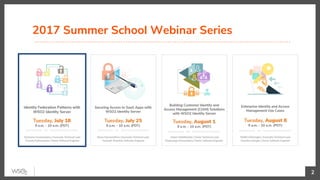
2017 Summer School Webinar Series
2
About WSO2
▪ All WSO2 products 100% free and open source
▪ Licensed under Apache 2.0
▪ Based on WSO2 Carbon platform
▪ Componentized, modular architecture
▪ Founded in 2005
3
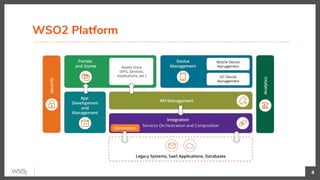
WSO2 Platform
4
▪ Currently in its 5th generation
▪ Latest release - WSO2 Identity Server 5.3.0
▪ Addresses critical IAM needs both in customer IAM and workforce IAM
spaces
▪ Extensive support for open standards - no vendor locking
▪ Large scale deployments over millions of users
▪ Rich eco system with 40+ connectors
(https://store.wso2.com/store/assets/isconnector/list)
▪ Support for multi-tenancy
▪ Extensible product architecture to address complex IAM needs
About WSO2 Identity Server
5
Identity Federation
Patterns
with
WSO2 Identity
Server
6
Agenda
▪ Need of the Identity Federation in reality
▪ Identity Federation is the solution!
▪ Capabilities of an Identity Broker
▪ Federation Problems & Patterns
▪ Q&A
7
Need of the
Identity Federation
in reality
8
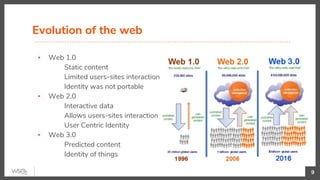
Evolution of the web
▪ Web 1.0
Static content
Limited users-sites interaction
Identity was not portable
▪ Web 2.0
Interactive data
Allows users-sites interaction
User Centric Identity
▪ Web 3.0
Predicted content
Identity of things
9
▪ For an consumer
Ability to access the services with minimum effort
▪ For an enterprise
Ability to quickly adopt to new business demands
Adhere with complex corporate policies of,
▪ password policies
▪ strong authentication
▪ login policies etc.
▪ to comply with regulations
▪ In general: provide seamless user experience for a better productivity
without compromising security
IAM Requirements
10
Identity Federation
is the
Solution!
11
What “Identity Federation” means
Connecting,
a person's digital identity and attributes,
stored across multiple distinct trust domains
12
Elevated Security
▪ Identity federation leverages widely adopted standard, secure and mature
protocols (SAML, OpenID and OAuth)
▪ Eliminate maintaining multiple credentials
▪ Enables Single Sign-On (SSO)
▪ Can introduce Multi-Factor Authentication (MFA)
Benefits of Identity Federation
13
Cost Benefits
▪ Introduce standard access control for enterprise apps with minimum effort
with a shortest possible time
▪ Eliminates the requirement of implementing proprietary SSO mechanism
▪ Secure legacy apps with modern security specification without additional
development effort
▪ Adaptation to latest security trends and organizational security
requirements with minimum effort
Benefits of Identity Federation
14
▪ Protocol Agnostic
▪ Claim Transformation
▪ Multi-option  Multi-step authentication
▪ Trust brokering
▪ Home Realm Discovery
▪ Adaptive Authentication
Capabilities of an Identity Broker
15
▪ Account Association
▪ Multiple Attribute Stores
▪ Just In Time Provisioning
▪ Manage Identity Relationships
▪ Centralized Access Control
▪ Centralized Monitoring & Analytics
Capabilities of an Identity Broker
16
Federation Problems
&
Patterns
17
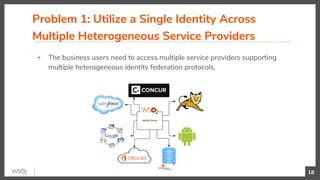
Problem 1: Utilize a Single Identity Across
Multiple Heterogeneous Service Providers
▪ The business users need to access multiple service providers supporting
multiple heterogeneous identity federation protocols.
18
Pattern 1: Identity Federation between Multiple
Heterogeneous Identity Federation Protocols
Pros
▪ Single Sign On
▪ Separate user authentication from application code
▪ Hides user credentials from applications
▪ Removes administrative overhead from applications
▪ Improves user experience
Cons
▪ Introduce a single point where the security of the system can be breached
19
Problem 2: Consuming Multiple Services Across
Different Trust Domains
▪ The business users need to utilize services beyond enterprise borders. The
cross border interaction typically implies interacting with services residing
under a different trust domain. The interaction may need to be done with or
without having dependencies with the external trust domain entities.
20
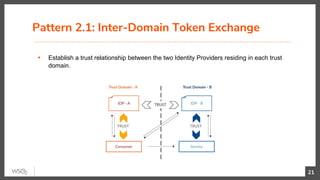
Pattern 2.1: Inter-Domain Token Exchange
▪ Establish a trust relationship between the two Identity Providers residing in each trust
domain.
21
Pattern 2.1: Inter-Domain Token Exchange
Pros
▪ Flexible in maintaining trust domains
▪ Facilitates federated interactions between consumers and services across
trust domains
▪ Same model can be extended to address more complex federation
scenarios
Cons
▪ Introduces certain level of dependency between the consumer and the
Identity Provider in the other trust domain
22
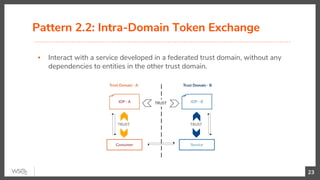
Pattern 2.2: Intra-Domain Token Exchange
▪ Interact with a service developed in a federated trust domain, without any
dependencies to entities in the other trust domain.
23
Pattern 2.2: Intra-Domain Token Exchange
Pros
▪ Removes dependencies between consumers and service in different trust
domains
▪ Can handle different token claim representations
Cons
▪ Adds complexity to the mechanism used to model the trust relationship
with the Identity Provider in the other trust domain
▪ Makes the services to accept messages that are not issued by the Identity
Provider that they trusts
24
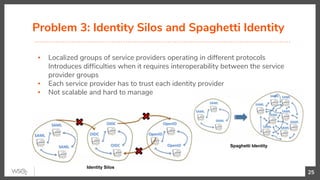
Problem 3: Identity Silos and Spaghetti Identity
▪ Localized groups of service providers operating in different protocols
Introduces difficulties when it requires interoperability between the service
provider groups
▪ Each service provider has to trust each identity provider
▪ Not scalable and hard to manage
25
Spaghetti Identity
Identity Silos
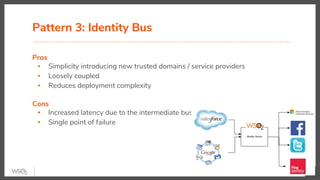
Pattern 3: Identity Bus
Pros
▪ Simplicity introducing new trusted domains / service providers
▪ Loosely coupled
▪ Reduces deployment complexity
Cons
▪ Increased latency due to the intermediate bus
▪ Single point of failure
26
Problem 4: Need of Dynamic and Fine-Grained
Authorization Policies
▪ Organizational policies may require securing services beyond typical
authorization mechanisms
▪ Service provider needs to define a complex authorization policy to decide
whether a given user is eligible to access a certain resource
27
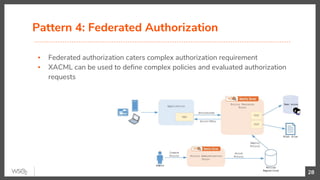
▪ Federated authorization caters complex authorization requirement
▪ XACML can be used to define complex policies and evaluated authorization
requests
28
Pattern 4: Federated Authorization
Pros
▪ Authorization implementation is decoupled from the application code base
▪ Supports securing services with complex authorization policies
▪ Avoid duplication of authorization policies across all the applications
Cons
▪ Not widely adapted compared to federated authentication.
29
Problem 5: Lack of Support for Federated
Authorization
▪ Even if the authentication is federated, most systems does not support
authorization in a federated manner. Hence, the SP requires to persist user
information up to a certain degree in order to perform authorization
30
Pattern 5.1: Federated Unidirectional
Provisioning
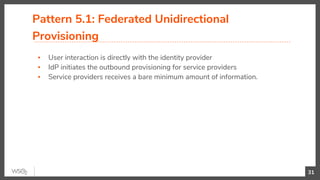
▪ User interaction is directly with the identity provider
▪ IdP initiates the outbound provisioning for service providers
▪ Service providers receives a bare minimum amount of information.
31
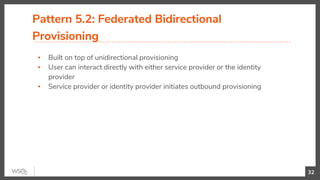
Pattern 5.2: Federated Bidirectional
Provisioning
▪ Built on top of unidirectional provisioning
▪ User can interact directly with either service provider or the identity
provider
▪ Service provider or identity provider initiates outbound provisioning
32
Q&A
33
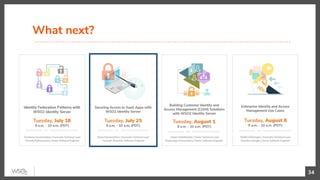
What next?
34
OPEN TECHNOLOGY FOR YOUR AGILE DIGITAL BUSINESS
THANK YOU
35

Identity Federation Patterns with WSO2 Identity Server​

  • 1.
    Identity Federation Patternswith WSO2 Identity Server​ June 18, 2017 Darshana Gunawardana Omindu Rathnaweera 1
  • 2.
    2017 Summer SchoolWebinar Series 2
  • 3.
    About WSO2 ▪ AllWSO2 products 100% free and open source ▪ Licensed under Apache 2.0 ▪ Based on WSO2 Carbon platform ▪ Componentized, modular architecture ▪ Founded in 2005 3
  • 4.
  • 5.
    ▪ Currently inits 5th generation ▪ Latest release - WSO2 Identity Server 5.3.0 ▪ Addresses critical IAM needs both in customer IAM and workforce IAM spaces ▪ Extensive support for open standards - no vendor locking ▪ Large scale deployments over millions of users ▪ Rich eco system with 40+ connectors (https://store.wso2.com/store/assets/isconnector/list) ▪ Support for multi-tenancy ▪ Extensible product architecture to address complex IAM needs About WSO2 Identity Server 5
  • 6.
  • 7.
    Agenda ▪ Need ofthe Identity Federation in reality ▪ Identity Federation is the solution! ▪ Capabilities of an Identity Broker ▪ Federation Problems & Patterns ▪ Q&A 7
  • 8.
    Need of the IdentityFederation in reality 8
  • 9.
    Evolution of theweb ▪ Web 1.0 Static content Limited users-sites interaction Identity was not portable ▪ Web 2.0 Interactive data Allows users-sites interaction User Centric Identity ▪ Web 3.0 Predicted content Identity of things 9
  • 10.
    ▪ For anconsumer Ability to access the services with minimum effort ▪ For an enterprise Ability to quickly adopt to new business demands Adhere with complex corporate policies of, ▪ password policies ▪ strong authentication ▪ login policies etc. ▪ to comply with regulations ▪ In general: provide seamless user experience for a better productivity without compromising security IAM Requirements 10
  • 11.
  • 12.
    What “Identity Federation”means Connecting, a person's digital identity and attributes, stored across multiple distinct trust domains 12
  • 13.
    Elevated Security ▪ Identityfederation leverages widely adopted standard, secure and mature protocols (SAML, OpenID and OAuth) ▪ Eliminate maintaining multiple credentials ▪ Enables Single Sign-On (SSO) ▪ Can introduce Multi-Factor Authentication (MFA) Benefits of Identity Federation 13
  • 14.
    Cost Benefits ▪ Introducestandard access control for enterprise apps with minimum effort with a shortest possible time ▪ Eliminates the requirement of implementing proprietary SSO mechanism ▪ Secure legacy apps with modern security specification without additional development effort ▪ Adaptation to latest security trends and organizational security requirements with minimum effort Benefits of Identity Federation 14
  • 15.
    ▪ Protocol Agnostic ▪Claim Transformation ▪ Multi-option Multi-step authentication ▪ Trust brokering ▪ Home Realm Discovery ▪ Adaptive Authentication Capabilities of an Identity Broker 15
  • 16.
    ▪ Account Association ▪Multiple Attribute Stores ▪ Just In Time Provisioning ▪ Manage Identity Relationships ▪ Centralized Access Control ▪ Centralized Monitoring & Analytics Capabilities of an Identity Broker 16
  • 17.
  • 18.
    Problem 1: Utilizea Single Identity Across Multiple Heterogeneous Service Providers ▪ The business users need to access multiple service providers supporting multiple heterogeneous identity federation protocols. 18
  • 19.
    Pattern 1: IdentityFederation between Multiple Heterogeneous Identity Federation Protocols Pros ▪ Single Sign On ▪ Separate user authentication from application code ▪ Hides user credentials from applications ▪ Removes administrative overhead from applications ▪ Improves user experience Cons ▪ Introduce a single point where the security of the system can be breached 19
  • 20.
    Problem 2: ConsumingMultiple Services Across Different Trust Domains ▪ The business users need to utilize services beyond enterprise borders. The cross border interaction typically implies interacting with services residing under a different trust domain. The interaction may need to be done with or without having dependencies with the external trust domain entities. 20
  • 21.
    Pattern 2.1: Inter-DomainToken Exchange ▪ Establish a trust relationship between the two Identity Providers residing in each trust domain. 21
  • 22.
    Pattern 2.1: Inter-DomainToken Exchange Pros ▪ Flexible in maintaining trust domains ▪ Facilitates federated interactions between consumers and services across trust domains ▪ Same model can be extended to address more complex federation scenarios Cons ▪ Introduces certain level of dependency between the consumer and the Identity Provider in the other trust domain 22
  • 23.
    Pattern 2.2: Intra-DomainToken Exchange ▪ Interact with a service developed in a federated trust domain, without any dependencies to entities in the other trust domain. 23
  • 24.
    Pattern 2.2: Intra-DomainToken Exchange Pros ▪ Removes dependencies between consumers and service in different trust domains ▪ Can handle different token claim representations Cons ▪ Adds complexity to the mechanism used to model the trust relationship with the Identity Provider in the other trust domain ▪ Makes the services to accept messages that are not issued by the Identity Provider that they trusts 24
  • 25.
    Problem 3: IdentitySilos and Spaghetti Identity ▪ Localized groups of service providers operating in different protocols Introduces difficulties when it requires interoperability between the service provider groups ▪ Each service provider has to trust each identity provider ▪ Not scalable and hard to manage 25 Spaghetti Identity Identity Silos
  • 26.
    Pattern 3: IdentityBus Pros ▪ Simplicity introducing new trusted domains / service providers ▪ Loosely coupled ▪ Reduces deployment complexity Cons ▪ Increased latency due to the intermediate bus ▪ Single point of failure 26
  • 27.
    Problem 4: Needof Dynamic and Fine-Grained Authorization Policies ▪ Organizational policies may require securing services beyond typical authorization mechanisms ▪ Service provider needs to define a complex authorization policy to decide whether a given user is eligible to access a certain resource 27
  • 28.
    ▪ Federated authorizationcaters complex authorization requirement ▪ XACML can be used to define complex policies and evaluated authorization requests 28 Pattern 4: Federated Authorization
  • 29.
    Pattern 4: FederatedAuthorization Pros ▪ Authorization implementation is decoupled from the application code base ▪ Supports securing services with complex authorization policies ▪ Avoid duplication of authorization policies across all the applications Cons ▪ Not widely adapted compared to federated authentication. 29
  • 30.
    Problem 5: Lackof Support for Federated Authorization ▪ Even if the authentication is federated, most systems does not support authorization in a federated manner. Hence, the SP requires to persist user information up to a certain degree in order to perform authorization 30
  • 31.
    Pattern 5.1: FederatedUnidirectional Provisioning ▪ User interaction is directly with the identity provider ▪ IdP initiates the outbound provisioning for service providers ▪ Service providers receives a bare minimum amount of information. 31
  • 32.
    Pattern 5.2: FederatedBidirectional Provisioning ▪ Built on top of unidirectional provisioning ▪ User can interact directly with either service provider or the identity provider ▪ Service provider or identity provider initiates outbound provisioning 32
  • 33.
  • 34.
  • 35.
    OPEN TECHNOLOGY FORYOUR AGILE DIGITAL BUSINESS THANK YOU 35