Navigating API Complexity:
REST, GraphQL, gRPC, WebSockets, WebSub,
AsyncAPI and more
Nuwan Dias
Deputy CTO
WSO2
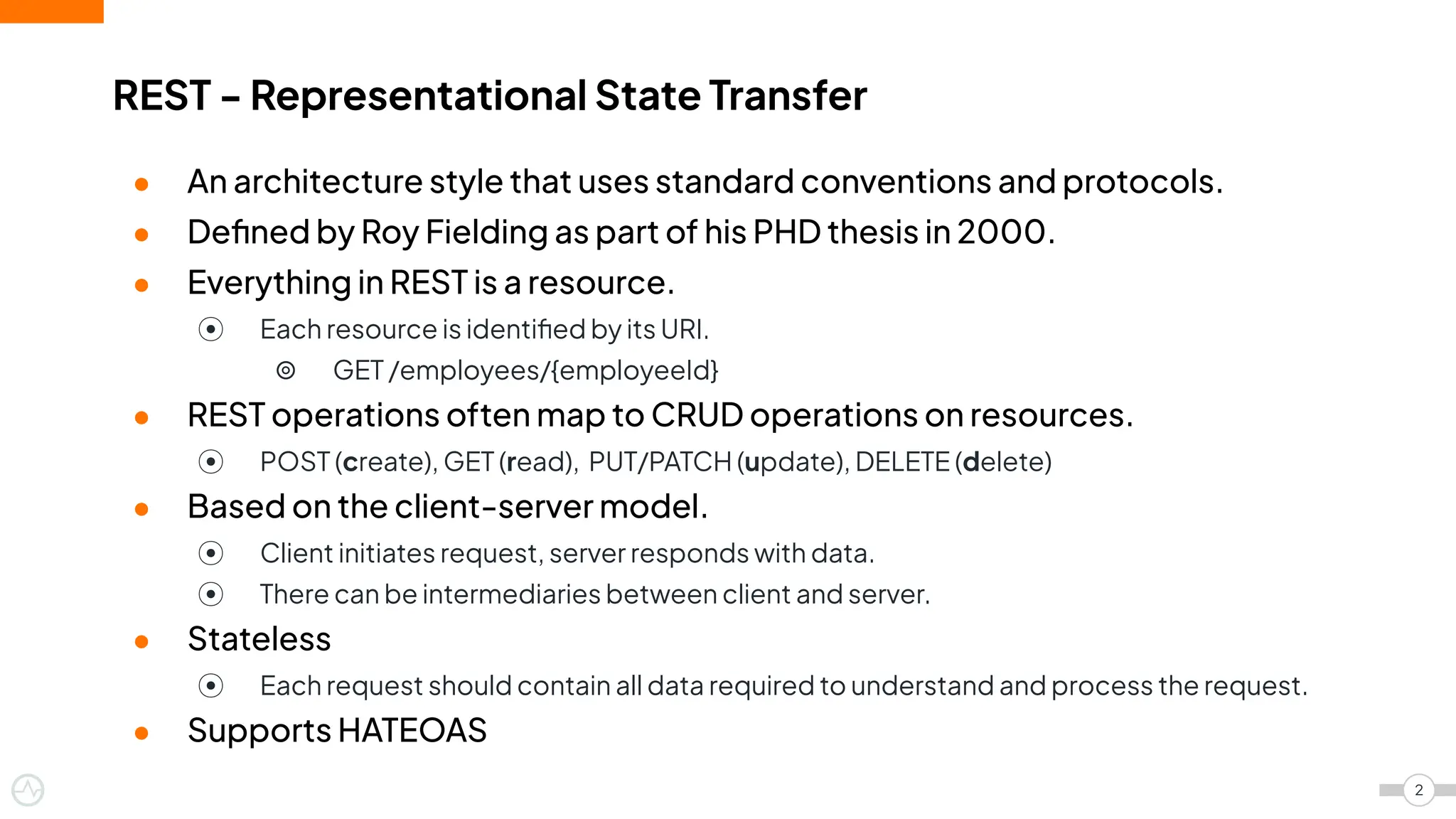
● An architecture style that uses standard conventions and protocols.
● Defined by Roy Fielding as part of his PHD thesis in 2000.
● Everything in REST is a resource.
⦿ Each resource is identified by its URI.
⦾ GET /employees/{employeeId}
● REST operations often map to CRUD operations on resources.
⦿ POST (create), GET (read), PUT/PATCH (update), DELETE (delete)
● Based on the client-server model.
⦿ Client initiates request, server responds with data.
⦿ There can be intermediaries between client and server.
● Stateless
⦿ Each request should contain all data required to understand and process the request.
● Supports HATEOAS
REST - Representational State Transfer
2
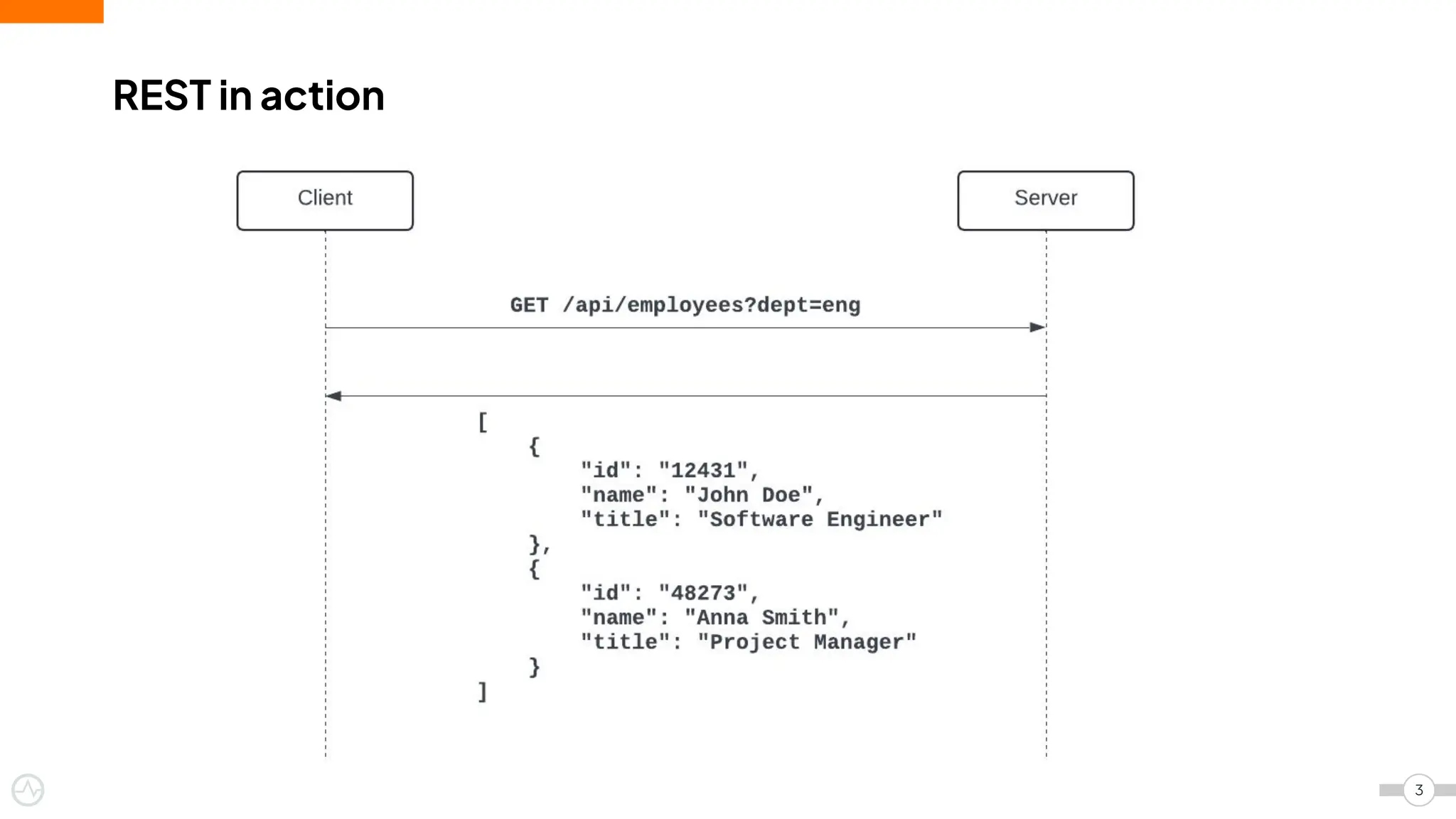
REST in action
3
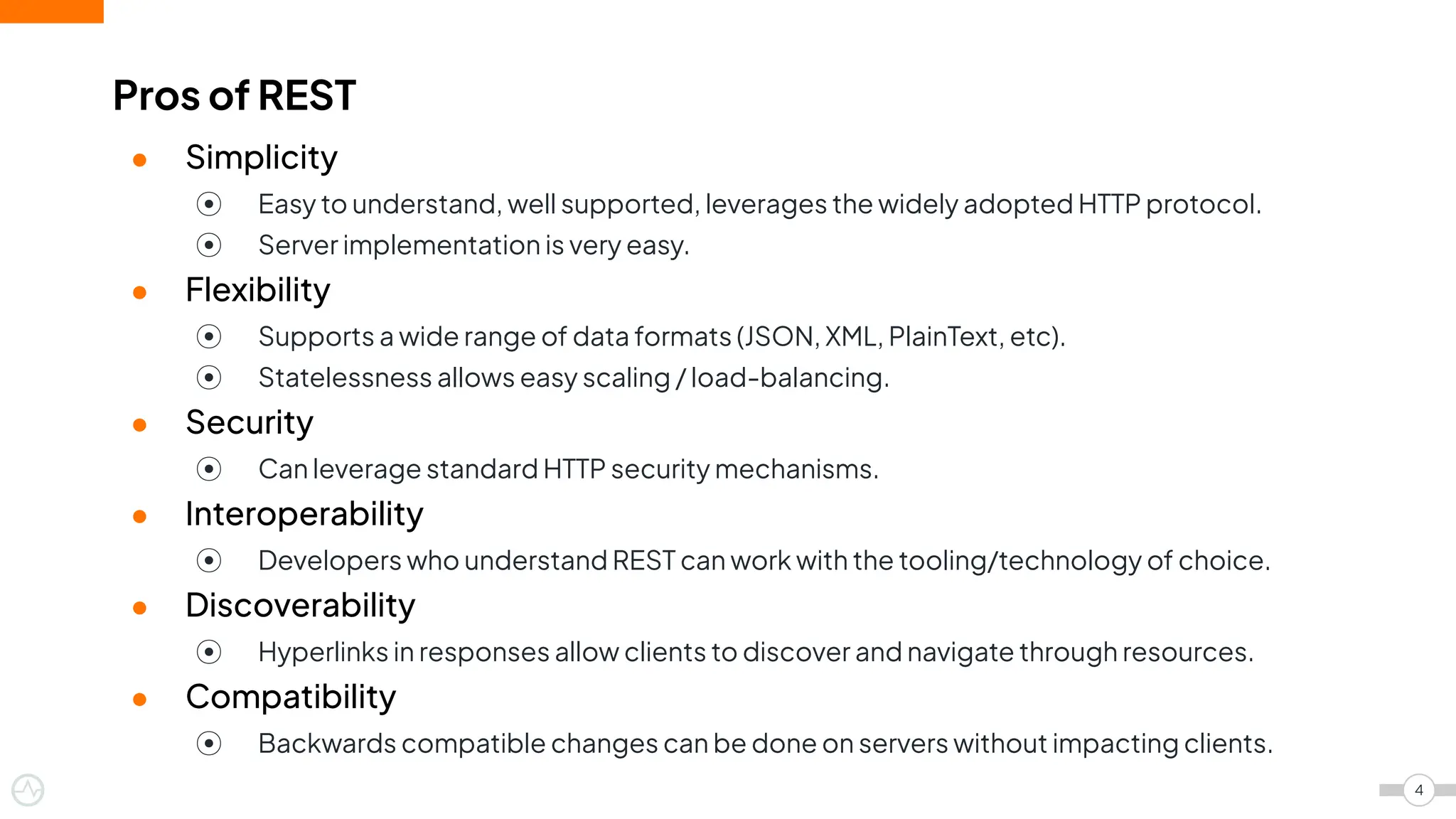
● Simplicity
⦿ Easy to understand, well supported, leverages the widely adopted HTTP protocol.
⦿ Server implementation is very easy.
● Flexibility
⦿ Supports a wide range of data formats (JSON, XML, PlainText, etc).
⦿ Statelessness allows easy scaling / load-balancing.
● Security
⦿ Can leverage standard HTTP security mechanisms.
● Interoperability
⦿ Developers who understand REST can work with the tooling/technology of choice.
● Discoverability
⦿ Hyperlinks in responses allow clients to discover and navigate through resources.
● Compatibility
⦿ Backwards compatible changes can be done on servers without impacting clients.
Pros of REST
4
● Over-fetching or under-fetching of data.
⦿ Returns unnecessary data or insufficient data about the requested resource.
⦿ Ex: Employee address.
● Verbosity for complex data retrieval.
⦿ Ex: foreach employee in department (GET /api/employees/{id}/address)
● Limited support for real-time updates.
⦿ Not so suitable for chatty applications.
⦿ In long running operations, clients would need to keep polling the server for updates.
● Versioning complexities.
⦿ Need to maintain multiple API versions to support old clients.
Cons of REST
5
● Developed by Facebook in 2012, open sourced in 2015.
● A query language for APIs that allow clients to request the exact data they
want.
⦿ Takes a declarative approach. Clients define the data they want, not how to fetch it.
● Key Concepts
⦿ Schema: Defines the data and relationships. I.e. A blueprint of the data structure.
⦿ Queries: Used by clients for fetching/reading data.
⦿ Mutations: Used by clients for modifying data.
⦿ Subscriptions: Used for real time updates on data.
● Strongly typed
⦿ Strong type enforcement reduces the possibility of errors.
GraphQL
6
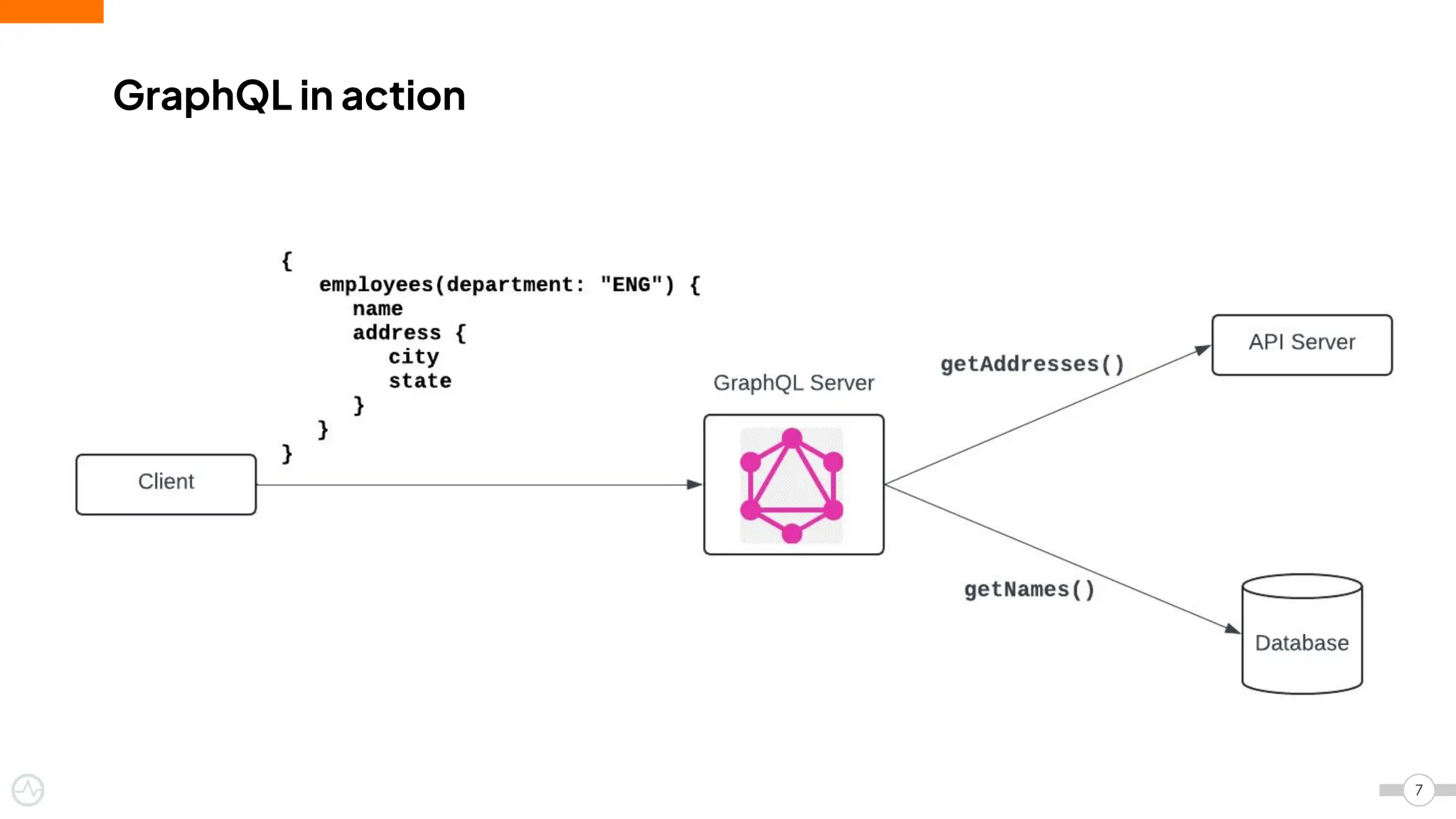
GraphQL in action
7
Pros
● No over-fetching or under-fetching of data.
● Efficient usage of network bandwidth between client and server.
● Efficient for complex data relationships.
● Strong typing eliminates errors early.
● Supports real-time updates via subscriptions.
Pros
● Complex server side implementations.
● Clients may request more data than they actually need (over-fetching).
● Hard to understand.
● Complex error handling.
● Caching requires more work (i.e. Everything is a POST)
Pros and cons of GraphQL
8
REST is better for,
● Simple operations such as CRUD.
● Public* APIs that drive business. I.e. Twilio.
● Idempotent operations that may rely on caching.
● Scenarios that require monetization by number of requests.
● Highly scalable applications where statelessness matters.
GraphQL is better for,
● Complex data relationships.
● Scenarios where clients benefit from querying the data instead of navigating.
● Scenarios where clients need real-time updates of data.
REST vs GraphQL
9
* Public - APIs used by people outside the organization, over the internet.
● An RPC framework that allows defining functions on servers and invoking them
via remote clients.
● Developed by Google in 2015.
● Utilizes protocol buffers for data serialization.
● Relies on HTTP/2 as its transport protocol.
⦿ gRPC is highly performant compared to HTTP/REST due to its binary protocol, multiplexing
support and header compression.
● Strongly typed, similar to GraphQL.
● Supports bi-directional streaming.
● Works across programming languages using generated code for server and
client stubs.
gRPC
10
Pros
● Highly performant due to using protocol buffers for data serialization.
● Strongly typed, limiting errors.
● Based on HTTP/2, hence making it possible to leverage benefits of HTTP.
● Supports bi-directional streaming.
Pros
● Has a considerable learning curve since it is based on a binary protocol
(protocol buffers).
● Limited browser (client) support.
● Any changes on the server will break clients unless they are updated too.
● Frequent bi-directional comms utilizes a lot of energy.
● Cannot leverage HTTP caching.
Pros and cons of gRPC
11
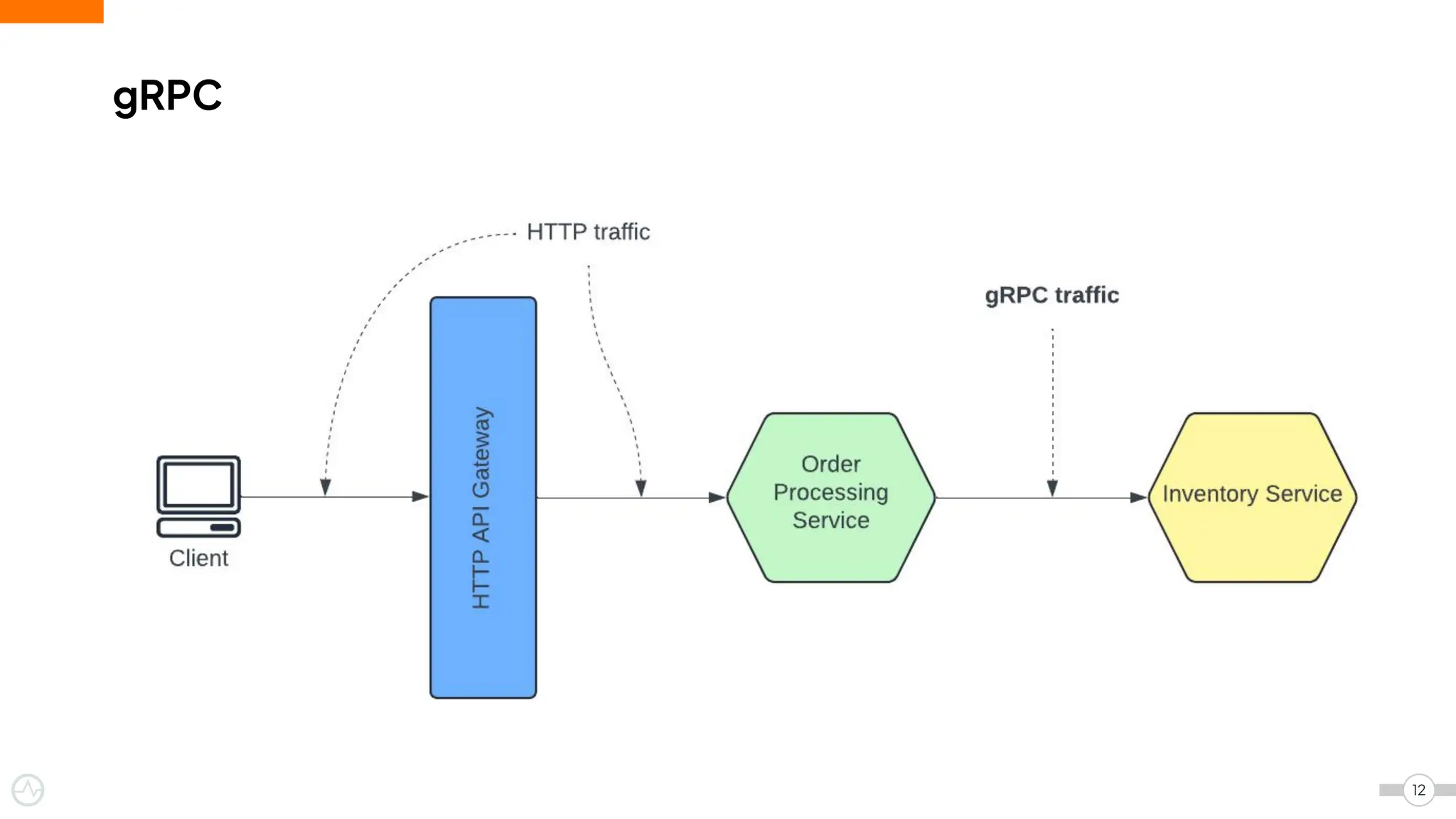
gRPC
12
● Before WebSockets, clients used to use long polling to receive real time
updates from servers.
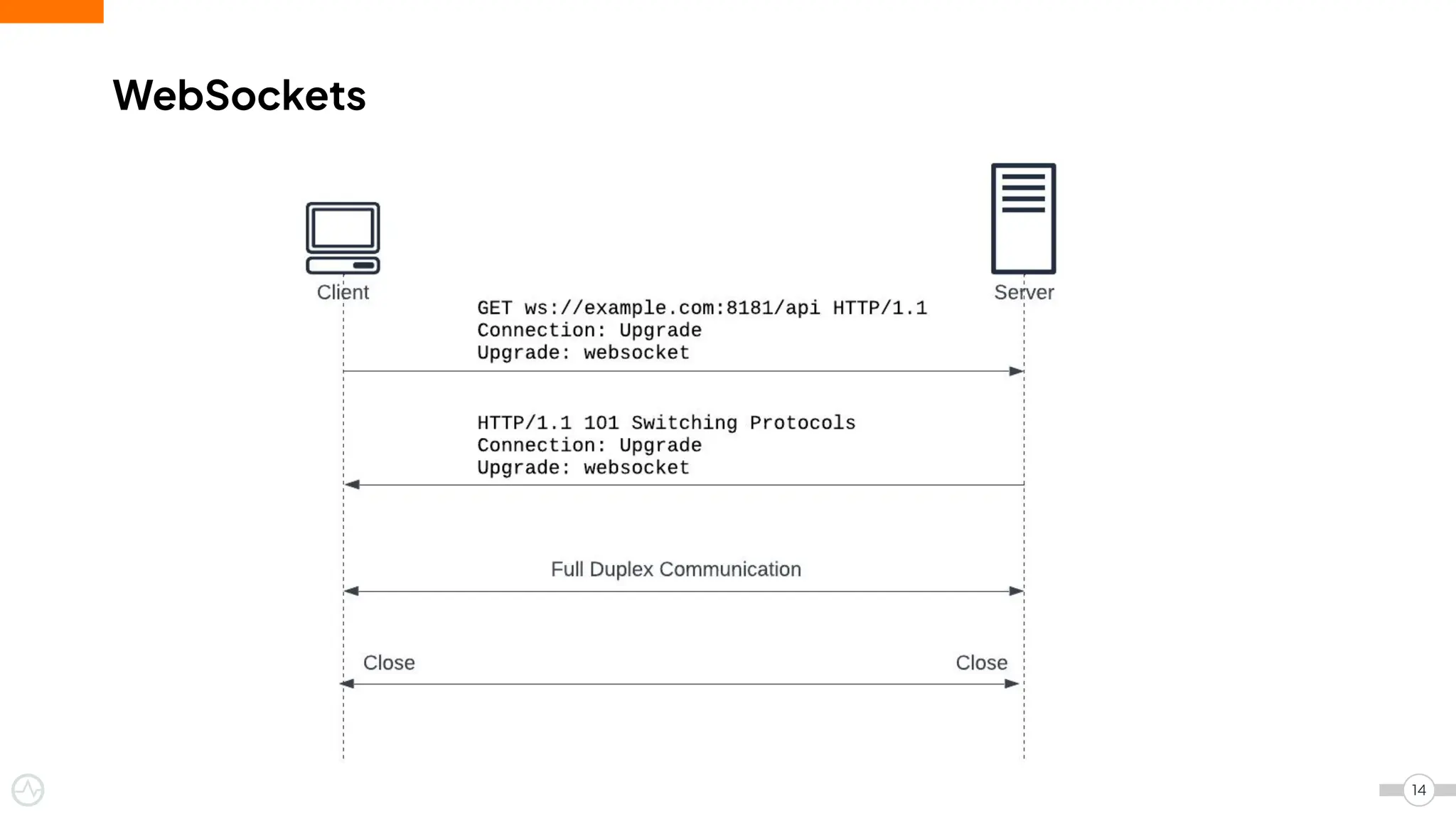
● WebSockets allowed bi-directional communications over a single HTTP
connection, allowing low-latency real time updates.
● Suitable for chatty applications which require full-duplex communications (i.e
chat systems, live data feeds).
● Compared to REST, operates with less HTTP connections, but each connection
will have a much longer TTL.
● gRPC vs WebSockets?
⦿ WebSockets are for end applications (browser, mobile), gRPC is better for internal
communications between services.
WebSockets
13
WebSockets
14
● Originated in the early 2000s as a more dynamic way for web applications to
communicate compared to polling.
● It is a user/client configured call-back mechanism over HTTP.
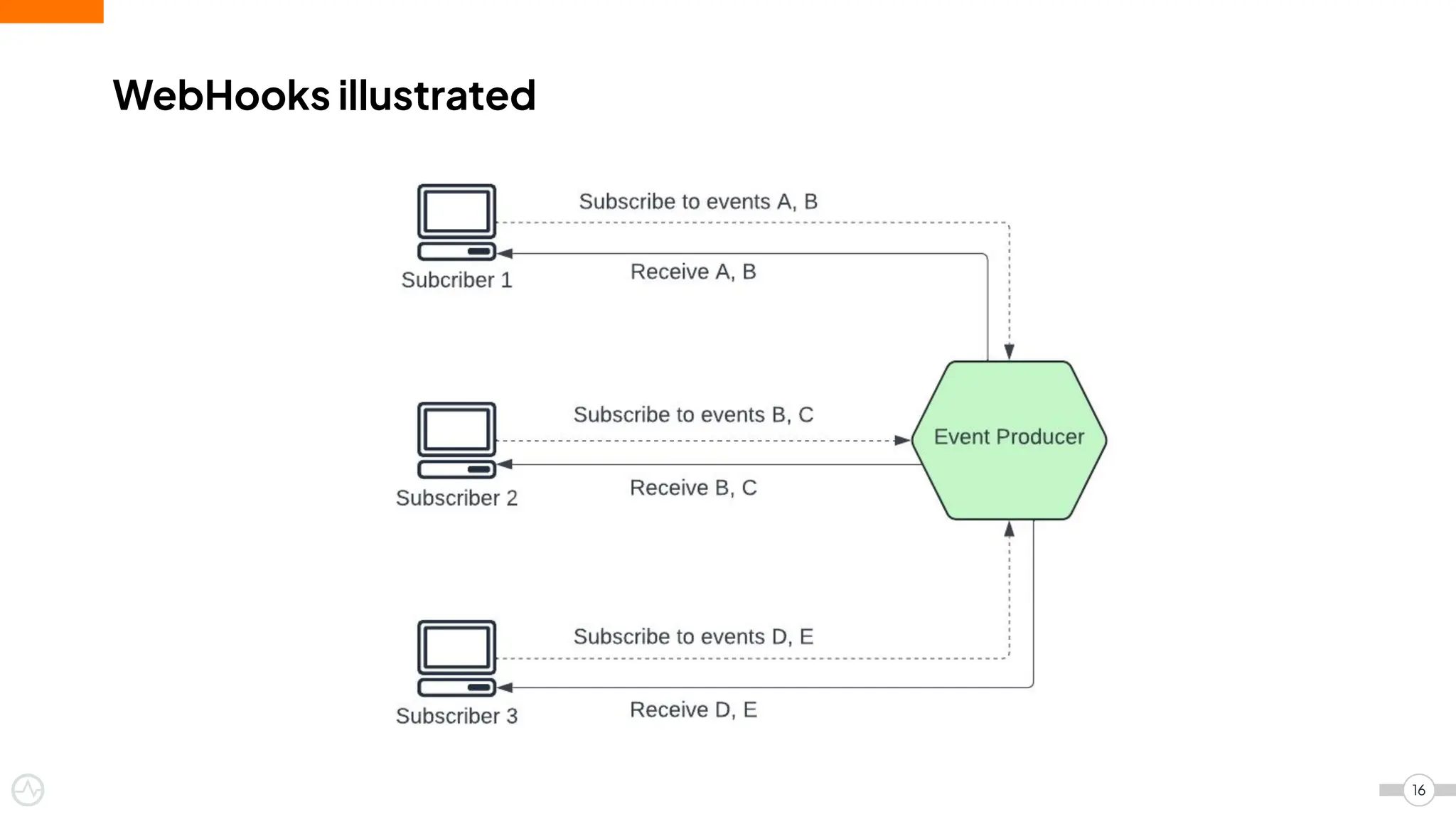
● A publisher (event producer) registers callbacks of parties interested in
receiving events and notifies them.
⦿ Notifications usually happen over HTTP POST.
● Subscribers (event receivers) act upon received events.
● Usually used to integrate software with partner systems.
⦿ Loosely coupled integrations.
● Publisher has to maintain list of subscribers and sending events to each
subscriber.
⦿ Complex server-side implementation
WebHooks
15
WebHooks illustrated
16
● Emerged in around 2017.
● Addresses the limitations in the WebHook approach.
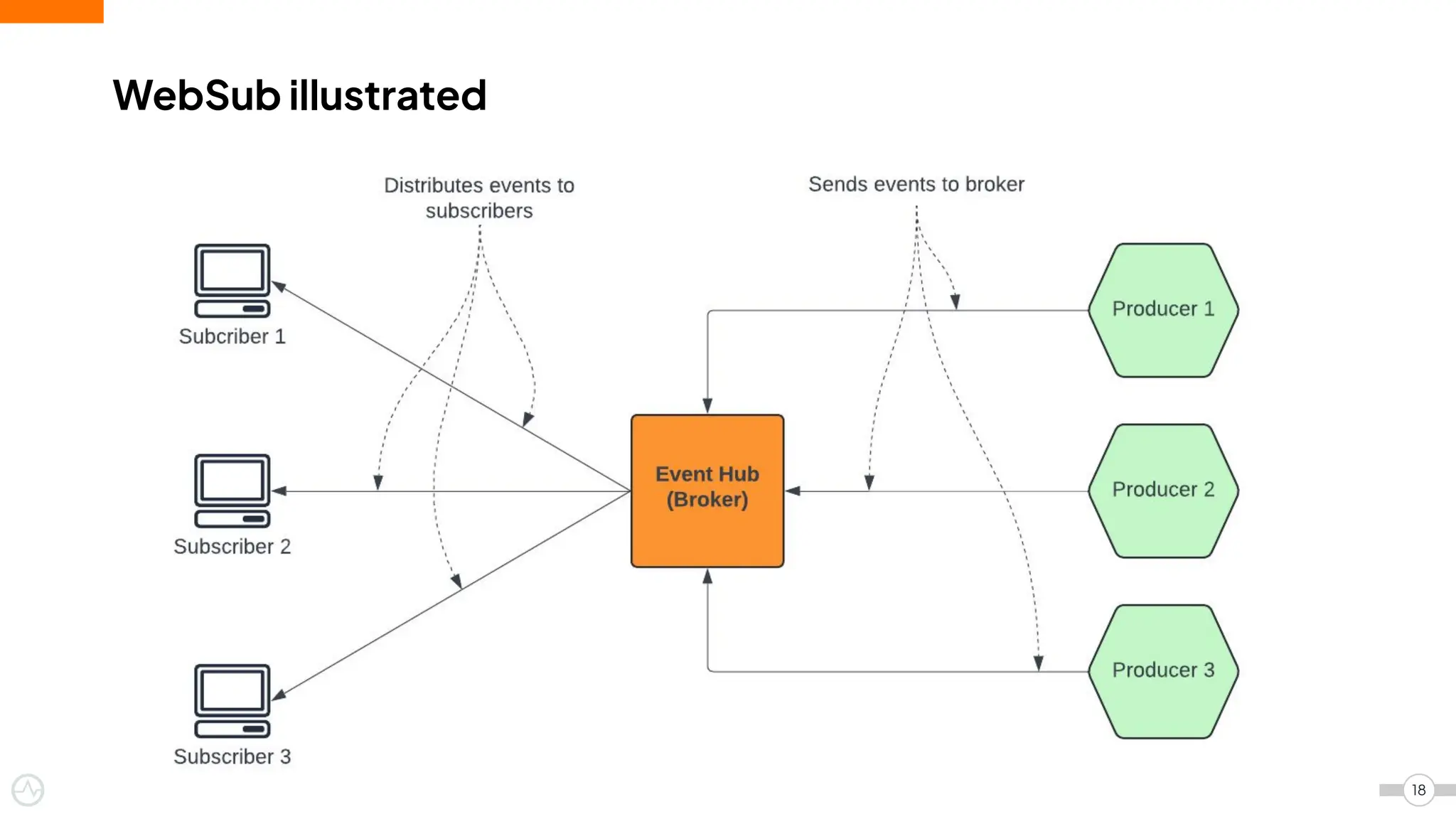
● Utilizes a Hub based architecture to decouple publishers from subscribers.
⦿ Publisher notifies Hub, Hub notifies interested subscribers.
● Simplifies the publisher architecture.
● Provides more reliability and robustness due to better error handling.
● Allows the Hub to scale independently.
WebSub
17
WebSub illustrated
18
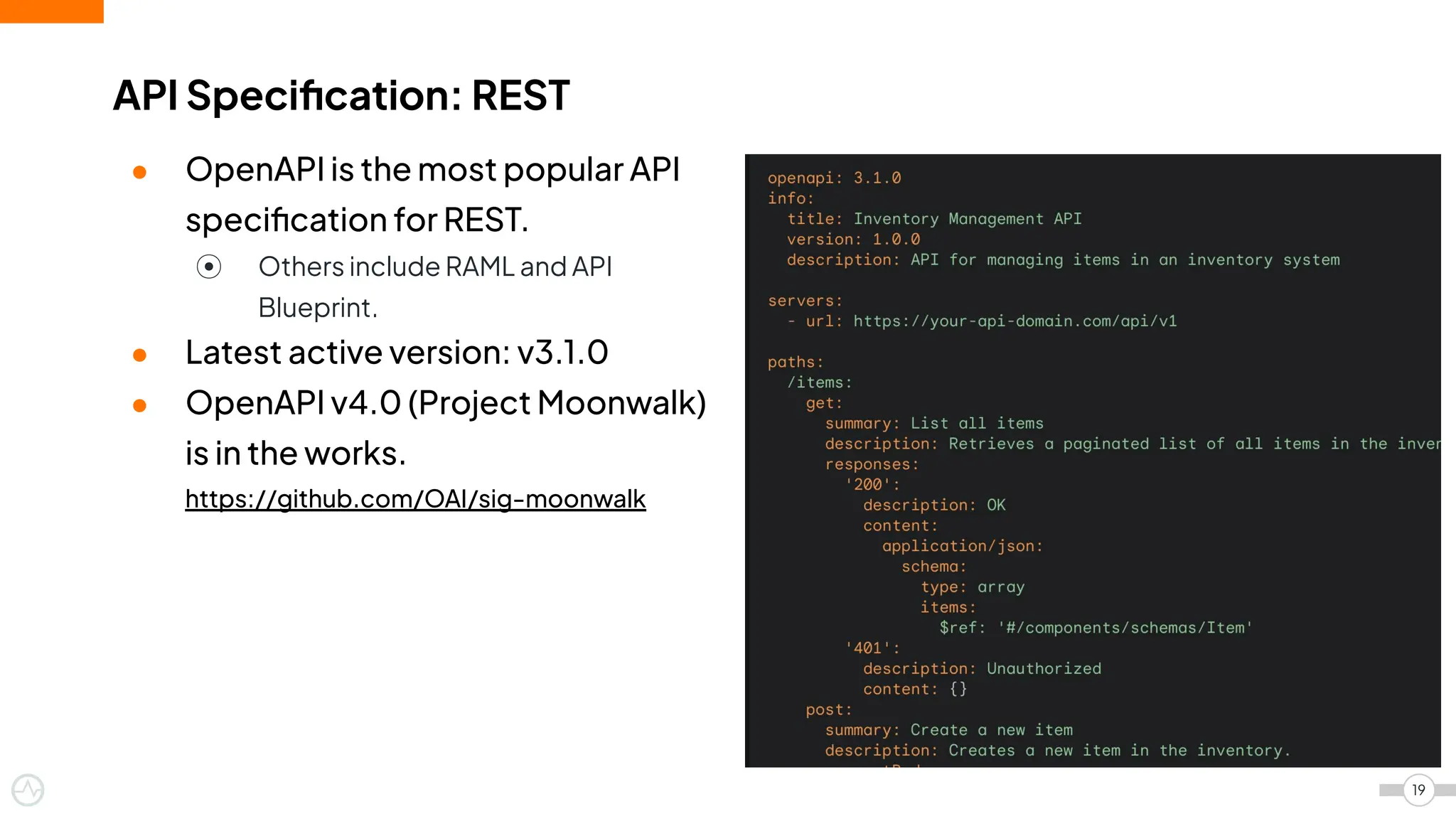
● OpenAPI is the most popular API
specification for REST.
⦿ Others include RAML and API
Blueprint.
● Latest active version: v3.1.0
● OpenAPI v4.0 (Project Moonwalk)
is in the works.
https://github.com/OAI/sig-moonwalk
API Specification: REST
19
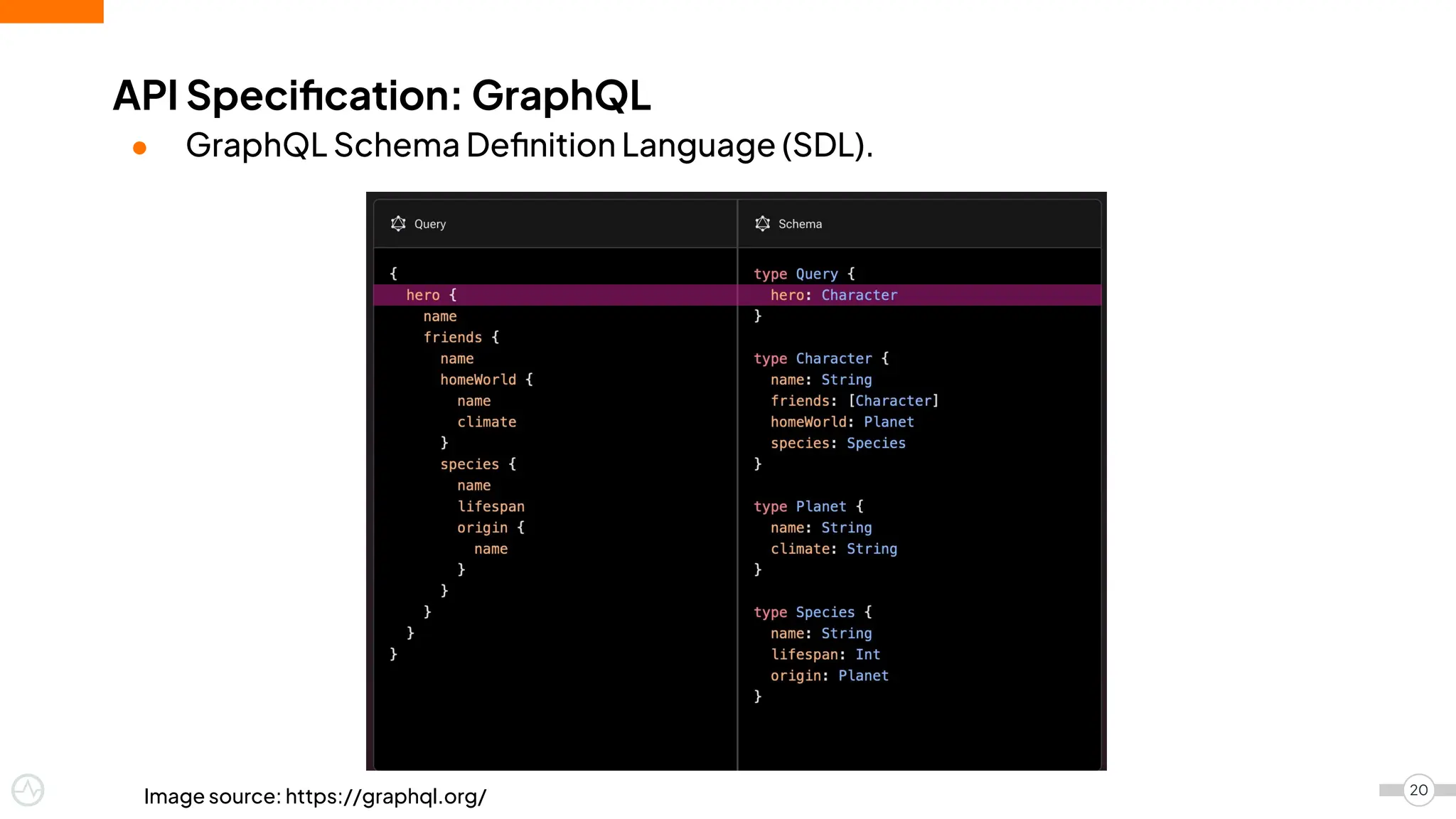
● GraphQL Schema Definition Language (SDL).
API Specification: GraphQL
20
Image source: https://graphql.org/
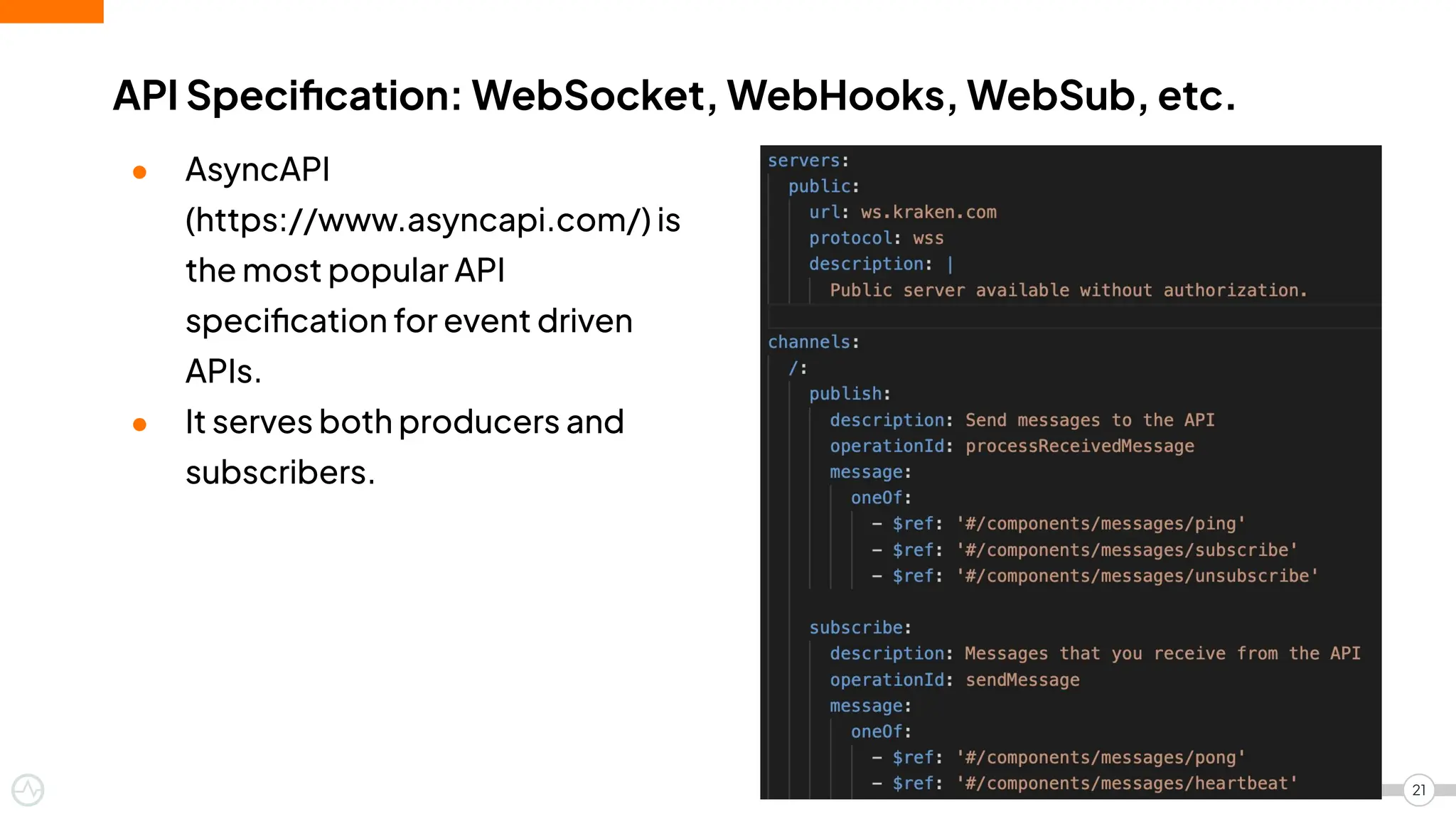
● AsyncAPI
(https://www.asyncapi.com/) is
the most popular API
specification for event driven
APIs.
● It serves both producers and
subscribers.
API Specification: WebSocket, WebHooks, WebSub, etc.
21
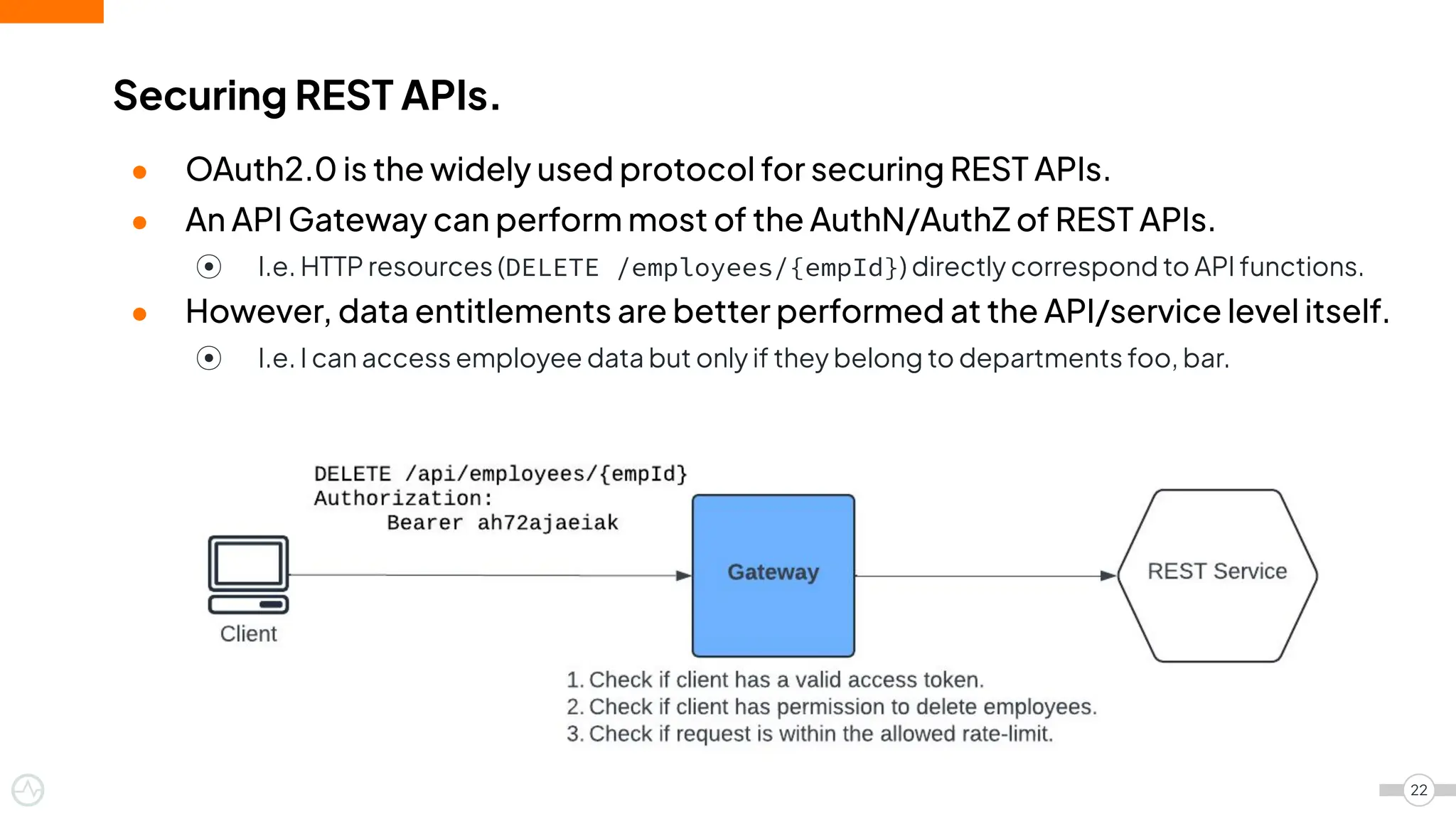
● OAuth2.0 is the widely used protocol for securing REST APIs.
● An API Gateway can perform most of the AuthN/AuthZ of REST APIs.
⦿ I.e. HTTP resources (DELETE /employees/{empId}) directly correspond to API functions.
● However, data entitlements are better performed at the API/service level itself.
⦿ I.e. I can access employee data but only if they belong to departments foo, bar.
Securing REST APIs.
22
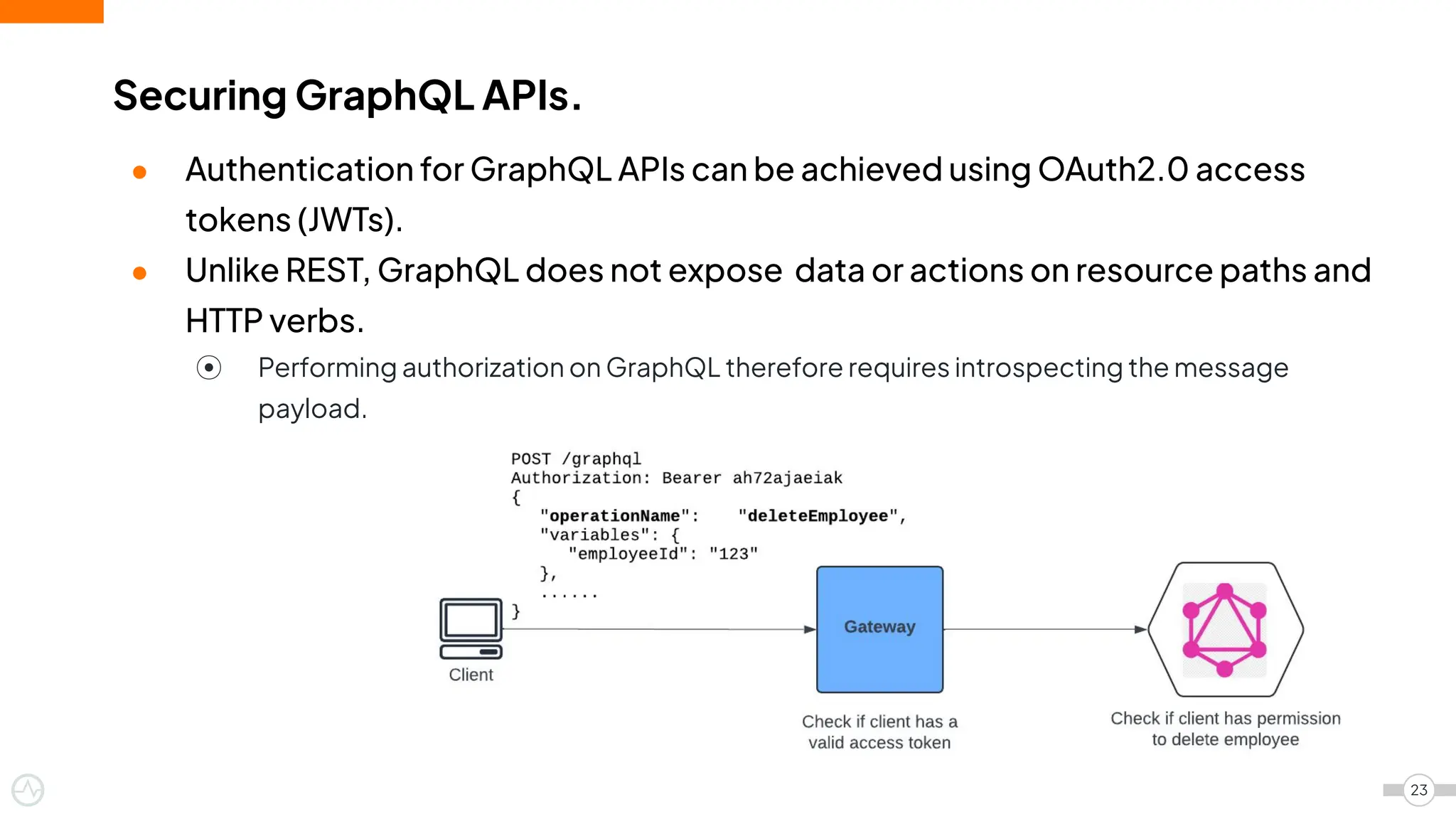
● Authentication for GraphQL APIs can be achieved using OAuth2.0 access
tokens (JWTs).
● Unlike REST, GraphQL does not expose data or actions on resource paths and
HTTP verbs.
⦿ Performing authorization on GraphQL therefore requires introspecting the message
payload.
Securing GraphQL APIs.
23
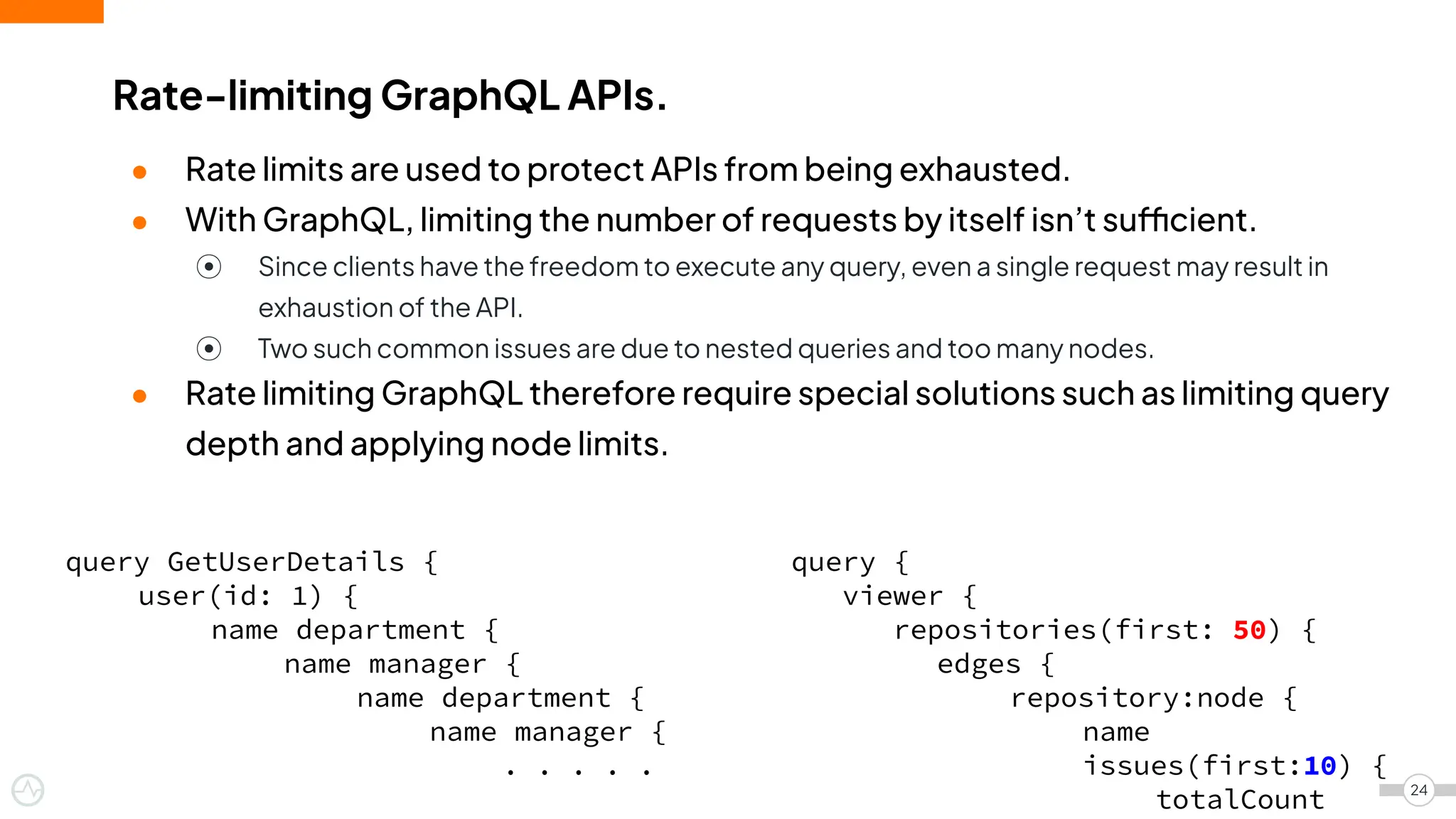
● Rate limits are used to protect APIs from being exhausted.
● With GraphQL, limiting the number of requests by itself isn’t sufficient.
⦿ Since clients have the freedom to execute any query, even a single request may result in
exhaustion of the API.
⦿ Two such common issues are due to nested queries and too many nodes.
● Rate limiting GraphQL therefore require special solutions such as limiting query
depth and applying node limits.
Rate-limiting GraphQL APIs.
24
query GetUserDetails {
user(id: 1) {
name department {
name manager {
name department {
name manager {
. . . . .
query {
viewer {
repositories(first: 50) {
edges {
repository:node {
name
issues(first:10) {
totalCount
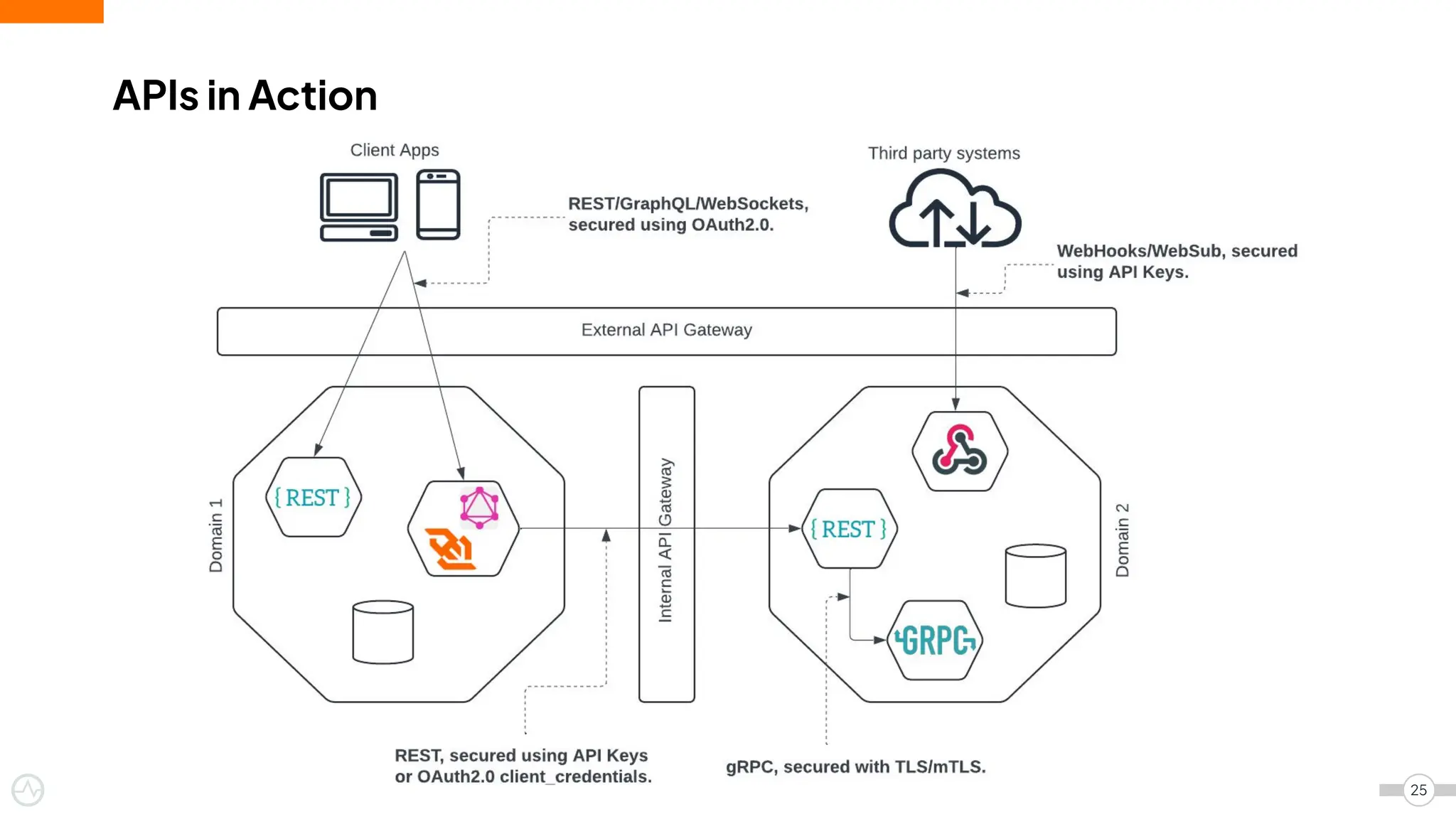
APIs in Action
25
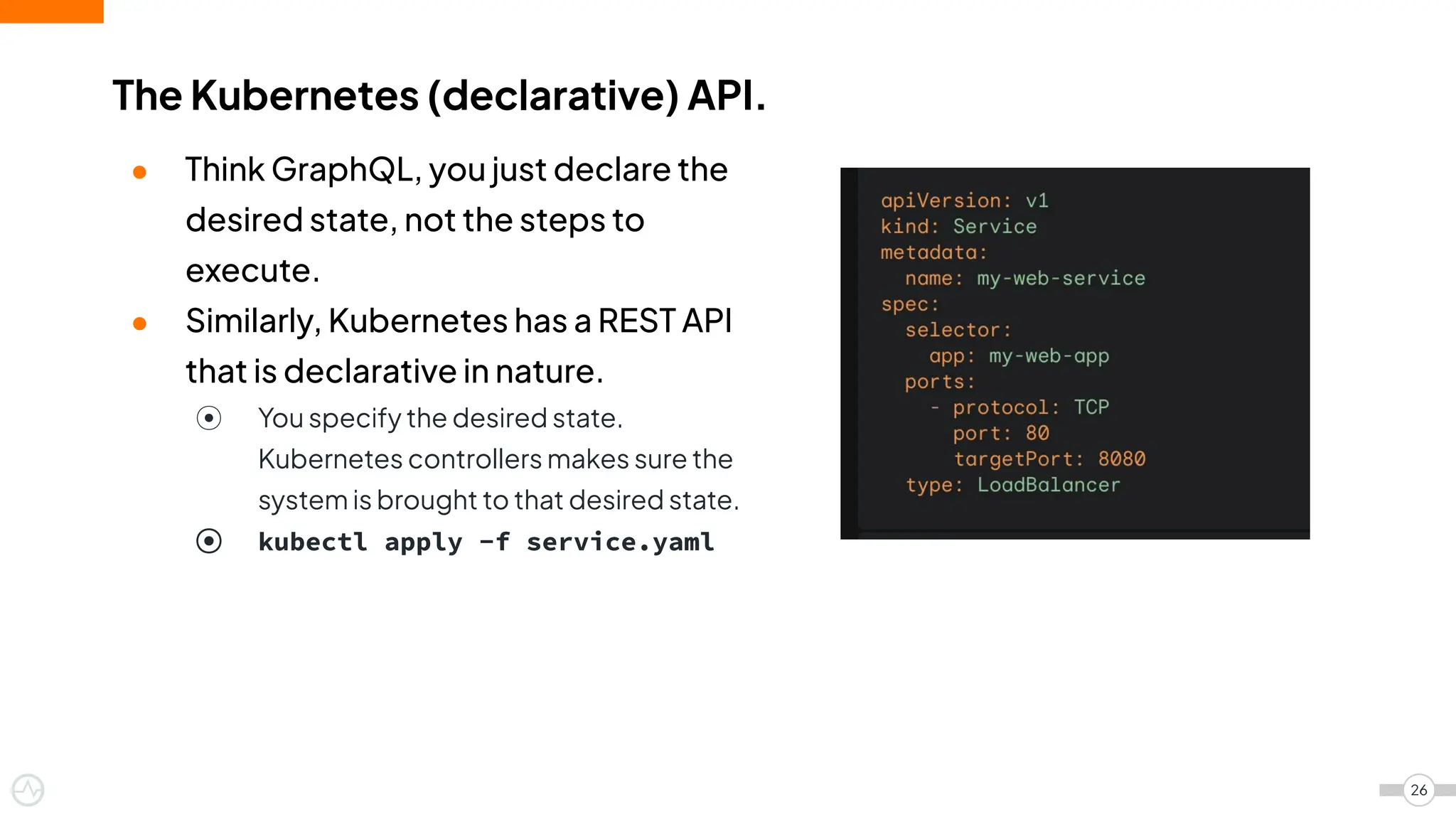
● Think GraphQL, you just declare the
desired state, not the steps to
execute.
● Similarly, Kubernetes has a REST API
that is declarative in nature.
⦿ You specify the desired state.
Kubernetes controllers makes sure the
system is brought to that desired state.
⦿ kubectl apply -f service.yaml
The Kubernetes (declarative) API.
26
Question Time!
27
Thank You!

WSO2CON 2024 - Navigating API Complexity: REST, GraphQL, gRPC, Websocket, WebSub, AsyncAPI and More

  • 1.
    Navigating API Complexity: REST,GraphQL, gRPC, WebSockets, WebSub, AsyncAPI and more Nuwan Dias Deputy CTO WSO2
  • 2.
    ● An architecturestyle that uses standard conventions and protocols. ● Defined by Roy Fielding as part of his PHD thesis in 2000. ● Everything in REST is a resource. ⦿ Each resource is identified by its URI. ⦾ GET /employees/{employeeId} ● REST operations often map to CRUD operations on resources. ⦿ POST (create), GET (read), PUT/PATCH (update), DELETE (delete) ● Based on the client-server model. ⦿ Client initiates request, server responds with data. ⦿ There can be intermediaries between client and server. ● Stateless ⦿ Each request should contain all data required to understand and process the request. ● Supports HATEOAS REST - Representational State Transfer 2
  • 3.
  • 4.
    ● Simplicity ⦿ Easyto understand, well supported, leverages the widely adopted HTTP protocol. ⦿ Server implementation is very easy. ● Flexibility ⦿ Supports a wide range of data formats (JSON, XML, PlainText, etc). ⦿ Statelessness allows easy scaling / load-balancing. ● Security ⦿ Can leverage standard HTTP security mechanisms. ● Interoperability ⦿ Developers who understand REST can work with the tooling/technology of choice. ● Discoverability ⦿ Hyperlinks in responses allow clients to discover and navigate through resources. ● Compatibility ⦿ Backwards compatible changes can be done on servers without impacting clients. Pros of REST 4
  • 5.
    ● Over-fetching orunder-fetching of data. ⦿ Returns unnecessary data or insufficient data about the requested resource. ⦿ Ex: Employee address. ● Verbosity for complex data retrieval. ⦿ Ex: foreach employee in department (GET /api/employees/{id}/address) ● Limited support for real-time updates. ⦿ Not so suitable for chatty applications. ⦿ In long running operations, clients would need to keep polling the server for updates. ● Versioning complexities. ⦿ Need to maintain multiple API versions to support old clients. Cons of REST 5
  • 6.
    ● Developed byFacebook in 2012, open sourced in 2015. ● A query language for APIs that allow clients to request the exact data they want. ⦿ Takes a declarative approach. Clients define the data they want, not how to fetch it. ● Key Concepts ⦿ Schema: Defines the data and relationships. I.e. A blueprint of the data structure. ⦿ Queries: Used by clients for fetching/reading data. ⦿ Mutations: Used by clients for modifying data. ⦿ Subscriptions: Used for real time updates on data. ● Strongly typed ⦿ Strong type enforcement reduces the possibility of errors. GraphQL 6
  • 7.
  • 8.
    Pros ● No over-fetchingor under-fetching of data. ● Efficient usage of network bandwidth between client and server. ● Efficient for complex data relationships. ● Strong typing eliminates errors early. ● Supports real-time updates via subscriptions. Pros ● Complex server side implementations. ● Clients may request more data than they actually need (over-fetching). ● Hard to understand. ● Complex error handling. ● Caching requires more work (i.e. Everything is a POST) Pros and cons of GraphQL 8
  • 9.
    REST is betterfor, ● Simple operations such as CRUD. ● Public* APIs that drive business. I.e. Twilio. ● Idempotent operations that may rely on caching. ● Scenarios that require monetization by number of requests. ● Highly scalable applications where statelessness matters. GraphQL is better for, ● Complex data relationships. ● Scenarios where clients benefit from querying the data instead of navigating. ● Scenarios where clients need real-time updates of data. REST vs GraphQL 9 * Public - APIs used by people outside the organization, over the internet.
  • 10.
    ● An RPCframework that allows defining functions on servers and invoking them via remote clients. ● Developed by Google in 2015. ● Utilizes protocol buffers for data serialization. ● Relies on HTTP/2 as its transport protocol. ⦿ gRPC is highly performant compared to HTTP/REST due to its binary protocol, multiplexing support and header compression. ● Strongly typed, similar to GraphQL. ● Supports bi-directional streaming. ● Works across programming languages using generated code for server and client stubs. gRPC 10
  • 11.
    Pros ● Highly performantdue to using protocol buffers for data serialization. ● Strongly typed, limiting errors. ● Based on HTTP/2, hence making it possible to leverage benefits of HTTP. ● Supports bi-directional streaming. Pros ● Has a considerable learning curve since it is based on a binary protocol (protocol buffers). ● Limited browser (client) support. ● Any changes on the server will break clients unless they are updated too. ● Frequent bi-directional comms utilizes a lot of energy. ● Cannot leverage HTTP caching. Pros and cons of gRPC 11
  • 12.
  • 13.
    ● Before WebSockets,clients used to use long polling to receive real time updates from servers. ● WebSockets allowed bi-directional communications over a single HTTP connection, allowing low-latency real time updates. ● Suitable for chatty applications which require full-duplex communications (i.e chat systems, live data feeds). ● Compared to REST, operates with less HTTP connections, but each connection will have a much longer TTL. ● gRPC vs WebSockets? ⦿ WebSockets are for end applications (browser, mobile), gRPC is better for internal communications between services. WebSockets 13
  • 14.
  • 15.
    ● Originated inthe early 2000s as a more dynamic way for web applications to communicate compared to polling. ● It is a user/client configured call-back mechanism over HTTP. ● A publisher (event producer) registers callbacks of parties interested in receiving events and notifies them. ⦿ Notifications usually happen over HTTP POST. ● Subscribers (event receivers) act upon received events. ● Usually used to integrate software with partner systems. ⦿ Loosely coupled integrations. ● Publisher has to maintain list of subscribers and sending events to each subscriber. ⦿ Complex server-side implementation WebHooks 15
  • 16.
  • 17.
    ● Emerged inaround 2017. ● Addresses the limitations in the WebHook approach. ● Utilizes a Hub based architecture to decouple publishers from subscribers. ⦿ Publisher notifies Hub, Hub notifies interested subscribers. ● Simplifies the publisher architecture. ● Provides more reliability and robustness due to better error handling. ● Allows the Hub to scale independently. WebSub 17
  • 18.
  • 19.
    ● OpenAPI isthe most popular API specification for REST. ⦿ Others include RAML and API Blueprint. ● Latest active version: v3.1.0 ● OpenAPI v4.0 (Project Moonwalk) is in the works. https://github.com/OAI/sig-moonwalk API Specification: REST 19
  • 20.
    ● GraphQL SchemaDefinition Language (SDL). API Specification: GraphQL 20 Image source: https://graphql.org/
  • 21.
    ● AsyncAPI (https://www.asyncapi.com/) is themost popular API specification for event driven APIs. ● It serves both producers and subscribers. API Specification: WebSocket, WebHooks, WebSub, etc. 21
  • 22.
    ● OAuth2.0 isthe widely used protocol for securing REST APIs. ● An API Gateway can perform most of the AuthN/AuthZ of REST APIs. ⦿ I.e. HTTP resources (DELETE /employees/{empId}) directly correspond to API functions. ● However, data entitlements are better performed at the API/service level itself. ⦿ I.e. I can access employee data but only if they belong to departments foo, bar. Securing REST APIs. 22
  • 23.
    ● Authentication forGraphQL APIs can be achieved using OAuth2.0 access tokens (JWTs). ● Unlike REST, GraphQL does not expose data or actions on resource paths and HTTP verbs. ⦿ Performing authorization on GraphQL therefore requires introspecting the message payload. Securing GraphQL APIs. 23
  • 24.
    ● Rate limitsare used to protect APIs from being exhausted. ● With GraphQL, limiting the number of requests by itself isn’t sufficient. ⦿ Since clients have the freedom to execute any query, even a single request may result in exhaustion of the API. ⦿ Two such common issues are due to nested queries and too many nodes. ● Rate limiting GraphQL therefore require special solutions such as limiting query depth and applying node limits. Rate-limiting GraphQL APIs. 24 query GetUserDetails { user(id: 1) { name department { name manager { name department { name manager { . . . . . query { viewer { repositories(first: 50) { edges { repository:node { name issues(first:10) { totalCount
  • 25.
  • 26.
    ● Think GraphQL,you just declare the desired state, not the steps to execute. ● Similarly, Kubernetes has a REST API that is declarative in nature. ⦿ You specify the desired state. Kubernetes controllers makes sure the system is brought to that desired state. ⦿ kubectl apply -f service.yaml The Kubernetes (declarative) API. 26
  • 27.
  • 28.