International Journal of Trend in Scientific Research and Development (IJTSRD)
Volume: 3 | Issue: 4 | May-Jun 2019 Available Online: www.ijtsrd.com e-ISSN: 2456 - 6470
@ IJTSRD | Unique Paper ID - IJTSRD23935 | Volume – 3 | Issue – 4 | May-Jun 2019 Page: 796
Identity and Access Management Tools
Mr. Vinay Jayprakash Pol
Bharti Vidyapeeth Institute of Management and Information Technology,
CBD Belapur, Navi Mumbai, Maharashtra, India
How to cite this paper: Mr. Vinay
Jayprakash Pol "Identity and Access
Management Tools" Published in
International Journal of Trend in
Scientific Research and Development
(ijtsrd), ISSN: 2456-
6470, Volume-3 |
Issue-4, June 2019,
pp.796-798, URL:
https://www.ijtsrd.c
om/papers/ijtsrd23
935.pdf
Copyright © 2019 by author(s) and
International Journal of Trend in
Scientific Research and Development
Journal. This is an Open Access article
distributed under
the terms of the
Creative Commons
Attribution License (CC BY 4.0)
(http://creativecommons.org/licenses/
by/4.0)
ABSTRACT
Identity and access management is a vital information security control for
organizations to minimize the insider threats and advanced persistent threats
that are caused by mismanaged user’s identities and access control on sensitive
business applications.
Unauthorized access to business-critical IT applications results in information
disclosure and financial loss for many organizations across the world.
Deployment of identity and access management as an essential information
security control will enable organizations to detect or even prevent security
breaches due to unauthorized access.
This paper elaborates necessary facts for making decisions towards protecting
the organization’s assets using IAM controls.
The purpose of this paper to compare various Identity and access management
tools.
Keywords: IAM, Identity and Access Management, SSO, Cyber Security,
Authentication, Authorization
INTRODUCTION
IAM
Identity and access management refers to the ability to
manage user identities and their access to it resources such
as systems, applications, files, and networks.
IAM solutions have been a critical aspect of IT infrastructure
for many years now as they help to make work happen.
However, many IT admins have come to discover that
traditional IAM solutions are struggling to manage the
complexity of modern networks.
As a result IT organisations are now looking for new
approaches to identify and access management.
Historically the most popular IAM platform has been
Microsoft active directory.
Active directory is an on-prem IAM platform that was
designed for on-prem windows-based environment.
When AD was introduced in 1999, mostITnetwork were on-
prem and windows-based.
Windows has remained the most popular enterprise
operating system ever since.
However, IT networks started to change as Mac systems,
Linux servers, web applications, alternative storage
solutions, google apps, aws and the cloud came to market in
the mid-2000s.
Solutions such as theseweren’twindows-based,northeyon-
prem.
Consequently, active directory implementations began to
struggle and have been ever since.
Of course, IT organizations could patch active directorywith
third party add-ons such as identity bridges, web
applications single sign-on, privileged identity management
and more to mitigate some of these traditional challenges.
The trouble with this approach, however, is that it adds
significant cost and complexity, not to mention that modern
IT organisations would rather shift their identity
management infrastructure to the cloud.
The good news is that a next generation cloud IAM platform
has come to market that is effectively active directory
reimagined for modern networks.
IAM tools has the power to manage virtuallyanyIT resource,
without the help of costly third-party add-ons and without
anything on-prem.
How IAM works?
It is more than just SSO or authentication, it’s an ongoing
process that continuously verifies a user’s identity and
enforces access policies each time a user logs into a cloud
application.
IJTSRD23935
International Journal of Trend in Scientific Research and Development (IJTSRD) @ www.ijtsrd.com eISSN: 2456-6470
@ IJTSRD | Unique Paper ID - IJTSRD23935 | Volume – 3 | Issue – 4 | May-Jun 2019 Page: 797
So in the old ways there was only one remote access point
the VPN.
Authenticate to the VPN and get access to all of the
enterprise apps you need in one shot.
But nowadays an employee may need access to several
different cloud apps throughout the workday.
This is a hassle for both users and IT.
Users have to remember many credentials which IT has to
manage.
The solution to this program is SSO.
By having one credential for all cloud apps, user can easily
log in once to several apps while IT saves time on password
reset.
Well depends how you look at it.
While convenient, SSO can also be risky.
By allowing users to login to a bunch of apps with one
credential, it leaves all cloud apps vulnerable if that
credential were to be compromised.
This is exactly where Cloud Access Management comes in.
By combining Identity Verification, SSO and Access Policies
Enforcement an Access Management Solution can
continuously verify a user's identity and enforce access
policies for each application.
So user gets an SSO experience while IT protects access to
cloud apps.
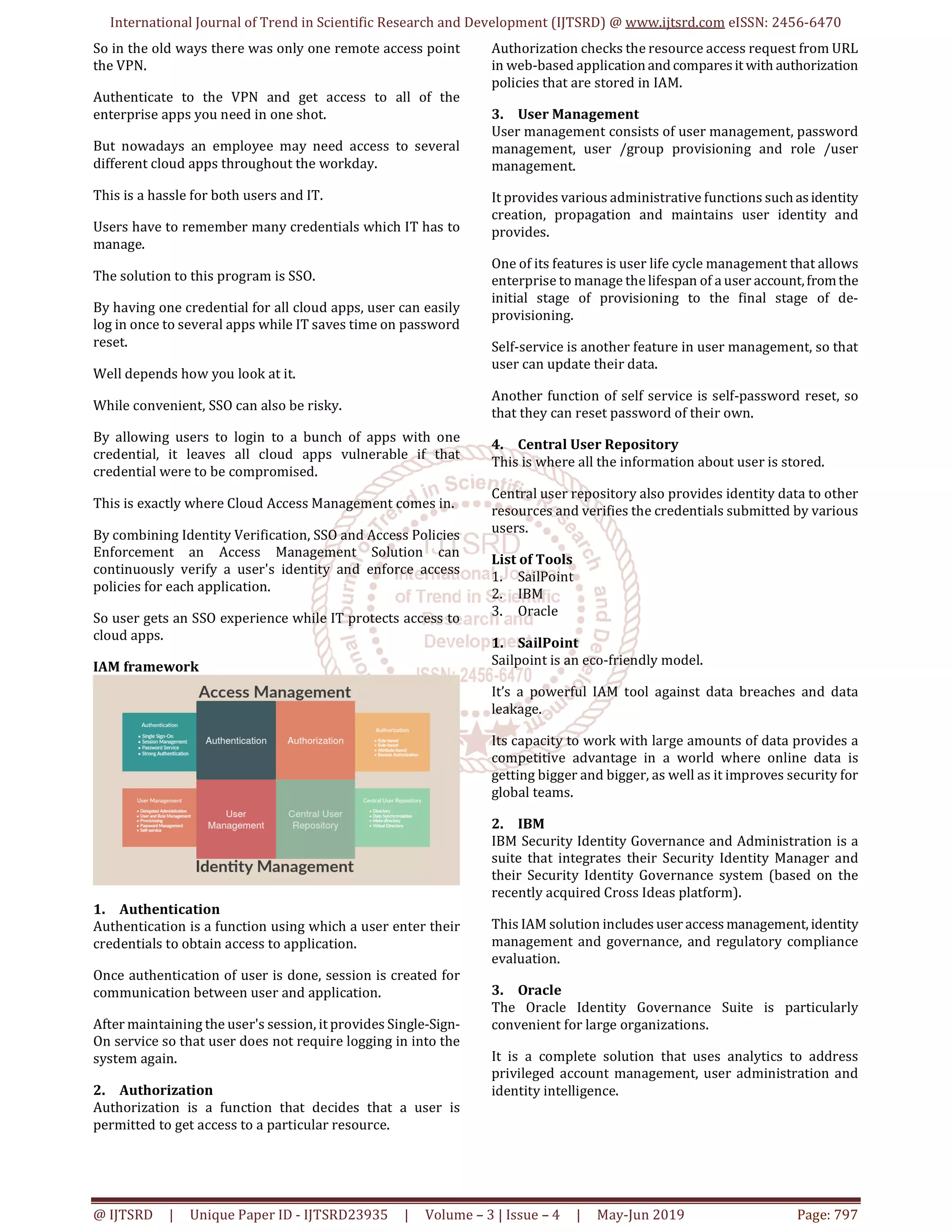
IAM framework
1. Authentication
Authentication is a function using which a user enter their
credentials to obtain access to application.
Once authentication of user is done, session is created for
communication between user and application.
After maintaining the user's session, it provides Single-Sign-
On service so that user does not require logging in into the
system again.
2. Authorization
Authorization is a function that decides that a user is
permitted to get access to a particular resource.
Authorization checks the resource access request from URL
in web-based applicationand comparesit with authorization
policies that are stored in IAM.
3. User Management
User management consists of user management, password
management, user /group provisioning and role /user
management.
It provides various administrative functions such asidentity
creation, propagation and maintains user identity and
provides.
One of its features is user life cycle management that allows
enterprise to manage the lifespan of a user account,fromthe
initial stage of provisioning to the final stage of de-
provisioning.
Self-service is another feature in user management, so that
user can update their data.
Another function of self service is self-password reset, so
that they can reset password of their own.
4. Central User Repository
This is where all the information about user is stored.
Central user repository also provides identity data to other
resources and verifies the credentials submitted by various
users.
List of Tools
1. SailPoint
2. IBM
3. Oracle
1. SailPoint
Sailpoint is an eco-friendly model.
It’s a powerful IAM tool against data breaches and data
leakage.
Its capacity to work with large amounts of data provides a
competitive advantage in a world where online data is
getting bigger and bigger, as well as it improves security for
global teams.
2. IBM
IBM Security Identity Governance and Administration is a
suite that integrates their Security Identity Manager and
their Security Identity Governance system (based on the
recently acquired Cross Ideas platform).
This IAM solution includes user access management, identity
management and governance, and regulatory compliance
evaluation.
3. Oracle
The Oracle Identity Governance Suite is particularly
convenient for large organizations.
It is a complete solution that uses analytics to address
privileged account management, user administration and
identity intelligence.
International Journal of Trend in Scientific Research and Development (IJTSRD) @ www.ijtsrd.com eISSN: 2456-6470
@ IJTSRD | Unique Paper ID - IJTSRD23935 | Volume – 3 | Issue – 4 | May-Jun 2019 Page: 798
COMPARISION OF VARIOUS TOOLS
Features IBM SailPoint Oracle
Access Management Yes Yes Yes
Single Sign-On Yes Yes Yes
Multi Factor Authentication Yes Yes Yes
User Activity Compliance Yes Yes
Identity Governance Yes Yes Yes
Managed Security Services Yes Yes Yes
User Provisioning Yes Yes Yes
Automate Risk Mitigation Yes
Compliance Manager Yes Yes Yes
Lifecycle Manager Yes Yes
Identity Intelligence Yes
Governance Platform Yes Yes Yes
Integration Modules Yes Yes
Secure Token Service Yes Yes Yes
Conclusion
Businesses that need to design and implement complicated
IAM strategies and need strongsupportalongtheway would
be the best suited for this tool.
Since IBM provides strategic, as well as deployment
solutions, if an enterprise has an IAM problem and does not
know where to start to solve it, IBMs IAM tool can help.
IBM is an industry leader with both tradition and innovation
capabilities,
Therefore, many enterprise businesses choose it as the best
all-in-one identity access management (IAM) tool to reduce
risks of insider threat and identity fraud, manage
administrative compliance and automatically improve
collaboration between users.
Reference
[1] https://www.sciencedirect.com/science/article/pii/S22
15098617316750#s0225
[2] https://searchcloudcomputing.techtarget.com/feature/
How-to-get-started-with-IAM-services-in-the-cloud
[3] https://www.getkisi.com/blog/identity-access-
management-tools

Identity and Access Management Tools

  • 1.
    International Journal ofTrend in Scientific Research and Development (IJTSRD) Volume: 3 | Issue: 4 | May-Jun 2019 Available Online: www.ijtsrd.com e-ISSN: 2456 - 6470 @ IJTSRD | Unique Paper ID - IJTSRD23935 | Volume – 3 | Issue – 4 | May-Jun 2019 Page: 796 Identity and Access Management Tools Mr. Vinay Jayprakash Pol Bharti Vidyapeeth Institute of Management and Information Technology, CBD Belapur, Navi Mumbai, Maharashtra, India How to cite this paper: Mr. Vinay Jayprakash Pol "Identity and Access Management Tools" Published in International Journal of Trend in Scientific Research and Development (ijtsrd), ISSN: 2456- 6470, Volume-3 | Issue-4, June 2019, pp.796-798, URL: https://www.ijtsrd.c om/papers/ijtsrd23 935.pdf Copyright © 2019 by author(s) and International Journal of Trend in Scientific Research and Development Journal. This is an Open Access article distributed under the terms of the Creative Commons Attribution License (CC BY 4.0) (http://creativecommons.org/licenses/ by/4.0) ABSTRACT Identity and access management is a vital information security control for organizations to minimize the insider threats and advanced persistent threats that are caused by mismanaged user’s identities and access control on sensitive business applications. Unauthorized access to business-critical IT applications results in information disclosure and financial loss for many organizations across the world. Deployment of identity and access management as an essential information security control will enable organizations to detect or even prevent security breaches due to unauthorized access. This paper elaborates necessary facts for making decisions towards protecting the organization’s assets using IAM controls. The purpose of this paper to compare various Identity and access management tools. Keywords: IAM, Identity and Access Management, SSO, Cyber Security, Authentication, Authorization INTRODUCTION IAM Identity and access management refers to the ability to manage user identities and their access to it resources such as systems, applications, files, and networks. IAM solutions have been a critical aspect of IT infrastructure for many years now as they help to make work happen. However, many IT admins have come to discover that traditional IAM solutions are struggling to manage the complexity of modern networks. As a result IT organisations are now looking for new approaches to identify and access management. Historically the most popular IAM platform has been Microsoft active directory. Active directory is an on-prem IAM platform that was designed for on-prem windows-based environment. When AD was introduced in 1999, mostITnetwork were on- prem and windows-based. Windows has remained the most popular enterprise operating system ever since. However, IT networks started to change as Mac systems, Linux servers, web applications, alternative storage solutions, google apps, aws and the cloud came to market in the mid-2000s. Solutions such as theseweren’twindows-based,northeyon- prem. Consequently, active directory implementations began to struggle and have been ever since. Of course, IT organizations could patch active directorywith third party add-ons such as identity bridges, web applications single sign-on, privileged identity management and more to mitigate some of these traditional challenges. The trouble with this approach, however, is that it adds significant cost and complexity, not to mention that modern IT organisations would rather shift their identity management infrastructure to the cloud. The good news is that a next generation cloud IAM platform has come to market that is effectively active directory reimagined for modern networks. IAM tools has the power to manage virtuallyanyIT resource, without the help of costly third-party add-ons and without anything on-prem. How IAM works? It is more than just SSO or authentication, it’s an ongoing process that continuously verifies a user’s identity and enforces access policies each time a user logs into a cloud application. IJTSRD23935
  • 2.
    International Journal ofTrend in Scientific Research and Development (IJTSRD) @ www.ijtsrd.com eISSN: 2456-6470 @ IJTSRD | Unique Paper ID - IJTSRD23935 | Volume – 3 | Issue – 4 | May-Jun 2019 Page: 797 So in the old ways there was only one remote access point the VPN. Authenticate to the VPN and get access to all of the enterprise apps you need in one shot. But nowadays an employee may need access to several different cloud apps throughout the workday. This is a hassle for both users and IT. Users have to remember many credentials which IT has to manage. The solution to this program is SSO. By having one credential for all cloud apps, user can easily log in once to several apps while IT saves time on password reset. Well depends how you look at it. While convenient, SSO can also be risky. By allowing users to login to a bunch of apps with one credential, it leaves all cloud apps vulnerable if that credential were to be compromised. This is exactly where Cloud Access Management comes in. By combining Identity Verification, SSO and Access Policies Enforcement an Access Management Solution can continuously verify a user's identity and enforce access policies for each application. So user gets an SSO experience while IT protects access to cloud apps. IAM framework 1. Authentication Authentication is a function using which a user enter their credentials to obtain access to application. Once authentication of user is done, session is created for communication between user and application. After maintaining the user's session, it provides Single-Sign- On service so that user does not require logging in into the system again. 2. Authorization Authorization is a function that decides that a user is permitted to get access to a particular resource. Authorization checks the resource access request from URL in web-based applicationand comparesit with authorization policies that are stored in IAM. 3. User Management User management consists of user management, password management, user /group provisioning and role /user management. It provides various administrative functions such asidentity creation, propagation and maintains user identity and provides. One of its features is user life cycle management that allows enterprise to manage the lifespan of a user account,fromthe initial stage of provisioning to the final stage of de- provisioning. Self-service is another feature in user management, so that user can update their data. Another function of self service is self-password reset, so that they can reset password of their own. 4. Central User Repository This is where all the information about user is stored. Central user repository also provides identity data to other resources and verifies the credentials submitted by various users. List of Tools 1. SailPoint 2. IBM 3. Oracle 1. SailPoint Sailpoint is an eco-friendly model. It’s a powerful IAM tool against data breaches and data leakage. Its capacity to work with large amounts of data provides a competitive advantage in a world where online data is getting bigger and bigger, as well as it improves security for global teams. 2. IBM IBM Security Identity Governance and Administration is a suite that integrates their Security Identity Manager and their Security Identity Governance system (based on the recently acquired Cross Ideas platform). This IAM solution includes user access management, identity management and governance, and regulatory compliance evaluation. 3. Oracle The Oracle Identity Governance Suite is particularly convenient for large organizations. It is a complete solution that uses analytics to address privileged account management, user administration and identity intelligence.
  • 3.
    International Journal ofTrend in Scientific Research and Development (IJTSRD) @ www.ijtsrd.com eISSN: 2456-6470 @ IJTSRD | Unique Paper ID - IJTSRD23935 | Volume – 3 | Issue – 4 | May-Jun 2019 Page: 798 COMPARISION OF VARIOUS TOOLS Features IBM SailPoint Oracle Access Management Yes Yes Yes Single Sign-On Yes Yes Yes Multi Factor Authentication Yes Yes Yes User Activity Compliance Yes Yes Identity Governance Yes Yes Yes Managed Security Services Yes Yes Yes User Provisioning Yes Yes Yes Automate Risk Mitigation Yes Compliance Manager Yes Yes Yes Lifecycle Manager Yes Yes Identity Intelligence Yes Governance Platform Yes Yes Yes Integration Modules Yes Yes Secure Token Service Yes Yes Yes Conclusion Businesses that need to design and implement complicated IAM strategies and need strongsupportalongtheway would be the best suited for this tool. Since IBM provides strategic, as well as deployment solutions, if an enterprise has an IAM problem and does not know where to start to solve it, IBMs IAM tool can help. IBM is an industry leader with both tradition and innovation capabilities, Therefore, many enterprise businesses choose it as the best all-in-one identity access management (IAM) tool to reduce risks of insider threat and identity fraud, manage administrative compliance and automatically improve collaboration between users. Reference [1] https://www.sciencedirect.com/science/article/pii/S22 15098617316750#s0225 [2] https://searchcloudcomputing.techtarget.com/feature/ How-to-get-started-with-IAM-services-in-the-cloud [3] https://www.getkisi.com/blog/identity-access- management-tools