Teacher’s
 Guide

            Table of Contents
              A Letter from Project AWARE Foundation . . . . . . . . . . . . . . .3
              Preface – Using the AWARE Kids Package . . . . . . . . . . . . . . .4
              The Prescribed Learning Outcomes for AWARE Kids . . . . . . .6
              Component Descriptions . . . . . . . . . . . . . . . . . . . . . . . . . . .9
              National Science Education Standards (NSES) Correlations 10

              Crazy About Coral Reefs . . . . . . . . . . . . . . . . . . . . . . . . . . .12
              Caring for Coral Reef Activity Sheet . . . . . . . . . . . . . . . . . . .17
              Sharks Rule! . . . . . . . . . . . . . . . . . . . . . . . . . . . . . . . . . . . . .18
              Kelp – It’s a Forest Out There... . . . . . . . . . . . . . . . . . . . . . .22
              Do You Eat Kelp? Activity Sheet . . . . . . . . . . . . . . . . . . . . .26
              Go Wild With Whales and Dolphins . . . . . . . . . . . . . . . . . .27
              Totally Sea Turtles . . . . . . . . . . . . . . . . . . . . . . . . . . . . . . . .31

              Classroom Fun and Games . . . . . . . . . . . . . . . . . . . . . . . . .35

              AWARE Kids in Action . . . . . . . . . . . . . . . . . . . . . . . . . . . . .38
              AWARE Mission 1: Kids Clean Up! . . . . . . . . . . . . . . . . . . . .38
              Kids Clean Up Activity Sheet . . . . . . . . . . . . . . . . . . . . . . . .41
              AWARE Mission 2: Recycling Rocks! . . . . . . . . . . . . . . . . . . .42
              Recycling Rocks! Activity Sheet . . . . . . . . . . . . . . . . . . . . . .43
              AWARE Mission 3: . . . . . . . . . . . . . . . . . . . . . . . . . . . . . . .44
                Kids to the Rescue! Threatened Underwater Animals
              AWARE Mission 4: Way Cool Water Conservation . . . . . . . .46
              Way Cool Water Conservation Activity Sheet . . . . . . . . . . . .48
              AWARE Mission 5: Speak Out! . . . . . . . . . . . . . . . . . . . . . . .49

              Teacher Feedback Form . . . . . . . . . . . . . . . . . . . . . . . . . . .51


                                                                                                 1
2
A Letter from
Project AWARE
  Foundation

                          Dear Educator,
                          The Project AWARE Foundation, a 501 c(3) nonprofit organization con-
                          serving underwater environments through education, advocacy and
                                action, organizes hands-on environmental activities, leads public
                                awareness and education programs and provides support for
                                conservation efforts worldwide.
                                The AWARE Kids Teacher’s Guide is a tool to help actively teach
                                students about issues facing the underwater world and provide
                                hands-on opportunities to participate in solutions. The AWARE
                                Kids activity book covers education subjects including coral reefs,
                                              sharks, kelp forests, whales, dolphins and sea turtles.
                                              AWARE Kids Missions encourage younger generations
                                              to participate in conservation activities. The book also
                                              includes fun puzzles, post cards, an underwater
                                              poster and more.
                                            Project AWARE Foundation’s goal with the AWARE Kids
                                                                   Teacher’s Guide is to inte-
                                                                   grate science, math, art, lan-
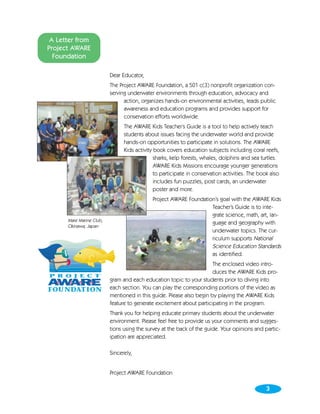
      Mare Marine Club,
                                                                   guage and geography with
      Okinawa, Japan
                                                                   underwater topics. The cur-
                                                                   riculum supports National
                                                                   Science Education Standards
                                                                   as identified.
                                                                      The enclosed video intro-
                                                                      duces the AWARE Kids pro-
                          gram and each education topic to your students prior to diving into
                          each section. You can play the corresponding portions of the video as
                          mentioned in this guide. Please also begin by playing the AWARE Kids
                          feature to generate excitement about participating in the program.
                          Thank you for helping educate primary students about the underwater
                          environment. Please feel free to provide us your comments and sugges-
                          tions using the survey at the back of the guide. Your opinions and partic-
                          ipation are appreciated.

                          Sincerely,


                          Project AWARE Foundation

                                                                                               3
                                                                                               3
Using the
    Preface
              AWARE Kids Package
              The AWARE Kids program is for elementary school aged kids who want
              to discover, explore and investigate the fascinating aquatic world.
              AWARE Kids uses the systems approach (all products are tied to one
              another) by design and currently consists of three products: AWARE Kids
              activity book; AWARE Kids video, and the AWARE Kids Teacher’s Guide.
                                  These AWARE Kids materials were designed for the
                                  elementary school teacher, adults who work with
                                  kids in different capacities such as a group/camp
                                  leader, councilor, or coach, (hereafter referred to as
                                  educators) and all children at the grade K through 4
                                  elementary school level. AWARE Kids is guided by
                                  three principles of learning: 1) learning requires the
                                  active participation of the student, 2) people learn in
                                                 a variety of ways and at different rates,
                                                 and 3) learning is both an individual
                                                 and a group process.
                                                  AWARE Kids incorporates the National
                                                  Science Education Content Standards
                                                  (NSES) for grades K through 4 and can
                                                  be modified and adapted to challenge
                                                  kids in grades 5 through 7. Aware Kids
                                                  draws upon the three traditional sci-
                                                  ence disciplines of physical science,
              life science and earth and space science. One advantage of studying the
              conservation of the underwater environment is that learning outcomes
              apply to all three of the science disciplines. In many aspects, AWARE
              Kids provides a broader and more complete understanding of how the
              traditional sciences interrelate than if they were to be studied separately.
              In this way, studying the aquatic environment and conservation efforts
              lends to an interdisciplinary science understanding.
              AWARE Kids involves studying the diversity, continuity, interactions, and
              balance between organisms and their environments. By using the skills,
              processes and attitudes of science, children extend their understanding
              of the living world and their place within it. By making sense of how
              organisms live in their environments, children develop an understanding
              of the diversity and interactions of living and nonliving things. The edu-

4
cator-led activities, provided in the AWARE Kids Teacher’s Guide,
          encourage children to research animals and plants in a variety of habitats
Preface   to determine the effects of structure and behavior on both individuals
          and species within that environment. Children demonstrate their knowl-
          edge of how animals adapt to their surroundings by completing the
          activities outlined in the AWARE Kids activity book. Students can further
                                       demonstrate their knowledge of how animals
                                       adapt to their surroundings by completing
                                       some of the educator-led extension activities
                                       outlined in the AWARE Kids Teacher’s Guide.
                                      AWARE Kids encourages the use of simple
                                      machines or scientific tools to make tasks eas-
                                      ier, determine their characteristics and uses.
                                      Many of the activities in the AWARE Kids
                                      activity book require children to use devices
                                      to measure, calculate, compare and contrast
                                      results.
          AWARE Kids also helps children develop an understanding of the forces,
          processes and dynamic life-supporting qualities of the Earth. Knowledge
          of the Earth’s fresh and saltwater resources is relevant to an understand-
          ing of our environment and our existence. Students experiment to deter-
          mine how water is important to all life forms. They consider issues of
          water use from various perspectives and identify ways in which water is
          used responsibly in their community. Students demonstrate their scientif-
          ic skills and processes when they use a variety of media to communicate
          the results of their investigations and act on their findings in a responsi-
          ble manner.
          Studying the conservation of the underwater environment through the
          AWARE Kids materials is more than integrating the traditional science dis-
          ciplines to examine the aquatic realm. It is about studying science itself.
          Science as a way of thinking, as it relates to technology, its social influ-
          ence and its history. Therefore, the study of the underwater environment
          and its conservation involves four content areas beyond the traditional
          science disciplines. They are science as inquiry, science and technology,
          science in personal and social perspectives and the historical nature of
          science. AWARE Kids interweaves the traditional science content and
          these four additional content areas through each of the five core topic
          sections, the classroom and games section and the five AWARE missions.


                                                                               5
Learning                  The Prescribed Learning
     Outcomes                   Outcomes for AWARE Kids

                                The United States has established as a goal that all students should
                                achieve scientific literacy. The National Science Education Content
                                Standards are designed to enable the nation to achieve this goal and
                                AWARE Kids is written with this goal in mind. Scientific literacy enables
                                people to use scientific principles and processes in making personal
                                decisions and participate in discussions of scientific issues that affect
                                society. AWARE Kids emphasizes a new way of teaching and learning
                                about science that reflects how science itself is done, emphasizing
                                inquiry as a way of achieving knowledge and understanding about the
                                world.
                                                                  The prescribed learning outcomes are
                                                                  driven by the NSES. They set out the
                                                                  knowledge, enduring ideas, issues, con-
                                                                  cepts, skills and attitudes for elementary
                                                                  school science. The prescribed learning
                                                                  outcomes are statements of what stu-
                                                                  dents are expected to know and do by
                                                                  completing the AWARE Kids activities.
                                                                  The prescribed learning outcomes are
                                                                  clearly stated, expressed in measurable
                                                                  terms and have been written to enable
                                                                  educators to use their experience and
                                                                  professional judgment in planning,
                                                                  implementing and evaluating. The pre-
                                                                  scribed learning outcomes are bench-
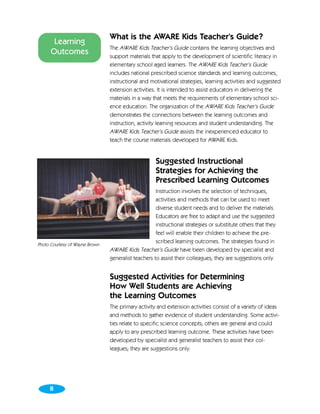
Photo Courtesy of Megan Saunders
                                 marks that will permit the use of criterion-referenced performance stan-
                                 dards. It is expected that performance will vary in relation to the learning
                                 outcomes.


     6
Learning   The Prescribed Learning Outcomes
Outcomes
            for AWARE Kids
            It is expected that students or children will:
             • predict the results of an experiment
             • perform an experiment by following a procedure
             • use appropriate tools to assist observations
             • construct simple definitions based on experiments
             • demonstrate an ability to recognize a valid interpretation of results
             • present an interpretation of the results from an experiment
             • use a variety of media to present information
             • demonstrate responsible action when using the scientific informa-
               tion and skills they have developed
             • relate the structure and behavior of organisms to their survival in
               local environments
             • discuss how changes in an organism’s habitat can affect the survival
               of individual organisms and entire species
             • give examples of how the differences in individuals of the same
               species may give an advantage in surviving and reproducing
             • relate the growth and survival of organisms to a variety of conditions
             • relate the life processes of an organism to its use of nutrients, water,
               and oxygen
             • describe the changing requirements of organisms as they grow
             • relate dietary habits and behavior to an organism’s health
             • manipulate simple machines to determine characteristics
               and uses
             • operate simple machines to demonstrate their usefulness in
               everyday life
             • categorize the various uses of water
             • outline the importance of water for life
             • use the physical properties of water to describe or illustrate the
               water cycle
             • compare and contrast freshwater and saltwater environments
             • describe human effects on the Earth’s water resources


                                                                                 7
What is the AWARE Kids Teacher’s Guide?
       Learning
                                The AWARE Kids Teacher’s Guide contains the learning objectives and
      Outcomes                  support materials that apply to the development of scientific literacy in
                                elementary school aged learners. The AWARE Kids Teacher’s Guide
                                includes national prescribed science standards and learning outcomes,
                                instructional and motivational strategies, learning activities and suggested
                                extension activities. It is intended to assist educators in delivering the
                                materials in a way that meets the requirements of elementary school sci-
                                ence education. The organization of the AWARE Kids Teacher’s Guide
                                demonstrates the connections between the learning outcomes and
                                instruction, activity learning resources and student understanding. The
                                AWARE Kids Teacher’s Guide assists the inexperienced educator to
                                teach the course materials developed for AWARE Kids.


                                                     Suggested Instructional
                                                     Strategies for Achieving the
                                                     Prescribed Learning Outcomes
                                                     Instruction involves the selection of techniques,
                                                     activities and methods that can be used to meet
                                                     diverse student needs and to deliver the materials.
                                                     Educators are free to adapt and use the suggested
                                                     instructional strategies or substitute others that they
                                                     feel will enable their children to achieve the pre-
                                                     scribed learning outcomes. The strategies found in
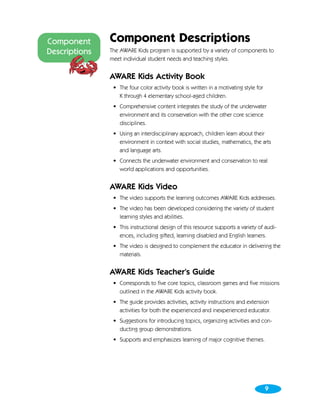
Photo Courtesy of Wayne Brown
                                AWARE Kids Teacher’s Guide have been developed by specialist and
                                generalist teachers to assist their colleagues; they are suggestions only.


                                Suggested Activities for Determining
                                How Well Students are Achieving
                                the Learning Outcomes
                                The primary activity and extension activities consist of a variety of ideas
                                and methods to gather evidence of student understanding. Some activi-
                                ties relate to specific science concepts; others are general and could
                                apply to any prescribed learning outcome. These activities have been
                                developed by specialist and generalist teachers to assist their col-
                                leagues; they are suggestions only.


     8
Component      Component Descriptions
Descriptions   The AWARE Kids program is supported by a variety of components to
               meet individual student needs and teaching styles.


               AWARE Kids Activity Book
                • The four color activity book is written in a motivating style for
                  K through 4 elementary school-aged children.
                • Comprehensive content integrates the study of the underwater
                  environment and its conservation with the other core science
                  disciplines.
                • Using an interdisciplinary approach, children learn about their
                  environment in context with social studies, mathematics, the arts
                  and language arts.
                • Connects the underwater environment and conservation to real
                  world applications and opportunities.


               AWARE Kids Video
                • The video supports the learning outcomes AWARE Kids addresses.
                • The video has been developed considering the variety of student
                  learning styles and abilities.
                • This instructional design of this resource supports a variety of audi-
                  ences, including gifted, learning disabled and English learners.
                • The video is designed to complement the educator in delivering the
                  materials.


               AWARE Kids Teacher’s Guide
                • Corresponds to five core topics, classroom games and five missions
                  outlined in the AWARE Kids activity book.
                • The guide provides activities, activity instructions and extension
                  activities for both the experienced and inexperienced educator.
                • Suggestions for introducing topics, organizing activities and con-
                  ducting group demonstrations.
                • Supports and emphasizes learning of major cognitive themes.


                                                                                      9
NSES                  National Science Education
    Standards               Standards (NSES) Correlations
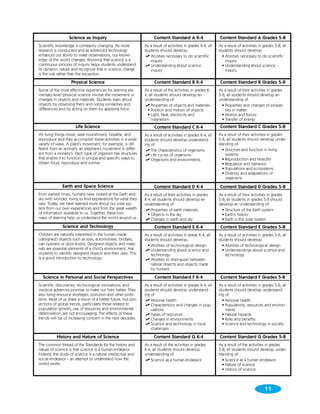
                            As the result of activities provided for students during the AWARE Kids
Reference: National         program, the content of the standard identified is to be understood or
Research Council, (1999).   the abilities are to be developed by the student.
National Science            AWARE Kids is developed for K through 4 elementary school aged chil-
Education Standards.        dren and can be modified and adapted to challenge grades 5 through 7
National Academy Press,     students. The check marks indicate direct correlations to AWARE Kids.
Washington, DC.


    10
Science as Inquiry                                 Content Standard A K-4                   Content Standard A Grades 5-8
Scientific knowledge is constantly changing. As more           As a result of activities in grades K-4, all   As a result of activities in grades 5-8, all
research is conducted and as advanced technology               students should develop:                       students should develop:
enhances our ability to make observations, our knowl-              Abilities necessary to do scientific         • Abilities necessary to do scientific
edge of the world changes. Knowing that science is a               inquiry                                        inquiry
continuous process of inquiry helps students understand            Understanding about science                  • Understanding about science
its dynamic nature and recognize that in science change            inquiry                                        inquiry
is the rule rather than the exception.

                   Physical Science                                  Content Standard B K-4                   Content Standard B Grades 5-8
Some of the most effective experiences for learning ele-       As a result of the activities in grades K-     As a result of their activities in grades
mentary-level physical science involve the movement or         4, all students should develop an              5-8, all students should develop an
changes in objects and materials. Students learn about         understanding of:                              understanding of:
objects by observing them and noting similarities and              Properties of objects and materials          • Properties and changes of proper-
differences and by acting on them by applying force.             • Position and motion of objects                 ties in matter
                                                                 • Light, heat, electricity and                 • Motion and forces
                                                                   magnetism                                    • Transfer of energy
                      Life Science                                   Content Standard C K-4                   Content Standard C Grades 5-8
All living things move, seek nourishment, breathe, and         As a result of activities in grades K-4, all   As a result of their activities in grades
reproduce and they accomplish these activities in a wide       students should develop understand-            5-8, all students should develop under-
variety of ways. A plant’s movement, for example, is dif-      ing of:                                        standing of:
ferent from an animal’s; an elephant’s movement is differ-         The characteristics of organisms             • Structure and function in living
ent from a monkey’s. Each type of organism has structures          Life cycles of organisms                       systems
that enable it to function in unique and specific ways to          Organisms and environments                   • Reproduction and heredity
obtain food, reproduce and survive.                                                                             • Regulation and behavior
                                                                                                                • Populations and ecosystems
                                                                                                                • Diversity and adaptations of
                                                                                                                  organisms

              Earth and Space Science                                Content Standard D K-4                   Content Standard D Grades 5-8
From earliest times, humans have looked at the Earth and       As a result of their activities in grades      As a result of their activities in grades
sky with wonder, trying to find explanations for what they     K-4, all students should develop an            5-8, all students in grades 5-8 should
saw. Today, we have learned more about our solar sys-          understanding of:                              develop an understanding of:
tem from our own experiences and from the great wealth             Properties of earth materials                • Structure of the Earth system
of information available to us. Together, these two              • Objects in the sky                           • Earth’s history
ways of learning help us understand the world around us.           Changes in earth and sky                     • Earth in the solar system
              Science and Technology                                 Content Standard E K-4                    Content Standard E Grades 5-8
Children are naturally interested in the human-made            As a result of activities in grade K-4, all    As a result of activities in grades 5-8, all
(designed) objects such as toys, automobiles, bridges,         students should develop:                       students should develop:
can openers or door knobs. Designed objects and mate-            • Abilities of technological design            • Abilities of technological design
rials are essential elements of a child’s environment. Ask         Understanding about science and              • Understandings about science and
students to identify designed objects and their uses. This         technology                                     technology
is a good introduction to technology.                              Abilities to distinguish between
                                                                   natural objects and objects made
                                                                   by humans

  Science in Personal and Social Perspectives                        Content Standard F K-4                    Content Standard F Grades 5-8
Scientific discoveries, technological innovations, and         As a result of activities in grades K-4, all   As a result of activities in grades 5-8, all
medical advances promise to make our lives better. They        students should develop understand-            students should develop understand-
also bring resource shortages, pollution and other prob-       ing of:                                        ing of:
lems. Most of us share a vision of a better future, but pro-       Personal health                              • Personal health
jections of global trends, particularly those related to           Characteristics and changes in pop-          • Populations, resources and environ-
population growth, use of resources and environmental              ulations                                       ments
deterioration, are not encouraging. The effects of these           Types of resources                           • Natural hazards
trends will be of increasing concern in the next decades.          Changes in environments                      • Risks and benefits
                                                                   Science and technology in local              • Science and technology in society
                                                                   challenges

           History and Nature of Science                             Content Standard G K-4                   Content Standard G Grades 5-8
The common thread of the Standards for the history and         As a result of the activities in grades        As a result of the activities in grades
nature of science is that science is a human endeavor.         K-4, all students should develop               5-8, all students should develop under-
Indeed, the study of science is a natural intellectual and     understanding of:                              standing of:
social endeavor – an attempt to understand how the                 Science as a human endeavor                  • Science as a human endeavor
world works.                                                                                                    • Nature of science
                                                                                                                • History of science


                                                                                                                                           11
Crazy About Coral Reefs
     Coral Reefs                                                [Page 1 of the AWARE Kids activity book.]


                                Topic Discussion:      Rainforests of the Sea
  Remember to play the
                                Coral reefs are the oldest, most productive ecosystems on earth.
 Coral Reef section of the
                                Existing for more than 200 million years, they’re named the rainforests of
   AWARE Kids video.
                                the sea because they maintain the biological diversity of our world’s
                                oceans. Corals are literally teeming with life. They serve as habitat or
Vocabulary:
                                nursery grounds for 25 percent of all known marine life and support
Conservation – taking care
                                4000 species of fish and thousands more plants and animals.
of the environment by pro-
tecting waterways and other     Built by colonies of tiny coral animals, called coral polyps, these animals
natural resources.              form huge coral reef structures. There are more than 2500 species of
Coral bleaching – the loss      coral growing in clear, shallow ocean waters across the globe. Most live
of color from a coral as it     in the warmer waters near the equator where they use the energy from
expels its zooxanthelle,
                                sunlight to thrive.
usually happens in response
to stress.                      There are two different types of coral reefs: hard corals (such as brain,
Coral polyps – tiny, fragile    star and elkhorn coral) and soft corals (such as sea fans, sea whips and
animals that compose a          sea rods). Both hard and soft corals come in all shapes, sizes and colors.
coral reef structure.           A few are even fluorescent.
Coral reefs – a massive         Aside from their vast ecological importance, coral reefs are valued for
structure made up of tiny,
                                many other reasons. For example,
fragile animals called coral
polyps.                          • Corals support local economies because they’re valuable tourist
Ecosystem – a community            attractions. Many tropical nations base much of their economy on
of plant and animal life that      the worldwide appeal of these diving and snorkeling destinations.
interact with each other and       Tourism brings billions of dol-
the physical environment.
                                   lars to local economies and
Habitat – the environment          sustains 10 percent of all jobs
where a species lives or
                                   on earth.
grows.
Nursery ground – environ-        • Corals also provide protection
ment where juvenile species        for coastal communities,
are produced and/or devel-         defending them against storms,
oped.                              wave damage and erosion. It’s
Species – a class of organ-        estimated that each square
isms grouped together              meter of coral reef protects
based on their common
                                   $47,000 US in property value.
features.
                                   Without this protection entire
Zooxanthelle – algae that
live in a symbiotic relation-
                                   islands and coastal communi-
ship with coral.                   ties wouldn’t exist.


     12
• Coral reefs are a critical resource for medical cures. Scientists have
                           found an abundance of compounds to help fight heart disease,
Coral Reefs                asthma, cancer, HIV and more. Marine biologists studying coral life
                           have also learned many things about the human body.


                              ASIA
                                                                           NORTH
     EUROPE                                                               AMERICA
                                                                                          WESTERN
                                                            HAWIIAN
                                                                                          ATLANTIC
              RED SEA                                       ISLANDS
                                          INDO                                            ✪
               ✪                         PACIFIC                                               CARIBBEAN
 AFRICA
                                             ✪
                                                                                          SOUTH
                                                                                         AMERICA


                                 AUSTRALIA


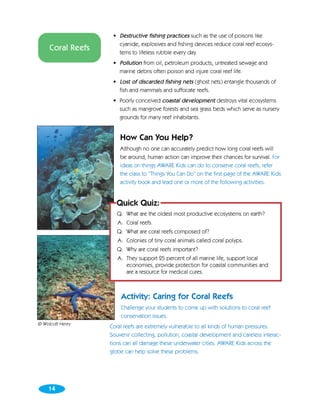
                                                   Highlighted areas demonstrate where coral reefs are found.


                        Conservation Discussion:            Coral Reefs
                        Sadly, coral reefs are rapidly disappearing. Scientists estimate that as
                        much as 25 percent of the world’s coral reefs are already dead and if
                        current trends continue this precious resource may be lost within the
                        next 30 to 50 years.
                        Although environmental stress is contributing to coral decline, humans
                        also contribute to major problems affecting coral reefs:
                         • Sedimentation from coastal development and unwise land use
                           policies cause soil erosion inducing coral stress and blocking light
                           necessary for coral growth.
                         • Runoff from cropland and animal feed lots introduce excessive
                           amounts of fertilizers and untreated sewage to reef environments.
                           These nutrients slow growth rates, reduce light and water flow to
                           coral surfaces and induce coral bleaching.
                         • Global warming trends due to an increase in greenhouse gases and
                           ozone depletion warm ocean temperatures, stressing coral reef
                           ecosystems, often causing corals to bleach and die.

                                                                                                    13
• Destructive fishing practices such as the use of poisons like
                      cyanide, explosives and fishing devices reduce coral reef ecosys-
     Coral Reefs      tems to lifeless rubble every day.
                    • Pollution from oil, petroleum products, untreated sewage and
                      marine debris often poison and injure coral reef life.
                    • Lost of discarded fishing nets (ghost nets) entangle thousands of
                      fish and mammals and suffocate reefs.
                    • Poorly conceived coastal development destroys vital ecosystems
                      such as mangrove forests and sea grass beds which serve as nursery
                      grounds for many reef inhabitants.


                       How Can You Help?
                       Although no one can accurately predict how long coral reefs will
                       be around, human action can improve their chances for survival. For
                       ideas on things AWARE Kids can do to conserve coral reefs, refer
                       the class to “Things You Can Do” on the first page of the AWARE Kids
                       activity book and lead one or more of the following activities.


                     Quick Quiz:
                      Q: What are the oldest most productive ecosystems on earth?
                      A: Coral reefs.
                      Q: What are coral reefs composed of?
                      A: Colonies of tiny coral animals called coral polyps.
                      Q: Why are coral reefs important?
                      A: They support 25 percent of all marine life, support local
                         economies, provide protection for coastal communities and
                         are a resource for medical cures.


                       Activity: Caring for Coral Reefs
                       Challenge your students to come up with solutions to coral reef
                       conservation issues.
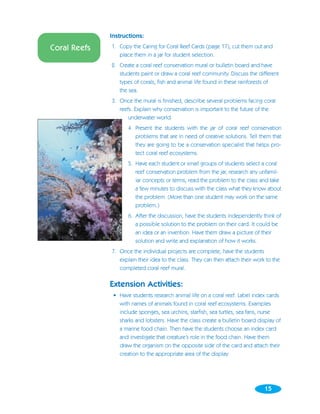
© Wolcott Henry
                   Coral reefs are extremely vulnerable to all kinds of human pressures.
                   Souvenir collecting, pollution, coastal development and careless interac-
                   tions can all damage these underwater cities. AWARE Kids across the
                   globe can help solve these problems.


    14
Instructions:
Coral Reefs   1. Copy the Caring for Coral Reef Cards (page 17), cut them out and
                 place them in a jar for student selection.
              2. Create a coral reef conservation mural or bulletin board and have
                 students paint or draw a coral reef community. Discuss the different
                 types of corals, fish and animal life found in these rainforests of
                 the sea.
              3. Once the mural is finished, describe several problems facing coral
                 reefs. Explain why conservation is important to the future of the
                     underwater world.
                     4. Present the students with the jar of coral reef conservation
                        problems that are in need of creative solutions. Tell them that
                        they are going to be a conservation specialist that helps pro-
                        tect coral reef ecosystems.
                     5. Have each student or small groups of students select a coral
                        reef conservation problem from the jar, research any unfamil-
                        iar concepts or terms, read the problem to the class and take
                        a few minutes to discuss with the class what they know about
                        the problem. (More than one student may work on the same
                        problem.)
                     6. After the discussion, have the students independently think of
                        a possible solution to the problem on their card. It could be
                        an idea or an invention. Have them draw a picture of their
                        solution and write and explanation of how it works.
              7. Once the individual projects are complete, have the students
                 explain their idea to the class. They can then attach their work to the
                 completed coral reef mural.

              Extension Activities:
               • Have students research animal life on a coral reef. Label index cards
                 with names of animals found in coral reef ecosystems. Examples
                 include sponges, sea urchins, starfish, sea turtles, sea fans, nurse
                 sharks and lobsters. Have the class create a bulletin board display of
                 a marine food chain. Then have the students choose an index card
                 and investigate that creature’s role in the food chain. Have them
                 draw the organism on the opposite side of the card and attach their
                 creation to the appropriate area of the display.


                                                                                 15
• Divide students into small groups and have them research coral reef
                threats. Examples include water pollution, coastal development,
Coral Reefs     souvenir collection and anchoring boats, etc. Have students create
                signs that they would post near a coral reef shoreline area, advising
                people against actions that can threaten the reef.
              • Invite a dive professional from a local PADI Dive Center or Resort to
                visit the classroom. Ask them to talk about diving, demonstrate how
                dive equipment works and explain how sustainable dive practices
                can conserve the underwater environment. To find a professional,
                use the directory on the PADI website at www.padi.com.
                            • Have students write a news story investigating a sci-
                              entist or nonprofit organization working to improve
                              coral reef conservation. Ask them to report on their
                              findings including who, what, where, why and how.
                              You can also ask them to interview an individual to
                              obtain quotes for their story.


16
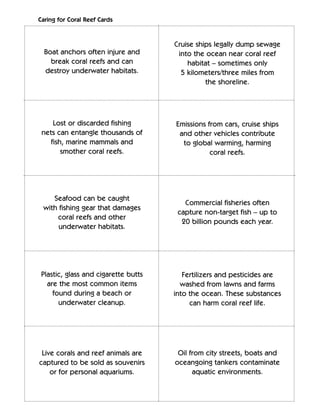
Caring for Coral Reef Cards


                                      Cruise ships legally dump sewage
  Boat anchors often injure and        into the ocean near coral reef
    break coral reefs and can             habitat – sometimes only
  destroy underwater habitats.          5 kilometers/three miles from
                                                the shoreline.


     Lost or discarded fishing        Emissions from cars, cruise ships
 nets can entangle thousands of        and other vehicles contribute
    fish, marine mammals and            to global warming, harming
        smother coral reefs.                     coral reefs.


    Seafood can be caught
                                         Commercial fisheries often
 with fishing gear that damages
                                       capture non-target fish – up to
     coral reefs and other
                                        20 billion pounds each year.
      underwater habitats.


 Plastic, glass and cigarette butts      Fertilizers and pesticides are
   are the most common items            washed from lawns and farms
     found during a beach or          into the ocean. These substances
       underwater cleanup.                 can harm coral reef life.


 Live corals and reef animals are      Oil from city streets, boats and
captured to be sold as souvenirs      oceangoing tankers contaminate
    or for personal aquariums.              aquatic environments.
Teacher’s                    Sharks Rule!
    Sharks Rule!
      Guide                                                       [Pages 2 – 3 of the AWARE Kids activity book]


                                  Topic Discussion:         What is a Shark?
  Remember to play the            Sharks rule the ocean. With their powerful, streamlined bodies and
   sharks section of the          remarkable sensory systems, these creatures have remained virtually
   AWARE Kids video.              unchanged for more than 400 million years.
                                  Technically speaking, sharks are fish. They have a skeleton, fins, live in the
Vocabulary:
                                  water and use gills to breathe. But their skeleton differs from that of
Apex predator – creature
                                  other fish because it’s made of cartilage (like humans have in their nose
at the very top of the food
chain who has no natural          and ears) rather than bone. Their scales are different too. Shark scales
predators.                        have the same structure as a tooth, which is why sharkskin feels rough
Cartilage – tough, flexible       like sandpaper. You may demonstrate this by bringing sandpaper into
connective tissue found in        the classroom for students to touch.
sharks.                           Speaking of teeth – sharks are famous for theirs. The rows of razor sharp
Extinction – the total disap-     teeth are lined up so when the outer row of teeth fall out, the row from
pearance of a species so          behind it moves up to take its place. Sharks are growing teeth all the
that it no longer exists on
                                  time. In fact they go through as many as 30,000 teeth in a lifetime.
the planet.
                                  There are more than 400 species of sharks and they live all over the
Finning – the practice of
fishing sharks solely for their   world. You can find them in tropical lagoons, polar seas and even some
fins and discarding the           freshwater rivers and lakes. But not all sharks eat large fish and marine
remainder of the shark.           mammals. Some, like the horn shark, live off clams and crabs while
                                  others, like the basking shark, are filter feeders that eat plankton.


                                  Photo Courtesty of Al Hornsby


     18
Conservation Discussion:          Sharks
    Sharks Rule!           Often, as in the fictitious movie Jaws, people think of sharks as human-
                           eating monsters. But, the fact is that sharks are in much greater danger
                           from humans than we are from them. Worldwide, less than 100 shark
                           attacks occur each year, very few of which result in fatal injury.
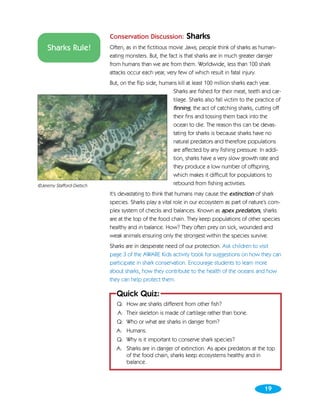
                           But, on the flip side, humans kill at least 100 million sharks each year.
                                                       Sharks are fished for their meat, teeth and car-
                                                       tilage. Sharks also fall victim to the practice of
                                                       finning, the act of catching sharks, cutting off
                                                       their fins and tossing them back into the
                                                       ocean to die. The reason this can be devas-
                                                       tating for sharks is because sharks have no
                                                       natural predators and therefore populations
                                                       are affected by any fishing pressure. In addi-
                                                       tion, sharks have a very slow growth rate and
                                                       they produce a low number of offspring,
                                                       which makes it difficult for populations to
©Jeremy Stafford-Dietsch                               rebound from fishing activities.
                           It’s devastating to think that humans may cause the extinction of shark
                           species. Sharks play a vital role in our ecosystem as part of nature’s com-
                           plex system of checks and balances. Known as apex predators, sharks
                           are at the top of the food chain. They keep populations of other species
                           healthy and in balance. How? They often prey on sick, wounded and
                           weak animals ensuring only the strongest within the species survive.
                           Sharks are in desperate need of our protection. Ask children to visit
                           page 3 of the AWARE Kids activity book for suggestions on how they can
                           participate in shark conservation. Encourage students to learn more
                           about sharks, how they contribute to the health of the oceans and how
                           they can help protect them.

                              Quick Quiz:
                              Q: How are sharks different from other fish?
                              A: Their skeleton is made of cartilage rather than bone.
                              Q: Who or what are sharks in danger from?
                              A: Humans.
                              Q: Why is it important to conserve shark species?
                              A: Sharks are in danger of extinction. As apex predators at the top
                                 of the food chain, sharks keep ecosystems healthy and in
                                 balance.


                                                                                                 19
Activity: Shark Detectives
Sharks Rule!   Sharks are in danger of extinction. But the more we know about sharks,
               the better we’re able to protect them and the habitat they depend on
               for survival.
               1. In a class discussion on sharks, list as many shark species as neces-
                  sary (older students can help you compile this list).
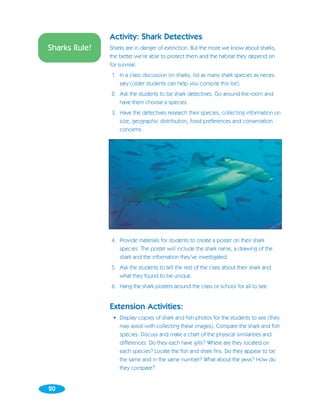
               2. Ask the students to be shark detectives. Go around the room and
                  have them choose a species.
               3. Have the detectives research their species, collecting information on
                  size, geographic distribution, food preferences and conservation
                  concerns.


               4. Provide materials for students to create a poster on their shark
                  species. The poster will include the shark name, a drawing of the
                  shark and the information they’ve investigated.
               5. Ask the students to tell the rest of the class about their shark and
                  what they found to be unique.
               6. Hang the shark posters around the class or school for all to see.


               Extension Activities:
                • Display copies of shark and fish photos for the students to see (they
                  may assist with collecting these images). Compare the shark and fish
                  species. Discuss and make a chart of the physical similarities and
                  differences. Do they each have gills? Where are they located on
                  each species? Locate the fish and shark fins. Do they appear to be
                  the same and in the same number? What about the jaws? How do
                  they compare?


20
• Sharks have survived on earth for more than 400 million years. Ask
                 students to make a timeline including sharks and five to ten other
Sharks Rule!     species (such as dinosaurs, humans, dogs, cats, elephants, sea tur-
                 tles or monkeys). Research these species and their lifespan on earth.
                 Label them all on the timeline. Discuss the reasons for shark’s suc-
                 cess and long-term survival.
               • As in page 3 of the AWARE Kids activity book, ask students to start a
                 shark campaign. Conduct a survey with their classmates, another
                 class, family and friends. Keep a tally of their responses to questions
                 such as “Are you afraid of sharks?”, “Are sharks only found in the
                 ocean?”, “Are sharks in danger of extinction?”. Have them make a
                 bar graph to discover the frequency of their responses. Discuss
                 what they’ve learned from their campaign. Do people have the
                 wrong idea about sharks? What can be done to educate people
                 about the need for conservation?
               • Sharks have a keen sense of smell. They can smell food up to hun-
                 dreds of meters away. How fast do our food smells travel? Stand at
                 the front of the class and slice and onion or orange. After 30 min-
                 utes, how far away can it be smelled? What has happened?


                                                                                 21
Kelp                Kelp – It’s a Forest
        Forests                Out There…
                                                           [Pages 2 – 3 of the AWARE Kids activity book]


 Remember to play the        Vocabulary:
kelp forest section of the   Algae – unicellular or multicellular plants containing chlorophyll and lacking
   AWARE Kids video.         true stems, leaves and roots.
                             Algin – a gelatinous substance derived from giant kelp and other algae, used as
                             a food thickener.
                             Alginate – derived from algin in brown algae. It’s used to help oil and water
                             mix together and form smooth liquids. It can be found in many food and bev-
                             erages, drugs, cosmetics, fertilizers and building materials.
                             Beta carotene – a form of carotene derived from green algae used as a food
                             coloring in many products.
                             Blade – the leaf of the kelp where photosynthesis occurs.
                             Canopy – the top layer of the kelp forest community.
                             Carrageenan – an ingredient found in many kinds of red algae. It’s used as a
                             clarifying and stabilizing agent in many foods, cosmetics, medicine and other
                             products.
                             Forest floor – the bottom layer of the kelp forest, or ocean floor.
                             Holdfast – similar to the roots of a land plant, the holdfast anchors kelp to the
                             sea floor.
                             Photosynthesis – the process where chlorophyll-containing cells produce car-
                             bohydrates using water, carbon dioxide and light.
                             Stipe – resembling the stems of land plants, the stipe provide support for the
                             kelp blades.
                             Stock – see stipe
                             Trophic levels – a segment of the food chain in which all organisms obtain
                             food and energy in a similar manner. From bottom to top: producers (green
                             plants); primary consumers (herbivores); secondary consumers (carnivores);
                             and tertiary consumers (larger consumers).
                             Understory – the area below the kelp forest canopy that comprises algae of
                             medium height much like the shrubs, bushes and saplings found beneath the
                             canopy of the land forest.


   22
Topic Discussion:      What is Kelp?
 Kelp
          Kelp belongs to a group of organisms called algae. They are classified as
Forests   large brown algae to be exact. Kelp are similar to land plants but are dif-
          ferent because they have no true leaves, stems or roots. Instead, kelp
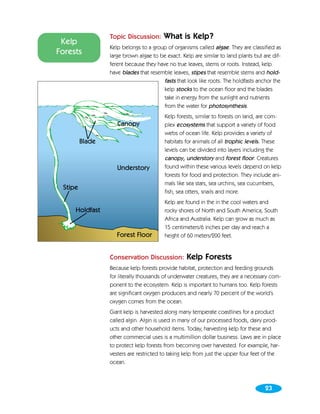
          have blades that resemble leaves, stipes that resemble stems and hold-
                                 fasts that look like roots. The holdfasts anchor the
                                 kelp stocks to the ocean floor and the blades
                                 take in energy from the sunlight and nutrients
                                 from the water for photosynthesis.
                                  Kelp forests, similar to forests on land, are com-
                                  plex ecosystems that support a variety of food
                                  webs of ocean life. Kelp provides a variety of
                                  habitats for animals of all trophic levels. These
                                  levels can be divided into layers including the
                                  canopy, understory and forest floor. Creatures
                                  found within these various levels depend on kelp
                                  forests for food and protection. They include ani-
                                  mals like sea stars, sea urchins, sea cucumbers,
                                  fish, sea otters, snails and more.
                                  Kelp are found in the in the cool waters and
                                  rocky shores of North and South America, South
                                  Africa and Australia. Kelp can grow as much as
                                  15 centimeters/6 inches per day and reach a
                                  height of 60 meters/200 feet.


          Conservation Discussion:         Kelp Forests
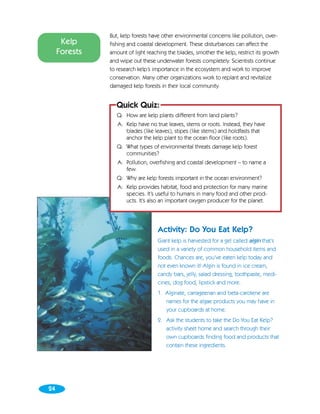
          Because kelp forests provide habitat, protection and feeding grounds
          for literally thousands of underwater creatures, they are a necessary com-
          ponent to the ecosystem. Kelp is important to humans too. Kelp forests
          are significant oxygen producers and nearly 70 percent of the world’s
          oxygen comes from the ocean.
          Giant kelp is harvested along many temperate coastlines for a product
          called algin. Algin is used in many of our processed foods, dairy prod-
          ucts and other household items. Today, harvesting kelp for these and
          other commercial uses is a multimillion dollar business. Laws are in place
          to protect kelp forests from becoming over harvested. For example, har-
          vesters are restricted to taking kelp from just the upper four feet of the
          ocean.


                                                                              23
But, kelp forests have other environmental concerns like pollution, over-
      Kelp     fishing and coastal development. These disturbances can affect the
     Forests   amount of light reaching the blades, smother the kelp, restrict its growth
               and wipe out these underwater forests completely. Scientists continue
               to research kelp’s importance in the ecosystem and work to improve
               conservation. Many other organizations work to replant and revitalize
               damaged kelp forests in their local community.


                 Quick Quiz:
                  Q: How are kelp plants different from land plants?
                  A: Kelp have no true leaves, stems or roots. Instead, they have
                     blades (like leaves), stipes (like stems) and holdfasts that
                     anchor the kelp plant to the ocean floor (like roots).
                  Q: What types of environmental threats damage kelp forest
                     communities?
                  A: Pollution, overfishing and coastal development – to name a
                     few.
                  Q: Why are kelp forests important in the ocean environment?
                  A: Kelp provides habitat, food and protection for many marine
                     species. It’s useful to humans in many food and other prod-
                     ucts. It’s also an important oxygen producer for the planet.


                                    Activity: Do You Eat Kelp?
                                    Giant kelp is harvested for a gel called algin that’s
                                    used in a variety of common household items and
                                    foods. Chances are, you’ve eaten kelp today and
                                    not even known it! Algin is found in ice cream,
                                    candy bars, jelly, salad dressing, toothpaste, medi-
                                    cines, dog food, lipstick and more.
                                    1. Alginate, carrageenan and beta-carotene are
                                       names for the algae products you may have in
                                       your cupboards at home.
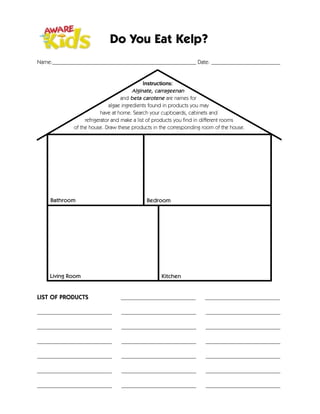
                                    2. Ask the students to take the Do You Eat Kelp?
                                       activity sheet home and search through their
                                       own cupboards finding food and products that
                                       contain these ingredients.


24
3. Have them make a list of these household items and what room
 Kelp        they’re found in.
Forests   4. Ask them to draw the products they found in the corresponding
             rooms of the house.
          5. Begin a discussion of all the items they discovered that contain algae
             at home.
             Answers include: baby food, beer, bread, breakfast bars, cake mix,
             canned gravy, canned sauces, chocolate milk, cookies, dog food,
             donuts, dyed fabric, mashed potato mix, juice drinks, lipstick,
             mayonnaise, paint, pancake mix, paper products, pickles, salad
             dressing, shaving cream, shoe polish, syrup, toothpaste, whipped
             cream topping and yogurt.


          Extension Activities
          • Ask students to draw a picture of giant kelp. Have them label the
            characteristics of the kelp including blade, stipe and holdfast. Have
            students write a description on the purpose of each of these struc-
            tures. They may also write about animals that rely on these structures
            as part of the kelp forest community. Did they spot any while watch-
            ing the kelp section of the video?
          • Divide students into two groups. Have one group create a food
            chain for a kelp forest ecosystem and the other create a food chain
            for a land forest ecosystem. Once they’re complete have them pres-
            ent their results to the entire class. Are there similarities in function of
            each food chain? Have students describe ways their food chain is
            connected to other food chains either on land or underwater. What
            would happen if their forest became damaged by human activity?
          • Have students make a shoe box diorama of the kelp forest commu-
            nity. Using several art supplies ask them to label the canopy, under-
            story and forest floor. They should include marine species within
            each trophic level.
          • Kelp can grow up to 60 meters/200 feet high. The can grow as much
            as 15 centimeters/6 inches per day. Have students figure out how
            many days it would take for kelp to reach its full height. Compared
            to their own height, how much taller does kelp grow? How many of
            their own arms lengths equals the total height of a kelp forest?


                                                                                25
Do You Eat Kelp?
Name:__________________________________________________ Date: ________________________


                                              Instructions:
                                         Alginate, carrageenan
                                   and beta carotene are names for
                              algae ingredients found in products you may
                          have at home. Search your cupboards, cabinets and
                  refrigerator and make a list of products you find in different rooms
             of the house. Draw these products in the corresponding room of the house.


LIST OF PRODUCTS________         __________________________          __________________________

__________________________       __________________________          __________________________

__________________________       __________________________          __________________________

__________________________       __________________________          __________________________

__________________________       __________________________          __________________________

__________________________       __________________________          __________________________

__________________________       __________________________          __________________________
Whales and                Go Wild With Whales
     Dolphins                  and Dolphins
                                                              [Page 4 of the AWARE Kids activity book]


                              Topic Discussion:      What are Whales and Dolphins?
Vocabulary:                   Whales and dolphins live in all the world’s oceans, but they aren’t fish,
                              they’re mammals. They’re warm-blooded, breathe air, give live birth,
Cetacean - belonging to the
order Cetacea, including
                              have hair and nurse their young just as all mammals do. If you’re wonder-
whales, dolphins and por-     ing about the hair – babies have sparse hair, but they shed it before
poises.                       reaching adulthood.
Echolocation – to locate      Whales and dolphins belong to the same order of marine mammals
objects by emitting sound     called cetaceans. They spend their whole lives in water, living in family
waves and interpreting the    groups called pods. Because they live in cool water, they have a thick
resulting echo.
                              layer of blubber just under the skin to keep them warm.
Mysticetes – baleen whales
that strain their food from
                              There are more than 70 species of whales, dolphins and porpoises
the water.                    belonging to two different groups: the suborder mysticetes or baleen
Odontocetes – toothed         whales and the suborder odontocetes or toothed whales. Dolphins
whales that grasp, grip or    and porpoises are classified as toothed whales. Sizes of these species
tear their food.              range from the 30 metre/100 foot blue whale to the 2 metre/6 foot
Pod – a social group of       dolphin.
whales.                       Whales and dolphins communicate with echolocation. When they make
                              sounds, the sound waves travel through the water in all different direc-
                              tions. When the sound reaches an object, it bounces off the object and
                              returns to the whale or dolphin. The echo that bounces back tells it
                              where the object is located, its size and its speed.


                                                               Conservation Discussion:
                                                               Whale and Dolphin
                                                               Years ago, whales and dolphins were
                                                               hunted for food, clothing and oil.
                                                               Although some whales that were near
                                                               extinction have recovered (such as gray
                                                               whales, which were removed from the
                                                               US Endangered Species List) others are
                                                               still endangered.
                                                               Aside from hunting, other threats to
                                                               whale populations include habitat


                                                                                                 27
destruction, entanglement in fishing gear, ocean pollution and an
    Whales and                     increase in boat traffic in vital whale habitat.
     Dolphins                      Protection laws have been put in place across the globe. For example,
                                   the Marine Mammal Protection Act has protected whales and dolphins
                                   in the US since 1972. The Convention on International Trade in
                                   Endangered Species (CITES) that regulates international trade of plants
                                   and animals also prohibits the trade of whale products.


                                       Quick Quiz:
                                       Q: Are whales and dolphins fish or mammals?
                                       A: Mammals. They’re warm-blooded, breathe air, give live birth,
                                          have hair (at one point) and nurse their young.
                                       Q: How do whales and dolphins communicate?
                                       A: With echolocation. They produce sound waves that travel
                                          through the water in different directions. When the sound
                                          reaches an object, it bounces off and returns to the creature.
                                          The echo that returns tells where the object is located, its size
                                          and its speed.
                                       Q: Many whale and dolphin species are now protected by law.
                                          Before these laws were in place, what types of threats put
                                          them near extinction?
                                       A: Hunting, habitat destruction, entaglement in fishing gear, ocean
                                          pollution and boat traffic.


                                                                      Activity: Echolocation
                                                                      1. Explain to students that whales and
                                                                         dolphins hear through echoloca-
                                                                         tion. Describe to them how it works
                                                                         using the information provided
                                                                         above.
                                                                      2. Blindfold one student at time and
                                                                         have him or her stand in front of the
                                                                         class.
                                                                      3. Ask several students to take turn
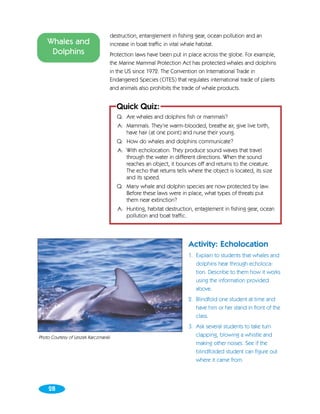
Photo Courtesy of Leszek Karczmarski                                     clapping, blowing a whistle and
                                                                         making other noises. See if the
                                                                         blindfolded student can figure out
                                                                         where it came from.


    28
4. Use a round pan of water and touch the center to demonstrate the
    Whales and          movement of waves. Explain that when whales and dolphins make
     Dolphins           sounds, the sound travels similar to waves, in all directions through
                        the water. When the sound reaches an object, it bounces off, return-
                        ing to the whale. Just as the wave in the pan does when it hits the
                        edge.
                     5. Now blindfold the students again one at a time. Have them hold a
                        bag of water over each ear and determine where sounds come from
                        just as they’ve done before.
                     6. Is there a difference when sound travels through air and water?
                        Discuss these concepts with the students.


                     Extension Activities
                     • Ask students to discover the size of whales and dolphins. Explain that
                        their sizes range from a few feet to a hundred feet. Have students
                        work in pairs or small groups to illustrate the lengths of different
                        species, making sure that no group graphs the same cetacean. You
                                                            can either assign the length of
                                                            species to each group or have
                                                            them research the numbers.
                                                            Students will use a ruler to deter-
                                                            mine the length of string or cord
                                                            needed to represent their species,
                                                            and cut the string to the appropri-
                                                            ate length. Have one student from
                                                            each team form a starting line on
                                                            the playground. Have another stu-
                                                            dent walk their line to the end.
                                                            Have students take turns stating
                                                            the name of their species and its
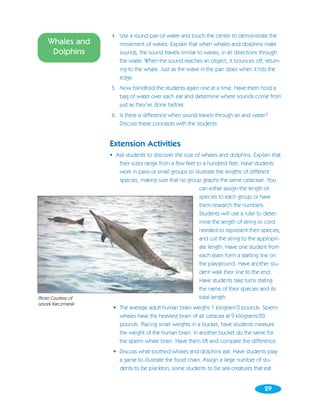
Photo Courtesy of                                           total length.
Leszek Karczmarski
                      • The average adult human brain weighs 1 kilogram/3 pounds. Sperm
                        whales have the heaviest brain of all cetacea at 9 kilograms/20
                        pounds. Placing small weights in a bucket, have students measure
                        the weight of the human brain. In another bucket do the same for
                        the sperm whale brain. Have them lift and compare the difference.
                      • Discuss what toothed whales and dolphins eat. Have students play
                        a game to illustrate the food chain. Assign a large number of stu-
                        dents to be plankton, some students to be sea creatures that eat


                                                                                        29
plankton and a small number to be different species of toothed
Whales and     whales. Have them create a sign to wear around their neck for what
 Dolphins      they represent, using paper and string. On an open playing field,
               instruct the whales to chase the sea creatures and the sea creatures
               to chase the plankton. Once a person is tagged, they’re out of the
               game. After the game is over, discuss the results. Did they survive? If
               they did, did they capture enough food to stay healthy? Discuss the
               kinds of defense mechanisms the prey used for staying alive and
               compare that to defense mechanisms that may be used in the wild.
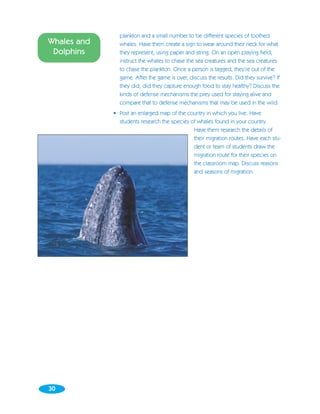
             • Post an enlarged map of the country in which you live. Have
               students research the species of whales found in your country.
                                              Have them research the details of
                                              their migration routes. Have each stu-
                                              dent or team of students draw the
                                              migration route for their species on
                                              the classroom map. Discuss reasons
                                              and seasons of migration.


30
Totally Sea Turtles
     Sea Turtles                                                [Page 11 of the AWARE Kids activity book]


                                Topic Discussion:
  Remember to play the          The Seven Species of Sea Turtles
 sea turtle section of the      Like sharks, sea turtles have lived on earth since before the dinosaurs –
   AWARE Kids video.            about 150 million years! There are seven different species of sea turtles:
                                loggerhead, green, leatherback, flatback, hawksbill, Kemp’s ridley and
Vocabulary:                     olive ridley.

Endangered – threatened         Although they’re all hard-shelled, air-breathing reptiles, they each have
with extinction.                distinct diets, behaviors and characteristics. These amazing creatures
Poacher – one who hunts         come in many sizes, shapes and colors. The olive ridley weighs up to 45
or fishes illegally or beyond   kilograms/100 pounds while the leatherback can weigh up to 600 kilo-
legal regulations.              grams/1300 pounds. And many sea turtles can live to be 100 years old.
Shrimp trawler – a large        Sea turtles live in the tropical and subtropical seas of the world, spend-
tapered and flattened or
                                ing most of their lives in the open ocean traveling great distances. One
conical fishing net that’s
                                olive ridley being tracked traveled 3050 kilometers/1900 miles in just 23
towed along the ocean floor
for shrimp.                     days. Sea turtles migrate between nesting and feeding grounds.
                                Although it takes 20–50 years to reach sexual maturity, females return to
                                the same beach where they were born to lay their eggs. They bury up to
                                180 eggs at a time and camouflage the nest site from predators.
                                                   Sea turtles don’t have teeth. Instead they have power-
                                                   ful “beaks” with sharp edges that they use to eat jelly-
                                                   fish, sponges and crustaceans. Although sea turtles
                                                   must breathe air like other reptiles, they’re amazing
                                                   divers and can hold their breath for a very long time.
                                                   Loggerhead sea turtles can hold their breath for up to
                                                   30 minutes each dive. In fact, they spend 80 – 94 per-
                                                   cent of their lives submerged.


                                Conservation Discussion:          Sea Turtles
                                Sea turtle species across the globe are endangered. The ratio of surviv-
                                ing sea turtles is about 1:1000. For every 1000 eggs laid, just one sea tur-
                                tle survives. Sea turtles are under attack from the very beginning of their
                                lives. Eggs laid and buried in the sand, face many dangers including nat-
                                ural predators like raccoons, coyotes and crab. They also must contend
                                with storms, hurricanes, coastal development on nesting beaches and
                                poachers collecting and selling sea turtle eggs.

                                                                                                     31
If a sea turtle survives and makes its way to the ocean, it faces a host of
                              other dangers. Thousands of sea turtles are caught in fishing nets each
     Sea Turtles              year. An estimated 150,000 are caught by shrimp trawlers alone.
                              Poachers illegally kill adult sea turtles for their meat, skin and shells.
                              Ocean pollution is also a major concern for sea turtle survival. For
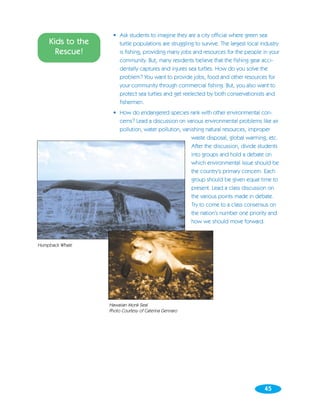
                                               instance, plastic bags look like one of their favorite foods
                                               – jellyfish. The ingested bags get caught in their intestines
                                               and eventually lead to the turtle’s demise.
                                             There are many things that can be done to help.
                                             Education is the first step. Educating younger generations
                                             as well as government officials is necessary for sea turtle
                                             protection. Writing letters and articles urging stronger
                                             endangered species legislation also supports sea turtle
                                             conservation. It’s also important to support environmental
                                             organizations and scientists protecting sea turtle habitat
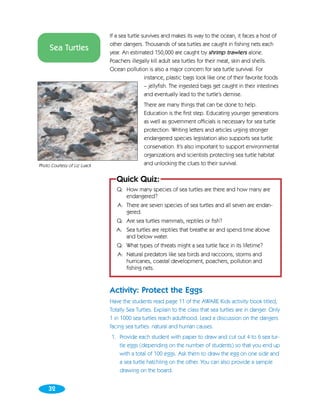
Photo Courtesy of Liz Luack                  and unlocking the clues to their survival.

                                 Quick Quiz:
                                 Q: How many species of sea turtles are there and how many are
                                    endangered?
                                 A: There are seven species of sea turtles and all seven are endan-
                                    gered.
                                 Q: Are sea turtles mammals, reptiles or fish?
                                 A: Sea turtles are reptiles that breathe air and spend time above
                                    and below water.
                                 Q: What types of threats might a sea turtle face in its lifetime?
                                 A: Natural predators like sea birds and raccoons, storms and
                                    hurricanes, coastal development, poachers, pollution and
                                    fishing nets.


                              Activity: Protect the Eggs
                              Have the students read page 11 of the AWARE Kids activity book titled,
                              Totally Sea Turtles. Explain to the class that sea turtles are in danger. Only
                              1 in 1000 sea turtles reach adulthood. Lead a discussion on the dangers
                              facing sea turtles: natural and human causes.
                              1. Provide each student with paper to draw and cut out 4 to 6 sea tur-
                                 tle eggs (depending on the number of students) so that you end up
                                 with a total of 100 eggs. Ask them to draw the egg on one side and
                                 a sea turtle hatchling on the other. You can also provide a sample
                                 drawing on the board.


     32
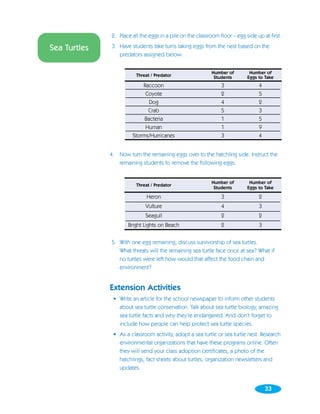
2. Place all the eggs in a pile on the classroom floor – egg side up at first.

Sea Turtles   3. Have students take turns taking eggs from the nest based on the
                 predators assigned below:


                                                           Number of         Number of
                         Threat / Predator                  Students        Eggs to Take

                    _____________________________________
                        Raccoon            3        4
                    _____________________________________
                         Coyote            2        5
                    _____________________________________
                           Dog             4        2
                    _____________________________________
                          Crab             5        3
                    _____________________________________
                         Bacteria          1        5
                    _____________________________________
                         Human             1        9
                       Storms/Hurricanes                        3                4


              4. Now turn the remaining eggs over to the hatchling side. Instruct the
                 remaining students to remove the following eggs:


                                                           Number of         Number of
                         Threat / Predator
                                                            Students        Eggs to Take
                         Heron             3        2
                    _____________________________________
                         Vulture           4        3
                    _____________________________________
                         Seagull           2        2
                    _____________________________________
                     Bright Lights on Beach                     2                3


              5. With one egg remaining, discuss survivorship of sea turtles.
                 What threats will the remaining sea turtle face once at sea? What if
                 no turtles were left how would that affect the food chain and
                 environment?


              Extension Activities
               • Write an article for the school newspaper to inform other students
                 about sea turtle conservation. Talk about sea turtle biology, amazing
                 sea turtle facts and why they’re endangered. And don’t forget to
                 include how people can help protect sea turtle species.
               • As a classroom activity, adopt a sea turtle or sea turtle nest. Research
                 environmental organizations that have these programs online. Often
                 they will send your class adoption certificates, a photo of the
                 hatchlings, fact sheets about turtles, organization newsletters and
                 updates.


                                                                                     33
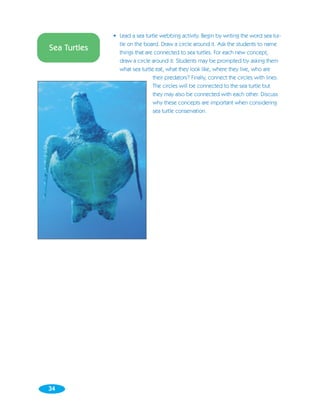
• Lead a sea turtle webbing activity. Begin by writing the word sea tur-
                tle on the board. Draw a circle around it. Ask the students to name
Sea Turtles     things that are connected to sea turtles. For each new concept,
                draw a circle around it. Students may be prompted by asking them
                what sea turtle eat, what they look like, where they live, who are
                               their predators? Finally, connect the circles with lines.
                               The circles will be connected to the sea turtle but
                               they may also be connected with each other. Discuss
                               why these concepts are important when considering
                               sea turtle conservation.


34
Classroom Fun & Games
   Fun & Games                                               [Pages 5 – 10 of the AWARE Kids activity book]


                                  Fish ID/Fun Fish Facts
Vocabulary:                       All About Fish
Anal fin – the median fin         Just about everywhere you find water, you’ll find fish. From colorful coral
located on the underside of       reef fish to enormous migrating whale sharks. Fish are found in all types
a fish, between the anus and      of aquatic environments and they come in all sizes. The smallest fish is
the caudal fin. Not all fish
                                  the tiny pygmy goby while the largest fish is the whale shark.
have an anal fin.
Caudal fin – the tail fin.
                                  What makes a fish unique? They have scales, fins and strong tails that
                                  provide protection, help them steer and propel through the water. In
Dorsal fin – the fin on the
back or top of an aquatic
                                  general, most fish have caudal, dorsal, anal, pelvic and pectoral fins.
animal.                           The size and shape of a fish’s fins can provide clues to where it lives and
Pectoral fin – the pair of fins
                                  what it may eat. Fish eat everything from plankton, to shellfish, insects
toward the front of the fish’s    and other fish.
body.                             Like humans, fish have an internal bony skeleton. They are cold-blooded
Pelvic fin – the pair of fins     and don’t need the protection of fur or hair to keep them warm. They are
on the underside of the fish’s    the same temperature as the water in which they live.
body, behind the pectoral
fins.
                                  Fisheries Conservation
Plankton – small, usually
microscopic, plants (phyto-       Fish thrive in all types of waters. But, as with other underwater creatures,
plankton) or animals (zoo-        fish populations are threatened by human activities. Many fish species
plankton) found in aquatic        are depleting at a rapid rate.
ecosystems.
                                  Human actions such as overfishing, bycatch, pollution and habitat
                                  destruction eliminate fish populations and habitat. We have the power
                                  to reverse this trend. The first step is awareness and education. Talk with
                                  your students about the ways in which we rely on fish across the globe.
                                  Speak about fisheries issues in your area and what can be done to help.


                                     Quick Quiz:
                                     Q: How are fish different than mammals?
                                     A: Fish have scales, fins and strong tails to help propel them
                                        through the water. They’re cold-blooded and don’t need the
                                        protection of fur or hair to keep them warm.
                                     Q: What kinds of human actions threaten fish populations?
                                     A: Overfishing, bycatch, pollution and habitat destruction.
© Wolcott Henry


                                                                                                       35
Activity: Fish ID/Fun Fish Facts
  Fun & Games   Have students cut out the Fish ID cards on page 5 and 6 of the AWARE
                Kids activity book. Split the class in small groups and play a Fish ID
                game. Reading aloud the trivia on the back of the cards, have students
                guess the name of the fish from listening and looking at the picture on
                the front of the card.


                Extension Activities
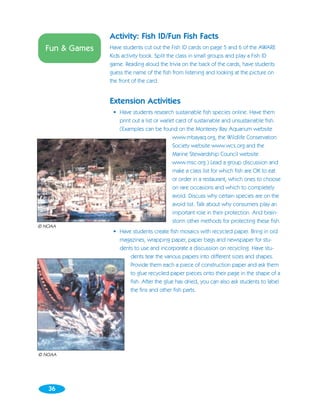
                 • Have students research sustainable fish species online. Have them
                   print out a list or wallet card of sustainable and unsustainable fish.
                   (Examples can be found on the Monterey Bay Aquarium website
                                            www.mbayaq.org, the Wildlife Conservation
                                            Society website www.wcs.org and the
                                            Marine Stewardship Council website
                                            www.msc.org.) Lead a group discussion and
                                            make a class list for which fish are OK to eat
                                            or order in a restaurant, which ones to choose
                                            on rare occasions and which to completely
                                            avoid. Discuss why certain species are on the
                                            avoid list. Talk about why consumers play an
                                            important role in their protection. And brain-
                                            storm other methods for protecting these fish.
© NOAA
                 • Have students create fish mosaics with recycled paper. Bring in old
                   magazines, wrapping paper, paper bags and newspaper for stu-
                   dents to use and incorporate a discussion on recycling. Have stu-
                       dents tear the various papers into different sizes and shapes.
                       Provide them each a piece of construction paper and ask them
                       to glue recycled paper pieces onto their page in the shape of a
                       fish. After the glue has dried, you can also ask students to label
                       the fins and other fish parts.


© NOAA


   36
It’s a Shore Thing!
Fun & Games   Have students complete the maze on page 7 of the AWARE Kids activity
              book. They will find their way from the city street to the shoreline, pick-
              ing up (circling) trash they find along the way. Answers located inside
                                  the back cover the of activity book.
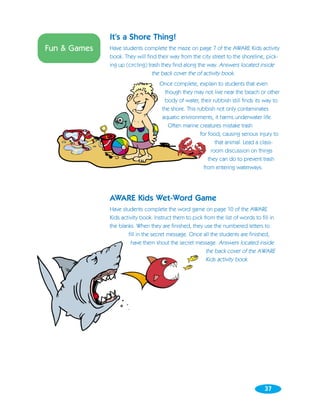
                                    Once complete, explain to students that even
                                      though they may not live near the beach or other
                                      body of water, their rubbish still finds its way to
                                     the shore. This rubbish not only contaminates
                                     aquatic environments, it harms underwater life.
                                       Often marine creatures mistake trash
                                                      for food, causing serious injury to
                                                             that animal. Lead a class-
                                                           room discussion on things
                                                          they can do to prevent trash
                                                        from entering waterways.


              AWARE Kids Wet-Word Game
              Have students complete the word game on page 10 of the AWARE
              Kids activity book. Instruct them to pick from the list of words to fill in
              the blanks. When they are finished, they use the numbered letters to
                      fill in the secret message. Once all the students are finished,
                       have them shout the secret message. Answers located inside
                                                         the back cover of the AWARE
                                                         Kids activity book.


                                                                                    37
Kids                       AWARE Kids in Action
       Clean Up                                                [Pages 12 – 16 of the AWARE Kids activity book]


                                     AWARE Mission 1: Kids Clean Up!

                                     Topic Discussion:       Why Clean Up?
                                     Each year 100 million tons of plastics, 17 million tons of sewage and
                                     garbage make its way to our waterways. The rubbish is washed down
                                     from city streets, thrown overboard boats and cruise ships and left
                                     behind by people visiting these natural areas.
                                     Polluted waterways are a concern for humans and underwater creatures
                                     alike. Not only does debris pollute an area, it makes it unfit for fun things
                                     like swimming, scuba diving, surfing and paddling. In 2000 there were
                                     11,270 days of beach closings in the United States alone.
                                     Underwater, trash can be a big problem too. Creatures like sea turtles
                                     and sea lions ingest garbage that they mistake for food, injuring and
                                     often killing them. Entanglement in discarded fishing nets, six pack rings
                                     and other waste also threatens aquatic life.
Photo Courtesy of Pura Vida Divers


                                     International Cleanup Day
                                     On the third Saturday in September each year, scuba divers and shore-
                                     line volunteers gather to remove debris from above and below the
                                     water. The first Cleanup Day was held in 1986 in Texas, USA and the
                                                                                   event now spans the
                                                                                   globe. Cleanup events
                                                                                   have been held in 127
                                                                                   countries and territories.
                                                                                    Volunteers of all ages vol-
                                                                                    unteer at their local
                                                                                    cleanup site and as they
                                                                                    gather debris, they record
                                                                                    information vital to conser-
                                                                                    vation efforts. Data gath-
                                                                                    ered is tallied by the
                                                                                    Ocean Conservancy to
                                     provide an overall picture of debris issues, educate the public and
                                     advocate for stronger management policies.


     38
Project AWARE Foundation organizes the underwater portion of
          Kids                  International Cleanup Day. Because divers have a view to the underwater
       Clean Up                 world, they can remove trash beneath the surface that sometimes
                                remains out of sight and out of mind. With the unique training and skills
                                to remove debris found underwater, divers often collect thousands of
                                pounds of trash including larger items like tires, washing machines and
                                furniture.


                                                      AWARE Mission 1: Kids Clean Up!
                                                      Using the information found on page 12 of the
                                                      AWARE Kids activity book, coordinate the activity,
                                                      AWARE Mission:1, Kids Clean Up! Ask the students
                                                      to read the cleanup procedures on page 12. After
                                                      you choose a date for this activity, you may like to
                                                      lead a class discussion on local shorelines that
                                                      need cleaning and ask the students to pick one
                                                      for the project.
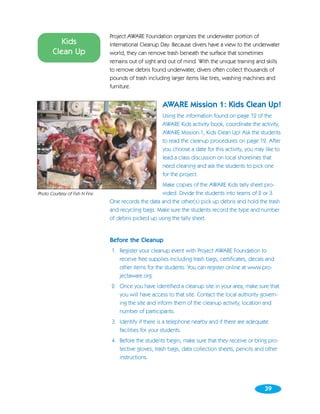
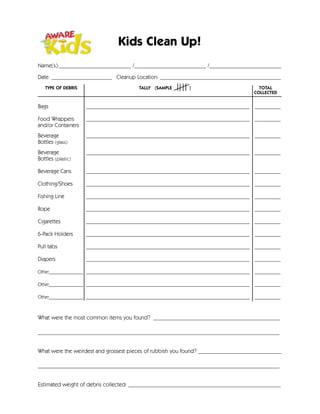
                                                     Make copies of the AWARE Kids tally sheet pro-
Photo Courtesy of Fish N Fins                        vided. Divide the students into teams of 2 or 3.
                                One records the data and the other(s) pick up debris and hold the trash
                                and recycling bags. Make sure the students record the type and number
                                of debris picked up using the tally sheet.


                                Before the Cleanup
                                1. Register your cleanup event with Project AWARE Foundation to
                                   receive free supplies including trash bags, certificates, decals and
                                   other items for the students. You can register online at www.pro-
                                   jectaware.org.
                                2. Once you have identified a cleanup site in your area, make sure that
                                   you will have access to that site. Contact the local authority govern-
                                   ing the site and inform them of the cleanup activity, location and
                                   number of participants.
                                3. Identify if there is a telephone nearby and if there are adequate
                                   facilities for your students.
                                4. Before the students begin, make sure that they receive or bring pro-
                                   tective gloves, trash bags, data collection sheets, pencils and other
                                   instructions.


                                                                                                  39
5. Inform the children to return to the check-in or starting point when
        they are finished and bring back their completed forms and
        collection bags.
     6. Visit the cleanup site prior to the event to conduct a risk assessment.
        Make sure parents sign a consent form or liability release for their
        child’s participation. For a sample copy email information@pro-
        jectaware.org.
     7. Try to gain sponsorship for food, beverage and supply donations if
        necessary.

                       On Cleanup Day
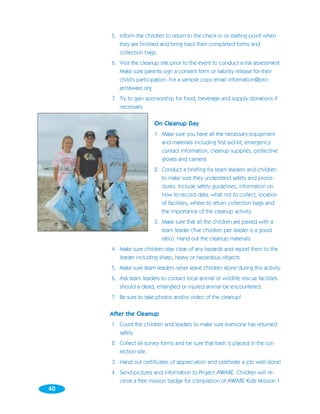
                       1. Make sure you have all the necessary equipment
                          and materials including first aid kit, emergency
                          contact information, cleanup supplies, protective
                          gloves and camera.
                       2. Conduct a briefing for team leaders and children
                          to make sure they understand safety and proce-
                          dures. Include safety guidelines, information on
                          how to record data, what not to collect, location
                          of facilities, where to return collection bags and
                          the importance of the cleanup activity.
                       3. Make sure that all the children are paired with a
                          team leader (five children per leader is a good
                          ratio). Hand out the cleanup materials.
     4. Make sure children stay clear of any hazards and report them to the
        leader including sharp, heavy or hazardous objects.
     5. Make sure team leaders never leave children alone during this activity.
     6. Ask team leaders to contact local animal or wildlife rescue facilities
        should a dead, entangled or injured animal be encountered.
     7. Be sure to take photos and/or video of the cleanup!

     After the Cleanup
     1. Count the children and leaders to make sure everyone has returned
        safely.
     2. Collect all survey forms and be sure that trash is placed in the col-
        lection site.
     3. Hand out certificates of appreciation and celebrate a job well done!
     4. Send pictures and information to Project AWARE. Children will re-
        ceive a free mission badge for completion of AWARE Kids Mission 1.
40
Kids Clean Up!
Name(s):_________________________ /_________________________ /_________________________

Date: _____________________ Cleanup Location: __________________________________________
   TYPE OF DEBRIS                         TALLY (SAMPLE        )                             TOTAL
                                                                                           COLLECTED
–––––––––––––––––––––––––––––––––––––––––––––––––––––––––––––––––––––––––––––––––––––––––––––––––––––––

Bags                _________________________________________________________ _________

Food Wrappers       _________________________________________________________ _________
and/or Containers
Beverage            _________________________________________________________ _________
Bottles (glass)
Beverage            _________________________________________________________ _________
Bottles (plastic)

Beverage Cans       _________________________________________________________ _________

Clothing/Shoes      _________________________________________________________ _________

Fishing Line        _________________________________________________________ _________

Rope                _________________________________________________________ _________

Cigarettes          _________________________________________________________ _________

6-Pack Holders      _________________________________________________________ _________

Pull tabs           _________________________________________________________ _________

Diapers             _________________________________________________________ _________

Other____________   _________________________________________________________ _________

Other____________   _________________________________________________________ _________

Other____________   _________________________________________________________ _________


What were the most common items you found? ____________________________________________

____________________________________________________________________________________


What were the weirdest and grossest pieces of rubbish you found? _____________________________

____________________________________________________________________________________


Estimated weight of debris collected: _____________________________________________________
AWARE Mission 2: Recycling Rocks!
Recycling
                                            [Page 13 of the AWARE Kids activity book]
 Rocks!
            Topic Discussion:      Why Recycle?
            Recycling is a process of treating discarded materials, often trash, so they
            can be used again. Among the most common types of recycled materials
            include paper, cardboard, aluminum, glass and certain kinds of plastics.
            Why recycle? Recycling saves space, energy and natural resources.
            People generate millions of tons of waste each year. On top of that, the
            number of land fills to accommodate this waste keeps dropping. When
            we recycle, we reuse and keep items that would have otherwise been
            thrown away, saving valuable landfill space. We also save energy
            because the amount of energy it takes to recycle an aluminum can is less
            than the amount it takes to make a can from raw materials. This in turn
            saves natural resources. The amount of fuel, water, wood, coal or other
            raw materials used to make the new can are no longer needed.


            AWARE Mission 2: Recycling Rocks!
            Ask the students to read page 13 of the AWARE Kids activity book.
            Instruct them to complete steps 1 – 3 of the recycling mission. Make
            copies of the enclosed Mission 2 Activity Sheet for their use.


            Extension Activities:
            1. Conduct a poetry contest. Ask students to write a poem about lit-
               ter and recycling. The poem can be funny, serious or rhymed. Once
               the poems are complete, have the students read aloud or you may
               read a few samples for the class.
            2. Turn recycled materials into works of art. Collect newspaper,
               plastic cups, boxes, wrapping paper tubes, egg cartons, etc. Use
               glue, tape and staples to put these pieces together and create a
               sculpture of recyclables. Have the students name their sculptures,
               paint them and mount them on cardboard or hang them from string.
               They can display their works with others in the classroom. You can
               even have the principal of the school judge for prizes.
            3. Write a list of recyclable materials on the board (examples may
               include paper bag, wire hanger, glass jar, newspaper, cardboard
               box, milk carton, etc). Ask the students to list 3 ways to reuse each
               item. Once complete, lead a class discussion asking them to share
               their ideas. How many of them currently use these ideas at home?

42
Recycling Rocks!
Name(s):_________________________ /_________________________ /_________________________

Date: _____________________ Recycling Project Location: ___________________________________
Instructions: Start a recycling project at home or school for one week. Decorate cardboard boxes –
one each for glass, aluminum, plastics and paper. Collect these items for recycling and weigh the daily
use of these items.


    TYPE OF                                WEIGHT OF DAILY USAGE                              WEEK
     LITTER        DAY 1     DAY 2      DAY 3     DAY 4      DAY 5     DAY 6      DAY 7      TOTALS
–––––––––––––––––––––––––––––––––––––––––––––––––––––––––––––––––––––––––––––––––––––––––––––––––––––––

        Glass
                 ______________________________________________________________ _________
   Aluminum
                 ______________________________________________________________ _________
      Plastics
                 ______________________________________________________________ _________
       Paper
                 ______________________________________________________________ _________


What are your ideas for ways waste can be reduced at home? _________________________________

____________________________________________________________________________________

____________________________________________________________________________________

____________________________________________________________________________________

____________________________________________________________________________________

____________________________________________________________________________________

____________________________________________________________________________________

____________________________________________________________________________________

____________________________________________________________________________________

____________________________________________________________________________________

____________________________________________________________________________________

____________________________________________________________________________________
AWARE Mission 3: Kids to the Rescue!
     Kids to the            Threatened Underwater Animals
       Rescue!
                                                            [Page 14 of the AWARE Kids activity book]


                            Topic Discussion:
                            Why are underwater animals in danger?
                            Threatened animals are those whose populations are becoming so small
                            they are in danger. Often they’re facing either becoming endangered or
                            even extinct. Though some populations may be threatened in a small
                            region, there are others that face global extinction.
                            A few examples of threatened underwater animals mentioned on page
                            14 of the AWARE Kids activity book include West Indian manatees,
                            Hawaiian monk seals, humpback whales, coho salmon, southern river
                            otters and all seven species of sea turtles. There are many reasons con-
                            tributing to their decline: habitat loss, pollution, overfishing and disease
                                                 to name a few.


                                                AWARE Mission 3:
                                                Kids to the Rescue!
                                                Threatened Underwater Animals
                                                Encourage students to read page 14 of the AWARE
                                                Kids activity book. There they will read about the
                                                problems facing underwater creatures and what is
                                                being done to protect these species and their
                                                habitat.
                                                Lead the threatened underwater animal mission
                                                found on page 14, encouraging students to research
Manatee Photo Courtesy of   and report on a threatened aquatic species of their choice. Encourage
Robert Zimmerman
                            the students to send their report to Project AWARE Foundation as their
                            mission indicates. They will each receive a mission badge for complet-
                            ing this task.


                            Extension Activities:
                             • Have the students imagine that they are an endangered under-
                               water animal. Ask them to write a story about their life. They should
                               include what type of habitat they live in, what they eat, why they are
                               in danger and what they wish humans would do to help protect
                               them.

    44
• Ask students to imagine they are a city official where green sea
    Kids to the       turtle populations are struggling to survive. The largest local industry
      Rescue!         is fishing, providing many jobs and resources for the people in your
                      community. But, many residents believe that the fishing gear acci-
                      dentally captures and injures sea turtles. How do you solve the
                      problem? You want to provide jobs, food and other resources for
                      your community through commercial fishing. But, you also want to
                      protect sea turtles and get reelected by both conservationists and
                      fishermen.
                    • How do endangered species rank with other environmental con-
                      cerns? Lead a discussion on various environmental problems like air
                      pollution, water pollution, vanishing natural resources, improper
                                                      waste disposal, global warming, etc.
                                                      After the discussion, divide students
                                                      into groups and hold a debate on
                                                      which environmental issue should be
                                                      the country’s primary concern. Each
                                                      group should be given equal time to
                                                      present. Lead a class discussion on
                                                      the various points made in debate.
                                                      Try to come to a class consensus on
                                                      the nation’s number one priority and
                                                      how we should move forward.


Humpback Whale


                  Hawaiian Monk Seal
                  Photo Courtesy of Caterina Gennaro


                                                                                       45
AWARE Mission 4:
   Water
               Way Cool Water Conservation
Conservation
                                               [Page 15 of the AWARE Kids activity book]


               Topic Discussion:      Why Conserve Water?
               Although more than 70 percent of the earth is covered by water, there
               are many places in the world where water is in short supply or unfit for
               drinking. Water can be made unclean by many things we can’t even see.
               Bacteria and other organisms can grow in water, for instance. Untreated
               sewage and run-off from city streets and farms are other ways that
               waters become contaminated.


               AWARE Mission 4: Way Cool Water
               Conservation
               Since every living thing on earth needs water to survive, its important for
               students to know that water needs conserving. There are many ways we
               can conserve water in our own homes to contribute to the water saving
                                effort. Ask the students to read the water conservation
                                section of the AWARE Kids activity book found on page
                                15. Provide them with the activity sheet (page 48)
                                including water usage measurements to calculate their
                                family’s daily water usage for one week. Ask them to
                                complete AWARE Mission 4: Way Cool Water
                                Conservation.
                               Once they’ve added up their family’s water usage and
                               completed the chart, ask them to estimate how much
                               water is used in a month and a year. Then lead a discus-
                               sion asking the students what they discovered. Were
                               there certain days of heavy water usage? Are there ways
                               they can think of to conserve water? Make sure they
                               write down their water-saving ideas and send these
                               along with their graph to Project AWARE Foundation.
                               They’ll receive a free AWARE Kids mission badge for
                               their completion of AWARE Mission 4: Way Cool Water
                               Conservation.


46
Water       Extension Activities:
 Conservation
                • Divide students into groups. Ask them to wear gloves while collect-
                  ing four samples of water from different local sources (local creek,
                  ocean, river, faucet, etc.) in a jar. Make sure they use masking tape to
                  label the source of the water collected on each jar. Cover jar with
                  white coffee filters and secure them to the top with rubber bands.
                  Ask the students to tip the jar so some of the sample is poured
                  directly onto the coffee filter. Note how the filters of each sample
                  appear. Are they different colors? Are there organisms caught in the
                  filter? How do they smell? Older students make like to test water
                  quality parameters such as pH, nitrate and phosphate concentra-
                  tions. They may also use a microscope to look for and identify plant
                                      and animal life in each sample. Does your local
                                      water authority regularly test these sites? What
                                      information have they collected?
                                      • Study the continuous flow of water. Ask stu-
                                        dents to draw and label the water cycle. The
                                        cycle should include and illustrate water
                                        evaporation, cloud saturation and water falling
                                        to earth in the form of rain. It should also show
                                        rainwater carrying dirt, trash and chemicals
                                        through gutters and storm drains back into
                                        lakes, rivers and oceans. Discuss how this
                                        relates to AWARE Mission 1 and 2 of the
                                        activity book.


© NOAA


                                                                                   47
Way Cool
                               Water Conservation
Name:_______________________________                Consider the following:
                                                    10 minute shower . . . . . .380 litres/100 gallons
Date: ________________________________              Full bath . . . . . . . . . . . . . .150 litres/40 gallons
                                                    Flushing toilet . . . . . . . . . .20 litres/6 gallons
                                                    Leaky faucet . . . . . . . . . . .1300 litres/350 gallons
                                                    Dishwasher . . . . . . . . . . .95 litres/25 gallons
                                                    Dish washing by hand . . .55 litres/15 gallons per
                                                     . . . . . . . . . . . . . . . . . . . .household member
                                                    Load of laundry . . . . . . . .190 litres/50 gallons
                                                    Watering the yard/plants . .1135 litres/300 gallons per
                                                     . . . . . . . . . . . . . . . . . . . . hour with a garden hose
Water Use Log
                                                   DAILY USAGE
                    DAY 1       DAY 2      DAY 3      DAY 4         DAY 5         DAY 6      DAY 7           TOTAL
                    Date:       Date:      Date:      Date:         Date:         Date:      Date:           USAGE

   ACTIVITY       _______ _______ _______ _______ _______ _______ _______

Showers/Baths     _______ _______ _______ _______ _______ _______ _______ _________

Toilet Flushing   _______ _______ _______ _______ _______ _______ _______ _________

Faucet Leaks      _______ _______ _______ _______ _______ _______ _______ _________

Dish Washing      _______ _______ _______ _______ _______ _______ _______ _________

Laundry           _______ _______ _______ _______ _______ _______ _______ _________

Watering and      _______ _______ _______ _______ _______ _______ _______ _________
Other Uses

TOTAL FOR:
 A Week _________ litres or gallons     A Month _________     litres or gallons   A Year _________     litres or gallons


What are your water saving ideas to conserve more water at home? _____________________________
____________________________________________________________________________________
____________________________________________________________________________________
____________________________________________________________________________________
____________________________________________________________________________________
____________________________________________________________________________________
____________________________________________________________________________________
AWARE Mission 5: Speak Out!
Speak Out!                                                                      [Page 16 of the AWARE Kids activity book]

                                     Speak with the students about how writing a letter can often be a good
                                     way to show your support for an issue and tell people about your con-
                                     cerns and ideas for protecting the underwater environment. Instruct
                                     them to complete their final AWARE Kids mission on page 16. AWARE
                                     Mission 5: Speak Out! For a Healthy Water Planet.
                                                                                                In this mission, students will
                                                                                                 compose a letter to a local or
                                                                                                 national government official.
                                                                                                  Ask them to write about an
Date                                                                                              issue that concerns them
                      Smith
           Somebody                                                                                personally. It could be
Honorable
           of Rep resentatives
U.S. House           se Office B
                                uilding                                                            something mentioned in the
2222 So mething Hou
                        5555                                                                        AWARE Kids activity book
             D.C. 22222-
 Washington
                                                                                                    or something else they’ve
                               sentative,
                able Repre
  Dear Honor                                                      pport of sh
                                                                               ark                   researched. In their letter
                                                     press my su                 entary,
                          tizen, I’m  writing to ex         e Wash ington Elem           ater         they should inform the
  As a co    ncerned ci            ade stud  ent at Georg         ecies in  the underw
                on . As a 4th gr              tanc  e of shark sp                                      official about the issue
   conser vati                   t the impor
                 arning abou
   I’ve been le                                                                                        and suggest things that
                  t.                                                                      se
    environmen                                                             today. Becau
                                                             populations                    to
                                      angers fa cing shark             ey are  vulnerable               can be done to solve the
                    of  the many d              mber of   offspring, th         ed on ly for
     I’ve learned                  and low nu                      ies are fish                         problem(s). They may
                   te maturity                       y shark spec
     of sharks la                    e. Today, man
                     hing pressur               k finning.                                               also ask what the govern-
      most any fis                 called shar
                      a practice
      their fins, in                                                         percent of                  ment is currently doing
                                                               orts that 95
                                                 e Times rep         things that
                                                                                   humans
                                    d by Scienc         e are many
                      l conducte                nd ther                         ideas to                  to improve the situation.
       A recent pol               ct sharks. A                    ncerns and
        people w  ant to prote             is to ex press our co          tection law
                                                                                       s are
                            ct them. One                    re shark pro                    is         Students must address
        can  do to prote             y idea is to make su           supporte  d and what
                      t officials. M               law s have you
        governmen                     protection                                                       the letter to the official
                      hat kinds of
         in place. W
                       eing done?                                                        continue       directly and mail a
         currently b                                                         ng. Please
                                                               arks are faci
                                      are of the  dangers sh              policie s.                    copy to Project
                         you are aw                          anagement
          I know that                          ction and m
                         better  shark prote                                                             AWARE in order to
          to work for
                                                 d action.                                               receive their final mis-
                                    support an
            Thank yo  u for your                                                                          sion badge. To find
                                                                                                          the address of local
          Sincerely,
          Joe Wilson                                                                                       or national politi-
                       udent
           4th grade st             entary                                                                 cians, research
                        hington Elem
           George Was
                                                                                                            online.


                                     Sample Letter


                                                                                                                           49
Project AWARE International Offices
Project AWARE Foundation (Americas)      Project AWARE Foundation (Asia Pacific)
30151 Tomas Street, Suite 200            Unit 3, 4 Skyline Place
Rancho Santa Margarita, CA 92688 USA     Frenchs Forest
Email: information@projectaware.org      New South Wales
                                         Australia 2086
Project AWARE International
                                         Email: info@projectaware.org.au
Unit 7, St. Philips Central
Albert Road                              Project AWARE (Japan)
St. Philips, Bristol BS2 0PD             1-20-1 Ebisu-Minami
United Kingdom                           Shibuya-ku Tokyo 150-0022
Email: info@projectaware.org.uk          Japan
                                         Email: planning@padi.co.jp
Project AWARE Foundation (Europe)
Obersileerstrasse 3 CH-8442 Hettlingen
Switzerland
Email: aware@padi.ch


  50
Teacher Feedback Form


                                     for using the AWARE Kids Teacher’s Guide to help inform children about
                           issues facing the underwater world and encouraging them to take part in solutions.
Please take a few moments to answer the following questions about AWARE Kids.

How did you use the AWARE Kids Teacher’s Guide and activity book in your class? Did you use them as a pres-
entation, part of a unit or other activity?
___________________________________________________________________________________________
___________________________________________________________________________________________
___________________________________________________________________________________________
___________________________________________________________________________________________

How much time did you spend on AWARE Kids: each education section, fun and activities sections? ________
___________________________________________________________________________________________
___________________________________________________________________________________________
___________________________________________________________________________________________
___________________________________________________________________________________________

What did you like about the AWARE Kids Teacher’s Guide and activity book? _____________________________
___________________________________________________________________________________________
___________________________________________________________________________________________
___________________________________________________________________________________________
___________________________________________________________________________________________

How would you improve the AWARE Kids materials? _______________________________________________
___________________________________________________________________________________________
___________________________________________________________________________________________
___________________________________________________________________________________________
___________________________________________________________________________________________

What other types of educational materials would be useful to you? _____________________________________
___________________________________________________________________________________________
___________________________________________________________________________________________
___________________________________________________________________________________________
___________________________________________________________________________ Continued on Back
Other comments or suggestions? ______________________________________________________________
_________________________________________________________________________________________
_________________________________________________________________________________________
_________________________________________________________________________________________
_________________________________________________________________________________________
_________________________________________________________________________________________
_________________________________________________________________________________________
_________________________________________________________________________________________
_________________________________________________________________________________________
_________________________________________________________________________________________
_________________________________________________________________________________________
_________________________________________________________________________________________
                 Send this form to your local Project AWARE Office listed on page 50.


Optional Information:
Name _________________________________________________________ Date _____________________
Phone Number ______________________________ Email ________________________________________
Name of School __________________________________________________________
School Address __________________________________________________________
________________________________________________________________________
________________________________________________________________________
30151 Tomas Street • Rancho Santa Margarita, CA 92688-2125 • U.S.A.
               Tel: +1 949 858 7657 • Toll Free +1866 80 AWARE • Fax +1 949 858 7521
                                  email: information@projectaware.org

Product No. 70306 (Rev. 3/05) Version 1.2                                      © Project AWARE, 2005

AWARE Kid's Teacher's Guide

  • 2.
    Teacher’s Guide Table of Contents A Letter from Project AWARE Foundation . . . . . . . . . . . . . . .3 Preface – Using the AWARE Kids Package . . . . . . . . . . . . . . .4 The Prescribed Learning Outcomes for AWARE Kids . . . . . . .6 Component Descriptions . . . . . . . . . . . . . . . . . . . . . . . . . . .9 National Science Education Standards (NSES) Correlations 10 Crazy About Coral Reefs . . . . . . . . . . . . . . . . . . . . . . . . . . .12 Caring for Coral Reef Activity Sheet . . . . . . . . . . . . . . . . . . .17 Sharks Rule! . . . . . . . . . . . . . . . . . . . . . . . . . . . . . . . . . . . . .18 Kelp – It’s a Forest Out There... . . . . . . . . . . . . . . . . . . . . . .22 Do You Eat Kelp? Activity Sheet . . . . . . . . . . . . . . . . . . . . .26 Go Wild With Whales and Dolphins . . . . . . . . . . . . . . . . . .27 Totally Sea Turtles . . . . . . . . . . . . . . . . . . . . . . . . . . . . . . . .31 Classroom Fun and Games . . . . . . . . . . . . . . . . . . . . . . . . .35 AWARE Kids in Action . . . . . . . . . . . . . . . . . . . . . . . . . . . . .38 AWARE Mission 1: Kids Clean Up! . . . . . . . . . . . . . . . . . . . .38 Kids Clean Up Activity Sheet . . . . . . . . . . . . . . . . . . . . . . . .41 AWARE Mission 2: Recycling Rocks! . . . . . . . . . . . . . . . . . . .42 Recycling Rocks! Activity Sheet . . . . . . . . . . . . . . . . . . . . . .43 AWARE Mission 3: . . . . . . . . . . . . . . . . . . . . . . . . . . . . . . .44 Kids to the Rescue! Threatened Underwater Animals AWARE Mission 4: Way Cool Water Conservation . . . . . . . .46 Way Cool Water Conservation Activity Sheet . . . . . . . . . . . .48 AWARE Mission 5: Speak Out! . . . . . . . . . . . . . . . . . . . . . . .49 Teacher Feedback Form . . . . . . . . . . . . . . . . . . . . . . . . . . .51 1
  • 3.
  • 4.
    A Letter from ProjectAWARE Foundation Dear Educator, The Project AWARE Foundation, a 501 c(3) nonprofit organization con- serving underwater environments through education, advocacy and action, organizes hands-on environmental activities, leads public awareness and education programs and provides support for conservation efforts worldwide. The AWARE Kids Teacher’s Guide is a tool to help actively teach students about issues facing the underwater world and provide hands-on opportunities to participate in solutions. The AWARE Kids activity book covers education subjects including coral reefs, sharks, kelp forests, whales, dolphins and sea turtles. AWARE Kids Missions encourage younger generations to participate in conservation activities. The book also includes fun puzzles, post cards, an underwater poster and more. Project AWARE Foundation’s goal with the AWARE Kids Teacher’s Guide is to inte- grate science, math, art, lan- Mare Marine Club, guage and geography with Okinawa, Japan underwater topics. The cur- riculum supports National Science Education Standards as identified. The enclosed video intro- duces the AWARE Kids pro- gram and each education topic to your students prior to diving into each section. You can play the corresponding portions of the video as mentioned in this guide. Please also begin by playing the AWARE Kids feature to generate excitement about participating in the program. Thank you for helping educate primary students about the underwater environment. Please feel free to provide us your comments and sugges- tions using the survey at the back of the guide. Your opinions and partic- ipation are appreciated. Sincerely, Project AWARE Foundation 3 3
  • 5.
    Using the Preface AWARE Kids Package The AWARE Kids program is for elementary school aged kids who want to discover, explore and investigate the fascinating aquatic world. AWARE Kids uses the systems approach (all products are tied to one another) by design and currently consists of three products: AWARE Kids activity book; AWARE Kids video, and the AWARE Kids Teacher’s Guide. These AWARE Kids materials were designed for the elementary school teacher, adults who work with kids in different capacities such as a group/camp leader, councilor, or coach, (hereafter referred to as educators) and all children at the grade K through 4 elementary school level. AWARE Kids is guided by three principles of learning: 1) learning requires the active participation of the student, 2) people learn in a variety of ways and at different rates, and 3) learning is both an individual and a group process. AWARE Kids incorporates the National Science Education Content Standards (NSES) for grades K through 4 and can be modified and adapted to challenge kids in grades 5 through 7. Aware Kids draws upon the three traditional sci- ence disciplines of physical science, life science and earth and space science. One advantage of studying the conservation of the underwater environment is that learning outcomes apply to all three of the science disciplines. In many aspects, AWARE Kids provides a broader and more complete understanding of how the traditional sciences interrelate than if they were to be studied separately. In this way, studying the aquatic environment and conservation efforts lends to an interdisciplinary science understanding. AWARE Kids involves studying the diversity, continuity, interactions, and balance between organisms and their environments. By using the skills, processes and attitudes of science, children extend their understanding of the living world and their place within it. By making sense of how organisms live in their environments, children develop an understanding of the diversity and interactions of living and nonliving things. The edu- 4
  • 6.
    cator-led activities, providedin the AWARE Kids Teacher’s Guide, encourage children to research animals and plants in a variety of habitats Preface to determine the effects of structure and behavior on both individuals and species within that environment. Children demonstrate their knowl- edge of how animals adapt to their surroundings by completing the activities outlined in the AWARE Kids activity book. Students can further demonstrate their knowledge of how animals adapt to their surroundings by completing some of the educator-led extension activities outlined in the AWARE Kids Teacher’s Guide. AWARE Kids encourages the use of simple machines or scientific tools to make tasks eas- ier, determine their characteristics and uses. Many of the activities in the AWARE Kids activity book require children to use devices to measure, calculate, compare and contrast results. AWARE Kids also helps children develop an understanding of the forces, processes and dynamic life-supporting qualities of the Earth. Knowledge of the Earth’s fresh and saltwater resources is relevant to an understand- ing of our environment and our existence. Students experiment to deter- mine how water is important to all life forms. They consider issues of water use from various perspectives and identify ways in which water is used responsibly in their community. Students demonstrate their scientif- ic skills and processes when they use a variety of media to communicate the results of their investigations and act on their findings in a responsi- ble manner. Studying the conservation of the underwater environment through the AWARE Kids materials is more than integrating the traditional science dis- ciplines to examine the aquatic realm. It is about studying science itself. Science as a way of thinking, as it relates to technology, its social influ- ence and its history. Therefore, the study of the underwater environment and its conservation involves four content areas beyond the traditional science disciplines. They are science as inquiry, science and technology, science in personal and social perspectives and the historical nature of science. AWARE Kids interweaves the traditional science content and these four additional content areas through each of the five core topic sections, the classroom and games section and the five AWARE missions. 5
  • 7.
    Learning The Prescribed Learning Outcomes Outcomes for AWARE Kids The United States has established as a goal that all students should achieve scientific literacy. The National Science Education Content Standards are designed to enable the nation to achieve this goal and AWARE Kids is written with this goal in mind. Scientific literacy enables people to use scientific principles and processes in making personal decisions and participate in discussions of scientific issues that affect society. AWARE Kids emphasizes a new way of teaching and learning about science that reflects how science itself is done, emphasizing inquiry as a way of achieving knowledge and understanding about the world. The prescribed learning outcomes are driven by the NSES. They set out the knowledge, enduring ideas, issues, con- cepts, skills and attitudes for elementary school science. The prescribed learning outcomes are statements of what stu- dents are expected to know and do by completing the AWARE Kids activities. The prescribed learning outcomes are clearly stated, expressed in measurable terms and have been written to enable educators to use their experience and professional judgment in planning, implementing and evaluating. The pre- scribed learning outcomes are bench- Photo Courtesy of Megan Saunders marks that will permit the use of criterion-referenced performance stan- dards. It is expected that performance will vary in relation to the learning outcomes. 6
  • 8.
    Learning The Prescribed Learning Outcomes Outcomes for AWARE Kids It is expected that students or children will: • predict the results of an experiment • perform an experiment by following a procedure • use appropriate tools to assist observations • construct simple definitions based on experiments • demonstrate an ability to recognize a valid interpretation of results • present an interpretation of the results from an experiment • use a variety of media to present information • demonstrate responsible action when using the scientific informa- tion and skills they have developed • relate the structure and behavior of organisms to their survival in local environments • discuss how changes in an organism’s habitat can affect the survival of individual organisms and entire species • give examples of how the differences in individuals of the same species may give an advantage in surviving and reproducing • relate the growth and survival of organisms to a variety of conditions • relate the life processes of an organism to its use of nutrients, water, and oxygen • describe the changing requirements of organisms as they grow • relate dietary habits and behavior to an organism’s health • manipulate simple machines to determine characteristics and uses • operate simple machines to demonstrate their usefulness in everyday life • categorize the various uses of water • outline the importance of water for life • use the physical properties of water to describe or illustrate the water cycle • compare and contrast freshwater and saltwater environments • describe human effects on the Earth’s water resources 7
  • 9.
    What is theAWARE Kids Teacher’s Guide? Learning The AWARE Kids Teacher’s Guide contains the learning objectives and Outcomes support materials that apply to the development of scientific literacy in elementary school aged learners. The AWARE Kids Teacher’s Guide includes national prescribed science standards and learning outcomes, instructional and motivational strategies, learning activities and suggested extension activities. It is intended to assist educators in delivering the materials in a way that meets the requirements of elementary school sci- ence education. The organization of the AWARE Kids Teacher’s Guide demonstrates the connections between the learning outcomes and instruction, activity learning resources and student understanding. The AWARE Kids Teacher’s Guide assists the inexperienced educator to teach the course materials developed for AWARE Kids. Suggested Instructional Strategies for Achieving the Prescribed Learning Outcomes Instruction involves the selection of techniques, activities and methods that can be used to meet diverse student needs and to deliver the materials. Educators are free to adapt and use the suggested instructional strategies or substitute others that they feel will enable their children to achieve the pre- scribed learning outcomes. The strategies found in Photo Courtesy of Wayne Brown AWARE Kids Teacher’s Guide have been developed by specialist and generalist teachers to assist their colleagues; they are suggestions only. Suggested Activities for Determining How Well Students are Achieving the Learning Outcomes The primary activity and extension activities consist of a variety of ideas and methods to gather evidence of student understanding. Some activi- ties relate to specific science concepts; others are general and could apply to any prescribed learning outcome. These activities have been developed by specialist and generalist teachers to assist their col- leagues; they are suggestions only. 8
  • 10.
    Component Component Descriptions Descriptions The AWARE Kids program is supported by a variety of components to meet individual student needs and teaching styles. AWARE Kids Activity Book • The four color activity book is written in a motivating style for K through 4 elementary school-aged children. • Comprehensive content integrates the study of the underwater environment and its conservation with the other core science disciplines. • Using an interdisciplinary approach, children learn about their environment in context with social studies, mathematics, the arts and language arts. • Connects the underwater environment and conservation to real world applications and opportunities. AWARE Kids Video • The video supports the learning outcomes AWARE Kids addresses. • The video has been developed considering the variety of student learning styles and abilities. • This instructional design of this resource supports a variety of audi- ences, including gifted, learning disabled and English learners. • The video is designed to complement the educator in delivering the materials. AWARE Kids Teacher’s Guide • Corresponds to five core topics, classroom games and five missions outlined in the AWARE Kids activity book. • The guide provides activities, activity instructions and extension activities for both the experienced and inexperienced educator. • Suggestions for introducing topics, organizing activities and con- ducting group demonstrations. • Supports and emphasizes learning of major cognitive themes. 9
  • 11.
    NSES National Science Education Standards Standards (NSES) Correlations As the result of activities provided for students during the AWARE Kids Reference: National program, the content of the standard identified is to be understood or Research Council, (1999). the abilities are to be developed by the student. National Science AWARE Kids is developed for K through 4 elementary school aged chil- Education Standards. dren and can be modified and adapted to challenge grades 5 through 7 National Academy Press, students. The check marks indicate direct correlations to AWARE Kids. Washington, DC. 10
  • 12.
    Science as Inquiry Content Standard A K-4 Content Standard A Grades 5-8 Scientific knowledge is constantly changing. As more As a result of activities in grades K-4, all As a result of activities in grades 5-8, all research is conducted and as advanced technology students should develop: students should develop: enhances our ability to make observations, our knowl- Abilities necessary to do scientific • Abilities necessary to do scientific edge of the world changes. Knowing that science is a inquiry inquiry continuous process of inquiry helps students understand Understanding about science • Understanding about science its dynamic nature and recognize that in science change inquiry inquiry is the rule rather than the exception. Physical Science Content Standard B K-4 Content Standard B Grades 5-8 Some of the most effective experiences for learning ele- As a result of the activities in grades K- As a result of their activities in grades mentary-level physical science involve the movement or 4, all students should develop an 5-8, all students should develop an changes in objects and materials. Students learn about understanding of: understanding of: objects by observing them and noting similarities and Properties of objects and materials • Properties and changes of proper- differences and by acting on them by applying force. • Position and motion of objects ties in matter • Light, heat, electricity and • Motion and forces magnetism • Transfer of energy Life Science Content Standard C K-4 Content Standard C Grades 5-8 All living things move, seek nourishment, breathe, and As a result of activities in grades K-4, all As a result of their activities in grades reproduce and they accomplish these activities in a wide students should develop understand- 5-8, all students should develop under- variety of ways. A plant’s movement, for example, is dif- ing of: standing of: ferent from an animal’s; an elephant’s movement is differ- The characteristics of organisms • Structure and function in living ent from a monkey’s. Each type of organism has structures Life cycles of organisms systems that enable it to function in unique and specific ways to Organisms and environments • Reproduction and heredity obtain food, reproduce and survive. • Regulation and behavior • Populations and ecosystems • Diversity and adaptations of organisms Earth and Space Science Content Standard D K-4 Content Standard D Grades 5-8 From earliest times, humans have looked at the Earth and As a result of their activities in grades As a result of their activities in grades sky with wonder, trying to find explanations for what they K-4, all students should develop an 5-8, all students in grades 5-8 should saw. Today, we have learned more about our solar sys- understanding of: develop an understanding of: tem from our own experiences and from the great wealth Properties of earth materials • Structure of the Earth system of information available to us. Together, these two • Objects in the sky • Earth’s history ways of learning help us understand the world around us. Changes in earth and sky • Earth in the solar system Science and Technology Content Standard E K-4 Content Standard E Grades 5-8 Children are naturally interested in the human-made As a result of activities in grade K-4, all As a result of activities in grades 5-8, all (designed) objects such as toys, automobiles, bridges, students should develop: students should develop: can openers or door knobs. Designed objects and mate- • Abilities of technological design • Abilities of technological design rials are essential elements of a child’s environment. Ask Understanding about science and • Understandings about science and students to identify designed objects and their uses. This technology technology is a good introduction to technology. Abilities to distinguish between natural objects and objects made by humans Science in Personal and Social Perspectives Content Standard F K-4 Content Standard F Grades 5-8 Scientific discoveries, technological innovations, and As a result of activities in grades K-4, all As a result of activities in grades 5-8, all medical advances promise to make our lives better. They students should develop understand- students should develop understand- also bring resource shortages, pollution and other prob- ing of: ing of: lems. Most of us share a vision of a better future, but pro- Personal health • Personal health jections of global trends, particularly those related to Characteristics and changes in pop- • Populations, resources and environ- population growth, use of resources and environmental ulations ments deterioration, are not encouraging. The effects of these Types of resources • Natural hazards trends will be of increasing concern in the next decades. Changes in environments • Risks and benefits Science and technology in local • Science and technology in society challenges History and Nature of Science Content Standard G K-4 Content Standard G Grades 5-8 The common thread of the Standards for the history and As a result of the activities in grades As a result of the activities in grades nature of science is that science is a human endeavor. K-4, all students should develop 5-8, all students should develop under- Indeed, the study of science is a natural intellectual and understanding of: standing of: social endeavor – an attempt to understand how the Science as a human endeavor • Science as a human endeavor world works. • Nature of science • History of science 11
  • 13.
    Crazy About CoralReefs Coral Reefs [Page 1 of the AWARE Kids activity book.] Topic Discussion: Rainforests of the Sea Remember to play the Coral reefs are the oldest, most productive ecosystems on earth. Coral Reef section of the Existing for more than 200 million years, they’re named the rainforests of AWARE Kids video. the sea because they maintain the biological diversity of our world’s oceans. Corals are literally teeming with life. They serve as habitat or Vocabulary: nursery grounds for 25 percent of all known marine life and support Conservation – taking care 4000 species of fish and thousands more plants and animals. of the environment by pro- tecting waterways and other Built by colonies of tiny coral animals, called coral polyps, these animals natural resources. form huge coral reef structures. There are more than 2500 species of Coral bleaching – the loss coral growing in clear, shallow ocean waters across the globe. Most live of color from a coral as it in the warmer waters near the equator where they use the energy from expels its zooxanthelle, sunlight to thrive. usually happens in response to stress. There are two different types of coral reefs: hard corals (such as brain, Coral polyps – tiny, fragile star and elkhorn coral) and soft corals (such as sea fans, sea whips and animals that compose a sea rods). Both hard and soft corals come in all shapes, sizes and colors. coral reef structure. A few are even fluorescent. Coral reefs – a massive Aside from their vast ecological importance, coral reefs are valued for structure made up of tiny, many other reasons. For example, fragile animals called coral polyps. • Corals support local economies because they’re valuable tourist Ecosystem – a community attractions. Many tropical nations base much of their economy on of plant and animal life that the worldwide appeal of these diving and snorkeling destinations. interact with each other and Tourism brings billions of dol- the physical environment. lars to local economies and Habitat – the environment sustains 10 percent of all jobs where a species lives or on earth. grows. Nursery ground – environ- • Corals also provide protection ment where juvenile species for coastal communities, are produced and/or devel- defending them against storms, oped. wave damage and erosion. It’s Species – a class of organ- estimated that each square isms grouped together meter of coral reef protects based on their common $47,000 US in property value. features. Without this protection entire Zooxanthelle – algae that live in a symbiotic relation- islands and coastal communi- ship with coral. ties wouldn’t exist. 12
  • 14.
    • Coral reefsare a critical resource for medical cures. Scientists have found an abundance of compounds to help fight heart disease, Coral Reefs asthma, cancer, HIV and more. Marine biologists studying coral life have also learned many things about the human body. ASIA NORTH EUROPE AMERICA WESTERN HAWIIAN ATLANTIC RED SEA ISLANDS INDO ✪ ✪ PACIFIC CARIBBEAN AFRICA ✪ SOUTH AMERICA AUSTRALIA Highlighted areas demonstrate where coral reefs are found. Conservation Discussion: Coral Reefs Sadly, coral reefs are rapidly disappearing. Scientists estimate that as much as 25 percent of the world’s coral reefs are already dead and if current trends continue this precious resource may be lost within the next 30 to 50 years. Although environmental stress is contributing to coral decline, humans also contribute to major problems affecting coral reefs: • Sedimentation from coastal development and unwise land use policies cause soil erosion inducing coral stress and blocking light necessary for coral growth. • Runoff from cropland and animal feed lots introduce excessive amounts of fertilizers and untreated sewage to reef environments. These nutrients slow growth rates, reduce light and water flow to coral surfaces and induce coral bleaching. • Global warming trends due to an increase in greenhouse gases and ozone depletion warm ocean temperatures, stressing coral reef ecosystems, often causing corals to bleach and die. 13
  • 15.
    • Destructive fishingpractices such as the use of poisons like cyanide, explosives and fishing devices reduce coral reef ecosys- Coral Reefs tems to lifeless rubble every day. • Pollution from oil, petroleum products, untreated sewage and marine debris often poison and injure coral reef life. • Lost of discarded fishing nets (ghost nets) entangle thousands of fish and mammals and suffocate reefs. • Poorly conceived coastal development destroys vital ecosystems such as mangrove forests and sea grass beds which serve as nursery grounds for many reef inhabitants. How Can You Help? Although no one can accurately predict how long coral reefs will be around, human action can improve their chances for survival. For ideas on things AWARE Kids can do to conserve coral reefs, refer the class to “Things You Can Do” on the first page of the AWARE Kids activity book and lead one or more of the following activities. Quick Quiz: Q: What are the oldest most productive ecosystems on earth? A: Coral reefs. Q: What are coral reefs composed of? A: Colonies of tiny coral animals called coral polyps. Q: Why are coral reefs important? A: They support 25 percent of all marine life, support local economies, provide protection for coastal communities and are a resource for medical cures. Activity: Caring for Coral Reefs Challenge your students to come up with solutions to coral reef conservation issues. © Wolcott Henry Coral reefs are extremely vulnerable to all kinds of human pressures. Souvenir collecting, pollution, coastal development and careless interac- tions can all damage these underwater cities. AWARE Kids across the globe can help solve these problems. 14
  • 16.
    Instructions: Coral Reefs 1. Copy the Caring for Coral Reef Cards (page 17), cut them out and place them in a jar for student selection. 2. Create a coral reef conservation mural or bulletin board and have students paint or draw a coral reef community. Discuss the different types of corals, fish and animal life found in these rainforests of the sea. 3. Once the mural is finished, describe several problems facing coral reefs. Explain why conservation is important to the future of the underwater world. 4. Present the students with the jar of coral reef conservation problems that are in need of creative solutions. Tell them that they are going to be a conservation specialist that helps pro- tect coral reef ecosystems. 5. Have each student or small groups of students select a coral reef conservation problem from the jar, research any unfamil- iar concepts or terms, read the problem to the class and take a few minutes to discuss with the class what they know about the problem. (More than one student may work on the same problem.) 6. After the discussion, have the students independently think of a possible solution to the problem on their card. It could be an idea or an invention. Have them draw a picture of their solution and write and explanation of how it works. 7. Once the individual projects are complete, have the students explain their idea to the class. They can then attach their work to the completed coral reef mural. Extension Activities: • Have students research animal life on a coral reef. Label index cards with names of animals found in coral reef ecosystems. Examples include sponges, sea urchins, starfish, sea turtles, sea fans, nurse sharks and lobsters. Have the class create a bulletin board display of a marine food chain. Then have the students choose an index card and investigate that creature’s role in the food chain. Have them draw the organism on the opposite side of the card and attach their creation to the appropriate area of the display. 15
  • 17.
    • Divide studentsinto small groups and have them research coral reef threats. Examples include water pollution, coastal development, Coral Reefs souvenir collection and anchoring boats, etc. Have students create signs that they would post near a coral reef shoreline area, advising people against actions that can threaten the reef. • Invite a dive professional from a local PADI Dive Center or Resort to visit the classroom. Ask them to talk about diving, demonstrate how dive equipment works and explain how sustainable dive practices can conserve the underwater environment. To find a professional, use the directory on the PADI website at www.padi.com. • Have students write a news story investigating a sci- entist or nonprofit organization working to improve coral reef conservation. Ask them to report on their findings including who, what, where, why and how. You can also ask them to interview an individual to obtain quotes for their story. 16
  • 18.
    Caring for CoralReef Cards Cruise ships legally dump sewage Boat anchors often injure and into the ocean near coral reef break coral reefs and can habitat – sometimes only destroy underwater habitats. 5 kilometers/three miles from the shoreline. Lost or discarded fishing Emissions from cars, cruise ships nets can entangle thousands of and other vehicles contribute fish, marine mammals and to global warming, harming smother coral reefs. coral reefs. Seafood can be caught Commercial fisheries often with fishing gear that damages capture non-target fish – up to coral reefs and other 20 billion pounds each year. underwater habitats. Plastic, glass and cigarette butts Fertilizers and pesticides are are the most common items washed from lawns and farms found during a beach or into the ocean. These substances underwater cleanup. can harm coral reef life. Live corals and reef animals are Oil from city streets, boats and captured to be sold as souvenirs oceangoing tankers contaminate or for personal aquariums. aquatic environments.
  • 19.
    Teacher’s Sharks Rule! Sharks Rule! Guide [Pages 2 – 3 of the AWARE Kids activity book] Topic Discussion: What is a Shark? Remember to play the Sharks rule the ocean. With their powerful, streamlined bodies and sharks section of the remarkable sensory systems, these creatures have remained virtually AWARE Kids video. unchanged for more than 400 million years. Technically speaking, sharks are fish. They have a skeleton, fins, live in the Vocabulary: water and use gills to breathe. But their skeleton differs from that of Apex predator – creature other fish because it’s made of cartilage (like humans have in their nose at the very top of the food chain who has no natural and ears) rather than bone. Their scales are different too. Shark scales predators. have the same structure as a tooth, which is why sharkskin feels rough Cartilage – tough, flexible like sandpaper. You may demonstrate this by bringing sandpaper into connective tissue found in the classroom for students to touch. sharks. Speaking of teeth – sharks are famous for theirs. The rows of razor sharp Extinction – the total disap- teeth are lined up so when the outer row of teeth fall out, the row from pearance of a species so behind it moves up to take its place. Sharks are growing teeth all the that it no longer exists on time. In fact they go through as many as 30,000 teeth in a lifetime. the planet. There are more than 400 species of sharks and they live all over the Finning – the practice of fishing sharks solely for their world. You can find them in tropical lagoons, polar seas and even some fins and discarding the freshwater rivers and lakes. But not all sharks eat large fish and marine remainder of the shark. mammals. Some, like the horn shark, live off clams and crabs while others, like the basking shark, are filter feeders that eat plankton. Photo Courtesty of Al Hornsby 18
  • 20.
    Conservation Discussion: Sharks Sharks Rule! Often, as in the fictitious movie Jaws, people think of sharks as human- eating monsters. But, the fact is that sharks are in much greater danger from humans than we are from them. Worldwide, less than 100 shark attacks occur each year, very few of which result in fatal injury. But, on the flip side, humans kill at least 100 million sharks each year. Sharks are fished for their meat, teeth and car- tilage. Sharks also fall victim to the practice of finning, the act of catching sharks, cutting off their fins and tossing them back into the ocean to die. The reason this can be devas- tating for sharks is because sharks have no natural predators and therefore populations are affected by any fishing pressure. In addi- tion, sharks have a very slow growth rate and they produce a low number of offspring, which makes it difficult for populations to ©Jeremy Stafford-Dietsch rebound from fishing activities. It’s devastating to think that humans may cause the extinction of shark species. Sharks play a vital role in our ecosystem as part of nature’s com- plex system of checks and balances. Known as apex predators, sharks are at the top of the food chain. They keep populations of other species healthy and in balance. How? They often prey on sick, wounded and weak animals ensuring only the strongest within the species survive. Sharks are in desperate need of our protection. Ask children to visit page 3 of the AWARE Kids activity book for suggestions on how they can participate in shark conservation. Encourage students to learn more about sharks, how they contribute to the health of the oceans and how they can help protect them. Quick Quiz: Q: How are sharks different from other fish? A: Their skeleton is made of cartilage rather than bone. Q: Who or what are sharks in danger from? A: Humans. Q: Why is it important to conserve shark species? A: Sharks are in danger of extinction. As apex predators at the top of the food chain, sharks keep ecosystems healthy and in balance. 19
  • 21.
    Activity: Shark Detectives SharksRule! Sharks are in danger of extinction. But the more we know about sharks, the better we’re able to protect them and the habitat they depend on for survival. 1. In a class discussion on sharks, list as many shark species as neces- sary (older students can help you compile this list). 2. Ask the students to be shark detectives. Go around the room and have them choose a species. 3. Have the detectives research their species, collecting information on size, geographic distribution, food preferences and conservation concerns. 4. Provide materials for students to create a poster on their shark species. The poster will include the shark name, a drawing of the shark and the information they’ve investigated. 5. Ask the students to tell the rest of the class about their shark and what they found to be unique. 6. Hang the shark posters around the class or school for all to see. Extension Activities: • Display copies of shark and fish photos for the students to see (they may assist with collecting these images). Compare the shark and fish species. Discuss and make a chart of the physical similarities and differences. Do they each have gills? Where are they located on each species? Locate the fish and shark fins. Do they appear to be the same and in the same number? What about the jaws? How do they compare? 20
  • 22.
    • Sharks havesurvived on earth for more than 400 million years. Ask students to make a timeline including sharks and five to ten other Sharks Rule! species (such as dinosaurs, humans, dogs, cats, elephants, sea tur- tles or monkeys). Research these species and their lifespan on earth. Label them all on the timeline. Discuss the reasons for shark’s suc- cess and long-term survival. • As in page 3 of the AWARE Kids activity book, ask students to start a shark campaign. Conduct a survey with their classmates, another class, family and friends. Keep a tally of their responses to questions such as “Are you afraid of sharks?”, “Are sharks only found in the ocean?”, “Are sharks in danger of extinction?”. Have them make a bar graph to discover the frequency of their responses. Discuss what they’ve learned from their campaign. Do people have the wrong idea about sharks? What can be done to educate people about the need for conservation? • Sharks have a keen sense of smell. They can smell food up to hun- dreds of meters away. How fast do our food smells travel? Stand at the front of the class and slice and onion or orange. After 30 min- utes, how far away can it be smelled? What has happened? 21
  • 23.
    Kelp Kelp – It’s a Forest Forests Out There… [Pages 2 – 3 of the AWARE Kids activity book] Remember to play the Vocabulary: kelp forest section of the Algae – unicellular or multicellular plants containing chlorophyll and lacking AWARE Kids video. true stems, leaves and roots. Algin – a gelatinous substance derived from giant kelp and other algae, used as a food thickener. Alginate – derived from algin in brown algae. It’s used to help oil and water mix together and form smooth liquids. It can be found in many food and bev- erages, drugs, cosmetics, fertilizers and building materials. Beta carotene – a form of carotene derived from green algae used as a food coloring in many products. Blade – the leaf of the kelp where photosynthesis occurs. Canopy – the top layer of the kelp forest community. Carrageenan – an ingredient found in many kinds of red algae. It’s used as a clarifying and stabilizing agent in many foods, cosmetics, medicine and other products. Forest floor – the bottom layer of the kelp forest, or ocean floor. Holdfast – similar to the roots of a land plant, the holdfast anchors kelp to the sea floor. Photosynthesis – the process where chlorophyll-containing cells produce car- bohydrates using water, carbon dioxide and light. Stipe – resembling the stems of land plants, the stipe provide support for the kelp blades. Stock – see stipe Trophic levels – a segment of the food chain in which all organisms obtain food and energy in a similar manner. From bottom to top: producers (green plants); primary consumers (herbivores); secondary consumers (carnivores); and tertiary consumers (larger consumers). Understory – the area below the kelp forest canopy that comprises algae of medium height much like the shrubs, bushes and saplings found beneath the canopy of the land forest. 22
  • 24.
    Topic Discussion: What is Kelp? Kelp Kelp belongs to a group of organisms called algae. They are classified as Forests large brown algae to be exact. Kelp are similar to land plants but are dif- ferent because they have no true leaves, stems or roots. Instead, kelp have blades that resemble leaves, stipes that resemble stems and hold- fasts that look like roots. The holdfasts anchor the kelp stocks to the ocean floor and the blades take in energy from the sunlight and nutrients from the water for photosynthesis. Kelp forests, similar to forests on land, are com- plex ecosystems that support a variety of food webs of ocean life. Kelp provides a variety of habitats for animals of all trophic levels. These levels can be divided into layers including the canopy, understory and forest floor. Creatures found within these various levels depend on kelp forests for food and protection. They include ani- mals like sea stars, sea urchins, sea cucumbers, fish, sea otters, snails and more. Kelp are found in the in the cool waters and rocky shores of North and South America, South Africa and Australia. Kelp can grow as much as 15 centimeters/6 inches per day and reach a height of 60 meters/200 feet. Conservation Discussion: Kelp Forests Because kelp forests provide habitat, protection and feeding grounds for literally thousands of underwater creatures, they are a necessary com- ponent to the ecosystem. Kelp is important to humans too. Kelp forests are significant oxygen producers and nearly 70 percent of the world’s oxygen comes from the ocean. Giant kelp is harvested along many temperate coastlines for a product called algin. Algin is used in many of our processed foods, dairy prod- ucts and other household items. Today, harvesting kelp for these and other commercial uses is a multimillion dollar business. Laws are in place to protect kelp forests from becoming over harvested. For example, har- vesters are restricted to taking kelp from just the upper four feet of the ocean. 23
  • 25.
    But, kelp forestshave other environmental concerns like pollution, over- Kelp fishing and coastal development. These disturbances can affect the Forests amount of light reaching the blades, smother the kelp, restrict its growth and wipe out these underwater forests completely. Scientists continue to research kelp’s importance in the ecosystem and work to improve conservation. Many other organizations work to replant and revitalize damaged kelp forests in their local community. Quick Quiz: Q: How are kelp plants different from land plants? A: Kelp have no true leaves, stems or roots. Instead, they have blades (like leaves), stipes (like stems) and holdfasts that anchor the kelp plant to the ocean floor (like roots). Q: What types of environmental threats damage kelp forest communities? A: Pollution, overfishing and coastal development – to name a few. Q: Why are kelp forests important in the ocean environment? A: Kelp provides habitat, food and protection for many marine species. It’s useful to humans in many food and other prod- ucts. It’s also an important oxygen producer for the planet. Activity: Do You Eat Kelp? Giant kelp is harvested for a gel called algin that’s used in a variety of common household items and foods. Chances are, you’ve eaten kelp today and not even known it! Algin is found in ice cream, candy bars, jelly, salad dressing, toothpaste, medi- cines, dog food, lipstick and more. 1. Alginate, carrageenan and beta-carotene are names for the algae products you may have in your cupboards at home. 2. Ask the students to take the Do You Eat Kelp? activity sheet home and search through their own cupboards finding food and products that contain these ingredients. 24
  • 26.
    3. Have themmake a list of these household items and what room Kelp they’re found in. Forests 4. Ask them to draw the products they found in the corresponding rooms of the house. 5. Begin a discussion of all the items they discovered that contain algae at home. Answers include: baby food, beer, bread, breakfast bars, cake mix, canned gravy, canned sauces, chocolate milk, cookies, dog food, donuts, dyed fabric, mashed potato mix, juice drinks, lipstick, mayonnaise, paint, pancake mix, paper products, pickles, salad dressing, shaving cream, shoe polish, syrup, toothpaste, whipped cream topping and yogurt. Extension Activities • Ask students to draw a picture of giant kelp. Have them label the characteristics of the kelp including blade, stipe and holdfast. Have students write a description on the purpose of each of these struc- tures. They may also write about animals that rely on these structures as part of the kelp forest community. Did they spot any while watch- ing the kelp section of the video? • Divide students into two groups. Have one group create a food chain for a kelp forest ecosystem and the other create a food chain for a land forest ecosystem. Once they’re complete have them pres- ent their results to the entire class. Are there similarities in function of each food chain? Have students describe ways their food chain is connected to other food chains either on land or underwater. What would happen if their forest became damaged by human activity? • Have students make a shoe box diorama of the kelp forest commu- nity. Using several art supplies ask them to label the canopy, under- story and forest floor. They should include marine species within each trophic level. • Kelp can grow up to 60 meters/200 feet high. The can grow as much as 15 centimeters/6 inches per day. Have students figure out how many days it would take for kelp to reach its full height. Compared to their own height, how much taller does kelp grow? How many of their own arms lengths equals the total height of a kelp forest? 25
  • 27.
    Do You EatKelp? Name:__________________________________________________ Date: ________________________ Instructions: Alginate, carrageenan and beta carotene are names for algae ingredients found in products you may have at home. Search your cupboards, cabinets and refrigerator and make a list of products you find in different rooms of the house. Draw these products in the corresponding room of the house. LIST OF PRODUCTS________ __________________________ __________________________ __________________________ __________________________ __________________________ __________________________ __________________________ __________________________ __________________________ __________________________ __________________________ __________________________ __________________________ __________________________ __________________________ __________________________ __________________________ __________________________ __________________________ __________________________
  • 28.
    Whales and Go Wild With Whales Dolphins and Dolphins [Page 4 of the AWARE Kids activity book] Topic Discussion: What are Whales and Dolphins? Vocabulary: Whales and dolphins live in all the world’s oceans, but they aren’t fish, they’re mammals. They’re warm-blooded, breathe air, give live birth, Cetacean - belonging to the order Cetacea, including have hair and nurse their young just as all mammals do. If you’re wonder- whales, dolphins and por- ing about the hair – babies have sparse hair, but they shed it before poises. reaching adulthood. Echolocation – to locate Whales and dolphins belong to the same order of marine mammals objects by emitting sound called cetaceans. They spend their whole lives in water, living in family waves and interpreting the groups called pods. Because they live in cool water, they have a thick resulting echo. layer of blubber just under the skin to keep them warm. Mysticetes – baleen whales that strain their food from There are more than 70 species of whales, dolphins and porpoises the water. belonging to two different groups: the suborder mysticetes or baleen Odontocetes – toothed whales and the suborder odontocetes or toothed whales. Dolphins whales that grasp, grip or and porpoises are classified as toothed whales. Sizes of these species tear their food. range from the 30 metre/100 foot blue whale to the 2 metre/6 foot Pod – a social group of dolphin. whales. Whales and dolphins communicate with echolocation. When they make sounds, the sound waves travel through the water in all different direc- tions. When the sound reaches an object, it bounces off the object and returns to the whale or dolphin. The echo that bounces back tells it where the object is located, its size and its speed. Conservation Discussion: Whale and Dolphin Years ago, whales and dolphins were hunted for food, clothing and oil. Although some whales that were near extinction have recovered (such as gray whales, which were removed from the US Endangered Species List) others are still endangered. Aside from hunting, other threats to whale populations include habitat 27
  • 29.
    destruction, entanglement infishing gear, ocean pollution and an Whales and increase in boat traffic in vital whale habitat. Dolphins Protection laws have been put in place across the globe. For example, the Marine Mammal Protection Act has protected whales and dolphins in the US since 1972. The Convention on International Trade in Endangered Species (CITES) that regulates international trade of plants and animals also prohibits the trade of whale products. Quick Quiz: Q: Are whales and dolphins fish or mammals? A: Mammals. They’re warm-blooded, breathe air, give live birth, have hair (at one point) and nurse their young. Q: How do whales and dolphins communicate? A: With echolocation. They produce sound waves that travel through the water in different directions. When the sound reaches an object, it bounces off and returns to the creature. The echo that returns tells where the object is located, its size and its speed. Q: Many whale and dolphin species are now protected by law. Before these laws were in place, what types of threats put them near extinction? A: Hunting, habitat destruction, entaglement in fishing gear, ocean pollution and boat traffic. Activity: Echolocation 1. Explain to students that whales and dolphins hear through echoloca- tion. Describe to them how it works using the information provided above. 2. Blindfold one student at time and have him or her stand in front of the class. 3. Ask several students to take turn Photo Courtesy of Leszek Karczmarski clapping, blowing a whistle and making other noises. See if the blindfolded student can figure out where it came from. 28
  • 30.
    4. Use around pan of water and touch the center to demonstrate the Whales and movement of waves. Explain that when whales and dolphins make Dolphins sounds, the sound travels similar to waves, in all directions through the water. When the sound reaches an object, it bounces off, return- ing to the whale. Just as the wave in the pan does when it hits the edge. 5. Now blindfold the students again one at a time. Have them hold a bag of water over each ear and determine where sounds come from just as they’ve done before. 6. Is there a difference when sound travels through air and water? Discuss these concepts with the students. Extension Activities • Ask students to discover the size of whales and dolphins. Explain that their sizes range from a few feet to a hundred feet. Have students work in pairs or small groups to illustrate the lengths of different species, making sure that no group graphs the same cetacean. You can either assign the length of species to each group or have them research the numbers. Students will use a ruler to deter- mine the length of string or cord needed to represent their species, and cut the string to the appropri- ate length. Have one student from each team form a starting line on the playground. Have another stu- dent walk their line to the end. Have students take turns stating the name of their species and its Photo Courtesy of total length. Leszek Karczmarski • The average adult human brain weighs 1 kilogram/3 pounds. Sperm whales have the heaviest brain of all cetacea at 9 kilograms/20 pounds. Placing small weights in a bucket, have students measure the weight of the human brain. In another bucket do the same for the sperm whale brain. Have them lift and compare the difference. • Discuss what toothed whales and dolphins eat. Have students play a game to illustrate the food chain. Assign a large number of stu- dents to be plankton, some students to be sea creatures that eat 29
  • 31.
    plankton and asmall number to be different species of toothed Whales and whales. Have them create a sign to wear around their neck for what Dolphins they represent, using paper and string. On an open playing field, instruct the whales to chase the sea creatures and the sea creatures to chase the plankton. Once a person is tagged, they’re out of the game. After the game is over, discuss the results. Did they survive? If they did, did they capture enough food to stay healthy? Discuss the kinds of defense mechanisms the prey used for staying alive and compare that to defense mechanisms that may be used in the wild. • Post an enlarged map of the country in which you live. Have students research the species of whales found in your country. Have them research the details of their migration routes. Have each stu- dent or team of students draw the migration route for their species on the classroom map. Discuss reasons and seasons of migration. 30
  • 32.
    Totally Sea Turtles Sea Turtles [Page 11 of the AWARE Kids activity book] Topic Discussion: Remember to play the The Seven Species of Sea Turtles sea turtle section of the Like sharks, sea turtles have lived on earth since before the dinosaurs – AWARE Kids video. about 150 million years! There are seven different species of sea turtles: loggerhead, green, leatherback, flatback, hawksbill, Kemp’s ridley and Vocabulary: olive ridley. Endangered – threatened Although they’re all hard-shelled, air-breathing reptiles, they each have with extinction. distinct diets, behaviors and characteristics. These amazing creatures Poacher – one who hunts come in many sizes, shapes and colors. The olive ridley weighs up to 45 or fishes illegally or beyond kilograms/100 pounds while the leatherback can weigh up to 600 kilo- legal regulations. grams/1300 pounds. And many sea turtles can live to be 100 years old. Shrimp trawler – a large Sea turtles live in the tropical and subtropical seas of the world, spend- tapered and flattened or ing most of their lives in the open ocean traveling great distances. One conical fishing net that’s olive ridley being tracked traveled 3050 kilometers/1900 miles in just 23 towed along the ocean floor for shrimp. days. Sea turtles migrate between nesting and feeding grounds. Although it takes 20–50 years to reach sexual maturity, females return to the same beach where they were born to lay their eggs. They bury up to 180 eggs at a time and camouflage the nest site from predators. Sea turtles don’t have teeth. Instead they have power- ful “beaks” with sharp edges that they use to eat jelly- fish, sponges and crustaceans. Although sea turtles must breathe air like other reptiles, they’re amazing divers and can hold their breath for a very long time. Loggerhead sea turtles can hold their breath for up to 30 minutes each dive. In fact, they spend 80 – 94 per- cent of their lives submerged. Conservation Discussion: Sea Turtles Sea turtle species across the globe are endangered. The ratio of surviv- ing sea turtles is about 1:1000. For every 1000 eggs laid, just one sea tur- tle survives. Sea turtles are under attack from the very beginning of their lives. Eggs laid and buried in the sand, face many dangers including nat- ural predators like raccoons, coyotes and crab. They also must contend with storms, hurricanes, coastal development on nesting beaches and poachers collecting and selling sea turtle eggs. 31
  • 33.
    If a seaturtle survives and makes its way to the ocean, it faces a host of other dangers. Thousands of sea turtles are caught in fishing nets each Sea Turtles year. An estimated 150,000 are caught by shrimp trawlers alone. Poachers illegally kill adult sea turtles for their meat, skin and shells. Ocean pollution is also a major concern for sea turtle survival. For instance, plastic bags look like one of their favorite foods – jellyfish. The ingested bags get caught in their intestines and eventually lead to the turtle’s demise. There are many things that can be done to help. Education is the first step. Educating younger generations as well as government officials is necessary for sea turtle protection. Writing letters and articles urging stronger endangered species legislation also supports sea turtle conservation. It’s also important to support environmental organizations and scientists protecting sea turtle habitat Photo Courtesy of Liz Luack and unlocking the clues to their survival. Quick Quiz: Q: How many species of sea turtles are there and how many are endangered? A: There are seven species of sea turtles and all seven are endan- gered. Q: Are sea turtles mammals, reptiles or fish? A: Sea turtles are reptiles that breathe air and spend time above and below water. Q: What types of threats might a sea turtle face in its lifetime? A: Natural predators like sea birds and raccoons, storms and hurricanes, coastal development, poachers, pollution and fishing nets. Activity: Protect the Eggs Have the students read page 11 of the AWARE Kids activity book titled, Totally Sea Turtles. Explain to the class that sea turtles are in danger. Only 1 in 1000 sea turtles reach adulthood. Lead a discussion on the dangers facing sea turtles: natural and human causes. 1. Provide each student with paper to draw and cut out 4 to 6 sea tur- tle eggs (depending on the number of students) so that you end up with a total of 100 eggs. Ask them to draw the egg on one side and a sea turtle hatchling on the other. You can also provide a sample drawing on the board. 32
  • 34.
    2. Place allthe eggs in a pile on the classroom floor – egg side up at first. Sea Turtles 3. Have students take turns taking eggs from the nest based on the predators assigned below: Number of Number of Threat / Predator Students Eggs to Take _____________________________________ Raccoon 3 4 _____________________________________ Coyote 2 5 _____________________________________ Dog 4 2 _____________________________________ Crab 5 3 _____________________________________ Bacteria 1 5 _____________________________________ Human 1 9 Storms/Hurricanes 3 4 4. Now turn the remaining eggs over to the hatchling side. Instruct the remaining students to remove the following eggs: Number of Number of Threat / Predator Students Eggs to Take Heron 3 2 _____________________________________ Vulture 4 3 _____________________________________ Seagull 2 2 _____________________________________ Bright Lights on Beach 2 3 5. With one egg remaining, discuss survivorship of sea turtles. What threats will the remaining sea turtle face once at sea? What if no turtles were left how would that affect the food chain and environment? Extension Activities • Write an article for the school newspaper to inform other students about sea turtle conservation. Talk about sea turtle biology, amazing sea turtle facts and why they’re endangered. And don’t forget to include how people can help protect sea turtle species. • As a classroom activity, adopt a sea turtle or sea turtle nest. Research environmental organizations that have these programs online. Often they will send your class adoption certificates, a photo of the hatchlings, fact sheets about turtles, organization newsletters and updates. 33
  • 35.
    • Lead asea turtle webbing activity. Begin by writing the word sea tur- tle on the board. Draw a circle around it. Ask the students to name Sea Turtles things that are connected to sea turtles. For each new concept, draw a circle around it. Students may be prompted by asking them what sea turtle eat, what they look like, where they live, who are their predators? Finally, connect the circles with lines. The circles will be connected to the sea turtle but they may also be connected with each other. Discuss why these concepts are important when considering sea turtle conservation. 34
  • 36.
    Classroom Fun &Games Fun & Games [Pages 5 – 10 of the AWARE Kids activity book] Fish ID/Fun Fish Facts Vocabulary: All About Fish Anal fin – the median fin Just about everywhere you find water, you’ll find fish. From colorful coral located on the underside of reef fish to enormous migrating whale sharks. Fish are found in all types a fish, between the anus and of aquatic environments and they come in all sizes. The smallest fish is the caudal fin. Not all fish the tiny pygmy goby while the largest fish is the whale shark. have an anal fin. Caudal fin – the tail fin. What makes a fish unique? They have scales, fins and strong tails that provide protection, help them steer and propel through the water. In Dorsal fin – the fin on the back or top of an aquatic general, most fish have caudal, dorsal, anal, pelvic and pectoral fins. animal. The size and shape of a fish’s fins can provide clues to where it lives and Pectoral fin – the pair of fins what it may eat. Fish eat everything from plankton, to shellfish, insects toward the front of the fish’s and other fish. body. Like humans, fish have an internal bony skeleton. They are cold-blooded Pelvic fin – the pair of fins and don’t need the protection of fur or hair to keep them warm. They are on the underside of the fish’s the same temperature as the water in which they live. body, behind the pectoral fins. Fisheries Conservation Plankton – small, usually microscopic, plants (phyto- Fish thrive in all types of waters. But, as with other underwater creatures, plankton) or animals (zoo- fish populations are threatened by human activities. Many fish species plankton) found in aquatic are depleting at a rapid rate. ecosystems. Human actions such as overfishing, bycatch, pollution and habitat destruction eliminate fish populations and habitat. We have the power to reverse this trend. The first step is awareness and education. Talk with your students about the ways in which we rely on fish across the globe. Speak about fisheries issues in your area and what can be done to help. Quick Quiz: Q: How are fish different than mammals? A: Fish have scales, fins and strong tails to help propel them through the water. They’re cold-blooded and don’t need the protection of fur or hair to keep them warm. Q: What kinds of human actions threaten fish populations? A: Overfishing, bycatch, pollution and habitat destruction. © Wolcott Henry 35
  • 37.
    Activity: Fish ID/FunFish Facts Fun & Games Have students cut out the Fish ID cards on page 5 and 6 of the AWARE Kids activity book. Split the class in small groups and play a Fish ID game. Reading aloud the trivia on the back of the cards, have students guess the name of the fish from listening and looking at the picture on the front of the card. Extension Activities • Have students research sustainable fish species online. Have them print out a list or wallet card of sustainable and unsustainable fish. (Examples can be found on the Monterey Bay Aquarium website www.mbayaq.org, the Wildlife Conservation Society website www.wcs.org and the Marine Stewardship Council website www.msc.org.) Lead a group discussion and make a class list for which fish are OK to eat or order in a restaurant, which ones to choose on rare occasions and which to completely avoid. Discuss why certain species are on the avoid list. Talk about why consumers play an important role in their protection. And brain- storm other methods for protecting these fish. © NOAA • Have students create fish mosaics with recycled paper. Bring in old magazines, wrapping paper, paper bags and newspaper for stu- dents to use and incorporate a discussion on recycling. Have stu- dents tear the various papers into different sizes and shapes. Provide them each a piece of construction paper and ask them to glue recycled paper pieces onto their page in the shape of a fish. After the glue has dried, you can also ask students to label the fins and other fish parts. © NOAA 36
  • 38.
    It’s a ShoreThing! Fun & Games Have students complete the maze on page 7 of the AWARE Kids activity book. They will find their way from the city street to the shoreline, pick- ing up (circling) trash they find along the way. Answers located inside the back cover the of activity book. Once complete, explain to students that even though they may not live near the beach or other body of water, their rubbish still finds its way to the shore. This rubbish not only contaminates aquatic environments, it harms underwater life. Often marine creatures mistake trash for food, causing serious injury to that animal. Lead a class- room discussion on things they can do to prevent trash from entering waterways. AWARE Kids Wet-Word Game Have students complete the word game on page 10 of the AWARE Kids activity book. Instruct them to pick from the list of words to fill in the blanks. When they are finished, they use the numbered letters to fill in the secret message. Once all the students are finished, have them shout the secret message. Answers located inside the back cover of the AWARE Kids activity book. 37
  • 39.
    Kids AWARE Kids in Action Clean Up [Pages 12 – 16 of the AWARE Kids activity book] AWARE Mission 1: Kids Clean Up! Topic Discussion: Why Clean Up? Each year 100 million tons of plastics, 17 million tons of sewage and garbage make its way to our waterways. The rubbish is washed down from city streets, thrown overboard boats and cruise ships and left behind by people visiting these natural areas. Polluted waterways are a concern for humans and underwater creatures alike. Not only does debris pollute an area, it makes it unfit for fun things like swimming, scuba diving, surfing and paddling. In 2000 there were 11,270 days of beach closings in the United States alone. Underwater, trash can be a big problem too. Creatures like sea turtles and sea lions ingest garbage that they mistake for food, injuring and often killing them. Entanglement in discarded fishing nets, six pack rings and other waste also threatens aquatic life. Photo Courtesy of Pura Vida Divers International Cleanup Day On the third Saturday in September each year, scuba divers and shore- line volunteers gather to remove debris from above and below the water. The first Cleanup Day was held in 1986 in Texas, USA and the event now spans the globe. Cleanup events have been held in 127 countries and territories. Volunteers of all ages vol- unteer at their local cleanup site and as they gather debris, they record information vital to conser- vation efforts. Data gath- ered is tallied by the Ocean Conservancy to provide an overall picture of debris issues, educate the public and advocate for stronger management policies. 38
  • 40.
    Project AWARE Foundationorganizes the underwater portion of Kids International Cleanup Day. Because divers have a view to the underwater Clean Up world, they can remove trash beneath the surface that sometimes remains out of sight and out of mind. With the unique training and skills to remove debris found underwater, divers often collect thousands of pounds of trash including larger items like tires, washing machines and furniture. AWARE Mission 1: Kids Clean Up! Using the information found on page 12 of the AWARE Kids activity book, coordinate the activity, AWARE Mission:1, Kids Clean Up! Ask the students to read the cleanup procedures on page 12. After you choose a date for this activity, you may like to lead a class discussion on local shorelines that need cleaning and ask the students to pick one for the project. Make copies of the AWARE Kids tally sheet pro- Photo Courtesy of Fish N Fins vided. Divide the students into teams of 2 or 3. One records the data and the other(s) pick up debris and hold the trash and recycling bags. Make sure the students record the type and number of debris picked up using the tally sheet. Before the Cleanup 1. Register your cleanup event with Project AWARE Foundation to receive free supplies including trash bags, certificates, decals and other items for the students. You can register online at www.pro- jectaware.org. 2. Once you have identified a cleanup site in your area, make sure that you will have access to that site. Contact the local authority govern- ing the site and inform them of the cleanup activity, location and number of participants. 3. Identify if there is a telephone nearby and if there are adequate facilities for your students. 4. Before the students begin, make sure that they receive or bring pro- tective gloves, trash bags, data collection sheets, pencils and other instructions. 39
  • 41.
    5. Inform thechildren to return to the check-in or starting point when they are finished and bring back their completed forms and collection bags. 6. Visit the cleanup site prior to the event to conduct a risk assessment. Make sure parents sign a consent form or liability release for their child’s participation. For a sample copy email information@pro- jectaware.org. 7. Try to gain sponsorship for food, beverage and supply donations if necessary. On Cleanup Day 1. Make sure you have all the necessary equipment and materials including first aid kit, emergency contact information, cleanup supplies, protective gloves and camera. 2. Conduct a briefing for team leaders and children to make sure they understand safety and proce- dures. Include safety guidelines, information on how to record data, what not to collect, location of facilities, where to return collection bags and the importance of the cleanup activity. 3. Make sure that all the children are paired with a team leader (five children per leader is a good ratio). Hand out the cleanup materials. 4. Make sure children stay clear of any hazards and report them to the leader including sharp, heavy or hazardous objects. 5. Make sure team leaders never leave children alone during this activity. 6. Ask team leaders to contact local animal or wildlife rescue facilities should a dead, entangled or injured animal be encountered. 7. Be sure to take photos and/or video of the cleanup! After the Cleanup 1. Count the children and leaders to make sure everyone has returned safely. 2. Collect all survey forms and be sure that trash is placed in the col- lection site. 3. Hand out certificates of appreciation and celebrate a job well done! 4. Send pictures and information to Project AWARE. Children will re- ceive a free mission badge for completion of AWARE Kids Mission 1. 40
  • 42.
    Kids Clean Up! Name(s):_________________________/_________________________ /_________________________ Date: _____________________ Cleanup Location: __________________________________________ TYPE OF DEBRIS TALLY (SAMPLE ) TOTAL COLLECTED ––––––––––––––––––––––––––––––––––––––––––––––––––––––––––––––––––––––––––––––––––––––––––––––––––––––– Bags _________________________________________________________ _________ Food Wrappers _________________________________________________________ _________ and/or Containers Beverage _________________________________________________________ _________ Bottles (glass) Beverage _________________________________________________________ _________ Bottles (plastic) Beverage Cans _________________________________________________________ _________ Clothing/Shoes _________________________________________________________ _________ Fishing Line _________________________________________________________ _________ Rope _________________________________________________________ _________ Cigarettes _________________________________________________________ _________ 6-Pack Holders _________________________________________________________ _________ Pull tabs _________________________________________________________ _________ Diapers _________________________________________________________ _________ Other____________ _________________________________________________________ _________ Other____________ _________________________________________________________ _________ Other____________ _________________________________________________________ _________ What were the most common items you found? ____________________________________________ ____________________________________________________________________________________ What were the weirdest and grossest pieces of rubbish you found? _____________________________ ____________________________________________________________________________________ Estimated weight of debris collected: _____________________________________________________
  • 43.
    AWARE Mission 2:Recycling Rocks! Recycling [Page 13 of the AWARE Kids activity book] Rocks! Topic Discussion: Why Recycle? Recycling is a process of treating discarded materials, often trash, so they can be used again. Among the most common types of recycled materials include paper, cardboard, aluminum, glass and certain kinds of plastics. Why recycle? Recycling saves space, energy and natural resources. People generate millions of tons of waste each year. On top of that, the number of land fills to accommodate this waste keeps dropping. When we recycle, we reuse and keep items that would have otherwise been thrown away, saving valuable landfill space. We also save energy because the amount of energy it takes to recycle an aluminum can is less than the amount it takes to make a can from raw materials. This in turn saves natural resources. The amount of fuel, water, wood, coal or other raw materials used to make the new can are no longer needed. AWARE Mission 2: Recycling Rocks! Ask the students to read page 13 of the AWARE Kids activity book. Instruct them to complete steps 1 – 3 of the recycling mission. Make copies of the enclosed Mission 2 Activity Sheet for their use. Extension Activities: 1. Conduct a poetry contest. Ask students to write a poem about lit- ter and recycling. The poem can be funny, serious or rhymed. Once the poems are complete, have the students read aloud or you may read a few samples for the class. 2. Turn recycled materials into works of art. Collect newspaper, plastic cups, boxes, wrapping paper tubes, egg cartons, etc. Use glue, tape and staples to put these pieces together and create a sculpture of recyclables. Have the students name their sculptures, paint them and mount them on cardboard or hang them from string. They can display their works with others in the classroom. You can even have the principal of the school judge for prizes. 3. Write a list of recyclable materials on the board (examples may include paper bag, wire hanger, glass jar, newspaper, cardboard box, milk carton, etc). Ask the students to list 3 ways to reuse each item. Once complete, lead a class discussion asking them to share their ideas. How many of them currently use these ideas at home? 42
  • 44.
    Recycling Rocks! Name(s):_________________________ /_________________________/_________________________ Date: _____________________ Recycling Project Location: ___________________________________ Instructions: Start a recycling project at home or school for one week. Decorate cardboard boxes – one each for glass, aluminum, plastics and paper. Collect these items for recycling and weigh the daily use of these items. TYPE OF WEIGHT OF DAILY USAGE WEEK LITTER DAY 1 DAY 2 DAY 3 DAY 4 DAY 5 DAY 6 DAY 7 TOTALS ––––––––––––––––––––––––––––––––––––––––––––––––––––––––––––––––––––––––––––––––––––––––––––––––––––––– Glass ______________________________________________________________ _________ Aluminum ______________________________________________________________ _________ Plastics ______________________________________________________________ _________ Paper ______________________________________________________________ _________ What are your ideas for ways waste can be reduced at home? _________________________________ ____________________________________________________________________________________ ____________________________________________________________________________________ ____________________________________________________________________________________ ____________________________________________________________________________________ ____________________________________________________________________________________ ____________________________________________________________________________________ ____________________________________________________________________________________ ____________________________________________________________________________________ ____________________________________________________________________________________ ____________________________________________________________________________________ ____________________________________________________________________________________
  • 45.
    AWARE Mission 3:Kids to the Rescue! Kids to the Threatened Underwater Animals Rescue! [Page 14 of the AWARE Kids activity book] Topic Discussion: Why are underwater animals in danger? Threatened animals are those whose populations are becoming so small they are in danger. Often they’re facing either becoming endangered or even extinct. Though some populations may be threatened in a small region, there are others that face global extinction. A few examples of threatened underwater animals mentioned on page 14 of the AWARE Kids activity book include West Indian manatees, Hawaiian monk seals, humpback whales, coho salmon, southern river otters and all seven species of sea turtles. There are many reasons con- tributing to their decline: habitat loss, pollution, overfishing and disease to name a few. AWARE Mission 3: Kids to the Rescue! Threatened Underwater Animals Encourage students to read page 14 of the AWARE Kids activity book. There they will read about the problems facing underwater creatures and what is being done to protect these species and their habitat. Lead the threatened underwater animal mission found on page 14, encouraging students to research Manatee Photo Courtesy of and report on a threatened aquatic species of their choice. Encourage Robert Zimmerman the students to send their report to Project AWARE Foundation as their mission indicates. They will each receive a mission badge for complet- ing this task. Extension Activities: • Have the students imagine that they are an endangered under- water animal. Ask them to write a story about their life. They should include what type of habitat they live in, what they eat, why they are in danger and what they wish humans would do to help protect them. 44
  • 46.
    • Ask studentsto imagine they are a city official where green sea Kids to the turtle populations are struggling to survive. The largest local industry Rescue! is fishing, providing many jobs and resources for the people in your community. But, many residents believe that the fishing gear acci- dentally captures and injures sea turtles. How do you solve the problem? You want to provide jobs, food and other resources for your community through commercial fishing. But, you also want to protect sea turtles and get reelected by both conservationists and fishermen. • How do endangered species rank with other environmental con- cerns? Lead a discussion on various environmental problems like air pollution, water pollution, vanishing natural resources, improper waste disposal, global warming, etc. After the discussion, divide students into groups and hold a debate on which environmental issue should be the country’s primary concern. Each group should be given equal time to present. Lead a class discussion on the various points made in debate. Try to come to a class consensus on the nation’s number one priority and how we should move forward. Humpback Whale Hawaiian Monk Seal Photo Courtesy of Caterina Gennaro 45
  • 47.
    AWARE Mission 4: Water Way Cool Water Conservation Conservation [Page 15 of the AWARE Kids activity book] Topic Discussion: Why Conserve Water? Although more than 70 percent of the earth is covered by water, there are many places in the world where water is in short supply or unfit for drinking. Water can be made unclean by many things we can’t even see. Bacteria and other organisms can grow in water, for instance. Untreated sewage and run-off from city streets and farms are other ways that waters become contaminated. AWARE Mission 4: Way Cool Water Conservation Since every living thing on earth needs water to survive, its important for students to know that water needs conserving. There are many ways we can conserve water in our own homes to contribute to the water saving effort. Ask the students to read the water conservation section of the AWARE Kids activity book found on page 15. Provide them with the activity sheet (page 48) including water usage measurements to calculate their family’s daily water usage for one week. Ask them to complete AWARE Mission 4: Way Cool Water Conservation. Once they’ve added up their family’s water usage and completed the chart, ask them to estimate how much water is used in a month and a year. Then lead a discus- sion asking the students what they discovered. Were there certain days of heavy water usage? Are there ways they can think of to conserve water? Make sure they write down their water-saving ideas and send these along with their graph to Project AWARE Foundation. They’ll receive a free AWARE Kids mission badge for their completion of AWARE Mission 4: Way Cool Water Conservation. 46
  • 48.
    Water Extension Activities: Conservation • Divide students into groups. Ask them to wear gloves while collect- ing four samples of water from different local sources (local creek, ocean, river, faucet, etc.) in a jar. Make sure they use masking tape to label the source of the water collected on each jar. Cover jar with white coffee filters and secure them to the top with rubber bands. Ask the students to tip the jar so some of the sample is poured directly onto the coffee filter. Note how the filters of each sample appear. Are they different colors? Are there organisms caught in the filter? How do they smell? Older students make like to test water quality parameters such as pH, nitrate and phosphate concentra- tions. They may also use a microscope to look for and identify plant and animal life in each sample. Does your local water authority regularly test these sites? What information have they collected? • Study the continuous flow of water. Ask stu- dents to draw and label the water cycle. The cycle should include and illustrate water evaporation, cloud saturation and water falling to earth in the form of rain. It should also show rainwater carrying dirt, trash and chemicals through gutters and storm drains back into lakes, rivers and oceans. Discuss how this relates to AWARE Mission 1 and 2 of the activity book. © NOAA 47
  • 49.
    Way Cool Water Conservation Name:_______________________________ Consider the following: 10 minute shower . . . . . .380 litres/100 gallons Date: ________________________________ Full bath . . . . . . . . . . . . . .150 litres/40 gallons Flushing toilet . . . . . . . . . .20 litres/6 gallons Leaky faucet . . . . . . . . . . .1300 litres/350 gallons Dishwasher . . . . . . . . . . .95 litres/25 gallons Dish washing by hand . . .55 litres/15 gallons per . . . . . . . . . . . . . . . . . . . .household member Load of laundry . . . . . . . .190 litres/50 gallons Watering the yard/plants . .1135 litres/300 gallons per . . . . . . . . . . . . . . . . . . . . hour with a garden hose Water Use Log DAILY USAGE DAY 1 DAY 2 DAY 3 DAY 4 DAY 5 DAY 6 DAY 7 TOTAL Date: Date: Date: Date: Date: Date: Date: USAGE ACTIVITY _______ _______ _______ _______ _______ _______ _______ Showers/Baths _______ _______ _______ _______ _______ _______ _______ _________ Toilet Flushing _______ _______ _______ _______ _______ _______ _______ _________ Faucet Leaks _______ _______ _______ _______ _______ _______ _______ _________ Dish Washing _______ _______ _______ _______ _______ _______ _______ _________ Laundry _______ _______ _______ _______ _______ _______ _______ _________ Watering and _______ _______ _______ _______ _______ _______ _______ _________ Other Uses TOTAL FOR: A Week _________ litres or gallons A Month _________ litres or gallons A Year _________ litres or gallons What are your water saving ideas to conserve more water at home? _____________________________ ____________________________________________________________________________________ ____________________________________________________________________________________ ____________________________________________________________________________________ ____________________________________________________________________________________ ____________________________________________________________________________________ ____________________________________________________________________________________
  • 50.
    AWARE Mission 5:Speak Out! Speak Out! [Page 16 of the AWARE Kids activity book] Speak with the students about how writing a letter can often be a good way to show your support for an issue and tell people about your con- cerns and ideas for protecting the underwater environment. Instruct them to complete their final AWARE Kids mission on page 16. AWARE Mission 5: Speak Out! For a Healthy Water Planet. In this mission, students will compose a letter to a local or national government official. Ask them to write about an Date issue that concerns them Smith Somebody personally. It could be Honorable of Rep resentatives U.S. House se Office B uilding something mentioned in the 2222 So mething Hou 5555 AWARE Kids activity book D.C. 22222- Washington or something else they’ve sentative, able Repre Dear Honor pport of sh ark researched. In their letter press my su entary, tizen, I’m writing to ex e Wash ington Elem ater they should inform the As a co ncerned ci ade stud ent at Georg ecies in the underw on . As a 4th gr tanc e of shark sp official about the issue conser vati t the impor arning abou I’ve been le and suggest things that t. se environmen today. Becau populations to angers fa cing shark ey are vulnerable can be done to solve the of the many d mber of offspring, th ed on ly for I’ve learned and low nu ies are fish problem(s). They may te maturity y shark spec of sharks la e. Today, man hing pressur k finning. also ask what the govern- most any fis called shar a practice their fins, in percent of ment is currently doing orts that 95 e Times rep things that humans d by Scienc e are many l conducte nd ther ideas to to improve the situation. A recent pol ct sharks. A ncerns and people w ant to prote is to ex press our co tection law s are ct them. One re shark pro is Students must address can do to prote y idea is to make su supporte d and what t officials. M law s have you governmen protection the letter to the official hat kinds of in place. W eing done? continue directly and mail a currently b ng. Please arks are faci are of the dangers sh policie s. copy to Project you are aw anagement I know that ction and m better shark prote AWARE in order to to work for d action. receive their final mis- support an Thank yo u for your sion badge. To find the address of local Sincerely, Joe Wilson or national politi- udent 4th grade st entary cians, research hington Elem George Was online. Sample Letter 49
  • 51.
    Project AWARE InternationalOffices Project AWARE Foundation (Americas) Project AWARE Foundation (Asia Pacific) 30151 Tomas Street, Suite 200 Unit 3, 4 Skyline Place Rancho Santa Margarita, CA 92688 USA Frenchs Forest Email: information@projectaware.org New South Wales Australia 2086 Project AWARE International Email: info@projectaware.org.au Unit 7, St. Philips Central Albert Road Project AWARE (Japan) St. Philips, Bristol BS2 0PD 1-20-1 Ebisu-Minami United Kingdom Shibuya-ku Tokyo 150-0022 Email: info@projectaware.org.uk Japan Email: planning@padi.co.jp Project AWARE Foundation (Europe) Obersileerstrasse 3 CH-8442 Hettlingen Switzerland Email: aware@padi.ch 50
  • 52.
    Teacher Feedback Form for using the AWARE Kids Teacher’s Guide to help inform children about issues facing the underwater world and encouraging them to take part in solutions. Please take a few moments to answer the following questions about AWARE Kids. How did you use the AWARE Kids Teacher’s Guide and activity book in your class? Did you use them as a pres- entation, part of a unit or other activity? ___________________________________________________________________________________________ ___________________________________________________________________________________________ ___________________________________________________________________________________________ ___________________________________________________________________________________________ How much time did you spend on AWARE Kids: each education section, fun and activities sections? ________ ___________________________________________________________________________________________ ___________________________________________________________________________________________ ___________________________________________________________________________________________ ___________________________________________________________________________________________ What did you like about the AWARE Kids Teacher’s Guide and activity book? _____________________________ ___________________________________________________________________________________________ ___________________________________________________________________________________________ ___________________________________________________________________________________________ ___________________________________________________________________________________________ How would you improve the AWARE Kids materials? _______________________________________________ ___________________________________________________________________________________________ ___________________________________________________________________________________________ ___________________________________________________________________________________________ ___________________________________________________________________________________________ What other types of educational materials would be useful to you? _____________________________________ ___________________________________________________________________________________________ ___________________________________________________________________________________________ ___________________________________________________________________________________________ ___________________________________________________________________________ Continued on Back
  • 53.
    Other comments orsuggestions? ______________________________________________________________ _________________________________________________________________________________________ _________________________________________________________________________________________ _________________________________________________________________________________________ _________________________________________________________________________________________ _________________________________________________________________________________________ _________________________________________________________________________________________ _________________________________________________________________________________________ _________________________________________________________________________________________ _________________________________________________________________________________________ _________________________________________________________________________________________ _________________________________________________________________________________________ Send this form to your local Project AWARE Office listed on page 50. Optional Information: Name _________________________________________________________ Date _____________________ Phone Number ______________________________ Email ________________________________________ Name of School __________________________________________________________ School Address __________________________________________________________ ________________________________________________________________________ ________________________________________________________________________
  • 54.
    30151 Tomas Street• Rancho Santa Margarita, CA 92688-2125 • U.S.A. Tel: +1 949 858 7657 • Toll Free +1866 80 AWARE • Fax +1 949 858 7521 email: information@projectaware.org Product No. 70306 (Rev. 3/05) Version 1.2 © Project AWARE, 2005