An Esri ® White Paper • June 2011


Identifying Special Needs Populations in Hazard Zones:
          How to Use Tapestry™ Segmentation
            for Disaster Evacuation Planning


                        Esri, 380 New York St., Redlands, CA 92373-8100 USA
             TEL 909-793-2853 • FAX 909-793-5953 • E-MAIL info@esri.com • WEB esri.com
Copyright © 2011 Esri
All rights reserved.
Printed in the United States of America.

The information contained in this document is the exclusive property of Esri. This work is protected under United States
copyright law and other international copyright treaties and conventions. No part of this work may be reproduced or
transmitted in any form or by any means, electronic or mechanical, including photocopying and recording, or by any
information storage or retrieval system, except as expressly permitted in writing by Esri. All requests should be sent to
Attention: Contracts and Legal Services Manager, Esri, 380 New York Street, Redlands, CA 92373-8100 USA.

The information contained in this document is subject to change without notice.

Esri, the Esri globe logo, Business Analyst, Tapestry, ArcMap, ArcView, esri.com, and @esri.com are trademarks,
registered trademarks, or service marks of Esri in the United States, the European Community, or certain other
jurisdictions. Other companies and products mentioned herein may be trademarks or registered trademarks of their
respective trademark owners.


                               Esri White Paper
J-9802


         Identifying Special Needs
         Populations in Hazard Zones:
         How to Use Tapestry
         Segmentation for Disaster
         Evacuation Planning
         An Esri White Paper

         Contents                                                                                                    Page
         Introduction ........................................................................................... 1
         Profile of the Central Virginia Region .................................................. 2
            Richmond Fire Department............................................................. 2
            Virginia Beach Fire Department .................................................... 3
            Charlottesville Fire Department ...................................................... 3

         The Challenge .......................................................................................        3
         The Methodology ..................................................................................           4
            Analyzing Special Needs Populations ............................................                          4
            Applying Traditional Marketing Techniques to Solve Public
             Safety Challenges .........................................................................              5
               The Concept of Segmentation ...................................................                        5
               Esri's Tapestry Segmentation System .......................................                            5
         The Project ............................................................................................     6

         Findings.................................................................................................    6
            Impact of Variables .........................................................................             8
                Automobiles ..............................................................................            8
                Health Behaviors .......................................................................              8
                Pets ............................................................................................     8
                Leisure Activities ......................................................................             8
         Developing Communication Strategies ................................................ 8
            Communicating Effectively with Messaging to Residents ............. 8

         Relocation Planning ..............................................................................           9


         Esri White Paper                                                                                                 i
Identifying Special Needs Populations in Hazard Zones:
How to Use Tapestry Segmentation for Disaster Evacuation Planning
                                                                                                                                       J-9802


                             Contents                                                                                              Page
                             Recovery ............................................................................................... 9
                             Conclusion ............................................................................................    9

                             Appendixes
                             Appendix A: Defining Special Needs ................................................... 10

                             Appendix B: The Analysis Workflow Process and Diagram ...............                                     12
                                Step One: Structure Address Records .............................................                      12
                                Step Two: Geocoding .....................................................................              12
                                Step Three: Demographic Data .......................................................                   12
                                Step Four: Tapestry Segmentation ..................................................                    12
                                Step Five: Population Segmentation ...............................................                     13
                                Step Six: Market Potential Data ......................................................                 13
                                Step Seven: Demographic and Socioeconomic Characteristics......                                        13
                                Step Eight: Consolidating Data .......................................................                 13
                                Step Nine: Applying Data ...............................................................               13
                             Appendix C: Materials Created for the Analysis ..................................                         15
                                Match & Geocode Summary Report...............................................                          15
                                   Understanding the Information in the Match & Geocode
                                    Summary Report .....................................................................               16
                                   Report Summary .......................................................................              16
                                      Map of Resident Locations in the Surge Zone....................                                  17
                                  Customer Geographic Summary Report ......................................... 18
                                  Geographic Resident Summary Report .......................................... 19
                                     Understanding Where Residents Live ...................................... 19

                                  Tapestry Segmentation Profile of Residents ................................... 20
                                     Tapestry Segmentation Profile of Residents ............................. 21
                                     Tapestry Segmentation Summary Groups ................................ 22

                                  Residents' Profile by Tapestry Summary Groups ........................... 23
                                  Who Are Special Needs Populations? ............................................ 27
                                    Special Needs Populations ........................................................ 28

                                  Learning about the Target Groups of Residents .............................                          28
                                     What Are Their Lifestyle Characteristics? ...............................                         28
                                         Top 20 Health Characteristics .............................................                   30
                                         Top 20 Leisure Activities/Lifestyle Characteristics ...........                               34


                             June 2011                                                                                                      ii
Identifying Special Needs Populations in Hazard Zones:
                                 How to Use Tapestry Segmentation for Disaster Evacuation Planning
J-9802


         Appendixes                                                                                          Page
              Communicating with Special Needs Populations ...........................                         35
                Top 20 Media—Listening Characteristics ................................                        35
                Top 20 Media—Reading Characteristics ..................................                        37
                Top 20 Media—Watching Characteristics................................                          38
              Developing Communications Strategies .........................................                   39
                 Communicating Effectively with Messaging to Residents .......                                 39
                    Media Selection ..................................................................         39
                        Direct Mail ....................................................................       39

              Relocation Planning ........................................................................ 40
              Recovery ......................................................................................... 40
         Appendix D—Tapestry Segments Mentioned in the Analysis .............                                  41
            Segment #13: In Style .....................................................................        41
            Segment #07: Exurbanites ..............................................................            42
            Segment #28: Aspiring Young Families .........................................                     43
            Segment #18: Cozy and Comfortable .............................................                    44
            Segment #19: Milk and Cookies .....................................................                45
            Segment #15: Silver and Gold ........................................................              46
            Segment #12: Up and Coming Families .........................................                      47
            Segment #03: Connoisseurs............................................................              48
            Segment #39: Young and Restless ..................................................                 59
            Segment #09: Urban Chic ..............................................................             50


         Esri White Paper                                                                                             iii
J-9802


                        Identifying Special Needs
                        Populations in Hazard Zones:
                        How to Use Tapestry
                        Segmentation for Disaster
                        Evacuation Planning
         Introduction   This document provides an overview of a geodemographic study that was
                        conducted to help fire departments in Central Virginia better understand
                        the psycho-social dynamics impacting evacuation efforts among special
                        needs populations during an emergency evacuation. The purpose of the
                        study was to determine the applicability of traditional marketing techniques
                        to support the planning efforts of emergency services personnel. In this
                        particular study, the goal was to support planning efforts to prepare and
                        mitigate the need for assistance for special needs populations during an
                        emergency evacuation. The study produced valuable insights that will help
                        emergency personnel understand and communicate with these important
                        members of our communities. This report summarizes the results of these
                        findings and provides recommendations for advancing the methodology for
                        more widespread access to the techniques described. The tools used to
                        develop the analysis include Esri® Business Analyst™ desktop software
                        and Esri's Tapestry™ Segmentation, Updated Demographics, Consumer
                        Spending, and Market Potential data.

                        The mission of any fire department is to save lives and protect property. To provide
                        adequate protection during catastrophic events, a fire department staff must have a
                        thorough knowledge of the types of people who live in its community and understand
                        how to contact and communicate quickly and effectively with special needs population
                        groups. These groups could be seniors older than age 65, children younger than age 5,
                        anyone who is language isolated, culturally diverse populations, and low-income people
                        with few resources.

                        The analysis performed for this study includes information from Esri's proprietary
                        Tapestry Segmentation system. Tapestry Segmentation classifies every US residential
                        neighborhood into 65 distinctive segments based on socioeconomic and demographic
                        characteristics. The analysis provides additional insights into US residential
                        neighborhoods. This information will help fire department staffs answer basic questions
                        about the populations in their districts, such as

                            Who are my types of residents?
                            Where do they live?
                            How do I reach them?


                        Esri White Paper
Identifying Special Needs Populations in Hazard Zones:
How to Use Tapestry Segmentation for Disaster Evacuation Planning
                                                                                                                       J-9802


                                 What messaging will be most effective?

                             This new perspective of a community's residents will also enable fire department
                             personnel to

                                 Recognize different lifestyle characteristics among resident segments.

                                 Understand the demographic and behavioral characteristics of special needs
                                 populations.

                                 Identify the neighborhoods where they live.

                                 Discover population groups that might be overlooked.

                                 Develop effective communication strategies for these groups.

                             Fire department staff members can use this information to better understand the types of
                             people in their neighborhoods, communicate appropriate and timely messaging more
                             effectively with different population groups, and expand capabilities needed to help
                             residents who will require additional services or support during a crisis. The analysis
                             includes

                                 Interpretation of the reports, maps, and the population base used in the analysis

                                 Selection, identification, and definition of core and developmental Tapestry
                                 segments

                                 Selection of appropriate market potential data categories

                                 Creation of action plans based on the report information

                             The more information a fire department staff has about its residents, the better it can
                             serve them; communicate with them; and, quite possibly, save them.

        Profile of the       The Central Virginia region is located due south of Washington, D.C., and includes the
     Central Virginia        City of Richmond, the Norfolk-Virginia Beach metropolitan area (Tidewater) in the east,
              Region         and the City of Charlottesville in the west.

       Richmond Fire         The Richmond Department of Fire and Emergency Services is the only US fire
          Department         department that operates under the Total Quint Concept. This plan enables the Richmond
                             Department of Fire and Emergency Services to operate all 20 fire stations with fewer
                             personnel using resources and apparatus more effectively and efficiently. The Total Quint
                             Concept integrates state-of-the-art firefighting equipment with extensive personnel
                             training, creative resource deployment, and fiscal management. The department plans,
                             prepares for, and mitigates emergencies; educates the public on preparedness; coordinates
                             and supports emergency response and recovery; collects and disseminates critical
                             information; and seeks and obtains funding and other aid to support the overall
                             preparedness of the City of Richmond.


                             June 2011                                                                                     2
Identifying Special Needs Populations in Hazard Zones:
                                                How to Use Tapestry Segmentation for Disaster Evacuation Planning
J-9802


  Virginia Beach Fire      The Virginia Beach Fire Department is a customer service organization that partners with
          Department       communities, members, residents, and visitors to foster an atmosphere of safety
                           anywhere, anytime, through planning, mitigation, response, and restoration. The City of
                           Virginia Beach operates 19 fire stations, 12 of which share facilities with rescue squads.
                           Community services such as safety seat inspections, blood pressure checks, and station
                           tours are provided daily to residents and visitors. The Marine Operations Team responds
                           to emergency operations involving fires on vessels, fires along the shoreline, emergency
                           medical services (EMS) calls about swimmers or boaters in distress, vessels in distress
                           (e.g., boats taking on water), and hazardous materials response. This specialized team
                           maintains and operates a 21-foot vessel around the City of Virginia Beach and can
                           respond as requested within the port of Hampton Roads.

    Charlottesville Fire   Since 1856, the Charlottesville Fire Department has served the City of Charlottesville, the
           Department      County of Albemarle, and the educational community at the University of Virginia. The
                           Charlottesville Fire Department is composed of 94 career personnel supported by
                           20 active volunteers. Services include fire suppression, basic and advanced life support,
                           technical hazardous materials response, and operational rescue services. A relatively
                           small department with very large responsibilities, the Charlottesville Fire Department acts
                           as the primary responder to a diverse array of residential, commercial, and other special
                           properties. In the foothills of the Blue Ridge Mountains, the City of Charlottesville is very
                           densely populated, with 4,000 people per square mile. It encompasses 10.4 square miles
                           and has a population of approximately 45,000 residents with an additional 20,000 students
                           living at the University of Virginia during the school year.

                           Large numbers of northeastern retirees are moving into the Central Virginia region,
                           where they can enjoy relatively warm winters and mild weather not far from family
                           members who live farther north. Groups of retired persons are now making their homes
                           in this region, some in senior communities familiar to the locals; others are purchasing or
                           renting homes in the area. Because they are still self-sufficient, these seniors are not well
                           known to the emergency medical technicians (EMTs), police, and firefighters. However,
                           during a crisis, they may be the most difficult to identify and ultimately require the most
                           emergency resources.

         The Challenge     In a hurricane, the entire Central Virginia area could be severely impacted. During the
                           evacuation period before the storm, populations in the Tidewater area would have to
                           move west to Richmond; some might travel on to Charlottesville. A geographic
                           information system (GIS) could provide a significant benefit to the region by enabling
                           emergency planners to calculate the total impact of a potential disaster, plan what-if
                           scenarios, and determine alternative ways to save lives and property. And, how could this
                           information help area emergency personnel assist special needs populations more
                           effectively during such an emergency?

                           Evacuation planning requires readiness for three phases of an evacuation:

                           1.   Before the Emergency
                                    Define evacuation routes and timing.
                                    Send preparatory messages to impacted populations.


                           Esri White Paper                                                                            3
Identifying Special Needs Populations in Hazard Zones:
How to Use Tapestry Segmentation for Disaster Evacuation Planning
                                                                                                                      J-9802


                             2.   During the Evacuation
                                      Set up roadway management: fuel stops, food for travelers, first-aid and medical
                                      stations, and accommodations for pets and vehicle breakdowns.

                             3.   After the Evacuation
                                      Provide shelter, water, food, and medical care to returning populations.

                             Fire chiefs in the Central Virginia region already know a great deal about their cities.
                             However, they thought they could learn more, so they challenged Esri to use GIS tools
                             and information to

                                  Tell them something they didn't know about their communities in order to better
                                  understand them.

                                  Help them communicate effectively with citizens and each other before, during, and
                                  after an evacuation.

                             Esri looked for tools that would help the fire chiefs achieve these goals. Could traditional
                             commercial marketing methodologies provide emergency responders with useful
                             information tools to help them protect their communities?

    The Methodology

   Analyzing Special         To achieve the fire chiefs' goals of better understanding and communicating with special
   Needs Populations         needs populations in their communities, Esri suggested that a profile study of these
                             populations be performed. The National Response Framework (NRF) definition provides
                             a function-based approach for special needs that addresses a broad set of common
                             function-based needs irrespective of specific diagnoses, statuses, or labels (e.g., children,
                             the elderly, those lacking transportation).

                             The NRF defines special needs populations as populations whose members may have
                             additional needs before, during, and after an incident in functional areas, including but
                             not limited to:

                                  Maintaining Independence
                                  Communication
                                  Transportation
                                  Supervision
                                  Medical

                             Individuals in need of additional response assistance may include those who have
                             disabilities; who live in institutionalized settings; who are elderly; who are children; who
                             are from diverse cultures; who have limited English proficiency; or who are non-English
                             speaking; or who are transportation disadvantaged.

                             (Note: For more information about this definition of "special needs populations" from
                             CPG-301: Interim Emergency Management Planning Guide for Special Needs
                             Populations, Version 1.0, August 15, 2008, please see Appendix A.)


                             June 2011                                                                                    4
Identifying Special Needs Populations in Hazard Zones:
                                               How to Use Tapestry Segmentation for Disaster Evacuation Planning
J-9802


                          This study employs a "common language" that describes special needs populations
                          located throughout the region. This language provides an easily understood and
                          consistent way to identify the characteristics and locations of special needs populations
                          and their property. The output of this study is called a Tapestry Segmentation analysis.

                          To begin the analysis, the City of Virginia Beach Fire Department provided Esri with a
                          file of residential structure addresses and a file defining the flood hazard zones. In
                          technical terms, these areas are called surge zones. To perform the Tapestry
                          Segmentation analysis, Esri then appended each address record with location information,
                          enabling the file to be used for the demographic assessment. The description of the
                          workflow process, along with the reports and maps used in this study, is included in
                          Appendix B.

                          The next section of this methodology provides information about the general concept of
                          segmentation, the Tapestry Segmentation system, and how Tapestry Segmentation was
                          used in this study to identify the special needs populations in these areas.

 Applying Traditional
           Marketing
  Techniques to Solve
        Public Safety
          Challenges

         The Concept of   For the past 30 years, companies, agencies, and organizations have used segmentation to
          Segmentation    divide and group areas to more precisely identify only their target customers, prospects,
                          residents, donors, or students. The goal of segmentation is to define a set of distinctively
                          different segments within the total population while ensuring that the neighborhoods
                          assigned to each segment are as similar as possible.

                          Segmentation systems operate on the theory that people with similar tastes, lifestyles, and
                          behaviors seek others with the same tastes—"like seeks like." These behaviors can be
                          measured, predicted, and targeted. Benefits of segmentation can be clearly defined by
                          those who need accurate information about their consumers, residents, donors, students,
                          or members. The next section describes Esri's Tapestry Segmentation system.

      Esri's Tapestry     Tapestry Segmentation combines the who of lifestyle demography with the what of
 Segmentation System      lifestyle characteristics and the where of local neighborhood geography to create a model
                          of various lifestyle classifications, or segments of actual neighborhoods with addresses—
                          distinct behavioral market segments. The who identifies the core demographic
                          characteristics of a neighborhood such as age, income, marital status, family type, race,
                          gender, homeownership, and more. The what adds information about residents' attitudes
                          and values, product preferences, and media habits. The where provides the additional
                          influence of a geographic location, such as urban or rural, that can play a prominent role
                          in behaviors.

                          The 65-segment Tapestry system classifies US residential neighborhoods based on their
                          socioeconomic and demographic composition. Tapestry Segmentation codes are assigned
                          by postal geographic levels to ZIP Codes and ZIP+4s and by census geographies at the
                          census tract and block group levels. For a broader view of US neighborhoods, Tapestry
                          Segmentation divides the 65 segments into summary groups:


                          Esri White Paper                                                                               5
Identifying Special Needs Populations in Hazard Zones:
How to Use Tapestry Segmentation for Disaster Evacuation Planning
                                                                                                                   J-9802


                                 LifeMode: Twelve summary groups based on lifestyle and lifestage

                                 Urbanization: Eleven summary groups based on geographic and physical features
                                 and income

                             "Although the demographic landscape of the United States has changed significantly in
                             some areas since Census 2000, review and updates to the segmentation system further
                             confirm the stability of Tapestry Segmentation as some neighborhoods have evolved and
                             moved into other segments," said Lynn Wombold, chief demographer and manager, data
                             development, Esri. "Tapestry Segmentation stands as a solid affirmation of the proven
                             segmentation methodology that has been developed and enhanced by proven usage in
                             commercial markets for more than 25 years."

           The Project       Esri appended demographic and Tapestry Segmentation codes to residential structure
                             address records supplied by the City of Virginia Beach Fire Department. Based on these
                             data appends, Esri created reports and maps specifically for the Virginia Beach, Virginia,
                             community, then analyzed the data to provide practical conclusions and
                             recommendations that met the fire chiefs' previously stated goals. This detailed
                             information can enable fire departments to better understand the community's special
                             needs populations, their locations, and the challenges involved in moving them safely and
                             swiftly and to provide messaging that will clearly communicate evacuation issues and
                             plans. This messaging must reach the right audiences in the right time frame and generate
                             maximum responses before, during, and after the evacuation process. The full reports,
                             maps, and analyses developed for the project are provided in Appendix C.

              Findings       1. Identify the special populations in the surge zone.

                             The Tapestry Segmentation Profile report automatically generates a ranked list of
                             Tapestry segments. This first, broad brush stroke analysis identified the top
                             10 neighborhoods in the surge zone as

                                 #13 In Style: Affluent residents of metropolitan neighborhoods

                                 #07 Exurbanites: Affluent empty nesters in open spaces

                                 #28 Aspiring Young Families: Young, married-couple families/single parents in
                                 growing metropolitan areas (MAs)

                                 #18 Cozy and Comfortable: Settled, married, and still-working suburbanites

                                 #19 Milk and Cookies: Young, affluent, married-couple families

                                 #15 Silver and Gold: Wealthy, older seniors

                                 #12 Up and Coming Families: Young, affluent families with young children

                                 #03 Connoisseurs: Well-educated, wealthy, conspicuous consumers


                             June 2011                                                                                 6
Identifying Special Needs Populations in Hazard Zones:
                              How to Use Tapestry Segmentation for Disaster Evacuation Planning
J-9802


             #39 Young and Restless: Young, on-the-go renters

             #09 Urban Chic: Well-educated residents living an urban, exclusive lifestyle

         Detailed descriptions of these Tapestry segments are found in Appendix D.

         The fire chiefs wanted Esri to help identify the special needs populations that would
         benefit from evacuation preparation initiatives. The fire chiefs thought the most
         vulnerable populations would be the elderly, the very young, the indigent, and anyone in
         fragile health. The fire chiefs also wanted to find population groups that might not be
         physically fit and those with mobility issues. Building on the disaster-planning lessons
         learned from Hurricanes Katrina, Rita, and Wilma, Esri was asked to help locate people
         who owned pets and wouldn't evacuate without them. The fire chiefs noted that the
         Federal Emergency Management Agency (FEMA) now mandates that pets be cared for
         during an evacuation.

         From the initial analysis of surge zone neighborhoods, the Esri analysis team went to
         work to identify neighborhoods with high concentrations of these special needs residents
         and learn more about what their needs might be and how to best communicate with them
         before, during, and after a disaster. Based on criteria provided by the fire chiefs, seniors
         in the dominant Tapestry Segmentation Silver and Gold segment in the surge zone were
         considered the most at risk. Although this segment ranked sixth in the Tapestry Profile
         list, Esri designated this segment to be the core segment, based on the special needs
         population criteria. In addition to the core Silver and Gold Tapestry segment, five
         additional concentrated population segments were identified as high priority for the study
         because of their larger household size and the presence of children. These developmental
         segments are #13: In Style, #07: Exurbanites, #28: Aspiring Young Families, #18: Cozy
         and Comfortable, and #19: Milk and Cookies. The concentrations of these target groups
         were then displayed on maps to help uncover the geographic distribution of these
         residents in the surge zone.

         2. Learn more about the kinds of special assistance these residents might require and
            understand how to design outreach programs for mitigating the needs and delivering
            the services.

         Once these segments of the population were identified as the priority population groups
         to focus on for the study, the team turned its attention to providing answers to the
         questions the fire chiefs had asked about their communities. The chiefs wanted to better
         understand how they could help and reach out to these special needs members of their
         communities. The Esri team of analysts accomplished this by selecting a specific set of
         variables as defined by the fire chiefs and conducting an in-depth analysis of how these
         variables would impact the special needs of the priority segments of the population
         before, during, and after an evacuation scenario. These factors included access to reliable
         transportation, health and medical issues, and the impact of activities and lifestyle
         preferences. Below are some brief highlights of the summary findings from the report.


         Esri White Paper                                                                           7
Identifying Special Needs Populations in Hazard Zones:
How to Use Tapestry Segmentation for Disaster Evacuation Planning
                                                                                                                      J-9802


  Impact of Variables
                              
          Automobiles        The fire chiefs wanted to understand what types of vehicles would likely be driven when
                             an evacuation notice is given. This information provides insight into the ability of the
                             neighborhood residents to have reliable vehicles for evacuation use. Because the lifestyle
                             index for the core (Silver and Gold) segment is well over 100, the fire chiefs now know
                             that these neighborhoods will have little or no difficulty with reliable vehicles during an
                             evacuation.

     Health Behaviors        The core index for the Silver and Gold Tapestry segment reports a population that has
                             mobility limitations and may need assistance in preparing their medications prior to
                             evacuating.

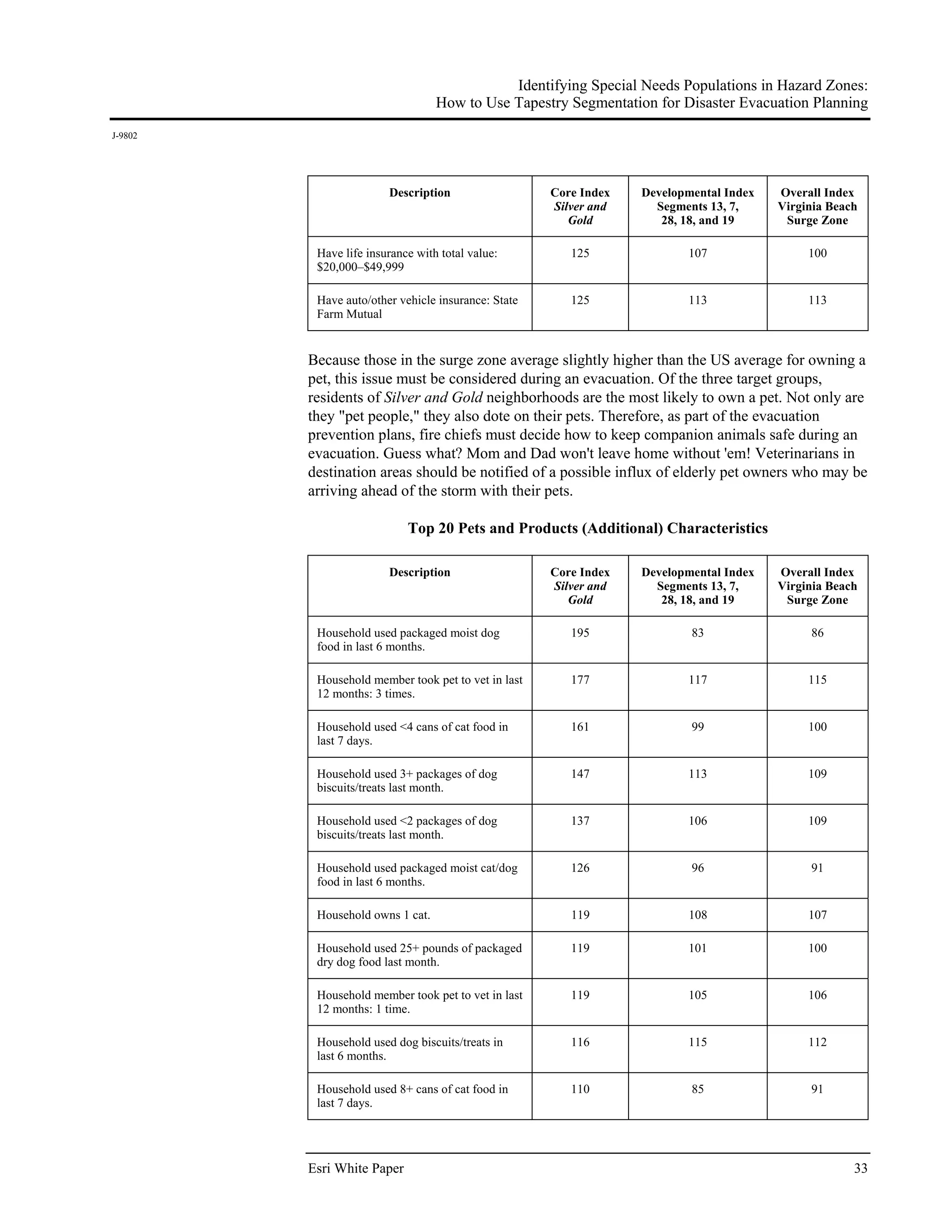
                    Pets     Because the populace in the surge zone averages slightly higher than the US average for
                             owning a pet, this issue must be considered during an evacuation. Not only are they "pet
                             people," they also dote on their pets. Guess what? Mom and dad won't leave home
                             without 'em! Alert veterinarians in new areas.

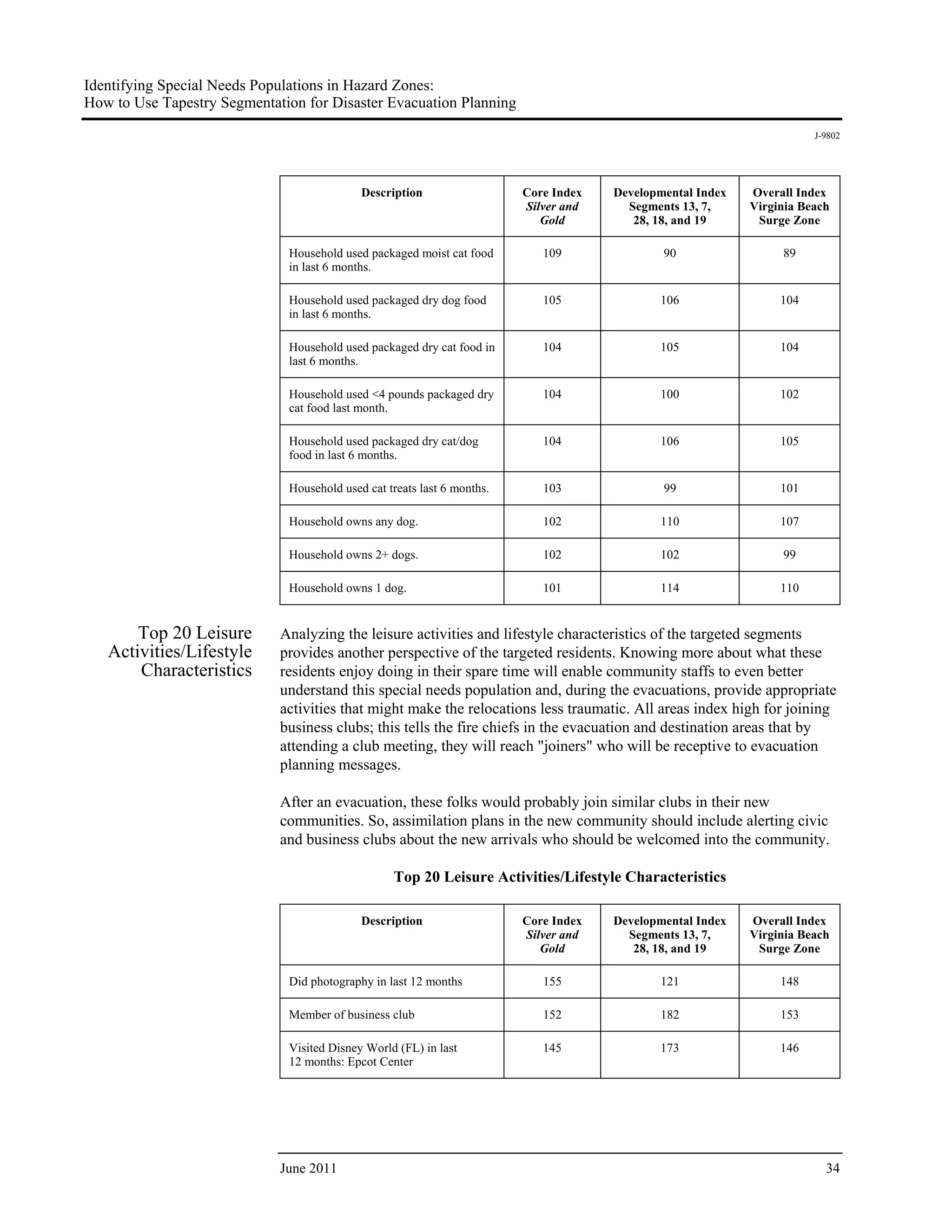
     Leisure Activities      Knowing what these residents enjoy doing in their leisure time will enable community
                             staffs to provide appropriate activities that might make the relocations during an
                             evacuation less traumatic. All areas rank high for business club memberships—this
                             information tells the fire chiefs that by attending a club meeting, they will reach "joiners"
                             who will be receptive to prevention messages. After an evacuation, these folks will be
                             likely to join similar clubs in their new community; providing information to the new
                             community may include visits to clubs before the onslaught of new residents.

        Developing
     Communication
         Strategies

      Communicating          The fire chiefs now know that their core (Silver and Gold) residents are avid golf fans,
      Effectively with       might have mobility limitations, and take prescription medications. In addition, residents
        Messaging to         of Silver and Gold neighborhoods will be very concerned about their pets in a time of
            Residents        crisis. This information enables the prevention team to create messages that residents of
                             Silver and Gold neighborhoods would probably notice and follow.

                             Specific recommendations were provided to reach these audiences with media campaigns
                             targeted at appropriate messages and media venues, including an in-depth assessment of
                             specific radio, newspaper, direct mail, and television media that would reach these
                             audiences most effectively. In addition, it was recommended that a county-level
                             community services department be responsible for community events, governmental and
                             legislative affairs, mass media public safety campaigns, news media relations, and public
                             education. This staff would greatly appreciate having access to information about the
                             Tapestry Segmentation special needs residents to help them create the right messages to
                             reach these neighborhoods.


                             June 2011                                                                                    8
Identifying Special Needs Populations in Hazard Zones:
                                           How to Use Tapestry Segmentation for Disaster Evacuation Planning
J-9802


 Relocation Planning   Tapestry Segmentation information about the residents can also be used for site location
                       analysis. For example, map a potential relocation area to see the special needs population
                       segments and areas with an expected high number of residents. If you include this
                       information in the evacuation plan, relocating people from these similar neighborhoods
                       into new areas may be less disruptive for them.

                       When you evaluate relocation sites, consider factors such as the proximity to health care
                       facilities, grocery stores, and government agencies, and the presence of the special needs
                       population segments. Using these criteria, you can preview new relocation sites and
                       select those that most closely match the residents' requirements.

           Recovery    Throughout the recovery process, issues such as relocation will continue to surface.
                       Methodologies similar to those applied in this pilot evacuation study can be used to
                       better understand the unique requirements of special needs populations in our
                       communities.

         Conclusion    The Tapestry Segmentation Study of the special needs populations in the Virginia Beach
                       surge zones proved to be an effective method for obtaining invaluable information
                       about the special needs of residents in these communities. This study confirmed the
                       theory that traditional marketing methodologies can be applied effectively to produce
                       important findings to enhance the safety of all residents in our communities.

                       A follow-up focus group meeting was conducted at the International Association of Fire
                       Chiefs in summer 2007 to share the findings of this study and explore the potential for
                       developing tools to enable more widespread use of these methodologies and make them
                       more readily available to fire department planners. Consensus opinion affirmed the
                       importance of this work, resulting in the formation of a technology advisory council to
                       advise and advance such programs.


                       Esri White Paper                                                                             9
J-9802


Appendix A: Defining Special
Needs
Emergency management takes into consideration planning for the safety
of every person in the community before, during, and after a disaster.
Taking into consideration populations historically considered vulnerable,
at risk, or special needs ultimately improves the overall community's
postdisaster sustainability.
Before drafting emergency plans, it is recommended that a statewide definition for the
term special needs be developed and used to guide state, territorial, tribal, and local
jurisdictions in the planning process. A consistent use of terminology will result in
improved communication and coordination of resources across state, territorial, tribal,
and local entities.

The NRF definition for special needs provides a function-based approach for planning
and seeks to establish a flexible framework that addresses a broad set of common
function-based needs irrespective of specific diagnosis, status, or label (e.g., children, the
elderly, the disadvantaged, and those lacking transportation). *

In other words, this function-based definition reflects the capabilities of the individual,
not the condition or label. Governments that choose to align their language to the NRF
definition will improve intergovernment communication during an incident. The
definition of special needs populations as it appears in the NRF is as follows:

Populations whose members may have additional needs before, during, and after an
incident in functional areas, including but not limited to the following:

     Maintaining Independence
     Communication
     Transportation
     Supervision
     Medical Care

Individuals in need of additional response assistance may include those who have
disabilities; who live in institutionalized settings; who are elderly; who are children; who
are from diverse cultures; who have limited English proficiency; or who are non-English
speaking; or who are transportation disadvantaged.

At first glance, it may appear that each of the above groups (and a disproportionately
large percentage of the population) is automatically classified as having special needs,
but this is not the case. The definition indicates that these groups may often include
individuals who have special needs and, in the event of an emergency, may need
additional assistance or specialized resources. For example, in a city like New York,
where less than half of all households own a car, transportation dependence is not

* The concept of a function-based approach to defining special needs populations has been developed by June
 Isaacson Kailes. See Kailes, J., and A. Enders, "Moving Beyond Special Needs, a Function-Based Framework
 for Emergency Management Planning," Journal of Disability Policy Studies, Vol. 44, 2007, pp. 230–237.


June 2011                                                                                                 10
Identifying Special Needs Populations in Hazard Zones:
                                 How to Use Tapestry Segmentation for Disaster Evacuation Planning
J-9802


         necessarily a special need. A special need in this instance is the inability to access the
         transportation alternatives defined by the Emergency Operations Plan (EOP). It is
         important to remember that special needs populations have needs that extend beyond
         those of the general population.

         The definition focuses on the following function-based aspects:

              Maintaining Independence—Individuals requiring support to be independent in
              daily activities may lose this support during an emergency or a disaster. Such support
              may include consumable medical supplies (diapers, bandages, ostomy supplies, etc.),
              durable medical equipment (wheelchairs, walkers, scooters, etc.), service animals,
              and/or attendants or caregivers. Supplying needed support to these individuals will
              enable them to maintain their predisaster level of independence.

              Communication—Individuals who have limitations that interfere with the receipt of
              and response to information will need that information provided in methods they can
              understand and use. They may not be able to hear verbal announcements, see
              directional signs, or understand how to get assistance due to hearing, visual, speech,
              cognitive, or intellectual limitations and/or limited English proficiency.

              Transportation—Individuals who cannot drive or who do not have a vehicle may
              require transportation support for successful evacuation. This support may include
              accessible vehicles (e.g., lift-equipped conveyances or vehicles suitable for
              transporting individuals who use oxygen) or information about how and where to
              access mass transportation during an evacuation.

              Supervision—Before, during, and after an emergency, individuals may lose the
              support of caregivers, family, or friends or may be unable to cope in a new
              environment (particularly if they have dementia, Alzheimer's, or psychiatric
              conditions such as schizophrenia or intense anxiety). If separated from their
              caregivers, young children may be unable to identify themselves; also, when in
              danger, they may lack the cognitive ability to assess the situation and react
              appropriately.

              Medical Care—Individuals who are not self-sufficient or who do not have adequate
              support from caregivers, family, or friends may need assistance with managing
              unstable, terminal, or contagious conditions that require observation and ongoing
              treatment; managing intravenous therapy, tube feeding, and vital signs; receiving
              dialysis, oxygen, and suction administration; managing wounds; and operating
              power-dependent equipment to sustain life. These individuals require support from
              trained medical professionals.

         The above examples illustrate function-based needs that may exist within the
         community. *


         * This information was taken from the Comprehensive Preparedness Guide (CPG) 301: Interim Emergency
          Management Planning Guide for Special Needs Populations, Federal Emergency Management Agency and
          DHS Office for Civil Rights and Civil Liberties, Version 1.0, August 15, 2008, Section III. "Defining Special
          Needs," pp. 4–6.


         Esri White Paper                                                                                            11
J-9802


               Appendix B: The Analysis
               Workflow Process and Diagram
   Step One:   These records are stored in files. For this example, each residential
   Structure   structure data record should consist of a name, complete street address,
     Address   city, state, and ZIP Code™. Post office boxes identify the location of a
     Records   person's local post office, not a person's physical residence. The example
               below shows a resident's basic address record. This data does not provide
               any information about the person except that he's a male and lives on Main
               Street in Anytown, CA.
                Name                     Address            City                 ST             ZIP Code

                Joe Smith                123 Main St.       Anytown              CA             99999-9999

  Step Two:    This is the process of enhancing address information with more detail by assigning a
  Geocoding    geographic code such as a latitude-longitude coordinate to each address record.
               Geographic codes that can be assigned include state, county, census tract, enumeration
               district, block group, and block. These are geographic boundaries used by governments in
               all state, county, and federal surveys, analyses, and evaluations. Esri's geocoding
               software uses a hierarchical methodology to assign latitude and longitude coordinates and
               a census geographic code, such as a block, to an address record. A block is a 15-digit
               code that represents an area the size of a city block. However, in more rural areas, this
               geographic area may be larger. The block is the smallest level of geography for which the
               Census Bureau tabulates data collected during a decennial census. When the census
               geocode is added, the address record looks like this:

                 Name         Address          City     ST         ZIP Code          Latitude    Longitude     Census Geocode

                  Joe
                 Smith      123 Main St.     Anytown    CA         99999-9999        32.87090    -117.23261    060730083151000


 Step Three:   After the residents' records have been geocoded with latitude, longitude, and census
Demographic    geography codes, demographic and segmentation data can be added to reveal even more
       Data    information about who these people are based on the profiles of their neighborhoods.
               Esri's demographic data variables, such as age, income, housing type, gender, race, and
               family type, help to more fully describe the types of people who live in an area.

  Step Four:   For an additional perspective about the types of people in an area, a Tapestry
    Tapestry   Segmentation code is appended to each address record. Esri's segmentation system,
Segmentation   Tapestry Segmentation, combines the who of lifestyle demography with the where of
               local neighborhood geography to create a model of various lifestyle classifications, or
               segments, of actual neighborhoods divided into distinct behavioral market segments. This
               example shows the addition of the Tapestry Segmentation code to the address record.

                                                             ZIP                                     Census
               Name        Address          City       ST    Code        Latitude      Longitude     Geocode           Tapestry
               Joe                                           99999-
               Smith       123 Main St      Anytown    CA    9999         32.87090      -117.23261   060730083151000   08


               June 2011                                                                                                      12
Identifying Special Needs Populations in Hazard Zones:
                                                         How to Use Tapestry Segmentation for Disaster Evacuation Planning
J-9802


             Step Five:    A Tapestry Segmentation code is appended to each resident's record. Now, the records
            Population     have latitude, longitude, and Tapestry Segmentation codes. The addition of this data
          Segmentation     provides valuable information about the types of residents who live in an area. As you
                           can see in the example below, adding demographic data such as current year population
                           (POP_CY) and the total number of households (HH_CY) provides information that
                           analysts can use to learn more about residents and their neighborhoods. This additional
                           data shows that there are 1,348 people who live in 752 households in the area.
                                                                 ZIP
                               Name    Address    City      ST   Code     Latitude   Longitude    Census Geocode    Tapestry   POP_CY   HH_CY
                               Joe     123                       99999-
                               Smith   Main St.   Anytown   CA   9999     32.87090   -117.23261   060730083151000   08         1,348     752


               Step Six:   Esri's Market Potential data is the potential (probability) that a product or service will be
                Market     purchased and used by consumers in a market. Adding Esri's Market Potential data to the
               Potential   demographic and socioeconomic data in Tapestry Segmentation provides insight into
                   Data    consumer behaviors and the product, service, and media preferences of residents in each
                           segment. This data can be used to learn about what they might buy, read, listen to, and
                           watch and about messaging that would most likely provide the best responses.
                           Understanding this information would enable the fire chiefs to communicate more
                           effectively with the residents of each segment.

            Step Seven:    After resident records have been appended with geographic, Tapestry Segmentation, and
          Demographic      demographic data codes, they can be divided according to the demographic and
                    and    socioeconomic characteristics in each segment. Business Analyst Desktop (Premium)
         Socioeconomic     analyzes the Tapestry Profile of the residents and generates core and developmental
         Characteristics   segment groups for further analysis. Analysts can now use this information to study the
                           different types of residents in an area.

            Step Eight:    This comprehensive information about the residents can be compiled into charts, reports,
          Consolidating    and maps. Analysts can collate this information into a booklet that can be easily
                  Data     distributed to everyone who requires detailed information about an area's residents.

             Step Nine:    After the records are appended and reports have been developed, analysts can study the
              Applying     information and reach conclusions about the best methods to prepare plans, communicate
                  Data     the right messages, and move all residents from the evacuation area quickly and safely.


                           Esri White Paper                                                                                                13
Identifying Special Needs Populations in Hazard Zones:
How to Use Tapestry Segmentation for Disaster Evacuation Planning
                                                                                           J-9802


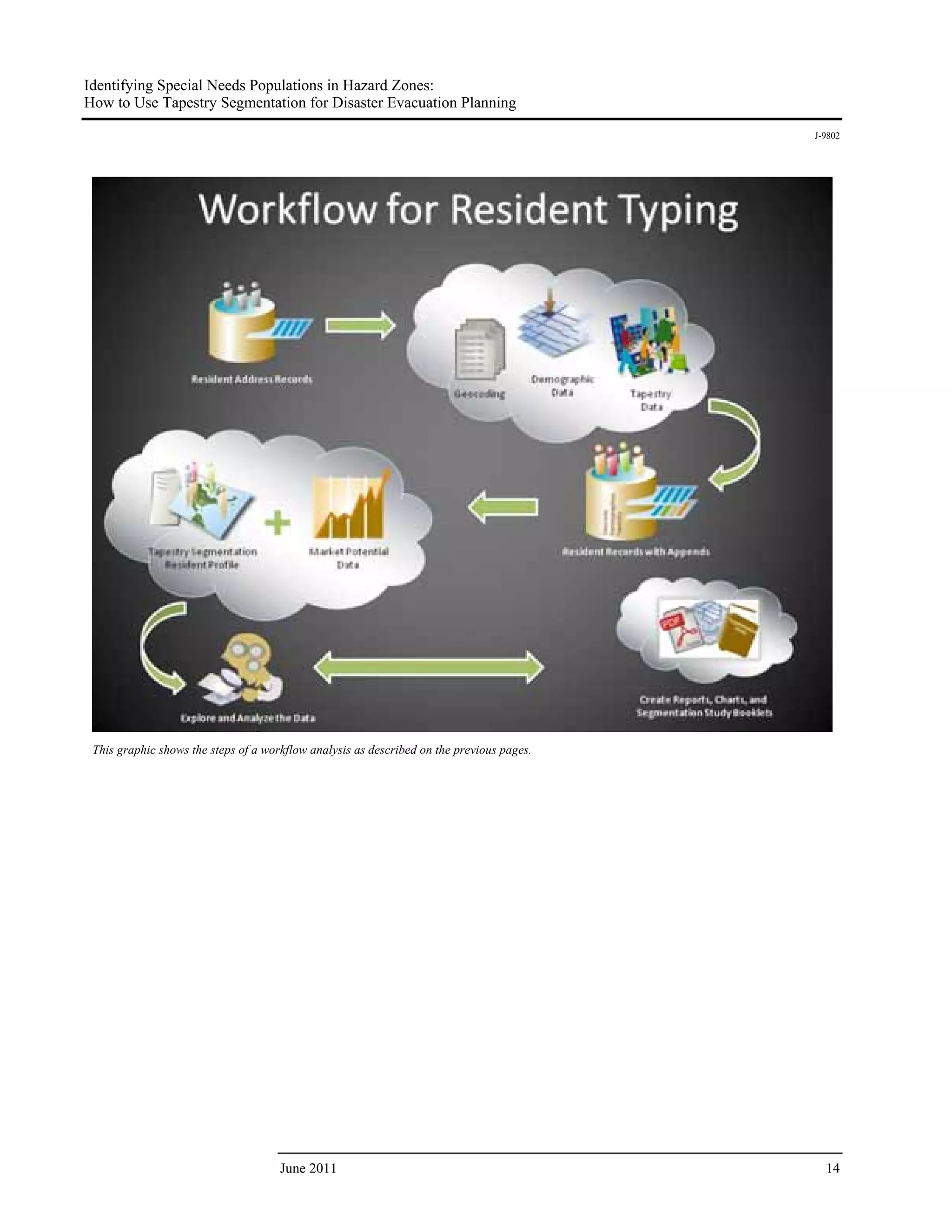
 This graphic shows the steps of a workflow analysis as described on the previous pages.


                                      June 2011                                              14
J-9802


                    Appendix C: Materials Created
                    for the Analysis
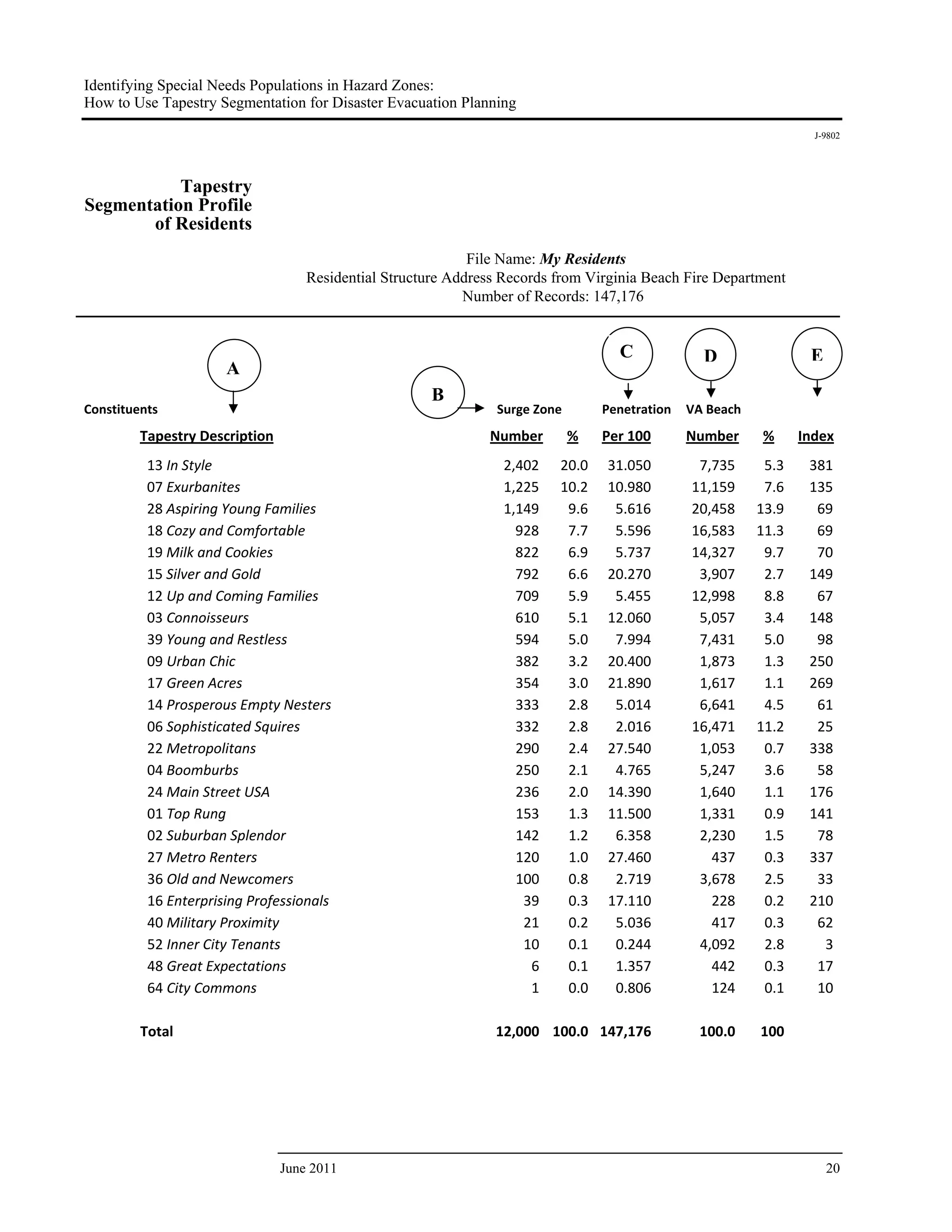
          Match &   File: My Residents
          Geocode   Residential Address Records from Virginia Beach Fire Department
         Summary    Number of Records: 4,109
           Report
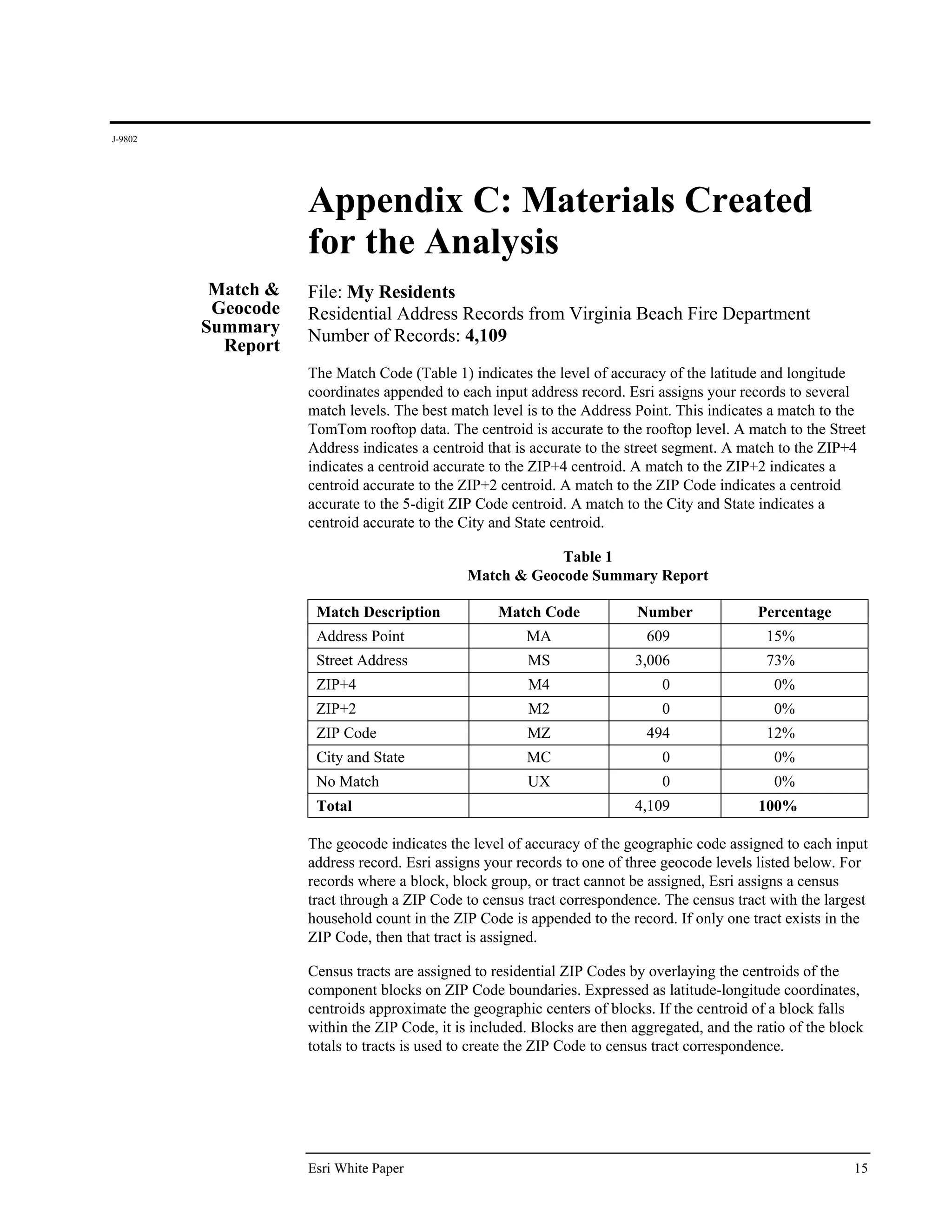
                    The Match Code (Table 1) indicates the level of accuracy of the latitude and longitude
                    coordinates appended to each input address record. Esri assigns your records to several
                    match levels. The best match level is to the Address Point. This indicates a match to the
                    TomTom rooftop data. The centroid is accurate to the rooftop level. A match to the Street
                    Address indicates a centroid that is accurate to the street segment. A match to the ZIP+4
                    indicates a centroid accurate to the ZIP+4 centroid. A match to the ZIP+2 indicates a
                    centroid accurate to the ZIP+2 centroid. A match to the ZIP Code indicates a centroid
                    accurate to the 5-digit ZIP Code centroid. A match to the City and State indicates a
                    centroid accurate to the City and State centroid.

                                                          Table 1
                                              Match & Geocode Summary Report

                     Match Description             Match Code            Number              Percentage
                     Address Point                     MA                  609                 15%
                     Street Address                     MS               3,006                 73%
                     ZIP+4                              M4                    0                 0%
                     ZIP+2                              M2                    0                 0%
                     ZIP Code                          MZ                  494                 12%
                     City and State                    MC                     0                 0%
                     No Match                           UX                    0                 0%
                     Total                                               4,109               100%

                    The geocode indicates the level of accuracy of the geographic code assigned to each input
                    address record. Esri assigns your records to one of three geocode levels listed below. For
                    records where a block, block group, or tract cannot be assigned, Esri assigns a census
                    tract through a ZIP Code to census tract correspondence. The census tract with the largest
                    household count in the ZIP Code is appended to the record. If only one tract exists in the
                    ZIP Code, then that tract is assigned.

                    Census tracts are assigned to residential ZIP Codes by overlaying the centroids of the
                    component blocks on ZIP Code boundaries. Expressed as latitude-longitude coordinates,
                    centroids approximate the geographic centers of blocks. If the centroid of a block falls
                    within the ZIP Code, it is included. Blocks are then aggregated, and the ratio of the block
                    totals to tracts is used to create the ZIP Code to census tract correspondence.


                    Esri White Paper                                                                         15
Identifying Special Needs Populations in Hazard Zones:
How to Use Tapestry Segmentation for Disaster Evacuation Planning
                                                                                                                    J-9802


                             If an address is assigned a No Geocode, no match was possible at the city level or below.
                             Post office boxes, rural routes or drops, or incomplete addresses can preclude the
                             assignment of a geocode or latitude-longitude coordinates. Addresses outside the United
                             States cannot be matched.

   Understanding the         Note: The Match & Geocode Summary report is also described in steps one and two in
   Information in the        the workflow.
   Match & Geocode
    Summary Report           Using address information from the Virginia Beach surge zone file, Esri geocoded
                             (assigned geographic codes to) the records and created a Match & Geocode Summary
                             report. This report assigns residents' records to one of five match levels:

                                 Address Point
                                 Street Address Range
                                 ZIP Code
                                 City and State
                                 No Geocode

                             Based on the geographic code assigned to each resident's address record, a Tapestry
                             Segmentation code was appended to each record.

                             The Address Point match level is the most accurate match type, and indicates that the
                             geocode is accurate at the address number. The next match type, Street Address Range,
                             indicates that the record can be matched to its street location. If a record cannot be
                             matched to the Address Point or Street Address Range, the next best match is the 5-digit
                             ZIP Code. If a record cannot be matched to Address Point, Street Address Range, or ZIP
                             Code, it is matched to the City and State. If an address received a No Geocode
                             designation, no match was possible below the county geographic level. Post office boxes,
                             rural routes, rural drops, non-US addresses, or incomplete addresses cannot be matched.

                             The Match Description column defines each match level category. The Match Code
                             column designates the abbreviation for each category. This match code will also be
                             appended to each record on the resident file and is provided as part of this analysis. The
                             Number column shows the number of records in each category and the total number of
                             records in the resident output file. The Percent column shows the percentage of resident
                             records for each match level category. Now you know how many of the resident records
                             are in each match level category.

     Report Summary          A total of 4,109 resident records for the Virginia Beach surge zone were in the My
                             Residents file. Of those, 3,006 records (73%) matched at the Street Address Range,
                             609 records (14%, rounded up to 15%) matched at the Address Point level, 494 records
                             (12%) matched in the ZIP Code range, 0 records (0%) matched in the City and State
                             range, and 0 records (0%) could not be matched and were assigned to the No Geocode
                             category. Of the total 4,109 resident records, fewer than 80 percent were assigned a
                             geocode at the Address Point or Street Address Range level. This is a below-average
                             match rate. The accuracy of the profile depends on the number of resident records that
                             can be assigned to the address or street level. Cleaning and re-geocoding the resident
                             database may increase the accuracy of subsequent analyses.

                             Note: Accuracy depends on the quality of the file that is processed.


                             June 2011                                                                                16
Identifying Special Needs Populations in Hazard Zones:
                                                 How to Use Tapestry Segmentation for Disaster Evacuation Planning
J-9802


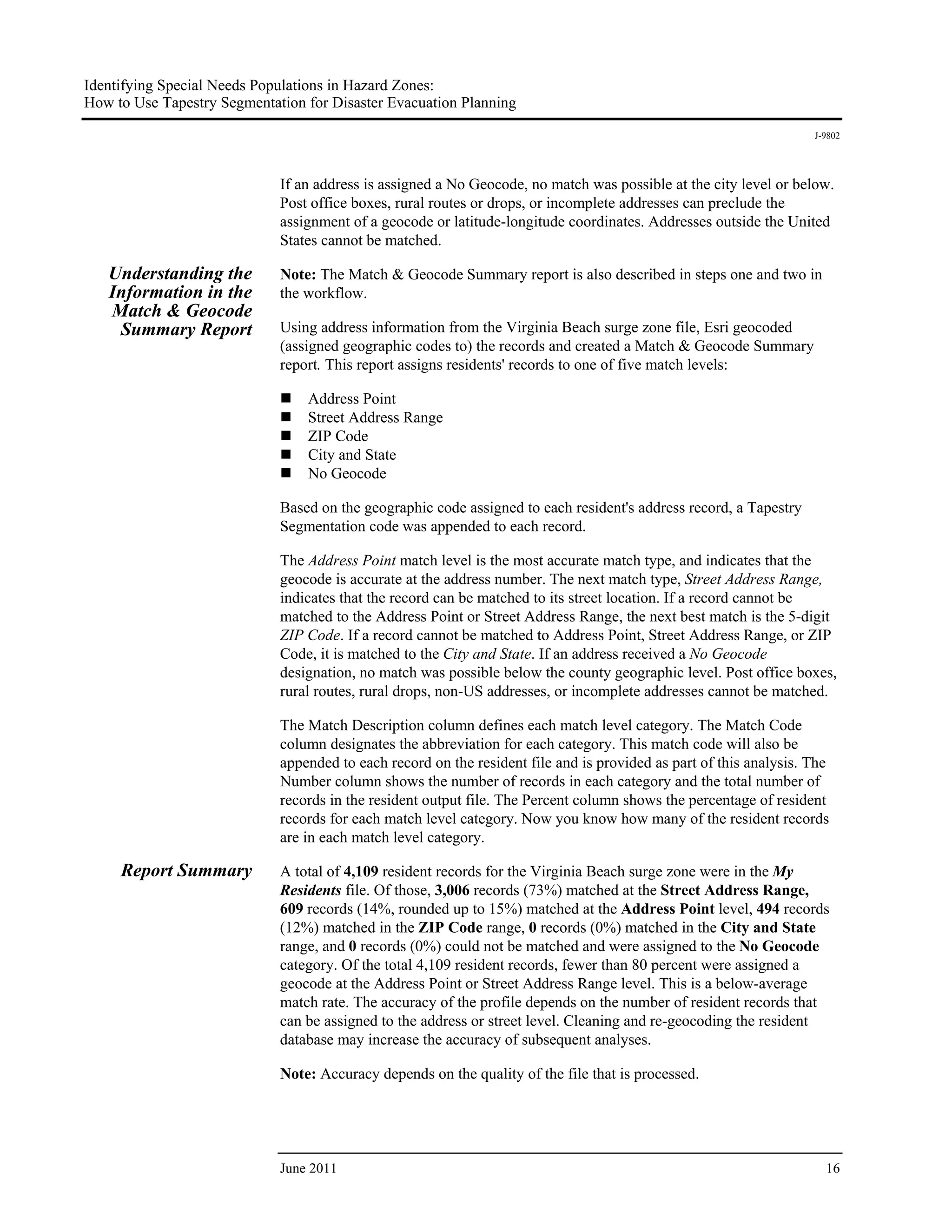
         Map of Resident    After resident records are appended with a latitude and longitude coordinate, you can
         Locations in the   visualize the surge zone and resident locations (Figure 1) that will be in the potential
             Surge Zone     flooded area.

                                                  Figure 1
                                 Map of Resident Locations in the Surge Zone


                            Note the following about this map:

                                The purple areas highlight the surge zone.
                                The black lines outline the city boundaries of Virginia Beach.
                                The black dots identify residents who live in the City of Virginia Beach surge zone.

                            The next report provides demographic details about the residents who live in the surge
                            zone. After the geocoding of the addresses in the City of Virginia Beach residential
                            structural address file is completed, this file contains only the residents who live in the
                            surge zone.


                            Esri White Paper                                                                              17
Identifying Special Needs Populations in Hazard Zones:
How to Use Tapestry Segmentation for Disaster Evacuation Planning
                                                                                                                  J-9802


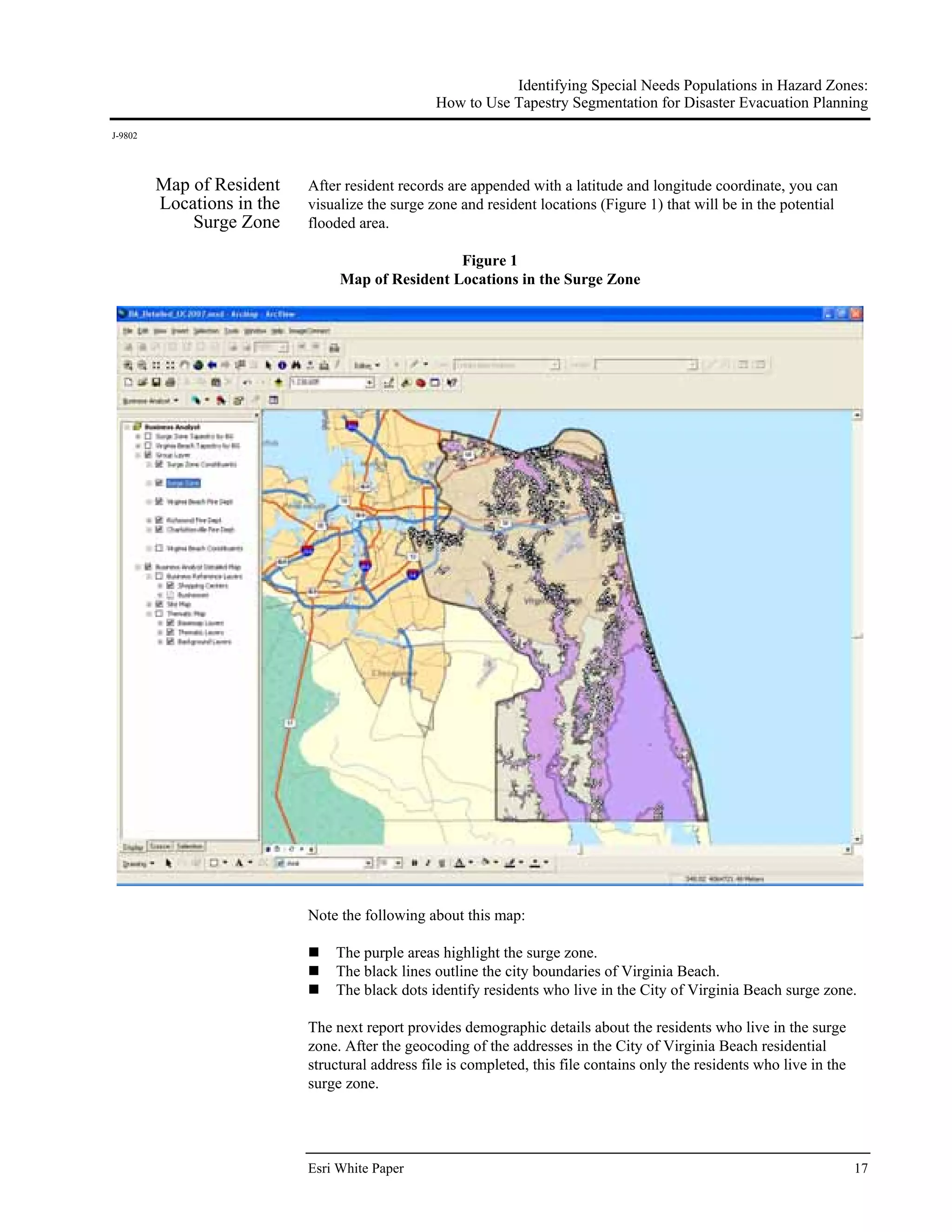
         Customer
        Geographic
    Summary Report

                                                             File: File Name
                                                            <DESCRIPTION>
                                         A               Number of Records: 11,545               D

                                     Record                                                    Record
Top 20 States                        Count       Percentage    Top 20 ZIP Codes                Count       Percentage

Virginia (51)                        11,545       99.950%      23451 Virginia Beach, VA         3,981      33.590%
                                                               23452 Virginia Beach, VA         2,157      18,200%
                                                               23456 Virginia Beach, VA         1,255      10.590%
                                                               23454 Virginia Beach, VA         1,100       9.280%
                                                               23453 Virginia Beach, VA           966       8.150%
                                                               23455 Virginia Beach, VA           906       7.640%
                                                               23462 Virginia Beach, VA           576       4.860%
                                                               23464 Virginia Beach, VA           517       4.360%
                                                               23457 Virginia Beach, VA           387       3.270%
                                                               23521 Norfolk, VA                    3       0.030%
                                                               23322 Chesapeake, VA                 2       0.020%

                                         B                                                            E


Other States                                 0     0.000%      Other ZIP Codes                         0     0.00%
 Nongeocoded Records                         6     0.050%       Records with no ZIP Code               1    0.010%

                                         C                                                        F


Top 20 Counties
City of Virginia Beach, VA (51810)   11,545       99.950%      Top 20 CBSAs
                                                               VA Beach-Norfolk-               11,811      99.960%
                                                                Newport News
Other Counties                               0     0.000%      Other CBSAs                             0    0.000%
 Nongeocoded Records                         5     0.050%       Records not in a CBSA                 40    0.340%

                             Note: The Customer Geographic Summary report displays the top 20 states, counties,
                             ZIP Codes, and metropolitan areas, in rank order.

                                 11,545 (99.949%) of the records are in the State of Virginia (51).

                                 11,545 (99.949%) of the records are in the City of Virginia Beach, Virginia (51810).
                                 This number is the county FIPS Code.


                             June 2011                                                                               18
Identifying Special Needs Populations in Hazard Zones:
                                           How to Use Tapestry Segmentation for Disaster Evacuation Planning
J-9802


                           Records that were not matched at the designated level are noted at the bottom of the
                           report.

                           23451, Virginia Beach, Virginia, is the top-ranked ZIP Code. 3,981 (33.592%) of the
                           records are in this ZIP Code.

                           Other than the top 20 ZIP Codes, no other ZIP Codes (0.000%) are represented in the
                           file.

                           11,811 (99.662%) of the records are located in the Virginia Beach-Norfolk-Newport
                           News, Virginia-North Carolina metropolitan area (47260).

Geographic Resident
   Summary Report

     Understanding     Knowing about the neighborhoods where the special needs populations live is another
Where Residents Live   important aspect of understanding their requirements before, during, and after an
                       evacuation. It is necessary to learn about local commuting patterns, locations of shopping
                       districts, and other factors that will impact an evacuation. Knowing about the
                       neighborhoods where the residents live enables you to target public service
                       announcement (PSA) messages, such as community service direct mail campaigns to
                       residents in specific geographic areas, instead of mailing one message to the entire city.

                       You can use the information in this report to identify neighborhoods where most of the
                       current residents live. To find the top 20 geographic areas in Virginia Beach, this report
                       summarizes the resident records at the state, county, ZIP Code, and core-based statistical
                       area (CBSA) geographic levels. Each record is assigned at the state, county, ZIP Code,
                       and CBSA geographic levels according to a point-in-polygon approach based on the
                       record's latitude and longitude. [Note: The Locator (LOC_NAME) field in the output file
                       identifies the match levels of the latitude and longitude for every address record.] Each
                       geographic level is analyzed according to the record count and percentages of the match
                       levels. Records that are not matched are noted at the end of each section.

                       This report lists the percentages of residents who live in each geographic area, ranked
                       high to low, based on results from the geocoding process. This information reveals where
                       you should concentrate community service PSA messaging efforts.


                       Esri White Paper                                                                        19
Identifying Special Needs Populations in Hazard Zones:
How to Use Tapestry Segmentation for Disaster Evacuation Planning
                                                                                                                         J-9802


           Tapestry
Segmentation Profile
       of Residents
                                                              File Name: My Residents
                                     Residential Structure Address Records from Virginia Beach Fire Department
                                                             Number of Records: 147,176


                                                                                       C             D                  E
                      A
                                                        B
Constituents                                                      Surge Zone         Penetration   VA Beach 
         Tapestry Description                                   Number          %    Per 100      Number        %      Index 
          13 In Style                                              2,402    20.0     31.050         7,735       5.3     381 
          07 Exurbanites                                           1,225    10.2     10.980        11,159       7.6     135 
          28 Aspiring Young Families                               1,149     9.6      5.616        20,458      13.9      69 
          18 Cozy and Comfortable                                    928     7.7      5.596        16,583      11.3      69 
          19 Milk and Cookies                                        822     6.9      5.737        14,327       9.7      70 
          15 Silver and Gold                                         792     6.6     20.270         3,907       2.7     149 
          12 Up and Coming Families                                  709     5.9      5.455        12,998       8.8      67 
          03 Connoisseurs                                            610     5.1     12.060         5,057       3.4     148 
          39 Young and Restless                                      594     5.0      7.994         7,431       5.0      98 
          09 Urban Chic                                              382     3.2     20.400         1,873       1.3     250 
          17 Green Acres                                             354     3.0     21.890         1,617       1.1     269 
          14 Prosperous Empty Nesters                                333     2.8      5.014         6,641       4.5      61 
          06 Sophisticated Squires                                   332     2.8      2.016        16,471      11.2      25 
          22 Metropolitans                                           290     2.4     27.540         1,053       0.7     338 
          04 Boomburbs                                               250     2.1      4.765         5,247       3.6      58 
          24 Main Street USA                                         236     2.0     14.390         1,640       1.1     176 
          01 Top Rung                                                153     1.3     11.500         1,331       0.9     141 
          02 Suburban Splendor                                       142     1.2      6.358         2,230       1.5      78 
          27 Metro Renters                                           120     1.0     27.460           437       0.3     337 
          36 Old and Newcomers                                       100     0.8      2.719         3,678       2.5      33 
          16 Enterprising Professionals                               39     0.3     17.110           228       0.2     210 
          40 Military Proximity                                       21     0.2      5.036           417       0.3      62 
          52 Inner City Tenants                                       10     0.1      0.244         4,092       2.8       3 
          48 Great Expectations                                        6     0.1      1.357           442       0.3      17 
          64 City Commons                                              1     0.0      0.806           124       0.1      10 
           
         Total                                                   12,000  100.0  147,176             100.0      100 


                                 June 2011                                                                                  20
Identifying Special Needs Populations in Hazard Zones:
                                            How to Use Tapestry Segmentation for Disaster Evacuation Planning
J-9802


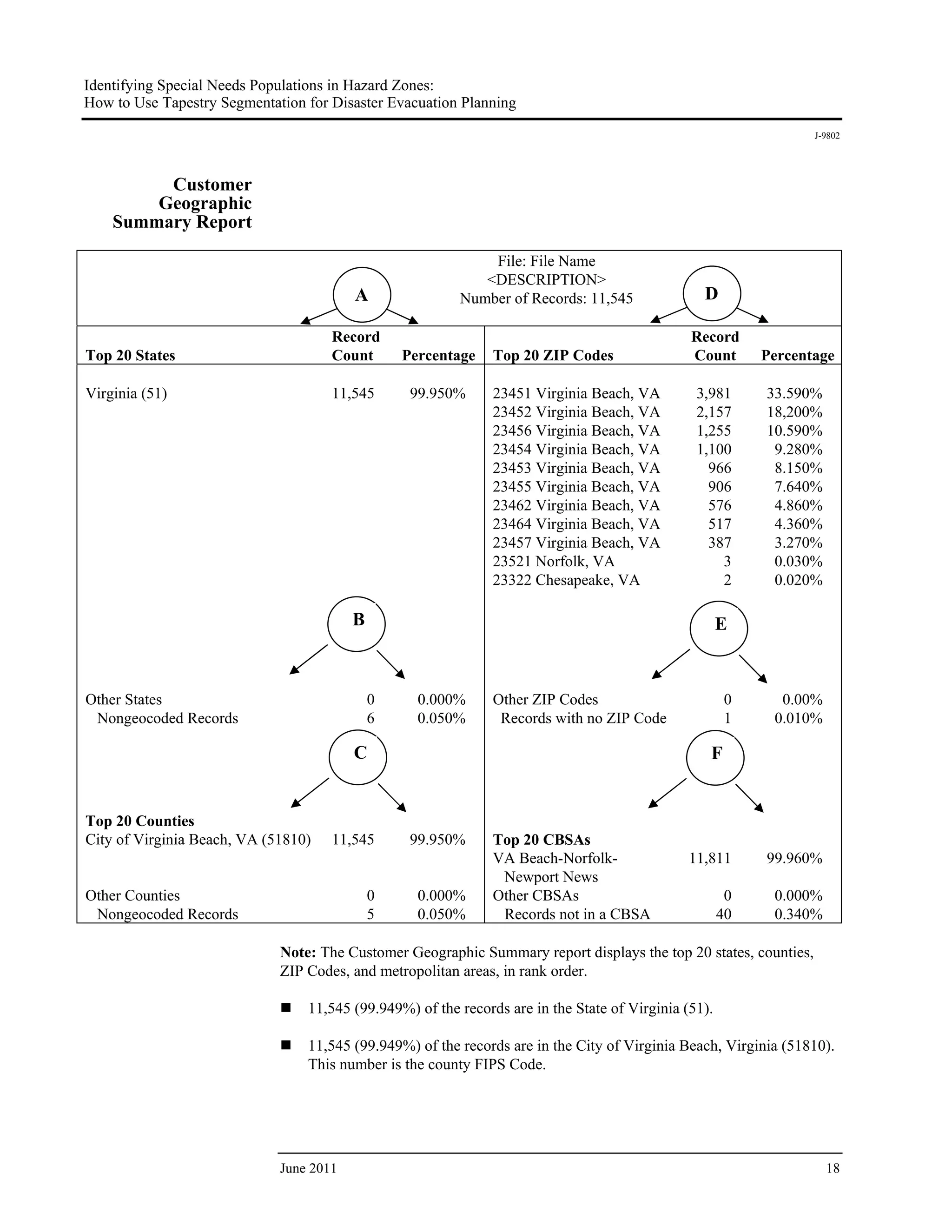
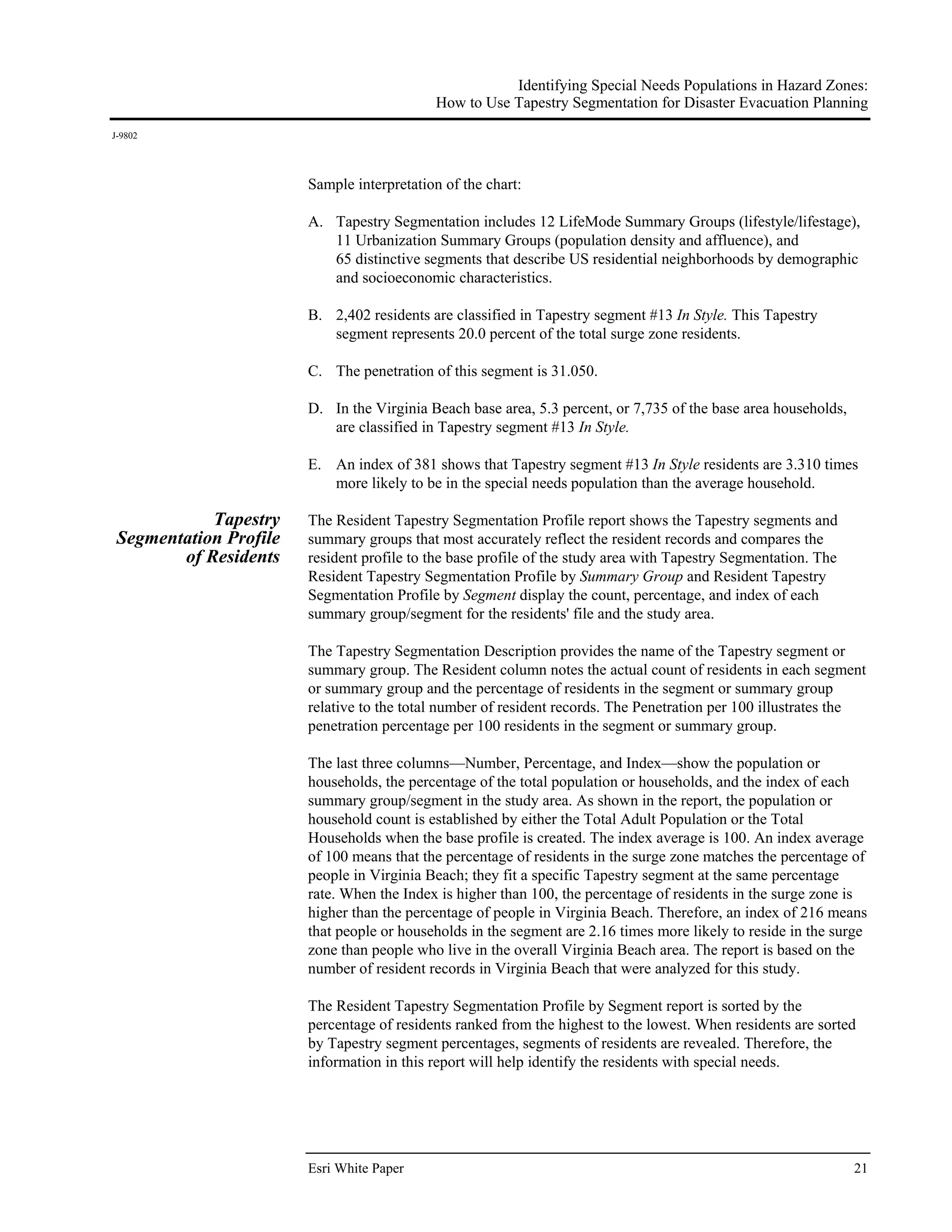
                        Sample interpretation of the chart:

                        A. Tapestry Segmentation includes 12 LifeMode Summary Groups (lifestyle/lifestage),
                           11 Urbanization Summary Groups (population density and affluence), and
                           65 distinctive segments that describe US residential neighborhoods by demographic
                           and socioeconomic characteristics.

                        B. 2,402 residents are classified in Tapestry segment #13 In Style. This Tapestry
                           segment represents 20.0 percent of the total surge zone residents.

                        C. The penetration of this segment is 31.050.

                        D. In the Virginia Beach base area, 5.3 percent, or 7,735 of the base area households,
                           are classified in Tapestry segment #13 In Style.

                        E. An index of 381 shows that Tapestry segment #13 In Style residents are 3.310 times
                           more likely to be in the special needs population than the average household.

            Tapestry    The Resident Tapestry Segmentation Profile report shows the Tapestry segments and
 Segmentation Profile   summary groups that most accurately reflect the resident records and compares the
        of Residents    resident profile to the base profile of the study area with Tapestry Segmentation. The
                        Resident Tapestry Segmentation Profile by Summary Group and Resident Tapestry
                        Segmentation Profile by Segment display the count, percentage, and index of each
                        summary group/segment for the residents' file and the study area.

                        The Tapestry Segmentation Description provides the name of the Tapestry segment or
                        summary group. The Resident column notes the actual count of residents in each segment
                        or summary group and the percentage of residents in the segment or summary group
                        relative to the total number of resident records. The Penetration per 100 illustrates the
                        penetration percentage per 100 residents in the segment or summary group.

                        The last three columns—Number, Percentage, and Index—show the population or
                        households, the percentage of the total population or households, and the index of each
                        summary group/segment in the study area. As shown in the report, the population or
                        household count is established by either the Total Adult Population or the Total
                        Households when the base profile is created. The index average is 100. An index average
                        of 100 means that the percentage of residents in the surge zone matches the percentage of
                        people in Virginia Beach; they fit a specific Tapestry segment at the same percentage
                        rate. When the Index is higher than 100, the percentage of residents in the surge zone is
                        higher than the percentage of people in Virginia Beach. Therefore, an index of 216 means
                        that people or households in the segment are 2.16 times more likely to reside in the surge
                        zone than people who live in the overall Virginia Beach area. The report is based on the
                        number of resident records in Virginia Beach that were analyzed for this study.

                        The Resident Tapestry Segmentation Profile by Segment report is sorted by the
                        percentage of residents ranked from the highest to the lowest. When residents are sorted
                        by Tapestry segment percentages, segments of residents are revealed. Therefore, the
                        information in this report will help identify the residents with special needs.


                        Esri White Paper                                                                         21
Identifying Special Needs Populations in Hazard Zones:
How to Use Tapestry Segmentation for Disaster Evacuation Planning
                                                                                                                J-9802


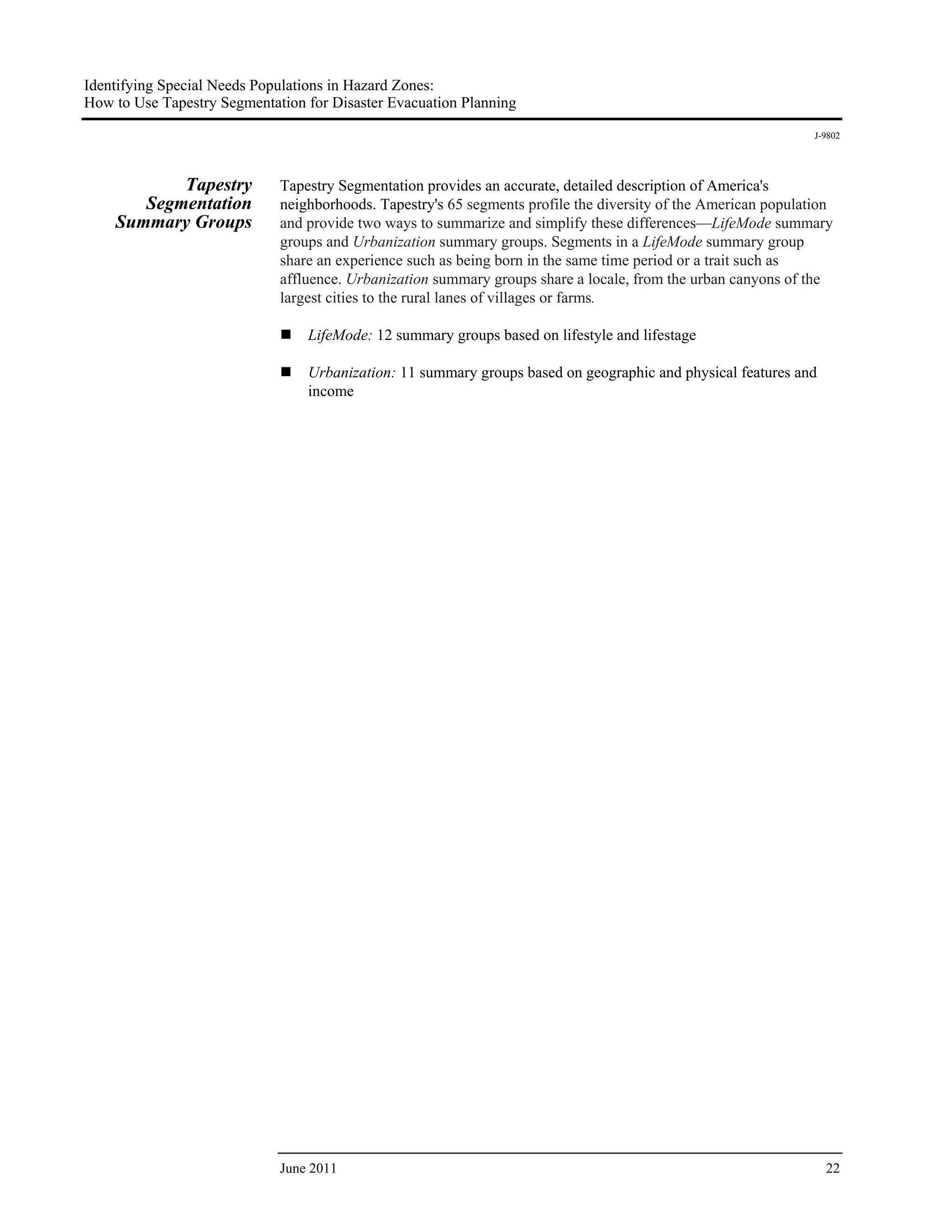
           Tapestry          Tapestry Segmentation provides an accurate, detailed description of America's
       Segmentation          neighborhoods. Tapestry's 65 segments profile the diversity of the American population
    Summary Groups           and provide two ways to summarize and simplify these differences—LifeMode summary
                             groups and Urbanization summary groups. Segments in a LifeMode summary group
                             share an experience such as being born in the same time period or a trait such as
                             affluence. Urbanization summary groups share a locale, from the urban canyons of the
                             largest cities to the rural lanes of villages or farms.

                                 LifeMode: 12 summary groups based on lifestyle and lifestage

                                 Urbanization: 11 summary groups based on geographic and physical features and
                                 income


                             June 2011                                                                            22
Identifying Special Needs Populations in Hazard Zones:
                                                 How to Use Tapestry Segmentation for Disaster Evacuation Planning
J-9802


Residents' Profile by
 Tapestry Summary
             Groups

                                                          File Name: My Residents
                                 Residential Structure Address Records from Virginia Beach Fire Department
                                                         Number of Records: 147,176


                                                                                 C        D          E
                                                         B
                  A

                                                 Surge Zone Constituents Penetration      VA Beach Constituents
         Tapestry LifeMode Summary Groups                    Number  %  Per 100           Number          %  Index 
          L2 Upscale Avenues                                  4,105  34.2  14.640          28,036        19.1  180 
          L1 High Society                                     2,712  22.6   6.536          41,495        28.2   80 
          L9 Family Portrait                                  1,532  12.8   5.581          27,449        18.7   68 
          L7 High Hopes                                       1,155   9.6   5.526          20,900        14.2   68 
          L5 Senior Styles                                    1,125   9.4  10.670          10,548         7.2  131 
          L4 Solo Acts                                          814   6.8   7.050          11,546         7.8   86 
          L3 Metropolis                                         290   2.4  27.540           1,053         0.7  338 
          L10 Traditional Living                                236   2.0  14.390           1,640         1.1  176 
          L6 Scholars and Patriots                               21   0.2   5.036             417         0.3   62 
          L8 Global Roots                                        10   0.1   0.244           4,092         2.8    3 
          L11 Factories and Farms                                 0   0.0   0.000               0         0.0    0 
          L12 American Quilt                                      0   0.0   0.000               0         0.0    0 
                                    A
         Surge Zone Constituents Penetration VA Beach Constituents
         Tapestry Urbanization Summary Groups                Number  %  Per 100           Number          %  Index 
         U7 Suburban Periphery I                              5,935  49.5   9.707          61,141        41.5  119 
         U3 Metro Cities I                                    2,296  19.1   9.619          23,869        16.2  118 
         U4 Metro Cities II                                   1,853  15.4   5.196          35,659        24.2   64 
         U8 Suburban Periphery II                               949   7.9   5.582          17,000        11.6   68 
         U5 Urban Outskirts I                                   492   4.1   6.713           7,329         5.0   82 
         U10 Rural I                                            354   3.0  21.890           1,617         1.1  269 
         U1 Principal Urban Centers I                           120   1.0  27.460             437         0.3  337 
         U2 Principal Urban Centers II                            1   0.0   0.806             124         0.1   10 
         U11 Rural II                                             0   0.0   0.000               0         0.0    0 
         U6 Urban Outskirts II                                    0   0.0   0.000               0         0.0    0 
         U9 Small Towns                                           0   0.0   0.000               0         0.0    0 


                             Esri White Paper                                                                    23
Identifying Special Needs Populations in Hazard Zones:
How to Use Tapestry Segmentation for Disaster Evacuation Planning
                                                                                                                    J-9802


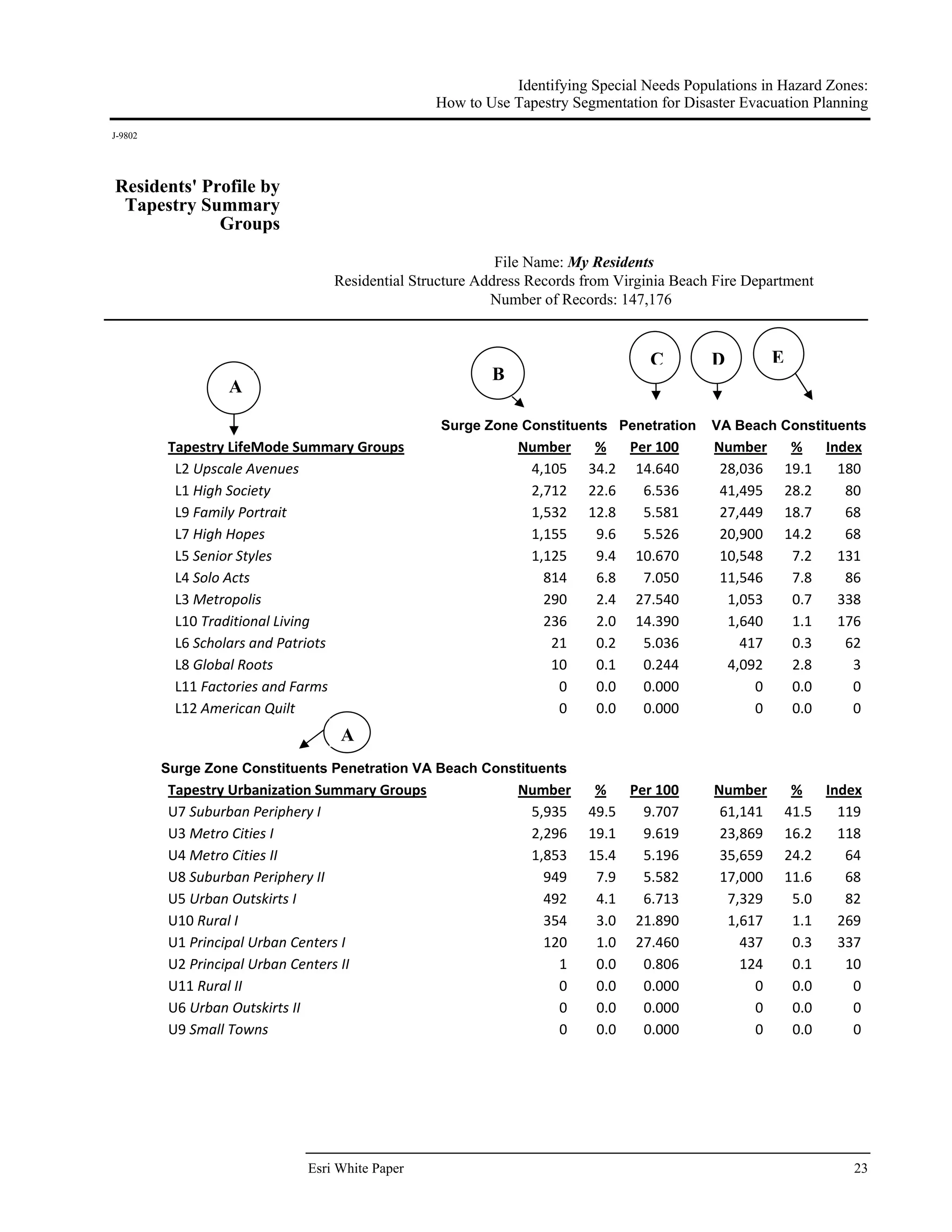
                             Interpretation of the chart: Tapestry Segmentation profiles resident areas from a
                             resident file based on a relative population, such as the United States'.

                             A. Tapestry Segmentation contains 12 LifeMode summary groups that are based on
                                lifestyle/lifestage and 11 Urbanization summary groups that are based on population
                                density and affluence.

                             B. 4,105, or 34.2 percent, of the residents are in the L2 Upscale Avenues LifeMode
                                summary group.

                             C. The penetration rate shows the number of surge zone residents relative to the
                                Virginia Beach base household count. For example, 14,640 of every 100 L2 Upscale
                                Avenues Virginia Beach residents are your targets.

                             D. The base of this profile is Virginia Beach households. The base represents the
                                selected residential area to show relevant comparisons and penetration rates. The
                                Tapestry L2 Upscale Avenues summary group is 19.050 percent of the Virginia
                                Beach base households.

                             E. The Tapestry Index measures the proportion of residents in a specific area relative to
                                the proportion of the base households in an area. For example, the Tapestry Index of
                                160 reflects the higher concentration (34.2 percent) of L2 Upscale Avenues residents
                                among surge zone residents compared to all the L2 Upscale Avenues in the Virginia
                                Beach base households (19.1 percent). In other words, surge zone residents are
                                80 percent more likely than the average Virginia Beach base household to be in the
                                L2 Upscale Avenues summary group.

                             After a resident's address record has been appended with a geocode and a Tapestry
                             Segmentation code, a great deal of information is now available about the resident.
                             Tapestry Segmentation links to volumes of consumer survey data, enabling you to learn
                             more about targeted neighborhoods.

                             The power of Tapestry Segmentation is in the application of this valuable information.
                             Marketing experts and consultants can help interpret the information and recommend the
                             best applications to achieve the project's objectives.

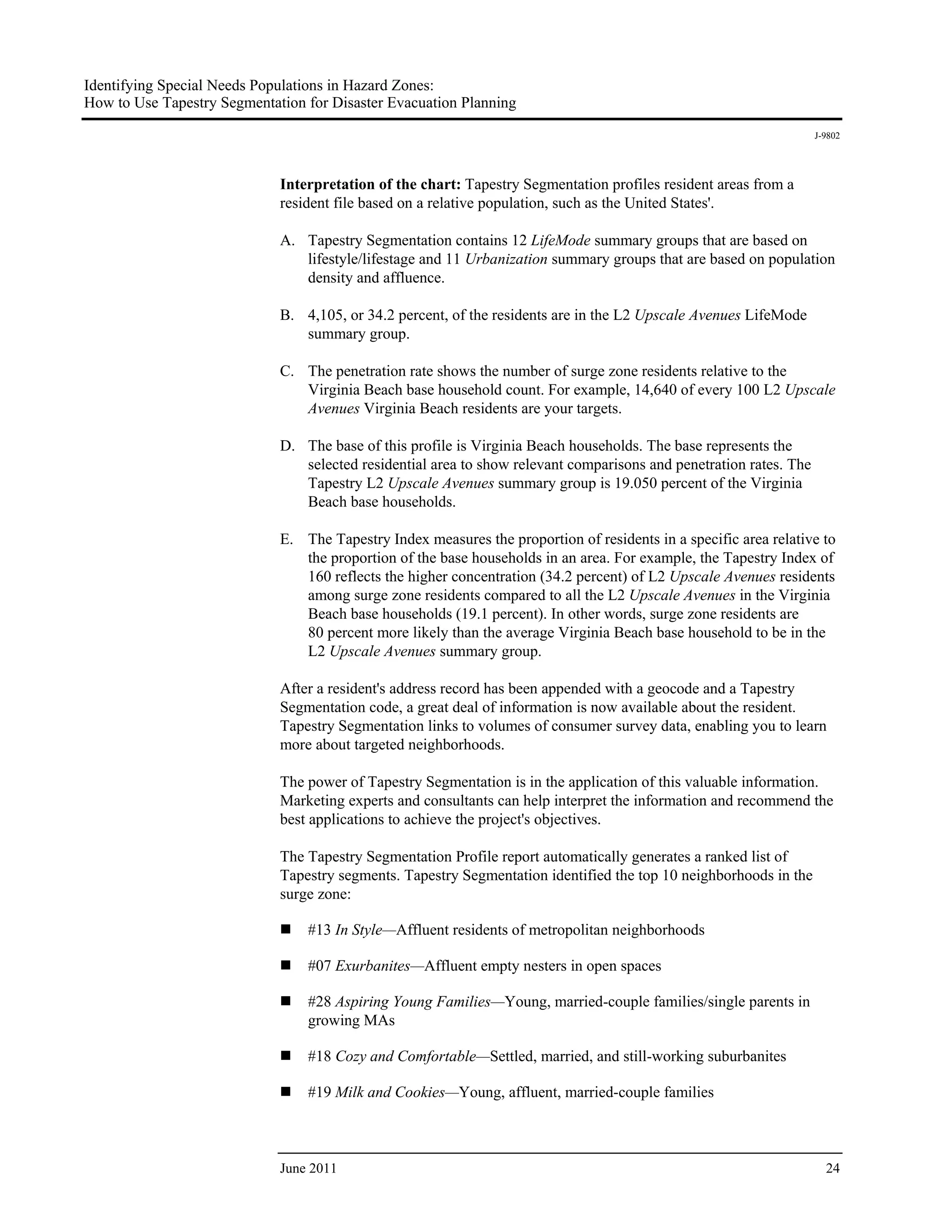
                             The Tapestry Segmentation Profile report automatically generates a ranked list of
                             Tapestry segments. Tapestry Segmentation identified the top 10 neighborhoods in the
                             surge zone:

                                 #13 In Style—Affluent residents of metropolitan neighborhoods

                                 #07 Exurbanites—Affluent empty nesters in open spaces

                                 #28 Aspiring Young Families—Young, married-couple families/single parents in
                                 growing MAs

                                 #18 Cozy and Comfortable—Settled, married, and still-working suburbanites

                                 #19 Milk and Cookies—Young, affluent, married-couple families


                             June 2011                                                                                24
Identifying Special Needs Populations in Hazard Zones:
                                How to Use Tapestry Segmentation for Disaster Evacuation Planning
J-9802


             #15 Silver and Gold—Wealthy, older seniors

             #12 Up and Coming Families—Young, affluent families with young children

             #03 Connoisseurs—Well-educated, wealthy, conspicuous consumers

             #39 Young and Restless—Young, on-the-go renters

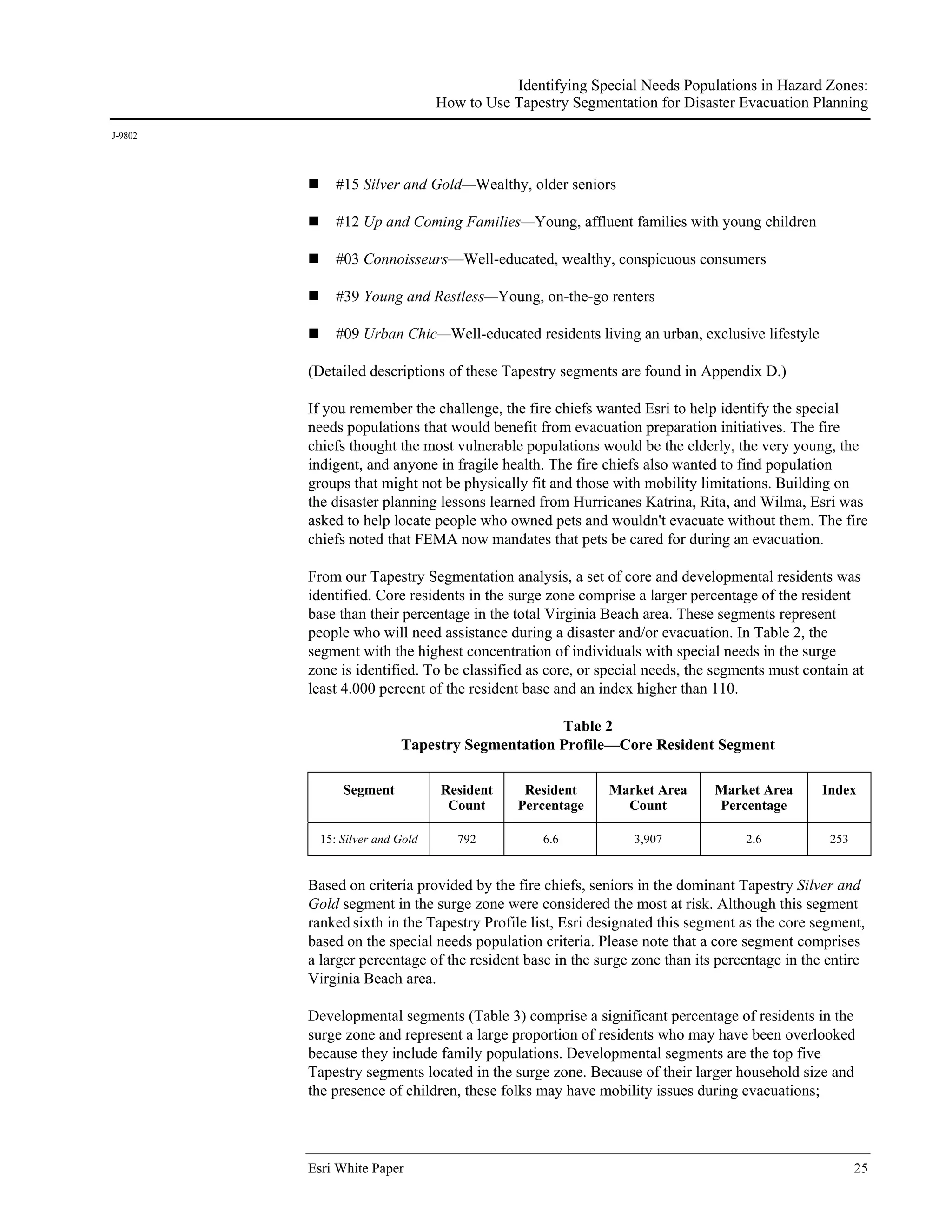
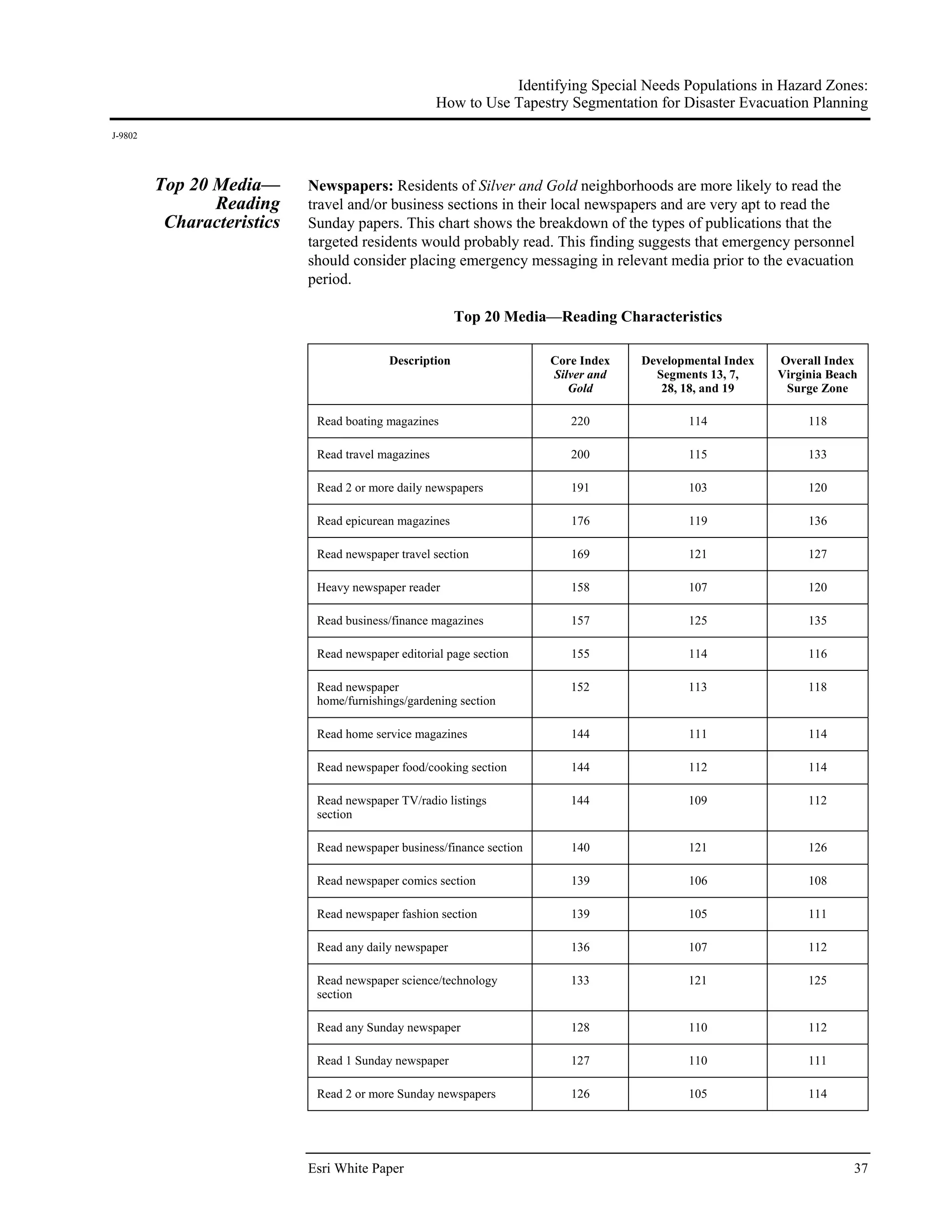
             #09 Urban Chic—Well-educated residents living an urban, exclusive lifestyle

         (Detailed descriptions of these Tapestry segments are found in Appendix D.)

         If you remember the challenge, the fire chiefs wanted Esri to help identify the special
         needs populations that would benefit from evacuation preparation initiatives. The fire
         chiefs thought the most vulnerable populations would be the elderly, the very young, the
         indigent, and anyone in fragile health. The fire chiefs also wanted to find population
         groups that might not be physically fit and those with mobility limitations. Building on
         the disaster planning lessons learned from Hurricanes Katrina, Rita, and Wilma, Esri was
         asked to help locate people who owned pets and wouldn't evacuate without them. The fire
         chiefs noted that FEMA now mandates that pets be cared for during an evacuation.

         From our Tapestry Segmentation analysis, a set of core and developmental residents was
         identified. Core residents in the surge zone comprise a larger percentage of the resident
         base than their percentage in the total Virginia Beach area. These segments represent
         people who will need assistance during a disaster and/or evacuation. In Table 2, the
         segment with the highest concentration of individuals with special needs in the surge
         zone is identified. To be classified as core, or special needs, the segments must contain at
         least 4.000 percent of the resident base and an index higher than 110.

                                               Table 2
                         Tapestry Segmentation Profile—Core Resident Segment

              Segment           Resident     Resident     Market Area       Market Area       Index
                                 Count      Percentage      Count           Percentage

          15: Silver and Gold      792          6.6           3,907              2.6           253


         Based on criteria provided by the fire chiefs, seniors in the dominant Tapestry Silver and
         Gold segment in the surge zone were considered the most at risk. Although this segment
         ranked sixth in the Tapestry Profile list, Esri designated this segment as the core segment,
         based on the special needs population criteria. Please note that a core segment comprises
         a larger percentage of the resident base in the surge zone than its percentage in the entire
         Virginia Beach area.

         Developmental segments (Table 3) comprise a significant percentage of residents in the
         surge zone and represent a large proportion of residents who may have been overlooked
         because they include family populations. Developmental segments are the top five
         Tapestry segments located in the surge zone. Because of their larger household size and
         the presence of children, these folks may have mobility issues during evacuations;


         Esri White Paper                                                                            25
Identifying Special Needs Populations in Hazard Zones:
How to Use Tapestry Segmentation for Disaster Evacuation Planning
                                                                                                                    J-9802


                             however, the fire chiefs did not consider them to need as much attention as the seniors in
                             Silver and Gold neighborhoods.

                                                                   Table 3
                                       Tapestry Segmentation Profile—Developmental Resident Segments

                                   Segment           Resident    Resident     Market Area      Market Area      Index
                                                      Count     Percentage      Count          Percentage

                                  13: In Style        2,402        20.0           7,735             5.2          387

                                 7: Exurbanites       1,225        10.2          11,159             7.5          137

                               28: Aspiring Young     1,149        9.6           20,458            13.7           70
                                    Families

                                 18: Cozy and          928         7.7           16,583            11.1           70
                                 Comfortable

                                  19: Milk and         822         6.9           14,327             9.6           72
                                    Cookies


                             The next step in the analysis was to create and visually display a Tapestry Segmentation
                             area profile of residents who would be impacted by the surge zone. Figure 2 displays the
                             Tapestry segments in the City of Virginia Beach at the block group geography level.

                                                                     Figure 2
                                                    Tapestry Segments in Virginia Beach, Virginia


                             June 2011                                                                                 26
Identifying Special Needs Populations in Hazard Zones:
                                           How to Use Tapestry Segmentation for Disaster Evacuation Planning
J-9802


                       A Tapestry Segmentation block group or ZIP+4 code links a resident file directly to a
                       basic building block of geography. A one-to-one relationship is maintained between a
                       single Tapestry segment and each of 200,000+ block groups and/or 22 million+ ZIP+4s
                       across the United States. By encoding a file with Tapestry Segmentation codes, a direct
                       relationship is created between a resident's address record and the Tapestry segment.

                       The polygons displayed in red on this map identify the locations of Silver and Gold
                       neighborhoods. Directed by the fire chief, the Virginia Beach staff can now contact
                       homeowners' associations and senior residents' groups in these areas to help implement
                       prevention programs.

                       Note: The land area at the top center of this map (Figure 3) shows no Tapestry segments
                       because this and many other areas in and around the City of Virginia Beach are military
                       facilities.

                                                          Figure 3
                                  Core and Developmental Tapestry Segments in the Surge Zone


    Who Are Special    Tapestry Segmentation provides a new perspective of residents in neighborhoods in the
  Needs Populations?   Virginia Beach surge zone. To allocate resources more efficiently, fire departments must
                       know which neighborhoods should receive particular attention. The best way to focus on
                       selected Tapestry segments is by defining special needs groups of residents based on
                       specific criteria. Using the Tapestry Segmentation Area Profile from the previous section,
                       target groups of residents can be identified by combining two factors: the index and the
                       percentage of residents.


                       Esri White Paper                                                                          27
Identifying Special Needs Populations in Hazard Zones:
How to Use Tapestry Segmentation for Disaster Evacuation Planning
                                                                                                                   J-9802


         Special Needs       Although these special needs populations comprise a significant percentage of senior
          Populations        residents in the local area, they do not have an above-average index. Special needs
                             populations are a significant portion of residents but also represent neighborhoods with
                             households that may need assistance during a disaster. These could be ethnic families
                             with small children and/or multigenerational households.

                             A base of Adult Population Aged 75 and Older was used to define the Tapestry segments
                             with a high percentage of the residents' base to identify a segment composed of a large
                             percentage of the resident base with an above-average age index older than age 75.

  Learning about the
   Target Groups of
           Residents

      What Are Their         Now that special needs populations have been identified, you must understand the
             Lifestyle       similarities and differences between the lifestyles of these two distinct groups of
      Characteristics?       segments. The Tapestry Segmentation Area Profile of the residents was used to calculate
                             a weighted index that accounts for the percentage composition of each segment in the
                             resident profile compared to that segment's index for a specific product, service, or
                             lifestyle characteristic. The Index is an easy way to analyze the residents. Using this
                             method, the Tapestry Segmentation profile of the residents was compared to the Tapestry
                             Segmentation profile that is based on a syndicated citizen survey. GfK MRI conducts the
                             Doublebase consumer survey that indicates how individuals purchase and use various
                             products and services. If an item's Index is higher than 100, people in an area are more
                             likely than the average U.S. household to purchase and use the product or have the
                             lifestyle characteristic.

                             Note: It is important to remember that the information in this section is from the
                             Doublebase consumer survey conducted by GfK MRI. Therefore, the information is not
                             actual rating data but consumers' responses to surveys.

                             Because we want to focus on the differences between the target segments (core,
                             developmental, and all segments) in the Virginia Beach Resident Profile, separate
                             weighted indexes were calculated for each group.

                             Esri used information from the GfK MRI syndicated consumer survey to create a Market
                             Potential database that reports indexes of lifestyle characteristics for selected products
                             and services. Due to the large number of survey items, Esri grouped the database into
                             these 35 categories:


                             June 2011                                                                                  28
Identifying Special Needs Populations in Hazard Zones:
                                How to Use Tapestry Segmentation for Disaster Evacuation Planning
J-9802


          MPI_01: Apparel                             MPI_19: Insurance
          MPI_02: Appliances                          MPI_20: Internet
          MPI_03: Attitudes                           MPI_21: Leisure Activities/Lifestyle
          MPI_04: Automobiles                         MPI_22: Mail & Phone Order/Yellow Pages
          MPI_05: Automotive Aftermarket              MPI_23: Media
          MPI_06: Baby Products                       MPI_24: Personal Care Products
          MPI_07: Beverage Consumption                MPI_25: Pets & Products
          MPI_08: Books                               MPI_26: Restaurants
          MPI_09: Cameras & Film                      MPI_27: Shopping
          MPI_10: Civic Activities                    MPI_28: Smoking
          MPI_11: Convenience Stores                  MPI_29: Sports
          MPI_12: Electronics                         MPI_30: Telephones & Service
          MPI_13: Financial                           MPI_31: Tools
          MPI_14: Furniture & HH Goods                MPI_32: Toys & Games
          MPI_15: Garden and Lawn                     MPI_33: Travel
          MPI_16: Grocery                             MPI_34: Video
          MPI_17: Health                              MPI_35: Miscellaneous
          MPI_18: Home Improvement

         For this study, Esri selected the categories of Automobiles, Health, Insurance, Pets and
         Products, and Leisure Activities/Lifestyles Market Potential to review. The following
         tables provide indexes of expected participation of the top 20 lifestyle characteristics for
         the core segment (Silver and Gold), developmental segments (Tapestry segments #13,
         #07, #28, #18, and #19), and overall segment (Virginia Beach surge zone) residents in the
         profile. Based on the index for the core segment (Silver and Gold) residents, the ranks are
         sorted from high to low.

         The Automobiles category was chosen because the fire chiefs wanted to know about the
         types of vehicles that residents would probably drive after they received an evacuation
         notice. The fire chiefs can use this information to learn whether residents in the
         neighborhoods have reliable vehicles they can use during an evacuation. Because the
         lifestyle index of each vehicle item for the core segment (Silver and Gold) is much higher
         than 100, the fire chiefs can assume that residents of these neighborhoods will have
         dependable vehicles to use during an evacuation.

                        Top 20 Characteristics of Automobiles and Other Vehicles

                       Description                Core Index   Developmental Index    Overall Index
                                                  Silver and     Segments 13, 7,      Virginia Beach
                                                     Gold         28, 18, and 19       Surge Zone

          Spent $30K+ on most recent vehicle         229               109                 130
          purchase/lease

          Spent $20K–$29K on most recent             159               125                 124
          vehicle purchase/lease

          Rented car from Budget (personal use)      158               115                 126
          last 12 months

          Purchased/Leased most recent vehicle       152               106                 108
          with trade-in

          Household owns/leases luxury car           145               118                 126


         Esri White Paper                                                                          29
Identifying Special Needs Populations in Hazard Zones:
How to Use Tapestry Segmentation for Disaster Evacuation Planning
                                                                                                                      J-9802


                                            Description                 Core Index   Developmental Index   Overall Index
                                                                        Silver and     Segments 13, 7,     Virginia Beach
                                                                           Gold         28, 18, and 19      Surge Zone

                              Household owns/leases full-size              139              110                 121
                              sport/utility vehicle

                              Belong to auto club                          136              120                 123

                              5,000–9,999 miles driven last 12 months      135              107                 108

                              Purchased/Leased most recent vehicle         134              104                 102
                              with bank loan

                              Belong to AAA auto club                      130              121                 126

                              Buick: most recent vehicle                   129               87                 88
                              purchased/leased

                              Rented personal use car last 12 months       129              124                 134
                              from Hertz

                              Oldsmobile: most recent vehicle              128               83                  92
                              purchased/leased

                              Household bought new vehicle last            126              124                 125
                              12 months

                              Household owns/leases truck                  126               97                 96

                              Chevrolet: most recent vehicle               124               98                 94
                              purchased/leased

                              Ford: most recent vehicle                    124               93                 95
                              purchased/leased

                              Household owns/leases two vehicles           122              115                 116

                              Jeep: most recent vehicle                    120              116                 115
                              purchased/leased

                              Household bought new domestic vehicle        120              113                 113
                              last 12 months


        Top 20 Health        The core index for the Silver and Gold segment reports health behaviors that are more
        Characteristics      likely to occur in this group than in the average US population. Those in this population
                             group probably have mobility issues and will also need help with their medications prior
                             to evacuating. Health issues such as weight, mobility, and heart problems might indicate
                             a high propensity for these residents to visit a cardiologist.


                             June 2011                                                                                  30
Identifying Special Needs Populations in Hazard Zones:
                                   How to Use Tapestry Segmentation for Disaster Evacuation Planning
J-9802


                                                 Top 20 Health Characteristics

                          Description                     Core Index   Developmental Index   Overall Index
                                                          Silver and     Segments 13, 7,     Virginia Beach
                                                             Gold         28, 18, and 19      Surge Zone

          Glucosamine: vitamin/dietary                       366                 101              123
          supplement used last 6 months

          Cardiologist: visited doctor in last               244                 102              106
          12 months

          Dermatologist: visited doctor last                 222                 119              129
          12 months

          Used prescription drug for                         218                 84               92
          arthritis/rheumatism

          Internist: visited doctor last 12 months           201                 123              130

          Buy foods specifically labeled as low              181                 106              108
          cholesterol

          Used prescription drug for backache                177                 90               94

          Diet control for cholesterol level                 173                 115              112

          Antioxidant: vitamin/dietary supplement            172                 111              115
          used last 6 months

          Diet control for physical fitness                  171                 124              128

          Used prescription drug for high                    170                 100              104
          cholesterol

          Vitamin/Dietary supplement used last               169                 115              118
          6 months: multivitamin with minerals

          Wear bifocals                                      168                 107              106

          Diet control for blood sugar level                 168                 94               90

          Used Weight Watchers as diet method                168                 119              121

          Vitamin/Dietary supplement used last               160                 106              111
          6 months: E

          Bought prescription eyewear from eye               159                 106              109
          doctor

          Used prescription drug for migraine                155                 117              114
          headache

          Buy foods specifically labeled as                  154                 102              115
          natural/organic

          Own stationary bicycle                             149                 115              114


         Esri White Paper                                                                                 31
Identifying Special Needs Populations in Hazard Zones:
How to Use Tapestry Segmentation for Disaster Evacuation Planning
                                                                                                                       J-9802


                                                              Top 20 Insurance Characteristics

                                            Description                  Core Index   Developmental Index   Overall Index
                                                                         Silver and     Segments 13, 7,     Virginia Beach
                                                                            Gold         28, 18, and 19      Surge Zone

                              Obtained medical insurance: Medicare          267               82                 91

                              Have personal liability insurance             216              107                 121

                              Have long-term care insurance                 172              125                 125

                              Have travel insurance                         171              116                 119

                              Have home/personal property insurance:        156              119                 120
                              theft/loss—liability coverage

                              Have auto/other vehicle insurance:            152              122                 121
                              towing

                              Acquired home/personal property               150              101                 106
                              insurance: direct mail

                              Have home/personal property insurance:        149              120                 122
                              theft/loss coverage

                              Carry homeowner's insurance                   147              114                 115

                              Have home/personal property insurance:        147              117                 118
                              fire coverage

                              Have medical insurance: Blue Cross/           146              111                 113
                              Blue Shield

                              Have home/personal property insurance:        143              126                 131
                              floater policy

                              Have insurance on home or personal            139              113                 113
                              belongings

                              Have auto/other vehicle insurance:            139              116                 116
                              medical payments

                              Acquired home/personal property               137              116                 116
                              insurance: from agent

                              Have life insurance: separate whole life      129              114                 111
                              policy

                              Have auto/other vehicle insurance:            128              120                 119
                              comprehensive

                              Have auto/other vehicle insurance:            126              118                 116
                              uninsured motorist


                             June 2011                                                                                   32
Identifying Special Needs Populations in Hazard Zones:
                                  How to Use Tapestry Segmentation for Disaster Evacuation Planning
J-9802


                        Description                  Core Index   Developmental Index   Overall Index
                                                     Silver and     Segments 13, 7,     Virginia Beach
                                                        Gold         28, 18, and 19      Surge Zone

          Have life insurance with total value:         125              107                 100
          $20,000–$49,999

          Have auto/other vehicle insurance: State      125              113                 113
          Farm Mutual


         Because those in the surge zone average slightly higher than the US average for owning a
         pet, this issue must be considered during an evacuation. Of the three target groups,
         residents of Silver and Gold neighborhoods are the most likely to own a pet. Not only are
         they "pet people," they also dote on their pets. Therefore, as part of the evacuation
         prevention plans, fire chiefs must decide how to keep companion animals safe during an
         evacuation. Guess what? Mom and Dad won't leave home without 'em! Veterinarians in
         destination areas should be notified of a possible influx of elderly pet owners who may be
         arriving ahead of the storm with their pets.

                            Top 20 Pets and Products (Additional) Characteristics

                        Description                  Core Index   Developmental Index   Overall Index
                                                     Silver and     Segments 13, 7,     Virginia Beach
                                                        Gold         28, 18, and 19      Surge Zone

          Household used packaged moist dog             195               83                 86
          food in last 6 months.

          Household member took pet to vet in last      177              117                 115
          12 months: 3 times.

          Household used <4 cans of cat food in         161               99                 100
          last 7 days.

          Household used 3+ packages of dog             147              113                 109
          biscuits/treats last month.

          Household used <2 packages of dog             137              106                 109
          biscuits/treats last month.

          Household used packaged moist cat/dog         126               96                 91
          food in last 6 months.

          Household owns 1 cat.                         119              108                 107

          Household used 25+ pounds of packaged         119              101                 100
          dry dog food last month.

          Household member took pet to vet in last      119              105                 106
          12 months: 1 time.

          Household used dog biscuits/treats in         116              115                 112
          last 6 months.

          Household used 8+ cans of cat food in         110               85                 91
          last 7 days.


         Esri White Paper                                                                            33
Identifying Special Needs Populations in Hazard Zones:
How to Use Tapestry Segmentation for Disaster Evacuation Planning
                                                                                                                       J-9802


                                            Description                  Core Index   Developmental Index   Overall Index
                                                                         Silver and     Segments 13, 7,     Virginia Beach
                                                                            Gold         28, 18, and 19      Surge Zone

                              Household used packaged moist cat food        109               90                 89
                              in last 6 months.

                              Household used packaged dry dog food          105              106                 104
                              in last 6 months.

                              Household used packaged dry cat food in       104              105                 104
                              last 6 months.

                              Household used <4 pounds packaged dry         104              100                 102
                              cat food last month.

                              Household used packaged dry cat/dog           104              106                 105
                              food in last 6 months.

                              Household used cat treats last 6 months.      103               99                 101

                              Household owns any dog.                       102              110                 107

                              Household owns 2+ dogs.                       102              102                 99

                              Household owns 1 dog.                         101              114                 110


       Top 20 Leisure        Analyzing the leisure activities and lifestyle characteristics of the targeted segments
   Activities/Lifestyle      provides another perspective of the targeted residents. Knowing more about what these
       Characteristics       residents enjoy doing in their spare time will enable community staffs to even better
                             understand this special needs population and, during the evacuations, provide appropriate
                             activities that might make the relocations less traumatic. All areas index high for joining
                             business clubs; this tells the fire chiefs in the evacuation and destination areas that by
                             attending a club meeting, they will reach "joiners" who will be receptive to evacuation
                             planning messages.

                             After an evacuation, these folks would probably join similar clubs in their new
                             communities. So, assimilation plans in the new community should include alerting civic
                             and business clubs about the new arrivals who should be welcomed into the community.

                                                  Top 20 Leisure Activities/Lifestyle Characteristics

                                            Description                  Core Index   Developmental Index   Overall Index
                                                                         Silver and     Segments 13, 7,     Virginia Beach
                                                                            Gold         28, 18, and 19      Surge Zone

                              Did photography in last 12 months             155              121                 148

                              Member of business club                       152              182                 153

                              Visited Disney World (FL) in last             145              173                 146
                              12 months: Epcot Center


                             June 2011                                                                                   34
Identifying Special Needs Populations in Hazard Zones:
                                                      How to Use Tapestry Segmentation for Disaster Evacuation Planning
J-9802


                                            Description                Core Index   Developmental Index   Overall Index
                                                                       Silver and     Segments 13, 7,     Virginia Beach
                                                                          Gold         28, 18, and 19      Surge Zone

                             Visited Disney World (FL) in last            143              196                 148
                             12 months: Magic Kingdom

                             Played board game in last 12 months          143               145                140

                             Went to zoo in last 12 months                141               153                140

                             Did bird watching in last 12 months          138               107                132

                             Flew a kite in last 12 months                137               168                139

                             Attended adult education course in last      135              147                 134
                             12 months

                             Visited Disney World (FL) in last            135              185                 140
                             12 months: MGM Studios

                             Attended horse races in last 12 months       134              153                 134

                             Played billiards/pool in last 12 months      133              120                 128

                             Attended auto show in last 12 months         129               133                126

                             Went to the beach in last 12 months          128               156                130

                             Surfed the Internet in last 12 months        128               157                131

                             Member of union                              128              103                 122

                             Dine out once a week                         127               148                128

                             Dine out 2+ times per week                   127               145                129

                             Played cards in last 12 months               127               118                124

                             Did furniture refinishing in last            127              142                 129
                             12 months


      Communicating         This section provides details about how to communicate effectively with the core Silver
    with Special Needs      and Gold target group; the developmental (the top five segments) groups; and the overall,
          Populations       or surge zone, residents. Let's explore the media information that Tapestry Segmentation
                            provides for the Silver and Gold target segment.

         Top 20 Media—      Radio: Because residents of these neighborhoods prefer to listen to public radio, classical
               Listening    stations, and news/talk stations, they probably wouldn't hear public service
          Characteristics   announcements about the storm and evacuation on the local hip-hop or rock stations.


                            Esri White Paper                                                                           35
Identifying Special Needs Populations in Hazard Zones:
How to Use Tapestry Segmentation for Disaster Evacuation Planning
                                                                                                                       J-9802


                                                          Top 20 Media—Listening Characteristics

                                             Description                 Core Index   Developmental Index   Overall Index
                                                                         Silver and     Segments 13, 7,     Virginia Beach
                                                                            Gold         28, 18, and 19      Surge Zone

                              Radio listening: golf                         148              104                 103

                              Radio format listen to: oldies                139              118                 115

                              Light radio listener                          130               86                 87

                              Radio format listen to: classic hits          118              115                 115

                              Light–medium radio listener                   116              109                 109

                              Radio listening: baseball regular season      114              112                 113

                              Radio listening: Monday night pro             112              101                 104
                              football

                              Radio listening: baseball playoffs/World      110              104                 107
                              Series

                              Radio format listened to: news/talk           103              132                 139

                              Listen to radio: 10:00 a.m.–3:00 p.m.         102               99                 101
                              weekdays

                              Medium radio listener                         100              109                 112

                              Radio format listened to: classical           100              113                 132

                              Radio listening: college football             100              117                 117

                              Radio listening: college basketball            95              119                 116

                              Radio format listened to: country             94                92                 89

                              Radio format listened to: jazz                89               116                 116

                              Listen to radio: 10:00 a.m.–3:00 p.m.         88               102                 102
                              weekends

                              Listen to radio: 3:00 p.m.–7:00 p.m.          88               103                 101
                              weekends

                              Radio format listened to: adult               87               112                 110
                              contemporary

                              Radio listening: NFL playoffs/Super           87               106                 108
                              Bowl


                             June 2011                                                                                   36
Identifying Special Needs Populations in Hazard Zones:
                                                     How to Use Tapestry Segmentation for Disaster Evacuation Planning
J-9802


         Top 20 Media—      Newspapers: Residents of Silver and Gold neighborhoods are more likely to read the
                Reading     travel and/or business sections in their local newspapers and are very apt to read the
          Characteristics   Sunday papers. This chart shows the breakdown of the types of publications that the
                            targeted residents would probably read. This finding suggests that emergency personnel
                            should consider placing emergency messaging in relevant media prior to the evacuation
                            period.

                                                        Top 20 Media—Reading Characteristics

                                          Description                  Core Index   Developmental Index   Overall Index
                                                                       Silver and     Segments 13, 7,     Virginia Beach
                                                                          Gold         28, 18, and 19      Surge Zone

                             Read boating magazines                       220              114                 118

                             Read travel magazines                        200              115                 133

                             Read 2 or more daily newspapers              191              103                 120

                             Read epicurean magazines                     176              119                 136

                             Read newspaper travel section                169              121                 127

                             Heavy newspaper reader                       158              107                 120

                             Read business/finance magazines              157              125                 135

                             Read newspaper editorial page section        155              114                 116

                             Read newspaper                               152              113                 118
                             home/furnishings/gardening section

                             Read home service magazines                  144              111                 114

                             Read newspaper food/cooking section          144              112                 114

                             Read newspaper TV/radio listings             144              109                 112
                             section

                             Read newspaper business/finance section      140              121                 126

                             Read newspaper comics section                139              106                 108

                             Read newspaper fashion section               139              105                 111

                             Read any daily newspaper                     136              107                 112

                             Read newspaper science/technology            133              121                 125
                             section

                             Read any Sunday newspaper                    128              110                 112

                             Read 1 Sunday newspaper                      127              110                 111

                             Read 2 or more Sunday newspapers             126              105                 114


                            Esri White Paper                                                                           37
Identifying Special Needs Populations in Hazard Zones:
How to Use Tapestry Segmentation for Disaster Evacuation Planning
                                                                                                                     J-9802


      Top 20 Media—          TV: These folks love to watch BBC America and the Home and Garden channel. Avid
            Watching         news channel viewers, they watch CNBC, MSNBC, and Headline CNN News cable
       Characteristics       channels. They also tend to watch sports such as tennis and ice hockey on television.

                             Golf is more of a way of life than a sport for Silver and Gold residents. So, which TV
                             channels does this segment watch? The Golf Channel, of course! Therefore, the Golf
                             Channel should be the best TV choice to send evacuation messages into the entire surge
                             zone; the BBC Channel also indexes high. This chart shows the types of programming
                             the targeted segments would probably watch.

                                                         Top 20 Media—Watching Characteristics

                                           Description                 Core Index   Developmental Index   Overall Index
                                                                       Silver and     Segments 13, 7,     Virginia Beach
                                                                          Gold         28, 18, and 19      Surge Zone

                              Watched Golf Channel last week              232              130                 139

                              Watch TV aired once/week: JAG               210               95                 103

                              Watch TV aired once/week: NBC               195               90                 98
                              Nightly News—Saturday

                              Watch syndicated TV M–F: Jeopardy!          185               96                 98

                              Watch TV aired once/week: NBC, Meet         184              105                 114
                              the Press

                              Watch TV aired once/week:                   182               94                 103
                              60 Minutes II

                              Watched last week: National Geographic      180               99                 105
                              Channel

                              Watched on TV: golf                         179              122                 126

                              Watch TV aired once/week: The West          177              113                 124
                              Wing

                              Watch TV aired once/week: 60 Minutes        176              103                 108

                              Watched last week: Bravo                    174              115                 125

                              Watched last week: A&E Television           170              113                 117
                              Network

                              Watch syndicated TV (M–F): The Oprah        168              102                 105
                              Winfrey Show

                              Watch TV aired once/week: Crossing          167               84                 93
                              Jordan

                              Watched last week: BBC America              165              118                 127

                              Watch TV aired once/week: NBC               164               90                 96
                              Nightly News—Sunday


                             June 2011                                                                                 38
Identifying Special Needs Populations in Hazard Zones:
                                                    How to Use Tapestry Segmentation for Disaster Evacuation Planning
J-9802


                                           Description                Core Index     Developmental Index    Overall Index
                                                                      Silver and       Segments 13, 7,      Virginia Beach
                                                                         Gold           28, 18, and 19       Surge Zone

                              Watched last week: CNBC                    162                 118                  124

                              Watched last week: Speed Channel           162                 121                  113

                              Watched last week: Turner Classic          162                 103                  107
                              Movies

                              Watched TV aired once/week: Third          161                  91                  97
                              Watch


             Developing      Based on the analysis results, the following steps are apparent. In the prevention planning
         Communications      stages before a disaster strikes, resident segments identified by Tapestry Segmentation as
              Strategies     special needs populations should receive frequent, precise, direct communications about
                             emergency preparedness programs. Here are suggested methods for reaching these target
                             residents with appropriate messaging.

          Communicating      The fire chiefs now know that their core (Silver and Gold) residents are avid golf fans,
          Effectively with   might have mobility limitations, and take prescription medications. In addition, residents
            Messaging to     of Silver and Gold neighborhoods will be very concerned about their pets in a time of
                Residents    crisis. This information enables the prevention team to create messages that residents of
                             Silver and Gold neighborhoods would probably notice and follow.

                             A county-level community services department may be responsible for community
                             events, governmental and legislative affairs, mass media public safety campaigns, news
                             media relations, and public education. This staff would greatly appreciate having access
                             to information about the Tapestry Segmentation target residents of special needs
                             populations to help them create the right messages to reach these neighborhoods.

          Media Selection    Sending the right message to the right types of people at the right time is the key to
                             successful media campaigns. Knowing who the residents are by what they read, listen to,
                             and watch can define the options for the types of media you select. For example, if you
                             know that this particular group of residents from a special needs population would
                             respond well to direct mail campaigns, you should create a direct mail piece with clear
                             information about the evacuation plans. However, we now know that the Silver and Gold
                             residents read the newspaper frequently; a better decision would be to place this
                             information in the sections of daily and/or Sunday newspapers. In addition to direct mail
                             and newspapers, media targeting is also effective for radio, TV, cable, the Internet, and
                             printed publications such as magazines. If you really know who the residents are in your
                             targeted neighborhoods, you can select the media that will reach them most effectively.

              Direct Mail    Direct mail is a useful tool to convey timely community service messages to affected
                             residents. A variety of direct mail vehicles, including letters, postcards, e-mail letters, and
                             notices, can be used to attract residents' attention. An essential element of any direct mail
                             campaign is correct resident contact information. This initiative particularly applies to
                             collecting contact information for residents of multiunit buildings who may be transient
                             renters. Before starting a direct marketing campaign, answer questions such as


                             Esri White Paper                                                                            39
Identifying Special Needs Populations in Hazard Zones:
How to Use Tapestry Segmentation for Disaster Evacuation Planning
                                                                                                                    J-9802


                                 Do my target residents respond to direct mail information?
                                 Should I use my resident list?
                                 Do I need to buy a list from a list broker?
                                 What should my message be?
                                 Should the message be the same for the special needs population segments?
                                 How do I ensure successful results?

                             To the extent that you have access to public relations and communications entities, Esri
                             strongly recommends that you hire a direct mail company, advertising agency, or media
                             service to help you create effective direct mail campaigns that will reach your special
                             needs populations. However, before you work with an agency, map the special needs
                             populations and prepare reports by census tract, block group, or ZIP Code geography
                             levels to avoid targeting unaffected areas. You can purchase/use direct mail lists through
                             a list broker.

 Relocation Planning         Tapestry Segmentation information about the residents can also be used for site location
                             analysis. For example, map a potential relocation area to see the special needs population
                             segments and areas with an expected high number of residents. If you include this
                             information in the evacuation plan, relocating people from these similar neighborhoods
                             into new areas may be less disruptive for them.

                             When you evaluate relocation sites, consider factors such as the proximity to health care
                             facilities, grocery stores, and government agencies and the presence of special needs
                             population segments. Using these criteria, you can preview new relocation sites and
                             select those that most closely match the residents' requirements.

              Recovery       Throughout the recovery process, issues such as relocation will continue to surface.
                             Methodologies similar to those applied in this pilot evacuation study can be applied to
                             better understand the unique requirements of special needs populations in our
                             communities.


                             June 2011                                                                                 40
J-9802


                 Appendix D: Tapestry Segments
                 Mentioned in the Analysis
                 The segments are listed in the order of their position in the surge zone.

                 (Note: These descriptions are from the 2010 version of Tapestry Segmentation.)

Segment #13:
    In Style

 Demographic     In Style residents live in the suburbs but prefer city life. Professional couples
                 predominate. Household distributions by type are similar to those of the United States.
                 Fifty-four percent of the households are married-couple families. Households without
                 children (married couples without children, single-person, shared, and other family types)
                 comprise more than two-thirds of all households. This count is increasing. The population
                 is slightly older, with a median age of 40 years. There is little racial diversity in these
                 neighborhoods.

Socioeconomic    In Style residents are prosperous, with a median household income of $70,745 and a
                 median net worth of $182,665 (nearly two times that of the national median). Wages and
                 salaries provide income for 84 percent of the households; 47 percent also receive some
                 form of investment income. In Style residents are more educated compared to the national
                 level: more than 42 percent of the population aged 25 years and older hold a bachelor's or
                 graduate degree. At 68.5 percent, labor force participation is above average; unemploy-
                 ment is 8.4 percent. Forty-six percent of employed residents have professional or
                 management positions, with above-average concentrations in the financial services,
                 insurance, technical services, and education industry sectors.

   Residential   In Style residents live in affluent neighborhoods of metropolitan areas, scattered all over
                 the country. More suburban than urban, they nevertheless embrace an urbane lifestyle;
                 many prefer townhomes (14 percent of households) to traditional single-family dwellings
                 (56 percent of households). The median home value is $218,289. Homeownership is
                 68 percent. More than three-fourths of the housing units were built in the last 30 years.

  Preferences    Computer savvy, In Style residents go online daily to obtain information about real estate,
                 do their banking, track investments, trade stocks, make travel arrangements, and buy
                 computer hardware or software and concert or sporting event tickets. They use a financial
                 planner and invest in stocks, bonds, money market funds, money market bank accounts,
                 and securities. Residents have life insurance and contribute to IRA and 401(k) retirement
                 accounts. To maintain their homes, they hire professional household cleaning services
                 and contractors and remodel their kitchens. To keep fit, residents exercise, follow a
                 healthy diet method for weight control, buy low-fat food, and take vitamins. They go to
                 live musical performances and gamble at casinos. They prefer to travel domestically and
                 keep golf or backpacking/hiking in mind when choosing a vacation destination. In Style
                 residents read magazines and listen to news-talk alternative radio. TV viewing includes
                 golf and major professional sports.


                 Esri White Paper                                                                         41
Identifying Special Needs Populations in Hazard Zones:
How to Use Tapestry Segmentation for Disaster Evacuation Planning
                                                                                                                      J-9802


         Segment #07:
          Exurbanites

         Demographic         Exurbanites residents prefer an affluent lifestyle in open space. Empty nesters (married
                             couples with no children living at home) comprise 40 percent of these households;
                             32 percent are married couples with children. Half are aged between 45 and 64 years.
                             Their median age of 45.5 years places these residents directly between paying college
                             expenses and caring for elderly parents. There is little ethnic diversity; most residents are
                             white.

       Socioeconomic         At 65.2 percent, labor force participation for Exurbanites neighborhoods is above
                             average. Residents are educated: more than 40 percent of the population aged 25 years
                             and older hold a bachelor's or graduate degree; approximately three in four have attended
                             college. They are also well employed. Approximately half hold professional or
                             management positions. The median net worth is $368,532, four times that of the national
                             median. The median household income is $84,522. More than 20 percent draw retirement
                             income, and 57 percent receive additional income from investments.

            Residential      Although Exurbanites households are growing by almost 1.6 percent annually, these are
                             not the newest neighborhoods. Recent construction comprises only 22 percent of the
                             housing stock. However, 70 percent of the housing units were built after 1969. Most
                             homes are single-family structures. The median home value is approximately $248,490,
                             one-and-one-half times that of the national median. Because Exurbanites residents can't
                             take advantage of public transportation, nearly 80 percent of the households own at least
                             two vehicles. Their average travel time to work is comparable to that of the U.S. average.

           Preferences       Because of their lifestage, Exurbanites residents are focused on financial security. They
                             consult with financial planners; have IRA accounts; own shares in money market and
                             mutual funds, and tax-exempt funds; own common stock; and track their investments
                             online. Between long-term care insurance and substantial life insurance policies, they are
                             well insured. Many hold home equity lines of credit.

                             Exurbanites residents work on their homes, lawns, and gardens. To enhance their
                             properties, they buy garden and lawn care products, shrubs, and plants. They will do
                             many home improvement tasks such as interior or exterior painting, although they will
                             hire contractors for more complicated projects. They own all kinds of tools, such as saws,
                             sanders, and wallpaper strippers, to help them complete their projects.

                             Exurbanites residents are very physically active; they lift weights, practice yoga, and jog
                             to stay fit. They also go boating, hiking, and kayaking; play Frisbee; take pictures; and
                             watch birds. While on vacation, typically within the United States, they hike, go downhill
                             skiing, play golf, attend live theater, and see the sights. This is the top market to watch
                             college basketball and professional football games. They listen to public and news/talk
                             radio and contribute to PBS. They participate in civic activities, serve on local
                             organization committees, address public meetings, and help with fundraising. Many are
                             members of charitable organizations.


                             June 2011                                                                                  42
Identifying Special Needs Populations in Hazard Zones:
                                              How to Use Tapestry Segmentation for Disaster Evacuation Planning
J-9802


         Segment #28:
             Aspiring
              Young
             Families

          Demographic     Most Aspiring Young Families residents are young, startup families, a mix of married-
                          couple families with and without children and single parents with children. The average
                          family size is 3.2, near the U.S. average. Approximately two-thirds of the households are
                          families, 27 percent are singles, and 9 percent are shared. Annual population growth is
                          1.7 percent, higher than the U.S. growth. The median age is 30.5 years; nearly one-fifth
                          of residents are in their 20s. This market is ethnically diverse. Typical of younger
                          populations, Aspiring Young Families residents are more diverse than the US population
                          as a whole.

         Socioeconomic    The median household income is $52,487, earned primarily from wages. The median net
                          worth is $44,145. Approximately 60 percent of employed residents have professional,
                          management, sales, or office/administrative support positions. Overall, 87 percent of
                          residents aged 25 years and older have graduated from high school, 58 percent have
                          attended college, and 24 percent hold a bachelor's or graduate degree.

            Residential   Aspiring Young Families neighborhoods are located in the large, growing metropolitan
                          areas primarily in the South and West, with the highest state concentrations in California,
                          Florida, and Texas. Although almost three-fourths of the households are in the South and
                          West, a fifth is in the Midwest. Half of the households rent, and half are homeowners.
                          Residents live in moderately priced apartments, single-family houses, and startup
                          townhomes. The average gross rent is comparable to the US average. The median home
                          value is $137,343. Most of the housing was built after 1969.

           Preferences    Aspiring Young Families residents spend much of their discretionary income on their
                          children and their homes. They buy baby and children's products and toys and furniture
                          for the home. Electronic purchases include cameras and video game systems. Residents
                          go online to look for jobs, play games, and shop for computer equipment or music.

                          Vacations are likely to include visits to theme parks. They play video games; watch
                          sports, news, courtroom TV, and TV entertainment shows; and go to the movies. They
                          also play basketball, go biking, and bowl. Residents listen to urban stations and
                          professional basketball games on the radio. They eat at family restaurants, such as Chili's
                          or IHOP, and buy fast food at Checkers and Jack-in-the-Box.


                          Esri White Paper                                                                         43
Identifying Special Needs Populations in Hazard Zones:
How to Use Tapestry Segmentation for Disaster Evacuation Planning
                                                                                                                   J-9802


         Segment #18:
             Cozy and
          Comfortable

         Demographic         Cozy and Comfortable residents are middle-aged, married couples, comfortably settled in
                             single-family homes in older neighborhoods. The median age of 42.3 years is five years
                             older than the US median. Most residents are married couples without children or married
                             couples with school-age and adult children. This is a relatively large segment, with
                             8.7 million people, and has grown moderately by approximately 0.6 percent since 2000.
                             Most of the residents are white.

       Socioeconomic         Although the labor force is older, they are in no hurry to retire. The labor force
                             participation rate of 65.7 percent is above average; unemployment is at 9.3 percent.
                             Employed residents work in a range of occupations such as professional, managerial, or
                             service, in a variety of industries. Occupation distributions are similar to US values. The
                             median household income is $65,665. Eighty percent of the households earn income from
                             wages and salaries. Forty-six percent receive income from investments. The median net
                             worth is $181,850.

            Residential      Cozy and Comfortable neighborhoods are located in suburban areas, primarily in the
                             Midwest, Northeast, and South. Many residents are still living in the homes in which they
                             raised their children. Single-family structures make up 88 percent of the household
                             inventory. The median home value is $154,868. Sixty-two percent of housing units were
                             built before 1970. Homeownership is at 85 percent, and vacancies are low at 5 percent.

           Preferences       Cozy and Comfortable residents prefer to own certificates of deposit and consult a
                             financial planner. They probably have a second mortgage, new car loan, and a home
                             equity line of credit. Home improvement and remodeling projects, including lawn care,
                             are important to them. Although they will contract for some work, these homeowners will
                             take an active part in many projects, especially painting and lawn care. They play golf or
                             ice skate for exercise, attend ice hockey games, and watch science fiction films on DVD.
                             They eat at family restaurants such as Friendly's, Bob Evans Farms, and Big Boy. They
                             take domestic vacations.

                             Their home computers are generally several years old because going online isn't a
                             priority. Television is significant to Cozy and Comfortable residents; many households
                             own four or more sets. They watch sports, particularly football, and news programs on
                             TV. Reading the Sunday newspaper is part of the routine for many households.


                             June 2011                                                                                44
Identifying Special Needs Populations in Hazard Zones:
                                               How to Use Tapestry Segmentation for Disaster Evacuation Planning
J-9802


         Segment #19:
             Milk and
              Cookies

          Demographic     Milk and Cookies represents young, affluent married couples who are starting their
                          families or already have young children. The median age of 33.8 years represents the
                          presence of kids; nearly half the households include children. One in four householders is
                          between 45 and 54 years of age. Population diversity is comparable to the US diversity,
                          and the proportions of population by race are close to the US distributions, with slightly
                          above-average ratios of black and Hispanic residents.

         Socioeconomic    Ninety percent of Milk and Cookies households earn income from wages. The labor force
                          participation of 69.8 percent is above average. Although unemployment is at 9.4 percent,
                          this market has one of the highest concentrations of multiple wage earners in the family.
                          The median household income is $64,880, and the median net worth is $135,190.
                          Approximately 58 percent of residents aged 25 years and older hold a bachelor's or
                          graduate degree or have attended college.

            Residential   Milk and Cookies residents prefer single-family homes in suburban neighborhoods of
                          cities, largely in the South, particularly in Texas. Smaller concentrations of households
                          are located in the West and Midwest. The median home value is $128,801. Housing units
                          are generally 20−30 years old. Given the concentration of dual-income families,
                          71 percent of households have at least two vehicles. Families with two or more workers,
                          more than one child, and two or more vehicles is the norm for these neighborhoods.

           Preferences    As Milk and Cookies residents settle into their family-oriented lifestyle, they focus on
                          family and the future. They are properly insured, carry life and accidental death and
                          dismemberment insurance at a minimum, and contribute to 401(k) retirement plans. They
                          use a credit union, have overdraft protection, and probably have a new car loan. Sprint is
                          their preferred long-distance carrier. They prefer motorcycles, pickup trucks, SUVs, and
                          minivans. Many households own a dog. The presence of children in Milk and Cookies
                          households drives their large purchases of baby and children's products including baby
                          food, baby equipment, clothes, shoes, medicine, vitamins, board games, bicycles, toys,
                          video games, and children's videotapes and DVDs. Most households own a video game
                          system, whether it's a Game Boy Advance, Microsoft's Xbox®, or PlayStation 2.
                          Although many households have older personal computers, they will invest in software.

                          To save time, they will buy prepared dinners from the grocery store, instant breakfasts,
                          and fast food (especially from Little Caesars, Whataburger, or Sonic Drive-In). For fun,
                          Milk and Cookies residents play games including chess and backgammon, participate in
                          football, or fly kites. Their interest in basketball is evident: they play basketball, attend
                          professional basketball games, watch games on TV, and listen to them on the radio.
                          Favorite cable channels include Toon Disney, ESPNews, and Lifetime Movie Network.
                          In their spare time, Milk and Cookies residents work on their lawns, paint the insides of
                          their homes, or do minor vehicle maintenance.


                          Esri White Paper                                                                            45
Identifying Special Needs Populations in Hazard Zones:
How to Use Tapestry Segmentation for Disaster Evacuation Planning
                                                                                                                    J-9802


         Segment #15:
                Silver
             and Gold

         Demographic         With a median age of 60.1 years, Silver and Gold residents are the second oldest of the
                             Tapestry segments. More than 70 percent of the householders are aged 55 years or older.
                             Most of them are retired from professional occupations. Half of the households are
                             composed of married couples without children. This market is small—less than 1 percent
                             of all US households—but the annual household growth has been 3 percent since 2000.
                             Silver and Gold residents are not ethnically diverse; 94 percent are white.

       Socioeconomic         These are wealthy, educated seniors. Their median household income is $67,806; their
                             median net worth is $331,108. Fifty-six percent of households still earn income from
                             wages or salary, half collect Social Security benefits, 63 percent receive income from
                             investments, and 35 percent collect retirement income. Labor force participation is low at
                             44 percent, well below the US level. The percentage of those working from home is
                             higher than the US worker percentage, and nearly one-fourth of employed residents are
                             self-employed, also higher than the national level.

            Residential      The affluence of Silver and Gold residents has allowed them the opportunity to relocate
                             to sunnier climates. More than 60 percent of these households are in the South, mainly in
                             Florida. One-fourth of these residents are located in the West, mainly in California and
                             Arizona. Neighborhoods are exclusive, with a median home value of $274,320 and a
                             homeownership rate of 83 percent. Silver and Gold is ranked second among the Tapestry
                             segments for the percentage of seasonal housing. Because they moved to newer single-
                             family dwellings, they are not living in the homes in which they raised their children.

           Preferences       Silver and Gold residents have the free time and resources to pursue their interests. They
                             travel domestically and abroad, including cruise vacations. They are also interested in
                             home improvement and remodeling projects. Although they own the tools, they are more
                             inclined to contract for home services from remodeling to housecleaning. They take an
                             active role in their communities, joining civic clubs, participating in local civic issues,
                             and writing to newspaper or magazine editors. They prefer to shop by phone and from
                             catalogs such as L.L. Bean and Lands' End.

                             Golf is more a way of life than just a leisure pursuit for Silver and Gold residents. They
                             play golf, attend tournaments, and watch the Golf Channel. They also go to horse races
                             and go bird watching, saltwater fishing, and power boating. They eat out, attend classical
                             music performances, and relax with a glass of wine. Favorite family restaurants include
                             Outback Steakhouse, Cracker Barrel, and Applebee's.

                             Silver and Gold residents are avid readers of books (biographies and mysteries),
                             magazines (boating, travel, and epicurean), and two or more daily newspapers. They
                             watch numerous news programs and news channels such as CNBC, CNN, and Fox News.
                             They watch non-news shows such as Jeopardy! and The Oprah Winfrey Show along with
                             cable channels that include National Geographic Channel, A&E Television Network, and
                             Turner Classic Movies.


                             June 2011                                                                                46
Identifying Special Needs Populations in Hazard Zones:
                                              How to Use Tapestry Segmentation for Disaster Evacuation Planning
J-9802


         Segment #12:
              Up and
             Coming
             Families

          Demographic     With an annual household growth rate of 5.2 percent, Up and Coming Families
                          represents the second-highest household growth market and youngest affluent family
                          market of the Tapestry segments, with a median age of 31.9 years. A mix of Generation
                          Xers (those born between 1964 and 1984) and baby boomers (those born between and
                          including 1946 and 1964), these residents are affluent families with younger children.
                          Eighty percent of the households are composed of families. Most of the residents in this
                          segment are white; however, the diversity of the population is increasing with its size.

         Socioeconomic    At the beginning of their careers, Up and Coming Families residents are earning above-
                          average income. The median household income is approximately $76,135, well above the
                          national median; the median net worth is $175,142. Nearly two-thirds of residents aged
                          25 years and older have attended college; more than one in five hold a bachelor's degree.
                          Labor force participation is well above average at 71 percent, and unemployment is low.
                          Understandably, 91 percent of households earn income from wage and salary
                          compensation. Although half of these households have children, they also have working
                          parents.

            Residential   Nearly half of Up and Coming Families segments are concentrated in the South, the other
                          half in the West and Midwest. These neighborhoods are in suburban outskirts of midsized
                          metropolitan areas with populations higher than 250,000 and are mainly new single-
                          family dwellings. Homeownership is at 83 percent. More than half of the housing units
                          were built in the last 10 years. The median value of houses in these neighborhoods is
                          $175,637.

           Preferences    Family and home life dictate the consumer choices for Up and Coming Families. Many
                          are beginning or expanding their families, so baby equipment, children's clothes, and toys
                          are essential purchases. Because many are first-time homeowners, buying basic
                          household furniture and lawn fertilizer, weed control, and insecticide is important. Vying
                          for attention in the family budget are car loans and mortgage payments. Up and Coming
                          Families residents most likely own or lease an SUV or minivan. On weekends, they go
                          through the drive-through window or take out fast food and eat out at family restaurants
                          such as Bennigan's.

                          They play softball, go to the zoo, and visit theme parks (generally Sea World or Disney
                          World), where they make good use of their digital camera or camcorder. They rent and
                          watch comedy, family, and action/adventure DVDs. Favorite cable stations are Country
                          Music Television, ESPNews, the Learning Channel (TLC), and the Disney Channel.
                          They listen to the radio and to country, soft rock, and contemporary music.


                          Esri White Paper                                                                          47
Identifying Special Needs Populations in Hazard Zones:
How to Use Tapestry Segmentation for Disaster Evacuation Planning
                                                                                                                      J-9802


         Segment #03:
         Connoisseurs

         Demographic         Residents of Connoisseurs neighborhoods are somewhat older, with a median age of
                             47 years. Approximately 70 percent of the population is married. Although residents
                             appear closer to retirement than child rearing, 30 percent of the households are married
                             couples with children living at home. Ethnic diversity is negligible.

       Socioeconomic         With a median net worth of $708,781, Connoisseurs residents are second in affluence
                             only to the Tapestry Top Rung segment. They are well educated; 64 percent of the
                             population aged 25 years and older hold a bachelor's or graduate degree. Employed
                             residents earn wages from high-paying management, professional, and sales jobs. Many
                             are self-employed, at twice the rate of the national average. They have a median
                             household income of $121,368; they also supplement their salaries with income from
                             interest, dividends, and rental properties.

            Residential      Connoisseurs neighborhoods are usually slow-growing, established affluent areas in
                             densely populated city centers where the median home value is $601,492. Most of their
                             homes are single-family structures built before 1970; 87 percent own their homes.
                             Commuting is a way of life; compared to the US average, more Connoisseurs residents
                             live in a state other than the one in which they work.

           Preferences       Connoisseurs residents may be second to Top Rung residents in wealth, but they are tops
                             for conspicuous consumption. Their homes include the latest upgrades. Not do-it-
                             yourselfers, they hire contractors for their home improvement and remodeling projects,
                             lawn care and landscaping services for property upkeep, and professional household
                             cleaning services. They have burglar alarms and smoke detectors installed for home
                             security and belong to the AAA auto club for vehicle security. They grind their own
                             coffee beans, typically Starbucks. This is one of the top markets to own or lease a luxury
                             car or convertible equipped with a navigation system.

                             Exercise is a priority; they work out weekly at a club or other facility, ski, play golf and
                             tennis, practice yoga, and jog. They also buy the latest sports attire to look good while
                             exercising. They travel domestically and abroad, go to museums, and attend the theater
                             and dance performances. They go online to make travel plans, track and trade their
                             investments, and shop. They order from high-end catalogs and also shop in person at
                             service-oriented department stores. Connoisseurs residents are well read. They prefer
                             reading history books, mysteries, and biographies; read two or more daily newspapers;
                             and read airline, epicurean, travel, finance, and business magazines. Residents listen to
                             classical music and public, all-news, news/talk, and all-talk radio. Active in their
                             communities, they work for political candidates or parties, write or visit elected officials,
                             and participate in local civic issues. They eat out several times a week but will cook at
                             home occasionally for fun.


                             June 2011                                                                                  48
Identifying Special Needs Populations in Hazard Zones:
                                              How to Use Tapestry Segmentation for Disaster Evacuation Planning
J-9802


         Segment #39:
              Young
                  and
             Restless

          Demographic     Change is the constant for residents of Young and Restless neighborhoods. This young,
                          on-the-go population has a median age of 28.6 years. Slightly more than half of them are
                          younger than age 35. These neighborhoods are diverse. Although 58 percent are white,
                          there is an above-average representation of blacks, Hispanics, and Asians. Fifty-eight
                          percent of the household types are singles or shared.

         Socioeconomic    The median household income is $46,185; the median net worth is $12,857. Although the
                          median household income is below the US median, because only 23 percent of these
                          households include children, discretionary income is higher than for segments with
                          similar income levels. Young and Restless residents are educated; 36 percent aged
                          25 years and older hold a bachelor's or graduate degree, and 69 percent have attended
                          college. Career is a common element shared by these ethnically diverse residents. Both
                          men and women participate in the labor force at much higher levels than the US rates.
                          The 73 percent labor force participation rate is the highest among the Tapestry segments;
                          the female labor force participation is also the highest. Most employed residents work in
                          professional, sales, service, and office/administrative support positions.

            Residential   Young and Restless neighborhoods are found in metropolitan areas: 56 percent in the
                          South, 23 percent in the West, and 19 percent in the Midwest, with the highest
                          concentration in the State of Texas. They rent apartments in multiunit buildings. Because
                          85 percent of the households rent, this segment is ranked fifth for the highest percentage
                          of renters among the Tapestry segments. Most of the housing units were built in the
                          1970s and 1980s. They are mobile and willing to move for better job opportunities;
                          85 percent moved in the last five years.

           Preferences    These young, single professionals are pursuing their careers and living a busy lifestyle.
                          They are technologically savvy and take advantage of many convenient products and
                          services. They go online to communicate with friends and families, shop, bank, look for
                          new jobs, and get the latest news and sports information. They read magazines to stay
                          current on the latest lifestyle and entertainment trends and are just as likely to read a
                          music magazine as a business publication. Their television viewing time is average.
                          Radio is a good way to reach them; favorite formats are contemporary hit and urban.

                          Seeing movies at theaters and on video is a major source of entertainment. They also go
                          to bars or nightclubs, work out at the gym, and play various sports. Domestic vehicles
                          have a slight edge in this market. Many have not yet begun saving for retirement or
                          contributing to investments.


                          Esri White Paper                                                                        49
Identifying Special Needs Populations in Hazard Zones:
How to Use Tapestry Segmentation for Disaster Evacuation Planning
                                                                                                                    J-9802


         Segment #09:
           Urban Chic

         Demographic         Urban Chic residents are professionals who live a sophisticated, exclusive lifestyle. More
                             than half of these households are married-couple families, similar to the US proportions.
                             Fewer than half of them have children. Unlike the United States norm, there is a smaller
                             proportion of single-parent families and a higher proportion of single-person and shared
                             households. The median age of 42.7 years is slightly older than the US median of
                             37 years; the diversity index of 51 is lower than the US diversity index of 61.

       Socioeconomic         A median household income of $87,202 and a median net worth of $314,496 enable these
                             residents to live a stylish lifestyle. They are well educated: more than half aged 25 years
                             and older hold a bachelor's or graduate degree. They pursue a variety of occupations,
                             especially management, professional, and sales positions in the scientific and technical
                             services, educational services, and health care industry sectors. One-fifth of these
                             households earn income from self-employment ventures; 55 percent receive additional
                             income from investments.

            Residential      Urban Chic neighborhoods parallel the United States for housing type and ownership.
                             The setting is urban, and homes range from pre-World War II to post-2000 and from
                             high-rise to single-family dwellings. Sixty-three percent of houses are single-family
                             dwellings; 27 percent are apartments in multiunit structures. Homeownership is at
                             70 percent. Median home value is $536,367, more than three times that of the US
                             median. Major concentrations of Urban Chic households are found on the northern and
                             southern California coasts and along the East Coast.

           Preferences       Urban Chic residents focus on lifestyle more than ambience. They travel extensively,
                             visit museums, attend dance performances, shop at upscale stores, and do volunteer work.
                             To stay fit, they downhill ski, hike, backpack, bike, practice yoga, do aerobics, play
                             tennis, and lift weights. They buy natural or organic food and take a multitude of
                             vitamins and dietary supplements. They choose imported wine and truly appreciate a
                             good cup of coffee. They prefer imported vehicles.

                             The busy, computer-savvy Urban Chic residents are connected. They use PCs
                             extensively. This is a top market to own an Apple computer. They go online to arrange
                             travel; check their investment portfolios; trade stocks; and buy books, clothes, flowers,
                             and tickets for concerts and sporting events. They use credit cards freely, often charging
                             more than $700 a month. They own stocks, shares in tax-exempt funds, mutual funds, and
                             money market funds, and will occasionally use a financial planner or brokerage firm.

                             Urban Chic residents are one of the top markets of the Tapestry segments for listening to
                             classical music, all-talk, and public radio. They are avid readers of newspapers and
                             books. They read general editorial, news and entertainment, business, and home service
                             magazines. TV viewing is not as prevalent in this market, but their favorite cable stations
                             broadcast news and documentaries.


                             June 2011                                                                                50
About Esri                                      Our Focus                                Contact Esri

Since 1969, Esri has been helping               Esri software is used by hundreds        1 800 GIS XPRT (1 800 447 9778)
organizations map and model our                 of thousands of organizations that       t    909 793 2853
world. Esri’s GIS software tools                apply GIS to solve problems and          f    909 793 5953
and methodologies enable these                  make our world a better place to         info@esri.com
organizations to effectively analyze            live. We pay close attention to our      esri.com
and manage their geographic                     users to ensure they have the best
                                                                                         Offices worldwide
information and make better                     tools possible to accomplish their
                                                                                         esri.com/locations
decisions. They are supported by our            missions. A comprehensive suite of
experienced and knowledgeable staff             training options offered worldwide
and extensive network of business               helps our users fully leverage their
partners and international distributors.        GIS applications.

A full-service GIS company, Esri                Esri is a socially conscious business,
supports the implementation of GIS              actively supporting organizations
technology on desktops, servers,                involved in education, conservation,
online services, and mobile devices.            sustainable development, and
These GIS solutions are flexible,               humanitarian affairs.
customizable, and easy to use.


                                     380 New York Street
                                     Redlands, California 92373-8100  usa


                                                                                                                           Printed in USA

Identifying Special Needs Populations in Hazard Zones

  • 1.
    An Esri ®White Paper • June 2011 Identifying Special Needs Populations in Hazard Zones: How to Use Tapestry™ Segmentation for Disaster Evacuation Planning Esri, 380 New York St., Redlands, CA 92373-8100 USA TEL 909-793-2853 • FAX 909-793-5953 • E-MAIL info@esri.com • WEB esri.com
  • 2.
    Copyright © 2011Esri All rights reserved. Printed in the United States of America. The information contained in this document is the exclusive property of Esri. This work is protected under United States copyright law and other international copyright treaties and conventions. No part of this work may be reproduced or transmitted in any form or by any means, electronic or mechanical, including photocopying and recording, or by any information storage or retrieval system, except as expressly permitted in writing by Esri. All requests should be sent to Attention: Contracts and Legal Services Manager, Esri, 380 New York Street, Redlands, CA 92373-8100 USA. The information contained in this document is subject to change without notice. Esri, the Esri globe logo, Business Analyst, Tapestry, ArcMap, ArcView, esri.com, and @esri.com are trademarks, registered trademarks, or service marks of Esri in the United States, the European Community, or certain other jurisdictions. Other companies and products mentioned herein may be trademarks or registered trademarks of their respective trademark owners. Esri White Paper
  • 3.
    J-9802 Identifying Special Needs Populations in Hazard Zones: How to Use Tapestry Segmentation for Disaster Evacuation Planning An Esri White Paper Contents Page Introduction ........................................................................................... 1 Profile of the Central Virginia Region .................................................. 2 Richmond Fire Department............................................................. 2 Virginia Beach Fire Department .................................................... 3 Charlottesville Fire Department ...................................................... 3 The Challenge ....................................................................................... 3 The Methodology .................................................................................. 4 Analyzing Special Needs Populations ............................................ 4 Applying Traditional Marketing Techniques to Solve Public Safety Challenges ......................................................................... 5 The Concept of Segmentation ................................................... 5 Esri's Tapestry Segmentation System ....................................... 5 The Project ............................................................................................ 6 Findings................................................................................................. 6 Impact of Variables ......................................................................... 8 Automobiles .............................................................................. 8 Health Behaviors ....................................................................... 8 Pets ............................................................................................ 8 Leisure Activities ...................................................................... 8 Developing Communication Strategies ................................................ 8 Communicating Effectively with Messaging to Residents ............. 8 Relocation Planning .............................................................................. 9 Esri White Paper i
  • 4.
    Identifying Special NeedsPopulations in Hazard Zones: How to Use Tapestry Segmentation for Disaster Evacuation Planning J-9802 Contents Page Recovery ............................................................................................... 9 Conclusion ............................................................................................ 9 Appendixes Appendix A: Defining Special Needs ................................................... 10 Appendix B: The Analysis Workflow Process and Diagram ............... 12 Step One: Structure Address Records ............................................. 12 Step Two: Geocoding ..................................................................... 12 Step Three: Demographic Data ....................................................... 12 Step Four: Tapestry Segmentation .................................................. 12 Step Five: Population Segmentation ............................................... 13 Step Six: Market Potential Data ...................................................... 13 Step Seven: Demographic and Socioeconomic Characteristics...... 13 Step Eight: Consolidating Data ....................................................... 13 Step Nine: Applying Data ............................................................... 13 Appendix C: Materials Created for the Analysis .................................. 15 Match & Geocode Summary Report............................................... 15 Understanding the Information in the Match & Geocode Summary Report ..................................................................... 16 Report Summary ....................................................................... 16 Map of Resident Locations in the Surge Zone.................... 17 Customer Geographic Summary Report ......................................... 18 Geographic Resident Summary Report .......................................... 19 Understanding Where Residents Live ...................................... 19 Tapestry Segmentation Profile of Residents ................................... 20 Tapestry Segmentation Profile of Residents ............................. 21 Tapestry Segmentation Summary Groups ................................ 22 Residents' Profile by Tapestry Summary Groups ........................... 23 Who Are Special Needs Populations? ............................................ 27 Special Needs Populations ........................................................ 28 Learning about the Target Groups of Residents ............................. 28 What Are Their Lifestyle Characteristics? ............................... 28 Top 20 Health Characteristics ............................................. 30 Top 20 Leisure Activities/Lifestyle Characteristics ........... 34 June 2011 ii
  • 5.
    Identifying Special NeedsPopulations in Hazard Zones: How to Use Tapestry Segmentation for Disaster Evacuation Planning J-9802 Appendixes Page Communicating with Special Needs Populations ........................... 35 Top 20 Media—Listening Characteristics ................................ 35 Top 20 Media—Reading Characteristics .................................. 37 Top 20 Media—Watching Characteristics................................ 38 Developing Communications Strategies ......................................... 39 Communicating Effectively with Messaging to Residents ....... 39 Media Selection .................................................................. 39 Direct Mail .................................................................... 39 Relocation Planning ........................................................................ 40 Recovery ......................................................................................... 40 Appendix D—Tapestry Segments Mentioned in the Analysis ............. 41 Segment #13: In Style ..................................................................... 41 Segment #07: Exurbanites .............................................................. 42 Segment #28: Aspiring Young Families ......................................... 43 Segment #18: Cozy and Comfortable ............................................. 44 Segment #19: Milk and Cookies ..................................................... 45 Segment #15: Silver and Gold ........................................................ 46 Segment #12: Up and Coming Families ......................................... 47 Segment #03: Connoisseurs............................................................ 48 Segment #39: Young and Restless .................................................. 59 Segment #09: Urban Chic .............................................................. 50 Esri White Paper iii
  • 6.
    J-9802 Identifying Special Needs Populations in Hazard Zones: How to Use Tapestry Segmentation for Disaster Evacuation Planning Introduction This document provides an overview of a geodemographic study that was conducted to help fire departments in Central Virginia better understand the psycho-social dynamics impacting evacuation efforts among special needs populations during an emergency evacuation. The purpose of the study was to determine the applicability of traditional marketing techniques to support the planning efforts of emergency services personnel. In this particular study, the goal was to support planning efforts to prepare and mitigate the need for assistance for special needs populations during an emergency evacuation. The study produced valuable insights that will help emergency personnel understand and communicate with these important members of our communities. This report summarizes the results of these findings and provides recommendations for advancing the methodology for more widespread access to the techniques described. The tools used to develop the analysis include Esri® Business Analyst™ desktop software and Esri's Tapestry™ Segmentation, Updated Demographics, Consumer Spending, and Market Potential data. The mission of any fire department is to save lives and protect property. To provide adequate protection during catastrophic events, a fire department staff must have a thorough knowledge of the types of people who live in its community and understand how to contact and communicate quickly and effectively with special needs population groups. These groups could be seniors older than age 65, children younger than age 5, anyone who is language isolated, culturally diverse populations, and low-income people with few resources. The analysis performed for this study includes information from Esri's proprietary Tapestry Segmentation system. Tapestry Segmentation classifies every US residential neighborhood into 65 distinctive segments based on socioeconomic and demographic characteristics. The analysis provides additional insights into US residential neighborhoods. This information will help fire department staffs answer basic questions about the populations in their districts, such as Who are my types of residents? Where do they live? How do I reach them? Esri White Paper
  • 7.
    Identifying Special NeedsPopulations in Hazard Zones: How to Use Tapestry Segmentation for Disaster Evacuation Planning J-9802 What messaging will be most effective? This new perspective of a community's residents will also enable fire department personnel to Recognize different lifestyle characteristics among resident segments. Understand the demographic and behavioral characteristics of special needs populations. Identify the neighborhoods where they live. Discover population groups that might be overlooked. Develop effective communication strategies for these groups. Fire department staff members can use this information to better understand the types of people in their neighborhoods, communicate appropriate and timely messaging more effectively with different population groups, and expand capabilities needed to help residents who will require additional services or support during a crisis. The analysis includes Interpretation of the reports, maps, and the population base used in the analysis Selection, identification, and definition of core and developmental Tapestry segments Selection of appropriate market potential data categories Creation of action plans based on the report information The more information a fire department staff has about its residents, the better it can serve them; communicate with them; and, quite possibly, save them. Profile of the The Central Virginia region is located due south of Washington, D.C., and includes the Central Virginia City of Richmond, the Norfolk-Virginia Beach metropolitan area (Tidewater) in the east, Region and the City of Charlottesville in the west. Richmond Fire The Richmond Department of Fire and Emergency Services is the only US fire Department department that operates under the Total Quint Concept. This plan enables the Richmond Department of Fire and Emergency Services to operate all 20 fire stations with fewer personnel using resources and apparatus more effectively and efficiently. The Total Quint Concept integrates state-of-the-art firefighting equipment with extensive personnel training, creative resource deployment, and fiscal management. The department plans, prepares for, and mitigates emergencies; educates the public on preparedness; coordinates and supports emergency response and recovery; collects and disseminates critical information; and seeks and obtains funding and other aid to support the overall preparedness of the City of Richmond. June 2011 2
  • 8.
    Identifying Special NeedsPopulations in Hazard Zones: How to Use Tapestry Segmentation for Disaster Evacuation Planning J-9802 Virginia Beach Fire The Virginia Beach Fire Department is a customer service organization that partners with Department communities, members, residents, and visitors to foster an atmosphere of safety anywhere, anytime, through planning, mitigation, response, and restoration. The City of Virginia Beach operates 19 fire stations, 12 of which share facilities with rescue squads. Community services such as safety seat inspections, blood pressure checks, and station tours are provided daily to residents and visitors. The Marine Operations Team responds to emergency operations involving fires on vessels, fires along the shoreline, emergency medical services (EMS) calls about swimmers or boaters in distress, vessels in distress (e.g., boats taking on water), and hazardous materials response. This specialized team maintains and operates a 21-foot vessel around the City of Virginia Beach and can respond as requested within the port of Hampton Roads. Charlottesville Fire Since 1856, the Charlottesville Fire Department has served the City of Charlottesville, the Department County of Albemarle, and the educational community at the University of Virginia. The Charlottesville Fire Department is composed of 94 career personnel supported by 20 active volunteers. Services include fire suppression, basic and advanced life support, technical hazardous materials response, and operational rescue services. A relatively small department with very large responsibilities, the Charlottesville Fire Department acts as the primary responder to a diverse array of residential, commercial, and other special properties. In the foothills of the Blue Ridge Mountains, the City of Charlottesville is very densely populated, with 4,000 people per square mile. It encompasses 10.4 square miles and has a population of approximately 45,000 residents with an additional 20,000 students living at the University of Virginia during the school year. Large numbers of northeastern retirees are moving into the Central Virginia region, where they can enjoy relatively warm winters and mild weather not far from family members who live farther north. Groups of retired persons are now making their homes in this region, some in senior communities familiar to the locals; others are purchasing or renting homes in the area. Because they are still self-sufficient, these seniors are not well known to the emergency medical technicians (EMTs), police, and firefighters. However, during a crisis, they may be the most difficult to identify and ultimately require the most emergency resources. The Challenge In a hurricane, the entire Central Virginia area could be severely impacted. During the evacuation period before the storm, populations in the Tidewater area would have to move west to Richmond; some might travel on to Charlottesville. A geographic information system (GIS) could provide a significant benefit to the region by enabling emergency planners to calculate the total impact of a potential disaster, plan what-if scenarios, and determine alternative ways to save lives and property. And, how could this information help area emergency personnel assist special needs populations more effectively during such an emergency? Evacuation planning requires readiness for three phases of an evacuation: 1. Before the Emergency Define evacuation routes and timing. Send preparatory messages to impacted populations. Esri White Paper 3
  • 9.
    Identifying Special NeedsPopulations in Hazard Zones: How to Use Tapestry Segmentation for Disaster Evacuation Planning J-9802 2. During the Evacuation Set up roadway management: fuel stops, food for travelers, first-aid and medical stations, and accommodations for pets and vehicle breakdowns. 3. After the Evacuation Provide shelter, water, food, and medical care to returning populations. Fire chiefs in the Central Virginia region already know a great deal about their cities. However, they thought they could learn more, so they challenged Esri to use GIS tools and information to Tell them something they didn't know about their communities in order to better understand them. Help them communicate effectively with citizens and each other before, during, and after an evacuation. Esri looked for tools that would help the fire chiefs achieve these goals. Could traditional commercial marketing methodologies provide emergency responders with useful information tools to help them protect their communities? The Methodology Analyzing Special To achieve the fire chiefs' goals of better understanding and communicating with special Needs Populations needs populations in their communities, Esri suggested that a profile study of these populations be performed. The National Response Framework (NRF) definition provides a function-based approach for special needs that addresses a broad set of common function-based needs irrespective of specific diagnoses, statuses, or labels (e.g., children, the elderly, those lacking transportation). The NRF defines special needs populations as populations whose members may have additional needs before, during, and after an incident in functional areas, including but not limited to: Maintaining Independence Communication Transportation Supervision Medical Individuals in need of additional response assistance may include those who have disabilities; who live in institutionalized settings; who are elderly; who are children; who are from diverse cultures; who have limited English proficiency; or who are non-English speaking; or who are transportation disadvantaged. (Note: For more information about this definition of "special needs populations" from CPG-301: Interim Emergency Management Planning Guide for Special Needs Populations, Version 1.0, August 15, 2008, please see Appendix A.) June 2011 4
  • 10.
    Identifying Special NeedsPopulations in Hazard Zones: How to Use Tapestry Segmentation for Disaster Evacuation Planning J-9802 This study employs a "common language" that describes special needs populations located throughout the region. This language provides an easily understood and consistent way to identify the characteristics and locations of special needs populations and their property. The output of this study is called a Tapestry Segmentation analysis. To begin the analysis, the City of Virginia Beach Fire Department provided Esri with a file of residential structure addresses and a file defining the flood hazard zones. In technical terms, these areas are called surge zones. To perform the Tapestry Segmentation analysis, Esri then appended each address record with location information, enabling the file to be used for the demographic assessment. The description of the workflow process, along with the reports and maps used in this study, is included in Appendix B. The next section of this methodology provides information about the general concept of segmentation, the Tapestry Segmentation system, and how Tapestry Segmentation was used in this study to identify the special needs populations in these areas. Applying Traditional Marketing Techniques to Solve Public Safety Challenges The Concept of For the past 30 years, companies, agencies, and organizations have used segmentation to Segmentation divide and group areas to more precisely identify only their target customers, prospects, residents, donors, or students. The goal of segmentation is to define a set of distinctively different segments within the total population while ensuring that the neighborhoods assigned to each segment are as similar as possible. Segmentation systems operate on the theory that people with similar tastes, lifestyles, and behaviors seek others with the same tastes—"like seeks like." These behaviors can be measured, predicted, and targeted. Benefits of segmentation can be clearly defined by those who need accurate information about their consumers, residents, donors, students, or members. The next section describes Esri's Tapestry Segmentation system. Esri's Tapestry Tapestry Segmentation combines the who of lifestyle demography with the what of Segmentation System lifestyle characteristics and the where of local neighborhood geography to create a model of various lifestyle classifications, or segments of actual neighborhoods with addresses— distinct behavioral market segments. The who identifies the core demographic characteristics of a neighborhood such as age, income, marital status, family type, race, gender, homeownership, and more. The what adds information about residents' attitudes and values, product preferences, and media habits. The where provides the additional influence of a geographic location, such as urban or rural, that can play a prominent role in behaviors. The 65-segment Tapestry system classifies US residential neighborhoods based on their socioeconomic and demographic composition. Tapestry Segmentation codes are assigned by postal geographic levels to ZIP Codes and ZIP+4s and by census geographies at the census tract and block group levels. For a broader view of US neighborhoods, Tapestry Segmentation divides the 65 segments into summary groups: Esri White Paper 5
  • 11.
    Identifying Special NeedsPopulations in Hazard Zones: How to Use Tapestry Segmentation for Disaster Evacuation Planning J-9802 LifeMode: Twelve summary groups based on lifestyle and lifestage Urbanization: Eleven summary groups based on geographic and physical features and income "Although the demographic landscape of the United States has changed significantly in some areas since Census 2000, review and updates to the segmentation system further confirm the stability of Tapestry Segmentation as some neighborhoods have evolved and moved into other segments," said Lynn Wombold, chief demographer and manager, data development, Esri. "Tapestry Segmentation stands as a solid affirmation of the proven segmentation methodology that has been developed and enhanced by proven usage in commercial markets for more than 25 years." The Project Esri appended demographic and Tapestry Segmentation codes to residential structure address records supplied by the City of Virginia Beach Fire Department. Based on these data appends, Esri created reports and maps specifically for the Virginia Beach, Virginia, community, then analyzed the data to provide practical conclusions and recommendations that met the fire chiefs' previously stated goals. This detailed information can enable fire departments to better understand the community's special needs populations, their locations, and the challenges involved in moving them safely and swiftly and to provide messaging that will clearly communicate evacuation issues and plans. This messaging must reach the right audiences in the right time frame and generate maximum responses before, during, and after the evacuation process. The full reports, maps, and analyses developed for the project are provided in Appendix C. Findings 1. Identify the special populations in the surge zone. The Tapestry Segmentation Profile report automatically generates a ranked list of Tapestry segments. This first, broad brush stroke analysis identified the top 10 neighborhoods in the surge zone as #13 In Style: Affluent residents of metropolitan neighborhoods #07 Exurbanites: Affluent empty nesters in open spaces #28 Aspiring Young Families: Young, married-couple families/single parents in growing metropolitan areas (MAs) #18 Cozy and Comfortable: Settled, married, and still-working suburbanites #19 Milk and Cookies: Young, affluent, married-couple families #15 Silver and Gold: Wealthy, older seniors #12 Up and Coming Families: Young, affluent families with young children #03 Connoisseurs: Well-educated, wealthy, conspicuous consumers June 2011 6
  • 12.
    Identifying Special NeedsPopulations in Hazard Zones: How to Use Tapestry Segmentation for Disaster Evacuation Planning J-9802 #39 Young and Restless: Young, on-the-go renters #09 Urban Chic: Well-educated residents living an urban, exclusive lifestyle Detailed descriptions of these Tapestry segments are found in Appendix D. The fire chiefs wanted Esri to help identify the special needs populations that would benefit from evacuation preparation initiatives. The fire chiefs thought the most vulnerable populations would be the elderly, the very young, the indigent, and anyone in fragile health. The fire chiefs also wanted to find population groups that might not be physically fit and those with mobility issues. Building on the disaster-planning lessons learned from Hurricanes Katrina, Rita, and Wilma, Esri was asked to help locate people who owned pets and wouldn't evacuate without them. The fire chiefs noted that the Federal Emergency Management Agency (FEMA) now mandates that pets be cared for during an evacuation. From the initial analysis of surge zone neighborhoods, the Esri analysis team went to work to identify neighborhoods with high concentrations of these special needs residents and learn more about what their needs might be and how to best communicate with them before, during, and after a disaster. Based on criteria provided by the fire chiefs, seniors in the dominant Tapestry Segmentation Silver and Gold segment in the surge zone were considered the most at risk. Although this segment ranked sixth in the Tapestry Profile list, Esri designated this segment to be the core segment, based on the special needs population criteria. In addition to the core Silver and Gold Tapestry segment, five additional concentrated population segments were identified as high priority for the study because of their larger household size and the presence of children. These developmental segments are #13: In Style, #07: Exurbanites, #28: Aspiring Young Families, #18: Cozy and Comfortable, and #19: Milk and Cookies. The concentrations of these target groups were then displayed on maps to help uncover the geographic distribution of these residents in the surge zone. 2. Learn more about the kinds of special assistance these residents might require and understand how to design outreach programs for mitigating the needs and delivering the services. Once these segments of the population were identified as the priority population groups to focus on for the study, the team turned its attention to providing answers to the questions the fire chiefs had asked about their communities. The chiefs wanted to better understand how they could help and reach out to these special needs members of their communities. The Esri team of analysts accomplished this by selecting a specific set of variables as defined by the fire chiefs and conducting an in-depth analysis of how these variables would impact the special needs of the priority segments of the population before, during, and after an evacuation scenario. These factors included access to reliable transportation, health and medical issues, and the impact of activities and lifestyle preferences. Below are some brief highlights of the summary findings from the report.   Esri White Paper 7
  • 13.
    Identifying Special NeedsPopulations in Hazard Zones: How to Use Tapestry Segmentation for Disaster Evacuation Planning J-9802 Impact of Variables   Automobiles The fire chiefs wanted to understand what types of vehicles would likely be driven when an evacuation notice is given. This information provides insight into the ability of the neighborhood residents to have reliable vehicles for evacuation use. Because the lifestyle index for the core (Silver and Gold) segment is well over 100, the fire chiefs now know that these neighborhoods will have little or no difficulty with reliable vehicles during an evacuation. Health Behaviors The core index for the Silver and Gold Tapestry segment reports a population that has mobility limitations and may need assistance in preparing their medications prior to evacuating. Pets Because the populace in the surge zone averages slightly higher than the US average for owning a pet, this issue must be considered during an evacuation. Not only are they "pet people," they also dote on their pets. Guess what? Mom and dad won't leave home without 'em! Alert veterinarians in new areas. Leisure Activities Knowing what these residents enjoy doing in their leisure time will enable community staffs to provide appropriate activities that might make the relocations during an evacuation less traumatic. All areas rank high for business club memberships—this information tells the fire chiefs that by attending a club meeting, they will reach "joiners" who will be receptive to prevention messages. After an evacuation, these folks will be likely to join similar clubs in their new community; providing information to the new community may include visits to clubs before the onslaught of new residents. Developing Communication Strategies Communicating The fire chiefs now know that their core (Silver and Gold) residents are avid golf fans, Effectively with might have mobility limitations, and take prescription medications. In addition, residents Messaging to of Silver and Gold neighborhoods will be very concerned about their pets in a time of Residents crisis. This information enables the prevention team to create messages that residents of Silver and Gold neighborhoods would probably notice and follow. Specific recommendations were provided to reach these audiences with media campaigns targeted at appropriate messages and media venues, including an in-depth assessment of specific radio, newspaper, direct mail, and television media that would reach these audiences most effectively. In addition, it was recommended that a county-level community services department be responsible for community events, governmental and legislative affairs, mass media public safety campaigns, news media relations, and public education. This staff would greatly appreciate having access to information about the Tapestry Segmentation special needs residents to help them create the right messages to reach these neighborhoods. June 2011 8
  • 14.
    Identifying Special NeedsPopulations in Hazard Zones: How to Use Tapestry Segmentation for Disaster Evacuation Planning J-9802 Relocation Planning Tapestry Segmentation information about the residents can also be used for site location analysis. For example, map a potential relocation area to see the special needs population segments and areas with an expected high number of residents. If you include this information in the evacuation plan, relocating people from these similar neighborhoods into new areas may be less disruptive for them. When you evaluate relocation sites, consider factors such as the proximity to health care facilities, grocery stores, and government agencies, and the presence of the special needs population segments. Using these criteria, you can preview new relocation sites and select those that most closely match the residents' requirements. Recovery Throughout the recovery process, issues such as relocation will continue to surface. Methodologies similar to those applied in this pilot evacuation study can be used to better understand the unique requirements of special needs populations in our communities. Conclusion The Tapestry Segmentation Study of the special needs populations in the Virginia Beach surge zones proved to be an effective method for obtaining invaluable information about the special needs of residents in these communities. This study confirmed the theory that traditional marketing methodologies can be applied effectively to produce important findings to enhance the safety of all residents in our communities. A follow-up focus group meeting was conducted at the International Association of Fire Chiefs in summer 2007 to share the findings of this study and explore the potential for developing tools to enable more widespread use of these methodologies and make them more readily available to fire department planners. Consensus opinion affirmed the importance of this work, resulting in the formation of a technology advisory council to advise and advance such programs. Esri White Paper 9
  • 15.
    J-9802 Appendix A: DefiningSpecial Needs Emergency management takes into consideration planning for the safety of every person in the community before, during, and after a disaster. Taking into consideration populations historically considered vulnerable, at risk, or special needs ultimately improves the overall community's postdisaster sustainability. Before drafting emergency plans, it is recommended that a statewide definition for the term special needs be developed and used to guide state, territorial, tribal, and local jurisdictions in the planning process. A consistent use of terminology will result in improved communication and coordination of resources across state, territorial, tribal, and local entities. The NRF definition for special needs provides a function-based approach for planning and seeks to establish a flexible framework that addresses a broad set of common function-based needs irrespective of specific diagnosis, status, or label (e.g., children, the elderly, the disadvantaged, and those lacking transportation). * In other words, this function-based definition reflects the capabilities of the individual, not the condition or label. Governments that choose to align their language to the NRF definition will improve intergovernment communication during an incident. The definition of special needs populations as it appears in the NRF is as follows: Populations whose members may have additional needs before, during, and after an incident in functional areas, including but not limited to the following: Maintaining Independence Communication Transportation Supervision Medical Care Individuals in need of additional response assistance may include those who have disabilities; who live in institutionalized settings; who are elderly; who are children; who are from diverse cultures; who have limited English proficiency; or who are non-English speaking; or who are transportation disadvantaged. At first glance, it may appear that each of the above groups (and a disproportionately large percentage of the population) is automatically classified as having special needs, but this is not the case. The definition indicates that these groups may often include individuals who have special needs and, in the event of an emergency, may need additional assistance or specialized resources. For example, in a city like New York, where less than half of all households own a car, transportation dependence is not * The concept of a function-based approach to defining special needs populations has been developed by June Isaacson Kailes. See Kailes, J., and A. Enders, "Moving Beyond Special Needs, a Function-Based Framework for Emergency Management Planning," Journal of Disability Policy Studies, Vol. 44, 2007, pp. 230–237. June 2011 10
  • 16.
    Identifying Special NeedsPopulations in Hazard Zones: How to Use Tapestry Segmentation for Disaster Evacuation Planning J-9802 necessarily a special need. A special need in this instance is the inability to access the transportation alternatives defined by the Emergency Operations Plan (EOP). It is important to remember that special needs populations have needs that extend beyond those of the general population. The definition focuses on the following function-based aspects: Maintaining Independence—Individuals requiring support to be independent in daily activities may lose this support during an emergency or a disaster. Such support may include consumable medical supplies (diapers, bandages, ostomy supplies, etc.), durable medical equipment (wheelchairs, walkers, scooters, etc.), service animals, and/or attendants or caregivers. Supplying needed support to these individuals will enable them to maintain their predisaster level of independence. Communication—Individuals who have limitations that interfere with the receipt of and response to information will need that information provided in methods they can understand and use. They may not be able to hear verbal announcements, see directional signs, or understand how to get assistance due to hearing, visual, speech, cognitive, or intellectual limitations and/or limited English proficiency. Transportation—Individuals who cannot drive or who do not have a vehicle may require transportation support for successful evacuation. This support may include accessible vehicles (e.g., lift-equipped conveyances or vehicles suitable for transporting individuals who use oxygen) or information about how and where to access mass transportation during an evacuation. Supervision—Before, during, and after an emergency, individuals may lose the support of caregivers, family, or friends or may be unable to cope in a new environment (particularly if they have dementia, Alzheimer's, or psychiatric conditions such as schizophrenia or intense anxiety). If separated from their caregivers, young children may be unable to identify themselves; also, when in danger, they may lack the cognitive ability to assess the situation and react appropriately. Medical Care—Individuals who are not self-sufficient or who do not have adequate support from caregivers, family, or friends may need assistance with managing unstable, terminal, or contagious conditions that require observation and ongoing treatment; managing intravenous therapy, tube feeding, and vital signs; receiving dialysis, oxygen, and suction administration; managing wounds; and operating power-dependent equipment to sustain life. These individuals require support from trained medical professionals. The above examples illustrate function-based needs that may exist within the community. * * This information was taken from the Comprehensive Preparedness Guide (CPG) 301: Interim Emergency Management Planning Guide for Special Needs Populations, Federal Emergency Management Agency and DHS Office for Civil Rights and Civil Liberties, Version 1.0, August 15, 2008, Section III. "Defining Special Needs," pp. 4–6. Esri White Paper 11
  • 17.
    J-9802 Appendix B: The Analysis Workflow Process and Diagram Step One: These records are stored in files. For this example, each residential Structure structure data record should consist of a name, complete street address, Address city, state, and ZIP Code™. Post office boxes identify the location of a Records person's local post office, not a person's physical residence. The example below shows a resident's basic address record. This data does not provide any information about the person except that he's a male and lives on Main Street in Anytown, CA. Name Address City ST ZIP Code Joe Smith 123 Main St. Anytown CA 99999-9999 Step Two: This is the process of enhancing address information with more detail by assigning a Geocoding geographic code such as a latitude-longitude coordinate to each address record. Geographic codes that can be assigned include state, county, census tract, enumeration district, block group, and block. These are geographic boundaries used by governments in all state, county, and federal surveys, analyses, and evaluations. Esri's geocoding software uses a hierarchical methodology to assign latitude and longitude coordinates and a census geographic code, such as a block, to an address record. A block is a 15-digit code that represents an area the size of a city block. However, in more rural areas, this geographic area may be larger. The block is the smallest level of geography for which the Census Bureau tabulates data collected during a decennial census. When the census geocode is added, the address record looks like this: Name Address City ST ZIP Code Latitude Longitude Census Geocode Joe Smith 123 Main St. Anytown CA 99999-9999 32.87090 -117.23261 060730083151000 Step Three: After the residents' records have been geocoded with latitude, longitude, and census Demographic geography codes, demographic and segmentation data can be added to reveal even more Data information about who these people are based on the profiles of their neighborhoods. Esri's demographic data variables, such as age, income, housing type, gender, race, and family type, help to more fully describe the types of people who live in an area. Step Four: For an additional perspective about the types of people in an area, a Tapestry Tapestry Segmentation code is appended to each address record. Esri's segmentation system, Segmentation Tapestry Segmentation, combines the who of lifestyle demography with the where of local neighborhood geography to create a model of various lifestyle classifications, or segments, of actual neighborhoods divided into distinct behavioral market segments. This example shows the addition of the Tapestry Segmentation code to the address record. ZIP Census Name Address City ST Code Latitude Longitude Geocode Tapestry Joe 99999- Smith 123 Main St Anytown CA 9999 32.87090 -117.23261 060730083151000 08 June 2011 12
  • 18.
    Identifying Special NeedsPopulations in Hazard Zones: How to Use Tapestry Segmentation for Disaster Evacuation Planning J-9802 Step Five: A Tapestry Segmentation code is appended to each resident's record. Now, the records Population have latitude, longitude, and Tapestry Segmentation codes. The addition of this data Segmentation provides valuable information about the types of residents who live in an area. As you can see in the example below, adding demographic data such as current year population (POP_CY) and the total number of households (HH_CY) provides information that analysts can use to learn more about residents and their neighborhoods. This additional data shows that there are 1,348 people who live in 752 households in the area. ZIP Name Address City ST Code Latitude Longitude Census Geocode Tapestry POP_CY HH_CY Joe 123 99999- Smith Main St. Anytown CA 9999 32.87090 -117.23261 060730083151000 08 1,348 752 Step Six: Esri's Market Potential data is the potential (probability) that a product or service will be Market purchased and used by consumers in a market. Adding Esri's Market Potential data to the Potential demographic and socioeconomic data in Tapestry Segmentation provides insight into Data consumer behaviors and the product, service, and media preferences of residents in each segment. This data can be used to learn about what they might buy, read, listen to, and watch and about messaging that would most likely provide the best responses. Understanding this information would enable the fire chiefs to communicate more effectively with the residents of each segment. Step Seven: After resident records have been appended with geographic, Tapestry Segmentation, and Demographic demographic data codes, they can be divided according to the demographic and and socioeconomic characteristics in each segment. Business Analyst Desktop (Premium) Socioeconomic analyzes the Tapestry Profile of the residents and generates core and developmental Characteristics segment groups for further analysis. Analysts can now use this information to study the different types of residents in an area. Step Eight: This comprehensive information about the residents can be compiled into charts, reports, Consolidating and maps. Analysts can collate this information into a booklet that can be easily Data distributed to everyone who requires detailed information about an area's residents. Step Nine: After the records are appended and reports have been developed, analysts can study the Applying information and reach conclusions about the best methods to prepare plans, communicate Data the right messages, and move all residents from the evacuation area quickly and safely.   Esri White Paper 13
  • 19.
    Identifying Special NeedsPopulations in Hazard Zones: How to Use Tapestry Segmentation for Disaster Evacuation Planning J-9802 This graphic shows the steps of a workflow analysis as described on the previous pages. June 2011 14
  • 20.
    J-9802 Appendix C: Materials Created for the Analysis Match & File: My Residents Geocode Residential Address Records from Virginia Beach Fire Department Summary Number of Records: 4,109 Report The Match Code (Table 1) indicates the level of accuracy of the latitude and longitude coordinates appended to each input address record. Esri assigns your records to several match levels. The best match level is to the Address Point. This indicates a match to the TomTom rooftop data. The centroid is accurate to the rooftop level. A match to the Street Address indicates a centroid that is accurate to the street segment. A match to the ZIP+4 indicates a centroid accurate to the ZIP+4 centroid. A match to the ZIP+2 indicates a centroid accurate to the ZIP+2 centroid. A match to the ZIP Code indicates a centroid accurate to the 5-digit ZIP Code centroid. A match to the City and State indicates a centroid accurate to the City and State centroid. Table 1 Match & Geocode Summary Report Match Description Match Code Number Percentage Address Point MA 609 15% Street Address MS 3,006 73% ZIP+4 M4 0 0% ZIP+2 M2 0 0% ZIP Code MZ 494 12% City and State MC 0 0% No Match UX 0 0% Total 4,109 100% The geocode indicates the level of accuracy of the geographic code assigned to each input address record. Esri assigns your records to one of three geocode levels listed below. For records where a block, block group, or tract cannot be assigned, Esri assigns a census tract through a ZIP Code to census tract correspondence. The census tract with the largest household count in the ZIP Code is appended to the record. If only one tract exists in the ZIP Code, then that tract is assigned. Census tracts are assigned to residential ZIP Codes by overlaying the centroids of the component blocks on ZIP Code boundaries. Expressed as latitude-longitude coordinates, centroids approximate the geographic centers of blocks. If the centroid of a block falls within the ZIP Code, it is included. Blocks are then aggregated, and the ratio of the block totals to tracts is used to create the ZIP Code to census tract correspondence. Esri White Paper 15
  • 21.
    Identifying Special NeedsPopulations in Hazard Zones: How to Use Tapestry Segmentation for Disaster Evacuation Planning J-9802 If an address is assigned a No Geocode, no match was possible at the city level or below. Post office boxes, rural routes or drops, or incomplete addresses can preclude the assignment of a geocode or latitude-longitude coordinates. Addresses outside the United States cannot be matched. Understanding the Note: The Match & Geocode Summary report is also described in steps one and two in Information in the the workflow. Match & Geocode Summary Report Using address information from the Virginia Beach surge zone file, Esri geocoded (assigned geographic codes to) the records and created a Match & Geocode Summary report. This report assigns residents' records to one of five match levels: Address Point Street Address Range ZIP Code City and State No Geocode Based on the geographic code assigned to each resident's address record, a Tapestry Segmentation code was appended to each record. The Address Point match level is the most accurate match type, and indicates that the geocode is accurate at the address number. The next match type, Street Address Range, indicates that the record can be matched to its street location. If a record cannot be matched to the Address Point or Street Address Range, the next best match is the 5-digit ZIP Code. If a record cannot be matched to Address Point, Street Address Range, or ZIP Code, it is matched to the City and State. If an address received a No Geocode designation, no match was possible below the county geographic level. Post office boxes, rural routes, rural drops, non-US addresses, or incomplete addresses cannot be matched. The Match Description column defines each match level category. The Match Code column designates the abbreviation for each category. This match code will also be appended to each record on the resident file and is provided as part of this analysis. The Number column shows the number of records in each category and the total number of records in the resident output file. The Percent column shows the percentage of resident records for each match level category. Now you know how many of the resident records are in each match level category. Report Summary A total of 4,109 resident records for the Virginia Beach surge zone were in the My Residents file. Of those, 3,006 records (73%) matched at the Street Address Range, 609 records (14%, rounded up to 15%) matched at the Address Point level, 494 records (12%) matched in the ZIP Code range, 0 records (0%) matched in the City and State range, and 0 records (0%) could not be matched and were assigned to the No Geocode category. Of the total 4,109 resident records, fewer than 80 percent were assigned a geocode at the Address Point or Street Address Range level. This is a below-average match rate. The accuracy of the profile depends on the number of resident records that can be assigned to the address or street level. Cleaning and re-geocoding the resident database may increase the accuracy of subsequent analyses. Note: Accuracy depends on the quality of the file that is processed. June 2011 16
  • 22.
    Identifying Special NeedsPopulations in Hazard Zones: How to Use Tapestry Segmentation for Disaster Evacuation Planning J-9802 Map of Resident After resident records are appended with a latitude and longitude coordinate, you can Locations in the visualize the surge zone and resident locations (Figure 1) that will be in the potential Surge Zone flooded area. Figure 1 Map of Resident Locations in the Surge Zone Note the following about this map: The purple areas highlight the surge zone. The black lines outline the city boundaries of Virginia Beach. The black dots identify residents who live in the City of Virginia Beach surge zone. The next report provides demographic details about the residents who live in the surge zone. After the geocoding of the addresses in the City of Virginia Beach residential structural address file is completed, this file contains only the residents who live in the surge zone. Esri White Paper 17
  • 23.
    Identifying Special NeedsPopulations in Hazard Zones: How to Use Tapestry Segmentation for Disaster Evacuation Planning J-9802 Customer Geographic Summary Report File: File Name <DESCRIPTION> A Number of Records: 11,545 D Record Record Top 20 States Count Percentage Top 20 ZIP Codes Count Percentage Virginia (51) 11,545 99.950% 23451 Virginia Beach, VA 3,981 33.590% 23452 Virginia Beach, VA 2,157 18,200% 23456 Virginia Beach, VA 1,255 10.590% 23454 Virginia Beach, VA 1,100 9.280% 23453 Virginia Beach, VA 966 8.150% 23455 Virginia Beach, VA 906 7.640% 23462 Virginia Beach, VA 576 4.860% 23464 Virginia Beach, VA 517 4.360% 23457 Virginia Beach, VA 387 3.270% 23521 Norfolk, VA 3 0.030% 23322 Chesapeake, VA 2 0.020% B E Other States 0 0.000% Other ZIP Codes 0 0.00% Nongeocoded Records 6 0.050% Records with no ZIP Code 1 0.010% C F Top 20 Counties City of Virginia Beach, VA (51810) 11,545 99.950% Top 20 CBSAs VA Beach-Norfolk- 11,811 99.960% Newport News Other Counties 0 0.000% Other CBSAs 0 0.000% Nongeocoded Records 5 0.050% Records not in a CBSA 40 0.340% Note: The Customer Geographic Summary report displays the top 20 states, counties, ZIP Codes, and metropolitan areas, in rank order. 11,545 (99.949%) of the records are in the State of Virginia (51). 11,545 (99.949%) of the records are in the City of Virginia Beach, Virginia (51810). This number is the county FIPS Code. June 2011 18
  • 24.
    Identifying Special NeedsPopulations in Hazard Zones: How to Use Tapestry Segmentation for Disaster Evacuation Planning J-9802 Records that were not matched at the designated level are noted at the bottom of the report. 23451, Virginia Beach, Virginia, is the top-ranked ZIP Code. 3,981 (33.592%) of the records are in this ZIP Code. Other than the top 20 ZIP Codes, no other ZIP Codes (0.000%) are represented in the file. 11,811 (99.662%) of the records are located in the Virginia Beach-Norfolk-Newport News, Virginia-North Carolina metropolitan area (47260). Geographic Resident Summary Report Understanding Knowing about the neighborhoods where the special needs populations live is another Where Residents Live important aspect of understanding their requirements before, during, and after an evacuation. It is necessary to learn about local commuting patterns, locations of shopping districts, and other factors that will impact an evacuation. Knowing about the neighborhoods where the residents live enables you to target public service announcement (PSA) messages, such as community service direct mail campaigns to residents in specific geographic areas, instead of mailing one message to the entire city. You can use the information in this report to identify neighborhoods where most of the current residents live. To find the top 20 geographic areas in Virginia Beach, this report summarizes the resident records at the state, county, ZIP Code, and core-based statistical area (CBSA) geographic levels. Each record is assigned at the state, county, ZIP Code, and CBSA geographic levels according to a point-in-polygon approach based on the record's latitude and longitude. [Note: The Locator (LOC_NAME) field in the output file identifies the match levels of the latitude and longitude for every address record.] Each geographic level is analyzed according to the record count and percentages of the match levels. Records that are not matched are noted at the end of each section. This report lists the percentages of residents who live in each geographic area, ranked high to low, based on results from the geocoding process. This information reveals where you should concentrate community service PSA messaging efforts. Esri White Paper 19
  • 25.
    Identifying Special NeedsPopulations in Hazard Zones: How to Use Tapestry Segmentation for Disaster Evacuation Planning J-9802 Tapestry Segmentation Profile of Residents File Name: My Residents Residential Structure Address Records from Virginia Beach Fire Department Number of Records: 147,176 C D E A B Constituents  Surge Zone  Penetration   VA Beach    Tapestry Description  Number  %  Per 100  Number  %  Index    13 In Style  2,402  20.0  31.050  7,735  5.3  381    07 Exurbanites  1,225  10.2  10.980  11,159  7.6  135    28 Aspiring Young Families  1,149  9.6  5.616  20,458  13.9  69    18 Cozy and Comfortable  928  7.7  5.596  16,583  11.3  69    19 Milk and Cookies  822  6.9  5.737  14,327  9.7  70    15 Silver and Gold  792  6.6  20.270  3,907  2.7  149    12 Up and Coming Families  709  5.9  5.455  12,998  8.8  67     03 Connoisseurs  610  5.1  12.060  5,057  3.4  148    39 Young and Restless  594  5.0  7.994  7,431  5.0  98    09 Urban Chic  382  3.2  20.400  1,873  1.3  250    17 Green Acres  354  3.0  21.890  1,617  1.1  269    14 Prosperous Empty Nesters  333  2.8  5.014  6,641  4.5  61    06 Sophisticated Squires  332  2.8  2.016  16,471  11.2  25    22 Metropolitans  290  2.4  27.540  1,053  0.7  338    04 Boomburbs  250  2.1  4.765  5,247  3.6  58    24 Main Street USA  236  2.0  14.390  1,640  1.1  176    01 Top Rung  153  1.3  11.500  1,331  0.9  141    02 Suburban Splendor  142  1.2  6.358  2,230  1.5  78    27 Metro Renters  120  1.0  27.460  437  0.3  337    36 Old and Newcomers  100  0.8  2.719  3,678  2.5  33    16 Enterprising Professionals  39  0.3  17.110  228  0.2  210    40 Military Proximity  21  0.2  5.036  417  0.3  62    52 Inner City Tenants  10  0.1  0.244  4,092  2.8  3    48 Great Expectations  6  0.1  1.357  442  0.3  17    64 City Commons  1  0.0  0.806  124  0.1  10        Total  12,000  100.0  147,176   100.0  100  June 2011 20
  • 26.
    Identifying Special NeedsPopulations in Hazard Zones: How to Use Tapestry Segmentation for Disaster Evacuation Planning J-9802 Sample interpretation of the chart: A. Tapestry Segmentation includes 12 LifeMode Summary Groups (lifestyle/lifestage), 11 Urbanization Summary Groups (population density and affluence), and 65 distinctive segments that describe US residential neighborhoods by demographic and socioeconomic characteristics. B. 2,402 residents are classified in Tapestry segment #13 In Style. This Tapestry segment represents 20.0 percent of the total surge zone residents. C. The penetration of this segment is 31.050. D. In the Virginia Beach base area, 5.3 percent, or 7,735 of the base area households, are classified in Tapestry segment #13 In Style. E. An index of 381 shows that Tapestry segment #13 In Style residents are 3.310 times more likely to be in the special needs population than the average household. Tapestry The Resident Tapestry Segmentation Profile report shows the Tapestry segments and Segmentation Profile summary groups that most accurately reflect the resident records and compares the of Residents resident profile to the base profile of the study area with Tapestry Segmentation. The Resident Tapestry Segmentation Profile by Summary Group and Resident Tapestry Segmentation Profile by Segment display the count, percentage, and index of each summary group/segment for the residents' file and the study area. The Tapestry Segmentation Description provides the name of the Tapestry segment or summary group. The Resident column notes the actual count of residents in each segment or summary group and the percentage of residents in the segment or summary group relative to the total number of resident records. The Penetration per 100 illustrates the penetration percentage per 100 residents in the segment or summary group. The last three columns—Number, Percentage, and Index—show the population or households, the percentage of the total population or households, and the index of each summary group/segment in the study area. As shown in the report, the population or household count is established by either the Total Adult Population or the Total Households when the base profile is created. The index average is 100. An index average of 100 means that the percentage of residents in the surge zone matches the percentage of people in Virginia Beach; they fit a specific Tapestry segment at the same percentage rate. When the Index is higher than 100, the percentage of residents in the surge zone is higher than the percentage of people in Virginia Beach. Therefore, an index of 216 means that people or households in the segment are 2.16 times more likely to reside in the surge zone than people who live in the overall Virginia Beach area. The report is based on the number of resident records in Virginia Beach that were analyzed for this study. The Resident Tapestry Segmentation Profile by Segment report is sorted by the percentage of residents ranked from the highest to the lowest. When residents are sorted by Tapestry segment percentages, segments of residents are revealed. Therefore, the information in this report will help identify the residents with special needs. Esri White Paper 21
  • 27.
    Identifying Special NeedsPopulations in Hazard Zones: How to Use Tapestry Segmentation for Disaster Evacuation Planning J-9802 Tapestry Tapestry Segmentation provides an accurate, detailed description of America's Segmentation neighborhoods. Tapestry's 65 segments profile the diversity of the American population Summary Groups and provide two ways to summarize and simplify these differences—LifeMode summary groups and Urbanization summary groups. Segments in a LifeMode summary group share an experience such as being born in the same time period or a trait such as affluence. Urbanization summary groups share a locale, from the urban canyons of the largest cities to the rural lanes of villages or farms. LifeMode: 12 summary groups based on lifestyle and lifestage Urbanization: 11 summary groups based on geographic and physical features and income June 2011 22
  • 28.
    Identifying Special NeedsPopulations in Hazard Zones: How to Use Tapestry Segmentation for Disaster Evacuation Planning J-9802 Residents' Profile by Tapestry Summary Groups File Name: My Residents Residential Structure Address Records from Virginia Beach Fire Department Number of Records: 147,176 C D E B A Surge Zone Constituents Penetration VA Beach Constituents Tapestry LifeMode Summary Groups  Number  %  Per 100  Number  %  Index    L2 Upscale Avenues  4,105  34.2  14.640  28,036  19.1  180    L1 High Society  2,712  22.6  6.536  41,495  28.2  80    L9 Family Portrait  1,532  12.8  5.581  27,449  18.7  68    L7 High Hopes  1,155  9.6  5.526  20,900  14.2  68    L5 Senior Styles  1,125  9.4  10.670  10,548  7.2  131    L4 Solo Acts  814  6.8  7.050  11,546  7.8  86    L3 Metropolis  290  2.4  27.540  1,053  0.7  338     L10 Traditional Living  236  2.0  14.390  1,640  1.1  176    L6 Scholars and Patriots  21  0.2  5.036  417  0.3  62    L8 Global Roots  10  0.1  0.244  4,092  2.8  3    L11 Factories and Farms  0  0.0  0.000  0  0.0  0    L12 American Quilt  0  0.0  0.000  0  0.0  0      A   Surge Zone Constituents Penetration VA Beach Constituents Tapestry Urbanization Summary Groups  Number  %  Per 100  Number  %  Index    U7 Suburban Periphery I  5,935  49.5  9.707  61,141  41.5  119    U3 Metro Cities I  2,296  19.1  9.619  23,869  16.2  118    U4 Metro Cities II  1,853  15.4  5.196  35,659  24.2  64    U8 Suburban Periphery II  949  7.9  5.582  17,000  11.6  68    U5 Urban Outskirts I  492  4.1  6.713  7,329  5.0  82    U10 Rural I  354  3.0  21.890  1,617  1.1  269    U1 Principal Urban Centers I  120  1.0  27.460  437  0.3  337    U2 Principal Urban Centers II  1  0.0  0.806  124  0.1  10    U11 Rural II  0  0.0  0.000  0  0.0  0    U6 Urban Outskirts II  0  0.0  0.000  0  0.0  0    U9 Small Towns  0  0.0  0.000  0  0.0  0  Esri White Paper 23
  • 29.
    Identifying Special NeedsPopulations in Hazard Zones: How to Use Tapestry Segmentation for Disaster Evacuation Planning J-9802 Interpretation of the chart: Tapestry Segmentation profiles resident areas from a resident file based on a relative population, such as the United States'. A. Tapestry Segmentation contains 12 LifeMode summary groups that are based on lifestyle/lifestage and 11 Urbanization summary groups that are based on population density and affluence. B. 4,105, or 34.2 percent, of the residents are in the L2 Upscale Avenues LifeMode summary group. C. The penetration rate shows the number of surge zone residents relative to the Virginia Beach base household count. For example, 14,640 of every 100 L2 Upscale Avenues Virginia Beach residents are your targets. D. The base of this profile is Virginia Beach households. The base represents the selected residential area to show relevant comparisons and penetration rates. The Tapestry L2 Upscale Avenues summary group is 19.050 percent of the Virginia Beach base households. E. The Tapestry Index measures the proportion of residents in a specific area relative to the proportion of the base households in an area. For example, the Tapestry Index of 160 reflects the higher concentration (34.2 percent) of L2 Upscale Avenues residents among surge zone residents compared to all the L2 Upscale Avenues in the Virginia Beach base households (19.1 percent). In other words, surge zone residents are 80 percent more likely than the average Virginia Beach base household to be in the L2 Upscale Avenues summary group. After a resident's address record has been appended with a geocode and a Tapestry Segmentation code, a great deal of information is now available about the resident. Tapestry Segmentation links to volumes of consumer survey data, enabling you to learn more about targeted neighborhoods. The power of Tapestry Segmentation is in the application of this valuable information. Marketing experts and consultants can help interpret the information and recommend the best applications to achieve the project's objectives. The Tapestry Segmentation Profile report automatically generates a ranked list of Tapestry segments. Tapestry Segmentation identified the top 10 neighborhoods in the surge zone: #13 In Style—Affluent residents of metropolitan neighborhoods #07 Exurbanites—Affluent empty nesters in open spaces #28 Aspiring Young Families—Young, married-couple families/single parents in growing MAs #18 Cozy and Comfortable—Settled, married, and still-working suburbanites #19 Milk and Cookies—Young, affluent, married-couple families June 2011 24
  • 30.
    Identifying Special NeedsPopulations in Hazard Zones: How to Use Tapestry Segmentation for Disaster Evacuation Planning J-9802 #15 Silver and Gold—Wealthy, older seniors #12 Up and Coming Families—Young, affluent families with young children #03 Connoisseurs—Well-educated, wealthy, conspicuous consumers #39 Young and Restless—Young, on-the-go renters #09 Urban Chic—Well-educated residents living an urban, exclusive lifestyle (Detailed descriptions of these Tapestry segments are found in Appendix D.) If you remember the challenge, the fire chiefs wanted Esri to help identify the special needs populations that would benefit from evacuation preparation initiatives. The fire chiefs thought the most vulnerable populations would be the elderly, the very young, the indigent, and anyone in fragile health. The fire chiefs also wanted to find population groups that might not be physically fit and those with mobility limitations. Building on the disaster planning lessons learned from Hurricanes Katrina, Rita, and Wilma, Esri was asked to help locate people who owned pets and wouldn't evacuate without them. The fire chiefs noted that FEMA now mandates that pets be cared for during an evacuation. From our Tapestry Segmentation analysis, a set of core and developmental residents was identified. Core residents in the surge zone comprise a larger percentage of the resident base than their percentage in the total Virginia Beach area. These segments represent people who will need assistance during a disaster and/or evacuation. In Table 2, the segment with the highest concentration of individuals with special needs in the surge zone is identified. To be classified as core, or special needs, the segments must contain at least 4.000 percent of the resident base and an index higher than 110. Table 2 Tapestry Segmentation Profile—Core Resident Segment Segment Resident Resident Market Area Market Area Index Count Percentage Count Percentage 15: Silver and Gold 792 6.6 3,907 2.6 253 Based on criteria provided by the fire chiefs, seniors in the dominant Tapestry Silver and Gold segment in the surge zone were considered the most at risk. Although this segment ranked sixth in the Tapestry Profile list, Esri designated this segment as the core segment, based on the special needs population criteria. Please note that a core segment comprises a larger percentage of the resident base in the surge zone than its percentage in the entire Virginia Beach area. Developmental segments (Table 3) comprise a significant percentage of residents in the surge zone and represent a large proportion of residents who may have been overlooked because they include family populations. Developmental segments are the top five Tapestry segments located in the surge zone. Because of their larger household size and the presence of children, these folks may have mobility issues during evacuations; Esri White Paper 25
  • 31.
    Identifying Special NeedsPopulations in Hazard Zones: How to Use Tapestry Segmentation for Disaster Evacuation Planning J-9802 however, the fire chiefs did not consider them to need as much attention as the seniors in Silver and Gold neighborhoods. Table 3 Tapestry Segmentation Profile—Developmental Resident Segments Segment Resident Resident Market Area Market Area Index Count Percentage Count Percentage 13: In Style 2,402 20.0 7,735 5.2 387 7: Exurbanites 1,225 10.2 11,159 7.5 137 28: Aspiring Young 1,149 9.6 20,458 13.7 70 Families 18: Cozy and 928 7.7 16,583 11.1 70 Comfortable 19: Milk and 822 6.9 14,327 9.6 72 Cookies The next step in the analysis was to create and visually display a Tapestry Segmentation area profile of residents who would be impacted by the surge zone. Figure 2 displays the Tapestry segments in the City of Virginia Beach at the block group geography level. Figure 2 Tapestry Segments in Virginia Beach, Virginia June 2011 26
  • 32.
    Identifying Special NeedsPopulations in Hazard Zones: How to Use Tapestry Segmentation for Disaster Evacuation Planning J-9802 A Tapestry Segmentation block group or ZIP+4 code links a resident file directly to a basic building block of geography. A one-to-one relationship is maintained between a single Tapestry segment and each of 200,000+ block groups and/or 22 million+ ZIP+4s across the United States. By encoding a file with Tapestry Segmentation codes, a direct relationship is created between a resident's address record and the Tapestry segment. The polygons displayed in red on this map identify the locations of Silver and Gold neighborhoods. Directed by the fire chief, the Virginia Beach staff can now contact homeowners' associations and senior residents' groups in these areas to help implement prevention programs. Note: The land area at the top center of this map (Figure 3) shows no Tapestry segments because this and many other areas in and around the City of Virginia Beach are military facilities. Figure 3 Core and Developmental Tapestry Segments in the Surge Zone Who Are Special Tapestry Segmentation provides a new perspective of residents in neighborhoods in the Needs Populations? Virginia Beach surge zone. To allocate resources more efficiently, fire departments must know which neighborhoods should receive particular attention. The best way to focus on selected Tapestry segments is by defining special needs groups of residents based on specific criteria. Using the Tapestry Segmentation Area Profile from the previous section, target groups of residents can be identified by combining two factors: the index and the percentage of residents. Esri White Paper 27
  • 33.
    Identifying Special NeedsPopulations in Hazard Zones: How to Use Tapestry Segmentation for Disaster Evacuation Planning J-9802 Special Needs Although these special needs populations comprise a significant percentage of senior Populations residents in the local area, they do not have an above-average index. Special needs populations are a significant portion of residents but also represent neighborhoods with households that may need assistance during a disaster. These could be ethnic families with small children and/or multigenerational households. A base of Adult Population Aged 75 and Older was used to define the Tapestry segments with a high percentage of the residents' base to identify a segment composed of a large percentage of the resident base with an above-average age index older than age 75. Learning about the Target Groups of Residents What Are Their Now that special needs populations have been identified, you must understand the Lifestyle similarities and differences between the lifestyles of these two distinct groups of Characteristics? segments. The Tapestry Segmentation Area Profile of the residents was used to calculate a weighted index that accounts for the percentage composition of each segment in the resident profile compared to that segment's index for a specific product, service, or lifestyle characteristic. The Index is an easy way to analyze the residents. Using this method, the Tapestry Segmentation profile of the residents was compared to the Tapestry Segmentation profile that is based on a syndicated citizen survey. GfK MRI conducts the Doublebase consumer survey that indicates how individuals purchase and use various products and services. If an item's Index is higher than 100, people in an area are more likely than the average U.S. household to purchase and use the product or have the lifestyle characteristic. Note: It is important to remember that the information in this section is from the Doublebase consumer survey conducted by GfK MRI. Therefore, the information is not actual rating data but consumers' responses to surveys. Because we want to focus on the differences between the target segments (core, developmental, and all segments) in the Virginia Beach Resident Profile, separate weighted indexes were calculated for each group. Esri used information from the GfK MRI syndicated consumer survey to create a Market Potential database that reports indexes of lifestyle characteristics for selected products and services. Due to the large number of survey items, Esri grouped the database into these 35 categories: June 2011 28
  • 34.
    Identifying Special NeedsPopulations in Hazard Zones: How to Use Tapestry Segmentation for Disaster Evacuation Planning J-9802 MPI_01: Apparel MPI_19: Insurance MPI_02: Appliances MPI_20: Internet MPI_03: Attitudes MPI_21: Leisure Activities/Lifestyle MPI_04: Automobiles MPI_22: Mail & Phone Order/Yellow Pages MPI_05: Automotive Aftermarket MPI_23: Media MPI_06: Baby Products MPI_24: Personal Care Products MPI_07: Beverage Consumption MPI_25: Pets & Products MPI_08: Books MPI_26: Restaurants MPI_09: Cameras & Film MPI_27: Shopping MPI_10: Civic Activities MPI_28: Smoking MPI_11: Convenience Stores MPI_29: Sports MPI_12: Electronics MPI_30: Telephones & Service MPI_13: Financial MPI_31: Tools MPI_14: Furniture & HH Goods MPI_32: Toys & Games MPI_15: Garden and Lawn MPI_33: Travel MPI_16: Grocery MPI_34: Video MPI_17: Health MPI_35: Miscellaneous MPI_18: Home Improvement For this study, Esri selected the categories of Automobiles, Health, Insurance, Pets and Products, and Leisure Activities/Lifestyles Market Potential to review. The following tables provide indexes of expected participation of the top 20 lifestyle characteristics for the core segment (Silver and Gold), developmental segments (Tapestry segments #13, #07, #28, #18, and #19), and overall segment (Virginia Beach surge zone) residents in the profile. Based on the index for the core segment (Silver and Gold) residents, the ranks are sorted from high to low. The Automobiles category was chosen because the fire chiefs wanted to know about the types of vehicles that residents would probably drive after they received an evacuation notice. The fire chiefs can use this information to learn whether residents in the neighborhoods have reliable vehicles they can use during an evacuation. Because the lifestyle index of each vehicle item for the core segment (Silver and Gold) is much higher than 100, the fire chiefs can assume that residents of these neighborhoods will have dependable vehicles to use during an evacuation. Top 20 Characteristics of Automobiles and Other Vehicles Description Core Index Developmental Index Overall Index Silver and Segments 13, 7, Virginia Beach Gold 28, 18, and 19 Surge Zone Spent $30K+ on most recent vehicle 229 109 130 purchase/lease Spent $20K–$29K on most recent 159 125 124 vehicle purchase/lease Rented car from Budget (personal use) 158 115 126 last 12 months Purchased/Leased most recent vehicle 152 106 108 with trade-in Household owns/leases luxury car 145 118 126 Esri White Paper 29
  • 35.
    Identifying Special NeedsPopulations in Hazard Zones: How to Use Tapestry Segmentation for Disaster Evacuation Planning J-9802 Description Core Index Developmental Index Overall Index Silver and Segments 13, 7, Virginia Beach Gold 28, 18, and 19 Surge Zone Household owns/leases full-size 139 110 121 sport/utility vehicle Belong to auto club 136 120 123 5,000–9,999 miles driven last 12 months 135 107 108 Purchased/Leased most recent vehicle 134 104 102 with bank loan Belong to AAA auto club 130 121 126 Buick: most recent vehicle 129 87 88 purchased/leased Rented personal use car last 12 months 129 124 134 from Hertz Oldsmobile: most recent vehicle 128 83 92 purchased/leased Household bought new vehicle last 126 124 125 12 months Household owns/leases truck 126 97 96 Chevrolet: most recent vehicle 124 98 94 purchased/leased Ford: most recent vehicle 124 93 95 purchased/leased Household owns/leases two vehicles 122 115 116 Jeep: most recent vehicle 120 116 115 purchased/leased Household bought new domestic vehicle 120 113 113 last 12 months Top 20 Health The core index for the Silver and Gold segment reports health behaviors that are more Characteristics likely to occur in this group than in the average US population. Those in this population group probably have mobility issues and will also need help with their medications prior to evacuating. Health issues such as weight, mobility, and heart problems might indicate a high propensity for these residents to visit a cardiologist. June 2011 30
  • 36.
    Identifying Special NeedsPopulations in Hazard Zones: How to Use Tapestry Segmentation for Disaster Evacuation Planning J-9802 Top 20 Health Characteristics Description Core Index Developmental Index Overall Index Silver and Segments 13, 7, Virginia Beach Gold 28, 18, and 19 Surge Zone Glucosamine: vitamin/dietary 366 101 123 supplement used last 6 months Cardiologist: visited doctor in last 244 102 106 12 months Dermatologist: visited doctor last 222 119 129 12 months Used prescription drug for 218 84 92 arthritis/rheumatism Internist: visited doctor last 12 months 201 123 130 Buy foods specifically labeled as low 181 106 108 cholesterol Used prescription drug for backache 177 90 94 Diet control for cholesterol level 173 115 112 Antioxidant: vitamin/dietary supplement 172 111 115 used last 6 months Diet control for physical fitness 171 124 128 Used prescription drug for high 170 100 104 cholesterol Vitamin/Dietary supplement used last 169 115 118 6 months: multivitamin with minerals Wear bifocals 168 107 106 Diet control for blood sugar level 168 94 90 Used Weight Watchers as diet method 168 119 121 Vitamin/Dietary supplement used last 160 106 111 6 months: E Bought prescription eyewear from eye 159 106 109 doctor Used prescription drug for migraine 155 117 114 headache Buy foods specifically labeled as 154 102 115 natural/organic Own stationary bicycle 149 115 114 Esri White Paper 31
  • 37.
    Identifying Special NeedsPopulations in Hazard Zones: How to Use Tapestry Segmentation for Disaster Evacuation Planning J-9802 Top 20 Insurance Characteristics Description Core Index Developmental Index Overall Index Silver and Segments 13, 7, Virginia Beach Gold 28, 18, and 19 Surge Zone Obtained medical insurance: Medicare 267 82 91 Have personal liability insurance 216 107 121 Have long-term care insurance 172 125 125 Have travel insurance 171 116 119 Have home/personal property insurance: 156 119 120 theft/loss—liability coverage Have auto/other vehicle insurance: 152 122 121 towing Acquired home/personal property 150 101 106 insurance: direct mail Have home/personal property insurance: 149 120 122 theft/loss coverage Carry homeowner's insurance 147 114 115 Have home/personal property insurance: 147 117 118 fire coverage Have medical insurance: Blue Cross/ 146 111 113 Blue Shield Have home/personal property insurance: 143 126 131 floater policy Have insurance on home or personal 139 113 113 belongings Have auto/other vehicle insurance: 139 116 116 medical payments Acquired home/personal property 137 116 116 insurance: from agent Have life insurance: separate whole life 129 114 111 policy Have auto/other vehicle insurance: 128 120 119 comprehensive Have auto/other vehicle insurance: 126 118 116 uninsured motorist June 2011 32
  • 38.
    Identifying Special NeedsPopulations in Hazard Zones: How to Use Tapestry Segmentation for Disaster Evacuation Planning J-9802 Description Core Index Developmental Index Overall Index Silver and Segments 13, 7, Virginia Beach Gold 28, 18, and 19 Surge Zone Have life insurance with total value: 125 107 100 $20,000–$49,999 Have auto/other vehicle insurance: State 125 113 113 Farm Mutual Because those in the surge zone average slightly higher than the US average for owning a pet, this issue must be considered during an evacuation. Of the three target groups, residents of Silver and Gold neighborhoods are the most likely to own a pet. Not only are they "pet people," they also dote on their pets. Therefore, as part of the evacuation prevention plans, fire chiefs must decide how to keep companion animals safe during an evacuation. Guess what? Mom and Dad won't leave home without 'em! Veterinarians in destination areas should be notified of a possible influx of elderly pet owners who may be arriving ahead of the storm with their pets. Top 20 Pets and Products (Additional) Characteristics Description Core Index Developmental Index Overall Index Silver and Segments 13, 7, Virginia Beach Gold 28, 18, and 19 Surge Zone Household used packaged moist dog 195 83 86 food in last 6 months. Household member took pet to vet in last 177 117 115 12 months: 3 times. Household used <4 cans of cat food in 161 99 100 last 7 days. Household used 3+ packages of dog 147 113 109 biscuits/treats last month. Household used <2 packages of dog 137 106 109 biscuits/treats last month. Household used packaged moist cat/dog 126 96 91 food in last 6 months. Household owns 1 cat. 119 108 107 Household used 25+ pounds of packaged 119 101 100 dry dog food last month. Household member took pet to vet in last 119 105 106 12 months: 1 time. Household used dog biscuits/treats in 116 115 112 last 6 months. Household used 8+ cans of cat food in 110 85 91 last 7 days. Esri White Paper 33
  • 39.
    Identifying Special NeedsPopulations in Hazard Zones: How to Use Tapestry Segmentation for Disaster Evacuation Planning J-9802 Description Core Index Developmental Index Overall Index Silver and Segments 13, 7, Virginia Beach Gold 28, 18, and 19 Surge Zone Household used packaged moist cat food 109 90 89 in last 6 months. Household used packaged dry dog food 105 106 104 in last 6 months. Household used packaged dry cat food in 104 105 104 last 6 months. Household used <4 pounds packaged dry 104 100 102 cat food last month. Household used packaged dry cat/dog 104 106 105 food in last 6 months. Household used cat treats last 6 months. 103 99 101 Household owns any dog. 102 110 107 Household owns 2+ dogs. 102 102 99 Household owns 1 dog. 101 114 110 Top 20 Leisure Analyzing the leisure activities and lifestyle characteristics of the targeted segments Activities/Lifestyle provides another perspective of the targeted residents. Knowing more about what these Characteristics residents enjoy doing in their spare time will enable community staffs to even better understand this special needs population and, during the evacuations, provide appropriate activities that might make the relocations less traumatic. All areas index high for joining business clubs; this tells the fire chiefs in the evacuation and destination areas that by attending a club meeting, they will reach "joiners" who will be receptive to evacuation planning messages. After an evacuation, these folks would probably join similar clubs in their new communities. So, assimilation plans in the new community should include alerting civic and business clubs about the new arrivals who should be welcomed into the community. Top 20 Leisure Activities/Lifestyle Characteristics Description Core Index Developmental Index Overall Index Silver and Segments 13, 7, Virginia Beach Gold 28, 18, and 19 Surge Zone Did photography in last 12 months 155 121 148 Member of business club 152 182 153 Visited Disney World (FL) in last 145 173 146 12 months: Epcot Center June 2011 34
  • 40.
    Identifying Special NeedsPopulations in Hazard Zones: How to Use Tapestry Segmentation for Disaster Evacuation Planning J-9802 Description Core Index Developmental Index Overall Index Silver and Segments 13, 7, Virginia Beach Gold 28, 18, and 19 Surge Zone Visited Disney World (FL) in last 143 196 148 12 months: Magic Kingdom Played board game in last 12 months 143 145 140 Went to zoo in last 12 months 141 153 140 Did bird watching in last 12 months 138 107 132 Flew a kite in last 12 months 137 168 139 Attended adult education course in last 135 147 134 12 months Visited Disney World (FL) in last 135 185 140 12 months: MGM Studios Attended horse races in last 12 months 134 153 134 Played billiards/pool in last 12 months 133 120 128 Attended auto show in last 12 months 129 133 126 Went to the beach in last 12 months 128 156 130 Surfed the Internet in last 12 months 128 157 131 Member of union 128 103 122 Dine out once a week 127 148 128 Dine out 2+ times per week 127 145 129 Played cards in last 12 months 127 118 124 Did furniture refinishing in last 127 142 129 12 months Communicating This section provides details about how to communicate effectively with the core Silver with Special Needs and Gold target group; the developmental (the top five segments) groups; and the overall, Populations or surge zone, residents. Let's explore the media information that Tapestry Segmentation provides for the Silver and Gold target segment. Top 20 Media— Radio: Because residents of these neighborhoods prefer to listen to public radio, classical Listening stations, and news/talk stations, they probably wouldn't hear public service Characteristics announcements about the storm and evacuation on the local hip-hop or rock stations. Esri White Paper 35
  • 41.
    Identifying Special NeedsPopulations in Hazard Zones: How to Use Tapestry Segmentation for Disaster Evacuation Planning J-9802 Top 20 Media—Listening Characteristics Description Core Index Developmental Index Overall Index Silver and Segments 13, 7, Virginia Beach Gold 28, 18, and 19 Surge Zone Radio listening: golf 148 104 103 Radio format listen to: oldies 139 118 115 Light radio listener 130 86 87 Radio format listen to: classic hits 118 115 115 Light–medium radio listener 116 109 109 Radio listening: baseball regular season 114 112 113 Radio listening: Monday night pro 112 101 104 football Radio listening: baseball playoffs/World 110 104 107 Series Radio format listened to: news/talk 103 132 139 Listen to radio: 10:00 a.m.–3:00 p.m. 102 99 101 weekdays Medium radio listener 100 109 112 Radio format listened to: classical 100 113 132 Radio listening: college football 100 117 117 Radio listening: college basketball 95 119 116 Radio format listened to: country 94 92 89 Radio format listened to: jazz 89 116 116 Listen to radio: 10:00 a.m.–3:00 p.m. 88 102 102 weekends Listen to radio: 3:00 p.m.–7:00 p.m. 88 103 101 weekends Radio format listened to: adult 87 112 110 contemporary Radio listening: NFL playoffs/Super 87 106 108 Bowl June 2011 36
  • 42.
    Identifying Special NeedsPopulations in Hazard Zones: How to Use Tapestry Segmentation for Disaster Evacuation Planning J-9802 Top 20 Media— Newspapers: Residents of Silver and Gold neighborhoods are more likely to read the Reading travel and/or business sections in their local newspapers and are very apt to read the Characteristics Sunday papers. This chart shows the breakdown of the types of publications that the targeted residents would probably read. This finding suggests that emergency personnel should consider placing emergency messaging in relevant media prior to the evacuation period. Top 20 Media—Reading Characteristics Description Core Index Developmental Index Overall Index Silver and Segments 13, 7, Virginia Beach Gold 28, 18, and 19 Surge Zone Read boating magazines 220 114 118 Read travel magazines 200 115 133 Read 2 or more daily newspapers 191 103 120 Read epicurean magazines 176 119 136 Read newspaper travel section 169 121 127 Heavy newspaper reader 158 107 120 Read business/finance magazines 157 125 135 Read newspaper editorial page section 155 114 116 Read newspaper 152 113 118 home/furnishings/gardening section Read home service magazines 144 111 114 Read newspaper food/cooking section 144 112 114 Read newspaper TV/radio listings 144 109 112 section Read newspaper business/finance section 140 121 126 Read newspaper comics section 139 106 108 Read newspaper fashion section 139 105 111 Read any daily newspaper 136 107 112 Read newspaper science/technology 133 121 125 section Read any Sunday newspaper 128 110 112 Read 1 Sunday newspaper 127 110 111 Read 2 or more Sunday newspapers 126 105 114 Esri White Paper 37
  • 43.
    Identifying Special NeedsPopulations in Hazard Zones: How to Use Tapestry Segmentation for Disaster Evacuation Planning J-9802 Top 20 Media— TV: These folks love to watch BBC America and the Home and Garden channel. Avid Watching news channel viewers, they watch CNBC, MSNBC, and Headline CNN News cable Characteristics channels. They also tend to watch sports such as tennis and ice hockey on television. Golf is more of a way of life than a sport for Silver and Gold residents. So, which TV channels does this segment watch? The Golf Channel, of course! Therefore, the Golf Channel should be the best TV choice to send evacuation messages into the entire surge zone; the BBC Channel also indexes high. This chart shows the types of programming the targeted segments would probably watch. Top 20 Media—Watching Characteristics Description Core Index Developmental Index Overall Index Silver and Segments 13, 7, Virginia Beach Gold 28, 18, and 19 Surge Zone Watched Golf Channel last week 232 130 139 Watch TV aired once/week: JAG 210 95 103 Watch TV aired once/week: NBC 195 90 98 Nightly News—Saturday Watch syndicated TV M–F: Jeopardy! 185 96 98 Watch TV aired once/week: NBC, Meet 184 105 114 the Press Watch TV aired once/week: 182 94 103 60 Minutes II Watched last week: National Geographic 180 99 105 Channel Watched on TV: golf 179 122 126 Watch TV aired once/week: The West 177 113 124 Wing Watch TV aired once/week: 60 Minutes 176 103 108 Watched last week: Bravo 174 115 125 Watched last week: A&E Television 170 113 117 Network Watch syndicated TV (M–F): The Oprah 168 102 105 Winfrey Show Watch TV aired once/week: Crossing 167 84 93 Jordan Watched last week: BBC America 165 118 127 Watch TV aired once/week: NBC 164 90 96 Nightly News—Sunday June 2011 38
  • 44.
    Identifying Special NeedsPopulations in Hazard Zones: How to Use Tapestry Segmentation for Disaster Evacuation Planning J-9802 Description Core Index Developmental Index Overall Index Silver and Segments 13, 7, Virginia Beach Gold 28, 18, and 19 Surge Zone Watched last week: CNBC 162 118 124 Watched last week: Speed Channel 162 121 113 Watched last week: Turner Classic 162 103 107 Movies Watched TV aired once/week: Third 161 91 97 Watch Developing Based on the analysis results, the following steps are apparent. In the prevention planning Communications stages before a disaster strikes, resident segments identified by Tapestry Segmentation as Strategies special needs populations should receive frequent, precise, direct communications about emergency preparedness programs. Here are suggested methods for reaching these target residents with appropriate messaging. Communicating The fire chiefs now know that their core (Silver and Gold) residents are avid golf fans, Effectively with might have mobility limitations, and take prescription medications. In addition, residents Messaging to of Silver and Gold neighborhoods will be very concerned about their pets in a time of Residents crisis. This information enables the prevention team to create messages that residents of Silver and Gold neighborhoods would probably notice and follow. A county-level community services department may be responsible for community events, governmental and legislative affairs, mass media public safety campaigns, news media relations, and public education. This staff would greatly appreciate having access to information about the Tapestry Segmentation target residents of special needs populations to help them create the right messages to reach these neighborhoods. Media Selection Sending the right message to the right types of people at the right time is the key to successful media campaigns. Knowing who the residents are by what they read, listen to, and watch can define the options for the types of media you select. For example, if you know that this particular group of residents from a special needs population would respond well to direct mail campaigns, you should create a direct mail piece with clear information about the evacuation plans. However, we now know that the Silver and Gold residents read the newspaper frequently; a better decision would be to place this information in the sections of daily and/or Sunday newspapers. In addition to direct mail and newspapers, media targeting is also effective for radio, TV, cable, the Internet, and printed publications such as magazines. If you really know who the residents are in your targeted neighborhoods, you can select the media that will reach them most effectively. Direct Mail Direct mail is a useful tool to convey timely community service messages to affected residents. A variety of direct mail vehicles, including letters, postcards, e-mail letters, and notices, can be used to attract residents' attention. An essential element of any direct mail campaign is correct resident contact information. This initiative particularly applies to collecting contact information for residents of multiunit buildings who may be transient renters. Before starting a direct marketing campaign, answer questions such as Esri White Paper 39
  • 45.
    Identifying Special NeedsPopulations in Hazard Zones: How to Use Tapestry Segmentation for Disaster Evacuation Planning J-9802 Do my target residents respond to direct mail information? Should I use my resident list? Do I need to buy a list from a list broker? What should my message be? Should the message be the same for the special needs population segments? How do I ensure successful results? To the extent that you have access to public relations and communications entities, Esri strongly recommends that you hire a direct mail company, advertising agency, or media service to help you create effective direct mail campaigns that will reach your special needs populations. However, before you work with an agency, map the special needs populations and prepare reports by census tract, block group, or ZIP Code geography levels to avoid targeting unaffected areas. You can purchase/use direct mail lists through a list broker. Relocation Planning Tapestry Segmentation information about the residents can also be used for site location analysis. For example, map a potential relocation area to see the special needs population segments and areas with an expected high number of residents. If you include this information in the evacuation plan, relocating people from these similar neighborhoods into new areas may be less disruptive for them. When you evaluate relocation sites, consider factors such as the proximity to health care facilities, grocery stores, and government agencies and the presence of special needs population segments. Using these criteria, you can preview new relocation sites and select those that most closely match the residents' requirements. Recovery Throughout the recovery process, issues such as relocation will continue to surface. Methodologies similar to those applied in this pilot evacuation study can be applied to better understand the unique requirements of special needs populations in our communities. June 2011 40
  • 46.
    J-9802 Appendix D: Tapestry Segments Mentioned in the Analysis The segments are listed in the order of their position in the surge zone. (Note: These descriptions are from the 2010 version of Tapestry Segmentation.) Segment #13: In Style Demographic In Style residents live in the suburbs but prefer city life. Professional couples predominate. Household distributions by type are similar to those of the United States. Fifty-four percent of the households are married-couple families. Households without children (married couples without children, single-person, shared, and other family types) comprise more than two-thirds of all households. This count is increasing. The population is slightly older, with a median age of 40 years. There is little racial diversity in these neighborhoods. Socioeconomic In Style residents are prosperous, with a median household income of $70,745 and a median net worth of $182,665 (nearly two times that of the national median). Wages and salaries provide income for 84 percent of the households; 47 percent also receive some form of investment income. In Style residents are more educated compared to the national level: more than 42 percent of the population aged 25 years and older hold a bachelor's or graduate degree. At 68.5 percent, labor force participation is above average; unemploy- ment is 8.4 percent. Forty-six percent of employed residents have professional or management positions, with above-average concentrations in the financial services, insurance, technical services, and education industry sectors. Residential In Style residents live in affluent neighborhoods of metropolitan areas, scattered all over the country. More suburban than urban, they nevertheless embrace an urbane lifestyle; many prefer townhomes (14 percent of households) to traditional single-family dwellings (56 percent of households). The median home value is $218,289. Homeownership is 68 percent. More than three-fourths of the housing units were built in the last 30 years. Preferences Computer savvy, In Style residents go online daily to obtain information about real estate, do their banking, track investments, trade stocks, make travel arrangements, and buy computer hardware or software and concert or sporting event tickets. They use a financial planner and invest in stocks, bonds, money market funds, money market bank accounts, and securities. Residents have life insurance and contribute to IRA and 401(k) retirement accounts. To maintain their homes, they hire professional household cleaning services and contractors and remodel their kitchens. To keep fit, residents exercise, follow a healthy diet method for weight control, buy low-fat food, and take vitamins. They go to live musical performances and gamble at casinos. They prefer to travel domestically and keep golf or backpacking/hiking in mind when choosing a vacation destination. In Style residents read magazines and listen to news-talk alternative radio. TV viewing includes golf and major professional sports. Esri White Paper 41
  • 47.
    Identifying Special NeedsPopulations in Hazard Zones: How to Use Tapestry Segmentation for Disaster Evacuation Planning J-9802 Segment #07: Exurbanites Demographic Exurbanites residents prefer an affluent lifestyle in open space. Empty nesters (married couples with no children living at home) comprise 40 percent of these households; 32 percent are married couples with children. Half are aged between 45 and 64 years. Their median age of 45.5 years places these residents directly between paying college expenses and caring for elderly parents. There is little ethnic diversity; most residents are white. Socioeconomic At 65.2 percent, labor force participation for Exurbanites neighborhoods is above average. Residents are educated: more than 40 percent of the population aged 25 years and older hold a bachelor's or graduate degree; approximately three in four have attended college. They are also well employed. Approximately half hold professional or management positions. The median net worth is $368,532, four times that of the national median. The median household income is $84,522. More than 20 percent draw retirement income, and 57 percent receive additional income from investments. Residential Although Exurbanites households are growing by almost 1.6 percent annually, these are not the newest neighborhoods. Recent construction comprises only 22 percent of the housing stock. However, 70 percent of the housing units were built after 1969. Most homes are single-family structures. The median home value is approximately $248,490, one-and-one-half times that of the national median. Because Exurbanites residents can't take advantage of public transportation, nearly 80 percent of the households own at least two vehicles. Their average travel time to work is comparable to that of the U.S. average. Preferences Because of their lifestage, Exurbanites residents are focused on financial security. They consult with financial planners; have IRA accounts; own shares in money market and mutual funds, and tax-exempt funds; own common stock; and track their investments online. Between long-term care insurance and substantial life insurance policies, they are well insured. Many hold home equity lines of credit. Exurbanites residents work on their homes, lawns, and gardens. To enhance their properties, they buy garden and lawn care products, shrubs, and plants. They will do many home improvement tasks such as interior or exterior painting, although they will hire contractors for more complicated projects. They own all kinds of tools, such as saws, sanders, and wallpaper strippers, to help them complete their projects. Exurbanites residents are very physically active; they lift weights, practice yoga, and jog to stay fit. They also go boating, hiking, and kayaking; play Frisbee; take pictures; and watch birds. While on vacation, typically within the United States, they hike, go downhill skiing, play golf, attend live theater, and see the sights. This is the top market to watch college basketball and professional football games. They listen to public and news/talk radio and contribute to PBS. They participate in civic activities, serve on local organization committees, address public meetings, and help with fundraising. Many are members of charitable organizations. June 2011 42
  • 48.
    Identifying Special NeedsPopulations in Hazard Zones: How to Use Tapestry Segmentation for Disaster Evacuation Planning J-9802 Segment #28: Aspiring Young Families Demographic Most Aspiring Young Families residents are young, startup families, a mix of married- couple families with and without children and single parents with children. The average family size is 3.2, near the U.S. average. Approximately two-thirds of the households are families, 27 percent are singles, and 9 percent are shared. Annual population growth is 1.7 percent, higher than the U.S. growth. The median age is 30.5 years; nearly one-fifth of residents are in their 20s. This market is ethnically diverse. Typical of younger populations, Aspiring Young Families residents are more diverse than the US population as a whole. Socioeconomic The median household income is $52,487, earned primarily from wages. The median net worth is $44,145. Approximately 60 percent of employed residents have professional, management, sales, or office/administrative support positions. Overall, 87 percent of residents aged 25 years and older have graduated from high school, 58 percent have attended college, and 24 percent hold a bachelor's or graduate degree. Residential Aspiring Young Families neighborhoods are located in the large, growing metropolitan areas primarily in the South and West, with the highest state concentrations in California, Florida, and Texas. Although almost three-fourths of the households are in the South and West, a fifth is in the Midwest. Half of the households rent, and half are homeowners. Residents live in moderately priced apartments, single-family houses, and startup townhomes. The average gross rent is comparable to the US average. The median home value is $137,343. Most of the housing was built after 1969. Preferences Aspiring Young Families residents spend much of their discretionary income on their children and their homes. They buy baby and children's products and toys and furniture for the home. Electronic purchases include cameras and video game systems. Residents go online to look for jobs, play games, and shop for computer equipment or music. Vacations are likely to include visits to theme parks. They play video games; watch sports, news, courtroom TV, and TV entertainment shows; and go to the movies. They also play basketball, go biking, and bowl. Residents listen to urban stations and professional basketball games on the radio. They eat at family restaurants, such as Chili's or IHOP, and buy fast food at Checkers and Jack-in-the-Box. Esri White Paper 43
  • 49.
    Identifying Special NeedsPopulations in Hazard Zones: How to Use Tapestry Segmentation for Disaster Evacuation Planning J-9802 Segment #18: Cozy and Comfortable Demographic Cozy and Comfortable residents are middle-aged, married couples, comfortably settled in single-family homes in older neighborhoods. The median age of 42.3 years is five years older than the US median. Most residents are married couples without children or married couples with school-age and adult children. This is a relatively large segment, with 8.7 million people, and has grown moderately by approximately 0.6 percent since 2000. Most of the residents are white. Socioeconomic Although the labor force is older, they are in no hurry to retire. The labor force participation rate of 65.7 percent is above average; unemployment is at 9.3 percent. Employed residents work in a range of occupations such as professional, managerial, or service, in a variety of industries. Occupation distributions are similar to US values. The median household income is $65,665. Eighty percent of the households earn income from wages and salaries. Forty-six percent receive income from investments. The median net worth is $181,850. Residential Cozy and Comfortable neighborhoods are located in suburban areas, primarily in the Midwest, Northeast, and South. Many residents are still living in the homes in which they raised their children. Single-family structures make up 88 percent of the household inventory. The median home value is $154,868. Sixty-two percent of housing units were built before 1970. Homeownership is at 85 percent, and vacancies are low at 5 percent. Preferences Cozy and Comfortable residents prefer to own certificates of deposit and consult a financial planner. They probably have a second mortgage, new car loan, and a home equity line of credit. Home improvement and remodeling projects, including lawn care, are important to them. Although they will contract for some work, these homeowners will take an active part in many projects, especially painting and lawn care. They play golf or ice skate for exercise, attend ice hockey games, and watch science fiction films on DVD. They eat at family restaurants such as Friendly's, Bob Evans Farms, and Big Boy. They take domestic vacations. Their home computers are generally several years old because going online isn't a priority. Television is significant to Cozy and Comfortable residents; many households own four or more sets. They watch sports, particularly football, and news programs on TV. Reading the Sunday newspaper is part of the routine for many households. June 2011 44
  • 50.
    Identifying Special NeedsPopulations in Hazard Zones: How to Use Tapestry Segmentation for Disaster Evacuation Planning J-9802 Segment #19: Milk and Cookies Demographic Milk and Cookies represents young, affluent married couples who are starting their families or already have young children. The median age of 33.8 years represents the presence of kids; nearly half the households include children. One in four householders is between 45 and 54 years of age. Population diversity is comparable to the US diversity, and the proportions of population by race are close to the US distributions, with slightly above-average ratios of black and Hispanic residents. Socioeconomic Ninety percent of Milk and Cookies households earn income from wages. The labor force participation of 69.8 percent is above average. Although unemployment is at 9.4 percent, this market has one of the highest concentrations of multiple wage earners in the family. The median household income is $64,880, and the median net worth is $135,190. Approximately 58 percent of residents aged 25 years and older hold a bachelor's or graduate degree or have attended college. Residential Milk and Cookies residents prefer single-family homes in suburban neighborhoods of cities, largely in the South, particularly in Texas. Smaller concentrations of households are located in the West and Midwest. The median home value is $128,801. Housing units are generally 20−30 years old. Given the concentration of dual-income families, 71 percent of households have at least two vehicles. Families with two or more workers, more than one child, and two or more vehicles is the norm for these neighborhoods. Preferences As Milk and Cookies residents settle into their family-oriented lifestyle, they focus on family and the future. They are properly insured, carry life and accidental death and dismemberment insurance at a minimum, and contribute to 401(k) retirement plans. They use a credit union, have overdraft protection, and probably have a new car loan. Sprint is their preferred long-distance carrier. They prefer motorcycles, pickup trucks, SUVs, and minivans. Many households own a dog. The presence of children in Milk and Cookies households drives their large purchases of baby and children's products including baby food, baby equipment, clothes, shoes, medicine, vitamins, board games, bicycles, toys, video games, and children's videotapes and DVDs. Most households own a video game system, whether it's a Game Boy Advance, Microsoft's Xbox®, or PlayStation 2. Although many households have older personal computers, they will invest in software. To save time, they will buy prepared dinners from the grocery store, instant breakfasts, and fast food (especially from Little Caesars, Whataburger, or Sonic Drive-In). For fun, Milk and Cookies residents play games including chess and backgammon, participate in football, or fly kites. Their interest in basketball is evident: they play basketball, attend professional basketball games, watch games on TV, and listen to them on the radio. Favorite cable channels include Toon Disney, ESPNews, and Lifetime Movie Network. In their spare time, Milk and Cookies residents work on their lawns, paint the insides of their homes, or do minor vehicle maintenance. Esri White Paper 45
  • 51.
    Identifying Special NeedsPopulations in Hazard Zones: How to Use Tapestry Segmentation for Disaster Evacuation Planning J-9802 Segment #15: Silver and Gold Demographic With a median age of 60.1 years, Silver and Gold residents are the second oldest of the Tapestry segments. More than 70 percent of the householders are aged 55 years or older. Most of them are retired from professional occupations. Half of the households are composed of married couples without children. This market is small—less than 1 percent of all US households—but the annual household growth has been 3 percent since 2000. Silver and Gold residents are not ethnically diverse; 94 percent are white. Socioeconomic These are wealthy, educated seniors. Their median household income is $67,806; their median net worth is $331,108. Fifty-six percent of households still earn income from wages or salary, half collect Social Security benefits, 63 percent receive income from investments, and 35 percent collect retirement income. Labor force participation is low at 44 percent, well below the US level. The percentage of those working from home is higher than the US worker percentage, and nearly one-fourth of employed residents are self-employed, also higher than the national level. Residential The affluence of Silver and Gold residents has allowed them the opportunity to relocate to sunnier climates. More than 60 percent of these households are in the South, mainly in Florida. One-fourth of these residents are located in the West, mainly in California and Arizona. Neighborhoods are exclusive, with a median home value of $274,320 and a homeownership rate of 83 percent. Silver and Gold is ranked second among the Tapestry segments for the percentage of seasonal housing. Because they moved to newer single- family dwellings, they are not living in the homes in which they raised their children. Preferences Silver and Gold residents have the free time and resources to pursue their interests. They travel domestically and abroad, including cruise vacations. They are also interested in home improvement and remodeling projects. Although they own the tools, they are more inclined to contract for home services from remodeling to housecleaning. They take an active role in their communities, joining civic clubs, participating in local civic issues, and writing to newspaper or magazine editors. They prefer to shop by phone and from catalogs such as L.L. Bean and Lands' End. Golf is more a way of life than just a leisure pursuit for Silver and Gold residents. They play golf, attend tournaments, and watch the Golf Channel. They also go to horse races and go bird watching, saltwater fishing, and power boating. They eat out, attend classical music performances, and relax with a glass of wine. Favorite family restaurants include Outback Steakhouse, Cracker Barrel, and Applebee's. Silver and Gold residents are avid readers of books (biographies and mysteries), magazines (boating, travel, and epicurean), and two or more daily newspapers. They watch numerous news programs and news channels such as CNBC, CNN, and Fox News. They watch non-news shows such as Jeopardy! and The Oprah Winfrey Show along with cable channels that include National Geographic Channel, A&E Television Network, and Turner Classic Movies. June 2011 46
  • 52.
    Identifying Special NeedsPopulations in Hazard Zones: How to Use Tapestry Segmentation for Disaster Evacuation Planning J-9802 Segment #12: Up and Coming Families Demographic With an annual household growth rate of 5.2 percent, Up and Coming Families represents the second-highest household growth market and youngest affluent family market of the Tapestry segments, with a median age of 31.9 years. A mix of Generation Xers (those born between 1964 and 1984) and baby boomers (those born between and including 1946 and 1964), these residents are affluent families with younger children. Eighty percent of the households are composed of families. Most of the residents in this segment are white; however, the diversity of the population is increasing with its size. Socioeconomic At the beginning of their careers, Up and Coming Families residents are earning above- average income. The median household income is approximately $76,135, well above the national median; the median net worth is $175,142. Nearly two-thirds of residents aged 25 years and older have attended college; more than one in five hold a bachelor's degree. Labor force participation is well above average at 71 percent, and unemployment is low. Understandably, 91 percent of households earn income from wage and salary compensation. Although half of these households have children, they also have working parents. Residential Nearly half of Up and Coming Families segments are concentrated in the South, the other half in the West and Midwest. These neighborhoods are in suburban outskirts of midsized metropolitan areas with populations higher than 250,000 and are mainly new single- family dwellings. Homeownership is at 83 percent. More than half of the housing units were built in the last 10 years. The median value of houses in these neighborhoods is $175,637. Preferences Family and home life dictate the consumer choices for Up and Coming Families. Many are beginning or expanding their families, so baby equipment, children's clothes, and toys are essential purchases. Because many are first-time homeowners, buying basic household furniture and lawn fertilizer, weed control, and insecticide is important. Vying for attention in the family budget are car loans and mortgage payments. Up and Coming Families residents most likely own or lease an SUV or minivan. On weekends, they go through the drive-through window or take out fast food and eat out at family restaurants such as Bennigan's. They play softball, go to the zoo, and visit theme parks (generally Sea World or Disney World), where they make good use of their digital camera or camcorder. They rent and watch comedy, family, and action/adventure DVDs. Favorite cable stations are Country Music Television, ESPNews, the Learning Channel (TLC), and the Disney Channel. They listen to the radio and to country, soft rock, and contemporary music. Esri White Paper 47
  • 53.
    Identifying Special NeedsPopulations in Hazard Zones: How to Use Tapestry Segmentation for Disaster Evacuation Planning J-9802 Segment #03: Connoisseurs Demographic Residents of Connoisseurs neighborhoods are somewhat older, with a median age of 47 years. Approximately 70 percent of the population is married. Although residents appear closer to retirement than child rearing, 30 percent of the households are married couples with children living at home. Ethnic diversity is negligible. Socioeconomic With a median net worth of $708,781, Connoisseurs residents are second in affluence only to the Tapestry Top Rung segment. They are well educated; 64 percent of the population aged 25 years and older hold a bachelor's or graduate degree. Employed residents earn wages from high-paying management, professional, and sales jobs. Many are self-employed, at twice the rate of the national average. They have a median household income of $121,368; they also supplement their salaries with income from interest, dividends, and rental properties. Residential Connoisseurs neighborhoods are usually slow-growing, established affluent areas in densely populated city centers where the median home value is $601,492. Most of their homes are single-family structures built before 1970; 87 percent own their homes. Commuting is a way of life; compared to the US average, more Connoisseurs residents live in a state other than the one in which they work. Preferences Connoisseurs residents may be second to Top Rung residents in wealth, but they are tops for conspicuous consumption. Their homes include the latest upgrades. Not do-it- yourselfers, they hire contractors for their home improvement and remodeling projects, lawn care and landscaping services for property upkeep, and professional household cleaning services. They have burglar alarms and smoke detectors installed for home security and belong to the AAA auto club for vehicle security. They grind their own coffee beans, typically Starbucks. This is one of the top markets to own or lease a luxury car or convertible equipped with a navigation system. Exercise is a priority; they work out weekly at a club or other facility, ski, play golf and tennis, practice yoga, and jog. They also buy the latest sports attire to look good while exercising. They travel domestically and abroad, go to museums, and attend the theater and dance performances. They go online to make travel plans, track and trade their investments, and shop. They order from high-end catalogs and also shop in person at service-oriented department stores. Connoisseurs residents are well read. They prefer reading history books, mysteries, and biographies; read two or more daily newspapers; and read airline, epicurean, travel, finance, and business magazines. Residents listen to classical music and public, all-news, news/talk, and all-talk radio. Active in their communities, they work for political candidates or parties, write or visit elected officials, and participate in local civic issues. They eat out several times a week but will cook at home occasionally for fun. June 2011 48
  • 54.
    Identifying Special NeedsPopulations in Hazard Zones: How to Use Tapestry Segmentation for Disaster Evacuation Planning J-9802 Segment #39: Young and Restless Demographic Change is the constant for residents of Young and Restless neighborhoods. This young, on-the-go population has a median age of 28.6 years. Slightly more than half of them are younger than age 35. These neighborhoods are diverse. Although 58 percent are white, there is an above-average representation of blacks, Hispanics, and Asians. Fifty-eight percent of the household types are singles or shared. Socioeconomic The median household income is $46,185; the median net worth is $12,857. Although the median household income is below the US median, because only 23 percent of these households include children, discretionary income is higher than for segments with similar income levels. Young and Restless residents are educated; 36 percent aged 25 years and older hold a bachelor's or graduate degree, and 69 percent have attended college. Career is a common element shared by these ethnically diverse residents. Both men and women participate in the labor force at much higher levels than the US rates. The 73 percent labor force participation rate is the highest among the Tapestry segments; the female labor force participation is also the highest. Most employed residents work in professional, sales, service, and office/administrative support positions. Residential Young and Restless neighborhoods are found in metropolitan areas: 56 percent in the South, 23 percent in the West, and 19 percent in the Midwest, with the highest concentration in the State of Texas. They rent apartments in multiunit buildings. Because 85 percent of the households rent, this segment is ranked fifth for the highest percentage of renters among the Tapestry segments. Most of the housing units were built in the 1970s and 1980s. They are mobile and willing to move for better job opportunities; 85 percent moved in the last five years. Preferences These young, single professionals are pursuing their careers and living a busy lifestyle. They are technologically savvy and take advantage of many convenient products and services. They go online to communicate with friends and families, shop, bank, look for new jobs, and get the latest news and sports information. They read magazines to stay current on the latest lifestyle and entertainment trends and are just as likely to read a music magazine as a business publication. Their television viewing time is average. Radio is a good way to reach them; favorite formats are contemporary hit and urban. Seeing movies at theaters and on video is a major source of entertainment. They also go to bars or nightclubs, work out at the gym, and play various sports. Domestic vehicles have a slight edge in this market. Many have not yet begun saving for retirement or contributing to investments. Esri White Paper 49
  • 55.
    Identifying Special NeedsPopulations in Hazard Zones: How to Use Tapestry Segmentation for Disaster Evacuation Planning J-9802 Segment #09: Urban Chic Demographic Urban Chic residents are professionals who live a sophisticated, exclusive lifestyle. More than half of these households are married-couple families, similar to the US proportions. Fewer than half of them have children. Unlike the United States norm, there is a smaller proportion of single-parent families and a higher proportion of single-person and shared households. The median age of 42.7 years is slightly older than the US median of 37 years; the diversity index of 51 is lower than the US diversity index of 61. Socioeconomic A median household income of $87,202 and a median net worth of $314,496 enable these residents to live a stylish lifestyle. They are well educated: more than half aged 25 years and older hold a bachelor's or graduate degree. They pursue a variety of occupations, especially management, professional, and sales positions in the scientific and technical services, educational services, and health care industry sectors. One-fifth of these households earn income from self-employment ventures; 55 percent receive additional income from investments. Residential Urban Chic neighborhoods parallel the United States for housing type and ownership. The setting is urban, and homes range from pre-World War II to post-2000 and from high-rise to single-family dwellings. Sixty-three percent of houses are single-family dwellings; 27 percent are apartments in multiunit structures. Homeownership is at 70 percent. Median home value is $536,367, more than three times that of the US median. Major concentrations of Urban Chic households are found on the northern and southern California coasts and along the East Coast. Preferences Urban Chic residents focus on lifestyle more than ambience. They travel extensively, visit museums, attend dance performances, shop at upscale stores, and do volunteer work. To stay fit, they downhill ski, hike, backpack, bike, practice yoga, do aerobics, play tennis, and lift weights. They buy natural or organic food and take a multitude of vitamins and dietary supplements. They choose imported wine and truly appreciate a good cup of coffee. They prefer imported vehicles. The busy, computer-savvy Urban Chic residents are connected. They use PCs extensively. This is a top market to own an Apple computer. They go online to arrange travel; check their investment portfolios; trade stocks; and buy books, clothes, flowers, and tickets for concerts and sporting events. They use credit cards freely, often charging more than $700 a month. They own stocks, shares in tax-exempt funds, mutual funds, and money market funds, and will occasionally use a financial planner or brokerage firm. Urban Chic residents are one of the top markets of the Tapestry segments for listening to classical music, all-talk, and public radio. They are avid readers of newspapers and books. They read general editorial, news and entertainment, business, and home service magazines. TV viewing is not as prevalent in this market, but their favorite cable stations broadcast news and documentaries. June 2011 50
  • 56.
    About Esri Our Focus Contact Esri Since 1969, Esri has been helping Esri software is used by hundreds 1 800 GIS XPRT (1 800 447 9778) organizations map and model our of thousands of organizations that t  909 793 2853 world. Esri’s GIS software tools apply GIS to solve problems and f  909 793 5953 and methodologies enable these make our world a better place to info@esri.com organizations to effectively analyze live. We pay close attention to our esri.com and manage their geographic users to ensure they have the best Offices worldwide information and make better tools possible to accomplish their esri.com/locations decisions. They are supported by our missions. A comprehensive suite of experienced and knowledgeable staff training options offered worldwide and extensive network of business helps our users fully leverage their partners and international distributors. GIS applications. A full-service GIS company, Esri Esri is a socially conscious business, supports the implementation of GIS actively supporting organizations technology on desktops, servers, involved in education, conservation, online services, and mobile devices. sustainable development, and These GIS solutions are flexible, humanitarian affairs. customizable, and easy to use. 380 New York Street Redlands, California 92373-8100  usa Printed in USA