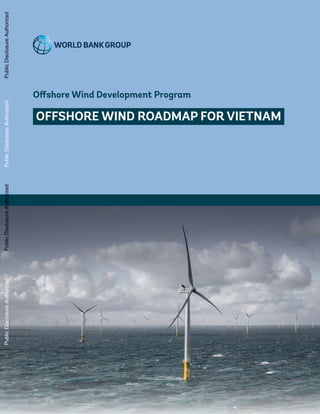
Offshore Wind Development Program
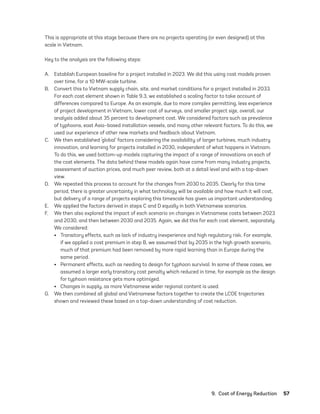
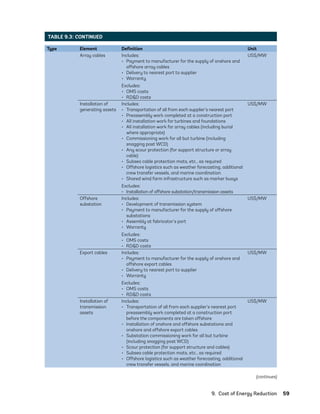
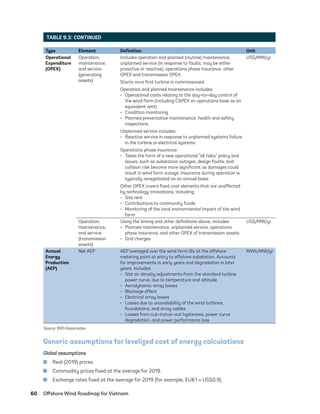
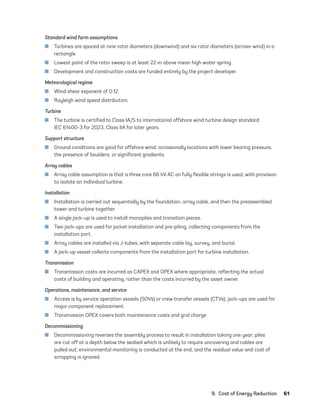
OFFSHORE WIND ROADMAP FOR VIETNAM
75983_ESMAP_Tech Report VM Wind_CVR.indd 3
75983_ESMAP_Tech Report VM Wind_CVR.indd 3 4/5/21 7:20 AM
4/5/21 7:20 AM
Public
Disclosure
Authorized
Public
Disclosure
Authorized
Public
Disclosure
Authorized
Public
Disclosure
Authorized
© 2021 June | International Bank for Reconstruction and Development / The World Bank
1818 H Street NW, Washington, DC 20433
Telephone: 202-473-1000; Internet: www.worldbank.org
Some rights reserved
This work is a product of the World Bank with contributions given by the staff and consultants listed in the
Acknowledgments. The findings, interpretations, and conclusions expressed in this work do not necessarily
reflect the views of the World Bank, its Board of Executive Directors, or the governments they represent.
The World Bank does not guarantee the accuracy of the data included in this work. The boundaries, colors,
denominations, and other information shown on any map in this work do not imply any judgment on the
part of the World Bank concerning the legal status of any territory or the endorsement or acceptance of
such boundaries. Nothing herein shall constitute or be considered to be a limitation upon or waiver of the
privileges and immunities of The World Bank, all of which are specifically reserved.
RIGHTS AND PERMISSIONS
This work is available under the Creative Commons Attribution 3.0 IGO license (CC BY 3.0 IGO) http://
creativecommons.org/licenses/by/3.0/igo. Under the Creative Commons Attribution license, you are free
to copy, distribute, transmit, and adapt this work, including for commercial purposes, under the following
conditions:
Attribution—Please cite the work as follows: World Bank. 2021. Offshore Wind Roadmap for Vietnam. World
Bank, Washington, DC. License: Creative Commons Attribution CC BY 3.0 IGO
Translations—If you create a translation of this work, please add the following disclaimer along with the
attribution: This translation was not created by The World Bank and should not be considered an official
World Bank translation. The World Bank shall not be liable for any content or error in this translation.
Adaptations—If you create an adaptation of this work, please add the following disclaimer along with the
attribution: This is an adaptation of an original work by The World Bank. Views and opinions expressed in
the adaptation are the sole responsibility of the author or authors of the adaptation and are not endorsed
by The World Bank.
Third-party content—The World Bank does not necessarily own each component of the content contained
within the work. The World Bank therefore does not warrant that the use of any third party-owned
individual component or part contained in the work will not infringe on the rights of those third parties. The
risk of claims resulting from such infringement rests solely with you. If you wish to re-use a component of
the work, it is your responsibility to determine whether permission is needed for that re-use and to obtain
permission from the copyright owner. Examples of components can include, but are not limited to, tables,
figures, or images.
All queries on rights and licenses should be addressed to World Bank Publications, The World Bank Group,
1818 H Street NW, Washington, DC 20433, USA; e-mail: pubrights@worldbank.org.
PRODUCTION CREDITS
Production Editor | Heather Austin, The World Bank
Designer | Shepherd, Inc.
Images | Front Cover: Nobelwind offshore wind farm/© Vestas; p. 26: Aberdeen Bay offshore wind
farm/© Vestas; Back Cover: Burbo Bank Extension offshore wind farm/© Vestas.
All images remain the sole property of their source and may not be used for any purpose without written
permission from the source.
75983_ESMAP_Tech Report VM Wind_CVR.indd 4
75983_ESMAP_Tech Report VM Wind_CVR.indd 4 5/27/21 1:40 PM
5/27/21 1:40 PM
Offshore Wind Roadmap
for Vietnam
75983_ESMAP_Tech Report VM Wind-NEW.indd 1
75983_ESMAP_Tech Report VM Wind-NEW.indd 1 3/19/21 12:25 PM
3/19/21 12:25 PM
75983_ESMAP_Tech Report VM Wind-NEW.indd 2
75983_ESMAP_Tech Report VM Wind-NEW.indd 2 3/19/21 12:25 PM
3/19/21 12:25 PM
iii
CONTENTS
Abbreviations .  .  .  .  .  .  .  .  .  .  .  .  .  .  .  .  .  .  .  .  .  .  .  .  .  .  .  .  .  .  .  .  .  .  .  .  .  .  .  .  .  .  .  .  .  .  .  .  .  .  .  .  .  .  .  .  .  .  .  .  .  .  .  .  .  .  .  .  .  . xi
Company and institute abbreviations .  .  .  .  .  .  .  .  .  .  .  .  .  .  .  .  .  .  .  .  .  .  .  .  .  .  .  .  .  .  .  .  .  .  .  .  .  .  .  .  .  .  .  .  .  .  .  .  .  .  .  .  .  . xiv
Acknowledgments .  .  .  .  .  .  .  .  .  .  .  .  .  .  .  .  .  .  .  .  .  .  .  .  .  .  .  .  .  .  .  .  .  .  .  .  .  .  .  .  .  .  .  .  .  .  .  .  .  .  .  .  .  .  .  .  .  .  .  .  .  .  .  . xvi
Executive Summary .  .  .  .  .  .  .  .  .  .  .  .  .  .  .  .  .  .  .  .  .  .  .  .  .  .  .  .  .  .  .  .  .  .  .  .  .  .  .  .  .  .  .  .  .  .  .  .  .  .  .  .  .  .  .  .  .  .  .  .  .  .  . xvii
About this Roadmap  .  .  .  .  .  .  .  .  .  .  .  .  .  .  .  .  .  .  .  .  .  .  .  .  .  .  .  .  .  .  .  .  .  .  .  .  .  .  .  .  .  .  .  .  .  .  .  .  .  .  .  .  .  .  .  .  .  .  .  .  .  .  .  .  .  .  .  .  . xvii
Key findings .  .  .  .  .  .  .  .  .  .  .  .  .  .  .  .  .  .  .  .  .  .  .  .  .  .  .  .  .  .  .  .  .  .  .  .  .  .  .  .  .  .  .  .  .  .  .  .  .  .  .  .  .  .  .  .  .  .  .  .  .  .  .  .  .  .  .  .  .  .  .  .  .  .  .  .  . xvii
Priority themes  .  .  .  .  .  .  .  .  .  .  .  .  .  .  .  .  .  .  .  .  .  .  .  .  .  .  .  .  .  .  .  .  .  .  .  .  .  .  .  .  .  .  .  .  .  .  .  .  .  .  .  .  .  .  .  .  .  .  .  .  .  .  .  .  .  .  .  .  .  .  .  .  .  . xix
Recommended actions  .  .  .  .  .  .  .  .  .  .  .  .  .  .  .  .  .  .  .  .  .  .  .  .  .  .  .  .  .  .  .  .  .  .  .  .  .  .  .  .  .  .  .  .  .  .  .  .  .  .  .  .  .  .  .  .  .  .  .  .  .  .  .  .  .  .  . xix
1. Introduction .  .  .  .  .  .  .  .  .  .  .  .  .  .  .  .  .  .  .  .  .  .  .  .  .  .  .  .  .  .  .  .  .  .  .  .  .  .  .  .  .  .  .  .  .  .  .  .  .  .  .  .  .  .  .  .  .  .  .  .  .  .  .  .  .  .  .  .  . 1
1.1  Report structure .  .  .  .  .  .  .  .  .  .  .  .  .  .  .  .  .  .  .  .  .  .  .  .  .  .  .  .  .  .  .  .  .  .  .  .  .  .  .  .  .  .  .  .  .  .  .  .  .  .  .  .  .  .  .  .  .  .  .  .  .  .  .  .  .  .  .  .  .  .  .  . 1
2.  Two Scenarios for Offshore Wind in Vietnam .  .  .  .  .  .  .  .  .  .  .  .  .  .  .  .  .  .  .  .  .  .  .  .  .  .  .  .  .  .  .  .  .  .  .  .  .  .  . 2
2.1  Types of offshore wind projects .  .  .  .  .  .  .  .  .  .  .  .  .  .  .  .  .  .  .  .  .  .  .  .  .  .  .  .  .  .  .  .  .  .  .  .  .  .  .  .  .  .  .  .  .  .  .  .  .  .  .  .  .  .  .  .  . 5
3.  Low Growth Scenario  .  .  .  .  .  .  .  .  .  .  .  .  .  .  .  .  .  .  .  .  .  .  .  .  .  .  .  .  .  .  .  .  .  .  .  .  .  .  .  .  .  .  .  .  .  .  .  .  .  .  .  .  .  .  .  .  .  .  .  . 6
3.1  Development areas .  .  .  .  .  .  .  .  .  .  .  .  .  .  .  .  .  .  .  .  .  .  .  .  .  .  .  .  .  .  .  .  .  .  .  .  .  .  .  .  .  .  .  .  .  .  .  .  .  .  .  .  .  .  .  .  .  .  .  .  .  .  .  .  .  .  .  . 6
3.2  Electricity mix  .  .  .  .  .  .  .  .  .  .  .  .  .  .  .  .  .  .  .  .  .  .  .  .  .  .  .  .  .  .  .  .  .  .  .  .  .  .  .  .  .  .  .  .  .  .  .  .  .  .  .  .  .  .  .  .  .  .  .  .  .  .  .  .  .  .  .  .  .  .  .  .  . 7
3.3  Levelized cost of energy and net benefit to consumers .  .  .  .  .  .  .  .  .  .  .  .  .  .  .  .  .  .  .  .  .  .  .  .  .  .  .  .  .  .  .  .  .  .  .  .  . 7
3.4  Supply chain and economic impact .  .  .  .  .  .  .  .  .  .  .  .  .  .  .  .  .  .  .  .  .  .  .  .  .  .  .  .  .  .  .  .  .  .  .  .  .  .  .  .  .  .  .  .  .  .  .  .  .  .  .  .  . 8
3.5 Infrastructure . . . . . . . . . . . . . . . . . . . . . . . . . . . . . . . . . . . . . . . . . . . . . . . . . . . . . . . . . . . . . . . . . . . . . . . . 10
3.6  Environment and social impacts .  .  .  .  .  .  .  .  .  .  .  .  .  .  .  .  .  .  .  .  .  .  .  .  .  .  .  .  .  .  .  .  .  .  .  .  .  .  .  .  .  .  .  .  .  .  .  .  .  .  .  .  .  .  . 10
3.7  Finance and procurement .  .  .  .  .  .  .  .  .  .  .  .  .  .  .  .  .  .  .  .  .  .  .  .  .  .  .  .  .  .  .  .  .  .  .  .  .  .  .  .  .  .  .  .  .  .  .  .  .  .  .  .  .  .  .  .  .  .  .  .  .  . 11
3.8  Actions to deliver the low growth scenario .  .  .  .  .  .  .  .  .  .  .  .  .  .  .  .  .  .  .  .  .  .  .  .  .  .  .  .  .  .  .  .  .  .  .  .  .  .  .  .  .  .  .  .  .  .  . 11
3.9  SWOT analysis for Vietnam in the low growth scenario .  .  .  .  .  .  .  .  .  .  .  .  .  .  .  .  .  .  .  .  .  .  .  .  .  .  .  .  .  .  .  .  .  .  . 11
4.  High Growth Scenario .  .  .  .  .  .  .  .  .  .  .  .  .  .  .  .  .  .  .  .  .  .  .  .  .  .  .  .  .  .  .  .  .  .  .  .  .  .  .  .  .  .  .  .  .  .  .  .  .  .  .  .  .  .  .  .  .  .  . 13
4.1  Development areas .  .  .  .  .  .  .  .  .  .  .  .  .  .  .  .  .  .  .  .  .  .  .  .  .  .  .  .  .  .  .  .  .  .  .  .  .  .  .  .  .  .  .  .  .  .  .  .  .  .  .  .  .  .  .  .  .  .  .  .  .  .  .  .  .  .  .  . 13
4.2  Electricity mix  .  .  .  .  .  .  .  .  .  .  .  .  .  .  .  .  .  .  .  .  .  .  .  .  .  .  .  .  .  .  .  .  .  .  .  .  .  .  .  .  .  .  .  .  .  .  .  .  .  .  .  .  .  .  .  .  .  .  .  .  .  .  .  .  .  .  .  .  .  .  .  . 13
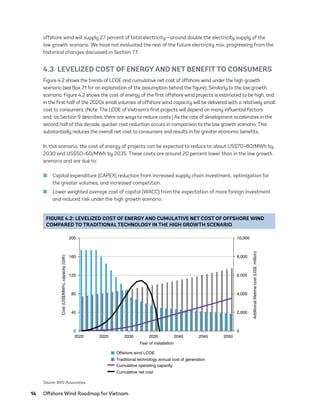
4.3  Levelized cost of energy and net benefit to consumers .  .  .  .  .  .  .  .  .  .  .  .  .  .  .  .  .  .  .  .  .  .  .  .  .  .  .  .  .  .  .  .  .  .  .  . 14
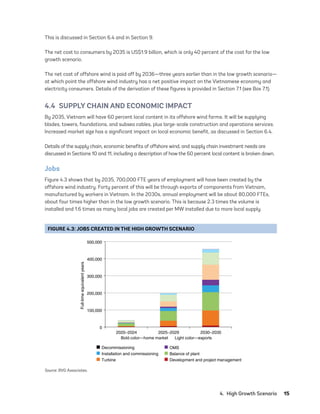
4.4  Supply chain and economic impact .  .  .  .  .  .  .  .  .  .  .  .  .  .  .  .  .  .  .  .  .  .  .  .  .  .  .  .  .  .  .  .  .  .  .  .  .  .  .  .  .  .  .  .  .  .  .  .  .  .  .  .  . 15
4.5 Infrastructure .  .  .  .  .  .  .  .  .  .  .  .  .  .  .  .  .  .  .  .  .  .  .  .  .  .  .  .  .  .  .  .  .  .  .  .  .  .  .  .  .  .  .  .  .  .  .  .  .  .  .  .  .  .  .  .  .  .  .  .  .  .  .  .  .  .  .  .  .  .  .  .  . 16
4.6  Environment and social impacts .  .  .  .  .  .  .  .  .  .  .  .  .  .  .  .  .  .  .  .  .  .  .  .  .  .  .  .  .  .  .  .  .  .  .  .  .  .  .  .  .  .  .  .  .  .  .  .  .  .  .  .  .  .  .  . 17
75983_ESMAP_Tech Report VM Wind-NEW.indd 3
75983_ESMAP_Tech Report VM Wind-NEW.indd 3 3/19/21 12:25 PM
3/19/21 12:25 PM
iv	 Offshore Wind Roadmap for Vietnam
4.7  Finance and procurement  .  .  .  .  .  .  .  .  .  .  .  .  .  .  .  .  .  .  .  .  .  .  .  .  .  .  .  .  .  .  .  .  .  .  .  .  .  .  .  .  .  .  .  .  .  .  .  .  .  .  .  .  .  .  .  .  .  .  .  .  .  . 17
4.8  Actions to deliver the high growth scenario .  .  .  .  .  .  .  .  .  .  .  .  .  .  .  .  .  .  .  .  .  .  .  .  .  .  .  .  .  .  .  .  .  .  .  .  .  .  .  .  .  .  .  .  .  . 18
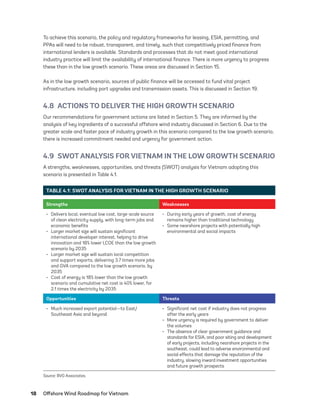
4.9  SWOT analysis for Vietnam in the low growth scenario .  .  .  .  .  .  .  .  .  .  .  .  .  .  .  .  .  .  .  .  .  .  .  .  .  .  .  .  .  .  .  .  .  .  . 18
5.  Roadmap for Offshore Wind in Vietnam: Our Recommendations .  .  .  .  .  .  .  .  .  .  .  .  .  .  .  .  .  .  . 19
5.1  Vision and volume targets .  .  .  .  .  .  .  .  .  .  .  .  .  .  .  .  .  .  .  .  .  .  .  .  .  .  .  .  .  .  .  .  .  .  .  .  .  .  .  .  .  .  .  .  .  .  .  .  .  .  .  .  .  .  .  .  .  .  .  .  .  . 19
5.2  Leasing, permitting, and power purchase .  .  .  .  .  .  .  .  .  .  .  .  .  .  .  .  .  .  .  .  .  .  .  .  .  .  .  .  .  .  .  .  .  .  .  .  .  .  .  .  .  .  .  .  .  .  . 20
5.3  Project finance .  .  .  .  .  .  .  .  .  .  .  .  .  .  .  .  .  .  .  .  .  .  .  .  .  .  .  .  .  .  .  .  .  .  .  .  .  .  .  .  .  .  .  .  .  .  .  .  .  .  .  .  .  .  .  .  .  .  .  .  .  .  .  .  .  .  .  .  .  .  .  . 21
5.4  Transmission and port infrastructure .  .  .  .  .  .  .  .  .  .  .  .  .  .  .  .  .  .  .  .  .  .  .  .  .  .  .  .  .  .  .  .  .  .  .  .  .  .  .  .  .  .  .  .  .  .  .  .  .  .  . 21
5.5  Supply chain development .  .  .  .  .  .  .  .  .  .  .  .  .  .  .  .  .  .  .  .  .  .  .  .  .  .  .  .  .  .  .  .  .  .  .  .  .  .  .  .  .  .  .  .  .  .  .  .  .  .  .  .  .  .  .  .  .  .  .  . 22
5.6  Standards and regulations .  .  .  .  .  .  .  .  .  .  .  .  .  .  .  .  .  .  .  .  .  .  .  .  .  .  .  .  .  .  .  .  .  .  .  .  .  .  .  .  .  .  .  .  .  .  .  .  .  .  .  .  .  .  .  .  .  .  .  . 23
Supporting Information .  .  .  .  .  .  .  .  .  .  .  .  .  .  .  .  .  .  .  .  .  .  .  .  .  .  .  .  .  .  .  .  .  .  .  .  .  .  .  .  .  .  .  .  .  .  .  .  .  .  .  .  .  .  .  .  .  .  .  . 26
6.  Key Ingredients for a Successful Offshore Wind Industry .  .  .  .  .  .  .  .  .  .  .  .  .  .  .  .  .  .  .  .  .  .  .  .  .  . 27
6.1  Stable policies and pipeline visibility .  .  .  .  .  .  .  .  .  .  .  .  .  .  .  .  .  .  .  .  .  .  .  .  .  .  .  .  .  .  .  .  .  .  .  .  .  .  .  .  .  .  .  .  .  .  .  .  .  .  .  . 27
6.2  A coherent industrial strategy .  .  .  .  .  .  .  .  .  .  .  .  .  .  .  .  .  .  .  .  .  .  .  .  .  .  .  .  .  .  .  .  .  .  .  .  .  .  .  .  .  .  .  .  .  .  .  .  .  .  .  .  .  .  .  .  . 29
6.3  Resourced institutions .  .  .  .  .  .  .  .  .  .  .  .  .  .  .  .  .  .  .  .  .  .  .  .  .  .  .  .  .  .  .  .  .  .  .  .  .  .  .  .  .  .  .  .  .  .  .  .  .  .  .  .  .  .  .  .  .  .  .  .  .  .  .  . 30
6.4  Competitive environment .  .  .  .  .  .  .  .  .  .  .  .  .  .  .  .  .  .  .  .  .  .  .  .  .  .  .  .  .  .  .  .  .  .  .  .  .  .  .  .  .  .  .  .  .  .  .  .  .  .  .  .  .  .  .  .  .  .  .  .  . 30
6.5  Supportive and engaged public .  .  .  .  .  .  .  .  .  .  .  .  .  .  .  .  .  .  .  .  .  .  .  .  .  .  .  .  .  .  .  .  .  .  .  .  .  .  .  .  .  .  .  .  .  .  .  .  .  .  .  .  .  .  .  . 32
6.6  A commitment to safety .  .  .  .  .  .  .  .  .  .  .  .  .  .  .  .  .  .  .  .  .  .  .  .  .  .  .  .  .  .  .  .  .  .  .  .  .  .  .  .  .  .  .  .  .  .  .  .  .  .  .  .  .  .  .  .  .  .  .  .  .  . 32
6.7  Using the best locations  .  .  .  .  .  .  .  .  .  .  .  .  .  .  .  .  .  .  .  .  .  .  .  .  .  .  .  .  .  .  .  .  .  .  .  .  .  .  .  .  .  .  .  .  .  .  .  .  .  .  .  .  .  .  .  .  .  .  .  .  .  . 32
7.  Benefits and Challenges of Offshore Wind .  .  .  .  .  .  .  .  .  .  .  .  .  .  .  .  .  .  .  .  .  .  .  .  .  .  .  .  .  .  .  .  .  .  .  .  .  .  .  . 36
7.1 Benefits .  .  .  .  .  .  .  .  .  .  .  .  .  .  .  .  .  .  .  .  .  .  .  .  .  .  .  .  .  .  .  .  .  .  .  .  .  .  .  .  .  .  .  .  .  .  .  .  .  .  .  .  .  .  .  .  .  .  .  .  .  .  .  .  .  .  .  .  .  .  .  .  .  .  .  .  .  . 36
7.2 Challenges .  .  .  .  .  .  .  .  .  .  .  .  .  .  .  .  .  .  .  .  .  .  .  .  .  .  .  .  .  .  .  .  .  .  .  .  .  .  .  .  .  .  .  .  .  .  .  .  .  .  .  .  .  .  .  .  .  .  .  .  .  .  .  .  .  .  .  .  .  .  .  .  .  .  . 38
8.  Market Volume in Vietnam  .  .  .  .  .  .  .  .  .  .  .  .  .  .  .  .  .  .  .  .  .  .  .  .  .  .  .  .  .  .  .  .  .  .  .  .  .  .  .  .  .  .  .  .  .  .  .  .  .  .  .  .  .  . 41
8.1  Story to date .  .  .  .  .  .  .  .  .  .  .  .  .  .  .  .  .  .  .  .  .  .  .  .  .  .  .  .  .  .  .  .  .  .  .  .  .  .  .  .  .  .  .  .  .  .  .  .  .  .  .  .  .  .  .  .  .  .  .  .  .  .  .  .  .  .  .  .  .  .  .  .  .  . 41
8.2  A vision for offshore wind to 2050 .  .  .  .  .  .  .  .  .  .  .  .  .  .  .  .  .  .  .  .  .  .  .  .  .  .  .  .  .  .  .  .  .  .  .  .  .  .  .  .  .  .  .  .  .  .  .  .  .  .  .  .  .  . 41
8.3  In Vietnam’s national context .  .  .  .  .  .  .  .  .  .  .  .  .  .  .  .  .  .  .  .  .  .  .  .  .  .  .  .  .  .  .  .  .  .  .  .  .  .  .  .  .  .  .  .  .  .  .  .  .  .  .  .  .  .  .  .  . 42
8.4  Within East and Southeast Asia .  .  .  .  .  .  .  .  .  .  .  .  .  .  .  .  .  .  .  .  .  .  .  .  .  .  .  .  .  .  .  .  .  .  .  .  .  .  .  .  .  .  .  .  .  .  .  .  .  .  .  .  .  .  . 42
8.5 Globally .  .  .  .  .  .  .  .  .  .  .  .  .  .  .  .  .  .  .  .  .  .  .  .  .  .  .  .  .  .  .  .  .  .  .  .  .  .  .  .  .  .  .  .  .  .  .  .  .  .  .  .  .  .  .  .  .  .  .  .  .  .  .  .  .  .  .  .  .  .  .  .  .  .  .  .  . 43
8.6  Vietnam offshore wind energy production and cost data  .  .  .  .  .  .  .  .  .  .  .  .  .  .  .  .  .  .  .  .  .  .  .  .  .  .  .  .  .  .  .  . 44
9.  Cost of Energy Reduction .  .  .  .  .  .  .  .  .  .  .  .  .  .  .  .  .  .  .  .  .  .  .  .  .  .  .  .  .  .  .  .  .  .  .  .  .  .  .  .  .  .  .  .  .  .  .  .  .  .  .  .  .  .  .  . 47
9.1 Purpose .  .  .  .  .  .  .  .  .  .  .  .  .  .  .  .  .  .  .  .  .  .  .  .  .  .  .  .  .  .  .  .  .  .  .  .  .  .  .  .  .  .  .  .  .  .  .  .  .  .  .  .  .  .  .  .  .  .  .  .  .  .  .  .  .  .  .  .  .  .  .  .  .  .  .  .  .  . 47
9.2 Method .  .  .  .  .  .  .  .  .  .  .  .  .  .  .  .  .  .  .  .  .  .  .  .  .  .  .  .  .  .  .  .  .  .  .  .  .  .  .  .  .  .  .  .  .  .  .  .  .  .  .  .  .  .  .  .  .  .  .  .  .  .  .  .  .  .  .  .  .  .  .  .  .  .  .  .  .  . 47
9.3 Results .  .  .  .  .  .  .  .  .  .  .  .  .  .  .  .  .  .  .  .  .  .  .  .  .  .  .  .  .  .  .  .  .  .  .  .  .  .  .  .  .  .  .  .  .  .  .  .  .  .  .  .  .  .  .  .  .  .  .  .  .  .  .  .  .  .  .  .  .  .  .  .  .  .  .  .  .  . 49
9.4  Key factors for cost reduction .  .  .  .  .  .  .  .  .  .  .  .  .  .  .  .  .  .  .  .  .  .  .  .  .  .  .  .  .  .  .  .  .  .  .  .  .  .  .  .  .  .  .  .  .  .  .  .  .  .  .  .  .  .  .  .  . 56
9.5  Background: Details of methodology .  .  .  .  .  .  .  .  .  .  .  .  .  .  .  .  .  .  .  .  .  .  .  .  .  .  .  .  .  .  .  .  .  .  .  .  .  .  .  .  .  .  .  .  .  .  .  .  .  .  . 56
75983_ESMAP_Tech Report VM Wind-NEW.indd 4
75983_ESMAP_Tech Report VM Wind-NEW.indd 4 3/19/21 12:25 PM
3/19/21 12:25 PM
Contents	v
10.  Supply Chain Analysis  .  .  .  .  .  .  .  .  .  .  .  .  .  .  .  .  .  .  .  .  .  .  .  .  .  .  .  .  .  .  .  .  .  .  .  .  .  .  .  .  .  .  .  .  .  .  .  .  .  .  .  .  .  .  .  .  . 62
10.1 Purpose .  .  .  .  .  .  .  .  .  .  .  .  .  .  .  .  .  .  .  .  .  .  .  .  .  .  .  .  .  .  .  .  .  .  .  .  .  .  .  .  .  .  .  .  .  .  .  .  .  .  .  .  .  .  .  .  .  .  .  .  .  .  .  .  .  .  .  .  .  .  .  .  .  .  .  .  . 62
10.2 Method .  .  .  .  .  .  .  .  .  .  .  .  .  .  .  .  .  .  .  .  .  .  .  .  .  .  .  .  .  .  .  .  .  .  .  .  .  .  .  .  .  .  .  .  .  .  .  .  .  .  .  .  .  .  .  .  .  .  .  .  .  .  .  .  .  .  .  .  .  .  .  .  .  .  .  .  . 62
10.3 Results .  .  .  .  .  .  .  .  .  .  .  .  .  .  .  .  .  .  .  .  .  .  .  .  .  .  .  .  .  .  .  .  .  .  .  .  .  .  .  .  .  .  .  .  .  .  .  .  .  .  .  .  .  .  .  .  .  .  .  .  .  .  .  .  .  .  .  .  .  .  .  .  .  .  .  .  . 64
11.  Jobs and Economic Benefit .  .  .  .  .  .  .  .  .  .  .  .  .  .  .  .  .  .  .  .  .  .  .  .  .  .  .  .  .  .  .  .  .  .  .  .  .  .  .  .  .  .  .  .  .  .  .  .  .  .  .  .  .  . 78
11.1 Purpose .  .  .  .  .  .  .  .  .  .  .  .  .  .  .  .  .  .  .  .  .  .  .  .  .  .  .  .  .  .  .  .  .  .  .  .  .  .  .  .  .  .  .  .  .  .  .  .  .  .  .  .  .  .  .  .  .  .  .  .  .  .  .  .  .  .  .  .  .  .  .  .  .  .  .  .  . 78
11.2 Method .  .  .  .  .  .  .  .  .  .  .  .  .  .  .  .  .  .  .  .  .  .  .  .  .  .  .  .  .  .  .  .  .  .  .  .  .  .  .  .  .  .  .  .  .  .  .  .  .  .  .  .  .  .  .  .  .  .  .  .  .  .  .  .  .  .  .  .  .  .  .  .  .  .  .  .  . 78
11.3 Results .  .  .  .  .  .  .  .  .  .  .  .  .  .  .  .  .  .  .  .  .  .  .  .  .  .  .  .  .  .  .  .  .  .  .  .  .  .  .  .  .  .  .  .  .  .  .  .  .  .  .  .  .  .  .  .  .  .  .  .  .  .  .  .  .  .  .  .  .  .  .  .  .  .  .  .  . 79
11.4  Background: Detail of method .  .  .  .  .  .  .  .  .  .  .  .  .  .  .  .  .  .  .  .  .  .  .  .  .  .  .  .  .  .  .  .  .  .  .  .  .  .  .  .  .  .  .  .  .  .  .  .  .  .  .  .  .  .  .  . 88
12.  Environmental and Social Considerations .  .  .  .  .  .  .  .  .  .  .  .  .  .  .  .  .  .  .  .  .  .  .  .  .  .  .  .  .  .  .  .  .  .  .  .  .  .  .  . 91
12.1 Purpose .  .  .  .  .  .  .  .  .  .  .  .  .  .  .  .  .  .  .  .  .  .  .  .  .  .  .  .  .  .  .  .  .  .  .  .  .  .  .  .  .  .  .  .  .  .  .  .  .  .  .  .  .  .  .  .  .  .  .  .  .  .  .  .  .  .  .  .  .  .  .  .  .  .  .  .  .  . 91
12.2 Method .  .  .  .  .  .  .  .  .  .  .  .  .  .  .  .  .  .  .  .  .  .  .  .  .  .  .  .  .  .  .  .  .  .  .  .  .  .  .  .  .  .  .  .  .  .  .  .  .  .  .  .  .  .  .  .  .  .  .  .  .  .  .  .  .  .  .  .  .  .  .  .  .  .  .  .  .  . 91
12.3 Results .  .  .  .  .  .  .  .  .  .  .  .  .  .  .  .  .  .  .  .  .  .  .  .  .  .  .  .  .  .  .  .  .  .  .  .  .  .  .  .  .  .  .  .  .  .  .  .  .  .  .  .  .  .  .  .  .  .  .  .  .  .  .  .  .  .  .  .  .  .  .  .  .  .  .  .  . 93
13.  Leasing and Permitting  .  .  .  .  .  .  .  .  .  .  .  .  .  .  .  .  .  .  .  .  .  .  .  .  .  .  .  .  .  .  .  .  .  .  .  .  .  .  .  .  .  .  .  .  .  .  .  .  .  .  .  .  .  .  . 103
13.1 Purpose .  .  .  .  .  .  .  .  .  .  .  .  .  .  .  .  .  .  .  .  .  .  .  .  .  .  .  .  .  .  .  .  .  .  .  .  .  .  .  .  .  .  .  .  .  .  .  .  .  .  .  .  .  .  .  .  .  .  .  .  .  .  .  .  .  .  .  .  .  .  .  .  .  .  .  . 103
13.2 Method .  .  .  .  .  .  .  .  .  .  .  .  .  .  .  .  .  .  .  .  .  .  .  .  .  .  .  .  .  .  .  .  .  .  .  .  .  .  .  .  .  .  .  .  .  .  .  .  .  .  .  .  .  .  .  .  .  .  .  .  .  .  .  .  .  .  .  .  .  .  .  .  .  .  .  . 103
13.3 Results .  .  .  .  .  .  .  .  .  .  .  .  .  .  .  .  .  .  .  .  .  .  .  .  .  .  .  .  .  .  .  .  .  .  .  .  .  .  .  .  .  .  .  .  .  .  .  .  .  .  .  .  .  .  .  .  .  .  .  .  .  .  .  .  .  .  .  .  .  .  .  .  .  .  .  . 104
13.4 Discussion  .  .  .  .  .  .  .  .  .  .  .  .  .  .  .  .  .  .  .  .  .  .  .  .  .  .  .  .  .  .  .  .  .  .  .  .  .  .  .  .  .  .  .  .  .  .  .  .  .  .  .  .  .  .  .  .  .  .  .  .  .  .  .  .  .  .  .  .  .  .  .  . 109
13.5 Background .  .  .  .  .  .  .  .  .  .  .  .  .  .  .  .  .  .  .  .  .  .  .  .  .  .  .  .  .  .  .  .  .  .  .  .  .  .  .  .  .  .  .  .  .  .  .  .  .  .  .  .  .  .  .  .  .  .  .  .  .  .  .  .  .  .  .  .  .  .  .  .  . 110
14.  Government Procurement .  .  .  .  .  .  .  .  .  .  .  .  .  .  .  .  .  .  .  .  .  .  .  .  .  .  .  .  .  .  .  .  .  .  .  .  .  .  .  .  .  .  .  .  .  .  .  .  .  .  .  .  . 121
14.1 Purpose .  .  .  .  .  .  .  .  .  .  .  .  .  .  .  .  .  .  .  .  .  .  .  .  .  .  .  .  .  .  .  .  .  .  .  .  .  .  .  .  .  .  .  .  .  .  .  .  .  .  .  .  .  .  .  .  .  .  .  .  .  .  .  .  .  .  .  .  .  .  .  .  .  .  .  .  . 121
14.2 Method .  .  .  .  .  .  .  .  .  .  .  .  .  .  .  .  .  .  .  .  .  .  .  .  .  .  .  .  .  .  .  .  .  .  .  .  .  .  .  .  .  .  .  .  .  .  .  .  .  .  .  .  .  .  .  .  .  .  .  .  .  .  .  .  .  .  .  .  .  .  .  .  .  .  .  .  . 121
14.3  Options considered .  .  .  .  .  .  .  .  .  .  .  .  .  .  .  .  .  .  .  .  .  .  .  .  .  .  .  .  .  .  .  .  .  .  .  .  .  .  .  .  .  .  .  .  .  .  .  .  .  .  .  .  .  .  .  .  .  .  .  .  .  .  .  .  . 122
14.4 Results .  .  .  .  .  .  .  .  .  .  .  .  .  .  .  .  .  .  .  .  .  .  .  .  .  .  .  .  .  .  .  .  .  .  .  .  .  .  .  .  .  .  .  .  .  .  .  .  .  .  .  .  .  .  .  .  .  .  .  .  .  .  .  .  .  .  .  .  .  .  .  .  .  .  .  . 125
14.5 Discussion .  .  .  .  .  .  .  .  .  .  .  .  .  .  .  .  .  .  .  .  .  .  .  .  .  .  .  .  .  .  .  .  .  .  .  .  .  .  .  .  .  .  .  .  .  .  .  .  .  .  .  .  .  .  .  .  .  .  .  .  .  .  .  .  .  .  .  .  .  .  .  .  . 126
15.  PPA Bankability .  .  .  .  .  .  .  .  .  .  .  .  .  .  .  .  .  .  .  .  .  .  .  .  .  .  .  .  .  .  .  .  .  .  .  .  .  .  .  .  .  .  .  .  .  .  .  .  .  .  .  .  .  .  .  .  .  .  .  .  .  . 129
15.1 Purpose .  .  .  .  .  .  .  .  .  .  .  .  .  .  .  .  .  .  .  .  .  .  .  .  .  .  .  .  .  .  .  .  .  .  .  .  .  .  .  .  .  .  .  .  .  .  .  .  .  .  .  .  .  .  .  .  .  .  .  .  .  .  .  .  .  .  .  .  .  .  .  .  .  .  .  . 129
15.2 Method .  .  .  .  .  .  .  .  .  .  .  .  .  .  .  .  .  .  .  .  .  .  .  .  .  .  .  .  .  .  .  .  .  .  .  .  .  .  .  .  .  .  .  .  .  .  .  .  .  .  .  .  .  .  .  .  .  .  .  .  .  .  .  .  .  .  .  .  .  .  .  .  .  .  .  . 129
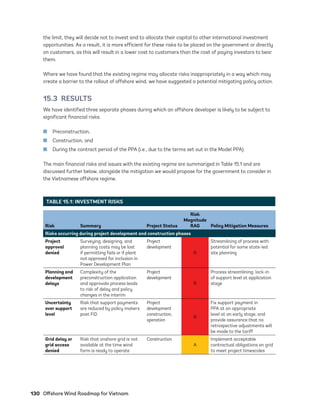
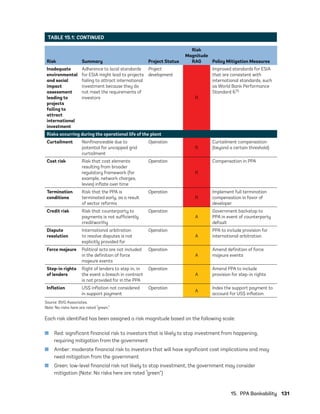
15.3 Results .  .  .  .  .  .  .  .  .  .  .  .  .  .  .  .  .  .  .  .  .  .  .  .  .  .  .  .  .  .  .  .  .  .  .  .  .  .  .  .  .  .  .  .  .  .  .  .  .  .  .  .  .  .  .  .  .  .  .  .  .  .  .  .  .  .  .  .  .  .  .  .  .  .  .  . 130
15.4 Discussion .  .  .  .  .  .  .  .  .  .  .  .  .  .  .  .  .  .  .  .  .  .  .  .  .  .  .  .  .  .  .  .  .  .  .  .  .  .  .  .  .  .  .  .  .  .  .  .  .  .  .  .  .  .  .  .  .  .  .  .  .  .  .  .  .  .  .  .  .  .  .  .  . 132
16.  Health and Safety .  .  .  .  .  .  .  .  .  .  .  .  .  .  .  .  .  .  .  .  .  .  .  .  .  .  .  .  .  .  .  .  .  .  .  .  .  .  .  .  .  .  .  .  .  .  .  .  .  .  .  .  .  .  .  .  .  .  .  . 136
16.1 Purpose .  .  .  .  .  .  .  .  .  .  .  .  .  .  .  .  .  .  .  .  .  .  .  .  .  .  .  .  .  .  .  .  .  .  .  .  .  .  .  .  .  .  .  .  .  .  .  .  .  .  .  .  .  .  .  .  .  .  .  .  .  .  .  .  .  .  .  .  .  .  .  .  .  .  .  . 136
16.2 Method .  .  .  .  .  .  .  .  .  .  .  .  .  .  .  .  .  .  .  .  .  .  .  .  .  .  .  .  .  .  .  .  .  .  .  .  .  .  .  .  .  .  .  .  .  .  .  .  .  .  .  .  .  .  .  .  .  .  .  .  .  .  .  .  .  .  .  .  .  .  .  .  .  .  .  . 136
16.3  Feedback from developers  .  .  .  .  .  .  .  .  .  .  .  .  .  .  .  .  .  .  .  .  .  .  .  .  .  .  .  .  .  .  .  .  .  .  .  .  .  .  .  .  .  .  .  .  .  .  .  .  .  .  .  .  .  .  .  .  .  . 136
75983_ESMAP_Tech Report VM Wind-NEW.indd 5
75983_ESMAP_Tech Report VM Wind-NEW.indd 5 3/19/21 12:25 PM
3/19/21 12:25 PM
vi	 Offshore Wind Roadmap for Vietnam
16.4 Results .  .  .  .  .  .  .  .  .  .  .  .  .  .  .  .  .  .  .  .  .  .  .  .  .  .  .  .  .  .  .  .  .  .  .  .  .  .  .  .  .  .  .  .  .  .  .  .  .  .  .  .  .  .  .  .  .  .  .  .  .  .  .  .  .  .  .  .  .  .  .  .  .  .  .  . 137
16.5 Discussion .  .  .  .  .  .  .  .  .  .  .  .  .  .  .  .  .  .  .  .  .  .  .  .  .  .  .  .  .  .  .  .  .  .  .  .  .  .  .  .  .  .  .  .  .  .  .  .  .  .  .  .  .  .  .  .  .  .  .  .  .  .  .  .  .  .  .  .  .  .  .  .  . 140
16.6 Recommendations .  .  .  .  .  .  .  .  .  .  .  .  .  .  .  .  .  .  .  .  .  .  .  .  .  .  .  .  .  .  .  .  .  .  .  .  .  .  .  .  .  .  .  .  .  .  .  .  .  .  .  .  .  .  .  .  .  .  .  .  .  .  .  .  .  . 141
17.  Transmission Infrastructure .  .  .  .  .  .  .  .  .  .  .  .  .  .  .  .  .  .  .  .  .  .  .  .  .  .  .  .  .  .  .  .  .  .  .  .  .  .  .  .  .  .  .  .  .  .  .  .  .  .  . 142
17.1 Purpose .  .  .  .  .  .  .  .  .  .  .  .  .  .  .  .  .  .  .  .  .  .  .  .  .  .  .  .  .  .  .  .  .  .  .  .  .  .  .  .  .  .  .  .  .  .  .  .  .  .  .  .  .  .  .  .  .  .  .  .  .  .  .  .  .  .  .  .  .  .  .  .  .  .  .  . 142
17.2 Method .  .  .  .  .  .  .  .  .  .  .  .  .  .  .  .  .  .  .  .  .  .  .  .  .  .  .  .  .  .  .  .  .  .  .  .  .  .  .  .  .  .  .  .  .  .  .  .  .  .  .  .  .  .  .  .  .  .  .  .  .  .  .  .  .  .  .  .  .  .  .  .  .  .  .  . 142
17.3  Current transmission network .  .  .  .  .  .  .  .  .  .  .  .  .  .  .  .  .  .  .  .  .  .  .  .  .  .  .  .  .  .  .  .  .  .  .  .  .  .  .  .  .  .  .  .  .  .  .  .  .  .  .  .  .  .  . 142
17.4  Potential issues with increased deployment of wind .  .  .  .  .  .  .  .  .  .  .  .  .  .  .  .  .  .  .  .  .  .  .  .  .  .  .  .  .  .  .  .  .  .  .  . 143
17.5  Future network requirements .  .  .  .  .  .  .  .  .  .  .  .  .  .  .  .  .  .  .  .  .  .  .  .  .  .  .  .  .  .  .  .  .  .  .  .  .  .  .  .  .  .  .  .  .  .  .  .  .  .  .  .  .  .  .  . 145
17.6  Grid connection process .  .  .  .  .  .  .  .  .  .  .  .  .  .  .  .  .  .  .  .  .  .  .  .  .  .  .  .  .  .  .  .  .  .  .  .  .  .  .  .  .  .  .  .  .  .  .  .  .  .  .  .  .  .  .  .  .  .  .  .  . 148
18.  Port Infrastructure .  .  .  .  .  .  .  .  .  .  .  .  .  .  .  .  .  .  .  .  .  .  .  .  .  .  .  .  .  .  .  .  .  .  .  .  .  .  .  .  .  .  .  .  .  .  .  .  .  .  .  .  .  .  .  .  .  .  . 150
18.1 Purpose .  .  .  .  .  .  .  .  .  .  .  .  .  .  .  .  .  .  .  .  .  .  .  .  .  .  .  .  .  .  .  .  .  .  .  .  .  .  .  .  .  .  .  .  .  .  .  .  .  .  .  .  .  .  .  .  .  .  .  .  .  .  .  .  .  .  .  .  .  .  .  .  .  .  .  . 150
18.2 Method .  .  .  .  .  .  .  .  .  .  .  .  .  .  .  .  .  .  .  .  .  .  .  .  .  .  .  .  .  .  .  .  .  .  .  .  .  .  .  .  .  .  .  .  .  .  .  .  .  .  .  .  .  .  .  .  .  .  .  .  .  .  .  .  .  .  .  .  .  .  .  .  .  .  .  . 150
18.3  Ports overview .  .  .  .  .  .  .  .  .  .  .  .  .  .  .  .  .  .  .  .  .  .  .  .  .  .  .  .  .  .  .  .  .  .  .  .  .  .  .  .  .  .  .  .  .  .  .  .  .  .  .  .  .  .  .  .  .  .  .  .  .  .  .  .  .  .  .  .  .  . 151
18.4  Port assessment criteria .  .  .  .  .  .  .  .  .  .  .  .  .  .  .  .  .  .  .  .  .  .  .  .  .  .  .  .  .  .  .  .  .  .  .  .  .  .  .  .  .  .  .  .  .  .  .  .  .  .  .  .  .  .  .  .  .  .  .  . 152
18.5 Results .  .  .  .  .  .  .  .  .  .  .  .  .  .  .  .  .  .  .  .  .  .  .  .  .  .  .  .  .  .  .  .  .  .  .  .  .  .  .  .  .  .  .  .  .  .  .  .  .  .  .  .  .  .  .  .  .  .  .  .  .  .  .  .  .  .  .  .  .  .  .  .  .  .  .  . 154
19.  Public Finance .  .  .  .  .  .  .  .  .  .  .  .  .  .  .  .  .  .  .  .  .  .  .  .  .  .  .  .  .  .  .  .  .  .  .  .  .  .  .  .  .  .  .  .  .  .  .  .  .  .  .  .  .  .  .  .  .  .  .  .  .  .  .  . 162
19.1 Purpose .  .  .  .  .  .  .  .  .  .  .  .  .  .  .  .  .  .  .  .  .  .  .  .  .  .  .  .  .  .  .  .  .  .  .  .  .  .  .  .  .  .  .  .  .  .  .  .  .  .  .  .  .  .  .  .  .  .  .  .  .  .  .  .  .  .  .  .  .  .  .  .  .  .  .  . 162
19.2 Method .  .  .  .  .  .  .  .  .  .  .  .  .  .  .  .  .  .  .  .  .  .  .  .  .  .  .  .  .  .  .  .  .  .  .  .  .  .  .  .  .  .  .  .  .  .  .  .  .  .  .  .  .  .  .  .  .  .  .  .  .  .  .  .  .  .  .  .  .  .  .  .  .  .  .  . 162
19.3  Overview of potential instruments .  .  .  .  .  .  .  .  .  .  .  .  .  .  .  .  .  .  .  .  .  .  .  .  .  .  .  .  .  .  .  .  .  .  .  .  .  .  .  .  .  .  .  .  .  .  .  .  .  .  . 162
20.  Spatial Mapping .  .  .  .  .  .  .  .  .  .  .  .  .  .  .  .  .  .  .  .  .  .  .  .  .  .  .  .  .  .  .  .  .  .  .  .  .  .  .  .  .  .  .  .  .  .  .  .  .  .  .  .  .  .  .  .  .  .  .  .  .  . 167
20.1 Purpose .  .  .  .  .  .  .  .  .  .  .  .  .  .  .  .  .  .  .  .  .  .  .  .  .  .  .  .  .  .  .  .  .  .  .  .  .  .  .  .  .  .  .  .  .  .  .  .  .  .  .  .  .  .  .  .  .  .  .  .  .  .  .  .  .  .  .  .  .  .  .  .  .  .  . 167
20.2 Method .  .  .  .  .  .  .  .  .  .  .  .  .  .  .  .  .  .  .  .  .  .  .  .  .  .  .  .  .  .  .  .  .  .  .  .  .  .  .  .  .  .  .  .  .  .  .  .  .  .  .  .  .  .  .  .  .  .  .  .  .  .  .  .  .  .  .  .  .  .  .  .  .  .  . 167
20.3  Results and discussion .  .  .  .  .  .  .  .  .  .  .  .  .  .  .  .  .  .  .  .  .  .  .  .  .  .  .  .  .  .  .  .  .  .  .  .  .  .  .  .  .  .  .  .  .  .  .  .  .  .  .  .  .  .  .  .  .  .  .  .  . 170
20.4 Discussion  .  .  .  .  .  .  .  .  .  .  .  .  .  .  .  .  .  .  .  .  .  .  .  .  .  .  .  .  .  .  .  .  .  .  .  .  .  .  .  .  .  .  .  .  .  .  .  .  .  .  .  .  .  .  .  .  .  .  .  .  .  .  .  .  .  .  .  .  .  .  .  . 179
21.  Downstream Studies .  .  .  .  .  .  .  .  .  .  .  .  .  .  .  .  .  .  .  .  .  .  .  .  .  .  .  .  .  .  .  .  .  .  .  .  .  .  .  .  .  .  .  .  .  .  .  .  .  .  .  .  .  .  .  .  . 180
21.1 Purpose .  .  .  .  .  .  .  .  .  .  .  .  .  .  .  .  .  .  .  .  .  .  .  .  .  .  .  .  .  .  .  .  .  .  .  .  .  .  .  .  .  .  .  .  .  .  .  .  .  .  .  .  .  .  .  .  .  .  .  .  .  .  .  .  .  .  .  .  .  .  .  .  .  .  .  . 180
21.2 Method .  .  .  .  .  .  .  .  .  .  .  .  .  .  .  .  .  .  .  .  .  .  .  .  .  .  .  .  .  .  .  .  .  .  .  .  .  .  .  .  .  .  .  .  .  .  .  .  .  .  .  .  .  .  .  .  .  .  .  .  .  .  .  .  .  .  .  .  .  .  .  .  .  .  .  . 180
21.3 Results .  .  .  .  .  .  .  .  .  .  .  .  .  .  .  .  .  .  .  .  .  .  .  .  .  .  .  .  .  .  .  .  .  .  .  .  .  .  .  .  .  .  .  .  .  .  .  .  .  .  .  .  .  .  .  .  .  .  .  .  .  .  .  .  .  .  .  .  .  .  .  .  .  .  .  . 180
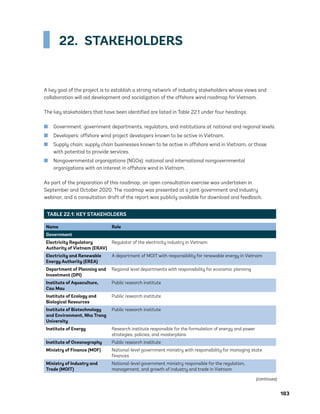
22. Stakeholders .  .  .  .  .  .  .  .  .  .  .  .  .  .  .  .  .  .  .  .  .  .  .  .  .  .  .  .  .  .  .  .  .  .  .  .  .  .  .  .  .  .  .  .  .  .  .  .  .  .  .  .  .  .  .  .  .  .  .  .  .  .  .  .  . 183
Endnotes .  .  .  .  .  .  .  .  .  .  .  .  .  .  .  .  .  .  .  .  .  .  .  .  .  .  .  .  .  .  .  .  .  .  .  .  .  .  .  .  .  .  .  .  .  .  .  .  .  .  .  .  .  .  .  .  .  .  .  .  .  .  .  .  .  .  .  .  .  .  .  .  . 186
75983_ESMAP_Tech Report VM Wind-NEW.indd 6
75983_ESMAP_Tech Report VM Wind-NEW.indd 6 3/19/21 12:25 PM
3/19/21 12:25 PM
Contents	vii
List of Boxes
Box 7.1: Levelized cost of energy and cumulative net cost of offshore wind .  .  .  .  .  .  .  .  .  .  .  .  .  .  .  .  .  .  .  .  .  .  .  . 37
List of Figures
Figure ES.1: Impact of offshore wind in Vietnam under low and high growth scenarios, 2020
to 2035 .  .  .  .  .  .  .  .  .  .  .  .  .  .  .  .  .  .  .  .  .  .  .  .  .  .  .  .  .  .  .  .  .  .  .  .  .  .  .  .  .  .  .  .  .  .  .  .  .  .  .  .  .  .  .  .  .  .  .  .  .  .  .  .  .  .  .  .  .  .  .  .  .  .  .  .  .  .  .  .  .  .  .  .  . xvii
Figure ES.2: Priority themes to create a successful offshore wind industry .  .  .  .  .  .  .  .  .  .  .  .  .  .  .  .  .  .  .  .  .  .  . xviii
Figure 2.1: Annual installed and cumulative operating capacity in the two scenarios .  .  .  .  .  .  .  .  .  .  .  .  .  .  .  . 4
Figure 2.2: Long-term ambition in low growth scenario .  .  .  .  .  .  .  .  .  .  .  .  .  .  .  .  .  .  .  .  .  .  .  .  .  .  .  .  .  .  .  .  .  .  .  .  .  .  .  .  .  .  . 4
Figure 2.3: Long-term ambition in high growth scenario .  .  .  .  .  .  .  .  .  .  .  .  .  .  .  .  .  .  .  .  .  .  .  .  .  .  .  .  .  .  .  .  .  .  .  .  .  .  .  .  .  . 5
Figure 3.1: Technical potential offshore wind development areas .  .  .  .  .  .  .  .  .  .  .  .  .  .  .  .  .  .  .  .  .  .  .  .  .  .  .  .  .  .  .  .  .  . 6
Figure 3.2: Annual electricity supplied by offshore wind and other sources to 2050 in the low
growth scenario .  .  .  .  .  .  .  .  .  .  .  .  .  .  .  .  .  .  .  .  .  .  .  .  .  .  .  .  .  .  .  .  .  .  .  .  .  .  .  .  .  .  .  .  .  .  .  .  .  .  .  .  .  .  .  .  .  .  .  .  .  .  .  .  .  .  .  .  .  .  .  .  .  .  .  .  .  .  .  . 7
Figure 3.3: Levelized cost of energy and cumulative net cost of offshore wind compared
to traditional technology in the low growth scenario .  .  .  .  .  .  .  .  .  .  .  .  .  .  .  .  .  .  .  .  .  .  .  .  .  .  .  .  .  .  .  .  .  .  .  .  .  .  .  .  .  .  .  .  .  . 8
Figure 3.4: Jobs created in the low growth scenario .  .  .  .  .  .  .  .  .  .  .  .  .  .  .  .  .  .  .  .  .  .  .  .  .  .  .  .  .  .  .  .  .  .  .  .  .  .  .  .  .  .  .  .  .  . 9
Figure 3.5: Local gross value added in the low growth scenario .  .  .  .  .  .  .  .  .  .  .  .  .  .  .  .  .  .  .  .  .  .  .  .  .  .  .  .  .  .  .  .  .  .  .  . 9
Figure 4.1: Annual electricity supplied by offshore wind and other sources to 2050
in the high growth scenario  .  .  .  .  .  .  .  .  .  .  .  .  .  .  .  .  .  .  .  .  .  .  .  .  .  .  .  .  .  .  .  .  .  .  .  .  .  .  .  .  .  .  .  .  .  .  .  .  .  .  .  .  .  .  .  .  .  .  .  .  .  .  .  .  .  .  .  . 13
Figure 4.2: Levelized cost of energy and cumulative net cost of offshore wind compared
to traditional technology in the high growth scenario .  .  .  .  .  .  .  .  .  .  .  .  .  .  .  .  .  .  .  .  .  .  .  .  .  .  .  .  .  .  .  .  .  .  .  .  .  .  .  .  .  .  .  .  . 14
Figure 4.3: Jobs created in the high growth scenario .  .  .  .  .  .  .  .  .  .  .  .  .  .  .  .  .  .  .  .  .  .  .  .  .  .  .  .  .  .  .  .  .  .  .  .  .  .  .  .  .  .  .  .  . 15
Figure 4.4: Local gross value added in the high growth scenario .  .  .  .  .  .  .  .  .  .  .  .  .  .  .  .  .  .  .  .  .  .  .  .  .  .  .  .  .  .  .  .  .  .  . 16
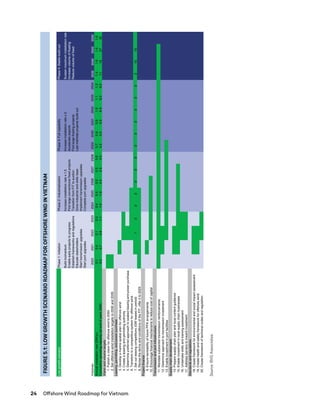
Figure 5.1: Low growth scenario roadmap for offshore wind in Vietnam .  .  .  .  .  .  .  .  .  .  .  .  .  .  .  .  .  .  .  .  .  .  .  .  .  .  . 24
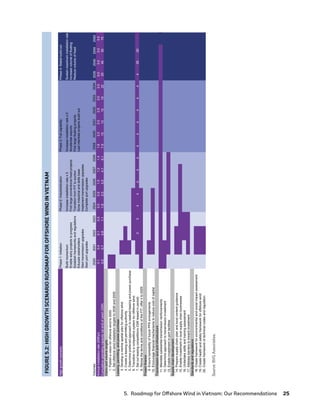
Figure 5.2: High growth scenario roadmap for offshore wind in Vietnam .  .  .  .  .  .  .  .  .  .  .  .  .  .  .  .  .  .  .  .  .  .  .  .  .  . 25
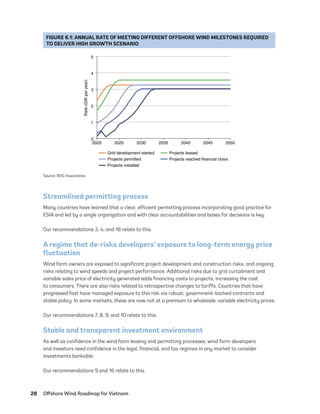
Figure 6.1: Annual rate of meeting different offshore wind milestones required to deliver
high growth scenario .  .  .  .  .  .  .  .  .  .  .  .  .  .  .  .  .  .  .  .  .  .  .  .  .  .  .  .  .  .  .  .  .  .  .  .  .  .  .  .  .  .  .  .  .  .  .  .  .  .  .  .  .  .  .  .  .  .  .  .  .  .  .  .  .  .  .  .  .  .  .  .  . 28
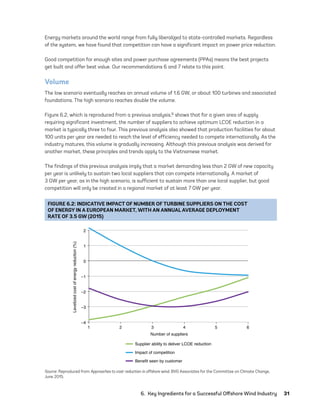
Figure 6.2: Indicative impact of number of turbine suppliers on the cost of energy in a European
market, with an annual average deployment rate of 3.5 GW (2015) .  .  .  .  .  .  .  .  .  .  .  .  .  .  .  .  .  .  .  .  .  .  .  .  .  .  .  .  .  .  .  . 31
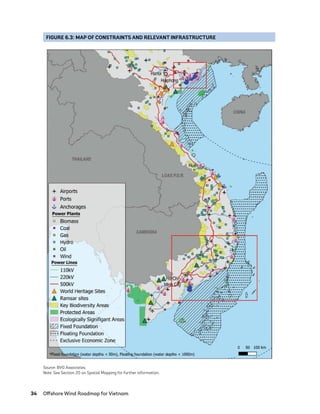
Figure 6.3: Map of constraints and relevant infrastructure .  .  .  .  .  .  .  .  .  .  .  .  .  .  .  .  .  .  .  .  .  .  .  .  .  .  .  .  .  .  .  .  .  .  .  .  .  . 34
Figure 7.1: Electricity supply in Vietnam split by generation type .  .  .  .  .  .  .  .  .  .  .  .  .  .  .  .  .  .  .  .  .  .  .  .  .  .  .  .  .  .  .  .  . 37
Figure 8.1: Vietnam’s place in top 12 countries for offshore wind, globally (2019) .  .  .  .  .  .  .  .  .  .  .  .  .  .  .  .  .  .  .  . 41
Figure 8.2: Indicative forecast of cumulative operating offshore wind capacity in high growth
scenario in Vietnam and in the rest of East and Southeast Asia, end 2030, 2040, and 2050 .  .  .  .  .  .  .  . 43
Figure 8.3: Indicative forecast of cumulative operating offshore wind capacity globally,
end 2050  .  .  .  .  .  .  .  .  .  .  .  .  .  .  .  .  .  .  .  .  .  .  .  .  .  .  .  .  .  .  .  .  .  .  .  .  .  .  .  .  .  .  .  .  .  .  .  .  .  .  .  .  .  .  .  .  .  .  .  .  .  .  .  .  .  .  .  .  .  .  .  .  .  .  .  .  .  .  .  .  .  .  . 43
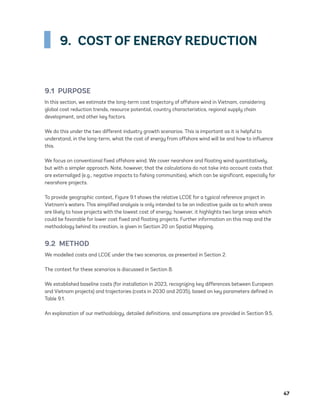
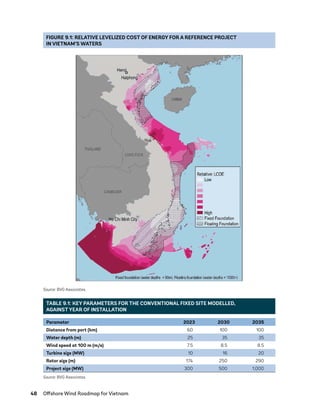
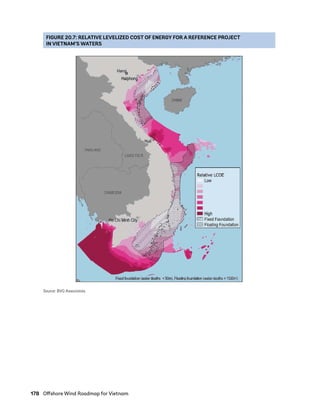
Figure 9.1: Relative levelized cost of energy for a reference project in Vietnam’s waters .  .  .  .  .  .  .  .  .  .  .  .  . 48
Figure 9.2: Levelized cost of energy trajectory for Vietnam sites, compared to established
markets trends .  .  .  .  .  .  .  .  .  .  .  .  .  .  .  .  .  .  .  .  .  .  .  .  .  .  .  .  .  .  .  .  .  .  .  .  .  .  .  .  .  .  .  .  .  .  .  .  .  .  .  .  .  .  .  .  .  .  .  .  .  .  .  .  .  .  .  .  .  .  .  .  .  .  .  .  .  . 50
Figure 9.3: Levelized cost of energy breakdown for conventional offshore sites in the low
growth scenario .  .  .  .  .  .  .  .  .  .  .  .  .  .  .  .  .  .  .  .  .  .  .  .  .  .  .  .  .  .  .  .  .  .  .  .  .  .  .  .  .  .  .  .  .  .  .  .  .  .  .  .  .  .  .  .  .  .  .  .  .  .  .  .  .  .  .  .  .  .  .  .  .  .  .  .  .  . 52
75983_ESMAP_Tech Report VM Wind-NEW.indd 7
75983_ESMAP_Tech Report VM Wind-NEW.indd 7 3/19/21 12:25 PM
3/19/21 12:25 PM
viii	 Offshore Wind Roadmap for Vietnam
Figure 9.4: Source of levelized cost of energy reduction by cost element for conventional
offshore sites in the low growth scenario .  .  .  .  .  .  .  .  .  .  .  .  .  .  .  .  .  .  .  .  .  .  .  .  .  .  .  .  .  .  .  .  .  .  .  .  .  .  .  .  .  .  .  .  .  .  .  .  .  .  .  .  .  .  . 53
Figure 9.5: Source of levelized cost of energy reduction by geography for conventional
offshore sites in the low growth scenario .  .  .  .  .  .  .  .  .  .  .  .  .  .  .  .  .  .  .  .  .  .  .  .  .  .  .  .  .  .  .  .  .  .  .  .  .  .  .  .  .  .  .  .  .  .  .  .  .  .  .  .  .  .  . 53
Figure 9.6: Levelized cost of energy breakdown for conventional offshore sites in the high
growth scenario .  .  .  .  .  .  .  .  .  .  .  .  .  .  .  .  .  .  .  .  .  .  .  .  .  .  .  .  .  .  .  .  .  .  .  .  .  .  .  .  .  .  .  .  .  .  .  .  .  .  .  .  .  .  .  .  .  .  .  .  .  .  .  .  .  .  .  .  .  .  .  .  .  .  .  .  .  . 54
Figure 9.7: Source of levelized cost of energy reduction by cost element for conventional
offshore sites in the high growth scenario .  .  .  .  .  .  .  .  .  .  .  .  .  .  .  .  .  .  .  .  .  .  .  .  .  .  .  .  .  .  .  .  .  .  .  .  .  .  .  .  .  .  .  .  .  .  .  .  .  .  .  .  .  . 55
Figure 9.8: Source of levelized cost of energy reduction by geography for conventional
offshore sites in the high growth scenario .  .  .  .  .  .  .  .  .  .  .  .  .  .  .  .  .  .  .  .  .  .  .  .  .  .  .  .  .  .  .  .  .  .  .  .  .  .  .  .  .  .  .  .  .  .  .  .  .  .  .  .  .  . 55
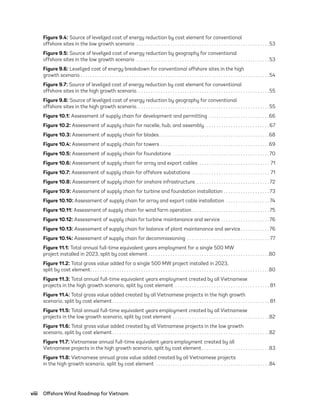
Figure 10.1: Assessment of supply chain for development and permitting .  .  .  .  .  .  .  .  .  .  .  .  .  .  .  .  .  .  .  .  .  .  .  .  . 66
Figure 10.2: Assessment of supply chain for nacelle, hub, and assembly .  .  .  .  .  .  .  .  .  .  .  .  .  .  .  .  .  .  .  .  .  .  .  .  .  . 67
Figure 10.3: Assessment of supply chain for blades .  .  .  .  .  .  .  .  .  .  .  .  .  .  .  .  .  .  .  .  .  .  .  .  .  .  .  .  .  .  .  .  .  .  .  .  .  .  .  .  .  .  .  .  . 68
Figure 10.4: Assessment of supply chain for towers .  .  .  .  .  .  .  .  .  .  .  .  .  .  .  .  .  .  .  .  .  .  .  .  .  .  .  .  .  .  .  .  .  .  .  .  .  .  .  .  .  .  .  .  . 69
Figure 10.5: Assessment of supply chain for foundations .  .  .  .  .  .  .  .  .  .  .  .  .  .  .  .  .  .  .  .  .  .  .  .  .  .  .  .  .  .  .  .  .  .  .  .  .  .  .  . 70
Figure 10.6: Assessment of supply chain for array and export cables .  .  .  .  .  .  .  .  .  .  .  .  .  .  .  .  .  .  .  .  .  .  .  .  .  .  .  .  .  . 71
Figure 10.7: Assessment of supply chain for offshore substations .  .  .  .  .  .  .  .  .  .  .  .  .  .  .  .  .  .  .  .  .  .  .  .  .  .  .  .  .  .  .  .  . 71
Figure 10.8: Assessment of supply chain for onshore infrastructure .  .  .  .  .  .  .  .  .  .  .  .  .  .  .  .  .  .  .  .  .  .  .  .  .  .  .  .  .  . 72
Figure 10.9: Assessment of supply chain for turbine and foundation installation .  .  .  .  .  .  .  .  .  .  .  .  .  .  .  .  .  .  . 73
Figure 10.10: Assessment of supply chain for array and export cable installation .  .  .  .  .  .  .  .  .  .  .  .  .  .  .  .  .  . 74
Figure 10.11: Assessment of supply chain for wind farm operation  .  .  .  .  .  .  .  .  .  .  .  .  .  .  .  .  .  .  .  .  .  .  .  .  .  .  .  .  .  .  . 75
Figure 10.12: Assessment of supply chain for turbine maintenance and service .  .  .  .  .  .  .  .  .  .  .  .  .  .  .  .  .  .  .  . 76
Figure 10.13: Assessment of supply chain for balance of plant maintenance and service .  .  .  .  .  .  .  .  .  .  . 76
Figure 10.14: Assessment of supply chain for decommissioning .  .  .  .  .  .  .  .  .  .  .  .  .  .  .  .  .  .  .  .  .  .  .  .  .  .  .  .  .  .  .  .  .  .  . 77
Figure 11.1: Total annual full-time equivalent years employment for a single 500 MW
project installed in 2023, split by cost element .  .  .  .  .  .  .  .  .  .  .  .  .  .  .  .  .  .  .  .  .  .  .  .  .  .  .  .  .  .  .  .  .  .  .  .  .  .  .  .  .  .  .  .  .  .  .  .  .  . 80
Figure 11.2: Total gross value added for a single 500 MW project installed in 2023,
split by cost element .  .  .  .  .  .  .  .  .  .  .  .  .  .  .  .  .  .  .  .  .  .  .  .  .  .  .  .  .  .  .  .  .  .  .  .  .  .  .  .  .  .  .  .  .  .  .  .  .  .  .  .  .  .  .  .  .  .  .  .  .  .  .  .  .  .  .  .  .  .  .  .  . 80
Figure 11.3: Total annual full-time equivalent years employment created by all Vietnamese
projects in the high growth scenario, split by cost element .  .  .  .  .  .  .  .  .  .  .  .  .  .  .  .  .  .  .  .  .  .  .  .  .  .  .  .  .  .  .  .  .  .  .  .  .  .  .  . 81
Figure 11.4: Total gross value added created by all Vietnamese projects in the high growth
scenario, split by cost element .  .  .  .  .  .  .  .  .  .  .  .  .  .  .  .  .  .  .  .  .  .  .  .  .  .  .  .  .  .  .  .  .  .  .  .  .  .  .  .  .  .  .  .  .  .  .  .  .  .  .  .  .  .  .  .  .  .  .  .  .  .  .  .  . 81
Figure 11.5: Total annual full-time equivalent years employment created by all Vietnamese
projects in the low growth scenario, split by cost element .  .  .  .  .  .  .  .  .  .  .  .  .  .  .  .  .  .  .  .  .  .  .  .  .  .  .  .  .  .  .  .  .  .  .  .  .  .  .  . 82
Figure 11.6: Total gross value added created by all Vietnamese projects in the low growth
scenario, split by cost element .  .  .  .  .  .  .  .  .  .  .  .  .  .  .  .  .  .  .  .  .  .  .  .  .  .  .  .  .  .  .  .  .  .  .  .  .  .  .  .  .  .  .  .  .  .  .  .  .  .  .  .  .  .  .  .  .  .  .  .  .  .  .  . 82
Figure 11.7: Vietnamese annual full-time equivalent years employment created by all
Vietnamese projects in the high growth scenario, split by cost element  .  .  .  .  .  .  .  .  .  .  .  .  .  .  .  .  .  .  .  .  .  .  .  .  .  .  . 83
Figure 11.8: Vietnamese annual gross value added created by all Vietnamese projects
in the high growth scenario, split by cost element .  .  .  .  .  .  .  .  .  .  .  .  .  .  .  .  .  .  .  .  .  .  .  .  .  .  .  .  .  .  .  .  .  .  .  .  .  .  .  .  .  .  .  .  .  .  . 84
75983_ESMAP_Tech Report VM Wind-NEW.indd 8
75983_ESMAP_Tech Report VM Wind-NEW.indd 8 3/19/21 12:25 PM
3/19/21 12:25 PM
Contents	ix
Figure 11.9: Vietnamese annual full-time equivalent years employment created by all
Vietnamese projects in low growth scenario, split by cost element .  .  .  .  .  .  .  .  .  .  .  .  .  .  .  .  .  .  .  .  .  .  .  .  .  .  .  .  .  .  .  . 84
Figure 11.10: Vietnamese annual gross value added created by all Vietnamese projects
in low growth scenario, split by cost element .  .  .  .  .  .  .  .  .  .  .  .  .  .  .  .  .  .  .  .  .  .  .  .  .  .  .  .  .  .  .  .  .  .  .  .  .  .  .  .  .  .  .  .  .  .  .  .  .  .  . 85
Figure 11.11: Vietnamese annual full-time equivalent years employment created by Vietnamese
and global projects in the high growth scenario, split by cost element .  .  .  .  .  .  .  .  .  .  .  .  .  .  .  .  .  .  .  .  .  .  .  .  .  .  .  .  . 85
Figure 11.12: Vietnamese annual gross value added created by Vietnamese and global projects
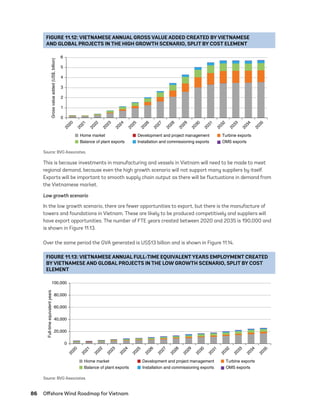
in the high growth scenario, split by cost element .  .  .  .  .  .  .  .  .  .  .  .  .  .  .  .  .  .  .  .  .  .  .  .  .  .  .  .  .  .  .  .  .  .  .  .  .  .  .  .  .  .  .  .  .  .  . 86
Figure 11.13: Vietnamese annual full-time equivalent years employment created by Vietnamese
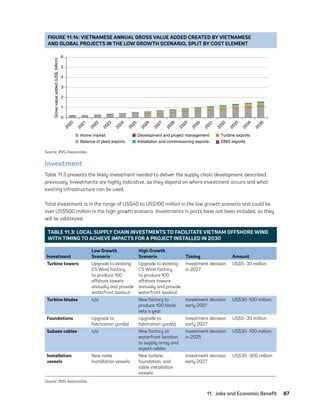
and global projects in the low growth scenario, split by cost element .  .  .  .  .  .  .  .  .  .  .  .  .  .  .  .  .  .  .  .  .  .  .  .  .  .  .  .  .  . 86
Figure 11.14: Vietnamese annual gross value added created by Vietnamese and global projects
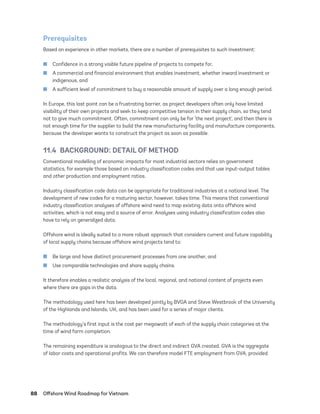
in the low growth scenario, split by cost element .  .  .  .  .  .  .  .  .  .  .  .  .  .  .  .  .  .  .  .  .  .  .  .  .  .  .  .  .  .  .  .  .  .  .  .  .  .  .  .  .  .  .  .  .  .  .  . 87
Figure 12.1: Indicative shipping activity, for vessels with Automatic Identification
Systems (AIS), in the waters around Vietnam .  .  .  .  .  .  .  .  .  .  .  .  .  .  .  .  .  .  .  .  .  .  .  .  .  .  .  .  .  .  .  .  .  .  .  .  .  .  .  .  .  .  .  .  .  .  .  .  .  .  . 98
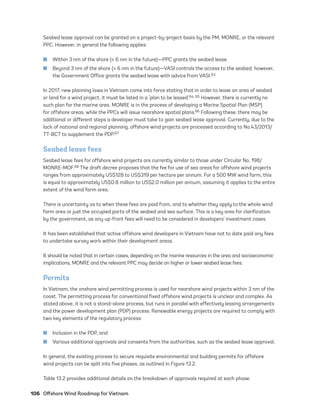
Figure 13.1: Seabed lease approval process .  .  .  .  .  .  .  .  .  .  .  .  .  .  .  .  .  .  .  .  .  .  .  .  .  .  .  .  .  .  .  .  .  .  .  .  .  .  .  .  .  .  .  .  .  .  .  .  .  .  .  . 105
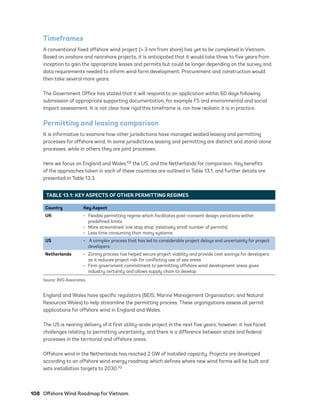
Figure 13.2: Project development phases  .  .  .  .  .  .  .  .  .  .  .  .  .  .  .  .  .  .  .  .  .  .  .  .  .  .  .  .  .  .  .  .  .  .  .  .  .  .  .  .  .  .  .  .  .  .  .  .  .  .  .  .  . 107
Figure 14.1: Overview of centralized and decentralized approaches to leasing
and PPA procurement .  .  .  .  .  .  .  .  .  .  .  .  .  .  .  .  .  .  .  .  .  .  .  .  .  .  .  .  .  .  .  .  .  .  .  .  .  .  .  .  .  .  .  .  .  .  .  .  .  .  .  .  .  .  .  .  .  .  .  .  .  .  .  .  .  .  .  .  .  .  . 123
Figure 17.1: Existing power plants in Vietnam .  .  .  .  .  .  .  .  .  .  .  .  .  .  .  .  .  .  .  .  .  .  .  .  .  .  .  .  .  .  .  .  .  .  .  .  .  .  .  .  .  .  .  .  .  .  .  .  .  . 143
Figure 17.2: Transmission congestion areas  .  .  .  .  .  .  .  .  .  .  .  .  .  .  .  .  .  .  .  .  .  .  .  .  .  .  .  .  .  .  .  .  .  .  .  .  .  .  .  .  .  .  .  .  .  .  .  .  .  .  . 143
Figure 17.3: Options for transmission upgrades for offshore wind expansion in Vietnam .  .  .  .  .  .  .  .  .  .  . 148
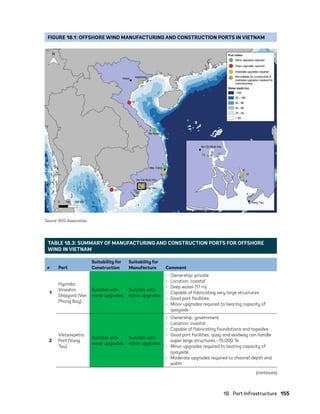
Figure 18.1: Offshore wind manufacturing and construction ports in Vietnam .  .  .  .  .  .  .  .  .  .  .  .  .  .  .  .  .  .  .  . 155
Figure 20.1: Vietnam’s fixed and floating offshore wind technical potential .  .  .  .  .  .  .  .  .  .  .  .  .  .  .  .  .  .  .  .  .  .  .  . 171
Figure 20.2: Map of constraints and relevant infrastructure . . . . . . . . . . . . . . . . . . . . . . . . . . . . . . . . . . . . 173
Figure 20.3: Constraints map of the northern region close to Hanoi .  .  .  .  .  .  .  .  .  .  .  .  .  .  .  .  .  .  .  .  .  .  .  .  .  .  .  .  .  . 174
Figure 20.4: Constraints map for southern Vietnam close to Ho Chi Minh City .  .  .  .  .  .  .  .  .  .  .  .  .  .  .  .  .  .  .  .  . 174
Figure 20.5: Maximum sustained wind speeds around Vietnam .  .  .  .  .  .  .  .  .  .  .  .  .  .  .  .  .  .  .  .  .  .  .  .  .  .  .  .  .  .  .  .  . 175
Figure 20.6: Shipping activity in the waters around Vietnam  .  .  .  .  .  .  .  .  .  .  .  .  .  .  .  .  .  .  .  .  .  .  .  .  .  .  .  .  .  .  .  .  .  .  .  . 177
Figure 20.7: Relative levelized cost of energy for a reference project in Vietnam’s waters .  .  .  .  .  .  .  .  .  . 178
List of Tables
Table 2.1: Characteristics of the two market development scenarios explored for Vietnam .  .  .  .  .  .  .  .  .  .  . 2
Table 3.1: SWOT analysis for Vietnam in the low growth scenario .  .  .  .  .  .  .  .  .  .  .  .  .  .  .  .  .  .  .  .  .  .  .  .  .  .  .  .  .  .  .  .  . 12
Table 4.1: SWOT analysis for Vietnam in the high growth scenario .  .  .  .  .  .  .  .  .  .  .  .  .  .  .  .  .  .  .  .  .  .  .  .  .  .  .  .  .  .  .  .  . 18
Table 8.1: Electricity supplied by offshore wind to 2050 in the high growth scenario  .  .  .  .  .  .  .  .  .  .  .  .  .  .  . 42
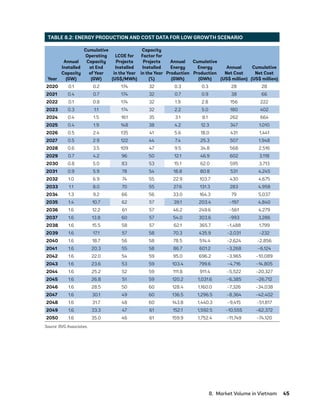
Table 8.2: Energy production and cost data for low growth scenario .  .  .  .  .  .  .  .  .  .  .  .  .  .  .  .  .  .  .  .  .  .  .  .  .  .  .  .  .  . 45
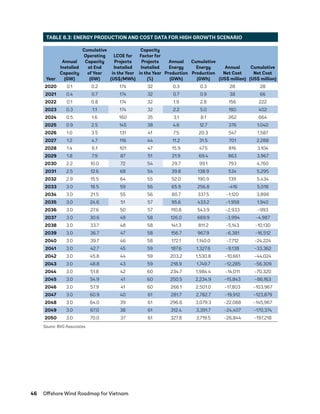
Table 8.3: Energy production and cost data for high growth scenario .  .  .  .  .  .  .  .  .  .  .  .  .  .  .  .  .  .  .  .  .  .  .  .  .  .  .  .  . 46
Table 9.1: Key parameters for the conventional fixed site modelled, against year of installation .  .  .  .  . 48
Table 9.2: Indicative levelized costs of energy for typical Vietnam sites modelled .  .  .  .  .  .  .  .  .  .  .  .  .  .  .  .  .  . 49
Table 9.3: Cost element definitions .  .  .  .  .  .  .  .  .  .  .  .  .  .  .  .  .  .  .  .  .  .  .  .  .  .  .  .  .  .  .  .  .  .  .  .  .  .  .  .  .  .  .  .  .  .  .  .  .  .  .  .  .  .  .  .  .  .  .  . 58
75983_ESMAP_Tech Report VM Wind-NEW.indd 9
75983_ESMAP_Tech Report VM Wind-NEW.indd 9 3/19/21 12:25 PM
3/19/21 12:25 PM
x	 Offshore Wind Roadmap for Vietnam
Table 10.1: Categorization of the supply chain .  .  .  .  .  .  .  .  .  .  .  .  .  .  .  .  .  .  .  .  .  .  .  .  .  .  .  .  .  .  .  .  .  .  .  .  .  .  .  .  .  .  .  .  .  .  .  .  .  . 63
Table 10.2: Criteria for assessing current and future Vietnamese capability .  .  .  .  .  .  .  .  .  .  .  .  .  .  .  .  .  .  .  .  .  .  . 64
Table 10.3: Summary of the supply chain analysis .  .  .  .  .  .  .  .  .  .  .  .  .  .  .  .  .  .  .  .  .  .  .  .  .  .  .  .  .  .  .  .  .  .  .  .  .  .  .  .  .  .  .  .  .  . 65
Table 10.4: Change in Vietnamese supply chain in low and high growth scenarios .  .  .  .  .  .  .  .  .  .  .  .  .  .  .  .  .  . 66
Table 11.1: Summary of potential Vietnamese supply chain .  .  .  .  .  .  .  .  .  .  .  .  .  .  .  .  .  .  .  .  .  .  .  .  .  .  .  .  .  .  .  .  .  .  .  .  .  . 79
Table 11.2: Vietnamese content for Vietnam offshore wind projects completed in 2023, 2030,
and 2025  .  .  .  .  .  .  .  .  .  .  .  .  .  .  .  .  .  .  .  .  .  .  .  .  .  .  .  .  .  .  .  .  .  .  .  .  .  .  .  .  .  .  .  .  .  .  .  .  .  .  .  .  .  .  .  .  .  .  .  .  .  .  .  .  .  .  .  .  .  .  .  .  .  .  .  .  .  .  .  .  .  .  . 83
Table 11.3: Local supply chain investments to facilitate Vietnam offshore wind with timing
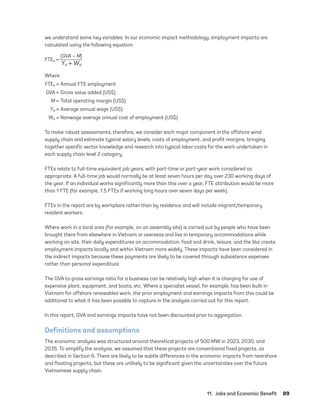
to achieve impacts for a project installed in 2030 .  .  .  .  .  .  .  .  .  .  .  .  .  .  .  .  .  .  .  .  .  .  .  .  .  .  .  .  .  .  .  .  .  .  .  .  .  .  .  .  .  .  .  .  .  .  . 87
Table 12.1: Summary of environmental and social constraints  .  .  .  .  .  .  .  .  .  .  .  .  .  .  .  .  .  .  .  .  .  .  .  .  .  .  .  .  .  .  .  .  .  .  . 94
Table 13.1: Key aspects of other permitting regimes  .  .  .  .  .  .  .  .  .  .  .  .  .  .  .  .  .  .  .  .  .  .  .  .  .  .  .  .  .  .  .  .  .  .  .  .  .  .  .  .  .  .  . 108
Table 13.2: Breakdown of permitting activity against project development phases  .  .  .  .  .  .  .  .  .  .  .  .  .  .  .  . 112
Table 13.3: Comparison of permitting and leasing regimes in example countries .  .  .  .  .  .  .  .  .  .  .  .  .  .  .  .  .  .  . 117
Table 14.1: Comparison between centralized one-stage and decentralized two-stage
approaches to leasing and PPAs .  .  .  .  .  .  .  .  .  .  .  .  .  .  .  .  .  .  .  .  .  .  .  .  .  .  .  .  .  .  .  .  .  .  .  .  .  .  .  .  .  .  .  .  .  .  .  .  .  .  .  .  .  .  .  .  .  .  .  .  .  . 125
Table 15.1: Investment risks  .  .  .  .  .  .  .  .  .  .  .  .  .  .  .  .  .  .  .  .  .  .  .  .  .  .  .  .  .  .  .  .  .  .  .  .  .  .  .  .  .  .  .  .  .  .  .  .  .  .  .  .  .  .  .  .  .  .  .  .  .  .  .  .  . 130
Table 16.1: Relevant health and safety legislation and guidance documents .  .  .  .  .  .  .  .  .  .  .  .  .  .  .  .  .  .  .  .  .  . 139
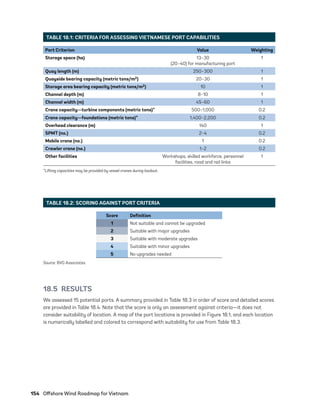
Table 18.1: Criteria for assessing Vietnamese port capabilities .  .  .  .  .  .  .  .  .  .  .  .  .  .  .  .  .  .  .  .  .  .  .  .  .  .  .  .  .  .  .  .  .  . 154
Table 18.2: Scoring against port criteria .  .  .  .  .  .  .  .  .  .  .  .  .  .  .  .  .  .  .  .  .  .  .  .  .  .  .  .  .  .  .  .  .  .  .  .  .  .  .  .  .  .  .  .  .  .  .  .  .  .  .  .  .  . 154
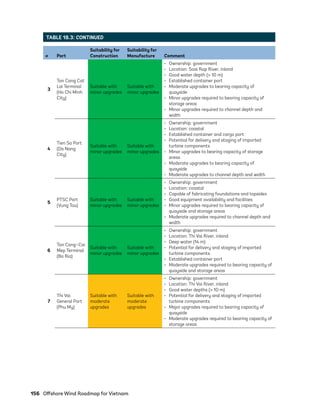
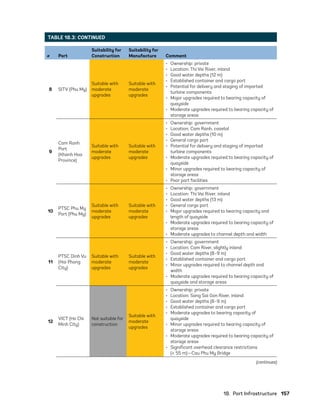
Table 18.3: Summary of manufacturing and construction ports for offshore wind in Vietnam . . . . . . 155
Table 18.4: Port assessment results .  .  .  .  .  .  .  .  .  .  .  .  .  .  .  .  .  .  .  .  .  .  .  .  .  .  .  .  .  .  .  .  .  .  .  .  .  .  .  .  .  .  .  .  .  .  .  .  .  .  .  .  .  .  .  .  .  .  . 161
Table 20.1: Spatial data layers included in the constraint mapping .  .  .  .  .  .  .  .  .  .  .  .  .  .  .  .  .  .  .  .  .  .  .  .  .  .  .  .  .  . 169
Table 20.2: Assumed characteristics of the reference wind farm project used in the modelling .  .  .  .  . 170
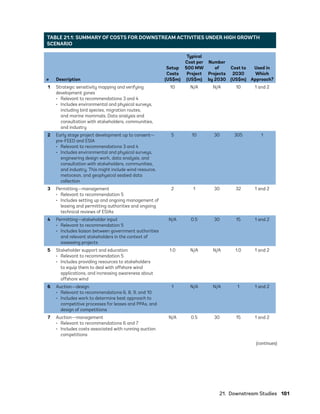
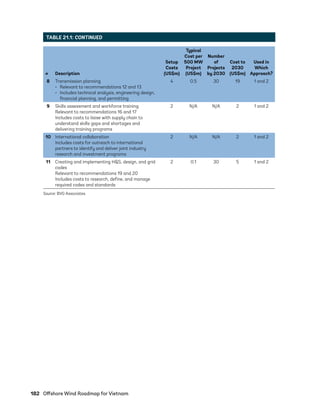
Table 21.1: Summary of costs for downstream activities under high growth scenario . . . . . . . . . . . . . . 181
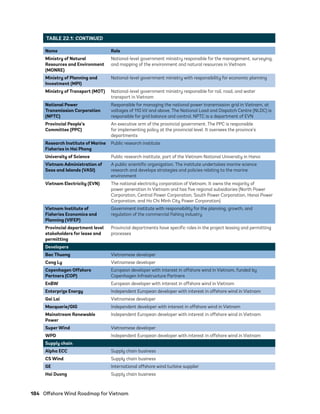
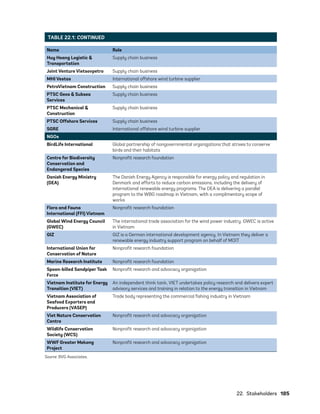
Table 22.1: Key stakeholders .  .  .  .  .  .  .  .  .  .  .  .  .  .  .  .  .  .  .  .  .  .  .  .  .  .  .  .  .  .  .  .  .  .  .  .  .  .  .  .  .  .  .  .  .  .  .  .  .  .  .  .  .  .  .  .  .  .  .  .  .  .  .  .  . 183
75983_ESMAP_Tech Report VM Wind-NEW.indd 10
75983_ESMAP_Tech Report VM Wind-NEW.indd 10 3/19/21 12:25 PM
3/19/21 12:25 PM
xi
ABBREVIATIONS
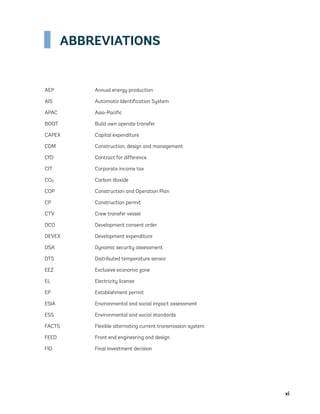
AEP Annual energy production
AIS Automatic Identification System
APAC Asia-Pacific
BOOT Build own operate transfer
CAPEX Capital expenditure
CDM Construction, design and management
CfD Contract for difference
CIT Corporate income tax
CO2 Carbon dioxide
COP Construction and Operation Plan
CP Construction permit
CTV Crew transfer vessel
DCO Development consent order
DEVEX Development expenditure
DSA Dynamic security assessment
DTS Distributed temperature sensor
EEZ Exclusive economic zone
EL Electricity license
EP Establishment permit
ESIA Environmental and social impact assessment
ESS Environmental and social standards
FACTS Flexible alternating current transmission system
FEED Front end engineering and design
FID Final investment decision
75983_ESMAP_Tech Report VM Wind-NEW.indd 11
75983_ESMAP_Tech Report VM Wind-NEW.indd 11 3/19/21 12:25 PM
3/19/21 12:25 PM
xii	 Offshore Wind Roadmap for Vietnam
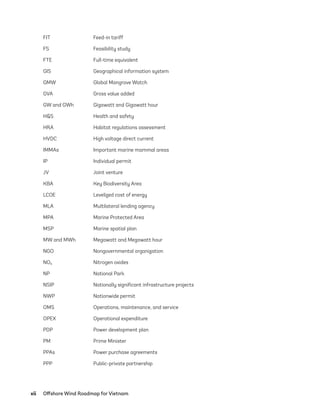
FIT Feed-in tariff
FS Feasibility study
FTE Full-time equivalent
GIS Geographical information system
GMW Global Mangrove Watch
GVA Gross value added
GW and GWh Gigawatt and Gigawatt hour
H&S Health and safety
HRA Habitat regulations assessment
HVDC High voltage direct current
IMMAs Important marine mammal areas
IP Individual permit
JV Joint venture
KBA Key Biodiversity Area
LCOE Levelized cost of energy
MLA Multilateral lending agency
MPA Marine Protected Area
MSP Marine spatial plan
MW and MWh Megawatt and Megawatt hour
NGO Nongovernmental organization
NOx Nitrogen oxides
NP National Park
NSIP Nationally significant infrastructure projects
NWP Nationwide permit
OMS Operations, maintenance, and service
OPEX Operational expenditure
PDP Power development plan
PM Prime Minister
PPAs Power purchase agreements
PPP Public-private partnership
75983_ESMAP_Tech Report VM Wind-NEW.indd 12
75983_ESMAP_Tech Report VM Wind-NEW.indd 12 3/19/21 12:25 PM
3/19/21 12:25 PM
Abbreviations	xiii
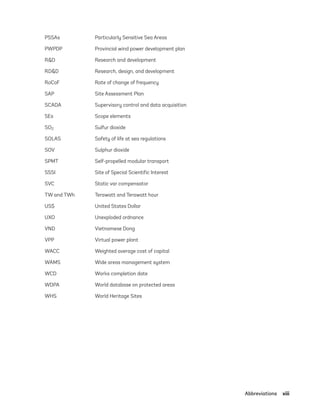
PSSAs Particularly Sensitive Sea Areas
PWPDP Provincial wind power development plan
R&D Research and development
RD&D Research, design, and development
RoCoF Rate of change of frequency
SAP Site Assessment Plan
SCADA Supervisory control and data acquisition
SEs Scope elements
SO2 Sulfur dioxide
SOLAS Safety of life at sea regulations
SOV Sulphur dioxide
SPMT Self-propelled modular transport
SSSI Site of Special Scientific Interest
SVC Static var compensator
TW and TWh Terawatt and Terawatt hour
US$ United States Dollar
UXO Unexploded ordnance
VND Vietnamese Dong
VPP Virtual power plant
WACC Weighted average cost of capital
WAMS Wide areas management system
WCD Works completion date
WDPA World database on protected areas
WHS World Heritage Sites
75983_ESMAP_Tech Report VM Wind-NEW.indd 13
75983_ESMAP_Tech Report VM Wind-NEW.indd 13 3/19/21 12:25 PM
3/19/21 12:25 PM
xiv	 Offshore Wind Roadmap for Vietnam
COMPANY AND INSTITUTE ABBREVIATIONS
ADB Asian Development Bank
BOE Bureau of Energy
BOEM Bureau of Ocean Energy Management
BVGA BVG Associates
CES Crown Estate Scotland
COP Copenhagen Offshore Partners
DEA Danish Energy Agency
DoD US Department of Defense
DoF Directorate of Fisheries
DOIT Department of Industry and Trade
DPI Department of Planning and Investment
EIB European Investment Bank
EPA Environmental Protection Agency
EPTC Electrical Power Trading Company
ERAV Electricity Regulatory Authority of Vietnam
EREA Electricity and Renewable Energy Authority
ESMAP Energy Sector Management Assistance Program
EVN Vietnam Electricity
GDE General Directorate of Energy
GWEC Global Wind Energy Council
GWO Global Wind Organization
HICT Haiphong International Container Terminal
IFC International Finance Corporation
IRENA International Renewable Energy Agency
MARD Ministry of Agriculture and Rural Development
MCST Ministry of Culture, Sports and Tourism
MIC Ministry of Information and Communication
MIGA Multilateral Investment Guarantee Agency
MMO Marine Management Organisation
MOEA Ministry of Economic Affairs
75983_ESMAP_Tech Report VM Wind-NEW.indd 14
75983_ESMAP_Tech Report VM Wind-NEW.indd 14 3/19/21 12:25 PM
3/19/21 12:25 PM
Abbreviations	xv
MOF Ministry of Finance
MOIP Ministry of Industries and Production
MOIT Ministry of Industry and Trade
MONRE Ministry of Natural Resources and Environment
MOPI Ministry of Planning and Investment
MOT Ministry of Transport
MPI Ministry of Planning and Investment
MS Marine Scotland
NLDC National Load and Dispatch Centre
NMFS National Marine Fisheries Service
NPA National Property Administration
NPTC National Power Transmission Corporation
NRW Natural Resources Wales
OFTO Offshore transmission owner
PPC Provincial People’s Committee
PTSC PetroVietnam Technical Services
PVN PetroVietnam
RPCo Regional Power Corporation
SHPO State Historic Prevention Office
TCE The Crown Estate
USACE United States Army Corps of Engineers
USCG United States Coast Guard
USFWS United States Fish and Wildlife Service
VASEP Vietnam Association of Seafood Exporters and Producers
VASI Vietnam Administration of Seas and Islands
VIET Vietnam Institute for Energy Transition
VIFEP Vietnam Institute of Fisheries Economics and Planning
VISI Vietnam Institute of Seas and Island
WBG World Bank Group
75983_ESMAP_Tech Report VM Wind-NEW.indd 15
75983_ESMAP_Tech Report VM Wind-NEW.indd 15 3/19/21 12:25 PM
3/19/21 12:25 PM
xvi	
ACKNOWLEDGMENTS
This roadmap was prepared, under contract to the World Bank, by BVG Associates in association with
Atkins, Frontier Economics, Sterling Technical Services (Vietnam), and Mr. Du Van Toan.
This roadmap was commissioned and supervised by Ky Hong Tran (Senior Energy Specialist, World
Bank), Rahul Kitchlu (Senior Energy Specialist, World Bank), and Thi Ba Chu (Senior Energy Specialist,
World Bank). Direction for this roadmap was provided by the World Bank Group’s Offshore Wind
Development team, led by Mark Leybourne (Senior Energy Specialist, ESMAP/World Bank) and Sean
Whittaker (Principal Industry Specialist, IFC), and supported by Oliver Knight (Senior Energy Specialist,
World Bank) and Alastair Dutton (Consultant, ESMAP/World Bank). The GIS analysis and mapping
were carried out by Clara Ivanescu (Geographer, World Bank) and Rachel Fox (Consultant, ESMAP/
World Bank).
Peer review was carried out by Peter Johansen (Senior Energy Specialist, World Bank), Manuel
Berlengiero (Senior Energy Specialist, World Bank), and Lazeena Rahman (Investment Officer, IFC)—we
are thankful for their time and feedback.
This report is one of a series of offshore wind roadmap studies commissioned by the World Bank
Group under the joint ESMAP-IFC Offshore Wind Development Program. Funding for this study was
generously provided by the Energy Sector Management Assistance Program (ESMAP).
We are exceptionally grateful to the wide range of stakeholders that provided feedback during the
report consultation process, and especially to all of the inputs provided by the Ministry of Industry and
Trade (MOIT).
Particular recognition is given to Neil Douglas and Bruce Valpy of BVG Associates for leading the
consultancy team and for their enthusiasm and dedication to this topic. We also thank Liming Qiao
from the Global Wind Energy Council (GWEC) for her views and feedback on this roadmap.
Finally, we thank the ESMAP donors for their engagement on this roadmap and particularly the Danish
Energy Agency (DEA) for kindly providing results from DEA-led studies as inputs to enhance this study.
75983_ESMAP_Tech Report VM Wind-NEW.indd 16
75983_ESMAP_Tech Report VM Wind-NEW.indd 16 4/5/21 7:24 AM
4/5/21 7:24 AM
xvii
EXECUTIVE SUMMARY
ABOUT THIS ROADMAP
This roadmap provides strategic analysis of the offshore wind development potential in Vietnam,
considering the opportunities and challenges under different growth scenarios. It is intended to provide
evidence to support the Government of Vietnam in establishing policy, regulations, processes, and
infrastructure to enable successful growth of this new industry.
It was initiated by the World Bank country team in Vietnam under the umbrella of the World Bank
Group’s Offshore Wind Development Program—which aims to accelerate offshore wind development in
emerging markets—and was funded by the Energy Sector Management Assistance Program (ESMAP).
KEY FINDINGS
Vietnam has an energetic and abundant offshore wind resource that is located close to demand
centers and in relatively shallow water—although this roadmap focuses on areas further offshore
which have higher wind speeds and energy yields.
Offshore wind could play a significant role in sustainably meeting Vietnam’s rapidly growing electricity
demand and has the potential to supply 12 percent of Vietnam’s electricity by 2035. By replacing
coal-fired generation, this could help to avoid over 200 million metric tons of CO2 emissions and add
at least US$50 billion to Vietnam’s economy by stimulating the growth of a strong, local supply chain,
creating thousands of skilled jobs, and exporting to other offshore wind markets globally.
The analysis underpinning this roadmap is based on two possible growth scenarios for Vietnam’s
offshore wind industry:
	
■ Low growth, with moderate expansion of offshore wind, resulting in offshore wind supplying
5 percent of Vietnam’s electricity needs by 2035, and
	
■ High growth, with significant expansion of offshore wind, resulting in offshore wind supplying
12 percent of Vietnam’s electricity needs by 2035.
Both the low and high growth scenarios require similar enabling actions but, under a high growth
scenario, a more ambitious vision is established with a requirement for earlier action. The headline
impacts of these two growth scenarios, considering the key metrics of electricity generation, cost,
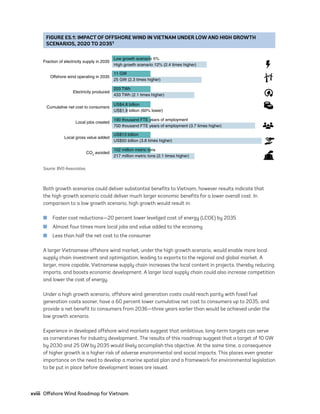
economic, and emissions, are summarized in Figure ES.1.
75983_ESMAP_Tech Report VM Wind-NEW.indd 17
75983_ESMAP_Tech Report VM Wind-NEW.indd 17 4/5/21 7:25 AM
4/5/21 7:25 AM
xviii	 Offshore Wind Roadmap for Vietnam
Both growth scenarios could deliver substantial benefits to Vietnam, however results indicate that
the high growth scenario could deliver much larger economic benefits for a lower overall cost. In
comparison to a low growth scenario, high growth would result in:
	
■ Faster cost reductions—20 percent lower levelized cost of energy (LCOE) by 2035
	
■ Almost four times more local jobs and value added to the economy
	
■ Less than half the net cost to the consumer
A larger Vietnamese offshore wind market, under the high growth scenario, would enable more local
supply chain investment and optimization, leading to exports to the regional and global market. A
larger, more capable, Vietnamese supply chain increases the local content in projects, thereby reducing
imports, and boosts economic development. A larger local supply chain could also increase competition
and lower the cost of energy.
Under a high growth scenario, offshore wind generation costs could reach parity with fossil fuel
generation costs sooner, have a 60 percent lower cumulative net cost to consumers up to 2035, and
provide a net benefit to consumers from 2036—three years earlier than would be achieved under the
low growth scenario.
Experience in developed offshore wind markets suggest that ambitious, long-term targets can serve
as cornerstones for industry development. The results of this roadmap suggest that a target of 10 GW
by 2030 and 25 GW by 2035 would likely accomplish this objective. At the same time, a consequence
of higher growth is a higher risk of adverse environmental and social impacts. This places even greater
importance on the need to develop a marine spatial plan and a framework for environmental legislation
to be put in place before development leases are issued.
FIGURE ES.1: IMPACT OF OFFSHORE WIND IN VIETNAM UNDER LOW AND HIGH GROWTH
SCENARIOS, 2020 TO 20351
Fraction of electricity supply in 2035
Low growth scenario 5%
High growth scenario 12% (2.4 times higher)
11 GW
25 GW (2.3 times higher)
203 TWh
433 TWh (2.1 times higher)
US$4.8 billion
US$1.9 billion (60% lower)
190 thousand FTE years of employment
700 thousand FTE years of employment (3.7 times higher)
US$13 billion
US$50 billion (3.8 times higher)
102 million metric tons
217 million metric tons (2.1 times higher)
Offshore wind operating in 2035
Electricity produced
Cumulative net cost to consumers
Local jobs created
Local gross value added
CO2
avoided
Source: BVG Associates.
75983_ESMAP_Tech Report VM Wind-NEW.indd 18
75983_ESMAP_Tech Report VM Wind-NEW.indd 18 4/5/21 7:26 AM
4/5/21 7:26 AM
Executive Summary	xix
The roadmap suggests that the existing regulations, legislation, processes, and infrastructure need
to be improved or developed to deliver the vision that is eventually set by the Government of Vietnam.
This roadmap provides a series of recommended next steps to help create the conditions to establish
and grow an industry.
PRIORITY THEMES
Action will need to be taken by the Government of Vietnam to develop a successful industry and
maximize the economic benefits that offshore wind can bring. To help focus efforts, the roadmap
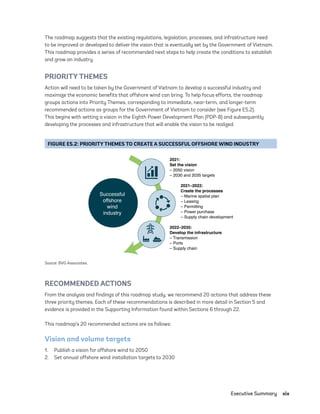
groups actions into Priority Themes, corresponding to immediate, near-term, and longer-term
recommended actions as groups for the Government of Vietnam to consider (see Figure ES.2).
This begins with setting a vision in the Eighth Power Development Plan (PDP-8) and subsequently
developing the processes and infrastructure that will enable the vision to be realized.
FIGURE ES.2: PRIORITY THEMES TO CREATE A SUCCESSFUL OFFSHORE WIND INDUSTRY
2021:
Set the vision
– 2050 vision
– 2030 and 2035 targets
2021–2022:
Create the processes
– Marine spatial plan
– Leasing
– Permitting
– Power purchase
– Supply chain development
2022–2035:
Develop the infrastructure
– Transmission
– Ports
– Supply chain
Successful
offshore
wind
industry
Source: BVG Associates.
RECOMMENDED ACTIONS
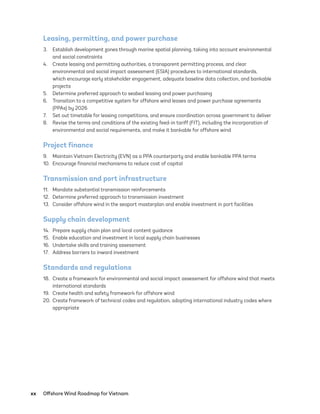
From the analysis and findings of this roadmap study, we recommend 20 actions that address these
three priority themes. Each of these recommendations is described in more detail in Section 5 and
evidence is provided in the Supporting Information found within Sections 6 through 22.
This roadmap’s 20 recommended actions are as follows:
Vision and volume targets
1.	 Publish a vision for offshore wind to 2050
2.	 Set annual offshore wind installation targets to 2030
75983_ESMAP_Tech Report VM Wind-NEW.indd 19
75983_ESMAP_Tech Report VM Wind-NEW.indd 19 3/19/21 12:25 PM
3/19/21 12:25 PM
xx	 Offshore Wind Roadmap for Vietnam
Leasing, permitting, and power purchase
3.	 Establish development zones through marine spatial planning, taking into account environmental
and social constraints
4.	 Create leasing and permitting authorities, a transparent permitting process, and clear
environmental and social impact assessment (ESIA) procedures to international standards,
which encourage early stakeholder engagement, adequate baseline data collection, and bankable
projects
5.	 Determine preferred approach to seabed leasing and power purchasing
6.	 Transition to a competitive system for offshore wind leases and power purchase agreements
(PPAs) by 2026
7.	 Set out timetable for leasing competitions, and ensure coordination across government to deliver
8.	 Revise the terms and conditions of the existing feed-in tariff (FIT), including the incorporation of
environmental and social requirements, and make it bankable for offshore wind
Project finance
9.	 Maintain Vietnam Electricity (EVN) as a PPA counterparty and enable bankable PPA terms
10.	 Encourage financial mechanisms to reduce cost of capital
Transmission and port infrastructure
11.	 Mandate substantial transmission reinforcements
12.	 Determine preferred approach to transmission investment
13.	 Consider offshore wind in the seaport masterplan and enable investment in port facilities
Supply chain development
14.	 Prepare supply chain plan and local content guidance
15.	 Enable education and investment in local supply chain businesses
16.	 Undertake skills and training assessment
17.	 Address barriers to inward investment
Standards and regulations
18.	 Create a framework for environmental and social impact assessment for offshore wind that meets
international standards
19.	 Create health and safety framework for offshore wind
20.	 Create framework of technical codes and regulation, adopting international industry codes where
appropriate
75983_ESMAP_Tech Report VM Wind-NEW.indd 20
75983_ESMAP_Tech Report VM Wind-NEW.indd 20 3/19/21 12:25 PM
3/19/21 12:25 PM
1
1. INTRODUCTION
This report is the output of a study commissioned by the World Bank Group (WBG) and delivered by
renewable energy strategy consultancy BVG Associates (BVGA), in association with Atkins, Frontier
Economics, Sterling Technical Services (Vietnam), and Mr. Du Van Toan.
It is the first in a series of roadmap studies supported by the World Bank Group as part of its
Offshore Wind Development Program2 that aims to fast-track the expansion of offshore wind power
in emerging markets and provide technical assistance to these countries, so they can assess their
offshore wind potential and develop a pipeline of projects that are investment ready.
It follows an invitation from the Government of Vietnam to the World Bank Group for assistance. The
study was carried out over the period February to October 2020.
The study is intended to support collaboration between the Government of Vietnam and the wind
industry. It does not represent the views of the Government of Vietnam.
1.1  REPORT STRUCTURE
The report is structured as follows:
	
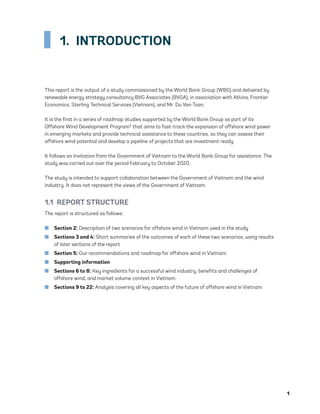
■ Section 2: Description of two scenarios for offshore wind in Vietnam used in the study
	
■ Sections 3 and 4: Short summaries of the outcomes of each of these two scenarios, using results
of later sections of the report
	
■ Section 5: Our recommendations and roadmap for offshore wind in Vietnam
	
■ Supporting information
	
■ Sections 6 to 8: Key ingredients for a successful wind industry, benefits and challenges of
offshore wind, and market volume context in Vietnam
	
■ Sections 9 to 22: Analysis covering all key aspects of the future of offshore wind in Vietnam
75983_ESMAP_Tech Report VM Wind-NEW.indd 1
75983_ESMAP_Tech Report VM Wind-NEW.indd 1 3/19/21 12:25 PM
3/19/21 12:25 PM
2	
2.  TWO SCENARIOS FOR
OFFSHORE WIND IN VIETNAM
Vietnam has a globally relevant offshore wind resource located close to their shores and population
centers and in relatively shallow water.
It has an opportunity to use this resource to generate up to almost 30 percent of its electricity by
2050, with the industry continuing to develop beyond this.
This report explores the impact of two different, possible growth scenarios chosen to cover realistic
paths for Vietnam in the context of its future electricity needs, as discussed in Section 8. The two
offshore wind growth scenarios represent:
	
■ Low growth: with moderate expansion of offshore wind and limited local industrialization
	
■ High growth: sufficient to drive realistic levels of competition, local supply chain investment, and
market-specific innovation
The differences between the scenarios are discussed in this section, and the headline characteristics of
the scenarios, also beyond volume, are summarized in Table 2.1.
TABLE 2.1: CHARACTERISTICS OF THE TWO MARKET DEVELOPMENT SCENARIOS
EXPLORED FOR VIETNAM
Low Growth Scenario High Growth Scenario
Cumulative operating
capacity in 2030
2035
2050
5 GW
11 GW
35 GW
10 GW
25 GW
70 GW
Maximum annual
installation rate
1.6 GW 3 GW
Policy environment •	 Good visibility of installation target
to 2030, with link to cost reduction
target
•	 Competitive auctions introduced
•	 No formal local content requirement,
but developers have to submit plans
to government for creating and
sustaining local benefits as part of
auction process
•	 Local focus encouraged
•	 As low growth scenario, but better
visibility and higher confidence
•	 As low growth scenario
•	 Collaboration with overseas
companies and export encouraged
through government programs
75983_ESMAP_Tech Report VM Wind-NEW.indd 2
75983_ESMAP_Tech Report VM Wind-NEW.indd 2 3/19/21 12:25 PM
3/19/21 12:25 PM
2.  Two Scenarios for Offshore Wind in Vietnam	3
Low Growth Scenario High Growth Scenario
Regulatory
environment
•	 Transparent and timely leasing,
ESIA, and permitting processes with
clear route through small number of
ministries
•	 Marine spatial planning is considered
from the start, with offshore wind a
major part of this; projects already
in the development process are
addressed sympathetically to help
build confidence and early pipeline
•	 Bankable power purchase
arrangements
•	 As low growth scenario, but faster
progress and increased confidence.
Will require collaboration and
alignment between multiple
government ministries and regional
departments.
•	 As low growth scenario
Supply chain •	 Mainly use turbines from global
suppliers, though likely with
increasing competition from Chinese
players
•	 Reasonable local content, but without
the efficiencies and growth of high
growth market and relationships with
global players, so higher costs and
less export
•	 As low growth scenario
•	 Joint ventures (JVs) and inward
investment support significant local
content in low cost markets that
exports well, in time
Other prerequisites
for scenario
•	 Some limited foreign investment and
ownership
•	 De-risking of investment by proving
consistent revenue streams
•	 Expanded foreign investment
or ownership, including allowing
repatriation of profit
•	 As low growth scenario
Source: BVG Associates.
TABLE 2.1: CONTINUED
Figure 2.1 shows the annual and cumulative installations for the two scenarios. Note that, although the
scenarios appear to show smooth trends in Figure 2.1, actual annual installation rates can be expected
to vary due to specific project sizes and timings. In the low growth scenario, the maximum annual
installation rate is reached by 2036. In the high growth scenario, the maximum is reached earlier, in
2033, and is double the size.
The split between nearshore, conventional fixed, and floating activity is presented in Figure 2.2 and
Figure 2.3. Details of the enabling actions recommended to deliver these scenarios are covered in
Section 5. The context for these scenarios within Vietnam’s future electricity mix is presented in
Section 8.
These growth scenarios can be compared with a ‘business-as-usual’ scenario. A business-as-usual
scenario is characterized by limited long-term market visibility, lack of transparent and timely leasing
and permitting processes, and lack of confidence in robustness of power purchase arrangements,
typical of a country at the early stages of offshore wind development. In a business-as-usual
scenario, the lack of marine spatial planning also increases the risk of poorly sited projects with high
environmental and social impacts, reducing their bankability. In such an environment, we anticipate
75983_ESMAP_Tech Report VM Wind-NEW.indd 3
75983_ESMAP_Tech Report VM Wind-NEW.indd 3 3/19/21 12:25 PM
3/19/21 12:25 PM
4	 Offshore Wind Roadmap for Vietnam
that entrepreneurial local and international developers will continue to develop, finance, and construct
a small number of conventional fixed offshore and nearshore projects. Development, investment, and
power purchase risks will be high, and projects will be expensive. There will not be a visible pipeline
of conventional, large offshore projects to support cost of energy reduction or local supply chain
investment.
FIGURE 2.2: LONG-TERM AMBITION IN LOW GROWTH SCENARIO
0
20
40
60
80
0
1
2
3
4
2020 2025 2030 2035 2040 2045 2050
Cumulative
operating
capacity
(GW)
Annual
installed
capacity
(GW)
Year of installation
Nearshore Fixed Floating All
Source: BVG Associates.
FIGURE 2.1: ANNUAL INSTALLED AND CUMULATIVE OPERATING CAPACITY IN THE TWO
SCENARIOS
0
20
40
60
80
0
1
2
3
4
Cumulative
operating
capacity
(GW)
Annual
installed
capacity
(GW)
Year of installation
E
a
r
l
i
e
r
2
0
2
0
2
0
2
1
2
0
2
2
2
0
2
3
2
0
2
4
2
0
2
5
2
0
2
6
2
0
2
7
2
0
2
8
2
0
2
9
2
0
3
0
2
0
3
1
2
0
3
2
2
0
3
3
2
0
3
4
2
0
3
5
2
0
3
6
2
0
3
7
2
0
3
8
2
0
3
9
2
0
4
0
2
0
4
1
2
0
4
2
2
0
4
3
2
0
4
4
2
0
4
5
2
0
4
6
2
0
4
7
2
0
4
8
2
0
4
9
2
0
5
0
Low growth scenario High growth scenario
Source: BVG Associates.
75983_ESMAP_Tech Report VM Wind-NEW.indd 4
75983_ESMAP_Tech Report VM Wind-NEW.indd 4 3/19/21 12:25 PM
3/19/21 12:25 PM
2.  Two Scenarios for Offshore Wind in Vietnam	5
2.1  TYPES OF OFFSHORE WIND PROJECTS
In this report, we focus on two types of offshore wind projects:
	
■ Conventional fixed offshore. Projects typically in water depths of between 10 and 50 meters,
using fixed foundations, installation methods, and very large turbines similar to those used in
many projects in Europe and elsewhere in Asia. We anticipate that this will make up the bulk of the
offshore wind market in Vietnam.
	
■ Floating. Projects in deeper water, typically > 50 meters, using floating foundations. Commercial-­
scale projects are likely only to be installed toward the end of the 2020s, but potentially make up
half of the newly installed capacity by 2050.
In addition, we also discuss nearshore wind projects qualitatively. We define nearshore projects as those
sited within 3 nm (~5.5 km) ofthe shore, where access may be directly from land. Foundations typically are
concrete-capped piles or monopiles, and turbines used are onshore models, with minor changes to make
them suited for use in the marine environment. Installation uses simpler barges suited for activities in calm,
shallowwaters. Such projects are considered as a hybrid between onshore and offshore wind. Vietnam has
established an early pipeline of such projects, particularly around the Mekong Delta, south of Ho Chi Minh City.
Wind development in these nearshore areas, however, has a high risk of significant adverse environmental and
social effects for a number of reasons, including: the presence of globally threatened species in coastal areas;
the proximity to protected or sensitive habitats; the potential impact on coastal sediment dynamics; and the
potential impact on coastal communities, in particular on livelihoods of artisanal fishers.
Nearshore projects located in Key Biodiversity Areas, critical habitat, and sensitive natural habitats may
be unlikely to meet the requirements of international lenders who typically adopt World Bank Group
environmental and social (E&S) standards. This report therefore includes recommendations that seek
to address risks associated with widespread development of nearshore projects. We anticipate that
following completion of the initial pipeline of nearshore projects, most projects will be conventional fixed.
FIGURE 2.3: LONG-TERM AMBITION IN HIGH GROWTH SCENARIO
0
20
40
60
80
0
1
2
3
4
2020 2025 2030 2035 2040 2045 2050
Cumulative
operating
capacity
(GW)
Annual
installed
capacity
(GW)
Year of installation
Nearshore Fixed Floating All
Source: BVG Associates.
75983_ESMAP_Tech Report VM Wind-NEW.indd 5
75983_ESMAP_Tech Report VM Wind-NEW.indd 5 3/19/21 12:25 PM
3/19/21 12:25 PM
6	
3.  LOW GROWTH SCENARIO
3.1  DEVELOPMENT AREAS
The low growth scenario mostly comprises conventional, fixed offshore wind farms using monopile
foundations. Under this scenario, by 2035, there will be 7 GW of conventional fixed projects, mainly using
monopile foundations. In addition, there will be 3.3 GW of nearshore projects and 400 MW floating projects.
Overall, conventional fixed and floating projects will cover < 3 percent of the potential development areas
identified in Figure 3.1—see Section 20 on Spatial Mapping for further information on these maps of
resource potential.
FIGURE 3.1: TECHNICAL POTENTIAL OFFSHORE WIND DEVELOPMENTAREAS (AS DEFINED BYWBG)
Source: ESMAP. 2021. Going Global: Expanding Offshore Wind to Emerging Markets (Vol. 50): Technical Potential for Offshore Wind in
Vietnam—Map (English). Washington, DC: World Bank Group. http://documents.worldbank.org/curated/en/340451572465613444/
Technical-Potential-for-Offshore-Wind-in-Vietnam-Map
75983_ESMAP_Tech Report VM Wind-NEW.indd 6
75983_ESMAP_Tech Report VM Wind-NEW.indd 6 3/19/21 12:25 PM
3/19/21 12:25 PM
3.  Low Growth Scenario	7
3.2  ELECTRICITY MIX
Figure 3.2 shows supply from offshore wind in the context of the demand for electricity in Vietnam
over the period 2020–2050. In 2035, offshore wind will provide 5 percent of Vietnam’s electricity
supply and projects will have cumulatively generated over 200 TWh of electricity since 2020. By 2050,
offshore wind will generate 14 percent of Vietnam’s electricity. We have not evaluated the rest of the
future electricity mix, progressing from the historical changes discussed in Section 7.1.
FIGURE 3.2: ANNUAL ELECTRICITY SUPPLIED BY OFFSHORE WIND AND OTHER SOURCES
TO 2050 IN THE LOW GROWTH SCENARIO
0
10
20
30
40
0
400
800
1,200
1,600
2020 2025 2035 2045
2030 2040 2050
Offshore
wind
as
fraction
of
total
(%)
Electricity
supply
(TWh/yr)
Other supply (TWh/yr)
Offshore wind supply (TWh/yr)
Percentage of supply from offshore wind
Source: BVG Associates.
3.3  LEVELIZED COST OF ENERGY AND NET BENEFIT TO CONSUMERS
The cost of energy of the first offshore wind projects will likely be high but is expected to fall quickly
as the market develops, risks reduce, volumes increase, and a higher proportion of goods and services
are sourced locally. This has been the experience in other offshore wind markets such as the United
Kingdom and Taiwan, where initially high costs reduced as the market evolved. In the analysis for this
roadmap, the estimated cost of energy for the first projects was predicted to exceed US$150/MWh.
The assumptions behind this are reasonably conservative and include a lower capacity factor, limited
use of local suppliers, and small project scale (these assumptions are described in more detail in
Section 9.3). Vietnam’s first offshore wind projects, however, may not have a cost of energy as high as
the estimates presented here, and will depend on numerous influential factors.
Experience from other markets has shown that the cost of energy quickly reduces as more capacity
is built out, with risks reducing and local capability increasing. In this scenario, the cost of energy of
projects can be expected to reduce to around US$80–90/MWh by 2030 and US$60–70/MWh by
2035. The reductions in cost of energy are discussed in Section 9, and the key drivers are:
	
■ The use of larger offshore turbines with rotors designed for lower wind sites.
	
■ Reduction in cost of capital due to reduction in risk and availability of significant volumes of finance.
	
■ Growth in local and regional supply, learning, and competition, again driven by volume and market
confidence.
75983_ESMAP_Tech Report VM Wind-NEW.indd 7
75983_ESMAP_Tech Report VM Wind-NEW.indd 7 3/19/21 12:25 PM
3/19/21 12:25 PM
8	 Offshore Wind Roadmap for Vietnam
The cumulative net cost to consumers by 2035 is US$4.8 billion; however, this is paid off by 2039.
From then on, offshore wind provides a rapidly increasing net benefit to Vietnam’s consumers and
economy. An explanation of Figure 3.3 and how net cost is calculated is provided in Section 7.1 (see
Box 7.1 for an explanation of the assumption behind the figure).
3.4  SUPPLY CHAIN AND ECONOMIC IMPACT
By 2035, Vietnam will have 40 percent local content in its offshore wind farms. It will be supplying
towers and foundations, plus small-scale construction and operations services. Much of the local
content and economic benefit will come from the operational phase of projects. A coordinated,
multiagency approach will be required to maximize local benefits and grow local capabilities.
Figure 3.4 shows that, by 2035, 190,000 full-time equivalent (FTE) years of employment will have been
created by the offshore wind industry.3 Forty percent of this will be through exports of components
from Vietnam, manufactured by workers in Vietnam. In the 2030s, annual employment will be about
20,000 FTEs.
Details of the supply chain, economic benefits of offshore wind, and supply chain investment needs are
discussed in Sections 10 and 11, including a description of how the 40 percent local content is broken
down.
FIGURE 3.3: LEVELIZED COST OF ENERGY AND CUMULATIVE NET COST OF OFFSHORE WIND
COMPARED TO TRADITIONAL TECHNOLOGY IN THE LOW GROWTH SCENARIO
0
2,000
4,000
6,000
8,000
10,000
0
40
80
120
160
200
2020 2025 2030 2035 2040 2045 2050
Additional
lifetime
cost
(US$,
million)
Cost
(US$/MWh),
capacity
(GW)
Year of installation
Offshore wind LCOE
Traditional technology annual cost of generation
Cumulative operating capacity
Cumulative net cost
Source: BVG Associates.
75983_ESMAP_Tech Report VM Wind-NEW.indd 8
75983_ESMAP_Tech Report VM Wind-NEW.indd 8 3/19/21 12:25 PM
3/19/21 12:25 PM
3.  Low Growth Scenario	9
Gross value added
Figure 3.5 shows that by 2035, US$13 billion of gross value will have been added through supply to the
offshore wind industry. Thirty percent of this will be through exports. In the 2030s, annual GVA will be
US$1 billion.
FIGURE 3.4: JOBS CREATED IN THE LOW GROWTH SCENARIO
0
100,000
200,000
300,000
400,000
500,000
2020–2024 2025–2029 2030–2035
Full-time
equivalent
years
Decommissioning Operations, management, and service (OMS)
Installation and commissioning Balance of plant
Turbine Development and project management
Bold color—home market Light color—exports
Source: BVG Associates.
FIGURE 3.5: LOCAL GROSS VALUE ADDED IN THE LOW GROWTH SCENARIO
0
10
20
30
40
2020–2024 2025–2029 2030–2035
Gross
value
added
(US$,
billions)
Decommissioning OMS
Installation and commissioning Balance of plant
Turbine Development and project management
Bold color—home market Light color—exports
Source: BVG Associates.
75983_ESMAP_Tech Report VM Wind-NEW.indd 9
75983_ESMAP_Tech Report VM Wind-NEW.indd 9 3/19/21 12:25 PM
3/19/21 12:25 PM
10	 Offshore Wind Roadmap for Vietnam
Supply chain investment
Large-scale investment in the supply chain will relate to towers and foundations, and potentially also
cable laying vessels. This will amount to US$40–100 million, with most investment before 2030.
3.5 INFRASTRUCTURE
In this scenario the electricity transmission system will benefit from an ongoing program of upgrades,
over and above those already being planned in Vietnam. Reinforcements will be targeted to address
grid bottlenecks, including upgrading the north to south interconnector that will transmit the
electricity generated by wind farms off the southeast coast to areas of high demand in the north of
the country. The transmission system is discussed in Section 17.
At an annual installation rate of 1.6 GW per year, two to three ports are in use for offshore wind
construction at any one time. These are most likely to be around Vung Tau and Ho Chi Minh City,
though ports further north may be used occasionally. Some port upgrades will be needed, but these
are likely to be relatively minor. Specific ports are discussed in Section 18.
3.6  ENVIRONMENT AND SOCIAL IMPACTS
By 2035, there will be about 450 large offshore wind turbines operating in Vietnam, installed in about
10 large conventional fixed offshore wind farms and 1 or 2 floating wind farms. In addition, based on
leases issued to date, there will be about 30 smaller nearshore wind farms using smaller turbines.
Some of these nearshore projects, however, may not proceed due to the higher risk of significant
adverse environmental and social effects in the nearshore environment. Nearshore areas (< 3 nm from
shore) are often very sensitive in terms of their importance for livelihoods from fishing, for coastal
processes, and for biodiversity. Nearshore projects in proximity to Key Biodiversity Areas, critical
habitat, and sensitive natural habitats will likely result in very high environmental impacts and may be
unlikely to meet World Bank Group environmental and social standards.
Offshore wind farms may have local adverse impacts on habitats, biodiversity, other sea users, and
local communities. These impacts can be international in scale, considering cumulative impacts, which
are difficult to manage.
There will be potential impacts on areas designated as sensitive ecological habitat, globally threatened
species, and areas valued for their seascapes, and also on other users of the sea, including the oil and
gas and fishing industries. To avoid and/or manage these impacts, robust marine spatial planning
needs to be completed from the start. Robust, project specific environmental and social impact
assessments (ESIAs) will be required to collect baseline data and identify appropriate mitigation
to avoid, minimize, and compensate for project-related impacts. Key environmental and social
considerations are discussed in Section 12.
The people of Vietnam will benefit from reduced local pollution from coal plants, and the global
environment will benefit from the cumulative displacement of 102 mT CO2 avoided by 2035. Vietnam
is a signatory of the UNPCC Paris Agreement4 and has ratified an unconditional target to reduce
greenhouse gas emissions.5 Countries that remain heavily reliant on fossil fuels for electricity
production are likely to come under increasing international pressure to decarbonize, as well having to
pay more for their electricity. Environmental metrics are discussed in Section 7.1.
75983_ESMAP_Tech Report VM Wind-NEW.indd 10
75983_ESMAP_Tech Report VM Wind-NEW.indd 10 3/19/21 12:25 PM
3/19/21 12:25 PM
3.  Low Growth Scenario	11
Coastal communities will benefit from the development of an offshore wind industry through increased
economic activity and jobs, as discussed in Section 3.4. People will be aware of the presence of the
wind farms and their associated onshore infrastructure.
People working on offshore wind farm construction and operations will be kept safe from harm
through a comprehensive approach to health and safety. We discuss this in Section 16.
3.7  FINANCE AND PROCUREMENT
In this scenario, offshore wind in Vietnam will be supported through a revised feed-in tariff through to
2025, (incorporating environmental and social requirements), and by a competitive auction system
from 2026. This structure will provide the best value to the economy of Vietnam while allowing the
industry and supply chain time to grow and evolve. Decisions will be needed regarding auctions,
including transitionary arrangements to deal with well advanced projects when changes in the support
structure are enacted. Options are discussed in Section 14.
Projects will be developed by a combination of international private developers, local private
developers, and state entities.
To achieve this scenario, the policy and regulatory frameworks for seabed leasing, ESIA, permitting,
and PPAs will need to be robust, transparent, and timely, such that competitively priced finance
from international lenders is available. Standards and processes that do not meet good international
industry practice will limit the availability of international finance. These areas are discussed in
Sections 13 and 15.
Sources of public finance will be accessed to fund vital project infrastructure, including port upgrades
and transmission assets. Financial instruments such as multilateral lending, credit enhancements, and
the adoption of green standards can be used to attract international finance and reduce the cost of
offshore wind in Vietnam. This is discussed in Sections 18 and 19.
3.8  ACTIONS TO DELIVER THE LOW GROWTH SCENARIO
Our recommendations for government actions are listed in Section 5. They are informed by the
analysis of key ingredients of a successful offshore wind industry discussed in Section 6.
3.9  SWOT ANALYSIS FOR VIETNAM IN THE LOW GROWTH SCENARIO
A strengths, weaknesses, opportunities and threats (SWOT) analysis for Vietnam adopting this
scenario is presented in Table 3.1.
75983_ESMAP_Tech Report VM Wind-NEW.indd 11
75983_ESMAP_Tech Report VM Wind-NEW.indd 11 3/19/21 12:25 PM
3/19/21 12:25 PM
12	 Offshore Wind Roadmap for Vietnam
TABLE 3.1: SWOT ANALYSIS FOR VIETNAM IN THE LOW GROWTH SCENARIO
Strengths Weaknesses
•	 Delivers local, eventual low cost, large-scale source
of clean electricity supply, with long-term jobs and
economic benefits
•	 Going slower enables more time to react as
industry and technology changes
•	 Market size will not sustain significant international
developer interest
•	 Market size will not sustain local competition at
a scale to be competitive in exports in areas of
supply, such as foundations
•	 Cost of energy is 0.2 times higher than the high
growth scenario and cumulative net cost is
2.5 times higher, for 47% of the electricity by 2035
•	 Same amount of government enabling work on
regulations will deliver 27% of the jobs and of the
GVA compared to the high growth scenario, by
2035
•	 Overreliance on nearshore projects with high
environmental and social impacts
Opportunities Threats
•	 Can accelerate to higher growth scenario at any
time
•	 Regional supply chain likely to establish more in
other East/Southeast Asian markets, driving more
imports
•	 Less likely that global wind turbine suppliers will
develop lower wind turbines suited to the Vietnam
market, a key source of cost of energy reduction
•	 The absence of clear government guidance
and standards for ESIA, and poor siting and
development of early projects, including nearshore
projects in the southeast, could lead to adverse
environmental and social effects and damage
the reputation of the industry, slowing inward
investment opportunities and future growth
prospects
Source: BVG Associates.
75983_ESMAP_Tech Report VM Wind-NEW.indd 12
75983_ESMAP_Tech Report VM Wind-NEW.indd 12 3/19/21 12:25 PM
3/19/21 12:25 PM
13
4.  HIGH GROWTH SCENARIO
The high growth scenario delivers more energy, more jobs, lower net cumulative cost, faster payback,
and more avoided CO2 than the low growth scenario. All measures improve due to the increased cost
reduction delivered by a larger market. To deliver this scale and growth rate, the government needs to
make a greater commitment and take more urgent action; however, the government effort required is
only slightly more onerous than for the low growth scenario.
4.1  DEVELOPMENT AREAS
Similarly to the low growth scenario, the high growth scenario mostly comprises conventional fixed
offshore wind farms using monopile foundations. Under this scenario, by 2035, there will be 17.5 GW
of conventional fixed projects, 4.1 GW of nearshore projects, and 2.9 GW of floating projects. Overall,
these conventional fixed and floating projects will cover about 2.8 times the seabed area required by
projects in the low growth scenario.
4.2  ELECTRICITY MIX
Figure 4.1 shows supply from offshore wind in the context of the demand for electricity in Vietnam over
the period 2020–2050. In 2035, offshore wind will provide 12 percent of Vietnam’s electricity supply,
and projects will have cumulatively generated over 430 TWh of electricity since 2020. By 2050,
FIGURE 4.1: ANNUAL ELECTRICITY SUPPLIED BY OFFSHORE WIND AND OTHER SOURCES
TO 2050 IN THE HIGH GROWTH SCENARIO
0
10
20
30
40
0
400
800
1,200
1,600
2020 2025 2035 2045
2030 2040 2050
Offshore
wind
as
fraction
of
total
(%)
Electricity
supply
(TWh/yr)
Other supply (TWh/yr)
Offshore wind supply (TWh/yr)
Percentage of supply from offshore wind
Source: BVG Associates.
75983_ESMAP_Tech Report VM Wind-NEW.indd 13
75983_ESMAP_Tech Report VM Wind-NEW.indd 13 3/19/21 12:25 PM
3/19/21 12:25 PM
14	 Offshore Wind Roadmap for Vietnam
offshore wind will supply 27 percent of total electricity—around double the electricity supply of the
low growth scenario. We have not evaluated the rest of the future electricity mix, progressing from the
historical changes discussed in Section 7.1.
4.3  LEVELIZED COST OF ENERGY AND NET BENEFIT TO CONSUMERS
Figure 4.2 shows the trends of LCOE and cumulative net cost of offshore wind under the high growth
scenario (see Box 7.1 for an explanation of the assumption behind the figure). Similarly to the low growth
scenario, Figure 4.2 shows the cost of energy of the first offshore wind projects is estimated to be high, and
in the first half of the 2020s small volumes of offshore wind capacity will be delivered with a relatively small
cost to consumers. (Note: The LCOE of Vietnam’s first projects will depend on many influential factors
and, as Section 9 describes, there are ways to reduce costs.) As the rate of development accelerates in the
second half of this decade, quicker cost reduction occurs in comparison to the low growth scenario. This
substantially reduces the overall net cost to consumers and results in far greater economic benefits.
In this scenario, the cost of energy of projects can be expected to reduce to about US$70–80/MWh by
2030 and US$50–60/MWh by 2035. These costs are around 20 percent lower than in the low growth
scenario and are due to:
	
■ Capital expenditure (CAPEX) reduction from increased supply chain investment, optimization for
the greater volumes, and increased competition.
	
■ Lower weighted average cost of capital (WACC) from the expectation of more foreign investment
and reduced risk under the high growth scenario.
FIGURE 4.2: LEVELIZED COST OF ENERGY AND CUMULATIVE NET COST OF OFFSHORE WIND
COMPARED TO TRADITIONAL TECHNOLOGY IN THE HIGH GROWTH SCENARIO
0
2,000
4,000
6,000
8,000
10,000
0
40
80
120
160
200
2020 2025 2030 2035 2040 2045 2050
Additional
lifetime
cost
(US$,
million)
Cost
(US$/MWh),
capacity
(GW)
Year of installation
Offshore wind LCOE
Traditional technology annual cost of generation
Cumulative operating capacity
Cumulative net cost
Source: BVG Associates.
75983_ESMAP_Tech Report VM Wind-NEW.indd 14
75983_ESMAP_Tech Report VM Wind-NEW.indd 14 3/19/21 12:25 PM
3/19/21 12:25 PM
4.  High Growth Scenario	15
This is discussed in Section 6.4 and in Section 9.
The net cost to consumers by 2035 is US$1.9 billion, which is only 40 percent of the cost for the low
growth scenario.
The net cost of offshore wind is paid off by 2036—three years earlier than in the low growth scenario—
at which point the offshore wind industry has a net positive impact on the Vietnamese economy and
electricity consumers. Details of the derivation of these figures is provided in Section 7.1 (see Box 7.1).
4.4  SUPPLY CHAIN AND ECONOMIC IMPACT
By 2035, Vietnam will have 60 percent local content in its offshore wind farms. It will be supplying
blades, towers, foundations, and subsea cables, plus large-scale construction and operations services.
Increased market size has a significant impact on local economic benefit, as discussed in Section 6.4.
Details of the supply chain, economic benefits of offshore wind, and supply chain investment needs are
discussed in Sections 10 and 11, including a description of how the 60 percent local content is broken down.
Jobs
Figure 4.3 shows that by 2035, 700,000 FTE years of employment will have been created by the
offshore wind industry. Forty percent of this will be through exports of components from Vietnam,
manufactured by workers in Vietnam. In the 2030s, annual employment will be about 80,000 FTEs,
about four times higher than in the low growth scenario. This is because 2.3 times the volume is
installed and 1.6 times as many local jobs are created per MW installed due to more local supply.
FIGURE 4.3: JOBS CREATED IN THE HIGH GROWTH SCENARIO
0
100,000
200,000
300,000
400,000
500,000
2020–2024 2025–2029 2030–2035
Full-time
equivalent
years
Decommissioning OMS
Installation and commissioning Balance of plant
Turbine Development and project management
Bold color—home market Light color—exports
Source: BVG Associates.
75983_ESMAP_Tech Report VM Wind-NEW.indd 15
75983_ESMAP_Tech Report VM Wind-NEW.indd 15 3/19/21 12:25 PM
3/19/21 12:25 PM
16	 Offshore Wind Roadmap for Vietnam
Gross value added
Figure 4.4 shows that by 2035, US$50 billion of gross value will have been added through supply to the
offshore wind industry. Again, 40 percent of this will be through exports. In the 2030s, annual GVA will
exceed US$5 billion, which is again about four times higher than in the low growth scenario.
Supply chain investment
Large-scale investment in the supply chain will relate to blades, towers, foundations, and subsea
cables, and potentially also turbine and foundation installation vessels. This could amount to US$500
million, with most investment before 2030.
4.5 INFRASTRUCTURE
In this scenario, the electricity transmission system will need further significant reinforcements. These
will be targeted to address grid bottlenecks, including upgrading the south to north interconnector that
will transmit the electricity generated by wind farms off the southeast coast to areas of high demand
in the north of the country. Given the length of the transmission network, HVDC technology is likely
to be adopted. Upgrades can take a considerable time, so it is important to progress this early. The
transmission system is discussed in Section 17.
At an annual installation rate of 3 GW per year, four to six ports will be in use for offshore wind
construction at any one time. These are most likely to be around Vung Tau, Ho Chi Minh City, and Nha
Trang, including for floating projects. Ports are discussed in Section 18.
FIGURE 4.4: LOCAL GROSS VALUE ADDED IN THE HIGH GROWTH SCENARIO
Decommissioning OMS
Installation and commissioning Balance of plant
Turbine Development and project management
Bold color—home market Light color—exports
0
10
20
30
40
2020–2024 2025–2029 2030–2035
Gross
value
added
(US$,
billion)
Source: BVG Associates.
75983_ESMAP_Tech Report VM Wind-NEW.indd 16
75983_ESMAP_Tech Report VM Wind-NEW.indd 16 3/19/21 12:25 PM
3/19/21 12:25 PM
4.  High Growth Scenario	17
4.6  ENVIRONMENT AND SOCIAL IMPACTS
By 2035, there will be about 1,200 large offshore wind turbines in Vietnam, installed in about 30 large
conventional fixed offshore wind farms and about 5 floating wind farms. In addition, there will be about
40 smaller nearshore wind farms using smaller turbines.
Nearshore areas are often very sensitive in terms of their importance for livelihoods, for coastal
processes, and for biodiversity. Nearshore projects in proximity to Key Biodiversity Areas, critical
habitats, and sensitive natural habitats will likely result in very high environmental impacts and may
be unlikely to meet World Bank Group E&S standards. Although a larger number of nearshore projects
have been included in the high growth scenario, ideally the capacity of many of these nearshore
projects would be replaced by conventional offshore projects.
As with any large infrastructure project, offshore wind farms may have local adverse impacts
on habitats, other sea users, and local communities. These impacts can be international in scale,
considering cumulative impacts, which are difficult to manage.
There will be potential impacts on areas designated as sensitive ecological habitats, to globally
threatened species and areas valued for their seascapes, and also on other users of the sea, including
the oil and gas and fishing industries. Under this high growth scenario, more cumulative effects will
occur. Environmental and social impacts will be larger and will require a higher level of assessment and
management. These impacts can be minimized or avoided through marine spatial planning that takes
full account of environmental and social issues. Robust project specific ESIAs will be required to collect
baseline data and identify appropriate mitigation to avoid, minimize, and compensate for project-
related impacts. Key environmental and social considerations are discussed in Section 12.
The people of Vietnam will benefit from reduced local pollution from coal plants, and the global
environment will benefit from the displacement of 217 mT CO2 avoided by 2035. This and other
environmental metrics are discussed in Section 7.1.
Coastal communities will benefit more than in the low growth scenario from the projects in terms of
economic activity and jobs, as discussed in Section 4.4. People will be aware of the presence of the
wind farms and their associated onshore infrastructure.
People working on offshore wind farm construction and operations will be kept safe from harm
through a comprehensive approach to health and safety. We discuss this in Section 16.
4.7  FINANCE AND PROCUREMENT
As in this low growth scenario, offshore wind in Vietnam will be supported through a revised feed-in
tariff through to 2025, and by a competitive auction system from 2026. This structure will provide
the best value to the economy of Vietnam while allowing the industry and supply chain time to grow
and evolve at a pace required to achieve enhanced installation rates. Decisions will be needed soon
regarding auctions to ensure continuity and build confidence in the supply chain. Options are discussed
in Section 14.
75983_ESMAP_Tech Report VM Wind-NEW.indd 17
75983_ESMAP_Tech Report VM Wind-NEW.indd 17 3/19/21 12:25 PM
3/19/21 12:25 PM
18	 Offshore Wind Roadmap for Vietnam
To achieve this scenario, the policy and regulatory frameworks for leasing, ESIA, permitting, and
PPAs will need to be robust, transparent, and timely, such that competitively priced finance from
international lenders is available. Standards and processes that do not meet good international
industry practice will limit the availability of international finance. There is more urgency to progress
these than in the low growth scenario. These areas are discussed in Section 15.
As in the low growth scenario, sources of public finance will be accessed to fund vital project
infrastructure, including port upgrades and transmission assets. This is discussed in Section 19.
4.8  ACTIONS TO DELIVER THE HIGH GROWTH SCENARIO
Our recommendations for government actions are listed in Section 5. They are informed by the
analysis of key ingredients of a successful offshore wind industry discussed in Section 6. Due to the
greater scale and faster pace of industry growth in this scenario compared to the low growth scenario,
there is increased commitment needed and urgency for government action.
4.9  SWOT ANALYSIS FOR VIETNAM IN THE LOW GROWTH SCENARIO
A strengths, weaknesses, opportunities, and threats (SWOT) analysis for Vietnam adopting this
scenario is presented in Table 4.1.
TABLE 4.1: SWOT ANALYSIS FOR VIETNAM IN THE HIGH GROWTH SCENARIO
Strengths Weaknesses
•	 Delivers local, eventual low cost, large-scale source
of clean electricity supply, with long-term jobs and
economic benefits
•	 Larger market size will sustain significant
international developer interest, helping to drive
innovation and 18% lower LCOE than the low growth
scenario by 2035
•	 Larger market size will sustain local competition
and support exports, delivering 3.7 times more jobs
and GVA compared to the low growth scenario, by
2035
•	 Cost of energy is 18% lower than the low growth
scenario and cumulative net cost is 40% lower, for
2.1 times the electricity by 2035
•	 During early years of growth, cost of energy
remains higher than traditional technology
•	 Some nearshore projects with potentially high
environmental and social impacts
Opportunities Threats
•	 Much increased export potential—to East/
Southeast Asia and beyond
•	 Significant net cost if industry does not progress
after the early years
•	 More urgency is required by government to deliver
the volumes
•	 The absence of clear government guidance and
standards for ESIA, and poor siting and development
of early projects, including nearshore projects in the
southeast, could lead to adverse environmental and
social effects that damage the reputation of the
industry, slowing inward investment opportunities
and future growth prospects
Source: BVG Associates.
75983_ESMAP_Tech Report VM Wind-NEW.indd 18
75983_ESMAP_Tech Report VM Wind-NEW.indd 18 3/19/21 12:25 PM
3/19/21 12:25 PM
19
5.  ROADMAP FOR OFFSHORE
WIND IN VIETNAM: OUR
RECOMMENDATIONS
Offshore wind has seen tremendous growth in some parts of the world, most notably in northwest
Europe and in China.
Where offshore wind has been a success in Europe (for example in the UK, Germany, Denmark, and
the Netherlands), it is because successive governments have implemented and sustained strategic
policy frameworks that encourage the development of offshore wind farms in their waters by private
developers and investors, using marine spatial planning processes to balance the needs of multiple
stakeholders and environmental constraints.
Governments have recognized that if they provide a stable and attractive policy and regulatory
framework, looking at least 10 years ahead, then developers will deliver offshore wind farms that
provide low cost and low carbon electricity to power their economies.
These frameworks set out robust, transparent, and timely processes for seabed leasing and project
permitting. In parallel, they consider what investment in grid and other infrastructure will be required
to deliver a sustainable pipeline of projects. Finally, they have understood what they can do to make
sure projects are financeable and can attract competitive capital by offering a stable and attractive
route to market for the electricity generated.
Based on experience in a range of countries, Section 6 summarizes key ingredients for a successful
offshore wind industry.
The key enabling actions in the roadmap for offshore wind in Vietnam are presented in the following
subsections and summarized in Figure 5.1 and Figure 5.2 at the end of Section 5.
The 20 recommendations apply to both the low and high growth scenarios. The level of effort by the
Government of Vietnam to execute these recommended actions is the same for both growth scenarios,
with the exception of recommendations 12 and 14.
Under a high growth scenario, these actions have a greater urgency; however, their impact is far
greater.
5.1  VISION AND VOLUME TARGETS
Communicating a clear long-term vision and associated volume targets for offshore wind is an
important step in attracting interest and investment from the global industry and supply chain,
stakeholders, government departments, and the people of Vietnam. We recommend that:
The government publishes and communicates a vision for offshore wind in Vietnam in the context of
its energy mix to 2050 and ensures that all subsequent policies and regulations consider this vision.
75983_ESMAP_Tech Report VM Wind-NEW.indd 19
75983_ESMAP_Tech Report VM Wind-NEW.indd 19 3/19/21 12:25 PM
3/19/21 12:25 PM
20	 Offshore Wind Roadmap for Vietnam
The government sets installation targets for offshore wind for 2030 and 2035 in line with the high
growth scenario presented and ensures that all subsequent policies and regulations consider these
targets. After this, we recommend that the government tracks cost reductions as project build-out
progresses, and adjusts installation targets dependent on cost reductions being achieved.
5.2  LEASING, PERMITTING, AND POWER PURCHASE
To develop a sustainable offshore wind energy industry, Vietnam needs processes for leasing and
permitting that are robust, transparent, and timely.
International investment will be required to develop the potential volumes of offshore wind in Vietnam
discussed in this report. A stable route to selling electricity is required to make this happen. We
recommend that:
The government develops a comprehensive and well-resourced marine spatial plan for offshore wind
that directs developers toward areas where the government wants to see developments happen.
The marine spatial plan will take full account of social and environmental considerations and will be
informed by strategic consultation and engagement with other users of the sea (see Section 14).
The government creates leasing and permitting authorities for offshore wind, with robust,
transparent, and timely processes. These authorities will ensure that good international industry
practices are applied and monitored in relation to an environmental and social impact assessment (ESIA).
These separate authorities should possess the resources, power, and knowledge to coordinate all
branches of government and communicate with all relevant stakeholders. They may be part of
existing departments but need to be visible to the market. Permitting authorities would also need to
integrate appropriate capacity to assess environmental and social considerations.
Leasing and permitting processes should be designed to be straightforward, time bound, and
repeatable, delivering decisions to an agreed timescale; provide transparency and confidence to
developers; and hold developers to high standards of environmental and social protection (see
Section 12).
Much good practice can be adapted from authorities in more mature markets and will also need to
be shared with relevant stakeholders and consulted organizations in Vietnam, who will need to be
resourced to deliver their role.
The government determines its preferred approach to seabed leasing and bankable power
purchase agreements, putting in place either a centralized one stage process or a decentralized
two-stage process. An assessment of permitting and leasing options is presented in Section 14.
The government transitions to a competitive system for procuring offshore wind beyond the
existing FIT, which should be extended to 2025 while incorporating environmental and social
requirements, particularly in relation to managing impacts from nearshore projects and based on
the outcome of recommendation 8 in the Key Findings section. This will drive competition between
developers and in the supply chain, ensuring that Vietnam benefits from the low cost of energy that
offshore wind can deliver (see Sections 14 and 15). The existing FIT tariff level needs to consider the
LCOE of the early pipeline of conventional offshore projects.
75983_ESMAP_Tech Report VM Wind-NEW.indd 20
75983_ESMAP_Tech Report VM Wind-NEW.indd 20 3/19/21 12:25 PM
3/19/21 12:25 PM
5.  Roadmap for Offshore Wind in Vietnam: Our Recommendations	21
The government sets out a program of seabed leasing competitions that provides the required
volume of leases to deliver its vision for offshore wind, well beyond 2030. This could include
consideration of phased leasing of demonstration or early commercial projects that allow government,
stakeholders, and supply chains to gain confidence and experience at a smaller and less risky scale
before working toward larger projects. Annual leasing must reach an annual rate of 4 GW by 2025 if
the high growth scenario is to be achieved. Significant coordination across government ministries and
regional departments will be required to deliver both scenarios, but especially the high growth scenario.
The government revises the revenue value, terms, and conditions of the current FIT to ensure it
provides a bankable PPA, and incorporates key environmental and social requirements. The PPA must
be financeable for large offshore wind farms in deeper water. This will provide early offshore projects
with a route to selling electricity, allowing permitting processes to be proved and supply chains to be
developed. The FIT, potentially at reducing value, should be available to projects until 2025, allowing
sufficient time for an alternative competitive regime to be developed and implemented (see Sections 14
and 15).
Qualifying criteria and the qualifying period for the FIT and subsequent auction scheme should be
clearly stated to provide the market with an investment horizon that will provide confidence and
stability.
5.3  PROJECT FINANCE
Reducing the cost of capital for offshore wind projects in Vietnam is a key driver in reducing the cost of
energy and in encouraging inward investment. We recommend that:
The government maintains EVN as a creditworthy PPA counterparty and addresses industry
concerns regarding the bankability of PPAs offered by EVN. EVN has a strong credit rating, but the
market will require PPA terms that are considered bankable for offshore wind projects which have
substantially higher capital costs and risks compared to onshore power generation. These bankable
PPA terms are essential to attract the large international investors and lenders needed to provide
sufficient volumes of financing and low cost of capital, which cannot be offered by local banks alone
(see Section 15).
The government encourages a range of financial measures to reduce the cost of capital to
offshore wind projects, including the participation of multilateral lenders, the deployment of credit
enhancement mechanisms, and the adoption of green standards (see Section 19). The government
should undertake a consultation exercise with international lenders and investors to gather views and
identify solutions.
5.4  TRANSMISSION AND PORT INFRASTRUCTURE
This report shows that it makes sense for Vietnam to invest in a program of grid and infrastructure
upgrades to deliver large amounts of offshore wind. We recommend that:
The government mandates substantial reinforcement of the south to north transmission system
to allow the transmission of offshore wind energy from the concentrated areas of resource in the south
75983_ESMAP_Tech Report VM Wind-NEW.indd 21
75983_ESMAP_Tech Report VM Wind-NEW.indd 21 3/19/21 12:25 PM
3/19/21 12:25 PM
22	 Offshore Wind Roadmap for Vietnam
to the population centers in the north. Being clear about how grid upgrades will undergo ESIA, and be
permitted, financed, and paid for will be important to provide market clarity (see Section 17).
The government determines its preferred approach to transmission investment to accelerate and
deliver the transmission system upgrades required at best cost to the government and at the time
needed by project developers. Substantial investment will be required, so sourcing the required capital
is an important step (see Section 17).
The government enables investment in the port upgrades that are required to provide
manufacturing, construction, and operations facilities, and ensures this is done with urgency where
it is known to put volume targets or local supply opportunities at risk (see Section 18). The seaport
masterplan that is currently under development should include specific consideration for offshore
wind.
5.5  SUPPLY CHAIN DEVELOPMENT
Vietnam possesses strong port infrastructure, and industrial skills and offshore wind has the potential
to deliver substantial economic benefit to Vietnam.
By committing to ambitious volume targets for offshore wind, putting in place comprehensive leasing
and permitting processes and offering stable routes to market, Vietnam will attract substantial
interest from the international development community.
This will in turn lead to the development and growth of the offshore wind supply chain, sustaining
existing jobs, delivering new employment, and leading to additional high value economic activity in
Vietnam.
A coordinated, multiagency approach will be required to maximize local benefits and grow local
capabilities.
We recommend that:
The government requires developers to prepare supply chain plans that consider the involvement
of Vietnamese businesses, and support skills development, innovation, and cost of energy reduction
without mandating specific levels of local supply (see Section 10).
The government educates, encourages, and enables investment in local supply chain businesses to
build supply chain capability in Vietnam. Possible large investments are discussed in Sections 10 and
11. Joint ventures, much local education about the industry and its opportunities, and international
collaboration in supply and industrial research will be important in accelerating local learning. The
government should also play a proactive role in encouraging the turbine supply chain to make low wind
speed optimized turbines available for the Vietnamese market, as they will be crucial in lowering the
cost of energy.
75983_ESMAP_Tech Report VM Wind-NEW.indd 22
75983_ESMAP_Tech Report VM Wind-NEW.indd 22 3/19/21 12:25 PM
3/19/21 12:25 PM
5.  Roadmap for Offshore Wind in Vietnam: Our Recommendations	23
The government undertakes a skills assessment for the sector and enables a timely skills and
training program for the Vietnamese workforce, in collaboration with international developers and
suppliers.
The government addresses aspects of the business and legal environment in Vietnam that present
barriers to inward investment.
5.6  STANDARDS AND REGULATIONS
Safeguarding the environment and societal interests, designing and installing safe structures, and
protecting workers need to be priorities at all levels of the industry.
Having a recognized framework of environmental and social impact assessment standards, technical
legislation, and design codes is an important element in establishing bankability and attracting and
sustaining international interest and investment in the market. We recommend that:
The government creates a framework and legislation for environmental and social impact
assessment for offshore wind that meets with good international industry practices (see Section 12).
The government sets out a clear framework of health and safety standards and legislation,
combining its own oil and gas good practice with mature approaches to offshore wind health and
safety from other markets, where appropriate (see Section 16).
The government creates a framework of technical codes and regulations, including wind farm
structural design standards and grid compliance codes.
75983_ESMAP_Tech Report VM Wind-NEW.indd 23
75983_ESMAP_Tech Report VM Wind-NEW.indd 23 3/19/21 12:25 PM
3/19/21 12:25 PM
24	 Offshore Wind Roadmap for Vietnam
FIGURE
5.1:
LOW
GROWTH
SCENARIO
ROADMAP
FOR
OFFSHORE
WIND
IN
VIETNAM
Low
growth
scenario
Phase
1:
Initiation
Phase
2:
Industrialization
Phase
3:
Full
capability
Phase
4:
Stable
build
out
Build
momentum
Increase
installation
rate
x
1.5
Increase
installation
rate
x
2
Sustain
maximum
installation
rate
Enable
early
projects
to
progress
First
large
conventional
fixed
projects
Accelerate
exports
Increase
volume
of
floating
Establish
frameworks
and
regulations
Transition
from
FIT
to
auction
First
large
floating
projects
Reduce
volume
of
fixed
Educate
stakeholders
Grow
industrial
and
skills
base
Last
intertidal
projects
build
out
Start
transmission
upgrades
Implement
transmission
upgrades
Start
port
upgrades
Complete
port
upgrades
Volumes
2020
2021
2022
2023
2024
2025
2026
2027
2028
2029
2030
2031
2032
2033
2034
2035
2040
2045
2050
Annual
installation
rate
(GW/yr)
0.1
0.4
0.1
0.3
0.4
0.4
0.5
0.5
0.6
0.7
0.8
0.9
1.0
1.1
1.3
1.4
1.6
1.6
1.6
Cumulative
operating
capacity
(at
end
of
year)
(GW)
0.2
0.7
0.8
1.1
1.5
1.9
2.4
2.9
3.5
4.2
5.0
5.9
6.9
8.0
9.2
11
19
27
35
Vision
and
volume
targets
1.
Publish
a
vision
for
offshore
wind
to
2050
2.
Set
offshore
wind
installation
targets
to
2030
and
2035
Leasing,
permitting,
and
power
purchase
3.
Develop
a
marine
spatial
plan
for
offshore
wind
4.
Create
a
leasing
and
permitting
authority
5.
Determine
preferred
approach
to
seabed
leasing
and
power
purchase
6.
Transition
to
a
competitive
system
for
offshore
wind
7.
Set
out
leasing
competitions
(GW
leased
in
period)
1
2
2
2
2
2
2
2
2
2
2
2
2
2
10
10
8.
Revise
the
terms
and
conditions
of
the
FIT;
offer
it
to
2025
Project
finance
9.
Ensure
bankability
of
future
PPA
arrangements
10.
Encourage
financial
mechanisms
to
reduce
cost
of
capital
Transmission
and
port
infrastructure
11.
Mandate
substantial
transmission
reinforcements
12.
Determine
approach
to
transmission
investment
13.
Enable
investment
in
port
facilities
Supply
chain
development
14.
Prepare
supply
chain
plan
and
local
content
guidance
15.
Enable
investment
in
local
supply
chain
businesses
16.
Undertake
skills
and
training
assessment
17.
Address
barriers
to
inward
investment
Standards
and
regulations
18.
Create
framework
for
environmental
and
social
impact
assessment
19.
Create
health
and
safety
framework
for
offshore
wind
20.
Create
framework
of
technical
codes
and
regulation
Source:
BVG
Associates.
75983_ESMAP_Tech Report VM Wind-NEW.indd 24
75983_ESMAP_Tech Report VM Wind-NEW.indd 24 3/19/21 12:25 PM
3/19/21 12:25 PM
5.  Roadmap for Offshore Wind in Vietnam: Our Recommendations	25
FIGURE
5.2:
HIGH
GROWTH
SCENARIO
ROADMAP
FOR
OFFSHORE
WIND
IN
VIETNAM
High
growth
scenario
Phase
1:
Initiation
Phase
2:
Industrialization
Phase
3:
Full
capability
Phase
4:
Stable
build
out
Build
momentum
Increase
installation
rate
x
3
Increase
installation
rate
x
2
Sustain
maximum
installation
rate
Enable
early
projects
to
progress
First
large
conventional
fixed
projects
Accelerate
exports
Increase
volume
of
floating
Establish
frameworks
and
regulations
Transition
from
FIT
to
auction
First
large
floating
projects
Reduce
volume
of
fixed
Educate
stakeholders
Grow
industrial
and
skills
base
Last
intertidal
projects
build
out
Start
transmission
upgrades
Implement
transmission
upgrades
Start
port
upgrades
Complete
port
upgrades
Volumes
2020
2021
2022
2023
2024
2025
2026
2027
2028
2029
2030
2031
2032
2033
2034
2035
2040
2045
2050
Annual
installation
rate
(GW/yr)
0.1
0.4
0.1
0.3
0.5
0.9
1.0
1.2
1.4
1.8
2.2
2.5
2.9
3.0
3.0
3.0
3.0
3.0
3.0
Cumulative
operating
capacity
(at
end
of
year)
(GW)
0.2
0.7
0.8
1.1
1.6
2.5
3.5
4.7
6.1
7.9
10
13
15
19
22
25
40
55
70
Vision
and
volume
targets
1.
Publish
a
vision
for
offshore
wind
to
2050
2.
Set
offshore
wind
installation
targets
to
2030
and
2035
Leasing,
permitting,
and
power
purchase
3.
Develop
a
marine
spatial
plan
for
offshore
wind
4.
Create
a
leasing
and
permitting
authority
5.
Determine
preferred
approach
to
seabed
leasing
and
power
purchase
6.
Transition
to
a
competitive
system
for
offshore
wind
7.
Set
out
leasing
competitions
(GW
leased
in
period)
2
3
4
4
4
4
4
4
4
4
4
4
4
4
20
20
8.
Revise
the
terms
and
conditions
of
the
FIT;
offer
it
to
2025
Project
finance
9.
Ensure
bankability
of
future
PPA
arrangements
10.
Encourage
financial
mechanisms
to
reduce
cost
of
capital
Transmission
and
port
infrastructure
11.
Mandate
substantial
transmission
reinforcements
12.
Determine
approach
to
transmission
investment
13.
Enable
investment
in
port
facilities
Supply
chain
development
14.
Prepare
supply
chain
plan
and
local
content
guidance
15.
Enable
investment
in
local
supply
chain
businesses
16.
Undertake
skills
and
training
assessment
17.
Address
barriers
to
inward
investment
Standards
and
regulations
18.
Create
framework
for
environmental
and
social
impact
assessment
19.
Create
health
and
safety
framework
for
offshore
wind
20.
Create
framework
of
technical
codes
and
regulation
Source:
BVG
Associates.
75983_ESMAP_Tech Report VM Wind-NEW.indd 25
75983_ESMAP_Tech Report VM Wind-NEW.indd 25 3/19/21 12:25 PM
3/19/21 12:25 PM
26	
SUPPORTING INFORMATION
75983_ESMAP_Tech Report VM Wind-NEW.indd 26
75983_ESMAP_Tech Report VM Wind-NEW.indd 26 3/19/21 12:25 PM
3/19/21 12:25 PM
27
6.  KEY INGREDIENTS FOR A
SUCCESSFUL OFFSHORE WIND
INDUSTRY
Based on experience in a range of countries, this section summarizes key ingredients for a successful
offshore wind industry.
6.1  STABLE POLICIES AND PIPELINE VISIBILITY
Sufficient, attractive lease areas for development
Offshore wind project developers and their supply chains need to have confidence in a sufficiently large
and visible pipeline of projects to facilitate investment, ongoing learning, and competition.
The way leases are allocated also needs to be transparent, robust, and bankable to enable developers
to invest confidently at an early stage.
Vietnam has plenty of attractive resources, and establishing a pipeline of 4 GW per year leased by
2025 will enable 3 GW per year to be installed by 2030. With export opportunities, this scale of market
will give Vietnam a leading role in the regional market.
The phasing of key activities is presented in Figure 6.1. This chart includes realistic levels of attrition,
where projects are delayed, resized, or fail due to environmental, technical, or commercial reasons.
It is indicative, not fully reflecting the pipeline of projects that already exist that have been leased
or consented. It shows, however, that reaching an annual rate of lease awards of 4 GW is an urgent
activity if Vietnam is to follow the high growth scenario.
The chart is based on the following headline typical project timeline:
	
■ Year 0: Project leased,
	
■ Year 3: Project permitted,
	
■ Year 5: Project reaches financial close, and
	
■ Year 8: Project installed.
There is the opportunity for governments to shape some elements of this timeline, and a general
speeding up can be expected over time.
Our recommendations 1, 2, and 8 relate to this point.
75983_ESMAP_Tech Report VM Wind-NEW.indd 27
75983_ESMAP_Tech Report VM Wind-NEW.indd 27 3/19/21 12:25 PM
3/19/21 12:25 PM
28	 Offshore Wind Roadmap for Vietnam
Streamlined permitting process
Many countries have learned that a clear, efficient permitting process incorporating good practice for
ESIA and led by a single organization and with clear accountabilities and bases for decisions is key.
Our recommendations 3, 4, and 18 relate to this.
A regime that de-risks developers’ exposure to long-term energy price
fluctuation
Wind farm owners are exposed to significant project development and construction risks, and ongoing
risks relating to wind speeds and project performance. Additional risks due to grid curtailment and
variable sales price of electricity generated adds financing costs to projects, increasing the cost
to consumers. There are also risks related to retrospective changes to tariffs. Countries that have
progressed fast have managed exposure to this risk via robust, government-backed contracts and
stable policy. In some markets, these are now not at a premium to wholesale, variable electricity prices.
Our recommendations 7, 8, 9, and 10 relate to this.
Stable and transparent investment environment
As well as confidence in the wind farm leasing and permitting processes, wind farm developers
and investors need confidence in the legal, financial, and tax regimes in any market to consider
investments bankable.
Our recommendations 9 and 16 relate to this.
FIGURE 6.1: ANNUAL RATE OF MEETING DIFFERENT OFFSHORE WIND MILESTONES REQUIRED
TO DELIVER HIGH GROWTH SCENARIO
0
1
2
3
4
5
2020 2025 2030 2035 2040 2045 2050
Rate
(GW
per
year)
Grid development started Projects leased
Projects permitted Projects reached financial close
Projects installed
Source: BVG Associates.
75983_ESMAP_Tech Report VM Wind-NEW.indd 28
75983_ESMAP_Tech Report VM Wind-NEW.indd 28 3/19/21 12:25 PM
3/19/21 12:25 PM
6.  Key Ingredients for a Successful Offshore Wind Industry	29
6.2  A COHERENT INDUSTRIAL STRATEGY
Policies that encourage realistic levels of local supply while keeping
close focus on cost
Offshore wind can become an important part of Vietnam’s industrial growth, with potential to
supply to local projects and to export to elsewhere in East/Southeast Asia and globally. The CS Wind
Corporation has already led the way in exporting wind turbine towers outside of the region.
Too much pressure on cost reduction with no regard to local supply chain benefits risks a market with
minimal local investment. Too high requirements for local content adds cost and leads to slow market
growth, hindering local job creation.
A good industrial strategy balances cost to the consumer and job creation. Industry can help find the
optimal ways to work with the government to achieve these objectives.
Offshore wind will need investment in new infrastructure to maximize efficiency. Working together,
industry and government can agree what is needed and how it can be funded.
Local site conditions and research and development (R&D) capabilities in each country also offer
opportunities to reduce cost of energy through innovation. In East/Southeast Asia, the offshore wind
industry is facing new challenges due to earthquakes, tsunamis, typhoons, and different ground
conditions compared to those in Europe. As the industry progresses, there will continue to be new areas
where government R&D support will both reduce cost of energy and create local value.
Our recommendations 13 and 14 relate to this point.
Strategic investments in infrastructure
Other countries have learned that strategic investment in ports and grids can accelerate offshore wind
and reduce costs.
Transmission grid
Without strategic intervention, offshore wind can be held back in two ways:
	
■ Offshore investment can be inefficient, with every project building its own transmission system
to shore, even if located close to other projects, where some sharing of infrastructure could be
possible.
	
■ Onshore delays can be introduced, with project-specific grid reinforcements to transfer power
around the country taking a long time to construct.
Section 17 shows that substantial investment in the transmission system will be required. The design,
investment, and implementation of new transmission assets are long-term projects and should be
started as critical lead items.
Our recommendation 11 relates to this.
75983_ESMAP_Tech Report VM Wind-NEW.indd 29
75983_ESMAP_Tech Report VM Wind-NEW.indd 29 3/19/21 12:25 PM
3/19/21 12:25 PM
30	 Offshore Wind Roadmap for Vietnam
Ports
There is always a way to install any given offshore wind project from available ports, but often
compromises have to be made that add costs. Early, strategic investment can both reduce costs for
a range of projects and help establish clusters of suppliers in a given area, with benefits in terms of
collaboration and shared learning.
In most cases, port infrastructure will be used by different companies and different projects over many
years. Section 18 shows that Vietnam has sufficient port infrastructure able to meet the requirements
of current and future offshore wind projects, often with only minor investment needed.
Our recommendation 12 relates to this.
Standards
Having a recognized framework of technical legislation and design codes is an important element in
establishing bankability and attracting and sustaining international interest in the market, protecting
the environment, and keeping workers safe.
There is a balance to find between adapting existing national standards relevant to other industries
and adopting international offshore wind good practice, which reduces risks and costs for international
players to supply to Vietnam.
Our recommendations 17 and 18 relate to this.
6.3  RESOURCED INSTITUTIONS
Offshore wind introduces new leasing, permitting, and other regulatory considerations.
Vietnam can address this by ensuring that its public institutions have the necessary skills and
resources to make robust and timely decisions.
These organizations will be involved in environmental management, leasing sites, permitting, and
providing market support mechanisms. When well resourced, these institutions create an environment
where industry has confidence to make business decisions and governments can plan public spending
and have confidence that its policy objectives are being achieved.
It is not just the organizations directly involved in the support of the offshore wind industry that
need resources. Offshore wind farms have implications for military and aviation organizations and
environmental protection agencies.
Staff need training to use knowledge and implement good practice learned elsewhere in the world over
the previous 20 or so years of the offshore wind industry.
6.4  COMPETITIVE ENVIRONMENT
Competition increases efficiency and innovation between developers and across the supply chain. This
reduces the cost of energy and helps Vietnam to succeed overseas.
75983_ESMAP_Tech Report VM Wind-NEW.indd 30
75983_ESMAP_Tech Report VM Wind-NEW.indd 30 3/19/21 12:25 PM
3/19/21 12:25 PM
6.  Key Ingredients for a Successful Offshore Wind Industry	31
Energy markets around the world range from fully liberalized to state-controlled markets. Regardless
of the system, we have found that competition can have a significant impact on power price reduction.
Good competition for enough sites and power purchase agreements (PPAs) means the best projects
get built and offer best value. Our recommendations 6 and 7 relate to this point.
Volume
The low scenario eventually reaches an annual volume of 1.6 GW, or about 100 turbines and associated
foundations. The high scenario reaches double the volume.
Figure 6.2, which is reproduced from a previous analysis,6 shows that for a given area of supply
requiring significant investment, the number of suppliers to achieve optimum LCOE reduction in a
market is typically three to four. This previous analysis also showed that production facilities for about
100 units per year are needed to reach the level of efficiency needed to compete internationally. As the
industry matures, this volume is gradually increasing. Although this previous analysis was derived for
another market, these principles and trends apply to the Vietnamese market.
The findings of this previous analysis imply that a market demanding less than 2 GW of new capacity
per year is unlikely to sustain two local suppliers that can compete internationally. A market of
3 GW per year, as in the high scenario, is sufficient to sustain more than one local supplier, but good
competition will only be created in a regional market of at least 7 GW per year.
FIGURE 6.2: INDICATIVE IMPACT OF NUMBER OF TURBINE SUPPLIERS ON THE COST
OF ENERGY IN A EUROPEAN MARKET, WITH AN ANNUAL AVERAGE DEPLOYMENT
RATE OF 3.5 GW (2015)
–4
–3
–2
–1
0
1
2
1 2 3 4 5 6
Levelized
cost
of
energy
reduction
(%)
Number of suppliers
Supplier ability to deliver LCOE reduction
Impact of competition
Benefit seen by customer
Source: Reproduced from Approaches to cost-reduction in offshore wind. BVG Associates for the Committee on Climate Change,
June 2015.
75983_ESMAP_Tech Report VM Wind-NEW.indd 31
75983_ESMAP_Tech Report VM Wind-NEW.indd 31 3/19/21 12:25 PM
3/19/21 12:25 PM
32	 Offshore Wind Roadmap for Vietnam
We anticipate that by 2030, the East/Southeast Asian market is likely to be over 10 GW per year.
Vietnam, having a home market of 3 GW per year and being an active player in a regional market,
gives opportunities for local suppliers to supply to Vietnamese projects and to export, as well as driving
the competition needed to reduce cost of energy. Our recommendations 1 and 2 relate to this.
6.5  SUPPORTIVE AND ENGAGED PUBLIC
Offshore wind farms affect the lives and concerns of many, and it is important that the voices of
individuals, communities, and organizations are heard and are involved at an early stage of the
development process, and that they understand the impact of the industry.
Governments can provide an important channel for these voices and the industry will listen.
Governments and other enabling organizations can also educate on the benefits of offshore wind,
including environmental benefits, job creation, and local economic development.
The process of public and stakeholder engagement, for example with fishing communities, can start
much earlier than project development and is best aligned with marine spatial planning.
Our recommendation 14 addresses this.
6.6  A COMMITMENT TO SAFETY
Working in offshore wind by nature is potentially hazardous due to the location, the need to work
at height, the size of components involved, and the presence of medium and high voltage electrical
systems.
The offshore wind industry protects its workers by seeking to get it ‘right the first time’—its aim is to
anticipate mistakes rather than just learn from them.
Vietnam has a platform to build on, with its offshore oil and gas industry. It is important also to ensure
strong communication and collaboration across industry. The G+ Global Offshore Wind Health and
Safety Organization already has an Asia-Pacific (APAC) focal group to engage with. The Global Wind
Organization (GWO) provides a robust framework for offshore wind health and safety training and
certification.
Our recommendation 17 addresses this point.
6.7  USING THE BEST LOCATIONS
For Vietnam to realize all the positive benefits that offshore wind has to offer, it has to strike the
right balance between the cost of energy from offshore wind farms with impacts on the natural
environment, local communities, and other users of the sea.
Vietnam should focus on developing a comprehensive framework of marine spatial planning that seeks
to achieve the above balance and provides clear direction to project developers and investors that
responsibly and respectfully developed offshore wind is welcomed and encouraged.
75983_ESMAP_Tech Report VM Wind-NEW.indd 32
75983_ESMAP_Tech Report VM Wind-NEW.indd 32 3/19/21 12:25 PM
3/19/21 12:25 PM
6.  Key Ingredients for a Successful Offshore Wind Industry	33
Making use of natural resources
Vietnam has globally significant offshore wind resources. Identifying the right places in Vietnam to
locate offshore wind farms is an important aspect of developing a sustainable and long-term industry.
The cost of energy from offshore wind farms varies from site to site, depending on factors such as
local wind and seabed conditions, water depth, and distance from shore.
By taking care to sustainably develop the lowest cost of energy sites, Vietnam can ensure that
offshore wind is an affordable choice for its people, businesses, and industries.
The offshore wind industry is a fast evolving one, with ongoing innovation leading to a steady
reduction in the cost of energy. Experience in other offshore wind markets has shown that the industry
is best at achieving cost reduction in a competitive environment when the government sets out clear
locational guidance that protects the interests of the environment and communities.
Vietnam already has an operational and planned pipeline of nearshore projects. Developing this
resource responsibly and sustainably is logical given land use constraints in Vietnam, although the
project size will remain modest. Furthermore, some nearshore projects may not be developed due to
the high risk of significant adverse environmental and social effects in these areas.
Larger offshore wind farms, using the largest available offshore turbines, will eventually become the
dominant form of offshore wind in Vietnam, first conventional fixed bottom, then floating, due to
availability of scale, and eventually, lower cost.
Our recommendations 3 and 4 relate to this.
Protecting the environment
One of the driving motivations behind developing offshore wind as an energy source is its positive
environmental benefit as a source of low carbon electricity.
Nonetheless, it is important to recognize that offshore wind farms are large industrial developments
and that their construction must be achieved in a way that minimizes harmful localized impacts on
the natural and human environments. A wide range of environmental and social considerations are
examined in detail in Sections 12 and 20.
Figure 6.3 shows some of the environmental, social, and technical constraints that need to be
considered when planning the siting and development of offshore wind projects. The spatial data sets
included in this map are summarized in Section 20 (see Table 20.2), along with the methodology used
in its creation.
The government should implement a robust permitting process where the design, construction, and
operation of offshore wind farms is delivered in accordance with good international industry practices
and standards, including those for ESIA.
Our recommendations 3 and 4 relate to this.
75983_ESMAP_Tech Report VM Wind-NEW.indd 33
75983_ESMAP_Tech Report VM Wind-NEW.indd 33 3/19/21 12:25 PM
3/19/21 12:25 PM
34	 Offshore Wind Roadmap for Vietnam
FIGURE 6.3: MAP OF CONSTRAINTS AND RELEVANT INFRASTRUCTURE
Source: BVG Associates.
Note: See Section 20 on Spatial Mapping for further information.
75983_ESMAP_Tech Report VM Wind-NEW.indd 34
75983_ESMAP_Tech Report VM Wind-NEW.indd 34 3/19/21 12:25 PM
3/19/21 12:25 PM
6.  Key Ingredients for a Successful Offshore Wind Industry	35
Respecting communities
For offshore wind to have a sustainable future, the rights of people and communities whose lives and
activities interact with offshore wind farms must be respected.
Offshore wind farms in Vietnam must be developed in a way that is sensitive to people’s livelihoods,
their recreational interests, and their cultural heritage.
Our recommendations 3 and 4 relate to this.
Identifying wind development areas
The Danish Energy Agency (DEA), working with the Ministry of Industry and Trade (MOIT), has
undertaken a study to identify the most promising locations for offshore wind energy in Vietnam.7
Although the work considered the technical, economic, and environmental factors that influence the
siting of offshore wind farms, the adverse environmental and social impacts associated with nearshore
projects were not fully accounted for.
75983_ESMAP_Tech Report VM Wind-NEW.indd 35
75983_ESMAP_Tech Report VM Wind-NEW.indd 35 3/19/21 12:25 PM
3/19/21 12:25 PM
36	
7.  BENEFITS AND CHALLENGES
OF OFFSHORE WIND
7.1 BENEFITS
The development of an offshore wind industry provides numerous benefits, which include:
	
■ Local: Once installed, it does not rely on fuel imported from other countries, so energy security
increases.
	
■ Low cost: Lifetime costs are still reducing quickly, while for traditional fossil fuel options, costs are
rising. It is becoming easier to finance offshore wind projects at the same time as it becomes more
difficult to finance fossil fuel generation.
	
■ Large scale: GW-scale projects can be constructed quickly.
	
■ Long-term jobs: Both leading up to and during operation, offshore wind creates and sustains local
jobs and local economic benefits, especially in coastal regions.
	
■ Clean: Offshore wind is low carbon, low air pollution, low water use, and low land use.
Local
Currently, Vietnam’s electricity supply is mainly from coal, gas, and hydropower, as shown in Figure 7.1.
Future electricity demand is planned to be met by increases in coal, wind, and solar generation,8 with
little remaining opportunity to further increase supply from large hydropower.
While it uses its own natural resources to generate electricity from gas and hydropower, Vietnam
imports a growing percentage of its coal demand from Australia, China, and Russia. Imports are
expected to reach 70 percent by 2030. Offshore wind, along with onshore wind and solar, offer the
chance for further energy independence, increasing energy security of supply and improving Vietnam’s
trade balance.
Low cost
In Europe, offshore wind is cost competitive with new-build fossil fuel options. In the high growth
scenario considered here, Vietnam will reach the same position before 2030, and the trend of reducing
costs will continue into the 2030s and 2040s, as technology and the supply chain continues to
develop. Section 6 shows how the LCOE of offshore wind will drop to below that of established markets
before 2035 in the high growth scenario.
Large scale
Offshore wind projects in mature markets are regularly between 0.5 GW and 1.5 GW in capacity. Last
year, early phases of the Dogger Bank project in UK that will develop three wind farms simultaneously
won power purchase contracts totaling 3.6 GW. Larger offshore wind turbines continue to be brought
to market, the largest now at 15 MW, further enabling large projects to be constructed rapidly.
75983_ESMAP_Tech Report VM Wind-NEW.indd 36
75983_ESMAP_Tech Report VM Wind-NEW.indd 36 3/19/21 12:25 PM
3/19/21 12:25 PM
7.  Benefits and Challenges of Offshore Wind	37
FIGURE 7.1: ELECTRICITY SUPPLY IN VIETNAM SPLIT BY GENERATION TYPE
0
10
20
30
1990 1995 2000 2005 2010 2015 2017
Annual
electricity
supply
(GW)
Oil Coal Natural gas Biofuels Hydro Wind
Source: International Energy Agency, https://www.iea.org/countries/viet-nam, last accessed November 2020.
Levelized cost of energy and cumulative net cost of offshore wind
(explanation of Figures 3.3 and 4.2)
In Figures 3.3 and 4.2, the blue bars show the levelized cost of energy (LCOE) for offshore wind installed
in the given year, assumed constant for the 25-year life of the plant. The gray bars show the annual
average cost of energy for traditional technology operating in the given year, assumed to increase
slowly over time due to fuel price inflation and other carbon abatement measures. The cost of offshore
wind in any given year is made up of higher cost earlier projects and lower cost later projects. Cost of
energy for a given offshore wind project is considered constant through its life. The cost of traditional
technology is driven more by fuel price, so the cost in a given year is assumed to be the same for all
production. The black line is the cumulative net cost of offshore wind from 2020.
In this example, the net cost to consumers by 2035 is US$1.9 billion. This is paid off by 2036.
Fuel price inflation and other carbon abatement measures are approximate. If the traditional
technology price inflation is reduced from 2 percent to 1 percent, then in the high (low) scenario, the
maximum net cost would be US$7.3 billion (US$7.0 billion), the net cost by 2035 would be US$6.6 billion
(US$6.9 billion) and this would be paid off by 2039 (2043).
BOX 7.1
Long-term jobs
Offshore wind offers local job opportunities in developing, manufacturing, construction, and operation
of offshore wind projects, over their life cycle of over 30 years. Section 11 explores the scale of the
opportunities, based on an analysis of the supply chain in Section 10.
75983_ESMAP_Tech Report VM Wind-NEW.indd 37
75983_ESMAP_Tech Report VM Wind-NEW.indd 37 3/19/21 12:25 PM
3/19/21 12:25 PM
38	 Offshore Wind Roadmap for Vietnam
Clean
Offshore wind produces less carbon dioxide and other pollution and uses less water and land than fossil
and nuclear sources of generation.
Carbon
Fossil fuels release on average 500 metric tons of carbon dioxide (CO2) per GWh of electricity
generated.9, 10 In the high growth scenario, by 2035 offshore wind will have produced over 430 TWh,
saving about 220 million metric tons of CO2, cumulatively. In the low scenario, this is just over 100 million
metric tons. A typical 1 GW wind farm saves over 2.2 million metric tons of CO2 per year. In Vietnam,
emissions from coal are likely to be at least 60 percent higher than quoted above, with emissions from
coal dropping from over 1,000 metric tons CO2 per GWh in 2010,11 further increasing the savings.
An analysis by Siemens Gamesa Renewable Energy found that an offshore wind farm pays back the
carbon produced during construction within 7.4 months of the start of operation. The life of an offshore
wind farm is likely to be 25 years or more.12
Pollution
Sulphur dioxide (SO2) and nitrogen oxides (NOx) are air pollutants known for creating smog and
triggering asthma attacks.
Fossil fuels release on average 1.1 metric tons of SO2 and 0.7 metric tons of NOx per GWh of electricity
generated.13 In the high growth scenario, offshore wind saves 480,000 metric tons of SO2 and
300,000 metric tons of NOx, cumulatively, by 2035.
The American Wind Energy Association estimated that reductions in air pollution created
US$9.4 billion in public health savings in 2018 from the 96 GW of onshore wind generating that year.14
Water
Thermal power plants require water to produce electricity and cool power generating equipment.
Fossil fuels consume on average 15 million liters of water per GWh.15 Wind farms require very little
water. In the high growth scenario, offshore wind saves 6.5 trillion liters of water by 2035, with a 1 GW
wind farm saving 65 billion liters of water per year.
Land
Onshore renewable energy projects are often constrained by local population density and competing land
uses. The onshore footprint of offshore wind is limited to grid infrastructure and port facilities. Offshore
wind, located and developed properly, typically does not have a large impact on other marine users.
7.2 CHALLENGES
Offshore wind, like any new technology and infrastructure investment, has significant challenges.
These include:
	
■ Variability: The wind does not blow all the time.
	
■ Technology: Cost of energy reduction depends on the development of technology overseas that is
both reliable and well suited to conditions in east Asia.
75983_ESMAP_Tech Report VM Wind-NEW.indd 38
75983_ESMAP_Tech Report VM Wind-NEW.indd 38 3/19/21 12:25 PM
3/19/21 12:25 PM
7.  Benefits and Challenges of Offshore Wind	39
	
■ Cost in the early years: Initially, costs will be higher than in more mature offshore wind markets,
and higher than traditional forms of electricity generation.
	
■ Young, rapidly growing industry: This introduces both risks and opportunities that need to be
managed.
	
■ Larger volume unlocks more benefits: Cost reduction and especially local economic benefits
increase with volume, which requires greater government commitment.
	
■ Environmental and social considerations: The local, regional, and international adverse impacts
of offshore wind, and especially nearshore projects, need to be recognized and carefully managed.
Variability
Seasonal variations in average wind speeds are well understood in mature markets, but energy
production can still vary by 10 percent from year to year.
Again, in mature markets, forecasts for a few days ahead are relatively accurate, but predictions
of energy production still need either supply- or demand-side action to ensure continuity of power
supplies.
Investment in the energy transition inevitably involves investment in smart grid technology, flexible
sources of generation, storage, and management solutions.
Technology
The continued reduction in cost of energy from offshore wind in Vietnam relies on further development
and support of new technology, especially:
	
■ Larger offshore turbines with rotors designed for lower wind sites, plus all the logistics and
equipment related to their use. It is not certain yet that these turbines will be developed.
	
■ Solutions to address site conditions specific to the area, including typhoons.
	
■ Ongoing improvement in the manufacture, installation, operation, and reliability of offshore wind
farms.
The first two relate especially to the east Asia market; the last applies to offshore wind, globally.
For the last 30 years, the wind industry has continued to innovate rapidly, and we anticipate that this
will continue. There is, however, a risk that local markets are not large enough to drive some areas of
innovation.
There also remains a risk of type faults causing significant reliability issues, especially as offshore wind
turbines incorporate a range of technology at the largest scale that it is used in volume, globally.
Cost in the early years
In Europe, offshore wind used to be much more expensive than traditional technologies. With
competition, innovation, and learning, the cost has been reduced by a factor of more than three in the
last decade.
75983_ESMAP_Tech Report VM Wind-NEW.indd 39
75983_ESMAP_Tech Report VM Wind-NEW.indd 39 3/19/21 12:25 PM
3/19/21 12:25 PM
40	 Offshore Wind Roadmap for Vietnam
In new markets, not all this cost reduction will be available, as the supply chain and experience will take
time to grow, and solutions to country-specific challenges will take time to develop.
This means that, as shown in Section 9.3, costs will start higher but come down faster than in an
established market.
Our analysis shows that getting through this period of higher costs via the high market scenario has
lower net cost per MWh to consumers than in the low market scenario, but in each case, there is still
a maximum net cumulative cost of about US$5 billion. This turns to a net benefit in the 2030s in both
cases, but it is important to recognize this cost.
Young, rapidly growing industry
The wind industry is only 30 years old, and it is less than 20 years since the offshore wind industry
started installing one or more projects each year. Many significant global businesses are involved, but
any young and rapidly growing industry presents challenges in terms of mergers and acquisitions and
changes of strategy at a pace faster than seen in more mature sectors.
Larger volume unlocks more benefits
As seen in the comparison between the low growth and high growth scenarios, more benefits
are unlocked by the high growth scenario, but this requires more urgency and commitment from
government to deliver, bringing challenges of costs and resources. Accessing sources of public funding
to support activity, including the cost of downstream studies, will be important, as discussed in
Sections 19 and 21.
Environmental and social impacts
As with any large infrastructure project, offshore wind farms do have local adverse impacts on
habitats, other sea users, and local communities. These impacts can be international in scale,
considering cumulative impacts, which are difficult to manage.
In particular, nearshore areas are often very sensitive in terms of their importance for livelihoods from
fishing, for coastal processes, and for biodiversity due to internationally important concentrations of
shorebirds. Nearshore projects in proximity to Key Biodiversity Areas, critical habitats, and sensitive
natural habitats will likely result in very high environmental impacts and may be unlikely to meet
World Bank Group E&S standards. In mature offshore wind markets, robust environmental and
social impact assessment processes and high levels of stakeholder engagement are used to ensure
that these impacts are identified and managed. This requires considerable environmental and social
baseline data collection, some of which can take two years or more to collect. This requirement for
data collection needs to be factored into the permitting arrangements, providing enough time to
collect such data prior to construction.
75983_ESMAP_Tech Report VM Wind-NEW.indd 40
75983_ESMAP_Tech Report VM Wind-NEW.indd 40 3/19/21 12:25 PM
3/19/21 12:25 PM
41
8.  MARKET VOLUME IN VIETNAM
8.1  STORY TO DATE
Vietnam has already been an early adopter of offshore wind through its nearshore projects in the
south. As Figure 8.1 shows, at the end of 2019, Vietnam had the ninth highest installed capacity of
offshore wind, with 99 MW operating, which was more than Japan, Korea, and the United States.
8.2  A VISION FOR OFFSHORE WIND TO 2050
Developing an offshore wind project is a long-term infrastructure investment. Developing a national
program of many projects needs to be considered within the context of strategic energy plans over decades.
Vietnam can accelerate offshore wind projects rapidly over the next few years. The success of this
acceleration will depend on the clarity of the government’s long-term ambition and the actions that
the government takes to facilitate growth.
The high growth scenario that we model passes a milestone of 70 GW operating capacity by 2050,
delivering 330 TWh per year in 2050.
FIGURE 8.1: VIETNAM’S PLACE IN TOP 12 COUNTRIES FOR OFFSHORE WIND, GLOBALLY (2019)
0.01
U
K
C
h
i
n
a
G
e
r
m
a
n
y
D
e
n
m
a
r
k
B
e
l
g
i
u
m
N
e
t
h
e
r
l
a
n
d
s
T
a
i
w
a
n
S
w
e
d
e
n
V
i
e
t
n
a
m
K
o
r
e
a
F
i
n
l
a
n
d
J
a
p
a
n
0.10
1.0
10.0
100.00
Offshore
wind
operating
capacity
(GW)
Source: BVG Associates.
75983_ESMAP_Tech Report VM Wind-NEW.indd 41
75983_ESMAP_Tech Report VM Wind-NEW.indd 41 3/19/21 12:25 PM
3/19/21 12:25 PM
42	 Offshore Wind Roadmap for Vietnam
8.3  IN VIETNAM’S NATIONAL CONTEXT
In 2050, 70 GW of offshore wind will provide almost 30 percent of Vietnam’s electricity supply, as
shown in Table 8.1.
The demand was established by combing the World Bank population forecast, rising to 110 million in
2050, with per capita electricity use statistics from the International Energy Agency (IEA), starting at
1.9 MWh per year in 2017 and following a growth curve to 10 MWh per year in 2050.16, 17, 18
This 70 GW fits comfortably within the World Bank’s previously published view of 599 GW of technical
potential, which includes 261 GW of fixed and 338 GW of floating capacity.19 This technical potential
does not take into account environmental and social constraints and includes all locations with wind
speed above 7 m/s at a 100 m height, water depth less than 1,000 m, and minimum size of 10 km2.
The 70 GW is also less than the 160 GW of screened technical potential recently derived by the DEA.20
Based on our understanding of social and economic constraints and future demand, we believe 70 GW
offers a balanced and realistic vision for offshore wind in Vietnam by 2050.
With Vietnam’s other renewables resources, offshore wind can help Vietnam take big steps to
decarbonize its power sector, as it continues to grow its economy and transitions toward a zero-
carbon future and meeting its international obligations. Twenty-seven percent of electricity production
is a little less than Wind Europe’s vision for the whole of Europe in 2050.21
We recognize that the energy transition will involve other vectors beyond electricity. There is much
work under way exploring the synergies between offshore wind and green hydrogen production for
internal use or export. Hydrogen offers further opportunities for Vietnam to benefit from its valuable
natural offshore wind resource.
8.4  WITHIN EAST AND SOUTHEAST ASIA
Within East and Southeast Asia, the other key offshore wind markets are likely to be China, Japan,
South Korea, Taiwan, and the Philippines.
Although there is much uncertainty, it is reasonable to assume growth in offshore wind following the
trend shown in Figure 8.2, with Vietnam having one of the largest markets after China and Japan.
TABLE 8.1: ELECTRICITY SUPPLIED BY OFFSHORE WIND TO 2050 IN THE HIGH GROWTH
SCENARIO
2030 2040 2050
Offshore wind operating capacity (GW) 10 40 70
Average capacity factor of operating projects (%) 43 54 56
Offshore wind electricity production (TWh/yr) 30 170 330
National average demand (TWh/yr) 580
(65 GW)
980
(110 GW)
1,210
(140 GW)
Electricity supplied by offshore wind (%) 5 17 27
Source: BVG Associates.
75983_ESMAP_Tech Report VM Wind-NEW.indd 42
75983_ESMAP_Tech Report VM Wind-NEW.indd 42 5/27/21 1:38 PM
5/27/21 1:38 PM
8.  Market Volume in Vietnam	43
8.5 GLOBALLY
The almost 600 GW of offshore wind capacity in Asia in 2050 fits within a wind industry vision22 of
1,400 TW in 2050, as shown in Figure 8.3. This 1,400 TW of offshore wind capacity is expected to
deliver 5,400 TWh per year, or about 10 percent of global electricity demand.
FIGURE 8.2: INDICATIVE FORECAST OF CUMULATIVE OPERATING OFFSHORE WIND
CAPACITY IN HIGH GROWTH SCENARIO IN VIETNAM AND IN THE REST OF EAST
AND SOUTHEAST ASIA, END 2030, 2040, AND 2050
0
100
C
h
i
n
a
J
a
p
a
n
V
i
e
t
n
a
m
S
o
u
t
h
K
o
r
e
a
T
a
i
w
a
n
P
h
i
l
i
p
p
i
n
e
s
O
t
h
e
r
200
300
Offshore
wind
operating
capacity
(GW)
2030 2040 2050
Source: BVG Associates.
FIGURE 8.3: INDICATIVE FORECAST OF CUMULATIVE OPERATING OFFSHORE WIND CAPACITY
GLOBALLY, END 2050
550 GW
450 GW
250 GW
150 GW
East Asia Europe Americas Other
Global: 1,400 GW
Source: BVG Associates.
75983_ESMAP_Tech Report VM Wind-NEW.indd 43
75983_ESMAP_Tech Report VM Wind-NEW.indd 43 3/19/21 12:25 PM
3/19/21 12:25 PM
44	 Offshore Wind Roadmap for Vietnam
8.6  VIETNAM OFFSHORE WIND ENERGY PRODUCTION
AND COST DATA
Table 8.2 and Table 8.3 show key data for both the low and high growth scenarios, respectively, for the
period 2020 to 2050, and support calculations throughout this study. Highlighted values are derived
in Section 9. For simplicity, data are provided assuming all capacity is installed on conventional fixed
sites, disregarding lower LCOE and lower energy production from nearshore sites and higher LCOE and
higher energy production from floating sites. We assume that projects installed in a given year do not
begin generating until the following year.
LCOE and capacity factor for projects installed in the year indicated are calculated by linear
interpolation between calculated points in 2023, 2030, and 2035. For LCOE, a 2 percent year-on-
year reduction is assumed after 2035, and a fixed value is assumed before 2023. For capacity factor,
a 0.5 percent year-on-year increase is assumed after 2035, and a fixed value is assumed before
2023. This means that capacity factors continue to increase from 57 percent in 2035 to just above
60 percent by 2050. While such figures seem high compared to existing projects, based on the pace
of technology development over the next 30 years, they are realistic, assuming the use of very large
turbines (larger than the 20 MW turbines modelled as being installed in 2035) with rotors designed for
low wind conditions.
Annual energy production is the sum across all wind farms operating in the year indicated, considering
the different capacity factor for each annual capacity installed. Cumulative energy production is the
sum of this, over time.
Annual net cost is the sum across all wind farms operating in the year indicated of energy production x
LCOE, considering the different energy production and LCOE for each annual capacity installed, minus
the annual cost of generation from traditional technology in the year (see Section 7.1). Cumulative net
cost is the sum of this, over time.
75983_ESMAP_Tech Report VM Wind-NEW.indd 44
75983_ESMAP_Tech Report VM Wind-NEW.indd 44 3/19/21 12:25 PM
3/19/21 12:25 PM
8.  Market Volume in Vietnam	45
TABLE 8.2: ENERGY PRODUCTION AND COST DATA FOR LOW GROWTH SCENARIO
Year
Annual
Installed
Capacity
(GW)
Cumulative
Operating
Capacity
at End
of Year
(GW)
LCOE for
Projects
Installed
in the Year
(US$/MWh)
Capacity
Factor for
Projects
Installed
in the Year
(%)
Annual
Energy
Production
(GWh)
Cumulative
Energy
Production
(GWh)
Annual
Net Cost
(US$ million)
Cumulative
Net Cost
(US$ million)
2020 0.1 0.2 174 32 0.3 0.3 28 28
2021 0.4 0.7 174 32 0.7 0.9 38 66
2022 0.1 0.8 174 32 1.9 2.8 156 222
2023 0.3 1.1 174 32 2.2 5.0 180 402
2024 0.4 1.5 161 35 3.1 8.1 262 664
2025 0.4 1.9 148 38 4.2 12.3 347 1,010
2026 0.5 2.4 135 41 5.6 18.0 431 1,441
2027 0.5 2.9 122 44 7.4 25.3 507 1,948
2028 0.6 3.5 109 47 9.5 34.8 568 2,516
2029 0.7 4.2 96 50 12.1 46.9 602 3,118
2030 0.8 5.0 83 53 15.1 62.0 595 3,713
2031 0.9 5.9 78 54 18.8 80.8 531 4,245
2032 1.0 6.9 74 55 22.9 103.7 430 4,675
2033 1.1 8.0 70 55 27.6 131.3 283 4,958
2034 1.3 9.2 66 56 33.0 164.3 79 5,037
2035 1.4 10.7 62 57 39.1 203.4 –197 4,840
2036 1.6 12.2 61 57 46.2 249.6 –561 4,279
2037 1.6 13.8 60 57 54.0 303.6 –993 3,286
2038 1.6 15.5 58 57 62.1 365.7 –1,488 1,799
2039 1.6 17.1 57 58 70.3 435.9 –2,031 –232
2040 1.6 18.7 56 58 78.5 514.4 –2,624 –2,856
2041 1.6 20.3 55 58 86.7 601.2 –3,268 –6,124
2042 1.6 22.0 54 59 95.0 696.2 –3,965 –10,089
2043 1.6 23.6 53 59 103.4 799.6 –4,716 –14,805
2044 1.6 25.2 52 59 111.8 911.4 –5,522 –20,327
2045 1.6 26.8 51 59 120.2 1,031.6 –6,385 –26,712
2046 1.6 28.5 50 60 128.4 1,160.0 –7,326 –34,038
2047 1.6 30.1 49 60 136.5 1,296.5 –8,364 –42,402
2048 1.6 31.7 48 60 143.8 1,440.3 –9,415 –51,817
2049 1.6 33.3 47 61 152.1 1,592.5 –10,555 –62,372
2050 1.6 35.0 46 61 159.9 1,752.4 –11,749 –74,120
Source: BVG Associates.
75983_ESMAP_Tech Report VM Wind-NEW.indd 45
75983_ESMAP_Tech Report VM Wind-NEW.indd 45 3/19/21 12:25 PM
3/19/21 12:25 PM
46	 Offshore Wind Roadmap for Vietnam
TABLE 8.3: ENERGY PRODUCTION AND COST DATA FOR HIGH GROWTH SCENARIO
Year
Annual
Installed
Capacity
(GW)
Cumulative
Operating
Capacity
at End
of Year
(GW)
LCOE for
Projects
Installed
in the Year
(US$/MWh)
Capacity
Factor for
Projects
Installed
in the Year
(%)
Annual
Energy
Production
(GWh)
Cumulative
Energy
Production
(GWh)
Annual
Net Cost
(US$ million)
Cumulative
Net Cost
(US$ million)
2020 0.1 0.2 174 32 0.3 0.3 28 28
2021 0.4 0.7 174 32 0.7 0.9 38 66
2022 0.1 0.8 174 32 1.9 2.8 156 222
2023 0.3 1.1 174 32 2.2 5.0 180 402
2024 0.5 1.6 160 35 3.1 8.1 262 664
2025 0.9 2.5 145 38 4.6 12.7 376 1,040
2026 1.0 3.5 131 41 7.5 20.3 547 1,587
2027 1.2 4.7 116 44 11.2 31.5 701 2,288
2028 1.4 6.1 101 47 15.9 47.5 816 3,104
2029 1.8 7.9 87 51 21.9 69.4 863 3,967
2030 2.2 10.0 72 54 29.7 99.1 793 4,760
2031 2.5 12.6 68 54 39.8 138.9 534 5,295
2032 2.9 15.5 64 55 52.0 190.9 139 5,434
2033 3.0 18.5 59 56 65.9 256.8 –416 5,018
2034 3.0 21.5 55 56 80.7 337.5 –1,120 3,898
2035 3.0 24.6 51 57 95.6 433.2 –1,958 1,940
2036 3.0 27.6 50 57 110.8 543.9 –2,933 –993
2037 3.0 30.6 49 58 126.0 669.9 –3,994 –4,987
2038 3.0 33.7 48 58 141.3 811.2 –5,143 –10,130
2039 3.0 36.7 47 58 156.7 967.9 –6,381 –16,512
2040 3.0 39.7 46 58 172.1 1,140.0 –7,712 –24,224
2041 3.0 42.7 45 59 187.6 1,327.6 –9,138 –33,362
2042 3.0 45.8 44 59 203.2 1,530.8 –10,661 –44,024
2043 3.0 48.8 43 59 218.9 1,749.7 –12,285 –56,309
2044 3.0 51.8 42 60 234.7 1,984.4 –14,011 –70,320
2045 3.0 54.9 41 60 250.5 2,234.9 –15,843 –86,163
2046 3.0 57.9 41 60 266.1 2,501.0 –17,803 –103,967
2047 3.0 60.9 40 61 281.7 2,782.7 –19,912 –123,879
2048 3.0 64.0 39 61 296.6 3,079.3 –22,088 –145,967
2049 3.0 67.0 38 61 312.4 3,391.7 –24,407 –170,374
2050 3.0 70.0 37 61 327.8 3,719.5 –26,844 –197,218
Source: BVG Associates.
75983_ESMAP_Tech Report VM Wind-NEW.indd 46
75983_ESMAP_Tech Report VM Wind-NEW.indd 46 3/19/21 12:25 PM
3/19/21 12:25 PM
47
9.  COST OF ENERGY REDUCTION
9.1 PURPOSE
In this section, we estimate the long-term cost trajectory of offshore wind in Vietnam, considering
global cost reduction trends, resource potential, country characteristics, regional supply chain
development, and other key factors.
We do this under the two different industry growth scenarios. This is important as it is helpful to
understand, in the long-term, what the cost of energy from offshore wind will be and how to influence
this.
We focus on conventional fixed offshore wind. We cover nearshore and floating wind quantitatively,
but with a simpler approach. Note, however, that the calculations do not take into account costs that
are externalized (e.g., negative impacts to fishing communities), which can be significant, especially for
nearshore projects.
To provide geographic context, Figure 9.1 shows the relative LCOE for a typical reference project in
Vietnam’s waters. This simplified analysis is only intended to be an indicative guide as to which areas
are likely to have projects with the lowest cost of energy; however, it highlights two large areas which
could be favorable for lower cost fixed and floating projects. Further information on this map and the
methodology behind its creation, is given in Section 20 on Spatial Mapping.
9.2 METHOD
We modelled costs and LCOE under the two scenarios, as presented in Section 2.
The context for these scenarios is discussed in Section 8.
We established baseline costs (for installation in 2023, recognizing key differences between European
and Vietnam projects) and trajectories (costs in 2030 and 2035), based on key parameters defined in
Table 9.1.
An explanation of our methodology, detailed definitions, and assumptions are provided in Section 9.5.
75983_ESMAP_Tech Report VM Wind-NEW.indd 47
75983_ESMAP_Tech Report VM Wind-NEW.indd 47 3/19/21 12:25 PM
3/19/21 12:25 PM
48	 Offshore Wind Roadmap for Vietnam
FIGURE 9.1: RELATIVE LEVELIZED COST OF ENERGY FOR A REFERENCE PROJECT
IN VIETNAM’S WATERS
Source: BVG Associates.
TABLE 9.1: KEY PARAMETERS FOR THE CONVENTIONAL FIXED SITE MODELLED,
AGAINST YEAR OF INSTALLATION
Parameter 2023 2030 2035
Distance from port (km) 60 100 100
Water depth (m) 25 35 35
Wind speed at 100 m (m/s) 7.5 8.5 8.5
Turbine size (MW) 10 16 20
Rotor size (m) 174 250 290
Project size (MW) 300 500 1,000
Source: BVG Associates.
75983_ESMAP_Tech Report VM Wind-NEW.indd 48
75983_ESMAP_Tech Report VM Wind-NEW.indd 48 3/19/21 12:25 PM
3/19/21 12:25 PM
9.  Cost of Energy Reduction	49
9.3 RESULTS
The LCOE for the conventional fixed Vietnam site under the two scenarios is shown in Table 9.2 and
Figure 9.2, along with indicative trends for nearshore and floating sites and established market
trends.23
	
■ The main differences between the Vietnamese and European projects are the lower wind speeds
and higher costs in the early years. The main opportunity for LCOE reduction beyond the
established market trends is in the use of large turbines with rotors designed for these lower wind
speeds. Other new offshore wind markets will also benefit from such turbines, as long as these
markets are recognized as long-term opportunities by wind turbine suppliers who will need to
develop low wind variants of their standard turbines. The pace of this activity may be increased
through competition from Chinese wind turbine suppliers that are starting to consider such
opportunities.
	
■ The LCOE of floating offshore wind remains above that of conventional fixed offshore wind, but
it expands the capacity available. By 2035, floating offshore wind has an LCOE only 15 percent
higher than that of the best conventional fixed offshore wind sites (and comparable to the
available offshore wind sites).
In 2035, in the high growth scenario, offshore wind in Vietnam has an LCOE lower than the global
average because of low underlying costs.
In 2030, the LCOE in the low growth scenario is already 14 percent higher than in the high growth
scenario. This gap grows to 223 percent by 2035.
Approximately one-third of the benefit of the high growth scenario is because of capital expenditure
(CAPEX) reduction from increased supply chain investment, optimization for the greater volumes, and
increased competition. Most of the remaining two-thirds is because of lower weighted average cost
of capital (WACC) from the expectation of more foreign investment and reduced risk under the high
growth scenario.
The detail behind these headline LCOE trajectories is discussed below.
TABLE 9.2: INDICATIVE LEVELIZED COSTS OF ENERGY FOR TYPICAL VIETNAM SITES MODELLED
Year of
Installation
Nearshore
Low Growth
Scenario
(US$/MWh)
Nearshore
High Growth
Scenario
(US$/MWh)
Conventional
Fixed Low
Growth
Scenario
(US$/MWh)
Conventional
Fixed High
Growth
Scenario
(US$/MWh)
Floating
Low Growth
Scenario
(US$/MWh)
Floating
High Growth
Scenario
(US$/MWh)
2023 81 81 174 174 N/A N/A
2030 65 61  83  73 101 88
2035 62 57  62  51  71 58
Source: BVG Associates.
75983_ESMAP_Tech Report VM Wind-NEW.indd 49
75983_ESMAP_Tech Report VM Wind-NEW.indd 49 3/19/21 12:25 PM
3/19/21 12:25 PM
50	 Offshore Wind Roadmap for Vietnam
Conventional offshore
The global LCOE reduction for conventional offshore wind shown in Table 9.2 comes from improving
technology and processes, increasing turbine size, and increasing wind farm size.
The increases in turbine and wind farm size bring economies of scale in manufacture and logistics,
including operations, maintenance, and service (OMS). There are also economies of scale in individual
components because the larger turbines need less infrastructure per megawatt.
Technology improvements include those in the design, manufacture, and use of high-tech monitoring
equipment. These lead to either better aerodynamics and thus more energy production, or to a reduced
cost of components. Additionally, the improvements in handling of large components by vessel and
port operators are key to enabling cost reduction.
Levelized cost of energy in 2023
In Vietnam, the conventional fixed LCOE in 2023 is higher than the conventional fixed LCOE in
established markets. This is because of the effects of setting up in a new market, including the smaller
initial farm size and significant risk, impacting the WACC. The other major difference is in the mean
wind speeds for the sites, which are lower in Vietnam than in established markets.24 This results in
lower annual energy production, and thus higher LCOE. In 2023, we have assumed the use of:
	
■ Mainly local project development services
	
■ Imported wind turbines designed for high wind European sites from the global leading suppliers, with
some Asian content, uprated to withstand typhoon conditions, some using locally supplied towers
FIGURE 9.2: LEVELIZED COST OF ENERGY TRAJECTORY FOR VIETNAM SITES, COMPARED
TO ESTABLISHED MARKETS TRENDS
0
50
100
150
200
2020 2021 2022 2023 2024 2025 2026 2027 2028 2029 2030 2031 2032 2033 2034 2035
Levelized
cost
of
energy
(US$/MWh)
Year of installation
Intertidal low growth scenario Intertidal high growth scenario
Conventional fixed established market
Conventional fixed low growth scenario
Conventional fixed high growth scenario
Floating established market
Floating low growth scenario
Floating high growth scenario
Source: BVG Associates.
75983_ESMAP_Tech Report VM Wind-NEW.indd 50
75983_ESMAP_Tech Report VM Wind-NEW.indd 50 3/19/21 12:25 PM
3/19/21 12:25 PM
9.  Cost of Energy Reduction	51
	
■ Regionally or locally manufactured monopile foundations25
	
■ Regional supply of subsea cables
	
■ Installation vessels from elsewhere in the region or Europe
	
■ Locally manufactured substation foundation
	
■ Local labor and support for operation, maintenance, and service, with overseas supervision26
Levelized Cost of Energy trajectory in the low growth scenario
Over the period, the LCOE premium in Vietnam from setting up in a new market reduces. A solid
regulatory environment with visibility enables investment in capacity and learning. More offshore wind
components are manufactured locally with increasing efficiency. Limited competition drives some
innovation and cost reduction. Logistics costs are reduced critically, and the WACC drops somewhat
due to increased certainty in all aspects of project lifecycle and revenue.
We have assumed:
	
■ More localization of project development services,
	
■ Slightly more localization of manufacture of turbine components, plus foundations, and
	
■ Somewhat increased involvement of local suppliers during installation.
As shown in Table 9.1, we have assumed that typical projects are in deeper waters, further from shore,
but critically in higher wind speeds and using larger turbines with rotors designed for lower wind sites,
significantly increasing typical capacity factors.
The LCOE breakdown and capacity factors for conventional fixed offshore wind in this scenario are
shown in Figure 9.3. The sources of LCOE reduction trends can be categorized by cost element, as
shown in Figure 9.4, or whether the reduction is due to a local or global effect, as shown in Figure 9.5.
Levelized Cost of Energy trajectory in the high growth scenario
Over the period, the LCOE premium in Vietnam from setting up in a new market reduces to zero. A solid
regulatory environment with visibility enables investment in capacity and learning. More offshore wind
components are manufactured locally with increasing efficiency, and competition drives innovation
and cost reduction. Logistics costs are reduced critically, and the WACC drops due to increased
certainty in all aspects of project lifecycle and revenue.
Compared to the low growth scenario, we have assumed:
	
■ Similar localization of project development services,
	
■ More localization of manufacture of turbine towers and some blades,
	
■ Establishment of some local subsea cable supply,
	
■ Increased involvement of local suppliers during installation, and
	
■ More local supply of replacement components during operation.
The site conditions are the same as for the low growth scenario.
75983_ESMAP_Tech Report VM Wind-NEW.indd 51
75983_ESMAP_Tech Report VM Wind-NEW.indd 51 3/19/21 12:25 PM
3/19/21 12:25 PM
52	 Offshore Wind Roadmap for Vietnam
FIGURE 9.3: LEVELIZED COST OF ENERGY BREAKDOWN FOR CONVENTIONAL OFFSHORE SITES
IN THE LOW GROWTH SCENARIO
0
10
20
30
40
50
60
0
30
60
90
120
150
180
Baseline—2023
(conventional) (US$/MWh)
Low growth scenario—2030
(conventional) (US$/MWh)
Low growth scenario—2035
(conventional) (US$/MWh)
Capacity
factor
(%)
Levelized
cost
of
energy
(US$/MWh)
Project development Turbine Foundation
Array cables Installation of generating assets Offshore substation
Export cables Installation of transmission assets Operation and planned maintenance
Unplanned service Contingency Decommissioning
WACC Capacity factor
Source: BVG Associates.
The LCOE breakdown and capacity factors for conventional fixed offshore wind in this scenario are
shown in Figure 9.6.
Again, the source of the LCOE reduction is shown by cost element in Figure 9.7. The largest difference
compared to the low growth scenario is increased reduction due to WACC, and due to further
decreased market risk and increased competitive tension between lenders. In other areas, the savings
are due to increased learning, competition, and international collaboration.
The source of the same LCOE reduction is shown by geography in Figure 9.8. This time, the Vietnam
effects are much greater, reflecting the increased local progress in efficiencies and risk reduction.
Nearshore
In 2023, the nearshore farms are based on onshore wind turbine technology. They have low capital and
operating costs relative to conventional fixed offshore sites installed at the same time but are sited in
areas with lower wind speeds. The same project developers that work onshore in Vietnam are typically
responsible for these projects and have previously built in similar conditions. While a low WACC for
75983_ESMAP_Tech Report VM Wind-NEW.indd 52
75983_ESMAP_Tech Report VM Wind-NEW.indd 52 3/19/21 12:25 PM
3/19/21 12:25 PM
9.  Cost of Energy Reduction	53
FIGURE 9.4: SOURCE OF LEVELIZED COST OF ENERGY REDUCTION BY COST ELEMENT
FOR CONVENTIONAL OFFSHORE SITES IN THE LOW GROWTH SCENARIO
0 30 60 90 120 150 180
All scenarios—2023
Project development
Turbine
Foundation
Array cables
Installation of generating assets
Offshore substation
Export cables
Installation of transmission assets
Operation and planned maintenance
Unplanned service
Annual energy production
Project lifetime
WACC
Low growth scenario (conventional)—2030
Project development
Turbine
Foundation
Array cables
Installation of generating assets
Offshore substation
Export cables
Installation of transmission assets
Operation and planned maintenance
Unplanned service
Annual energy production
Project lifetime
WACC
Low growth scenario (conventional)—2035
Levelized cost of energy (US$/MWh)
Source: BVG Associates.
FIGURE 9.5: SOURCE OF LEVELIZED COST OF ENERGY REDUCTION BY GEOGRAPHY
FOR CONVENTIONAL OFFSHORE SITES IN THE LOW GROWTH SCENARIO
0 30 60 90 120 150 180
All scenarios—2023
Global effects
Vietnam effects
Low growth scenario (conventional)—2030
Global effects
Vietnam effects
Low growth scenario (conventional)—2035
Levelized cost of energy (US$/MWh)
Source: BVG Associates.
75983_ESMAP_Tech Report VM Wind-NEW.indd 53
75983_ESMAP_Tech Report VM Wind-NEW.indd 53 3/19/21 12:25 PM
3/19/21 12:25 PM
54	 Offshore Wind Roadmap for Vietnam
FIGURE 9.6: LEVELIZED COST OF ENERGY BREAKDOWN FOR CONVENTIONAL OFFSHORE SITES
IN THE HIGH GROWTH SCENARIO
0
10
20
30
40
50
60
0
30
60
90
120
150
180
Baseline—2023
(conventional) (US$/MWh)
High growth scenario—2030
(conventional) (US$/MWh)
High growth scenario—2035
(conventional) (US$/MWh)
Capacity
factor
(%)
Levelized
cost
of
energy
(US$/MWh)
Project development Turbine Foundation
Array cables Installation of generating assets Offshore substation
Export cables Installation of transmission assets Operation and planned maintenance
Unplanned service Contingency Decommissioning
WACC Capacity factor
Source: BVG Associates.
nearshore projects has been included in the assessment, the difficulty of these projects to meet
international environmental and social standards might mean that low interest rate debt may become
unavailable, meaning that the LCOE for nearshore projects may be underestimated.
For nearshore sites in 2030 and 2035, there is learning by doing, as well as an increase in turbine
rating, but there are no major changes in farm size, energy, or WACC, so the LCOE decrease is less
than that for conventional offshore sites. By 2035 conventional offshore wind has lower LCOE than
nearshore for both the low and high growth scenarios. In reality, the growing environmental and social
impacts of nearshore projects, notably cumulative impacts, might mean that they become unfeasible
sooner.
Floating
We assume that the differences between floating and conventional offshore wind that we observe in
other markets will be similar in Vietnam. There is a similar increase in cost and risk and a similar ability
to build in sites with higher wind speeds. As such, we assume that the LCOE differences between these
technologies in the global market will be reflected in Vietnam, reducing to small differences during the
early 2030s.
75983_ESMAP_Tech Report VM Wind-NEW.indd 54
75983_ESMAP_Tech Report VM Wind-NEW.indd 54 3/19/21 12:25 PM
3/19/21 12:25 PM
9.  Cost of Energy Reduction	55
FIGURE 9.7: SOURCE OF LEVELIZED COST OF ENERGY REDUCTION BY COST ELEMENT
FOR CONVENTIONAL OFFSHORE SITES IN THE HIGH GROWTH SCENARIO
0 30 60 90 120 150 180
All scenarios—2023
Project development
Turbine
Foundation
Array cables
Installation of generating assets
Offshore substation
Export cables
Installation of transmission assets
Operation and planned maintenance
Unplanned service
Annual energy production
Project lifetime
WACC
High growth scenario (conventional)—2030
Project development
Turbine
Foundation
Array cables
Installation of generating assets
Offshore substation
Export cables
Installation of transmission assets
Operation and planned maintenance
Unplanned service
Annual energy production
Project lifetime
WACC
High growth scenario (conventional)—2035
Levelized cost of energy (US$/MWh)
Source: BVG Associates.
FIGURE 9.8: SOURCE OF LEVELIZED COST OF ENERGY REDUCTION BY GEOGRAPHY
FOR CONVENTIONAL OFFSHORE SITES IN THE HIGH GROWTH SCENARIO
0 30 60 90 120 150 180
All scenarios—2023
Global effects
Vietnam effects
High growth scenario (conventional)—2030
Global effects
Vietnam effects
High growth scenario (conventional)—2035
Levelized cost of energy (US$/MWh)
Source: BVG Associates.
75983_ESMAP_Tech Report VM Wind-NEW.indd 55
75983_ESMAP_Tech Report VM Wind-NEW.indd 55 3/19/21 12:25 PM
3/19/21 12:25 PM
56	 Offshore Wind Roadmap for Vietnam
9.4  KEY FACTORS FOR COST REDUCTION
The key factors for cost reduction in Vietnam are:
	
■ The use of larger offshore turbines with rotors designed for lower wind sites. It is not certain yet
that these turbines will be developed. Clear market signals from countries needing such turbines
will help investment happen. These countries include Vietnam, Japan, and Korea. Across the
leading turbine suppliers, the investment needed to develop these low wind turbines could be up to
about US$1 billion.
	
■ Reduction in WACC due to reduction in risk and availability of significant volumes of finance.
Reduction in WACC is one of the main drivers in LCOE reduction. WACC is a function of a wide
range of market risks and issues. Achieving a reduction in WACC requires the establishment of
stable, transparent, and robust frameworks and regulations for offshore wind, and confidence in
the long-term pipeline of projects and growth of the industry in Vietnam.
	
■ Growth in local and regional supply, learning, and competition, again driven by volume and market
confidence.
9.5  BACKGROUND: DETAILS OF METHODOLOGY
Definition of levelized cost of energy
At its most simple, levelized cost of energy (LCOE) is the cost of the project divided by the energy
produced. The technical definition is:
∑
n
t=s
lt + Mt
(1 + r)t
LCOE =
∑n
t=s
Et
(1 + r)t
where:
lt	 Investment expenditure in year t
Mt	 Operation, maintenance, and service expenditure in year t
Et	 Energy generation in year t
r	 Discount rate
s	 Start year of the project
n	 Lifetime of the project in years
We use a WACC method to establish the discount rate, that is, a rate based on the weighted average
of the debt and equity portions of the financing, from inception of the project to decommissioning.
Method for cost analysis
The analysis presented in Section 6 is based on a significant body of work peer reviewed through many
published reports and private projects with industry clients in Europe, the United States, and Asia.
In effect, here we have conducted a study of studies, where we access published, but mainly
unpublished, studies that we have been involved with (or have received in delivery of consultancy
projects). This gives a far better data set than is in the public domain.
75983_ESMAP_Tech Report VM Wind-NEW.indd 56
75983_ESMAP_Tech Report VM Wind-NEW.indd 56 3/19/21 12:25 PM
3/19/21 12:25 PM
9.  Cost of Energy Reduction	57
This is appropriate at this stage because there are no projects operating (or even designed) at this
scale in Vietnam.
Key to the analysis are the following steps:
A.	 Establish European baseline for a project installed in 2023. We did this using cost models proven
over time, for a 10 MW-scale turbine.
B.	 Convert this to Vietnam supply chain, site, and market conditions for a project installed in 2033.
For each cost element shown in Table 9.3, we established a scaling factor to take account of
differences compared to Europe. As an example, due to more complex permitting, less experience
of project development in Vietnam, lower cost of surveys, and smaller project size, overall, our
analysis added about 35 percent to development cost. We considered factors such as prevalence
of typhoons, east Asia–based installation vessels, and many other relevant factors. To do this, we
used our experience of other new markets and feedback about Vietnam.
C.	 We then established ‘global’ factors considering the availability of larger turbines, much industry
innovation, and learning for projects installed in 2030, independent of what happens in Vietnam.
To do this, we used bottom-up models capturing the impact of a range of innovations on each of
the cost elements. The data behind these models again have come from many industry projects,
assessment of auction prices, and much peer review, both at a detail level and with a top-down
view.
D.	 We repeated this process to account for the changes from 2030 to 2035. Clearly for this time
period, there is greater uncertainty in what technology will be available and how much it will cost,
but delivery of a range of projects exploring this timescale has given us important understanding.
E.	 We applied the factors derived in steps C and D equally in both Vietnamese scenarios.
F.	 We then also explored the impact of each scenario on changes in Vietnamese costs between 2023
and 2030, and then between 2030 and 2035. Again, we did this for each cost element, separately.
We considered:
•	 Transitory effects, such as lack of industry inexperience and high regulatory risk. For example,
if we applied a cost premium in step B, we assumed that by 2035 in the high growth scenario,
much of that premium had been removed by more rapid learning than in Europe during the
same period.
•	 Permanent effects, such as needing to design for typhoon survival. In some of these cases, we
assumed a larger early transitory cost penalty which reduced in time, for example as the design
for typhoon resistance gets more optimized.
•	 Changes in supply, as more Vietnamese wider regional content is used.
G.	 We then combined all global and Vietnamese factors together to create the LCOE trajectories
shown and reviewed these based on a top-down understanding of cost reduction.
75983_ESMAP_Tech Report VM Wind-NEW.indd 57
75983_ESMAP_Tech Report VM Wind-NEW.indd 57 3/19/21 12:25 PM
3/19/21 12:25 PM
58	 Offshore Wind Roadmap for Vietnam
Cost element definitions
TABLE 9.3: COST ELEMENT DEFINITIONS
Type Element Definition Unit
Development
Expenditure
(DEVEX)
Development
and project
management
Development, permitting, and project management work
paid for by the developer up to works completion date
(WCD).
Includes:
•	 Internal and external activities such as environmental
and wildlife surveys; metocean surveys; met mast
(including installation); geophysical, geotechnical, and
hydrological services; and engineering (pre front end
engineering and design [FEED]) and planning studies
•	 Permitting services
•	 Further site investigations and surveys after final
investment decision (FID)
•	 FEED studies
•	 Environmental monitoring during construction
•	 Project management (work undertaken or contracted by
the developer up to WCD)
•	 Other administrative and professional services such as
accountancy and legal advice
•	 Any reservation payments to suppliers
Excludes:
•	 Development costs of transmission system
•	 Construction phase insurance
•	 Suppliers own project management
US$/MW
Capital
Expenditure
(CAPEX)
Turbine (including
tower)
Includes:
•	 Payment to wind turbine manufacturer for the supply of:
•	 Rotor, including blades, hub, and pitch system
•	 Nacelle, including bearing, gearbox, generator, yaw
system, the electrical system to the array cables,
control systems, etc.
•	 Tower
•	 Assembly thereof
•	 Delivery to nearest port to supplier
•	 Warranty
•	 The wind turbine supplier aspects of commissioning costs
Excludes:
•	 Turbine OPEX
•	 Research, design, and development (RD&D) costs
US$/MW
Foundation Includes:
•	 Payment to suppliers for the supply of the support
structure comprising the foundation (including any
piles, transition piece, and secondary steel work such as
J-tubes and personnel access ladders and platforms)
•	 Delivery to nearest port to supplier
•	 Warranty
Excludes:
•	 Turbine tower
•	 Foundation OPEX
•	 RD&D costs
US$/MW
75983_ESMAP_Tech Report VM Wind-NEW.indd 58
75983_ESMAP_Tech Report VM Wind-NEW.indd 58 3/19/21 12:25 PM
3/19/21 12:25 PM
9.  Cost of Energy Reduction	59
Type Element Definition Unit
Array cables Includes:
•	 Payment to manufacturer for the supply of onshore and
offshore array cables
•	 Delivery to nearest port to supplier
•	 Warranty
Excludes:
•	 OMS costs
•	 RD&D costs
US$/MW
Installation of
generating assets
Includes:
•	 Transportation of all from each supplier’s nearest port
•	 Preassembly work completed at a construction port
•	 All installation work for turbines and foundations
•	 All installation work for array cables (including burial
where appropriate)
•	 Commissioning work for all but turbine (including
snagging post WCD)
•	 Any scour protection (for support structure or array
cable)
•	 Subsea cable protection mats, etc., as required
•	 Offshore logistics such as weather forecasting, additional
crew transfer vessels, and marine coordination
•	 Shared wind farm infrastructure such as marker buoys
Excludes:
•	 Installation of offshore substation/transmission assets
US$/MW
Offshore
substation
Includes:
•	 Development of transmission system
•	 Payment to manufacturer for the supply of offshore
substations
•	 Assembly at fabricator’s port
•	 Warranty
Excludes:
•	 OMS costs
•	 RD&D costs
US$/MW
Export cables Includes:
•	 Payment to manufacturer for the supply of onshore and
offshore export cables
•	 Delivery to nearest port to supplier
•	 Warranty
Excludes:
•	 OMS costs
•	 RD&D costs
US$/MW
Installation of
transmission
assets
Includes:
•	 Transportation of all from each supplier’s nearest port
preassembly work completed at a construction port
before the components are taken offshore
•	 Installation of onshore and offshore substations and
onshore and offshore export cables
•	 Substation commissioning work for all but turbine
(including snagging post WCD)
•	 Scour protection (for support structure and cables)
•	 Subsea cable protection mats, etc., as required
•	 Offshore logistics such as weather forecasting, additional
crew transfer vessels, and marine coordination
US$/MW
(continues)
TABLE 9.3: CONTINUED
75983_ESMAP_Tech Report VM Wind-NEW.indd 59
75983_ESMAP_Tech Report VM Wind-NEW.indd 59 3/19/21 12:25 PM
3/19/21 12:25 PM
60	 Offshore Wind Roadmap for Vietnam
Generic assumptions for levelized cost of energy calculations
Global assumptions
	
■ Real (2019) prices.
	
■ Commodity prices fixed at the average for 2019.
	
■ Exchange rates fixed at the average for 2019 (for example, EU€1 = US$0.9).
Type Element Definition Unit
Operational
Expenditure
(OPEX)
Operation,
maintenance,
and service
(generating
assets)
Includes operation and planned (routine) maintenance,
unplanned service (in response to faults; may be either
proactive or reactive), operations phase insurance, other
OPEX and transmission OPEX.
Starts once first turbine is commissioned.
Operation and planned maintenance includes:
•	 Operational costs relating to the day-to-day control of
the wind farm (including CAPEX on operations base as an
equivalent rent)
•	 Condition monitoring
•	 Planned preventative maintenance, health and safety
inspections
Unplanned service includes:
•	 Reactive service in response to unplanned systems failure
in the turbine or electrical systems
Operations phase insurance:
•	 Takes the form of a new operational “all risks” policy and
issues, such as substation outages, design faults, and
collision risk become more significant as damages could
result in wind farm outage. Insurance during operation is
typically renegotiated on an annual basis
Other OPEX covers fixed cost elements that are unaffected
by technology innovations, including:
•	 Site rent
•	 Contributions to community funds
•	 Monitoring of the local environmental impact of the wind
farm
US$/MW/yr
Operation,
maintenance,
and service
(transmission
assets)
Using the timing and other definitions above, includes:
•	 Planned maintenance, unplanned service, operations
phase insurance, and other OPEX of transmission assets
•	 Grid charges
US$/MW/yr
Annual
Energy
Production
(AEP)
Net AEP AEP averaged over the wind farm life at the offshore
metering point at entry to offshore substation. Accounts
for improvements in early years and degradation in later
years. Includes:
•	 Site air density adjustments from the standard turbine
power curve, due to temperature and altitude
•	 Aerodynamic array losses
•	 Blockage effect
•	 Electrical array losses
•	 Losses due to unavailability of the wind turbines,
foundations, and array cables
•	 Losses from cut-in/cut-out hysteresis, power curve
degradation, and power performance loss
MWh/MW/yr
Source: BVG Associates.
TABLE 9.3: CONTINUED
75983_ESMAP_Tech Report VM Wind-NEW.indd 60
75983_ESMAP_Tech Report VM Wind-NEW.indd 60 3/19/21 12:25 PM
3/19/21 12:25 PM
9.  Cost of Energy Reduction	61
Standard wind farm assumptions
	
■ Turbines are spaced at nine rotor diameters (downwind) and six rotor diameters (across-wind) in a
rectangle.
	
■ Lowest point of the rotor sweep is at least 22 m above mean high water spring.
	
■ Development and construction costs are funded entirely by the project developer.
Meteorological regime
	
■ Wind shear exponent of 0.12.
	
■ Rayleigh wind speed distribution.
Turbine
	
■ The turbine is certified to Class IA/S to international offshore wind turbine design standard
IEC 61400-3 for 2023, Class IIA for later years.
Support structure
	
■ Ground conditions are good for offshore wind; occasionally locations with lower bearing pressure,
the presence of boulders, or significant gradients.
Array cables
	
■ Array cable assumption is that a three core 66 kV AC on fully flexible strings is used, with provision
to isolate an individual turbine.
Installation
	
■ Installation is carried out sequentially by the foundation, array cable, and then the preassembled
tower and turbine together.
	
■ A single jack-up is used to install monopiles and transition pieces.
	
■ Two jack-ups are used for jacket installation and pre-piling, collecting components from the
installation port.
	
■ Array cables are installed via J-tubes, with separate cable lay, survey, and burial.
	
■ A jack-up vessel collects components from the installation port for turbine installation.
Transmission
	
■ Transmission costs are incurred as CAPEX and OPEX where appropriate, reflecting the actual
costs of building and operating, rather than the costs incurred by the asset owner.
Operations, maintenance, and service
	
■ Access is by service operation vessels (SOVs) or crew transfer vessels (CTVs); jack-ups are used for
major component replacement.
	
■ Transmission OPEX covers both maintenance costs and grid charge.
Decommissioning
	
■ Decommissioning reverses the assembly process to result in installation taking one year; piles
are cut off at a depth below the seabed which is unlikely to require uncovering and cables are
pulled out; environmental monitoring is conducted at the end; and the residual value and cost of
scrapping is ignored.
75983_ESMAP_Tech Report VM Wind-NEW.indd 61
75983_ESMAP_Tech Report VM Wind-NEW.indd 61 3/19/21 12:25 PM
3/19/21 12:25 PM
62	
10.  SUPPLY CHAIN ANALYSIS
10.1 PURPOSE
In this section, we assessed the supply chain for offshore wind in Vietnam, including an analysis
of current in-country capabilities and opportunities for future investment under the two scenarios
presented in Section 2.
We focus on conventional fixed offshore wind supply chain needs, covering nearshore and floating in
less depth. Ports are covered in Section 18.
We also explore potential bottlenecks that could slow the industry in each of the scenarios.
This analysis is important as it underpins work on cost reduction and economic benefits in Sections 6
and 10.
10.2 METHOD
We established a categorization of the supply chain and robust criteria for assessing capability. These
are presented in Table 10.1 and Table 10.2. The level 2 categories broadly correspond to the packages
for tier 1 suppliers if a developer is multi-contracting.
Criteria for assessing capability
We developed a set of criteria for assessing the current and future capability of the Vietnamese supply
chain. They relate to the likelihood that existing Vietnamese companies can be successful in the
industry and the likelihood that new companies can be attracted to invest in Vietnam. These criteria
were scored for each level 2 category, as shown in Table 10.2. In the analysis we distinguished between
principal suppliers (equivalent to tier 1) and lower tier suppliers. We shared this assessment with key
stakeholders and gathered feedback and additional data, as well as views on bottlenecks, recognizing
Vietnam’s place in a regional and global market.
75983_ESMAP_Tech Report VM Wind-NEW.indd 62
75983_ESMAP_Tech Report VM Wind-NEW.indd 62 3/19/21 12:25 PM
3/19/21 12:25 PM
10.  Supply Chain Analysis	63
TABLE 10.1: CATEGORIZATION OF THE SUPPLY CHAIN
Level 1 Category Level 2 Category Description
Development
and project
management
Development and
project management
Work by the developer and its supply chain, including planning
consent, front-end engineering and design, project management,
and procurement.
Turbine Nacelle, hub, and
assembly
Supply of components to produce the ex-works nacelle and hub
and their delivery to the final port before installation
Blades Supply of finished blades and their delivery to the final port before
installation
Tower Supply of tower sections and their delivery to the final port before
installation
Balance of plant Foundation supply Supply of foundations and their delivery to the final port before
installation
Array cable supply Supply of array cables and their delivery to the final port before
installation
Export cable supply Supply of onshore and offshore cables and their delivery to the
final port before installation
Offshore substation
supply
Supply of the completed offshore substation platform and
foundation ready for installation
Onshore infrastructure Supply of components and materials for the onshore substation
and the operations base
Installation and
commissioning
Turbine installation Work undertaken in the final port before installation and the
installation and commissioning of the turbines, including vessels
Foundation installation Work undertaken in the final port before installation and the
installation of the foundations, including vessels
Array cable installation Installation of the cables, including route clearance, post-lay
surveys, and cable termination
Export cable
installation
Installation of the cables, including route clearance, post-lay
surveys, and cable termination
Other installation Onshore works associated with the substation, cables, and
operations base; installation of the offshore substation; general
offshore logistics
Operation,
maintenance,
and service
Wind farm operation Wind farm administration and asset management, including
onshore and offshore logistics
Turbine maintenance
and service
Work to maintain and service the turbines, including spare parts
and consumables
Foundation
maintenance
Inspection and repair of foundations
Subsea cable
maintenance
Inspection and repair or replacement of cables
Substation
maintenance
and service
Onshore and offshore substation maintenance and service
Decommissioning Decommissioning Removal of all necessary infrastructure and transport to port;
excludes recycling or re-use
Source: BVG Associates.
75983_ESMAP_Tech Report VM Wind-NEW.indd 63
75983_ESMAP_Tech Report VM Wind-NEW.indd 63 3/19/21 12:25 PM
3/19/21 12:25 PM
64	 Offshore Wind Roadmap for Vietnam
10.3 RESULTS
Table 10.3 summarizes our analysis. Some categories have been considered together to avoid
duplication. The following sections discuss our findings in more detail.
The analysis shows that there is relevant capability in most parts of the supply chain. The main
opportunities lie where:
	
■ There is capability,
	
■ There is logic in supplying from Vietnam (which is sensitive to the growth scenario), and
	
■ The investment risk is lowest.
The opportunity is therefore greatest in categories such as tower, foundation, and substation
production.
TABLE 10.2: CRITERIA FOR ASSESSING CURRENT AND FUTURE VIETNAMESE CAPABILITY
Criterion Score Description
Vietnam track
record and
capacity in
offshore wind
1 No experience
2 Experience in supplying wind farm ≤ 100 MW
3 One company with experience of supplying wind farm > 100 MW
4 Two or more companies with experience of supplying wind farm > 100 MW
Vietnam
capability in
parallel sectors
1 No relevant parallel sectors
2 Relevant sectors with relevant workforce only
3
Companies in parallel sectors that can enter market with high barriers to
investment
4
Companies in parallel sectors that can enter market with low barriers to
investment
Benefits of
Vietnamese supply
for Vietnamese
projects
1 No benefits in supplying Vietnamese projects from Vietnam
2
Some benefits in supplying Vietnamese projects from Vietnam but no significant
impact on cost or risk
3
Work for Vietnamese projects can be undertaken from outside Vietnam but only
with significant increased cost and risk
4 Work for Vietnamese projects must be undertaken locally
Investment risk
in Vietnam
1
Investment that needs market certainty from offshore wind for five or more
years
2 Investment that needs market certainty from offshore wind for two to five years
3
Low investment ≤ US$50 million that can also meet demand from other small
sectors
4
Low investment ≤ US$50 million that can also meet demand from other major
sectors with market confidence
Size of the
opportunity
1 < 2% of lifetime expenditure
2 2% ≤ 3.5%
3 3.5%–5.0%
4 > 5% of lifetime expenditure
Source: BVG Associates.
75983_ESMAP_Tech Report VM Wind-NEW.indd 64
75983_ESMAP_Tech Report VM Wind-NEW.indd 64 3/19/21 12:25 PM
3/19/21 12:25 PM
10.  Supply Chain Analysis	65
TABLE 10.3: SUMMARY OF THE SUPPLY CHAIN ANALYSIS
Category
Notable Relevant
Companies in Vietnam
Vietnam
Track
Record and
Capacity
in Offshore
Wind
Vietnam
Capability
in Parallel
Sectors
Benefits of
Vietnamese
Supply
Investment
Risk in
Vietnam
Size of the
Opportunity
Developing
and permitting
Various developers and
local consultancies plus
PTSC, Technip Vietnam,
Vietsovpetro
4 4 4 4 2
Nacelle, hub,
and assembly
GE (generators and control
systems)
Helukabel (cabling)
1 2 2 1 4
Blades Materials only: An Viet
Long, Triac Composites,
and others
1 2 3 1 4
Tower CS Wind 1 3 3 2 3
Foundation
supply
Alpha ECC, PetroVietnam
Construction, PetroVietnam
Marine Shipyard, PTSC,
Vietsovpetro
2 2 3 2 4
Array and export
cable supply
None 1 2 1 1 3
Offshore
substation
supply
Structure: Alpha ECC,
PetroVietnam Construction,
PetroVietnam Marine
Shipyard, PTSC,
Vietsovpetro
Electrical: ABB, Hyosung
1 4 2 3 2
Onshore
infrastructure
Various 2 4 4 4 2
Turbine and
foundation
installation
Huy Hoang Logistic &
Transportation, PTSC,
Vietsovpetro—most likely
in partnership with global
contractors
2 2 1 1 3
Array and export
cable installation
Thien Nam Offshore
Services, PTSC, Tan
Cang Offshore Services,
Vietsovpetro could also
enter the market
2 3 1 2 4
Wind farm
operation
Various developers 2 4 4 3 3
Turbine
maintenance
and service
Turbine suppliers 2 4 4 4 4
Balance of plant
maintenance
Various 2 4 3 3 3
Decommissioning Huy Hoang Logistic &
Transportation, PTSC,
Vietsovpetro
1 3 1 2 4
Source: BVG Associates.
75983_ESMAP_Tech Report VM Wind-NEW.indd 65
75983_ESMAP_Tech Report VM Wind-NEW.indd 65 3/19/21 12:25 PM
3/19/21 12:25 PM
66	 Offshore Wind Roadmap for Vietnam
Table 10.4 shows the likely changes in the Vietnam supply chain in the low and high growth scenarios.
The high growth scenario creates a stronger logic for Vietnamese supply and lowers market risk. We
anticipate that most strategic investments will happen before 2030. This is because by this time the
regional supply chain will have matured, and it will become increasingly difficult to attract new inward
investment, except to extend existing facilities.
Development and permitting
Vietnam’s first offshore (mainly nearshore) wind farms have had Vietnamese developers and used local
supply chains for survey and engineering studies. These were active in other maritime sectors such as
shipping and oil and gas. Examples are PTSC, Technip Vietnam, and Vietsovpetro.
There are benefits of using a local supply chain during development because these companies will have
a good understanding of relevant Vietnamese regulations, and local companies can minimize logistics
and labor costs. The barriers to entry are low, with investments mainly in skills to meet the needs of
offshore wind. These conclusions are summarized in Figure 10.1.
TABLE 10.4: CHANGE IN VIETNAMESE SUPPLY CHAIN IN LOW AND HIGH GROWTH SCENARIOS
Low Growth
2030
High Growth
2030
Project development  
Turbine  
Foundations  
Cables  
Installation  
Operation  
Source: BVG Associates.
Note:  = minimal change;  = organic growth;  = growth via significant inward investment
FIGURE 10.1: ASSESSMENT OF SUPPLY CHAIN FOR DEVELOPMENT AND PERMITTING
1
2
3
4
Vietnam track
record and
capacity in
offshore wind
Vietnam
capability in
parallel
sectors
Size of the
opportunity
Benefits of
Vietnamese
supply
Investment
risk in
Vietnam
4 = most favorable
Source: BVG Associates.
75983_ESMAP_Tech Report VM Wind-NEW.indd 66
75983_ESMAP_Tech Report VM Wind-NEW.indd 66 3/19/21 12:25 PM
3/19/21 12:25 PM
10.  Supply Chain Analysis	67
As the industry developers in both market scenarios, global developers are likely to become increasingly
involved, in many cases partnering with local developers. The development supply chain is likely to remain
mostly Vietnamese, although global developers are likely to use specialist engineering firms active in
more established markets. Many of these firms will build a local presence in the high market scenario.
Turbine
With the involvement of global developers, we anticipate that Vietnamese wind farms will use turbine
suppliers that dominate the European and US markets, since these are likely to offer the lowest cost of
energy.
Nacelle, hub, and assembly
Vietnam has no turbine manufacturing facilities, and the turbines for Vietnam’s first offshore wind
projects have been onshore products from global suppliers.
As East and Southeast Asian markets develop, Europe-based turbine suppliers will see value in localizing
their activities. This will reduce transport costs, although decisions are likely to be driven by capacity
constraints at existing factories. Local content requirements also bring forward decisions to localize.
At the same time, suppliers are cautious, as their nacelles and hubs have complex supply chains and
components that are critical to turbine performance and reliability. The barriers to investment are
therefore high.
Political and market considerations have driven investment in a nacelle assembly factory by Siemens
Gamesa in Taiwan, and GE is committed to a factory in Guangdong Province, China. MHI Vestas has
yet to commit to a factory, and Japan is a credible location. It is likely that in this decade, leading wind
turbine suppliers will only establish one set of facilities in East and Southeast Asia. The opportunity
for Vietnam is most likely to come in the supply chain, for example low voltage internal cabling for all
turbine suppliers. These conclusions are summarized in Figure 10.2.
FIGURE 10.2: ASSESSMENT OF SUPPLY CHAIN FOR NACELLE, HUB, AND ASSEMBLY
1
2
3
4
Vietnam track
record and
capacity in
offshore wind
Vietnam
capability in
parallel
sectors
Size of the
opportunity
Benefits of
Vietnamese
supply
Investment
risk in
Vietnam
4 = most favorable
Source: BVG Associates.
75983_ESMAP_Tech Report VM Wind-NEW.indd 67
75983_ESMAP_Tech Report VM Wind-NEW.indd 67 3/19/21 12:25 PM
3/19/21 12:25 PM
68	 Offshore Wind Roadmap for Vietnam
Blades
Vietnam has no blade production facilities. The transport costs of blades are high, and manufacture
is relatively easy to localize as its supply chain is mostly materials from commodity suppliers. The
benefits of local supply of these commodities are much lower than for the finished blade. Given
the growing offshore wind market in the region, global turbine suppliers are likely to invest in East/
Southeast Asian manufacturing facilities. MHI Vestas and Siemens Gamesa have made commitments
to Taiwan, and the opportunity for Vietnam is most likely to come from the supply of composite
materials. For example, Triac Composites and An Viet Long supply carbon fiber products.
These conclusions are summarized in Figure 10.3.
Tower
CS Wind has a tower production facility in the south of Vietnam. With investment, it could
manufacture offshore towers, although it currently does not have direct access to quayside facilities
for loadout.
There are logistical benefits in local supply and in the high growth scenario, and there is logic in a
coastal Vietnamese facility designed to meet demand from the offshore market. Tower production is
largely automated, and Vietnam has a suitably qualified workforce.
Investment risks in tower production facilities are high because they would need at least two
customers, and turbine suppliers typically do not give long-term contracts to tower suppliers. Profit
margins are typically small. Any new facility could support exports and the onshore wind market.
These conclusions are summarized in Figure 10.4.
FIGURE 10.3: ASSESSMENT OF SUPPLY CHAIN FOR BLADES
2
3
4
Vietnam track
record and
capacity in
offshore wind
Vietnam
capability in
parallel
sectors
Size of the
opportunity
Benefits of
Vietnamese
supply
Investment
risk in
Vietnam
4 = most favorable
1
Source: BVG Associates.
75983_ESMAP_Tech Report VM Wind-NEW.indd 68
75983_ESMAP_Tech Report VM Wind-NEW.indd 68 3/19/21 12:25 PM
3/19/21 12:25 PM
10.  Supply Chain Analysis	69
Balance of plant
Foundation supply
The foundations for Vietnam’s nearshore wind farms have been concrete-capped piles. These are
suitable for such projects but are not suitable for conventional fixed offshore wind farms.
It is likely that the foundation market for conventional fixed projects will be made up mainly of
monopiles, with jackets in deeper waters. There may be opportunities for concrete gravity base
foundations on some sites, with floating foundations following at the end of the decade in waters
deeper than 50–60 m. Gravity bases have not been widely used for utility scale offshore wind farms,
but they may be attractive for sites where ground conditions make piling difficult.
There are logistical benefits in the local supply of foundations, particularly for jackets, which are costly
to transport.
Vietnam has significant steel fabrication skills, particularly from shipbuilding and oil and gas. There is a
significant opportunity for Vietnamese companies in foundation fabrication. Key companies are likely
to be Alpha ECC, PetroVietnam Construction, PetroVietnam Marine Shipyard, PTSC, and Vietsovpetro.
Even established steel fabrication facilities will require investment to enable the high volume and
lean manufacturing needed for offshore wind. Investment risks are high in the low market scenario
because of uneven demand but lower in the high market. Risks can be offset if there is clarity over
the foundation technology that will be adopted by the industry. These conclusions are summarized in
Figure 10.5.
FIGURE 10.4: ASSESSMENT OF SUPPLY CHAIN FOR TOWERS
2
3
4
Vietnam track
record and
capacity in
offshore wind
Vietnam
capability in
parallel
sectors
Size of the
opportunity
Benefits of
Vietnamese
supply
Investment
risk in
Vietnam
4 = most favorable
1
Source: BVG Associates.
75983_ESMAP_Tech Report VM Wind-NEW.indd 69
75983_ESMAP_Tech Report VM Wind-NEW.indd 69 3/19/21 12:25 PM
3/19/21 12:25 PM
70	 Offshore Wind Roadmap for Vietnam
Array and export cable supply
Vietnam has no subsea cable production capability. The logistical benefits are low because in many
cases a single cable vessel can transport all the cable for a project from the factory in one or two
journeys. Subsea cable factories in China, Japan, and Korea are likely to be used for Vietnamese
projects. As the East/Southeast Asian market grows, new investment is likely to be necessary, but
cable suppliers typically seek to expand existing facilities rather than invest at new sites. This is
because long lead times for new factories with low market certainty mean a significant investment
risk. Suppliers are also cautious about diluting their technical competency at their centers of
excellence. Despite this, in the high growth scenario, the high local demand for subsea cables could
drive investment in Vietnam if there is good market visibility. These conclusions are summarized in
Figure 10.6.
Offshore substation supply
To date nearshore offshore wind farms in Vietnam have been built without an offshore substation, and
there has been no local experience in other markets.
Offshore wind substation supply has synergies with shipbuilding and oil and gas platform supply as
it requires steel fabrication and systems integration skills. Substations are typically one-off designs,
and therefore new entrants do not need to make investments to enable efficient volume production. A
challenge for new entrants has been the lower profit margins in offshore wind, relative to oil and gas.
Current suppliers in other markets typically work from existing sites because of the uneven demand
and the fact that little specific investment is needed.
Vietnam has several fabricators with the skills and experience to supply substations, potentially
through joint ventures with electrical equipment suppliers. Key companies are likely to be Alpha ECC,
PetroVietnam Construction, PetroVietnam Marine Shipyard, PTSC, and Vietsovpetro.
FIGURE 10.5: ASSESSMENT OF SUPPLY CHAIN FOR FOUNDATIONS
2
3
4
Vietnam track
record and
capacity in
offshore wind
Vietnam
capability in
parallel
sectors
Size of the
opportunity
Benefits of
Vietnamese
supply
Investment
risk in
Vietnam
4 = most favorable
1
Source: BVG Associates.
75983_ESMAP_Tech Report VM Wind-NEW.indd 70
75983_ESMAP_Tech Report VM Wind-NEW.indd 70 3/19/21 12:25 PM
3/19/21 12:25 PM
10.  Supply Chain Analysis	71
Vietnam also has the capability to supply electrical components. ABB has a transformer factory in
Hanoi, and it has high voltage and medium voltage power product factories in Bac Ninh.
The offshore wind industry is typically too small to drive electrical equipment manufacturing
investments in new locations. The power transmission and distribution sector is significantly larger
and uses similar products. Its rapid growth in Vietnam could enable more investment. Figure 10.7
summarizes our conclusions.
FIGURE 10.6: ASSESSMENT OF SUPPLY CHAIN FOR ARRAY AND EXPORT CABLES
2
3
4
Vietnam track
record and
capacity in
offshore wind
Vietnam
capability in
parallel
sectors
Size of the
opportunity
Benefits of
Vietnamese
supply
Investment
risk in
Vietnam
4 = most favorable
1
Source: BVG Associates.
FIGURE 10.7: ASSESSMENT OF SUPPLY CHAIN FOR OFFSHORE SUBSTATIONS
2
3
4
Vietnam track
record and
capacity in
offshore wind
Vietnam
capability in
parallel
sectors
Size of the
opportunity
Benefits of
Vietnamese
supply
Investment
risk in
Vietnam
4 = most favorable
1
Source: BVG Associates.
75983_ESMAP_Tech Report VM Wind-NEW.indd 71
75983_ESMAP_Tech Report VM Wind-NEW.indd 71 3/19/21 12:25 PM
3/19/21 12:25 PM
72	 Offshore Wind Roadmap for Vietnam
Onshore infrastructure
Onshore infrastructure includes the onshore export cable, the onshore substation, and the operations
base. There are significant synergies with the rest of the civil engineering sector, and this work is
invariably provided by local companies. No significant investment by Vietnamese companies is likely to
be necessary. Our findings are shown in Figure 10.8.
FIGURE 10.8: ASSESSMENT OF SUPPLY CHAIN FOR ONSHORE INFRASTRUCTURE
2
3
4
Vietnam track
record and
capacity in
offshore wind
Vietnam
capability in
parallel
sectors
Size of the
opportunity
Benefits of
Vietnamese
supply
Investment
risk in
Vietnam
4 = most favorable
1
Source: BVG Associates.
Installation and commissioning
Turbine and foundation installation
Preassembly at the port and final assembly at the wind farm site are undertaken by the turbine
supplier. Conventional fixed offshore wind farms use special jack-up vessels built almost exclusively for
offshore wind use. Vietnam currently has no suitable vessels.
Foundations may be installed by a jack-up vessel (which may also be used for turbines) or a floating
heavy lift vessel. While Vietnam has floating construction vessels with cranes, these do not have the
lifting capacity (up to 2,000 t) needed for offshore wind foundations.
Vietnam has oil and gas contractors and shipping companies with significant experience working
offshore, and these could enter the market with investment. These include Huy Hoang Logistic &
Transportation, PTSC, and Vietsovpetro.
Offshore wind vessels can work in any country, notwithstanding any restrictive legislation. The
offshore wind industry has seen a significant number of new vessels built, which suggests low barriers
to investment. Joint ventures with established European contractors would further reduce investment
risk. A number of vessels are already under construction in Japan.
75983_ESMAP_Tech Report VM Wind-NEW.indd 72
75983_ESMAP_Tech Report VM Wind-NEW.indd 72 3/19/21 12:25 PM
3/19/21 12:25 PM
10.  Supply Chain Analysis	73
A challenge has been balancing the capital cost of the vessel while ensuring that it continues to be
capable of installing the ever increasing size of turbines and foundations.
Figure 10.9 summarizes our conclusions.
Array and export cable installation
The techniques for laying cables for nearshore projects has similarities with the inshore export cable
laying process for conventional offshore wind farms. Otherwise, the expertise and equipment for
conventional offshore projects are distinct. Array and export cable installation can in theory use
the same vessels and equipment, but optimal solutions differ. Array cable laying vessels need to
be maneuverable but do not need high carrying capacity. Export cable laying vessels are typically
larger to carry the full length of an export cable. Ideally, they can also operate in shallow water. Thien
Nam Offshore Services has cable-laying capability, but it is likely that it would need to invest to be
competitive in offshore wind. Other oil and gas companies such PTSC, Tan Cang Offshore Services, and
Vietsovpetro could also enter the market.
Offshore wind cable laying is technically challenging, particularly the process of pulling in and
terminating the cable at the base of the turbine, and the risks of entering the market are significant.
As well as the investment in vessels, inexperienced cable laying companies have suffered project delays
in established offshore wind markets, and the financial consequences can be severe. A partnership with
an established contractor would lower this risk.
Figure 10.10 summarizes our conclusions.
FIGURE 10.9: ASSESSMENT OF SUPPLY CHAIN FOR TURBINE AND FOUNDATION INSTALLATION
3
4
Vietnam track
record and
capacity in
offshore wind
Vietnam
capability in
parallel
sectors
Size of the
opportunity
Benefits of
Vietnamese
supply
Investment
risk in
Vietnam
4 = most favorable
1
2
Source: BVG Associates.
75983_ESMAP_Tech Report VM Wind-NEW.indd 73
75983_ESMAP_Tech Report VM Wind-NEW.indd 73 3/19/21 12:25 PM
3/19/21 12:25 PM
74	 Offshore Wind Roadmap for Vietnam
Offshore and onshore substation installation
Offshore substation installation includes the foundation (usually a jacket) installation and the
substation platform installation.
The substation foundation is typically installed in the same way as a turbine foundation. It may
use similar vessels and may be delivered as part of the turbine foundation installation contract. Our
conclusions are therefore the same as for turbine foundation installation. As noted above, Vietnam has
contractors with the skills to undertake the work but not suitable vessels for current needs.
The substation platform is likely to weigh more than 2,000 t. In most cases it is transported to the site
by barge and then lifted into position by a heavy lift vessel. These vessels are typically ‘borrowed’ for
short-term use from the oil and gas fleet, but none are currently operated by Vietnamese companies.
Onshore substation installation is very similar to the construction of other power transmission
infrastructure, and Vietnam has suitable expertise to undertake the work.
Operations, maintenance, and service
Wind farm operation
Wind farm operation combines some of the asset management expertise in onshore wind along with
offshore logistics. Vietnam has a growing onshore wind industry and will therefore have the relevant
asset management skills. Offshore logistics expertise is found in Vietnam’s oil and gas and shipping
industries, although investment in skills and vessels will be necessary. Key companies could be
Hai Duong Company, PTSC, Tan Cang Offshore Services, and Vietsovpetro,
FIGURE 10.10: ASSESSMENT OF SUPPLY CHAIN FOR ARRAY AND EXPORT CABLE INSTALLATION
3
4
Vietnam track
record and
capacity in
offshore wind
Vietnam
capability in
parallel
sectors
Size of the
opportunity
Benefits of
Vietnamese
supply
Investment
risk in
Vietnam
4 = most favorable
1
2
Source: BVG Associates.
75983_ESMAP_Tech Report VM Wind-NEW.indd 74
75983_ESMAP_Tech Report VM Wind-NEW.indd 74 3/19/21 12:25 PM
3/19/21 12:25 PM
10.  Supply Chain Analysis	75
The barriers to entry are generally low, revenue streams long term, and benefit of local supply high,
which suggests potentially high competition in time.
Figure 10.11 summarizes our conclusions.
Turbine maintenance and service
Turbine maintenance and service are typically undertaken by the turbine supplier, generally under a
service agreement of up to 15 years. A local workforce will be used for much of the work, and there
is an opportunity for local companies offering inspection services and technicians during planned
maintenance and unplanned service activities in response to turbine faults. These skills can be found in
Vietnam’s onshore wind industry. The barriers to entry are low, and investment will mainly be focused
on ensuring a high-level skills base.
Figure 10.12 summarizes our conclusions.
Balance of plant maintenance and service
Balance of plant maintenance and service covers foundations, the array and export cables, and the
substations. Cable maintenance and service are the most significant, with cable failures the biggest
source of insurance claims in offshore wind, typically due to mechanical damage caused to the cables.
It uses similar equipment as cable installation, as array cables are often replaced rather than repaired,
and the same companies could undertake the work.
Foundation maintenance and service include inspections for corrosion or structural defects above and
below the water line, and cleaning and repairing areas above the water line. Vietnamese companies
such as Tan Cang Offshore Services are well suited to this work.
FIGURE 10.11: ASSESSMENT OF SUPPLY CHAIN FOR WIND FARM OPERATION
3
4
Vietnam track
record and
capacity in
offshore wind
Vietnam
capability in
parallel
sectors
Size of the
opportunity
Benefits of
Vietnamese
supply
Investment
risk in
Vietnam
4 = most favorable
1
2
Source: BVG Associates.
75983_ESMAP_Tech Report VM Wind-NEW.indd 75
75983_ESMAP_Tech Report VM Wind-NEW.indd 75 3/19/21 12:25 PM
3/19/21 12:25 PM
76	 Offshore Wind Roadmap for Vietnam
Substation maintenance and service may be undertaken by the electrical system supplier or
subsidiaries of Electricity Vietnam, but it is likely that companies offering operational support to
oil and gas platforms could undertake this work, such as PTSC, Thien Nam Offshore Services, and
Vietsovpetro.
Figure 10.13 summarizes our conclusions.
FIGURE 10.12: ASSESSMENT OF SUPPLY CHAIN FOR TURBINE MAINTENANCE AND SERVICE
3
4
Vietnam track
record and
capacity in
offshore wind
Vietnam
capability in
parallel
sectors
Size of the
opportunity
Benefits of
Vietnamese
supply
Investment
risk in
Vietnam
4 = most favorable
1
2
Source: BVG Associates.
FIGURE 10.13: ASSESSMENT OF SUPPLY CHAIN FOR BALANCE OF PLANT MAINTENANCE
AND SERVICE
3
4
Vietnam track
record and
capacity in
offshore wind
Vietnam
capability in
parallel
sectors
Size of the
opportunity
Benefits of
Vietnamese
supply
Investment
risk in
Vietnam
4 = most favorable
1
2
Source: BVG Associates.
75983_ESMAP_Tech Report VM Wind-NEW.indd 76
75983_ESMAP_Tech Report VM Wind-NEW.indd 76 3/19/21 12:25 PM
3/19/21 12:25 PM
10.  Supply Chain Analysis	77
Decommissioning
Decommissioning strategies have not yet been developed in established European markets. It is most
likely that vessels that have been used for installation will also support decommissioning. Companies
active in decommissioning could therefore be Huy Hoang Logistic & Transportation, PTSC, Tan Cang
Offshore Services, Thien Nam Offshore Services, and Vietsovpetro.
Figure 10.14 summarizes our conclusions.
FIGURE 10.14: ASSESSMENT OF SUPPLY CHAIN FOR DECOMMISSIONING
3
4
Vietnam track
record and
capacity in
offshore wind
Vietnam
capability in
parallel
sectors
Size of the
opportunity
Benefits of
Vietnamese
supply
Investment
risk in
Vietnam
4 = most favorable
2
1
Source: BVG Associates.
75983_ESMAP_Tech Report VM Wind-NEW.indd 77
75983_ESMAP_Tech Report VM Wind-NEW.indd 77 3/19/21 12:25 PM
3/19/21 12:25 PM
78	
11.  JOBS AND ECONOMIC BENEFIT
11.1 PURPOSE
In this section, we determine the economic impact of offshore wind in Vietnam, looking at the potential
for job creation and direct investment in the country’s offshore wind industry under the scenarios
established in Section 2.
The analysis looks at opportunities at different stages of the industry (including manufacturing,
installation, operation, and maintenance), both for in-country projects and export.
This analysis is important as it is helpful to understand, long term, what the economic impact of
offshore wind is and how to maximize this.
The analysis aimed to establish the economic impacts created by Vietnamese wind farms globally, as
well as in Vietnam.
11.2 METHOD
We considered three types of impact:
	
■ Total impacts from Vietnamese projects,
	
■ Vietnam impacts from Vietnamese projects, and
	
■ Vietnam impacts from Vietnamese projects and global projects.
Direct and indirect impacts were modelled. Direct impacts are defined as those associated with project
developers and their main contractors. Indirect impacts are defined as those associated with their sub-
suppliers. Induced impacts, created as a result of the personal expenditure of salaries, were omitted
because of the lack of available economic statistics.
Total impacts from Vietnamese projects
We established the total full-time equivalent (FTE) employment years and GVA by year created for
each market scenario if there was 100 percent Vietnamese content (that is, there is no import of
materials, components, and services):
	
■ Low growth scenario (5G W by 2030 and 35 GW by 2050), and
	
■ High growth scenario (10 GW by 2030 and 70 GW by 2050).
We used an in-house model that uses multipliers to convert expenditure to FTE years and GVA. More
details of our methodology are provided in Section 11.4.
75983_ESMAP_Tech Report VM Wind-NEW.indd 78
75983_ESMAP_Tech Report VM Wind-NEW.indd 78 3/19/21 12:25 PM
3/19/21 12:25 PM
11.  Jobs and Economic Benefit	79
For each scenario, we calculated the impacts for a single typical 500 MW Vietnam project in 2023,
2030, and 2035 on a conventional fixed offshore site and used these to establish the overall impact.
Vietnam impacts from Vietnamese projects
We established the impacts in Vietnam by considering the current and potential future capability
of the Vietnamese supply chain and assessed the likely percentage of Vietnamese content for each
scenario. The capability of the Vietnamese supply chain and opportunities for growth are discussed in
Section 10. A non-exhaustive list of notable relevant suppliers is provided in Table 11.1.
Vietnam impacts from Vietnamese projects and global projects
This is the sum of the above and anticipated exports. We estimated the potential based on our
understanding of the regional and global market and the Vietnam supply chain and how that will
develop in each growth scenario.
11.3 RESULTS
Total impacts from Vietnamese projects
Single project
Figure 11.1 shows the total FTE years of employment created annually for a single project installed in
2023. The figures do not vary between scenarios. It shows that employment peaks in 2022, the first
full year of construction at about 7,500 FTE years, when there is significant turbine and balance of
plant manufacture as well as installation.
TABLE 11.1: SUMMARY OF POTENTIAL VIETNAMESE SUPPLY CHAIN
Category Notable Relevant Companies in Vietnam
Developing and permitting Various developers and local consultancies plus PTSC, Technip Vietnam,
and Vietsovpetro
Nacelle, hub, and assembly GE (generators and control systems), Helukabel (cabling)
Blades Materials only: An Viet Long, Triac Composites, and others
Tower CS Wind
Foundation supply Alpha ECC, PetroVietnam Construction, PetroVietnam Marine Shipyard,
PTSC, and Vietsovpetro
Array and export cable supply None identified
Offshore substation supply Structure: Alpha ECC, PetroVietnam Construction, PetroVietnam Marine
Shipyard, PTSC, and Vietsovpetro
Electrical: ABB, Hyosung
Onshore infrastructure Various
Turbine and foundation
installation
Huy Hoang Logistic & Transportation, PTSC, and Vietsovpetro—most likely
in partnership with global contractors
Array and export cable
installation
Thien Nam Offshore Services, PTSC, Tan Cang Offshore Services, and
Vietsovpetro could also enter the market
Wind farm operation Various developers
Turbine maintenance and service Turbine suppliers
Balance of plant maintenance Various
Decommissioning Huy Hoang Logistic & Transportation, PTSC, and Vietsovpetro
Source: BVG Associates.
75983_ESMAP_Tech Report VM Wind-NEW.indd 79
75983_ESMAP_Tech Report VM Wind-NEW.indd 79 3/19/21 12:25 PM
3/19/21 12:25 PM
80	 Offshore Wind Roadmap for Vietnam
Total employment for the project is about 30,000 FTE years. An International Renewable Energy
Agency (IRENA) study in 2018 estimated that a 500 MW wind farm created about 2.1 million person
days (about 10,000 FTE years). This was based on an industry survey and likely to miss jobs created in
the lower tiers of the supply chain. It was also based on European working practices.27
Figure 11.2 shows the GVA generated by this single project. The peak GVA in 2022 is about
US$740 million. The total GVA over the lifetime of the project is about US$2.4 billion.
For single projects in 2030 and 2035, the corresponding figures are slightly lower, reflecting the cost
reduction that will be achieved. The charts for these years are not shown.
FIGURE 11.1: TOTAL ANNUAL FULL-TIME EQUIVALENT YEARS EMPLOYMENT FOR A SINGLE
500 MW PROJECT INSTALLED IN 2023, SPLIT BY COST ELEMENT
0
2,000
2
0
2
0
2
0
2
1
2
0
2
2
2
0
2
3
2
0
2
4
2
0
2
5
2
0
2
6
2
0
2
7
2
0
2
8
2
0
2
9
2
0
3
0
2
0
3
1
2
0
3
2
2
0
3
3
2
0
3
4
2
0
3
5
2
0
3
6
2
0
3
7
2
0
3
8
2
0
3
9
2
0
4
0
2
0
4
1
2
0
4
2
2
0
4
3
2
0
4
4
2
0
4
5
2
0
4
6
2
0
4
7
2
0
4
8
2
0
4
9
2
0
5
0
2
0
5
1
2
0
5
2
2
0
5
3
2
0
5
4
4,000
6,000
8,000
Development and project management Turbine Balance of plant
Installation and commissioning OMS Decommissioning
Full-time
equivalent
years
Source: BVG Associates.
FIGURE 11.2: TOTAL GROSS VALUE ADDED FOR A SINGLE 500 MW PROJECT INSTALLED
IN 2023, SPLIT BY COST ELEMENT
0
0.2
2
0
2
0
2
0
2
1
2
0
2
2
2
0
2
3
2
0
2
4
2
0
2
5
2
0
2
6
2
0
2
7
2
0
2
8
2
0
2
9
2
0
3
0
2
0
3
1
2
0
3
2
2
0
3
3
2
0
3
4
2
0
3
5
2
0
3
6
2
0
3
7
2
0
3
8
2
0
3
9
2
0
4
0
2
0
4
1
2
0
4
2
2
0
4
3
2
0
4
4
2
0
4
5
2
0
4
6
2
0
4
7
2
0
4
8
2
0
4
9
2
0
5
0
2
0
5
1
2
0
5
2
2
0
5
3
2
0
5
4
0.6
0.4
0.8
1.0
Development and project management Turbine Balance of plant
Installation and commissioning OMS Decommissioning
Gross
value
added
(US$,
billion)
Source: BVG Associates.
75983_ESMAP_Tech Report VM Wind-NEW.indd 80
75983_ESMAP_Tech Report VM Wind-NEW.indd 80 3/19/21 12:25 PM
3/19/21 12:25 PM
11.  Jobs and Economic Benefit	81
High growth scenario
Figure 11.3 shows the global annual FTE years of employment, and it shows that the number of jobs
grows steadily to 2032 before plateauing at about 90,000 FTE years per year. This is because in this
scenario, annual installed capacity reaches a steady state in 2032. Although there is an increase in
OMS jobs after 2032, this is offset by reductions in other parts of the supply chain as a consequence
of falling LCOEs. Between 2020 and 2035, more than 800,000 FTE years are created.
In Figure 11.4, the GVA created by all projects shows a similar pattern, with GVA reaching about
US$6.5 billion per year in the 2030s. Between 2020 and 2035, more than US$60 billion GVA is
generated.
FIGURE 11.3: TOTAL ANNUAL FULL-TIME EQUIVALENT YEARS EMPLOYMENT CREATED BY
ALL VIETNAMESE PROJECTS IN THE HIGH GROWTH SCENARIO, SPLIT BY COST ELEMENT
0
20,000
2
0
2
0
2
0
2
1
2
0
2
2
2
0
2
3
2
0
2
4
2
0
2
5
2
0
2
6
2
0
2
7
2
0
2
8
2
0
2
9
2
0
3
0
2
0
3
1
2
0
3
2
2
0
3
3
2
0
3
4
2
0
3
5
40,000
60,000
80,000
100,000
120,000
Development and project management Turbine Balance of plant
Installation and commissioning OMS
Full-time
equivalent
years
Source: BVG Associates.
FIGURE 11.4: TOTAL GROSS VALUE ADDED CREATED BY ALL VIETNAMESE PROJECTS
IN THE HIGH GROWTH SCENARIO, SPLIT BY COST ELEMENT
0
2
2
0
2
0
2
0
2
1
2
0
2
2
2
0
2
3
2
0
2
4
2
0
2
5
2
0
2
6
2
0
2
7
2
0
2
8
2
0
2
9
2
0
3
0
2
0
3
1
2
0
3
2
2
0
3
3
2
0
3
4
2
0
3
5
6
4
8
Development and project management Turbine Balance of plant
Installation and commissioning OMS
Gross
value
added
(US$,
billion)
Source: BVG Associates.
75983_ESMAP_Tech Report VM Wind-NEW.indd 81
75983_ESMAP_Tech Report VM Wind-NEW.indd 81 3/19/21 12:25 PM
3/19/21 12:25 PM
82	 Offshore Wind Roadmap for Vietnam
Low growth scenario
For the low growth scenario, the pattern is similar, although the plateau occurs later because the
market only reaches a steady state in 2037. This is shown in Figure 11.5. Given that cost reduction is
slower in this market, the number of jobs continues to rise to about 70,000 FTE years per year as the
OMS market expands.
In Figure 11.6 the GVA created by all projects in the low growth scenario shows a similar trend. Between
2020 and 2035, about US$30 billion is generated.
FIGURE 11.5: TOTAL ANNUAL FULL-TIME EQUIVALENT YEARS EMPLOYMENT CREATED
BY ALL VIETNAMESE PROJECTS IN THE LOW GROWTH SCENARIO, SPLIT BY COST ELEMENT
0
20,000
2
0
2
0
2
0
2
1
2
0
2
2
2
0
2
3
2
0
2
4
2
0
2
5
2
0
2
6
2
0
2
7
2
0
2
8
2
0
2
9
2
0
3
0
2
0
3
1
2
0
3
2
2
0
3
3
2
0
3
4
2
0
3
5
40,000
60,000
80,000
100,000
120,000
Development and project management Turbine Balance of plant
Installation and commissioning OMS
Full-time
equivalent
years
Source: BVG Associates.
FIGURE 11.6: TOTAL GROSS VALUE ADDED CREATED BY ALL VIETNAMESE PROJECTS
IN THE LOW GROWTH SCENARIO, SPLIT BY COST ELEMENT
0
2
2
0
2
0
2
0
2
1
2
0
2
2
2
0
2
3
2
0
2
4
2
0
2
5
2
0
2
6
2
0
2
7
2
0
2
8
2
0
2
9
2
0
3
0
2
0
3
1
2
0
3
2
2
0
3
3
2
0
3
4
2
0
3
5
6
4
8
Development and project management Turbine Balance of plant
Installation and commissioning OMS
Gross
value
added
(US$,
billion)
Source: BVG Associates.
75983_ESMAP_Tech Report VM Wind-NEW.indd 82
75983_ESMAP_Tech Report VM Wind-NEW.indd 82 3/19/21 12:25 PM
3/19/21 12:25 PM
11.  Jobs and Economic Benefit	83
Vietnamese impacts from Vietnamese projects
Table 11.2 shows how Vietnamese content changes over time as investments are made. These reflect
the assumptions about the current and future Vietnamese supply chain developed in Section 10
and summarized in Table 11.1. The important differences are that the high growth scenario leads to
investment in a Vietnamese blade factory, a subsea cable factory, and Vietnamese installation vessels
ready for a project in 2030.
High growth scenario
Figure 11.7 shows the Vietnamese annual FTE years of employment created by all projects. It shows
that the number of FTE years reaches about 45,000 in the 2030s. Between 2020 and 2035, 420,000
FTE years are created, about half of the total created globally.
TABLE 11.2: VIETNAMESE CONTENT FOR VIETNAM OFFSHORE WIND PROJECTS COMPLETED
IN 2023, 2030, AND 2025
Cost Element
Low Growth Scenario High Growth Scenario
2023 (%) 2030 (%) 2035 (%) 2023 (%) 2030 (%) 2035 (%)
Project development 60 70 70 60 70 70
Turbine 5 10 10 5 15 15
Foundations 70 80 80 70 80 80
Cables 0 0 0 0 70 70
Installation 10 30 30 10 60 60
Operation 70 70 70 70 75 75
Decommissioning 50 50 50 50 50 50
Total 34 40 40 34 60 60
Source: BVG Associates.
FIGURE 11.7: VIETNAMESE ANNUAL FULL-TIME EQUIVALENT YEARS EMPLOYMENT CREATED BY
ALL VIETNAMESE PROJECTS IN THE HIGH GROWTH SCENARIO, SPLIT BY COST ELEMENT
0
10,000
2
0
2
0
2
0
2
1
2
0
2
2
2
0
2
3
2
0
2
4
2
0
2
5
2
0
2
6
2
0
2
7
2
0
2
8
2
0
2
9
2
0
3
0
2
0
3
1
2
0
3
2
2
0
3
3
2
0
3
4
2
0
3
5
20,000
30,000
40,000
50,000
60,000
Development and project management Turbine Balance of plant
Installation and commissioning OMS
Full-time
equivalent
years
Source: BVG Associates.
75983_ESMAP_Tech Report VM Wind-NEW.indd 83
75983_ESMAP_Tech Report VM Wind-NEW.indd 83 3/19/21 12:25 PM
3/19/21 12:25 PM
84	 Offshore Wind Roadmap for Vietnam
Figure 11.8 shows that annual GVA reaches about US$3.5 billion in the 2030s. Between 2020 and
2035, over US$30 billion GVA is generated, about half of the total generated globally.
Low growth scenario
Figure 11.9 shows the Vietnamese annual FTE years of employment created by all projects. It shows
that the number of FTE years continues to increase in the early 2030s, reaching about 15,500 in 2035.
It continues to rise to about 20,000 FTE years in the late 2040s. The number of FTE years created
between 2020 and 2035 is about 120,000.
Figure 11.10 shows that annual GVA reaches about US$1.2 billion in 2035. It increases to about
US$1.5 billion in the late 2040s. The GVA generated between 2020 and 2035 is about US$9 billion.
FIGURE 11.8: VIETNAMESE ANNUAL GROSS VALUE ADDED CREATED BY ALL VIETNAMESE
PROJECTS IN THE HIGH GROWTH SCENARIO, SPLIT BY COST ELEMENT
0
1
2
0
2
0
2
0
2
1
2
0
2
2
2
0
2
3
2
0
2
4
2
0
2
5
2
0
2
6
2
0
2
7
2
0
2
8
2
0
2
9
2
0
3
0
2
0
3
1
2
0
3
2
2
0
3
3
2
0
3
4
2
0
3
5
3
2
4
Development and project management Turbine Balance of plant
Installation and commissioning OMS
Gross
value
added
(US$,
billion)
Source: BVG Associates.
FIGURE 11.9: VIETNAMESE ANNUAL FULL-TIME EQUIVALENT YEARS EMPLOYMENT CREATED
BY ALL VIETNAMESE PROJECTS IN LOW GROWTH SCENARIO, SPLIT BY COST ELEMENT
0
10,000
2
0
2
0
2
0
2
1
2
0
2
2
2
0
2
3
2
0
2
4
2
0
2
5
2
0
2
6
2
0
2
7
2
0
2
8
2
0
2
9
2
0
3
0
2
0
3
1
2
0
3
2
2
0
3
3
2
0
3
4
2
0
3
5
20,000
30,000
40,000
50,000
60,000
Development and project management Turbine Balance of plant
Installation and commissioning OMS
Full-time
equivalent
years
Source: BVG Associates.
75983_ESMAP_Tech Report VM Wind-NEW.indd 84
75983_ESMAP_Tech Report VM Wind-NEW.indd 84 3/19/21 12:25 PM
3/19/21 12:25 PM
11.  Jobs and Economic Benefit	85
Vietnamese impacts from global projects
High growth scenario
Figure 11.11 and Figure 11.12 provide an indication of the impact of exports on job creation and GVA.
Along with supply to the home market, total employment reaches almost 80,000 FTE years in the
2030s, with 700,000 FTE years created between 2020 and 2035. GVA reaches US$5.5 billion in the
2030s and sums to US$50 billion between 2020 and 2035.
Component manufacturing can be particularly important, and neighboring markets can be almost as
important as the home Vietnamese market.
FIGURE 11.10: VIETNAMESE ANNUAL GROSS VALUE ADDED CREATED BY ALL VIETNAMESE
PROJECTS IN LOW GROWTH SCENARIO, SPLIT BY COST ELEMENT
0
1
2
0
2
0
2
0
2
1
2
0
2
2
2
0
2
3
2
0
2
4
2
0
2
5
2
0
2
6
2
0
2
7
2
0
2
8
2
0
2
9
2
0
3
0
2
0
3
1
2
0
3
2
2
0
3
3
2
0
3
4
2
0
3
5
3
2
4
Development and project management Turbine Balance of plant
Installation and commissioning OMS
Gross
value
added
(US$,
billion)
Source: BVG Associates.
FIGURE 11.11: VIETNAMESE ANNUAL FULL-TIME EQUIVALENT YEARS EMPLOYMENT CREATED
BY VIETNAMESE AND GLOBAL PROJECTS IN THE HIGH GROWTH SCENARIO, SPLIT BY COST
ELEMENT
0
2
0
2
0
2
0
2
1
2
0
2
2
2
0
2
3
2
0
2
4
2
0
2
5
2
0
2
6
2
0
2
7
2
0
2
8
2
0
2
9
2
0
3
0
2
0
3
1
2
0
3
2
2
0
3
3
2
0
3
4
2
0
3
5
20,000
40,000
60,000
80,000
100,000
Development and project management Turbine exports
Balance of plant exports
Home market
Installation and commissioning exports OMS exports
Full-time
equivalent
years
Source: BVG Associates.
75983_ESMAP_Tech Report VM Wind-NEW.indd 85
75983_ESMAP_Tech Report VM Wind-NEW.indd 85 3/19/21 12:25 PM
3/19/21 12:25 PM
86	 Offshore Wind Roadmap for Vietnam
This is because investments in manufacturing and vessels in Vietnam will need to be made to meet
regional demand, because even the high growth scenario will not support many suppliers by itself.
Exports will be important to smooth supply chain output as there will be fluctuations in demand from
the Vietnamese market.
Low growth scenario
In the low growth scenario, there are fewer opportunities to export, but there is the manufacture of
towers and foundations in Vietnam. These are likely to be produced competitively and suppliers will
have export opportunities. The number of FTE years created between 2020 and 2035 is 190,000 and
is shown in Figure 11.13.
Over the same period the GVA generated is US$13 billion and is shown in Figure 11.14.
FIGURE 11.12: VIETNAMESE ANNUAL GROSS VALUE ADDED CREATED BY VIETNAMESE
AND GLOBAL PROJECTS IN THE HIGH GROWTH SCENARIO, SPLIT BY COST ELEMENT
0
2
3
1
2
0
2
0
2
0
2
1
2
0
2
2
2
0
2
3
2
0
2
4
2
0
2
5
2
0
2
6
2
0
2
7
2
0
2
8
2
0
2
9
2
0
3
0
2
0
3
1
2
0
3
2
2
0
3
3
2
0
3
4
2
0
3
5
5
4
6
Gross
value
added
(US$,
billion)
Development and project management Turbine exports
Balance of plant exports
Home market
Installation and commissioning exports OMS exports
Source: BVG Associates.
FIGURE 11.13: VIETNAMESE ANNUAL FULL-TIME EQUIVALENT YEARS EMPLOYMENT CREATED
BY VIETNAMESE AND GLOBAL PROJECTS IN THE LOW GROWTH SCENARIO, SPLIT BY COST
ELEMENT
0
2
0
2
0
2
0
2
1
2
0
2
2
2
0
2
3
2
0
2
4
2
0
2
5
2
0
2
6
2
0
2
7
2
0
2
8
2
0
2
9
2
0
3
0
2
0
3
1
2
0
3
2
2
0
3
3
2
0
3
4
2
0
3
5
20,000
40,000
60,000
80,000
100,000
Development and project management Turbine exports
Balance of plant exports
Home market
Installation and commissioning exports OMS exports
Full-time
equivalent
years
Source: BVG Associates.
75983_ESMAP_Tech Report VM Wind-NEW.indd 86
75983_ESMAP_Tech Report VM Wind-NEW.indd 86 3/19/21 12:25 PM
3/19/21 12:25 PM
11.  Jobs and Economic Benefit	87
Investment
Table 11.3 presents the likely investment needed to deliver the supply chain development described
previously. Investments are highly indicative, as they depend on where investment occurs and what
existing infrastructure can be used.
Total investment is in the range of US$40 to US$100 million in the low growth scenario and could be
over US$500 million in the high growth scenario. Investments in ports have not been included, so they
will be additional.
TABLE 11.3: LOCAL SUPPLY CHAIN INVESTMENTS TO FACILITATE VIETNAM OFFSHORE WIND
WITH TIMING TO ACHIEVE IMPACTS FOR A PROJECT INSTALLED IN 2030
Investment
Low Growth
Scenario
High Growth
Scenario Timing Amount
Turbine towers Upgrade to existing
CS Wind factory
to produce 100
offshore towers
annually and provide
waterfront loadout
Upgrade to existing
CS Wind factory
to produce 100
offshore towers
annually and provide
waterfront loadout
Investment decision
in 2027
US$5–30 million
Turbine blades n/a New factory to
produce 100 blade
sets a year
Investment decision
early 2027
US$30–100 million
Foundations Upgrade to
fabrication yard(s)
Upgrade to
fabrication yard(s)
Investment decision
early 2027
US$5–30 million
Subsea cables n/a New factory at
waterfront location
to supply array and
export cables
Investment decision
in 2025
US$30–100 million
Installation
vessels
New cable
installation vessels
New turbine,
foundation, and
cable installation
vessels
Investment decision
early 2027
US$30–300 million
Source: BVG Associates.
FIGURE 11.14: VIETNAMESE ANNUAL GROSS VALUE ADDED CREATED BY VIETNAMESE
AND GLOBAL PROJECTS IN THE LOW GROWTH SCENARIO, SPLIT BY COST ELEMENT
0
2
3
1
2
0
2
0
2
0
2
1
2
0
2
2
2
0
2
3
2
0
2
4
2
0
2
5
2
0
2
6
2
0
2
7
2
0
2
8
2
0
2
9
2
0
3
0
2
0
3
1
2
0
3
2
2
0
3
3
2
0
3
4
2
0
3
5
5
4
6
Gross
value
added
(US$,
billion)
Development and project management Turbine exports
Balance of plant exports
Home market
Installation and commissioning exports OMS exports
Source: BVG Associates.
75983_ESMAP_Tech Report VM Wind-NEW.indd 87
75983_ESMAP_Tech Report VM Wind-NEW.indd 87 3/19/21 12:25 PM
3/19/21 12:25 PM
88	 Offshore Wind Roadmap for Vietnam
Prerequisites
Based on experience in other markets, there are a number of prerequisites to such investment:
	
■ Confidence in a strong visible future pipeline of projects to compete for,
	
■ A commercial and financial environment that enables investment, whether inward investment or
indigenous, and
	
■ A sufficient level of commitment to buy a reasonable amount of supply over a long enough period.
In Europe, this last point can be a frustrating barrier, as project developers often only have limited
visibility of their own projects and seek to keep competitive tension in their supply chain, so they tend
not to give much commitment. Often, commitment can only be for ‘the next project’, and then there is
not enough time for the supplier to build the new manufacturing facility and manufacture components,
because the developer wants to construct the project as soon as possible.
11.4  BACKGROUND: DETAIL OF METHOD
Conventional modelling of economic impacts for most industrial sectors relies on government
statistics, for example those based on industry classification codes and that use input-output tables
and other production and employment ratios.
Industry classification code data can be appropriate for traditional industries at a national level. The
development of new codes for a maturing sector, however, takes time. This means that conventional
industry classification analyses of offshore wind need to map existing data onto offshore wind
activities, which is not easy and a source of error. Analyses using industry classification codes also
have to rely on generalized data.
Offshore wind is ideally suited to a more robust approach that considers current and future capability
of local supply chains because offshore wind projects tend to:
	
■ Be large and have distinct procurement processes from one another, and
	
■ Use comparable technologies and share supply chains.
It therefore enables a realistic analysis of the local, regional, and national content of projects even
where there are gaps in the data.
The methodology used here has been developed jointly by BVGA and Steve Westbrook of the University
of the Highlands and Islands, UK, and has been used for a series of major clients.
The methodology’s first input is the cost per megawatt of each of the supply chain categories at the
time of wind farm completion.
The remaining expenditure is analogous to the direct and indirect GVA created. GVA is the aggregate
of labor costs and operational profits. We can therefore model FTE employment from GVA, provided
75983_ESMAP_Tech Report VM Wind-NEW.indd 88
75983_ESMAP_Tech Report VM Wind-NEW.indd 88 3/19/21 12:25 PM
3/19/21 12:25 PM
11.  Jobs and Economic Benefit	89
we understand some key variables. In our economic impact methodology, employment impacts are
calculated using the following equation:
FTEa =
(GVA – M)
Ya + Wa
Where:
	FTEa =	Annual FTE employment
	GVA =	Gross value added (US$)
	M =	Total operating margin (US$)
	Ya =	Average annual wage (US$)
	Wa =	Nonwage average annual cost of employment (US$)
To make robust assessments, therefore, we consider each major component in the offshore wind
supply chain and estimate typical salary levels, costs of employment, and profit margins, bringing
together specific sector knowledge and research into typical labor costs for the work undertaken in
each supply chain level 2 category.
FTEs relate to full-time equivalent job years, with part-time or part-year work considered as
appropriate. A full-time job would normally be at least seven hours per day over 230 working days of
the year. If an individual works significantly more than this over a year, FTE attribution would be more
than 1 FTE (for example, 1.5 FTEs if working long hours over seven days per week).
FTEs in the report are by workplace rather than by residence and will include migrant/temporary
resident workers.
Where work in a local area (for example, on an assembly site) is carried out by people who have been
brought there from elsewhere in Vietnam or overseas and live in temporary accommodations while
working on site, their daily expenditures on accommodation, food and drink, leisure, and the like create
employment impacts locally and within Vietnam more widely. These impacts have been considered in
the indirect impacts because these payments are likely to be covered through subsistence expenses
rather than personal expenditure.
The GVA to gross earnings ratio for a business can be relatively high when it is charging for use of
expensive plant, equipment, and boats, etc. Where a specialist vessel, for example, has been built in
Vietnam for offshore renewables work, the prior employment and earnings impacts from this could be
additional to what it has been possible to capture in the analysis carried out for this report.
In this report, GVA and earnings impacts have not been discounted prior to aggregation.
Definitions and assumptions
The economic analysis was structured around theoretical projects of 500 MW in 2023, 2030, and
2035. To simplify the analysis, we assumed that these projects are conventional fixed projects, as
described in Section 6. There are likely to be subtle differences in the economic impacts from nearshore
and floating projects, but these are unlikely to be significant given the uncertainties over the future
Vietnamese supply chain.
75983_ESMAP_Tech Report VM Wind-NEW.indd 89
75983_ESMAP_Tech Report VM Wind-NEW.indd 89 3/19/21 12:25 PM
3/19/21 12:25 PM
90	 Offshore Wind Roadmap for Vietnam
For each of the theoretical projects, we made judgements of the Vietnamese content for each of
the supply chain categories defined in Section 10. Project costs in 2023 were taken from the LCOE
modelling described in Section 6. Vietnam has one of the highest rates of salary growth in Asia, and
this could have a significant impact on future costs. To simplify this analysis, we assumed that there is
no real terms increase in salaries, and that changes in cost for the projects in 2030 and 2035 are due
to changes to technology and industry learning. As a result, the analysis is likely to underestimate the
GVA.
To model economic impacts from 2020 to 2050, we interpolated costs and Vietnamese content
between 2023 and 2035. For impacts before 2023, we assumed that there were no changes per
megawatt from the 2023 figures, and for impacts after 2035, we assumed no changes per megawatt
from the 2035 figures.
Our analysis has assumed that work undertaken in Vietnam has twice the human resource intensity
of European companies because lower wage costs reduce the business case for investment in
automation. We propose to discuss this assumption further with the government before finalizing the
results.
75983_ESMAP_Tech Report VM Wind-NEW.indd 90
75983_ESMAP_Tech Report VM Wind-NEW.indd 90 3/19/21 12:25 PM
3/19/21 12:25 PM
91
12.  ENVIRONMENTAL AND SOCIAL
CONSIDERATIONS
12.1 PURPOSE
In this section we consider the environmental and social considerations that will influence the future
development of Vietnam’s offshore wind market.
The work addresses how the government can encourage the industry and stakeholders to work
together to deal with constraints, protect the environment, and maximize social acceptance, while
supporting and developing the offshore wind industry.
12.2 METHOD
We determined the main categories of environmental and social considerations for offshore wind in
Vietnam, as presented in Table 12.1. Each consideration identified has been ranked according to its
impact on the development of offshore wind using the following RAG scale:
	
■ Red: an environmental or social consideration that is very likely to impact or influence the
development of offshore wind farm development in most cases
	
■ Amber: an environmental or social consideration that is likely to constrain or influence offshore
wind farm development in most cases
	
■ Green: an environmental or social constraint that is unlikely to constrain or influence offshore wind
farm development in any case (Note: no risks here are rated green)
These categories were defined based on a combination of our own knowledge and professional
judgement of issues relevant to offshore wind in other markets, and through engagement with relevant
stakeholders in Vietnam.
This approach ensured that the list of environmental and social considerations took account of both
international experience and issues specific to Vietnam.
While we have incorporated the inputs from local stakeholders regarding the relevance of the identified
considerations, our final recommendations are in line with good international industry practice.28
We are aware of the ongoing parallel work by the WBG involving the assessment of environmental
issues in Vietnam and have therefore maintained our analysis at a high level and with a stronger focus
on social considerations.
Where possible, we have identified whether the considerations are more relevant to nearshore sites
(within 3 nm from shore) or conventional fixed sites (beyond 3 nm). Generally, there is a higher risk
of significant adverse environmental and social effects occurring in the nearshore environment,
particularly in respect of biodiversity due to the presence of globally threatened species in the coastal
75983_ESMAP_Tech Report VM Wind-NEW.indd 91
75983_ESMAP_Tech Report VM Wind-NEW.indd 91 3/19/21 12:25 PM
3/19/21 12:25 PM
92	 Offshore Wind Roadmap for Vietnam
strip and proximity to protected or sensitive habitats. Some of these projects may face challenges
accessing funding from international lenders, due to not meeting lenders’ environment and social
standards, including the need for international standard ESIA.
The analysis focused on considerations for conventional fixed project developments, but the findings
are also useful for nearshore and floating offshore wind installations, as many issues are similar in
nature for both types of systems, although there may be some differences in the level of detail required
for floating offshore wind compared to fixed bottom developments. For example, the physical footprint
of floating wind on the seabed likely will be smaller than for fixed bottom.
The key stakeholders for environmental and social considerations are:
	
■ Government:
•	 MONRE,
•	 VASI,
•	 Provincial departments,
•	 University of Science,
•	 Institute of Biotechnology and Environment, Nha Trang University,
•	 Institute of Aquaculture, Cau Mau,
•	 Research Institute of Marine Fisheries, Hai Phong,
•	 Institute of Oceanography,
•	 Marine Research Foundation, and
•	 Institute of Ecology and Biological Resources.
	
■ NGOs:
•	 Vietnam Institute for Energy Transition (VIET),
•	 BirdLife International,
•	 Viet Nature Conservation Centre,
•	 Spoon-billed Sandpiper Task Force,
•	 WWF Greater Mekong Project,
•	 Wildlife Conservation Society (WCS),
•	 Centre for Biodiversity Conservation and Endangered Species,
•	 Flora and Fauna International (FFI) Vietnam,
•	 Nature Advisory, and
•	 Amperes.
For each consideration we have:
	
■ Determined to what extent the consideration applies to the most likely offshore wind development
areas in Vietnam,
	
■ Assessed how the issue is defined in law and applied in practice,
	
■ Defined how similar issues have been addressed in other offshore wind markets, and
	
■ Set out options for how Vietnam can address the key issues.
75983_ESMAP_Tech Report VM Wind-NEW.indd 92
75983_ESMAP_Tech Report VM Wind-NEW.indd 92 3/19/21 12:25 PM
3/19/21 12:25 PM
12.  Environmental and Social Considerations	93
We have considered the World Bank Environmental and Social Framework29 (ESF). The ESF applies
to all new World Bank investment project financing and enables the World Bank and prospective
borrowers to better manage environmental and social risks of projects and to improve development
outcomes. It consists of 10 core environmental and social standards (ESS) as follows:
	
■ ESS1: Assessment and Management of Environmental and Social Risks and Impacts
	
■ ESS2: Labor and Working Conditions
	
■ ESS3: Resource Efficiency and Pollution Prevention and Management
	
■ ESS4: Community Health and Safety
	
■ ESS5: Land Acquisition, Restrictions on Land Use, and Involuntary Resettlement
	
■ ESS6: Biodiversity Conservation and Sustainable Management of Living Natural Resources
	
■ ESS7: Indigenous Peoples/Sub-Saharan African Historically Underserved Traditional Local
Communities
	
■ ESS8: Cultural Heritage
	
■ ESS9: Financial Intermediaries
	
■ ESS10: Stakeholder Engagement and Information Disclosure
12.3 RESULTS
The principal environmental and social considerations are defined in Table 12.1. Constraints are aligned
with World Bank Environmental and Social Standards ESS1 and ESS6 where relevant.30
Critical and priority habitats and legally protected areas
There are several designated areas likely to be of interest to offshore wind developers. The designated
areas with marine components more likely to impact developers are Key Biodiversity Areas (KBAs),
Marine Protected Areas (MPAs), National Parks (NPs), Nature Reserves, PSSAs, Ramsar and locally
protected wetlands, UNESCO-MAB Biosphere Reserves, and World Heritage Sites (WHS). Those areas
most likely to be a constraint, based on the location of prospective offshore wind development sites
are Bai Tu Long, Ha Long, Cat Ba, and Con Co off the northeast coast of Vietnam; Cu Lao Cham off the
central coast; Hon Mun, Nui Chua, Hon Cau, Thanh Phu, Binh Dai, and Mui Ca Mau off the southeast
coast; and Con Dao off the south coast. It is unlikely that the development of nearshore projects is
compatible with the conservation objectives of Marine Protected Areas and Key Biodiversity Areas
along the southeast coast.
Legislation requires developers to prepare an ESIA for approval by MONRE for all offshore wind
projects, although these are generally not considered to be to good international industry standards for
ESIA. EISAs are required for projects using lands of National Parks, Nature Reserves, World Heritage
Sites, and Biosphere Reserves.31 There is no specific institutional framework for MPAs. In practice
these areas are often of multiple use and managed by the PPC and provincial sectoral agencies.32 Key
Biodiversity Areas do not receive formal protection, in their own right, under Vietnamese legislation.
75983_ESMAP_Tech Report VM Wind-NEW.indd 93
75983_ESMAP_Tech Report VM Wind-NEW.indd 93 3/19/21 12:25 PM
3/19/21 12:25 PM
94	 Offshore Wind Roadmap for Vietnam
TABLE 12.1: SUMMARY OF ENVIRONMENTAL AND SOCIAL CONSTRAINTS
Constraint Category
Impact on
Offshore
Wind Definition and Relevance to Offshore Wind
Protected
areas and Key
Biodiversity Areas
Environmental
R
Environmentally designated sites of regional, national, and
international significance.
Affects both nearshore and offshore sites, but more likely to
impact nearshore sites.
Critical and
natural habitats
Environmental
R
Coastal habitats such as nearshore flats and mangroves
and offshore seagrass beds and coral reefs. Affects both
nearshore and offshore sites, but coastal habitats more
likely to impact nearshore sites.
Sensitive marine
species (priority
biodiversity
values)
Environmental
R
Dolphins, dugongs, sharks, turtles, and other species
sensitive to survey and construction activities, including
numerous threatened species. Affects both nearshore and
offshore sites, but more likely to impact nearshore sites.
Birds and bats Environmental
A
Habitats for resident and migratory bird species, particularly
nearshore feeding grounds and high-tide roost sites which
support internationally important populations of threatened
species. Particularly important for nearshore sites.
Oil and gas
operations
Social
R
Oil and gas fields, supply lines, port facilities, and pipelines.
More likely to affect offshore sites.
Energy and
communication
infrastructure
Social
A
Subsea power cables, communications, internet.
Affects both nearshore and offshore sites.
Ships and
navigation routes*
Technical
R
Shipping routes, anchoring areas, and transshipment area.
Affects both nearshore and offshore sites.
Commercial
fishing grounds
and artisanal
fishers
Social
R
Areas used for fishing.
Particularly important for nearshore sites.
Aquaculture Social
A
Coastal aquaculture and maricultural of fish, shellfish, and
seaweed. Particularly important for nearshore sites.
Landscape,
seascape
Social
A
Visual impact of wind turbines on nearby heritage features
or natural settings (negative); and on communities (positive/
negative).
Particularly important for nearshore sites.
Historical and
cultural heritage
Social
R
Shipwrecks, coastal historical buildings, religious and
ceremonial areas.
Wreck sites can also include unexploded ordnance (UXO).
Particularly important for nearshore sites.
Tourism activities Social
A
Diving, recreational fishing, boating, sailing, coastal hotels,
beach, cruise ships.
Particularly important for nearshore sites.
Military exercise
areas*
Technical
R
Military bases, firing ranges, exclusion zones, military no-fly
zones.
Firing ranges can also include UXO.
Affects both nearshore and offshore sites.
Aviation* Technical
A
Physical obstruction and aviation radar signal distortion
caused by wind turbines and blade rotation.
Particularly important for nearshore sites.
Source: BVG Associates.
Note: Constraints marked * are not considered to be environmental or social constraints according to World Bank ESS definitions
but are included here as technical constraints that will need to be addressed in project development.
75983_ESMAP_Tech Report VM Wind-NEW.indd 94
75983_ESMAP_Tech Report VM Wind-NEW.indd 94 3/19/21 12:25 PM
3/19/21 12:25 PM
12.  Environmental and Social Considerations	95
International experience has been that encroachment on designated areas has largely been avoided
by offshore wind developers, specifically where the designations could lead to a presumption against
consent being granted, by simply avoiding these areas in favor of areas with similar properties for wind
energy generation.
There are a range of important natural marine habitats that are sensitive to impacts from
developments such as offshore wind. These habitats include coral reefs, seagrass beds, mangroves,
and nearshore flats. Nearshore flats in the Mekong and Red River deltas support internationally
important populations of shorebirds, including the critically endangered Spoon-billed Sandpiper. Many
of the most sensitive habitats occur in shallow coastal waters and are therefore particularly vulnerable
to nearshore wind project development.
Several technical mitigation measures have been developed by the wind industry in other markets
to allow wind farm development near designated areas, such as the modification of wind turbine
operations in the presence of birds and bats and use of bubble curtains to limit noise disturbance on
marine mammals during offshore wind turbine foundation installation. A robust regulatory and ESIA
framework is required to ensure that appropriate mitigation measures are implemented in Vietnam.
Options for Vietnam include formalizing the MPA network and identifying those areas with potential
for multi-use for offshore wind farms and those that are incompatible. The best option is to avoid
offshore wind development in designated areas, followed by technical options for mitigating potential
impacts. This study recommends the development of guidance and clear environmental assessment
and monitoring requirements for developers to consider within the ESIA process when developments
are proposed in proximity to designated areas and important natural habitats.
Sensitive marine species (priority diversity values)
Some marine species in Vietnam are sensitive to survey and construction activities. These species are,
in general, those that are particularly sensitive to underwater noise, vibration, or smothering or loss of
seabed habitat. Developers should consider the likely presence of dolphins, dugongs, sharks, turtles,
and some schooling fish species. These include species that are threatened by the risk of extinction.
Marine mammals are particularly sensitive to underwater noise. The degree of sensitivity varies
according to species and the frequency and duration of noise. Some species are also susceptible to
collision risk from vessels (for example dugong). Legislation protects species from hunting but not from
harm caused by other maritime activities. Some very rare species, such as the Irrawaddy dolphin, are
found in Vietnam. MONRE oversees their protection.
International experience has seen the inclusion of sensitive species in ESIAs, where the developer must
offer sufficient mitigation measures to satisfy the regulators that the population of each species will
not suffer significant adverse impacts.
Vietnam can adopt industry practices used in countries with a history of offshore development, such
as the use of acoustic deterrence devices, seasonal work, observers, or soft piling techniques during
survey and construction work to minimize impact on sensitive species.
75983_ESMAP_Tech Report VM Wind-NEW.indd 95
75983_ESMAP_Tech Report VM Wind-NEW.indd 95 3/19/21 12:25 PM
3/19/21 12:25 PM
96	 Offshore Wind Roadmap for Vietnam
Migratory birds and bats
Many bird species use Vietnam as a stopping point or destination during seasonal migration.
Vietnamese nearshore flats support internationally important populations of threatened shorebirds,
including the spoon-billed sandpiper, which is a critically endangered species. Development of
nearshore wind projects poses a significant risk to bird species, and causes disturbance and habitat
displacement to shorebirds. Vietnam’s tropical seas support lower populations of seabirds in offshore
areas compared to temperate areas, such as the North Sea in Europe. There is, however, currently a
paucity of data to identify areas where seabirds might be impacted by offshore wind development.
There is a statutory requirement for developers to carry out an ESIA, but standards do not cover
birds and offshore wind farms specifically. In practice, international wind farm developers often
prefer to follow international standards (IFC Environmental and Social Performance Standards).33
Demonstrating adherence to international standards may provide benefits to developers in terms of
attracting international finance or investment.
Internationally, the issue is addressed by conducting surveys to identify birds and migration pathways,
and then avoiding areas if possible. If necessary, developers could be required to modify the number
and size of wind turbines and the layout, implement turbine shutdown during key migratory periods,
and eliminate rotor rotation in very light winds when not generating power. Although there are some
measures developers can implement to mitigate impacts, these are unlikely to be sufficient for the
most important sites for shorebirds (e.g., Key Biodiversity Areas).
Vietnam has several species of bats and their interaction with wind farms is not known, although this
is likely only to be relevant for nearshore projects.
Options for Vietnam include carrying out survey work (possibly in partnerships which could reduce
cost and benefit several developments) and avoiding the high risk areas identified. Research from
other countries with established onshore and offshore wind industries on collision risk and bat/bird
avoidance behaviors can be used to inform policies on siting, impact assessment methodologies, and
wind farm design or layout. Review and alignment of ESIA requirements with international standards
are recommended.
Oil and gas operations
Oil and gas fields are located in the south of Vietnam in both the nearshore and offshore areas and are
connected by pipelines and supply routes to the mainland.
The oil and gas sector is administered by MOIT and PetroVietnam (PVN). The sector has followed
international best practice, until the recent introduction of requirements for environmental
considerations into domestic legislation. It is not clear how the new legislation compares with
international best practice.
Historically, oil and gas exploitation has had priority over other uses of the sea, and offshore wind
developers are likely to avoid these areas but can optimize use of onshore support facilities (for
example ports), survey data, and supply chains.
75983_ESMAP_Tech Report VM Wind-NEW.indd 96
75983_ESMAP_Tech Report VM Wind-NEW.indd 96 3/19/21 12:25 PM
3/19/21 12:25 PM
12.  Environmental and Social Considerations	97
Energy and communication infrastructure
Copper and fiber optic cables used for transferring power and communications (internet) are often
buried or laid on the seafloor and present a localized but hard constraint to the installation of offshore
wind farms due to the risk of damaging the cables.
In Vietnam subsea communication cables stretch out from Da Nang, Qui Nhon, and Vung Tau for
approximately 150 km before they connect with major international submarine cables running
between Asia and Europe.34 Some of the major international cables run in parallel to the coast of
Vietnam without making landfall but could still present a constraint for offshore wind farm installation
(the FLAG Europe-Asia (FEA) cable runs within 80 km of the Vietnamese coast). The only subsea power
cable in the country connects Phu Quoc to the mainland, where offshore wind potential is low.35
Subsea cables are managed by the Ministry of Information and Communications (MIC) and the local
internet service providers. Vietnam has the responsibility to exercise control over activities in its
waters, potentially including the presence of international subsea cables and preventing them from
being damaged (for example, by fishing gear or offshore wind farm installation).36
In other jurisdictions, the best practice includes the precise mapping of subsea cable routes and their
early consideration during offshore wind siting and planning for future development sites.
Options for Vietnam include exact identification of existing and proposed routes of subsea cable
infrastructure, and making it a requirement for the developers to consult on their location early in the
planning process, while keeping the information confidential if there are concerns of potential cable
theft (for metal resale, sabotage).
Ships and navigation routes
With a mountainous terrain across much of its territory, which makes land transportation challenging,
ports and shipping routes are of significant importance for Vietnam’s international trade.
Vietnam’s waters are busy with shipping activity, and Figure 12.1 shows typical shipping density around
Vietnam—see Section 20 on Spatial Mapping for further information on this map and the data it uses.
The area along Vietnam’s southern coast appears to be heavily trafficked. Siting projects in this shipping
route should therefore be avoided in order to reduce the risk of collision. Consultation with Vietnam’s
maritime authorities and shipping stakeholders is needed to further explore this potential constraint.
There are several large, international ports located in Hai Phong, Da Nang, and Ho Chi Minh City,
together with other smaller ports with potential for expansion to accommodate onshore support
facilities, which could be taken into account during the development of the seaport master plan
2021–2030.
Some prospective offshore wind development sites are within the 12 nm territorial sea (due to wind
speed and water depth constraints), where Vietnam has sovereignty and can regulate all shipping.37
International experience varies, with some countries declaring wind farm exclusion zones (for example
Belgium and Germany), while others are open to transit (for example the UK and Denmark). Where
possible, all countries will try to place wind farm developments away from shipping routes and declare
75983_ESMAP_Tech Report VM Wind-NEW.indd 97
75983_ESMAP_Tech Report VM Wind-NEW.indd 97 3/19/21 12:25 PM
3/19/21 12:25 PM
98	 Offshore Wind Roadmap for Vietnam
minimum safety zones (which may differ between the construction and operation phases) because of
the risk of accidents and potential human casualties and environmental damage.38
Marine spatial planning is recommended to agree on location, layout, and spacing of wind
developments.39 Shipping routes are a constraint, but ports are an opportunity for onshore support
and economic development (survey, construction and maintenance/service vessels, and supply chain).
As discussed in Section 18, offshore wind farm construction generally requires a large laydown area
onshore, such that the capacity and facilities of ports to accommodate the needs of offshore wind farm
development (or the ability to expand to do so) need to be considered, as well as simply their proximity
to development sites.
FIGURE 12.1: INDICATIVE SHIPPING ACTIVITY, FOR VESSELS WITH AUTOMATIC
IDENTIFICATION SYSTEMS (AIS), IN THE WATERS AROUND VIETNAM
Source: Marine Traffic.
75983_ESMAP_Tech Report VM Wind-NEW.indd 98
75983_ESMAP_Tech Report VM Wind-NEW.indd 98 3/19/21 12:25 PM
3/19/21 12:25 PM
12.  Environmental and Social Considerations	99
Commercial fishing grounds
Fishing in Vietnam is an important source of food, economic activity, and livelihoods, with fishing
grounds presenting a constraint for offshore wind development. Depending on the type of fishing
activity, some fishing techniques may be more affected than others. Towed, mobile bottom gear
techniques are more likely to be constrained by the presence of wind farm infrastructure, compared to
mid-water fishing techniques.
The Tonkin Gulf, Central, and South East commercial fishing areas are likely to constrain offshore
wind development. With coastal areas already overfished, displacement of fishing grounds by wind
energy developers puts additional pressure on stocks and local livelihoods. Some fishers have been
able to move to more attractive offshore fishing grounds with species such as tuna and flying fish.
Displacement of fishing efforts to other species/areas has knock-one effects to stocks and habitats in
those places, while potentially increasing costs for fishers who now need to travel further to fish or to
pay for new/different fishing gear.
The Directorate of Fisheries (DoF), under the Ministry of Agriculture and Rural Development (MARD),
manages fisheries according to boat engine power and fishing area. DoF is responsible for enforcing
fishing rules and managing illegal fishing.40
Offshore wind development sites restrict access for many types of commercial fishing practices, and
the installation of foundations and cables can temporarily increase suspended sediments in the water
with negative impacts to commercial fisheries. In other jurisdictions, fishing compensation schemes
are widely used, involving different benefits packages. These can include retraining, community
investment, or disruption payments.41 Such schemes have varying degrees of success and acceptance.
Options for Vietnam include consultation with fishers and site selection to avoid interference with the
most important commercial fishing grounds and their biologically linked habitats (spawning, nursery
areas), use of compensation schemes, and agreed on multiuse areas (for example, allow transit,
use of certain gear). Changes to fishing practices, stocks, and the physical environment (including
climate change driven changes such as temperature changes) can lead to the location of important
fishing grounds changing over time, such that important commercial fishing grounds are not static.
Information regarding the location and importance of fishing areas needs to be continually reviewed.
Vietnam could also look to learn lessons from other Asian countries that have developed offshore wind,
including stakeholder engagement during marine spatial planning and well-resourced ESIA.
Aquaculture
Vietnam is one of the world’s largest producers of food from aquaculture, mainly from brackish
and freshwater systems, but with plans to significantly increase marine aquaculture production.42
Marine aquaculture requires good water quality and sheltered areas, and can constrain offshore wind
development sites, but only relatively close to shore.
The emerging marine aquaculture industry (groupers, cobia, molluscs, pearls, lobster) is practiced in
nearshore waters and covers around 250,000 ha of water.43 Main cultured areas concentrate in Hai
Phong, Phu Yen, Quang Ninh, Khanh Hoa, and Vung Tau.44
75983_ESMAP_Tech Report VM Wind-NEW.indd 99
75983_ESMAP_Tech Report VM Wind-NEW.indd 99 3/19/21 12:25 PM
3/19/21 12:25 PM
100	 Offshore Wind Roadmap for Vietnam
The sector is regulated by DoF and MARD, which have favored an increase of finfish farming in those
areas and have statutory responsibility to guide the development of aquaculture master plants
(aquaculture zones).45 In practice there has been no conflict with offshore wind development recorded
yet. However, as both the number of aquaculture and wind farm sites increases, the potential for
conflict also increases.
In other jurisdictions, established aquaculture sites are generally avoided by developers, and
identification and establishment of aquaculture management areas (clusters) and multiuse areas are
used to mitigate conflicts.46 Biological and technical studies have demonstrated the general feasibility
of colocation between marine aquaculture and offshore wind farms, but complex socioeconomic and
technical challenges would still need to be addressed.47
Options for Vietnam include spatial planning for dedicated marine aquaculture management areas and
assessing potential for colocation of aquaculture activities with offshore wind farms once these have
been established.
Landscape and seascape
The character and features of a specific landscape or seascape may have a physical or aesthetic social
value, which can be impacted by the placement of a wind farm.
Landscapes and seascapes stretch along the coast of Vietnam, and a total of 22 protected landscapes
has been recorded.48 The visual impact of a wind farm can be positive or negative for observers. Visual
intrusion clearly is more important for the nearshore.
In Vietnam landscape protection zones are declared for scenic areas, and aesthetic qualities and are
often linked to forest areas or cultural sites. They are managed by the PPC and include provisions to
restrict certain changes and uses of the landscape.49
In other jurisdictions, landscape and seascapes are often protected by legislation, and developers must
follow official guidance on how the assessment of impacts from offshore wind farms should be carried
out, often involving wide consultation and visual representations (photomontage).
Options for Vietnam include mapping of protected landscapes, consultation with local communities,
clarification of requirements and restrictions for placing offshore wind farms within protected
landscapes, and drafting of guidance and regulations for developers to consider landscape and seascape
aspects within the ESIA process, including the preference of local communities for wind farm siting.
Historical and cultural heritage
Shipwrecks, ancient buildings, and specific historic settings are of cultural importance to Vietnam.
Other aspects with historical and cultural value are sunken aircrafts and war graves of drowned
vessels or planes, which could have cultural and social significance, while other wrecks may have been
sunk deliberately for diving and tourism purposes.
While most sites with historical and cultural value are located inland and would be unaffected by offshore
wind developments (except Ha Long Bay, and possibly Hoi An UNESCO sites), underwater archaeology
(Bach Dang battlefield) is not protected from developments. Shipwrecks are usually close to the coast.
75983_ESMAP_Tech Report VM Wind-NEW.indd 100
75983_ESMAP_Tech Report VM Wind-NEW.indd 100 3/19/21 12:25 PM
3/19/21 12:25 PM
12.  Environmental and Social Considerations	101
Historical and cultural heritage is under the administration of the Ministry of Culture, Sports and Tourism
(MCST). Protection and expertise have focused on terrestrial archaeology, with underwater artifacts from
shipwrecks often being sold and having far less protection against damage caused by development.
International experience shows a high degree of protection for underwater archaeology and historical
settings (for example, coastal forts), and developers avoiding proximity to these sites. Preinstallation,
developers consult archaeological records and make use of the geophysical surveys carried out to
assess the seabed suitability for turbines and to identify potential wreck sites, which could require a
site-­
specific aquatic survey (for example, more detailed geophysical surveys or dives).
Options for Vietnam include early identification of wrecks and important underwater heritage sites to
map them and avoid conflict with offshore developments, and early engagement with stakeholders to
understand the potential presence of local cultural practices or areas of importance. Opportunities for
mitigation and replacement of lost and damaged heritage are limited—once sites are lost, they cannot
recover (unlike some ecological areas).
Tourism activities
The tourism sector is growing in Vietnam and includes coastal and marine activities. Coastal tourism
centers around beaches (Danang), boat trips (Ha Long Bay), and diving and snorkeling (Phu Quoc, Nha
Trang), usually in proximity to the large urban centers, but also in protected areas close to potential
offshore wind development sites.
Tourism activities are administered by the MCST, which will require developers to provide enough
guarantees that tourism activities and associated jobs and revenue will not suffer significant impacts
due to offshore wind developments.
International experience suggests that offshore wind developers avoid areas with important tourism
activities, as they are often site specific and provide numerous jobs (adding economic and social value).
Options for Vietnam include the siting of sites away from tourism hot spots. Floating offshore wind
developments may offer more opportunities to be located farther from shore, away from tourism sites.
Consultation with the public to develop the siting of offshore wind farms as a tourism attraction may
also be possible, as was the case with Bac Lieu, which inadvertently became a tourist attraction.
Military exercise areas
Military activities, such as vessel maneuvering exercises, firing practice, low-fly training, and testing
of ammunition and other technologies are in most cases not compatible with offshore wind farms and
pose a hard constraint.
The high level of uncertainty regarding military exercise and activity areas could constrain the
development and operation of prospective offshore wind development sites.
It is not clear what the legal requirements are regarding military exercise areas and offshore wind
development, but in practice, developers opt for early consultation with the military as they have a
significant role in decision-making, and the issues regarding offshore wind sites are addressed on a
case-by-case basis.
75983_ESMAP_Tech Report VM Wind-NEW.indd 101
75983_ESMAP_Tech Report VM Wind-NEW.indd 101 3/19/21 12:25 PM
3/19/21 12:25 PM
102	 Offshore Wind Roadmap for Vietnam
In other jurisdictions the military has established exclusion zones, site-specific restrictions, and no-­
restriction zones for offshore wind development. Some temporal activities like export cable installation
or survey work are often allowed after consultation with the military.50, 51
Options for Vietnam include early liaison with the military to determine exclusion zones and
development restrictions and avoid spatial conflict with offshore wind development. A more localized
assessment could lead to mitigation measures regarding layout design or location of wind farms,
which could allow some military activities to continue unimpeded (patrolling, transport, training).
Aviation
Offshore wind turbines pose a risk to the aviation sector by way of physical obstruction, radar
interference, and potential negative effects on the performance of communication and navigation
systems.52 In this context, areas around air traffic control centers (radars), airports, aerodromes, and
air traffic zones can pose soft or hard constraints for developers.
Numerous aviation-related sites exist along the coast of Vietnam serving the larger urban centers, and
these could be a constraint for nearshore wind development.
The Civil Aviation Administration of Vietnam under the Ministry of Transport (MOT) regulates civil
aviation, and it is responsible for developing plans, programs, regulations, and standards, and providing
flight management and aviation safety. It also manages several airports and aviation support
infrastructure.53 It is a legal requirement to consult them.
75983_ESMAP_Tech Report VM Wind-NEW.indd 102
75983_ESMAP_Tech Report VM Wind-NEW.indd 102 3/19/21 12:25 PM
3/19/21 12:25 PM
103
13.  LEASING AND PERMITTING
13.1 PURPOSE
In this section, we examine how leasing and permitting of offshore wind are currently managed in
Vietnam and consider how well they operate.
Balanced, transparent, and efficient processes for granting project leases and permits are required for
Vietnam to deliver the significant volumes of offshore wind discussed in this report.
We identify gaps that need to be addressed to ensure the processes are capable of managing the
expected increase in the volume of projects seeking permits and providing recommendations for
improvement to underpin the development of a sustainable offshore wind industry in Vietnam. In
Section 14 we cover possible future big-picture approaches to lease and PPA competitions. Here, we
focus on the existing leasing and permitting arrangements and how these could be improved at a
more detailed level, whether they fit in a centralized one-stage approach or a decentralized two-stage
approach or any other approach to government procurement.
13.2 METHOD
We have mapped out the regulatory processes that apply when a developer wishes to secure:
	
■ An exclusive seabed lease that allows survey work and site occupation through the development,
construction, and operation phases of an offshore wind farm, and
	
■ All necessary environmental and building permits to allow construction and operation to proceed.
These processes were mapped out based on engagement with relevant stakeholders in Vietnam,
including central government ministries and project developers:
	
■ Government:
•	 Vietnam Administration of Seas and Islands (VASI).
	
■ Project developers:
•	 Copenhagen Offshore Partners (COP),
•	 Enterprize Energy, and
•	 Mainstream Renewable Power.
75983_ESMAP_Tech Report VM Wind-NEW.indd 103
75983_ESMAP_Tech Report VM Wind-NEW.indd 103 3/19/21 12:25 PM
3/19/21 12:25 PM
104	 Offshore Wind Roadmap for Vietnam
13.3 RESULTS
Key legislation
The main laws that govern offshore wind energy in Vietnam are:
	
■ Investment law,
	
■ Land law, and
	
■ Electricity law and the law on environmental protection.54
Specific pieces of Vietnamese legislation on renewable energy are outlined in Section 13.5.
Resources
The Government Office is a ministry-level agency that assists the government and the Prime Minister
(PM).55 In the Government Office, the Department of Industry and Trade (DOIT) currently deals with
offshore wind lease and permit applications and consults with various ministries including:
	
■ MOIT—(via the Electricity and Renewable Energy Authority [EREA]) or the provincial departments
of industry and trade, depending on the capacity of the projects. MOIT is the main regulator for
renewable energy,
	
■ The Electricity Regulatory Authority of Vietnam (ERAV) manages the development of all power
projects; however, EREA has the authority and responsibility for regulating FITs for renewable
energy,
	
■ Ministry of Natural Resources and Environment (MONRE) and the provincial departments of
natural resources and environment, who approve environmental impact assessments,
	
■ Ministry of Industries and Production (MOIP), and
	
■ Ministry of Construction.
Site identification and exclusivity
The first stages of offshore wind development involve the developer undertaking of preliminary
studies to find a suitable site for development, including site availability and obtaining a subsequent
acceptance letter for site exclusivity.56
After receiving an exclusivity letter from MOIT/Provincial Peoples Committee (PPC), or the Prime
Minister’s office the developer is entitled to perform wind measurement activities on site to feed into
pre-­
feasibility studies. This is effectively a pre-lease and allows the developer to start the seabed lease
approval process.
All applicants consult with the provincial governments as a starting point, such that any duplication
of a site would be flagged very early in the process. No formal clearing process for competing interest
currently exists.
75983_ESMAP_Tech Report VM Wind-NEW.indd 104
75983_ESMAP_Tech Report VM Wind-NEW.indd 104 3/19/21 12:25 PM
3/19/21 12:25 PM
13.  Leasing and Permitting	105
Seabed lease
Figure 13.1 outlines the key elements that are specifically required for seabed lease approval.
Applying for seabed lease approval is not a stand-alone process and fits under the preliminary project
development and project development stages (see Figure 13.2).
In order to apply for a seabed lease, the proposed wind farm must be included in either the Power
Development Plan (PDP) or the Provincial Wind Power Development Plan (PWPDP). To be included in
these plans, developers must submit a pre-feasibility study in an ‘application to be included’ to the
MOIT. Details such as the project site, power sources, and interconnection plan need to be approved for
inclusion in the PDP before the developer can apply for investment approval and other related licenses.
Under Circular No. 02 of MOIT, a developer is also required to obtain written opinions of the competent
authorities (MONRE and the equivalent departments at the regional level) on the uses of natural
resources and marine areas for the proposed offshore wind project and the Regional Power Corporation
of Vietnam Electricity (EVN) or the National Power Transmission Corporation of EVN when applying for
inclusion in the PDP.
Following inclusion in the PDP, under Circular No. 02 a feasibility study (FS) must also be conducted
to gain seabed lease approval.57, 58, 59 As part of the FS, the developer must also obtain approval from
MONRE and the equivalent regional departments of MONRE to proceed with surveys and development
activities. In addition, they must have written confirmation or approval of the competent authorities
on the location of offshore wind turbines.
Currently, there are no specified requirements for a developer to lease the seabed prior to conducting
surveys. The process is unclear, however. According to local consultation sources, to survey without a
seabed lease the developer must contact MOIT and MONRE.60 MONRE passes the request on to the
Government Office for approval. Once the Government Office has approved the request, surveys can
begin. There are no requirements or guidance in place to state how long surveys must be to collect an
appropriate amount of information.
To register the title of the sea area for an offshore wind project in Vietnam, a developer must apply for
seabed lease approval, in accordance with the Government’s Decree No. 51.61, 62 It should be noted that
MONRE is currently drafting a new decree to replace this and therefore the process may change. It is
not clear when the decree is due to come into force and what will change.
FIGURE 13.1: SEABED LEASE APPROVAL PROCESS
Pre-feasibility
Power
development
plan
Feasibility
study
Seabed lease
approval
Source: BVG Associates.
75983_ESMAP_Tech Report VM Wind-NEW.indd 105
75983_ESMAP_Tech Report VM Wind-NEW.indd 105 3/19/21 12:25 PM
3/19/21 12:25 PM
106	 Offshore Wind Roadmap for Vietnam
Seabed lease approval can be granted on a project-by-project basis by the PM, MONRE, or the relevant
PPC. However, in general the following applies:
	
■ Within 3 nm of the shore (< 6 nm in the future)—PPC grants the seabed lease.
	
■ Beyond 3 nm of the shore (> 6 nm in the future)—VASI controls the access to the seabed; however,
the Government Office grants the seabed lease with advice from VASI.63
In 2017, new planning laws in Vietnam came into force stating that in order to lease an area of seabed
or land for a wind project, it must be listed in a ‘plan to be leased’.64, 65 However, there is currently no
such plan for the marine area. MONRE is in the process of developing a Marine Spatial Plan (MSP)
for offshore areas, while the PPCs will issue nearshore spatial plans.66 Following these, there may be
additional or different steps a developer must take to gain seabed lease approval. Currently, due to the
lack of national and regional planning, offshore wind projects are processed according to No.43/2013/
TT-BCT to supplement the PDP.67
Seabed lease fees
Seabed lease fees for offshore wind projects are currently similar to those under Circular No. 198/
MONRE-MOF.68 The draft decree proposes that the fee for use of sea areas for offshore wind projects
ranges from approximately US$128 to US$319 per hectare per annum. For a 500 MW wind farm, this
is equal to approximately US$0.8 million to US$2.0 million per annum, assuming it applies to the entire
extent of the wind farm area.
There is uncertainty as to when these fees are paid from, and to whether they apply to the whole wind
farm area or just the occupied parts of the seabed and sea surface. This is a key area for clarification
by the government, as any up-front fees will need to be considered in developers’ investment cases.
It has been established that active offshore wind developers in Vietnam have not to date paid any fees
to undertake survey work within their development areas.
It should be noted that in certain cases, depending on the marine resources in the area and socioeconomic
implications, MONRE and the relevant PPC may decide on higher or lower seabed lease fees.
Permits
In Vietnam, the onshore wind permitting process is used for nearshore wind projects within 3 nm of the
coast. The permitting process for conventional fixed offshore wind projects is unclear and complex. As
stated above, it is not a stand-alone process, but runs in parallel with effectively leasing arrangements
and the power development plan (PDP) process. Renewable energy projects are required to comply with
two key elements of the regulatory process:
	
■ Inclusion in the PDP, and
	
■ Various additional approvals and consents from the authorities, such as the seabed lease approval.
In general, the existing process to secure requisite environmental and building permits for offshore
wind projects can be split into five phases, as outlined in Figure 13.2.
Table 13.2 provides additional details on the breakdown of approvals required at each phase.
75983_ESMAP_Tech Report VM Wind-NEW.indd 106
75983_ESMAP_Tech Report VM Wind-NEW.indd 106 3/19/21 12:25 PM
3/19/21 12:25 PM
13.  Leasing and Permitting	107
Preliminary project development
Preliminary project development starts with site selection and ends when the developer or investor
obtains the decision on investment from MOIP. The key regulatory hurdle in this phase is for the project
to be included in the PDP/PWPDP. The duration of this phase can take up to 24 months for sites where
there are no wind data available.
Project development
In the project development phase, the developer must obtain a range of agreements, authorizations,
and permits for the wind farm and associated infrastructure, including the grid connection, from
various authorities including MOIT and EVN. The key regulatory hurdles in this phase are:
	
■ Feasibility Study, containing all the required data and information required to approach the
different administrations for approval, including an ESIA
	
■ Purchase Power Agreement
It is estimated this phase can take up to four years in some instances and must be completed prior to
construction.
Legislation requires developers to prepare an ESIA to local standards for approval by MONRE for all
offshore wind projects. The ESIA standards in Vietnam have not been developed with offshore wind in
mind and therefore do not present an ideal framework throughout the ESIA of offshore wind farms.
Construction
Following construction, the developer must obtain an electricity generation license from the ERAV in
order to start producing electricity.
FIGURE 13.2: PROJECT DEVELOPMENT PHASES
Preliminary project
development
Project
development
Construction
Operation
Decommissioning
Source: BVG Associates.
75983_ESMAP_Tech Report VM Wind-NEW.indd 107
75983_ESMAP_Tech Report VM Wind-NEW.indd 107 3/19/21 12:25 PM
3/19/21 12:25 PM
108	 Offshore Wind Roadmap for Vietnam
Timeframes
A conventional fixed offshore wind project (> 3 nm from shore) has yet to be completed in Vietnam.
Based on onshore and nearshore projects, it is anticipated that it would take three to five years from
inception to gain the appropriate leases and permits but could be longer depending on the survey and
data requirements needed to inform wind farm development. Procurement and construction would
then take several more years.
The Government Office has stated that it will respond to an application within 60 days following
submission of appropriate supporting documentation, for example FS and environmental and social
impact assessment. It is not clear how rigid this timeframe is, nor how realistic it is in practice.
Permitting and leasing comparison
It is informative to examine how other jurisdictions have managed seabed leasing and permitting
processes for offshore wind. In some jurisdictions leasing and permitting are distinct and stand-alone
processes, while in others they are joint processes.
Here we focus on England and Wales,69 the US, and the Netherlands for comparison. Key benefits
of the approaches taken in each of these countries are outlined in Table 13.1, and further details are
presented in Table 13.3.
England and Wales have specific regulators (BEIS, Marine Management Organisation, and Natural
Resources Wales) to help streamline the permitting process. These organizations assess all permit
applications for offshore wind in England and Wales.
The US is nearing delivery of it first utility-scale project in the next five years; however, it has faced
challenges relating to permitting uncertainty, and there is a difference between state and federal
processes in the territorial and offshore areas.
Offshore wind in the Netherlands has reached 2 GW of installed capacity. Projects are developed
according to an offshore wind energy roadmap which defines where new wind farms will be built and
sets installation targets to 2030.70
TABLE 13.1: KEY ASPECTS OF OTHER PERMITTING REGIMES
Country Key Aspect
UK •	 Flexible permitting regime which facilitates post-consent design variations within
predefined limits
•	 More streamlined ‘one stop shop’ (relatively small number of permits)
•	 Less time consuming than many systems
US •	 A complex process that has led to considerable project delays and uncertainty for project
developers
Netherlands •	 Zoning process has helped secure project viability and provide cost savings for developers
as it reduces project risk for conflicting use of sea areas
•	 Firm government commitment to permitting offshore wind development areas gives
industry certainty and allows supply chain to develop
Source: BVG Associates.
75983_ESMAP_Tech Report VM Wind-NEW.indd 108
75983_ESMAP_Tech Report VM Wind-NEW.indd 108 3/19/21 12:25 PM
3/19/21 12:25 PM
13.  Leasing and Permitting	109
13.4 DISCUSSION
The existing permitting process in Vietnam for offshore (> 3 nm) wind projects is unclear and complex.
The process is currently heavily based on the onshore wind process, so does not consider the specific
technical and commercial issues of offshore wind. It is likely that this absence of offshore specifics will
cause issues when applied to the permitting of offshore wind farms.
The effective aspects of the current permitting process and key risks and issues in Vietnam are:
	
■ Fees for seabed lease are relatively low and are not likely to be a development constraint.
	
■ A seabed lease is not required to undertake surveys.
	
■ Changes are currently being made to existing guidelines to aid the development of offshore wind
projects in Vietnam. The current uncertainty regarding their final form acts as a disincentive for
development in the short term, until they are finalized.
The risks and issues of the existing permitting and regulatory process in Vietnam are:
	
■ Seabed leasing is currently a lengthy process, which adds to development risks and costs.
	
■ Site exclusivity as it currently stands is risky for developers/investors. Gathering sufficient
information comes at a considerable cost for a site which they may not get the exclusive right to
develop.
	
■ Requirement for the project to be included in the relevant PDP before developers are permitted
to proceed may dissuade developers. However, it is noted that some developers have started
feasibility studies prior to inclusion in the PDP.
	
■ Requests to be included in PDPs is currently a time consuming and complex procedure due to
transmission planning issues in Vietnam, which adds to project risk and uncertainty.
	
■ Unclear permitting process system may dissuade developers from working in Vietnam, or will add
to risk premium.
	
■ Standards of ESIA are not specific to offshore wind and do not meet good international industry
practice for offshore wind farm development.
	
■ No clear timelines for permit approvals, which will make it hard to plan and finance projects.
	
■ Lack of transparency and administration throughout the permitting process, which adds to
development risks and costs.
	
■ No clear alignment or coordination between the government ministries and the PPCs, which will
add to uncertainty over the timeframe for permits being issued.
	
■ Large number of different permits and letters of approval are required throughout construction,
adding an administrative burden and slowing the delivery of projects.
Recommendations
As the volume of projects seeking consents increases, it is recommended that Vietnam consider several
changes to address the risks and issues identified in this section. Implementing some of these changes
would assist in the development of offshore wind in Vietnam.
	
■ Enhance and align coordination between different government departments (MOIT, MONRE,
and MOIP) and municipal decision-making bodies to establish clear rules and processes on site
75983_ESMAP_Tech Report VM Wind-NEW.indd 109
75983_ESMAP_Tech Report VM Wind-NEW.indd 109 3/19/21 12:25 PM
3/19/21 12:25 PM
110	 Offshore Wind Roadmap for Vietnam
identification and leasing process. This would also ensure that local blockages do not hold up
national renewable energy developments.
	
■ Change how the government defines exclusivity to ensure the developer is awarded exclusive rights
to a site. This guarantee would help reduce uncertainty and risk for the developer. Where multiple
developers are requesting the same area, a fair and transparent process at the central government
level is required to resolve conflicts and allocate survey areas between developers. Under an
auction system, this potential conflict would not arise.
	
■ Complete and issue the MSP and any related plans/guidelines to ensure the processes are in line
with the changes to the planning law.
	
■ Provide clarity on MSP and how this will change the permitting process, and how existing projects
that predate the MSP will be treated. Where an existing project is in the process of being included
into the PDP or obtaining licenses, and where there are no significant conflicts with the MSP, these
projects should be allowed to continue to progress through permitting.
	
■ Ensure collaboration between all relevant ministries, authorities, and offshore wind organizations
to deliver a more efficient process. Clarify and streamline the permitting process, ESIA standards,
and stakeholder engagement requirements, with specific guidelines for offshore wind development.
	
■ Provide a single point of entry to the permitting process for developers. Currently there are at least
twelve different agencies and ministries involved.
	
■ Reduce the number of permits and approval letters required in order to streamline the process and
avoid duplication and potential overlap.
	
■ Permit flexibility in design to prevent the need for full reapplication and subsequent delays should
any design changes be required as the project progresses.
	
■ Provide relevant data to the industry. Pre-feasibility studies and feasibility studies are
predominantly about collecting information. If the government can provide information that they
hold for sites it would reduce risks and costs to developers.
These recommendations should be considered in the context of the high-level nature of this review and
its focus on the developer’s perspective. A consideration of the regulatory requirements and capacities
(technical and resources) should also be considered but is beyond the scope of this review.
In addition, it is recommended that a detailed review of the relevant legislation is also carried out to
determine if it is fit for purpose. The availability and appropriateness of supporting guidance should also
be reviewed, along with a consideration of what is considered best practice for offshore wind ESIAs and
permitting processes, taking account of all parties—developers, regulators, and stakeholders.
13.5 BACKGROUND
This section contains various areas of further supporting information.
Vietnamese legislation—renewable energy
Relevant legislation relating to offshore renewable energy are listed below. Please note that this is not
an exhaustive list.
	
■ Decision No. 37/2011/QD-TTg (issued on June 29, 2011, and effective as of August 20, 2011), Decision
No. 39/2018/QD-TTg (issued on September 10, 2018, and effective as of November 1, 2018),
75983_ESMAP_Tech Report VM Wind-NEW.indd 110
75983_ESMAP_Tech Report VM Wind-NEW.indd 110 3/19/21 12:25 PM
3/19/21 12:25 PM
13.  Leasing and Permitting	111
and Circular No. 02/2019/TT-BCT (issued on January 15, 2019, and effective as of February 28,
2019) on wind energy.
	
■ Decision No. 24/2014/QD-TTg (issued on March 24, 2014, and effective as of May 10, 2014),
Circular No. 44/2015/TT-BCT (issued on December 9, 2015, and effective as of January 25, 2016),
and Circular No. 54/2018/TT-BCT (issued on December 25, 2018, and effective as of February 18,
2019) on biomass power.
	
■ Decision No. 31/2014/QD-TTg (issued on May 5, 2014, and effective as of June 20, 2014) and
Circular No. 32/2015/TT-BCT (issued on October 8, 2015, and effective as of December 7, 2015) on
solid waste power.
	
■ Decision No. 11/2017/QD-TTg (issued on April 11, 2017, and effective as of June 1, 2017), Decision
No. 02/2019/QD-TTg (issued on and effective as of January 8, 2018), Circular No. 16/2017/TT-BCT
(issued on September 12, 2017, and effective as of October 26, 2017), and Circular No. 05/2019/
TT-BCT (issued on March 11, 2019, and effective as of April 25, 2019) on solar power. Decisions
No. 11/2017/QD-TTg and No. 02/2019/QD-TTg expire on June 30, 2019.
	
■ Circular No. 10/2015/TT-BCT dated May 29, 2015 of MOIT on providing for order and procedures
for issue, revocation, and duration of electricity activity permit, Article 10.
	
■ Law No. 55/2014/QH13 dated June 23, 2014 of the National Assembly on environmental
protection, Article 20, Article 22.
	
■ Decree No. 18/2015/ND-CP dated February 14, 2015 on environmental protection planning,
strategic environmental assessment, environmental impact assessment, and environmental
protection plan, Article 14.
	
■ Circular No. 27/2015/TT-BTNMT dated May 29, 2015 of MONRE on strategic environmental
assessment, IEA, and environmental protection plans, Article 6.
	
■ Circular No. 218/2010/TT-BTC dated December 29, 2010 of Ministry of Finance (MOF) on providing
for the payment, management, and use of charges for appraising ESIA reports.
	
■ Circular No. 40/2014/TT-BCT dated November 5, 2014 of MOIT on stipulating the procedure for
dispatching of the national power system.
	
■ Decision No. 45/QD-DTDL dated July 1, 2015 of ERAV on promulgation of the procedure for
examining and issuing operation certificates for officers directly participating in regulating,
operating the national electricity system.
	
■ Law No. 50/2014/QH13 dated June 18, 2014 of the National Assembly on Construction.
	
■ Circular No. 32/2012/TT-BCT dated November 12, 2012 of MOIT on regulations on implementation
of wind power projects development and Standardized Power Purchase Agreement for wind power
projects, Article 7.
	
■ Law No. 45/2013/QH13 dated November 29, 2013 of the National Assembly on Land, Article 4,
Article 69, Article 126.
	
■ Decree No. 47/2014/NĐ-CP dated May 15, 2014 of government on regulations on compensation,
support, and resettlement on land expropriation by government.
	
■ Circular No. 37/2014/TT-BTNMT dated June 30, 2014 of MONRE on detailed regulations on
compensation, support, and resettlement on land expropriation by government.
	
■ Law No. 27/2001/QH10 dated June 29, 2001 of the National Assembly on fire prevention and
fighting.
75983_ESMAP_Tech Report VM Wind-NEW.indd 111
75983_ESMAP_Tech Report VM Wind-NEW.indd 111 3/19/21 12:25 PM
3/19/21 12:25 PM
112	 Offshore Wind Roadmap for Vietnam
	
■ Law No. 40/2013/QH13 dated November 22, 2013 of the National Assembly on amending and
adding a number of articles of the law on fire prevention and fighting.
	
■ Decision No. 37/2011/QD-TTg dated June 29, 2011 of Prime Minister on the mechanism supporting
the development of wind power projects in Vietnam.
	
■ Circular No. 32/2012/TT-BCT dated November 12, 2012 of MOIT on regulations on implementation
of wind power projects development and Standardized Power Purchase agreements for wind power
projects.
Permitting process
Table 13.2 details the permitting processes relevant to the project development phases that are
identified in Figure 13.2. It should be noted that this is not an exhaustive list of what is required at
each step; rather it outlines the general process and key details that must be included. The permitting
process in Vietnam is likely to be subject to change as the development of offshore wind progresses
and as policy and legislation change to support the sector. Legislative changes are currently in
development at present, but their final form is not clear.
TABLE 13.2: BREAKDOWN OF PERMITTING ACTIVITY AGAINST PROJECT DEVELOPMENT
PHASES
Phase Additional Details
Required
Approval
or Permit Relevant Ministry
Preliminary project development
Site
identification/
selection—site
exclusivity
Developer undertakes a preliminary study to find
a suitable site for development, including site
availability and subsequent acceptance letter for site
exclusivity.
Exclusivity Letter PPC and MOIT
Project
development
plan (PDP)
inclusion
The developer must apply for inclusion of newly
proposed wind projects in the PDP if not already
included (application to be included). This approval
process includes the following:
•	 Whether the site is located in internal waters
of the Vietnam sea, without involving any
disagreements with neighboring countries and
totally within Vietnam’s sovereignty, which is
under the Ministry of Foreign Affairs’ authority.
•	 Any conflict or overlap with maritime activities,
which is under the Ministry of Transport’s
authority.
•	 Any impact on national security/defense or
military activities, which is under the Ministry of
National Defence authority.
•	 Any impact on the exploration of offshore natural
resources and oil and gas activities, and maritime
transportation, which is under the joint authority
of the MOIT, the MONRE, and the Ministry of
Planning and Investment.
•	 Any impact on aquaculture, which is under the
Ministry of Agriculture and Rural Development’s
authority.
PDP Approval MOIT and
Government Office
(PM)
75983_ESMAP_Tech Report VM Wind-NEW.indd 112
75983_ESMAP_Tech Report VM Wind-NEW.indd 112 3/19/21 12:25 PM
3/19/21 12:25 PM
13.  Leasing and Permitting	113
Phase Additional Details
Required
Approval
or Permit Relevant Ministry
continued A pre-feasibility study is required to collect
information about the site and the potential risks
and impacts of the project. This is a key requirement
in order for the project to be included in the PDP.
PDP approval is required before a developer is able
to progress the project development and to obtain a
Decision on Investment.
Site surveys—for small-scale projects the developer
must contact the PPCs of the provinces managing
the waters at the site. For larger scale projects the
developer must contact the Ministry of Planning or
Government Office for investment policy.
Decision on
Investment
The request for ‘Decision on Investment’ is the
equivalent to a permit to develop the project and
must contain:
•	 Written permission to execute the process
•	 Investment proposals
•	 Financial statements of the developer/investor
•	 Preliminary assessment of environmental impacts
•	 An assessment of socioeconomic effects of the
project
Once a ‘Decision on Investment’ is granted, this
allows local developers/investors to start project
development and constitutes the basis for foreign
developers/investors to obtain an Investment
Registration Certificate.
Decision on
Investment
PPC/Ministry
of Planning and
Investment (MOPI)/
PM
Investment
registration
The Investment Registration Certificate entitles
foreign companies to develop wind farms in Vietnam.
Investment
Registration
Certificate
MOIP
Preliminary
purchase power
agreement
(Preliminary
PPA)
Preliminary PPA entitles the developer or investor
to apply for the PPA and gives an exclusivity to the
developer or investor to negotiate and obtain the
PPA for a certain project or area. Preliminary PPA
cannot be gained before the Decision on Investment.
Preliminary PPA
Acceptance
EVN/EPTC
Project development
Feasibility
study (FS)
Developer is required to undertake an FS to provide
the developer with the necessary information to
assess the practicality of a proposed project and
setup required. It will also inform decision-makers
on the background practicality and impact of the
project, while supporting applications for additional
approvals and licenses required. The FS is a key
milestone and must include the following key
contents:
•	 Wind resource report
•	 Location, coordinates, land area for permanent
use, land area for temporary use, sea area for use
•	 Interconnection plan
Acceptance Letter MOIT
(continues)
TABLE 13.2: CONTINUED
75983_ESMAP_Tech Report VM Wind-NEW.indd 113
75983_ESMAP_Tech Report VM Wind-NEW.indd 113 3/19/21 12:25 PM
3/19/21 12:25 PM
114	 Offshore Wind Roadmap for Vietnam
Phase Additional Details
Required
Approval
or Permit Relevant Ministry
continued •	 Technical plan (including basic design) and
projections, decommissioning costs
•	 Copies of the FS must be sent to MOIT for
approval and subsequent acceptance letter
received
An acceptance letter from MOIT or the Department
of Industry and Trade (DOIT) is sent to the developer
or investor once MOIT or DOIT has no further
comments on the basic design of the project. This
acceptance letter entitles the developer or investor
to approve the FS study and go ahead with the
technical design of the project.
Grid connection
agreement
A grid connection report must be submitted to
obtain the connection agreement.
Connection
Agreement
If the connection
voltage is < 220 kV,
the connection
agreement is under
the responsibility
of the Regional
Power Corporation
(RPCo).
If the connection
voltage is ≥ 220 kV,
the connection
agreement is under
the responsibility
of the National
Power Transmission
Corporation (NPTC).
Metering
agreement
The developer/investor must submit a detailed
metering report.
Metering
Agreement
Electricity Power
Trading Company
(EPTC)
Supervisory
control and
data acquisition
(SCADA)
agreement
A detailed communication system report and
information must be submitted for approval.
SCADA Agreement National Load
Dispatch Centre for
projects > 30 MW
Regional Load
Dispatch Centre
< 3 MW
Protective relay
agreement
An agreement between the developer or investor and
the National and Regional Load Dispatch Centre is
required regarding the functions of protection relay
and characterization of automation devices of wind
farms based on Vietnamese technical standards.
Protective Relay
Agreement
National Load
Dispatch Centre for
projects > 220 kV
Regional Load
Dispatch Centre for
projects < 220 kV
Fire prevention
and fighting
The developer must submit a document on fire
prevention and fighting. Construction can only
commence once the project designs on safety for
fire prevention and fighting have been approved.
Fire Prevention
and Fighting
Approval
Department of Fire
Prevention and
Fighting
Health and
safety approvals
The developer must submit documents on health
and safety management and risk assessment.
Construction can only commence once the project
plan for health and safety has been approved.
Health and safety
approval
MOIT
TABLE 13.2: CONTINUED
75983_ESMAP_Tech Report VM Wind-NEW.indd 114
75983_ESMAP_Tech Report VM Wind-NEW.indd 114 3/19/21 12:25 PM
3/19/21 12:25 PM
13.  Leasing and Permitting	115
TABLE 13.2: CONTINUED
Phase Additional Details
Required
Approval
or Permit Relevant Ministry
Environmental
and social
impact
assessment
(ESIA)
Developers or investors must prepare an ESIA and
any supporting documentation. Vietnam has its
own ESIA standards, although these are generally
not considered to be aligned with good international
industry practice for ESIA.
Approved ESIA MONRE
PPC
Technical design The developer must produce technical design
documentation which will provide the final
comprehensive technical parameters, used
materials, placement, and structural analysis to
MOIT.
When there are no further comments on the
technical design, an acceptance letter will be issued.
Technical Design
Acceptance Letter
MOIT
Land use rights Land lease—currently used for onshore and
nearshore wind projects. It is currently unclear
whether a land use right certificate will be required
for the onshore infrastructure related to offshore
wind projects.
Land Use Right
Certificate
PPC
Seabed lease In order to apply for a seabed lease, the proposed
wind farm must be included in either the Power
Development Plan (PDP) or the Provincial Wind
Power Development Plan (PWPDP). To be included in
these plans, developers must submit a pre-feasibility
study in an ‘application to be included’ to MOIT.
Seabed lease
approval
MOIT
Purchase power
agreement (PPA)
The PPA is a legally binding document between the
developer or investor and the power purchases (EVN).
Currently under Vietnamese regulations, the PPA is
a non-negotiable standardized agreement regulated
by Circular 32/2012-TT-BCT and has a duration of
20 years.
The main requirements are listed as follows:
•	 Letter from project developer/investor to EPTC/EVN
•	 Certified copy of approvals by relevant authorities
for project development (e.g., power source and
grid plan, in case the plant is approved by the PPC,
it is necessary to enclose the approval of MOIT for
the plant, Investment certificate, related license,
etc.)
•	 Basic information of the project developer/
investor document proving legal entity, business
registration, capability, and experience in project
development, financial capacity, etc.
•	 Grid connection agreement
•	 Metering agreement
•	 SCADA agreement
•	 Protective relay system agreement
•	 Preliminary PPA acceptance
Signed PPA General Directorate
of Energy (GDE)
and EVA
(continues)
75983_ESMAP_Tech Report VM Wind-NEW.indd 115
75983_ESMAP_Tech Report VM Wind-NEW.indd 115 3/19/21 12:25 PM
3/19/21 12:25 PM
116	 Offshore Wind Roadmap for Vietnam
Phase Additional Details
Required
Approval
or Permit Relevant Ministry
Construction
Finalized
detailed design
Finalized Detailed Design must be approved Approved Detailed
Design
MOIT
Construction Prior to construction the developer must satisfy the
following:
•	 Land is available
•	 Valid construction permit
•	 Finalized detailed designs
•	 Construction contracts signed between the project
developer/investor
•	 Adequate funds according to work construction
progress
•	 Planned measures to endure safety and
environment protection
•	 Signed PPA
The Ministry of Construction issues the building
permit for onshore and nearshore wind projects. It is
currently not clear who will issue the building permits
for offshore wind projects, but it is assumed it will be
the same.
Construction
Permit
The Ministry of
Construction
Operation
Operation
license
Developers or investors currently must apply for
an operation license for operators for onshore and
nearshore wind farms. This requirement is still to be
confirmed for offshore.
Operation License National/Regional
Load Dispatch
Centre
Electricity
generation
license
The developer or investor must obtain an Electricity
Generation License in order to officially operate
the wind power plant and commence commercial
activities.
Circular No. 10/2015/TT-BCT dated May 29, 2015
of MOIT on providing for order and procedures for
issue, revocation, and duration of electricity activity
permit, Article 10.
Electricity
Generation
ERAV
Decommissioning
Decommissioning
plan
At the end of the operation period of the project, the
wind farm will either be upgraded and reconditioned
or decommissioned. The developer/investor will
present a decommissioning and restoration
plan to address all the significant aspects of the
decommissioning process.
Decommissioning
and Restoration
Plan
Unclear but
expected to be
MOIT
Source: BVG Associates.
TABLE 13.2: CONTINUED
75983_ESMAP_Tech Report VM Wind-NEW.indd 116
75983_ESMAP_Tech Report VM Wind-NEW.indd 116 3/19/21 12:25 PM
3/19/21 12:25 PM
13.  Leasing and Permitting	117
Comparison
of
permitting
and
leasing
processes
A
high-level
comparison
of
the
processes
for
permitting
and
leasing
in
the
UK,
US,
and
the
Netherlands
is
provided
in
Table
13.3.
TABLE
13.3:
COMPARISON
OF
PERMITTING
AND
LEASING
REGIMES
IN
EXAMPLE
COUNTRIES
England
and
Wales
US
Netherlands
Installed
capacity
8.4
GW
30
MW
1.1
GW
Offshore
wind
targets
40
GW
by
2030
(all
UK)
2%
of
national
demand
in
2030
and
7%
in
2050.
Targets
for
offshore
wind
are
being
driven
at
state
levels.
11.5
GW
by
2030
Offshore
wind
market
maturity
The
UK
is
an
established
offshore
wind
market
with
upcoming
lease
auctions
Round
4
for
England
and
Wales
currently
ongoing
which
will
add
over
7
GW
to
the
UK
offshore
wind
development
portfolio.
The
US
offshore
wind
market
is
about
to
deliver
its
first
utility
scale
project
over
the
next
five
years.
However,
it
has
faced
several
challenges
in
the
form
of
permitting
uncertainty.
Permitting
has
emerged
as
one
of
the
greatest
risks
to
the
sector
after
an
unexpected
environmental
review
of
all
proposed
East
Coast
projects.
The
Netherlands
was
one
of
the
first
countries
in
Europe
to
install
offshore
wind
farms.
It
was
initially
slow
to
expand
its
capacity
but
has
since
made
a
significant
commitment
to
the
growth
of
its
industry.
Ongoing
leasing
rounds
will
run
through
the
2020s,
with
around
700 MW
of
capacity
planned
to
be
installed
on
an
annual
basis
to
2027,
and
1
GWE
per
annum
from
2028
to
2030.
Offshore
wind
targets
have
been
aligned
with
a
series
of
auctions
and
offshore
grid
development.
Sites
are
consented
before
the
auctions.
This
lowers
project
risk
but
also
limits
the
ability
of
a
developer
to
differentiate
itself
from
its
competitors.
Auctions
have
been
very
competitive
and
have
led
to
low
prices.
In
2019,
the
Netherlands
first
subsidy
free
auction
was
held
(although
this
does
not
cover
grid
costs).
Seabed
leasing
Competitive
leasing
rounds
and
auctions.
Issued
by
The
Crown
Estate
(TCE)
.
Active
leasing
rounds
in
England
and
Wales:
Round 4.
Round
4
lease
areas
will
be
granted
for
60
years.
Competitive
leasing
rounds
and
auctions
granted
by
the
Secretary
of
the
Interior
and
issued
by
Bureau
of
Ocean
Energy
Management
(BOEM).
Project
development
at
present
is
being
driven
at
state
levels,
where
states
are
individually
setting
offshore
wind
targets.
A
25-year
commercial
lease
is
granted
with
possibility
for
renewal.
The
Dutch
government
allocates
the
sites
on
the
basis
of
competitive
tenders,
in
which
wind
farm
developers
compete
for
the
rights
to
build
the
site,
including
the
seabed
lease,
development
and
construction
permits,
PPA,
and
grid
connection.
The
single
stage
leasing
and
price
support
system
has
lower
risks
for
developers,
but
it
does
make
it
more
difficult
for
developers
to
develop
a
smooth
pipeline
of
projects
and
build
out
very
large
projects
of
several
gigawatts.
Also,
as
the
developer
has
not
been
involved
in
early
development
work,
they
may
only
learn
about
issues
with
the
project
site
at
a
late
stage.
There
is
also
a
small
risk
that
if
the
early
government
work
was
in
error,
this
could
lead
to
claims.
71
(continues)
75983_ESMAP_Tech Report VM Wind-NEW.indd 117
75983_ESMAP_Tech Report VM Wind-NEW.indd 117 3/19/21 12:25 PM
3/19/21 12:25 PM
118	 Offshore Wind Roadmap for Vietnam
England
and
Wales
US
Netherlands
Main
consents
required
>
100
MW
projects
are
classed
as
Nationally
Significant
Infrastructure
Projects
(NSIP).
This
requires
a
Development
Consent
Order
(DCO)
granted
under
the
Planning
Act
2008
and
incorporates
additional
consents
such
as
deemed
marine
license
and
onshore
consents.
NSIP
projects
are
examined
by
the
Planning
Inspectorate
with
central
government
(Department
for
Business,
Energy
and
Industrial
Strategy)
making
the
final
decision.
Some
differences
in
approach
exist
between
England
and
Wales.
<
100
MW
projected
are
examined
by
the
Marine
Management
Organisation
(MMO)
in
England
or
Natural
Resources
Wales
(NRW)
in
Wales.
A
marine
license
and
Section
36
(Electricity
Act
1989)
are
required
with
deemed
planning.
Site
Assessment
Plan
(SAP),
which
sets
out
the
technical
data
collection
plan
for
the
site.
Construction
and
Operation
Plan
(COP).
The
Dutch
government
undertakes
all
the
work
to
establish
the
offshore
wind
farms,
including
establishing
their
location
and
design,
undertaking
ESIA,
and
securing
the
necessary
permits.
To
this
end,
the
government
researches
the
site,
the
seabed,
wind
speeds,
and
metocean
data.
This
ensures
that
wind
farm
developers
are
provided
with
all
the
information
they
need
in
advance
about
how
best
to
construct
and
operate
the
wind
farm.
Additional
studies
or
consents
•	
ESIA
•	
Habitat
Regulations
Assessment
(HRA)
•	
European
Protected
Species
License
Post
Consent
Marine
license
conditions
such
as:
•	
Construction
Management
Plan
•	
Environmental
Management
Plan
•	
Environmental
Monitoring
Plan
Legislation
and
guidance
provide
details
of
what
must
be
considered/assessed,
and
surveys
and
assessments
required.
•	
ESIA
•	
Cumulative
Impact
Analysis
•	
Climate
Change
Assessment
•	
Transboundary
ESIA
Permits
are
also
required
with
individual
state
agencies
covering
migratory
birds,
coastal
zone
management,
water
quality,
air
regulations,
and
defense.
In
addition
to
the
BOEM
SAP
and
COP,
there
is
a
complex
permitting
process
that
runs
concurrently
with
or
tangentially
to
the
BOEM
process.
These
federal
activities
include:
U.S.
Army
Corps
of
Engineers
(USACE)
permits
for
impacts
to
waters
of
the
U.S.
Nationwide
Permit
(NWP)
for
SAP
and
Individual
permit
(IP)
for
COP
pursuant
to
the
Clean
Water
Act;
Consultation
with
the
U.S.
Fish
and
Wildlife
Service
(USFWS)
for
the
preparation
of
a
Biological
Assessment
for
impacts
to
•	
In
identifying
the
best
locations
to
take
forward
into
auction
rounds,
the
Dutch
Government
undertakes
extensive
environmental
monitoring
and
detailed
public
and
stakeholder
consultation
•	
TenneT
is
designated
as
the
offshore
grid
operator.
They
are
responsible
for
connecting
the
wind
farms
to
the
onshore
transmission
system
TABLE
13.3:
CONTINUED
75983_ESMAP_Tech Report VM Wind-NEW.indd 118
75983_ESMAP_Tech Report VM Wind-NEW.indd 118 3/19/21 12:25 PM
3/19/21 12:25 PM
13.  Leasing and Permitting	119
TABLE
13.3:
CONTINUED
England
and
Wales
US
Netherlands
Continued
federally
protected
species;
consultation
with
the
USFWS
pursuant
to
the
Migratory
Bird
Treaty
Act;
consultation
with
the
National
Marine
Fisheries
Service
(NMFS)
for
Incidental
Take
Authorization
pursuant
to
the
Marine
Mammal
Protection
Act;
consultation
with
NMFS
for
Essential
Fish
Habitat
pursuant
to
the
Magnuson-Stevens
Act;
coordination
with
U.S.
Coast
Guard
(USCG)
for
approval
for
Private
Aids
to
Navigation;
Section
106
Concurrence
with
State
Historic
Preservation
Office
(SHPO)
for
cultural
resources;
and
Environmental
Protection
Agency
(EPA)
permit
for
the
Outer
Continental
Shelf
Air
Regulations.
In
addition
to
permits,
there
is
also
coordination
with
other
relevant
stakeholders,
including
the
Department
of
Defense
(DoD).
At
the
state
level,
approvals/permits
include
a
Section
401
Water
Quality
Certificate,
Coastal
Zone
Management
Act
consistency
determination,
and
other
construction-related
permits.
Approvals
for
impacts
to
state
protected
species
and
forest/trees
may
also
be
required.
Post-construction
monitoring
and
coordination
with
state
agencies
and
BOEM
are
needed
to
ensure
fulfilment
of
mitigation
measures
outlined
in
the
COP
and
individual
permits.
Key
legislation
•	
Planning
Act
2008
•	
Marine
and
Coastal
Access
Act
2009
•	
Energy
Act
2004
•	
Electricity
Act
1989
•	
Energy
Policy
Act
2005
(s.388)
•	
Outer
Continental
Shelf
Lands
Act
(43
U.S.C.
§
1331)
•	
National
Environmental
Policy
Act
•	
Coastal
Zone
Management
Act
•	
Various
regulations
of
the
Minister
of
Economic
Affairs
setting
out
rules
for
licensing
of
offshore
wind
projects,
for
example
of
October
13,
2017,
no.
WJZ/17122295
for
lots
I
and
II
of
the
Hollandse
Kust
(zuid)
wind
energy
area
•	
Ministerial
Order
of
the
Minister
of
Economic
Affairs,
no.
WJZ/17160973,
concerning
regulations
on
the
subsidization
of
the
production
of
renewable
electricity
using
innovative
offshore
wind
energy
(continues)
75983_ESMAP_Tech Report VM Wind-NEW.indd 119
75983_ESMAP_Tech Report VM Wind-NEW.indd 119 3/19/21 12:25 PM
3/19/21 12:25 PM
120	 Offshore Wind Roadmap for Vietnam
England
and
Wales
US
Netherlands
Government
resources
Specific
departments
within
MS,
MMO,
and
NRW
process
the
applications
relating
to
permitting
in
the
marine
environment.
A
development
consent
order
(DCO)
is
granted
by
BEIS
after
examination
by
the
Planning
Inspectorate.
MMO
and
NRW
process
applications
for
all
other
developments
and
consents
in
the
marine
environment
regardless
of
the
size
and
type.
For
example.
harbors,
sea
defenses,
moorings,
energy,
etc.
BOEM
is
the
main
federal
agency
responsible
for
managing
energy
development
for
both
traditional
energy
resources
and
renewables.
However,
a
wide
range
of
federal
and
state
agencies
remain
key
contributors
to
the
permitting
process.
BOEM
undertakes
marine
spatial
planning
and
holds
auctions
for
lease
areas
once
development
zones
have
been
identified.
Individual
states
hold
power
purchase
auctions.
Rijksdienst
voor
Ondernemend
Nederland
(RVO)
secures
the
environmental
permits
before
auctions.
Energy
Project
Office
(Bureau
Energieprojecten)
provides
coordinated
project
development
for
large
energy
projects,
including
offshore
wind
farms.
The
Ministry
for
Economic
Affairs
and
Climate
Policy
issues
permits
for
offshore
wind
projects.
Benefits
•	
Flexible
permitting
regime
with
the
ability
to
alter
the
project
design
within
limits
•	
More
streamlined
(relatively
small
number
of
permits)
•	
Generally,
less
time
consuming
than
many
systems
•	
Stable
policy
regime
•	
Skilled
supply
chain
•	
In
the
US
a
developer
can
suggest
a
site
for
the
government
to
auction
and
if
the
government
agrees,
the
developer
can
win
the
lease
by
being
the
only
bidder
(not
always)
•	
Certainty
of
pipeline
due
to
published
targets
to
2030
•	
No
permitting
risks
to
developers
•	
Government
has
full
control
over
project
siting
Issues
•	
Delays
in
project
consenting
due
to
resource
capacity
issues
•	
Complex
framework
of
laws
and
regulations
(federal,
state,
and
local),
needs
clarity
and
consistency
across
states
to
develop
supply
chain
and
attract
investment
•	
Numerous
permits
required
•	
Jones
Act
severely
restricts
use
of
installation
vessels
to
be
American
•	
Up-front
costs
to
government
to
undertake
studies
and
plan
project
areas
•	
Cost
to
maintain
capability
and
resources
within
government
•	
Developers
may
consider
that
they
are
better
at
selecting
and
designing
sites,
and
at
taking
advantage
of
innovation
that
can
lead
to
cost
reductions
Source:
BVG
Associates.
TABLE
13.3:
CONTINUED
75983_ESMAP_Tech Report VM Wind-NEW.indd 120
75983_ESMAP_Tech Report VM Wind-NEW.indd 120 3/19/21 12:25 PM
3/19/21 12:25 PM
121
14.  GOVERNMENT PROCUREMENT
14.1 PURPOSE
In this section, we examine the different regulatory options available to the government for awarding
both leases and PPAs through competitive processes.
We outline options for Vietnam to best facilitate steady growth, cost reduction, and local economic
benefit, based on timing and volumes consistent with the scenarios described in Section 2.
We consider nearshore projects and other early mover conventional fixed projects already in
development and the need to build market confidence.
Existing FIT in Vietnam and future auctions
There is an existing FIT in Vietnam available to qualifying renewable energy projects. This FIT is set
at US$98/MWh for offshore wind. It is broadly considered to be unfinanceable for offshore wind, as
discussed in Section 15.
The government has recently announced that FIT will be available to projects that reach commercial
operation before November 2023.
The government has stated its intention to introduce a competitive auction system for renewable
energy projects after 2023, although no details of a proposed auction system have been made public.
This section takes this stated intention of a transition to PPA auctions as a starting point and examines
the options available to the government to put in place processes that cover both leasing and PPAs.
Existing approach to leasing in Vietnam
Currently Vietnam has an open door approach to leasing, where the developer identifies a site and
works through the steps required to secure development rights from the government. This approach is
discussed in Section 12 and is not considered to be suitable to deliver high volumes of prospective sites
or to give industry pipeline visibility.
This section focuses on options for a proactive government procurement approach required to deliver
the scenarios discussed in Section 2.
14.2 METHOD
We assessed the approaches to leasing and PPAs used in various markets around the world, most
of which tend to fall into two main categories: a one-stage centralized process and a two-stage
decentralized process.
75983_ESMAP_Tech Report VM Wind-NEW.indd 121
75983_ESMAP_Tech Report VM Wind-NEW.indd 121 3/19/21 12:25 PM
3/19/21 12:25 PM
122	 Offshore Wind Roadmap for Vietnam
We compared these approaches and highlighted the strengths and weaknesses for each. We also
considered lessons learned from other countries and gathered perspectives from project developers
active in Vietnam.
14.3  OPTIONS CONSIDERED
The one-stage and two-stage approaches to leasing and PPA procurement are described as follows:
	
■ A centralized, one-stage approach, in which the government first identifies project development
areas, undertakes ESIA and puts in place all required permits and grid connection agreements. The
government then auctions the lease and PPA to developers in a single competitive process. This
centralized one-stage process is used in Denmark and the Netherlands.
	
■ A decentralized, two-stage approach, in which a developer selects a site and is responsible for
carrying out the development activities. In a two-stage process a competition is first held to
award a lease that grants exclusive development rights for a period of time. The developer is then
responsible for applying for and gaining the necessary development permits and grid connection
agreement. Once the development permits and grid connection agreement have been secured, the
project is then eligible to participate in a second competition for a PPA. This is often in the form of
a Contract for Difference (CfD) auction. This decentralized two-stage process is used in China, the
UK, and the United States of America.
The two approaches are presented in Figure 14.1.
Important factors, independent of approach
The above approaches will be explored in detail in this section, but there are some important factors
for the government to consider, regardless of the approach:
	
■ Streamlining and transparency of the leasing, permitting, and PPA processes,
	
■ Sufficient flexibility in wind farm design during permitting,
	
■ The right level of ambition when planning the pipeline of projects,
	
■ Long-term, at least 10 years, visibility of the pipeline,
	
■ Suitable PPA for the market,
	
■ A transition process for moving to a new PPA or leasing approach, and
	
■ Securing strong competition.
These factors are discussed in the following sections.
Streamlining and transparency of the leasing, permitting, and PPA processes
As discussed in Section 12, the current permitting process in Vietnam is unclear and complex. This can
lead to lower investor confidence in the market under either approach.
Under a centralized approach, the government needs to take over the surveying and site identification
processes, and to provide industry with confidence that the sites being offered for lease are technically
and commercially feasible. ESIA standards must be sufficient to attract international sources of
75983_ESMAP_Tech Report VM Wind-NEW.indd 122
75983_ESMAP_Tech Report VM Wind-NEW.indd 122 3/19/21 12:25 PM
3/19/21 12:25 PM
14.  Government Procurement	123
FIGURE 14.1: OVERVIEW OF CENTRALIZED AND DECENTRALIZED APPROACHES TO LEASING
AND PPA PROCUREMENT
Offshore wind-specific
Wider
activity
Offshore wind-specific
Wider
activity
t
n
e
m
s
s
e
s
s
a
l
a
t
n
e
m
n
o
r
i
v
n
e
c
i
g
e
t
a
r
t
S
t
n
e
m
s
s
e
s
s
a
l
a
t
n
e
m
n
o
r
i
v
n
e
c
i
g
e
t
a
r
t
S
s
e
n
o
z
t
n
e
m
p
o
l
e
v
e
d
h
s
i
l
b
a
t
s
E
s
e
n
o
z
t
n
e
m
p
o
l
e
v
e
d
h
s
i
l
b
a
t
s
E
n
o
i
t
a
c
u
d
e
d
n
a
t
r
o
p
p
u
s
r
e
d
l
o
h
e
k
a
t
S
n
o
i
t
a
c
u
d
e
d
n
a
t
r
o
p
p
u
s
r
e
d
l
o
h
e
k
a
t
S
Pre-FEED and EIA Lease competition
Preliminary permitting Stakeholder support and education
Lease and PPA competition Pre-FEED and EIA
Stakeholder support and education
FEED and final applications for
permits
FEED and final applications for
permits
Permitting
Final permitting PPA competition
D
I
F
d
n
a
t
n
e
m
e
r
u
c
o
r
P
D
I
F
d
n
a
t
n
e
m
e
r
u
c
o
r
P
n
o
i
t
a
r
e
p
o
d
n
a
n
o
i
t
c
u
r
t
s
n
o
C
n
o
i
t
a
r
e
p
o
d
n
a
n
o
i
t
c
u
r
t
s
n
o
C
Key
h
c
a
o
r
p
p
a
e
g
a
t
s
-
o
w
t
d
e
z
i
l
a
r
t
n
e
c
e
D
h
c
a
o
r
p
p
a
e
g
a
t
s
-
e
n
o
d
e
z
i
l
a
r
t
n
e
C
Marine
spatial
planning
and
cumulative
impact
assessment
Marine
spatial
planning
and
cumulative
impact
assessment
Regulation
and
oversight
Government activity (both approaches)
Government activity in one-stage approach
Government activity in two-stage approach
Developer activity
Regulatory
setup
Repeat
activity
for
each
competition
round
Regulation
and
oversight
Source: BVG Associates.
finance. A well-coordinated process with interdepartmental coordination at ministry and provincial
department levels is vital.
Under a decentralized approach to leasing and PPAs, this can impact investor confidence due to
development delays and the risk of not getting permits for the site.
Sufficient flexibility in wind farm design during permitting
Flexibility in construction and design of projects needs to be allowed for under both approaches.
Under both centralized and decentralized approaches, flexibility to change the design throughout the
period between leasing and PPA is important to avoid delays due to reapplication of permits after
changes are made. It also allows for optimization of design as new technology emerges.
75983_ESMAP_Tech Report VM Wind-NEW.indd 123
75983_ESMAP_Tech Report VM Wind-NEW.indd 123 3/19/21 12:25 PM
3/19/21 12:25 PM
124	 Offshore Wind Roadmap for Vietnam
The right level of ambition when planning the pipeline of projects
Having an ambitious pipeline of projects and a sufficient volume are important for building up the
industry and creating competition from several project developers and supply chain companies. The high
growth scenario, which builds up to 3 GW per year, would allow for growth and competition. However, if it
is too ambitious in the short term, it can lead to supply chain bottlenecks and project delays.
Long-term visibility of the pipeline
In addition to an ambitious pipeline, it is important to provide a long-term visibility of the pipeline,
which can be achieved by planning lease and PPA auctions on a regular basis to provide confidence.
This allows for early planning, coordination, and optimization. Suppliers need long-term visibility and
certainty of scale to make investments in capacity. Long-term visibility also brings confidence to
invest in infrastructure and technology.
Suitable PPA for the market
Using the right type of PPA approach as the market develops is key. Concerns have been raised by
international lenders and investors that the current FIT is encouraging the development of nearshore projects
that are incompatible with the environmental and social standards of lenders, and that FIT may not be
suitable to support large-scale offshore wind projects in its current form. This is discussed in Section 15.
For early projects in a new market, the risk premiums and costs are significantly higher than in
mature markets. This is due to a combination of an unproven and potentially incomplete regulatory
framework, an immature supply chain, lack of infrastructure, and high development costs.
Adapting a FIT specifically designed for offshore wind projects in the short term could reduce the
risk of nondelivery, enabling the domestic market to build capability and construction volume before
transitioning to an auction system.
Through industry engagement, we understand that preference for the current early mover projects is
negotiated PPAs with the government, in lieu of a suitable FIT or a competitive auction process.
In the long term, switching to a competitive auction can drive down the cost of energy, but only if there
is sufficient competition and visibility in the market.
A transition process for moving to a new PPA or leasing approach
To secure investor confidence, it will be important to ensure that there is a process in place to handle
the transition into either a centralized one-stage approach or a decentralized two-stage approach.
Projects in early-stage development at the time of the transition need clarity around where they fit
in. If transitioning from a decentralized to a centralized approach leads to developers having their
previously granted permits withdrawn to facilitate a transition, it can undermine investor confidence
and be disruptive to sector growth.
Moving to a competitive auction requires a sufficient transition period to allow industry players to
adapt. Going straight from FIT or negotiated PPAs to competitive auctions too quickly could lead to
the market stalling due to bid prices being higher than the government can bear because of supply
chain immaturity and the uncertainty of a new market.
A transition plan also needs to clearly set out how projects currently under development, or those
that will start development prior to the transition, will be handled. For example, when the UK wind
75983_ESMAP_Tech Report VM Wind-NEW.indd 124
75983_ESMAP_Tech Report VM Wind-NEW.indd 124 3/19/21 12:25 PM
3/19/21 12:25 PM
14.  Government Procurement	125
market made the transition from a fixed tariff regime to a system of competitive auctions, it used
an arrangement known as the Financial Investment Decision Enabling Round (FIDER),72 which was
designed to enable developers to make final investment decisions of projects ahead of the Contract for
Difference (CfD) regime being implemented. Such a transitionary arrangement needs to identify what
stage a project needs to have reached at the time of the transition to be able to negotiate a PPA with
the government, as opposed to falling under a competitive auction scheme.
Securing strong competition
Competitive PPA auctions have generally been efficient in delivering cost reductions. Squeezing the
price for developers and the supply chain too early, however, can increase the risk of nondelivery, which
can lead to a market stalling.
Assessing the level of investor interest in the market before transitioning to competitive auctions is
key to ensure competitive bid prices.
The balance between cost and local content needs to be considered in competitive auctions. Some
markets introduce local content requirements through their auctions, which support the development
of a local supply chain, but can be a barrier to cost reduction and industry growth. Other markets have
had success in stimulating local supply with less direct requirements.
Introducing prequalification requirements and tendering conditions to the auctions, especially under a
centralized approach, will encourage serious bids only.
Competitive auctions increase the costs and risks for developers. Creating a strong pipeline of auctions
can help de-risk this.
14.4 RESULTS
A summary of the advantages and drawbacks of the two main competitive approaches to offshore
wind procurement is given in Table 14.1.
TABLE 14.1: COMPARISON BETWEEN CENTRALIZED ONE-STAGE AND DECENTRALIZED
TWO-STAGE APPROACHES TO LEASING AND PPAS
Centralized one-stage approach Decentralized two-stage approach
Risk or cost to
government
+	 Could lead to lower bid prices
+	 More opportunity for government to plan
efficiently where the wind farms go
-	 Higher risks and up-front cost to
government
+	 Lower risk and up-front cost to
government
+	 Competition between best projects
-	 Less opportunity to cluster projects to
benefit grid connection and supply chain
Attractiveness to
developers
+	 Less up-front risk
-	 Less control; some developers find this
inefficient
-	 Less opportunity for project innovation
and differentiation
+	 Greater control for developers
+	 Greater chance to innovate and
differentiate
-	 Greater risk to developers
Supply chain
investment impact
+	 Allows government to spread deployment
over time, which is good for supply chain
investment
-	 Less opportunity for relationships to form
between developers and local supply chain
+	 Allows for long-term relationships to form
between developer and local suppliers
-	 If combined with capacity constrained
auctions, could deliver less opportunity
for suppliers
Source: BVG Associates.
75983_ESMAP_Tech Report VM Wind-NEW.indd 125
75983_ESMAP_Tech Report VM Wind-NEW.indd 125 3/19/21 12:25 PM
3/19/21 12:25 PM
126	 Offshore Wind Roadmap for Vietnam
14.5 DISCUSSION
Centralized one-stage approach
In a centralized approach, the government undertakes site identification, surveying, permitting, and
grid connection, and then auctions off both the right to construct the project and a PPA to a developer
in the same auction.
Under this approach the government takes on the up-front costs and the risks of the development
stage of the project. This up-front work includes sensitivity mapping to assess and define social and
environmental constraints across the areas of interest. The findings of the sensitivity mapping exercise
are used to inform a marine spatial plan (MSP), which defines potential development areas for offshore
wind in the context of the social and environmental constraints and the interest of other sea users and
offshore industries. This MSP approach best protects the environment while enabling development in
the right locations and also limits the risk to developers of not gaining consent or grid connection.
Some developers might feel that it is inefficient, however, and that they would prefer to have greater
control. They might also prefer to be able to build a portfolio of early-stage developments, which would
allow them to justify the investment in dedicated personnel, research, and development activities, as
well as developing relationships with suppliers over a long period of time.
The centralized approach could either be a more efficient approach, or it could be slowed down due to
bureaucracy, depending on how streamlined the processes are, and how well the relevant departments
within government work together. If there is a strong pipeline of projects, and developers have
confidence in the data provided and can rely on the timing and security of the permits, this approach
could be beneficial for investor confidence. Up-front cost to the government is higher, although well-
defined costs can be reimbursed by successful bidders.
The government being able to control site selection could also deliver other synergies, including
planning when capacity becomes available and allowing for a central grid connection for several wind
farms.
Some countries taking the centralized approach also allow for developers to identify sites and secure
leases for corporate PPAs under an open door policy. The open door policy can increase cost, time, and
risk of project failure. A better approach might be to combine a centralized approach with a zoning
approach for corporate PPAs, where the government shares their spatial planning and constraints
mapping results with developers looking to develop a project with a corporate PPA.
Decentralized two-stage approach
In a decentralized approach, developers select the site they want to develop and carry out the
development work. The developer is responsible for securing land ownership rights and permits,
undertaking site surveys, acquiring grid connection and consent, and designing and constructing the
electrical infrastructure.
In most markets the government combines a decentralized approach with undertaking some early
spatial planning and constraint mapping to identify suitable development areas, within which the
developers can choose the most suitable site.
75983_ESMAP_Tech Report VM Wind-NEW.indd 126
75983_ESMAP_Tech Report VM Wind-NEW.indd 126 3/19/21 12:25 PM
3/19/21 12:25 PM
14.  Government Procurement	127
This de-risks the decentralized approach to an extent, as it facilitates early stakeholder engagement
and rules out unsuitable areas and conflicts with other users. This approach is favored by some
developers, as it gives them greater flexibility to pick the most suitable site based on their own
expertise and risk appetite, and it adds confidence because several potential constraints are excluded.
They can also establish a pipeline of projects that they can develop at different rates to suit resources,
relative attractiveness of projects, and upcoming PPA competitions.
If a decentralized approach is combined with a competitive PPA auction, the developer does not have
any guarantee that they will get a PPA for their project even if it secures permits. The risk can be
somewhat mitigated by having a strong pipeline of planned PPA auctions.
Although the decentralized approach involves less up-front costs to the government, the per megawatt
hour bid prices for the projects could be higher than in a centralized approach, at least until the market
is more mature and government policy framework and capability are proven. This is due to higher costs
and risks for the developers being priced into auction bids.
Some developers prefer this approach even though it increases their risks and costs, as it gives them
greater control and opportunities for a competitive advantage. Some developers are likely also to be
more experienced in selecting suitable sites than the government, especially in an emerging market,
and therefore prefer this approach, as it maximizes the value of the wind resources available.
Under this approach the developers have more time to create long-term relationships with local
suppliers, which can be beneficial. On the other hand, auction capacity limits under this approach could
hinder deployment of projects, which in turn means there are fewer contracts to be awarded to the
supply chain. An example of this was in the 2014 CfD round in the UK, where one project was awarded
more than half the available capacity.
Considerations for Vietnam
	
■ The high growth scenario is based on leases awarded per year growing from 2 GW to 4 GW
per year in the 2020s and sustaining that rate in the long term. It is important to get the right
processes in place as soon as possible to achieve this, recognizing the time from award to
construction.
	
■ Regardless of whether Vietnam adopts a centralized one-stage or a decentralized two-stage
process, the government should undertake detailed marine spatial planning, backed by strategic
sensitivity mapping and considering future cumulative impacts. A robust spatial plan provides
locational guidance and certainty to developers and reduces the impact of project permitting risks.
This planning work is time critical, so it needs to be carried out as soon as possible. This work also
needs to take into consideration the grid requirements and any locational signals the government
wishes to impart in that regard.
	
■ To prime the market and maintain momentum, a route to bankable PPAs for the offshore projects
already in development in Vietnam should be prioritized. This can be based on a revision of terms
of the existing PPA, or on the government entering negotiated PPAs with project owners.
	
■ An independent review of the developer interest in the market should be carried out before
deciding to adopt a competitive PPA auction process, to ensure there is sufficient competition.
75983_ESMAP_Tech Report VM Wind-NEW.indd 127
75983_ESMAP_Tech Report VM Wind-NEW.indd 127 3/19/21 12:25 PM
3/19/21 12:25 PM
128	 Offshore Wind Roadmap for Vietnam
	
■ A clearly defined plan is required for transitioning from a FIT or negotiated PPA to a one-stage or
two-stage process that delivers bankable PPAs that meet the needs of international lenders. This
must include a plan for how to handle any current or new projects in development at the time of
transition. This should include guidance on what stage the project needs to be at during the time
of transition to fall under the new approach, and what happens to those that do not meet that
requirement.
	
■ The prequalification processes for future lease and PPA auctions need to focus on capability and
strength of bidders. Experienced and competent developers are key to lowering the LCOE and
successfully delivering projects and local benefit.
	
■ The pipeline of lease and PPA auctions needs to be ambitious in terms of capacity and provide a
time horizon that encourages investment in learning, supply chain capacity, and infrastructure.
	
■ Expertise and capacity development within government departments are crucial. If the site
selection and development in the centralized one-stage approach is not to an acceptable standard
for the developer securing the lease, there could be a risk that the government is exposed to
commercial liabilities.
75983_ESMAP_Tech Report VM Wind-NEW.indd 128
75983_ESMAP_Tech Report VM Wind-NEW.indd 128 6/1/21 7:18 AM
6/1/21 7:18 AM
129
15.  PPA BANKABILITY
15.1 PURPOSE
The purpose of this section is to define the elements which impact the bankability of offshore wind
projects in Vietnam. Our focus is the potential financial risks to large-scale offshore wind development
which may be perceived as a barrier by international and local investors alike.
It is important to state that, due to the high volumes of capital and risks, the PPA terms required for
offshore wind projects are different than those used for onshore power generation (onshore wind and
solar PV for example). The availability of bankable PPAs that meet the needs of international lenders is
a prerequisite for a successful market; local lenders alone will not be able to provide sufficient volumes
of finance or at an acceptable cost of capital.
While we consider the general macroeconomic environment, we have not at this stage considered
­
country-specific issues which are not specific to investments in offshore wind, for example foreign
exchange controls or constraints on dividend repatriation.
15.2 METHOD
On January 15, 2019, the terms of Vietnam’s PPA for onshore and offshore wind were updated and
published by MOIT in Circular No. 02/2019/TT-BCT (Circular 02) with an implementation date of
February 28, 2019. Circular 02 sets out the requirements for inclusion of a wind power project in the
National Power Development Plan, construction of the wind power project, and application for the PPA.
It also provides a Model PPA contract, which is required to form the basis of all PPAs between EVN and
asset owners.
Developing an offshore wind plant involves different risks and considerations to onshore development.
However, there will also be benefits in taking elements of the onshore regime as a template for the
offshore regime, where that is possible.
We therefore reviewed key aspects of the existing regime and considered intended changes, such as
the proposed move to auctions beyond 2023, and identified the risks that such a regime may create.73
To do this we consulted with a range of offshore wind developers active in Vietnam, carried out a
review of commentary by parties in Vietnam and other global institutions on existing arrangements,
and relied on our knowledge of key issues for investors in other support regimes internationally.74
Throughout, our guiding principle has been that risk should be placed where it can be best managed.
There are some risks, such as higher than expected operating costs, which investors should bear as
they are well placed to manage them. If risks are placed with investors that are outside of their control,
such as regulatory or policy risks, they will require an increased rate of return for bearing them. In
75983_ESMAP_Tech Report VM Wind-NEW.indd 129
75983_ESMAP_Tech Report VM Wind-NEW.indd 129 3/19/21 12:25 PM
3/19/21 12:25 PM
130	 Offshore Wind Roadmap for Vietnam
the limit, they will decide not to invest and to allocate their capital to other international investment
opportunities. As a result, it is more efficient for these risks to be placed on the government or directly
on customers, as this will result in a lower cost to customers than the cost of paying investors to bear
them.
Where we have found that the existing regime may allocate risks inappropriately in a way which may
create a barrier to the rollout of offshore wind, we have suggested a potential mitigating policy action.
15.3 RESULTS
We have identified three separate phases during which an offshore developer is likely to be subject to
significant financial risks.
	
■ Preconstruction,
	
■ Construction, and
	
■ During the contract period of the PPA (i.e., due to the terms set out in the Model PPA).
The main financial risks and issues with the existing regime are summarized in Table 15.1 and are
discussed further below, alongside the mitigation we would propose for the government to consider in
the Vietnamese offshore regime.
TABLE 15.1: INVESTMENT RISKS
Risk Summary Project Status
Risk
Magnitude
RAG Policy Mitigation Measures
Risks occurring during project development and construction phases
Project
approval
denied
Surveying, designing, and
planning costs may be lost
if permitting fails or if plant
not approved for inclusion in
Power Development Plan
Project
development
R
Streamlining of process with
potential for some state-led
site planning
Planning and
development
delays
Complexity of the
preconstruction application
and approvals process leads
to risk of delay and policy
changes in the interim
Project
development
R
Process streamlining; lock-in
of support level at application
stage
Uncertainty
over support
level
Risk that support payments
are reduced by policy makers
post FID
Project
development
construction,
operation
R
Fix support payment in
PPA at an appropriate
level at an early stage, and
provide assurance that no
retrospective adjustments will
be made to the tariff
Grid delay or
grid access
denied
Risk that onshore grid is not
available at the time wind
farm is ready to operate
Construction
A
Implement acceptable
contractual obligations on grid
to meet project timescales
75983_ESMAP_Tech Report VM Wind-NEW.indd 130
75983_ESMAP_Tech Report VM Wind-NEW.indd 130 3/19/21 12:25 PM
3/19/21 12:25 PM
15.  PPA Bankability	131
Risk Summary Project Status
Risk
Magnitude
RAG Policy Mitigation Measures
Inadequate
environmental
and social
impact
assessment
leading to
projects
failing to
attract
international
investment
Adherence to local standards
for ESIA might lead to projects
failing to attract international
investment because they do
not meet the requirements of
investors
Project
development
R
Improved standards for ESIA
that are consistent with
international standards, such
as World Bank Performance
Standard 675
Risks occurring during the operational life of the plant
Curtailment Nonfinanceable due to
potential for uncapped grid
curtailment
Operation
R
Curtailment compensation
(beyond a certain threshold)
Cost risk Risk that cost elements
resulting from broader
regulatory framework (for
example, network charges,
levies) inflate over time
Operation
R
Compensation in PPA
Termination
conditions
Risk that the PPA is
terminated early, as a result
of sector reforms
Operation
R
Implement full termination
compensation in favor of
developer
Credit risk Risk that counterparty to
payments is not sufficiently
creditworthy
Operation
A
Government backstop to
PPA in event of counterparty
default
Dispute
resolution
International arbitration
to resolve disputes is not
explicitly provided for
Operation
A
PPA to include provision for
international arbitration
Force majeure Political acts are not included
in the definition of force
majeure events
Operation
A
Amend definition of force
majeure events
Step-in rights
of lenders
Right of lenders to step in, in
the event a breach in contract
is not provided for in the PPA
Operation
A
Amend PPA to include
provision for step-in rights
Inflation US$ inflation not considered
in support payment
Operation
A
Index the support payment to
account for US$ inflation
Source: BVG Associates.
Note: No risks here are rated “green.”
TABLE 15.1: CONTINUED
Each risk identified has been assigned a risk magnitude based on the following scale:
	
■ Red: significant financial risk to investors that is likely to stop investment from happening,
requiring mitigation from the government
	
■ Amber: moderate financial risk to investors that will have significant cost implications and may
need mitigation from the government
	
■ Green: low-level financial risk not likely to stop investment, the government may consider
mitigation (Note: No risks here are rated “green”)
75983_ESMAP_Tech Report VM Wind-NEW.indd 131
75983_ESMAP_Tech Report VM Wind-NEW.indd 131 3/19/21 12:25 PM
3/19/21 12:25 PM
132	 Offshore Wind Roadmap for Vietnam
This scale focuses on the size of the impact should a risk materialize, rather than the probability of it
materializing.
These risks apply to the present FIT support regime in Vietnam. Should an alternative support
mechanism be implemented for offshore wind, then further risk assessment will be required.
15.4 DISCUSSION
We have focused on the risks which are outside of the developers’ control. We discuss the specific risks
occurring in each of the three phases below.
Development phase risks
For onshore and offshore wind projects, there are several requirements placed on developers in relation
to project approval and permitting, which create risks for developers.76
Using competition to set support payment levels (for example, via an auction) is typically seen as likely
to result in lower costs for customers and is proposed from 2023 for Vietnam.77 Auctions will only
deliver an efficient outcome if there are sufficient competitors. If this is not the case, a competitive
process can lead to high support payments.
Any switch to an auction approach beyond 2023 should involve an assessment of the likely level of developer
interest and must consider the fact that a change in the PPA regime will itself add a period of market
uncertainty. Efforts should be made to provide clarity about new PPA arrangements as early as possible.
If sufficient interest in an auction regime cannot be guaranteed, continuing with an administratively
set price is likely to be a preferable option. Alternatively, the government might consider offering a
long-term flat rate to developers willing to commit to a significant pipeline of projects. Under such an
arrangement the developer would carry the higher costs of earlier projects but would be motivated to
stimulate the supply chain on the basis of developing future project with lower LCOE.
At the very least, Vietnam should consider a simple competitive process which is low cost for
participants, and which has an administratively set cap on price which is sufficient to secure the
economics of ongoing development.
Even if the “headline” support payment is set at a level which appears attractive, there will be further
considerations for developers in the preconstruction phase. First, there are significant risks when developers
make substantial investments into projects which are not subsequently approved if, for example, the policy
appetite for offshore wind changes. Second, there are risks associated with the timing of the application
process. Developers require to liaise and negotiate with multiple parties. The potential for timing delays in
this phase of the project exposes the developer to cost risks, as they have an unknown cost of financing
predevelopment and risk that the level of support payment changes during the development process.
Some of these risks can be mitigated by process streamlining, and potentially with the state taking a
larger role in establishing sites and connections for wind farms.78 This would sacrifice, to some extent,
the ability to benefit from existing private sector expertise in the development phase. For example, if a
private actor has more experience and expertise in assessing site conditions than the state, this may
be an acceptable trade-off.
75983_ESMAP_Tech Report VM Wind-NEW.indd 132
75983_ESMAP_Tech Report VM Wind-NEW.indd 132 3/19/21 12:25 PM
3/19/21 12:25 PM
15.  PPA Bankability	133
Beyond this, a further way to manage these risks would be to provide for support levels to be locked in
via the PPA contract, which is then activated once the wind farm is commissioned. This would go some
way to providing investors with comfort. Such a contract would ideally include incentives or penalties
on investors related to their projects, to ensure that developers did not “hoard” such PPAs.
Construction phase risks
We have highlighted two risks which investors may face during the construction period.
The first relates to the risk that support levels are changed over time, as discussed previously in
relation to preconstruction risks.
The second is that, while the wind farm development may be completed on time, other works such as
the onshore grid connection may be delayed. At best this will result in developers running up additional
financing costs; at worst, it may shorten the duration of the effective support regime and/or result in
penalties under the PPA for failure to supply.
This can be mitigated by providing for compensation from the parties carrying out related network
investments.
Operation phase risks
EVN is the sole buyer of electricity in Vietnam and, as a result, developers must have a PPA signed
with EVN prior to beginning a wind farm’s construction. There are a number of terms in the model PPA
which introduce financial risks for investors. These risks are detailed below.
Curtailment
While the PPA may require EVN to buy all of the electricity generated by a plant and delivered to the
specified delivery point, the terms of the PPA may relieve EVN from its obligation to purchase when
there are technical issues on the transmission grid.
These terms effectively transfer all transmission risk to the developer. While the PPN may require that
EVN minimize the reduction or suspension in its receipt of power and must give 10 days’ notice of the
interruption, it is unlikely that these provisions sufficiently reduce the risk of uncapped curtailment.
This risk can be mitigated by the implementation of curtailment compensation beyond a certain
“anticipated” level of curtailment.
Cost risk
The investor may face a risk relating to elements of their cost base which is outside their direct control,
for example those which derive from the broader sector regulatory framework such as any network
charges, charges for transmission losses, or levies on generators. Were such elements to increase in
value over the lifetime of the plant, it would clearly impact expected returns.
This risk could be mitigated by including an explicit requirement on the counterparty in the PPA to
indemnify the developer against such risks.
75983_ESMAP_Tech Report VM Wind-NEW.indd 133
75983_ESMAP_Tech Report VM Wind-NEW.indd 133 3/19/21 12:25 PM
3/19/21 12:25 PM
134	 Offshore Wind Roadmap for Vietnam
Termination conditions
Investors would clearly face significant risk if the PPA were terminated early. There are a range of
possible reasons for such a termination, including for example related to proposals for wider reform
of the electricity industry in Vietnam, which would see EVN ceasing to operate as a central buyer of
power as is currently the case.
This could be mitigated by making clear in the PPA that the contract could not be terminated in such
an eventuality, and that the contract would be novated to an equally creditworthy counterparty in the
event that sector reforms meant that it was no longer possible for EVN to remain as a counterparty.
Credit risk
Investors will be paid by EVN, and so they will be exposed to a credit risk relating to EVN’s
creditworthiness. It will clearly be important to investors that EVN is seen as creditworthy and for
there to be a transparent route through which EVN can recover the costs it incurs as a result.
EVN has a credit rating of BB,79 which indicates that it is creditworthy and stable. However, if credit­
worthiness were to constitute a major issue for investors, it could be mitigated by the government
providing some form of backstop arrangement, whereby it would provide payment in the event of a
default by EVN.
Dispute resolution
The PPA is governed by Vietnamese law and does not include an explicit provision for international
arbitration. Circular 02 does state that, following failed attempts at negotiation, dispute resolution
may be pursued under relevant provisions of law. This may allow developers to negotiate with EVN for
the inclusion of an international arbitration clause in the PPA. It is unclear if EVN will be open to such
an amendment. If it is not, the developer is at greater risk if dispute resolution is required.
To remove the dispute resolution risk, the PPA should be amended to explicitly provide for international
arbitration.
Force majeure
Events of a political nature are no longer included in the definition of force majeure events included
in the PPA. As a result, government acts which affect the performance of the PPA, the non-issuance
of licenses or approvals to the developer, nationalization of the developer’s property, or government
appropriation are no longer considered to be force majeure events by default. To get force majeure
protection, the impacted party would have to prove the political event was unforeseeable and
uncontrollable. If it cannot do so, it would be in breach of contract.
This highlights the importance of providing for international arbitration in the PPA to give confidence
to developers that an impartial party will determine whether a political act was a force majeure event.
Additionally, this risk could be mitigated through the explicit inclusions of political acts in the force
majeure clause in the PPA.
75983_ESMAP_Tech Report VM Wind-NEW.indd 134
75983_ESMAP_Tech Report VM Wind-NEW.indd 134 3/19/21 12:25 PM
3/19/21 12:25 PM
15.  PPA Bankability	135
Step-in rights
In the event of a breach in contract, the rights of lenders to step in and replace the breaching party
directly or by appointing a third party are no longer explicitly provided for in the PPA. Developers need
to negotiate with EVN if lenders are to keep this right, though it is unclear whether EVN will be open to
this amendment.
If this risk is found to be of serious concern to developers or their lenders, and unable to be easily dealt
with through negotiation with EVN, the government should consider amending the PPA to explicitly
include a step-in right for lenders.
Inflation
The current FIT is not indexed to an inflation rate, meaning the investor is exposed to the risk of
higher than forecast inflation. The FIT is stated in United States dollar (US$) equivalent but is paid to
developers in Vietnamese Dong (VND). As a result, it is reasonable to assume that Vietnamese inflation
will be accounted for, as it should lead to a depreciation of the VND against the US$. The investor will
still be exposed to the risk that US inflation deviates from their forecasts over the 20-year duration of
the PPA.
This risk could be mitigated through indexing any future support payment to an inflation rate.
Summary
We understand that none of the European developers (including COP, Enterprize, Macquarie, and
Mainstream) consider the existing FIT regime to be suitable to secure financing for large offshore wind
projects. Our analysis indicates several issues with the existing regime, and with any similar regime
dependent on auctions to set the support payment level, which may act as a barrier to offshore
investment.
Vietnam should consider material changes to the existing FIT regime in the short term to reallocate
risk to support the bankability of projects. This will increase investor interest in the sector and prevent
Vietnamese consumers having to pay higher tariffs to compensate for inappropriately allocated risks.
The value of the FIT needs to recognize the LCOE of the early pipeline of conventional offshore projects.
This should involve changes to the regime which protect developers from “state” risks, for example
project permitting or grid delays, particularly during the preconstruction period, which address issues
around unpredictable curtailment, and which ensure that the terms of the PPA actively facilitate the
involvement of international finance, for example termination conditions, step-in rights, and dispute
resolution.
Regardless of whether the government adopts a centralized one-stage process or a decentralized
two-stage process, as outlined in Section 14, any move to an auction-based regime should be based on
an assessment of the likelihood of sufficient investor interest. This is critical for an auction approach
to be successful. Prior to the sector maturing sufficiently to secure such interest, an administratively
set support level is likely to be more appropriate, or at least a competitive process which is low cost for
participants and which has a “backstop” cap on the level of support payments, set at a level which will
ensure the financeability of an offshore wind rollout.
75983_ESMAP_Tech Report VM Wind-NEW.indd 135
75983_ESMAP_Tech Report VM Wind-NEW.indd 135 3/19/21 12:25 PM
3/19/21 12:25 PM
136	
16.  HEALTH AND SAFETY
16.1 PURPOSE
The management and regulation of health and safety is a vital aspect of developing a sustainable and
responsible offshore wind industry. The purpose of this section is to undertake a high-level review of
applicable health and safety (H&S) guidance and law in Vietnam, to understand how this guidance and
law aligns with offshore wind requirements, and to identify areas for improvement, where required.
16.2 METHOD
Our assessment has been based on our existing knowledge of offshore wind health and safety issues,
primary research in relation to health and safety frameworks in Vietnam, engagement with local
partners with direct knowledge of marine operations in Vietnam, and discussions with the following
active developers:
	
■ Enterprize Energy, and
	
■ Mainstream Renewable Power.
16.3  FEEDBACK FROM DEVELOPERS
There is an expectation that developers will build on regulations already in place for the offshore oil
and gas industry in Vietnam with the understanding that not everything will be covered by these
regulations and that a pragmatic approach will be required in the early years.
Design standards will be selected following international good practice, with Vietnamese standards
considered when these exceed international standards. It is unlikely that there will be many cases
where this is the case, given the infancy of the offshore wind industry in Vietnam and globally.
Developers will specify the various H&S standards that will be relevant during construction and
operation and ensure contractors have access to the necessary resources to be able to properly
implement these standards.
In addition to applying international standards, developers will also make use of experienced personnel
from other regions for the training and development of operational personnel in Vietnam.
75983_ESMAP_Tech Report VM Wind-NEW.indd 136
75983_ESMAP_Tech Report VM Wind-NEW.indd 136 3/19/21 12:25 PM
3/19/21 12:25 PM
16.  Health and Safety	137
16.4 RESULTS
The offshore wind industry in Vietnam is in its infancy and currently only nearshore installations
exist. While no regulations exist specifically for the offshore wind industry, the ‘Petroleum Operational
Safety Management’ regulation, PM Decision No. 04/2015/QD-TTg, does exist for the offshore oil and
gas industry.
These regulations have been developed by the PM’s office. All documentation that is required to be
created in accordance with these guidelines must be submitted to MOIT for approval before any
operations can begin.
While it is currently not a requirement that offshore wind farm owners comply with the existing oil
and gas regulations, in the absence of offshore wind specific regulations, it is appropriate that the
oil and gas regulation be taken as a logical and robust starting point. While it is recognized that oil
and gas activities have different health and safety risks associated with them due to the presence of
pressurized hydrocarbons, there is a precedent for adoption of general health and safety standards
in other offshore wind markets such as the UK, where oil and gas regulations have been used as a
starting point for offshore wind projects.
This would also be an efficient way of proceeding with offshore wind projects in Vietnam, as the
creation of entirely new guidelines can be a long process. This is also in line with the expectations of
project developers, as discussed in Section 16.3.
Our understanding is that once a developer has submitted documentation for each wind farm project,
MOIT will then establish an Assessment Council to examine the material.
MOIT will then notify the relevant organization or individual on the status of submission—whether it
has been accepted or if further work or modifications are required.
This council may then carry out on-site inspections during site activity and hold verification meetings.
The existing oil and gas regulations provide details on safety management for all operations including:
search, exploration, processing, storage, and transport of oil and gas.
The regulations cover:
	
■ Safety management program (including policies, objectives, safety activities, national and
international regulations, and a compliance assessment),
	
■ Risk assessment report,
	
■ Emergency response plan,
	
■ Responsibility of organization of individual for safety management (including materials, safety
and risk management, emergency response, occupational safety, personnel training, and
qualifications),
75983_ESMAP_Tech Report VM Wind-NEW.indd 137
75983_ESMAP_Tech Report VM Wind-NEW.indd 137 3/19/21 12:25 PM
3/19/21 12:25 PM
138	 Offshore Wind Roadmap for Vietnam
	
■ Safe design and construction of facilities (including general requirements, hazardous area
classification, and firefighting and prevention),
	
■ Safe operation of facilities (including facility operation and maintenance management,
communication, transportation of people and cargo, work permits, wind farm vessels, and safety
zones), and
	
■ Inspection, investigation, and reporting system (including safety inspection, incident or accident
investigation, and reporting systems).
Other regulations that are normally applicable to offshore oil and gas projects in Vietnam include:
	
■ QCVN 11:2012/BCT—National Regulation on Risk Acceptance Criteria used for Quantitative Risk
Assessment (QRA) of Oil and Gas, Petroleum, Chemicals and Thermal Power Activities, 2012,
	
■ QCVN 19:2009/BTNMT—National Technical Regulation on Industrial Emissions of Inorganic
Substances and Dust, 2009, and
	
■ QCVN 20:2009/BTNMT—National Technical Regulation on Industrial Emissions of Organic
Substances, 2009.
In order to determine any gaps in current Vietnamese regulations and determine areas for
improvement, it is important to understand the various health and safety documents that are
applicable to offshore wind activities globally.
Table 16.1 lists the various health and safety legislation documents that are commonly used around the
world, along with some that are UK specific. UK specific guidelines have been used here as an example
of a market that is more established than the Vietnamese market. While some UK specific regulations
have been included, the vast majority are international standards (that have also been applied to UK
projects) and, as indicated by developer feedback, the intention is to apply these to offshore wind
projects in Vietnam.
In the UK, the Construction, Design and Management (CDM) regulations apply to most construction
projects, while the DNVGL-ST guidelines are the main global standards for offshore substations and
wind turbines.
G+ is the global health and safety organization bringing together the offshore wind industry to work
on the areas of incident data reporting, good practice guidelines, Safe by Design workshops, and
learning from incidents. The guidance is intended to be used by all to improve global health and safety
standards within offshore wind farms.
The various G+ and RenewableUK guidelines have been developed specifically for the wind industry
(offshore and onshore) and are used in conjunction with the DNVGL guidelines.
It should be noted that this is not an exhaustive list, rather the main legislation and guidance are
applied to offshore wind projects. There are many international standards applicable for specific design
areas, including European Standards (EN), International Organization for Standarization (ISO), and
International Electrotechnical Commission (IEC) standards.
75983_ESMAP_Tech Report VM Wind-NEW.indd 138
75983_ESMAP_Tech Report VM Wind-NEW.indd 138 3/19/21 12:25 PM
3/19/21 12:25 PM
16.  Health and Safety	139
TABLE 16.1: RELEVANT HEALTH AND SAFETY LEGISLATION AND GUIDANCE DOCUMENTS
(UK/WORLDWIDE)
Project Stage/Area Document Summary
Applicable to
Vietnamese Projects
Construction Construction, Design
and Management
(CDM) Regulations
Regulations to cover the management of
health, safety, and welfare when carrying
out construction projects in the UK.
No (UK specific and
there may already
be similar in place in
Vietnam).
Design safety/
emergency
response
Inspection
Emergency
response
DNVGL-ST-0145,
Offshore Substations
for Windfarms
General safety principles, requirements,
and guidance for platform installations
associated with offshore renewable
energy projects (substations).
Yes (international
standard applied
globally).
Design inspection DNVGL-ST-0119,
Floating Wind Turbine
Structures
Principles, technical requirements, and
guidance for design, construction, and
inspection of floating wind turbine
structures.
Yes (international
standard applied
globally).
Design
construction
DNVGL-ST-0126,
Support Structures
for Wind Turbines
General principles and guidelines for the
structural design of wind turbine supports.
Yes (international
standard applied
globally).
Design
construction
DNVGL-ST-0437,
Loads and Site
Conditions for Wind
Turbines
Principles, technical requirements, and
guidance for loads and site conditions of
wind turbines.
Yes (international
standard applied
globally).
Design IEC 61400, Wind
Turbine Generator
Systems
Minimum design requirements for wind
turbines.
Yes (international
standard applied
globally).
Design operation
maintenance
EN 50308: Wind
Turbines—Protective
Measures—
Requirements for
Design, Operation,
and Maintenance
Defines requirements for protective
measures relating to health and safety of
personnel (commissioning, operation, and
maintenance).
Yes (international
standard applied
globally).
Various G+ Good Practice
Guidelines and Safe
by Design Workshop
Reports
Good practice guidance intended to
improve the global H&S standards within
offshore wind farms and workshop
reports that explore current industry
design and investigate improvements.
Yes (international
standard applied
globally).
Health & safety RenewableUK Health
& Safety Publications
Various H&S guidelines for offshore wind
farms, including emergency response
guidelines.
UK specific, but
may be applied
internationally.
Safety/emergency
response
arrangements
Safety of Life at Sea
Regulations (SOLAS)
Sets minimum safety standards for
lifesaving appliances and arrangements.
Yes (international
standard applied
globally).
Construction
safety
CAP 437, Standards
for Offshore
Helicopter Landing
Areas
Criteria required in assessing the
standards for offshore helicopter landing
areas.
Yes (UK standard
but typically applied
internationally).
Source: BVG Associates.
75983_ESMAP_Tech Report VM Wind-NEW.indd 139
75983_ESMAP_Tech Report VM Wind-NEW.indd 139 3/19/21 12:25 PM
3/19/21 12:25 PM
140	 Offshore Wind Roadmap for Vietnam
16.5 DISCUSSION
Vietnam does not currently have any health and safety regulation in place specifically for the offshore
wind industry. Regulations do exist for the offshore oil and gas industry, however. Analyses have shown
that these regulations set out the requirements and responsibilities of any organization undertaking an
offshore project at a high level. These regulations provide a good framework that can also be applied
to the offshore wind industry. It is important to note that these regulations do not set out any specific
targets or criteria in relation to health and safety, such as design criteria, safety targets, or emergency
response times.
Experience with other offshore wind markets has shown that project developers have made use of
international regulations, standards, and guidelines (e.g. DNVGL, ISO, G+, etc.) in conjunction with any
overarching guidelines in place for the country of operation (for example CDM) in place of creating
new guidelines for the offshore wind market. As an example, offshore wind farms in the UK will follow
CDM guidelines and will also make use of DNVGL-ST-0145/0119/0126, along with various other ISO
standards and guidelines.
It may be possible for developers to adopt the same approach for new offshore wind developments
in Vietnam using PM Decision No. 04/2015/QD-TTg (or its equivalent for offshore wind), along with
various international standards guidelines. Not only does this approach eliminate the need to develop
entirely new guidelines, it has already been adopted in other markets. Feedback from developers is that
this is their intention.
The language used in PM Decision No. 04/2015/QD-TTg is broad enough that, in most cases, it may be
applied to offshore wind projects. Should the government wish to provide a more complete document
for the offshore wind industry, however, consideration should be given to expanding these regulations
to include specific international design and operational guidelines and standards that should be
followed.
The approach that has been followed in other regions (such as the UK) is to use offshore oil and
gas regulations as the starting point and use these, in conjunction with international offshore wind
regulations, in order to ensure best practice and minimize health and safety risks for design and
operation of offshore wind farms.
Given that this approach has been followed elsewhere, it would be advantageous to make the best use
of experienced personnel during project development and operations, including training of personnel.
The intention to do just this has also been indicated by project developers.
Behavioral health and safety training form an integral part of modern health and safety frameworks
and has been widely adopted and applied in the offshore wind industry. Vietnam can benefit from
international experience gained in this regard by developers in other offshore wind markets.
75983_ESMAP_Tech Report VM Wind-NEW.indd 140
75983_ESMAP_Tech Report VM Wind-NEW.indd 140 3/19/21 12:25 PM
3/19/21 12:25 PM
16.  Health and Safety	141
16.6 RECOMMENDATIONS
The government should liaise with various project developers at an early stage to gain a better
understanding of the various international standards and regulations that will be applied to offshore
wind farm projects in Vietnam. This would build on the current oil and gas regulations already in place
(specifically PM Decision No. 04/2015/QD-TTg) to include more offshore wind specific guidance, such
as which regulations should be applied to new wind projects.
The approach will provide clarity and assurance to project developers that there is a good framework
in place for H&S relating to the design, construction, commissioning, and operation of wind farms. This
decreases risk of harm to people and also decreases risk of delays to projects while regulatory issues
are resolved.
The government should state in any updated guidelines specific to the offshore wind market that
experienced personnel from other regions shall be used to operate new installations and train local
personnel. This will indicate the commitment to using local personnel in the long term and will also
provide confidence to potential investors that previous learnings and experiences will be used as much
as possible to minimize health and safety risk. Applicable regulations should have a firm focus on the
behavioral aspects of health and safety and ensure that ongoing behavioral training forms a core
element of compliance.
75983_ESMAP_Tech Report VM Wind-NEW.indd 141
75983_ESMAP_Tech Report VM Wind-NEW.indd 141 3/19/21 12:25 PM
3/19/21 12:25 PM
142	
17.  TRANSMISSION INFRASTRUCTURE
17.1 PURPOSE
In this package, we examine the existing transmission network and transmission upgrades as well as
changes in grid management that may be required to support development of offshore wind under the
offshore wind scenarios presented in Section 2.
We also review the processes that are used to manage grid connection applications in Vietnam.
17.2 METHOD
Our assessment has been based on sources cited within this section along with industry knowledge.
Environmental and social aspects have not yet been considered in the scope of this assessment and
would need to be incorporated during a future, more detailed option appraisal.
17.3  CURRENT TRANSMISSION NETWORK
As of 2019 the peak demand in Vietnam was 60 GW, with predictions for this to increase to 130 GW
by 2030 due to economic growth. As such, the system will require additional generation to satisfy the
predicted increase in demand. This poses challenges for developing and reinforcing the transmission
network, whatever new generation capacity is installed.
The transmission network is divided into three regions, north, central, and south. Demand centers
are focused around the north and south, absorbing about 45 percent of total power each. The central
region plays the role of a transmission link in between the north and the south. Power is transmitted at
50 Hz. Transmission lines at voltages ranging between 500 kV and 110 kV are used to connect network
demand centers and generation.
The system has over 7,500 km of 500 kV lines and nearly 40,000 km of 110 kV and 220 kV lines. There
are two parallel 1,500 km, 500 kV transmission lines connecting the north and south of the country
with a general south to north power flow. This connection is highly loaded, especially in the rainy
season, which corresponds to periods where there is high wind resources. The capacity on the north-
central connection is 2,600 MW, while the central-south connection has 4,600 MW capacity.80
To account for the constraints, balancing mechanisms are used to manage electricity flow. The surplus
electricity generated in the south is exported to Cambodia. Additional electricity can be imported from
China or Laos, although this only accounted for 1.5 percent of electricity usage in 2018.81
Figure 17.1 shows a map of power generation by type.
75983_ESMAP_Tech Report VM Wind-NEW.indd 142
75983_ESMAP_Tech Report VM Wind-NEW.indd 142 3/19/21 12:25 PM
3/19/21 12:25 PM
17.  Transmission Infrastructure	143
According to the Institute of Energy’s Energy Outlook 2019 Report, Figure 17.2 shows areas of
congestion have been identified in the transmission grid for 27 GW of renewable generation, of which 5
GW is offshore wind generation, in 2030.
The offshore wind market is still immature in Vietnam. Less than 100 MW is installed at present, but
this will increase significantly. Section 3 shows that the majority of the potential offshore wind areas
are in the south, due to lower wind resources in the north.83 This imbalance between the south and
north will be an increasing challenge for the power system.
17.4  POTENTIAL ISSUES WITH INCREASED DEPLOYMENT OF WIND
Substations and transmission upgrades
Inevitably as Vietnam progresses and new power plants are brought online, new substations and
transmission upgrades will be needed.
Recent system modelling studies show that there is already congestion in and around major cities
with high population density, putting strain on local substations and lines.84 New infrastructure will
be required to support areas of high congestion and new capacity. Technologies such as distributed
temperature sensors (DTSs) can help to maximize use of existing infrastructure.
Grid harmonics
Modern wind turbines commonly employ variable speed generator technology with a power electronic
converter as part of the grid connection. A drawback of the use of power electronics is the emission of
harmonic currents. In addition, they impact the resonance frequencies of the grid due to the presence
FIGURE 17.1: EXISTING POWER PLANTS
IN VIETNAM82
Source: Data from WRI Global Power Plant Database.
2018.
FIGURE 17.2: TRANSMISSION CONGESTION
AREAS
Source: BVG Associates.
75983_ESMAP_Tech Report VM Wind-NEW.indd 143
75983_ESMAP_Tech Report VM Wind-NEW.indd 143 3/19/21 12:25 PM
3/19/21 12:25 PM
144	 Offshore Wind Roadmap for Vietnam
of large amounts of capacitance in subsea cables and capacitor banks. At the point of connection,
harmonic compensation must be considered.
Reactive compensation
Connection of offshore wind by onshore and subsea cables also gives rise to voltage rise during
energization and low load situations, needing reactive compensation locally through static var
compensators (SVCs).
Dispatching and wind farm control
Increased wind capacity warrants the use of forecasting systems to estimate the infeed. Dispatch
procedures should be changed to consider variations in output. Optimizing reserve calculations to
include the impact of wind energy on imbalances between generation in demand during events such as
storms should be considered.
Where the installation of wind poses a significant impact on power system operation, generation
should be operated to enhance operational flexibility. It is important to include parts of existing wind
generation in the dispatch procedures and to monitor and control them. An example of this is during
the reduction of wind production because of emergency situations.
Where the amount of conventional generation is low, system stability can be a major issue. A mix of
wind control and other control technologies are required to ensure security of supply. Few examples
of this in operation exist. In Ireland, wind power can provide up to 60 percent of power supply. This,
combined with few interconnectors to other countries, can lead to periods of wind farm curtailment
which if uncompensated will lead to an unacceptable investment risk.
System frequency and inertia
A major implication of significant wind generation is on system inertia. Following the disconnection of a
generator, the frequency of the transmission and distribution system will decrease. The frequency drop
and rate of change depend on the contribution to system inertia from the offline generator, duration
of fault, available inertia from other generators on the network, and network demand. The impact can
have serious consequences: in the United Kingdom, the disconnection of separate generators, including
an offshore wind farm in August 2019, resulted in the grid frequency dropping enough that demand
disconnection was necessary to prevent a nationwide blackout.
With the increased penetration of wind, the overall system inertia will decrease. As such, a drop
in generation will have a greater impact in the change of frequency on the network. This is often
compounded by embedded generators such as solar installations being connected to the network
using rate of change of frequency (RoCoF) relays, disconnecting during a network event, and driving
the frequency lower. Protection settings of wind farms and other generators connected to the system
will require revision in light of significant wind penetration.
Inertial and frequency response can also be provided by wind power by balancing controls between
maximizing performance, reliability, and stability provision to the transmission network. Modern wind
farms can control their active power to be able to respond to grid frequency events to assist in overall
grid stability. Performance like that of conventional generators can be achieved by using controlled
75983_ESMAP_Tech Report VM Wind-NEW.indd 144
75983_ESMAP_Tech Report VM Wind-NEW.indd 144 3/19/21 12:25 PM
3/19/21 12:25 PM
17.  Transmission Infrastructure	145
inertial response technology. Wind farm capabilities can also be used by system operators as a
flexibility service to ensure appropriate operation of the transmission and distribution network.
Research has highlighted that transmission operators in different countries are now recognizing the
impact that inertial response provided by wind generators has toward system reliability.85 The study
identifies that countries with high wind penetration, such as Ireland and Denmark, are currently in
stages of implementing wind inertia requirements in their standard operating conditions.
In many power systems, ancillary service markets have been developed and provide incentives
toward developing technologies that provide services to support transmission system reliability, for
example, the enhanced frequency response capability in the British market which aims to use battery
technology for the provision of inertial response.
Technologies to address grid issues
The Technology Assessment of Smart Grids for Renewable Energy and Energy Efficiency86 report provides
specific recommendations for the implementation of technologies to deal with potential grid issues for
the Vietnam transmission network, including:
	
■ High voltage direct current (HVDC) for long-distance transmission to alleviate overloading on the
transmission lines for an increase in transmission capacity,
	
■ Implement wide area management system (WAMS) for warnings of grid instability to prevent large
disturbances,
	
■ Smart inverter deployment for new wind generation,
	
■ Flexible alternating current transmission system (FACTS) to enhance power system stability by
providing fast, responsive, reactive power compensation to the transmission network,
	
■ Capacities for demand side management and response should be developed,
	
■ Virtual power plants (VPPs) implemented to improve handling flexibility in the system to manage
imbalances between generation and demand, and
	
■ Online dynamic security assessment (DSA) for efficient system operation when high penetrations
of wind generation are reached.82
The recommendations within the report suggest there may be grid stability, voltage, congestion, or
overloading concerns within the transmission network. These help identify what upgrades may be
required with the installation of additional wind capacity.
It is a key recommendation that Vietnam should provide clear guidance and a grid code standard for
new offshore wind grid connections.
17.5  FUTURE NETWORK REQUIREMENTS
Through the stated goals of PDP 7, Vietnam aims to invest in the transmission system to ensure
development is in line with previous plans. This involves increasing reliability of supply; reducing
transmission power losses; and ensuring mobilization of power in different demand scenarios.
75983_ESMAP_Tech Report VM Wind-NEW.indd 145
75983_ESMAP_Tech Report VM Wind-NEW.indd 145 3/19/21 12:25 PM
3/19/21 12:25 PM
146	 Offshore Wind Roadmap for Vietnam
To increase the North-Central capacity, a 750 km, 500 kV-line is under construction.87 Additionally,
there are 25 substation extensions and line projects to be completed by 2025, including a transmission
line in the North-South corridor.
Additionally, there are 25 substation extension and line projects to be completed by 2025, including a
transmission line in the North-South corridor.
Future research and development is being conducted to upgrade the transmission network to higher
voltage levels, including 750 kV, 1,000 kV, and HVDC connections.
PDP 7 has proposed further ways in which the transmission network will be upgraded for the period up
to 2030.
	
■ Develop a 500 kV transmission network, connecting power systems among regions and
neighboring countries,
	
■ Develop 220 kV transmission grids with ring typology,
	
■ Research and build gas insulated substations GIS, 220/22 kV, underground, and unmanned
substations, and
	
■ Apply smart grid technologies in the transmission network.
The PDP 7 has estimated that the total investment capital required is approximately US$26 billion for
the period from 2021 to 2030 for power network development.
As of the end of 2018, 4,800 MW of wind power was included in the Government’s Revised PDP 7 with
an additional 7,400 MW proposed.88
The Vietnam Energy Outlook Report 2019 also considers various scenarios for energy balances.84
The C1 RE target assumes a wind penetration of 10 GW by 2030, including 2.5 GW offshore and 7.5
GW onshore. A study has been conducted which simulates this scenario with consideration of the
proposed works in PDP 7.83 It found regional interfaces have adequate capacity for transmission of the
additional installed generation.
For the purpose of estimating whether further upgrades may be necessary, this report considers two
scenarios which represent different levels of offshore wind penetration, these are:
	
■ Low growth scenario:
•	 Up to average 1.6 GW annual installation rate,
•	 5 GW by 2030, and
•	 35 GW by 2050.
	
■ High growth scenario:
•	 Up to average 3 GW annual installation rate,
•	 10 GW installed by end 2030, and
•	 70 GW by 2050.
This capacity will be located in the areas of offshore wind potential illustrated in Figure 3.1 (see Section 3).
75983_ESMAP_Tech Report VM Wind-NEW.indd 146
75983_ESMAP_Tech Report VM Wind-NEW.indd 146 3/19/21 12:25 PM
3/19/21 12:25 PM
17.  Transmission Infrastructure	147
The grid modelling study conducted to support PDP 7 assumed a total of 10 GW of installed wind
capacity by 2030, including 2.5 GW of offshore wind and 7.5 GW of onshore wind.85 It concluded that
for this quantity, along with the proposed reinforcements under PDP 7, the transmission network was
able to meet the increased generation requirements.
In the offshore wind growth scenarios examined in the present study, an additional 2.5 GW of offshore
wind is proposed by 2030 under the low growth scenario and an additional 7.5 GW of offshore wind
by 2030 under the high growth scenario, over and above the levels of offshore wind considered
in the PDP 7 analysis. While no detailed system analysis has been undertaken here, the proposed
transmission network upgrades are assessed as being insufficient to meet the proposed generation
requirements of 5 to 10 GW of offshore wind by 2030.
For levels of offshore wind to reach 5 to 10 GW by 2030 and 35 to 70 GW by 2050, the network will
need further significant reinforcement to alleviate overloading of regional transmission systems. This
reinforcement is over and above that planned to deliver the capacity anticipated in PDP 7, although
it is also the case that much of this reinforcement will be required to meet general system growth, so
it is not a direct consequence of offshore wind. These reinforcements will include local substations,
further North-South transmission network capacity and reactive compensation requirements. Given
the length of the transmission network, HVDC technology is likely to be adopted. Detailed system
modelling analyses are required to determine the upgrades that will be required.
Work published by VIET89 analyzed the transmission upgrades required to integrate 10 GW of offshore
wind by 2030, the high growth scenario considered in this study.
The work assumed that in the period to 2025, offshore wind development will be focused on the
potential development areas to the south and southeast of Vietnam’s coast to supply power for the
peak load demand centers in the south.
In the period from 2025 to 2030, the VIET study assumes that offshore wind development will shift
toward the north of the country where there is insufficient regional generation, especially during the
peak load period in the dry season when hydropower plants have lower than average generation.
The study proposes three transmission upgrade options, as shown in Figure 17.3.
The study presents a high-level estimate of the investment costs for these three options:
	
■ Option 1: US$3.5 billion
	
■ Option 2: US$11.7 billion
	
■ Option 3: US$7.1 billion
Planning for transmission upgrades
It should be assumed that the development of upgrades required to absorb 5 to 10 GW of new offshore
wind by 2030 and 35 to 70 GW of new offshore wind by 2050 will require up to 5 to 10 years of
design, planning, and construction work; therefore this process needs to be started in the early 2020s.
Environmental and permitting requirements have the potential to delay such a large-scale program.
75983_ESMAP_Tech Report VM Wind-NEW.indd 147
75983_ESMAP_Tech Report VM Wind-NEW.indd 147 3/19/21 12:25 PM
3/19/21 12:25 PM
148	 Offshore Wind Roadmap for Vietnam
Investment options
Substantial investment will be required to build the transmission system upgrades.
One commonly used mechanism to facilitate large transmission system upgrades that lessens the
investment burden on governments is a build own operate transfer (BOOT) model. Under a BOOT
model, a private business is mandated by government to finance, construct, build, and operate the
transmission infrastructure. The investment is recovered by levying a fee to government.
This approach could allow Vietnam to undertake an accelerated program of transmission built without
such investment.
17.6  GRID CONNECTION PROCESS
As the offshore wind market develops, Vietnam will need to ensure that the processes for issuing
grid connections to projects are capable of handling increased volumes and applications in a fair,
transparent, and timely way.
Existing process
The National Power Transmission Corporation (NPTC) is responsible for managing and operating the
nationwide power transmission system.90 Electricity distribution and supply is operated by EVN, with
power corporations for five different regions.91
FIGURE 17.3: OPTIONS FOR TRANSMISSION UPGRADES FOR OFFSHORE WIND EXPANSION
IN VIETNAM
Source: BVG Associates.
75983_ESMAP_Tech Report VM Wind-NEW.indd 148
75983_ESMAP_Tech Report VM Wind-NEW.indd 148 3/19/21 12:25 PM
3/19/21 12:25 PM
17.  Transmission Infrastructure	149
In order to be connected to the transmission grid, a power plant must satisfy technical and safety
requirements provided by law. As part of the application process, EVN will review the request,
considering factors such as system inertia, harmonic levels, protection settings, and reactive power. In
Vietnam, the Electric Power Trading Company (EPTC) is the sole buyer and purchaser of all generated
energy. The EPTC will negotiate and enter into PPAs with generators. It then sells the energy to the five
power corporations for sale to end-consumers.
Agreements with the Vietnamese authorities are required at the following project phases:
	
■ Preliminary development: decision on investment with an Investment Registration certificate,
	
■ Development: secure funding, land use right, construction and environmental permits, agreements
(as described in Section 12), and
	
■ Operation and maintenance: operation license, electricity generation license.
The connection from the wind farm to the grid interconnection point is the responsibility of the
power plant owner. This includes investment and operation of the transmission cables, transformer
stations, and switchgear. Beyond the interconnection, the transmission company under EVN takes all
responsibility.88 An electricity operating license from the Electricity Regulatory Authority is required.
Process options
To accelerate the process of investment in offshore wind, a more competitive and decentralized model
for developing grid connection agreements will be required. Future work should focus on establishing
this process in the early years of the roadmap.
As an example, in the UK the transmission system between the wind farm collector/offshore
substation to the onshore transmission network is built by the developer and then tendered through
a regulatory arrangement. Licenses are given to offshore transmission owners (OFTOs) following a
competitive tender process run by the regulator, Ofgem, to own and operate the network.92
The UK power market operates a competitive process. Electricity is traded between generators and
suppliers through termed contracts or spot dealing using electricity market transaction administering
units to ensure regulation and consistency.91 Imbalances are resolved by the system operator
using intra-day auctions or reserve/response. This system has contributed to a reduction in cost of
electricity from offshore wind.93
75983_ESMAP_Tech Report VM Wind-NEW.indd 149
75983_ESMAP_Tech Report VM Wind-NEW.indd 149 3/19/21 12:25 PM
3/19/21 12:25 PM
150	
18.  PORT INFRASTRUCTURE
18.1 PURPOSE
In this section, we assess Vietnam’s infrastructure capability with regard to offshore wind.
We focus on conventional fixed offshore wind supply chain needs and focus on ports to support
coastal manufacturing and construction. We then cover needs for nearshore and floating projects in
less depth. Large vessels are covered in Section 10. Road, rail, and other infrastructure requirements
around ports depend on port use. In general terms, although there is limited infrastructure, we do not
see significant issues in this regard for the construction and types of manufacturing that we anticipate
within the next 10 years.
Ports to support operation of the project over the 25 or more years of generation typically have much
lower requirements, and any investment is easier to justify over the long operating life of an offshore
wind project. We understand that Binh Thuan and Ninh Thuan provinces are reasonably served by
ports with facilities that can be used without significant upgrade cost. We look at Vietnamese port
capabilities and gaps and provide recommendations how best to address potential bottlenecks.
This is important as good ports are critical for safe and efficient construction of offshore wind
projects. This underpins work in Section 6 and Section 12 and informs other activities.
18.2 METHOD
We started by establishing port requirements for construction of conventional fixed offshore wind
looking to 2030. As the industry continues to develop quickly, a 10-year horizon for investment in
ports is a reasonable timescale.
We then used team and stakeholder knowledge to assess existing ports in locations relevant to
offshore wind, categorizing ports as:
	
■ Suitable with little or minor upgrades (cost less than US$5 million),
	
■ Suitable with moderate upgrades (cost between US$5 million and US$50 million), or
	
■ Suitable only with major upgrades (cost greater than US$50 million).
We then shared this assessment with key developers and gathered feedback and additional data.
A map of manufacturing and construction ports relevant to offshore wind is provided in Figure 18.1.
This is supported by Table 18.3.
Environmental and social aspects have not yet been considered in the scope of this assessment and
would need to be incorporated during a more detailed, future option appraisal.
75983_ESMAP_Tech Report VM Wind-NEW.indd 150
75983_ESMAP_Tech Report VM Wind-NEW.indd 150 3/19/21 12:25 PM
3/19/21 12:25 PM
18.  Port Infrastructure	151
18.3  PORTS OVERVIEW
Vietnam has a coastline of over 3,000 km and an established port infrastructure with 320 designated
ports distributed along the coast. Many of these are small inland ports facilitating fishing and
transshipment of container cargo with generally shallow channels. Vietnam has 44 seaports with
the largest terminals located in Hai Phong, Da Nang, and Ho Chi Minh City. The quality of Vietnam’s
port infrastructure is ranked lower than other regional countries, such as China, Thailand, and India.94
Vietnamese ports are owned and managed by a mix of state-owned and private enterprises.
Regional view
In northern Vietnam, the largest ports are clustered around the Hai Phong region with one deep
water terminal, Haiphong International Container Terminal (HICT), focused on international container
transport. Our engagements have indicated that PTSC Dinh Vu (11 in Figure 18.1 and Table 18.3) is the
most likely port in Hai Phong that will be used for offshore wind construction.
In the central region, the port of Da Nang has deep water, managing traffic from neighboring countries
such as Thailand, Myanmar, and Laos. Van Phong Bay is located slightly further south in the central
region. This location has deep water and Hyundai has a shipyard on the southwest area of the bay.
Ho Chi Minh City has a network of ports that serve southern Vietnam, accounting for almost 70
percent of all throughput in Vietnamese ports. Ports near the city, such as Cat Lai, are preferred for
cargo mainly for convenience. This has led to congestion around internal port areas and low utilization
of other deepwater ports situated slightly south of the city in the Phu My region.
Ports in Vung Tau support the oil and gas industry and are located on a peninsula southeast of Ho Chi
Minh city. These ports can accommodate large structures and have a track history of manufacturing
substructures and topsides.
Location of potential offshore wind suppliers
There are companies in Vietnam that will depend on reliable and accessible port infrastructure to
supply the offshore wind industry.
CS Wind is a major turbine tower manufacturer located in Phu My that has previously used ports such
as Thi Vai General Port (7), Saigon International Terminals (8), and PTSC Phu My Port (10). CS Wind’s
fabrication yard is not located immediately on a quayside but is within 3 km of these ports. Saigon
Hiep Phuoc port in Ho Chi Minh city has potential as a construction and manufacturing port, as it has
facilitated fabrication by various suppliers to the oil and gas sector.
There are several fabricators such as Alpha ECC, PTSC, and Vietsovpetro who have served the oil and
gas market and could be potential offshore wind foundation suppliers. These organizations are all
located in Vung Tau on the southern coast of Vietnam, which is ideally placed to serve the offshore
industry. Vietsovpetro and PTSC have direct access to quaysides, with Alpha EEC in close vicinity.
Our engagements have indicated that ports in Vung Tau could also be used for construction, as it
has a strong track history in offshore heavy industries, is in a sheltered coastal location, and has an
established port infrastructure to accommodate large vessels, materials handling, and loadout.
75983_ESMAP_Tech Report VM Wind-NEW.indd 151
75983_ESMAP_Tech Report VM Wind-NEW.indd 151 3/19/21 12:25 PM
3/19/21 12:25 PM
152	 Offshore Wind Roadmap for Vietnam
We anticipate turbine components, such as nacelles and blades, will be shipped from other regional
markets. Our engagement with developers has highlighted their preference for imported components
to be delivered directly to construction ports. If bottlenecks in port availability occur, it is possible that
components will be delivered to commercial ports throughout Vietnam, temporarily stored, and then
shipped by barge to the preferred construction port. In the south-central region ports such as Tien Sa
Port and Cam Ranh can be used for this purpose, while in the south, ports in Vung Tau and Phu My can
accommodate this cargo.
18.4  PORT ASSESSMENT CRITERIA
The criteria used to assess both construction and manufacturing ports are defined in this section and
are summarized in Table 18.1.
Construction ports must accommodate the delivery of materials, foundations, and storage space
for components. These ports must be capable of facilitating full or partial assembly of turbines and
foundations prior to loadout and transport to the wind farm site. Loadout of components normally
occurs in batches of four or more turbines or foundations at a time, depending on the capacity of the
vessel used.
The main difference between construction and manufacturing port requirements is space.
Manufacturing facilities require large areas for warehouses and storage space for components before
onward transportation. In some cases, manufacturing ports may facilitate construction activities
through colocation or clustering. The feasibility of this solution depends on storage space and quayside
access constraints, ensuring each process can continue simultaneously without hindrance.
Manufacturing port requirements
The typical minimum space needed at a turbine tower or blade manufacturing facility is around 20 ha,
while nacelle manufacturing tends to require less space at between 6 to 10 ha. We anticipate blades or
nacelles will not be manufactured locally in Vietnam and supplied regionally, at least toward the end of
the 2020s.
Offshore substations tend to be large but are often built as single units or two units at a time and
require similar space to a nacelle manufacturing facility. Substations use less serial manufacturing
processes, so are more like oil and gas fabrications.
Our engagements have suggested that monopiles will be the most prominent foundation type in
Vietnam. Suppliers of these foundations often manufacture both monopiles and transition pieces at
the same site. The minimum space required for a foundation manufacturing yard to serve 400 MW per
year is approximately 20 ha. To deliver up to 1 GW annually, 40 ha are needed.
We have therefore specified a range of 20 to 40 ha of space for a quayside manufacturing port
catering for at least one component in Table 18.1. Foundations for floating projects can require
approximately one-third more space compared to fixed bottom projects owing to their size. We
therefore expect the larger ports to be selected for manufacture and construction of floating projects
toward the end of the 2020s.
75983_ESMAP_Tech Report VM Wind-NEW.indd 152
75983_ESMAP_Tech Report VM Wind-NEW.indd 152 3/19/21 12:25 PM
3/19/21 12:25 PM
18.  Port Infrastructure	153
Construction port requirements
Construction ports will often receive components in batches which are temporarily stored before
loadout for installation. The minimum storage space for a construction port is specified as 13 ha for
400 MW build out per year. For sites with greater weather restrictions or for larger-scale projects, up
to 30 ha is required.
Quay length requirement is between 250 and 300 m, which will accommodate up to two mid-sized
jack-up installation vessels or one next-generation installation vessel such as Jan De Nul’s ‘Voltaire’ or
DEME’s ‘Orion’.
These vessels have drafts ranging between 8 and 10 m, and minimal channel depths have been
specified based on this. Port channels must be wide enough for vessels with beams ranging between
45 and 60 m with overhead clearances of 140 m to allow for the vertical shipment of turbine towers.
Quaysides need bearing capacities between 20 and 30 metric tons/m2 for loadout to adjacent vessels,
while storage areas need a capacity of at least 10 metric tons/m2.
Quayside cranes can be used to lift turbine components and foundations in port areas. Suitable cranes
have capacities between 500 and 1,000 metric tons for turbine components and between 1,400 and
2,200 metric tons for medium to large monopiles. We acknowledge that lifting is often completed by
installation vessels or temporary land-based cranes during loadout, so the importance of these criteria
has been reduced in our analysis. Self-propelled modular transports (SPMTs) facilitate the onshore
transport of cargo between storage and quayside areas. Mobile and crawler cranes are also used
for materials handling, but as ports can temporarily hire this equipment, weightings were applied to
reduce the significance of these criteria.
Ports also need workshop areas, personnel facilities, and good onshore transport links, which are
included in Table 18.1 under ‘other facilities’.
For each criterion presented in Table 18.1, a weighted score of one to five was allocated as defined in
Table 18.2. We then summed the total score for each port, noting any showstoppers.
75983_ESMAP_Tech Report VM Wind-NEW.indd 153
75983_ESMAP_Tech Report VM Wind-NEW.indd 153 3/19/21 12:25 PM
3/19/21 12:25 PM
154	 Offshore Wind Roadmap for Vietnam
TABLE 18.2: SCORING AGAINST PORT CRITERIA
Score Definition
1 Not suitable and cannot be upgraded
2 Suitable with major upgrades
3 Suitable with moderate upgrades
4 Suitable with minor upgrades
5 No upgrades needed
Source: BVG Associates.
18.5 RESULTS
We assessed 15 potential ports. A summary provided in Table 18.3 in order of score and detailed scores
are provided in Table 18.4. Note that the score is only an assessment against criteria—it does not
consider suitability of location. A map of the port locations is provided in Figure 18.1, and each location
is numerically labelled and colored to correspond with suitability for use from Table 18.3.
TABLE 18.1: CRITERIA FOR ASSESSING VIETNAMESE PORT CAPABILITIES
Port Criterion Value Weighting
Storage space (ha) 13–30
(20–40) for manufacturing port
1
Quay length (m) 250–300 1
Quayside bearing capacity (metric tons/m2) 20–30 1
Storage area bearing capacity (metric tons/m2) 10 1
Channel depth (m) 8–10 1
Channel width (m) 45–60 1
Crane capacity—turbine components (metric tons)* 500–1,000 0.2
Crane capacity—foundations (metric tons)* 1,400–2,200 0.2
Overhead clearance (m) 140 1
SPMT (no.) 2–4 0.2
Mobile crane (no.) 1 0.2
Crawler crane (no.) 1–2 0.2
Other facilities Workshops, skilled workforce, personnel
facilities, road and rail links
1
*Lifting capacities may be provided by vessel cranes during loadout.
75983_ESMAP_Tech Report VM Wind-NEW.indd 154
75983_ESMAP_Tech Report VM Wind-NEW.indd 154 3/19/21 12:25 PM
3/19/21 12:25 PM
18.  Port Infrastructure	155
FIGURE 18.1: OFFSHORE WIND MANUFACTURING AND CONSTRUCTION PORTS IN VIETNAM
Source: BVG Associates.
TABLE 18.3: SUMMARY OF MANUFACTURING AND CONSTRUCTION PORTS FOR OFFSHORE
WIND IN VIETNAM
# Port
Suitability for
Construction
Suitability for
Manufacture Comment
1
Hyundai
Vinashin
Shipyard (Van
Phong Bay)
Suitable with
minor upgrades
Suitable with
minor upgrades
•	 Ownership: private
•	 Location: coastal
•	 Deep water (17 m)
•	 Capable of fabricating very large structures
•	 Good port facilities
•	 Minor upgrades required to bearing capacity of
quayside
2
Vietsovpetro
Port (Vung
Tau)
Suitable with
minor upgrades
Suitable with
minor upgrades
•	 Ownership: government
•	 Location: coastal
•	 Capable of fabricating foundations and topsides
•	 Good port facilities, quay and skidway can handle
super large structures ~15,000 Te
•	 Minor upgrades required to bearing capacity of
quayside
•	 Moderate upgrades required to channel depth and
width
(continues)
75983_ESMAP_Tech Report VM Wind-NEW.indd 155
75983_ESMAP_Tech Report VM Wind-NEW.indd 155 3/19/21 12:25 PM
3/19/21 12:25 PM
156	 Offshore Wind Roadmap for Vietnam
# Port
Suitability for
Construction
Suitability for
Manufacture Comment
3
Tan Cang Cat
Lai Terminal
(Ho Chi Minh
City)
Suitable with
minor upgrades
Suitable with
minor upgrades
•	 Ownership: government
•	 Location: Soai Rap River, inland
•	 Good water depth (> 10 m)
•	 Established container port
•	 Moderate upgrades to bearing capacity of
quayside
•	 Minor upgrades required to bearing capacity of
storage areas
•	 Minor upgrades required to channel depth and
width
4
Tien Sa Port
(Da Nang
City)
Suitable with
minor upgrades
Suitable with
minor upgrades
•	 Ownership: government
•	 Location: coastal
•	 Established container and cargo port
•	 Potential for delivery and staging of imported
turbine components
•	 Minor upgrades to bearing capacity of storage
areas
•	 Moderate upgrades to bearing capacity of
quayside
•	 Moderate upgrades to channel depth and width
5
PTSC Port
(Vung Tau)
Suitable with
minor upgrades
Suitable with
minor upgrades
•	 Ownership: government
•	 Location: coastal
•	 Capable of fabricating foundations and topsides
•	 Good equipment availability and facilities
•	 Minor upgrades required to bearing capacity of
quayside and storage areas
•	 Moderate upgrades required to channel depth and
width
6
Tan Cang–Cai
Mep Terminal
(Ba Ria)
Suitable with
minor upgrades
Suitable with
minor upgrades
•	 Ownership: government
•	 Location: Thi Vai River, inland
•	 Deep water (14 m)
•	 Potential for delivery and staging of imported
turbine components.
•	 Established container port
•	 Moderate upgrades required to bearing capacity of
quayside and storage areas
7
Thi Vai
General Port
(Phu My)
Suitable with
moderate
upgrades
Suitable with
moderate
upgrades
•	 Ownership: government
•	 Location: Thi Vai River, inland
•	 Good water depths (> 10 m)
•	 Potential for delivery and staging of imported
turbine components
•	 Major upgrades required to bearing capacity of
quayside
•	 Moderate upgrades required to bearing capacity of
storage areas
TABLE 18.3: CONTINUED
75983_ESMAP_Tech Report VM Wind-NEW.indd 156
75983_ESMAP_Tech Report VM Wind-NEW.indd 156 3/19/21 12:25 PM
3/19/21 12:25 PM
18.  Port Infrastructure	157
# Port
Suitability for
Construction
Suitability for
Manufacture Comment
8 SITV (Phu My)
Suitable with
moderate
upgrades
Suitable with
moderate
upgrades
•	 Ownership: private
•	 Location: Thi Vai River, inland
•	 Good water depths (12 m)
•	 Established container and cargo port
•	 Potential for delivery and staging of imported
turbine components
•	 Major upgrades required to bearing capacity of
quayside
•	 Moderate upgrades required to bearing capacity of
storage areas
9
Cam Ranh
Port
(Khanh Hoa
Province)
Suitable with
moderate
upgrades
Suitable with
moderate
upgrades
•	 Ownership: government
•	 Location: Cam Ranh, coastal
•	 Good water depths (10 m)
•	 General cargo port
•	 Potential for delivery and staging of imported
turbine components
•	 Moderate upgrades required to bearing capacity of
quayside
•	 Minor upgrades required to bearing capacity of
storage areas
•	 Poor port facilities
10
PTSC Phu My
Port (Phu My)
Suitable with
moderate
upgrades
Suitable with
moderate
upgrades
•	 Ownership: government
•	 Location: Thi Vai River, inland
•	 Good water depths (13 m)
•	 General cargo port
•	 Major upgrades required to bearing capacity and
length of quayside
•	 Moderate upgrades required to bearing capacity of
storage areas
•	 Moderate upgrades to channel depth and width
11
PTSC Dinh Vu
(Hai Phong
City)
Suitable with
moderate
upgrades
Suitable with
moderate
upgrades
•	 Ownership: government
•	 Location: Cam River, slightly inland
•	 Good water depths (8–9 m)
•	 Established container and cargo port
•	 Minor upgrades required to channel depth and
width
•	 Moderate upgrades required to bearing capacity of
quayside and storage areas
12
VICT (Ho Chi
Minh City)
Not suitable for
construction
Suitable with
moderate
upgrades
•	 Ownership: private
•	 Location: Song Sai Gon River, inland
•	 Good water depths (8–9 m)
•	 Established container and cargo port
•	 Moderate upgrades to bearing capacity of
quayside
•	 Minor upgrades required to bearing capacity of
storage areas
•	 Moderate upgrades required to bearing capacity of
storage areas
•	 Significant overhead clearance restrictions
(< 55 m)—Cau Phu My Bridge
TABLE 18.3: CONTINUED
(continues)
75983_ESMAP_Tech Report VM Wind-NEW.indd 157
75983_ESMAP_Tech Report VM Wind-NEW.indd 157 3/19/21 12:25 PM
3/19/21 12:25 PM
158	 Offshore Wind Roadmap for Vietnam
Our assessment has generally identified that many ports have the space for manufacturing as well as
construction.
The tidal variations around the Vietnamese coast and riverway siltation can restrict access to ports,
but from our engagements we understand that Nghe Tinh (14) is the only port in our assessment that
may suffer from these constraints. As most of the ports we have investigated are generally large and
are critical for the Vietnamese economy, we expect riverways and port channels to be maintained to
accommodate vessel access.
At this stage, we have not assessed port availability and interest in offshore wind. As some ports are
established container or cargo ports, this could restrict their availability, although we are aware that
some ports such as the Tan Cang–Cai Mep Terminal (6) are underutilized. It is possible that the excess
capacity of these ports could provide support for construction.
# Port
Suitability for
Construction
Suitability for
Manufacture Comment
13
Hiep Phuoc
Port (Ho Chi
Minh City)
Not suitable for
construction
Suitable with
moderate
upgrades
•	 Ownership: government
•	 Location: Song Sai Gon River, inland
•	 Good water depths (8–9 m)
•	 Moderate upgrades to bearing capacity of
quayside and storage areas
•	 Moderate upgrades to length of quayside
•	 Minor upgrades to channel depth and width
•	 Significant overhead clearance restrictions
(< 55 m)—Cau Phu My Bridge
•	 Limited port facilities
14
Nghe Tinh
(Vinh City)
Suitable with
major upgrades
Suitable with
major upgrades
•	 Ownership: government
•	 Location: Song Cam River, inland
•	 Poor water depths (7.5 m)
•	 Nearshore characteristics could restrict access
•	 Major upgrades required to quay length
•	 Major upgrades required to channel depth and
width
•	 Moderate upgrades required to bearing capacity of
quayside and storage area
•	 Limited port facilities
15
Duong Dong
(Phu Quoc
Island)
Suitable with
major upgrades
Suitable with
major upgrades
•	 Ownership: government
•	 Location: coastal
•	 Good water depth (> 10 m)
•	 Limited storage space for use as a construction
port
•	 No quayside crane capacity
•	 Significant limitations in quay length and upgrades
may be restricted
•	 Major upgrades required to quayside bearing
capacity
•	 Moderate upgrades required to storage area
bearing capacity
•	 Minor upgrades required to channel width
•	 Very limited quayside facilities, equipment, and
transport links
Source: BVG Associates.
TABLE 18.3: CONTINUED
75983_ESMAP_Tech Report VM Wind-NEW.indd 158
75983_ESMAP_Tech Report VM Wind-NEW.indd 158 3/19/21 12:25 PM
3/19/21 12:25 PM
18.  Port Infrastructure	159
Ports requiring minor upgrades
We determined that all ports require some level of upgrade to be suitable for construction or
manufacturing. We have identified six ports that we expect will be suitable after minor upgrades,
estimated as less than US$5 million for each port. Most of the ports in this category require minor
upgrades to the bearing capacities and widening or deepening of the channels. We expect bearing
capacities can be improved with laid concrete with pile reinforcements at the quayside and stones
or temporary timber mats in storage areas. We anticipate that dredging will be sufficient to improve
channels in most cases.
Ports requiring moderate upgrades
We have classified seven ports that will be suitable for manufacturing after moderate upgrades
estimated between US$5 million and US$50 million are completed. Two of these ports, VICT (12)
and Hiep Phuoc (13) in Ho Chi Minh City, are not suitable for construction as the Cau Phu My Bridge
enforces a maximum air draft of 55 m, preventing the vertical shipment of towers. We have applied
gray shading in Table 18.3 to indicate that these ports are not suitable for construction. We expect
most manufactured components to be shipped out horizontally and therefore should avoid this
restriction. Many of the ports in this category will require more extensive reinforcements to bearing
capacities, which for quaysides will require significant piling or cofferdam cells in conjunction with laid
concrete to provide the strength required. We expect improvements to storage areas to be simpler but
may require notable volumes of stone, sand, or concrete in addition to piling reinforcements.
Ports requiring major upgrades
Both Nghe Tinh (14) and Duong Dong (15) ports were classified as suitable subject to major upgrades of
greater than US$50 million being completed. Such improvements would include significant extension
of quaysides and reclamation of land for storage and port facilities. Our engagements have suggested
it is unlikely either port will be selected and subsequently upgraded for offshore wind purposes.
Ports likely to be used most for offshore wind
There is a notable cluster of potential ports located in the southern region of Vietnam located in Ho
Chi Minh City, Phu My, and Vung Tau. As seven of these ports were identified as requiring only minor
or moderate upgrades and that a significant proportion of the Vietnamese offshore wind projects
are located in this region, we expect these ports to see the greatest activity within the offshore wind
industry. We have investigated the potential for clustering manufacturing and construction activities
in the same port area, but as many ports are home to established industries, we believe it will be
difficult to find a single suitable location. The ports around Vung Tau could, together, form a cluster in
the way that ports in Virginia, US, are clustered.95
Developer view
Developers have generally expressed their confidence in the immediate capabilities of Vietnamese ports to
support the development of offshore wind. Most expect foundations and turbine components to be supplied
externally by regional markets, and developers have predominantly focused on the feasibility of ports for
construction. Their perspective is based on the construction of single projects ranging between 800 MW
and 1 GW in capacity, and it is likely they will compete to secure some of the most promising ports for
construction.
75983_ESMAP_Tech Report VM Wind-NEW.indd 159
75983_ESMAP_Tech Report VM Wind-NEW.indd 159 3/19/21 12:25 PM
3/19/21 12:25 PM
160	 Offshore Wind Roadmap for Vietnam
Nearshore
Our engagements have also indicated that nearshore projects are unlikely to impact the availability of
ports for large-scale projects, as smaller port options will continue to be used in conjunction with low
draft vessels such as barges with temporary cranes.
Port supply compared to demand
Early years
Our low and high growth scenarios for annual installed capacity indicate that the equivalent of one major
construction port will be needed between 2020 and 2023. Although supply can come from overseas,
there is also a realistic opportunity to establish one or more foundation manufacturing facilities in
suitable manufacturing ports. There is also the opportunity to establish a more coastal facility for tower
manufacturing.
To 2030
In the high growth scenario, the demand for construction ports will increase steadily between 2024
and 2030, requiring between one or two more ports to become available every year. In total we expect
that a minimum of six construction ports will be needed in this scenario. The largest ports are likely be
used for the construction of floating projects in time. Based on our assessment, we believe there are six
ports that could be ready now with minor upgrades and therefore should be able to accommodate for
growth of the industry, although some promising ports such as Tien Sa Port (4) in Da Nang may be far
from offshore sites and could be less desirable as a result. A few of the most promising ports (3, 6) in the
southern region are in inland riverways, and developers indicate they would avoid such locations where
possible.
In the high growth scenario, we anticipate one or two more foundation manufacturing facilities to be
established, plus one blade and one subsea cable manufacturing facility. This could strain the available
ports, which may lead to the need for upgrades to ports in the moderate category during the mid-
2020s to provide additional capacity.
Investment
We have indicated that each port assessed needs investment to support offshore wind, thereby
creating local value. We understand the Government of Vietnam is keen to support the upgrade of
ports, but developers have seen little activity to date. It is unclear whether public finance will be
available or whether private investment will be required. We anticipate that the pending seaport
master plan 2021–2030 will define the government’s intentions to improve efficiencies through
seaport investment and ensure holistic development of both ports and transport infrastructure. We
recommend that the seaport masterplan include specific consideration of offshore wind.
Detail scores for ports are provided in Table 18.4. Ports 12 and 13 have been shaded gray under
construction rating because overhead clearance restrictions will prevent the use of these ports for
construction.
75983_ESMAP_Tech Report VM Wind-NEW.indd 160
75983_ESMAP_Tech Report VM Wind-NEW.indd 160 3/19/21 12:25 PM
3/19/21 12:25 PM
18.  Port Infrastructure	161
TABLE 18.4: PORT ASSESSMENT RESULTS
Criteria 1 2 3 4 5 6 7 8 9 10 11 12 13 14 15
Vinashin
Shipyard,
Van
Phong
Bay
Vietsovpetro
Port
Tan
Cang
Cat
Lai
Terminal
Tien
Sa
Port
PTSC
Port
Tan
Cang–Cai
Mep
Terminal
Thi
Vai
General
Port
SITV
Cam
Ranh
Port
PTSC
Phu
My
Port
PTSC
Dinh
Vu
VICT
Hiep
Phuoc
Port
Nghe
Tinh
Duong
Dong
Port
Space—
construction
port
5 5 5 5 5 5 5 5 5 5 5 5 5 5 3
Space—
manufacturing
port
5 5 5 5 5 5 5 5 5 5 5 5 5 5 3
Quay length 5 5 5 5 5 5 5 5 5 4 5 5 3 2 1
Quayside
UDL/bearing
capacity
4 4 3 3 4 3 2 2 3 2 3 3 3 3 2
Storage area
UDL/bearing
capacity
4 5 4 4 4 3 3 3 4 3 3 4 3 3 3
Channel depth 5 3 5 5 3 5 5 5 5 5 4 5 4 2 5
Channel width 5 3 5 5 3 5 5 5 5 5 4 5 4 2 5
Crane
capacity—
turbines
4 5 3 2 5 3 3 2 2 3 2 3 2 2 1
Crane
capacity—
foundations
4 5 3 2 5 3 2 2 2 2 2 3 2 2 1
Overhead
clearance
5 5 5 5 5 5 5 5 5 5 5 1 1 5 5
SPMT 4 5 4 4 5 4 3 4 4 4 4 4 4 4 2
Mobile crane 4 5 4 4 5 4 4 4 4 4 4 4 4 4 2
Crawler crane 4 5 4 4 5 4 4 4 4 4 4 4 4 4 2
Other facilities 5 5 4 4 5 4 4 4 2 4 4 4 3 3 1
Construction
port rating
42 40 39.6 39.2 39 38.6 37.2 37.2 37.2 36.4 36.2 35.6 29.2 28.2 26.6
Manufacturing
port rating
42 40 39.6 39.2 39 38.6 37.2 37.2 37.2 36.4 36.2 35.6 29.2 28.2 26.6
Source: BVG Associates.
75983_ESMAP_Tech Report VM Wind-NEW.indd 161
75983_ESMAP_Tech Report VM Wind-NEW.indd 161 3/19/21 12:25 PM
3/19/21 12:25 PM
162	
19.  PUBLIC FINANCE
19.1 PURPOSE
If the support for offshore wind projects comes exclusively through support payments paid for by
EVN in PPAs, then the cost of the support in early years is likely to fall on electricity customers. It
is worth noting that this does not imply a particular distribution of the burden, as EVN could design
arrangements to place more or less of the burden with specific customers (and in other jurisdictions,
industries that are particularly exposed to international competition have had a lower proportionate
burden placed upon them).
Broader public policy can be used to reduce the extent to which initial projects constitute a burden on
electricity customers, which may help to increase acceptability of a significant rollout of offshore wind
financing.
This report section presents a high-level assessment of the potential role of broader public policy
(including concessionary finance and climate finance) in the offshore wind rollout in Vietnam. It
presents examples where public financial support has been used to enable other types of large
infrastructure industries.
19.2 METHOD
We have identified relevant financial instruments that could play an enabling role in the development
of the Vietnamese offshore wind industry. We have also identified several case studies that show a
successful path to utilizing public and concessionary financing in the context of offshore wind.
19.3  OVERVIEW OF POTENTIAL INSTRUMENTS
We have developed five categories of financial support that can be used to reduce explicit support
payments and so reduce the increase on final customer tariffs from offshore renewables development:
	
■ Tax and policy incentives,
	
■ Multilateral lending,
	
■ Credit enhancement mechanisms,
	
■ Green debt instruments, and
	
■ Green equity instruments.
Within each of these categories, there are several instrument types that could be used. In the following
sections, we discuss the types of instruments available.
75983_ESMAP_Tech Report VM Wind-NEW.indd 162
75983_ESMAP_Tech Report VM Wind-NEW.indd 162 3/19/21 12:25 PM
3/19/21 12:25 PM
19.  Public Finance	163
Tax and policy incentives
There are a number of tax and policy incentives that can be deployed (some of which are already in
place for renewable energy projects in Vietnam). The existing incentives include:
	
■ Import duties: Projects are exempt from import duties applicable to the imported materials,
equipment, and facilities which make up the fixed asset base of the renewables project.
	
■ Corporate income tax: Projects receive corporate income tax (CIT) incentives, including a
preferential CIT rate of 10 percent (rather than the 20 percent standard CIT rate) for 15 years, CIT
exemption for 4 years, and a reduction of 50 percent for the next 9 years.
	
■ Land-related incentives: Some exemption or reduction of land taxes, land rents, and water surface
rents.
These incentives directly lead to cost reductions for developers, reducing the amount they that need to
recuperate through revenue.
Direct government support to a PPA counterparty (in order to reduce the burden on tariff payers) is
another support that would fit under this category and could be considered to support offshore wind in
Vietnam.
Given the substantial overlap between the energy consumers paying tariffs and taxpayers, these
policies are less likely to be effective where the concern is the overall level of affordability to Vietnam
as a country. They may have advantages where particular distributional outcomes are more difficult to
achieve with the tariff regime than with the tax regime.
Multilateral lending
The ability of private sector developers to secure finance from multilateral lending agencies (MLAs)
such as the International Finance Corporation (IFC), Asian Development Bank (ADB), and European
Investment Bank (EIB) can create several benefits in terms of the overall availability of finance and its
cost.
Participation (in equity or, more typically, debt) from multilateral lenders has several benefits. For
sectors they prioritize, they will typically offer a source of lower cost finance. Participation is also likely
to increase appetite from other lenders because:
	
■ They are often willing to take on a larger tranche of financing for early, higher risk projects,
	
■ Their presence acts as a signal which often increases interest among private institutions,
	
■ Their environmental and social impact assessment standards such as IFC PS696 ensure that best
practice in ESIA is applied, making it easier for other investors to participate,
	
■ Their due diligence processes are often relied on by others, reducing the cost of participation by
private financing parties, and
	
■ Their participation often comes with other support, either advisory or in terms of credit enhancement.
Multilateral lenders may offer concessional loans (loans on more favorable terms than market loans,
either lower than standard market interest rates, longer tenures, or a combination of these terms97)
which have been used previously in Vietnam.
75983_ESMAP_Tech Report VM Wind-NEW.indd 163
75983_ESMAP_Tech Report VM Wind-NEW.indd 163 3/19/21 12:25 PM
3/19/21 12:25 PM
164	 Offshore Wind Roadmap for Vietnam
One example of such a program is the HD Bank solar power program worth US$299 million, which was
set up to finance solar power projects in Vietnam. Its loans are intended to offer up to 70 percent of a
project’s total investment capital for a maximum loan period of 12 years.
Where there are particular areas of priority, MLAs may also participate at the equity level in projects
(or provide convertible debt). Again, this can act as a means to ensure there is available finance, in
particular in relation for up-front development costs prior to debt financing being available.
Credit enhancement mechanisms
Credit enhancement mechanisms are tools used to improve the credit risk profile of a business (that is
improve its creditworthiness), which should lead to reductions in financing costs.
These credit enhancement mechanisms can be deployed by national entities, or as part of the
participation in a project by a multilateral lender. We note that some of the credit enhancement
mechanisms (such as political risk guarantees) may overlap with some of our suggestions of risk
mitigation solutions discussed in Section 15.
The following subsections provide examples of credit enhancement mechanisms that have been
previously implemented in Vietnam and list other mechanism types that may be considered.
Partial risk guarantees
A credit guarantee may be created to absorb part or all of the debt service default risk of a project,
regardless of the reason for default. This will reduce the cost of financing for a developer, which should
then reduce the tariff required by the developer to pay its financing costs.
The government, through the Vietnam Development Bank, provides partial guarantees of up to 70
percent of total investment capital for renewable energy projects. Similarly, the Vietnam Scaling Up
Energy Efficiency Project (funded by the World Bank and the Green Climate Fund) offers a risk sharing
facility that provides partial credit guarantees to participating financial institutions to cover potential
loan defaults on loans provided by the institutions to finance eligible energy efficiency subprojects.98
Partial risk guarantees may also cover private lenders for some of the risks associated with lending to
sovereign or sub-sovereign borrowers, including the risks of repatriation, expropriation, and regulatory
risk.
In 2015, the Multilateral Investment Guarantee Agency (MIGA, the political risk insurance and credit
enhancement arm of the World Bank Group) issued a US$39.7 million guarantee to several lenders. The
loan was guaranteed by the Ministry of Finance (MOF) to support the construction of a hydropower
plant in Vietnam which was to produce and sell electricity to EVN under a PPA. The guarantee covers
the risk of non-honoring of sovereign financial obligations in respect of the government’s repayment
guarantee to the lenders for 15 years.99
Given the number of political and regulatory risks identified within the existing PPA framework, the
government may consider whether to leverage its existing relationships with MIGA and other potential
guarantors to attract international investment to the offshore wind sector.
75983_ESMAP_Tech Report VM Wind-NEW.indd 164
75983_ESMAP_Tech Report VM Wind-NEW.indd 164 3/19/21 12:25 PM
3/19/21 12:25 PM
19.  Public Finance	165
Other credit enhancement mechanisms
There are a number of other credit enhancement mechanisms which help to mitigate risks for
investors, such as currency swap risks associated with cross-border transactions or the performance
risk that efficiency solutions will not achieve a certain level of energy savings.
While there are a range of credit enhancement mechanisms available, the most effective mechanisms
will address the largest risks which have not been addressed in the structure of the PPA arrangement.
This risk reduction will allow developers to access cheaper financing, which should reduce the required
FIT and lessen the tariff burden on consumers.
Green debt instruments
Green debt instruments are bonds or securities issued to fund projects or assets that have a positive
environmental or climate impact. These bonds can be issued either by public or private actors, and
may bring the following benefits:
	
■ Enhancements to the issuer’s reputation, as green bonds serve to enhance their commitment to
environmental goals or targets,
	
■ They require good standards of ESIA to be applied,
	
■ Investor diversification, as there is a growing pool of capital earmarked for green projects. Thus,
the issuer can access investors who may not have been interested in purchasing a regular bond,
and
	
■ Potential pricing advantages if the wider investor base allows the issuer to get better pricing terms
on a green bond than on a regular bond, though evidence to support the existence of a pricing
advantage is mixed.
Green bonds have so far not been used to support renewable energy in Vietnam, though they have
been used to support water resource management projects. In 2016, the Vietnam Ministry of Finance
approved a pilot project for municipal green bonds. Following this approval, the People’s Committee
of Ba Ria Vung Tau Province sold US$4 million five-year green bonds to finance a water resource
management project. Green bonds have also been issued by Ho Chi Minh City Finance and Investment
State Owned Company, which issued US$23 million in 15-year green bonds to fund 11 water and
adaptation infrastructure projects.
To support the offshore sector, Vietnam could consider adopting an international definition of a ‘green’
project so that it could label infrastructure projects that meet the criteria, such as offshore wind
projects, with the ‘green’ label. This would help to facilitate increased access to international capital
markets for the private developers of these projects, helping to accelerate the development of the
offshore wind industry by reducing the costs of finance.
This could reduce the cost of finance for offshore projects, and so reduce the level of charges to energy
consumers through their tariffs.
75983_ESMAP_Tech Report VM Wind-NEW.indd 165
75983_ESMAP_Tech Report VM Wind-NEW.indd 165 3/19/21 12:25 PM
3/19/21 12:25 PM
166	 Offshore Wind Roadmap for Vietnam
Green equity instruments
Green equity instruments relate to equity issuances by a company where the capital raised is to be
used specifically for projects that have a positive environmental impact. There are three forms of green
equity instruments which have previously been used in Vietnam:
	
■ Public-private partnership (PPP), involving a long-term contract between a public entity and a
private party that is used to deliver infrastructure or services,
	
■ Joint venture, involving an agreement between two or more businesses that pool their capital,
skills, and resources for a specific project, and
	
■ Private equity, that is equity issued by a developer or business to fund specific projects.
Of these equity instruments, the most relevant policy option from the government’s perspective will
be the PPP. Vietnam has a history of using PPPs in sectors such as transport, power and energy, and
water supply, sewage, and the environment in order to mobilize private capital to invest in needed
infrastructure. For example, the Duong River Surface water treatment plant has been run through a
PPP between a private water company and the municipal authorities since 2006.
The government has recently submitted a draft of a new proposed law on PPPs. This signals both
that it is keen to continue using PPPs to drive investment in infrastructure and services and that it
recognizes that improvements to the PPP framework may attract more foreign investment. To do this,
the government should ensure that the law spreads the risk between parties such that it will provide
enough benefits to private companies to encourage foreign investment, while also ensuring that the
environmental and infrastructure needs of Vietnam can be met. If some offshore wind projects were
partly financed through PPPs, it should ultimately reduce the tariff impact by reducing the financing
costs for developers.
Summary
To support the development of offshore wind, Vietnamese customers will have to support the
difference between its costs and the cost of electricity produced by other means.
There are actions which Vietnam can take to reduce the cost of offshore wind development. Some
national policies (for example reducing duties) can transfer the cost from customers to taxpayers
and could be considered. A higher priority should be the encouragement of participation in projects
by multilateral lenders, the deployment (by national or multilateral lenders) of credit enhancement
mechanisms, and the adoption of green standards. This can reduce the cost of financing offshore wind
by encouraging greater competition in finance, or by achieving a more efficient allocation of financing
risks (for example, credit default).
A significant reduction in the cost of offshore wind finance will lead to a material reduction on the
overall cost of offshore wind—and hence in the end to lower cost for Vietnamese electricity customers.
75983_ESMAP_Tech Report VM Wind-NEW.indd 166
75983_ESMAP_Tech Report VM Wind-NEW.indd 166 3/19/21 12:25 PM
3/19/21 12:25 PM
167
20.  SPATIAL MAPPING
20.1 PURPOSE
The purpose of this section is to present an overview of the publicly available spatial data relating
to environmental, social, and technical constraints that may impact prospective offshore wind
development in Vietnam. This section was authored by the WBG ESMAP team, with input on
methodology and data from BVG Associates.
The maps presented in this section are intended to inform readers of the potential constraints and
site characteristics within, and in proximity to, offshore areas that are technically suited to fixed and
floating offshore wind development. These maps supplement the high-level spatial mapping work
undertaken by the Danish Energy Agency7 but, unlike the DEA study, do not identify or delineate sites
or zones for offshore wind.
It is important to realize that only a few spatial data sets are provided in this work, and many
additional constraints and characteristics need to be considered when planning offshore wind projects.
These maps serve as a preliminary snapshot of potential constraints to offshore wind development
and provide a basis for a future expanded marine spatial plan for Vietnam. As stated in Section 5 and
Section 13, we recommend that a marine spatial plan is developed to identify areas and sites that have
a low probability of constraint or conflict for offshore wind deployment.
20.2 METHOD
The figures in this section provide the outputs of work to identify and collect data sets from public
sources and internal WBG data libraries. Where possible, we have identified the existence of data sets
that could not be obtained.
Three categories of maps are included in this section:
	
■ Technical potential,
	
■ Environmental, social, and technical constraints, and
	
■ Levelized cost of energy.
The following subsections describe the methods used in the creation of the maps for these three
categories.
Technical potential
Outputs from ESMAP’s analysis of technical potential for offshore wind in Vietnam were used in this
section. The analysis was originally described and published in the Going Global: Expanding Offshore
Wind to Emerging Markets report100 which estimated Vietnam’s ‘technical potential’ to be 261 GW for
fixed foundation and 214 GW for floating foundation offshore wind technologies.
75983_ESMAP_Tech Report VM Wind-NEW.indd 167
75983_ESMAP_Tech Report VM Wind-NEW.indd 167 3/19/21 12:25 PM
3/19/21 12:25 PM
168	 Offshore Wind Roadmap for Vietnam
Technical potential mapping is defined as the maximum possible installed capacity as determined
by wind speed and water depth. Annual average wind speeds (at 100 m height) exceeding 7 (m/s) are
considered viable for offshore wind, and water depths of up to 60 m and up to 1,000 m are considered
viable for fixed and floating foundations, respectively. The data sets used in this analysis were:
	
■ The Global Wind Atlas v3.0, released in 2019 and produced by DTU and World Bank, was used for
the annual average wind speeds, and
	
■ The General Bathymetric Chart of the Oceans (GEBCO) was used for water depths.
A full description of the methodology for this analysis, including the assumptions made, is given in the
original report.100
The analysis of technical potential does not consider many other factors that could influence
the planning and siting of offshore wind projects, including environmental, social, and economic
constraints. To better understand the potential for offshore wind, these additional factors need to be
considered.
Environmental, social, and technical constraints
The environmental, social, and technical constraints mapping provides additional context about the
known locations of environmentally sensitive areas, and important land and coastal infrastructure.
Most data sets identified are global data sets which include data covering Vietnam.
Table 20.1 provides a list of the spatial datasets and sources that were included in this constraints
mapping activity.
No reliable data sets were obtained for the following social and technical constraints:
	
■ Offshore oil and gas activity and pipelines,
	
■ Subsea telecoms and power cables,
	
■ Wrecks and historic offshore sites,
	
■ Military and danger areas,
	
■ Offshore disposal sites,
	
■ Aggregate and material extraction areas,
	
■ Marine aquaculture,
	
■ Commercial fisheries,
	
■ Important tourism and recreation areas, and
	
■ Historical, religious, and culturally significant sites.
Limited environmental data exist for Vietnam’s waters, and only a few global data sets were included
in the spatial mapping. Future spatial analysis as part of a country-scale marine spatial planning
exercise will need to consult stakeholders, identify relevant existing data, and gather data on prioritized
biodiversity aspects101 to better understand Vietnam’s onshore, coastal, and offshore ecosystems.
In addition to the constraints map, two additional maps are provided to illustrate shipping traffic
intensity102 and extreme wind speeds.103
75983_ESMAP_Tech Report VM Wind-NEW.indd 168
75983_ESMAP_Tech Report VM Wind-NEW.indd 168 3/19/21 12:25 PM
3/19/21 12:25 PM
20.  Spatial Mapping	169
Levelized cost of energy
Certain characteristics of a site will have a large influence on the cost of energy that would result if a
project were constructed at that location. The site parameters that have the most influence on cost of
energy are:
	
■ Wind speed,
	
■ Water depth,
	
■ Distance to construction port,
	
■ Distance to operation port, and
	
■ Distance to grid.
These site parameters were used along with an assumed set of reference project characteristics,
as shown in Table 20.2, and functions of typical project costs from BVG Associates as inputs into a
technoeconomic model which was used to estimate the spatial distribution of the relative levelized cost
of energy (LCOE) for a reference project in Vietnam’s waters.
The wind speed and water depth spatial data sets used were the same as for the technical potential
mapping; the Global Wind Atlas v3.0 (GWA), and the General Bathymetric Chart of the Oceans (GEBCO).
For the cost analysis we also used the following simple scaling proxies.
TABLE 20.1: SPATIAL DATA LAYERS INCLUDED IN THE CONSTRAINT MAPPING
Data Layer Notes Data Source
Airports Regions around airports may need to be avoided
to reduce radar impacts
Openflights 2020
Anchorages Regions designated for vessel anchorage Global Fishing Watch
Ports Locations and size of ports Humdata
Power plants Locations of existing power generation plant World Resources Institute
Key Biodiversity Areas Areas of international importance in terms of
biodiversity conservation
IBAT
UNESCO World Heritage Sites Culturally significant sites which are potentially
sensitive to development
UNESCO 2019
World Database on Protected
Areas (WDPA)
Data set summarizing different types of
protected areas around the globe
WDPA
Ramsar sites Wetlands of international importance UNESCO
Ecologically or biologically
significant marine areas
Internationally agreed marine areas of
importance
CDB
Exclusive Economic Zones (EEZ) Internationally recognized marine boundaries Marine Eco Regions
Fixed foundation technical
potential
Water depths < 50 m, Annual average 100 m
height wind speeds above 7 m/s
Energydata.info
Floating foundation technical
potential
Water depths < 1,000 m, Annual average 100 m
height wind speeds above 7 m/s
Energydata.info
Shipping density Annual route density–routes per 5 km2 per year Marine Traffic
Maximum sustained windspeed Extreme winds; stated in knots for a
10 minute averaging period, observed at a
10 m height
NOAA IBTrACS
Source: BVG Associates.
75983_ESMAP_Tech Report VM Wind-NEW.indd 169
75983_ESMAP_Tech Report VM Wind-NEW.indd 169 3/19/21 12:25 PM
3/19/21 12:25 PM
170	 Offshore Wind Roadmap for Vietnam
Distance to construction port (D′)—we adjusted shortest distance to shore (D) as follows:
	
■ D′ (km) = (D2 + 402)1/2 to reflect the fact that there are limited ports available that are suited to
support construction activities. Project specific analysis could consider the location of specific
viable construction ports.
	
■ Distance to operation port: assumed to be equal to the shortest distance to shore as, typically,
there are many ports that can be used for OMS activities.
	
■ Distance to grid connection: assumed to be equal to the shortest distance to shore plus 20 km.
We constrained water depth to less than 1,200 m to rule out the most challenging of the floating
offshore wind sites. We assumed floating foundations for sites with water deeper than 60 m. In
practice, the cutoff between fixed and floating depths will be determined on a project-by-project basis.
We constrained distance to shore to less than 200 km to rule out sites where novel transmission
infrastructure or alternative energy conversion would be needed. This was also the limit of the GWA
wind speed data set.
As the LCOE of projects is so sensitive to numerous parameters, it is not appropriate to use this
simplified approach to estimate the absolute LCOE of projects at different locations across Vietnam’s
waters. Instead, we have provided the LCOE as an indicative and relative metric, purely to identify the
areas around Vietnam that may support projects with lower LCOE than others.
20.3  RESULTS AND DISCUSSION
Technical potential
Vietnam has a high technical potential for offshore wind, with a potential energy resource that
far exceeds the country’s energy demand. Extracting even a small fraction of this resource could
significantly contribute to Vietnam’s future energy mix. The map shown in Figure 20.1 is taken from
TABLE 20.2: ASSUMED CHARACTERISTICS OF THE REFERENCE WIND FARM PROJECT
USED IN THE MODELLING
Property Value
Year of FID 2027
Turbine rating (MW) 15
Turbine rotor diameter (m) 230
Turbine hub height (m) 150
Project size (MW) 500
Lifetime (years) 30
Weighted average cost of capital (WACC) 5%
Foundation type (as function of water depth) Monopile: < 35 m
Jacket: 35–60 m
Floating: > 60 m
Transmission type (as function of distance to shore) HVAC (< 130 km)
HVDC (> 130 km)
Operations, Maintenance and Service (OMS) strategy (as function of distance to
OMS port)
CTV (< 80 km)
SOV (> 80 km)
Source: BVG Associates.
75983_ESMAP_Tech Report VM Wind-NEW.indd 170
75983_ESMAP_Tech Report VM Wind-NEW.indd 170 3/19/21 12:25 PM
3/19/21 12:25 PM
20.  Spatial Mapping	171
previous WBG analysis,104 noting that this previous work assumed 50 m depth to be the lower water
depth limit for floating wind. Figure 20.1 shows that Vietnam has two main areas that are most
technically suited to offshore wind development:
	
■ The northern waters in the Gulf of Tonkin offer reasonable mean wind speeds, typically 7.5 to
8.5 m/s at 100 m height. The large shallow region close to Hanoi and the coastal load centers may
offer some attractive sites for fixed offshore wind development.
	
■ The southeastern waters offer even more energetic wind resource, with mean wind speeds
exceeding 9.5 m/s at 100 m height over a range of water depths suited to fixed and floating wind.
The proximity of this area to Ho Chi Minh City and other load centers in the south could reduce
transmission requirements for projects in this region.
Due to the substantially higher wind speeds in the south, this region is likely to, initially, be the main
focal point for further investigations of offshore wind development in Vietnam’s waters.
FIGURE 20.1: VIETNAM’S FIXED AND FLOATING OFFSHORE WIND TECHNICAL POTENTIAL
Source: ESMAP. 2021. Going Global: Expanding Offshore Wind to Emerging Markets (Vol. 50): Technical Potential for Off-
shore Wind in Vietnam—Map (English). Washington, DC: World Bank Group. http://documents.worldbank.org/curated/
en/340451572465613444/Technical-Potential-for-Offshore-Wind-in-Vietnam-Map
75983_ESMAP_Tech Report VM Wind-NEW.indd 171
75983_ESMAP_Tech Report VM Wind-NEW.indd 171 3/19/21 12:25 PM
3/19/21 12:25 PM
172	 Offshore Wind Roadmap for Vietnam
Environmental, social, and technical constraints
The following maps show some of the environmental, social, and technical constraints that need to
be considered when planning the siting and development of offshore wind projects. Figure 20.2 shows
the spatial data sets summarized in Table 20.2 in relation to the technical potential areas for fixed and
floating wind.
We were not able to obtain all relevant offshore spatial data, so much of the information shown relates
to onshore or coastal characteristics. It is important to realize that, although these maps suggest
there are few constraints in Vietnam’s waters, this assessment does not capture many other relevant
environmental and social receptors. This is often due to a lack of data, as there has been limited
research and data collection in the offshore waters of Vietnam, to date. These data gaps will need to
be filled by future surveys to study the baseline environmental and social conditions that are relevant
to offshore wind development.
The northern region of Vietnam’s waters, which has good offshore wind potential, is close to some
environmentally sensitive areas.
Figure 20.3 shows the region around Ha Long Bay, which has a combination of protected areas and
ecologically significant areas. Although it may not be interesting to locate offshore wind projects
within these areas (as the wind speeds are too low), offshore projects that seek to connect to the
500 kV transmission grid will need to consider the impacts of laying subsea cables through this region.
The northern region also features a number of coal power stations along the coast. Older coal plants
that are set to close in the near future could offer good grid connection opportunities for offshore wind
project development.
The southeastern regions of Vietnam’s waters, shown in Figure 20.4, offer the most technically suitable
conditions for offshore wind development due to the mean high wind speeds and areas of shallower
water, suited to fixed foundation offshore wind turbines. The spatial data sets we collected do not
show many offshore constraints in this region; however, no data on important biodiversity receptors
(birds, mammals, fish, etc.) or important social receptors (fisheries, indigenous populations, etc.) were
collected, so this mapping does not present a complete picture.
As with the northern region, both high voltage transmission lines and population/load centers can be
found close to the areas of offshore wind resource. This could provide opportunities to minimize the
transmission required for offshore wind projects in this region.
The area around Phú Quý Island in Bình Thu^
ąn Province is a protected area due to the biodiversity on
and surrounding the island. Given the likely proximity of projects to this island, it will be important to
consider the potential impacts of any developments on this protected area.
Although not a typical constraint to offshore wind developments, extreme wind speeds are an
important consideration in the planning and design of projects. Vietnam is prone to typhoons, and the
extreme wind speeds that can result from these storms could necessitate the use of ‘typhoon class’
wind turbines. Figure 20.5 shows the maximum sustained wind speeds around Vietnam as estimated
by NOAA.103 Wind speeds are stated in knots for a 10 minute averaging period, observed at a 10 m
height. Northern waters are more susceptible to higher wind speeds, potentially exceeding 80 knots
(~41 m/s), whereas southern waters are at lower risk.
75983_ESMAP_Tech Report VM Wind-NEW.indd 172
75983_ESMAP_Tech Report VM Wind-NEW.indd 172 3/19/21 12:25 PM
3/19/21 12:25 PM
20.  Spatial Mapping	173
FIGURE 20.2: MAP OF CONSTRAINTS AND RELEVANT INFRASTRUCTURE
Source: World Bank (using data from Table 20.1).
75983_ESMAP_Tech Report VM Wind-NEW.indd 173
75983_ESMAP_Tech Report VM Wind-NEW.indd 173 3/19/21 12:25 PM
3/19/21 12:25 PM
174	 Offshore Wind Roadmap for Vietnam
FIGURE 20.4: CONSTRAINTS MAP FOR SOUTHERN VIETNAM CLOSE TO HO CHI MINH CITY
Source: World Bank (using data from Table 20.1).
Note: See Figure 20.1 for legend.
FIGURE 20.3: CONSTRAINTS MAP OF THE NORTHERN REGION CLOSE TO HANOI
Source: World Bank (using data from Table 20.1).
Note: See Figure 20.1 for legend.
75983_ESMAP_Tech Report VM Wind-NEW.indd 174
75983_ESMAP_Tech Report VM Wind-NEW.indd 174 3/25/21 12:52 PM
3/25/21 12:52 PM
20.  Spatial Mapping	175
FIGURE 20.5: MAXIMUM SUSTAINED WIND SPEEDS AROUND VIETNAM
Source: United Nations Office of Disaster Risk Reduction (UNDRR).
75983_ESMAP_Tech Report VM Wind-NEW.indd 175
75983_ESMAP_Tech Report VM Wind-NEW.indd 175 3/25/21 12:52 PM
3/25/21 12:52 PM
176	 Offshore Wind Roadmap for Vietnam
Shipping routes are important to consider when siting offshore wind projects. Larger vessels, in
particular, cannot pass through an offshore wind farm and would need to chart a course around
projects. Smaller vessels may be able to transit through a wind farm but there is a risk of collision
with the offshore structures. A navigational risk assessment needs to be carried out when planning a
project and, in general, major shipping routes should be avoided. Figure 20.6 shows the typical shipping
density around Vietnam for vessels fitted with AIS105 (Automatic Identification System). The data were
compiled, analyzed, and published by Marine Traffic.102 Areas colored orange and red indicate a greater
amount of shipping activity.
The area along Vietnam’s southern coast appears to be heavily trafficked. Siting projects in this
shipping route should therefore be avoided in order to reduce the risk of collision. Consultation with
Vietnam’s maritime authorities and shipping stakeholders is needed to further explore this potential
constraint.
Figure 20.6 also shows significant vessel activity around the offshore hydrocarbon wells in the
southern waters. Although the locations of the offshore hydrocarbon infrastructure were not available
for this work, the locations of pipelines, wells, and platforms will need to be considered when planning
projects, as well as the vessel activity associated with this infrastructure.
Levelized cost of energy
The cost of energy from offshore wind is an important factor in determining the viability of projects
and different sites. The wind speed is perhaps the most critical factor, as this determines the potential
energy yield. Section 20.2 describes the headline methodology used to develop a layer which shows
the spatial distribution of relative LCOE in Vietnam’s waters. Figure 20.7 shows the relative LCOE for a
500 MW fixed or floating reference project in Vietnam’s waters. This analysis is only intended to be an
indicative guide as to which areas are likely to have projects with the lowest cost of energy.
The distribution of LCOE follows trends that are present in the technical potential mapping. Areas with
high wind speeds, shallower waters, and closer to shore and ports, are likely to have lower LCOE. In
particular, the northern region of Vietnam’s waters has an area with comparatively low LCOE; however,
the region in the southeast of Vietnam’s waters offers more areas that are likely to have low LCOE
fixed and floating wind projects.
75983_ESMAP_Tech Report VM Wind-NEW.indd 176
75983_ESMAP_Tech Report VM Wind-NEW.indd 176 3/19/21 12:25 PM
3/19/21 12:25 PM
20.  Spatial Mapping	177
FIGURE 20.6: SHIPPING ACTIVITY IN THE WATERS AROUND VIETNAM
Source: Marine Traffic.
75983_ESMAP_Tech Report VM Wind-NEW.indd 177
75983_ESMAP_Tech Report VM Wind-NEW.indd 177 3/19/21 12:25 PM
3/19/21 12:25 PM
178	 Offshore Wind Roadmap for Vietnam
FIGURE 20.7: RELATIVE LEVELIZED COST OF ENERGY FOR A REFERENCE PROJECT
IN VIETNAM’S WATERS
Source: BVG Associates.
75983_ESMAP_Tech Report VM Wind-NEW.indd 178
75983_ESMAP_Tech Report VM Wind-NEW.indd 178 3/19/21 12:25 PM
3/19/21 12:25 PM
20.  Spatial Mapping	179
20.4 DISCUSSION
These maps show that large areas of Vietnam’s territorial waters are likely to be well suited to offshore
wind development. Some areas, particularly in the southeast, have high wind speeds and are close to
the onshore transmission grid as well as load centers.
The spatial information presented in this section does not provide a complete picture of the
environmental, social, economic, and technical constraints for offshore wind development. There are
numerous data gaps and further data gathering is needed to better understand the risks associated
with different sites. As this study was not able to collect all relevant data from stakeholders, including
the locations of offshore hydrocarbon infrastructure, the data could come from existing sources.
Where data do not already exist, such as the distributions and behaviors of seabirds for example,
physical surveys will be required to gather primary data. This should all be compiled into a marine
spatial plan for Vietnam’s waters, so that multiple stakeholders and marine users can be considered
at a countrywide, strategic level. This will help to plan projects that are considered acceptable by
consenting authorities when they undergo project-level ESIA.
75983_ESMAP_Tech Report VM Wind-NEW.indd 179
75983_ESMAP_Tech Report VM Wind-NEW.indd 179 3/19/21 12:25 PM
3/19/21 12:25 PM
180	
21.  DOWNSTREAM STUDIES
21.1 PURPOSE
In this section, we present options and costs for predevelopment studies and broader industry
enablement work should the government choose to take responsibility for this. We also consider
studies that will progress the recommendations presented in Section 5. Finally, we also cover capacity
building and training within stakeholders to deliver regulatory responsibilities.
This is important as it is valuable to understand what costs are involved and what planning is needed
in order that the industry progresses.
Costs may also be used as an evidence base to inform potential applications for climate finance (grant
funding) by the government to funding organizations, including the World Bank, to enable effective
development of an offshore wind pipeline.
Costs are high-level estimates only.
21.2 METHOD
In assessing costs and resources, we have assumed development and installation is in line with the
high growth scenario.
We consider costs in the context of:
1.	 A centralized one-stage approach, and
2.	 A decentralized two-stage approach to leasing and PPAs, as discussed in Section 14.
At this stage, we have not engaged beyond European contacts with experience of different
approaches. We have not discussed with stakeholders in Vietnam.
In calculating costs to 2030, we assume an average project size of 500 MW, that a total of 20 projects
have been through the development process to the point of construction, and that a further 10 projects
have reached a mature stage of development.
21.3 RESULTS
We have identified 11 areas where significant costs may be incurred. These are listed in Table 21.1.
75983_ESMAP_Tech Report VM Wind-NEW.indd 180
75983_ESMAP_Tech Report VM Wind-NEW.indd 180 3/19/21 12:25 PM
3/19/21 12:25 PM
21.  Downstream Studies	181
TABLE 21.1: SUMMARY OF COSTS FOR DOWNSTREAM ACTIVITIES UNDER HIGH GROWTH
SCENARIO
# Description
Setup
Costs
(US$m)
Typical
Cost per
500 MW
Project
(US$m)
Number
of
Projects
by 2030
Cost to
2030
(US$m)
Used in
Which
Approach?
1 Strategic sensitivity mapping and verifying
development zones
•	 Relevant to recommendations 3 and 4
•	 Includes environmental and physical surveys,
including bird species, migration routes,
and marine mammals, Data analysis and
consultation with stakeholders, communities,
and industry
10 N/A N/A 10 1 and 2
2 Early stage project development up to consent—
pre-FEED and ESIA
•	 Relevant to recommendations 3 and 4
•	 Includes environmental and physical surveys,
engineering design work, data analysis, and
consultation with stakeholders, communities,
and industry. This might include wind resource,
metocean, and geophysical seabed data
collection
5 10 30 305 1
3 Permitting—management
•	 Relevant to recommendation 5
•	 Includes setting up and ongoing management of
leasing and permitting authorities and ongoing
technical reviews of ESIAs
2 1 30 32 1 and 2
4 Permitting—stakeholder input
•	 Relevant to recommendation 5
•	 Includes liaison between government authorities
and relevant stakeholders in the context of
assessing projects
N/A 0.5 30 15 1 and 2
5 Stakeholder support and education
•	 Relevant to recommendation 5
•	 Includes providing resources to stakeholders
to equip them to deal with offshore wind
applications, and increasing awareness about
offshore wind
1.0 N/A N/A 1.0 1 and 2
6 Auction—design
•	 Relevant to recommendations 6, 8, 9, and 10
•	 Includes work to determine best approach to
competitive processes for leases and PPAs, and
design of competitions
1 N/A N/A 1 1 and 2
7 Auction—management
•	 Relevant to recommendations 6 and 7
•	 Includes costs associated with running auction
competitions
N/A 0.5 30 15 1 and 2
(continues)
75983_ESMAP_Tech Report VM Wind-NEW.indd 181
75983_ESMAP_Tech Report VM Wind-NEW.indd 181 3/19/21 12:25 PM
3/19/21 12:25 PM
182	 Offshore Wind Roadmap for Vietnam
# Description
Setup
Costs
(US$m)
Typical
Cost per
500 MW
Project
(US$m)
Number
of
Projects
by 2030
Cost to
2030
(US$m)
Used in
Which
Approach?
8 Transmission planning
•	 Relevant to recommendations 12 and 13
•	 Includes technical analysis, engineering design,
financial planning, and permitting
4 0.5 30 19 1 and 2
9 Skills assessment and workforce training
Relevant to recommendations 16 and 17
Includes costs to liaise with supply chain to
understand skills gaps and shortages and
delivering training programs
2 N/A N/A 2 1 and 2
10 International collaboration
Includes costs for outreach to international
partners to identify and deliver joint industry
research and investment programs
2 N/A N/A 2 1 and 2
11 Creating and implementing H&S, design, and grid
codes
Relevant to recommendations 19 and 20
Includes costs to research, define, and manage
required codes and standards
2 0.1 30 5 1 and 2
Source: BVG Associates.
TABLE 21.1: CONTINUED
75983_ESMAP_Tech Report VM Wind-NEW.indd 182
75983_ESMAP_Tech Report VM Wind-NEW.indd 182 3/19/21 12:25 PM
3/19/21 12:25 PM
183
22. STAKEHOLDERS
A key goal of the project is to establish a strong network of industry stakeholders whose views and
collaboration will aid development and socialization of the offshore wind roadmap for Vietnam.
The key stakeholders that have been identified are listed in Table 22.1 under four headings:
	
■ Government: government departments, regulators, and institutions at national and regional levels.
	
■ Developers: offshore wind project developers known to be active in Vietnam.
	
■ Supply chain: supply chain businesses known to be active in offshore wind in Vietnam, or those
with potential to provide services.
	
■ Nongovernmental organizations (NGOs): national and international nongovernmental
organizations with an interest in offshore wind in Vietnam.
As part of the preparation of this roadmap, an open consultation exercise was undertaken in
September and October 2020. The roadmap was presented at a joint government and industry
webinar, and a consultation draft of the report was publicly available for download and feedback.
TABLE 22.1: KEY STAKEHOLDERS
Name Role
Government
Electricity Regulatory
Authority of Vietnam (ERAV)
Regulator of the electricity industry in Vietnam
Electricity and Renewable
Energy Authority (EREA)
A department of MOIT with responsibility for renewable energy in Vietnam
Department of Planning and
Investment (DPI)
Regional level departments with responsibility for economic planning
Institute of Aquaculture,
Cau Mau
Public research institute
Institute of Ecology and
Biological Resources
Public research institute
Institute of Biotechnology
and Environment, Nha Trang
University
Public research institute
Institute of Energy Research institute responsible for the formulation of energy and power
strategies, policies, and masterplans
Institute of Oceanography Public research institute
Ministry of Finance (MOF) National-level government ministry with responsibility for managing state
finances
Ministry of Industry and
Trade (MOIT)
National-level government ministry responsible for the regulation,
management, and growth of industry and trade in Vietnam
(continues)
75983_ESMAP_Tech Report VM Wind-NEW.indd 183
75983_ESMAP_Tech Report VM Wind-NEW.indd 183 3/19/21 12:25 PM
3/19/21 12:25 PM
184	 Offshore Wind Roadmap for Vietnam
Name Role
Ministry of Natural
Resources and Environment
(MONRE)
National-level government ministry responsible for the management, surveying,
and mapping of the environment and natural resources in Vietnam
Ministry of Planning and
Investment (MPI)
National-level government ministry with responsibility for economic planning
Ministry of Transport (MOT) National-level government ministry responsible for rail, road, and water
transport in Vietnam
National Power
Transmission Corporation
(NPTC)
Responsible for managing the national power transmission grid in Vietnam, at
voltages of 110 kV and above. The National Load and Dispatch Centre (NLDC) is
responsible for grid balance and control. NPTC is a department of EVN
Provincial People’s
Committee (PPC)
An executive arm of the provincial government. The PPC is responsible
for implementing policy at the provincial level. It oversees the province’s
departments
Research Institute of Marine
Fisheries in Hai Phong
Public research institute
University of Science Public research institute, part of the Vietnam National University in Hanoi
Vietnam Administration of
Seas and Islands (VASI)
A public scientific organization. The institute undertakes marine science
research and develops strategies and policies relating to the marine
environment
Vietnam Electricity (EVN) The national electricity corporation of Vietnam. It owns the majority of
power generation In Vietnam and has five regional subsidiaries (North Power
Corporation, Central Power Corporation, South Power Corporation, Hanoi Power
Corporation, and Ho Chi Minh City Power Corporation)
Vietnam Institute of
Fisheries Economics and
Planning (VIFEP)
Government institute with responsibility for the planning, growth, and
regulation of the commercial fishing industry
Provincial department level
stakeholders for lease and
permitting
Provincial departments have specific roles in the project leasing and permitting
processes
Developers
Bac Thuong Vietnamese developer
Cong Ly Vietnamese developer
Copenhagen Offshore
Partners (COP)
European developer with interest in offshore wind in Vietnam, funded by
Copenhagen Infrastructure Partners
EnBW European developer with interest in offshore wind in Vietnam
Enterprize Energy Independent European developer with interest in offshore wind in Vietnam
Gai Lai Vietnamese developer
Macquarie/GIG Independent developer with interest in offshore wind in Vietnam
Mainstream Renewable
Power
Independent European developer with interest in offshore wind in Vietnam
Super Wind Vietnamese developer
WPD Independent European developer with interest in offshore wind in Vietnam
Supply chain
Alpha ECC Supply chain business
CS Wind Supply chain business
GE International offshore wind turbine supplier
Hai Duong Supply chain business
TABLE 22.1: CONTINUED
75983_ESMAP_Tech Report VM Wind-NEW.indd 184
75983_ESMAP_Tech Report VM Wind-NEW.indd 184 3/19/21 12:25 PM
3/19/21 12:25 PM
22. Stakeholders	185
Name Role
Huy Hoang Logistic &
Transportation
Supply chain business
Joint Venture Vietsovpetro Supply chain business
MHI Vestas International offshore wind turbine supplier
PetroVietnam Construction Supply chain business
PTSC Geos & Subsea
Services
Supply chain business
PTSC Mechanical &
Construction
Supply chain business
PTSC Offshore Services Supply chain business
SGRE International offshore wind turbine supplier
NGOs
BirdLife International Global partnership of nongovernmental organizations that strives to conserve
birds and their habitats
Centre for Biodiversity
Conservation and
Endangered Species
Nonprofit research foundation
Danish Energy Ministry
(DEA)
The Danish Energy Agency is responsible for energy policy and regulation in
Denmark and efforts to reduce carbon emissions, including the delivery of
international renewable energy programs. The DEA is delivering a parallel
program to the WBG roadmap in Vietnam, with a complimentary scope of
works
Flora and Fauna
International (FFI) Vietnam
Nonprofit research foundation
Global Wind Energy Council
(GWEC)
The international trade association for the wind power industry. GWEC is active
in Vietnam
GIZ GIZ is a German international development agency. In Vietnam they deliver a
renewable energy industry support program on behalf of MOIT
International Union for
Conservation of Nature
Nonprofit research foundation
Marine Research Institute Nonprofit research foundation
Spoon-billed Sandpiper Task
Force
Nonprofit research and advocacy organization
Vietnam Institute for Energy
Transition (VIET)
An independent think tank, VIET undertakes policy research and delivers expert
advisory services and training in relation to the energy transition in Vietnam
Vietnam Association of
Seafood Exporters and
Producers (VASEP)
Trade body representing the commercial fishing industry in Vietnam
Viet Nature Conservation
Centre
Nonprofit research and advocacy organization
Wildlife Conservation
Society (WCS)
Nonprofit research and advocacy organization
WWF Greater Mekong
Project
Nonprofit research and advocacy organization
Source: BVG Associates.
TABLE 22.1: CONTINUED
75983_ESMAP_Tech Report VM Wind-NEW.indd 185
75983_ESMAP_Tech Report VM Wind-NEW.indd 185 3/19/21 12:25 PM
3/19/21 12:25 PM
186	
ENDNOTES
1All figures are cumulative over the period 2020 to 2035, unless stated. The fraction of electricity supply
is discussed in Sections 3.2 and 4.2. Offshore wind capacity operating is discussed in Section 2. Electric-
ity produced is discussed in Sections 3.3 and 4.3. Net cost to consumers is discussed in Sections 3.3, 4.3,
and 7.1. Local jobs and gross value added (GVA) are discussed in Sections 3.4, 4.4, and 11. CO2 avoided is
discussed in Section 7.1.
2https://esmap.org/offshore-wind
3Each FTE year of employment is the equivalent of one person working full time for a year. In reality the
190,000 FTE years of employment will be made up of some people working on the project for much less
than a year and others working on the project for many years, especially during the operational phase.
The employment profile for a typical project is shown in Figure 11.1.
4https://unfccc.int/process-and-meetings/the-paris-agreement/the-paris-agreement, last accessed
November 2020.
5https://climateactiontracker.org/countries/vietnam/pledges-and-targets/, last accessed November
2020.
6Approaches to cost-reduction in offshore wind. BVG Associates for the Committee on Climate Change,
June 2015.
7Input to roadmap for offshore wind development in Vietnam. Task 3—Deliverable 5. Danish Energy Agency
on behalf of Electricity and Renewable Energy Authority of Vietnam and the Ministry of Industry and
Trade in Vietnam, June 2020.
8Made in Vietnam Energy Plan 2.0, Vietnam Business Forum, December 2019, available online at: https://
asiafoundation.org/wp-content/uploads/2020/02/Made-in-Vietnam-Energy-Plan-2.0_EN.pdf, last
accessed November 2020.
9Carbon footprint of electricity generation, Houses of Parliament, June 2011, available online at https://
www.parliament.uk/documents/post/postpn_383-carbon-footprint-electricity-generation.pdf, last
accessed November 2020. Used a value of 500 metric tons of CO2 per GWh, approximate average of
median values listed for coal, coal CCS, gas, and gas CCS.
10Stacey Dolan, and Garvin Heath. 2012. “Life cycle greenhouse gas emissions of utility-scale wind
power: Systematic review and harmonization,” Journal of Industrial Ecology, 16, 136–S154. Offshore wind
lifetime emissions of 12 metric tons of CO2 per GWh are insignificant compared to the 500 metric tons
from fossil fuels.
11Anton Finenko, and Elspeth Thomson. 2014. “Future Carbon Dioxide Emissions from Vietnam’s Coal
Power Generation Sector,” Energy Procedia, 61, 1519–1523.
75983_ESMAP_Tech Report VM Wind-NEW.indd 186
75983_ESMAP_Tech Report VM Wind-NEW.indd 186 3/19/21 12:25 PM
3/19/21 12:25 PM
Endnotes	187
12A clean energy solution—from cradle to grave, Siemens Gamesa Renewable Energy, 2019, available
online at: https://www.siemensgamesa.com/-/media/siemensgamesa/downloads/en/sustainability/
environment/siemens-gamesa-environmental-product-declaration-epd-sg-8-0-167.pdf, last accessed
November 2020.
13US Energy Information Agency, https://www.eia.gov/, last accessed November 2020.
14American Wind Energy Association, https://www.awea.org/wind-101/benefits-of-wind/
environmental-benefits, last accessed November 2020.
15US Energy Information Agency, https://www.eia.gov/, last accessed November 2020.
16The World Bank, 2020, https://datacatalog.worldbank.org/dataset/population-estimates-and-
projections, last accessed November 2020.
17International Energy Agency, https://www.iea.org/countries/viet-nam, last accessed November 2020.
18For comparison, the United States has had an almost stable per capita energy use of 13 MWh per
year since 2000, ref. International Energy Agency, https://www.iea.org/countries/united-states, last
accessed November 2020.
19Offshore Wind Technical Potential in Vietnam, The World Bank, March 2020, available online at http://
documents.worldbank.org/curated/en/781371586848751429/pdf/Technical-Potential-for-Offshore-
Wind-in-Vietnam-Map.pdf, last accessed November 2020.
20Vietnam offshore wind country screening and site selection report, COWI for MOIT/EREA, March 2020.
Not for external distribution.
21Financing and investment trends, Wind Europe, April 2020, available online at https://windeurope
.org/wp-content/uploads/files/about-wind/reports/Financing-and-Investment-Trends-2019.pdf, last
accessed November 2020.
22The Power of Our Ocean, Ocean Renewable Energy Action Coalition (OREAC), December 2020. Avail-
able online at: https://gwec.net/oreac/, last accessed February 2021.
23The established market trends are based on the bottom-up modelling discussed in Section 9.5, but
using typical turbine sizes and site conditions anticipated in established markets over the period.
24There is large uncertainty on the wind speeds in Vietnam in comparison to those in other regions
because of the shorter history of detailed wind speed measurements.
25There is large uncertainty in foundation costs because of uncertainty in design requirements and
resulting designs for ground and typhoon conditions; also in manufacturing costs due to uncertainty in
how efficient local foundation manufacture will become.
26The industry has not yet proven the extent to which the local labor and supply chain can efficiently
support operation, maintenance, and service.
27Renewable Energy Benefits: Leveraging Local Capacity for Offshore Wind, International Renew-
able Energy Agency, 2018, available online at https://www.irena.org/-/media/Files/IRENA/Agency/
Publication/2018/May/IRENA_Leveraging_for_Offshore_Wind_2018.pdf, last accessed November 2020.
75983_ESMAP_Tech Report VM Wind-NEW.indd 187
75983_ESMAP_Tech Report VM Wind-NEW.indd 187 3/19/21 12:25 PM
3/19/21 12:25 PM
188	 Offshore Wind Roadmap for Vietnam
28For example, the IFC’s Environmental and Social Performance Standards; and the Good Practice Guide
and Toolkit—GPWIND (onshore and offshore). http://pubdocs.worldbank.org/en/360141554756701078/
World-Bank-Environmental-and-Social-Policy-for-Investment-Project-Financing.pdf, last accessed
November 2020.
29https://www.worldbank.org/en/projects-operations/environmental-and-social-framework, last accessed
November 2020.
30https://www.worldbank.org/en/projects-operations/environmental-and-social-framework/brief/
environmental-and-social-standards#ess6, last accessed November 2020.
31Decree No. 18/2015/ND-CP—prescribing environmental protection master plan, strategic environmen-
tal assessment, environmental impact assessment and environmental protection plan, Vietnam Law
and Legal Forum, February 2015, available online at http://extwprlegs1.fao.org/docs/pdf/vie168510.pdf,
last accessed November 2020.
32Thu Van Trung Ho, Alison Cottrell, and Simon Woodley. 2012. ‘Perceived barriers to effective mul-
tilevel governance of human-natural systems: an analysis of Marine Protected Areas in Vietnam’,
Journal of Political Ecology, volume 19, December, available online at https://www.researchgate.net/
publication/266012904_Perceived_barriers_to_effective_multilevel_governance_of_human-natural_
systems_an_analysis_of_Marine_Protected_Areas_in_Vietnam, last accessed November 2020.
33Guidelines on Environmental and Social Impact Assessment for Wind Power Projects in Vietnam. GIZ on
behalf of the Ministry of Industry and Trade, June 2018, available online at http://gizenergy.org.vn/
media/app/media/GIZ-ESP_ESIA%20Report_ENG_Final.pdf, last accessed June 2020.
34TeleGeography—Submarine Cable Map, https://www.submarinecablemap.com/, last accessed
November 2020.
35‘Intertak secures new submarine power cable contract offshore Vietnam’, Press release, Offshore
Energy, February 12, 2013, available online at https://www.offshore-energy.biz/intertek-secures-new-
submarine-power-cable-contract-offshore-vietnam/, last accessed November 2020.
36Mike Green, and Douglas Burnett. 2008. ‘Security of International Submarine Cable Infrastructure:
Time to Rethink?’, International Cable Protection Committee, available online at https://www.google.co.uk/
url?sa=t&rct=j&q=&esrc=s&source=web&cd=1&cad=rja&uact=8&ved=2ahUKEwiPleGv0cLpAhXnURUI
HaDlD1MQFjAAegQIBRAB&url=https%3A%2F%2Fwww.iscpc.org%2Fdocuments%2F%3Fid%3D2974&
usg=AOvVaw2KwcGRWBy_CCGdSt7Qeyc0, last accessed November 2020.
37The Division for Ocean Affairs and the Law of the Sea, Office of Legal Affairs and the United Nations,
https://www.un.org/Depts/los/LEGISLATIONANDTREATIES/STATEFILES/VNM.htm, last accessed
November 2020.
38Distance from turbines to shipping routes varies from less than 0.5 nm (intolerable) to more than
3.5 nm (broadly acceptable).
39It seems that Vietnam prefers the term ‘marine’ when it comes to spatial planning in the sea and
coastal areas (that is MSP). ‘Vietnam actively implements IOC’s initiatives on marine spatial planning’,
Nhân Dân Online, February 18, 2019, available online at https://en.nhandan.org.vn/scitech/environment/
item/7159502-vietnam-actively-implements-ioc%E2%80%99s-initiatives-on-marine-spatial-planning
.html, last accessed November 2020.
75983_ESMAP_Tech Report VM Wind-NEW.indd 188
75983_ESMAP_Tech Report VM Wind-NEW.indd 188 3/19/21 12:25 PM
3/19/21 12:25 PM
Endnotes	189
40Research for PECH Committee—Fisheries in Vietnam, Policy Department for Structural and Cohesion
Policies Directorate-General for Internal Policies, October 2018, available online at https://www.europarl
.europa.eu/RegData/etudes/STUD/2018/629175/IPOL_STU(2018)629175_EN.pdf, last accessed
November 2020.
41Kieran Reilly, Anne Marie O’Hagan, and Gordon Dalton. 2016. ‘Developing benefit schemes and finan-
cial compensation measures for fishermen impacted by marine renewable energy projects’, Energy Pol-
icy, volume 97, October, available online at https://doi.org/10.1016/j.enpol.2016.07.034, last accessed
November 2020.
42Toan Dao. 2018. ‘Vietnam poised to become top player in ocean aquiculture’, SeafoodSource, August 8,
available online at https://www.seafoodsource.com/news/aquaculture/vietnam-poised-to-become-
top-player-in-ocean-aquaculture, last accessed November 2020; Helen Huynh. 2019. ‘Strategy for
sustainable aquaculture potential development in Vietnam’, Vietnam Insider, September 10, available
online at https://vietnaminsider.vn/strategy-for-sustainable-aquaculture-potential-development-in-
vietnam/, last accessed November 2020.
43Aquaculture Vietnam 2021, https://www.aquafisheriesexpo.com/vietnam/en-us/news-updates/
vietnam-aquaculture-overview, last accessed November 2020.
44Tran Van Dung, Pham Quoc Hung, and Thong Tien Hguyen. 2016. ‘Marine finfish farming in Vietnam:
status and direction’ Journal of Fisheries Science and Technology, No. 3, September 26. Available online
at https://www.researchgate.net/publication/311224148_Marine_finfish_farming_in_Vietnam_status_
and_direction, last accessed November 2020.
45Decision No. 1445/QD-TTg 16 August 2013, approving the master plan on fisheries development through
2020 with a vision toward 2030, Vietnam Law and Legal Forum, August 31, 2013, available online at
http://extwprlegs1.fao.org/docs/pdf/vie164823.pdf, last accessed November 2020.
46Sanchez-Jerez P., Karakassis I., Massa F, Fezzardi D., and others. 2016. ‘Aquaculture’s struggle for
space: the need for coastal spatial planning and the potential benefits of Allocated Zones for Aquacul-
ture (AZAs) to avoid conflict and promote sustainability’ Aquaculture Environment Interactions, volume 8,
January 6, available online at https://doi.org/10.3354/aei00161, last accessed November 2020.
47Guidance on a Better Integration of Aquaculture, Fisheries, and other Activities in the Coastal Zone:
From tools to practical examples. Ireland: Coexist Project, 2013, 79pp, available online at http://www
.coexistproject.eu/images/COEXIST/Guidance_Document/Best%20practices%20guidelines_FINAL.pdf,
last accessed November 2020.
48List of protected landscapes available here—J. E. Clarke, ‘Regional Environmental Technical Assis-
tance 5771. Poverty Reduction & Environmental Management in Remote Greater Mekong Subre-
gion (GMS) Watersheds Project (Phase I)’, available online at http://www.mekonginfo.org/assets/
midocs/0002519-environment-biodiversity-and-protected-areas-vietnam.pdf, last accessed Novem-
ber 2020.
49Decision No. 186/2006/QD-TTg promulgating the Regulation on forest management, Vietnam Law and
Legal Forum, August 2006, available online at http://extwprlegs1.fao.org/docs/pdf/vie68053.pdf, last
accessed November 2020.
75983_ESMAP_Tech Report VM Wind-NEW.indd 189
75983_ESMAP_Tech Report VM Wind-NEW.indd 189 3/19/21 12:25 PM
3/19/21 12:25 PM
190	 Offshore Wind Roadmap for Vietnam
50Fred Engle, DoD assessment of offshore military activities and wind energy development on the Outer
Continental Shelf off South Carolina, United States of America Department of Defense, available online
at https://www.boem.gov/sites/default/files/renewable-energy-program/State-Activities/SC/DOD-
assessment-offshore-military-activities-and-wind-energy-developmnet.pdf, last accessed November
2020.
51Sectoral Marine Plan for Offshore Wind Energy (encompassing Deep Water Plan Options) Social and
Economic Impact Assessment, Marine Scotland on behalf of the Scottish Government, June 2018,
available online at https://www.gov.scot/publications/sectoral-marine-plan-offshore-wind-energy-
encompassing-deep-waterplan-options/pages/15/, last accessed November 2020.
52Policy and Guidelines on Wind Turbines—CAP764, Civil Aviation Authority, February 2016, available
online at https://publicapps.caa.co.uk/docs/33/CAP764%20Issue6%20FINAL%20Feb.pdf, last accessed
November 2020.
53Civil Aviation Authority of Vietnam, http://english.caa.gov.vn/, last accessed November 2020.
54Nguyen Viet Ha, and Nguyen Hong Hai. 2018. ‘The Renewable Energy Law Review: Vietnam’, In
Karen Wong, The Renewable Energy Law Review, available online at http://lexcommvn.com/image/files/
Vietnam%20Renewable%20Energy%20Law%20Review%202019(1).pdf, last accessed November 2020.
55Nguyen Viet Ha, and Nguyen Hong Hai. 2019. ‘Renewable Energy Policy and Regulation in Viet-
nam’, Lexology, August 28, available online at https://www.lexology.com/library/detail.aspx?g=
1df596fd-0aa3-483b-a4ca-f60033fb9a70, last accessed November 2020.
56In Vietnam, the meaning of site exclusivity is slightly different. The site remains exclusive to the devel-
oper/investor as long as they can continue to keep the development progressing and demonstrate their
commitment. If they cannot, the site can go to a different developer/investor.
57For the first few offshore wind farms in Vietnam (Thanglong, Mainstream) developers have conducted
feasibility studies before being included in the PDP.
58‘New Circular 02 on Development Guidelines for Wind Power Projects in Vietnam’, Press release,
Baker McKenzie, January 2019, available online at https://www.lexology.com/library/detail.aspx?g=
9c8618bb-427f-4a0b-801b-30b26e2648fd, last accessed November 2020.
59PDP 7 was published in 2011 and amended in 2016. PDP 8 is expected to be published in 2021.
60VASI, June 2020.
61Decree No. 51/2014/ND-CP of the government dated May 21, 2014 on regulations on granting given sea
areas to organizations and individuals for sea and marine resources exploitation and use (Decree No. 51).
62‘Vietnam: Legal considerations for development of large-scale offshore wind power projects in Viet-
nam’, Press release, Baker McKenzie, April 24, 2020, available online at: https://www.lexology.com/
library/detail.aspx?g=7f5acbe3-be9f-4202-90ee-ecaf32beaced, last accessed November 2020.
63Note that PPCs will still be consulted at > 3 nm.
64Article 23 stipulates the contents of National Marine Spatial Planning from the 14th National Assem-
bly on December 29, 2017.
65Vietnam is currently in a transitional period of the Planning Law. Currently MOIT is still the focal point
for the management of power projects.
75983_ESMAP_Tech Report VM Wind-NEW.indd 190
75983_ESMAP_Tech Report VM Wind-NEW.indd 190 3/19/21 12:25 PM
3/19/21 12:25 PM
Endnotes	191
66The National Assembly expects a draft by the end of 2020 and approval in 2021. It will include two
plans: (1) National Marine Spatial Planning, and (2) provincial planning for use of seas within 3 nm.
67Consultation—Wind Energy Company Vietnam.
68Joint Circular No. 198/2015/TTLT-BTC-BTNMT of the Ministry of Finance and the MONRE dated
December 7, 2015 on the calculation method, mode of collection, and regulation on management and
use of money for use of sea areas (Circular No. 198).
69In the UK, England, and Wales, Scotland and Northern Ireland have separate processes for project
permitting. For clarity, here we focus on England and Wales.
70https://www.government.nl/topics/renewable-energy/offshore-wind-energy, last accessed November
2020.
71Offshore Wind Energy Permitting: A Survey of U.S. Project Developers, Pacific Northwest National Labora-
tory on behalf of the U.S. Department of Energy, November 2010, available online at https://www.pnnl
.gov/main/publications/external/technical_reports/PNNL-20024.pdf, last accessed November 2020.
72https://www.gov.uk/government/publications/increasing-certainty-for-investors-in-renewable-
electricity-final-investment-decision-enabling-for-renewables, last accessed November 2020.
73Note that we have not considered all potential eventualities—for example imposition of strict local
content requirements.
74Including Baker McKenzie, Watson Farley & Williams, Mayer Brown, LNT & Partners, and the Global
Wind Energy Council.
75https://www.ifc.org/wps/wcm/connect/topics_ext_content/ifc_external_corporate_site/
sustainability-at-ifc/policies-standards/performance-standards/ps6, last accessed November 2020.
76These requirements include: (i) an application for inclusion in the National PDP containing a plan-
ning scheme, details of land/water/natural resource use with opinions from competent authorities, and
written opinions from the relevant power corporation; (ii) an FS; and (iii) an application for construction
design.
77An auction regime could operate alongside the rest of the existing regime. The auction could simply
be a means by which the level of support for a given set of projects was set (as opposed to the current
administrative process). This level would then be inserted into the relevant PPAs.
78For example, via a state entity, undertaking wind studies to determine the most suitable potential
sites, getting the seabed rights, arranging planning permission, and arranging a connection agreement
with the electricity system operator. Developers would then bid for the right to build and operate the
wind farm in the designated location.
79https://www.worldbank.org/en/news/press-release/2019/04/11/fitch-ratings-confirms-
creditworthiness-of-vietnam-national-power-transmission-corporation#:~:text=Having%20
attained%20a%20Long%2DTerm,Standalone%20Rating%20is%20’BB%2B, last accessed November
2020.
80Le Hong Lam, and Ngo Van Duong. 2019. ‘A proposal to mitigate over-voltage issue within period
of 2017–2020 and a vision to 2025 in central Vietnam’, 2019 IEEE Milan PowerTech, available online at
https://ieeexplore.ieee.org/document/8810457, last accessed November 2020.
75983_ESMAP_Tech Report VM Wind-NEW.indd 191
75983_ESMAP_Tech Report VM Wind-NEW.indd 191 3/19/21 12:25 PM
3/19/21 12:25 PM
192	 Offshore Wind Roadmap for Vietnam
81Vietnam Electricity Annual Report 2017t, Vietnam Electricity, February 2018, available online at https://
en.evn.com.vn/d6/news/Annual-Report-2017-6-13-839.aspx, last accessed November 2020.
82Greening the Grid, https://greeningthegrid.org/where-we-work/greening-the-grid-vietnam, last
accessed November 2020.
83The Wind Power, https://www.thewindpower.net/store_country_en.php?id_zone=74, last accessed
November 2020.
84Detailed grid modelling of the Vietnamese power system. Background to the Vietnam Energy Outlook Report
2019, Electricity and Renewable Energy Authority (EREA) and Danish Energy Agency (DEA), 2019, avail-
able online at https://ens.dk/sites/ens.dk/files/Globalcooperation/grid_modelling_of_the_vietnamese_
power_system.pdf, last accessed November 2020.
85P. W. Christensen, and G. T. Tarnowski. 2011. Inertia of wind power plants—State-of-the-art review, year
2011, Presentation made at 10th International Workshop on Large-Scale of Wind Power, Aarhus, Den-
mark, October 25–26.
86‘Technology Assessment for Smart Grids Applications in Viet Nam’, Press release, MOIT and GIZ,
2019, available online at http://gizenergy.org.vn/en/article/technology-assessment-smart-grids-
application-viet-nam, last accessed November 2020.
87‘500kV power line overloaded, VND 12,000 billion project—a matter of urgency’, Press release, Viet-
nam Electricity, 4 June 2019, available online at https://en.evn.com.vn/d6/news/500kV-power-line-
overloaded-VND-12000-billion-project-a-matter-of-urgency-66-163-1503.aspx#:~:text=500kV%20
power%20line%20overloaded%2C%20VND%2012%2C000%20billion%20project%20%2D%20a%20
matter,and%202%20have%20been%20overloaded, last accessed November 2020.
88Offshore Wind Worldwide, Regulatory Framework in Selected Countries, Hogan Lovells, March 2020.
89Offshore wind in Vietnam: Grid integration 2020–2030, presented online by VIET and Dr. Phuong Nguyen
of Eindhoven Technical University. Used with permission.
90Electricity of Vietnam National Power Transmission Corporation.
91Thomson Reuters Practical Law, (2019), https://uk.practicallaw.thomsonreuters.com/
4-628-5349?transitionType=Default&contextData=(sc.Default)&firstPage=true&bhcp=1, last accessed
November 2020.
92Offshore Transmission: Updated Guidance for Cost Assessment, Ofgem, July 2017, available
online at https://www.ofgem.gov.uk/system/files/docs/2017/07/170629_update_cost_assessment_
guidance__0.pdf, last accessed November 2020.
93Michael Grubb, and Paul Drummond. 2018. ‘UK Industrial Electricity Prices: Competitiveness
in a Low-Carbon World’, University College London, February 5, available online at https://www
.researchgate.net/publication/323285801_UK_Industrial_Electricity_Prices_Competitiveness_in_a_
Low-Carbon_World, last accessed November 2020.
94The Global Competitiveness Report 2017–2018, World Economic Forum, 2017, available online at https://
www.weforum.org/reports/the-global-competitiveness-report-2017-2018, last accessed November
2020.
95Virginia offshore wind port readiness evaluation Report 2: Port utilization scenarios, BVG Associates, May
2015, available online at https://www.vaoffshorewind.org/supply-chain, last accessed November 2020.
75983_ESMAP_Tech Report VM Wind-NEW.indd 192
75983_ESMAP_Tech Report VM Wind-NEW.indd 192 3/19/21 12:25 PM
3/19/21 12:25 PM
Endnotes	193
96https://www.ifc.org/wps/wcm/connect/topics_ext_content/ifc_external_corporate_site/sustainability-
at-ifc/policies-standards/performance-standards/ps6, last accessed November 2020.
97MLAs may also subordinate their debt to other lenders or offer loan loss reserve funds, reducing the
risk of default for other sources of finance.
98Vietnam—scaling up energy efficiency project, The World Bank, June 2019, available online at http://
documents.worldbank.org/curated/en/321081568124943388/pdf/Vietnam-Scaling-up-Energy-
Efficiency-Project.pdf, last accessed November 2020.
99‘MIGA Credit Enhancement Back Hoi Xuan Hydropower in Vietnam’, Press Release, Multilateral Invest-
ment Guarantee Agency, January 13, 2016, available online at https://www.miga.org/press-release/
miga-credit-enhancement-backs-hoi-xuan-hydropower-vietnam, last accessed November 2020.
100Going Global: Expanding Offshore Wind to Emerging Markets https://openknowledge.worldbank
.org/bitstream/handle/10986/32801/Going-Global-Expanding-Offshore-Wind-To-Emerging-Markets
.pdf?sequence=5&isAllowed=y, last accessed November 2020.
101These aspects are likely to include birds, marine mammals, fish, benthic communities, bats, turtles,
and onshore receptors.
102Data source: Marine Traffic. https://www.marinetraffic.com/
103Data source: NOAA IBTrACS. https://www.ncdc.noaa.gov/ibtracs/
104http://documents1.worldbank.org/curated/en/340451572465613444/pdf/Technical-Potential-
for-Offshore-Wind-in-Vietnam-Map.pdf, last accessed November 2020.
105The International Maritime Organization’s International Convention for the Safety of Life at Sea
requires AIS to be fitted aboard international voyaging ships with 300 or more gross tonnage (GT), and
all passenger ships regardless of size. https://www.imo.org/en/OurWork/Safety/Pages/AIS.aspx
75983_ESMAP_Tech Report VM Wind-NEW.indd 193
75983_ESMAP_Tech Report VM Wind-NEW.indd 193 3/19/21 12:25 PM
3/19/21 12:25 PM
Energy Sector Management Assistance Program
The World Bank
1818 H Street, N.W.
Washington, DC 20433 USA
esmap.org | esmap@worldbank.org
75983_ESMAP_Tech Report VM Wind_CVR.indd 2
75983_ESMAP_Tech Report VM Wind_CVR.indd 2 4/5/21 7:19 AM
4/5/21 7:19 AM

Offshore wind-development-program-offshore-wind-roadmap-for-vietnam

  • 1.
    Offshore Wind DevelopmentProgram OFFSHORE WIND ROADMAP FOR VIETNAM 75983_ESMAP_Tech Report VM Wind_CVR.indd 3 75983_ESMAP_Tech Report VM Wind_CVR.indd 3 4/5/21 7:20 AM 4/5/21 7:20 AM Public Disclosure Authorized Public Disclosure Authorized Public Disclosure Authorized Public Disclosure Authorized
  • 2.
    © 2021 June| International Bank for Reconstruction and Development / The World Bank 1818 H Street NW, Washington, DC 20433 Telephone: 202-473-1000; Internet: www.worldbank.org Some rights reserved This work is a product of the World Bank with contributions given by the staff and consultants listed in the Acknowledgments. The findings, interpretations, and conclusions expressed in this work do not necessarily reflect the views of the World Bank, its Board of Executive Directors, or the governments they represent. The World Bank does not guarantee the accuracy of the data included in this work. The boundaries, colors, denominations, and other information shown on any map in this work do not imply any judgment on the part of the World Bank concerning the legal status of any territory or the endorsement or acceptance of such boundaries. Nothing herein shall constitute or be considered to be a limitation upon or waiver of the privileges and immunities of The World Bank, all of which are specifically reserved. RIGHTS AND PERMISSIONS This work is available under the Creative Commons Attribution 3.0 IGO license (CC BY 3.0 IGO) http:// creativecommons.org/licenses/by/3.0/igo. Under the Creative Commons Attribution license, you are free to copy, distribute, transmit, and adapt this work, including for commercial purposes, under the following conditions: Attribution—Please cite the work as follows: World Bank. 2021. Offshore Wind Roadmap for Vietnam. World Bank, Washington, DC. License: Creative Commons Attribution CC BY 3.0 IGO Translations—If you create a translation of this work, please add the following disclaimer along with the attribution: This translation was not created by The World Bank and should not be considered an official World Bank translation. The World Bank shall not be liable for any content or error in this translation. Adaptations—If you create an adaptation of this work, please add the following disclaimer along with the attribution: This is an adaptation of an original work by The World Bank. Views and opinions expressed in the adaptation are the sole responsibility of the author or authors of the adaptation and are not endorsed by The World Bank. Third-party content—The World Bank does not necessarily own each component of the content contained within the work. The World Bank therefore does not warrant that the use of any third party-owned individual component or part contained in the work will not infringe on the rights of those third parties. The risk of claims resulting from such infringement rests solely with you. If you wish to re-use a component of the work, it is your responsibility to determine whether permission is needed for that re-use and to obtain permission from the copyright owner. Examples of components can include, but are not limited to, tables, figures, or images. All queries on rights and licenses should be addressed to World Bank Publications, The World Bank Group, 1818 H Street NW, Washington, DC 20433, USA; e-mail: pubrights@worldbank.org. PRODUCTION CREDITS Production Editor | Heather Austin, The World Bank Designer | Shepherd, Inc. Images | Front Cover: Nobelwind offshore wind farm/© Vestas; p. 26: Aberdeen Bay offshore wind farm/© Vestas; Back Cover: Burbo Bank Extension offshore wind farm/© Vestas. All images remain the sole property of their source and may not be used for any purpose without written permission from the source. 75983_ESMAP_Tech Report VM Wind_CVR.indd 4 75983_ESMAP_Tech Report VM Wind_CVR.indd 4 5/27/21 1:40 PM 5/27/21 1:40 PM
  • 3.
    Offshore Wind Roadmap forVietnam 75983_ESMAP_Tech Report VM Wind-NEW.indd 1 75983_ESMAP_Tech Report VM Wind-NEW.indd 1 3/19/21 12:25 PM 3/19/21 12:25 PM
  • 4.
    75983_ESMAP_Tech Report VMWind-NEW.indd 2 75983_ESMAP_Tech Report VM Wind-NEW.indd 2 3/19/21 12:25 PM 3/19/21 12:25 PM
  • 5.
    iii CONTENTS Abbreviations . . . . . . . . . . . . . . . . . . . . . . . . . . . . . . . . . . . . . . . . . . . . . . . . . . . . . . . . . . . . . . . . . . . . . . xi Company and institute abbreviations . . . . . . . . . . . . . . . . . . . . . . . . . . . . . . . . . . . . . . . . . . . . . . . . . . . . . . xiv Acknowledgments . . . . . . . . . . . . . . . . . . . . . . . . . . . . . . . . . . . . . . . . . . . . . . . . . . . . . . . . . . . . . . . . xvi Executive Summary . . . . . . . . . . . . . . . . . . . . . . . . . . . . . . . . . . . . . . . . . . . . . . . . . . . . . . . . . . . . . . . xvii About this Roadmap . . . . . . . . . . . . . . . . . . . . . . . . . . . . . . . . . . . . . . . . . . . . . . . . . . . . . . . . . . . . . . . . . . . . . xvii Key findings . . . . . . . . . . . . . . . . . . . . . . . . . . . . . . . . . . . . . . . . . . . . . . . . . . . . . . . . . . . . . . . . . . . . . . . . . . . . . xvii Priority themes . . . . . . . . . . . . . . . . . . . . . . . . . . . . . . . . . . . . . . . . . . . . . . . . . . . . . . . . . . . . . . . . . . . . . . . . . . xix Recommended actions . . . . . . . . . . . . . . . . . . . . . . . . . . . . . . . . . . . . . . . . . . . . . . . . . . . . . . . . . . . . . . . . . . . xix 1. Introduction . . . . . . . . . . . . . . . . . . . . . . . . . . . . . . . . . . . . . . . . . . . . . . . . . . . . . . . . . . . . . . . . . . . . . 1 1.1  Report structure . . . . . . . . . . . . . . . . . . . . . . . . . . . . . . . . . . . . . . . . . . . . . . . . . . . . . . . . . . . . . . . . . . . . . . . . 1 2.  Two Scenarios for Offshore Wind in Vietnam . . . . . . . . . . . . . . . . . . . . . . . . . . . . . . . . . . . . . . . 2 2.1  Types of offshore wind projects . . . . . . . . . . . . . . . . . . . . . . . . . . . . . . . . . . . . . . . . . . . . . . . . . . . . . . . . . 5 3.  Low Growth Scenario . . . . . . . . . . . . . . . . . . . . . . . . . . . . . . . . . . . . . . . . . . . . . . . . . . . . . . . . . . . . 6 3.1  Development areas . . . . . . . . . . . . . . . . . . . . . . . . . . . . . . . . . . . . . . . . . . . . . . . . . . . . . . . . . . . . . . . . . . . . 6 3.2  Electricity mix . . . . . . . . . . . . . . . . . . . . . . . . . . . . . . . . . . . . . . . . . . . . . . . . . . . . . . . . . . . . . . . . . . . . . . . . . 7 3.3  Levelized cost of energy and net benefit to consumers . . . . . . . . . . . . . . . . . . . . . . . . . . . . . . . . . . . . . 7 3.4  Supply chain and economic impact . . . . . . . . . . . . . . . . . . . . . . . . . . . . . . . . . . . . . . . . . . . . . . . . . . . . . 8 3.5 Infrastructure . . . . . . . . . . . . . . . . . . . . . . . . . . . . . . . . . . . . . . . . . . . . . . . . . . . . . . . . . . . . . . . . . . . . . . . . 10 3.6  Environment and social impacts . . . . . . . . . . . . . . . . . . . . . . . . . . . . . . . . . . . . . . . . . . . . . . . . . . . . . . . 10 3.7  Finance and procurement . . . . . . . . . . . . . . . . . . . . . . . . . . . . . . . . . . . . . . . . . . . . . . . . . . . . . . . . . . . . . . 11 3.8  Actions to deliver the low growth scenario . . . . . . . . . . . . . . . . . . . . . . . . . . . . . . . . . . . . . . . . . . . . . . . 11 3.9  SWOT analysis for Vietnam in the low growth scenario . . . . . . . . . . . . . . . . . . . . . . . . . . . . . . . . . . . 11 4.  High Growth Scenario . . . . . . . . . . . . . . . . . . . . . . . . . . . . . . . . . . . . . . . . . . . . . . . . . . . . . . . . . . . 13 4.1  Development areas . . . . . . . . . . . . . . . . . . . . . . . . . . . . . . . . . . . . . . . . . . . . . . . . . . . . . . . . . . . . . . . . . . . . 13 4.2  Electricity mix . . . . . . . . . . . . . . . . . . . . . . . . . . . . . . . . . . . . . . . . . . . . . . . . . . . . . . . . . . . . . . . . . . . . . . . . 13 4.3  Levelized cost of energy and net benefit to consumers . . . . . . . . . . . . . . . . . . . . . . . . . . . . . . . . . . . . 14 4.4  Supply chain and economic impact . . . . . . . . . . . . . . . . . . . . . . . . . . . . . . . . . . . . . . . . . . . . . . . . . . . . . 15 4.5 Infrastructure . . . . . . . . . . . . . . . . . . . . . . . . . . . . . . . . . . . . . . . . . . . . . . . . . . . . . . . . . . . . . . . . . . . . . . . . . 16 4.6  Environment and social impacts . . . . . . . . . . . . . . . . . . . . . . . . . . . . . . . . . . . . . . . . . . . . . . . . . . . . . . . . 17 75983_ESMAP_Tech Report VM Wind-NEW.indd 3 75983_ESMAP_Tech Report VM Wind-NEW.indd 3 3/19/21 12:25 PM 3/19/21 12:25 PM
  • 6.
    iv Offshore WindRoadmap for Vietnam 4.7  Finance and procurement . . . . . . . . . . . . . . . . . . . . . . . . . . . . . . . . . . . . . . . . . . . . . . . . . . . . . . . . . . . . . . 17 4.8  Actions to deliver the high growth scenario . . . . . . . . . . . . . . . . . . . . . . . . . . . . . . . . . . . . . . . . . . . . . . 18 4.9  SWOT analysis for Vietnam in the low growth scenario . . . . . . . . . . . . . . . . . . . . . . . . . . . . . . . . . . . 18 5.  Roadmap for Offshore Wind in Vietnam: Our Recommendations . . . . . . . . . . . . . . . . . . . 19 5.1  Vision and volume targets . . . . . . . . . . . . . . . . . . . . . . . . . . . . . . . . . . . . . . . . . . . . . . . . . . . . . . . . . . . . . . 19 5.2  Leasing, permitting, and power purchase . . . . . . . . . . . . . . . . . . . . . . . . . . . . . . . . . . . . . . . . . . . . . . . 20 5.3  Project finance . . . . . . . . . . . . . . . . . . . . . . . . . . . . . . . . . . . . . . . . . . . . . . . . . . . . . . . . . . . . . . . . . . . . . . . . 21 5.4  Transmission and port infrastructure . . . . . . . . . . . . . . . . . . . . . . . . . . . . . . . . . . . . . . . . . . . . . . . . . . . 21 5.5  Supply chain development . . . . . . . . . . . . . . . . . . . . . . . . . . . . . . . . . . . . . . . . . . . . . . . . . . . . . . . . . . . . 22 5.6  Standards and regulations . . . . . . . . . . . . . . . . . . . . . . . . . . . . . . . . . . . . . . . . . . . . . . . . . . . . . . . . . . . . 23 Supporting Information . . . . . . . . . . . . . . . . . . . . . . . . . . . . . . . . . . . . . . . . . . . . . . . . . . . . . . . . . . . . 26 6.  Key Ingredients for a Successful Offshore Wind Industry . . . . . . . . . . . . . . . . . . . . . . . . . . 27 6.1  Stable policies and pipeline visibility . . . . . . . . . . . . . . . . . . . . . . . . . . . . . . . . . . . . . . . . . . . . . . . . . . . . 27 6.2  A coherent industrial strategy . . . . . . . . . . . . . . . . . . . . . . . . . . . . . . . . . . . . . . . . . . . . . . . . . . . . . . . . . 29 6.3  Resourced institutions . . . . . . . . . . . . . . . . . . . . . . . . . . . . . . . . . . . . . . . . . . . . . . . . . . . . . . . . . . . . . . . . 30 6.4  Competitive environment . . . . . . . . . . . . . . . . . . . . . . . . . . . . . . . . . . . . . . . . . . . . . . . . . . . . . . . . . . . . . 30 6.5  Supportive and engaged public . . . . . . . . . . . . . . . . . . . . . . . . . . . . . . . . . . . . . . . . . . . . . . . . . . . . . . . . 32 6.6  A commitment to safety . . . . . . . . . . . . . . . . . . . . . . . . . . . . . . . . . . . . . . . . . . . . . . . . . . . . . . . . . . . . . . 32 6.7  Using the best locations . . . . . . . . . . . . . . . . . . . . . . . . . . . . . . . . . . . . . . . . . . . . . . . . . . . . . . . . . . . . . . 32 7.  Benefits and Challenges of Offshore Wind . . . . . . . . . . . . . . . . . . . . . . . . . . . . . . . . . . . . . . . . 36 7.1 Benefits . . . . . . . . . . . . . . . . . . . . . . . . . . . . . . . . . . . . . . . . . . . . . . . . . . . . . . . . . . . . . . . . . . . . . . . . . . . . . . 36 7.2 Challenges . . . . . . . . . . . . . . . . . . . . . . . . . . . . . . . . . . . . . . . . . . . . . . . . . . . . . . . . . . . . . . . . . . . . . . . . . . . 38 8.  Market Volume in Vietnam . . . . . . . . . . . . . . . . . . . . . . . . . . . . . . . . . . . . . . . . . . . . . . . . . . . . . . 41 8.1  Story to date . . . . . . . . . . . . . . . . . . . . . . . . . . . . . . . . . . . . . . . . . . . . . . . . . . . . . . . . . . . . . . . . . . . . . . . . . . 41 8.2  A vision for offshore wind to 2050 . . . . . . . . . . . . . . . . . . . . . . . . . . . . . . . . . . . . . . . . . . . . . . . . . . . . . . 41 8.3  In Vietnam’s national context . . . . . . . . . . . . . . . . . . . . . . . . . . . . . . . . . . . . . . . . . . . . . . . . . . . . . . . . . 42 8.4  Within East and Southeast Asia . . . . . . . . . . . . . . . . . . . . . . . . . . . . . . . . . . . . . . . . . . . . . . . . . . . . . . . 42 8.5 Globally . . . . . . . . . . . . . . . . . . . . . . . . . . . . . . . . . . . . . . . . . . . . . . . . . . . . . . . . . . . . . . . . . . . . . . . . . . . . . 43 8.6  Vietnam offshore wind energy production and cost data . . . . . . . . . . . . . . . . . . . . . . . . . . . . . . . . 44 9.  Cost of Energy Reduction . . . . . . . . . . . . . . . . . . . . . . . . . . . . . . . . . . . . . . . . . . . . . . . . . . . . . . . . 47 9.1 Purpose . . . . . . . . . . . . . . . . . . . . . . . . . . . . . . . . . . . . . . . . . . . . . . . . . . . . . . . . . . . . . . . . . . . . . . . . . . . . . . 47 9.2 Method . . . . . . . . . . . . . . . . . . . . . . . . . . . . . . . . . . . . . . . . . . . . . . . . . . . . . . . . . . . . . . . . . . . . . . . . . . . . . . 47 9.3 Results . . . . . . . . . . . . . . . . . . . . . . . . . . . . . . . . . . . . . . . . . . . . . . . . . . . . . . . . . . . . . . . . . . . . . . . . . . . . . . 49 9.4  Key factors for cost reduction . . . . . . . . . . . . . . . . . . . . . . . . . . . . . . . . . . . . . . . . . . . . . . . . . . . . . . . . . 56 9.5  Background: Details of methodology . . . . . . . . . . . . . . . . . . . . . . . . . . . . . . . . . . . . . . . . . . . . . . . . . . . 56 75983_ESMAP_Tech Report VM Wind-NEW.indd 4 75983_ESMAP_Tech Report VM Wind-NEW.indd 4 3/19/21 12:25 PM 3/19/21 12:25 PM
  • 7.
    Contents v 10.  Supply ChainAnalysis . . . . . . . . . . . . . . . . . . . . . . . . . . . . . . . . . . . . . . . . . . . . . . . . . . . . . . . . . 62 10.1 Purpose . . . . . . . . . . . . . . . . . . . . . . . . . . . . . . . . . . . . . . . . . . . . . . . . . . . . . . . . . . . . . . . . . . . . . . . . . . . . . 62 10.2 Method . . . . . . . . . . . . . . . . . . . . . . . . . . . . . . . . . . . . . . . . . . . . . . . . . . . . . . . . . . . . . . . . . . . . . . . . . . . . . 62 10.3 Results . . . . . . . . . . . . . . . . . . . . . . . . . . . . . . . . . . . . . . . . . . . . . . . . . . . . . . . . . . . . . . . . . . . . . . . . . . . . . 64 11.  Jobs and Economic Benefit . . . . . . . . . . . . . . . . . . . . . . . . . . . . . . . . . . . . . . . . . . . . . . . . . . . . . . 78 11.1 Purpose . . . . . . . . . . . . . . . . . . . . . . . . . . . . . . . . . . . . . . . . . . . . . . . . . . . . . . . . . . . . . . . . . . . . . . . . . . . . . 78 11.2 Method . . . . . . . . . . . . . . . . . . . . . . . . . . . . . . . . . . . . . . . . . . . . . . . . . . . . . . . . . . . . . . . . . . . . . . . . . . . . . 78 11.3 Results . . . . . . . . . . . . . . . . . . . . . . . . . . . . . . . . . . . . . . . . . . . . . . . . . . . . . . . . . . . . . . . . . . . . . . . . . . . . . 79 11.4  Background: Detail of method . . . . . . . . . . . . . . . . . . . . . . . . . . . . . . . . . . . . . . . . . . . . . . . . . . . . . . . . 88 12.  Environmental and Social Considerations . . . . . . . . . . . . . . . . . . . . . . . . . . . . . . . . . . . . . . . . 91 12.1 Purpose . . . . . . . . . . . . . . . . . . . . . . . . . . . . . . . . . . . . . . . . . . . . . . . . . . . . . . . . . . . . . . . . . . . . . . . . . . . . . . 91 12.2 Method . . . . . . . . . . . . . . . . . . . . . . . . . . . . . . . . . . . . . . . . . . . . . . . . . . . . . . . . . . . . . . . . . . . . . . . . . . . . . . 91 12.3 Results . . . . . . . . . . . . . . . . . . . . . . . . . . . . . . . . . . . . . . . . . . . . . . . . . . . . . . . . . . . . . . . . . . . . . . . . . . . . . 93 13.  Leasing and Permitting . . . . . . . . . . . . . . . . . . . . . . . . . . . . . . . . . . . . . . . . . . . . . . . . . . . . . . . 103 13.1 Purpose . . . . . . . . . . . . . . . . . . . . . . . . . . . . . . . . . . . . . . . . . . . . . . . . . . . . . . . . . . . . . . . . . . . . . . . . . . . . 103 13.2 Method . . . . . . . . . . . . . . . . . . . . . . . . . . . . . . . . . . . . . . . . . . . . . . . . . . . . . . . . . . . . . . . . . . . . . . . . . . . . 103 13.3 Results . . . . . . . . . . . . . . . . . . . . . . . . . . . . . . . . . . . . . . . . . . . . . . . . . . . . . . . . . . . . . . . . . . . . . . . . . . . . 104 13.4 Discussion . . . . . . . . . . . . . . . . . . . . . . . . . . . . . . . . . . . . . . . . . . . . . . . . . . . . . . . . . . . . . . . . . . . . . . . . 109 13.5 Background . . . . . . . . . . . . . . . . . . . . . . . . . . . . . . . . . . . . . . . . . . . . . . . . . . . . . . . . . . . . . . . . . . . . . . . . . 110 14.  Government Procurement . . . . . . . . . . . . . . . . . . . . . . . . . . . . . . . . . . . . . . . . . . . . . . . . . . . . . 121 14.1 Purpose . . . . . . . . . . . . . . . . . . . . . . . . . . . . . . . . . . . . . . . . . . . . . . . . . . . . . . . . . . . . . . . . . . . . . . . . . . . . . 121 14.2 Method . . . . . . . . . . . . . . . . . . . . . . . . . . . . . . . . . . . . . . . . . . . . . . . . . . . . . . . . . . . . . . . . . . . . . . . . . . . . . 121 14.3  Options considered . . . . . . . . . . . . . . . . . . . . . . . . . . . . . . . . . . . . . . . . . . . . . . . . . . . . . . . . . . . . . . . . . 122 14.4 Results . . . . . . . . . . . . . . . . . . . . . . . . . . . . . . . . . . . . . . . . . . . . . . . . . . . . . . . . . . . . . . . . . . . . . . . . . . . . 125 14.5 Discussion . . . . . . . . . . . . . . . . . . . . . . . . . . . . . . . . . . . . . . . . . . . . . . . . . . . . . . . . . . . . . . . . . . . . . . . . . 126 15.  PPA Bankability . . . . . . . . . . . . . . . . . . . . . . . . . . . . . . . . . . . . . . . . . . . . . . . . . . . . . . . . . . . . . . 129 15.1 Purpose . . . . . . . . . . . . . . . . . . . . . . . . . . . . . . . . . . . . . . . . . . . . . . . . . . . . . . . . . . . . . . . . . . . . . . . . . . . . 129 15.2 Method . . . . . . . . . . . . . . . . . . . . . . . . . . . . . . . . . . . . . . . . . . . . . . . . . . . . . . . . . . . . . . . . . . . . . . . . . . . . 129 15.3 Results . . . . . . . . . . . . . . . . . . . . . . . . . . . . . . . . . . . . . . . . . . . . . . . . . . . . . . . . . . . . . . . . . . . . . . . . . . . . 130 15.4 Discussion . . . . . . . . . . . . . . . . . . . . . . . . . . . . . . . . . . . . . . . . . . . . . . . . . . . . . . . . . . . . . . . . . . . . . . . . . 132 16.  Health and Safety . . . . . . . . . . . . . . . . . . . . . . . . . . . . . . . . . . . . . . . . . . . . . . . . . . . . . . . . . . . . 136 16.1 Purpose . . . . . . . . . . . . . . . . . . . . . . . . . . . . . . . . . . . . . . . . . . . . . . . . . . . . . . . . . . . . . . . . . . . . . . . . . . . . 136 16.2 Method . . . . . . . . . . . . . . . . . . . . . . . . . . . . . . . . . . . . . . . . . . . . . . . . . . . . . . . . . . . . . . . . . . . . . . . . . . . . 136 16.3  Feedback from developers . . . . . . . . . . . . . . . . . . . . . . . . . . . . . . . . . . . . . . . . . . . . . . . . . . . . . . . . . . 136 75983_ESMAP_Tech Report VM Wind-NEW.indd 5 75983_ESMAP_Tech Report VM Wind-NEW.indd 5 3/19/21 12:25 PM 3/19/21 12:25 PM
  • 8.
    vi Offshore WindRoadmap for Vietnam 16.4 Results . . . . . . . . . . . . . . . . . . . . . . . . . . . . . . . . . . . . . . . . . . . . . . . . . . . . . . . . . . . . . . . . . . . . . . . . . . . . 137 16.5 Discussion . . . . . . . . . . . . . . . . . . . . . . . . . . . . . . . . . . . . . . . . . . . . . . . . . . . . . . . . . . . . . . . . . . . . . . . . . 140 16.6 Recommendations . . . . . . . . . . . . . . . . . . . . . . . . . . . . . . . . . . . . . . . . . . . . . . . . . . . . . . . . . . . . . . . . . . 141 17.  Transmission Infrastructure . . . . . . . . . . . . . . . . . . . . . . . . . . . . . . . . . . . . . . . . . . . . . . . . . . . 142 17.1 Purpose . . . . . . . . . . . . . . . . . . . . . . . . . . . . . . . . . . . . . . . . . . . . . . . . . . . . . . . . . . . . . . . . . . . . . . . . . . . . 142 17.2 Method . . . . . . . . . . . . . . . . . . . . . . . . . . . . . . . . . . . . . . . . . . . . . . . . . . . . . . . . . . . . . . . . . . . . . . . . . . . . 142 17.3  Current transmission network . . . . . . . . . . . . . . . . . . . . . . . . . . . . . . . . . . . . . . . . . . . . . . . . . . . . . . . 142 17.4  Potential issues with increased deployment of wind . . . . . . . . . . . . . . . . . . . . . . . . . . . . . . . . . . . . 143 17.5  Future network requirements . . . . . . . . . . . . . . . . . . . . . . . . . . . . . . . . . . . . . . . . . . . . . . . . . . . . . . . . 145 17.6  Grid connection process . . . . . . . . . . . . . . . . . . . . . . . . . . . . . . . . . . . . . . . . . . . . . . . . . . . . . . . . . . . . . 148 18.  Port Infrastructure . . . . . . . . . . . . . . . . . . . . . . . . . . . . . . . . . . . . . . . . . . . . . . . . . . . . . . . . . . . 150 18.1 Purpose . . . . . . . . . . . . . . . . . . . . . . . . . . . . . . . . . . . . . . . . . . . . . . . . . . . . . . . . . . . . . . . . . . . . . . . . . . . . 150 18.2 Method . . . . . . . . . . . . . . . . . . . . . . . . . . . . . . . . . . . . . . . . . . . . . . . . . . . . . . . . . . . . . . . . . . . . . . . . . . . . 150 18.3  Ports overview . . . . . . . . . . . . . . . . . . . . . . . . . . . . . . . . . . . . . . . . . . . . . . . . . . . . . . . . . . . . . . . . . . . . . . 151 18.4  Port assessment criteria . . . . . . . . . . . . . . . . . . . . . . . . . . . . . . . . . . . . . . . . . . . . . . . . . . . . . . . . . . . . 152 18.5 Results . . . . . . . . . . . . . . . . . . . . . . . . . . . . . . . . . . . . . . . . . . . . . . . . . . . . . . . . . . . . . . . . . . . . . . . . . . . . 154 19.  Public Finance . . . . . . . . . . . . . . . . . . . . . . . . . . . . . . . . . . . . . . . . . . . . . . . . . . . . . . . . . . . . . . . . 162 19.1 Purpose . . . . . . . . . . . . . . . . . . . . . . . . . . . . . . . . . . . . . . . . . . . . . . . . . . . . . . . . . . . . . . . . . . . . . . . . . . . . 162 19.2 Method . . . . . . . . . . . . . . . . . . . . . . . . . . . . . . . . . . . . . . . . . . . . . . . . . . . . . . . . . . . . . . . . . . . . . . . . . . . . 162 19.3  Overview of potential instruments . . . . . . . . . . . . . . . . . . . . . . . . . . . . . . . . . . . . . . . . . . . . . . . . . . . 162 20.  Spatial Mapping . . . . . . . . . . . . . . . . . . . . . . . . . . . . . . . . . . . . . . . . . . . . . . . . . . . . . . . . . . . . . . 167 20.1 Purpose . . . . . . . . . . . . . . . . . . . . . . . . . . . . . . . . . . . . . . . . . . . . . . . . . . . . . . . . . . . . . . . . . . . . . . . . . . . 167 20.2 Method . . . . . . . . . . . . . . . . . . . . . . . . . . . . . . . . . . . . . . . . . . . . . . . . . . . . . . . . . . . . . . . . . . . . . . . . . . . 167 20.3  Results and discussion . . . . . . . . . . . . . . . . . . . . . . . . . . . . . . . . . . . . . . . . . . . . . . . . . . . . . . . . . . . . . 170 20.4 Discussion . . . . . . . . . . . . . . . . . . . . . . . . . . . . . . . . . . . . . . . . . . . . . . . . . . . . . . . . . . . . . . . . . . . . . . . . 179 21.  Downstream Studies . . . . . . . . . . . . . . . . . . . . . . . . . . . . . . . . . . . . . . . . . . . . . . . . . . . . . . . . . 180 21.1 Purpose . . . . . . . . . . . . . . . . . . . . . . . . . . . . . . . . . . . . . . . . . . . . . . . . . . . . . . . . . . . . . . . . . . . . . . . . . . . . 180 21.2 Method . . . . . . . . . . . . . . . . . . . . . . . . . . . . . . . . . . . . . . . . . . . . . . . . . . . . . . . . . . . . . . . . . . . . . . . . . . . . 180 21.3 Results . . . . . . . . . . . . . . . . . . . . . . . . . . . . . . . . . . . . . . . . . . . . . . . . . . . . . . . . . . . . . . . . . . . . . . . . . . . . 180 22. Stakeholders . . . . . . . . . . . . . . . . . . . . . . . . . . . . . . . . . . . . . . . . . . . . . . . . . . . . . . . . . . . . . . . . . 183 Endnotes . . . . . . . . . . . . . . . . . . . . . . . . . . . . . . . . . . . . . . . . . . . . . . . . . . . . . . . . . . . . . . . . . . . . . . . . . 186 75983_ESMAP_Tech Report VM Wind-NEW.indd 6 75983_ESMAP_Tech Report VM Wind-NEW.indd 6 3/19/21 12:25 PM 3/19/21 12:25 PM
  • 9.
    Contents vii List of Boxes Box7.1: Levelized cost of energy and cumulative net cost of offshore wind . . . . . . . . . . . . . . . . . . . . . . . . 37 List of Figures Figure ES.1: Impact of offshore wind in Vietnam under low and high growth scenarios, 2020 to 2035 . . . . . . . . . . . . . . . . . . . . . . . . . . . . . . . . . . . . . . . . . . . . . . . . . . . . . . . . . . . . . . . . . . . . . . . . . . . . . . . . . . . . . xvii Figure ES.2: Priority themes to create a successful offshore wind industry . . . . . . . . . . . . . . . . . . . . . . . xviii Figure 2.1: Annual installed and cumulative operating capacity in the two scenarios . . . . . . . . . . . . . . . . 4 Figure 2.2: Long-term ambition in low growth scenario . . . . . . . . . . . . . . . . . . . . . . . . . . . . . . . . . . . . . . . . . . . 4 Figure 2.3: Long-term ambition in high growth scenario . . . . . . . . . . . . . . . . . . . . . . . . . . . . . . . . . . . . . . . . . . 5 Figure 3.1: Technical potential offshore wind development areas . . . . . . . . . . . . . . . . . . . . . . . . . . . . . . . . . . 6 Figure 3.2: Annual electricity supplied by offshore wind and other sources to 2050 in the low growth scenario . . . . . . . . . . . . . . . . . . . . . . . . . . . . . . . . . . . . . . . . . . . . . . . . . . . . . . . . . . . . . . . . . . . . . . . . . . . . . . . . 7 Figure 3.3: Levelized cost of energy and cumulative net cost of offshore wind compared to traditional technology in the low growth scenario . . . . . . . . . . . . . . . . . . . . . . . . . . . . . . . . . . . . . . . . . . . . . . 8 Figure 3.4: Jobs created in the low growth scenario . . . . . . . . . . . . . . . . . . . . . . . . . . . . . . . . . . . . . . . . . . . . . . 9 Figure 3.5: Local gross value added in the low growth scenario . . . . . . . . . . . . . . . . . . . . . . . . . . . . . . . . . . . . 9 Figure 4.1: Annual electricity supplied by offshore wind and other sources to 2050 in the high growth scenario . . . . . . . . . . . . . . . . . . . . . . . . . . . . . . . . . . . . . . . . . . . . . . . . . . . . . . . . . . . . . . . . . . . . 13 Figure 4.2: Levelized cost of energy and cumulative net cost of offshore wind compared to traditional technology in the high growth scenario . . . . . . . . . . . . . . . . . . . . . . . . . . . . . . . . . . . . . . . . . . . . . 14 Figure 4.3: Jobs created in the high growth scenario . . . . . . . . . . . . . . . . . . . . . . . . . . . . . . . . . . . . . . . . . . . . . 15 Figure 4.4: Local gross value added in the high growth scenario . . . . . . . . . . . . . . . . . . . . . . . . . . . . . . . . . . . 16 Figure 5.1: Low growth scenario roadmap for offshore wind in Vietnam . . . . . . . . . . . . . . . . . . . . . . . . . . . 24 Figure 5.2: High growth scenario roadmap for offshore wind in Vietnam . . . . . . . . . . . . . . . . . . . . . . . . . . 25 Figure 6.1: Annual rate of meeting different offshore wind milestones required to deliver high growth scenario . . . . . . . . . . . . . . . . . . . . . . . . . . . . . . . . . . . . . . . . . . . . . . . . . . . . . . . . . . . . . . . . . . . . . . . . . 28 Figure 6.2: Indicative impact of number of turbine suppliers on the cost of energy in a European market, with an annual average deployment rate of 3.5 GW (2015) . . . . . . . . . . . . . . . . . . . . . . . . . . . . . . . . 31 Figure 6.3: Map of constraints and relevant infrastructure . . . . . . . . . . . . . . . . . . . . . . . . . . . . . . . . . . . . . . 34 Figure 7.1: Electricity supply in Vietnam split by generation type . . . . . . . . . . . . . . . . . . . . . . . . . . . . . . . . . 37 Figure 8.1: Vietnam’s place in top 12 countries for offshore wind, globally (2019) . . . . . . . . . . . . . . . . . . . . 41 Figure 8.2: Indicative forecast of cumulative operating offshore wind capacity in high growth scenario in Vietnam and in the rest of East and Southeast Asia, end 2030, 2040, and 2050 . . . . . . . . 43 Figure 8.3: Indicative forecast of cumulative operating offshore wind capacity globally, end 2050 . . . . . . . . . . . . . . . . . . . . . . . . . . . . . . . . . . . . . . . . . . . . . . . . . . . . . . . . . . . . . . . . . . . . . . . . . . . . . . . . . . . 43 Figure 9.1: Relative levelized cost of energy for a reference project in Vietnam’s waters . . . . . . . . . . . . . 48 Figure 9.2: Levelized cost of energy trajectory for Vietnam sites, compared to established markets trends . . . . . . . . . . . . . . . . . . . . . . . . . . . . . . . . . . . . . . . . . . . . . . . . . . . . . . . . . . . . . . . . . . . . . . . . . . . . . . 50 Figure 9.3: Levelized cost of energy breakdown for conventional offshore sites in the low growth scenario . . . . . . . . . . . . . . . . . . . . . . . . . . . . . . . . . . . . . . . . . . . . . . . . . . . . . . . . . . . . . . . . . . . . . . . . . . . . . . 52 75983_ESMAP_Tech Report VM Wind-NEW.indd 7 75983_ESMAP_Tech Report VM Wind-NEW.indd 7 3/19/21 12:25 PM 3/19/21 12:25 PM
  • 10.
    viii Offshore WindRoadmap for Vietnam Figure 9.4: Source of levelized cost of energy reduction by cost element for conventional offshore sites in the low growth scenario . . . . . . . . . . . . . . . . . . . . . . . . . . . . . . . . . . . . . . . . . . . . . . . . . . . . . . . 53 Figure 9.5: Source of levelized cost of energy reduction by geography for conventional offshore sites in the low growth scenario . . . . . . . . . . . . . . . . . . . . . . . . . . . . . . . . . . . . . . . . . . . . . . . . . . . . . . . 53 Figure 9.6: Levelized cost of energy breakdown for conventional offshore sites in the high growth scenario . . . . . . . . . . . . . . . . . . . . . . . . . . . . . . . . . . . . . . . . . . . . . . . . . . . . . . . . . . . . . . . . . . . . . . . . . . . . . . 54 Figure 9.7: Source of levelized cost of energy reduction by cost element for conventional offshore sites in the high growth scenario . . . . . . . . . . . . . . . . . . . . . . . . . . . . . . . . . . . . . . . . . . . . . . . . . . . . . . 55 Figure 9.8: Source of levelized cost of energy reduction by geography for conventional offshore sites in the high growth scenario . . . . . . . . . . . . . . . . . . . . . . . . . . . . . . . . . . . . . . . . . . . . . . . . . . . . . . 55 Figure 10.1: Assessment of supply chain for development and permitting . . . . . . . . . . . . . . . . . . . . . . . . . 66 Figure 10.2: Assessment of supply chain for nacelle, hub, and assembly . . . . . . . . . . . . . . . . . . . . . . . . . . 67 Figure 10.3: Assessment of supply chain for blades . . . . . . . . . . . . . . . . . . . . . . . . . . . . . . . . . . . . . . . . . . . . . 68 Figure 10.4: Assessment of supply chain for towers . . . . . . . . . . . . . . . . . . . . . . . . . . . . . . . . . . . . . . . . . . . . . 69 Figure 10.5: Assessment of supply chain for foundations . . . . . . . . . . . . . . . . . . . . . . . . . . . . . . . . . . . . . . . . 70 Figure 10.6: Assessment of supply chain for array and export cables . . . . . . . . . . . . . . . . . . . . . . . . . . . . . . 71 Figure 10.7: Assessment of supply chain for offshore substations . . . . . . . . . . . . . . . . . . . . . . . . . . . . . . . . . 71 Figure 10.8: Assessment of supply chain for onshore infrastructure . . . . . . . . . . . . . . . . . . . . . . . . . . . . . . 72 Figure 10.9: Assessment of supply chain for turbine and foundation installation . . . . . . . . . . . . . . . . . . . 73 Figure 10.10: Assessment of supply chain for array and export cable installation . . . . . . . . . . . . . . . . . . 74 Figure 10.11: Assessment of supply chain for wind farm operation . . . . . . . . . . . . . . . . . . . . . . . . . . . . . . . 75 Figure 10.12: Assessment of supply chain for turbine maintenance and service . . . . . . . . . . . . . . . . . . . . 76 Figure 10.13: Assessment of supply chain for balance of plant maintenance and service . . . . . . . . . . . 76 Figure 10.14: Assessment of supply chain for decommissioning . . . . . . . . . . . . . . . . . . . . . . . . . . . . . . . . . . . 77 Figure 11.1: Total annual full-time equivalent years employment for a single 500 MW project installed in 2023, split by cost element . . . . . . . . . . . . . . . . . . . . . . . . . . . . . . . . . . . . . . . . . . . . . . . . . . 80 Figure 11.2: Total gross value added for a single 500 MW project installed in 2023, split by cost element . . . . . . . . . . . . . . . . . . . . . . . . . . . . . . . . . . . . . . . . . . . . . . . . . . . . . . . . . . . . . . . . . . . . . . . . . 80 Figure 11.3: Total annual full-time equivalent years employment created by all Vietnamese projects in the high growth scenario, split by cost element . . . . . . . . . . . . . . . . . . . . . . . . . . . . . . . . . . . . . . . . 81 Figure 11.4: Total gross value added created by all Vietnamese projects in the high growth scenario, split by cost element . . . . . . . . . . . . . . . . . . . . . . . . . . . . . . . . . . . . . . . . . . . . . . . . . . . . . . . . . . . . . . . . . 81 Figure 11.5: Total annual full-time equivalent years employment created by all Vietnamese projects in the low growth scenario, split by cost element . . . . . . . . . . . . . . . . . . . . . . . . . . . . . . . . . . . . . . . . 82 Figure 11.6: Total gross value added created by all Vietnamese projects in the low growth scenario, split by cost element . . . . . . . . . . . . . . . . . . . . . . . . . . . . . . . . . . . . . . . . . . . . . . . . . . . . . . . . . . . . . . . . 82 Figure 11.7: Vietnamese annual full-time equivalent years employment created by all Vietnamese projects in the high growth scenario, split by cost element . . . . . . . . . . . . . . . . . . . . . . . . . . . 83 Figure 11.8: Vietnamese annual gross value added created by all Vietnamese projects in the high growth scenario, split by cost element . . . . . . . . . . . . . . . . . . . . . . . . . . . . . . . . . . . . . . . . . . . . . . . 84 75983_ESMAP_Tech Report VM Wind-NEW.indd 8 75983_ESMAP_Tech Report VM Wind-NEW.indd 8 3/19/21 12:25 PM 3/19/21 12:25 PM
  • 11.
    Contents ix Figure 11.9: Vietnameseannual full-time equivalent years employment created by all Vietnamese projects in low growth scenario, split by cost element . . . . . . . . . . . . . . . . . . . . . . . . . . . . . . . . 84 Figure 11.10: Vietnamese annual gross value added created by all Vietnamese projects in low growth scenario, split by cost element . . . . . . . . . . . . . . . . . . . . . . . . . . . . . . . . . . . . . . . . . . . . . . . . . . . 85 Figure 11.11: Vietnamese annual full-time equivalent years employment created by Vietnamese and global projects in the high growth scenario, split by cost element . . . . . . . . . . . . . . . . . . . . . . . . . . . . . 85 Figure 11.12: Vietnamese annual gross value added created by Vietnamese and global projects in the high growth scenario, split by cost element . . . . . . . . . . . . . . . . . . . . . . . . . . . . . . . . . . . . . . . . . . . . . . . 86 Figure 11.13: Vietnamese annual full-time equivalent years employment created by Vietnamese and global projects in the low growth scenario, split by cost element . . . . . . . . . . . . . . . . . . . . . . . . . . . . . . 86 Figure 11.14: Vietnamese annual gross value added created by Vietnamese and global projects in the low growth scenario, split by cost element . . . . . . . . . . . . . . . . . . . . . . . . . . . . . . . . . . . . . . . . . . . . . . . . 87 Figure 12.1: Indicative shipping activity, for vessels with Automatic Identification Systems (AIS), in the waters around Vietnam . . . . . . . . . . . . . . . . . . . . . . . . . . . . . . . . . . . . . . . . . . . . . . . . . . . 98 Figure 13.1: Seabed lease approval process . . . . . . . . . . . . . . . . . . . . . . . . . . . . . . . . . . . . . . . . . . . . . . . . . . . . 105 Figure 13.2: Project development phases . . . . . . . . . . . . . . . . . . . . . . . . . . . . . . . . . . . . . . . . . . . . . . . . . . . . . 107 Figure 14.1: Overview of centralized and decentralized approaches to leasing and PPA procurement . . . . . . . . . . . . . . . . . . . . . . . . . . . . . . . . . . . . . . . . . . . . . . . . . . . . . . . . . . . . . . . . . . . . . . . 123 Figure 17.1: Existing power plants in Vietnam . . . . . . . . . . . . . . . . . . . . . . . . . . . . . . . . . . . . . . . . . . . . . . . . . . 143 Figure 17.2: Transmission congestion areas . . . . . . . . . . . . . . . . . . . . . . . . . . . . . . . . . . . . . . . . . . . . . . . . . . . 143 Figure 17.3: Options for transmission upgrades for offshore wind expansion in Vietnam . . . . . . . . . . . 148 Figure 18.1: Offshore wind manufacturing and construction ports in Vietnam . . . . . . . . . . . . . . . . . . . . 155 Figure 20.1: Vietnam’s fixed and floating offshore wind technical potential . . . . . . . . . . . . . . . . . . . . . . . . 171 Figure 20.2: Map of constraints and relevant infrastructure . . . . . . . . . . . . . . . . . . . . . . . . . . . . . . . . . . . . 173 Figure 20.3: Constraints map of the northern region close to Hanoi . . . . . . . . . . . . . . . . . . . . . . . . . . . . . . 174 Figure 20.4: Constraints map for southern Vietnam close to Ho Chi Minh City . . . . . . . . . . . . . . . . . . . . . 174 Figure 20.5: Maximum sustained wind speeds around Vietnam . . . . . . . . . . . . . . . . . . . . . . . . . . . . . . . . . 175 Figure 20.6: Shipping activity in the waters around Vietnam . . . . . . . . . . . . . . . . . . . . . . . . . . . . . . . . . . . . 177 Figure 20.7: Relative levelized cost of energy for a reference project in Vietnam’s waters . . . . . . . . . . 178 List of Tables Table 2.1: Characteristics of the two market development scenarios explored for Vietnam . . . . . . . . . . . 2 Table 3.1: SWOT analysis for Vietnam in the low growth scenario . . . . . . . . . . . . . . . . . . . . . . . . . . . . . . . . . 12 Table 4.1: SWOT analysis for Vietnam in the high growth scenario . . . . . . . . . . . . . . . . . . . . . . . . . . . . . . . . . 18 Table 8.1: Electricity supplied by offshore wind to 2050 in the high growth scenario . . . . . . . . . . . . . . . 42 Table 8.2: Energy production and cost data for low growth scenario . . . . . . . . . . . . . . . . . . . . . . . . . . . . . . 45 Table 8.3: Energy production and cost data for high growth scenario . . . . . . . . . . . . . . . . . . . . . . . . . . . . . 46 Table 9.1: Key parameters for the conventional fixed site modelled, against year of installation . . . . . 48 Table 9.2: Indicative levelized costs of energy for typical Vietnam sites modelled . . . . . . . . . . . . . . . . . . 49 Table 9.3: Cost element definitions . . . . . . . . . . . . . . . . . . . . . . . . . . . . . . . . . . . . . . . . . . . . . . . . . . . . . . . . . . . . 58 75983_ESMAP_Tech Report VM Wind-NEW.indd 9 75983_ESMAP_Tech Report VM Wind-NEW.indd 9 3/19/21 12:25 PM 3/19/21 12:25 PM
  • 12.
    x Offshore WindRoadmap for Vietnam Table 10.1: Categorization of the supply chain . . . . . . . . . . . . . . . . . . . . . . . . . . . . . . . . . . . . . . . . . . . . . . . . . . 63 Table 10.2: Criteria for assessing current and future Vietnamese capability . . . . . . . . . . . . . . . . . . . . . . . 64 Table 10.3: Summary of the supply chain analysis . . . . . . . . . . . . . . . . . . . . . . . . . . . . . . . . . . . . . . . . . . . . . . 65 Table 10.4: Change in Vietnamese supply chain in low and high growth scenarios . . . . . . . . . . . . . . . . . . 66 Table 11.1: Summary of potential Vietnamese supply chain . . . . . . . . . . . . . . . . . . . . . . . . . . . . . . . . . . . . . . 79 Table 11.2: Vietnamese content for Vietnam offshore wind projects completed in 2023, 2030, and 2025 . . . . . . . . . . . . . . . . . . . . . . . . . . . . . . . . . . . . . . . . . . . . . . . . . . . . . . . . . . . . . . . . . . . . . . . . . . . . . . . . . . . 83 Table 11.3: Local supply chain investments to facilitate Vietnam offshore wind with timing to achieve impacts for a project installed in 2030 . . . . . . . . . . . . . . . . . . . . . . . . . . . . . . . . . . . . . . . . . . . . . . . 87 Table 12.1: Summary of environmental and social constraints . . . . . . . . . . . . . . . . . . . . . . . . . . . . . . . . . . . 94 Table 13.1: Key aspects of other permitting regimes . . . . . . . . . . . . . . . . . . . . . . . . . . . . . . . . . . . . . . . . . . . 108 Table 13.2: Breakdown of permitting activity against project development phases . . . . . . . . . . . . . . . . 112 Table 13.3: Comparison of permitting and leasing regimes in example countries . . . . . . . . . . . . . . . . . . . 117 Table 14.1: Comparison between centralized one-stage and decentralized two-stage approaches to leasing and PPAs . . . . . . . . . . . . . . . . . . . . . . . . . . . . . . . . . . . . . . . . . . . . . . . . . . . . . . . . . . . . . . 125 Table 15.1: Investment risks . . . . . . . . . . . . . . . . . . . . . . . . . . . . . . . . . . . . . . . . . . . . . . . . . . . . . . . . . . . . . . . . . 130 Table 16.1: Relevant health and safety legislation and guidance documents . . . . . . . . . . . . . . . . . . . . . . 139 Table 18.1: Criteria for assessing Vietnamese port capabilities . . . . . . . . . . . . . . . . . . . . . . . . . . . . . . . . . . 154 Table 18.2: Scoring against port criteria . . . . . . . . . . . . . . . . . . . . . . . . . . . . . . . . . . . . . . . . . . . . . . . . . . . . . . 154 Table 18.3: Summary of manufacturing and construction ports for offshore wind in Vietnam . . . . . . 155 Table 18.4: Port assessment results . . . . . . . . . . . . . . . . . . . . . . . . . . . . . . . . . . . . . . . . . . . . . . . . . . . . . . . . . . . 161 Table 20.1: Spatial data layers included in the constraint mapping . . . . . . . . . . . . . . . . . . . . . . . . . . . . . . 169 Table 20.2: Assumed characteristics of the reference wind farm project used in the modelling . . . . . 170 Table 21.1: Summary of costs for downstream activities under high growth scenario . . . . . . . . . . . . . . 181 Table 22.1: Key stakeholders . . . . . . . . . . . . . . . . . . . . . . . . . . . . . . . . . . . . . . . . . . . . . . . . . . . . . . . . . . . . . . . . . 183 75983_ESMAP_Tech Report VM Wind-NEW.indd 10 75983_ESMAP_Tech Report VM Wind-NEW.indd 10 3/19/21 12:25 PM 3/19/21 12:25 PM
  • 13.
    xi ABBREVIATIONS AEP Annual energyproduction AIS Automatic Identification System APAC Asia-Pacific BOOT Build own operate transfer CAPEX Capital expenditure CDM Construction, design and management CfD Contract for difference CIT Corporate income tax CO2 Carbon dioxide COP Construction and Operation Plan CP Construction permit CTV Crew transfer vessel DCO Development consent order DEVEX Development expenditure DSA Dynamic security assessment DTS Distributed temperature sensor EEZ Exclusive economic zone EL Electricity license EP Establishment permit ESIA Environmental and social impact assessment ESS Environmental and social standards FACTS Flexible alternating current transmission system FEED Front end engineering and design FID Final investment decision 75983_ESMAP_Tech Report VM Wind-NEW.indd 11 75983_ESMAP_Tech Report VM Wind-NEW.indd 11 3/19/21 12:25 PM 3/19/21 12:25 PM
  • 14.
    xii Offshore WindRoadmap for Vietnam FIT Feed-in tariff FS Feasibility study FTE Full-time equivalent GIS Geographical information system GMW Global Mangrove Watch GVA Gross value added GW and GWh Gigawatt and Gigawatt hour H&S Health and safety HRA Habitat regulations assessment HVDC High voltage direct current IMMAs Important marine mammal areas IP Individual permit JV Joint venture KBA Key Biodiversity Area LCOE Levelized cost of energy MLA Multilateral lending agency MPA Marine Protected Area MSP Marine spatial plan MW and MWh Megawatt and Megawatt hour NGO Nongovernmental organization NOx Nitrogen oxides NP National Park NSIP Nationally significant infrastructure projects NWP Nationwide permit OMS Operations, maintenance, and service OPEX Operational expenditure PDP Power development plan PM Prime Minister PPAs Power purchase agreements PPP Public-private partnership 75983_ESMAP_Tech Report VM Wind-NEW.indd 12 75983_ESMAP_Tech Report VM Wind-NEW.indd 12 3/19/21 12:25 PM 3/19/21 12:25 PM
  • 15.
    Abbreviations xiii PSSAs Particularly SensitiveSea Areas PWPDP Provincial wind power development plan R&D Research and development RD&D Research, design, and development RoCoF Rate of change of frequency SAP Site Assessment Plan SCADA Supervisory control and data acquisition SEs Scope elements SO2 Sulfur dioxide SOLAS Safety of life at sea regulations SOV Sulphur dioxide SPMT Self-propelled modular transport SSSI Site of Special Scientific Interest SVC Static var compensator TW and TWh Terawatt and Terawatt hour US$ United States Dollar UXO Unexploded ordnance VND Vietnamese Dong VPP Virtual power plant WACC Weighted average cost of capital WAMS Wide areas management system WCD Works completion date WDPA World database on protected areas WHS World Heritage Sites 75983_ESMAP_Tech Report VM Wind-NEW.indd 13 75983_ESMAP_Tech Report VM Wind-NEW.indd 13 3/19/21 12:25 PM 3/19/21 12:25 PM
  • 16.
    xiv Offshore WindRoadmap for Vietnam COMPANY AND INSTITUTE ABBREVIATIONS ADB Asian Development Bank BOE Bureau of Energy BOEM Bureau of Ocean Energy Management BVGA BVG Associates CES Crown Estate Scotland COP Copenhagen Offshore Partners DEA Danish Energy Agency DoD US Department of Defense DoF Directorate of Fisheries DOIT Department of Industry and Trade DPI Department of Planning and Investment EIB European Investment Bank EPA Environmental Protection Agency EPTC Electrical Power Trading Company ERAV Electricity Regulatory Authority of Vietnam EREA Electricity and Renewable Energy Authority ESMAP Energy Sector Management Assistance Program EVN Vietnam Electricity GDE General Directorate of Energy GWEC Global Wind Energy Council GWO Global Wind Organization HICT Haiphong International Container Terminal IFC International Finance Corporation IRENA International Renewable Energy Agency MARD Ministry of Agriculture and Rural Development MCST Ministry of Culture, Sports and Tourism MIC Ministry of Information and Communication MIGA Multilateral Investment Guarantee Agency MMO Marine Management Organisation MOEA Ministry of Economic Affairs 75983_ESMAP_Tech Report VM Wind-NEW.indd 14 75983_ESMAP_Tech Report VM Wind-NEW.indd 14 3/19/21 12:25 PM 3/19/21 12:25 PM
  • 17.
    Abbreviations xv MOF Ministry ofFinance MOIP Ministry of Industries and Production MOIT Ministry of Industry and Trade MONRE Ministry of Natural Resources and Environment MOPI Ministry of Planning and Investment MOT Ministry of Transport MPI Ministry of Planning and Investment MS Marine Scotland NLDC National Load and Dispatch Centre NMFS National Marine Fisheries Service NPA National Property Administration NPTC National Power Transmission Corporation NRW Natural Resources Wales OFTO Offshore transmission owner PPC Provincial People’s Committee PTSC PetroVietnam Technical Services PVN PetroVietnam RPCo Regional Power Corporation SHPO State Historic Prevention Office TCE The Crown Estate USACE United States Army Corps of Engineers USCG United States Coast Guard USFWS United States Fish and Wildlife Service VASEP Vietnam Association of Seafood Exporters and Producers VASI Vietnam Administration of Seas and Islands VIET Vietnam Institute for Energy Transition VIFEP Vietnam Institute of Fisheries Economics and Planning VISI Vietnam Institute of Seas and Island WBG World Bank Group 75983_ESMAP_Tech Report VM Wind-NEW.indd 15 75983_ESMAP_Tech Report VM Wind-NEW.indd 15 3/19/21 12:25 PM 3/19/21 12:25 PM
  • 18.
    xvi ACKNOWLEDGMENTS This roadmap wasprepared, under contract to the World Bank, by BVG Associates in association with Atkins, Frontier Economics, Sterling Technical Services (Vietnam), and Mr. Du Van Toan. This roadmap was commissioned and supervised by Ky Hong Tran (Senior Energy Specialist, World Bank), Rahul Kitchlu (Senior Energy Specialist, World Bank), and Thi Ba Chu (Senior Energy Specialist, World Bank). Direction for this roadmap was provided by the World Bank Group’s Offshore Wind Development team, led by Mark Leybourne (Senior Energy Specialist, ESMAP/World Bank) and Sean Whittaker (Principal Industry Specialist, IFC), and supported by Oliver Knight (Senior Energy Specialist, World Bank) and Alastair Dutton (Consultant, ESMAP/World Bank). The GIS analysis and mapping were carried out by Clara Ivanescu (Geographer, World Bank) and Rachel Fox (Consultant, ESMAP/ World Bank). Peer review was carried out by Peter Johansen (Senior Energy Specialist, World Bank), Manuel Berlengiero (Senior Energy Specialist, World Bank), and Lazeena Rahman (Investment Officer, IFC)—we are thankful for their time and feedback. This report is one of a series of offshore wind roadmap studies commissioned by the World Bank Group under the joint ESMAP-IFC Offshore Wind Development Program. Funding for this study was generously provided by the Energy Sector Management Assistance Program (ESMAP). We are exceptionally grateful to the wide range of stakeholders that provided feedback during the report consultation process, and especially to all of the inputs provided by the Ministry of Industry and Trade (MOIT). Particular recognition is given to Neil Douglas and Bruce Valpy of BVG Associates for leading the consultancy team and for their enthusiasm and dedication to this topic. We also thank Liming Qiao from the Global Wind Energy Council (GWEC) for her views and feedback on this roadmap. Finally, we thank the ESMAP donors for their engagement on this roadmap and particularly the Danish Energy Agency (DEA) for kindly providing results from DEA-led studies as inputs to enhance this study. 75983_ESMAP_Tech Report VM Wind-NEW.indd 16 75983_ESMAP_Tech Report VM Wind-NEW.indd 16 4/5/21 7:24 AM 4/5/21 7:24 AM
  • 19.
    xvii EXECUTIVE SUMMARY ABOUT THISROADMAP This roadmap provides strategic analysis of the offshore wind development potential in Vietnam, considering the opportunities and challenges under different growth scenarios. It is intended to provide evidence to support the Government of Vietnam in establishing policy, regulations, processes, and infrastructure to enable successful growth of this new industry. It was initiated by the World Bank country team in Vietnam under the umbrella of the World Bank Group’s Offshore Wind Development Program—which aims to accelerate offshore wind development in emerging markets—and was funded by the Energy Sector Management Assistance Program (ESMAP). KEY FINDINGS Vietnam has an energetic and abundant offshore wind resource that is located close to demand centers and in relatively shallow water—although this roadmap focuses on areas further offshore which have higher wind speeds and energy yields. Offshore wind could play a significant role in sustainably meeting Vietnam’s rapidly growing electricity demand and has the potential to supply 12 percent of Vietnam’s electricity by 2035. By replacing coal-fired generation, this could help to avoid over 200 million metric tons of CO2 emissions and add at least US$50 billion to Vietnam’s economy by stimulating the growth of a strong, local supply chain, creating thousands of skilled jobs, and exporting to other offshore wind markets globally. The analysis underpinning this roadmap is based on two possible growth scenarios for Vietnam’s offshore wind industry: ■ Low growth, with moderate expansion of offshore wind, resulting in offshore wind supplying 5 percent of Vietnam’s electricity needs by 2035, and ■ High growth, with significant expansion of offshore wind, resulting in offshore wind supplying 12 percent of Vietnam’s electricity needs by 2035. Both the low and high growth scenarios require similar enabling actions but, under a high growth scenario, a more ambitious vision is established with a requirement for earlier action. The headline impacts of these two growth scenarios, considering the key metrics of electricity generation, cost, economic, and emissions, are summarized in Figure ES.1. 75983_ESMAP_Tech Report VM Wind-NEW.indd 17 75983_ESMAP_Tech Report VM Wind-NEW.indd 17 4/5/21 7:25 AM 4/5/21 7:25 AM
  • 20.
    xviii Offshore WindRoadmap for Vietnam Both growth scenarios could deliver substantial benefits to Vietnam, however results indicate that the high growth scenario could deliver much larger economic benefits for a lower overall cost. In comparison to a low growth scenario, high growth would result in: ■ Faster cost reductions—20 percent lower levelized cost of energy (LCOE) by 2035 ■ Almost four times more local jobs and value added to the economy ■ Less than half the net cost to the consumer A larger Vietnamese offshore wind market, under the high growth scenario, would enable more local supply chain investment and optimization, leading to exports to the regional and global market. A larger, more capable, Vietnamese supply chain increases the local content in projects, thereby reducing imports, and boosts economic development. A larger local supply chain could also increase competition and lower the cost of energy. Under a high growth scenario, offshore wind generation costs could reach parity with fossil fuel generation costs sooner, have a 60 percent lower cumulative net cost to consumers up to 2035, and provide a net benefit to consumers from 2036—three years earlier than would be achieved under the low growth scenario. Experience in developed offshore wind markets suggest that ambitious, long-term targets can serve as cornerstones for industry development. The results of this roadmap suggest that a target of 10 GW by 2030 and 25 GW by 2035 would likely accomplish this objective. At the same time, a consequence of higher growth is a higher risk of adverse environmental and social impacts. This places even greater importance on the need to develop a marine spatial plan and a framework for environmental legislation to be put in place before development leases are issued. FIGURE ES.1: IMPACT OF OFFSHORE WIND IN VIETNAM UNDER LOW AND HIGH GROWTH SCENARIOS, 2020 TO 20351 Fraction of electricity supply in 2035 Low growth scenario 5% High growth scenario 12% (2.4 times higher) 11 GW 25 GW (2.3 times higher) 203 TWh 433 TWh (2.1 times higher) US$4.8 billion US$1.9 billion (60% lower) 190 thousand FTE years of employment 700 thousand FTE years of employment (3.7 times higher) US$13 billion US$50 billion (3.8 times higher) 102 million metric tons 217 million metric tons (2.1 times higher) Offshore wind operating in 2035 Electricity produced Cumulative net cost to consumers Local jobs created Local gross value added CO2 avoided Source: BVG Associates. 75983_ESMAP_Tech Report VM Wind-NEW.indd 18 75983_ESMAP_Tech Report VM Wind-NEW.indd 18 4/5/21 7:26 AM 4/5/21 7:26 AM
  • 21.
    Executive Summary xix The roadmapsuggests that the existing regulations, legislation, processes, and infrastructure need to be improved or developed to deliver the vision that is eventually set by the Government of Vietnam. This roadmap provides a series of recommended next steps to help create the conditions to establish and grow an industry. PRIORITY THEMES Action will need to be taken by the Government of Vietnam to develop a successful industry and maximize the economic benefits that offshore wind can bring. To help focus efforts, the roadmap groups actions into Priority Themes, corresponding to immediate, near-term, and longer-term recommended actions as groups for the Government of Vietnam to consider (see Figure ES.2). This begins with setting a vision in the Eighth Power Development Plan (PDP-8) and subsequently developing the processes and infrastructure that will enable the vision to be realized. FIGURE ES.2: PRIORITY THEMES TO CREATE A SUCCESSFUL OFFSHORE WIND INDUSTRY 2021: Set the vision – 2050 vision – 2030 and 2035 targets 2021–2022: Create the processes – Marine spatial plan – Leasing – Permitting – Power purchase – Supply chain development 2022–2035: Develop the infrastructure – Transmission – Ports – Supply chain Successful offshore wind industry Source: BVG Associates. RECOMMENDED ACTIONS From the analysis and findings of this roadmap study, we recommend 20 actions that address these three priority themes. Each of these recommendations is described in more detail in Section 5 and evidence is provided in the Supporting Information found within Sections 6 through 22. This roadmap’s 20 recommended actions are as follows: Vision and volume targets 1. Publish a vision for offshore wind to 2050 2. Set annual offshore wind installation targets to 2030 75983_ESMAP_Tech Report VM Wind-NEW.indd 19 75983_ESMAP_Tech Report VM Wind-NEW.indd 19 3/19/21 12:25 PM 3/19/21 12:25 PM
  • 22.
    xx Offshore WindRoadmap for Vietnam Leasing, permitting, and power purchase 3. Establish development zones through marine spatial planning, taking into account environmental and social constraints 4. Create leasing and permitting authorities, a transparent permitting process, and clear environmental and social impact assessment (ESIA) procedures to international standards, which encourage early stakeholder engagement, adequate baseline data collection, and bankable projects 5. Determine preferred approach to seabed leasing and power purchasing 6. Transition to a competitive system for offshore wind leases and power purchase agreements (PPAs) by 2026 7. Set out timetable for leasing competitions, and ensure coordination across government to deliver 8. Revise the terms and conditions of the existing feed-in tariff (FIT), including the incorporation of environmental and social requirements, and make it bankable for offshore wind Project finance 9. Maintain Vietnam Electricity (EVN) as a PPA counterparty and enable bankable PPA terms 10. Encourage financial mechanisms to reduce cost of capital Transmission and port infrastructure 11. Mandate substantial transmission reinforcements 12. Determine preferred approach to transmission investment 13. Consider offshore wind in the seaport masterplan and enable investment in port facilities Supply chain development 14. Prepare supply chain plan and local content guidance 15. Enable education and investment in local supply chain businesses 16. Undertake skills and training assessment 17. Address barriers to inward investment Standards and regulations 18. Create a framework for environmental and social impact assessment for offshore wind that meets international standards 19. Create health and safety framework for offshore wind 20. Create framework of technical codes and regulation, adopting international industry codes where appropriate 75983_ESMAP_Tech Report VM Wind-NEW.indd 20 75983_ESMAP_Tech Report VM Wind-NEW.indd 20 3/19/21 12:25 PM 3/19/21 12:25 PM
  • 23.
    1 1. INTRODUCTION This report isthe output of a study commissioned by the World Bank Group (WBG) and delivered by renewable energy strategy consultancy BVG Associates (BVGA), in association with Atkins, Frontier Economics, Sterling Technical Services (Vietnam), and Mr. Du Van Toan. It is the first in a series of roadmap studies supported by the World Bank Group as part of its Offshore Wind Development Program2 that aims to fast-track the expansion of offshore wind power in emerging markets and provide technical assistance to these countries, so they can assess their offshore wind potential and develop a pipeline of projects that are investment ready. It follows an invitation from the Government of Vietnam to the World Bank Group for assistance. The study was carried out over the period February to October 2020. The study is intended to support collaboration between the Government of Vietnam and the wind industry. It does not represent the views of the Government of Vietnam. 1.1  REPORT STRUCTURE The report is structured as follows: ■ Section 2: Description of two scenarios for offshore wind in Vietnam used in the study ■ Sections 3 and 4: Short summaries of the outcomes of each of these two scenarios, using results of later sections of the report ■ Section 5: Our recommendations and roadmap for offshore wind in Vietnam ■ Supporting information ■ Sections 6 to 8: Key ingredients for a successful wind industry, benefits and challenges of offshore wind, and market volume context in Vietnam ■ Sections 9 to 22: Analysis covering all key aspects of the future of offshore wind in Vietnam 75983_ESMAP_Tech Report VM Wind-NEW.indd 1 75983_ESMAP_Tech Report VM Wind-NEW.indd 1 3/19/21 12:25 PM 3/19/21 12:25 PM
  • 24.
    2 2.  TWO SCENARIOSFOR OFFSHORE WIND IN VIETNAM Vietnam has a globally relevant offshore wind resource located close to their shores and population centers and in relatively shallow water. It has an opportunity to use this resource to generate up to almost 30 percent of its electricity by 2050, with the industry continuing to develop beyond this. This report explores the impact of two different, possible growth scenarios chosen to cover realistic paths for Vietnam in the context of its future electricity needs, as discussed in Section 8. The two offshore wind growth scenarios represent: ■ Low growth: with moderate expansion of offshore wind and limited local industrialization ■ High growth: sufficient to drive realistic levels of competition, local supply chain investment, and market-specific innovation The differences between the scenarios are discussed in this section, and the headline characteristics of the scenarios, also beyond volume, are summarized in Table 2.1. TABLE 2.1: CHARACTERISTICS OF THE TWO MARKET DEVELOPMENT SCENARIOS EXPLORED FOR VIETNAM Low Growth Scenario High Growth Scenario Cumulative operating capacity in 2030 2035 2050 5 GW 11 GW 35 GW 10 GW 25 GW 70 GW Maximum annual installation rate 1.6 GW 3 GW Policy environment • Good visibility of installation target to 2030, with link to cost reduction target • Competitive auctions introduced • No formal local content requirement, but developers have to submit plans to government for creating and sustaining local benefits as part of auction process • Local focus encouraged • As low growth scenario, but better visibility and higher confidence • As low growth scenario • As low growth scenario • Collaboration with overseas companies and export encouraged through government programs 75983_ESMAP_Tech Report VM Wind-NEW.indd 2 75983_ESMAP_Tech Report VM Wind-NEW.indd 2 3/19/21 12:25 PM 3/19/21 12:25 PM
  • 25.
    2.  Two Scenariosfor Offshore Wind in Vietnam 3 Low Growth Scenario High Growth Scenario Regulatory environment • Transparent and timely leasing, ESIA, and permitting processes with clear route through small number of ministries • Marine spatial planning is considered from the start, with offshore wind a major part of this; projects already in the development process are addressed sympathetically to help build confidence and early pipeline • Bankable power purchase arrangements • As low growth scenario, but faster progress and increased confidence. Will require collaboration and alignment between multiple government ministries and regional departments. • As low growth scenario • As low growth scenario Supply chain • Mainly use turbines from global suppliers, though likely with increasing competition from Chinese players • Reasonable local content, but without the efficiencies and growth of high growth market and relationships with global players, so higher costs and less export • As low growth scenario • Joint ventures (JVs) and inward investment support significant local content in low cost markets that exports well, in time Other prerequisites for scenario • Some limited foreign investment and ownership • De-risking of investment by proving consistent revenue streams • Expanded foreign investment or ownership, including allowing repatriation of profit • As low growth scenario Source: BVG Associates. TABLE 2.1: CONTINUED Figure 2.1 shows the annual and cumulative installations for the two scenarios. Note that, although the scenarios appear to show smooth trends in Figure 2.1, actual annual installation rates can be expected to vary due to specific project sizes and timings. In the low growth scenario, the maximum annual installation rate is reached by 2036. In the high growth scenario, the maximum is reached earlier, in 2033, and is double the size. The split between nearshore, conventional fixed, and floating activity is presented in Figure 2.2 and Figure 2.3. Details of the enabling actions recommended to deliver these scenarios are covered in Section 5. The context for these scenarios within Vietnam’s future electricity mix is presented in Section 8. These growth scenarios can be compared with a ‘business-as-usual’ scenario. A business-as-usual scenario is characterized by limited long-term market visibility, lack of transparent and timely leasing and permitting processes, and lack of confidence in robustness of power purchase arrangements, typical of a country at the early stages of offshore wind development. In a business-as-usual scenario, the lack of marine spatial planning also increases the risk of poorly sited projects with high environmental and social impacts, reducing their bankability. In such an environment, we anticipate 75983_ESMAP_Tech Report VM Wind-NEW.indd 3 75983_ESMAP_Tech Report VM Wind-NEW.indd 3 3/19/21 12:25 PM 3/19/21 12:25 PM
  • 26.
    4 Offshore WindRoadmap for Vietnam that entrepreneurial local and international developers will continue to develop, finance, and construct a small number of conventional fixed offshore and nearshore projects. Development, investment, and power purchase risks will be high, and projects will be expensive. There will not be a visible pipeline of conventional, large offshore projects to support cost of energy reduction or local supply chain investment. FIGURE 2.2: LONG-TERM AMBITION IN LOW GROWTH SCENARIO 0 20 40 60 80 0 1 2 3 4 2020 2025 2030 2035 2040 2045 2050 Cumulative operating capacity (GW) Annual installed capacity (GW) Year of installation Nearshore Fixed Floating All Source: BVG Associates. FIGURE 2.1: ANNUAL INSTALLED AND CUMULATIVE OPERATING CAPACITY IN THE TWO SCENARIOS 0 20 40 60 80 0 1 2 3 4 Cumulative operating capacity (GW) Annual installed capacity (GW) Year of installation E a r l i e r 2 0 2 0 2 0 2 1 2 0 2 2 2 0 2 3 2 0 2 4 2 0 2 5 2 0 2 6 2 0 2 7 2 0 2 8 2 0 2 9 2 0 3 0 2 0 3 1 2 0 3 2 2 0 3 3 2 0 3 4 2 0 3 5 2 0 3 6 2 0 3 7 2 0 3 8 2 0 3 9 2 0 4 0 2 0 4 1 2 0 4 2 2 0 4 3 2 0 4 4 2 0 4 5 2 0 4 6 2 0 4 7 2 0 4 8 2 0 4 9 2 0 5 0 Low growth scenario High growth scenario Source: BVG Associates. 75983_ESMAP_Tech Report VM Wind-NEW.indd 4 75983_ESMAP_Tech Report VM Wind-NEW.indd 4 3/19/21 12:25 PM 3/19/21 12:25 PM
  • 27.
    2.  Two Scenariosfor Offshore Wind in Vietnam 5 2.1  TYPES OF OFFSHORE WIND PROJECTS In this report, we focus on two types of offshore wind projects: ■ Conventional fixed offshore. Projects typically in water depths of between 10 and 50 meters, using fixed foundations, installation methods, and very large turbines similar to those used in many projects in Europe and elsewhere in Asia. We anticipate that this will make up the bulk of the offshore wind market in Vietnam. ■ Floating. Projects in deeper water, typically > 50 meters, using floating foundations. Commercial-­ scale projects are likely only to be installed toward the end of the 2020s, but potentially make up half of the newly installed capacity by 2050. In addition, we also discuss nearshore wind projects qualitatively. We define nearshore projects as those sited within 3 nm (~5.5 km) ofthe shore, where access may be directly from land. Foundations typically are concrete-capped piles or monopiles, and turbines used are onshore models, with minor changes to make them suited for use in the marine environment. Installation uses simpler barges suited for activities in calm, shallowwaters. Such projects are considered as a hybrid between onshore and offshore wind. Vietnam has established an early pipeline of such projects, particularly around the Mekong Delta, south of Ho Chi Minh City. Wind development in these nearshore areas, however, has a high risk of significant adverse environmental and social effects for a number of reasons, including: the presence of globally threatened species in coastal areas; the proximity to protected or sensitive habitats; the potential impact on coastal sediment dynamics; and the potential impact on coastal communities, in particular on livelihoods of artisanal fishers. Nearshore projects located in Key Biodiversity Areas, critical habitat, and sensitive natural habitats may be unlikely to meet the requirements of international lenders who typically adopt World Bank Group environmental and social (E&S) standards. This report therefore includes recommendations that seek to address risks associated with widespread development of nearshore projects. We anticipate that following completion of the initial pipeline of nearshore projects, most projects will be conventional fixed. FIGURE 2.3: LONG-TERM AMBITION IN HIGH GROWTH SCENARIO 0 20 40 60 80 0 1 2 3 4 2020 2025 2030 2035 2040 2045 2050 Cumulative operating capacity (GW) Annual installed capacity (GW) Year of installation Nearshore Fixed Floating All Source: BVG Associates. 75983_ESMAP_Tech Report VM Wind-NEW.indd 5 75983_ESMAP_Tech Report VM Wind-NEW.indd 5 3/19/21 12:25 PM 3/19/21 12:25 PM
  • 28.
    6 3.  LOW GROWTHSCENARIO 3.1  DEVELOPMENT AREAS The low growth scenario mostly comprises conventional, fixed offshore wind farms using monopile foundations. Under this scenario, by 2035, there will be 7 GW of conventional fixed projects, mainly using monopile foundations. In addition, there will be 3.3 GW of nearshore projects and 400 MW floating projects. Overall, conventional fixed and floating projects will cover < 3 percent of the potential development areas identified in Figure 3.1—see Section 20 on Spatial Mapping for further information on these maps of resource potential. FIGURE 3.1: TECHNICAL POTENTIAL OFFSHORE WIND DEVELOPMENTAREAS (AS DEFINED BYWBG) Source: ESMAP. 2021. Going Global: Expanding Offshore Wind to Emerging Markets (Vol. 50): Technical Potential for Offshore Wind in Vietnam—Map (English). Washington, DC: World Bank Group. http://documents.worldbank.org/curated/en/340451572465613444/ Technical-Potential-for-Offshore-Wind-in-Vietnam-Map 75983_ESMAP_Tech Report VM Wind-NEW.indd 6 75983_ESMAP_Tech Report VM Wind-NEW.indd 6 3/19/21 12:25 PM 3/19/21 12:25 PM
  • 29.
    3.  Low GrowthScenario 7 3.2  ELECTRICITY MIX Figure 3.2 shows supply from offshore wind in the context of the demand for electricity in Vietnam over the period 2020–2050. In 2035, offshore wind will provide 5 percent of Vietnam’s electricity supply and projects will have cumulatively generated over 200 TWh of electricity since 2020. By 2050, offshore wind will generate 14 percent of Vietnam’s electricity. We have not evaluated the rest of the future electricity mix, progressing from the historical changes discussed in Section 7.1. FIGURE 3.2: ANNUAL ELECTRICITY SUPPLIED BY OFFSHORE WIND AND OTHER SOURCES TO 2050 IN THE LOW GROWTH SCENARIO 0 10 20 30 40 0 400 800 1,200 1,600 2020 2025 2035 2045 2030 2040 2050 Offshore wind as fraction of total (%) Electricity supply (TWh/yr) Other supply (TWh/yr) Offshore wind supply (TWh/yr) Percentage of supply from offshore wind Source: BVG Associates. 3.3  LEVELIZED COST OF ENERGY AND NET BENEFIT TO CONSUMERS The cost of energy of the first offshore wind projects will likely be high but is expected to fall quickly as the market develops, risks reduce, volumes increase, and a higher proportion of goods and services are sourced locally. This has been the experience in other offshore wind markets such as the United Kingdom and Taiwan, where initially high costs reduced as the market evolved. In the analysis for this roadmap, the estimated cost of energy for the first projects was predicted to exceed US$150/MWh. The assumptions behind this are reasonably conservative and include a lower capacity factor, limited use of local suppliers, and small project scale (these assumptions are described in more detail in Section 9.3). Vietnam’s first offshore wind projects, however, may not have a cost of energy as high as the estimates presented here, and will depend on numerous influential factors. Experience from other markets has shown that the cost of energy quickly reduces as more capacity is built out, with risks reducing and local capability increasing. In this scenario, the cost of energy of projects can be expected to reduce to around US$80–90/MWh by 2030 and US$60–70/MWh by 2035. The reductions in cost of energy are discussed in Section 9, and the key drivers are: ■ The use of larger offshore turbines with rotors designed for lower wind sites. ■ Reduction in cost of capital due to reduction in risk and availability of significant volumes of finance. ■ Growth in local and regional supply, learning, and competition, again driven by volume and market confidence. 75983_ESMAP_Tech Report VM Wind-NEW.indd 7 75983_ESMAP_Tech Report VM Wind-NEW.indd 7 3/19/21 12:25 PM 3/19/21 12:25 PM
  • 30.
    8 Offshore WindRoadmap for Vietnam The cumulative net cost to consumers by 2035 is US$4.8 billion; however, this is paid off by 2039. From then on, offshore wind provides a rapidly increasing net benefit to Vietnam’s consumers and economy. An explanation of Figure 3.3 and how net cost is calculated is provided in Section 7.1 (see Box 7.1 for an explanation of the assumption behind the figure). 3.4  SUPPLY CHAIN AND ECONOMIC IMPACT By 2035, Vietnam will have 40 percent local content in its offshore wind farms. It will be supplying towers and foundations, plus small-scale construction and operations services. Much of the local content and economic benefit will come from the operational phase of projects. A coordinated, multiagency approach will be required to maximize local benefits and grow local capabilities. Figure 3.4 shows that, by 2035, 190,000 full-time equivalent (FTE) years of employment will have been created by the offshore wind industry.3 Forty percent of this will be through exports of components from Vietnam, manufactured by workers in Vietnam. In the 2030s, annual employment will be about 20,000 FTEs. Details of the supply chain, economic benefits of offshore wind, and supply chain investment needs are discussed in Sections 10 and 11, including a description of how the 40 percent local content is broken down. FIGURE 3.3: LEVELIZED COST OF ENERGY AND CUMULATIVE NET COST OF OFFSHORE WIND COMPARED TO TRADITIONAL TECHNOLOGY IN THE LOW GROWTH SCENARIO 0 2,000 4,000 6,000 8,000 10,000 0 40 80 120 160 200 2020 2025 2030 2035 2040 2045 2050 Additional lifetime cost (US$, million) Cost (US$/MWh), capacity (GW) Year of installation Offshore wind LCOE Traditional technology annual cost of generation Cumulative operating capacity Cumulative net cost Source: BVG Associates. 75983_ESMAP_Tech Report VM Wind-NEW.indd 8 75983_ESMAP_Tech Report VM Wind-NEW.indd 8 3/19/21 12:25 PM 3/19/21 12:25 PM
  • 31.
    3.  Low GrowthScenario 9 Gross value added Figure 3.5 shows that by 2035, US$13 billion of gross value will have been added through supply to the offshore wind industry. Thirty percent of this will be through exports. In the 2030s, annual GVA will be US$1 billion. FIGURE 3.4: JOBS CREATED IN THE LOW GROWTH SCENARIO 0 100,000 200,000 300,000 400,000 500,000 2020–2024 2025–2029 2030–2035 Full-time equivalent years Decommissioning Operations, management, and service (OMS) Installation and commissioning Balance of plant Turbine Development and project management Bold color—home market Light color—exports Source: BVG Associates. FIGURE 3.5: LOCAL GROSS VALUE ADDED IN THE LOW GROWTH SCENARIO 0 10 20 30 40 2020–2024 2025–2029 2030–2035 Gross value added (US$, billions) Decommissioning OMS Installation and commissioning Balance of plant Turbine Development and project management Bold color—home market Light color—exports Source: BVG Associates. 75983_ESMAP_Tech Report VM Wind-NEW.indd 9 75983_ESMAP_Tech Report VM Wind-NEW.indd 9 3/19/21 12:25 PM 3/19/21 12:25 PM
  • 32.
    10 Offshore WindRoadmap for Vietnam Supply chain investment Large-scale investment in the supply chain will relate to towers and foundations, and potentially also cable laying vessels. This will amount to US$40–100 million, with most investment before 2030. 3.5 INFRASTRUCTURE In this scenario the electricity transmission system will benefit from an ongoing program of upgrades, over and above those already being planned in Vietnam. Reinforcements will be targeted to address grid bottlenecks, including upgrading the north to south interconnector that will transmit the electricity generated by wind farms off the southeast coast to areas of high demand in the north of the country. The transmission system is discussed in Section 17. At an annual installation rate of 1.6 GW per year, two to three ports are in use for offshore wind construction at any one time. These are most likely to be around Vung Tau and Ho Chi Minh City, though ports further north may be used occasionally. Some port upgrades will be needed, but these are likely to be relatively minor. Specific ports are discussed in Section 18. 3.6  ENVIRONMENT AND SOCIAL IMPACTS By 2035, there will be about 450 large offshore wind turbines operating in Vietnam, installed in about 10 large conventional fixed offshore wind farms and 1 or 2 floating wind farms. In addition, based on leases issued to date, there will be about 30 smaller nearshore wind farms using smaller turbines. Some of these nearshore projects, however, may not proceed due to the higher risk of significant adverse environmental and social effects in the nearshore environment. Nearshore areas (< 3 nm from shore) are often very sensitive in terms of their importance for livelihoods from fishing, for coastal processes, and for biodiversity. Nearshore projects in proximity to Key Biodiversity Areas, critical habitat, and sensitive natural habitats will likely result in very high environmental impacts and may be unlikely to meet World Bank Group environmental and social standards. Offshore wind farms may have local adverse impacts on habitats, biodiversity, other sea users, and local communities. These impacts can be international in scale, considering cumulative impacts, which are difficult to manage. There will be potential impacts on areas designated as sensitive ecological habitat, globally threatened species, and areas valued for their seascapes, and also on other users of the sea, including the oil and gas and fishing industries. To avoid and/or manage these impacts, robust marine spatial planning needs to be completed from the start. Robust, project specific environmental and social impact assessments (ESIAs) will be required to collect baseline data and identify appropriate mitigation to avoid, minimize, and compensate for project-related impacts. Key environmental and social considerations are discussed in Section 12. The people of Vietnam will benefit from reduced local pollution from coal plants, and the global environment will benefit from the cumulative displacement of 102 mT CO2 avoided by 2035. Vietnam is a signatory of the UNPCC Paris Agreement4 and has ratified an unconditional target to reduce greenhouse gas emissions.5 Countries that remain heavily reliant on fossil fuels for electricity production are likely to come under increasing international pressure to decarbonize, as well having to pay more for their electricity. Environmental metrics are discussed in Section 7.1. 75983_ESMAP_Tech Report VM Wind-NEW.indd 10 75983_ESMAP_Tech Report VM Wind-NEW.indd 10 3/19/21 12:25 PM 3/19/21 12:25 PM
  • 33.
    3.  Low GrowthScenario 11 Coastal communities will benefit from the development of an offshore wind industry through increased economic activity and jobs, as discussed in Section 3.4. People will be aware of the presence of the wind farms and their associated onshore infrastructure. People working on offshore wind farm construction and operations will be kept safe from harm through a comprehensive approach to health and safety. We discuss this in Section 16. 3.7  FINANCE AND PROCUREMENT In this scenario, offshore wind in Vietnam will be supported through a revised feed-in tariff through to 2025, (incorporating environmental and social requirements), and by a competitive auction system from 2026. This structure will provide the best value to the economy of Vietnam while allowing the industry and supply chain time to grow and evolve. Decisions will be needed regarding auctions, including transitionary arrangements to deal with well advanced projects when changes in the support structure are enacted. Options are discussed in Section 14. Projects will be developed by a combination of international private developers, local private developers, and state entities. To achieve this scenario, the policy and regulatory frameworks for seabed leasing, ESIA, permitting, and PPAs will need to be robust, transparent, and timely, such that competitively priced finance from international lenders is available. Standards and processes that do not meet good international industry practice will limit the availability of international finance. These areas are discussed in Sections 13 and 15. Sources of public finance will be accessed to fund vital project infrastructure, including port upgrades and transmission assets. Financial instruments such as multilateral lending, credit enhancements, and the adoption of green standards can be used to attract international finance and reduce the cost of offshore wind in Vietnam. This is discussed in Sections 18 and 19. 3.8  ACTIONS TO DELIVER THE LOW GROWTH SCENARIO Our recommendations for government actions are listed in Section 5. They are informed by the analysis of key ingredients of a successful offshore wind industry discussed in Section 6. 3.9  SWOT ANALYSIS FOR VIETNAM IN THE LOW GROWTH SCENARIO A strengths, weaknesses, opportunities and threats (SWOT) analysis for Vietnam adopting this scenario is presented in Table 3.1. 75983_ESMAP_Tech Report VM Wind-NEW.indd 11 75983_ESMAP_Tech Report VM Wind-NEW.indd 11 3/19/21 12:25 PM 3/19/21 12:25 PM
  • 34.
    12 Offshore WindRoadmap for Vietnam TABLE 3.1: SWOT ANALYSIS FOR VIETNAM IN THE LOW GROWTH SCENARIO Strengths Weaknesses • Delivers local, eventual low cost, large-scale source of clean electricity supply, with long-term jobs and economic benefits • Going slower enables more time to react as industry and technology changes • Market size will not sustain significant international developer interest • Market size will not sustain local competition at a scale to be competitive in exports in areas of supply, such as foundations • Cost of energy is 0.2 times higher than the high growth scenario and cumulative net cost is 2.5 times higher, for 47% of the electricity by 2035 • Same amount of government enabling work on regulations will deliver 27% of the jobs and of the GVA compared to the high growth scenario, by 2035 • Overreliance on nearshore projects with high environmental and social impacts Opportunities Threats • Can accelerate to higher growth scenario at any time • Regional supply chain likely to establish more in other East/Southeast Asian markets, driving more imports • Less likely that global wind turbine suppliers will develop lower wind turbines suited to the Vietnam market, a key source of cost of energy reduction • The absence of clear government guidance and standards for ESIA, and poor siting and development of early projects, including nearshore projects in the southeast, could lead to adverse environmental and social effects and damage the reputation of the industry, slowing inward investment opportunities and future growth prospects Source: BVG Associates. 75983_ESMAP_Tech Report VM Wind-NEW.indd 12 75983_ESMAP_Tech Report VM Wind-NEW.indd 12 3/19/21 12:25 PM 3/19/21 12:25 PM
  • 35.
    13 4.  HIGH GROWTHSCENARIO The high growth scenario delivers more energy, more jobs, lower net cumulative cost, faster payback, and more avoided CO2 than the low growth scenario. All measures improve due to the increased cost reduction delivered by a larger market. To deliver this scale and growth rate, the government needs to make a greater commitment and take more urgent action; however, the government effort required is only slightly more onerous than for the low growth scenario. 4.1  DEVELOPMENT AREAS Similarly to the low growth scenario, the high growth scenario mostly comprises conventional fixed offshore wind farms using monopile foundations. Under this scenario, by 2035, there will be 17.5 GW of conventional fixed projects, 4.1 GW of nearshore projects, and 2.9 GW of floating projects. Overall, these conventional fixed and floating projects will cover about 2.8 times the seabed area required by projects in the low growth scenario. 4.2  ELECTRICITY MIX Figure 4.1 shows supply from offshore wind in the context of the demand for electricity in Vietnam over the period 2020–2050. In 2035, offshore wind will provide 12 percent of Vietnam’s electricity supply, and projects will have cumulatively generated over 430 TWh of electricity since 2020. By 2050, FIGURE 4.1: ANNUAL ELECTRICITY SUPPLIED BY OFFSHORE WIND AND OTHER SOURCES TO 2050 IN THE HIGH GROWTH SCENARIO 0 10 20 30 40 0 400 800 1,200 1,600 2020 2025 2035 2045 2030 2040 2050 Offshore wind as fraction of total (%) Electricity supply (TWh/yr) Other supply (TWh/yr) Offshore wind supply (TWh/yr) Percentage of supply from offshore wind Source: BVG Associates. 75983_ESMAP_Tech Report VM Wind-NEW.indd 13 75983_ESMAP_Tech Report VM Wind-NEW.indd 13 3/19/21 12:25 PM 3/19/21 12:25 PM
  • 36.
    14 Offshore WindRoadmap for Vietnam offshore wind will supply 27 percent of total electricity—around double the electricity supply of the low growth scenario. We have not evaluated the rest of the future electricity mix, progressing from the historical changes discussed in Section 7.1. 4.3  LEVELIZED COST OF ENERGY AND NET BENEFIT TO CONSUMERS Figure 4.2 shows the trends of LCOE and cumulative net cost of offshore wind under the high growth scenario (see Box 7.1 for an explanation of the assumption behind the figure). Similarly to the low growth scenario, Figure 4.2 shows the cost of energy of the first offshore wind projects is estimated to be high, and in the first half of the 2020s small volumes of offshore wind capacity will be delivered with a relatively small cost to consumers. (Note: The LCOE of Vietnam’s first projects will depend on many influential factors and, as Section 9 describes, there are ways to reduce costs.) As the rate of development accelerates in the second half of this decade, quicker cost reduction occurs in comparison to the low growth scenario. This substantially reduces the overall net cost to consumers and results in far greater economic benefits. In this scenario, the cost of energy of projects can be expected to reduce to about US$70–80/MWh by 2030 and US$50–60/MWh by 2035. These costs are around 20 percent lower than in the low growth scenario and are due to: ■ Capital expenditure (CAPEX) reduction from increased supply chain investment, optimization for the greater volumes, and increased competition. ■ Lower weighted average cost of capital (WACC) from the expectation of more foreign investment and reduced risk under the high growth scenario. FIGURE 4.2: LEVELIZED COST OF ENERGY AND CUMULATIVE NET COST OF OFFSHORE WIND COMPARED TO TRADITIONAL TECHNOLOGY IN THE HIGH GROWTH SCENARIO 0 2,000 4,000 6,000 8,000 10,000 0 40 80 120 160 200 2020 2025 2030 2035 2040 2045 2050 Additional lifetime cost (US$, million) Cost (US$/MWh), capacity (GW) Year of installation Offshore wind LCOE Traditional technology annual cost of generation Cumulative operating capacity Cumulative net cost Source: BVG Associates. 75983_ESMAP_Tech Report VM Wind-NEW.indd 14 75983_ESMAP_Tech Report VM Wind-NEW.indd 14 3/19/21 12:25 PM 3/19/21 12:25 PM
  • 37.
    4.  High GrowthScenario 15 This is discussed in Section 6.4 and in Section 9. The net cost to consumers by 2035 is US$1.9 billion, which is only 40 percent of the cost for the low growth scenario. The net cost of offshore wind is paid off by 2036—three years earlier than in the low growth scenario— at which point the offshore wind industry has a net positive impact on the Vietnamese economy and electricity consumers. Details of the derivation of these figures is provided in Section 7.1 (see Box 7.1). 4.4  SUPPLY CHAIN AND ECONOMIC IMPACT By 2035, Vietnam will have 60 percent local content in its offshore wind farms. It will be supplying blades, towers, foundations, and subsea cables, plus large-scale construction and operations services. Increased market size has a significant impact on local economic benefit, as discussed in Section 6.4. Details of the supply chain, economic benefits of offshore wind, and supply chain investment needs are discussed in Sections 10 and 11, including a description of how the 60 percent local content is broken down. Jobs Figure 4.3 shows that by 2035, 700,000 FTE years of employment will have been created by the offshore wind industry. Forty percent of this will be through exports of components from Vietnam, manufactured by workers in Vietnam. In the 2030s, annual employment will be about 80,000 FTEs, about four times higher than in the low growth scenario. This is because 2.3 times the volume is installed and 1.6 times as many local jobs are created per MW installed due to more local supply. FIGURE 4.3: JOBS CREATED IN THE HIGH GROWTH SCENARIO 0 100,000 200,000 300,000 400,000 500,000 2020–2024 2025–2029 2030–2035 Full-time equivalent years Decommissioning OMS Installation and commissioning Balance of plant Turbine Development and project management Bold color—home market Light color—exports Source: BVG Associates. 75983_ESMAP_Tech Report VM Wind-NEW.indd 15 75983_ESMAP_Tech Report VM Wind-NEW.indd 15 3/19/21 12:25 PM 3/19/21 12:25 PM
  • 38.
    16 Offshore WindRoadmap for Vietnam Gross value added Figure 4.4 shows that by 2035, US$50 billion of gross value will have been added through supply to the offshore wind industry. Again, 40 percent of this will be through exports. In the 2030s, annual GVA will exceed US$5 billion, which is again about four times higher than in the low growth scenario. Supply chain investment Large-scale investment in the supply chain will relate to blades, towers, foundations, and subsea cables, and potentially also turbine and foundation installation vessels. This could amount to US$500 million, with most investment before 2030. 4.5 INFRASTRUCTURE In this scenario, the electricity transmission system will need further significant reinforcements. These will be targeted to address grid bottlenecks, including upgrading the south to north interconnector that will transmit the electricity generated by wind farms off the southeast coast to areas of high demand in the north of the country. Given the length of the transmission network, HVDC technology is likely to be adopted. Upgrades can take a considerable time, so it is important to progress this early. The transmission system is discussed in Section 17. At an annual installation rate of 3 GW per year, four to six ports will be in use for offshore wind construction at any one time. These are most likely to be around Vung Tau, Ho Chi Minh City, and Nha Trang, including for floating projects. Ports are discussed in Section 18. FIGURE 4.4: LOCAL GROSS VALUE ADDED IN THE HIGH GROWTH SCENARIO Decommissioning OMS Installation and commissioning Balance of plant Turbine Development and project management Bold color—home market Light color—exports 0 10 20 30 40 2020–2024 2025–2029 2030–2035 Gross value added (US$, billion) Source: BVG Associates. 75983_ESMAP_Tech Report VM Wind-NEW.indd 16 75983_ESMAP_Tech Report VM Wind-NEW.indd 16 3/19/21 12:25 PM 3/19/21 12:25 PM
  • 39.
    4.  High GrowthScenario 17 4.6  ENVIRONMENT AND SOCIAL IMPACTS By 2035, there will be about 1,200 large offshore wind turbines in Vietnam, installed in about 30 large conventional fixed offshore wind farms and about 5 floating wind farms. In addition, there will be about 40 smaller nearshore wind farms using smaller turbines. Nearshore areas are often very sensitive in terms of their importance for livelihoods, for coastal processes, and for biodiversity. Nearshore projects in proximity to Key Biodiversity Areas, critical habitats, and sensitive natural habitats will likely result in very high environmental impacts and may be unlikely to meet World Bank Group E&S standards. Although a larger number of nearshore projects have been included in the high growth scenario, ideally the capacity of many of these nearshore projects would be replaced by conventional offshore projects. As with any large infrastructure project, offshore wind farms may have local adverse impacts on habitats, other sea users, and local communities. These impacts can be international in scale, considering cumulative impacts, which are difficult to manage. There will be potential impacts on areas designated as sensitive ecological habitats, to globally threatened species and areas valued for their seascapes, and also on other users of the sea, including the oil and gas and fishing industries. Under this high growth scenario, more cumulative effects will occur. Environmental and social impacts will be larger and will require a higher level of assessment and management. These impacts can be minimized or avoided through marine spatial planning that takes full account of environmental and social issues. Robust project specific ESIAs will be required to collect baseline data and identify appropriate mitigation to avoid, minimize, and compensate for project- related impacts. Key environmental and social considerations are discussed in Section 12. The people of Vietnam will benefit from reduced local pollution from coal plants, and the global environment will benefit from the displacement of 217 mT CO2 avoided by 2035. This and other environmental metrics are discussed in Section 7.1. Coastal communities will benefit more than in the low growth scenario from the projects in terms of economic activity and jobs, as discussed in Section 4.4. People will be aware of the presence of the wind farms and their associated onshore infrastructure. People working on offshore wind farm construction and operations will be kept safe from harm through a comprehensive approach to health and safety. We discuss this in Section 16. 4.7  FINANCE AND PROCUREMENT As in this low growth scenario, offshore wind in Vietnam will be supported through a revised feed-in tariff through to 2025, and by a competitive auction system from 2026. This structure will provide the best value to the economy of Vietnam while allowing the industry and supply chain time to grow and evolve at a pace required to achieve enhanced installation rates. Decisions will be needed soon regarding auctions to ensure continuity and build confidence in the supply chain. Options are discussed in Section 14. 75983_ESMAP_Tech Report VM Wind-NEW.indd 17 75983_ESMAP_Tech Report VM Wind-NEW.indd 17 3/19/21 12:25 PM 3/19/21 12:25 PM
  • 40.
    18 Offshore WindRoadmap for Vietnam To achieve this scenario, the policy and regulatory frameworks for leasing, ESIA, permitting, and PPAs will need to be robust, transparent, and timely, such that competitively priced finance from international lenders is available. Standards and processes that do not meet good international industry practice will limit the availability of international finance. There is more urgency to progress these than in the low growth scenario. These areas are discussed in Section 15. As in the low growth scenario, sources of public finance will be accessed to fund vital project infrastructure, including port upgrades and transmission assets. This is discussed in Section 19. 4.8  ACTIONS TO DELIVER THE HIGH GROWTH SCENARIO Our recommendations for government actions are listed in Section 5. They are informed by the analysis of key ingredients of a successful offshore wind industry discussed in Section 6. Due to the greater scale and faster pace of industry growth in this scenario compared to the low growth scenario, there is increased commitment needed and urgency for government action. 4.9  SWOT ANALYSIS FOR VIETNAM IN THE LOW GROWTH SCENARIO A strengths, weaknesses, opportunities, and threats (SWOT) analysis for Vietnam adopting this scenario is presented in Table 4.1. TABLE 4.1: SWOT ANALYSIS FOR VIETNAM IN THE HIGH GROWTH SCENARIO Strengths Weaknesses • Delivers local, eventual low cost, large-scale source of clean electricity supply, with long-term jobs and economic benefits • Larger market size will sustain significant international developer interest, helping to drive innovation and 18% lower LCOE than the low growth scenario by 2035 • Larger market size will sustain local competition and support exports, delivering 3.7 times more jobs and GVA compared to the low growth scenario, by 2035 • Cost of energy is 18% lower than the low growth scenario and cumulative net cost is 40% lower, for 2.1 times the electricity by 2035 • During early years of growth, cost of energy remains higher than traditional technology • Some nearshore projects with potentially high environmental and social impacts Opportunities Threats • Much increased export potential—to East/ Southeast Asia and beyond • Significant net cost if industry does not progress after the early years • More urgency is required by government to deliver the volumes • The absence of clear government guidance and standards for ESIA, and poor siting and development of early projects, including nearshore projects in the southeast, could lead to adverse environmental and social effects that damage the reputation of the industry, slowing inward investment opportunities and future growth prospects Source: BVG Associates. 75983_ESMAP_Tech Report VM Wind-NEW.indd 18 75983_ESMAP_Tech Report VM Wind-NEW.indd 18 3/19/21 12:25 PM 3/19/21 12:25 PM
  • 41.
    19 5.  ROADMAP FOROFFSHORE WIND IN VIETNAM: OUR RECOMMENDATIONS Offshore wind has seen tremendous growth in some parts of the world, most notably in northwest Europe and in China. Where offshore wind has been a success in Europe (for example in the UK, Germany, Denmark, and the Netherlands), it is because successive governments have implemented and sustained strategic policy frameworks that encourage the development of offshore wind farms in their waters by private developers and investors, using marine spatial planning processes to balance the needs of multiple stakeholders and environmental constraints. Governments have recognized that if they provide a stable and attractive policy and regulatory framework, looking at least 10 years ahead, then developers will deliver offshore wind farms that provide low cost and low carbon electricity to power their economies. These frameworks set out robust, transparent, and timely processes for seabed leasing and project permitting. In parallel, they consider what investment in grid and other infrastructure will be required to deliver a sustainable pipeline of projects. Finally, they have understood what they can do to make sure projects are financeable and can attract competitive capital by offering a stable and attractive route to market for the electricity generated. Based on experience in a range of countries, Section 6 summarizes key ingredients for a successful offshore wind industry. The key enabling actions in the roadmap for offshore wind in Vietnam are presented in the following subsections and summarized in Figure 5.1 and Figure 5.2 at the end of Section 5. The 20 recommendations apply to both the low and high growth scenarios. The level of effort by the Government of Vietnam to execute these recommended actions is the same for both growth scenarios, with the exception of recommendations 12 and 14. Under a high growth scenario, these actions have a greater urgency; however, their impact is far greater. 5.1  VISION AND VOLUME TARGETS Communicating a clear long-term vision and associated volume targets for offshore wind is an important step in attracting interest and investment from the global industry and supply chain, stakeholders, government departments, and the people of Vietnam. We recommend that: The government publishes and communicates a vision for offshore wind in Vietnam in the context of its energy mix to 2050 and ensures that all subsequent policies and regulations consider this vision. 75983_ESMAP_Tech Report VM Wind-NEW.indd 19 75983_ESMAP_Tech Report VM Wind-NEW.indd 19 3/19/21 12:25 PM 3/19/21 12:25 PM
  • 42.
    20 Offshore WindRoadmap for Vietnam The government sets installation targets for offshore wind for 2030 and 2035 in line with the high growth scenario presented and ensures that all subsequent policies and regulations consider these targets. After this, we recommend that the government tracks cost reductions as project build-out progresses, and adjusts installation targets dependent on cost reductions being achieved. 5.2  LEASING, PERMITTING, AND POWER PURCHASE To develop a sustainable offshore wind energy industry, Vietnam needs processes for leasing and permitting that are robust, transparent, and timely. International investment will be required to develop the potential volumes of offshore wind in Vietnam discussed in this report. A stable route to selling electricity is required to make this happen. We recommend that: The government develops a comprehensive and well-resourced marine spatial plan for offshore wind that directs developers toward areas where the government wants to see developments happen. The marine spatial plan will take full account of social and environmental considerations and will be informed by strategic consultation and engagement with other users of the sea (see Section 14). The government creates leasing and permitting authorities for offshore wind, with robust, transparent, and timely processes. These authorities will ensure that good international industry practices are applied and monitored in relation to an environmental and social impact assessment (ESIA). These separate authorities should possess the resources, power, and knowledge to coordinate all branches of government and communicate with all relevant stakeholders. They may be part of existing departments but need to be visible to the market. Permitting authorities would also need to integrate appropriate capacity to assess environmental and social considerations. Leasing and permitting processes should be designed to be straightforward, time bound, and repeatable, delivering decisions to an agreed timescale; provide transparency and confidence to developers; and hold developers to high standards of environmental and social protection (see Section 12). Much good practice can be adapted from authorities in more mature markets and will also need to be shared with relevant stakeholders and consulted organizations in Vietnam, who will need to be resourced to deliver their role. The government determines its preferred approach to seabed leasing and bankable power purchase agreements, putting in place either a centralized one stage process or a decentralized two-stage process. An assessment of permitting and leasing options is presented in Section 14. The government transitions to a competitive system for procuring offshore wind beyond the existing FIT, which should be extended to 2025 while incorporating environmental and social requirements, particularly in relation to managing impacts from nearshore projects and based on the outcome of recommendation 8 in the Key Findings section. This will drive competition between developers and in the supply chain, ensuring that Vietnam benefits from the low cost of energy that offshore wind can deliver (see Sections 14 and 15). The existing FIT tariff level needs to consider the LCOE of the early pipeline of conventional offshore projects. 75983_ESMAP_Tech Report VM Wind-NEW.indd 20 75983_ESMAP_Tech Report VM Wind-NEW.indd 20 3/19/21 12:25 PM 3/19/21 12:25 PM
  • 43.
    5.  Roadmap forOffshore Wind in Vietnam: Our Recommendations 21 The government sets out a program of seabed leasing competitions that provides the required volume of leases to deliver its vision for offshore wind, well beyond 2030. This could include consideration of phased leasing of demonstration or early commercial projects that allow government, stakeholders, and supply chains to gain confidence and experience at a smaller and less risky scale before working toward larger projects. Annual leasing must reach an annual rate of 4 GW by 2025 if the high growth scenario is to be achieved. Significant coordination across government ministries and regional departments will be required to deliver both scenarios, but especially the high growth scenario. The government revises the revenue value, terms, and conditions of the current FIT to ensure it provides a bankable PPA, and incorporates key environmental and social requirements. The PPA must be financeable for large offshore wind farms in deeper water. This will provide early offshore projects with a route to selling electricity, allowing permitting processes to be proved and supply chains to be developed. The FIT, potentially at reducing value, should be available to projects until 2025, allowing sufficient time for an alternative competitive regime to be developed and implemented (see Sections 14 and 15). Qualifying criteria and the qualifying period for the FIT and subsequent auction scheme should be clearly stated to provide the market with an investment horizon that will provide confidence and stability. 5.3  PROJECT FINANCE Reducing the cost of capital for offshore wind projects in Vietnam is a key driver in reducing the cost of energy and in encouraging inward investment. We recommend that: The government maintains EVN as a creditworthy PPA counterparty and addresses industry concerns regarding the bankability of PPAs offered by EVN. EVN has a strong credit rating, but the market will require PPA terms that are considered bankable for offshore wind projects which have substantially higher capital costs and risks compared to onshore power generation. These bankable PPA terms are essential to attract the large international investors and lenders needed to provide sufficient volumes of financing and low cost of capital, which cannot be offered by local banks alone (see Section 15). The government encourages a range of financial measures to reduce the cost of capital to offshore wind projects, including the participation of multilateral lenders, the deployment of credit enhancement mechanisms, and the adoption of green standards (see Section 19). The government should undertake a consultation exercise with international lenders and investors to gather views and identify solutions. 5.4  TRANSMISSION AND PORT INFRASTRUCTURE This report shows that it makes sense for Vietnam to invest in a program of grid and infrastructure upgrades to deliver large amounts of offshore wind. We recommend that: The government mandates substantial reinforcement of the south to north transmission system to allow the transmission of offshore wind energy from the concentrated areas of resource in the south 75983_ESMAP_Tech Report VM Wind-NEW.indd 21 75983_ESMAP_Tech Report VM Wind-NEW.indd 21 3/19/21 12:25 PM 3/19/21 12:25 PM
  • 44.
    22 Offshore WindRoadmap for Vietnam to the population centers in the north. Being clear about how grid upgrades will undergo ESIA, and be permitted, financed, and paid for will be important to provide market clarity (see Section 17). The government determines its preferred approach to transmission investment to accelerate and deliver the transmission system upgrades required at best cost to the government and at the time needed by project developers. Substantial investment will be required, so sourcing the required capital is an important step (see Section 17). The government enables investment in the port upgrades that are required to provide manufacturing, construction, and operations facilities, and ensures this is done with urgency where it is known to put volume targets or local supply opportunities at risk (see Section 18). The seaport masterplan that is currently under development should include specific consideration for offshore wind. 5.5  SUPPLY CHAIN DEVELOPMENT Vietnam possesses strong port infrastructure, and industrial skills and offshore wind has the potential to deliver substantial economic benefit to Vietnam. By committing to ambitious volume targets for offshore wind, putting in place comprehensive leasing and permitting processes and offering stable routes to market, Vietnam will attract substantial interest from the international development community. This will in turn lead to the development and growth of the offshore wind supply chain, sustaining existing jobs, delivering new employment, and leading to additional high value economic activity in Vietnam. A coordinated, multiagency approach will be required to maximize local benefits and grow local capabilities. We recommend that: The government requires developers to prepare supply chain plans that consider the involvement of Vietnamese businesses, and support skills development, innovation, and cost of energy reduction without mandating specific levels of local supply (see Section 10). The government educates, encourages, and enables investment in local supply chain businesses to build supply chain capability in Vietnam. Possible large investments are discussed in Sections 10 and 11. Joint ventures, much local education about the industry and its opportunities, and international collaboration in supply and industrial research will be important in accelerating local learning. The government should also play a proactive role in encouraging the turbine supply chain to make low wind speed optimized turbines available for the Vietnamese market, as they will be crucial in lowering the cost of energy. 75983_ESMAP_Tech Report VM Wind-NEW.indd 22 75983_ESMAP_Tech Report VM Wind-NEW.indd 22 3/19/21 12:25 PM 3/19/21 12:25 PM
  • 45.
    5.  Roadmap forOffshore Wind in Vietnam: Our Recommendations 23 The government undertakes a skills assessment for the sector and enables a timely skills and training program for the Vietnamese workforce, in collaboration with international developers and suppliers. The government addresses aspects of the business and legal environment in Vietnam that present barriers to inward investment. 5.6  STANDARDS AND REGULATIONS Safeguarding the environment and societal interests, designing and installing safe structures, and protecting workers need to be priorities at all levels of the industry. Having a recognized framework of environmental and social impact assessment standards, technical legislation, and design codes is an important element in establishing bankability and attracting and sustaining international interest and investment in the market. We recommend that: The government creates a framework and legislation for environmental and social impact assessment for offshore wind that meets with good international industry practices (see Section 12). The government sets out a clear framework of health and safety standards and legislation, combining its own oil and gas good practice with mature approaches to offshore wind health and safety from other markets, where appropriate (see Section 16). The government creates a framework of technical codes and regulations, including wind farm structural design standards and grid compliance codes. 75983_ESMAP_Tech Report VM Wind-NEW.indd 23 75983_ESMAP_Tech Report VM Wind-NEW.indd 23 3/19/21 12:25 PM 3/19/21 12:25 PM
  • 46.
    24 Offshore WindRoadmap for Vietnam FIGURE 5.1: LOW GROWTH SCENARIO ROADMAP FOR OFFSHORE WIND IN VIETNAM Low growth scenario Phase 1: Initiation Phase 2: Industrialization Phase 3: Full capability Phase 4: Stable build out Build momentum Increase installation rate x 1.5 Increase installation rate x 2 Sustain maximum installation rate Enable early projects to progress First large conventional fixed projects Accelerate exports Increase volume of floating Establish frameworks and regulations Transition from FIT to auction First large floating projects Reduce volume of fixed Educate stakeholders Grow industrial and skills base Last intertidal projects build out Start transmission upgrades Implement transmission upgrades Start port upgrades Complete port upgrades Volumes 2020 2021 2022 2023 2024 2025 2026 2027 2028 2029 2030 2031 2032 2033 2034 2035 2040 2045 2050 Annual installation rate (GW/yr) 0.1 0.4 0.1 0.3 0.4 0.4 0.5 0.5 0.6 0.7 0.8 0.9 1.0 1.1 1.3 1.4 1.6 1.6 1.6 Cumulative operating capacity (at end of year) (GW) 0.2 0.7 0.8 1.1 1.5 1.9 2.4 2.9 3.5 4.2 5.0 5.9 6.9 8.0 9.2 11 19 27 35 Vision and volume targets 1. Publish a vision for offshore wind to 2050 2. Set offshore wind installation targets to 2030 and 2035 Leasing, permitting, and power purchase 3. Develop a marine spatial plan for offshore wind 4. Create a leasing and permitting authority 5. Determine preferred approach to seabed leasing and power purchase 6. Transition to a competitive system for offshore wind 7. Set out leasing competitions (GW leased in period) 1 2 2 2 2 2 2 2 2 2 2 2 2 2 10 10 8. Revise the terms and conditions of the FIT; offer it to 2025 Project finance 9. Ensure bankability of future PPA arrangements 10. Encourage financial mechanisms to reduce cost of capital Transmission and port infrastructure 11. Mandate substantial transmission reinforcements 12. Determine approach to transmission investment 13. Enable investment in port facilities Supply chain development 14. Prepare supply chain plan and local content guidance 15. Enable investment in local supply chain businesses 16. Undertake skills and training assessment 17. Address barriers to inward investment Standards and regulations 18. Create framework for environmental and social impact assessment 19. Create health and safety framework for offshore wind 20. Create framework of technical codes and regulation Source: BVG Associates. 75983_ESMAP_Tech Report VM Wind-NEW.indd 24 75983_ESMAP_Tech Report VM Wind-NEW.indd 24 3/19/21 12:25 PM 3/19/21 12:25 PM
  • 47.
    5.  Roadmap forOffshore Wind in Vietnam: Our Recommendations 25 FIGURE 5.2: HIGH GROWTH SCENARIO ROADMAP FOR OFFSHORE WIND IN VIETNAM High growth scenario Phase 1: Initiation Phase 2: Industrialization Phase 3: Full capability Phase 4: Stable build out Build momentum Increase installation rate x 3 Increase installation rate x 2 Sustain maximum installation rate Enable early projects to progress First large conventional fixed projects Accelerate exports Increase volume of floating Establish frameworks and regulations Transition from FIT to auction First large floating projects Reduce volume of fixed Educate stakeholders Grow industrial and skills base Last intertidal projects build out Start transmission upgrades Implement transmission upgrades Start port upgrades Complete port upgrades Volumes 2020 2021 2022 2023 2024 2025 2026 2027 2028 2029 2030 2031 2032 2033 2034 2035 2040 2045 2050 Annual installation rate (GW/yr) 0.1 0.4 0.1 0.3 0.5 0.9 1.0 1.2 1.4 1.8 2.2 2.5 2.9 3.0 3.0 3.0 3.0 3.0 3.0 Cumulative operating capacity (at end of year) (GW) 0.2 0.7 0.8 1.1 1.6 2.5 3.5 4.7 6.1 7.9 10 13 15 19 22 25 40 55 70 Vision and volume targets 1. Publish a vision for offshore wind to 2050 2. Set offshore wind installation targets to 2030 and 2035 Leasing, permitting, and power purchase 3. Develop a marine spatial plan for offshore wind 4. Create a leasing and permitting authority 5. Determine preferred approach to seabed leasing and power purchase 6. Transition to a competitive system for offshore wind 7. Set out leasing competitions (GW leased in period) 2 3 4 4 4 4 4 4 4 4 4 4 4 4 20 20 8. Revise the terms and conditions of the FIT; offer it to 2025 Project finance 9. Ensure bankability of future PPA arrangements 10. Encourage financial mechanisms to reduce cost of capital Transmission and port infrastructure 11. Mandate substantial transmission reinforcements 12. Determine approach to transmission investment 13. Enable investment in port facilities Supply chain development 14. Prepare supply chain plan and local content guidance 15. Enable investment in local supply chain businesses 16. Undertake skills and training assessment 17. Address barriers to inward investment Standards and regulations 18. Create framework for environmental and social impact assessment 19. Create health and safety framework for offshore wind 20. Create framework of technical codes and regulation Source: BVG Associates. 75983_ESMAP_Tech Report VM Wind-NEW.indd 25 75983_ESMAP_Tech Report VM Wind-NEW.indd 25 3/19/21 12:25 PM 3/19/21 12:25 PM
  • 48.
    26 SUPPORTING INFORMATION 75983_ESMAP_Tech ReportVM Wind-NEW.indd 26 75983_ESMAP_Tech Report VM Wind-NEW.indd 26 3/19/21 12:25 PM 3/19/21 12:25 PM
  • 49.
    27 6.  KEY INGREDIENTSFOR A SUCCESSFUL OFFSHORE WIND INDUSTRY Based on experience in a range of countries, this section summarizes key ingredients for a successful offshore wind industry. 6.1  STABLE POLICIES AND PIPELINE VISIBILITY Sufficient, attractive lease areas for development Offshore wind project developers and their supply chains need to have confidence in a sufficiently large and visible pipeline of projects to facilitate investment, ongoing learning, and competition. The way leases are allocated also needs to be transparent, robust, and bankable to enable developers to invest confidently at an early stage. Vietnam has plenty of attractive resources, and establishing a pipeline of 4 GW per year leased by 2025 will enable 3 GW per year to be installed by 2030. With export opportunities, this scale of market will give Vietnam a leading role in the regional market. The phasing of key activities is presented in Figure 6.1. This chart includes realistic levels of attrition, where projects are delayed, resized, or fail due to environmental, technical, or commercial reasons. It is indicative, not fully reflecting the pipeline of projects that already exist that have been leased or consented. It shows, however, that reaching an annual rate of lease awards of 4 GW is an urgent activity if Vietnam is to follow the high growth scenario. The chart is based on the following headline typical project timeline: ■ Year 0: Project leased, ■ Year 3: Project permitted, ■ Year 5: Project reaches financial close, and ■ Year 8: Project installed. There is the opportunity for governments to shape some elements of this timeline, and a general speeding up can be expected over time. Our recommendations 1, 2, and 8 relate to this point. 75983_ESMAP_Tech Report VM Wind-NEW.indd 27 75983_ESMAP_Tech Report VM Wind-NEW.indd 27 3/19/21 12:25 PM 3/19/21 12:25 PM
  • 50.
    28 Offshore WindRoadmap for Vietnam Streamlined permitting process Many countries have learned that a clear, efficient permitting process incorporating good practice for ESIA and led by a single organization and with clear accountabilities and bases for decisions is key. Our recommendations 3, 4, and 18 relate to this. A regime that de-risks developers’ exposure to long-term energy price fluctuation Wind farm owners are exposed to significant project development and construction risks, and ongoing risks relating to wind speeds and project performance. Additional risks due to grid curtailment and variable sales price of electricity generated adds financing costs to projects, increasing the cost to consumers. There are also risks related to retrospective changes to tariffs. Countries that have progressed fast have managed exposure to this risk via robust, government-backed contracts and stable policy. In some markets, these are now not at a premium to wholesale, variable electricity prices. Our recommendations 7, 8, 9, and 10 relate to this. Stable and transparent investment environment As well as confidence in the wind farm leasing and permitting processes, wind farm developers and investors need confidence in the legal, financial, and tax regimes in any market to consider investments bankable. Our recommendations 9 and 16 relate to this. FIGURE 6.1: ANNUAL RATE OF MEETING DIFFERENT OFFSHORE WIND MILESTONES REQUIRED TO DELIVER HIGH GROWTH SCENARIO 0 1 2 3 4 5 2020 2025 2030 2035 2040 2045 2050 Rate (GW per year) Grid development started Projects leased Projects permitted Projects reached financial close Projects installed Source: BVG Associates. 75983_ESMAP_Tech Report VM Wind-NEW.indd 28 75983_ESMAP_Tech Report VM Wind-NEW.indd 28 3/19/21 12:25 PM 3/19/21 12:25 PM
  • 51.
    6.  Key Ingredientsfor a Successful Offshore Wind Industry 29 6.2  A COHERENT INDUSTRIAL STRATEGY Policies that encourage realistic levels of local supply while keeping close focus on cost Offshore wind can become an important part of Vietnam’s industrial growth, with potential to supply to local projects and to export to elsewhere in East/Southeast Asia and globally. The CS Wind Corporation has already led the way in exporting wind turbine towers outside of the region. Too much pressure on cost reduction with no regard to local supply chain benefits risks a market with minimal local investment. Too high requirements for local content adds cost and leads to slow market growth, hindering local job creation. A good industrial strategy balances cost to the consumer and job creation. Industry can help find the optimal ways to work with the government to achieve these objectives. Offshore wind will need investment in new infrastructure to maximize efficiency. Working together, industry and government can agree what is needed and how it can be funded. Local site conditions and research and development (R&D) capabilities in each country also offer opportunities to reduce cost of energy through innovation. In East/Southeast Asia, the offshore wind industry is facing new challenges due to earthquakes, tsunamis, typhoons, and different ground conditions compared to those in Europe. As the industry progresses, there will continue to be new areas where government R&D support will both reduce cost of energy and create local value. Our recommendations 13 and 14 relate to this point. Strategic investments in infrastructure Other countries have learned that strategic investment in ports and grids can accelerate offshore wind and reduce costs. Transmission grid Without strategic intervention, offshore wind can be held back in two ways: ■ Offshore investment can be inefficient, with every project building its own transmission system to shore, even if located close to other projects, where some sharing of infrastructure could be possible. ■ Onshore delays can be introduced, with project-specific grid reinforcements to transfer power around the country taking a long time to construct. Section 17 shows that substantial investment in the transmission system will be required. The design, investment, and implementation of new transmission assets are long-term projects and should be started as critical lead items. Our recommendation 11 relates to this. 75983_ESMAP_Tech Report VM Wind-NEW.indd 29 75983_ESMAP_Tech Report VM Wind-NEW.indd 29 3/19/21 12:25 PM 3/19/21 12:25 PM
  • 52.
    30 Offshore WindRoadmap for Vietnam Ports There is always a way to install any given offshore wind project from available ports, but often compromises have to be made that add costs. Early, strategic investment can both reduce costs for a range of projects and help establish clusters of suppliers in a given area, with benefits in terms of collaboration and shared learning. In most cases, port infrastructure will be used by different companies and different projects over many years. Section 18 shows that Vietnam has sufficient port infrastructure able to meet the requirements of current and future offshore wind projects, often with only minor investment needed. Our recommendation 12 relates to this. Standards Having a recognized framework of technical legislation and design codes is an important element in establishing bankability and attracting and sustaining international interest in the market, protecting the environment, and keeping workers safe. There is a balance to find between adapting existing national standards relevant to other industries and adopting international offshore wind good practice, which reduces risks and costs for international players to supply to Vietnam. Our recommendations 17 and 18 relate to this. 6.3  RESOURCED INSTITUTIONS Offshore wind introduces new leasing, permitting, and other regulatory considerations. Vietnam can address this by ensuring that its public institutions have the necessary skills and resources to make robust and timely decisions. These organizations will be involved in environmental management, leasing sites, permitting, and providing market support mechanisms. When well resourced, these institutions create an environment where industry has confidence to make business decisions and governments can plan public spending and have confidence that its policy objectives are being achieved. It is not just the organizations directly involved in the support of the offshore wind industry that need resources. Offshore wind farms have implications for military and aviation organizations and environmental protection agencies. Staff need training to use knowledge and implement good practice learned elsewhere in the world over the previous 20 or so years of the offshore wind industry. 6.4  COMPETITIVE ENVIRONMENT Competition increases efficiency and innovation between developers and across the supply chain. This reduces the cost of energy and helps Vietnam to succeed overseas. 75983_ESMAP_Tech Report VM Wind-NEW.indd 30 75983_ESMAP_Tech Report VM Wind-NEW.indd 30 3/19/21 12:25 PM 3/19/21 12:25 PM
  • 53.
    6.  Key Ingredientsfor a Successful Offshore Wind Industry 31 Energy markets around the world range from fully liberalized to state-controlled markets. Regardless of the system, we have found that competition can have a significant impact on power price reduction. Good competition for enough sites and power purchase agreements (PPAs) means the best projects get built and offer best value. Our recommendations 6 and 7 relate to this point. Volume The low scenario eventually reaches an annual volume of 1.6 GW, or about 100 turbines and associated foundations. The high scenario reaches double the volume. Figure 6.2, which is reproduced from a previous analysis,6 shows that for a given area of supply requiring significant investment, the number of suppliers to achieve optimum LCOE reduction in a market is typically three to four. This previous analysis also showed that production facilities for about 100 units per year are needed to reach the level of efficiency needed to compete internationally. As the industry matures, this volume is gradually increasing. Although this previous analysis was derived for another market, these principles and trends apply to the Vietnamese market. The findings of this previous analysis imply that a market demanding less than 2 GW of new capacity per year is unlikely to sustain two local suppliers that can compete internationally. A market of 3 GW per year, as in the high scenario, is sufficient to sustain more than one local supplier, but good competition will only be created in a regional market of at least 7 GW per year. FIGURE 6.2: INDICATIVE IMPACT OF NUMBER OF TURBINE SUPPLIERS ON THE COST OF ENERGY IN A EUROPEAN MARKET, WITH AN ANNUAL AVERAGE DEPLOYMENT RATE OF 3.5 GW (2015) –4 –3 –2 –1 0 1 2 1 2 3 4 5 6 Levelized cost of energy reduction (%) Number of suppliers Supplier ability to deliver LCOE reduction Impact of competition Benefit seen by customer Source: Reproduced from Approaches to cost-reduction in offshore wind. BVG Associates for the Committee on Climate Change, June 2015. 75983_ESMAP_Tech Report VM Wind-NEW.indd 31 75983_ESMAP_Tech Report VM Wind-NEW.indd 31 3/19/21 12:25 PM 3/19/21 12:25 PM
  • 54.
    32 Offshore WindRoadmap for Vietnam We anticipate that by 2030, the East/Southeast Asian market is likely to be over 10 GW per year. Vietnam, having a home market of 3 GW per year and being an active player in a regional market, gives opportunities for local suppliers to supply to Vietnamese projects and to export, as well as driving the competition needed to reduce cost of energy. Our recommendations 1 and 2 relate to this. 6.5  SUPPORTIVE AND ENGAGED PUBLIC Offshore wind farms affect the lives and concerns of many, and it is important that the voices of individuals, communities, and organizations are heard and are involved at an early stage of the development process, and that they understand the impact of the industry. Governments can provide an important channel for these voices and the industry will listen. Governments and other enabling organizations can also educate on the benefits of offshore wind, including environmental benefits, job creation, and local economic development. The process of public and stakeholder engagement, for example with fishing communities, can start much earlier than project development and is best aligned with marine spatial planning. Our recommendation 14 addresses this. 6.6  A COMMITMENT TO SAFETY Working in offshore wind by nature is potentially hazardous due to the location, the need to work at height, the size of components involved, and the presence of medium and high voltage electrical systems. The offshore wind industry protects its workers by seeking to get it ‘right the first time’—its aim is to anticipate mistakes rather than just learn from them. Vietnam has a platform to build on, with its offshore oil and gas industry. It is important also to ensure strong communication and collaboration across industry. The G+ Global Offshore Wind Health and Safety Organization already has an Asia-Pacific (APAC) focal group to engage with. The Global Wind Organization (GWO) provides a robust framework for offshore wind health and safety training and certification. Our recommendation 17 addresses this point. 6.7  USING THE BEST LOCATIONS For Vietnam to realize all the positive benefits that offshore wind has to offer, it has to strike the right balance between the cost of energy from offshore wind farms with impacts on the natural environment, local communities, and other users of the sea. Vietnam should focus on developing a comprehensive framework of marine spatial planning that seeks to achieve the above balance and provides clear direction to project developers and investors that responsibly and respectfully developed offshore wind is welcomed and encouraged. 75983_ESMAP_Tech Report VM Wind-NEW.indd 32 75983_ESMAP_Tech Report VM Wind-NEW.indd 32 3/19/21 12:25 PM 3/19/21 12:25 PM
  • 55.
    6.  Key Ingredientsfor a Successful Offshore Wind Industry 33 Making use of natural resources Vietnam has globally significant offshore wind resources. Identifying the right places in Vietnam to locate offshore wind farms is an important aspect of developing a sustainable and long-term industry. The cost of energy from offshore wind farms varies from site to site, depending on factors such as local wind and seabed conditions, water depth, and distance from shore. By taking care to sustainably develop the lowest cost of energy sites, Vietnam can ensure that offshore wind is an affordable choice for its people, businesses, and industries. The offshore wind industry is a fast evolving one, with ongoing innovation leading to a steady reduction in the cost of energy. Experience in other offshore wind markets has shown that the industry is best at achieving cost reduction in a competitive environment when the government sets out clear locational guidance that protects the interests of the environment and communities. Vietnam already has an operational and planned pipeline of nearshore projects. Developing this resource responsibly and sustainably is logical given land use constraints in Vietnam, although the project size will remain modest. Furthermore, some nearshore projects may not be developed due to the high risk of significant adverse environmental and social effects in these areas. Larger offshore wind farms, using the largest available offshore turbines, will eventually become the dominant form of offshore wind in Vietnam, first conventional fixed bottom, then floating, due to availability of scale, and eventually, lower cost. Our recommendations 3 and 4 relate to this. Protecting the environment One of the driving motivations behind developing offshore wind as an energy source is its positive environmental benefit as a source of low carbon electricity. Nonetheless, it is important to recognize that offshore wind farms are large industrial developments and that their construction must be achieved in a way that minimizes harmful localized impacts on the natural and human environments. A wide range of environmental and social considerations are examined in detail in Sections 12 and 20. Figure 6.3 shows some of the environmental, social, and technical constraints that need to be considered when planning the siting and development of offshore wind projects. The spatial data sets included in this map are summarized in Section 20 (see Table 20.2), along with the methodology used in its creation. The government should implement a robust permitting process where the design, construction, and operation of offshore wind farms is delivered in accordance with good international industry practices and standards, including those for ESIA. Our recommendations 3 and 4 relate to this. 75983_ESMAP_Tech Report VM Wind-NEW.indd 33 75983_ESMAP_Tech Report VM Wind-NEW.indd 33 3/19/21 12:25 PM 3/19/21 12:25 PM
  • 56.
    34 Offshore WindRoadmap for Vietnam FIGURE 6.3: MAP OF CONSTRAINTS AND RELEVANT INFRASTRUCTURE Source: BVG Associates. Note: See Section 20 on Spatial Mapping for further information. 75983_ESMAP_Tech Report VM Wind-NEW.indd 34 75983_ESMAP_Tech Report VM Wind-NEW.indd 34 3/19/21 12:25 PM 3/19/21 12:25 PM
  • 57.
    6.  Key Ingredientsfor a Successful Offshore Wind Industry 35 Respecting communities For offshore wind to have a sustainable future, the rights of people and communities whose lives and activities interact with offshore wind farms must be respected. Offshore wind farms in Vietnam must be developed in a way that is sensitive to people’s livelihoods, their recreational interests, and their cultural heritage. Our recommendations 3 and 4 relate to this. Identifying wind development areas The Danish Energy Agency (DEA), working with the Ministry of Industry and Trade (MOIT), has undertaken a study to identify the most promising locations for offshore wind energy in Vietnam.7 Although the work considered the technical, economic, and environmental factors that influence the siting of offshore wind farms, the adverse environmental and social impacts associated with nearshore projects were not fully accounted for. 75983_ESMAP_Tech Report VM Wind-NEW.indd 35 75983_ESMAP_Tech Report VM Wind-NEW.indd 35 3/19/21 12:25 PM 3/19/21 12:25 PM
  • 58.
    36 7.  BENEFITS ANDCHALLENGES OF OFFSHORE WIND 7.1 BENEFITS The development of an offshore wind industry provides numerous benefits, which include: ■ Local: Once installed, it does not rely on fuel imported from other countries, so energy security increases. ■ Low cost: Lifetime costs are still reducing quickly, while for traditional fossil fuel options, costs are rising. It is becoming easier to finance offshore wind projects at the same time as it becomes more difficult to finance fossil fuel generation. ■ Large scale: GW-scale projects can be constructed quickly. ■ Long-term jobs: Both leading up to and during operation, offshore wind creates and sustains local jobs and local economic benefits, especially in coastal regions. ■ Clean: Offshore wind is low carbon, low air pollution, low water use, and low land use. Local Currently, Vietnam’s electricity supply is mainly from coal, gas, and hydropower, as shown in Figure 7.1. Future electricity demand is planned to be met by increases in coal, wind, and solar generation,8 with little remaining opportunity to further increase supply from large hydropower. While it uses its own natural resources to generate electricity from gas and hydropower, Vietnam imports a growing percentage of its coal demand from Australia, China, and Russia. Imports are expected to reach 70 percent by 2030. Offshore wind, along with onshore wind and solar, offer the chance for further energy independence, increasing energy security of supply and improving Vietnam’s trade balance. Low cost In Europe, offshore wind is cost competitive with new-build fossil fuel options. In the high growth scenario considered here, Vietnam will reach the same position before 2030, and the trend of reducing costs will continue into the 2030s and 2040s, as technology and the supply chain continues to develop. Section 6 shows how the LCOE of offshore wind will drop to below that of established markets before 2035 in the high growth scenario. Large scale Offshore wind projects in mature markets are regularly between 0.5 GW and 1.5 GW in capacity. Last year, early phases of the Dogger Bank project in UK that will develop three wind farms simultaneously won power purchase contracts totaling 3.6 GW. Larger offshore wind turbines continue to be brought to market, the largest now at 15 MW, further enabling large projects to be constructed rapidly. 75983_ESMAP_Tech Report VM Wind-NEW.indd 36 75983_ESMAP_Tech Report VM Wind-NEW.indd 36 3/19/21 12:25 PM 3/19/21 12:25 PM
  • 59.
    7.  Benefits andChallenges of Offshore Wind 37 FIGURE 7.1: ELECTRICITY SUPPLY IN VIETNAM SPLIT BY GENERATION TYPE 0 10 20 30 1990 1995 2000 2005 2010 2015 2017 Annual electricity supply (GW) Oil Coal Natural gas Biofuels Hydro Wind Source: International Energy Agency, https://www.iea.org/countries/viet-nam, last accessed November 2020. Levelized cost of energy and cumulative net cost of offshore wind (explanation of Figures 3.3 and 4.2) In Figures 3.3 and 4.2, the blue bars show the levelized cost of energy (LCOE) for offshore wind installed in the given year, assumed constant for the 25-year life of the plant. The gray bars show the annual average cost of energy for traditional technology operating in the given year, assumed to increase slowly over time due to fuel price inflation and other carbon abatement measures. The cost of offshore wind in any given year is made up of higher cost earlier projects and lower cost later projects. Cost of energy for a given offshore wind project is considered constant through its life. The cost of traditional technology is driven more by fuel price, so the cost in a given year is assumed to be the same for all production. The black line is the cumulative net cost of offshore wind from 2020. In this example, the net cost to consumers by 2035 is US$1.9 billion. This is paid off by 2036. Fuel price inflation and other carbon abatement measures are approximate. If the traditional technology price inflation is reduced from 2 percent to 1 percent, then in the high (low) scenario, the maximum net cost would be US$7.3 billion (US$7.0 billion), the net cost by 2035 would be US$6.6 billion (US$6.9 billion) and this would be paid off by 2039 (2043). BOX 7.1 Long-term jobs Offshore wind offers local job opportunities in developing, manufacturing, construction, and operation of offshore wind projects, over their life cycle of over 30 years. Section 11 explores the scale of the opportunities, based on an analysis of the supply chain in Section 10. 75983_ESMAP_Tech Report VM Wind-NEW.indd 37 75983_ESMAP_Tech Report VM Wind-NEW.indd 37 3/19/21 12:25 PM 3/19/21 12:25 PM
  • 60.
    38 Offshore WindRoadmap for Vietnam Clean Offshore wind produces less carbon dioxide and other pollution and uses less water and land than fossil and nuclear sources of generation. Carbon Fossil fuels release on average 500 metric tons of carbon dioxide (CO2) per GWh of electricity generated.9, 10 In the high growth scenario, by 2035 offshore wind will have produced over 430 TWh, saving about 220 million metric tons of CO2, cumulatively. In the low scenario, this is just over 100 million metric tons. A typical 1 GW wind farm saves over 2.2 million metric tons of CO2 per year. In Vietnam, emissions from coal are likely to be at least 60 percent higher than quoted above, with emissions from coal dropping from over 1,000 metric tons CO2 per GWh in 2010,11 further increasing the savings. An analysis by Siemens Gamesa Renewable Energy found that an offshore wind farm pays back the carbon produced during construction within 7.4 months of the start of operation. The life of an offshore wind farm is likely to be 25 years or more.12 Pollution Sulphur dioxide (SO2) and nitrogen oxides (NOx) are air pollutants known for creating smog and triggering asthma attacks. Fossil fuels release on average 1.1 metric tons of SO2 and 0.7 metric tons of NOx per GWh of electricity generated.13 In the high growth scenario, offshore wind saves 480,000 metric tons of SO2 and 300,000 metric tons of NOx, cumulatively, by 2035. The American Wind Energy Association estimated that reductions in air pollution created US$9.4 billion in public health savings in 2018 from the 96 GW of onshore wind generating that year.14 Water Thermal power plants require water to produce electricity and cool power generating equipment. Fossil fuels consume on average 15 million liters of water per GWh.15 Wind farms require very little water. In the high growth scenario, offshore wind saves 6.5 trillion liters of water by 2035, with a 1 GW wind farm saving 65 billion liters of water per year. Land Onshore renewable energy projects are often constrained by local population density and competing land uses. The onshore footprint of offshore wind is limited to grid infrastructure and port facilities. Offshore wind, located and developed properly, typically does not have a large impact on other marine users. 7.2 CHALLENGES Offshore wind, like any new technology and infrastructure investment, has significant challenges. These include: ■ Variability: The wind does not blow all the time. ■ Technology: Cost of energy reduction depends on the development of technology overseas that is both reliable and well suited to conditions in east Asia. 75983_ESMAP_Tech Report VM Wind-NEW.indd 38 75983_ESMAP_Tech Report VM Wind-NEW.indd 38 3/19/21 12:25 PM 3/19/21 12:25 PM
  • 61.
    7.  Benefits andChallenges of Offshore Wind 39 ■ Cost in the early years: Initially, costs will be higher than in more mature offshore wind markets, and higher than traditional forms of electricity generation. ■ Young, rapidly growing industry: This introduces both risks and opportunities that need to be managed. ■ Larger volume unlocks more benefits: Cost reduction and especially local economic benefits increase with volume, which requires greater government commitment. ■ Environmental and social considerations: The local, regional, and international adverse impacts of offshore wind, and especially nearshore projects, need to be recognized and carefully managed. Variability Seasonal variations in average wind speeds are well understood in mature markets, but energy production can still vary by 10 percent from year to year. Again, in mature markets, forecasts for a few days ahead are relatively accurate, but predictions of energy production still need either supply- or demand-side action to ensure continuity of power supplies. Investment in the energy transition inevitably involves investment in smart grid technology, flexible sources of generation, storage, and management solutions. Technology The continued reduction in cost of energy from offshore wind in Vietnam relies on further development and support of new technology, especially: ■ Larger offshore turbines with rotors designed for lower wind sites, plus all the logistics and equipment related to their use. It is not certain yet that these turbines will be developed. ■ Solutions to address site conditions specific to the area, including typhoons. ■ Ongoing improvement in the manufacture, installation, operation, and reliability of offshore wind farms. The first two relate especially to the east Asia market; the last applies to offshore wind, globally. For the last 30 years, the wind industry has continued to innovate rapidly, and we anticipate that this will continue. There is, however, a risk that local markets are not large enough to drive some areas of innovation. There also remains a risk of type faults causing significant reliability issues, especially as offshore wind turbines incorporate a range of technology at the largest scale that it is used in volume, globally. Cost in the early years In Europe, offshore wind used to be much more expensive than traditional technologies. With competition, innovation, and learning, the cost has been reduced by a factor of more than three in the last decade. 75983_ESMAP_Tech Report VM Wind-NEW.indd 39 75983_ESMAP_Tech Report VM Wind-NEW.indd 39 3/19/21 12:25 PM 3/19/21 12:25 PM
  • 62.
    40 Offshore WindRoadmap for Vietnam In new markets, not all this cost reduction will be available, as the supply chain and experience will take time to grow, and solutions to country-specific challenges will take time to develop. This means that, as shown in Section 9.3, costs will start higher but come down faster than in an established market. Our analysis shows that getting through this period of higher costs via the high market scenario has lower net cost per MWh to consumers than in the low market scenario, but in each case, there is still a maximum net cumulative cost of about US$5 billion. This turns to a net benefit in the 2030s in both cases, but it is important to recognize this cost. Young, rapidly growing industry The wind industry is only 30 years old, and it is less than 20 years since the offshore wind industry started installing one or more projects each year. Many significant global businesses are involved, but any young and rapidly growing industry presents challenges in terms of mergers and acquisitions and changes of strategy at a pace faster than seen in more mature sectors. Larger volume unlocks more benefits As seen in the comparison between the low growth and high growth scenarios, more benefits are unlocked by the high growth scenario, but this requires more urgency and commitment from government to deliver, bringing challenges of costs and resources. Accessing sources of public funding to support activity, including the cost of downstream studies, will be important, as discussed in Sections 19 and 21. Environmental and social impacts As with any large infrastructure project, offshore wind farms do have local adverse impacts on habitats, other sea users, and local communities. These impacts can be international in scale, considering cumulative impacts, which are difficult to manage. In particular, nearshore areas are often very sensitive in terms of their importance for livelihoods from fishing, for coastal processes, and for biodiversity due to internationally important concentrations of shorebirds. Nearshore projects in proximity to Key Biodiversity Areas, critical habitats, and sensitive natural habitats will likely result in very high environmental impacts and may be unlikely to meet World Bank Group E&S standards. In mature offshore wind markets, robust environmental and social impact assessment processes and high levels of stakeholder engagement are used to ensure that these impacts are identified and managed. This requires considerable environmental and social baseline data collection, some of which can take two years or more to collect. This requirement for data collection needs to be factored into the permitting arrangements, providing enough time to collect such data prior to construction. 75983_ESMAP_Tech Report VM Wind-NEW.indd 40 75983_ESMAP_Tech Report VM Wind-NEW.indd 40 3/19/21 12:25 PM 3/19/21 12:25 PM
  • 63.
    41 8.  MARKET VOLUMEIN VIETNAM 8.1  STORY TO DATE Vietnam has already been an early adopter of offshore wind through its nearshore projects in the south. As Figure 8.1 shows, at the end of 2019, Vietnam had the ninth highest installed capacity of offshore wind, with 99 MW operating, which was more than Japan, Korea, and the United States. 8.2  A VISION FOR OFFSHORE WIND TO 2050 Developing an offshore wind project is a long-term infrastructure investment. Developing a national program of many projects needs to be considered within the context of strategic energy plans over decades. Vietnam can accelerate offshore wind projects rapidly over the next few years. The success of this acceleration will depend on the clarity of the government’s long-term ambition and the actions that the government takes to facilitate growth. The high growth scenario that we model passes a milestone of 70 GW operating capacity by 2050, delivering 330 TWh per year in 2050. FIGURE 8.1: VIETNAM’S PLACE IN TOP 12 COUNTRIES FOR OFFSHORE WIND, GLOBALLY (2019) 0.01 U K C h i n a G e r m a n y D e n m a r k B e l g i u m N e t h e r l a n d s T a i w a n S w e d e n V i e t n a m K o r e a F i n l a n d J a p a n 0.10 1.0 10.0 100.00 Offshore wind operating capacity (GW) Source: BVG Associates. 75983_ESMAP_Tech Report VM Wind-NEW.indd 41 75983_ESMAP_Tech Report VM Wind-NEW.indd 41 3/19/21 12:25 PM 3/19/21 12:25 PM
  • 64.
    42 Offshore WindRoadmap for Vietnam 8.3  IN VIETNAM’S NATIONAL CONTEXT In 2050, 70 GW of offshore wind will provide almost 30 percent of Vietnam’s electricity supply, as shown in Table 8.1. The demand was established by combing the World Bank population forecast, rising to 110 million in 2050, with per capita electricity use statistics from the International Energy Agency (IEA), starting at 1.9 MWh per year in 2017 and following a growth curve to 10 MWh per year in 2050.16, 17, 18 This 70 GW fits comfortably within the World Bank’s previously published view of 599 GW of technical potential, which includes 261 GW of fixed and 338 GW of floating capacity.19 This technical potential does not take into account environmental and social constraints and includes all locations with wind speed above 7 m/s at a 100 m height, water depth less than 1,000 m, and minimum size of 10 km2. The 70 GW is also less than the 160 GW of screened technical potential recently derived by the DEA.20 Based on our understanding of social and economic constraints and future demand, we believe 70 GW offers a balanced and realistic vision for offshore wind in Vietnam by 2050. With Vietnam’s other renewables resources, offshore wind can help Vietnam take big steps to decarbonize its power sector, as it continues to grow its economy and transitions toward a zero- carbon future and meeting its international obligations. Twenty-seven percent of electricity production is a little less than Wind Europe’s vision for the whole of Europe in 2050.21 We recognize that the energy transition will involve other vectors beyond electricity. There is much work under way exploring the synergies between offshore wind and green hydrogen production for internal use or export. Hydrogen offers further opportunities for Vietnam to benefit from its valuable natural offshore wind resource. 8.4  WITHIN EAST AND SOUTHEAST ASIA Within East and Southeast Asia, the other key offshore wind markets are likely to be China, Japan, South Korea, Taiwan, and the Philippines. Although there is much uncertainty, it is reasonable to assume growth in offshore wind following the trend shown in Figure 8.2, with Vietnam having one of the largest markets after China and Japan. TABLE 8.1: ELECTRICITY SUPPLIED BY OFFSHORE WIND TO 2050 IN THE HIGH GROWTH SCENARIO 2030 2040 2050 Offshore wind operating capacity (GW) 10 40 70 Average capacity factor of operating projects (%) 43 54 56 Offshore wind electricity production (TWh/yr) 30 170 330 National average demand (TWh/yr) 580 (65 GW) 980 (110 GW) 1,210 (140 GW) Electricity supplied by offshore wind (%) 5 17 27 Source: BVG Associates. 75983_ESMAP_Tech Report VM Wind-NEW.indd 42 75983_ESMAP_Tech Report VM Wind-NEW.indd 42 5/27/21 1:38 PM 5/27/21 1:38 PM
  • 65.
    8.  Market Volumein Vietnam 43 8.5 GLOBALLY The almost 600 GW of offshore wind capacity in Asia in 2050 fits within a wind industry vision22 of 1,400 TW in 2050, as shown in Figure 8.3. This 1,400 TW of offshore wind capacity is expected to deliver 5,400 TWh per year, or about 10 percent of global electricity demand. FIGURE 8.2: INDICATIVE FORECAST OF CUMULATIVE OPERATING OFFSHORE WIND CAPACITY IN HIGH GROWTH SCENARIO IN VIETNAM AND IN THE REST OF EAST AND SOUTHEAST ASIA, END 2030, 2040, AND 2050 0 100 C h i n a J a p a n V i e t n a m S o u t h K o r e a T a i w a n P h i l i p p i n e s O t h e r 200 300 Offshore wind operating capacity (GW) 2030 2040 2050 Source: BVG Associates. FIGURE 8.3: INDICATIVE FORECAST OF CUMULATIVE OPERATING OFFSHORE WIND CAPACITY GLOBALLY, END 2050 550 GW 450 GW 250 GW 150 GW East Asia Europe Americas Other Global: 1,400 GW Source: BVG Associates. 75983_ESMAP_Tech Report VM Wind-NEW.indd 43 75983_ESMAP_Tech Report VM Wind-NEW.indd 43 3/19/21 12:25 PM 3/19/21 12:25 PM
  • 66.
    44 Offshore WindRoadmap for Vietnam 8.6  VIETNAM OFFSHORE WIND ENERGY PRODUCTION AND COST DATA Table 8.2 and Table 8.3 show key data for both the low and high growth scenarios, respectively, for the period 2020 to 2050, and support calculations throughout this study. Highlighted values are derived in Section 9. For simplicity, data are provided assuming all capacity is installed on conventional fixed sites, disregarding lower LCOE and lower energy production from nearshore sites and higher LCOE and higher energy production from floating sites. We assume that projects installed in a given year do not begin generating until the following year. LCOE and capacity factor for projects installed in the year indicated are calculated by linear interpolation between calculated points in 2023, 2030, and 2035. For LCOE, a 2 percent year-on- year reduction is assumed after 2035, and a fixed value is assumed before 2023. For capacity factor, a 0.5 percent year-on-year increase is assumed after 2035, and a fixed value is assumed before 2023. This means that capacity factors continue to increase from 57 percent in 2035 to just above 60 percent by 2050. While such figures seem high compared to existing projects, based on the pace of technology development over the next 30 years, they are realistic, assuming the use of very large turbines (larger than the 20 MW turbines modelled as being installed in 2035) with rotors designed for low wind conditions. Annual energy production is the sum across all wind farms operating in the year indicated, considering the different capacity factor for each annual capacity installed. Cumulative energy production is the sum of this, over time. Annual net cost is the sum across all wind farms operating in the year indicated of energy production x LCOE, considering the different energy production and LCOE for each annual capacity installed, minus the annual cost of generation from traditional technology in the year (see Section 7.1). Cumulative net cost is the sum of this, over time. 75983_ESMAP_Tech Report VM Wind-NEW.indd 44 75983_ESMAP_Tech Report VM Wind-NEW.indd 44 3/19/21 12:25 PM 3/19/21 12:25 PM
  • 67.
    8.  Market Volumein Vietnam 45 TABLE 8.2: ENERGY PRODUCTION AND COST DATA FOR LOW GROWTH SCENARIO Year Annual Installed Capacity (GW) Cumulative Operating Capacity at End of Year (GW) LCOE for Projects Installed in the Year (US$/MWh) Capacity Factor for Projects Installed in the Year (%) Annual Energy Production (GWh) Cumulative Energy Production (GWh) Annual Net Cost (US$ million) Cumulative Net Cost (US$ million) 2020 0.1 0.2 174 32 0.3 0.3 28 28 2021 0.4 0.7 174 32 0.7 0.9 38 66 2022 0.1 0.8 174 32 1.9 2.8 156 222 2023 0.3 1.1 174 32 2.2 5.0 180 402 2024 0.4 1.5 161 35 3.1 8.1 262 664 2025 0.4 1.9 148 38 4.2 12.3 347 1,010 2026 0.5 2.4 135 41 5.6 18.0 431 1,441 2027 0.5 2.9 122 44 7.4 25.3 507 1,948 2028 0.6 3.5 109 47 9.5 34.8 568 2,516 2029 0.7 4.2 96 50 12.1 46.9 602 3,118 2030 0.8 5.0 83 53 15.1 62.0 595 3,713 2031 0.9 5.9 78 54 18.8 80.8 531 4,245 2032 1.0 6.9 74 55 22.9 103.7 430 4,675 2033 1.1 8.0 70 55 27.6 131.3 283 4,958 2034 1.3 9.2 66 56 33.0 164.3 79 5,037 2035 1.4 10.7 62 57 39.1 203.4 –197 4,840 2036 1.6 12.2 61 57 46.2 249.6 –561 4,279 2037 1.6 13.8 60 57 54.0 303.6 –993 3,286 2038 1.6 15.5 58 57 62.1 365.7 –1,488 1,799 2039 1.6 17.1 57 58 70.3 435.9 –2,031 –232 2040 1.6 18.7 56 58 78.5 514.4 –2,624 –2,856 2041 1.6 20.3 55 58 86.7 601.2 –3,268 –6,124 2042 1.6 22.0 54 59 95.0 696.2 –3,965 –10,089 2043 1.6 23.6 53 59 103.4 799.6 –4,716 –14,805 2044 1.6 25.2 52 59 111.8 911.4 –5,522 –20,327 2045 1.6 26.8 51 59 120.2 1,031.6 –6,385 –26,712 2046 1.6 28.5 50 60 128.4 1,160.0 –7,326 –34,038 2047 1.6 30.1 49 60 136.5 1,296.5 –8,364 –42,402 2048 1.6 31.7 48 60 143.8 1,440.3 –9,415 –51,817 2049 1.6 33.3 47 61 152.1 1,592.5 –10,555 –62,372 2050 1.6 35.0 46 61 159.9 1,752.4 –11,749 –74,120 Source: BVG Associates. 75983_ESMAP_Tech Report VM Wind-NEW.indd 45 75983_ESMAP_Tech Report VM Wind-NEW.indd 45 3/19/21 12:25 PM 3/19/21 12:25 PM
  • 68.
    46 Offshore WindRoadmap for Vietnam TABLE 8.3: ENERGY PRODUCTION AND COST DATA FOR HIGH GROWTH SCENARIO Year Annual Installed Capacity (GW) Cumulative Operating Capacity at End of Year (GW) LCOE for Projects Installed in the Year (US$/MWh) Capacity Factor for Projects Installed in the Year (%) Annual Energy Production (GWh) Cumulative Energy Production (GWh) Annual Net Cost (US$ million) Cumulative Net Cost (US$ million) 2020 0.1 0.2 174 32 0.3 0.3 28 28 2021 0.4 0.7 174 32 0.7 0.9 38 66 2022 0.1 0.8 174 32 1.9 2.8 156 222 2023 0.3 1.1 174 32 2.2 5.0 180 402 2024 0.5 1.6 160 35 3.1 8.1 262 664 2025 0.9 2.5 145 38 4.6 12.7 376 1,040 2026 1.0 3.5 131 41 7.5 20.3 547 1,587 2027 1.2 4.7 116 44 11.2 31.5 701 2,288 2028 1.4 6.1 101 47 15.9 47.5 816 3,104 2029 1.8 7.9 87 51 21.9 69.4 863 3,967 2030 2.2 10.0 72 54 29.7 99.1 793 4,760 2031 2.5 12.6 68 54 39.8 138.9 534 5,295 2032 2.9 15.5 64 55 52.0 190.9 139 5,434 2033 3.0 18.5 59 56 65.9 256.8 –416 5,018 2034 3.0 21.5 55 56 80.7 337.5 –1,120 3,898 2035 3.0 24.6 51 57 95.6 433.2 –1,958 1,940 2036 3.0 27.6 50 57 110.8 543.9 –2,933 –993 2037 3.0 30.6 49 58 126.0 669.9 –3,994 –4,987 2038 3.0 33.7 48 58 141.3 811.2 –5,143 –10,130 2039 3.0 36.7 47 58 156.7 967.9 –6,381 –16,512 2040 3.0 39.7 46 58 172.1 1,140.0 –7,712 –24,224 2041 3.0 42.7 45 59 187.6 1,327.6 –9,138 –33,362 2042 3.0 45.8 44 59 203.2 1,530.8 –10,661 –44,024 2043 3.0 48.8 43 59 218.9 1,749.7 –12,285 –56,309 2044 3.0 51.8 42 60 234.7 1,984.4 –14,011 –70,320 2045 3.0 54.9 41 60 250.5 2,234.9 –15,843 –86,163 2046 3.0 57.9 41 60 266.1 2,501.0 –17,803 –103,967 2047 3.0 60.9 40 61 281.7 2,782.7 –19,912 –123,879 2048 3.0 64.0 39 61 296.6 3,079.3 –22,088 –145,967 2049 3.0 67.0 38 61 312.4 3,391.7 –24,407 –170,374 2050 3.0 70.0 37 61 327.8 3,719.5 –26,844 –197,218 Source: BVG Associates. 75983_ESMAP_Tech Report VM Wind-NEW.indd 46 75983_ESMAP_Tech Report VM Wind-NEW.indd 46 3/19/21 12:25 PM 3/19/21 12:25 PM
  • 69.
    47 9.  COST OFENERGY REDUCTION 9.1 PURPOSE In this section, we estimate the long-term cost trajectory of offshore wind in Vietnam, considering global cost reduction trends, resource potential, country characteristics, regional supply chain development, and other key factors. We do this under the two different industry growth scenarios. This is important as it is helpful to understand, in the long-term, what the cost of energy from offshore wind will be and how to influence this. We focus on conventional fixed offshore wind. We cover nearshore and floating wind quantitatively, but with a simpler approach. Note, however, that the calculations do not take into account costs that are externalized (e.g., negative impacts to fishing communities), which can be significant, especially for nearshore projects. To provide geographic context, Figure 9.1 shows the relative LCOE for a typical reference project in Vietnam’s waters. This simplified analysis is only intended to be an indicative guide as to which areas are likely to have projects with the lowest cost of energy; however, it highlights two large areas which could be favorable for lower cost fixed and floating projects. Further information on this map and the methodology behind its creation, is given in Section 20 on Spatial Mapping. 9.2 METHOD We modelled costs and LCOE under the two scenarios, as presented in Section 2. The context for these scenarios is discussed in Section 8. We established baseline costs (for installation in 2023, recognizing key differences between European and Vietnam projects) and trajectories (costs in 2030 and 2035), based on key parameters defined in Table 9.1. An explanation of our methodology, detailed definitions, and assumptions are provided in Section 9.5. 75983_ESMAP_Tech Report VM Wind-NEW.indd 47 75983_ESMAP_Tech Report VM Wind-NEW.indd 47 3/19/21 12:25 PM 3/19/21 12:25 PM
  • 70.
    48 Offshore WindRoadmap for Vietnam FIGURE 9.1: RELATIVE LEVELIZED COST OF ENERGY FOR A REFERENCE PROJECT IN VIETNAM’S WATERS Source: BVG Associates. TABLE 9.1: KEY PARAMETERS FOR THE CONVENTIONAL FIXED SITE MODELLED, AGAINST YEAR OF INSTALLATION Parameter 2023 2030 2035 Distance from port (km) 60 100 100 Water depth (m) 25 35 35 Wind speed at 100 m (m/s) 7.5 8.5 8.5 Turbine size (MW) 10 16 20 Rotor size (m) 174 250 290 Project size (MW) 300 500 1,000 Source: BVG Associates. 75983_ESMAP_Tech Report VM Wind-NEW.indd 48 75983_ESMAP_Tech Report VM Wind-NEW.indd 48 3/19/21 12:25 PM 3/19/21 12:25 PM
  • 71.
    9.  Cost ofEnergy Reduction 49 9.3 RESULTS The LCOE for the conventional fixed Vietnam site under the two scenarios is shown in Table 9.2 and Figure 9.2, along with indicative trends for nearshore and floating sites and established market trends.23 ■ The main differences between the Vietnamese and European projects are the lower wind speeds and higher costs in the early years. The main opportunity for LCOE reduction beyond the established market trends is in the use of large turbines with rotors designed for these lower wind speeds. Other new offshore wind markets will also benefit from such turbines, as long as these markets are recognized as long-term opportunities by wind turbine suppliers who will need to develop low wind variants of their standard turbines. The pace of this activity may be increased through competition from Chinese wind turbine suppliers that are starting to consider such opportunities. ■ The LCOE of floating offshore wind remains above that of conventional fixed offshore wind, but it expands the capacity available. By 2035, floating offshore wind has an LCOE only 15 percent higher than that of the best conventional fixed offshore wind sites (and comparable to the available offshore wind sites). In 2035, in the high growth scenario, offshore wind in Vietnam has an LCOE lower than the global average because of low underlying costs. In 2030, the LCOE in the low growth scenario is already 14 percent higher than in the high growth scenario. This gap grows to 223 percent by 2035. Approximately one-third of the benefit of the high growth scenario is because of capital expenditure (CAPEX) reduction from increased supply chain investment, optimization for the greater volumes, and increased competition. Most of the remaining two-thirds is because of lower weighted average cost of capital (WACC) from the expectation of more foreign investment and reduced risk under the high growth scenario. The detail behind these headline LCOE trajectories is discussed below. TABLE 9.2: INDICATIVE LEVELIZED COSTS OF ENERGY FOR TYPICAL VIETNAM SITES MODELLED Year of Installation Nearshore Low Growth Scenario (US$/MWh) Nearshore High Growth Scenario (US$/MWh) Conventional Fixed Low Growth Scenario (US$/MWh) Conventional Fixed High Growth Scenario (US$/MWh) Floating Low Growth Scenario (US$/MWh) Floating High Growth Scenario (US$/MWh) 2023 81 81 174 174 N/A N/A 2030 65 61  83  73 101 88 2035 62 57  62  51  71 58 Source: BVG Associates. 75983_ESMAP_Tech Report VM Wind-NEW.indd 49 75983_ESMAP_Tech Report VM Wind-NEW.indd 49 3/19/21 12:25 PM 3/19/21 12:25 PM
  • 72.
    50 Offshore WindRoadmap for Vietnam Conventional offshore The global LCOE reduction for conventional offshore wind shown in Table 9.2 comes from improving technology and processes, increasing turbine size, and increasing wind farm size. The increases in turbine and wind farm size bring economies of scale in manufacture and logistics, including operations, maintenance, and service (OMS). There are also economies of scale in individual components because the larger turbines need less infrastructure per megawatt. Technology improvements include those in the design, manufacture, and use of high-tech monitoring equipment. These lead to either better aerodynamics and thus more energy production, or to a reduced cost of components. Additionally, the improvements in handling of large components by vessel and port operators are key to enabling cost reduction. Levelized cost of energy in 2023 In Vietnam, the conventional fixed LCOE in 2023 is higher than the conventional fixed LCOE in established markets. This is because of the effects of setting up in a new market, including the smaller initial farm size and significant risk, impacting the WACC. The other major difference is in the mean wind speeds for the sites, which are lower in Vietnam than in established markets.24 This results in lower annual energy production, and thus higher LCOE. In 2023, we have assumed the use of: ■ Mainly local project development services ■ Imported wind turbines designed for high wind European sites from the global leading suppliers, with some Asian content, uprated to withstand typhoon conditions, some using locally supplied towers FIGURE 9.2: LEVELIZED COST OF ENERGY TRAJECTORY FOR VIETNAM SITES, COMPARED TO ESTABLISHED MARKETS TRENDS 0 50 100 150 200 2020 2021 2022 2023 2024 2025 2026 2027 2028 2029 2030 2031 2032 2033 2034 2035 Levelized cost of energy (US$/MWh) Year of installation Intertidal low growth scenario Intertidal high growth scenario Conventional fixed established market Conventional fixed low growth scenario Conventional fixed high growth scenario Floating established market Floating low growth scenario Floating high growth scenario Source: BVG Associates. 75983_ESMAP_Tech Report VM Wind-NEW.indd 50 75983_ESMAP_Tech Report VM Wind-NEW.indd 50 3/19/21 12:25 PM 3/19/21 12:25 PM
  • 73.
    9.  Cost ofEnergy Reduction 51 ■ Regionally or locally manufactured monopile foundations25 ■ Regional supply of subsea cables ■ Installation vessels from elsewhere in the region or Europe ■ Locally manufactured substation foundation ■ Local labor and support for operation, maintenance, and service, with overseas supervision26 Levelized Cost of Energy trajectory in the low growth scenario Over the period, the LCOE premium in Vietnam from setting up in a new market reduces. A solid regulatory environment with visibility enables investment in capacity and learning. More offshore wind components are manufactured locally with increasing efficiency. Limited competition drives some innovation and cost reduction. Logistics costs are reduced critically, and the WACC drops somewhat due to increased certainty in all aspects of project lifecycle and revenue. We have assumed: ■ More localization of project development services, ■ Slightly more localization of manufacture of turbine components, plus foundations, and ■ Somewhat increased involvement of local suppliers during installation. As shown in Table 9.1, we have assumed that typical projects are in deeper waters, further from shore, but critically in higher wind speeds and using larger turbines with rotors designed for lower wind sites, significantly increasing typical capacity factors. The LCOE breakdown and capacity factors for conventional fixed offshore wind in this scenario are shown in Figure 9.3. The sources of LCOE reduction trends can be categorized by cost element, as shown in Figure 9.4, or whether the reduction is due to a local or global effect, as shown in Figure 9.5. Levelized Cost of Energy trajectory in the high growth scenario Over the period, the LCOE premium in Vietnam from setting up in a new market reduces to zero. A solid regulatory environment with visibility enables investment in capacity and learning. More offshore wind components are manufactured locally with increasing efficiency, and competition drives innovation and cost reduction. Logistics costs are reduced critically, and the WACC drops due to increased certainty in all aspects of project lifecycle and revenue. Compared to the low growth scenario, we have assumed: ■ Similar localization of project development services, ■ More localization of manufacture of turbine towers and some blades, ■ Establishment of some local subsea cable supply, ■ Increased involvement of local suppliers during installation, and ■ More local supply of replacement components during operation. The site conditions are the same as for the low growth scenario. 75983_ESMAP_Tech Report VM Wind-NEW.indd 51 75983_ESMAP_Tech Report VM Wind-NEW.indd 51 3/19/21 12:25 PM 3/19/21 12:25 PM
  • 74.
    52 Offshore WindRoadmap for Vietnam FIGURE 9.3: LEVELIZED COST OF ENERGY BREAKDOWN FOR CONVENTIONAL OFFSHORE SITES IN THE LOW GROWTH SCENARIO 0 10 20 30 40 50 60 0 30 60 90 120 150 180 Baseline—2023 (conventional) (US$/MWh) Low growth scenario—2030 (conventional) (US$/MWh) Low growth scenario—2035 (conventional) (US$/MWh) Capacity factor (%) Levelized cost of energy (US$/MWh) Project development Turbine Foundation Array cables Installation of generating assets Offshore substation Export cables Installation of transmission assets Operation and planned maintenance Unplanned service Contingency Decommissioning WACC Capacity factor Source: BVG Associates. The LCOE breakdown and capacity factors for conventional fixed offshore wind in this scenario are shown in Figure 9.6. Again, the source of the LCOE reduction is shown by cost element in Figure 9.7. The largest difference compared to the low growth scenario is increased reduction due to WACC, and due to further decreased market risk and increased competitive tension between lenders. In other areas, the savings are due to increased learning, competition, and international collaboration. The source of the same LCOE reduction is shown by geography in Figure 9.8. This time, the Vietnam effects are much greater, reflecting the increased local progress in efficiencies and risk reduction. Nearshore In 2023, the nearshore farms are based on onshore wind turbine technology. They have low capital and operating costs relative to conventional fixed offshore sites installed at the same time but are sited in areas with lower wind speeds. The same project developers that work onshore in Vietnam are typically responsible for these projects and have previously built in similar conditions. While a low WACC for 75983_ESMAP_Tech Report VM Wind-NEW.indd 52 75983_ESMAP_Tech Report VM Wind-NEW.indd 52 3/19/21 12:25 PM 3/19/21 12:25 PM
  • 75.
    9.  Cost ofEnergy Reduction 53 FIGURE 9.4: SOURCE OF LEVELIZED COST OF ENERGY REDUCTION BY COST ELEMENT FOR CONVENTIONAL OFFSHORE SITES IN THE LOW GROWTH SCENARIO 0 30 60 90 120 150 180 All scenarios—2023 Project development Turbine Foundation Array cables Installation of generating assets Offshore substation Export cables Installation of transmission assets Operation and planned maintenance Unplanned service Annual energy production Project lifetime WACC Low growth scenario (conventional)—2030 Project development Turbine Foundation Array cables Installation of generating assets Offshore substation Export cables Installation of transmission assets Operation and planned maintenance Unplanned service Annual energy production Project lifetime WACC Low growth scenario (conventional)—2035 Levelized cost of energy (US$/MWh) Source: BVG Associates. FIGURE 9.5: SOURCE OF LEVELIZED COST OF ENERGY REDUCTION BY GEOGRAPHY FOR CONVENTIONAL OFFSHORE SITES IN THE LOW GROWTH SCENARIO 0 30 60 90 120 150 180 All scenarios—2023 Global effects Vietnam effects Low growth scenario (conventional)—2030 Global effects Vietnam effects Low growth scenario (conventional)—2035 Levelized cost of energy (US$/MWh) Source: BVG Associates. 75983_ESMAP_Tech Report VM Wind-NEW.indd 53 75983_ESMAP_Tech Report VM Wind-NEW.indd 53 3/19/21 12:25 PM 3/19/21 12:25 PM
  • 76.
    54 Offshore WindRoadmap for Vietnam FIGURE 9.6: LEVELIZED COST OF ENERGY BREAKDOWN FOR CONVENTIONAL OFFSHORE SITES IN THE HIGH GROWTH SCENARIO 0 10 20 30 40 50 60 0 30 60 90 120 150 180 Baseline—2023 (conventional) (US$/MWh) High growth scenario—2030 (conventional) (US$/MWh) High growth scenario—2035 (conventional) (US$/MWh) Capacity factor (%) Levelized cost of energy (US$/MWh) Project development Turbine Foundation Array cables Installation of generating assets Offshore substation Export cables Installation of transmission assets Operation and planned maintenance Unplanned service Contingency Decommissioning WACC Capacity factor Source: BVG Associates. nearshore projects has been included in the assessment, the difficulty of these projects to meet international environmental and social standards might mean that low interest rate debt may become unavailable, meaning that the LCOE for nearshore projects may be underestimated. For nearshore sites in 2030 and 2035, there is learning by doing, as well as an increase in turbine rating, but there are no major changes in farm size, energy, or WACC, so the LCOE decrease is less than that for conventional offshore sites. By 2035 conventional offshore wind has lower LCOE than nearshore for both the low and high growth scenarios. In reality, the growing environmental and social impacts of nearshore projects, notably cumulative impacts, might mean that they become unfeasible sooner. Floating We assume that the differences between floating and conventional offshore wind that we observe in other markets will be similar in Vietnam. There is a similar increase in cost and risk and a similar ability to build in sites with higher wind speeds. As such, we assume that the LCOE differences between these technologies in the global market will be reflected in Vietnam, reducing to small differences during the early 2030s. 75983_ESMAP_Tech Report VM Wind-NEW.indd 54 75983_ESMAP_Tech Report VM Wind-NEW.indd 54 3/19/21 12:25 PM 3/19/21 12:25 PM
  • 77.
    9.  Cost ofEnergy Reduction 55 FIGURE 9.7: SOURCE OF LEVELIZED COST OF ENERGY REDUCTION BY COST ELEMENT FOR CONVENTIONAL OFFSHORE SITES IN THE HIGH GROWTH SCENARIO 0 30 60 90 120 150 180 All scenarios—2023 Project development Turbine Foundation Array cables Installation of generating assets Offshore substation Export cables Installation of transmission assets Operation and planned maintenance Unplanned service Annual energy production Project lifetime WACC High growth scenario (conventional)—2030 Project development Turbine Foundation Array cables Installation of generating assets Offshore substation Export cables Installation of transmission assets Operation and planned maintenance Unplanned service Annual energy production Project lifetime WACC High growth scenario (conventional)—2035 Levelized cost of energy (US$/MWh) Source: BVG Associates. FIGURE 9.8: SOURCE OF LEVELIZED COST OF ENERGY REDUCTION BY GEOGRAPHY FOR CONVENTIONAL OFFSHORE SITES IN THE HIGH GROWTH SCENARIO 0 30 60 90 120 150 180 All scenarios—2023 Global effects Vietnam effects High growth scenario (conventional)—2030 Global effects Vietnam effects High growth scenario (conventional)—2035 Levelized cost of energy (US$/MWh) Source: BVG Associates. 75983_ESMAP_Tech Report VM Wind-NEW.indd 55 75983_ESMAP_Tech Report VM Wind-NEW.indd 55 3/19/21 12:25 PM 3/19/21 12:25 PM
  • 78.
    56 Offshore WindRoadmap for Vietnam 9.4  KEY FACTORS FOR COST REDUCTION The key factors for cost reduction in Vietnam are: ■ The use of larger offshore turbines with rotors designed for lower wind sites. It is not certain yet that these turbines will be developed. Clear market signals from countries needing such turbines will help investment happen. These countries include Vietnam, Japan, and Korea. Across the leading turbine suppliers, the investment needed to develop these low wind turbines could be up to about US$1 billion. ■ Reduction in WACC due to reduction in risk and availability of significant volumes of finance. Reduction in WACC is one of the main drivers in LCOE reduction. WACC is a function of a wide range of market risks and issues. Achieving a reduction in WACC requires the establishment of stable, transparent, and robust frameworks and regulations for offshore wind, and confidence in the long-term pipeline of projects and growth of the industry in Vietnam. ■ Growth in local and regional supply, learning, and competition, again driven by volume and market confidence. 9.5  BACKGROUND: DETAILS OF METHODOLOGY Definition of levelized cost of energy At its most simple, levelized cost of energy (LCOE) is the cost of the project divided by the energy produced. The technical definition is: ∑ n t=s lt + Mt (1 + r)t LCOE = ∑n t=s Et (1 + r)t where: lt Investment expenditure in year t Mt Operation, maintenance, and service expenditure in year t Et Energy generation in year t r Discount rate s Start year of the project n Lifetime of the project in years We use a WACC method to establish the discount rate, that is, a rate based on the weighted average of the debt and equity portions of the financing, from inception of the project to decommissioning. Method for cost analysis The analysis presented in Section 6 is based on a significant body of work peer reviewed through many published reports and private projects with industry clients in Europe, the United States, and Asia. In effect, here we have conducted a study of studies, where we access published, but mainly unpublished, studies that we have been involved with (or have received in delivery of consultancy projects). This gives a far better data set than is in the public domain. 75983_ESMAP_Tech Report VM Wind-NEW.indd 56 75983_ESMAP_Tech Report VM Wind-NEW.indd 56 3/19/21 12:25 PM 3/19/21 12:25 PM
  • 79.
    9.  Cost ofEnergy Reduction 57 This is appropriate at this stage because there are no projects operating (or even designed) at this scale in Vietnam. Key to the analysis are the following steps: A. Establish European baseline for a project installed in 2023. We did this using cost models proven over time, for a 10 MW-scale turbine. B. Convert this to Vietnam supply chain, site, and market conditions for a project installed in 2033. For each cost element shown in Table 9.3, we established a scaling factor to take account of differences compared to Europe. As an example, due to more complex permitting, less experience of project development in Vietnam, lower cost of surveys, and smaller project size, overall, our analysis added about 35 percent to development cost. We considered factors such as prevalence of typhoons, east Asia–based installation vessels, and many other relevant factors. To do this, we used our experience of other new markets and feedback about Vietnam. C. We then established ‘global’ factors considering the availability of larger turbines, much industry innovation, and learning for projects installed in 2030, independent of what happens in Vietnam. To do this, we used bottom-up models capturing the impact of a range of innovations on each of the cost elements. The data behind these models again have come from many industry projects, assessment of auction prices, and much peer review, both at a detail level and with a top-down view. D. We repeated this process to account for the changes from 2030 to 2035. Clearly for this time period, there is greater uncertainty in what technology will be available and how much it will cost, but delivery of a range of projects exploring this timescale has given us important understanding. E. We applied the factors derived in steps C and D equally in both Vietnamese scenarios. F. We then also explored the impact of each scenario on changes in Vietnamese costs between 2023 and 2030, and then between 2030 and 2035. Again, we did this for each cost element, separately. We considered: • Transitory effects, such as lack of industry inexperience and high regulatory risk. For example, if we applied a cost premium in step B, we assumed that by 2035 in the high growth scenario, much of that premium had been removed by more rapid learning than in Europe during the same period. • Permanent effects, such as needing to design for typhoon survival. In some of these cases, we assumed a larger early transitory cost penalty which reduced in time, for example as the design for typhoon resistance gets more optimized. • Changes in supply, as more Vietnamese wider regional content is used. G. We then combined all global and Vietnamese factors together to create the LCOE trajectories shown and reviewed these based on a top-down understanding of cost reduction. 75983_ESMAP_Tech Report VM Wind-NEW.indd 57 75983_ESMAP_Tech Report VM Wind-NEW.indd 57 3/19/21 12:25 PM 3/19/21 12:25 PM
  • 80.
    58 Offshore WindRoadmap for Vietnam Cost element definitions TABLE 9.3: COST ELEMENT DEFINITIONS Type Element Definition Unit Development Expenditure (DEVEX) Development and project management Development, permitting, and project management work paid for by the developer up to works completion date (WCD). Includes: • Internal and external activities such as environmental and wildlife surveys; metocean surveys; met mast (including installation); geophysical, geotechnical, and hydrological services; and engineering (pre front end engineering and design [FEED]) and planning studies • Permitting services • Further site investigations and surveys after final investment decision (FID) • FEED studies • Environmental monitoring during construction • Project management (work undertaken or contracted by the developer up to WCD) • Other administrative and professional services such as accountancy and legal advice • Any reservation payments to suppliers Excludes: • Development costs of transmission system • Construction phase insurance • Suppliers own project management US$/MW Capital Expenditure (CAPEX) Turbine (including tower) Includes: • Payment to wind turbine manufacturer for the supply of: • Rotor, including blades, hub, and pitch system • Nacelle, including bearing, gearbox, generator, yaw system, the electrical system to the array cables, control systems, etc. • Tower • Assembly thereof • Delivery to nearest port to supplier • Warranty • The wind turbine supplier aspects of commissioning costs Excludes: • Turbine OPEX • Research, design, and development (RD&D) costs US$/MW Foundation Includes: • Payment to suppliers for the supply of the support structure comprising the foundation (including any piles, transition piece, and secondary steel work such as J-tubes and personnel access ladders and platforms) • Delivery to nearest port to supplier • Warranty Excludes: • Turbine tower • Foundation OPEX • RD&D costs US$/MW 75983_ESMAP_Tech Report VM Wind-NEW.indd 58 75983_ESMAP_Tech Report VM Wind-NEW.indd 58 3/19/21 12:25 PM 3/19/21 12:25 PM
  • 81.
    9.  Cost ofEnergy Reduction 59 Type Element Definition Unit Array cables Includes: • Payment to manufacturer for the supply of onshore and offshore array cables • Delivery to nearest port to supplier • Warranty Excludes: • OMS costs • RD&D costs US$/MW Installation of generating assets Includes: • Transportation of all from each supplier’s nearest port • Preassembly work completed at a construction port • All installation work for turbines and foundations • All installation work for array cables (including burial where appropriate) • Commissioning work for all but turbine (including snagging post WCD) • Any scour protection (for support structure or array cable) • Subsea cable protection mats, etc., as required • Offshore logistics such as weather forecasting, additional crew transfer vessels, and marine coordination • Shared wind farm infrastructure such as marker buoys Excludes: • Installation of offshore substation/transmission assets US$/MW Offshore substation Includes: • Development of transmission system • Payment to manufacturer for the supply of offshore substations • Assembly at fabricator’s port • Warranty Excludes: • OMS costs • RD&D costs US$/MW Export cables Includes: • Payment to manufacturer for the supply of onshore and offshore export cables • Delivery to nearest port to supplier • Warranty Excludes: • OMS costs • RD&D costs US$/MW Installation of transmission assets Includes: • Transportation of all from each supplier’s nearest port preassembly work completed at a construction port before the components are taken offshore • Installation of onshore and offshore substations and onshore and offshore export cables • Substation commissioning work for all but turbine (including snagging post WCD) • Scour protection (for support structure and cables) • Subsea cable protection mats, etc., as required • Offshore logistics such as weather forecasting, additional crew transfer vessels, and marine coordination US$/MW (continues) TABLE 9.3: CONTINUED 75983_ESMAP_Tech Report VM Wind-NEW.indd 59 75983_ESMAP_Tech Report VM Wind-NEW.indd 59 3/19/21 12:25 PM 3/19/21 12:25 PM
  • 82.
    60 Offshore WindRoadmap for Vietnam Generic assumptions for levelized cost of energy calculations Global assumptions ■ Real (2019) prices. ■ Commodity prices fixed at the average for 2019. ■ Exchange rates fixed at the average for 2019 (for example, EU€1 = US$0.9). Type Element Definition Unit Operational Expenditure (OPEX) Operation, maintenance, and service (generating assets) Includes operation and planned (routine) maintenance, unplanned service (in response to faults; may be either proactive or reactive), operations phase insurance, other OPEX and transmission OPEX. Starts once first turbine is commissioned. Operation and planned maintenance includes: • Operational costs relating to the day-to-day control of the wind farm (including CAPEX on operations base as an equivalent rent) • Condition monitoring • Planned preventative maintenance, health and safety inspections Unplanned service includes: • Reactive service in response to unplanned systems failure in the turbine or electrical systems Operations phase insurance: • Takes the form of a new operational “all risks” policy and issues, such as substation outages, design faults, and collision risk become more significant as damages could result in wind farm outage. Insurance during operation is typically renegotiated on an annual basis Other OPEX covers fixed cost elements that are unaffected by technology innovations, including: • Site rent • Contributions to community funds • Monitoring of the local environmental impact of the wind farm US$/MW/yr Operation, maintenance, and service (transmission assets) Using the timing and other definitions above, includes: • Planned maintenance, unplanned service, operations phase insurance, and other OPEX of transmission assets • Grid charges US$/MW/yr Annual Energy Production (AEP) Net AEP AEP averaged over the wind farm life at the offshore metering point at entry to offshore substation. Accounts for improvements in early years and degradation in later years. Includes: • Site air density adjustments from the standard turbine power curve, due to temperature and altitude • Aerodynamic array losses • Blockage effect • Electrical array losses • Losses due to unavailability of the wind turbines, foundations, and array cables • Losses from cut-in/cut-out hysteresis, power curve degradation, and power performance loss MWh/MW/yr Source: BVG Associates. TABLE 9.3: CONTINUED 75983_ESMAP_Tech Report VM Wind-NEW.indd 60 75983_ESMAP_Tech Report VM Wind-NEW.indd 60 3/19/21 12:25 PM 3/19/21 12:25 PM
  • 83.
    9.  Cost ofEnergy Reduction 61 Standard wind farm assumptions ■ Turbines are spaced at nine rotor diameters (downwind) and six rotor diameters (across-wind) in a rectangle. ■ Lowest point of the rotor sweep is at least 22 m above mean high water spring. ■ Development and construction costs are funded entirely by the project developer. Meteorological regime ■ Wind shear exponent of 0.12. ■ Rayleigh wind speed distribution. Turbine ■ The turbine is certified to Class IA/S to international offshore wind turbine design standard IEC 61400-3 for 2023, Class IIA for later years. Support structure ■ Ground conditions are good for offshore wind; occasionally locations with lower bearing pressure, the presence of boulders, or significant gradients. Array cables ■ Array cable assumption is that a three core 66 kV AC on fully flexible strings is used, with provision to isolate an individual turbine. Installation ■ Installation is carried out sequentially by the foundation, array cable, and then the preassembled tower and turbine together. ■ A single jack-up is used to install monopiles and transition pieces. ■ Two jack-ups are used for jacket installation and pre-piling, collecting components from the installation port. ■ Array cables are installed via J-tubes, with separate cable lay, survey, and burial. ■ A jack-up vessel collects components from the installation port for turbine installation. Transmission ■ Transmission costs are incurred as CAPEX and OPEX where appropriate, reflecting the actual costs of building and operating, rather than the costs incurred by the asset owner. Operations, maintenance, and service ■ Access is by service operation vessels (SOVs) or crew transfer vessels (CTVs); jack-ups are used for major component replacement. ■ Transmission OPEX covers both maintenance costs and grid charge. Decommissioning ■ Decommissioning reverses the assembly process to result in installation taking one year; piles are cut off at a depth below the seabed which is unlikely to require uncovering and cables are pulled out; environmental monitoring is conducted at the end; and the residual value and cost of scrapping is ignored. 75983_ESMAP_Tech Report VM Wind-NEW.indd 61 75983_ESMAP_Tech Report VM Wind-NEW.indd 61 3/19/21 12:25 PM 3/19/21 12:25 PM
  • 84.
    62 10.  SUPPLY CHAINANALYSIS 10.1 PURPOSE In this section, we assessed the supply chain for offshore wind in Vietnam, including an analysis of current in-country capabilities and opportunities for future investment under the two scenarios presented in Section 2. We focus on conventional fixed offshore wind supply chain needs, covering nearshore and floating in less depth. Ports are covered in Section 18. We also explore potential bottlenecks that could slow the industry in each of the scenarios. This analysis is important as it underpins work on cost reduction and economic benefits in Sections 6 and 10. 10.2 METHOD We established a categorization of the supply chain and robust criteria for assessing capability. These are presented in Table 10.1 and Table 10.2. The level 2 categories broadly correspond to the packages for tier 1 suppliers if a developer is multi-contracting. Criteria for assessing capability We developed a set of criteria for assessing the current and future capability of the Vietnamese supply chain. They relate to the likelihood that existing Vietnamese companies can be successful in the industry and the likelihood that new companies can be attracted to invest in Vietnam. These criteria were scored for each level 2 category, as shown in Table 10.2. In the analysis we distinguished between principal suppliers (equivalent to tier 1) and lower tier suppliers. We shared this assessment with key stakeholders and gathered feedback and additional data, as well as views on bottlenecks, recognizing Vietnam’s place in a regional and global market. 75983_ESMAP_Tech Report VM Wind-NEW.indd 62 75983_ESMAP_Tech Report VM Wind-NEW.indd 62 3/19/21 12:25 PM 3/19/21 12:25 PM
  • 85.
    10.  Supply ChainAnalysis 63 TABLE 10.1: CATEGORIZATION OF THE SUPPLY CHAIN Level 1 Category Level 2 Category Description Development and project management Development and project management Work by the developer and its supply chain, including planning consent, front-end engineering and design, project management, and procurement. Turbine Nacelle, hub, and assembly Supply of components to produce the ex-works nacelle and hub and their delivery to the final port before installation Blades Supply of finished blades and their delivery to the final port before installation Tower Supply of tower sections and their delivery to the final port before installation Balance of plant Foundation supply Supply of foundations and their delivery to the final port before installation Array cable supply Supply of array cables and their delivery to the final port before installation Export cable supply Supply of onshore and offshore cables and their delivery to the final port before installation Offshore substation supply Supply of the completed offshore substation platform and foundation ready for installation Onshore infrastructure Supply of components and materials for the onshore substation and the operations base Installation and commissioning Turbine installation Work undertaken in the final port before installation and the installation and commissioning of the turbines, including vessels Foundation installation Work undertaken in the final port before installation and the installation of the foundations, including vessels Array cable installation Installation of the cables, including route clearance, post-lay surveys, and cable termination Export cable installation Installation of the cables, including route clearance, post-lay surveys, and cable termination Other installation Onshore works associated with the substation, cables, and operations base; installation of the offshore substation; general offshore logistics Operation, maintenance, and service Wind farm operation Wind farm administration and asset management, including onshore and offshore logistics Turbine maintenance and service Work to maintain and service the turbines, including spare parts and consumables Foundation maintenance Inspection and repair of foundations Subsea cable maintenance Inspection and repair or replacement of cables Substation maintenance and service Onshore and offshore substation maintenance and service Decommissioning Decommissioning Removal of all necessary infrastructure and transport to port; excludes recycling or re-use Source: BVG Associates. 75983_ESMAP_Tech Report VM Wind-NEW.indd 63 75983_ESMAP_Tech Report VM Wind-NEW.indd 63 3/19/21 12:25 PM 3/19/21 12:25 PM
  • 86.
    64 Offshore WindRoadmap for Vietnam 10.3 RESULTS Table 10.3 summarizes our analysis. Some categories have been considered together to avoid duplication. The following sections discuss our findings in more detail. The analysis shows that there is relevant capability in most parts of the supply chain. The main opportunities lie where: ■ There is capability, ■ There is logic in supplying from Vietnam (which is sensitive to the growth scenario), and ■ The investment risk is lowest. The opportunity is therefore greatest in categories such as tower, foundation, and substation production. TABLE 10.2: CRITERIA FOR ASSESSING CURRENT AND FUTURE VIETNAMESE CAPABILITY Criterion Score Description Vietnam track record and capacity in offshore wind 1 No experience 2 Experience in supplying wind farm ≤ 100 MW 3 One company with experience of supplying wind farm > 100 MW 4 Two or more companies with experience of supplying wind farm > 100 MW Vietnam capability in parallel sectors 1 No relevant parallel sectors 2 Relevant sectors with relevant workforce only 3 Companies in parallel sectors that can enter market with high barriers to investment 4 Companies in parallel sectors that can enter market with low barriers to investment Benefits of Vietnamese supply for Vietnamese projects 1 No benefits in supplying Vietnamese projects from Vietnam 2 Some benefits in supplying Vietnamese projects from Vietnam but no significant impact on cost or risk 3 Work for Vietnamese projects can be undertaken from outside Vietnam but only with significant increased cost and risk 4 Work for Vietnamese projects must be undertaken locally Investment risk in Vietnam 1 Investment that needs market certainty from offshore wind for five or more years 2 Investment that needs market certainty from offshore wind for two to five years 3 Low investment ≤ US$50 million that can also meet demand from other small sectors 4 Low investment ≤ US$50 million that can also meet demand from other major sectors with market confidence Size of the opportunity 1 < 2% of lifetime expenditure 2 2% ≤ 3.5% 3 3.5%–5.0% 4 > 5% of lifetime expenditure Source: BVG Associates. 75983_ESMAP_Tech Report VM Wind-NEW.indd 64 75983_ESMAP_Tech Report VM Wind-NEW.indd 64 3/19/21 12:25 PM 3/19/21 12:25 PM
  • 87.
    10.  Supply ChainAnalysis 65 TABLE 10.3: SUMMARY OF THE SUPPLY CHAIN ANALYSIS Category Notable Relevant Companies in Vietnam Vietnam Track Record and Capacity in Offshore Wind Vietnam Capability in Parallel Sectors Benefits of Vietnamese Supply Investment Risk in Vietnam Size of the Opportunity Developing and permitting Various developers and local consultancies plus PTSC, Technip Vietnam, Vietsovpetro 4 4 4 4 2 Nacelle, hub, and assembly GE (generators and control systems) Helukabel (cabling) 1 2 2 1 4 Blades Materials only: An Viet Long, Triac Composites, and others 1 2 3 1 4 Tower CS Wind 1 3 3 2 3 Foundation supply Alpha ECC, PetroVietnam Construction, PetroVietnam Marine Shipyard, PTSC, Vietsovpetro 2 2 3 2 4 Array and export cable supply None 1 2 1 1 3 Offshore substation supply Structure: Alpha ECC, PetroVietnam Construction, PetroVietnam Marine Shipyard, PTSC, Vietsovpetro Electrical: ABB, Hyosung 1 4 2 3 2 Onshore infrastructure Various 2 4 4 4 2 Turbine and foundation installation Huy Hoang Logistic & Transportation, PTSC, Vietsovpetro—most likely in partnership with global contractors 2 2 1 1 3 Array and export cable installation Thien Nam Offshore Services, PTSC, Tan Cang Offshore Services, Vietsovpetro could also enter the market 2 3 1 2 4 Wind farm operation Various developers 2 4 4 3 3 Turbine maintenance and service Turbine suppliers 2 4 4 4 4 Balance of plant maintenance Various 2 4 3 3 3 Decommissioning Huy Hoang Logistic & Transportation, PTSC, Vietsovpetro 1 3 1 2 4 Source: BVG Associates. 75983_ESMAP_Tech Report VM Wind-NEW.indd 65 75983_ESMAP_Tech Report VM Wind-NEW.indd 65 3/19/21 12:25 PM 3/19/21 12:25 PM
  • 88.
    66 Offshore WindRoadmap for Vietnam Table 10.4 shows the likely changes in the Vietnam supply chain in the low and high growth scenarios. The high growth scenario creates a stronger logic for Vietnamese supply and lowers market risk. We anticipate that most strategic investments will happen before 2030. This is because by this time the regional supply chain will have matured, and it will become increasingly difficult to attract new inward investment, except to extend existing facilities. Development and permitting Vietnam’s first offshore (mainly nearshore) wind farms have had Vietnamese developers and used local supply chains for survey and engineering studies. These were active in other maritime sectors such as shipping and oil and gas. Examples are PTSC, Technip Vietnam, and Vietsovpetro. There are benefits of using a local supply chain during development because these companies will have a good understanding of relevant Vietnamese regulations, and local companies can minimize logistics and labor costs. The barriers to entry are low, with investments mainly in skills to meet the needs of offshore wind. These conclusions are summarized in Figure 10.1. TABLE 10.4: CHANGE IN VIETNAMESE SUPPLY CHAIN IN LOW AND HIGH GROWTH SCENARIOS Low Growth 2030 High Growth 2030 Project development   Turbine   Foundations   Cables   Installation   Operation   Source: BVG Associates. Note:  = minimal change;  = organic growth;  = growth via significant inward investment FIGURE 10.1: ASSESSMENT OF SUPPLY CHAIN FOR DEVELOPMENT AND PERMITTING 1 2 3 4 Vietnam track record and capacity in offshore wind Vietnam capability in parallel sectors Size of the opportunity Benefits of Vietnamese supply Investment risk in Vietnam 4 = most favorable Source: BVG Associates. 75983_ESMAP_Tech Report VM Wind-NEW.indd 66 75983_ESMAP_Tech Report VM Wind-NEW.indd 66 3/19/21 12:25 PM 3/19/21 12:25 PM
  • 89.
    10.  Supply ChainAnalysis 67 As the industry developers in both market scenarios, global developers are likely to become increasingly involved, in many cases partnering with local developers. The development supply chain is likely to remain mostly Vietnamese, although global developers are likely to use specialist engineering firms active in more established markets. Many of these firms will build a local presence in the high market scenario. Turbine With the involvement of global developers, we anticipate that Vietnamese wind farms will use turbine suppliers that dominate the European and US markets, since these are likely to offer the lowest cost of energy. Nacelle, hub, and assembly Vietnam has no turbine manufacturing facilities, and the turbines for Vietnam’s first offshore wind projects have been onshore products from global suppliers. As East and Southeast Asian markets develop, Europe-based turbine suppliers will see value in localizing their activities. This will reduce transport costs, although decisions are likely to be driven by capacity constraints at existing factories. Local content requirements also bring forward decisions to localize. At the same time, suppliers are cautious, as their nacelles and hubs have complex supply chains and components that are critical to turbine performance and reliability. The barriers to investment are therefore high. Political and market considerations have driven investment in a nacelle assembly factory by Siemens Gamesa in Taiwan, and GE is committed to a factory in Guangdong Province, China. MHI Vestas has yet to commit to a factory, and Japan is a credible location. It is likely that in this decade, leading wind turbine suppliers will only establish one set of facilities in East and Southeast Asia. The opportunity for Vietnam is most likely to come in the supply chain, for example low voltage internal cabling for all turbine suppliers. These conclusions are summarized in Figure 10.2. FIGURE 10.2: ASSESSMENT OF SUPPLY CHAIN FOR NACELLE, HUB, AND ASSEMBLY 1 2 3 4 Vietnam track record and capacity in offshore wind Vietnam capability in parallel sectors Size of the opportunity Benefits of Vietnamese supply Investment risk in Vietnam 4 = most favorable Source: BVG Associates. 75983_ESMAP_Tech Report VM Wind-NEW.indd 67 75983_ESMAP_Tech Report VM Wind-NEW.indd 67 3/19/21 12:25 PM 3/19/21 12:25 PM
  • 90.
    68 Offshore WindRoadmap for Vietnam Blades Vietnam has no blade production facilities. The transport costs of blades are high, and manufacture is relatively easy to localize as its supply chain is mostly materials from commodity suppliers. The benefits of local supply of these commodities are much lower than for the finished blade. Given the growing offshore wind market in the region, global turbine suppliers are likely to invest in East/ Southeast Asian manufacturing facilities. MHI Vestas and Siemens Gamesa have made commitments to Taiwan, and the opportunity for Vietnam is most likely to come from the supply of composite materials. For example, Triac Composites and An Viet Long supply carbon fiber products. These conclusions are summarized in Figure 10.3. Tower CS Wind has a tower production facility in the south of Vietnam. With investment, it could manufacture offshore towers, although it currently does not have direct access to quayside facilities for loadout. There are logistical benefits in local supply and in the high growth scenario, and there is logic in a coastal Vietnamese facility designed to meet demand from the offshore market. Tower production is largely automated, and Vietnam has a suitably qualified workforce. Investment risks in tower production facilities are high because they would need at least two customers, and turbine suppliers typically do not give long-term contracts to tower suppliers. Profit margins are typically small. Any new facility could support exports and the onshore wind market. These conclusions are summarized in Figure 10.4. FIGURE 10.3: ASSESSMENT OF SUPPLY CHAIN FOR BLADES 2 3 4 Vietnam track record and capacity in offshore wind Vietnam capability in parallel sectors Size of the opportunity Benefits of Vietnamese supply Investment risk in Vietnam 4 = most favorable 1 Source: BVG Associates. 75983_ESMAP_Tech Report VM Wind-NEW.indd 68 75983_ESMAP_Tech Report VM Wind-NEW.indd 68 3/19/21 12:25 PM 3/19/21 12:25 PM
  • 91.
    10.  Supply ChainAnalysis 69 Balance of plant Foundation supply The foundations for Vietnam’s nearshore wind farms have been concrete-capped piles. These are suitable for such projects but are not suitable for conventional fixed offshore wind farms. It is likely that the foundation market for conventional fixed projects will be made up mainly of monopiles, with jackets in deeper waters. There may be opportunities for concrete gravity base foundations on some sites, with floating foundations following at the end of the decade in waters deeper than 50–60 m. Gravity bases have not been widely used for utility scale offshore wind farms, but they may be attractive for sites where ground conditions make piling difficult. There are logistical benefits in the local supply of foundations, particularly for jackets, which are costly to transport. Vietnam has significant steel fabrication skills, particularly from shipbuilding and oil and gas. There is a significant opportunity for Vietnamese companies in foundation fabrication. Key companies are likely to be Alpha ECC, PetroVietnam Construction, PetroVietnam Marine Shipyard, PTSC, and Vietsovpetro. Even established steel fabrication facilities will require investment to enable the high volume and lean manufacturing needed for offshore wind. Investment risks are high in the low market scenario because of uneven demand but lower in the high market. Risks can be offset if there is clarity over the foundation technology that will be adopted by the industry. These conclusions are summarized in Figure 10.5. FIGURE 10.4: ASSESSMENT OF SUPPLY CHAIN FOR TOWERS 2 3 4 Vietnam track record and capacity in offshore wind Vietnam capability in parallel sectors Size of the opportunity Benefits of Vietnamese supply Investment risk in Vietnam 4 = most favorable 1 Source: BVG Associates. 75983_ESMAP_Tech Report VM Wind-NEW.indd 69 75983_ESMAP_Tech Report VM Wind-NEW.indd 69 3/19/21 12:25 PM 3/19/21 12:25 PM
  • 92.
    70 Offshore WindRoadmap for Vietnam Array and export cable supply Vietnam has no subsea cable production capability. The logistical benefits are low because in many cases a single cable vessel can transport all the cable for a project from the factory in one or two journeys. Subsea cable factories in China, Japan, and Korea are likely to be used for Vietnamese projects. As the East/Southeast Asian market grows, new investment is likely to be necessary, but cable suppliers typically seek to expand existing facilities rather than invest at new sites. This is because long lead times for new factories with low market certainty mean a significant investment risk. Suppliers are also cautious about diluting their technical competency at their centers of excellence. Despite this, in the high growth scenario, the high local demand for subsea cables could drive investment in Vietnam if there is good market visibility. These conclusions are summarized in Figure 10.6. Offshore substation supply To date nearshore offshore wind farms in Vietnam have been built without an offshore substation, and there has been no local experience in other markets. Offshore wind substation supply has synergies with shipbuilding and oil and gas platform supply as it requires steel fabrication and systems integration skills. Substations are typically one-off designs, and therefore new entrants do not need to make investments to enable efficient volume production. A challenge for new entrants has been the lower profit margins in offshore wind, relative to oil and gas. Current suppliers in other markets typically work from existing sites because of the uneven demand and the fact that little specific investment is needed. Vietnam has several fabricators with the skills and experience to supply substations, potentially through joint ventures with electrical equipment suppliers. Key companies are likely to be Alpha ECC, PetroVietnam Construction, PetroVietnam Marine Shipyard, PTSC, and Vietsovpetro. FIGURE 10.5: ASSESSMENT OF SUPPLY CHAIN FOR FOUNDATIONS 2 3 4 Vietnam track record and capacity in offshore wind Vietnam capability in parallel sectors Size of the opportunity Benefits of Vietnamese supply Investment risk in Vietnam 4 = most favorable 1 Source: BVG Associates. 75983_ESMAP_Tech Report VM Wind-NEW.indd 70 75983_ESMAP_Tech Report VM Wind-NEW.indd 70 3/19/21 12:25 PM 3/19/21 12:25 PM
  • 93.
    10.  Supply ChainAnalysis 71 Vietnam also has the capability to supply electrical components. ABB has a transformer factory in Hanoi, and it has high voltage and medium voltage power product factories in Bac Ninh. The offshore wind industry is typically too small to drive electrical equipment manufacturing investments in new locations. The power transmission and distribution sector is significantly larger and uses similar products. Its rapid growth in Vietnam could enable more investment. Figure 10.7 summarizes our conclusions. FIGURE 10.6: ASSESSMENT OF SUPPLY CHAIN FOR ARRAY AND EXPORT CABLES 2 3 4 Vietnam track record and capacity in offshore wind Vietnam capability in parallel sectors Size of the opportunity Benefits of Vietnamese supply Investment risk in Vietnam 4 = most favorable 1 Source: BVG Associates. FIGURE 10.7: ASSESSMENT OF SUPPLY CHAIN FOR OFFSHORE SUBSTATIONS 2 3 4 Vietnam track record and capacity in offshore wind Vietnam capability in parallel sectors Size of the opportunity Benefits of Vietnamese supply Investment risk in Vietnam 4 = most favorable 1 Source: BVG Associates. 75983_ESMAP_Tech Report VM Wind-NEW.indd 71 75983_ESMAP_Tech Report VM Wind-NEW.indd 71 3/19/21 12:25 PM 3/19/21 12:25 PM
  • 94.
    72 Offshore WindRoadmap for Vietnam Onshore infrastructure Onshore infrastructure includes the onshore export cable, the onshore substation, and the operations base. There are significant synergies with the rest of the civil engineering sector, and this work is invariably provided by local companies. No significant investment by Vietnamese companies is likely to be necessary. Our findings are shown in Figure 10.8. FIGURE 10.8: ASSESSMENT OF SUPPLY CHAIN FOR ONSHORE INFRASTRUCTURE 2 3 4 Vietnam track record and capacity in offshore wind Vietnam capability in parallel sectors Size of the opportunity Benefits of Vietnamese supply Investment risk in Vietnam 4 = most favorable 1 Source: BVG Associates. Installation and commissioning Turbine and foundation installation Preassembly at the port and final assembly at the wind farm site are undertaken by the turbine supplier. Conventional fixed offshore wind farms use special jack-up vessels built almost exclusively for offshore wind use. Vietnam currently has no suitable vessels. Foundations may be installed by a jack-up vessel (which may also be used for turbines) or a floating heavy lift vessel. While Vietnam has floating construction vessels with cranes, these do not have the lifting capacity (up to 2,000 t) needed for offshore wind foundations. Vietnam has oil and gas contractors and shipping companies with significant experience working offshore, and these could enter the market with investment. These include Huy Hoang Logistic & Transportation, PTSC, and Vietsovpetro. Offshore wind vessels can work in any country, notwithstanding any restrictive legislation. The offshore wind industry has seen a significant number of new vessels built, which suggests low barriers to investment. Joint ventures with established European contractors would further reduce investment risk. A number of vessels are already under construction in Japan. 75983_ESMAP_Tech Report VM Wind-NEW.indd 72 75983_ESMAP_Tech Report VM Wind-NEW.indd 72 3/19/21 12:25 PM 3/19/21 12:25 PM
  • 95.
    10.  Supply ChainAnalysis 73 A challenge has been balancing the capital cost of the vessel while ensuring that it continues to be capable of installing the ever increasing size of turbines and foundations. Figure 10.9 summarizes our conclusions. Array and export cable installation The techniques for laying cables for nearshore projects has similarities with the inshore export cable laying process for conventional offshore wind farms. Otherwise, the expertise and equipment for conventional offshore projects are distinct. Array and export cable installation can in theory use the same vessels and equipment, but optimal solutions differ. Array cable laying vessels need to be maneuverable but do not need high carrying capacity. Export cable laying vessels are typically larger to carry the full length of an export cable. Ideally, they can also operate in shallow water. Thien Nam Offshore Services has cable-laying capability, but it is likely that it would need to invest to be competitive in offshore wind. Other oil and gas companies such PTSC, Tan Cang Offshore Services, and Vietsovpetro could also enter the market. Offshore wind cable laying is technically challenging, particularly the process of pulling in and terminating the cable at the base of the turbine, and the risks of entering the market are significant. As well as the investment in vessels, inexperienced cable laying companies have suffered project delays in established offshore wind markets, and the financial consequences can be severe. A partnership with an established contractor would lower this risk. Figure 10.10 summarizes our conclusions. FIGURE 10.9: ASSESSMENT OF SUPPLY CHAIN FOR TURBINE AND FOUNDATION INSTALLATION 3 4 Vietnam track record and capacity in offshore wind Vietnam capability in parallel sectors Size of the opportunity Benefits of Vietnamese supply Investment risk in Vietnam 4 = most favorable 1 2 Source: BVG Associates. 75983_ESMAP_Tech Report VM Wind-NEW.indd 73 75983_ESMAP_Tech Report VM Wind-NEW.indd 73 3/19/21 12:25 PM 3/19/21 12:25 PM
  • 96.
    74 Offshore WindRoadmap for Vietnam Offshore and onshore substation installation Offshore substation installation includes the foundation (usually a jacket) installation and the substation platform installation. The substation foundation is typically installed in the same way as a turbine foundation. It may use similar vessels and may be delivered as part of the turbine foundation installation contract. Our conclusions are therefore the same as for turbine foundation installation. As noted above, Vietnam has contractors with the skills to undertake the work but not suitable vessels for current needs. The substation platform is likely to weigh more than 2,000 t. In most cases it is transported to the site by barge and then lifted into position by a heavy lift vessel. These vessels are typically ‘borrowed’ for short-term use from the oil and gas fleet, but none are currently operated by Vietnamese companies. Onshore substation installation is very similar to the construction of other power transmission infrastructure, and Vietnam has suitable expertise to undertake the work. Operations, maintenance, and service Wind farm operation Wind farm operation combines some of the asset management expertise in onshore wind along with offshore logistics. Vietnam has a growing onshore wind industry and will therefore have the relevant asset management skills. Offshore logistics expertise is found in Vietnam’s oil and gas and shipping industries, although investment in skills and vessels will be necessary. Key companies could be Hai Duong Company, PTSC, Tan Cang Offshore Services, and Vietsovpetro, FIGURE 10.10: ASSESSMENT OF SUPPLY CHAIN FOR ARRAY AND EXPORT CABLE INSTALLATION 3 4 Vietnam track record and capacity in offshore wind Vietnam capability in parallel sectors Size of the opportunity Benefits of Vietnamese supply Investment risk in Vietnam 4 = most favorable 1 2 Source: BVG Associates. 75983_ESMAP_Tech Report VM Wind-NEW.indd 74 75983_ESMAP_Tech Report VM Wind-NEW.indd 74 3/19/21 12:25 PM 3/19/21 12:25 PM
  • 97.
    10.  Supply ChainAnalysis 75 The barriers to entry are generally low, revenue streams long term, and benefit of local supply high, which suggests potentially high competition in time. Figure 10.11 summarizes our conclusions. Turbine maintenance and service Turbine maintenance and service are typically undertaken by the turbine supplier, generally under a service agreement of up to 15 years. A local workforce will be used for much of the work, and there is an opportunity for local companies offering inspection services and technicians during planned maintenance and unplanned service activities in response to turbine faults. These skills can be found in Vietnam’s onshore wind industry. The barriers to entry are low, and investment will mainly be focused on ensuring a high-level skills base. Figure 10.12 summarizes our conclusions. Balance of plant maintenance and service Balance of plant maintenance and service covers foundations, the array and export cables, and the substations. Cable maintenance and service are the most significant, with cable failures the biggest source of insurance claims in offshore wind, typically due to mechanical damage caused to the cables. It uses similar equipment as cable installation, as array cables are often replaced rather than repaired, and the same companies could undertake the work. Foundation maintenance and service include inspections for corrosion or structural defects above and below the water line, and cleaning and repairing areas above the water line. Vietnamese companies such as Tan Cang Offshore Services are well suited to this work. FIGURE 10.11: ASSESSMENT OF SUPPLY CHAIN FOR WIND FARM OPERATION 3 4 Vietnam track record and capacity in offshore wind Vietnam capability in parallel sectors Size of the opportunity Benefits of Vietnamese supply Investment risk in Vietnam 4 = most favorable 1 2 Source: BVG Associates. 75983_ESMAP_Tech Report VM Wind-NEW.indd 75 75983_ESMAP_Tech Report VM Wind-NEW.indd 75 3/19/21 12:25 PM 3/19/21 12:25 PM
  • 98.
    76 Offshore WindRoadmap for Vietnam Substation maintenance and service may be undertaken by the electrical system supplier or subsidiaries of Electricity Vietnam, but it is likely that companies offering operational support to oil and gas platforms could undertake this work, such as PTSC, Thien Nam Offshore Services, and Vietsovpetro. Figure 10.13 summarizes our conclusions. FIGURE 10.12: ASSESSMENT OF SUPPLY CHAIN FOR TURBINE MAINTENANCE AND SERVICE 3 4 Vietnam track record and capacity in offshore wind Vietnam capability in parallel sectors Size of the opportunity Benefits of Vietnamese supply Investment risk in Vietnam 4 = most favorable 1 2 Source: BVG Associates. FIGURE 10.13: ASSESSMENT OF SUPPLY CHAIN FOR BALANCE OF PLANT MAINTENANCE AND SERVICE 3 4 Vietnam track record and capacity in offshore wind Vietnam capability in parallel sectors Size of the opportunity Benefits of Vietnamese supply Investment risk in Vietnam 4 = most favorable 1 2 Source: BVG Associates. 75983_ESMAP_Tech Report VM Wind-NEW.indd 76 75983_ESMAP_Tech Report VM Wind-NEW.indd 76 3/19/21 12:25 PM 3/19/21 12:25 PM
  • 99.
    10.  Supply ChainAnalysis 77 Decommissioning Decommissioning strategies have not yet been developed in established European markets. It is most likely that vessels that have been used for installation will also support decommissioning. Companies active in decommissioning could therefore be Huy Hoang Logistic & Transportation, PTSC, Tan Cang Offshore Services, Thien Nam Offshore Services, and Vietsovpetro. Figure 10.14 summarizes our conclusions. FIGURE 10.14: ASSESSMENT OF SUPPLY CHAIN FOR DECOMMISSIONING 3 4 Vietnam track record and capacity in offshore wind Vietnam capability in parallel sectors Size of the opportunity Benefits of Vietnamese supply Investment risk in Vietnam 4 = most favorable 2 1 Source: BVG Associates. 75983_ESMAP_Tech Report VM Wind-NEW.indd 77 75983_ESMAP_Tech Report VM Wind-NEW.indd 77 3/19/21 12:25 PM 3/19/21 12:25 PM
  • 100.
    78 11.  JOBS ANDECONOMIC BENEFIT 11.1 PURPOSE In this section, we determine the economic impact of offshore wind in Vietnam, looking at the potential for job creation and direct investment in the country’s offshore wind industry under the scenarios established in Section 2. The analysis looks at opportunities at different stages of the industry (including manufacturing, installation, operation, and maintenance), both for in-country projects and export. This analysis is important as it is helpful to understand, long term, what the economic impact of offshore wind is and how to maximize this. The analysis aimed to establish the economic impacts created by Vietnamese wind farms globally, as well as in Vietnam. 11.2 METHOD We considered three types of impact: ■ Total impacts from Vietnamese projects, ■ Vietnam impacts from Vietnamese projects, and ■ Vietnam impacts from Vietnamese projects and global projects. Direct and indirect impacts were modelled. Direct impacts are defined as those associated with project developers and their main contractors. Indirect impacts are defined as those associated with their sub- suppliers. Induced impacts, created as a result of the personal expenditure of salaries, were omitted because of the lack of available economic statistics. Total impacts from Vietnamese projects We established the total full-time equivalent (FTE) employment years and GVA by year created for each market scenario if there was 100 percent Vietnamese content (that is, there is no import of materials, components, and services): ■ Low growth scenario (5G W by 2030 and 35 GW by 2050), and ■ High growth scenario (10 GW by 2030 and 70 GW by 2050). We used an in-house model that uses multipliers to convert expenditure to FTE years and GVA. More details of our methodology are provided in Section 11.4. 75983_ESMAP_Tech Report VM Wind-NEW.indd 78 75983_ESMAP_Tech Report VM Wind-NEW.indd 78 3/19/21 12:25 PM 3/19/21 12:25 PM
  • 101.
    11.  Jobs andEconomic Benefit 79 For each scenario, we calculated the impacts for a single typical 500 MW Vietnam project in 2023, 2030, and 2035 on a conventional fixed offshore site and used these to establish the overall impact. Vietnam impacts from Vietnamese projects We established the impacts in Vietnam by considering the current and potential future capability of the Vietnamese supply chain and assessed the likely percentage of Vietnamese content for each scenario. The capability of the Vietnamese supply chain and opportunities for growth are discussed in Section 10. A non-exhaustive list of notable relevant suppliers is provided in Table 11.1. Vietnam impacts from Vietnamese projects and global projects This is the sum of the above and anticipated exports. We estimated the potential based on our understanding of the regional and global market and the Vietnam supply chain and how that will develop in each growth scenario. 11.3 RESULTS Total impacts from Vietnamese projects Single project Figure 11.1 shows the total FTE years of employment created annually for a single project installed in 2023. The figures do not vary between scenarios. It shows that employment peaks in 2022, the first full year of construction at about 7,500 FTE years, when there is significant turbine and balance of plant manufacture as well as installation. TABLE 11.1: SUMMARY OF POTENTIAL VIETNAMESE SUPPLY CHAIN Category Notable Relevant Companies in Vietnam Developing and permitting Various developers and local consultancies plus PTSC, Technip Vietnam, and Vietsovpetro Nacelle, hub, and assembly GE (generators and control systems), Helukabel (cabling) Blades Materials only: An Viet Long, Triac Composites, and others Tower CS Wind Foundation supply Alpha ECC, PetroVietnam Construction, PetroVietnam Marine Shipyard, PTSC, and Vietsovpetro Array and export cable supply None identified Offshore substation supply Structure: Alpha ECC, PetroVietnam Construction, PetroVietnam Marine Shipyard, PTSC, and Vietsovpetro Electrical: ABB, Hyosung Onshore infrastructure Various Turbine and foundation installation Huy Hoang Logistic & Transportation, PTSC, and Vietsovpetro—most likely in partnership with global contractors Array and export cable installation Thien Nam Offshore Services, PTSC, Tan Cang Offshore Services, and Vietsovpetro could also enter the market Wind farm operation Various developers Turbine maintenance and service Turbine suppliers Balance of plant maintenance Various Decommissioning Huy Hoang Logistic & Transportation, PTSC, and Vietsovpetro Source: BVG Associates. 75983_ESMAP_Tech Report VM Wind-NEW.indd 79 75983_ESMAP_Tech Report VM Wind-NEW.indd 79 3/19/21 12:25 PM 3/19/21 12:25 PM
  • 102.
    80 Offshore WindRoadmap for Vietnam Total employment for the project is about 30,000 FTE years. An International Renewable Energy Agency (IRENA) study in 2018 estimated that a 500 MW wind farm created about 2.1 million person days (about 10,000 FTE years). This was based on an industry survey and likely to miss jobs created in the lower tiers of the supply chain. It was also based on European working practices.27 Figure 11.2 shows the GVA generated by this single project. The peak GVA in 2022 is about US$740 million. The total GVA over the lifetime of the project is about US$2.4 billion. For single projects in 2030 and 2035, the corresponding figures are slightly lower, reflecting the cost reduction that will be achieved. The charts for these years are not shown. FIGURE 11.1: TOTAL ANNUAL FULL-TIME EQUIVALENT YEARS EMPLOYMENT FOR A SINGLE 500 MW PROJECT INSTALLED IN 2023, SPLIT BY COST ELEMENT 0 2,000 2 0 2 0 2 0 2 1 2 0 2 2 2 0 2 3 2 0 2 4 2 0 2 5 2 0 2 6 2 0 2 7 2 0 2 8 2 0 2 9 2 0 3 0 2 0 3 1 2 0 3 2 2 0 3 3 2 0 3 4 2 0 3 5 2 0 3 6 2 0 3 7 2 0 3 8 2 0 3 9 2 0 4 0 2 0 4 1 2 0 4 2 2 0 4 3 2 0 4 4 2 0 4 5 2 0 4 6 2 0 4 7 2 0 4 8 2 0 4 9 2 0 5 0 2 0 5 1 2 0 5 2 2 0 5 3 2 0 5 4 4,000 6,000 8,000 Development and project management Turbine Balance of plant Installation and commissioning OMS Decommissioning Full-time equivalent years Source: BVG Associates. FIGURE 11.2: TOTAL GROSS VALUE ADDED FOR A SINGLE 500 MW PROJECT INSTALLED IN 2023, SPLIT BY COST ELEMENT 0 0.2 2 0 2 0 2 0 2 1 2 0 2 2 2 0 2 3 2 0 2 4 2 0 2 5 2 0 2 6 2 0 2 7 2 0 2 8 2 0 2 9 2 0 3 0 2 0 3 1 2 0 3 2 2 0 3 3 2 0 3 4 2 0 3 5 2 0 3 6 2 0 3 7 2 0 3 8 2 0 3 9 2 0 4 0 2 0 4 1 2 0 4 2 2 0 4 3 2 0 4 4 2 0 4 5 2 0 4 6 2 0 4 7 2 0 4 8 2 0 4 9 2 0 5 0 2 0 5 1 2 0 5 2 2 0 5 3 2 0 5 4 0.6 0.4 0.8 1.0 Development and project management Turbine Balance of plant Installation and commissioning OMS Decommissioning Gross value added (US$, billion) Source: BVG Associates. 75983_ESMAP_Tech Report VM Wind-NEW.indd 80 75983_ESMAP_Tech Report VM Wind-NEW.indd 80 3/19/21 12:25 PM 3/19/21 12:25 PM
  • 103.
    11.  Jobs andEconomic Benefit 81 High growth scenario Figure 11.3 shows the global annual FTE years of employment, and it shows that the number of jobs grows steadily to 2032 before plateauing at about 90,000 FTE years per year. This is because in this scenario, annual installed capacity reaches a steady state in 2032. Although there is an increase in OMS jobs after 2032, this is offset by reductions in other parts of the supply chain as a consequence of falling LCOEs. Between 2020 and 2035, more than 800,000 FTE years are created. In Figure 11.4, the GVA created by all projects shows a similar pattern, with GVA reaching about US$6.5 billion per year in the 2030s. Between 2020 and 2035, more than US$60 billion GVA is generated. FIGURE 11.3: TOTAL ANNUAL FULL-TIME EQUIVALENT YEARS EMPLOYMENT CREATED BY ALL VIETNAMESE PROJECTS IN THE HIGH GROWTH SCENARIO, SPLIT BY COST ELEMENT 0 20,000 2 0 2 0 2 0 2 1 2 0 2 2 2 0 2 3 2 0 2 4 2 0 2 5 2 0 2 6 2 0 2 7 2 0 2 8 2 0 2 9 2 0 3 0 2 0 3 1 2 0 3 2 2 0 3 3 2 0 3 4 2 0 3 5 40,000 60,000 80,000 100,000 120,000 Development and project management Turbine Balance of plant Installation and commissioning OMS Full-time equivalent years Source: BVG Associates. FIGURE 11.4: TOTAL GROSS VALUE ADDED CREATED BY ALL VIETNAMESE PROJECTS IN THE HIGH GROWTH SCENARIO, SPLIT BY COST ELEMENT 0 2 2 0 2 0 2 0 2 1 2 0 2 2 2 0 2 3 2 0 2 4 2 0 2 5 2 0 2 6 2 0 2 7 2 0 2 8 2 0 2 9 2 0 3 0 2 0 3 1 2 0 3 2 2 0 3 3 2 0 3 4 2 0 3 5 6 4 8 Development and project management Turbine Balance of plant Installation and commissioning OMS Gross value added (US$, billion) Source: BVG Associates. 75983_ESMAP_Tech Report VM Wind-NEW.indd 81 75983_ESMAP_Tech Report VM Wind-NEW.indd 81 3/19/21 12:25 PM 3/19/21 12:25 PM
  • 104.
    82 Offshore WindRoadmap for Vietnam Low growth scenario For the low growth scenario, the pattern is similar, although the plateau occurs later because the market only reaches a steady state in 2037. This is shown in Figure 11.5. Given that cost reduction is slower in this market, the number of jobs continues to rise to about 70,000 FTE years per year as the OMS market expands. In Figure 11.6 the GVA created by all projects in the low growth scenario shows a similar trend. Between 2020 and 2035, about US$30 billion is generated. FIGURE 11.5: TOTAL ANNUAL FULL-TIME EQUIVALENT YEARS EMPLOYMENT CREATED BY ALL VIETNAMESE PROJECTS IN THE LOW GROWTH SCENARIO, SPLIT BY COST ELEMENT 0 20,000 2 0 2 0 2 0 2 1 2 0 2 2 2 0 2 3 2 0 2 4 2 0 2 5 2 0 2 6 2 0 2 7 2 0 2 8 2 0 2 9 2 0 3 0 2 0 3 1 2 0 3 2 2 0 3 3 2 0 3 4 2 0 3 5 40,000 60,000 80,000 100,000 120,000 Development and project management Turbine Balance of plant Installation and commissioning OMS Full-time equivalent years Source: BVG Associates. FIGURE 11.6: TOTAL GROSS VALUE ADDED CREATED BY ALL VIETNAMESE PROJECTS IN THE LOW GROWTH SCENARIO, SPLIT BY COST ELEMENT 0 2 2 0 2 0 2 0 2 1 2 0 2 2 2 0 2 3 2 0 2 4 2 0 2 5 2 0 2 6 2 0 2 7 2 0 2 8 2 0 2 9 2 0 3 0 2 0 3 1 2 0 3 2 2 0 3 3 2 0 3 4 2 0 3 5 6 4 8 Development and project management Turbine Balance of plant Installation and commissioning OMS Gross value added (US$, billion) Source: BVG Associates. 75983_ESMAP_Tech Report VM Wind-NEW.indd 82 75983_ESMAP_Tech Report VM Wind-NEW.indd 82 3/19/21 12:25 PM 3/19/21 12:25 PM
  • 105.
    11.  Jobs andEconomic Benefit 83 Vietnamese impacts from Vietnamese projects Table 11.2 shows how Vietnamese content changes over time as investments are made. These reflect the assumptions about the current and future Vietnamese supply chain developed in Section 10 and summarized in Table 11.1. The important differences are that the high growth scenario leads to investment in a Vietnamese blade factory, a subsea cable factory, and Vietnamese installation vessels ready for a project in 2030. High growth scenario Figure 11.7 shows the Vietnamese annual FTE years of employment created by all projects. It shows that the number of FTE years reaches about 45,000 in the 2030s. Between 2020 and 2035, 420,000 FTE years are created, about half of the total created globally. TABLE 11.2: VIETNAMESE CONTENT FOR VIETNAM OFFSHORE WIND PROJECTS COMPLETED IN 2023, 2030, AND 2025 Cost Element Low Growth Scenario High Growth Scenario 2023 (%) 2030 (%) 2035 (%) 2023 (%) 2030 (%) 2035 (%) Project development 60 70 70 60 70 70 Turbine 5 10 10 5 15 15 Foundations 70 80 80 70 80 80 Cables 0 0 0 0 70 70 Installation 10 30 30 10 60 60 Operation 70 70 70 70 75 75 Decommissioning 50 50 50 50 50 50 Total 34 40 40 34 60 60 Source: BVG Associates. FIGURE 11.7: VIETNAMESE ANNUAL FULL-TIME EQUIVALENT YEARS EMPLOYMENT CREATED BY ALL VIETNAMESE PROJECTS IN THE HIGH GROWTH SCENARIO, SPLIT BY COST ELEMENT 0 10,000 2 0 2 0 2 0 2 1 2 0 2 2 2 0 2 3 2 0 2 4 2 0 2 5 2 0 2 6 2 0 2 7 2 0 2 8 2 0 2 9 2 0 3 0 2 0 3 1 2 0 3 2 2 0 3 3 2 0 3 4 2 0 3 5 20,000 30,000 40,000 50,000 60,000 Development and project management Turbine Balance of plant Installation and commissioning OMS Full-time equivalent years Source: BVG Associates. 75983_ESMAP_Tech Report VM Wind-NEW.indd 83 75983_ESMAP_Tech Report VM Wind-NEW.indd 83 3/19/21 12:25 PM 3/19/21 12:25 PM
  • 106.
    84 Offshore WindRoadmap for Vietnam Figure 11.8 shows that annual GVA reaches about US$3.5 billion in the 2030s. Between 2020 and 2035, over US$30 billion GVA is generated, about half of the total generated globally. Low growth scenario Figure 11.9 shows the Vietnamese annual FTE years of employment created by all projects. It shows that the number of FTE years continues to increase in the early 2030s, reaching about 15,500 in 2035. It continues to rise to about 20,000 FTE years in the late 2040s. The number of FTE years created between 2020 and 2035 is about 120,000. Figure 11.10 shows that annual GVA reaches about US$1.2 billion in 2035. It increases to about US$1.5 billion in the late 2040s. The GVA generated between 2020 and 2035 is about US$9 billion. FIGURE 11.8: VIETNAMESE ANNUAL GROSS VALUE ADDED CREATED BY ALL VIETNAMESE PROJECTS IN THE HIGH GROWTH SCENARIO, SPLIT BY COST ELEMENT 0 1 2 0 2 0 2 0 2 1 2 0 2 2 2 0 2 3 2 0 2 4 2 0 2 5 2 0 2 6 2 0 2 7 2 0 2 8 2 0 2 9 2 0 3 0 2 0 3 1 2 0 3 2 2 0 3 3 2 0 3 4 2 0 3 5 3 2 4 Development and project management Turbine Balance of plant Installation and commissioning OMS Gross value added (US$, billion) Source: BVG Associates. FIGURE 11.9: VIETNAMESE ANNUAL FULL-TIME EQUIVALENT YEARS EMPLOYMENT CREATED BY ALL VIETNAMESE PROJECTS IN LOW GROWTH SCENARIO, SPLIT BY COST ELEMENT 0 10,000 2 0 2 0 2 0 2 1 2 0 2 2 2 0 2 3 2 0 2 4 2 0 2 5 2 0 2 6 2 0 2 7 2 0 2 8 2 0 2 9 2 0 3 0 2 0 3 1 2 0 3 2 2 0 3 3 2 0 3 4 2 0 3 5 20,000 30,000 40,000 50,000 60,000 Development and project management Turbine Balance of plant Installation and commissioning OMS Full-time equivalent years Source: BVG Associates. 75983_ESMAP_Tech Report VM Wind-NEW.indd 84 75983_ESMAP_Tech Report VM Wind-NEW.indd 84 3/19/21 12:25 PM 3/19/21 12:25 PM
  • 107.
    11.  Jobs andEconomic Benefit 85 Vietnamese impacts from global projects High growth scenario Figure 11.11 and Figure 11.12 provide an indication of the impact of exports on job creation and GVA. Along with supply to the home market, total employment reaches almost 80,000 FTE years in the 2030s, with 700,000 FTE years created between 2020 and 2035. GVA reaches US$5.5 billion in the 2030s and sums to US$50 billion between 2020 and 2035. Component manufacturing can be particularly important, and neighboring markets can be almost as important as the home Vietnamese market. FIGURE 11.10: VIETNAMESE ANNUAL GROSS VALUE ADDED CREATED BY ALL VIETNAMESE PROJECTS IN LOW GROWTH SCENARIO, SPLIT BY COST ELEMENT 0 1 2 0 2 0 2 0 2 1 2 0 2 2 2 0 2 3 2 0 2 4 2 0 2 5 2 0 2 6 2 0 2 7 2 0 2 8 2 0 2 9 2 0 3 0 2 0 3 1 2 0 3 2 2 0 3 3 2 0 3 4 2 0 3 5 3 2 4 Development and project management Turbine Balance of plant Installation and commissioning OMS Gross value added (US$, billion) Source: BVG Associates. FIGURE 11.11: VIETNAMESE ANNUAL FULL-TIME EQUIVALENT YEARS EMPLOYMENT CREATED BY VIETNAMESE AND GLOBAL PROJECTS IN THE HIGH GROWTH SCENARIO, SPLIT BY COST ELEMENT 0 2 0 2 0 2 0 2 1 2 0 2 2 2 0 2 3 2 0 2 4 2 0 2 5 2 0 2 6 2 0 2 7 2 0 2 8 2 0 2 9 2 0 3 0 2 0 3 1 2 0 3 2 2 0 3 3 2 0 3 4 2 0 3 5 20,000 40,000 60,000 80,000 100,000 Development and project management Turbine exports Balance of plant exports Home market Installation and commissioning exports OMS exports Full-time equivalent years Source: BVG Associates. 75983_ESMAP_Tech Report VM Wind-NEW.indd 85 75983_ESMAP_Tech Report VM Wind-NEW.indd 85 3/19/21 12:25 PM 3/19/21 12:25 PM
  • 108.
    86 Offshore WindRoadmap for Vietnam This is because investments in manufacturing and vessels in Vietnam will need to be made to meet regional demand, because even the high growth scenario will not support many suppliers by itself. Exports will be important to smooth supply chain output as there will be fluctuations in demand from the Vietnamese market. Low growth scenario In the low growth scenario, there are fewer opportunities to export, but there is the manufacture of towers and foundations in Vietnam. These are likely to be produced competitively and suppliers will have export opportunities. The number of FTE years created between 2020 and 2035 is 190,000 and is shown in Figure 11.13. Over the same period the GVA generated is US$13 billion and is shown in Figure 11.14. FIGURE 11.12: VIETNAMESE ANNUAL GROSS VALUE ADDED CREATED BY VIETNAMESE AND GLOBAL PROJECTS IN THE HIGH GROWTH SCENARIO, SPLIT BY COST ELEMENT 0 2 3 1 2 0 2 0 2 0 2 1 2 0 2 2 2 0 2 3 2 0 2 4 2 0 2 5 2 0 2 6 2 0 2 7 2 0 2 8 2 0 2 9 2 0 3 0 2 0 3 1 2 0 3 2 2 0 3 3 2 0 3 4 2 0 3 5 5 4 6 Gross value added (US$, billion) Development and project management Turbine exports Balance of plant exports Home market Installation and commissioning exports OMS exports Source: BVG Associates. FIGURE 11.13: VIETNAMESE ANNUAL FULL-TIME EQUIVALENT YEARS EMPLOYMENT CREATED BY VIETNAMESE AND GLOBAL PROJECTS IN THE LOW GROWTH SCENARIO, SPLIT BY COST ELEMENT 0 2 0 2 0 2 0 2 1 2 0 2 2 2 0 2 3 2 0 2 4 2 0 2 5 2 0 2 6 2 0 2 7 2 0 2 8 2 0 2 9 2 0 3 0 2 0 3 1 2 0 3 2 2 0 3 3 2 0 3 4 2 0 3 5 20,000 40,000 60,000 80,000 100,000 Development and project management Turbine exports Balance of plant exports Home market Installation and commissioning exports OMS exports Full-time equivalent years Source: BVG Associates. 75983_ESMAP_Tech Report VM Wind-NEW.indd 86 75983_ESMAP_Tech Report VM Wind-NEW.indd 86 3/19/21 12:25 PM 3/19/21 12:25 PM
  • 109.
    11.  Jobs andEconomic Benefit 87 Investment Table 11.3 presents the likely investment needed to deliver the supply chain development described previously. Investments are highly indicative, as they depend on where investment occurs and what existing infrastructure can be used. Total investment is in the range of US$40 to US$100 million in the low growth scenario and could be over US$500 million in the high growth scenario. Investments in ports have not been included, so they will be additional. TABLE 11.3: LOCAL SUPPLY CHAIN INVESTMENTS TO FACILITATE VIETNAM OFFSHORE WIND WITH TIMING TO ACHIEVE IMPACTS FOR A PROJECT INSTALLED IN 2030 Investment Low Growth Scenario High Growth Scenario Timing Amount Turbine towers Upgrade to existing CS Wind factory to produce 100 offshore towers annually and provide waterfront loadout Upgrade to existing CS Wind factory to produce 100 offshore towers annually and provide waterfront loadout Investment decision in 2027 US$5–30 million Turbine blades n/a New factory to produce 100 blade sets a year Investment decision early 2027 US$30–100 million Foundations Upgrade to fabrication yard(s) Upgrade to fabrication yard(s) Investment decision early 2027 US$5–30 million Subsea cables n/a New factory at waterfront location to supply array and export cables Investment decision in 2025 US$30–100 million Installation vessels New cable installation vessels New turbine, foundation, and cable installation vessels Investment decision early 2027 US$30–300 million Source: BVG Associates. FIGURE 11.14: VIETNAMESE ANNUAL GROSS VALUE ADDED CREATED BY VIETNAMESE AND GLOBAL PROJECTS IN THE LOW GROWTH SCENARIO, SPLIT BY COST ELEMENT 0 2 3 1 2 0 2 0 2 0 2 1 2 0 2 2 2 0 2 3 2 0 2 4 2 0 2 5 2 0 2 6 2 0 2 7 2 0 2 8 2 0 2 9 2 0 3 0 2 0 3 1 2 0 3 2 2 0 3 3 2 0 3 4 2 0 3 5 5 4 6 Gross value added (US$, billion) Development and project management Turbine exports Balance of plant exports Home market Installation and commissioning exports OMS exports Source: BVG Associates. 75983_ESMAP_Tech Report VM Wind-NEW.indd 87 75983_ESMAP_Tech Report VM Wind-NEW.indd 87 3/19/21 12:25 PM 3/19/21 12:25 PM
  • 110.
    88 Offshore WindRoadmap for Vietnam Prerequisites Based on experience in other markets, there are a number of prerequisites to such investment: ■ Confidence in a strong visible future pipeline of projects to compete for, ■ A commercial and financial environment that enables investment, whether inward investment or indigenous, and ■ A sufficient level of commitment to buy a reasonable amount of supply over a long enough period. In Europe, this last point can be a frustrating barrier, as project developers often only have limited visibility of their own projects and seek to keep competitive tension in their supply chain, so they tend not to give much commitment. Often, commitment can only be for ‘the next project’, and then there is not enough time for the supplier to build the new manufacturing facility and manufacture components, because the developer wants to construct the project as soon as possible. 11.4  BACKGROUND: DETAIL OF METHOD Conventional modelling of economic impacts for most industrial sectors relies on government statistics, for example those based on industry classification codes and that use input-output tables and other production and employment ratios. Industry classification code data can be appropriate for traditional industries at a national level. The development of new codes for a maturing sector, however, takes time. This means that conventional industry classification analyses of offshore wind need to map existing data onto offshore wind activities, which is not easy and a source of error. Analyses using industry classification codes also have to rely on generalized data. Offshore wind is ideally suited to a more robust approach that considers current and future capability of local supply chains because offshore wind projects tend to: ■ Be large and have distinct procurement processes from one another, and ■ Use comparable technologies and share supply chains. It therefore enables a realistic analysis of the local, regional, and national content of projects even where there are gaps in the data. The methodology used here has been developed jointly by BVGA and Steve Westbrook of the University of the Highlands and Islands, UK, and has been used for a series of major clients. The methodology’s first input is the cost per megawatt of each of the supply chain categories at the time of wind farm completion. The remaining expenditure is analogous to the direct and indirect GVA created. GVA is the aggregate of labor costs and operational profits. We can therefore model FTE employment from GVA, provided 75983_ESMAP_Tech Report VM Wind-NEW.indd 88 75983_ESMAP_Tech Report VM Wind-NEW.indd 88 3/19/21 12:25 PM 3/19/21 12:25 PM
  • 111.
    11.  Jobs andEconomic Benefit 89 we understand some key variables. In our economic impact methodology, employment impacts are calculated using the following equation: FTEa = (GVA – M) Ya + Wa Where: FTEa = Annual FTE employment GVA = Gross value added (US$) M = Total operating margin (US$) Ya = Average annual wage (US$) Wa = Nonwage average annual cost of employment (US$) To make robust assessments, therefore, we consider each major component in the offshore wind supply chain and estimate typical salary levels, costs of employment, and profit margins, bringing together specific sector knowledge and research into typical labor costs for the work undertaken in each supply chain level 2 category. FTEs relate to full-time equivalent job years, with part-time or part-year work considered as appropriate. A full-time job would normally be at least seven hours per day over 230 working days of the year. If an individual works significantly more than this over a year, FTE attribution would be more than 1 FTE (for example, 1.5 FTEs if working long hours over seven days per week). FTEs in the report are by workplace rather than by residence and will include migrant/temporary resident workers. Where work in a local area (for example, on an assembly site) is carried out by people who have been brought there from elsewhere in Vietnam or overseas and live in temporary accommodations while working on site, their daily expenditures on accommodation, food and drink, leisure, and the like create employment impacts locally and within Vietnam more widely. These impacts have been considered in the indirect impacts because these payments are likely to be covered through subsistence expenses rather than personal expenditure. The GVA to gross earnings ratio for a business can be relatively high when it is charging for use of expensive plant, equipment, and boats, etc. Where a specialist vessel, for example, has been built in Vietnam for offshore renewables work, the prior employment and earnings impacts from this could be additional to what it has been possible to capture in the analysis carried out for this report. In this report, GVA and earnings impacts have not been discounted prior to aggregation. Definitions and assumptions The economic analysis was structured around theoretical projects of 500 MW in 2023, 2030, and 2035. To simplify the analysis, we assumed that these projects are conventional fixed projects, as described in Section 6. There are likely to be subtle differences in the economic impacts from nearshore and floating projects, but these are unlikely to be significant given the uncertainties over the future Vietnamese supply chain. 75983_ESMAP_Tech Report VM Wind-NEW.indd 89 75983_ESMAP_Tech Report VM Wind-NEW.indd 89 3/19/21 12:25 PM 3/19/21 12:25 PM
  • 112.
    90 Offshore WindRoadmap for Vietnam For each of the theoretical projects, we made judgements of the Vietnamese content for each of the supply chain categories defined in Section 10. Project costs in 2023 were taken from the LCOE modelling described in Section 6. Vietnam has one of the highest rates of salary growth in Asia, and this could have a significant impact on future costs. To simplify this analysis, we assumed that there is no real terms increase in salaries, and that changes in cost for the projects in 2030 and 2035 are due to changes to technology and industry learning. As a result, the analysis is likely to underestimate the GVA. To model economic impacts from 2020 to 2050, we interpolated costs and Vietnamese content between 2023 and 2035. For impacts before 2023, we assumed that there were no changes per megawatt from the 2023 figures, and for impacts after 2035, we assumed no changes per megawatt from the 2035 figures. Our analysis has assumed that work undertaken in Vietnam has twice the human resource intensity of European companies because lower wage costs reduce the business case for investment in automation. We propose to discuss this assumption further with the government before finalizing the results. 75983_ESMAP_Tech Report VM Wind-NEW.indd 90 75983_ESMAP_Tech Report VM Wind-NEW.indd 90 3/19/21 12:25 PM 3/19/21 12:25 PM
  • 113.
    91 12.  ENVIRONMENTAL ANDSOCIAL CONSIDERATIONS 12.1 PURPOSE In this section we consider the environmental and social considerations that will influence the future development of Vietnam’s offshore wind market. The work addresses how the government can encourage the industry and stakeholders to work together to deal with constraints, protect the environment, and maximize social acceptance, while supporting and developing the offshore wind industry. 12.2 METHOD We determined the main categories of environmental and social considerations for offshore wind in Vietnam, as presented in Table 12.1. Each consideration identified has been ranked according to its impact on the development of offshore wind using the following RAG scale: ■ Red: an environmental or social consideration that is very likely to impact or influence the development of offshore wind farm development in most cases ■ Amber: an environmental or social consideration that is likely to constrain or influence offshore wind farm development in most cases ■ Green: an environmental or social constraint that is unlikely to constrain or influence offshore wind farm development in any case (Note: no risks here are rated green) These categories were defined based on a combination of our own knowledge and professional judgement of issues relevant to offshore wind in other markets, and through engagement with relevant stakeholders in Vietnam. This approach ensured that the list of environmental and social considerations took account of both international experience and issues specific to Vietnam. While we have incorporated the inputs from local stakeholders regarding the relevance of the identified considerations, our final recommendations are in line with good international industry practice.28 We are aware of the ongoing parallel work by the WBG involving the assessment of environmental issues in Vietnam and have therefore maintained our analysis at a high level and with a stronger focus on social considerations. Where possible, we have identified whether the considerations are more relevant to nearshore sites (within 3 nm from shore) or conventional fixed sites (beyond 3 nm). Generally, there is a higher risk of significant adverse environmental and social effects occurring in the nearshore environment, particularly in respect of biodiversity due to the presence of globally threatened species in the coastal 75983_ESMAP_Tech Report VM Wind-NEW.indd 91 75983_ESMAP_Tech Report VM Wind-NEW.indd 91 3/19/21 12:25 PM 3/19/21 12:25 PM
  • 114.
    92 Offshore WindRoadmap for Vietnam strip and proximity to protected or sensitive habitats. Some of these projects may face challenges accessing funding from international lenders, due to not meeting lenders’ environment and social standards, including the need for international standard ESIA. The analysis focused on considerations for conventional fixed project developments, but the findings are also useful for nearshore and floating offshore wind installations, as many issues are similar in nature for both types of systems, although there may be some differences in the level of detail required for floating offshore wind compared to fixed bottom developments. For example, the physical footprint of floating wind on the seabed likely will be smaller than for fixed bottom. The key stakeholders for environmental and social considerations are: ■ Government: • MONRE, • VASI, • Provincial departments, • University of Science, • Institute of Biotechnology and Environment, Nha Trang University, • Institute of Aquaculture, Cau Mau, • Research Institute of Marine Fisheries, Hai Phong, • Institute of Oceanography, • Marine Research Foundation, and • Institute of Ecology and Biological Resources. ■ NGOs: • Vietnam Institute for Energy Transition (VIET), • BirdLife International, • Viet Nature Conservation Centre, • Spoon-billed Sandpiper Task Force, • WWF Greater Mekong Project, • Wildlife Conservation Society (WCS), • Centre for Biodiversity Conservation and Endangered Species, • Flora and Fauna International (FFI) Vietnam, • Nature Advisory, and • Amperes. For each consideration we have: ■ Determined to what extent the consideration applies to the most likely offshore wind development areas in Vietnam, ■ Assessed how the issue is defined in law and applied in practice, ■ Defined how similar issues have been addressed in other offshore wind markets, and ■ Set out options for how Vietnam can address the key issues. 75983_ESMAP_Tech Report VM Wind-NEW.indd 92 75983_ESMAP_Tech Report VM Wind-NEW.indd 92 3/19/21 12:25 PM 3/19/21 12:25 PM
  • 115.
    12.  Environmental andSocial Considerations 93 We have considered the World Bank Environmental and Social Framework29 (ESF). The ESF applies to all new World Bank investment project financing and enables the World Bank and prospective borrowers to better manage environmental and social risks of projects and to improve development outcomes. It consists of 10 core environmental and social standards (ESS) as follows: ■ ESS1: Assessment and Management of Environmental and Social Risks and Impacts ■ ESS2: Labor and Working Conditions ■ ESS3: Resource Efficiency and Pollution Prevention and Management ■ ESS4: Community Health and Safety ■ ESS5: Land Acquisition, Restrictions on Land Use, and Involuntary Resettlement ■ ESS6: Biodiversity Conservation and Sustainable Management of Living Natural Resources ■ ESS7: Indigenous Peoples/Sub-Saharan African Historically Underserved Traditional Local Communities ■ ESS8: Cultural Heritage ■ ESS9: Financial Intermediaries ■ ESS10: Stakeholder Engagement and Information Disclosure 12.3 RESULTS The principal environmental and social considerations are defined in Table 12.1. Constraints are aligned with World Bank Environmental and Social Standards ESS1 and ESS6 where relevant.30 Critical and priority habitats and legally protected areas There are several designated areas likely to be of interest to offshore wind developers. The designated areas with marine components more likely to impact developers are Key Biodiversity Areas (KBAs), Marine Protected Areas (MPAs), National Parks (NPs), Nature Reserves, PSSAs, Ramsar and locally protected wetlands, UNESCO-MAB Biosphere Reserves, and World Heritage Sites (WHS). Those areas most likely to be a constraint, based on the location of prospective offshore wind development sites are Bai Tu Long, Ha Long, Cat Ba, and Con Co off the northeast coast of Vietnam; Cu Lao Cham off the central coast; Hon Mun, Nui Chua, Hon Cau, Thanh Phu, Binh Dai, and Mui Ca Mau off the southeast coast; and Con Dao off the south coast. It is unlikely that the development of nearshore projects is compatible with the conservation objectives of Marine Protected Areas and Key Biodiversity Areas along the southeast coast. Legislation requires developers to prepare an ESIA for approval by MONRE for all offshore wind projects, although these are generally not considered to be to good international industry standards for ESIA. EISAs are required for projects using lands of National Parks, Nature Reserves, World Heritage Sites, and Biosphere Reserves.31 There is no specific institutional framework for MPAs. In practice these areas are often of multiple use and managed by the PPC and provincial sectoral agencies.32 Key Biodiversity Areas do not receive formal protection, in their own right, under Vietnamese legislation. 75983_ESMAP_Tech Report VM Wind-NEW.indd 93 75983_ESMAP_Tech Report VM Wind-NEW.indd 93 3/19/21 12:25 PM 3/19/21 12:25 PM
  • 116.
    94 Offshore WindRoadmap for Vietnam TABLE 12.1: SUMMARY OF ENVIRONMENTAL AND SOCIAL CONSTRAINTS Constraint Category Impact on Offshore Wind Definition and Relevance to Offshore Wind Protected areas and Key Biodiversity Areas Environmental R Environmentally designated sites of regional, national, and international significance. Affects both nearshore and offshore sites, but more likely to impact nearshore sites. Critical and natural habitats Environmental R Coastal habitats such as nearshore flats and mangroves and offshore seagrass beds and coral reefs. Affects both nearshore and offshore sites, but coastal habitats more likely to impact nearshore sites. Sensitive marine species (priority biodiversity values) Environmental R Dolphins, dugongs, sharks, turtles, and other species sensitive to survey and construction activities, including numerous threatened species. Affects both nearshore and offshore sites, but more likely to impact nearshore sites. Birds and bats Environmental A Habitats for resident and migratory bird species, particularly nearshore feeding grounds and high-tide roost sites which support internationally important populations of threatened species. Particularly important for nearshore sites. Oil and gas operations Social R Oil and gas fields, supply lines, port facilities, and pipelines. More likely to affect offshore sites. Energy and communication infrastructure Social A Subsea power cables, communications, internet. Affects both nearshore and offshore sites. Ships and navigation routes* Technical R Shipping routes, anchoring areas, and transshipment area. Affects both nearshore and offshore sites. Commercial fishing grounds and artisanal fishers Social R Areas used for fishing. Particularly important for nearshore sites. Aquaculture Social A Coastal aquaculture and maricultural of fish, shellfish, and seaweed. Particularly important for nearshore sites. Landscape, seascape Social A Visual impact of wind turbines on nearby heritage features or natural settings (negative); and on communities (positive/ negative). Particularly important for nearshore sites. Historical and cultural heritage Social R Shipwrecks, coastal historical buildings, religious and ceremonial areas. Wreck sites can also include unexploded ordnance (UXO). Particularly important for nearshore sites. Tourism activities Social A Diving, recreational fishing, boating, sailing, coastal hotels, beach, cruise ships. Particularly important for nearshore sites. Military exercise areas* Technical R Military bases, firing ranges, exclusion zones, military no-fly zones. Firing ranges can also include UXO. Affects both nearshore and offshore sites. Aviation* Technical A Physical obstruction and aviation radar signal distortion caused by wind turbines and blade rotation. Particularly important for nearshore sites. Source: BVG Associates. Note: Constraints marked * are not considered to be environmental or social constraints according to World Bank ESS definitions but are included here as technical constraints that will need to be addressed in project development. 75983_ESMAP_Tech Report VM Wind-NEW.indd 94 75983_ESMAP_Tech Report VM Wind-NEW.indd 94 3/19/21 12:25 PM 3/19/21 12:25 PM
  • 117.
    12.  Environmental andSocial Considerations 95 International experience has been that encroachment on designated areas has largely been avoided by offshore wind developers, specifically where the designations could lead to a presumption against consent being granted, by simply avoiding these areas in favor of areas with similar properties for wind energy generation. There are a range of important natural marine habitats that are sensitive to impacts from developments such as offshore wind. These habitats include coral reefs, seagrass beds, mangroves, and nearshore flats. Nearshore flats in the Mekong and Red River deltas support internationally important populations of shorebirds, including the critically endangered Spoon-billed Sandpiper. Many of the most sensitive habitats occur in shallow coastal waters and are therefore particularly vulnerable to nearshore wind project development. Several technical mitigation measures have been developed by the wind industry in other markets to allow wind farm development near designated areas, such as the modification of wind turbine operations in the presence of birds and bats and use of bubble curtains to limit noise disturbance on marine mammals during offshore wind turbine foundation installation. A robust regulatory and ESIA framework is required to ensure that appropriate mitigation measures are implemented in Vietnam. Options for Vietnam include formalizing the MPA network and identifying those areas with potential for multi-use for offshore wind farms and those that are incompatible. The best option is to avoid offshore wind development in designated areas, followed by technical options for mitigating potential impacts. This study recommends the development of guidance and clear environmental assessment and monitoring requirements for developers to consider within the ESIA process when developments are proposed in proximity to designated areas and important natural habitats. Sensitive marine species (priority diversity values) Some marine species in Vietnam are sensitive to survey and construction activities. These species are, in general, those that are particularly sensitive to underwater noise, vibration, or smothering or loss of seabed habitat. Developers should consider the likely presence of dolphins, dugongs, sharks, turtles, and some schooling fish species. These include species that are threatened by the risk of extinction. Marine mammals are particularly sensitive to underwater noise. The degree of sensitivity varies according to species and the frequency and duration of noise. Some species are also susceptible to collision risk from vessels (for example dugong). Legislation protects species from hunting but not from harm caused by other maritime activities. Some very rare species, such as the Irrawaddy dolphin, are found in Vietnam. MONRE oversees their protection. International experience has seen the inclusion of sensitive species in ESIAs, where the developer must offer sufficient mitigation measures to satisfy the regulators that the population of each species will not suffer significant adverse impacts. Vietnam can adopt industry practices used in countries with a history of offshore development, such as the use of acoustic deterrence devices, seasonal work, observers, or soft piling techniques during survey and construction work to minimize impact on sensitive species. 75983_ESMAP_Tech Report VM Wind-NEW.indd 95 75983_ESMAP_Tech Report VM Wind-NEW.indd 95 3/19/21 12:25 PM 3/19/21 12:25 PM
  • 118.
    96 Offshore WindRoadmap for Vietnam Migratory birds and bats Many bird species use Vietnam as a stopping point or destination during seasonal migration. Vietnamese nearshore flats support internationally important populations of threatened shorebirds, including the spoon-billed sandpiper, which is a critically endangered species. Development of nearshore wind projects poses a significant risk to bird species, and causes disturbance and habitat displacement to shorebirds. Vietnam’s tropical seas support lower populations of seabirds in offshore areas compared to temperate areas, such as the North Sea in Europe. There is, however, currently a paucity of data to identify areas where seabirds might be impacted by offshore wind development. There is a statutory requirement for developers to carry out an ESIA, but standards do not cover birds and offshore wind farms specifically. In practice, international wind farm developers often prefer to follow international standards (IFC Environmental and Social Performance Standards).33 Demonstrating adherence to international standards may provide benefits to developers in terms of attracting international finance or investment. Internationally, the issue is addressed by conducting surveys to identify birds and migration pathways, and then avoiding areas if possible. If necessary, developers could be required to modify the number and size of wind turbines and the layout, implement turbine shutdown during key migratory periods, and eliminate rotor rotation in very light winds when not generating power. Although there are some measures developers can implement to mitigate impacts, these are unlikely to be sufficient for the most important sites for shorebirds (e.g., Key Biodiversity Areas). Vietnam has several species of bats and their interaction with wind farms is not known, although this is likely only to be relevant for nearshore projects. Options for Vietnam include carrying out survey work (possibly in partnerships which could reduce cost and benefit several developments) and avoiding the high risk areas identified. Research from other countries with established onshore and offshore wind industries on collision risk and bat/bird avoidance behaviors can be used to inform policies on siting, impact assessment methodologies, and wind farm design or layout. Review and alignment of ESIA requirements with international standards are recommended. Oil and gas operations Oil and gas fields are located in the south of Vietnam in both the nearshore and offshore areas and are connected by pipelines and supply routes to the mainland. The oil and gas sector is administered by MOIT and PetroVietnam (PVN). The sector has followed international best practice, until the recent introduction of requirements for environmental considerations into domestic legislation. It is not clear how the new legislation compares with international best practice. Historically, oil and gas exploitation has had priority over other uses of the sea, and offshore wind developers are likely to avoid these areas but can optimize use of onshore support facilities (for example ports), survey data, and supply chains. 75983_ESMAP_Tech Report VM Wind-NEW.indd 96 75983_ESMAP_Tech Report VM Wind-NEW.indd 96 3/19/21 12:25 PM 3/19/21 12:25 PM
  • 119.
    12.  Environmental andSocial Considerations 97 Energy and communication infrastructure Copper and fiber optic cables used for transferring power and communications (internet) are often buried or laid on the seafloor and present a localized but hard constraint to the installation of offshore wind farms due to the risk of damaging the cables. In Vietnam subsea communication cables stretch out from Da Nang, Qui Nhon, and Vung Tau for approximately 150 km before they connect with major international submarine cables running between Asia and Europe.34 Some of the major international cables run in parallel to the coast of Vietnam without making landfall but could still present a constraint for offshore wind farm installation (the FLAG Europe-Asia (FEA) cable runs within 80 km of the Vietnamese coast). The only subsea power cable in the country connects Phu Quoc to the mainland, where offshore wind potential is low.35 Subsea cables are managed by the Ministry of Information and Communications (MIC) and the local internet service providers. Vietnam has the responsibility to exercise control over activities in its waters, potentially including the presence of international subsea cables and preventing them from being damaged (for example, by fishing gear or offshore wind farm installation).36 In other jurisdictions, the best practice includes the precise mapping of subsea cable routes and their early consideration during offshore wind siting and planning for future development sites. Options for Vietnam include exact identification of existing and proposed routes of subsea cable infrastructure, and making it a requirement for the developers to consult on their location early in the planning process, while keeping the information confidential if there are concerns of potential cable theft (for metal resale, sabotage). Ships and navigation routes With a mountainous terrain across much of its territory, which makes land transportation challenging, ports and shipping routes are of significant importance for Vietnam’s international trade. Vietnam’s waters are busy with shipping activity, and Figure 12.1 shows typical shipping density around Vietnam—see Section 20 on Spatial Mapping for further information on this map and the data it uses. The area along Vietnam’s southern coast appears to be heavily trafficked. Siting projects in this shipping route should therefore be avoided in order to reduce the risk of collision. Consultation with Vietnam’s maritime authorities and shipping stakeholders is needed to further explore this potential constraint. There are several large, international ports located in Hai Phong, Da Nang, and Ho Chi Minh City, together with other smaller ports with potential for expansion to accommodate onshore support facilities, which could be taken into account during the development of the seaport master plan 2021–2030. Some prospective offshore wind development sites are within the 12 nm territorial sea (due to wind speed and water depth constraints), where Vietnam has sovereignty and can regulate all shipping.37 International experience varies, with some countries declaring wind farm exclusion zones (for example Belgium and Germany), while others are open to transit (for example the UK and Denmark). Where possible, all countries will try to place wind farm developments away from shipping routes and declare 75983_ESMAP_Tech Report VM Wind-NEW.indd 97 75983_ESMAP_Tech Report VM Wind-NEW.indd 97 3/19/21 12:25 PM 3/19/21 12:25 PM
  • 120.
    98 Offshore WindRoadmap for Vietnam minimum safety zones (which may differ between the construction and operation phases) because of the risk of accidents and potential human casualties and environmental damage.38 Marine spatial planning is recommended to agree on location, layout, and spacing of wind developments.39 Shipping routes are a constraint, but ports are an opportunity for onshore support and economic development (survey, construction and maintenance/service vessels, and supply chain). As discussed in Section 18, offshore wind farm construction generally requires a large laydown area onshore, such that the capacity and facilities of ports to accommodate the needs of offshore wind farm development (or the ability to expand to do so) need to be considered, as well as simply their proximity to development sites. FIGURE 12.1: INDICATIVE SHIPPING ACTIVITY, FOR VESSELS WITH AUTOMATIC IDENTIFICATION SYSTEMS (AIS), IN THE WATERS AROUND VIETNAM Source: Marine Traffic. 75983_ESMAP_Tech Report VM Wind-NEW.indd 98 75983_ESMAP_Tech Report VM Wind-NEW.indd 98 3/19/21 12:25 PM 3/19/21 12:25 PM
  • 121.
    12.  Environmental andSocial Considerations 99 Commercial fishing grounds Fishing in Vietnam is an important source of food, economic activity, and livelihoods, with fishing grounds presenting a constraint for offshore wind development. Depending on the type of fishing activity, some fishing techniques may be more affected than others. Towed, mobile bottom gear techniques are more likely to be constrained by the presence of wind farm infrastructure, compared to mid-water fishing techniques. The Tonkin Gulf, Central, and South East commercial fishing areas are likely to constrain offshore wind development. With coastal areas already overfished, displacement of fishing grounds by wind energy developers puts additional pressure on stocks and local livelihoods. Some fishers have been able to move to more attractive offshore fishing grounds with species such as tuna and flying fish. Displacement of fishing efforts to other species/areas has knock-one effects to stocks and habitats in those places, while potentially increasing costs for fishers who now need to travel further to fish or to pay for new/different fishing gear. The Directorate of Fisheries (DoF), under the Ministry of Agriculture and Rural Development (MARD), manages fisheries according to boat engine power and fishing area. DoF is responsible for enforcing fishing rules and managing illegal fishing.40 Offshore wind development sites restrict access for many types of commercial fishing practices, and the installation of foundations and cables can temporarily increase suspended sediments in the water with negative impacts to commercial fisheries. In other jurisdictions, fishing compensation schemes are widely used, involving different benefits packages. These can include retraining, community investment, or disruption payments.41 Such schemes have varying degrees of success and acceptance. Options for Vietnam include consultation with fishers and site selection to avoid interference with the most important commercial fishing grounds and their biologically linked habitats (spawning, nursery areas), use of compensation schemes, and agreed on multiuse areas (for example, allow transit, use of certain gear). Changes to fishing practices, stocks, and the physical environment (including climate change driven changes such as temperature changes) can lead to the location of important fishing grounds changing over time, such that important commercial fishing grounds are not static. Information regarding the location and importance of fishing areas needs to be continually reviewed. Vietnam could also look to learn lessons from other Asian countries that have developed offshore wind, including stakeholder engagement during marine spatial planning and well-resourced ESIA. Aquaculture Vietnam is one of the world’s largest producers of food from aquaculture, mainly from brackish and freshwater systems, but with plans to significantly increase marine aquaculture production.42 Marine aquaculture requires good water quality and sheltered areas, and can constrain offshore wind development sites, but only relatively close to shore. The emerging marine aquaculture industry (groupers, cobia, molluscs, pearls, lobster) is practiced in nearshore waters and covers around 250,000 ha of water.43 Main cultured areas concentrate in Hai Phong, Phu Yen, Quang Ninh, Khanh Hoa, and Vung Tau.44 75983_ESMAP_Tech Report VM Wind-NEW.indd 99 75983_ESMAP_Tech Report VM Wind-NEW.indd 99 3/19/21 12:25 PM 3/19/21 12:25 PM
  • 122.
    100 Offshore WindRoadmap for Vietnam The sector is regulated by DoF and MARD, which have favored an increase of finfish farming in those areas and have statutory responsibility to guide the development of aquaculture master plants (aquaculture zones).45 In practice there has been no conflict with offshore wind development recorded yet. However, as both the number of aquaculture and wind farm sites increases, the potential for conflict also increases. In other jurisdictions, established aquaculture sites are generally avoided by developers, and identification and establishment of aquaculture management areas (clusters) and multiuse areas are used to mitigate conflicts.46 Biological and technical studies have demonstrated the general feasibility of colocation between marine aquaculture and offshore wind farms, but complex socioeconomic and technical challenges would still need to be addressed.47 Options for Vietnam include spatial planning for dedicated marine aquaculture management areas and assessing potential for colocation of aquaculture activities with offshore wind farms once these have been established. Landscape and seascape The character and features of a specific landscape or seascape may have a physical or aesthetic social value, which can be impacted by the placement of a wind farm. Landscapes and seascapes stretch along the coast of Vietnam, and a total of 22 protected landscapes has been recorded.48 The visual impact of a wind farm can be positive or negative for observers. Visual intrusion clearly is more important for the nearshore. In Vietnam landscape protection zones are declared for scenic areas, and aesthetic qualities and are often linked to forest areas or cultural sites. They are managed by the PPC and include provisions to restrict certain changes and uses of the landscape.49 In other jurisdictions, landscape and seascapes are often protected by legislation, and developers must follow official guidance on how the assessment of impacts from offshore wind farms should be carried out, often involving wide consultation and visual representations (photomontage). Options for Vietnam include mapping of protected landscapes, consultation with local communities, clarification of requirements and restrictions for placing offshore wind farms within protected landscapes, and drafting of guidance and regulations for developers to consider landscape and seascape aspects within the ESIA process, including the preference of local communities for wind farm siting. Historical and cultural heritage Shipwrecks, ancient buildings, and specific historic settings are of cultural importance to Vietnam. Other aspects with historical and cultural value are sunken aircrafts and war graves of drowned vessels or planes, which could have cultural and social significance, while other wrecks may have been sunk deliberately for diving and tourism purposes. While most sites with historical and cultural value are located inland and would be unaffected by offshore wind developments (except Ha Long Bay, and possibly Hoi An UNESCO sites), underwater archaeology (Bach Dang battlefield) is not protected from developments. Shipwrecks are usually close to the coast. 75983_ESMAP_Tech Report VM Wind-NEW.indd 100 75983_ESMAP_Tech Report VM Wind-NEW.indd 100 3/19/21 12:25 PM 3/19/21 12:25 PM
  • 123.
    12.  Environmental andSocial Considerations 101 Historical and cultural heritage is under the administration of the Ministry of Culture, Sports and Tourism (MCST). Protection and expertise have focused on terrestrial archaeology, with underwater artifacts from shipwrecks often being sold and having far less protection against damage caused by development. International experience shows a high degree of protection for underwater archaeology and historical settings (for example, coastal forts), and developers avoiding proximity to these sites. Preinstallation, developers consult archaeological records and make use of the geophysical surveys carried out to assess the seabed suitability for turbines and to identify potential wreck sites, which could require a site-­ specific aquatic survey (for example, more detailed geophysical surveys or dives). Options for Vietnam include early identification of wrecks and important underwater heritage sites to map them and avoid conflict with offshore developments, and early engagement with stakeholders to understand the potential presence of local cultural practices or areas of importance. Opportunities for mitigation and replacement of lost and damaged heritage are limited—once sites are lost, they cannot recover (unlike some ecological areas). Tourism activities The tourism sector is growing in Vietnam and includes coastal and marine activities. Coastal tourism centers around beaches (Danang), boat trips (Ha Long Bay), and diving and snorkeling (Phu Quoc, Nha Trang), usually in proximity to the large urban centers, but also in protected areas close to potential offshore wind development sites. Tourism activities are administered by the MCST, which will require developers to provide enough guarantees that tourism activities and associated jobs and revenue will not suffer significant impacts due to offshore wind developments. International experience suggests that offshore wind developers avoid areas with important tourism activities, as they are often site specific and provide numerous jobs (adding economic and social value). Options for Vietnam include the siting of sites away from tourism hot spots. Floating offshore wind developments may offer more opportunities to be located farther from shore, away from tourism sites. Consultation with the public to develop the siting of offshore wind farms as a tourism attraction may also be possible, as was the case with Bac Lieu, which inadvertently became a tourist attraction. Military exercise areas Military activities, such as vessel maneuvering exercises, firing practice, low-fly training, and testing of ammunition and other technologies are in most cases not compatible with offshore wind farms and pose a hard constraint. The high level of uncertainty regarding military exercise and activity areas could constrain the development and operation of prospective offshore wind development sites. It is not clear what the legal requirements are regarding military exercise areas and offshore wind development, but in practice, developers opt for early consultation with the military as they have a significant role in decision-making, and the issues regarding offshore wind sites are addressed on a case-by-case basis. 75983_ESMAP_Tech Report VM Wind-NEW.indd 101 75983_ESMAP_Tech Report VM Wind-NEW.indd 101 3/19/21 12:25 PM 3/19/21 12:25 PM
  • 124.
    102 Offshore WindRoadmap for Vietnam In other jurisdictions the military has established exclusion zones, site-specific restrictions, and no-­ restriction zones for offshore wind development. Some temporal activities like export cable installation or survey work are often allowed after consultation with the military.50, 51 Options for Vietnam include early liaison with the military to determine exclusion zones and development restrictions and avoid spatial conflict with offshore wind development. A more localized assessment could lead to mitigation measures regarding layout design or location of wind farms, which could allow some military activities to continue unimpeded (patrolling, transport, training). Aviation Offshore wind turbines pose a risk to the aviation sector by way of physical obstruction, radar interference, and potential negative effects on the performance of communication and navigation systems.52 In this context, areas around air traffic control centers (radars), airports, aerodromes, and air traffic zones can pose soft or hard constraints for developers. Numerous aviation-related sites exist along the coast of Vietnam serving the larger urban centers, and these could be a constraint for nearshore wind development. The Civil Aviation Administration of Vietnam under the Ministry of Transport (MOT) regulates civil aviation, and it is responsible for developing plans, programs, regulations, and standards, and providing flight management and aviation safety. It also manages several airports and aviation support infrastructure.53 It is a legal requirement to consult them. 75983_ESMAP_Tech Report VM Wind-NEW.indd 102 75983_ESMAP_Tech Report VM Wind-NEW.indd 102 3/19/21 12:25 PM 3/19/21 12:25 PM
  • 125.
    103 13.  LEASING ANDPERMITTING 13.1 PURPOSE In this section, we examine how leasing and permitting of offshore wind are currently managed in Vietnam and consider how well they operate. Balanced, transparent, and efficient processes for granting project leases and permits are required for Vietnam to deliver the significant volumes of offshore wind discussed in this report. We identify gaps that need to be addressed to ensure the processes are capable of managing the expected increase in the volume of projects seeking permits and providing recommendations for improvement to underpin the development of a sustainable offshore wind industry in Vietnam. In Section 14 we cover possible future big-picture approaches to lease and PPA competitions. Here, we focus on the existing leasing and permitting arrangements and how these could be improved at a more detailed level, whether they fit in a centralized one-stage approach or a decentralized two-stage approach or any other approach to government procurement. 13.2 METHOD We have mapped out the regulatory processes that apply when a developer wishes to secure: ■ An exclusive seabed lease that allows survey work and site occupation through the development, construction, and operation phases of an offshore wind farm, and ■ All necessary environmental and building permits to allow construction and operation to proceed. These processes were mapped out based on engagement with relevant stakeholders in Vietnam, including central government ministries and project developers: ■ Government: • Vietnam Administration of Seas and Islands (VASI). ■ Project developers: • Copenhagen Offshore Partners (COP), • Enterprize Energy, and • Mainstream Renewable Power. 75983_ESMAP_Tech Report VM Wind-NEW.indd 103 75983_ESMAP_Tech Report VM Wind-NEW.indd 103 3/19/21 12:25 PM 3/19/21 12:25 PM
  • 126.
    104 Offshore WindRoadmap for Vietnam 13.3 RESULTS Key legislation The main laws that govern offshore wind energy in Vietnam are: ■ Investment law, ■ Land law, and ■ Electricity law and the law on environmental protection.54 Specific pieces of Vietnamese legislation on renewable energy are outlined in Section 13.5. Resources The Government Office is a ministry-level agency that assists the government and the Prime Minister (PM).55 In the Government Office, the Department of Industry and Trade (DOIT) currently deals with offshore wind lease and permit applications and consults with various ministries including: ■ MOIT—(via the Electricity and Renewable Energy Authority [EREA]) or the provincial departments of industry and trade, depending on the capacity of the projects. MOIT is the main regulator for renewable energy, ■ The Electricity Regulatory Authority of Vietnam (ERAV) manages the development of all power projects; however, EREA has the authority and responsibility for regulating FITs for renewable energy, ■ Ministry of Natural Resources and Environment (MONRE) and the provincial departments of natural resources and environment, who approve environmental impact assessments, ■ Ministry of Industries and Production (MOIP), and ■ Ministry of Construction. Site identification and exclusivity The first stages of offshore wind development involve the developer undertaking of preliminary studies to find a suitable site for development, including site availability and obtaining a subsequent acceptance letter for site exclusivity.56 After receiving an exclusivity letter from MOIT/Provincial Peoples Committee (PPC), or the Prime Minister’s office the developer is entitled to perform wind measurement activities on site to feed into pre-­ feasibility studies. This is effectively a pre-lease and allows the developer to start the seabed lease approval process. All applicants consult with the provincial governments as a starting point, such that any duplication of a site would be flagged very early in the process. No formal clearing process for competing interest currently exists. 75983_ESMAP_Tech Report VM Wind-NEW.indd 104 75983_ESMAP_Tech Report VM Wind-NEW.indd 104 3/19/21 12:25 PM 3/19/21 12:25 PM
  • 127.
    13.  Leasing andPermitting 105 Seabed lease Figure 13.1 outlines the key elements that are specifically required for seabed lease approval. Applying for seabed lease approval is not a stand-alone process and fits under the preliminary project development and project development stages (see Figure 13.2). In order to apply for a seabed lease, the proposed wind farm must be included in either the Power Development Plan (PDP) or the Provincial Wind Power Development Plan (PWPDP). To be included in these plans, developers must submit a pre-feasibility study in an ‘application to be included’ to the MOIT. Details such as the project site, power sources, and interconnection plan need to be approved for inclusion in the PDP before the developer can apply for investment approval and other related licenses. Under Circular No. 02 of MOIT, a developer is also required to obtain written opinions of the competent authorities (MONRE and the equivalent departments at the regional level) on the uses of natural resources and marine areas for the proposed offshore wind project and the Regional Power Corporation of Vietnam Electricity (EVN) or the National Power Transmission Corporation of EVN when applying for inclusion in the PDP. Following inclusion in the PDP, under Circular No. 02 a feasibility study (FS) must also be conducted to gain seabed lease approval.57, 58, 59 As part of the FS, the developer must also obtain approval from MONRE and the equivalent regional departments of MONRE to proceed with surveys and development activities. In addition, they must have written confirmation or approval of the competent authorities on the location of offshore wind turbines. Currently, there are no specified requirements for a developer to lease the seabed prior to conducting surveys. The process is unclear, however. According to local consultation sources, to survey without a seabed lease the developer must contact MOIT and MONRE.60 MONRE passes the request on to the Government Office for approval. Once the Government Office has approved the request, surveys can begin. There are no requirements or guidance in place to state how long surveys must be to collect an appropriate amount of information. To register the title of the sea area for an offshore wind project in Vietnam, a developer must apply for seabed lease approval, in accordance with the Government’s Decree No. 51.61, 62 It should be noted that MONRE is currently drafting a new decree to replace this and therefore the process may change. It is not clear when the decree is due to come into force and what will change. FIGURE 13.1: SEABED LEASE APPROVAL PROCESS Pre-feasibility Power development plan Feasibility study Seabed lease approval Source: BVG Associates. 75983_ESMAP_Tech Report VM Wind-NEW.indd 105 75983_ESMAP_Tech Report VM Wind-NEW.indd 105 3/19/21 12:25 PM 3/19/21 12:25 PM
  • 128.
    106 Offshore WindRoadmap for Vietnam Seabed lease approval can be granted on a project-by-project basis by the PM, MONRE, or the relevant PPC. However, in general the following applies: ■ Within 3 nm of the shore (< 6 nm in the future)—PPC grants the seabed lease. ■ Beyond 3 nm of the shore (> 6 nm in the future)—VASI controls the access to the seabed; however, the Government Office grants the seabed lease with advice from VASI.63 In 2017, new planning laws in Vietnam came into force stating that in order to lease an area of seabed or land for a wind project, it must be listed in a ‘plan to be leased’.64, 65 However, there is currently no such plan for the marine area. MONRE is in the process of developing a Marine Spatial Plan (MSP) for offshore areas, while the PPCs will issue nearshore spatial plans.66 Following these, there may be additional or different steps a developer must take to gain seabed lease approval. Currently, due to the lack of national and regional planning, offshore wind projects are processed according to No.43/2013/ TT-BCT to supplement the PDP.67 Seabed lease fees Seabed lease fees for offshore wind projects are currently similar to those under Circular No. 198/ MONRE-MOF.68 The draft decree proposes that the fee for use of sea areas for offshore wind projects ranges from approximately US$128 to US$319 per hectare per annum. For a 500 MW wind farm, this is equal to approximately US$0.8 million to US$2.0 million per annum, assuming it applies to the entire extent of the wind farm area. There is uncertainty as to when these fees are paid from, and to whether they apply to the whole wind farm area or just the occupied parts of the seabed and sea surface. This is a key area for clarification by the government, as any up-front fees will need to be considered in developers’ investment cases. It has been established that active offshore wind developers in Vietnam have not to date paid any fees to undertake survey work within their development areas. It should be noted that in certain cases, depending on the marine resources in the area and socioeconomic implications, MONRE and the relevant PPC may decide on higher or lower seabed lease fees. Permits In Vietnam, the onshore wind permitting process is used for nearshore wind projects within 3 nm of the coast. The permitting process for conventional fixed offshore wind projects is unclear and complex. As stated above, it is not a stand-alone process, but runs in parallel with effectively leasing arrangements and the power development plan (PDP) process. Renewable energy projects are required to comply with two key elements of the regulatory process: ■ Inclusion in the PDP, and ■ Various additional approvals and consents from the authorities, such as the seabed lease approval. In general, the existing process to secure requisite environmental and building permits for offshore wind projects can be split into five phases, as outlined in Figure 13.2. Table 13.2 provides additional details on the breakdown of approvals required at each phase. 75983_ESMAP_Tech Report VM Wind-NEW.indd 106 75983_ESMAP_Tech Report VM Wind-NEW.indd 106 3/19/21 12:25 PM 3/19/21 12:25 PM
  • 129.
    13.  Leasing andPermitting 107 Preliminary project development Preliminary project development starts with site selection and ends when the developer or investor obtains the decision on investment from MOIP. The key regulatory hurdle in this phase is for the project to be included in the PDP/PWPDP. The duration of this phase can take up to 24 months for sites where there are no wind data available. Project development In the project development phase, the developer must obtain a range of agreements, authorizations, and permits for the wind farm and associated infrastructure, including the grid connection, from various authorities including MOIT and EVN. The key regulatory hurdles in this phase are: ■ Feasibility Study, containing all the required data and information required to approach the different administrations for approval, including an ESIA ■ Purchase Power Agreement It is estimated this phase can take up to four years in some instances and must be completed prior to construction. Legislation requires developers to prepare an ESIA to local standards for approval by MONRE for all offshore wind projects. The ESIA standards in Vietnam have not been developed with offshore wind in mind and therefore do not present an ideal framework throughout the ESIA of offshore wind farms. Construction Following construction, the developer must obtain an electricity generation license from the ERAV in order to start producing electricity. FIGURE 13.2: PROJECT DEVELOPMENT PHASES Preliminary project development Project development Construction Operation Decommissioning Source: BVG Associates. 75983_ESMAP_Tech Report VM Wind-NEW.indd 107 75983_ESMAP_Tech Report VM Wind-NEW.indd 107 3/19/21 12:25 PM 3/19/21 12:25 PM
  • 130.
    108 Offshore WindRoadmap for Vietnam Timeframes A conventional fixed offshore wind project (> 3 nm from shore) has yet to be completed in Vietnam. Based on onshore and nearshore projects, it is anticipated that it would take three to five years from inception to gain the appropriate leases and permits but could be longer depending on the survey and data requirements needed to inform wind farm development. Procurement and construction would then take several more years. The Government Office has stated that it will respond to an application within 60 days following submission of appropriate supporting documentation, for example FS and environmental and social impact assessment. It is not clear how rigid this timeframe is, nor how realistic it is in practice. Permitting and leasing comparison It is informative to examine how other jurisdictions have managed seabed leasing and permitting processes for offshore wind. In some jurisdictions leasing and permitting are distinct and stand-alone processes, while in others they are joint processes. Here we focus on England and Wales,69 the US, and the Netherlands for comparison. Key benefits of the approaches taken in each of these countries are outlined in Table 13.1, and further details are presented in Table 13.3. England and Wales have specific regulators (BEIS, Marine Management Organisation, and Natural Resources Wales) to help streamline the permitting process. These organizations assess all permit applications for offshore wind in England and Wales. The US is nearing delivery of it first utility-scale project in the next five years; however, it has faced challenges relating to permitting uncertainty, and there is a difference between state and federal processes in the territorial and offshore areas. Offshore wind in the Netherlands has reached 2 GW of installed capacity. Projects are developed according to an offshore wind energy roadmap which defines where new wind farms will be built and sets installation targets to 2030.70 TABLE 13.1: KEY ASPECTS OF OTHER PERMITTING REGIMES Country Key Aspect UK • Flexible permitting regime which facilitates post-consent design variations within predefined limits • More streamlined ‘one stop shop’ (relatively small number of permits) • Less time consuming than many systems US • A complex process that has led to considerable project delays and uncertainty for project developers Netherlands • Zoning process has helped secure project viability and provide cost savings for developers as it reduces project risk for conflicting use of sea areas • Firm government commitment to permitting offshore wind development areas gives industry certainty and allows supply chain to develop Source: BVG Associates. 75983_ESMAP_Tech Report VM Wind-NEW.indd 108 75983_ESMAP_Tech Report VM Wind-NEW.indd 108 3/19/21 12:25 PM 3/19/21 12:25 PM
  • 131.
    13.  Leasing andPermitting 109 13.4 DISCUSSION The existing permitting process in Vietnam for offshore (> 3 nm) wind projects is unclear and complex. The process is currently heavily based on the onshore wind process, so does not consider the specific technical and commercial issues of offshore wind. It is likely that this absence of offshore specifics will cause issues when applied to the permitting of offshore wind farms. The effective aspects of the current permitting process and key risks and issues in Vietnam are: ■ Fees for seabed lease are relatively low and are not likely to be a development constraint. ■ A seabed lease is not required to undertake surveys. ■ Changes are currently being made to existing guidelines to aid the development of offshore wind projects in Vietnam. The current uncertainty regarding their final form acts as a disincentive for development in the short term, until they are finalized. The risks and issues of the existing permitting and regulatory process in Vietnam are: ■ Seabed leasing is currently a lengthy process, which adds to development risks and costs. ■ Site exclusivity as it currently stands is risky for developers/investors. Gathering sufficient information comes at a considerable cost for a site which they may not get the exclusive right to develop. ■ Requirement for the project to be included in the relevant PDP before developers are permitted to proceed may dissuade developers. However, it is noted that some developers have started feasibility studies prior to inclusion in the PDP. ■ Requests to be included in PDPs is currently a time consuming and complex procedure due to transmission planning issues in Vietnam, which adds to project risk and uncertainty. ■ Unclear permitting process system may dissuade developers from working in Vietnam, or will add to risk premium. ■ Standards of ESIA are not specific to offshore wind and do not meet good international industry practice for offshore wind farm development. ■ No clear timelines for permit approvals, which will make it hard to plan and finance projects. ■ Lack of transparency and administration throughout the permitting process, which adds to development risks and costs. ■ No clear alignment or coordination between the government ministries and the PPCs, which will add to uncertainty over the timeframe for permits being issued. ■ Large number of different permits and letters of approval are required throughout construction, adding an administrative burden and slowing the delivery of projects. Recommendations As the volume of projects seeking consents increases, it is recommended that Vietnam consider several changes to address the risks and issues identified in this section. Implementing some of these changes would assist in the development of offshore wind in Vietnam. ■ Enhance and align coordination between different government departments (MOIT, MONRE, and MOIP) and municipal decision-making bodies to establish clear rules and processes on site 75983_ESMAP_Tech Report VM Wind-NEW.indd 109 75983_ESMAP_Tech Report VM Wind-NEW.indd 109 3/19/21 12:25 PM 3/19/21 12:25 PM
  • 132.
    110 Offshore WindRoadmap for Vietnam identification and leasing process. This would also ensure that local blockages do not hold up national renewable energy developments. ■ Change how the government defines exclusivity to ensure the developer is awarded exclusive rights to a site. This guarantee would help reduce uncertainty and risk for the developer. Where multiple developers are requesting the same area, a fair and transparent process at the central government level is required to resolve conflicts and allocate survey areas between developers. Under an auction system, this potential conflict would not arise. ■ Complete and issue the MSP and any related plans/guidelines to ensure the processes are in line with the changes to the planning law. ■ Provide clarity on MSP and how this will change the permitting process, and how existing projects that predate the MSP will be treated. Where an existing project is in the process of being included into the PDP or obtaining licenses, and where there are no significant conflicts with the MSP, these projects should be allowed to continue to progress through permitting. ■ Ensure collaboration between all relevant ministries, authorities, and offshore wind organizations to deliver a more efficient process. Clarify and streamline the permitting process, ESIA standards, and stakeholder engagement requirements, with specific guidelines for offshore wind development. ■ Provide a single point of entry to the permitting process for developers. Currently there are at least twelve different agencies and ministries involved. ■ Reduce the number of permits and approval letters required in order to streamline the process and avoid duplication and potential overlap. ■ Permit flexibility in design to prevent the need for full reapplication and subsequent delays should any design changes be required as the project progresses. ■ Provide relevant data to the industry. Pre-feasibility studies and feasibility studies are predominantly about collecting information. If the government can provide information that they hold for sites it would reduce risks and costs to developers. These recommendations should be considered in the context of the high-level nature of this review and its focus on the developer’s perspective. A consideration of the regulatory requirements and capacities (technical and resources) should also be considered but is beyond the scope of this review. In addition, it is recommended that a detailed review of the relevant legislation is also carried out to determine if it is fit for purpose. The availability and appropriateness of supporting guidance should also be reviewed, along with a consideration of what is considered best practice for offshore wind ESIAs and permitting processes, taking account of all parties—developers, regulators, and stakeholders. 13.5 BACKGROUND This section contains various areas of further supporting information. Vietnamese legislation—renewable energy Relevant legislation relating to offshore renewable energy are listed below. Please note that this is not an exhaustive list. ■ Decision No. 37/2011/QD-TTg (issued on June 29, 2011, and effective as of August 20, 2011), Decision No. 39/2018/QD-TTg (issued on September 10, 2018, and effective as of November 1, 2018), 75983_ESMAP_Tech Report VM Wind-NEW.indd 110 75983_ESMAP_Tech Report VM Wind-NEW.indd 110 3/19/21 12:25 PM 3/19/21 12:25 PM
  • 133.
    13.  Leasing andPermitting 111 and Circular No. 02/2019/TT-BCT (issued on January 15, 2019, and effective as of February 28, 2019) on wind energy. ■ Decision No. 24/2014/QD-TTg (issued on March 24, 2014, and effective as of May 10, 2014), Circular No. 44/2015/TT-BCT (issued on December 9, 2015, and effective as of January 25, 2016), and Circular No. 54/2018/TT-BCT (issued on December 25, 2018, and effective as of February 18, 2019) on biomass power. ■ Decision No. 31/2014/QD-TTg (issued on May 5, 2014, and effective as of June 20, 2014) and Circular No. 32/2015/TT-BCT (issued on October 8, 2015, and effective as of December 7, 2015) on solid waste power. ■ Decision No. 11/2017/QD-TTg (issued on April 11, 2017, and effective as of June 1, 2017), Decision No. 02/2019/QD-TTg (issued on and effective as of January 8, 2018), Circular No. 16/2017/TT-BCT (issued on September 12, 2017, and effective as of October 26, 2017), and Circular No. 05/2019/ TT-BCT (issued on March 11, 2019, and effective as of April 25, 2019) on solar power. Decisions No. 11/2017/QD-TTg and No. 02/2019/QD-TTg expire on June 30, 2019. ■ Circular No. 10/2015/TT-BCT dated May 29, 2015 of MOIT on providing for order and procedures for issue, revocation, and duration of electricity activity permit, Article 10. ■ Law No. 55/2014/QH13 dated June 23, 2014 of the National Assembly on environmental protection, Article 20, Article 22. ■ Decree No. 18/2015/ND-CP dated February 14, 2015 on environmental protection planning, strategic environmental assessment, environmental impact assessment, and environmental protection plan, Article 14. ■ Circular No. 27/2015/TT-BTNMT dated May 29, 2015 of MONRE on strategic environmental assessment, IEA, and environmental protection plans, Article 6. ■ Circular No. 218/2010/TT-BTC dated December 29, 2010 of Ministry of Finance (MOF) on providing for the payment, management, and use of charges for appraising ESIA reports. ■ Circular No. 40/2014/TT-BCT dated November 5, 2014 of MOIT on stipulating the procedure for dispatching of the national power system. ■ Decision No. 45/QD-DTDL dated July 1, 2015 of ERAV on promulgation of the procedure for examining and issuing operation certificates for officers directly participating in regulating, operating the national electricity system. ■ Law No. 50/2014/QH13 dated June 18, 2014 of the National Assembly on Construction. ■ Circular No. 32/2012/TT-BCT dated November 12, 2012 of MOIT on regulations on implementation of wind power projects development and Standardized Power Purchase Agreement for wind power projects, Article 7. ■ Law No. 45/2013/QH13 dated November 29, 2013 of the National Assembly on Land, Article 4, Article 69, Article 126. ■ Decree No. 47/2014/NĐ-CP dated May 15, 2014 of government on regulations on compensation, support, and resettlement on land expropriation by government. ■ Circular No. 37/2014/TT-BTNMT dated June 30, 2014 of MONRE on detailed regulations on compensation, support, and resettlement on land expropriation by government. ■ Law No. 27/2001/QH10 dated June 29, 2001 of the National Assembly on fire prevention and fighting. 75983_ESMAP_Tech Report VM Wind-NEW.indd 111 75983_ESMAP_Tech Report VM Wind-NEW.indd 111 3/19/21 12:25 PM 3/19/21 12:25 PM
  • 134.
    112 Offshore WindRoadmap for Vietnam ■ Law No. 40/2013/QH13 dated November 22, 2013 of the National Assembly on amending and adding a number of articles of the law on fire prevention and fighting. ■ Decision No. 37/2011/QD-TTg dated June 29, 2011 of Prime Minister on the mechanism supporting the development of wind power projects in Vietnam. ■ Circular No. 32/2012/TT-BCT dated November 12, 2012 of MOIT on regulations on implementation of wind power projects development and Standardized Power Purchase agreements for wind power projects. Permitting process Table 13.2 details the permitting processes relevant to the project development phases that are identified in Figure 13.2. It should be noted that this is not an exhaustive list of what is required at each step; rather it outlines the general process and key details that must be included. The permitting process in Vietnam is likely to be subject to change as the development of offshore wind progresses and as policy and legislation change to support the sector. Legislative changes are currently in development at present, but their final form is not clear. TABLE 13.2: BREAKDOWN OF PERMITTING ACTIVITY AGAINST PROJECT DEVELOPMENT PHASES Phase Additional Details Required Approval or Permit Relevant Ministry Preliminary project development Site identification/ selection—site exclusivity Developer undertakes a preliminary study to find a suitable site for development, including site availability and subsequent acceptance letter for site exclusivity. Exclusivity Letter PPC and MOIT Project development plan (PDP) inclusion The developer must apply for inclusion of newly proposed wind projects in the PDP if not already included (application to be included). This approval process includes the following: • Whether the site is located in internal waters of the Vietnam sea, without involving any disagreements with neighboring countries and totally within Vietnam’s sovereignty, which is under the Ministry of Foreign Affairs’ authority. • Any conflict or overlap with maritime activities, which is under the Ministry of Transport’s authority. • Any impact on national security/defense or military activities, which is under the Ministry of National Defence authority. • Any impact on the exploration of offshore natural resources and oil and gas activities, and maritime transportation, which is under the joint authority of the MOIT, the MONRE, and the Ministry of Planning and Investment. • Any impact on aquaculture, which is under the Ministry of Agriculture and Rural Development’s authority. PDP Approval MOIT and Government Office (PM) 75983_ESMAP_Tech Report VM Wind-NEW.indd 112 75983_ESMAP_Tech Report VM Wind-NEW.indd 112 3/19/21 12:25 PM 3/19/21 12:25 PM
  • 135.
    13.  Leasing andPermitting 113 Phase Additional Details Required Approval or Permit Relevant Ministry continued A pre-feasibility study is required to collect information about the site and the potential risks and impacts of the project. This is a key requirement in order for the project to be included in the PDP. PDP approval is required before a developer is able to progress the project development and to obtain a Decision on Investment. Site surveys—for small-scale projects the developer must contact the PPCs of the provinces managing the waters at the site. For larger scale projects the developer must contact the Ministry of Planning or Government Office for investment policy. Decision on Investment The request for ‘Decision on Investment’ is the equivalent to a permit to develop the project and must contain: • Written permission to execute the process • Investment proposals • Financial statements of the developer/investor • Preliminary assessment of environmental impacts • An assessment of socioeconomic effects of the project Once a ‘Decision on Investment’ is granted, this allows local developers/investors to start project development and constitutes the basis for foreign developers/investors to obtain an Investment Registration Certificate. Decision on Investment PPC/Ministry of Planning and Investment (MOPI)/ PM Investment registration The Investment Registration Certificate entitles foreign companies to develop wind farms in Vietnam. Investment Registration Certificate MOIP Preliminary purchase power agreement (Preliminary PPA) Preliminary PPA entitles the developer or investor to apply for the PPA and gives an exclusivity to the developer or investor to negotiate and obtain the PPA for a certain project or area. Preliminary PPA cannot be gained before the Decision on Investment. Preliminary PPA Acceptance EVN/EPTC Project development Feasibility study (FS) Developer is required to undertake an FS to provide the developer with the necessary information to assess the practicality of a proposed project and setup required. It will also inform decision-makers on the background practicality and impact of the project, while supporting applications for additional approvals and licenses required. The FS is a key milestone and must include the following key contents: • Wind resource report • Location, coordinates, land area for permanent use, land area for temporary use, sea area for use • Interconnection plan Acceptance Letter MOIT (continues) TABLE 13.2: CONTINUED 75983_ESMAP_Tech Report VM Wind-NEW.indd 113 75983_ESMAP_Tech Report VM Wind-NEW.indd 113 3/19/21 12:25 PM 3/19/21 12:25 PM
  • 136.
    114 Offshore WindRoadmap for Vietnam Phase Additional Details Required Approval or Permit Relevant Ministry continued • Technical plan (including basic design) and projections, decommissioning costs • Copies of the FS must be sent to MOIT for approval and subsequent acceptance letter received An acceptance letter from MOIT or the Department of Industry and Trade (DOIT) is sent to the developer or investor once MOIT or DOIT has no further comments on the basic design of the project. This acceptance letter entitles the developer or investor to approve the FS study and go ahead with the technical design of the project. Grid connection agreement A grid connection report must be submitted to obtain the connection agreement. Connection Agreement If the connection voltage is < 220 kV, the connection agreement is under the responsibility of the Regional Power Corporation (RPCo). If the connection voltage is ≥ 220 kV, the connection agreement is under the responsibility of the National Power Transmission Corporation (NPTC). Metering agreement The developer/investor must submit a detailed metering report. Metering Agreement Electricity Power Trading Company (EPTC) Supervisory control and data acquisition (SCADA) agreement A detailed communication system report and information must be submitted for approval. SCADA Agreement National Load Dispatch Centre for projects > 30 MW Regional Load Dispatch Centre < 3 MW Protective relay agreement An agreement between the developer or investor and the National and Regional Load Dispatch Centre is required regarding the functions of protection relay and characterization of automation devices of wind farms based on Vietnamese technical standards. Protective Relay Agreement National Load Dispatch Centre for projects > 220 kV Regional Load Dispatch Centre for projects < 220 kV Fire prevention and fighting The developer must submit a document on fire prevention and fighting. Construction can only commence once the project designs on safety for fire prevention and fighting have been approved. Fire Prevention and Fighting Approval Department of Fire Prevention and Fighting Health and safety approvals The developer must submit documents on health and safety management and risk assessment. Construction can only commence once the project plan for health and safety has been approved. Health and safety approval MOIT TABLE 13.2: CONTINUED 75983_ESMAP_Tech Report VM Wind-NEW.indd 114 75983_ESMAP_Tech Report VM Wind-NEW.indd 114 3/19/21 12:25 PM 3/19/21 12:25 PM
  • 137.
    13.  Leasing andPermitting 115 TABLE 13.2: CONTINUED Phase Additional Details Required Approval or Permit Relevant Ministry Environmental and social impact assessment (ESIA) Developers or investors must prepare an ESIA and any supporting documentation. Vietnam has its own ESIA standards, although these are generally not considered to be aligned with good international industry practice for ESIA. Approved ESIA MONRE PPC Technical design The developer must produce technical design documentation which will provide the final comprehensive technical parameters, used materials, placement, and structural analysis to MOIT. When there are no further comments on the technical design, an acceptance letter will be issued. Technical Design Acceptance Letter MOIT Land use rights Land lease—currently used for onshore and nearshore wind projects. It is currently unclear whether a land use right certificate will be required for the onshore infrastructure related to offshore wind projects. Land Use Right Certificate PPC Seabed lease In order to apply for a seabed lease, the proposed wind farm must be included in either the Power Development Plan (PDP) or the Provincial Wind Power Development Plan (PWPDP). To be included in these plans, developers must submit a pre-feasibility study in an ‘application to be included’ to MOIT. Seabed lease approval MOIT Purchase power agreement (PPA) The PPA is a legally binding document between the developer or investor and the power purchases (EVN). Currently under Vietnamese regulations, the PPA is a non-negotiable standardized agreement regulated by Circular 32/2012-TT-BCT and has a duration of 20 years. The main requirements are listed as follows: • Letter from project developer/investor to EPTC/EVN • Certified copy of approvals by relevant authorities for project development (e.g., power source and grid plan, in case the plant is approved by the PPC, it is necessary to enclose the approval of MOIT for the plant, Investment certificate, related license, etc.) • Basic information of the project developer/ investor document proving legal entity, business registration, capability, and experience in project development, financial capacity, etc. • Grid connection agreement • Metering agreement • SCADA agreement • Protective relay system agreement • Preliminary PPA acceptance Signed PPA General Directorate of Energy (GDE) and EVA (continues) 75983_ESMAP_Tech Report VM Wind-NEW.indd 115 75983_ESMAP_Tech Report VM Wind-NEW.indd 115 3/19/21 12:25 PM 3/19/21 12:25 PM
  • 138.
    116 Offshore WindRoadmap for Vietnam Phase Additional Details Required Approval or Permit Relevant Ministry Construction Finalized detailed design Finalized Detailed Design must be approved Approved Detailed Design MOIT Construction Prior to construction the developer must satisfy the following: • Land is available • Valid construction permit • Finalized detailed designs • Construction contracts signed between the project developer/investor • Adequate funds according to work construction progress • Planned measures to endure safety and environment protection • Signed PPA The Ministry of Construction issues the building permit for onshore and nearshore wind projects. It is currently not clear who will issue the building permits for offshore wind projects, but it is assumed it will be the same. Construction Permit The Ministry of Construction Operation Operation license Developers or investors currently must apply for an operation license for operators for onshore and nearshore wind farms. This requirement is still to be confirmed for offshore. Operation License National/Regional Load Dispatch Centre Electricity generation license The developer or investor must obtain an Electricity Generation License in order to officially operate the wind power plant and commence commercial activities. Circular No. 10/2015/TT-BCT dated May 29, 2015 of MOIT on providing for order and procedures for issue, revocation, and duration of electricity activity permit, Article 10. Electricity Generation ERAV Decommissioning Decommissioning plan At the end of the operation period of the project, the wind farm will either be upgraded and reconditioned or decommissioned. The developer/investor will present a decommissioning and restoration plan to address all the significant aspects of the decommissioning process. Decommissioning and Restoration Plan Unclear but expected to be MOIT Source: BVG Associates. TABLE 13.2: CONTINUED 75983_ESMAP_Tech Report VM Wind-NEW.indd 116 75983_ESMAP_Tech Report VM Wind-NEW.indd 116 3/19/21 12:25 PM 3/19/21 12:25 PM
  • 139.
    13.  Leasing andPermitting 117 Comparison of permitting and leasing processes A high-level comparison of the processes for permitting and leasing in the UK, US, and the Netherlands is provided in Table 13.3. TABLE 13.3: COMPARISON OF PERMITTING AND LEASING REGIMES IN EXAMPLE COUNTRIES England and Wales US Netherlands Installed capacity 8.4 GW 30 MW 1.1 GW Offshore wind targets 40 GW by 2030 (all UK) 2% of national demand in 2030 and 7% in 2050. Targets for offshore wind are being driven at state levels. 11.5 GW by 2030 Offshore wind market maturity The UK is an established offshore wind market with upcoming lease auctions Round 4 for England and Wales currently ongoing which will add over 7 GW to the UK offshore wind development portfolio. The US offshore wind market is about to deliver its first utility scale project over the next five years. However, it has faced several challenges in the form of permitting uncertainty. Permitting has emerged as one of the greatest risks to the sector after an unexpected environmental review of all proposed East Coast projects. The Netherlands was one of the first countries in Europe to install offshore wind farms. It was initially slow to expand its capacity but has since made a significant commitment to the growth of its industry. Ongoing leasing rounds will run through the 2020s, with around 700 MW of capacity planned to be installed on an annual basis to 2027, and 1 GWE per annum from 2028 to 2030. Offshore wind targets have been aligned with a series of auctions and offshore grid development. Sites are consented before the auctions. This lowers project risk but also limits the ability of a developer to differentiate itself from its competitors. Auctions have been very competitive and have led to low prices. In 2019, the Netherlands first subsidy free auction was held (although this does not cover grid costs). Seabed leasing Competitive leasing rounds and auctions. Issued by The Crown Estate (TCE) . Active leasing rounds in England and Wales: Round 4. Round 4 lease areas will be granted for 60 years. Competitive leasing rounds and auctions granted by the Secretary of the Interior and issued by Bureau of Ocean Energy Management (BOEM). Project development at present is being driven at state levels, where states are individually setting offshore wind targets. A 25-year commercial lease is granted with possibility for renewal. The Dutch government allocates the sites on the basis of competitive tenders, in which wind farm developers compete for the rights to build the site, including the seabed lease, development and construction permits, PPA, and grid connection. The single stage leasing and price support system has lower risks for developers, but it does make it more difficult for developers to develop a smooth pipeline of projects and build out very large projects of several gigawatts. Also, as the developer has not been involved in early development work, they may only learn about issues with the project site at a late stage. There is also a small risk that if the early government work was in error, this could lead to claims. 71 (continues) 75983_ESMAP_Tech Report VM Wind-NEW.indd 117 75983_ESMAP_Tech Report VM Wind-NEW.indd 117 3/19/21 12:25 PM 3/19/21 12:25 PM
  • 140.
    118 Offshore WindRoadmap for Vietnam England and Wales US Netherlands Main consents required > 100 MW projects are classed as Nationally Significant Infrastructure Projects (NSIP). This requires a Development Consent Order (DCO) granted under the Planning Act 2008 and incorporates additional consents such as deemed marine license and onshore consents. NSIP projects are examined by the Planning Inspectorate with central government (Department for Business, Energy and Industrial Strategy) making the final decision. Some differences in approach exist between England and Wales. < 100 MW projected are examined by the Marine Management Organisation (MMO) in England or Natural Resources Wales (NRW) in Wales. A marine license and Section 36 (Electricity Act 1989) are required with deemed planning. Site Assessment Plan (SAP), which sets out the technical data collection plan for the site. Construction and Operation Plan (COP). The Dutch government undertakes all the work to establish the offshore wind farms, including establishing their location and design, undertaking ESIA, and securing the necessary permits. To this end, the government researches the site, the seabed, wind speeds, and metocean data. This ensures that wind farm developers are provided with all the information they need in advance about how best to construct and operate the wind farm. Additional studies or consents • ESIA • Habitat Regulations Assessment (HRA) • European Protected Species License Post Consent Marine license conditions such as: • Construction Management Plan • Environmental Management Plan • Environmental Monitoring Plan Legislation and guidance provide details of what must be considered/assessed, and surveys and assessments required. • ESIA • Cumulative Impact Analysis • Climate Change Assessment • Transboundary ESIA Permits are also required with individual state agencies covering migratory birds, coastal zone management, water quality, air regulations, and defense. In addition to the BOEM SAP and COP, there is a complex permitting process that runs concurrently with or tangentially to the BOEM process. These federal activities include: U.S. Army Corps of Engineers (USACE) permits for impacts to waters of the U.S. Nationwide Permit (NWP) for SAP and Individual permit (IP) for COP pursuant to the Clean Water Act; Consultation with the U.S. Fish and Wildlife Service (USFWS) for the preparation of a Biological Assessment for impacts to • In identifying the best locations to take forward into auction rounds, the Dutch Government undertakes extensive environmental monitoring and detailed public and stakeholder consultation • TenneT is designated as the offshore grid operator. They are responsible for connecting the wind farms to the onshore transmission system TABLE 13.3: CONTINUED 75983_ESMAP_Tech Report VM Wind-NEW.indd 118 75983_ESMAP_Tech Report VM Wind-NEW.indd 118 3/19/21 12:25 PM 3/19/21 12:25 PM
  • 141.
    13.  Leasing andPermitting 119 TABLE 13.3: CONTINUED England and Wales US Netherlands Continued federally protected species; consultation with the USFWS pursuant to the Migratory Bird Treaty Act; consultation with the National Marine Fisheries Service (NMFS) for Incidental Take Authorization pursuant to the Marine Mammal Protection Act; consultation with NMFS for Essential Fish Habitat pursuant to the Magnuson-Stevens Act; coordination with U.S. Coast Guard (USCG) for approval for Private Aids to Navigation; Section 106 Concurrence with State Historic Preservation Office (SHPO) for cultural resources; and Environmental Protection Agency (EPA) permit for the Outer Continental Shelf Air Regulations. In addition to permits, there is also coordination with other relevant stakeholders, including the Department of Defense (DoD). At the state level, approvals/permits include a Section 401 Water Quality Certificate, Coastal Zone Management Act consistency determination, and other construction-related permits. Approvals for impacts to state protected species and forest/trees may also be required. Post-construction monitoring and coordination with state agencies and BOEM are needed to ensure fulfilment of mitigation measures outlined in the COP and individual permits. Key legislation • Planning Act 2008 • Marine and Coastal Access Act 2009 • Energy Act 2004 • Electricity Act 1989 • Energy Policy Act 2005 (s.388) • Outer Continental Shelf Lands Act (43 U.S.C. § 1331) • National Environmental Policy Act • Coastal Zone Management Act • Various regulations of the Minister of Economic Affairs setting out rules for licensing of offshore wind projects, for example of October 13, 2017, no. WJZ/17122295 for lots I and II of the Hollandse Kust (zuid) wind energy area • Ministerial Order of the Minister of Economic Affairs, no. WJZ/17160973, concerning regulations on the subsidization of the production of renewable electricity using innovative offshore wind energy (continues) 75983_ESMAP_Tech Report VM Wind-NEW.indd 119 75983_ESMAP_Tech Report VM Wind-NEW.indd 119 3/19/21 12:25 PM 3/19/21 12:25 PM
  • 142.
    120 Offshore WindRoadmap for Vietnam England and Wales US Netherlands Government resources Specific departments within MS, MMO, and NRW process the applications relating to permitting in the marine environment. A development consent order (DCO) is granted by BEIS after examination by the Planning Inspectorate. MMO and NRW process applications for all other developments and consents in the marine environment regardless of the size and type. For example. harbors, sea defenses, moorings, energy, etc. BOEM is the main federal agency responsible for managing energy development for both traditional energy resources and renewables. However, a wide range of federal and state agencies remain key contributors to the permitting process. BOEM undertakes marine spatial planning and holds auctions for lease areas once development zones have been identified. Individual states hold power purchase auctions. Rijksdienst voor Ondernemend Nederland (RVO) secures the environmental permits before auctions. Energy Project Office (Bureau Energieprojecten) provides coordinated project development for large energy projects, including offshore wind farms. The Ministry for Economic Affairs and Climate Policy issues permits for offshore wind projects. Benefits • Flexible permitting regime with the ability to alter the project design within limits • More streamlined (relatively small number of permits) • Generally, less time consuming than many systems • Stable policy regime • Skilled supply chain • In the US a developer can suggest a site for the government to auction and if the government agrees, the developer can win the lease by being the only bidder (not always) • Certainty of pipeline due to published targets to 2030 • No permitting risks to developers • Government has full control over project siting Issues • Delays in project consenting due to resource capacity issues • Complex framework of laws and regulations (federal, state, and local), needs clarity and consistency across states to develop supply chain and attract investment • Numerous permits required • Jones Act severely restricts use of installation vessels to be American • Up-front costs to government to undertake studies and plan project areas • Cost to maintain capability and resources within government • Developers may consider that they are better at selecting and designing sites, and at taking advantage of innovation that can lead to cost reductions Source: BVG Associates. TABLE 13.3: CONTINUED 75983_ESMAP_Tech Report VM Wind-NEW.indd 120 75983_ESMAP_Tech Report VM Wind-NEW.indd 120 3/19/21 12:25 PM 3/19/21 12:25 PM
  • 143.
    121 14.  GOVERNMENT PROCUREMENT 14.1 PURPOSE Inthis section, we examine the different regulatory options available to the government for awarding both leases and PPAs through competitive processes. We outline options for Vietnam to best facilitate steady growth, cost reduction, and local economic benefit, based on timing and volumes consistent with the scenarios described in Section 2. We consider nearshore projects and other early mover conventional fixed projects already in development and the need to build market confidence. Existing FIT in Vietnam and future auctions There is an existing FIT in Vietnam available to qualifying renewable energy projects. This FIT is set at US$98/MWh for offshore wind. It is broadly considered to be unfinanceable for offshore wind, as discussed in Section 15. The government has recently announced that FIT will be available to projects that reach commercial operation before November 2023. The government has stated its intention to introduce a competitive auction system for renewable energy projects after 2023, although no details of a proposed auction system have been made public. This section takes this stated intention of a transition to PPA auctions as a starting point and examines the options available to the government to put in place processes that cover both leasing and PPAs. Existing approach to leasing in Vietnam Currently Vietnam has an open door approach to leasing, where the developer identifies a site and works through the steps required to secure development rights from the government. This approach is discussed in Section 12 and is not considered to be suitable to deliver high volumes of prospective sites or to give industry pipeline visibility. This section focuses on options for a proactive government procurement approach required to deliver the scenarios discussed in Section 2. 14.2 METHOD We assessed the approaches to leasing and PPAs used in various markets around the world, most of which tend to fall into two main categories: a one-stage centralized process and a two-stage decentralized process. 75983_ESMAP_Tech Report VM Wind-NEW.indd 121 75983_ESMAP_Tech Report VM Wind-NEW.indd 121 3/19/21 12:25 PM 3/19/21 12:25 PM
  • 144.
    122 Offshore WindRoadmap for Vietnam We compared these approaches and highlighted the strengths and weaknesses for each. We also considered lessons learned from other countries and gathered perspectives from project developers active in Vietnam. 14.3  OPTIONS CONSIDERED The one-stage and two-stage approaches to leasing and PPA procurement are described as follows: ■ A centralized, one-stage approach, in which the government first identifies project development areas, undertakes ESIA and puts in place all required permits and grid connection agreements. The government then auctions the lease and PPA to developers in a single competitive process. This centralized one-stage process is used in Denmark and the Netherlands. ■ A decentralized, two-stage approach, in which a developer selects a site and is responsible for carrying out the development activities. In a two-stage process a competition is first held to award a lease that grants exclusive development rights for a period of time. The developer is then responsible for applying for and gaining the necessary development permits and grid connection agreement. Once the development permits and grid connection agreement have been secured, the project is then eligible to participate in a second competition for a PPA. This is often in the form of a Contract for Difference (CfD) auction. This decentralized two-stage process is used in China, the UK, and the United States of America. The two approaches are presented in Figure 14.1. Important factors, independent of approach The above approaches will be explored in detail in this section, but there are some important factors for the government to consider, regardless of the approach: ■ Streamlining and transparency of the leasing, permitting, and PPA processes, ■ Sufficient flexibility in wind farm design during permitting, ■ The right level of ambition when planning the pipeline of projects, ■ Long-term, at least 10 years, visibility of the pipeline, ■ Suitable PPA for the market, ■ A transition process for moving to a new PPA or leasing approach, and ■ Securing strong competition. These factors are discussed in the following sections. Streamlining and transparency of the leasing, permitting, and PPA processes As discussed in Section 12, the current permitting process in Vietnam is unclear and complex. This can lead to lower investor confidence in the market under either approach. Under a centralized approach, the government needs to take over the surveying and site identification processes, and to provide industry with confidence that the sites being offered for lease are technically and commercially feasible. ESIA standards must be sufficient to attract international sources of 75983_ESMAP_Tech Report VM Wind-NEW.indd 122 75983_ESMAP_Tech Report VM Wind-NEW.indd 122 3/19/21 12:25 PM 3/19/21 12:25 PM
  • 145.
    14.  Government Procurement 123 FIGURE14.1: OVERVIEW OF CENTRALIZED AND DECENTRALIZED APPROACHES TO LEASING AND PPA PROCUREMENT Offshore wind-specific Wider activity Offshore wind-specific Wider activity t n e m s s e s s a l a t n e m n o r i v n e c i g e t a r t S t n e m s s e s s a l a t n e m n o r i v n e c i g e t a r t S s e n o z t n e m p o l e v e d h s i l b a t s E s e n o z t n e m p o l e v e d h s i l b a t s E n o i t a c u d e d n a t r o p p u s r e d l o h e k a t S n o i t a c u d e d n a t r o p p u s r e d l o h e k a t S Pre-FEED and EIA Lease competition Preliminary permitting Stakeholder support and education Lease and PPA competition Pre-FEED and EIA Stakeholder support and education FEED and final applications for permits FEED and final applications for permits Permitting Final permitting PPA competition D I F d n a t n e m e r u c o r P D I F d n a t n e m e r u c o r P n o i t a r e p o d n a n o i t c u r t s n o C n o i t a r e p o d n a n o i t c u r t s n o C Key h c a o r p p a e g a t s - o w t d e z i l a r t n e c e D h c a o r p p a e g a t s - e n o d e z i l a r t n e C Marine spatial planning and cumulative impact assessment Marine spatial planning and cumulative impact assessment Regulation and oversight Government activity (both approaches) Government activity in one-stage approach Government activity in two-stage approach Developer activity Regulatory setup Repeat activity for each competition round Regulation and oversight Source: BVG Associates. finance. A well-coordinated process with interdepartmental coordination at ministry and provincial department levels is vital. Under a decentralized approach to leasing and PPAs, this can impact investor confidence due to development delays and the risk of not getting permits for the site. Sufficient flexibility in wind farm design during permitting Flexibility in construction and design of projects needs to be allowed for under both approaches. Under both centralized and decentralized approaches, flexibility to change the design throughout the period between leasing and PPA is important to avoid delays due to reapplication of permits after changes are made. It also allows for optimization of design as new technology emerges. 75983_ESMAP_Tech Report VM Wind-NEW.indd 123 75983_ESMAP_Tech Report VM Wind-NEW.indd 123 3/19/21 12:25 PM 3/19/21 12:25 PM
  • 146.
    124 Offshore WindRoadmap for Vietnam The right level of ambition when planning the pipeline of projects Having an ambitious pipeline of projects and a sufficient volume are important for building up the industry and creating competition from several project developers and supply chain companies. The high growth scenario, which builds up to 3 GW per year, would allow for growth and competition. However, if it is too ambitious in the short term, it can lead to supply chain bottlenecks and project delays. Long-term visibility of the pipeline In addition to an ambitious pipeline, it is important to provide a long-term visibility of the pipeline, which can be achieved by planning lease and PPA auctions on a regular basis to provide confidence. This allows for early planning, coordination, and optimization. Suppliers need long-term visibility and certainty of scale to make investments in capacity. Long-term visibility also brings confidence to invest in infrastructure and technology. Suitable PPA for the market Using the right type of PPA approach as the market develops is key. Concerns have been raised by international lenders and investors that the current FIT is encouraging the development of nearshore projects that are incompatible with the environmental and social standards of lenders, and that FIT may not be suitable to support large-scale offshore wind projects in its current form. This is discussed in Section 15. For early projects in a new market, the risk premiums and costs are significantly higher than in mature markets. This is due to a combination of an unproven and potentially incomplete regulatory framework, an immature supply chain, lack of infrastructure, and high development costs. Adapting a FIT specifically designed for offshore wind projects in the short term could reduce the risk of nondelivery, enabling the domestic market to build capability and construction volume before transitioning to an auction system. Through industry engagement, we understand that preference for the current early mover projects is negotiated PPAs with the government, in lieu of a suitable FIT or a competitive auction process. In the long term, switching to a competitive auction can drive down the cost of energy, but only if there is sufficient competition and visibility in the market. A transition process for moving to a new PPA or leasing approach To secure investor confidence, it will be important to ensure that there is a process in place to handle the transition into either a centralized one-stage approach or a decentralized two-stage approach. Projects in early-stage development at the time of the transition need clarity around where they fit in. If transitioning from a decentralized to a centralized approach leads to developers having their previously granted permits withdrawn to facilitate a transition, it can undermine investor confidence and be disruptive to sector growth. Moving to a competitive auction requires a sufficient transition period to allow industry players to adapt. Going straight from FIT or negotiated PPAs to competitive auctions too quickly could lead to the market stalling due to bid prices being higher than the government can bear because of supply chain immaturity and the uncertainty of a new market. A transition plan also needs to clearly set out how projects currently under development, or those that will start development prior to the transition, will be handled. For example, when the UK wind 75983_ESMAP_Tech Report VM Wind-NEW.indd 124 75983_ESMAP_Tech Report VM Wind-NEW.indd 124 3/19/21 12:25 PM 3/19/21 12:25 PM
  • 147.
    14.  Government Procurement 125 marketmade the transition from a fixed tariff regime to a system of competitive auctions, it used an arrangement known as the Financial Investment Decision Enabling Round (FIDER),72 which was designed to enable developers to make final investment decisions of projects ahead of the Contract for Difference (CfD) regime being implemented. Such a transitionary arrangement needs to identify what stage a project needs to have reached at the time of the transition to be able to negotiate a PPA with the government, as opposed to falling under a competitive auction scheme. Securing strong competition Competitive PPA auctions have generally been efficient in delivering cost reductions. Squeezing the price for developers and the supply chain too early, however, can increase the risk of nondelivery, which can lead to a market stalling. Assessing the level of investor interest in the market before transitioning to competitive auctions is key to ensure competitive bid prices. The balance between cost and local content needs to be considered in competitive auctions. Some markets introduce local content requirements through their auctions, which support the development of a local supply chain, but can be a barrier to cost reduction and industry growth. Other markets have had success in stimulating local supply with less direct requirements. Introducing prequalification requirements and tendering conditions to the auctions, especially under a centralized approach, will encourage serious bids only. Competitive auctions increase the costs and risks for developers. Creating a strong pipeline of auctions can help de-risk this. 14.4 RESULTS A summary of the advantages and drawbacks of the two main competitive approaches to offshore wind procurement is given in Table 14.1. TABLE 14.1: COMPARISON BETWEEN CENTRALIZED ONE-STAGE AND DECENTRALIZED TWO-STAGE APPROACHES TO LEASING AND PPAS Centralized one-stage approach Decentralized two-stage approach Risk or cost to government + Could lead to lower bid prices + More opportunity for government to plan efficiently where the wind farms go - Higher risks and up-front cost to government + Lower risk and up-front cost to government + Competition between best projects - Less opportunity to cluster projects to benefit grid connection and supply chain Attractiveness to developers + Less up-front risk - Less control; some developers find this inefficient - Less opportunity for project innovation and differentiation + Greater control for developers + Greater chance to innovate and differentiate - Greater risk to developers Supply chain investment impact + Allows government to spread deployment over time, which is good for supply chain investment - Less opportunity for relationships to form between developers and local supply chain + Allows for long-term relationships to form between developer and local suppliers - If combined with capacity constrained auctions, could deliver less opportunity for suppliers Source: BVG Associates. 75983_ESMAP_Tech Report VM Wind-NEW.indd 125 75983_ESMAP_Tech Report VM Wind-NEW.indd 125 3/19/21 12:25 PM 3/19/21 12:25 PM
  • 148.
    126 Offshore WindRoadmap for Vietnam 14.5 DISCUSSION Centralized one-stage approach In a centralized approach, the government undertakes site identification, surveying, permitting, and grid connection, and then auctions off both the right to construct the project and a PPA to a developer in the same auction. Under this approach the government takes on the up-front costs and the risks of the development stage of the project. This up-front work includes sensitivity mapping to assess and define social and environmental constraints across the areas of interest. The findings of the sensitivity mapping exercise are used to inform a marine spatial plan (MSP), which defines potential development areas for offshore wind in the context of the social and environmental constraints and the interest of other sea users and offshore industries. This MSP approach best protects the environment while enabling development in the right locations and also limits the risk to developers of not gaining consent or grid connection. Some developers might feel that it is inefficient, however, and that they would prefer to have greater control. They might also prefer to be able to build a portfolio of early-stage developments, which would allow them to justify the investment in dedicated personnel, research, and development activities, as well as developing relationships with suppliers over a long period of time. The centralized approach could either be a more efficient approach, or it could be slowed down due to bureaucracy, depending on how streamlined the processes are, and how well the relevant departments within government work together. If there is a strong pipeline of projects, and developers have confidence in the data provided and can rely on the timing and security of the permits, this approach could be beneficial for investor confidence. Up-front cost to the government is higher, although well- defined costs can be reimbursed by successful bidders. The government being able to control site selection could also deliver other synergies, including planning when capacity becomes available and allowing for a central grid connection for several wind farms. Some countries taking the centralized approach also allow for developers to identify sites and secure leases for corporate PPAs under an open door policy. The open door policy can increase cost, time, and risk of project failure. A better approach might be to combine a centralized approach with a zoning approach for corporate PPAs, where the government shares their spatial planning and constraints mapping results with developers looking to develop a project with a corporate PPA. Decentralized two-stage approach In a decentralized approach, developers select the site they want to develop and carry out the development work. The developer is responsible for securing land ownership rights and permits, undertaking site surveys, acquiring grid connection and consent, and designing and constructing the electrical infrastructure. In most markets the government combines a decentralized approach with undertaking some early spatial planning and constraint mapping to identify suitable development areas, within which the developers can choose the most suitable site. 75983_ESMAP_Tech Report VM Wind-NEW.indd 126 75983_ESMAP_Tech Report VM Wind-NEW.indd 126 3/19/21 12:25 PM 3/19/21 12:25 PM
  • 149.
    14.  Government Procurement 127 Thisde-risks the decentralized approach to an extent, as it facilitates early stakeholder engagement and rules out unsuitable areas and conflicts with other users. This approach is favored by some developers, as it gives them greater flexibility to pick the most suitable site based on their own expertise and risk appetite, and it adds confidence because several potential constraints are excluded. They can also establish a pipeline of projects that they can develop at different rates to suit resources, relative attractiveness of projects, and upcoming PPA competitions. If a decentralized approach is combined with a competitive PPA auction, the developer does not have any guarantee that they will get a PPA for their project even if it secures permits. The risk can be somewhat mitigated by having a strong pipeline of planned PPA auctions. Although the decentralized approach involves less up-front costs to the government, the per megawatt hour bid prices for the projects could be higher than in a centralized approach, at least until the market is more mature and government policy framework and capability are proven. This is due to higher costs and risks for the developers being priced into auction bids. Some developers prefer this approach even though it increases their risks and costs, as it gives them greater control and opportunities for a competitive advantage. Some developers are likely also to be more experienced in selecting suitable sites than the government, especially in an emerging market, and therefore prefer this approach, as it maximizes the value of the wind resources available. Under this approach the developers have more time to create long-term relationships with local suppliers, which can be beneficial. On the other hand, auction capacity limits under this approach could hinder deployment of projects, which in turn means there are fewer contracts to be awarded to the supply chain. An example of this was in the 2014 CfD round in the UK, where one project was awarded more than half the available capacity. Considerations for Vietnam ■ The high growth scenario is based on leases awarded per year growing from 2 GW to 4 GW per year in the 2020s and sustaining that rate in the long term. It is important to get the right processes in place as soon as possible to achieve this, recognizing the time from award to construction. ■ Regardless of whether Vietnam adopts a centralized one-stage or a decentralized two-stage process, the government should undertake detailed marine spatial planning, backed by strategic sensitivity mapping and considering future cumulative impacts. A robust spatial plan provides locational guidance and certainty to developers and reduces the impact of project permitting risks. This planning work is time critical, so it needs to be carried out as soon as possible. This work also needs to take into consideration the grid requirements and any locational signals the government wishes to impart in that regard. ■ To prime the market and maintain momentum, a route to bankable PPAs for the offshore projects already in development in Vietnam should be prioritized. This can be based on a revision of terms of the existing PPA, or on the government entering negotiated PPAs with project owners. ■ An independent review of the developer interest in the market should be carried out before deciding to adopt a competitive PPA auction process, to ensure there is sufficient competition. 75983_ESMAP_Tech Report VM Wind-NEW.indd 127 75983_ESMAP_Tech Report VM Wind-NEW.indd 127 3/19/21 12:25 PM 3/19/21 12:25 PM
  • 150.
    128 Offshore WindRoadmap for Vietnam ■ A clearly defined plan is required for transitioning from a FIT or negotiated PPA to a one-stage or two-stage process that delivers bankable PPAs that meet the needs of international lenders. This must include a plan for how to handle any current or new projects in development at the time of transition. This should include guidance on what stage the project needs to be at during the time of transition to fall under the new approach, and what happens to those that do not meet that requirement. ■ The prequalification processes for future lease and PPA auctions need to focus on capability and strength of bidders. Experienced and competent developers are key to lowering the LCOE and successfully delivering projects and local benefit. ■ The pipeline of lease and PPA auctions needs to be ambitious in terms of capacity and provide a time horizon that encourages investment in learning, supply chain capacity, and infrastructure. ■ Expertise and capacity development within government departments are crucial. If the site selection and development in the centralized one-stage approach is not to an acceptable standard for the developer securing the lease, there could be a risk that the government is exposed to commercial liabilities. 75983_ESMAP_Tech Report VM Wind-NEW.indd 128 75983_ESMAP_Tech Report VM Wind-NEW.indd 128 6/1/21 7:18 AM 6/1/21 7:18 AM
  • 151.
    129 15.  PPA BANKABILITY 15.1 PURPOSE Thepurpose of this section is to define the elements which impact the bankability of offshore wind projects in Vietnam. Our focus is the potential financial risks to large-scale offshore wind development which may be perceived as a barrier by international and local investors alike. It is important to state that, due to the high volumes of capital and risks, the PPA terms required for offshore wind projects are different than those used for onshore power generation (onshore wind and solar PV for example). The availability of bankable PPAs that meet the needs of international lenders is a prerequisite for a successful market; local lenders alone will not be able to provide sufficient volumes of finance or at an acceptable cost of capital. While we consider the general macroeconomic environment, we have not at this stage considered ­ country-specific issues which are not specific to investments in offshore wind, for example foreign exchange controls or constraints on dividend repatriation. 15.2 METHOD On January 15, 2019, the terms of Vietnam’s PPA for onshore and offshore wind were updated and published by MOIT in Circular No. 02/2019/TT-BCT (Circular 02) with an implementation date of February 28, 2019. Circular 02 sets out the requirements for inclusion of a wind power project in the National Power Development Plan, construction of the wind power project, and application for the PPA. It also provides a Model PPA contract, which is required to form the basis of all PPAs between EVN and asset owners. Developing an offshore wind plant involves different risks and considerations to onshore development. However, there will also be benefits in taking elements of the onshore regime as a template for the offshore regime, where that is possible. We therefore reviewed key aspects of the existing regime and considered intended changes, such as the proposed move to auctions beyond 2023, and identified the risks that such a regime may create.73 To do this we consulted with a range of offshore wind developers active in Vietnam, carried out a review of commentary by parties in Vietnam and other global institutions on existing arrangements, and relied on our knowledge of key issues for investors in other support regimes internationally.74 Throughout, our guiding principle has been that risk should be placed where it can be best managed. There are some risks, such as higher than expected operating costs, which investors should bear as they are well placed to manage them. If risks are placed with investors that are outside of their control, such as regulatory or policy risks, they will require an increased rate of return for bearing them. In 75983_ESMAP_Tech Report VM Wind-NEW.indd 129 75983_ESMAP_Tech Report VM Wind-NEW.indd 129 3/19/21 12:25 PM 3/19/21 12:25 PM
  • 152.
    130 Offshore WindRoadmap for Vietnam the limit, they will decide not to invest and to allocate their capital to other international investment opportunities. As a result, it is more efficient for these risks to be placed on the government or directly on customers, as this will result in a lower cost to customers than the cost of paying investors to bear them. Where we have found that the existing regime may allocate risks inappropriately in a way which may create a barrier to the rollout of offshore wind, we have suggested a potential mitigating policy action. 15.3 RESULTS We have identified three separate phases during which an offshore developer is likely to be subject to significant financial risks. ■ Preconstruction, ■ Construction, and ■ During the contract period of the PPA (i.e., due to the terms set out in the Model PPA). The main financial risks and issues with the existing regime are summarized in Table 15.1 and are discussed further below, alongside the mitigation we would propose for the government to consider in the Vietnamese offshore regime. TABLE 15.1: INVESTMENT RISKS Risk Summary Project Status Risk Magnitude RAG Policy Mitigation Measures Risks occurring during project development and construction phases Project approval denied Surveying, designing, and planning costs may be lost if permitting fails or if plant not approved for inclusion in Power Development Plan Project development R Streamlining of process with potential for some state-led site planning Planning and development delays Complexity of the preconstruction application and approvals process leads to risk of delay and policy changes in the interim Project development R Process streamlining; lock-in of support level at application stage Uncertainty over support level Risk that support payments are reduced by policy makers post FID Project development construction, operation R Fix support payment in PPA at an appropriate level at an early stage, and provide assurance that no retrospective adjustments will be made to the tariff Grid delay or grid access denied Risk that onshore grid is not available at the time wind farm is ready to operate Construction A Implement acceptable contractual obligations on grid to meet project timescales 75983_ESMAP_Tech Report VM Wind-NEW.indd 130 75983_ESMAP_Tech Report VM Wind-NEW.indd 130 3/19/21 12:25 PM 3/19/21 12:25 PM
  • 153.
    15.  PPA Bankability 131 RiskSummary Project Status Risk Magnitude RAG Policy Mitigation Measures Inadequate environmental and social impact assessment leading to projects failing to attract international investment Adherence to local standards for ESIA might lead to projects failing to attract international investment because they do not meet the requirements of investors Project development R Improved standards for ESIA that are consistent with international standards, such as World Bank Performance Standard 675 Risks occurring during the operational life of the plant Curtailment Nonfinanceable due to potential for uncapped grid curtailment Operation R Curtailment compensation (beyond a certain threshold) Cost risk Risk that cost elements resulting from broader regulatory framework (for example, network charges, levies) inflate over time Operation R Compensation in PPA Termination conditions Risk that the PPA is terminated early, as a result of sector reforms Operation R Implement full termination compensation in favor of developer Credit risk Risk that counterparty to payments is not sufficiently creditworthy Operation A Government backstop to PPA in event of counterparty default Dispute resolution International arbitration to resolve disputes is not explicitly provided for Operation A PPA to include provision for international arbitration Force majeure Political acts are not included in the definition of force majeure events Operation A Amend definition of force majeure events Step-in rights of lenders Right of lenders to step in, in the event a breach in contract is not provided for in the PPA Operation A Amend PPA to include provision for step-in rights Inflation US$ inflation not considered in support payment Operation A Index the support payment to account for US$ inflation Source: BVG Associates. Note: No risks here are rated “green.” TABLE 15.1: CONTINUED Each risk identified has been assigned a risk magnitude based on the following scale: ■ Red: significant financial risk to investors that is likely to stop investment from happening, requiring mitigation from the government ■ Amber: moderate financial risk to investors that will have significant cost implications and may need mitigation from the government ■ Green: low-level financial risk not likely to stop investment, the government may consider mitigation (Note: No risks here are rated “green”) 75983_ESMAP_Tech Report VM Wind-NEW.indd 131 75983_ESMAP_Tech Report VM Wind-NEW.indd 131 3/19/21 12:25 PM 3/19/21 12:25 PM
  • 154.
    132 Offshore WindRoadmap for Vietnam This scale focuses on the size of the impact should a risk materialize, rather than the probability of it materializing. These risks apply to the present FIT support regime in Vietnam. Should an alternative support mechanism be implemented for offshore wind, then further risk assessment will be required. 15.4 DISCUSSION We have focused on the risks which are outside of the developers’ control. We discuss the specific risks occurring in each of the three phases below. Development phase risks For onshore and offshore wind projects, there are several requirements placed on developers in relation to project approval and permitting, which create risks for developers.76 Using competition to set support payment levels (for example, via an auction) is typically seen as likely to result in lower costs for customers and is proposed from 2023 for Vietnam.77 Auctions will only deliver an efficient outcome if there are sufficient competitors. If this is not the case, a competitive process can lead to high support payments. Any switch to an auction approach beyond 2023 should involve an assessment of the likely level of developer interest and must consider the fact that a change in the PPA regime will itself add a period of market uncertainty. Efforts should be made to provide clarity about new PPA arrangements as early as possible. If sufficient interest in an auction regime cannot be guaranteed, continuing with an administratively set price is likely to be a preferable option. Alternatively, the government might consider offering a long-term flat rate to developers willing to commit to a significant pipeline of projects. Under such an arrangement the developer would carry the higher costs of earlier projects but would be motivated to stimulate the supply chain on the basis of developing future project with lower LCOE. At the very least, Vietnam should consider a simple competitive process which is low cost for participants, and which has an administratively set cap on price which is sufficient to secure the economics of ongoing development. Even if the “headline” support payment is set at a level which appears attractive, there will be further considerations for developers in the preconstruction phase. First, there are significant risks when developers make substantial investments into projects which are not subsequently approved if, for example, the policy appetite for offshore wind changes. Second, there are risks associated with the timing of the application process. Developers require to liaise and negotiate with multiple parties. The potential for timing delays in this phase of the project exposes the developer to cost risks, as they have an unknown cost of financing predevelopment and risk that the level of support payment changes during the development process. Some of these risks can be mitigated by process streamlining, and potentially with the state taking a larger role in establishing sites and connections for wind farms.78 This would sacrifice, to some extent, the ability to benefit from existing private sector expertise in the development phase. For example, if a private actor has more experience and expertise in assessing site conditions than the state, this may be an acceptable trade-off. 75983_ESMAP_Tech Report VM Wind-NEW.indd 132 75983_ESMAP_Tech Report VM Wind-NEW.indd 132 3/19/21 12:25 PM 3/19/21 12:25 PM
  • 155.
    15.  PPA Bankability 133 Beyondthis, a further way to manage these risks would be to provide for support levels to be locked in via the PPA contract, which is then activated once the wind farm is commissioned. This would go some way to providing investors with comfort. Such a contract would ideally include incentives or penalties on investors related to their projects, to ensure that developers did not “hoard” such PPAs. Construction phase risks We have highlighted two risks which investors may face during the construction period. The first relates to the risk that support levels are changed over time, as discussed previously in relation to preconstruction risks. The second is that, while the wind farm development may be completed on time, other works such as the onshore grid connection may be delayed. At best this will result in developers running up additional financing costs; at worst, it may shorten the duration of the effective support regime and/or result in penalties under the PPA for failure to supply. This can be mitigated by providing for compensation from the parties carrying out related network investments. Operation phase risks EVN is the sole buyer of electricity in Vietnam and, as a result, developers must have a PPA signed with EVN prior to beginning a wind farm’s construction. There are a number of terms in the model PPA which introduce financial risks for investors. These risks are detailed below. Curtailment While the PPA may require EVN to buy all of the electricity generated by a plant and delivered to the specified delivery point, the terms of the PPA may relieve EVN from its obligation to purchase when there are technical issues on the transmission grid. These terms effectively transfer all transmission risk to the developer. While the PPN may require that EVN minimize the reduction or suspension in its receipt of power and must give 10 days’ notice of the interruption, it is unlikely that these provisions sufficiently reduce the risk of uncapped curtailment. This risk can be mitigated by the implementation of curtailment compensation beyond a certain “anticipated” level of curtailment. Cost risk The investor may face a risk relating to elements of their cost base which is outside their direct control, for example those which derive from the broader sector regulatory framework such as any network charges, charges for transmission losses, or levies on generators. Were such elements to increase in value over the lifetime of the plant, it would clearly impact expected returns. This risk could be mitigated by including an explicit requirement on the counterparty in the PPA to indemnify the developer against such risks. 75983_ESMAP_Tech Report VM Wind-NEW.indd 133 75983_ESMAP_Tech Report VM Wind-NEW.indd 133 3/19/21 12:25 PM 3/19/21 12:25 PM
  • 156.
    134 Offshore WindRoadmap for Vietnam Termination conditions Investors would clearly face significant risk if the PPA were terminated early. There are a range of possible reasons for such a termination, including for example related to proposals for wider reform of the electricity industry in Vietnam, which would see EVN ceasing to operate as a central buyer of power as is currently the case. This could be mitigated by making clear in the PPA that the contract could not be terminated in such an eventuality, and that the contract would be novated to an equally creditworthy counterparty in the event that sector reforms meant that it was no longer possible for EVN to remain as a counterparty. Credit risk Investors will be paid by EVN, and so they will be exposed to a credit risk relating to EVN’s creditworthiness. It will clearly be important to investors that EVN is seen as creditworthy and for there to be a transparent route through which EVN can recover the costs it incurs as a result. EVN has a credit rating of BB,79 which indicates that it is creditworthy and stable. However, if credit­ worthiness were to constitute a major issue for investors, it could be mitigated by the government providing some form of backstop arrangement, whereby it would provide payment in the event of a default by EVN. Dispute resolution The PPA is governed by Vietnamese law and does not include an explicit provision for international arbitration. Circular 02 does state that, following failed attempts at negotiation, dispute resolution may be pursued under relevant provisions of law. This may allow developers to negotiate with EVN for the inclusion of an international arbitration clause in the PPA. It is unclear if EVN will be open to such an amendment. If it is not, the developer is at greater risk if dispute resolution is required. To remove the dispute resolution risk, the PPA should be amended to explicitly provide for international arbitration. Force majeure Events of a political nature are no longer included in the definition of force majeure events included in the PPA. As a result, government acts which affect the performance of the PPA, the non-issuance of licenses or approvals to the developer, nationalization of the developer’s property, or government appropriation are no longer considered to be force majeure events by default. To get force majeure protection, the impacted party would have to prove the political event was unforeseeable and uncontrollable. If it cannot do so, it would be in breach of contract. This highlights the importance of providing for international arbitration in the PPA to give confidence to developers that an impartial party will determine whether a political act was a force majeure event. Additionally, this risk could be mitigated through the explicit inclusions of political acts in the force majeure clause in the PPA. 75983_ESMAP_Tech Report VM Wind-NEW.indd 134 75983_ESMAP_Tech Report VM Wind-NEW.indd 134 3/19/21 12:25 PM 3/19/21 12:25 PM
  • 157.
    15.  PPA Bankability 135 Step-inrights In the event of a breach in contract, the rights of lenders to step in and replace the breaching party directly or by appointing a third party are no longer explicitly provided for in the PPA. Developers need to negotiate with EVN if lenders are to keep this right, though it is unclear whether EVN will be open to this amendment. If this risk is found to be of serious concern to developers or their lenders, and unable to be easily dealt with through negotiation with EVN, the government should consider amending the PPA to explicitly include a step-in right for lenders. Inflation The current FIT is not indexed to an inflation rate, meaning the investor is exposed to the risk of higher than forecast inflation. The FIT is stated in United States dollar (US$) equivalent but is paid to developers in Vietnamese Dong (VND). As a result, it is reasonable to assume that Vietnamese inflation will be accounted for, as it should lead to a depreciation of the VND against the US$. The investor will still be exposed to the risk that US inflation deviates from their forecasts over the 20-year duration of the PPA. This risk could be mitigated through indexing any future support payment to an inflation rate. Summary We understand that none of the European developers (including COP, Enterprize, Macquarie, and Mainstream) consider the existing FIT regime to be suitable to secure financing for large offshore wind projects. Our analysis indicates several issues with the existing regime, and with any similar regime dependent on auctions to set the support payment level, which may act as a barrier to offshore investment. Vietnam should consider material changes to the existing FIT regime in the short term to reallocate risk to support the bankability of projects. This will increase investor interest in the sector and prevent Vietnamese consumers having to pay higher tariffs to compensate for inappropriately allocated risks. The value of the FIT needs to recognize the LCOE of the early pipeline of conventional offshore projects. This should involve changes to the regime which protect developers from “state” risks, for example project permitting or grid delays, particularly during the preconstruction period, which address issues around unpredictable curtailment, and which ensure that the terms of the PPA actively facilitate the involvement of international finance, for example termination conditions, step-in rights, and dispute resolution. Regardless of whether the government adopts a centralized one-stage process or a decentralized two-stage process, as outlined in Section 14, any move to an auction-based regime should be based on an assessment of the likelihood of sufficient investor interest. This is critical for an auction approach to be successful. Prior to the sector maturing sufficiently to secure such interest, an administratively set support level is likely to be more appropriate, or at least a competitive process which is low cost for participants and which has a “backstop” cap on the level of support payments, set at a level which will ensure the financeability of an offshore wind rollout. 75983_ESMAP_Tech Report VM Wind-NEW.indd 135 75983_ESMAP_Tech Report VM Wind-NEW.indd 135 3/19/21 12:25 PM 3/19/21 12:25 PM
  • 158.
    136 16.  HEALTH ANDSAFETY 16.1 PURPOSE The management and regulation of health and safety is a vital aspect of developing a sustainable and responsible offshore wind industry. The purpose of this section is to undertake a high-level review of applicable health and safety (H&S) guidance and law in Vietnam, to understand how this guidance and law aligns with offshore wind requirements, and to identify areas for improvement, where required. 16.2 METHOD Our assessment has been based on our existing knowledge of offshore wind health and safety issues, primary research in relation to health and safety frameworks in Vietnam, engagement with local partners with direct knowledge of marine operations in Vietnam, and discussions with the following active developers: ■ Enterprize Energy, and ■ Mainstream Renewable Power. 16.3  FEEDBACK FROM DEVELOPERS There is an expectation that developers will build on regulations already in place for the offshore oil and gas industry in Vietnam with the understanding that not everything will be covered by these regulations and that a pragmatic approach will be required in the early years. Design standards will be selected following international good practice, with Vietnamese standards considered when these exceed international standards. It is unlikely that there will be many cases where this is the case, given the infancy of the offshore wind industry in Vietnam and globally. Developers will specify the various H&S standards that will be relevant during construction and operation and ensure contractors have access to the necessary resources to be able to properly implement these standards. In addition to applying international standards, developers will also make use of experienced personnel from other regions for the training and development of operational personnel in Vietnam. 75983_ESMAP_Tech Report VM Wind-NEW.indd 136 75983_ESMAP_Tech Report VM Wind-NEW.indd 136 3/19/21 12:25 PM 3/19/21 12:25 PM
  • 159.
    16.  Health andSafety 137 16.4 RESULTS The offshore wind industry in Vietnam is in its infancy and currently only nearshore installations exist. While no regulations exist specifically for the offshore wind industry, the ‘Petroleum Operational Safety Management’ regulation, PM Decision No. 04/2015/QD-TTg, does exist for the offshore oil and gas industry. These regulations have been developed by the PM’s office. All documentation that is required to be created in accordance with these guidelines must be submitted to MOIT for approval before any operations can begin. While it is currently not a requirement that offshore wind farm owners comply with the existing oil and gas regulations, in the absence of offshore wind specific regulations, it is appropriate that the oil and gas regulation be taken as a logical and robust starting point. While it is recognized that oil and gas activities have different health and safety risks associated with them due to the presence of pressurized hydrocarbons, there is a precedent for adoption of general health and safety standards in other offshore wind markets such as the UK, where oil and gas regulations have been used as a starting point for offshore wind projects. This would also be an efficient way of proceeding with offshore wind projects in Vietnam, as the creation of entirely new guidelines can be a long process. This is also in line with the expectations of project developers, as discussed in Section 16.3. Our understanding is that once a developer has submitted documentation for each wind farm project, MOIT will then establish an Assessment Council to examine the material. MOIT will then notify the relevant organization or individual on the status of submission—whether it has been accepted or if further work or modifications are required. This council may then carry out on-site inspections during site activity and hold verification meetings. The existing oil and gas regulations provide details on safety management for all operations including: search, exploration, processing, storage, and transport of oil and gas. The regulations cover: ■ Safety management program (including policies, objectives, safety activities, national and international regulations, and a compliance assessment), ■ Risk assessment report, ■ Emergency response plan, ■ Responsibility of organization of individual for safety management (including materials, safety and risk management, emergency response, occupational safety, personnel training, and qualifications), 75983_ESMAP_Tech Report VM Wind-NEW.indd 137 75983_ESMAP_Tech Report VM Wind-NEW.indd 137 3/19/21 12:25 PM 3/19/21 12:25 PM
  • 160.
    138 Offshore WindRoadmap for Vietnam ■ Safe design and construction of facilities (including general requirements, hazardous area classification, and firefighting and prevention), ■ Safe operation of facilities (including facility operation and maintenance management, communication, transportation of people and cargo, work permits, wind farm vessels, and safety zones), and ■ Inspection, investigation, and reporting system (including safety inspection, incident or accident investigation, and reporting systems). Other regulations that are normally applicable to offshore oil and gas projects in Vietnam include: ■ QCVN 11:2012/BCT—National Regulation on Risk Acceptance Criteria used for Quantitative Risk Assessment (QRA) of Oil and Gas, Petroleum, Chemicals and Thermal Power Activities, 2012, ■ QCVN 19:2009/BTNMT—National Technical Regulation on Industrial Emissions of Inorganic Substances and Dust, 2009, and ■ QCVN 20:2009/BTNMT—National Technical Regulation on Industrial Emissions of Organic Substances, 2009. In order to determine any gaps in current Vietnamese regulations and determine areas for improvement, it is important to understand the various health and safety documents that are applicable to offshore wind activities globally. Table 16.1 lists the various health and safety legislation documents that are commonly used around the world, along with some that are UK specific. UK specific guidelines have been used here as an example of a market that is more established than the Vietnamese market. While some UK specific regulations have been included, the vast majority are international standards (that have also been applied to UK projects) and, as indicated by developer feedback, the intention is to apply these to offshore wind projects in Vietnam. In the UK, the Construction, Design and Management (CDM) regulations apply to most construction projects, while the DNVGL-ST guidelines are the main global standards for offshore substations and wind turbines. G+ is the global health and safety organization bringing together the offshore wind industry to work on the areas of incident data reporting, good practice guidelines, Safe by Design workshops, and learning from incidents. The guidance is intended to be used by all to improve global health and safety standards within offshore wind farms. The various G+ and RenewableUK guidelines have been developed specifically for the wind industry (offshore and onshore) and are used in conjunction with the DNVGL guidelines. It should be noted that this is not an exhaustive list, rather the main legislation and guidance are applied to offshore wind projects. There are many international standards applicable for specific design areas, including European Standards (EN), International Organization for Standarization (ISO), and International Electrotechnical Commission (IEC) standards. 75983_ESMAP_Tech Report VM Wind-NEW.indd 138 75983_ESMAP_Tech Report VM Wind-NEW.indd 138 3/19/21 12:25 PM 3/19/21 12:25 PM
  • 161.
    16.  Health andSafety 139 TABLE 16.1: RELEVANT HEALTH AND SAFETY LEGISLATION AND GUIDANCE DOCUMENTS (UK/WORLDWIDE) Project Stage/Area Document Summary Applicable to Vietnamese Projects Construction Construction, Design and Management (CDM) Regulations Regulations to cover the management of health, safety, and welfare when carrying out construction projects in the UK. No (UK specific and there may already be similar in place in Vietnam). Design safety/ emergency response Inspection Emergency response DNVGL-ST-0145, Offshore Substations for Windfarms General safety principles, requirements, and guidance for platform installations associated with offshore renewable energy projects (substations). Yes (international standard applied globally). Design inspection DNVGL-ST-0119, Floating Wind Turbine Structures Principles, technical requirements, and guidance for design, construction, and inspection of floating wind turbine structures. Yes (international standard applied globally). Design construction DNVGL-ST-0126, Support Structures for Wind Turbines General principles and guidelines for the structural design of wind turbine supports. Yes (international standard applied globally). Design construction DNVGL-ST-0437, Loads and Site Conditions for Wind Turbines Principles, technical requirements, and guidance for loads and site conditions of wind turbines. Yes (international standard applied globally). Design IEC 61400, Wind Turbine Generator Systems Minimum design requirements for wind turbines. Yes (international standard applied globally). Design operation maintenance EN 50308: Wind Turbines—Protective Measures— Requirements for Design, Operation, and Maintenance Defines requirements for protective measures relating to health and safety of personnel (commissioning, operation, and maintenance). Yes (international standard applied globally). Various G+ Good Practice Guidelines and Safe by Design Workshop Reports Good practice guidance intended to improve the global H&S standards within offshore wind farms and workshop reports that explore current industry design and investigate improvements. Yes (international standard applied globally). Health & safety RenewableUK Health & Safety Publications Various H&S guidelines for offshore wind farms, including emergency response guidelines. UK specific, but may be applied internationally. Safety/emergency response arrangements Safety of Life at Sea Regulations (SOLAS) Sets minimum safety standards for lifesaving appliances and arrangements. Yes (international standard applied globally). Construction safety CAP 437, Standards for Offshore Helicopter Landing Areas Criteria required in assessing the standards for offshore helicopter landing areas. Yes (UK standard but typically applied internationally). Source: BVG Associates. 75983_ESMAP_Tech Report VM Wind-NEW.indd 139 75983_ESMAP_Tech Report VM Wind-NEW.indd 139 3/19/21 12:25 PM 3/19/21 12:25 PM
  • 162.
    140 Offshore WindRoadmap for Vietnam 16.5 DISCUSSION Vietnam does not currently have any health and safety regulation in place specifically for the offshore wind industry. Regulations do exist for the offshore oil and gas industry, however. Analyses have shown that these regulations set out the requirements and responsibilities of any organization undertaking an offshore project at a high level. These regulations provide a good framework that can also be applied to the offshore wind industry. It is important to note that these regulations do not set out any specific targets or criteria in relation to health and safety, such as design criteria, safety targets, or emergency response times. Experience with other offshore wind markets has shown that project developers have made use of international regulations, standards, and guidelines (e.g. DNVGL, ISO, G+, etc.) in conjunction with any overarching guidelines in place for the country of operation (for example CDM) in place of creating new guidelines for the offshore wind market. As an example, offshore wind farms in the UK will follow CDM guidelines and will also make use of DNVGL-ST-0145/0119/0126, along with various other ISO standards and guidelines. It may be possible for developers to adopt the same approach for new offshore wind developments in Vietnam using PM Decision No. 04/2015/QD-TTg (or its equivalent for offshore wind), along with various international standards guidelines. Not only does this approach eliminate the need to develop entirely new guidelines, it has already been adopted in other markets. Feedback from developers is that this is their intention. The language used in PM Decision No. 04/2015/QD-TTg is broad enough that, in most cases, it may be applied to offshore wind projects. Should the government wish to provide a more complete document for the offshore wind industry, however, consideration should be given to expanding these regulations to include specific international design and operational guidelines and standards that should be followed. The approach that has been followed in other regions (such as the UK) is to use offshore oil and gas regulations as the starting point and use these, in conjunction with international offshore wind regulations, in order to ensure best practice and minimize health and safety risks for design and operation of offshore wind farms. Given that this approach has been followed elsewhere, it would be advantageous to make the best use of experienced personnel during project development and operations, including training of personnel. The intention to do just this has also been indicated by project developers. Behavioral health and safety training form an integral part of modern health and safety frameworks and has been widely adopted and applied in the offshore wind industry. Vietnam can benefit from international experience gained in this regard by developers in other offshore wind markets. 75983_ESMAP_Tech Report VM Wind-NEW.indd 140 75983_ESMAP_Tech Report VM Wind-NEW.indd 140 3/19/21 12:25 PM 3/19/21 12:25 PM
  • 163.
    16.  Health andSafety 141 16.6 RECOMMENDATIONS The government should liaise with various project developers at an early stage to gain a better understanding of the various international standards and regulations that will be applied to offshore wind farm projects in Vietnam. This would build on the current oil and gas regulations already in place (specifically PM Decision No. 04/2015/QD-TTg) to include more offshore wind specific guidance, such as which regulations should be applied to new wind projects. The approach will provide clarity and assurance to project developers that there is a good framework in place for H&S relating to the design, construction, commissioning, and operation of wind farms. This decreases risk of harm to people and also decreases risk of delays to projects while regulatory issues are resolved. The government should state in any updated guidelines specific to the offshore wind market that experienced personnel from other regions shall be used to operate new installations and train local personnel. This will indicate the commitment to using local personnel in the long term and will also provide confidence to potential investors that previous learnings and experiences will be used as much as possible to minimize health and safety risk. Applicable regulations should have a firm focus on the behavioral aspects of health and safety and ensure that ongoing behavioral training forms a core element of compliance. 75983_ESMAP_Tech Report VM Wind-NEW.indd 141 75983_ESMAP_Tech Report VM Wind-NEW.indd 141 3/19/21 12:25 PM 3/19/21 12:25 PM
  • 164.
    142 17.  TRANSMISSION INFRASTRUCTURE 17.1 PURPOSE Inthis package, we examine the existing transmission network and transmission upgrades as well as changes in grid management that may be required to support development of offshore wind under the offshore wind scenarios presented in Section 2. We also review the processes that are used to manage grid connection applications in Vietnam. 17.2 METHOD Our assessment has been based on sources cited within this section along with industry knowledge. Environmental and social aspects have not yet been considered in the scope of this assessment and would need to be incorporated during a future, more detailed option appraisal. 17.3  CURRENT TRANSMISSION NETWORK As of 2019 the peak demand in Vietnam was 60 GW, with predictions for this to increase to 130 GW by 2030 due to economic growth. As such, the system will require additional generation to satisfy the predicted increase in demand. This poses challenges for developing and reinforcing the transmission network, whatever new generation capacity is installed. The transmission network is divided into three regions, north, central, and south. Demand centers are focused around the north and south, absorbing about 45 percent of total power each. The central region plays the role of a transmission link in between the north and the south. Power is transmitted at 50 Hz. Transmission lines at voltages ranging between 500 kV and 110 kV are used to connect network demand centers and generation. The system has over 7,500 km of 500 kV lines and nearly 40,000 km of 110 kV and 220 kV lines. There are two parallel 1,500 km, 500 kV transmission lines connecting the north and south of the country with a general south to north power flow. This connection is highly loaded, especially in the rainy season, which corresponds to periods where there is high wind resources. The capacity on the north- central connection is 2,600 MW, while the central-south connection has 4,600 MW capacity.80 To account for the constraints, balancing mechanisms are used to manage electricity flow. The surplus electricity generated in the south is exported to Cambodia. Additional electricity can be imported from China or Laos, although this only accounted for 1.5 percent of electricity usage in 2018.81 Figure 17.1 shows a map of power generation by type. 75983_ESMAP_Tech Report VM Wind-NEW.indd 142 75983_ESMAP_Tech Report VM Wind-NEW.indd 142 3/19/21 12:25 PM 3/19/21 12:25 PM
  • 165.
    17.  Transmission Infrastructure 143 Accordingto the Institute of Energy’s Energy Outlook 2019 Report, Figure 17.2 shows areas of congestion have been identified in the transmission grid for 27 GW of renewable generation, of which 5 GW is offshore wind generation, in 2030. The offshore wind market is still immature in Vietnam. Less than 100 MW is installed at present, but this will increase significantly. Section 3 shows that the majority of the potential offshore wind areas are in the south, due to lower wind resources in the north.83 This imbalance between the south and north will be an increasing challenge for the power system. 17.4  POTENTIAL ISSUES WITH INCREASED DEPLOYMENT OF WIND Substations and transmission upgrades Inevitably as Vietnam progresses and new power plants are brought online, new substations and transmission upgrades will be needed. Recent system modelling studies show that there is already congestion in and around major cities with high population density, putting strain on local substations and lines.84 New infrastructure will be required to support areas of high congestion and new capacity. Technologies such as distributed temperature sensors (DTSs) can help to maximize use of existing infrastructure. Grid harmonics Modern wind turbines commonly employ variable speed generator technology with a power electronic converter as part of the grid connection. A drawback of the use of power electronics is the emission of harmonic currents. In addition, they impact the resonance frequencies of the grid due to the presence FIGURE 17.1: EXISTING POWER PLANTS IN VIETNAM82 Source: Data from WRI Global Power Plant Database. 2018. FIGURE 17.2: TRANSMISSION CONGESTION AREAS Source: BVG Associates. 75983_ESMAP_Tech Report VM Wind-NEW.indd 143 75983_ESMAP_Tech Report VM Wind-NEW.indd 143 3/19/21 12:25 PM 3/19/21 12:25 PM
  • 166.
    144 Offshore WindRoadmap for Vietnam of large amounts of capacitance in subsea cables and capacitor banks. At the point of connection, harmonic compensation must be considered. Reactive compensation Connection of offshore wind by onshore and subsea cables also gives rise to voltage rise during energization and low load situations, needing reactive compensation locally through static var compensators (SVCs). Dispatching and wind farm control Increased wind capacity warrants the use of forecasting systems to estimate the infeed. Dispatch procedures should be changed to consider variations in output. Optimizing reserve calculations to include the impact of wind energy on imbalances between generation in demand during events such as storms should be considered. Where the installation of wind poses a significant impact on power system operation, generation should be operated to enhance operational flexibility. It is important to include parts of existing wind generation in the dispatch procedures and to monitor and control them. An example of this is during the reduction of wind production because of emergency situations. Where the amount of conventional generation is low, system stability can be a major issue. A mix of wind control and other control technologies are required to ensure security of supply. Few examples of this in operation exist. In Ireland, wind power can provide up to 60 percent of power supply. This, combined with few interconnectors to other countries, can lead to periods of wind farm curtailment which if uncompensated will lead to an unacceptable investment risk. System frequency and inertia A major implication of significant wind generation is on system inertia. Following the disconnection of a generator, the frequency of the transmission and distribution system will decrease. The frequency drop and rate of change depend on the contribution to system inertia from the offline generator, duration of fault, available inertia from other generators on the network, and network demand. The impact can have serious consequences: in the United Kingdom, the disconnection of separate generators, including an offshore wind farm in August 2019, resulted in the grid frequency dropping enough that demand disconnection was necessary to prevent a nationwide blackout. With the increased penetration of wind, the overall system inertia will decrease. As such, a drop in generation will have a greater impact in the change of frequency on the network. This is often compounded by embedded generators such as solar installations being connected to the network using rate of change of frequency (RoCoF) relays, disconnecting during a network event, and driving the frequency lower. Protection settings of wind farms and other generators connected to the system will require revision in light of significant wind penetration. Inertial and frequency response can also be provided by wind power by balancing controls between maximizing performance, reliability, and stability provision to the transmission network. Modern wind farms can control their active power to be able to respond to grid frequency events to assist in overall grid stability. Performance like that of conventional generators can be achieved by using controlled 75983_ESMAP_Tech Report VM Wind-NEW.indd 144 75983_ESMAP_Tech Report VM Wind-NEW.indd 144 3/19/21 12:25 PM 3/19/21 12:25 PM
  • 167.
    17.  Transmission Infrastructure 145 inertialresponse technology. Wind farm capabilities can also be used by system operators as a flexibility service to ensure appropriate operation of the transmission and distribution network. Research has highlighted that transmission operators in different countries are now recognizing the impact that inertial response provided by wind generators has toward system reliability.85 The study identifies that countries with high wind penetration, such as Ireland and Denmark, are currently in stages of implementing wind inertia requirements in their standard operating conditions. In many power systems, ancillary service markets have been developed and provide incentives toward developing technologies that provide services to support transmission system reliability, for example, the enhanced frequency response capability in the British market which aims to use battery technology for the provision of inertial response. Technologies to address grid issues The Technology Assessment of Smart Grids for Renewable Energy and Energy Efficiency86 report provides specific recommendations for the implementation of technologies to deal with potential grid issues for the Vietnam transmission network, including: ■ High voltage direct current (HVDC) for long-distance transmission to alleviate overloading on the transmission lines for an increase in transmission capacity, ■ Implement wide area management system (WAMS) for warnings of grid instability to prevent large disturbances, ■ Smart inverter deployment for new wind generation, ■ Flexible alternating current transmission system (FACTS) to enhance power system stability by providing fast, responsive, reactive power compensation to the transmission network, ■ Capacities for demand side management and response should be developed, ■ Virtual power plants (VPPs) implemented to improve handling flexibility in the system to manage imbalances between generation and demand, and ■ Online dynamic security assessment (DSA) for efficient system operation when high penetrations of wind generation are reached.82 The recommendations within the report suggest there may be grid stability, voltage, congestion, or overloading concerns within the transmission network. These help identify what upgrades may be required with the installation of additional wind capacity. It is a key recommendation that Vietnam should provide clear guidance and a grid code standard for new offshore wind grid connections. 17.5  FUTURE NETWORK REQUIREMENTS Through the stated goals of PDP 7, Vietnam aims to invest in the transmission system to ensure development is in line with previous plans. This involves increasing reliability of supply; reducing transmission power losses; and ensuring mobilization of power in different demand scenarios. 75983_ESMAP_Tech Report VM Wind-NEW.indd 145 75983_ESMAP_Tech Report VM Wind-NEW.indd 145 3/19/21 12:25 PM 3/19/21 12:25 PM
  • 168.
    146 Offshore WindRoadmap for Vietnam To increase the North-Central capacity, a 750 km, 500 kV-line is under construction.87 Additionally, there are 25 substation extensions and line projects to be completed by 2025, including a transmission line in the North-South corridor. Additionally, there are 25 substation extension and line projects to be completed by 2025, including a transmission line in the North-South corridor. Future research and development is being conducted to upgrade the transmission network to higher voltage levels, including 750 kV, 1,000 kV, and HVDC connections. PDP 7 has proposed further ways in which the transmission network will be upgraded for the period up to 2030. ■ Develop a 500 kV transmission network, connecting power systems among regions and neighboring countries, ■ Develop 220 kV transmission grids with ring typology, ■ Research and build gas insulated substations GIS, 220/22 kV, underground, and unmanned substations, and ■ Apply smart grid technologies in the transmission network. The PDP 7 has estimated that the total investment capital required is approximately US$26 billion for the period from 2021 to 2030 for power network development. As of the end of 2018, 4,800 MW of wind power was included in the Government’s Revised PDP 7 with an additional 7,400 MW proposed.88 The Vietnam Energy Outlook Report 2019 also considers various scenarios for energy balances.84 The C1 RE target assumes a wind penetration of 10 GW by 2030, including 2.5 GW offshore and 7.5 GW onshore. A study has been conducted which simulates this scenario with consideration of the proposed works in PDP 7.83 It found regional interfaces have adequate capacity for transmission of the additional installed generation. For the purpose of estimating whether further upgrades may be necessary, this report considers two scenarios which represent different levels of offshore wind penetration, these are: ■ Low growth scenario: • Up to average 1.6 GW annual installation rate, • 5 GW by 2030, and • 35 GW by 2050. ■ High growth scenario: • Up to average 3 GW annual installation rate, • 10 GW installed by end 2030, and • 70 GW by 2050. This capacity will be located in the areas of offshore wind potential illustrated in Figure 3.1 (see Section 3). 75983_ESMAP_Tech Report VM Wind-NEW.indd 146 75983_ESMAP_Tech Report VM Wind-NEW.indd 146 3/19/21 12:25 PM 3/19/21 12:25 PM
  • 169.
    17.  Transmission Infrastructure 147 Thegrid modelling study conducted to support PDP 7 assumed a total of 10 GW of installed wind capacity by 2030, including 2.5 GW of offshore wind and 7.5 GW of onshore wind.85 It concluded that for this quantity, along with the proposed reinforcements under PDP 7, the transmission network was able to meet the increased generation requirements. In the offshore wind growth scenarios examined in the present study, an additional 2.5 GW of offshore wind is proposed by 2030 under the low growth scenario and an additional 7.5 GW of offshore wind by 2030 under the high growth scenario, over and above the levels of offshore wind considered in the PDP 7 analysis. While no detailed system analysis has been undertaken here, the proposed transmission network upgrades are assessed as being insufficient to meet the proposed generation requirements of 5 to 10 GW of offshore wind by 2030. For levels of offshore wind to reach 5 to 10 GW by 2030 and 35 to 70 GW by 2050, the network will need further significant reinforcement to alleviate overloading of regional transmission systems. This reinforcement is over and above that planned to deliver the capacity anticipated in PDP 7, although it is also the case that much of this reinforcement will be required to meet general system growth, so it is not a direct consequence of offshore wind. These reinforcements will include local substations, further North-South transmission network capacity and reactive compensation requirements. Given the length of the transmission network, HVDC technology is likely to be adopted. Detailed system modelling analyses are required to determine the upgrades that will be required. Work published by VIET89 analyzed the transmission upgrades required to integrate 10 GW of offshore wind by 2030, the high growth scenario considered in this study. The work assumed that in the period to 2025, offshore wind development will be focused on the potential development areas to the south and southeast of Vietnam’s coast to supply power for the peak load demand centers in the south. In the period from 2025 to 2030, the VIET study assumes that offshore wind development will shift toward the north of the country where there is insufficient regional generation, especially during the peak load period in the dry season when hydropower plants have lower than average generation. The study proposes three transmission upgrade options, as shown in Figure 17.3. The study presents a high-level estimate of the investment costs for these three options: ■ Option 1: US$3.5 billion ■ Option 2: US$11.7 billion ■ Option 3: US$7.1 billion Planning for transmission upgrades It should be assumed that the development of upgrades required to absorb 5 to 10 GW of new offshore wind by 2030 and 35 to 70 GW of new offshore wind by 2050 will require up to 5 to 10 years of design, planning, and construction work; therefore this process needs to be started in the early 2020s. Environmental and permitting requirements have the potential to delay such a large-scale program. 75983_ESMAP_Tech Report VM Wind-NEW.indd 147 75983_ESMAP_Tech Report VM Wind-NEW.indd 147 3/19/21 12:25 PM 3/19/21 12:25 PM
  • 170.
    148 Offshore WindRoadmap for Vietnam Investment options Substantial investment will be required to build the transmission system upgrades. One commonly used mechanism to facilitate large transmission system upgrades that lessens the investment burden on governments is a build own operate transfer (BOOT) model. Under a BOOT model, a private business is mandated by government to finance, construct, build, and operate the transmission infrastructure. The investment is recovered by levying a fee to government. This approach could allow Vietnam to undertake an accelerated program of transmission built without such investment. 17.6  GRID CONNECTION PROCESS As the offshore wind market develops, Vietnam will need to ensure that the processes for issuing grid connections to projects are capable of handling increased volumes and applications in a fair, transparent, and timely way. Existing process The National Power Transmission Corporation (NPTC) is responsible for managing and operating the nationwide power transmission system.90 Electricity distribution and supply is operated by EVN, with power corporations for five different regions.91 FIGURE 17.3: OPTIONS FOR TRANSMISSION UPGRADES FOR OFFSHORE WIND EXPANSION IN VIETNAM Source: BVG Associates. 75983_ESMAP_Tech Report VM Wind-NEW.indd 148 75983_ESMAP_Tech Report VM Wind-NEW.indd 148 3/19/21 12:25 PM 3/19/21 12:25 PM
  • 171.
    17.  Transmission Infrastructure 149 Inorder to be connected to the transmission grid, a power plant must satisfy technical and safety requirements provided by law. As part of the application process, EVN will review the request, considering factors such as system inertia, harmonic levels, protection settings, and reactive power. In Vietnam, the Electric Power Trading Company (EPTC) is the sole buyer and purchaser of all generated energy. The EPTC will negotiate and enter into PPAs with generators. It then sells the energy to the five power corporations for sale to end-consumers. Agreements with the Vietnamese authorities are required at the following project phases: ■ Preliminary development: decision on investment with an Investment Registration certificate, ■ Development: secure funding, land use right, construction and environmental permits, agreements (as described in Section 12), and ■ Operation and maintenance: operation license, electricity generation license. The connection from the wind farm to the grid interconnection point is the responsibility of the power plant owner. This includes investment and operation of the transmission cables, transformer stations, and switchgear. Beyond the interconnection, the transmission company under EVN takes all responsibility.88 An electricity operating license from the Electricity Regulatory Authority is required. Process options To accelerate the process of investment in offshore wind, a more competitive and decentralized model for developing grid connection agreements will be required. Future work should focus on establishing this process in the early years of the roadmap. As an example, in the UK the transmission system between the wind farm collector/offshore substation to the onshore transmission network is built by the developer and then tendered through a regulatory arrangement. Licenses are given to offshore transmission owners (OFTOs) following a competitive tender process run by the regulator, Ofgem, to own and operate the network.92 The UK power market operates a competitive process. Electricity is traded between generators and suppliers through termed contracts or spot dealing using electricity market transaction administering units to ensure regulation and consistency.91 Imbalances are resolved by the system operator using intra-day auctions or reserve/response. This system has contributed to a reduction in cost of electricity from offshore wind.93 75983_ESMAP_Tech Report VM Wind-NEW.indd 149 75983_ESMAP_Tech Report VM Wind-NEW.indd 149 3/19/21 12:25 PM 3/19/21 12:25 PM
  • 172.
    150 18.  PORT INFRASTRUCTURE 18.1 PURPOSE Inthis section, we assess Vietnam’s infrastructure capability with regard to offshore wind. We focus on conventional fixed offshore wind supply chain needs and focus on ports to support coastal manufacturing and construction. We then cover needs for nearshore and floating projects in less depth. Large vessels are covered in Section 10. Road, rail, and other infrastructure requirements around ports depend on port use. In general terms, although there is limited infrastructure, we do not see significant issues in this regard for the construction and types of manufacturing that we anticipate within the next 10 years. Ports to support operation of the project over the 25 or more years of generation typically have much lower requirements, and any investment is easier to justify over the long operating life of an offshore wind project. We understand that Binh Thuan and Ninh Thuan provinces are reasonably served by ports with facilities that can be used without significant upgrade cost. We look at Vietnamese port capabilities and gaps and provide recommendations how best to address potential bottlenecks. This is important as good ports are critical for safe and efficient construction of offshore wind projects. This underpins work in Section 6 and Section 12 and informs other activities. 18.2 METHOD We started by establishing port requirements for construction of conventional fixed offshore wind looking to 2030. As the industry continues to develop quickly, a 10-year horizon for investment in ports is a reasonable timescale. We then used team and stakeholder knowledge to assess existing ports in locations relevant to offshore wind, categorizing ports as: ■ Suitable with little or minor upgrades (cost less than US$5 million), ■ Suitable with moderate upgrades (cost between US$5 million and US$50 million), or ■ Suitable only with major upgrades (cost greater than US$50 million). We then shared this assessment with key developers and gathered feedback and additional data. A map of manufacturing and construction ports relevant to offshore wind is provided in Figure 18.1. This is supported by Table 18.3. Environmental and social aspects have not yet been considered in the scope of this assessment and would need to be incorporated during a more detailed, future option appraisal. 75983_ESMAP_Tech Report VM Wind-NEW.indd 150 75983_ESMAP_Tech Report VM Wind-NEW.indd 150 3/19/21 12:25 PM 3/19/21 12:25 PM
  • 173.
    18.  Port Infrastructure 151 18.3 PORTS OVERVIEW Vietnam has a coastline of over 3,000 km and an established port infrastructure with 320 designated ports distributed along the coast. Many of these are small inland ports facilitating fishing and transshipment of container cargo with generally shallow channels. Vietnam has 44 seaports with the largest terminals located in Hai Phong, Da Nang, and Ho Chi Minh City. The quality of Vietnam’s port infrastructure is ranked lower than other regional countries, such as China, Thailand, and India.94 Vietnamese ports are owned and managed by a mix of state-owned and private enterprises. Regional view In northern Vietnam, the largest ports are clustered around the Hai Phong region with one deep water terminal, Haiphong International Container Terminal (HICT), focused on international container transport. Our engagements have indicated that PTSC Dinh Vu (11 in Figure 18.1 and Table 18.3) is the most likely port in Hai Phong that will be used for offshore wind construction. In the central region, the port of Da Nang has deep water, managing traffic from neighboring countries such as Thailand, Myanmar, and Laos. Van Phong Bay is located slightly further south in the central region. This location has deep water and Hyundai has a shipyard on the southwest area of the bay. Ho Chi Minh City has a network of ports that serve southern Vietnam, accounting for almost 70 percent of all throughput in Vietnamese ports. Ports near the city, such as Cat Lai, are preferred for cargo mainly for convenience. This has led to congestion around internal port areas and low utilization of other deepwater ports situated slightly south of the city in the Phu My region. Ports in Vung Tau support the oil and gas industry and are located on a peninsula southeast of Ho Chi Minh city. These ports can accommodate large structures and have a track history of manufacturing substructures and topsides. Location of potential offshore wind suppliers There are companies in Vietnam that will depend on reliable and accessible port infrastructure to supply the offshore wind industry. CS Wind is a major turbine tower manufacturer located in Phu My that has previously used ports such as Thi Vai General Port (7), Saigon International Terminals (8), and PTSC Phu My Port (10). CS Wind’s fabrication yard is not located immediately on a quayside but is within 3 km of these ports. Saigon Hiep Phuoc port in Ho Chi Minh city has potential as a construction and manufacturing port, as it has facilitated fabrication by various suppliers to the oil and gas sector. There are several fabricators such as Alpha ECC, PTSC, and Vietsovpetro who have served the oil and gas market and could be potential offshore wind foundation suppliers. These organizations are all located in Vung Tau on the southern coast of Vietnam, which is ideally placed to serve the offshore industry. Vietsovpetro and PTSC have direct access to quaysides, with Alpha EEC in close vicinity. Our engagements have indicated that ports in Vung Tau could also be used for construction, as it has a strong track history in offshore heavy industries, is in a sheltered coastal location, and has an established port infrastructure to accommodate large vessels, materials handling, and loadout. 75983_ESMAP_Tech Report VM Wind-NEW.indd 151 75983_ESMAP_Tech Report VM Wind-NEW.indd 151 3/19/21 12:25 PM 3/19/21 12:25 PM
  • 174.
    152 Offshore WindRoadmap for Vietnam We anticipate turbine components, such as nacelles and blades, will be shipped from other regional markets. Our engagement with developers has highlighted their preference for imported components to be delivered directly to construction ports. If bottlenecks in port availability occur, it is possible that components will be delivered to commercial ports throughout Vietnam, temporarily stored, and then shipped by barge to the preferred construction port. In the south-central region ports such as Tien Sa Port and Cam Ranh can be used for this purpose, while in the south, ports in Vung Tau and Phu My can accommodate this cargo. 18.4  PORT ASSESSMENT CRITERIA The criteria used to assess both construction and manufacturing ports are defined in this section and are summarized in Table 18.1. Construction ports must accommodate the delivery of materials, foundations, and storage space for components. These ports must be capable of facilitating full or partial assembly of turbines and foundations prior to loadout and transport to the wind farm site. Loadout of components normally occurs in batches of four or more turbines or foundations at a time, depending on the capacity of the vessel used. The main difference between construction and manufacturing port requirements is space. Manufacturing facilities require large areas for warehouses and storage space for components before onward transportation. In some cases, manufacturing ports may facilitate construction activities through colocation or clustering. The feasibility of this solution depends on storage space and quayside access constraints, ensuring each process can continue simultaneously without hindrance. Manufacturing port requirements The typical minimum space needed at a turbine tower or blade manufacturing facility is around 20 ha, while nacelle manufacturing tends to require less space at between 6 to 10 ha. We anticipate blades or nacelles will not be manufactured locally in Vietnam and supplied regionally, at least toward the end of the 2020s. Offshore substations tend to be large but are often built as single units or two units at a time and require similar space to a nacelle manufacturing facility. Substations use less serial manufacturing processes, so are more like oil and gas fabrications. Our engagements have suggested that monopiles will be the most prominent foundation type in Vietnam. Suppliers of these foundations often manufacture both monopiles and transition pieces at the same site. The minimum space required for a foundation manufacturing yard to serve 400 MW per year is approximately 20 ha. To deliver up to 1 GW annually, 40 ha are needed. We have therefore specified a range of 20 to 40 ha of space for a quayside manufacturing port catering for at least one component in Table 18.1. Foundations for floating projects can require approximately one-third more space compared to fixed bottom projects owing to their size. We therefore expect the larger ports to be selected for manufacture and construction of floating projects toward the end of the 2020s. 75983_ESMAP_Tech Report VM Wind-NEW.indd 152 75983_ESMAP_Tech Report VM Wind-NEW.indd 152 3/19/21 12:25 PM 3/19/21 12:25 PM
  • 175.
    18.  Port Infrastructure 153 Constructionport requirements Construction ports will often receive components in batches which are temporarily stored before loadout for installation. The minimum storage space for a construction port is specified as 13 ha for 400 MW build out per year. For sites with greater weather restrictions or for larger-scale projects, up to 30 ha is required. Quay length requirement is between 250 and 300 m, which will accommodate up to two mid-sized jack-up installation vessels or one next-generation installation vessel such as Jan De Nul’s ‘Voltaire’ or DEME’s ‘Orion’. These vessels have drafts ranging between 8 and 10 m, and minimal channel depths have been specified based on this. Port channels must be wide enough for vessels with beams ranging between 45 and 60 m with overhead clearances of 140 m to allow for the vertical shipment of turbine towers. Quaysides need bearing capacities between 20 and 30 metric tons/m2 for loadout to adjacent vessels, while storage areas need a capacity of at least 10 metric tons/m2. Quayside cranes can be used to lift turbine components and foundations in port areas. Suitable cranes have capacities between 500 and 1,000 metric tons for turbine components and between 1,400 and 2,200 metric tons for medium to large monopiles. We acknowledge that lifting is often completed by installation vessels or temporary land-based cranes during loadout, so the importance of these criteria has been reduced in our analysis. Self-propelled modular transports (SPMTs) facilitate the onshore transport of cargo between storage and quayside areas. Mobile and crawler cranes are also used for materials handling, but as ports can temporarily hire this equipment, weightings were applied to reduce the significance of these criteria. Ports also need workshop areas, personnel facilities, and good onshore transport links, which are included in Table 18.1 under ‘other facilities’. For each criterion presented in Table 18.1, a weighted score of one to five was allocated as defined in Table 18.2. We then summed the total score for each port, noting any showstoppers. 75983_ESMAP_Tech Report VM Wind-NEW.indd 153 75983_ESMAP_Tech Report VM Wind-NEW.indd 153 3/19/21 12:25 PM 3/19/21 12:25 PM
  • 176.
    154 Offshore WindRoadmap for Vietnam TABLE 18.2: SCORING AGAINST PORT CRITERIA Score Definition 1 Not suitable and cannot be upgraded 2 Suitable with major upgrades 3 Suitable with moderate upgrades 4 Suitable with minor upgrades 5 No upgrades needed Source: BVG Associates. 18.5 RESULTS We assessed 15 potential ports. A summary provided in Table 18.3 in order of score and detailed scores are provided in Table 18.4. Note that the score is only an assessment against criteria—it does not consider suitability of location. A map of the port locations is provided in Figure 18.1, and each location is numerically labelled and colored to correspond with suitability for use from Table 18.3. TABLE 18.1: CRITERIA FOR ASSESSING VIETNAMESE PORT CAPABILITIES Port Criterion Value Weighting Storage space (ha) 13–30 (20–40) for manufacturing port 1 Quay length (m) 250–300 1 Quayside bearing capacity (metric tons/m2) 20–30 1 Storage area bearing capacity (metric tons/m2) 10 1 Channel depth (m) 8–10 1 Channel width (m) 45–60 1 Crane capacity—turbine components (metric tons)* 500–1,000 0.2 Crane capacity—foundations (metric tons)* 1,400–2,200 0.2 Overhead clearance (m) 140 1 SPMT (no.) 2–4 0.2 Mobile crane (no.) 1 0.2 Crawler crane (no.) 1–2 0.2 Other facilities Workshops, skilled workforce, personnel facilities, road and rail links 1 *Lifting capacities may be provided by vessel cranes during loadout. 75983_ESMAP_Tech Report VM Wind-NEW.indd 154 75983_ESMAP_Tech Report VM Wind-NEW.indd 154 3/19/21 12:25 PM 3/19/21 12:25 PM
  • 177.
    18.  Port Infrastructure 155 FIGURE18.1: OFFSHORE WIND MANUFACTURING AND CONSTRUCTION PORTS IN VIETNAM Source: BVG Associates. TABLE 18.3: SUMMARY OF MANUFACTURING AND CONSTRUCTION PORTS FOR OFFSHORE WIND IN VIETNAM # Port Suitability for Construction Suitability for Manufacture Comment 1 Hyundai Vinashin Shipyard (Van Phong Bay) Suitable with minor upgrades Suitable with minor upgrades • Ownership: private • Location: coastal • Deep water (17 m) • Capable of fabricating very large structures • Good port facilities • Minor upgrades required to bearing capacity of quayside 2 Vietsovpetro Port (Vung Tau) Suitable with minor upgrades Suitable with minor upgrades • Ownership: government • Location: coastal • Capable of fabricating foundations and topsides • Good port facilities, quay and skidway can handle super large structures ~15,000 Te • Minor upgrades required to bearing capacity of quayside • Moderate upgrades required to channel depth and width (continues) 75983_ESMAP_Tech Report VM Wind-NEW.indd 155 75983_ESMAP_Tech Report VM Wind-NEW.indd 155 3/19/21 12:25 PM 3/19/21 12:25 PM
  • 178.
    156 Offshore WindRoadmap for Vietnam # Port Suitability for Construction Suitability for Manufacture Comment 3 Tan Cang Cat Lai Terminal (Ho Chi Minh City) Suitable with minor upgrades Suitable with minor upgrades • Ownership: government • Location: Soai Rap River, inland • Good water depth (> 10 m) • Established container port • Moderate upgrades to bearing capacity of quayside • Minor upgrades required to bearing capacity of storage areas • Minor upgrades required to channel depth and width 4 Tien Sa Port (Da Nang City) Suitable with minor upgrades Suitable with minor upgrades • Ownership: government • Location: coastal • Established container and cargo port • Potential for delivery and staging of imported turbine components • Minor upgrades to bearing capacity of storage areas • Moderate upgrades to bearing capacity of quayside • Moderate upgrades to channel depth and width 5 PTSC Port (Vung Tau) Suitable with minor upgrades Suitable with minor upgrades • Ownership: government • Location: coastal • Capable of fabricating foundations and topsides • Good equipment availability and facilities • Minor upgrades required to bearing capacity of quayside and storage areas • Moderate upgrades required to channel depth and width 6 Tan Cang–Cai Mep Terminal (Ba Ria) Suitable with minor upgrades Suitable with minor upgrades • Ownership: government • Location: Thi Vai River, inland • Deep water (14 m) • Potential for delivery and staging of imported turbine components. • Established container port • Moderate upgrades required to bearing capacity of quayside and storage areas 7 Thi Vai General Port (Phu My) Suitable with moderate upgrades Suitable with moderate upgrades • Ownership: government • Location: Thi Vai River, inland • Good water depths (> 10 m) • Potential for delivery and staging of imported turbine components • Major upgrades required to bearing capacity of quayside • Moderate upgrades required to bearing capacity of storage areas TABLE 18.3: CONTINUED 75983_ESMAP_Tech Report VM Wind-NEW.indd 156 75983_ESMAP_Tech Report VM Wind-NEW.indd 156 3/19/21 12:25 PM 3/19/21 12:25 PM
  • 179.
    18.  Port Infrastructure 157 #Port Suitability for Construction Suitability for Manufacture Comment 8 SITV (Phu My) Suitable with moderate upgrades Suitable with moderate upgrades • Ownership: private • Location: Thi Vai River, inland • Good water depths (12 m) • Established container and cargo port • Potential for delivery and staging of imported turbine components • Major upgrades required to bearing capacity of quayside • Moderate upgrades required to bearing capacity of storage areas 9 Cam Ranh Port (Khanh Hoa Province) Suitable with moderate upgrades Suitable with moderate upgrades • Ownership: government • Location: Cam Ranh, coastal • Good water depths (10 m) • General cargo port • Potential for delivery and staging of imported turbine components • Moderate upgrades required to bearing capacity of quayside • Minor upgrades required to bearing capacity of storage areas • Poor port facilities 10 PTSC Phu My Port (Phu My) Suitable with moderate upgrades Suitable with moderate upgrades • Ownership: government • Location: Thi Vai River, inland • Good water depths (13 m) • General cargo port • Major upgrades required to bearing capacity and length of quayside • Moderate upgrades required to bearing capacity of storage areas • Moderate upgrades to channel depth and width 11 PTSC Dinh Vu (Hai Phong City) Suitable with moderate upgrades Suitable with moderate upgrades • Ownership: government • Location: Cam River, slightly inland • Good water depths (8–9 m) • Established container and cargo port • Minor upgrades required to channel depth and width • Moderate upgrades required to bearing capacity of quayside and storage areas 12 VICT (Ho Chi Minh City) Not suitable for construction Suitable with moderate upgrades • Ownership: private • Location: Song Sai Gon River, inland • Good water depths (8–9 m) • Established container and cargo port • Moderate upgrades to bearing capacity of quayside • Minor upgrades required to bearing capacity of storage areas • Moderate upgrades required to bearing capacity of storage areas • Significant overhead clearance restrictions (< 55 m)—Cau Phu My Bridge TABLE 18.3: CONTINUED (continues) 75983_ESMAP_Tech Report VM Wind-NEW.indd 157 75983_ESMAP_Tech Report VM Wind-NEW.indd 157 3/19/21 12:25 PM 3/19/21 12:25 PM
  • 180.
    158 Offshore WindRoadmap for Vietnam Our assessment has generally identified that many ports have the space for manufacturing as well as construction. The tidal variations around the Vietnamese coast and riverway siltation can restrict access to ports, but from our engagements we understand that Nghe Tinh (14) is the only port in our assessment that may suffer from these constraints. As most of the ports we have investigated are generally large and are critical for the Vietnamese economy, we expect riverways and port channels to be maintained to accommodate vessel access. At this stage, we have not assessed port availability and interest in offshore wind. As some ports are established container or cargo ports, this could restrict their availability, although we are aware that some ports such as the Tan Cang–Cai Mep Terminal (6) are underutilized. It is possible that the excess capacity of these ports could provide support for construction. # Port Suitability for Construction Suitability for Manufacture Comment 13 Hiep Phuoc Port (Ho Chi Minh City) Not suitable for construction Suitable with moderate upgrades • Ownership: government • Location: Song Sai Gon River, inland • Good water depths (8–9 m) • Moderate upgrades to bearing capacity of quayside and storage areas • Moderate upgrades to length of quayside • Minor upgrades to channel depth and width • Significant overhead clearance restrictions (< 55 m)—Cau Phu My Bridge • Limited port facilities 14 Nghe Tinh (Vinh City) Suitable with major upgrades Suitable with major upgrades • Ownership: government • Location: Song Cam River, inland • Poor water depths (7.5 m) • Nearshore characteristics could restrict access • Major upgrades required to quay length • Major upgrades required to channel depth and width • Moderate upgrades required to bearing capacity of quayside and storage area • Limited port facilities 15 Duong Dong (Phu Quoc Island) Suitable with major upgrades Suitable with major upgrades • Ownership: government • Location: coastal • Good water depth (> 10 m) • Limited storage space for use as a construction port • No quayside crane capacity • Significant limitations in quay length and upgrades may be restricted • Major upgrades required to quayside bearing capacity • Moderate upgrades required to storage area bearing capacity • Minor upgrades required to channel width • Very limited quayside facilities, equipment, and transport links Source: BVG Associates. TABLE 18.3: CONTINUED 75983_ESMAP_Tech Report VM Wind-NEW.indd 158 75983_ESMAP_Tech Report VM Wind-NEW.indd 158 3/19/21 12:25 PM 3/19/21 12:25 PM
  • 181.
    18.  Port Infrastructure 159 Portsrequiring minor upgrades We determined that all ports require some level of upgrade to be suitable for construction or manufacturing. We have identified six ports that we expect will be suitable after minor upgrades, estimated as less than US$5 million for each port. Most of the ports in this category require minor upgrades to the bearing capacities and widening or deepening of the channels. We expect bearing capacities can be improved with laid concrete with pile reinforcements at the quayside and stones or temporary timber mats in storage areas. We anticipate that dredging will be sufficient to improve channels in most cases. Ports requiring moderate upgrades We have classified seven ports that will be suitable for manufacturing after moderate upgrades estimated between US$5 million and US$50 million are completed. Two of these ports, VICT (12) and Hiep Phuoc (13) in Ho Chi Minh City, are not suitable for construction as the Cau Phu My Bridge enforces a maximum air draft of 55 m, preventing the vertical shipment of towers. We have applied gray shading in Table 18.3 to indicate that these ports are not suitable for construction. We expect most manufactured components to be shipped out horizontally and therefore should avoid this restriction. Many of the ports in this category will require more extensive reinforcements to bearing capacities, which for quaysides will require significant piling or cofferdam cells in conjunction with laid concrete to provide the strength required. We expect improvements to storage areas to be simpler but may require notable volumes of stone, sand, or concrete in addition to piling reinforcements. Ports requiring major upgrades Both Nghe Tinh (14) and Duong Dong (15) ports were classified as suitable subject to major upgrades of greater than US$50 million being completed. Such improvements would include significant extension of quaysides and reclamation of land for storage and port facilities. Our engagements have suggested it is unlikely either port will be selected and subsequently upgraded for offshore wind purposes. Ports likely to be used most for offshore wind There is a notable cluster of potential ports located in the southern region of Vietnam located in Ho Chi Minh City, Phu My, and Vung Tau. As seven of these ports were identified as requiring only minor or moderate upgrades and that a significant proportion of the Vietnamese offshore wind projects are located in this region, we expect these ports to see the greatest activity within the offshore wind industry. We have investigated the potential for clustering manufacturing and construction activities in the same port area, but as many ports are home to established industries, we believe it will be difficult to find a single suitable location. The ports around Vung Tau could, together, form a cluster in the way that ports in Virginia, US, are clustered.95 Developer view Developers have generally expressed their confidence in the immediate capabilities of Vietnamese ports to support the development of offshore wind. Most expect foundations and turbine components to be supplied externally by regional markets, and developers have predominantly focused on the feasibility of ports for construction. Their perspective is based on the construction of single projects ranging between 800 MW and 1 GW in capacity, and it is likely they will compete to secure some of the most promising ports for construction. 75983_ESMAP_Tech Report VM Wind-NEW.indd 159 75983_ESMAP_Tech Report VM Wind-NEW.indd 159 3/19/21 12:25 PM 3/19/21 12:25 PM
  • 182.
    160 Offshore WindRoadmap for Vietnam Nearshore Our engagements have also indicated that nearshore projects are unlikely to impact the availability of ports for large-scale projects, as smaller port options will continue to be used in conjunction with low draft vessels such as barges with temporary cranes. Port supply compared to demand Early years Our low and high growth scenarios for annual installed capacity indicate that the equivalent of one major construction port will be needed between 2020 and 2023. Although supply can come from overseas, there is also a realistic opportunity to establish one or more foundation manufacturing facilities in suitable manufacturing ports. There is also the opportunity to establish a more coastal facility for tower manufacturing. To 2030 In the high growth scenario, the demand for construction ports will increase steadily between 2024 and 2030, requiring between one or two more ports to become available every year. In total we expect that a minimum of six construction ports will be needed in this scenario. The largest ports are likely be used for the construction of floating projects in time. Based on our assessment, we believe there are six ports that could be ready now with minor upgrades and therefore should be able to accommodate for growth of the industry, although some promising ports such as Tien Sa Port (4) in Da Nang may be far from offshore sites and could be less desirable as a result. A few of the most promising ports (3, 6) in the southern region are in inland riverways, and developers indicate they would avoid such locations where possible. In the high growth scenario, we anticipate one or two more foundation manufacturing facilities to be established, plus one blade and one subsea cable manufacturing facility. This could strain the available ports, which may lead to the need for upgrades to ports in the moderate category during the mid- 2020s to provide additional capacity. Investment We have indicated that each port assessed needs investment to support offshore wind, thereby creating local value. We understand the Government of Vietnam is keen to support the upgrade of ports, but developers have seen little activity to date. It is unclear whether public finance will be available or whether private investment will be required. We anticipate that the pending seaport master plan 2021–2030 will define the government’s intentions to improve efficiencies through seaport investment and ensure holistic development of both ports and transport infrastructure. We recommend that the seaport masterplan include specific consideration of offshore wind. Detail scores for ports are provided in Table 18.4. Ports 12 and 13 have been shaded gray under construction rating because overhead clearance restrictions will prevent the use of these ports for construction. 75983_ESMAP_Tech Report VM Wind-NEW.indd 160 75983_ESMAP_Tech Report VM Wind-NEW.indd 160 3/19/21 12:25 PM 3/19/21 12:25 PM
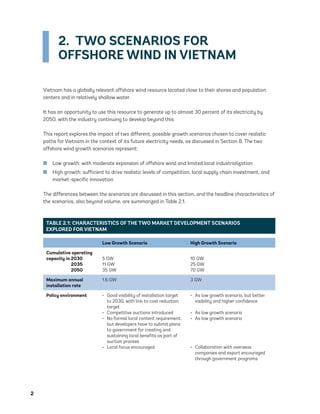
  • 183.
    18.  Port Infrastructure 161 TABLE18.4: PORT ASSESSMENT RESULTS Criteria 1 2 3 4 5 6 7 8 9 10 11 12 13 14 15 Vinashin Shipyard, Van Phong Bay Vietsovpetro Port Tan Cang Cat Lai Terminal Tien Sa Port PTSC Port Tan Cang–Cai Mep Terminal Thi Vai General Port SITV Cam Ranh Port PTSC Phu My Port PTSC Dinh Vu VICT Hiep Phuoc Port Nghe Tinh Duong Dong Port Space— construction port 5 5 5 5 5 5 5 5 5 5 5 5 5 5 3 Space— manufacturing port 5 5 5 5 5 5 5 5 5 5 5 5 5 5 3 Quay length 5 5 5 5 5 5 5 5 5 4 5 5 3 2 1 Quayside UDL/bearing capacity 4 4 3 3 4 3 2 2 3 2 3 3 3 3 2 Storage area UDL/bearing capacity 4 5 4 4 4 3 3 3 4 3 3 4 3 3 3 Channel depth 5 3 5 5 3 5 5 5 5 5 4 5 4 2 5 Channel width 5 3 5 5 3 5 5 5 5 5 4 5 4 2 5 Crane capacity— turbines 4 5 3 2 5 3 3 2 2 3 2 3 2 2 1 Crane capacity— foundations 4 5 3 2 5 3 2 2 2 2 2 3 2 2 1 Overhead clearance 5 5 5 5 5 5 5 5 5 5 5 1 1 5 5 SPMT 4 5 4 4 5 4 3 4 4 4 4 4 4 4 2 Mobile crane 4 5 4 4 5 4 4 4 4 4 4 4 4 4 2 Crawler crane 4 5 4 4 5 4 4 4 4 4 4 4 4 4 2 Other facilities 5 5 4 4 5 4 4 4 2 4 4 4 3 3 1 Construction port rating 42 40 39.6 39.2 39 38.6 37.2 37.2 37.2 36.4 36.2 35.6 29.2 28.2 26.6 Manufacturing port rating 42 40 39.6 39.2 39 38.6 37.2 37.2 37.2 36.4 36.2 35.6 29.2 28.2 26.6 Source: BVG Associates. 75983_ESMAP_Tech Report VM Wind-NEW.indd 161 75983_ESMAP_Tech Report VM Wind-NEW.indd 161 3/19/21 12:25 PM 3/19/21 12:25 PM
  • 184.
    162 19.  PUBLIC FINANCE 19.1 PURPOSE Ifthe support for offshore wind projects comes exclusively through support payments paid for by EVN in PPAs, then the cost of the support in early years is likely to fall on electricity customers. It is worth noting that this does not imply a particular distribution of the burden, as EVN could design arrangements to place more or less of the burden with specific customers (and in other jurisdictions, industries that are particularly exposed to international competition have had a lower proportionate burden placed upon them). Broader public policy can be used to reduce the extent to which initial projects constitute a burden on electricity customers, which may help to increase acceptability of a significant rollout of offshore wind financing. This report section presents a high-level assessment of the potential role of broader public policy (including concessionary finance and climate finance) in the offshore wind rollout in Vietnam. It presents examples where public financial support has been used to enable other types of large infrastructure industries. 19.2 METHOD We have identified relevant financial instruments that could play an enabling role in the development of the Vietnamese offshore wind industry. We have also identified several case studies that show a successful path to utilizing public and concessionary financing in the context of offshore wind. 19.3  OVERVIEW OF POTENTIAL INSTRUMENTS We have developed five categories of financial support that can be used to reduce explicit support payments and so reduce the increase on final customer tariffs from offshore renewables development: ■ Tax and policy incentives, ■ Multilateral lending, ■ Credit enhancement mechanisms, ■ Green debt instruments, and ■ Green equity instruments. Within each of these categories, there are several instrument types that could be used. In the following sections, we discuss the types of instruments available. 75983_ESMAP_Tech Report VM Wind-NEW.indd 162 75983_ESMAP_Tech Report VM Wind-NEW.indd 162 3/19/21 12:25 PM 3/19/21 12:25 PM
  • 185.
    19.  Public Finance 163 Taxand policy incentives There are a number of tax and policy incentives that can be deployed (some of which are already in place for renewable energy projects in Vietnam). The existing incentives include: ■ Import duties: Projects are exempt from import duties applicable to the imported materials, equipment, and facilities which make up the fixed asset base of the renewables project. ■ Corporate income tax: Projects receive corporate income tax (CIT) incentives, including a preferential CIT rate of 10 percent (rather than the 20 percent standard CIT rate) for 15 years, CIT exemption for 4 years, and a reduction of 50 percent for the next 9 years. ■ Land-related incentives: Some exemption or reduction of land taxes, land rents, and water surface rents. These incentives directly lead to cost reductions for developers, reducing the amount they that need to recuperate through revenue. Direct government support to a PPA counterparty (in order to reduce the burden on tariff payers) is another support that would fit under this category and could be considered to support offshore wind in Vietnam. Given the substantial overlap between the energy consumers paying tariffs and taxpayers, these policies are less likely to be effective where the concern is the overall level of affordability to Vietnam as a country. They may have advantages where particular distributional outcomes are more difficult to achieve with the tariff regime than with the tax regime. Multilateral lending The ability of private sector developers to secure finance from multilateral lending agencies (MLAs) such as the International Finance Corporation (IFC), Asian Development Bank (ADB), and European Investment Bank (EIB) can create several benefits in terms of the overall availability of finance and its cost. Participation (in equity or, more typically, debt) from multilateral lenders has several benefits. For sectors they prioritize, they will typically offer a source of lower cost finance. Participation is also likely to increase appetite from other lenders because: ■ They are often willing to take on a larger tranche of financing for early, higher risk projects, ■ Their presence acts as a signal which often increases interest among private institutions, ■ Their environmental and social impact assessment standards such as IFC PS696 ensure that best practice in ESIA is applied, making it easier for other investors to participate, ■ Their due diligence processes are often relied on by others, reducing the cost of participation by private financing parties, and ■ Their participation often comes with other support, either advisory or in terms of credit enhancement. Multilateral lenders may offer concessional loans (loans on more favorable terms than market loans, either lower than standard market interest rates, longer tenures, or a combination of these terms97) which have been used previously in Vietnam. 75983_ESMAP_Tech Report VM Wind-NEW.indd 163 75983_ESMAP_Tech Report VM Wind-NEW.indd 163 3/19/21 12:25 PM 3/19/21 12:25 PM
  • 186.
    164 Offshore WindRoadmap for Vietnam One example of such a program is the HD Bank solar power program worth US$299 million, which was set up to finance solar power projects in Vietnam. Its loans are intended to offer up to 70 percent of a project’s total investment capital for a maximum loan period of 12 years. Where there are particular areas of priority, MLAs may also participate at the equity level in projects (or provide convertible debt). Again, this can act as a means to ensure there is available finance, in particular in relation for up-front development costs prior to debt financing being available. Credit enhancement mechanisms Credit enhancement mechanisms are tools used to improve the credit risk profile of a business (that is improve its creditworthiness), which should lead to reductions in financing costs. These credit enhancement mechanisms can be deployed by national entities, or as part of the participation in a project by a multilateral lender. We note that some of the credit enhancement mechanisms (such as political risk guarantees) may overlap with some of our suggestions of risk mitigation solutions discussed in Section 15. The following subsections provide examples of credit enhancement mechanisms that have been previously implemented in Vietnam and list other mechanism types that may be considered. Partial risk guarantees A credit guarantee may be created to absorb part or all of the debt service default risk of a project, regardless of the reason for default. This will reduce the cost of financing for a developer, which should then reduce the tariff required by the developer to pay its financing costs. The government, through the Vietnam Development Bank, provides partial guarantees of up to 70 percent of total investment capital for renewable energy projects. Similarly, the Vietnam Scaling Up Energy Efficiency Project (funded by the World Bank and the Green Climate Fund) offers a risk sharing facility that provides partial credit guarantees to participating financial institutions to cover potential loan defaults on loans provided by the institutions to finance eligible energy efficiency subprojects.98 Partial risk guarantees may also cover private lenders for some of the risks associated with lending to sovereign or sub-sovereign borrowers, including the risks of repatriation, expropriation, and regulatory risk. In 2015, the Multilateral Investment Guarantee Agency (MIGA, the political risk insurance and credit enhancement arm of the World Bank Group) issued a US$39.7 million guarantee to several lenders. The loan was guaranteed by the Ministry of Finance (MOF) to support the construction of a hydropower plant in Vietnam which was to produce and sell electricity to EVN under a PPA. The guarantee covers the risk of non-honoring of sovereign financial obligations in respect of the government’s repayment guarantee to the lenders for 15 years.99 Given the number of political and regulatory risks identified within the existing PPA framework, the government may consider whether to leverage its existing relationships with MIGA and other potential guarantors to attract international investment to the offshore wind sector. 75983_ESMAP_Tech Report VM Wind-NEW.indd 164 75983_ESMAP_Tech Report VM Wind-NEW.indd 164 3/19/21 12:25 PM 3/19/21 12:25 PM
  • 187.
    19.  Public Finance 165 Othercredit enhancement mechanisms There are a number of other credit enhancement mechanisms which help to mitigate risks for investors, such as currency swap risks associated with cross-border transactions or the performance risk that efficiency solutions will not achieve a certain level of energy savings. While there are a range of credit enhancement mechanisms available, the most effective mechanisms will address the largest risks which have not been addressed in the structure of the PPA arrangement. This risk reduction will allow developers to access cheaper financing, which should reduce the required FIT and lessen the tariff burden on consumers. Green debt instruments Green debt instruments are bonds or securities issued to fund projects or assets that have a positive environmental or climate impact. These bonds can be issued either by public or private actors, and may bring the following benefits: ■ Enhancements to the issuer’s reputation, as green bonds serve to enhance their commitment to environmental goals or targets, ■ They require good standards of ESIA to be applied, ■ Investor diversification, as there is a growing pool of capital earmarked for green projects. Thus, the issuer can access investors who may not have been interested in purchasing a regular bond, and ■ Potential pricing advantages if the wider investor base allows the issuer to get better pricing terms on a green bond than on a regular bond, though evidence to support the existence of a pricing advantage is mixed. Green bonds have so far not been used to support renewable energy in Vietnam, though they have been used to support water resource management projects. In 2016, the Vietnam Ministry of Finance approved a pilot project for municipal green bonds. Following this approval, the People’s Committee of Ba Ria Vung Tau Province sold US$4 million five-year green bonds to finance a water resource management project. Green bonds have also been issued by Ho Chi Minh City Finance and Investment State Owned Company, which issued US$23 million in 15-year green bonds to fund 11 water and adaptation infrastructure projects. To support the offshore sector, Vietnam could consider adopting an international definition of a ‘green’ project so that it could label infrastructure projects that meet the criteria, such as offshore wind projects, with the ‘green’ label. This would help to facilitate increased access to international capital markets for the private developers of these projects, helping to accelerate the development of the offshore wind industry by reducing the costs of finance. This could reduce the cost of finance for offshore projects, and so reduce the level of charges to energy consumers through their tariffs. 75983_ESMAP_Tech Report VM Wind-NEW.indd 165 75983_ESMAP_Tech Report VM Wind-NEW.indd 165 3/19/21 12:25 PM 3/19/21 12:25 PM
  • 188.
    166 Offshore WindRoadmap for Vietnam Green equity instruments Green equity instruments relate to equity issuances by a company where the capital raised is to be used specifically for projects that have a positive environmental impact. There are three forms of green equity instruments which have previously been used in Vietnam: ■ Public-private partnership (PPP), involving a long-term contract between a public entity and a private party that is used to deliver infrastructure or services, ■ Joint venture, involving an agreement between two or more businesses that pool their capital, skills, and resources for a specific project, and ■ Private equity, that is equity issued by a developer or business to fund specific projects. Of these equity instruments, the most relevant policy option from the government’s perspective will be the PPP. Vietnam has a history of using PPPs in sectors such as transport, power and energy, and water supply, sewage, and the environment in order to mobilize private capital to invest in needed infrastructure. For example, the Duong River Surface water treatment plant has been run through a PPP between a private water company and the municipal authorities since 2006. The government has recently submitted a draft of a new proposed law on PPPs. This signals both that it is keen to continue using PPPs to drive investment in infrastructure and services and that it recognizes that improvements to the PPP framework may attract more foreign investment. To do this, the government should ensure that the law spreads the risk between parties such that it will provide enough benefits to private companies to encourage foreign investment, while also ensuring that the environmental and infrastructure needs of Vietnam can be met. If some offshore wind projects were partly financed through PPPs, it should ultimately reduce the tariff impact by reducing the financing costs for developers. Summary To support the development of offshore wind, Vietnamese customers will have to support the difference between its costs and the cost of electricity produced by other means. There are actions which Vietnam can take to reduce the cost of offshore wind development. Some national policies (for example reducing duties) can transfer the cost from customers to taxpayers and could be considered. A higher priority should be the encouragement of participation in projects by multilateral lenders, the deployment (by national or multilateral lenders) of credit enhancement mechanisms, and the adoption of green standards. This can reduce the cost of financing offshore wind by encouraging greater competition in finance, or by achieving a more efficient allocation of financing risks (for example, credit default). A significant reduction in the cost of offshore wind finance will lead to a material reduction on the overall cost of offshore wind—and hence in the end to lower cost for Vietnamese electricity customers. 75983_ESMAP_Tech Report VM Wind-NEW.indd 166 75983_ESMAP_Tech Report VM Wind-NEW.indd 166 3/19/21 12:25 PM 3/19/21 12:25 PM
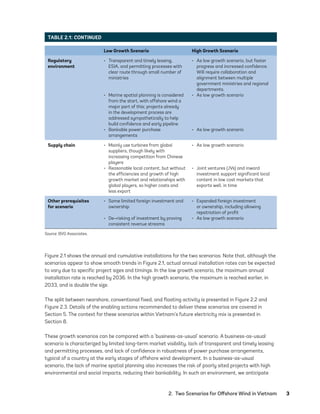
  • 189.
    167 20.  SPATIAL MAPPING 20.1 PURPOSE Thepurpose of this section is to present an overview of the publicly available spatial data relating to environmental, social, and technical constraints that may impact prospective offshore wind development in Vietnam. This section was authored by the WBG ESMAP team, with input on methodology and data from BVG Associates. The maps presented in this section are intended to inform readers of the potential constraints and site characteristics within, and in proximity to, offshore areas that are technically suited to fixed and floating offshore wind development. These maps supplement the high-level spatial mapping work undertaken by the Danish Energy Agency7 but, unlike the DEA study, do not identify or delineate sites or zones for offshore wind. It is important to realize that only a few spatial data sets are provided in this work, and many additional constraints and characteristics need to be considered when planning offshore wind projects. These maps serve as a preliminary snapshot of potential constraints to offshore wind development and provide a basis for a future expanded marine spatial plan for Vietnam. As stated in Section 5 and Section 13, we recommend that a marine spatial plan is developed to identify areas and sites that have a low probability of constraint or conflict for offshore wind deployment. 20.2 METHOD The figures in this section provide the outputs of work to identify and collect data sets from public sources and internal WBG data libraries. Where possible, we have identified the existence of data sets that could not be obtained. Three categories of maps are included in this section: ■ Technical potential, ■ Environmental, social, and technical constraints, and ■ Levelized cost of energy. The following subsections describe the methods used in the creation of the maps for these three categories. Technical potential Outputs from ESMAP’s analysis of technical potential for offshore wind in Vietnam were used in this section. The analysis was originally described and published in the Going Global: Expanding Offshore Wind to Emerging Markets report100 which estimated Vietnam’s ‘technical potential’ to be 261 GW for fixed foundation and 214 GW for floating foundation offshore wind technologies. 75983_ESMAP_Tech Report VM Wind-NEW.indd 167 75983_ESMAP_Tech Report VM Wind-NEW.indd 167 3/19/21 12:25 PM 3/19/21 12:25 PM
  • 190.
    168 Offshore WindRoadmap for Vietnam Technical potential mapping is defined as the maximum possible installed capacity as determined by wind speed and water depth. Annual average wind speeds (at 100 m height) exceeding 7 (m/s) are considered viable for offshore wind, and water depths of up to 60 m and up to 1,000 m are considered viable for fixed and floating foundations, respectively. The data sets used in this analysis were: ■ The Global Wind Atlas v3.0, released in 2019 and produced by DTU and World Bank, was used for the annual average wind speeds, and ■ The General Bathymetric Chart of the Oceans (GEBCO) was used for water depths. A full description of the methodology for this analysis, including the assumptions made, is given in the original report.100 The analysis of technical potential does not consider many other factors that could influence the planning and siting of offshore wind projects, including environmental, social, and economic constraints. To better understand the potential for offshore wind, these additional factors need to be considered. Environmental, social, and technical constraints The environmental, social, and technical constraints mapping provides additional context about the known locations of environmentally sensitive areas, and important land and coastal infrastructure. Most data sets identified are global data sets which include data covering Vietnam. Table 20.1 provides a list of the spatial datasets and sources that were included in this constraints mapping activity. No reliable data sets were obtained for the following social and technical constraints: ■ Offshore oil and gas activity and pipelines, ■ Subsea telecoms and power cables, ■ Wrecks and historic offshore sites, ■ Military and danger areas, ■ Offshore disposal sites, ■ Aggregate and material extraction areas, ■ Marine aquaculture, ■ Commercial fisheries, ■ Important tourism and recreation areas, and ■ Historical, religious, and culturally significant sites. Limited environmental data exist for Vietnam’s waters, and only a few global data sets were included in the spatial mapping. Future spatial analysis as part of a country-scale marine spatial planning exercise will need to consult stakeholders, identify relevant existing data, and gather data on prioritized biodiversity aspects101 to better understand Vietnam’s onshore, coastal, and offshore ecosystems. In addition to the constraints map, two additional maps are provided to illustrate shipping traffic intensity102 and extreme wind speeds.103 75983_ESMAP_Tech Report VM Wind-NEW.indd 168 75983_ESMAP_Tech Report VM Wind-NEW.indd 168 3/19/21 12:25 PM 3/19/21 12:25 PM
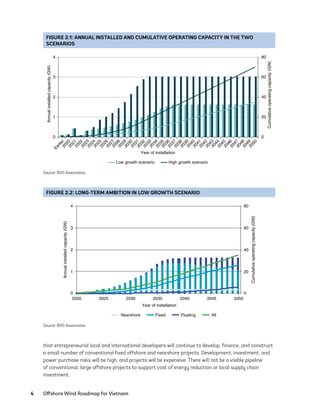
  • 191.
    20.  Spatial Mapping 169 Levelizedcost of energy Certain characteristics of a site will have a large influence on the cost of energy that would result if a project were constructed at that location. The site parameters that have the most influence on cost of energy are: ■ Wind speed, ■ Water depth, ■ Distance to construction port, ■ Distance to operation port, and ■ Distance to grid. These site parameters were used along with an assumed set of reference project characteristics, as shown in Table 20.2, and functions of typical project costs from BVG Associates as inputs into a technoeconomic model which was used to estimate the spatial distribution of the relative levelized cost of energy (LCOE) for a reference project in Vietnam’s waters. The wind speed and water depth spatial data sets used were the same as for the technical potential mapping; the Global Wind Atlas v3.0 (GWA), and the General Bathymetric Chart of the Oceans (GEBCO). For the cost analysis we also used the following simple scaling proxies. TABLE 20.1: SPATIAL DATA LAYERS INCLUDED IN THE CONSTRAINT MAPPING Data Layer Notes Data Source Airports Regions around airports may need to be avoided to reduce radar impacts Openflights 2020 Anchorages Regions designated for vessel anchorage Global Fishing Watch Ports Locations and size of ports Humdata Power plants Locations of existing power generation plant World Resources Institute Key Biodiversity Areas Areas of international importance in terms of biodiversity conservation IBAT UNESCO World Heritage Sites Culturally significant sites which are potentially sensitive to development UNESCO 2019 World Database on Protected Areas (WDPA) Data set summarizing different types of protected areas around the globe WDPA Ramsar sites Wetlands of international importance UNESCO Ecologically or biologically significant marine areas Internationally agreed marine areas of importance CDB Exclusive Economic Zones (EEZ) Internationally recognized marine boundaries Marine Eco Regions Fixed foundation technical potential Water depths < 50 m, Annual average 100 m height wind speeds above 7 m/s Energydata.info Floating foundation technical potential Water depths < 1,000 m, Annual average 100 m height wind speeds above 7 m/s Energydata.info Shipping density Annual route density–routes per 5 km2 per year Marine Traffic Maximum sustained windspeed Extreme winds; stated in knots for a 10 minute averaging period, observed at a 10 m height NOAA IBTrACS Source: BVG Associates. 75983_ESMAP_Tech Report VM Wind-NEW.indd 169 75983_ESMAP_Tech Report VM Wind-NEW.indd 169 3/19/21 12:25 PM 3/19/21 12:25 PM
  • 192.
    170 Offshore WindRoadmap for Vietnam Distance to construction port (D′)—we adjusted shortest distance to shore (D) as follows: ■ D′ (km) = (D2 + 402)1/2 to reflect the fact that there are limited ports available that are suited to support construction activities. Project specific analysis could consider the location of specific viable construction ports. ■ Distance to operation port: assumed to be equal to the shortest distance to shore as, typically, there are many ports that can be used for OMS activities. ■ Distance to grid connection: assumed to be equal to the shortest distance to shore plus 20 km. We constrained water depth to less than 1,200 m to rule out the most challenging of the floating offshore wind sites. We assumed floating foundations for sites with water deeper than 60 m. In practice, the cutoff between fixed and floating depths will be determined on a project-by-project basis. We constrained distance to shore to less than 200 km to rule out sites where novel transmission infrastructure or alternative energy conversion would be needed. This was also the limit of the GWA wind speed data set. As the LCOE of projects is so sensitive to numerous parameters, it is not appropriate to use this simplified approach to estimate the absolute LCOE of projects at different locations across Vietnam’s waters. Instead, we have provided the LCOE as an indicative and relative metric, purely to identify the areas around Vietnam that may support projects with lower LCOE than others. 20.3  RESULTS AND DISCUSSION Technical potential Vietnam has a high technical potential for offshore wind, with a potential energy resource that far exceeds the country’s energy demand. Extracting even a small fraction of this resource could significantly contribute to Vietnam’s future energy mix. The map shown in Figure 20.1 is taken from TABLE 20.2: ASSUMED CHARACTERISTICS OF THE REFERENCE WIND FARM PROJECT USED IN THE MODELLING Property Value Year of FID 2027 Turbine rating (MW) 15 Turbine rotor diameter (m) 230 Turbine hub height (m) 150 Project size (MW) 500 Lifetime (years) 30 Weighted average cost of capital (WACC) 5% Foundation type (as function of water depth) Monopile: < 35 m Jacket: 35–60 m Floating: > 60 m Transmission type (as function of distance to shore) HVAC (< 130 km) HVDC (> 130 km) Operations, Maintenance and Service (OMS) strategy (as function of distance to OMS port) CTV (< 80 km) SOV (> 80 km) Source: BVG Associates. 75983_ESMAP_Tech Report VM Wind-NEW.indd 170 75983_ESMAP_Tech Report VM Wind-NEW.indd 170 3/19/21 12:25 PM 3/19/21 12:25 PM
  • 193.
    20.  Spatial Mapping 171 previousWBG analysis,104 noting that this previous work assumed 50 m depth to be the lower water depth limit for floating wind. Figure 20.1 shows that Vietnam has two main areas that are most technically suited to offshore wind development: ■ The northern waters in the Gulf of Tonkin offer reasonable mean wind speeds, typically 7.5 to 8.5 m/s at 100 m height. The large shallow region close to Hanoi and the coastal load centers may offer some attractive sites for fixed offshore wind development. ■ The southeastern waters offer even more energetic wind resource, with mean wind speeds exceeding 9.5 m/s at 100 m height over a range of water depths suited to fixed and floating wind. The proximity of this area to Ho Chi Minh City and other load centers in the south could reduce transmission requirements for projects in this region. Due to the substantially higher wind speeds in the south, this region is likely to, initially, be the main focal point for further investigations of offshore wind development in Vietnam’s waters. FIGURE 20.1: VIETNAM’S FIXED AND FLOATING OFFSHORE WIND TECHNICAL POTENTIAL Source: ESMAP. 2021. Going Global: Expanding Offshore Wind to Emerging Markets (Vol. 50): Technical Potential for Off- shore Wind in Vietnam—Map (English). Washington, DC: World Bank Group. http://documents.worldbank.org/curated/ en/340451572465613444/Technical-Potential-for-Offshore-Wind-in-Vietnam-Map 75983_ESMAP_Tech Report VM Wind-NEW.indd 171 75983_ESMAP_Tech Report VM Wind-NEW.indd 171 3/19/21 12:25 PM 3/19/21 12:25 PM
  • 194.
    172 Offshore WindRoadmap for Vietnam Environmental, social, and technical constraints The following maps show some of the environmental, social, and technical constraints that need to be considered when planning the siting and development of offshore wind projects. Figure 20.2 shows the spatial data sets summarized in Table 20.2 in relation to the technical potential areas for fixed and floating wind. We were not able to obtain all relevant offshore spatial data, so much of the information shown relates to onshore or coastal characteristics. It is important to realize that, although these maps suggest there are few constraints in Vietnam’s waters, this assessment does not capture many other relevant environmental and social receptors. This is often due to a lack of data, as there has been limited research and data collection in the offshore waters of Vietnam, to date. These data gaps will need to be filled by future surveys to study the baseline environmental and social conditions that are relevant to offshore wind development. The northern region of Vietnam’s waters, which has good offshore wind potential, is close to some environmentally sensitive areas. Figure 20.3 shows the region around Ha Long Bay, which has a combination of protected areas and ecologically significant areas. Although it may not be interesting to locate offshore wind projects within these areas (as the wind speeds are too low), offshore projects that seek to connect to the 500 kV transmission grid will need to consider the impacts of laying subsea cables through this region. The northern region also features a number of coal power stations along the coast. Older coal plants that are set to close in the near future could offer good grid connection opportunities for offshore wind project development. The southeastern regions of Vietnam’s waters, shown in Figure 20.4, offer the most technically suitable conditions for offshore wind development due to the mean high wind speeds and areas of shallower water, suited to fixed foundation offshore wind turbines. The spatial data sets we collected do not show many offshore constraints in this region; however, no data on important biodiversity receptors (birds, mammals, fish, etc.) or important social receptors (fisheries, indigenous populations, etc.) were collected, so this mapping does not present a complete picture. As with the northern region, both high voltage transmission lines and population/load centers can be found close to the areas of offshore wind resource. This could provide opportunities to minimize the transmission required for offshore wind projects in this region. The area around Phú Quý Island in Bình Thu^ ąn Province is a protected area due to the biodiversity on and surrounding the island. Given the likely proximity of projects to this island, it will be important to consider the potential impacts of any developments on this protected area. Although not a typical constraint to offshore wind developments, extreme wind speeds are an important consideration in the planning and design of projects. Vietnam is prone to typhoons, and the extreme wind speeds that can result from these storms could necessitate the use of ‘typhoon class’ wind turbines. Figure 20.5 shows the maximum sustained wind speeds around Vietnam as estimated by NOAA.103 Wind speeds are stated in knots for a 10 minute averaging period, observed at a 10 m height. Northern waters are more susceptible to higher wind speeds, potentially exceeding 80 knots (~41 m/s), whereas southern waters are at lower risk. 75983_ESMAP_Tech Report VM Wind-NEW.indd 172 75983_ESMAP_Tech Report VM Wind-NEW.indd 172 3/19/21 12:25 PM 3/19/21 12:25 PM
  • 195.
    20.  Spatial Mapping 173 FIGURE20.2: MAP OF CONSTRAINTS AND RELEVANT INFRASTRUCTURE Source: World Bank (using data from Table 20.1). 75983_ESMAP_Tech Report VM Wind-NEW.indd 173 75983_ESMAP_Tech Report VM Wind-NEW.indd 173 3/19/21 12:25 PM 3/19/21 12:25 PM
  • 196.
    174 Offshore WindRoadmap for Vietnam FIGURE 20.4: CONSTRAINTS MAP FOR SOUTHERN VIETNAM CLOSE TO HO CHI MINH CITY Source: World Bank (using data from Table 20.1). Note: See Figure 20.1 for legend. FIGURE 20.3: CONSTRAINTS MAP OF THE NORTHERN REGION CLOSE TO HANOI Source: World Bank (using data from Table 20.1). Note: See Figure 20.1 for legend. 75983_ESMAP_Tech Report VM Wind-NEW.indd 174 75983_ESMAP_Tech Report VM Wind-NEW.indd 174 3/25/21 12:52 PM 3/25/21 12:52 PM
  • 197.
    20.  Spatial Mapping 175 FIGURE20.5: MAXIMUM SUSTAINED WIND SPEEDS AROUND VIETNAM Source: United Nations Office of Disaster Risk Reduction (UNDRR). 75983_ESMAP_Tech Report VM Wind-NEW.indd 175 75983_ESMAP_Tech Report VM Wind-NEW.indd 175 3/25/21 12:52 PM 3/25/21 12:52 PM
  • 198.
    176 Offshore WindRoadmap for Vietnam Shipping routes are important to consider when siting offshore wind projects. Larger vessels, in particular, cannot pass through an offshore wind farm and would need to chart a course around projects. Smaller vessels may be able to transit through a wind farm but there is a risk of collision with the offshore structures. A navigational risk assessment needs to be carried out when planning a project and, in general, major shipping routes should be avoided. Figure 20.6 shows the typical shipping density around Vietnam for vessels fitted with AIS105 (Automatic Identification System). The data were compiled, analyzed, and published by Marine Traffic.102 Areas colored orange and red indicate a greater amount of shipping activity. The area along Vietnam’s southern coast appears to be heavily trafficked. Siting projects in this shipping route should therefore be avoided in order to reduce the risk of collision. Consultation with Vietnam’s maritime authorities and shipping stakeholders is needed to further explore this potential constraint. Figure 20.6 also shows significant vessel activity around the offshore hydrocarbon wells in the southern waters. Although the locations of the offshore hydrocarbon infrastructure were not available for this work, the locations of pipelines, wells, and platforms will need to be considered when planning projects, as well as the vessel activity associated with this infrastructure. Levelized cost of energy The cost of energy from offshore wind is an important factor in determining the viability of projects and different sites. The wind speed is perhaps the most critical factor, as this determines the potential energy yield. Section 20.2 describes the headline methodology used to develop a layer which shows the spatial distribution of relative LCOE in Vietnam’s waters. Figure 20.7 shows the relative LCOE for a 500 MW fixed or floating reference project in Vietnam’s waters. This analysis is only intended to be an indicative guide as to which areas are likely to have projects with the lowest cost of energy. The distribution of LCOE follows trends that are present in the technical potential mapping. Areas with high wind speeds, shallower waters, and closer to shore and ports, are likely to have lower LCOE. In particular, the northern region of Vietnam’s waters has an area with comparatively low LCOE; however, the region in the southeast of Vietnam’s waters offers more areas that are likely to have low LCOE fixed and floating wind projects. 75983_ESMAP_Tech Report VM Wind-NEW.indd 176 75983_ESMAP_Tech Report VM Wind-NEW.indd 176 3/19/21 12:25 PM 3/19/21 12:25 PM
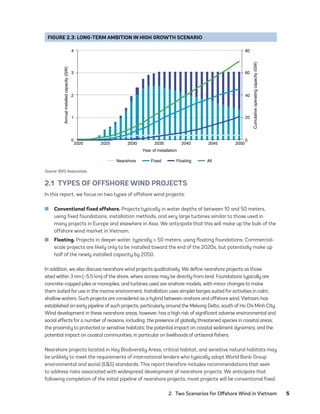
  • 199.
    20.  Spatial Mapping 177 FIGURE20.6: SHIPPING ACTIVITY IN THE WATERS AROUND VIETNAM Source: Marine Traffic. 75983_ESMAP_Tech Report VM Wind-NEW.indd 177 75983_ESMAP_Tech Report VM Wind-NEW.indd 177 3/19/21 12:25 PM 3/19/21 12:25 PM
  • 200.
    178 Offshore WindRoadmap for Vietnam FIGURE 20.7: RELATIVE LEVELIZED COST OF ENERGY FOR A REFERENCE PROJECT IN VIETNAM’S WATERS Source: BVG Associates. 75983_ESMAP_Tech Report VM Wind-NEW.indd 178 75983_ESMAP_Tech Report VM Wind-NEW.indd 178 3/19/21 12:25 PM 3/19/21 12:25 PM
  • 201.
    20.  Spatial Mapping 179 20.4 DISCUSSION Thesemaps show that large areas of Vietnam’s territorial waters are likely to be well suited to offshore wind development. Some areas, particularly in the southeast, have high wind speeds and are close to the onshore transmission grid as well as load centers. The spatial information presented in this section does not provide a complete picture of the environmental, social, economic, and technical constraints for offshore wind development. There are numerous data gaps and further data gathering is needed to better understand the risks associated with different sites. As this study was not able to collect all relevant data from stakeholders, including the locations of offshore hydrocarbon infrastructure, the data could come from existing sources. Where data do not already exist, such as the distributions and behaviors of seabirds for example, physical surveys will be required to gather primary data. This should all be compiled into a marine spatial plan for Vietnam’s waters, so that multiple stakeholders and marine users can be considered at a countrywide, strategic level. This will help to plan projects that are considered acceptable by consenting authorities when they undergo project-level ESIA. 75983_ESMAP_Tech Report VM Wind-NEW.indd 179 75983_ESMAP_Tech Report VM Wind-NEW.indd 179 3/19/21 12:25 PM 3/19/21 12:25 PM
  • 202.
    180 21.  DOWNSTREAM STUDIES 21.1 PURPOSE Inthis section, we present options and costs for predevelopment studies and broader industry enablement work should the government choose to take responsibility for this. We also consider studies that will progress the recommendations presented in Section 5. Finally, we also cover capacity building and training within stakeholders to deliver regulatory responsibilities. This is important as it is valuable to understand what costs are involved and what planning is needed in order that the industry progresses. Costs may also be used as an evidence base to inform potential applications for climate finance (grant funding) by the government to funding organizations, including the World Bank, to enable effective development of an offshore wind pipeline. Costs are high-level estimates only. 21.2 METHOD In assessing costs and resources, we have assumed development and installation is in line with the high growth scenario. We consider costs in the context of: 1. A centralized one-stage approach, and 2. A decentralized two-stage approach to leasing and PPAs, as discussed in Section 14. At this stage, we have not engaged beyond European contacts with experience of different approaches. We have not discussed with stakeholders in Vietnam. In calculating costs to 2030, we assume an average project size of 500 MW, that a total of 20 projects have been through the development process to the point of construction, and that a further 10 projects have reached a mature stage of development. 21.3 RESULTS We have identified 11 areas where significant costs may be incurred. These are listed in Table 21.1. 75983_ESMAP_Tech Report VM Wind-NEW.indd 180 75983_ESMAP_Tech Report VM Wind-NEW.indd 180 3/19/21 12:25 PM 3/19/21 12:25 PM
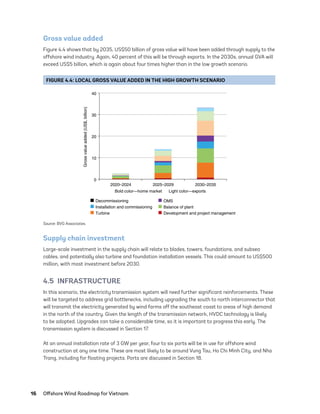
  • 203.
    21.  Downstream Studies 181 TABLE21.1: SUMMARY OF COSTS FOR DOWNSTREAM ACTIVITIES UNDER HIGH GROWTH SCENARIO # Description Setup Costs (US$m) Typical Cost per 500 MW Project (US$m) Number of Projects by 2030 Cost to 2030 (US$m) Used in Which Approach? 1 Strategic sensitivity mapping and verifying development zones • Relevant to recommendations 3 and 4 • Includes environmental and physical surveys, including bird species, migration routes, and marine mammals, Data analysis and consultation with stakeholders, communities, and industry 10 N/A N/A 10 1 and 2 2 Early stage project development up to consent— pre-FEED and ESIA • Relevant to recommendations 3 and 4 • Includes environmental and physical surveys, engineering design work, data analysis, and consultation with stakeholders, communities, and industry. This might include wind resource, metocean, and geophysical seabed data collection 5 10 30 305 1 3 Permitting—management • Relevant to recommendation 5 • Includes setting up and ongoing management of leasing and permitting authorities and ongoing technical reviews of ESIAs 2 1 30 32 1 and 2 4 Permitting—stakeholder input • Relevant to recommendation 5 • Includes liaison between government authorities and relevant stakeholders in the context of assessing projects N/A 0.5 30 15 1 and 2 5 Stakeholder support and education • Relevant to recommendation 5 • Includes providing resources to stakeholders to equip them to deal with offshore wind applications, and increasing awareness about offshore wind 1.0 N/A N/A 1.0 1 and 2 6 Auction—design • Relevant to recommendations 6, 8, 9, and 10 • Includes work to determine best approach to competitive processes for leases and PPAs, and design of competitions 1 N/A N/A 1 1 and 2 7 Auction—management • Relevant to recommendations 6 and 7 • Includes costs associated with running auction competitions N/A 0.5 30 15 1 and 2 (continues) 75983_ESMAP_Tech Report VM Wind-NEW.indd 181 75983_ESMAP_Tech Report VM Wind-NEW.indd 181 3/19/21 12:25 PM 3/19/21 12:25 PM
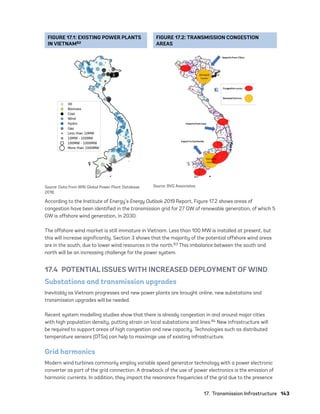
  • 204.
    182 Offshore WindRoadmap for Vietnam # Description Setup Costs (US$m) Typical Cost per 500 MW Project (US$m) Number of Projects by 2030 Cost to 2030 (US$m) Used in Which Approach? 8 Transmission planning • Relevant to recommendations 12 and 13 • Includes technical analysis, engineering design, financial planning, and permitting 4 0.5 30 19 1 and 2 9 Skills assessment and workforce training Relevant to recommendations 16 and 17 Includes costs to liaise with supply chain to understand skills gaps and shortages and delivering training programs 2 N/A N/A 2 1 and 2 10 International collaboration Includes costs for outreach to international partners to identify and deliver joint industry research and investment programs 2 N/A N/A 2 1 and 2 11 Creating and implementing H&S, design, and grid codes Relevant to recommendations 19 and 20 Includes costs to research, define, and manage required codes and standards 2 0.1 30 5 1 and 2 Source: BVG Associates. TABLE 21.1: CONTINUED 75983_ESMAP_Tech Report VM Wind-NEW.indd 182 75983_ESMAP_Tech Report VM Wind-NEW.indd 182 3/19/21 12:25 PM 3/19/21 12:25 PM
  • 205.
    183 22. STAKEHOLDERS A key goalof the project is to establish a strong network of industry stakeholders whose views and collaboration will aid development and socialization of the offshore wind roadmap for Vietnam. The key stakeholders that have been identified are listed in Table 22.1 under four headings: ■ Government: government departments, regulators, and institutions at national and regional levels. ■ Developers: offshore wind project developers known to be active in Vietnam. ■ Supply chain: supply chain businesses known to be active in offshore wind in Vietnam, or those with potential to provide services. ■ Nongovernmental organizations (NGOs): national and international nongovernmental organizations with an interest in offshore wind in Vietnam. As part of the preparation of this roadmap, an open consultation exercise was undertaken in September and October 2020. The roadmap was presented at a joint government and industry webinar, and a consultation draft of the report was publicly available for download and feedback. TABLE 22.1: KEY STAKEHOLDERS Name Role Government Electricity Regulatory Authority of Vietnam (ERAV) Regulator of the electricity industry in Vietnam Electricity and Renewable Energy Authority (EREA) A department of MOIT with responsibility for renewable energy in Vietnam Department of Planning and Investment (DPI) Regional level departments with responsibility for economic planning Institute of Aquaculture, Cau Mau Public research institute Institute of Ecology and Biological Resources Public research institute Institute of Biotechnology and Environment, Nha Trang University Public research institute Institute of Energy Research institute responsible for the formulation of energy and power strategies, policies, and masterplans Institute of Oceanography Public research institute Ministry of Finance (MOF) National-level government ministry with responsibility for managing state finances Ministry of Industry and Trade (MOIT) National-level government ministry responsible for the regulation, management, and growth of industry and trade in Vietnam (continues) 75983_ESMAP_Tech Report VM Wind-NEW.indd 183 75983_ESMAP_Tech Report VM Wind-NEW.indd 183 3/19/21 12:25 PM 3/19/21 12:25 PM
  • 206.
    184 Offshore WindRoadmap for Vietnam Name Role Ministry of Natural Resources and Environment (MONRE) National-level government ministry responsible for the management, surveying, and mapping of the environment and natural resources in Vietnam Ministry of Planning and Investment (MPI) National-level government ministry with responsibility for economic planning Ministry of Transport (MOT) National-level government ministry responsible for rail, road, and water transport in Vietnam National Power Transmission Corporation (NPTC) Responsible for managing the national power transmission grid in Vietnam, at voltages of 110 kV and above. The National Load and Dispatch Centre (NLDC) is responsible for grid balance and control. NPTC is a department of EVN Provincial People’s Committee (PPC) An executive arm of the provincial government. The PPC is responsible for implementing policy at the provincial level. It oversees the province’s departments Research Institute of Marine Fisheries in Hai Phong Public research institute University of Science Public research institute, part of the Vietnam National University in Hanoi Vietnam Administration of Seas and Islands (VASI) A public scientific organization. The institute undertakes marine science research and develops strategies and policies relating to the marine environment Vietnam Electricity (EVN) The national electricity corporation of Vietnam. It owns the majority of power generation In Vietnam and has five regional subsidiaries (North Power Corporation, Central Power Corporation, South Power Corporation, Hanoi Power Corporation, and Ho Chi Minh City Power Corporation) Vietnam Institute of Fisheries Economics and Planning (VIFEP) Government institute with responsibility for the planning, growth, and regulation of the commercial fishing industry Provincial department level stakeholders for lease and permitting Provincial departments have specific roles in the project leasing and permitting processes Developers Bac Thuong Vietnamese developer Cong Ly Vietnamese developer Copenhagen Offshore Partners (COP) European developer with interest in offshore wind in Vietnam, funded by Copenhagen Infrastructure Partners EnBW European developer with interest in offshore wind in Vietnam Enterprize Energy Independent European developer with interest in offshore wind in Vietnam Gai Lai Vietnamese developer Macquarie/GIG Independent developer with interest in offshore wind in Vietnam Mainstream Renewable Power Independent European developer with interest in offshore wind in Vietnam Super Wind Vietnamese developer WPD Independent European developer with interest in offshore wind in Vietnam Supply chain Alpha ECC Supply chain business CS Wind Supply chain business GE International offshore wind turbine supplier Hai Duong Supply chain business TABLE 22.1: CONTINUED 75983_ESMAP_Tech Report VM Wind-NEW.indd 184 75983_ESMAP_Tech Report VM Wind-NEW.indd 184 3/19/21 12:25 PM 3/19/21 12:25 PM
  • 207.
    22. Stakeholders 185 Name Role Huy HoangLogistic & Transportation Supply chain business Joint Venture Vietsovpetro Supply chain business MHI Vestas International offshore wind turbine supplier PetroVietnam Construction Supply chain business PTSC Geos & Subsea Services Supply chain business PTSC Mechanical & Construction Supply chain business PTSC Offshore Services Supply chain business SGRE International offshore wind turbine supplier NGOs BirdLife International Global partnership of nongovernmental organizations that strives to conserve birds and their habitats Centre for Biodiversity Conservation and Endangered Species Nonprofit research foundation Danish Energy Ministry (DEA) The Danish Energy Agency is responsible for energy policy and regulation in Denmark and efforts to reduce carbon emissions, including the delivery of international renewable energy programs. The DEA is delivering a parallel program to the WBG roadmap in Vietnam, with a complimentary scope of works Flora and Fauna International (FFI) Vietnam Nonprofit research foundation Global Wind Energy Council (GWEC) The international trade association for the wind power industry. GWEC is active in Vietnam GIZ GIZ is a German international development agency. In Vietnam they deliver a renewable energy industry support program on behalf of MOIT International Union for Conservation of Nature Nonprofit research foundation Marine Research Institute Nonprofit research foundation Spoon-billed Sandpiper Task Force Nonprofit research and advocacy organization Vietnam Institute for Energy Transition (VIET) An independent think tank, VIET undertakes policy research and delivers expert advisory services and training in relation to the energy transition in Vietnam Vietnam Association of Seafood Exporters and Producers (VASEP) Trade body representing the commercial fishing industry in Vietnam Viet Nature Conservation Centre Nonprofit research and advocacy organization Wildlife Conservation Society (WCS) Nonprofit research and advocacy organization WWF Greater Mekong Project Nonprofit research and advocacy organization Source: BVG Associates. TABLE 22.1: CONTINUED 75983_ESMAP_Tech Report VM Wind-NEW.indd 185 75983_ESMAP_Tech Report VM Wind-NEW.indd 185 3/19/21 12:25 PM 3/19/21 12:25 PM
  • 208.
    186 ENDNOTES 1All figures arecumulative over the period 2020 to 2035, unless stated. The fraction of electricity supply is discussed in Sections 3.2 and 4.2. Offshore wind capacity operating is discussed in Section 2. Electric- ity produced is discussed in Sections 3.3 and 4.3. Net cost to consumers is discussed in Sections 3.3, 4.3, and 7.1. Local jobs and gross value added (GVA) are discussed in Sections 3.4, 4.4, and 11. CO2 avoided is discussed in Section 7.1. 2https://esmap.org/offshore-wind 3Each FTE year of employment is the equivalent of one person working full time for a year. In reality the 190,000 FTE years of employment will be made up of some people working on the project for much less than a year and others working on the project for many years, especially during the operational phase. The employment profile for a typical project is shown in Figure 11.1. 4https://unfccc.int/process-and-meetings/the-paris-agreement/the-paris-agreement, last accessed November 2020. 5https://climateactiontracker.org/countries/vietnam/pledges-and-targets/, last accessed November 2020. 6Approaches to cost-reduction in offshore wind. BVG Associates for the Committee on Climate Change, June 2015. 7Input to roadmap for offshore wind development in Vietnam. Task 3—Deliverable 5. Danish Energy Agency on behalf of Electricity and Renewable Energy Authority of Vietnam and the Ministry of Industry and Trade in Vietnam, June 2020. 8Made in Vietnam Energy Plan 2.0, Vietnam Business Forum, December 2019, available online at: https:// asiafoundation.org/wp-content/uploads/2020/02/Made-in-Vietnam-Energy-Plan-2.0_EN.pdf, last accessed November 2020. 9Carbon footprint of electricity generation, Houses of Parliament, June 2011, available online at https:// www.parliament.uk/documents/post/postpn_383-carbon-footprint-electricity-generation.pdf, last accessed November 2020. Used a value of 500 metric tons of CO2 per GWh, approximate average of median values listed for coal, coal CCS, gas, and gas CCS. 10Stacey Dolan, and Garvin Heath. 2012. “Life cycle greenhouse gas emissions of utility-scale wind power: Systematic review and harmonization,” Journal of Industrial Ecology, 16, 136–S154. Offshore wind lifetime emissions of 12 metric tons of CO2 per GWh are insignificant compared to the 500 metric tons from fossil fuels. 11Anton Finenko, and Elspeth Thomson. 2014. “Future Carbon Dioxide Emissions from Vietnam’s Coal Power Generation Sector,” Energy Procedia, 61, 1519–1523. 75983_ESMAP_Tech Report VM Wind-NEW.indd 186 75983_ESMAP_Tech Report VM Wind-NEW.indd 186 3/19/21 12:25 PM 3/19/21 12:25 PM
  • 209.
    Endnotes 187 12A clean energysolution—from cradle to grave, Siemens Gamesa Renewable Energy, 2019, available online at: https://www.siemensgamesa.com/-/media/siemensgamesa/downloads/en/sustainability/ environment/siemens-gamesa-environmental-product-declaration-epd-sg-8-0-167.pdf, last accessed November 2020. 13US Energy Information Agency, https://www.eia.gov/, last accessed November 2020. 14American Wind Energy Association, https://www.awea.org/wind-101/benefits-of-wind/ environmental-benefits, last accessed November 2020. 15US Energy Information Agency, https://www.eia.gov/, last accessed November 2020. 16The World Bank, 2020, https://datacatalog.worldbank.org/dataset/population-estimates-and- projections, last accessed November 2020. 17International Energy Agency, https://www.iea.org/countries/viet-nam, last accessed November 2020. 18For comparison, the United States has had an almost stable per capita energy use of 13 MWh per year since 2000, ref. International Energy Agency, https://www.iea.org/countries/united-states, last accessed November 2020. 19Offshore Wind Technical Potential in Vietnam, The World Bank, March 2020, available online at http:// documents.worldbank.org/curated/en/781371586848751429/pdf/Technical-Potential-for-Offshore- Wind-in-Vietnam-Map.pdf, last accessed November 2020. 20Vietnam offshore wind country screening and site selection report, COWI for MOIT/EREA, March 2020. Not for external distribution. 21Financing and investment trends, Wind Europe, April 2020, available online at https://windeurope .org/wp-content/uploads/files/about-wind/reports/Financing-and-Investment-Trends-2019.pdf, last accessed November 2020. 22The Power of Our Ocean, Ocean Renewable Energy Action Coalition (OREAC), December 2020. Avail- able online at: https://gwec.net/oreac/, last accessed February 2021. 23The established market trends are based on the bottom-up modelling discussed in Section 9.5, but using typical turbine sizes and site conditions anticipated in established markets over the period. 24There is large uncertainty on the wind speeds in Vietnam in comparison to those in other regions because of the shorter history of detailed wind speed measurements. 25There is large uncertainty in foundation costs because of uncertainty in design requirements and resulting designs for ground and typhoon conditions; also in manufacturing costs due to uncertainty in how efficient local foundation manufacture will become. 26The industry has not yet proven the extent to which the local labor and supply chain can efficiently support operation, maintenance, and service. 27Renewable Energy Benefits: Leveraging Local Capacity for Offshore Wind, International Renew- able Energy Agency, 2018, available online at https://www.irena.org/-/media/Files/IRENA/Agency/ Publication/2018/May/IRENA_Leveraging_for_Offshore_Wind_2018.pdf, last accessed November 2020. 75983_ESMAP_Tech Report VM Wind-NEW.indd 187 75983_ESMAP_Tech Report VM Wind-NEW.indd 187 3/19/21 12:25 PM 3/19/21 12:25 PM
  • 210.
    188 Offshore WindRoadmap for Vietnam 28For example, the IFC’s Environmental and Social Performance Standards; and the Good Practice Guide and Toolkit—GPWIND (onshore and offshore). http://pubdocs.worldbank.org/en/360141554756701078/ World-Bank-Environmental-and-Social-Policy-for-Investment-Project-Financing.pdf, last accessed November 2020. 29https://www.worldbank.org/en/projects-operations/environmental-and-social-framework, last accessed November 2020. 30https://www.worldbank.org/en/projects-operations/environmental-and-social-framework/brief/ environmental-and-social-standards#ess6, last accessed November 2020. 31Decree No. 18/2015/ND-CP—prescribing environmental protection master plan, strategic environmen- tal assessment, environmental impact assessment and environmental protection plan, Vietnam Law and Legal Forum, February 2015, available online at http://extwprlegs1.fao.org/docs/pdf/vie168510.pdf, last accessed November 2020. 32Thu Van Trung Ho, Alison Cottrell, and Simon Woodley. 2012. ‘Perceived barriers to effective mul- tilevel governance of human-natural systems: an analysis of Marine Protected Areas in Vietnam’, Journal of Political Ecology, volume 19, December, available online at https://www.researchgate.net/ publication/266012904_Perceived_barriers_to_effective_multilevel_governance_of_human-natural_ systems_an_analysis_of_Marine_Protected_Areas_in_Vietnam, last accessed November 2020. 33Guidelines on Environmental and Social Impact Assessment for Wind Power Projects in Vietnam. GIZ on behalf of the Ministry of Industry and Trade, June 2018, available online at http://gizenergy.org.vn/ media/app/media/GIZ-ESP_ESIA%20Report_ENG_Final.pdf, last accessed June 2020. 34TeleGeography—Submarine Cable Map, https://www.submarinecablemap.com/, last accessed November 2020. 35‘Intertak secures new submarine power cable contract offshore Vietnam’, Press release, Offshore Energy, February 12, 2013, available online at https://www.offshore-energy.biz/intertek-secures-new- submarine-power-cable-contract-offshore-vietnam/, last accessed November 2020. 36Mike Green, and Douglas Burnett. 2008. ‘Security of International Submarine Cable Infrastructure: Time to Rethink?’, International Cable Protection Committee, available online at https://www.google.co.uk/ url?sa=t&rct=j&q=&esrc=s&source=web&cd=1&cad=rja&uact=8&ved=2ahUKEwiPleGv0cLpAhXnURUI HaDlD1MQFjAAegQIBRAB&url=https%3A%2F%2Fwww.iscpc.org%2Fdocuments%2F%3Fid%3D2974& usg=AOvVaw2KwcGRWBy_CCGdSt7Qeyc0, last accessed November 2020. 37The Division for Ocean Affairs and the Law of the Sea, Office of Legal Affairs and the United Nations, https://www.un.org/Depts/los/LEGISLATIONANDTREATIES/STATEFILES/VNM.htm, last accessed November 2020. 38Distance from turbines to shipping routes varies from less than 0.5 nm (intolerable) to more than 3.5 nm (broadly acceptable). 39It seems that Vietnam prefers the term ‘marine’ when it comes to spatial planning in the sea and coastal areas (that is MSP). ‘Vietnam actively implements IOC’s initiatives on marine spatial planning’, Nhân Dân Online, February 18, 2019, available online at https://en.nhandan.org.vn/scitech/environment/ item/7159502-vietnam-actively-implements-ioc%E2%80%99s-initiatives-on-marine-spatial-planning .html, last accessed November 2020. 75983_ESMAP_Tech Report VM Wind-NEW.indd 188 75983_ESMAP_Tech Report VM Wind-NEW.indd 188 3/19/21 12:25 PM 3/19/21 12:25 PM
  • 211.
    Endnotes 189 40Research for PECHCommittee—Fisheries in Vietnam, Policy Department for Structural and Cohesion Policies Directorate-General for Internal Policies, October 2018, available online at https://www.europarl .europa.eu/RegData/etudes/STUD/2018/629175/IPOL_STU(2018)629175_EN.pdf, last accessed November 2020. 41Kieran Reilly, Anne Marie O’Hagan, and Gordon Dalton. 2016. ‘Developing benefit schemes and finan- cial compensation measures for fishermen impacted by marine renewable energy projects’, Energy Pol- icy, volume 97, October, available online at https://doi.org/10.1016/j.enpol.2016.07.034, last accessed November 2020. 42Toan Dao. 2018. ‘Vietnam poised to become top player in ocean aquiculture’, SeafoodSource, August 8, available online at https://www.seafoodsource.com/news/aquaculture/vietnam-poised-to-become- top-player-in-ocean-aquaculture, last accessed November 2020; Helen Huynh. 2019. ‘Strategy for sustainable aquaculture potential development in Vietnam’, Vietnam Insider, September 10, available online at https://vietnaminsider.vn/strategy-for-sustainable-aquaculture-potential-development-in- vietnam/, last accessed November 2020. 43Aquaculture Vietnam 2021, https://www.aquafisheriesexpo.com/vietnam/en-us/news-updates/ vietnam-aquaculture-overview, last accessed November 2020. 44Tran Van Dung, Pham Quoc Hung, and Thong Tien Hguyen. 2016. ‘Marine finfish farming in Vietnam: status and direction’ Journal of Fisheries Science and Technology, No. 3, September 26. Available online at https://www.researchgate.net/publication/311224148_Marine_finfish_farming_in_Vietnam_status_ and_direction, last accessed November 2020. 45Decision No. 1445/QD-TTg 16 August 2013, approving the master plan on fisheries development through 2020 with a vision toward 2030, Vietnam Law and Legal Forum, August 31, 2013, available online at http://extwprlegs1.fao.org/docs/pdf/vie164823.pdf, last accessed November 2020. 46Sanchez-Jerez P., Karakassis I., Massa F, Fezzardi D., and others. 2016. ‘Aquaculture’s struggle for space: the need for coastal spatial planning and the potential benefits of Allocated Zones for Aquacul- ture (AZAs) to avoid conflict and promote sustainability’ Aquaculture Environment Interactions, volume 8, January 6, available online at https://doi.org/10.3354/aei00161, last accessed November 2020. 47Guidance on a Better Integration of Aquaculture, Fisheries, and other Activities in the Coastal Zone: From tools to practical examples. Ireland: Coexist Project, 2013, 79pp, available online at http://www .coexistproject.eu/images/COEXIST/Guidance_Document/Best%20practices%20guidelines_FINAL.pdf, last accessed November 2020. 48List of protected landscapes available here—J. E. Clarke, ‘Regional Environmental Technical Assis- tance 5771. Poverty Reduction & Environmental Management in Remote Greater Mekong Subre- gion (GMS) Watersheds Project (Phase I)’, available online at http://www.mekonginfo.org/assets/ midocs/0002519-environment-biodiversity-and-protected-areas-vietnam.pdf, last accessed Novem- ber 2020. 49Decision No. 186/2006/QD-TTg promulgating the Regulation on forest management, Vietnam Law and Legal Forum, August 2006, available online at http://extwprlegs1.fao.org/docs/pdf/vie68053.pdf, last accessed November 2020. 75983_ESMAP_Tech Report VM Wind-NEW.indd 189 75983_ESMAP_Tech Report VM Wind-NEW.indd 189 3/19/21 12:25 PM 3/19/21 12:25 PM
  • 212.
    190 Offshore WindRoadmap for Vietnam 50Fred Engle, DoD assessment of offshore military activities and wind energy development on the Outer Continental Shelf off South Carolina, United States of America Department of Defense, available online at https://www.boem.gov/sites/default/files/renewable-energy-program/State-Activities/SC/DOD- assessment-offshore-military-activities-and-wind-energy-developmnet.pdf, last accessed November 2020. 51Sectoral Marine Plan for Offshore Wind Energy (encompassing Deep Water Plan Options) Social and Economic Impact Assessment, Marine Scotland on behalf of the Scottish Government, June 2018, available online at https://www.gov.scot/publications/sectoral-marine-plan-offshore-wind-energy- encompassing-deep-waterplan-options/pages/15/, last accessed November 2020. 52Policy and Guidelines on Wind Turbines—CAP764, Civil Aviation Authority, February 2016, available online at https://publicapps.caa.co.uk/docs/33/CAP764%20Issue6%20FINAL%20Feb.pdf, last accessed November 2020. 53Civil Aviation Authority of Vietnam, http://english.caa.gov.vn/, last accessed November 2020. 54Nguyen Viet Ha, and Nguyen Hong Hai. 2018. ‘The Renewable Energy Law Review: Vietnam’, In Karen Wong, The Renewable Energy Law Review, available online at http://lexcommvn.com/image/files/ Vietnam%20Renewable%20Energy%20Law%20Review%202019(1).pdf, last accessed November 2020. 55Nguyen Viet Ha, and Nguyen Hong Hai. 2019. ‘Renewable Energy Policy and Regulation in Viet- nam’, Lexology, August 28, available online at https://www.lexology.com/library/detail.aspx?g= 1df596fd-0aa3-483b-a4ca-f60033fb9a70, last accessed November 2020. 56In Vietnam, the meaning of site exclusivity is slightly different. The site remains exclusive to the devel- oper/investor as long as they can continue to keep the development progressing and demonstrate their commitment. If they cannot, the site can go to a different developer/investor. 57For the first few offshore wind farms in Vietnam (Thanglong, Mainstream) developers have conducted feasibility studies before being included in the PDP. 58‘New Circular 02 on Development Guidelines for Wind Power Projects in Vietnam’, Press release, Baker McKenzie, January 2019, available online at https://www.lexology.com/library/detail.aspx?g= 9c8618bb-427f-4a0b-801b-30b26e2648fd, last accessed November 2020. 59PDP 7 was published in 2011 and amended in 2016. PDP 8 is expected to be published in 2021. 60VASI, June 2020. 61Decree No. 51/2014/ND-CP of the government dated May 21, 2014 on regulations on granting given sea areas to organizations and individuals for sea and marine resources exploitation and use (Decree No. 51). 62‘Vietnam: Legal considerations for development of large-scale offshore wind power projects in Viet- nam’, Press release, Baker McKenzie, April 24, 2020, available online at: https://www.lexology.com/ library/detail.aspx?g=7f5acbe3-be9f-4202-90ee-ecaf32beaced, last accessed November 2020. 63Note that PPCs will still be consulted at > 3 nm. 64Article 23 stipulates the contents of National Marine Spatial Planning from the 14th National Assem- bly on December 29, 2017. 65Vietnam is currently in a transitional period of the Planning Law. Currently MOIT is still the focal point for the management of power projects. 75983_ESMAP_Tech Report VM Wind-NEW.indd 190 75983_ESMAP_Tech Report VM Wind-NEW.indd 190 3/19/21 12:25 PM 3/19/21 12:25 PM
  • 213.
    Endnotes 191 66The National Assemblyexpects a draft by the end of 2020 and approval in 2021. It will include two plans: (1) National Marine Spatial Planning, and (2) provincial planning for use of seas within 3 nm. 67Consultation—Wind Energy Company Vietnam. 68Joint Circular No. 198/2015/TTLT-BTC-BTNMT of the Ministry of Finance and the MONRE dated December 7, 2015 on the calculation method, mode of collection, and regulation on management and use of money for use of sea areas (Circular No. 198). 69In the UK, England, and Wales, Scotland and Northern Ireland have separate processes for project permitting. For clarity, here we focus on England and Wales. 70https://www.government.nl/topics/renewable-energy/offshore-wind-energy, last accessed November 2020. 71Offshore Wind Energy Permitting: A Survey of U.S. Project Developers, Pacific Northwest National Labora- tory on behalf of the U.S. Department of Energy, November 2010, available online at https://www.pnnl .gov/main/publications/external/technical_reports/PNNL-20024.pdf, last accessed November 2020. 72https://www.gov.uk/government/publications/increasing-certainty-for-investors-in-renewable- electricity-final-investment-decision-enabling-for-renewables, last accessed November 2020. 73Note that we have not considered all potential eventualities—for example imposition of strict local content requirements. 74Including Baker McKenzie, Watson Farley & Williams, Mayer Brown, LNT & Partners, and the Global Wind Energy Council. 75https://www.ifc.org/wps/wcm/connect/topics_ext_content/ifc_external_corporate_site/ sustainability-at-ifc/policies-standards/performance-standards/ps6, last accessed November 2020. 76These requirements include: (i) an application for inclusion in the National PDP containing a plan- ning scheme, details of land/water/natural resource use with opinions from competent authorities, and written opinions from the relevant power corporation; (ii) an FS; and (iii) an application for construction design. 77An auction regime could operate alongside the rest of the existing regime. The auction could simply be a means by which the level of support for a given set of projects was set (as opposed to the current administrative process). This level would then be inserted into the relevant PPAs. 78For example, via a state entity, undertaking wind studies to determine the most suitable potential sites, getting the seabed rights, arranging planning permission, and arranging a connection agreement with the electricity system operator. Developers would then bid for the right to build and operate the wind farm in the designated location. 79https://www.worldbank.org/en/news/press-release/2019/04/11/fitch-ratings-confirms- creditworthiness-of-vietnam-national-power-transmission-corporation#:~:text=Having%20 attained%20a%20Long%2DTerm,Standalone%20Rating%20is%20’BB%2B, last accessed November 2020. 80Le Hong Lam, and Ngo Van Duong. 2019. ‘A proposal to mitigate over-voltage issue within period of 2017–2020 and a vision to 2025 in central Vietnam’, 2019 IEEE Milan PowerTech, available online at https://ieeexplore.ieee.org/document/8810457, last accessed November 2020. 75983_ESMAP_Tech Report VM Wind-NEW.indd 191 75983_ESMAP_Tech Report VM Wind-NEW.indd 191 3/19/21 12:25 PM 3/19/21 12:25 PM
  • 214.
    192 Offshore WindRoadmap for Vietnam 81Vietnam Electricity Annual Report 2017t, Vietnam Electricity, February 2018, available online at https:// en.evn.com.vn/d6/news/Annual-Report-2017-6-13-839.aspx, last accessed November 2020. 82Greening the Grid, https://greeningthegrid.org/where-we-work/greening-the-grid-vietnam, last accessed November 2020. 83The Wind Power, https://www.thewindpower.net/store_country_en.php?id_zone=74, last accessed November 2020. 84Detailed grid modelling of the Vietnamese power system. Background to the Vietnam Energy Outlook Report 2019, Electricity and Renewable Energy Authority (EREA) and Danish Energy Agency (DEA), 2019, avail- able online at https://ens.dk/sites/ens.dk/files/Globalcooperation/grid_modelling_of_the_vietnamese_ power_system.pdf, last accessed November 2020. 85P. W. Christensen, and G. T. Tarnowski. 2011. Inertia of wind power plants—State-of-the-art review, year 2011, Presentation made at 10th International Workshop on Large-Scale of Wind Power, Aarhus, Den- mark, October 25–26. 86‘Technology Assessment for Smart Grids Applications in Viet Nam’, Press release, MOIT and GIZ, 2019, available online at http://gizenergy.org.vn/en/article/technology-assessment-smart-grids- application-viet-nam, last accessed November 2020. 87‘500kV power line overloaded, VND 12,000 billion project—a matter of urgency’, Press release, Viet- nam Electricity, 4 June 2019, available online at https://en.evn.com.vn/d6/news/500kV-power-line- overloaded-VND-12000-billion-project-a-matter-of-urgency-66-163-1503.aspx#:~:text=500kV%20 power%20line%20overloaded%2C%20VND%2012%2C000%20billion%20project%20%2D%20a%20 matter,and%202%20have%20been%20overloaded, last accessed November 2020. 88Offshore Wind Worldwide, Regulatory Framework in Selected Countries, Hogan Lovells, March 2020. 89Offshore wind in Vietnam: Grid integration 2020–2030, presented online by VIET and Dr. Phuong Nguyen of Eindhoven Technical University. Used with permission. 90Electricity of Vietnam National Power Transmission Corporation. 91Thomson Reuters Practical Law, (2019), https://uk.practicallaw.thomsonreuters.com/ 4-628-5349?transitionType=Default&contextData=(sc.Default)&firstPage=true&bhcp=1, last accessed November 2020. 92Offshore Transmission: Updated Guidance for Cost Assessment, Ofgem, July 2017, available online at https://www.ofgem.gov.uk/system/files/docs/2017/07/170629_update_cost_assessment_ guidance__0.pdf, last accessed November 2020. 93Michael Grubb, and Paul Drummond. 2018. ‘UK Industrial Electricity Prices: Competitiveness in a Low-Carbon World’, University College London, February 5, available online at https://www .researchgate.net/publication/323285801_UK_Industrial_Electricity_Prices_Competitiveness_in_a_ Low-Carbon_World, last accessed November 2020. 94The Global Competitiveness Report 2017–2018, World Economic Forum, 2017, available online at https:// www.weforum.org/reports/the-global-competitiveness-report-2017-2018, last accessed November 2020. 95Virginia offshore wind port readiness evaluation Report 2: Port utilization scenarios, BVG Associates, May 2015, available online at https://www.vaoffshorewind.org/supply-chain, last accessed November 2020. 75983_ESMAP_Tech Report VM Wind-NEW.indd 192 75983_ESMAP_Tech Report VM Wind-NEW.indd 192 3/19/21 12:25 PM 3/19/21 12:25 PM
  • 215.
    Endnotes 193 96https://www.ifc.org/wps/wcm/connect/topics_ext_content/ifc_external_corporate_site/sustainability- at-ifc/policies-standards/performance-standards/ps6, last accessedNovember 2020. 97MLAs may also subordinate their debt to other lenders or offer loan loss reserve funds, reducing the risk of default for other sources of finance. 98Vietnam—scaling up energy efficiency project, The World Bank, June 2019, available online at http:// documents.worldbank.org/curated/en/321081568124943388/pdf/Vietnam-Scaling-up-Energy- Efficiency-Project.pdf, last accessed November 2020. 99‘MIGA Credit Enhancement Back Hoi Xuan Hydropower in Vietnam’, Press Release, Multilateral Invest- ment Guarantee Agency, January 13, 2016, available online at https://www.miga.org/press-release/ miga-credit-enhancement-backs-hoi-xuan-hydropower-vietnam, last accessed November 2020. 100Going Global: Expanding Offshore Wind to Emerging Markets https://openknowledge.worldbank .org/bitstream/handle/10986/32801/Going-Global-Expanding-Offshore-Wind-To-Emerging-Markets .pdf?sequence=5&isAllowed=y, last accessed November 2020. 101These aspects are likely to include birds, marine mammals, fish, benthic communities, bats, turtles, and onshore receptors. 102Data source: Marine Traffic. https://www.marinetraffic.com/ 103Data source: NOAA IBTrACS. https://www.ncdc.noaa.gov/ibtracs/ 104http://documents1.worldbank.org/curated/en/340451572465613444/pdf/Technical-Potential- for-Offshore-Wind-in-Vietnam-Map.pdf, last accessed November 2020. 105The International Maritime Organization’s International Convention for the Safety of Life at Sea requires AIS to be fitted aboard international voyaging ships with 300 or more gross tonnage (GT), and all passenger ships regardless of size. https://www.imo.org/en/OurWork/Safety/Pages/AIS.aspx 75983_ESMAP_Tech Report VM Wind-NEW.indd 193 75983_ESMAP_Tech Report VM Wind-NEW.indd 193 3/19/21 12:25 PM 3/19/21 12:25 PM
  • 216.
    Energy Sector ManagementAssistance Program The World Bank 1818 H Street, N.W. Washington, DC 20433 USA esmap.org | esmap@worldbank.org 75983_ESMAP_Tech Report VM Wind_CVR.indd 2 75983_ESMAP_Tech Report VM Wind_CVR.indd 2 4/5/21 7:19 AM 4/5/21 7:19 AM