
Insights
Strategy Documents
I04/2011


Public Affairs

Identifying and prioritizing
stakeholders correctly,
the key to good crisis
management
                     Stakeholders management has, since the 80’s, been the paradigm that has
                     transformed management the most. The right of companies to have information
                     at their disposal about activities which affect them directly or indirectly has
                     brought an era of transparency which coexists with the associated risks of
                     revealing certain information.

                     It was the philosopher R. Edwards Freeman,                   the satisfaction of their needs, on the knowledge
                     Professor in Business Administration at the                  of their expectations and on the management of
                     Darden School in the University of Virginia who,             relationships between them. Clearly, this led to a
                     in 1984, launched his theory – until then unknown            change that has consolidated in the management
                     – about the administration of organizations such as          of the intangible assets, as it is used in fields such as
                     the management of interest groups – stakeholders             CSR, Reputation, Image, Communication, Public
                     -, in other words, parts of society who have an              Relations or Corporate Governance.
                     interest in the evolution and development of a
                     company from an economic, social, environmental              The stakeholder master copy
                     or even psychological perspective, an interest to            The first tool that companies can use to understand
                     know if the company contributes to the general               and get know interest groups around them in detail
                     interest or only to its own good.                            is the stakeholder master copy, which includes 4
                                                                                  important points:
                     For Freeman, the company had to change its
                     rapprochement to the creation of value approaching           1. Identification: who they are
                     it from a more holistic and integral perspective, where         and what they are called.
                     the said creation is not made ‘against’ society but ‘with’   2. Expectations: what are they looking
                     society, with suppliers, shareholders, investors, clients,      for and what do they expect.
                     consumers, employees and the local community,                3. Obligations: what rights do they have
                     namely introducing the Kantian perspective of not               and what obligations do we have.
                     seeing people as media, but as an end in themselves.         4. Prioritization: who are the most
                                                                                     important in terms of the above.
                     With the objective of changing it, of turning the
                     tables, he proposed a new focus, a new mentality             The problem is always this last point: how to define
                     based on the management of interest groups, on               priorities, grant a value to each one and place
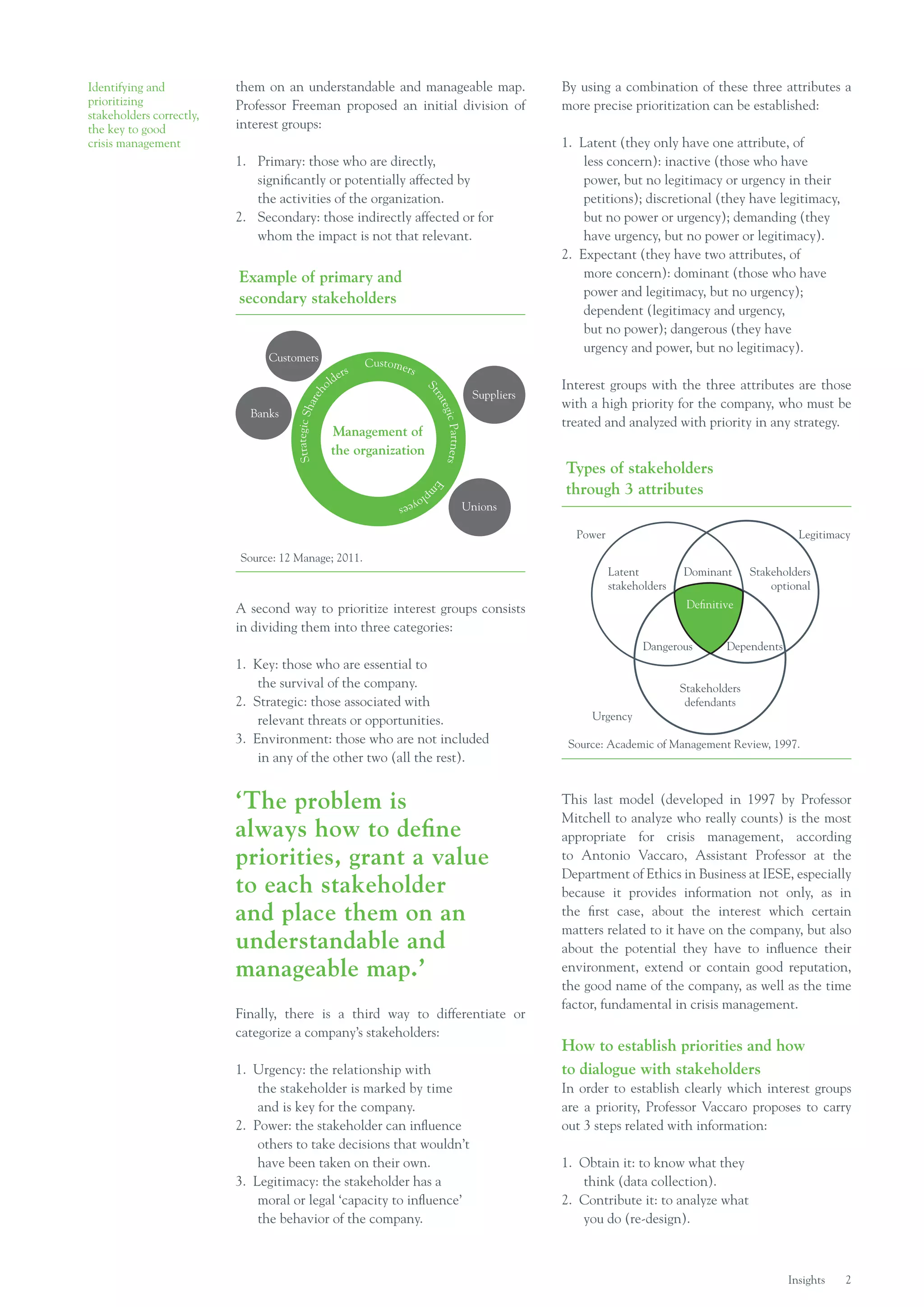
Identifying and           them on an understandable and manageable map.                                         By using a combination of these three attributes a
prioritizing              Professor Freeman proposed an initial division of                                     more precise prioritization can be established:
stakeholders correctly,
the key to good           interest groups:
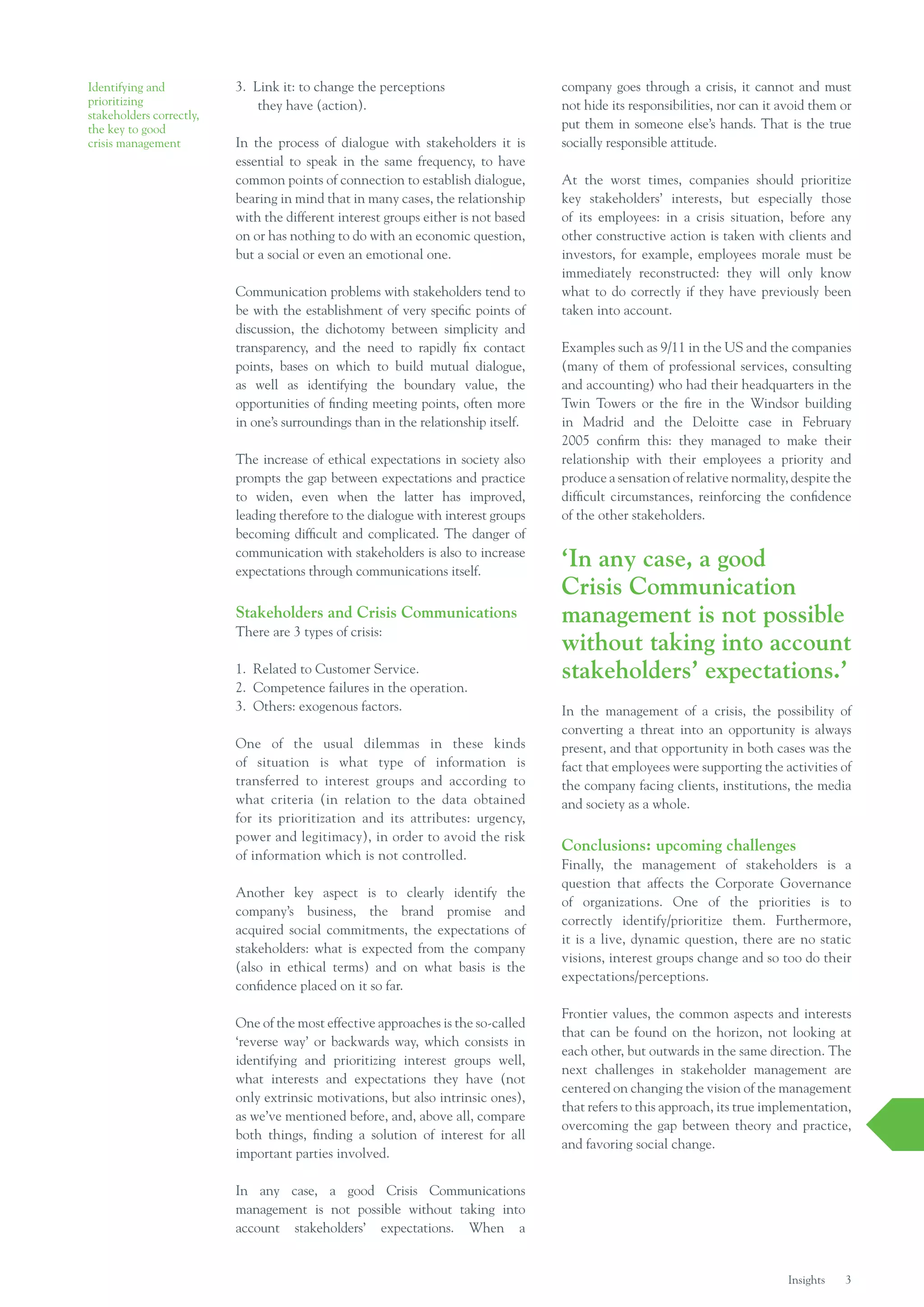
crisis management                                                                                               1.	 Latent (they only have one attribute, of
                          1.	 	Primary: those who are directly,                                                      less concern): inactive (those who have
                               significantly or potentially affected by                                              power, but no legitimacy or urgency in their
                               the activities of the organization.                                                   petitions); discretional (they have legitimacy,
                          2.	 	Secondary: those indirectly affected or for                                           but no power or urgency); demanding (they
                               whom the impact is not that relevant.                                                 have urgency, but no power or legitimacy).
                                                                                                                2.	 Expectant (they have two attributes, of
                          Example of primary and                                                                     more concern): dominant (those who have
                                                                                                                     power and legitimacy, but no urgency);
                          secondary stakeholders
                                                                                                                     dependent (legitimacy and urgency,
                                                                                                                     but no power); dangerous (they have
                                                                                                                     urgency and power, but no legitimacy).
                                Customers
                                                                    Customer
                                                               rs              s
                                                          de
                                                        ol                         S                            Interest groups with the three attributes are those
                                                                                                    Suppliers
                                                 re h


                                                                                    tra
                                                                                                                with a high priority for the company, who must be

                                                                                       teg
                                    Strategic Sha


                            Banks
                                                                                                                treated and analyzed with priority in any strategy.
                                                                                           ic
                                                         Management of
                                                         the organization                Partners

                                                                                                                Types of stakeholders
                                                                                                                through 3 attributes
                                                                                    Em


                                                                         plo
                                                                            yee
                                                                                s               Unions

                                                                                                                  Power                                          Legitimacy

                          Source: 12 Manage; 2011.
                                                                                                                          Latent         Dominant       Stakeholders
                                                                                                                          stakeholders                      optional
                          A second way to prioritize interest groups consists                                                             Definitive
                          in dividing them into three categories:
                                                                                                                                 Dangerous        Dependents
                          1.	 Key: those who are essential to
                               the survival of the company.                                                                              Stakeholders
                          2.	 Strategic: those associated with                                                                            defendants
                               relevant threats or opportunities.                                                    Urgency
                          3.	 Environment: those who are not included                                            Source: Academic of Management Review, 1997.
                               in any of the other two (all the rest).


                          ‘The problem is                                                                       This last model (developed in 1997 by Professor
                                                                                                                Mitchell to analyze who really counts) is the most
                          always how to define                                                                  appropriate for crisis management, according
                          priorities, grant a value                                                             to Antonio Vaccaro, Assistant Professor at the
                                                                                                                Department of Ethics in Business at IESE, especially
                          to each stakeholder                                                                   because it provides information not only, as in
                          and place them on an                                                                  the first case, about the interest which certain
                                                                                                                matters related to it have on the company, but also
                          understandable and                                                                    about the potential they have to influence their
                          manageable map.’                                                                      environment, extend or contain good reputation,
                                                                                                                the good name of the company, as well as the time
                                                                                                                factor, fundamental in crisis management.
                          Finally, there is a third way to differentiate or
                          categorize a company’s stakeholders:
                                                                                                                How to establish priorities and how
                          1.	 Urgency: the relationship with                                                    to dialogue with stakeholders
                               the stakeholder is marked by time                                                In order to establish clearly which interest groups
                               and is key for the company.                                                      are a priority, Professor Vaccaro proposes to carry
                          2.	 Power: the stakeholder can influence                                              out 3 steps related with information:
                               others to take decisions that wouldn’t
                               have been taken on their own.                                                    1.	 Obtain it: to know what they
                          3.	 Legitimacy: the stakeholder has a                                                     think (data collection).
                               moral or legal ‘capacity to influence’                                           2.	 Contribute it: to analyze what
                               the behavior of the company.                                                         you do (re-design).


                                                                                                                                                               Insights   2
Identifying and           3. Link it: to change the perceptions                    company goes through a crisis, it cannot and must
prioritizing                  they have (action).                                  not hide its responsibilities, nor can it avoid them or
stakeholders correctly,
the key to good                                                                    put them in someone else’s hands. That is the true
crisis management         In the process of dialogue with stakeholders it is       socially responsible attitude.
                          essential to speak in the same frequency, to have
                          common points of connection to establish dialogue,       At the worst times, companies should prioritize
                          bearing in mind that in many cases, the relationship     key stakeholders’ interests, but especially those
                          with the different interest groups either is not based   of its employees: in a crisis situation, before any
                          on or has nothing to do with an economic question,       other constructive action is taken with clients and
                          but a social or even an emotional one.                   investors, for example, employees morale must be
                                                                                   immediately reconstructed: they will only know
                          Communication problems with stakeholders tend to         what to do correctly if they have previously been
                          be with the establishment of very specific points of     taken into account.
                          discussion, the dichotomy between simplicity and
                          transparency, and the need to rapidly fix contact        Examples such as 9/11 in the US and the companies
                          points, bases on which to build mutual dialogue,         (many of them of professional services, consulting
                          as well as identifying the boundary value, the           and accounting) who had their headquarters in the
                          opportunities of finding meeting points, often more      Twin Towers or the fire in the Windsor building
                          in one’s surroundings than in the relationship itself.   in Madrid and the Deloitte case in February
                                                                                   2005 confirm this: they managed to make their
                          The increase of ethical expectations in society also     relationship with their employees a priority and
                          prompts the gap between expectations and practice        produce a sensation of relative normality, despite the
                          to widen, even when the latter has improved,             difficult circumstances, reinforcing the confidence
                          leading therefore to the dialogue with interest groups   of the other stakeholders.
                          becoming difficult and complicated. The danger of
                          communication with stakeholders is also to increase
                          expectations through communications itself.
                                                                                   ‘In any case, a good
                                                                                   Crisis Communication
                          Stakeholders and Crisis Communications                   management is not possible
                          There are 3 types of crisis:
                                                                                   without taking into account
                          1. Related to Customer Service.                          stakeholders’ expectations.’
                          2. Competence failures in the operation.
                          3. Others: exogenous factors.                            In the management of a crisis, the possibility of
                                                                                   converting a threat into an opportunity is always
                          One of the usual dilemmas in these kinds                 present, and that opportunity in both cases was the
                          of situation is what type of information is              fact that employees were supporting the activities of
                          transferred to interest groups and according to          the company facing clients, institutions, the media
                          what criteria (in relation to the data obtained          and society as a whole.
                          for its prioritization and its attributes: urgency,
                          power and legitimacy), in order to avoid the risk
                                                                                   Conclusions: upcoming challenges
                          of information which is not controlled.
                                                                                   Finally, the management of stakeholders is a
                                                                                   question that affects the Corporate Governance
                          Another key aspect is to clearly identify the
                                                                                   of organizations. One of the priorities is to
                          company’s business, the brand promise and
                                                                                   correctly identify/prioritize them. Furthermore,
                          acquired social commitments, the expectations of
                                                                                   it is a live, dynamic question, there are no static
                          stakeholders: what is expected from the company
                                                                                   visions, interest groups change and so too do their
                          (also in ethical terms) and on what basis is the
                                                                                   expectations/perceptions.
                          confidence placed on it so far.

                                                                                   Frontier values, the common aspects and interests
                          One of the most effective approaches is the so-called
                                                                                   that can be found on the horizon, not looking at
                          ‘reverse way’ or backwards way, which consists in
                                                                                   each other, but outwards in the same direction. The
                          identifying and prioritizing interest groups well,
                                                                                   next challenges in stakeholder management are
                          what interests and expectations they have (not
                                                                                   centered on changing the vision of the management
                          only extrinsic motivations, but also intrinsic ones),
                                                                                   that refers to this approach, its true implementation,
                          as we’ve mentioned before, and, above all, compare
                                                                                   overcoming the gap between theory and practice,
                          both things, finding a solution of interest for all
                                                                                   and favoring social change.
                          important parties involved.

                          In any case, a good Crisis Communications
                          management is not possible without taking into
                          account stakeholders’ expectations. When a


                                                                                                                             Insights   3
©2011, Corporate Excellence - Centre for Reputation Leadership
Business foundation created by large companies to professionalize the management of intangible assets and contribute to the development
of strong brands, with good reputation and able to compete in the global market. Its mission is to be the driver which leads and consolidates
the professional management of reputation as a strategic resource that guides and creates value for companies throughout the world.

Legal Notice
This document is property of the Corporate Excellence - Centre for Reputation Leadership and has as its objective to share business
knowledge about Brand, Reputation, Communication and Public Affairs Management.

This document is directed exclusively towards its addressee and contains confidential information, subject to professional secrecy, whose
disclosure, copy or non-authorized use is against the Law. If you receive this document by mistake, let us know immediately and erase it
without keeping a copy.

Corporate Excellence - Centre for Reputation Leadership is the owner of all the intellectual property rights of the images, texts, designs
and any other content or elements of this product and has the necessary permission for its use, and therefore, its copy, distribution, public
release or transformation is prohibited, without express authorization from the owner.

Identifying and prioritizing stakeholders correctly, the key to good crisis management

  • 1.
    Insights Strategy Documents I04/2011 Public Affairs Identifyingand prioritizing stakeholders correctly, the key to good crisis management Stakeholders management has, since the 80’s, been the paradigm that has transformed management the most. The right of companies to have information at their disposal about activities which affect them directly or indirectly has brought an era of transparency which coexists with the associated risks of revealing certain information. It was the philosopher R. Edwards Freeman, the satisfaction of their needs, on the knowledge Professor in Business Administration at the of their expectations and on the management of Darden School in the University of Virginia who, relationships between them. Clearly, this led to a in 1984, launched his theory – until then unknown change that has consolidated in the management – about the administration of organizations such as of the intangible assets, as it is used in fields such as the management of interest groups – stakeholders CSR, Reputation, Image, Communication, Public -, in other words, parts of society who have an Relations or Corporate Governance. interest in the evolution and development of a company from an economic, social, environmental The stakeholder master copy or even psychological perspective, an interest to The first tool that companies can use to understand know if the company contributes to the general and get know interest groups around them in detail interest or only to its own good. is the stakeholder master copy, which includes 4 important points: For Freeman, the company had to change its rapprochement to the creation of value approaching 1. Identification: who they are it from a more holistic and integral perspective, where and what they are called. the said creation is not made ‘against’ society but ‘with’ 2. Expectations: what are they looking society, with suppliers, shareholders, investors, clients, for and what do they expect. consumers, employees and the local community, 3. Obligations: what rights do they have namely introducing the Kantian perspective of not and what obligations do we have. seeing people as media, but as an end in themselves. 4. Prioritization: who are the most important in terms of the above. With the objective of changing it, of turning the tables, he proposed a new focus, a new mentality The problem is always this last point: how to define based on the management of interest groups, on priorities, grant a value to each one and place
  • 2.
    Identifying and them on an understandable and manageable map. By using a combination of these three attributes a prioritizing Professor Freeman proposed an initial division of more precise prioritization can be established: stakeholders correctly, the key to good interest groups: crisis management 1. Latent (they only have one attribute, of 1. Primary: those who are directly, less concern): inactive (those who have significantly or potentially affected by power, but no legitimacy or urgency in their the activities of the organization. petitions); discretional (they have legitimacy, 2. Secondary: those indirectly affected or for but no power or urgency); demanding (they whom the impact is not that relevant. have urgency, but no power or legitimacy). 2. Expectant (they have two attributes, of Example of primary and more concern): dominant (those who have power and legitimacy, but no urgency); secondary stakeholders dependent (legitimacy and urgency, but no power); dangerous (they have urgency and power, but no legitimacy). Customers Customer rs s de ol S Interest groups with the three attributes are those Suppliers re h tra with a high priority for the company, who must be teg Strategic Sha Banks treated and analyzed with priority in any strategy. ic Management of the organization Partners Types of stakeholders through 3 attributes Em plo yee s Unions Power Legitimacy Source: 12 Manage; 2011. Latent Dominant Stakeholders stakeholders optional A second way to prioritize interest groups consists Definitive in dividing them into three categories: Dangerous Dependents 1. Key: those who are essential to the survival of the company. Stakeholders 2. Strategic: those associated with defendants relevant threats or opportunities. Urgency 3. Environment: those who are not included Source: Academic of Management Review, 1997. in any of the other two (all the rest). ‘The problem is This last model (developed in 1997 by Professor Mitchell to analyze who really counts) is the most always how to define appropriate for crisis management, according priorities, grant a value to Antonio Vaccaro, Assistant Professor at the Department of Ethics in Business at IESE, especially to each stakeholder because it provides information not only, as in and place them on an the first case, about the interest which certain matters related to it have on the company, but also understandable and about the potential they have to influence their manageable map.’ environment, extend or contain good reputation, the good name of the company, as well as the time factor, fundamental in crisis management. Finally, there is a third way to differentiate or categorize a company’s stakeholders: How to establish priorities and how 1. Urgency: the relationship with to dialogue with stakeholders the stakeholder is marked by time In order to establish clearly which interest groups and is key for the company. are a priority, Professor Vaccaro proposes to carry 2. Power: the stakeholder can influence out 3 steps related with information: others to take decisions that wouldn’t have been taken on their own. 1. Obtain it: to know what they 3. Legitimacy: the stakeholder has a think (data collection). moral or legal ‘capacity to influence’ 2. Contribute it: to analyze what the behavior of the company. you do (re-design). Insights 2
  • 3.
    Identifying and 3. Link it: to change the perceptions company goes through a crisis, it cannot and must prioritizing they have (action). not hide its responsibilities, nor can it avoid them or stakeholders correctly, the key to good put them in someone else’s hands. That is the true crisis management In the process of dialogue with stakeholders it is socially responsible attitude. essential to speak in the same frequency, to have common points of connection to establish dialogue, At the worst times, companies should prioritize bearing in mind that in many cases, the relationship key stakeholders’ interests, but especially those with the different interest groups either is not based of its employees: in a crisis situation, before any on or has nothing to do with an economic question, other constructive action is taken with clients and but a social or even an emotional one. investors, for example, employees morale must be immediately reconstructed: they will only know Communication problems with stakeholders tend to what to do correctly if they have previously been be with the establishment of very specific points of taken into account. discussion, the dichotomy between simplicity and transparency, and the need to rapidly fix contact Examples such as 9/11 in the US and the companies points, bases on which to build mutual dialogue, (many of them of professional services, consulting as well as identifying the boundary value, the and accounting) who had their headquarters in the opportunities of finding meeting points, often more Twin Towers or the fire in the Windsor building in one’s surroundings than in the relationship itself. in Madrid and the Deloitte case in February 2005 confirm this: they managed to make their The increase of ethical expectations in society also relationship with their employees a priority and prompts the gap between expectations and practice produce a sensation of relative normality, despite the to widen, even when the latter has improved, difficult circumstances, reinforcing the confidence leading therefore to the dialogue with interest groups of the other stakeholders. becoming difficult and complicated. The danger of communication with stakeholders is also to increase expectations through communications itself. ‘In any case, a good Crisis Communication Stakeholders and Crisis Communications management is not possible There are 3 types of crisis: without taking into account 1. Related to Customer Service. stakeholders’ expectations.’ 2. Competence failures in the operation. 3. Others: exogenous factors. In the management of a crisis, the possibility of converting a threat into an opportunity is always One of the usual dilemmas in these kinds present, and that opportunity in both cases was the of situation is what type of information is fact that employees were supporting the activities of transferred to interest groups and according to the company facing clients, institutions, the media what criteria (in relation to the data obtained and society as a whole. for its prioritization and its attributes: urgency, power and legitimacy), in order to avoid the risk Conclusions: upcoming challenges of information which is not controlled. Finally, the management of stakeholders is a question that affects the Corporate Governance Another key aspect is to clearly identify the of organizations. One of the priorities is to company’s business, the brand promise and correctly identify/prioritize them. Furthermore, acquired social commitments, the expectations of it is a live, dynamic question, there are no static stakeholders: what is expected from the company visions, interest groups change and so too do their (also in ethical terms) and on what basis is the expectations/perceptions. confidence placed on it so far. Frontier values, the common aspects and interests One of the most effective approaches is the so-called that can be found on the horizon, not looking at ‘reverse way’ or backwards way, which consists in each other, but outwards in the same direction. The identifying and prioritizing interest groups well, next challenges in stakeholder management are what interests and expectations they have (not centered on changing the vision of the management only extrinsic motivations, but also intrinsic ones), that refers to this approach, its true implementation, as we’ve mentioned before, and, above all, compare overcoming the gap between theory and practice, both things, finding a solution of interest for all and favoring social change. important parties involved. In any case, a good Crisis Communications management is not possible without taking into account stakeholders’ expectations. When a Insights 3
  • 4.
    ©2011, Corporate Excellence- Centre for Reputation Leadership Business foundation created by large companies to professionalize the management of intangible assets and contribute to the development of strong brands, with good reputation and able to compete in the global market. Its mission is to be the driver which leads and consolidates the professional management of reputation as a strategic resource that guides and creates value for companies throughout the world. Legal Notice This document is property of the Corporate Excellence - Centre for Reputation Leadership and has as its objective to share business knowledge about Brand, Reputation, Communication and Public Affairs Management. This document is directed exclusively towards its addressee and contains confidential information, subject to professional secrecy, whose disclosure, copy or non-authorized use is against the Law. If you receive this document by mistake, let us know immediately and erase it without keeping a copy. Corporate Excellence - Centre for Reputation Leadership is the owner of all the intellectual property rights of the images, texts, designs and any other content or elements of this product and has the necessary permission for its use, and therefore, its copy, distribution, public release or transformation is prohibited, without express authorization from the owner.