
Prepared By:
Shruti Prashant uh13047@stu.ximb.ac.in
Xavier Institute of Management, Bhubaneswar
Executive
Summary
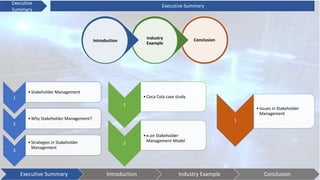
Executive Summary
ConclusionIndustry
Example
Introduction
1
•Stakeholder Management
2
•Why Stakeholder Management?
3
•Strategies in Stakeholder
Management
1
•Coca Cola case study
2
•e.on Stakeholder
Management Model
1
•Issues in Stakeholder
Management
Executive Summary Introduction Industry Example Conclusion
Introduction
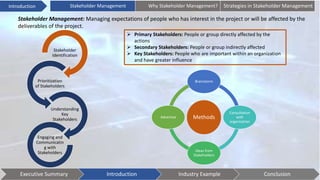
Stakeholder Management: Managing expectations of people who has interest in the project or will be affected by the
deliverables of the project.
Stakeholder
Identification
Prioritization
of Stakeholders
Understanding
Key
Stakeholders
Engaging and
Communicatin
g with
Stakeholders
 Primary Stakeholders: People or group directly affected by the
actions
 Secondary Stakeholders: People or group indirectly affected
 Key Stakeholders: People who are important within an organization
and have greater influence
Methods
Brainstorm
Consultation
with
organization
Ideas from
Stakeholders
Advertise
Executive Summary Introduction Industry Example Conclusion
Stakeholder Management Why Stakeholder Management? Strategies in Stakeholder Management
Introduction
Stakeholder
Identification
Prioritization
of Stakeholders
Understanding
Key
Stakeholders
Engaging and
Communicatin
g with
Stakeholders
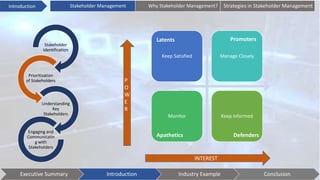
Keep Satisfied Manage Closely
Monitor Keep Informed
Latents Promoters
Apathetics Defenders
INTEREST
P
O
W
E
R
Executive Summary Introduction Industry Example Conclusion
Stakeholder Management Why Stakeholder Management? Strategies in Stakeholder Management
Introduction
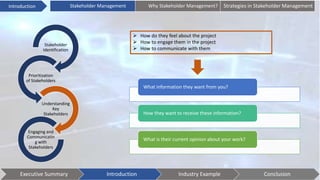
 How do they feel about the project
 How to engage them in the project
 How to communicate with them
What information they want from you?
How they want to receive these information?
What is their current opinion about your work?
Executive Summary Introduction Industry Example Conclusion
Stakeholder Management Why Stakeholder Management? Strategies in Stakeholder Management
Stakeholder
Identification
Prioritization
of Stakeholders
Understanding
Key
Stakeholders
Engaging and
Communicatin
g with
Stakeholders
Introduction
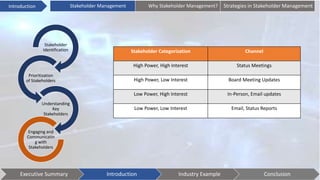
Stakeholder Categorization Channel
High Power, High Interest Status Meetings
High Power, Low Interest Board Meeting Updates
Low Power, High Interest In-Person, Email updates
Low Power, Low Interest Email, Status Reports
Executive Summary Introduction Industry Example Conclusion
Stakeholder Management Why Stakeholder Management? Strategies in Stakeholder Management
Stakeholder
Identification
Prioritization
of Stakeholders
Understanding
Key
Stakeholders
Engaging and
Communicatin
g with
Stakeholders
Introduction Stakeholder Management Why Stakeholder Management? Strategies in Stakeholder Management
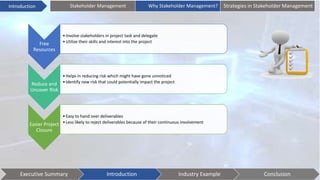
Free
Resources
•Involve stakeholders in project task and delegate
•Utilize their skills and interest into the project
Reduce and
Uncover Risk
•Helps in reducing risk which might have gone unnoticed
•Identify new risk that could potentially impact the project
Easier Project
Closure
•Easy to hand over deliverables
•Less likely to reject deliverables because of their continuous involvement
Executive Summary Introduction Industry Example Conclusion
Introduction
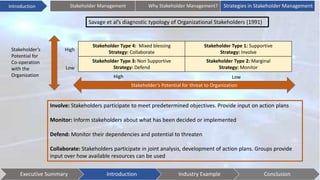
Savage et al’s diagnostic typology of Organizational Stakeholders (1991)
Stakeholder Type 4: Mixed blessing
Strategy: Collaborate
Stakeholder Type 1: Supportive
Strategy: Involve
Stakeholder Type 3: Non Supportive
Strategy: Defend
Stakeholder Type 2: Marginal
Strategy: Monitor
LowHigh
Low
High
Stakeholder’s Potential for threat to Organization
Stakeholder’s
Potential for
Co-operation
with the
Organization
Involve: Stakeholders participate to meet predetermined objectives. Provide input on action plans
Monitor: Inform stakeholders about what has been decided or implemented
Defend: Monitor their dependencies and potential to threaten
Collaborate: Stakeholders participate in joint analysis, development of action plans. Groups provide
input over how available resources can be used
Executive Summary Introduction Industry Example Conclusion
Stakeholder Management Why Stakeholder Management? Strategies in Stakeholder Management
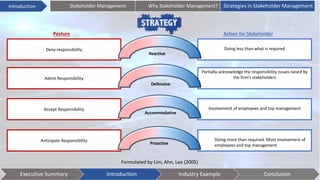
Deny responsibility Doing less than what is required
Admit Responsibility
Partially acknowledge the responsibility issues raised by
the firm’s stakeholders
Accept Responsibility Involvement of employees and top management
Anticipate Responsibility Doing more than required. Most involvement of
employees and top management
Posture Action for Stakeholder
Reactive
Defensive
Accommodative
Proactive
Introduction
Executive Summary Introduction Industry Example Conclusion
Stakeholder Management Why Stakeholder Management? Strategies in Stakeholder Management
Formulated by Lim, Ahn, Lee (2005)
Industry Example
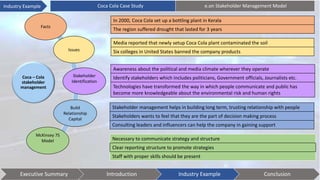
In 2000, Coca Cola set up a bottling plant in Kerala
The region suffered drought that lasted for 3 years
Media reported that newly setup Coca Cola plant contaminated the soil
Six colleges in United States banned the company products
Awareness about the political and media climate wherever they operate
Identify stakeholders which includes politicians, Government officials, Journalists etc.
Technologies have transformed the way in which people communicate and public has
become more knowledgeable about the environmental risk and human rights
Stakeholder management helps in building long term, trusting relationship with people
Stakeholders wants to feel that they are the part of decision making process
Consulting leaders and influencers can help the company in gaining support
Necessary to communicate strategy and structure
Clear reporting structure to promote strategies
Staff with proper skills should be present
Coca – Cola
stakeholder
management
Facts
McKinsey 7S
Model
Build
Relationship
Capital
Stakeholder
Identification
Issues
Executive Summary Introduction Industry Example Conclusion
Coca Cola Case Study e.on Stakeholder Management Model
Industry Example
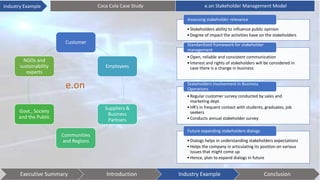
Customer
Employees
Suppliers &
Business
Partners
Communities
and Regions
Govt., Society
and the Public
NGOs and
sustainability
experts
•Stakeholders ability to influence public opinion
•Degree of impact the activities have on the stakeholders
Assessing stakeholder relevance
•Open, reliable and consistent communication
•Interest and rights of stakeholders will be considered in
case there is a change in business
Standardized framework for stakeholder
management
•Regular customer survey conducted by sales and
marketing dept.
•HR’s in frequent contact with students, graduates, job
seekers
•Conducts annual stakeholder survey
Stakeholders involvement in Business
Operations
•Dialogs helps in understanding stakeholders expectations
•Helps the company in articulating its position on various
issues that might come up
•Hence, plan to expand dialogs in future
Future expanding stakeholders dialogs
e.on
Executive Summary Introduction Industry Example Conclusion
Coca Cola Case Study e.on Stakeholder Management Model
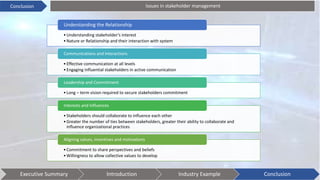
Conclusion Issues in stakeholder management
•Understanding stakeholder’s interest
•Nature or Relationship and their interaction with system
Understanding the Relationship
•Effective communication at all levels
•Engaging influential stakeholders in active communication
Communications and Interactions
•Long – term vision required to secure stakeholders commitment
Leadership and Commitment
•Stakeholders should collaborate to influence each other
•Greater the number of ties between stakeholders, greater their ability to collaborate and
influence organizational practices
Interests and Influences
•Commitment to share perspectives and beliefs
•Willingness to allow collective values to develop
Aligning values, incentives and motivations
Executive Summary Introduction Industry Example Conclusion
Trends in stakeholder management shruti prashant

Trends in stakeholder management shruti prashant

  • 1.
    Prepared By: Shruti Prashantuh13047@stu.ximb.ac.in Xavier Institute of Management, Bhubaneswar
  • 2.
    Executive Summary Executive Summary ConclusionIndustry Example Introduction 1 •Stakeholder Management 2 •WhyStakeholder Management? 3 •Strategies in Stakeholder Management 1 •Coca Cola case study 2 •e.on Stakeholder Management Model 1 •Issues in Stakeholder Management Executive Summary Introduction Industry Example Conclusion
  • 3.
    Introduction Stakeholder Management: Managingexpectations of people who has interest in the project or will be affected by the deliverables of the project. Stakeholder Identification Prioritization of Stakeholders Understanding Key Stakeholders Engaging and Communicatin g with Stakeholders  Primary Stakeholders: People or group directly affected by the actions  Secondary Stakeholders: People or group indirectly affected  Key Stakeholders: People who are important within an organization and have greater influence Methods Brainstorm Consultation with organization Ideas from Stakeholders Advertise Executive Summary Introduction Industry Example Conclusion Stakeholder Management Why Stakeholder Management? Strategies in Stakeholder Management
  • 4.
    Introduction Stakeholder Identification Prioritization of Stakeholders Understanding Key Stakeholders Engaging and Communicatin gwith Stakeholders Keep Satisfied Manage Closely Monitor Keep Informed Latents Promoters Apathetics Defenders INTEREST P O W E R Executive Summary Introduction Industry Example Conclusion Stakeholder Management Why Stakeholder Management? Strategies in Stakeholder Management
  • 5.
    Introduction  How dothey feel about the project  How to engage them in the project  How to communicate with them What information they want from you? How they want to receive these information? What is their current opinion about your work? Executive Summary Introduction Industry Example Conclusion Stakeholder Management Why Stakeholder Management? Strategies in Stakeholder Management Stakeholder Identification Prioritization of Stakeholders Understanding Key Stakeholders Engaging and Communicatin g with Stakeholders
  • 6.
    Introduction Stakeholder Categorization Channel HighPower, High Interest Status Meetings High Power, Low Interest Board Meeting Updates Low Power, High Interest In-Person, Email updates Low Power, Low Interest Email, Status Reports Executive Summary Introduction Industry Example Conclusion Stakeholder Management Why Stakeholder Management? Strategies in Stakeholder Management Stakeholder Identification Prioritization of Stakeholders Understanding Key Stakeholders Engaging and Communicatin g with Stakeholders
  • 7.
    Introduction Stakeholder ManagementWhy Stakeholder Management? Strategies in Stakeholder Management Free Resources •Involve stakeholders in project task and delegate •Utilize their skills and interest into the project Reduce and Uncover Risk •Helps in reducing risk which might have gone unnoticed •Identify new risk that could potentially impact the project Easier Project Closure •Easy to hand over deliverables •Less likely to reject deliverables because of their continuous involvement Executive Summary Introduction Industry Example Conclusion
  • 8.
    Introduction Savage et al’sdiagnostic typology of Organizational Stakeholders (1991) Stakeholder Type 4: Mixed blessing Strategy: Collaborate Stakeholder Type 1: Supportive Strategy: Involve Stakeholder Type 3: Non Supportive Strategy: Defend Stakeholder Type 2: Marginal Strategy: Monitor LowHigh Low High Stakeholder’s Potential for threat to Organization Stakeholder’s Potential for Co-operation with the Organization Involve: Stakeholders participate to meet predetermined objectives. Provide input on action plans Monitor: Inform stakeholders about what has been decided or implemented Defend: Monitor their dependencies and potential to threaten Collaborate: Stakeholders participate in joint analysis, development of action plans. Groups provide input over how available resources can be used Executive Summary Introduction Industry Example Conclusion Stakeholder Management Why Stakeholder Management? Strategies in Stakeholder Management
  • 9.
    Deny responsibility Doingless than what is required Admit Responsibility Partially acknowledge the responsibility issues raised by the firm’s stakeholders Accept Responsibility Involvement of employees and top management Anticipate Responsibility Doing more than required. Most involvement of employees and top management Posture Action for Stakeholder Reactive Defensive Accommodative Proactive Introduction Executive Summary Introduction Industry Example Conclusion Stakeholder Management Why Stakeholder Management? Strategies in Stakeholder Management Formulated by Lim, Ahn, Lee (2005)
  • 10.
    Industry Example In 2000,Coca Cola set up a bottling plant in Kerala The region suffered drought that lasted for 3 years Media reported that newly setup Coca Cola plant contaminated the soil Six colleges in United States banned the company products Awareness about the political and media climate wherever they operate Identify stakeholders which includes politicians, Government officials, Journalists etc. Technologies have transformed the way in which people communicate and public has become more knowledgeable about the environmental risk and human rights Stakeholder management helps in building long term, trusting relationship with people Stakeholders wants to feel that they are the part of decision making process Consulting leaders and influencers can help the company in gaining support Necessary to communicate strategy and structure Clear reporting structure to promote strategies Staff with proper skills should be present Coca – Cola stakeholder management Facts McKinsey 7S Model Build Relationship Capital Stakeholder Identification Issues Executive Summary Introduction Industry Example Conclusion Coca Cola Case Study e.on Stakeholder Management Model
  • 11.
    Industry Example Customer Employees Suppliers & Business Partners Communities andRegions Govt., Society and the Public NGOs and sustainability experts •Stakeholders ability to influence public opinion •Degree of impact the activities have on the stakeholders Assessing stakeholder relevance •Open, reliable and consistent communication •Interest and rights of stakeholders will be considered in case there is a change in business Standardized framework for stakeholder management •Regular customer survey conducted by sales and marketing dept. •HR’s in frequent contact with students, graduates, job seekers •Conducts annual stakeholder survey Stakeholders involvement in Business Operations •Dialogs helps in understanding stakeholders expectations •Helps the company in articulating its position on various issues that might come up •Hence, plan to expand dialogs in future Future expanding stakeholders dialogs e.on Executive Summary Introduction Industry Example Conclusion Coca Cola Case Study e.on Stakeholder Management Model
  • 12.
    Conclusion Issues instakeholder management •Understanding stakeholder’s interest •Nature or Relationship and their interaction with system Understanding the Relationship •Effective communication at all levels •Engaging influential stakeholders in active communication Communications and Interactions •Long – term vision required to secure stakeholders commitment Leadership and Commitment •Stakeholders should collaborate to influence each other •Greater the number of ties between stakeholders, greater their ability to collaborate and influence organizational practices Interests and Influences •Commitment to share perspectives and beliefs •Willingness to allow collective values to develop Aligning values, incentives and motivations Executive Summary Introduction Industry Example Conclusion