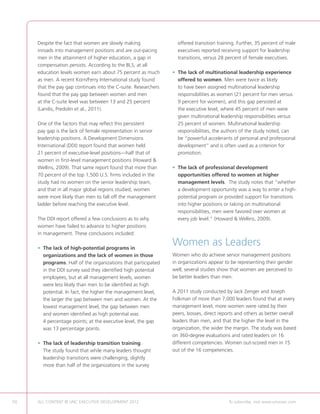

VOLUME 3


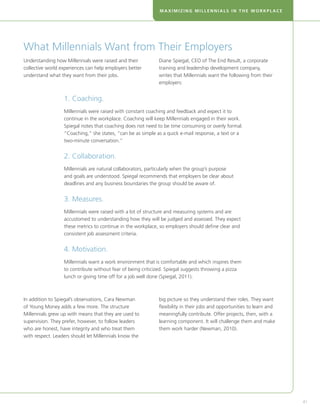
           BUSINESS INSIGHTS FROM UNC EXECUTIVE DEVELOPMENT


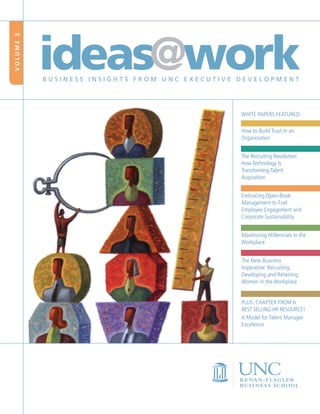
                                                WHITE PAPERS FEATURED:

                                                How to Build Trust in an
                                                Organization


                                                The Recruiting Revolution:
                                                How Technology Is
                                                Transforming Talent
                                                Acquisition


                                                Embracing Open-Book
                                                Management to Fuel
                                                Employee Engagement and
                                                Corporate Sustainability


                                                Maximizing Millennials in the
                                                Workplace


                                                The New Business
                                                Imperative: Recruiting,
                                                Developing and Retaining
                                                Women in the Workplace


                                                PLUS: CHAPTER FROM A
                                                BEST SELLING HR RESOURCE!
                                                A Model for Talent Manager
                                                Excellence
A message from the
    President and Associate Dean of
    Executive Development at
    UNC Kenan-Flagler Business School

    Hello again from the University of North Carolina at Chapel       We are also pleased to feature a chapter from The Talent
    Hill, and welcome to the latest volume of ideas@work.             Management Handbook titled A Model for Talent Manager
    We created ideas@work specifically for business leaders           Excellence, co-authored by Marc Effron and Jim Shanley.
    interested in talent development so that we can share the         We are delighted to have their contribution and to announce
    knowledge and expertise that we’ve gained working with            that we are partnering with them to launch the Talent
    organizations around the world. ideas@work offers some            Management Institute in November 2012. This new program
    of the latest talent development research and highlights best     will be led by Effron, Shanley and Corey Seitz, another leader
    practices that we hope you can apply in your organization.        in global talent management.


    The latest volume features 5 new white papers authored by         I hope that you enjoy the latest volume of ideas@work.
    members of the UNC team. One paper explores the unique            I encourage you to visit our website (www.uncexec.com) to
    contributions Millennials offer as they enter the workforce,      access our library of talent development resources including
    and another paper discusses how social media and emerging         white papers, webinars, and research. You can also join
    technologies are transforming talent acquisition. A third         our mailing list to receive our newsletter which features
    paper examines the critical role trust plays in an organization   these resources and more, and our team would be happy
    and identifies ways you can build a culture of trust. The New     to talk with you about the custom work we do for our
    Business Imperative: Recruiting, Developing and Retaining         organizational clients.
    Women in the Workplace offers insights about the changing
    role of women business leaders and how companies are              Thank you for your interest in UNC Executive Development.
    adapting to changing demographics. This paper also                Susan Cates
    includes findings from a recent survey conducted by UNC           susan.cates@uncexec.com
    Kenan-Flagler.


                                      Consistently ranked one of      Our commitment to                  At UNC Executive
                                      the world’s best business       developing socially                Development, we believe
                                      schools, UNC’s Kenan-           responsible, results-driven        that managing employee
                                      Flagler Business School         leaders distinguishes our          talent is vital to the success
                                      is known for experiential       programs. We educate               of any organization, and we
                                      learning and teamwork,          people at every stage              provide unique learning and
                                      superior teaching,              of their careers and               development experiences
                                      innovative research and a       prepare them to manage             for our partners.
                                      collaborative culture.          successfully in the global
                                                                      business environment.


2   ALL CONTENT © UNC EXECUTIVE DEVELOPMENT 2012           	                                        To subscribe, visit www.uncexec.com
Inside this issue


                                    How to Build Trust in an Organization
                                                                 page 4


   The Recruiting Revolution: How Technology Is Transforming Talent Acquisition
                                                                 page 14


      Embracing Open-Book Management to Fuel Employee Engagement and
                          Corporate Sustainability
                                                                 page 26


                                  Maximizing Millennials in the Workplace
                                                                 page 36


   The New Business Imperative: Recruiting, Developing and Retaining Women
                              in the Workplace
                                                                 page 48


                                                                4+2
                   BONUS CHAPTER: A Model for Talent Manager Excellence
                                                                 page 60


     (Note: The information or conclusions expressed in the following white papers are the authors’ review of findings expressed by the
         organizations. All brand representations are registered trademarks owned by the respective companies or organizations.)

                                                                                                                                          3
How to Build Trust in an
    Organization
    Chris Hitch, Ph.D.
    Program Director
    UNC Executive Development


    Introduction
    In a 2001 interview with Fortune magazine about his           for $7.99 each. Customers – many of whom faced a
    company’s continued success, Herbert D. Kelleher,             60 percent increase for monthly Netflix services – were
    founder of Southwest Airlines, attributed much of             outraged, and the customer-led backlash eventually
    it to the fact that he always treated his employees           made Hastings reverse the decision. The damage was
    like customers. Kelleher knew that employees who              already done, however. By mid-September 2011,
    are trusted and treated fairly will, in turn, treat their     Netflix lost one million more subscribers than they
    customers with trust and respect.                             had estimated after the July announcement, and the
                                                                  company’s stock plummeted 14 percent. By the end of
    This is the same kind of philosophy that made Netflix a       the year, Netflix had made $40.7 million in the last three
    huge success as a young start-up organization. From the       months of the year. By comparison, it had made $47.1
    beginning, Netflix founder Reed Hastings knew the kind        million in the last three months of 2010.
    of company culture he wanted to develop to achieve its
    purpose. Netflix’s “Freedom and Responsibility Culture”       The trust that customers, stakeholders and employees
    was based on the premise that all employees understand        had in Netflix’s top management to make sound choices
    the purpose of the organization and that they know the        was shaken by the decision, and the delayed reversal
    value customers get from doing business with Netflix.         further eroded that trust. Netflix’s leadership lost sight
    The foundation of that culture is trust and responsibility;   of the value they provided their customers – and by
    trust in its employees to achieve the company’s               extension their employees – when they failed to ensure
    goals and trust in its customers to act responsibly by        that their decisions and actions supported its purpose.
    eliminating late fees and asking customers to return          And by doing this, they let their employees down.
    their DVD rentals when they are ready.                        Netflix employees no longer had a clear vision of the
                                                                  value customers got from doing business with Netflix
    That all was put in jeopardy when Netflix announced in        – and this confusion has damaged its “Freedom and
    July 2011 that it was eliminating it’s $9.99 per month        Responsibility Culture”.
    DVD + streaming plan in favor of two separate plans


4   ALL CONTENT © UNC EXECUTIVE DEVELOPMENT 2012         	                                   To subscribe, visit www.uncexec.com
H O W T O B U I L D T R U S T I N A N O R G A N I Z AT I O N


“ rust is the lubrication that makes it
 T
 possible for organizations to work.”
 – Warren Bennis


 Time will tell if Netflix can rebuild the trust they lost
 with their employees and their customers—its culture of
 trust, responsibility and freedom to take risks and to be
 innovative hangs in the balance.

 Leadership and organizational studies pioneer
 Warren Bennis once said that “trust is the lubrication
 that makes it possible for organizations to work.”
 Organizations with high levels of trust have more
 productive workforces, better employee morale and
 lower employee turnover. They also perform better
 financially than their industry peers.


 Promise
 This white paper:
 • Defines trust in organizations.
   
 • Explores the characteristics of organizational trust
   
   and how it develops.
 • Examines the benefits of trust in organizations.
 • Examines the erosion of trust in the workplace.
 • Offers steps HR professionals can take to build
   
   or rebuild trust in their organizations.                  The Foundations of Trust:
                                                             Credibility, Respect and
                                                             Fairness
“ o be persuasive we must be
 T                                                           Dr. Duane C. Tway, Jr., offered an excellent definition of
 believable; to be believable we must                        trust in his 1993 dissertation, A Construct of Trust, as
 be credible; to be credible we must                         “the state of readiness for unguarded interaction with
 be truthful.”                                               someone or something” (Dubois, 2010). Warren Buffet
                                                             put it another way. “Trust,” said Buffet “is like the air
 – Edward R. Murrow
                                                             we breathe. When it’s present, nobody really notices.
                                                             But when it’s absent, everybody notices.”


                                                                                                                            5
We know when we feel that state of readiness, but               High-trust organizations ensure that employees
    what elements are needed to get to that state? Amy              experience respect. This is exhibited through employers’
    Lyman, co-founder of The Great Place to Work Institute,         support of their employees’ professional growth and the
    has studied trust in organizations for more than 20             consideration of employees’ ideas in decision-making
    years. She has found three characteristics, or elements,        processes. Finally, employees in high-trust organizations
    that come up time and time again in her interviews with         believe they are treated fairly regardless of their
    clients: credibility, respect and fair treatment (Lyman,        position within the organization (Lyman, 2012).
    2003, 2012).
                                                                    High-trust organizations collaborate well across
    According to Lyman, in organizations with high levels of        departments and hierarchies, and seek fair resolutions to
    trust, employees see others (particularly management)           difficult situations. Employees in high-trust organizations
    as credible—they mean what they say, and believe                have confidence in their leader’s vision for the future
    what they say is true—and have confidence that the              (Lyman, 2012).
    actions of others will remain consistent with their
    words. In high-trust organizations, co-workers believe
    that others (particularly management) are ethical in their
    business practices.


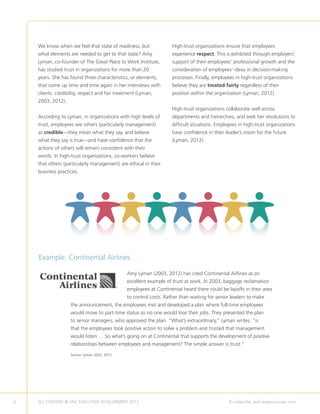
    Example: Continental Airlines

                                               Amy Lyman (2003, 2012) has cited Continental Airlines as an
                                               excellent example of trust at work. In 2003, baggage reclamation
                                               employees at Continental heard there could be layoffs in their area
                                               to control costs. Rather than waiting for senior leaders to make
                   the announcement, the employees met and developed a plan where full-time employees
                   would move to part-time status so no one would lose their jobs. They presented the plan
                   to senior managers, who approved the plan. “What’s extraordinary,” Lyman writes, “is
                   that the employees took positive action to solve a problem and trusted that management
                   would listen … So what’s going on at Continental that supports the development of positive
                   relationships between employees and management? The simple answer is trust.”

                   Source: Lyman 2003, 2012.


6   ALL CONTENT © UNC EXECUTIVE DEVELOPMENT 2012          	                                    To subscribe, visit www.uncexec.com
H O W T O B U I L D T R U S T I N A N O R G A N I Z AT I O N


The Development of Trust:                                     Russell 3000 and SP 500, posting annualized
                                                              returns of 11 percent versus 4.26 percent and 3.83
Action and Interaction                                        percent, respectively. Lyman also notes that those best
                                                              companies experience about half the turnover rate
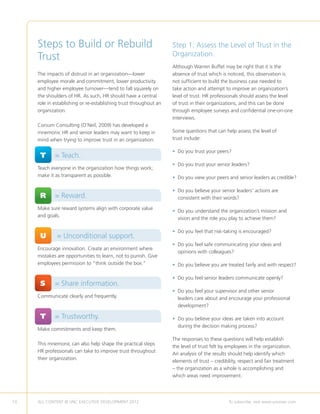
Trust is earned through action. As Maister, Green and         than other organizations in their industries. (Lyman,
Galford wrote in their seminal book, The Trusted Advisor      2003, 2012).
(2001), “You have to do something to give people the
evidence they need to believe you should be trusted.        A 2009 study by Interaction Associates found that high-
You have to be willing to give in order to get.”            trust organizations also had more effective leadership
                                                            and better collaboration at all levels of the organization.
Trust is also earned through interaction. It can be as      The study found that high-trust organizations:
simple as a conversation between co-workers, a five-
minute chat in the break room between a manager             • Have a strong sense of shared purpose.
                                                              
and her employee, or teamwork among co-workers to
complete a project. It is the interaction that conveys to   • Have employees who work together to support that
                                                              
others the willingness on the part of one person to do        purpose.
something that is to the benefit of another person’s
health and well-being (Lyman, 2012).                        •  reate cultures in which tolerance and cooperation
                                                              C
                                                              are highly valued.
It is through a person’s action and interaction that
others can assess whether that person is credible,          • Have leaders who coach rather than just manage.
                                                              
reliable and fair.
                                                            • Have many people participate in making decisions.


The Effect of Trust:                                        The study revealed that in addition to superior earnings
                                                            as compared to low-trust organizations, high-trust
A Better Bottom Line                                        organizations excelled (as compared to their low-trust
                                                            peers) at exhibiting organizational behavior consistent
Numerous studies have been conducted through the
                                                            with their values and ethics (85 percent vs. 46 percent);
years that confirm the benefit of trust in the workplace:
                                                            at retaining employees (80 percent vs. 42 percent);
                                                            and at attracting, deploying and developing talent (76
• A classic study by Cornell University Associate
  
                                                            percent vs. 24 percent).
  Professor Tony Simon of 6,300 Holiday Inn employees
  found that hotels where managers followed through
                                                            If trust increases profitability and helps in attracting and
  on their promises and had behavioral integrity were
                                                            keeping talent, then the lack of trust lowers productivity,
  more profitable (in Bader, 2003).
                                                            job satisfaction and commitment and increases
                                                            employee turnover.
•  Watson Wyatt Worldwide study found that
  A
  organizations in which front-line employees trusted
                                                            With all the documented benefits of having trust in
  their senior leaders had a 42 percent higher return on
                                                            an organization, one would think that creating and
  shareholder investment than organizations in which
                                                            maintaining it would be a high priority for senior
  distrust was the norm (Reina and Reina, 2007).
                                                            business leaders. Unfortunately, many senior leaders
                                                            cannot seem to shake the top-down model of
• Amy Lyman’s tracking of publicly traded 100 Best
  
                                                            management that adheres to the notion that authority
  Companies has shown that as a group and over
                                                            creates trust. In reality, trust creates authority.
  time, those organizations have outperformed the


                                                                                                                           7
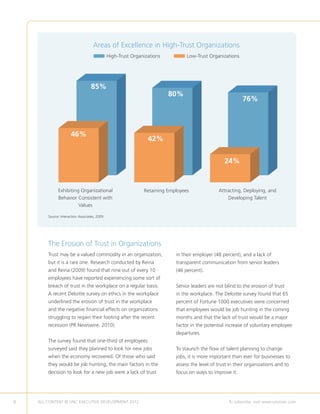
Areas of Excellence in High-Trust Organizations
                                                High-Trust Organizations          Low-Trust Organizations


                                    85%
                                                                           80%
                                                                                                             76%


                      46%
                                                                     42%


                                                                                                    24%


              Exhibiting Organizational                         Retaining Employees              Attracting, Deploying, and
              Behavior Consistent with                                                               Developing Talent
                        Values

        Source: Interaction Associates, 2009.


        The Erosion of Trust in Organizations
        Trust may be a valued commodity in an organization,                  in their employer (48 percent), and a lack of
        but it is a rare one. Research conducted by Reina                    transparent communication from senior leaders
        and Reina (2009) found that nine out of every 10                     (46 percent).
        employees have reported experiencing some sort of
        breach of trust in the workplace on a regular basis.                 Senior leaders are not blind to the erosion of trust
        A recent Deloitte survey on ethics in the workplace                  in the workplace. The Deloitte survey found that 65
        underlined the erosion of trust in the workplace                     percent of Fortune 1000 executives were concerned
        and the negative financial effects on organizations                  that employees would be job hunting in the coming
        struggling to regain their footing after the recent                  months and that the lack of trust would be a major
        recession (PR Newswire, 2010).                                       factor in the potential increase of voluntary employee
                                                                             departures.
        The survey found that one-third of employees
        surveyed said they planned to look for new jobs                      To staunch the flow of talent planning to change
        when the economy recovered. Of those who said                        jobs, it is more important than ever for businesses to
        they would be job hunting, the main factors in the                   assess the level of trust in their organizations and to
        decision to look for a new job were a lack of trust                  focus on ways to improve it.


8   ALL CONTENT © UNC EXECUTIVE DEVELOPMENT 2012                 	                                    To subscribe, visit www.uncexec.com
H O W T O B U I L D T R U S T I N A N O R G A N I Z AT I O N


Example: Whole Foods Market

                         J
                          ohn Mackey, CEO Whole Foods Market, Inc. (Austin, Tex.), wrote an essay
                         in 2010 that provides insight into why Whole Foods is ranked consistently
                         in the top 25 of the Best Companies to Work For list. To create a high trust
                         organization, writes Mackey, organizations must:


        •  evelop and articulate a higher purpose. “The single most important requirement for the
          D
          creation of higher levels of trust for any organization,” notes Mackey, “is to discover or
          rediscover the higher purpose of the organization.” This higher purpose must go beyond
          making money.


        •  alk the talk. Organizations must have leaders who “walk the talk”—who serve the
          W
          purpose and mission of the organization and lead by example.


        •  ave teams everywhere. Small teams maximize familiarity and trust, which helps
          H
          maximize collaboration at all levels of an organization.


        •  mpower employees, because empowerment equals trust. “The effectiveness of teams,”
          E
          Mackey writes, “is tremendously enhanced when they are fully empowered to do their
          work and to fulfill the organization’s mission and values.”


        •  ave transparent and authentic communication. One of the biggest mistakes
          H
          organizations make is trying to “spin” their messages in the belief that if they tell
          stakeholders what they want to hear rather than the unvarnished truth, they will like
          them better. Spinning a message, in fact, creates distrust.


        •  ractice fairness. A virtue of transparency, notes Mackey, is that it helps ensure that
          P
          unfairness is quickly seen and corrected.


        •  reate a culture of love and care. Mackey believes that leaders must embody genuine
          C
          love and care of the organization and its people. In fact, he believes the virtues of love
          and care should be considered in all promotional decisions, writing that “we shouldn’t
          just promote the most competent, but also the most loving and caring.” A vital part
          of this loving-and-caring culture, notes Mackey, is the cultivation of forgiveness rather
          than judgment and condemnation.


          Source: Mackey, 2010.


                                                                                                                          9
Steps to Build or Rebuild                                     Step 1: Assess the Level of Trust in the
     Trust                                                         Organization.
                                                                   Although Warren Buffet may be right that it is the
     The impacts of distrust in an organization—lower              absence of trust which is noticed, this observation is
     employee morale and commitment, lower productivity            not sufficient to build the business case needed to
     and higher employee turnover—tend to fall squarely on         take action and attempt to improve an organization’s
     the shoulders of HR. As such, HR should have a central        level of trust. HR professionals should assess the level
     role in establishing or re-establishing trust throughout an   of trust in their organizations, and this can be done
     organization.                                                 through employee surveys and confidential one-on-one
                                                                   interviews.
     Corsum Consulting (O’Neil, 2009) has developed a
     mnemonic HR and senior leaders may want to keep in            Some questions that can help assess the level of
     mind when trying to improve trust in an organization:         trust include:

                                                                   • Do you trust your peers?
                                                                     
     	T 	 = Teach.
                                                                   • Do you trust your senior leaders?
     Teach everyone in the organization how things work;
     make it as transparent as possible.                           • Do you view your peers and senior leaders as credible?

                                                                   • Do you believe your senior leaders’ actions are
                                                                     
     	R 	 = Reward.                                                  consistent with their words?

     Make sure reward systems align with corporate value
                                                                   • Do you understand the organization’s mission and
                                                                     
     and goals.
                                                                     vision and the role you play to achieve them?

                                                                   • Do you feel that risk-taking is encouraged?
                                                                     
     	U	      = Unconditional support.
                                                                   • Do you feel safe communicating your ideas and
                                                                     
     Encourage innovation. Create an environment where
                                                                     opinions with colleagues?
     mistakes are opportunities to learn, not to punish. Give
     employees permission to “think outside the box.”              • Do you believe you are treated fairly and with respect?
                                                                     

                                                                   • Do you feel senior leaders communicate openly?
     	S 	 = Share information.
                                                                   • Do you feel your supervisor and other senior
                                                                     
     Communicate clearly and frequently.                             leaders care about and encourage your professional
                                                                     development?

     	T 	 = Trustworthy.                                           • Do you believe your ideas are taken into account
                                                                     
                                                                     during the decision making process?
     Make commitments and keep them.
                                                                   The responses to these questions will help establish
     This mnemonic can also help shape the practical steps
                                                                   the level of trust felt by employees in the organization.
     HR professionals can take to improve trust throughout
                                                                   An analysis of the results should help identify which
     their organization.
                                                                   elements of trust – credibility, respect and fair treatment
                                                                   – the organization as a whole is accomplishing and
                                                                   which areas need improvement.


10   ALL CONTENT © UNC EXECUTIVE DEVELOPMENT 2012       	                                     To subscribe, visit www.uncexec.com
H O W T O B U I L D T R U S T I N A N O R G A N I Z AT I O N


Step 2: Report the Results of the                           Step 3a: Assess Your Own
Assessment.                                                 Trustworthiness and Whether HR
A recurring theme, which emerges in the study of trust
                                                            Programs and Policies Promote Trust in
in organizations, is to improve it, organizations must      the Organization.
communicate as openly and transparently as possible
with employees at all levels. Once assessed, the results
of an organizational survey of trust should be openly       Step 3b: Ask Other Senior Leaders to
communicated to all employees. HR professionals
                                                            Do the Same.
should consider multiple delivery methods, including
town hall meetings and posting the results on a             Trust in senior leaders is vital to an organization’s
company intranet. The communication should report           success, and while an employee survey may help
on the strengths and weaknesses found through the           recognize organizational trust issues, HR professionals
study. Areas of improvement should be identified, and       must assess whether their actions are construed as
employees should participate in the process of what         trustworthy by others. Feedback (from all levels in
steps will be taken to make those improvements.             the organization) and self-assessment are ways this
                                                            information may be gathered.
Reina and Reina (2007) offer the following suggestions
to HR professionals when trying to establish or rebuild     Some questions that could be asked when seeking
trust in the workplace:                                     feedback or taking a self-assessment may include:

•  llow feelings to surface. When reporting
  A                                                         • Do I communicate openly, honestly and consistently?
  on the results of the survey, allow employees to
                                                            • Are my actions consistent with my words?
                                                              
  constructively voice their concerns, issues and
  feelings. Holding small group meetings after the          • Do I share information with my employees
                                                              
  report has been presented may make employees feel           consistently?
  safer and encourage them to more openly discuss
                                                            • Do I help develop my employees?
                                                              
  their experiences.
                                                            • Do I respect my employees’ opinions? Do I include
                                                              
•  et support. Reina and Reina observed that a
  G
                                                              their opinions during the decision making process?
  common mistake made by senior leaders and
  HR professionals is to think they can manage the          • Do I treat all of my employees fairly?
                                                              
  process of building or rebuilding trust alone. Trust
  is highly emotional for everyone involved; obtaining      With the expertise of an outside consultant, use the
  the support of an outside consultant to guide the         information obtained from the organization-wide
  organization through the process can help.                survey and the personal assessment to develop a
                                                            “trustworthiness improvement plan.” This may also
•  ake responsibility. HR professionals and senior
  T                                                         be a good time to identify a coach or mentor who can
  leaders must take responsibility for any actions they     help guide you through the process in the long term.
  made in the past that lowered trust. Do not spin
  the truth or cover up mistakes—this will only lower       Next, ask senior leaders to undergo the same process.
  trust more.                                               Everyone at the senior leadership level must lead by
                                                            example to establish or re-establish trust and credibility.
•  ncourage forgiveness. Forgive yourself and others.
  E
  Forgiveness helps release feelings of anger, bitterness
  and resentment that come with broken trust.


                                                                                                                           11
In addition, HR professionals should take the opportunity                                       practices should be designed to foster a culture where
     to assess whether HR policies and practices foster the                                          employees feel safe to be innovative and engaged.
     development of trust in the organization. To encourage
     the growth of trust, HR policies and practices must                                             Step 4: Follow Up and Remain Vigilant.
     be aligned with the organization’s mission and vision,
     and the organization’s total compensation plan should                                           The loss of trust can occur after a single event (such
     reward trustworthy behavior. HR professionals should                                            as a layoff, merger or acquisition), but trust is built
     develop and offer interpersonal communications and                                              over time. HR professionals should assess the levels of
     skills training to all employees to encourage constructive                                      trust in their organizations on a regular basis and ensure
     communication and information sharing. HR policies and                                          that any incidences causing distrust are addressed in a
                                                                                                     timely manner.


     Conclusion
     As the economy improves, valued employees who have                                              HR professionals can staunch the flow of talent leaving
     lost trust in their senior leaders will seek employment                                         the organization by taking proactive steps to improve
     elsewhere, leading to increased turnover, lost productivity                                     trust in the workplace.
     plus higher recruiting and onboarding costs.


     Bader, G.  Liljenstrand, A. (2003, May 15).    Galford, R.  Drapeau, A. (2006). Trust         Maister, D., Green, C.,  Galford, R.              Tzafir, S. (2005, September). The relationship
     The value of building trust in the workplace.   inside the organization. The Trusted Advisor.   (2001). The trusted advisor. New York, NY:         between trust, HRM, practices and firm
     The Bader Group. Retrieved from http://         Retrieved from http://www.thetrustedleader.     Touchstone.                                        performance. International Journal of
     badergroup.com/the-value-of-building-trust-     com/newsletter/issue32-february-06.html                                                            Human Resource Management, 16, 1600-
     in-the-workplace/                                                                               O’Neill, M. (2009, August 17). Five ways           1622.
                                                     Interaction Associates (2009). Building         to build trust in the workplace. Corsum
     Better Business Bureau. (2010, September        trust in business. Interaction Associates.      Consulting. Retrieved from http://www.             Wentworth, D. (2011, December
     6). Creating a culture of trust in your         Cambridge: MA.                                  corsum.com/Building-Business-Value-blog/           7). Information underload. I4cp.
     company. Better Business Bureau. Retrieved                                                      bid/24614/Five-Ways-to-Build-Trust-in-the-         Retrieved from http://www.i4cp.com/
     from http://vi.bbb.org/article/creating-a-      Kochan, T. (2004, September). Restoring         Workplace                                          trendwatchers/2011/12/07/information-
     culture-of-trust-in-your-company-22043          trust in the human resource management                                                             underload
                                                     profession. MIT Institute for Work             PR Newswire. (2010, July 26). Trust and
     Deloitte. (2010, September 29). 2010 ethics     Employment Research. Cambridge: MA.             ethics in the workplace have been battered         Wright, P. (2003, September 1). Restoring
      workplace survey. Deloitte. Retrieved                                                         by the recession, Deloitte’s 2010 ethics           trust: The role of HR in corporate
     from http://web.docuticker.com/go/              Lyman, A. (2003). Building trust in the          workplace survey finds. PR Newswire.             governance. Cornell University ILR School/
     docubase/35598                                  workplace. Melcrum Publishing, Ltd.             Retrieved from http://www.prnewswire.              Center for Advanced Human Resources
                                                     London: England.                                com/news-releases/trust-and-ethics-in-the-         Studies. Ithaca: NY.
     Dubois, L. (2010, August 2). How to build                                                       workplace-have-been-battered-by-the-
     a corporate culture of trust. Inc. Retrieved    Lyman, A. (2012). The trustworthy leader:       recession-deloittes-2010-ethics--workplace-
     from http://www.inc.com/guides/2010/08/         Leveraging the power of trust to transform      survey-finds-99228989.html
     how-to-build-a-corporate-culture-of-trust.      your organization. Jossey-Bass. San
     html                                            Francisco: CA.                                  Reina, D.  Reina, M. (2007, May 2). The HR
                                                                                                     executive’s role in rebuilding trust. Human
                                                     Mackey, J. (2010, March 14). Creating a         Resource Executive Online. Retrieved from
                                                     high trust organization. Huffington Post.       http://www.hreonline.com/HRE/story.jsp?
                                                     Retrieved from http://www.huffingtonpost.       storyId=12160414
                                                     com/john-mackey/creating-the-high-trust-
                                                     o_b_497589.html


12   ALL CONTENT © UNC EXECUTIVE DEVELOPMENT 2012                                      	                                                           To subscribe, visit www.uncexec.com
We help you
       develop executive talent
while tackling real-world
           challenges.
    				                                    (Now that’s multi-tasking.)


U N C      E X E C U T I V E       D E V E L O P M E N T            CUSTOM EXPERIENCES


Businesses today face many distinctive challenges.
We listen to your needs and develop a thorough
understanding of your business and industry.
Then we create unique executive learning
experiences designed to develop your executives
                                                                    UNC EXECUTIVE DEVELOPMENT
as they address and overcome these challenges.
                                                                    The Power of Experience.
Multi-tasking at its best.


To learn more, visit www.uncexec.com.


                                                                                                13
The Recruiting Revolution:
     How Technology
     Is Transforming Talent
     Acquisition
     Shelly Gorman
     Director, Career Management
     MBA@UNC


     Introduction
     We are living through an exciting era in technology         •  xplores how leading organizations are using these
                                                                   E
     development—the emergence of interactive, social              technologies in their HR practices.
     media and virtual technologies whose business
     applications are not yet fully realized. While marketing    • Provides HR and talent management professionals
                                                                   
     professionals have been quick to embrace the potential        with information they can use to help them
     of these technologies for product placement, branding         incorporate social media and virtual technologies into
     and sales, HR and talent management professionals             their organizations’ hiring practices.
     have approached them with a little more caution as they
     explore how interactive, social media and virtual world
     technologies can be effectively applied to attract talent   Social Media
     to their organizations.                                     The next section highlights some of the major players in
                                                                 the social media market today, describes how recruiters

     Promise                                                     are using social media technology to expand their talent
                                                                 pipelines, and how job seekers are using them to aid in
     This white paper:                                           their job searches.

     • dentifies some of the major players in social media
       I
       and describes their main features.

     •  xamines the pros and cons of using social media,
       E
       simulations and virtual world technologies to expand
       talent pools and to identify good job candidates.


14   ALL CONTENT © UNC EXECUTIVE DEVELOPMENT 2012      	                                  To subscribe, visit www.uncexec.com
THE RECRUITING REVOLUTION AND TECHNOLOGY


                                           15
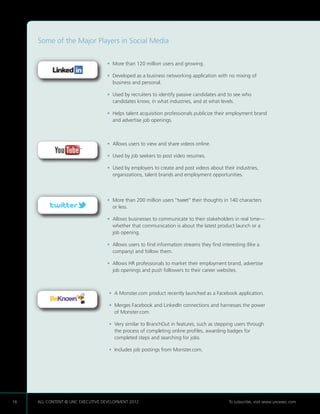
Some of the Major Players in Social Media


                                   •  ore than 120 million users and growing.
                                     M

                                   •  eveloped as a business networking application with no mixing of
                                     D
                                     business and personal.

                                   •  sed by recruiters to identify passive candidates and to see who
                                     U
                                     candidates know, in what industries, and at what levels.

                                   •  elps talent acquisition professionals publicize their employment brand
                                     H
                                     and advertise job openings.


                                   •  llows users to view and share videos online.
                                     A

                                   •  sed by job seekers to post video resumes.
                                     U

                                   •  sed by employers to create and post videos about their industries,
                                     U
                                     organizations, talent brands and employment opportunities.


                                   •  ore than 200 million users “tweet” their thoughts in 140 characters
                                     M
                                     or less.

                                   •  llows businesses to communicate to their stakeholders in real time—
                                     A
                                     whether that communication is about the latest product launch or a
                                     job opening.

                                   •  llows users to find information streams they find interesting (like a
                                     A
                                     company) and follow them.

                                   •  llows HR professionals to market their employment brand, advertise
                                     A
                                     job openings and push followers to their career websites.


                                    •  Monster.com product recently launched as a Facebook application.
                                      A

                                    •  erges Facebook and LinkedIn connections and harnesses the power
                                      M
                                      of Monster.com.

                                    •  ery similar to BranchOut in features, such as stepping users through
                                      V
                                      the process of completing online profiles, awarding badges for
                                      completed steps and searching for jobs.

                                    • ncludes job postings from Monster.com.
                                      I


16   ALL CONTENT © UNC EXECUTIVE DEVELOPMENT 2012    	                                       To subscribe, visit www.uncexec.com
THE RECRUITING REVOLUTION AND TECHNOLOGY


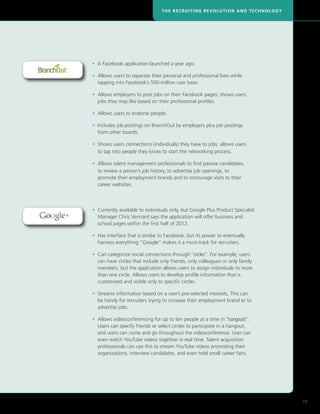
• A Facebook application launched a year ago.
  

• Allows users to separate their personal and professional lives while
  
  tapping into Facebook’s 500-million user base.

• Allows employers to post jobs on their Facebook pages; shows users
  
  jobs they may like based on their professional profiles.

• Allows users to endorse people.
  

• Includes job postings on BranchOut by employers plus job postings
  
  from other boards.

• Shows users connections (individuals) they have to jobs; allows users
  
  to tap into people they know to start the networking process.

• Allows talent management professionals to find passive candidates,
  
  to review a person’s job history, to advertise job openings, to
  promote their employment brands and to encourage visits to their
  career websites.


• Currently available to individuals only, but Google Plus Product Specialist
  
  Manager Chris Vennard says the application will offer business and
  school pages within the first half of 2012.

• Has interface that is similar to Facebook, but its power to eventually
  
  harness everything “Google” makes it a must-track for recruiters.

• Can categorize social connections through ”circles”. For example, users
  
  can have circles that include only friends, only colleagues or only family
  members, but the application allows users to assign individuals to more
  than one circle. Allows users to develop profile information that is
  customized and visible only to specific circles.

• Streams information based on a user’s pre-selected interests. This can
  
  be handy for recruiters trying to increase their employment brand or to
  advertise jobs.

• Allows videoconferencing for up to ten people at a time in ”hangouts”.
  
  Users can specify friends or select circles to participate in a hangout,
  and users can come and go throughout the videoconference. User can
  even watch YouTube videos together in real time. Talent acquisition
  professionals can use this to stream YouTube videos promoting their
  organizations, interview candidates, and even hold small career fairs.


                                                                                17
How Social Media Is Being Used . . . . . . . . . . . . . . . . . . . . . . . . . . . . . . . . . . . . . . . . . . . . . . . . . . . . . . . . . . . . . . . . . . . . . . . . . . . . . . . . . . . . .
     Social media appears to be successful in not only                                                            The quality of hires is always a concern, and while
     expanding talent pools, but in hiring candidates as                                                          recruiters continue to rank employee referrals as
     well. Sixty-four percent of respondents to a 2011                                                            the best source of quality of hires (8.6 on a scale of
     Jobvite survey said they had successfully hired a                                                            10), social networks fair well with a rank of seven
     candidate through a social network in 2011. Nearly                                                           on a scale of 10. Corporate career sites, third-party
     all survey respondents (95 percent) said they had                                                            recruiting firms, campus recruiting, job boards and
     hired someone through LinkedIn; 24 percent of                                                                search engines all ranked below social networks in
     respondents had hired someone through Facebook                                                               the quality of hires (Jobvite, 2011). It is important
     and 16 percent of respondents had hired someone                                                              to note that employee referrals and social networks
     through Twitter.                                                                                             are not mutually exclusive; some social networks
                                                                                                                  like BeKnown and BranchOut include features that
                                                                                                                  encourage employees to recommend colleagues and
                                                                                                                  friends.


     The Pros of Social Media in the Talent Acquisition Process. . . . . . . . . . . . . . . . . . . . . . . . . . . . . . . . . . . . . . . . .
     Social media offers recruiters several advantages.                                                           Third, as organizations continue to do more with
     First, these applications expand talent pools beyond                                                         less, these technologies are extremely cost effective.
     geographic boundaries, allowing employers to reach                                                           It costs little to establish a social media presence,
     a global audience.                                                                                           although managing those networks can be a
                                                                                                                  challenge.
     Second, they allow candidates to find talent
     acquisition professionals. Most people find jobs                                                             Perhaps the most compelling reason to use social
     through personal or professional networks—moving                                                             media in HR and the talent acquisition process,
     those networks online allows more people to be                                                               though, is because it is inevitable. Most large
     aware of an organization’s employment brand and                                                              organizations already have a prominent social media
     job openings. It also allows employees to notify their                                                       presence and leverage it to improve their employment
     personal and professional networks of job openings                                                           brand and to find active and passive job candidates.
     in their organizations.


     The Cons of Social Media in the Talent Acquisition Process. . . . . . . . . . . . . . . . . . . . . . . . . . . . . . . . . . . . . . .
     One of the challenges HR professionals face when                                                             With so many choices available, choosing one or
     entering the social media market is that it is growing                                                       more to use is a viable concern for job seekers and
     at seemingly exponential rates with new players                                                              recruiters. For job seekers, maintaining multiple social
     regularly entering the arena. This makes it difficult to                                                     media accounts could easily become a full-time job.
     know where one should concentrate efforts when it                                                            The same is true for recruiting professionals, but
     comes to talent acquisition.                                                                                 added to that concern is whether they will be using
                                                                                                                  the “right” application for their talent acquisition
                                                                                                                  needs as these platforms develop. Unfortunately, it
                                                                                                                  will take time to see what application emerges as an
                                                                                                                  overall or industry-specific leader.


18   ALL CONTENT © UNC EXECUTIVE DEVELOPMENT 2012                                           	                                                                  To subscribe, visit www.uncexec.com
THE RECRUITING REVOLUTION AND TECHNOLOGY


    Which Application Is the Right One?. . . . . . . . . . . . . . . . . . . . . . . . . . . . . . . . . . . . . . . . . . . . . . . . . . . . . . . . . . . . . . . . . . . . . . . . . . . . . . . . . . 
    In a side-by-side comparison of BeKnown and                                                               social media applications. When selecting which social
    BranchOut, J.T. O’Donnell, founder of Careerealism.                                                       media applications to use, HR and talent management
    com, urged job seekers to choose one and stick with                                                       professionals should not only consider the resources
    it because you can’t go wrong either way. These are                                                       they have available to maintain them, but should
    early days in social media for career networking, and                                                     also consider which ones will best align with their
    no single application has emerged as a clear overall                                                      organization’s strategic HR plan.
    long-term leader, and none has emerged as a leader
    in a specific industry. Until that evolution happens,
    recruiters will likely find themselves juggling multiple


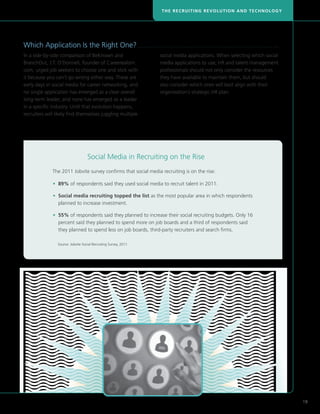
                                                     Social Media in Recruiting on the Rise
                          The 2011 Jobvite survey confirms that social media recruiting is on the rise:

	                         • 89% of respondents said they used social media to recruit talent in 2011.

	                         •  ocial media recruiting topped the list as the most popular area in which respondents
                            S
                            planned to increase investment.

	                         •  5% of respondents said they planned to increase their social recruiting budgets. Only 16
                            5
                            percent said they planned to spend more on job boards and a third of respondents said
                            they planned to spend less on job boards, third-party recruiters and search firms.

		                            Source: Jobvite Social Recruiting Survey, 2011.


                                                                                                                                                                                                              19
Example: Discovery Communications
                                                      Tyler Benjamin, vice president of global talent management at Discovery
                                                      Communications, is the first to admit that Discovery is not yet a leader
                                                      in using social media for talent acquisition—and that is deliberate. “We
                                     intentionally took our time to test out Twitter, Facebook and LinkedIn. This helped us
                                     form a strategic social media plan,” said Benjamin. “We quickly realized that establishing
                                     a talent brand was key and that most of our followers, while disbursed throughout the
                                     world, wanted local information. We’re currently concentrating on building that brand in
                                     the United States because we not only need to have content, we also need to have the
                                     staff to manage that content. Our plan is to expand our global ‘local’ content within the
                                     next few years.”

                                     Discovery has used social media to establish alumni groups to some success. “We have a
                                     lot of people who return to Discovery after spending time with other organizations. Our
                                     alumni groups help us keep in touch with them,” said Benjamin.


     Simulations and Virtual Worlds
     Although the terms “simulations” and “virtual worlds” are often used interchangeably, they are not the same.
     Simulations replicate job-related tasks to allow employers to assess a candidate’s skills. Virtual worlds like Second
     Life allow participants to interact with each other through avatars. Virtual worlds were originally created with social
     users in mind, but some employers are using it as a recruiting tool. This section describes both types of technologies,
     provides examples of how they have been used in the talent acquisition process and explores their possible growth
     in this field.


     Simulations. . . . . . . . . . . . . . . . . . . . . . . . . . . . . . . . . . . . . . . . . . . . . . . . . . . . . . . . . . . . . . . . . . . . . . . . . . . . . . . . . . . . . . . . . . . . . . . . . . . . . . . . . . . . . . . . . . . . . . . . . . . . . 
     Early simulations were often administered on the job                                                                                      centers (data entry and customer service skills) and
     site and imitated actual job tasks (like typing speed                                                                                     manufacturing (computer and logic skills), and to
     and accuracy) to assess a person’s ability. These early                                                                                   offer candidates ”day-in-the-life” glimpses into an
     simulations eventually expanded into in-basket exercises                                                                                  organization’s working environment.
     where candidates had to assume a job role and handle
     some of the daily tasks of that job (Handler, 2009).                                                                                      Many recruiters believe that simulations offer
                                                                                                                                               advantages over traditional tests. First, they
     Technology has taken simulations online and to a new                                                                                      are more engaging than traditional, non-interactive
     level, making it possible to replicate a variety of work                                                                                  assessments. In addition, they offer more realistic job
     environments and to assess performance in a more                                                                                          previews and can reduce bias and subjectivity in the
     automated manner. Today, these engaging simulations                                                                                       hiring process because of their realism and automated
     are being used to assess skills in such settings as call                                                                                  scoring (Handler, 2009).


20   ALL CONTENT © UNC EXECUTIVE DEVELOPMENT 2012                                                                  	                                                                                    To subscribe, visit www.uncexec.com
THE RECRUITING REVOLUTION AND TECHNOLOGY


 Example: AutoMax Recruiting  Training
                                            AutoMax Recruiting  Training recently partnered with Hire the
                                            Winners, the creator of a car sales simulator that helps dealers learn
                                            more about sales candidates and their sales potential. According to
                         AutoMax, the simulator has been used more than 16,000 times and has an 82 percent
                         retention rate after two years for sales people the simulator recommended. For those the
                         simulator recommended with reservation, the two-year retention rate was 64 percent,
                         and for those not recommended, the two-year retention rate was just 14 percent.


When Are Simulations Appropriate?. . . . . . . . . . . . . . . . . . . . . . . . . . . . . . . . . . . . . . . . . . . . . . . . . . . . . . . . . . . . . . . . . . . . . . . . . . . . . . . . . . . 
There are a few important considerations for employers                                                  that simulations may cause bottlenecks in the hiring
thinking about using simulations in the talent acquisition                                              process, particularly for organizations hiring a large
process. Some recruiters feel that simulations may turn                                                 number of candidates. Finally, the types of skills assessed
off upper-level professionals who expect to be wooed                                                    through simulations must be considered—they may be
rather than assessed, and they advise employers to                                                      better suited to softer skills, such as customer-service
consider the type of worker being recruited and whether                                                 orientation (Ruiz, 2008). For harder, knowledge-based
a simulation is appropriate. Others are concerned                                                       skills, traditional assessments may be more appropriate.


The Next Evolution of Simulations: Gaming. . . . . . . . . . . . . . . . . . . . . . . . . . . . . . . . . . . . . . . . . . . . . . . . . . . . . . . . . . . . . . . . . . . . . . . 
The future is here in the world of simulations and                                                      1.  ive rewards (like badges) to visitors to your site when
                                                                                                           G
recruitment, and that future is gaming. Employers                                                          they’ve engaged in an activity such as watching a
are using gaming technology to offer realistic job                                                         video or taking an assessment. Encourage them to
previews and video tours to attract candidates to their                                                    come back to the site frequently.
organizations. Gaming technology lures candidates to
the organization’s website, keeps them there longer as                                                  2. 	Consider using virtual world technology like Second
they play a game or two, and in the process, users learn                                                    Life. IBM, Monster.com and other organizations have
more about the organization in a fun and engaging                                                           used this technology to host virtual job fairs, conduct
way. Recruiters are learning from gamers that awarding                                                      interviews and offer virtual tours.
badges and showing progress toward a goal attracts the
Gen Yers who have grown up playing online games. Ken                                                    3. 	 ffer video-based job tryouts.
                                                                                                            O
Wheeler from ERE.net predicts that gaming will become
                                                                                                        4. 	Hold virtual career fairs.
standard fare in recruiting within the next decade
(Wheeler, 2010).
                                                                                                        5. 	 se tests, puzzles and simulations.
                                                                                                            U

Wheeler offers six tips recruiters can use to start the                                                 6. 	 evelop a full-fledged game. These simulated
                                                                                                            D
gaming ball rolling.                                                                                        environments engage candidates and can immerse
                                                                                                            them in your organization’s talent brand.


                                                                                                                                                                                                          21
Organizations are taking gaming online to establish                  • Merrill Lynch developed their Financial Games
                                                                            
     their talent brands and to attract candidates:                         Collection to educate undergraduates and MBA
                                                                            students about available careers and to drive
     •  ahoo! Hotjobs launched Swivel Chair Relay
       Y                                                                    traffic to their career website. The game teaches
       and Flip Off Your Boss to engage their targeted                      players about the IPO process while positioning
       recruiting demographic of 18-24 year olds. The                       Merrill Lynch as a great place to work.
       games blend humor and entertainment with the
       HotJobs brand messaging. The promotion was                         • The U.S. Army was arguably the first
                                                                            
       considered a great success, with more than                           organization to use gaming as a recruitment tool
       40,000 people playing the games and registering                      when it launched America’s Army on its website.
       as HotJob members.                                                   The game, according to the Army, significantly
                                                                            helped raise flagging enlistment rates.

     Source: Brandgames.


     Example: Marriott International
                                               Since its launch in June, gamers in 122 countries have played
                                               the My Marriott game on Facebook, the first game designed
                                               to educate players about careers in the hospitality industry.
                                               Players enter a virtual Marriott kitchen where they hire and train
                           employees, ensure that meals are well prepared, serve guests, and buy restaurant
                           equipment and ingredients on a budget. They earn points for satisfied customers and
                           lose points for unsatisfied ones.

                           The game is part of a painstakingly planned global employer brand strategy that
                           was two years in the making, according to Susan Strayer, senior director for global
                           employer brand and marketing at Marriott International.

                           For Marriott, it was important to have a strategy in place for social recruiting. “We
                           didn’t want to execute solutions without understanding how those solutions fit into
                           the overall strategy,” noted Strayer. That strategy included the release of a video in
                           April with a new talent brand line, “Find Your World,” followed by the unveiling of a
                           Marriott International Facebook page (which now has nearly 32,000 followers) in May
                           and the My Marriott game in June. One of the goals of this strategy: to have people
                           self-select into the industry in general and Marriott in particular. “For Marriott,” Strayer
                           notes, “it’s not about finding people, but about finding the right people.”


22   ALL CONTENT © UNC EXECUTIVE DEVELOPMENT 2012            	                                       To subscribe, visit www.uncexec.com
THE RECRUITING REVOLUTION AND TECHNOLOGY


Virtual World Technology: Virtual Career Fairs


The use of virtual worlds (mostly used to host virtual        using that same technology; and visit networking
career fairs) in the talent acquisition process admittedly    lounges where they can interact with different employers
had a rocky start a few years ago. Limits to the              and other job seekers. Virtual career fairs can even allow
technology at the time and people’s unfamiliarity with        managers who would normally be unable to attend live
how it worked caused these online experiences to be           fairs to talk to candidates, speeding up the interviewing
often clunky and sometimes downright embarrassing,            process.
according to Courtney Hunt, Ph.D., principle at
Renaissance Strategic Solutions. “I heard horror stories      Virtual career fairs allow employers to reach candidates
of avatars floating during virtual career fairs—and that      from across the globe without the costs associated with
wasn’t the person’s intent,” recalls Hunt.                    travel and hosting on-site career fairs. They are also
                                                              environmentally friendly because they are paperless
Others agree. Until recently, technological limitations       (resumes are submitted virtually) and energy saving
made virtual career fairs just barely better than what        (reduced reliance on gas to get to and from live career
employers could get through online job boards; a              fairs).
place to post jobs and a corporate profile, an area for
online chats, and bulletin boards (Zappe, 2011). These        A survey by Unisfair, a virtual engagement marketing
limitations caused interest in the use of virtual worlds in   company, found that 60 percent of respondents plan
recruiting to wane.                                           to increase spending on virtual environments and 67
                                                              percent of respondents are thinking about hosting ten
New and improved virtual world technology, however,           or more virtual events in the next 12 months (Gardner,
has caused a resurgence of interest among HR                  2011).
professionals who see virtual career fairs as a cost
effective way to attract talent, particularly those           “Virtual engagement is not just a replacement for a
who grew up using technology and who find online              physical event, but is a new channel for reaching your
interaction more the norm than the exception (Zappe,          audiences,” notes Joerg Rathenberg, Unisfair’s vice
2011).                                                        president of marketing. “The research indicates that
                                                              virtual events are being adopted across industries and
In today’s virtual career fairs, job seekers and recruiters   enterprises and will continue to be the preferred way to
use avatars to enter a virtual world. Participants can chat   meet, market, collaborate and educate for both hosts
live through text, voice or video; conduct interviews         and attendees alike.” (Gardner, 2011).


                                                                                                                           23
Example: Monster Canada’s Virtual Career Fair
                                            A virtual career fair recently hosted by Monster Canada was deemed a huge
                                            success by the company and attendees. The fair featured 21 employers and
                               generated more than 400,000 page views, 18,000 visits, 21,000 job views and collected
                               more than 12,000 resumes.

                               “Monster’s first virtual career fair in April was hugely popular and the high level of activity
                               clearly demonstrated how having an active online career strategy is the way of the future,
                               both for successful job seekers and employers,” noted Monster Canada Senior Vice
                               President of International Sales Peter Gilfillan (Market Watch, 2011).

     Most recruiters agree that virtual career fairs should be                                       the emergence of hybrid career fairs—a combination
     part of a whole recruitment strategy and should not                                             of physical and virtual locations that allow for human
     replace face-to-face interaction. Many recruiters predict                                       interaction.


     Conclusion
     Social media, simulations and virtual worlds are                                                At the same time, it will require HR professionals to
     opening new and exciting venues for HR and talent                                               be nimble enough to make changes to their talent
     management professionals to source new talent and                                               acquisition processes “on the fly” while managing these
     to establish their talent brands. The rapid pace at                                             applications in ways that will achieve their organization’s
     which these technologies are developing will challenge                                          strategic talent plan.
     HR professionals to stay up-to-date with their uses.


     Berzon, A. (2011, June 6). Enough with the      Giles, J. (2011, October). Meet the New         Khan, R. (n.d.). Google Plus. The Starter’s        Raphael, T. (2011, February 1). 2011 ERE
     ‘Call of Duty,’ Answer the Call in Room 417.    Boss. Second Life’s Creator wants to Rewire     Guide. Accessed September 24, 2011 from            Recruiting Excellence Award Finalists.
     The Wall Street Journal. Retrieved September    How Businesses Run. The Atlantic. Retrieved     www.youtube.com.                                   ERE.net. Retrieved August 25, 2011 from
     7, 2011 from http://online.wsj.com/             September 15, 2011 from www.theatlantic.                                                           www.ere.net/2011/02/01/2011-ere-
                                                     com/magazine/archive/2011/ 10/meet-the-         Light, J. (2011, April 4). For Job Seekers,        recruiting-excellence-award-finalists/.
     Brandgames (www.brandgames.com).                new-boss/8637/#.Tm-L_hkXE7k.twitter.            Company Sites Beat Online Job Boards, Social
                                                                                                     Media. The Wall Street Journal. Retrieved          Ruiz, G. (2008, January). Job Candidate
     Brightmove.com (www.brightmove.com).            Hampton, M. (2011, Winter). Getting the         September 6, 2011 from www.wsj.com.                Assessment Tests Go Virtual. Workforce
                                                     Biggest Bang for Your Recruiting Buck.                                                             Management Online. Retrieved August 25,
     Crispin, G.  Mehler, M. (2011, March). 10th    Employment Relations Today, 27-36.              Light, J. (2011, May 30). Start-Ups Tag            2011 from www.workforce.com.
     CareerXRoads Annual Source of Hire Report:                                                      Facebook for Career Networking. The Wall
     By the Numbers. Retrieved August 30, 2011       Handler, C. (2009, March 11). Job               Street Journal. Retrieved September 6, 2011        Wheeler, K. (2010, December 22). Serious
     from www.careerxroads.com.                      Simulations for Selecting Employees:            from www.wsj.com.                                  Recruiting Games: 6 Tips for Using Games
                                                     What might the future hold? ERE.net.                                                               and Simulations for Recruiting Success.
     DaZube, D. (2008, November). Virtual Job        Retrieved August 29, 2011 from www.ere.         Market Watch (2011, September 14).                 ERE.net. Retrieved August 31, 2011 from
     Fairs Gain Ground. Dice.com. Retrieved          net/2009/03/11/job-simulations-for-selecting-   Monster.ca’s Popular Virtual Career Fair Is        www.ere.net.
     September 8, 2011 from http://career-           employees-what-might-the-future-hold/.          Back. Market Watch. Retrieved September
     resources.dice.com/technical-resume/virtual-                                                    15, 2011 from www.marketwatch.com/story/           Zappe, J. (2011, July 15). 8-city Virtual Job
     job-fairs-gain-ground.shtml.                    Jobvite (2011). Jobvite Social Recruiting       monstercas-popular-virtual-career-fair-is-         Fair May Be the Crest of a Trend. ERE.net.
                                                     Survey 2011. Retrieved August 30, 2011          back-2011-09-14.                                   Retrieved September 7, 2011 from
     Epicor (n.d.). Finding the Perfect Candidate.   from www.jobvite.com.                                                                              www.ere.net/2011/07/15/8-city-virtual-job-
     Epicor. Irvine: CA.                                                                             O’Donnell. J.T. (2011, June 27). BranchOut         fair-may-be-the-crest-of-a-trend/.
                                                     Johnson, D. (2011, August 18). AutoMax          Versus BeKnown—Which Facebook App for
     Gardner, D. (2011, May 9). 60% of               Recruiting  Training Partners with Hire        Your Career? CareeRealism.com. Retrieved
     Marketers to Increase Spend on Virtual          the Winners and the Car Sales Simulator.        September 24, 2011 from www.careerealsim.
     Conferences. CMO.com. Retrieved                 Autodealerpeople.com. Retrieved August 31,      com/beknown-branchout-facebook-career-
     September 15, 2011 from www.cmo.com/            2011 from www.autodealerpeople.com.             app/.
     virtual-worlds/60-marketers-increase-spend-
     virtual-conferences?cmpid=NR87.


24   ALL CONTENT © UNC EXECUTIVE DEVELOPMENT 2012                                     	                                                             To subscribe, visit www.uncexec.com
Lead your
       HR organization
                                                           into the future.
B U S I N E S S    A N D     H U M A N      R E S O U R C E S


Now more than ever, senior HR leaders need the
knowledge, skills and experience to respond to
emerging trends that are shaping the future of global
business. Offered in partnership with the Society for
Human Resource Management (SHRM), UNC’s
                                                                UNC EXECUTIVE DEVELOPMENT
Business and Human Resources program is designed
                                                                The Power of Experience.
to equip senior HR leaders with the most up-to-date
business knowledge and skills needed to succeed in
the rapidly changing business environment today -
and tomorrow.

To learn more, visit www.bhr.uncexec.com.


                                                                                            25
Embracing Open-Book
     Management to Fuel Employee
     Engagement and
     Corporate Sustainability
     Anne Claire Broughton   Jessica Thomas
     Senior Director,        Managing Director, Center for Sustainable Enterprise
     SJF Institute           UNC Kenan-Flagler Business School


     Introduction
     When John Case and Jack Stack first introduced the                   •  xplores how open-book management practices are
                                                                            E
     concept of open-book management more than 30 years                     well-suited to help achieve corporate sustainability
     ago, the intent was to unleash the entrepreneur in every               goals.
     employee and to spur them—and their organizations—
     to better performance. Since then, countless                         •  utlines steps HR and talent management
                                                                            O
     organizations have opened their books and engaged                      professionals can take to ensure the application of
     their employees in understanding the critical numbers                  those practices in their own organizations.
     with positive results to their bottom lines. Although
     the original goals of open-book management were
     improved profitability and productivity, organizations
                                                                          The Basics of Open-Book
     have realized other benefits from the practice. These                Management
     benefits include improved employee satisfaction,
     engagement, retention, motivation, innovation and                    Before most people were focusing on corporate
     corporate sustainability.                                            sustainability, Case and Stack were espousing the
                                                                          virtues of open communication to engage employees
                                                                          to achieve better overall business performance. In his
     Promise                                                              book, The Great Game of Business, Stack describes
                                                                          open-book management as being “all about promoting
     This white paper:
                                                                          clear, effective and open communication” to employees.
     •  xamines open-book management and the benefits
       E                                                                  By doing so, employees at all levels have a clearer
       of applying its principles to improve employee                     understanding of their organizations’ purpose and goals,
       satisfaction, engagement, retention, motivation,                   are more engaged in their organizations and perform
       innovation and corporate sustainability.                           better in their jobs.


26   ALL CONTENT © UNC EXECUTIVE DEVELOPMENT 2012          	                                        To subscribe, visit www.uncexec.com
EMBRACING OPEN-BOOK MANAGEMENT


Organizations practicing open-book management:            • Teach employees how to follow the action and
                                                            
                                                            keep score. All employees track progress on critical
• Explain clearly the organization’s key measures of
                                                           numbers through regular meetings and scorecards.
  business success, allowing employees to make better-      They are empowered to take action to improve
  informed business decisions.                              performance as needed.

• Share financial information (such as income
                                                         • Engage the ingenuity of all employees in solving key
                                                            
  statements, balance sheets and other key metrics)         business challenges, such as how the organization
  with employees, and ensure they understand them           can become more socially and environmentally
  and know how they relate to the organization’s key        sustainable.
  measures of business success.
                                                          “When you share the numbers and bring them alive,
• Tell the stories behind the numbers to bring them
                                                         you turn them into tools people can use to help
  alive and give them meaning.                            themselves as they go about their business every day.
                                                          That’s the key to open-book management.”
• Allow employees to share in the success of the
  
                                                          (Stack, 1992).
  organization through a profit-sharing program that is
  tied to key business metrics.


                                                                                                                   27
Why Open-Book Management Works
     Clearly communicated and understood goals, a                 • Demonstrate innovative thinking because they feel
                                                                    
     hallmark of open-book management, leads to improved            more vested in their organizations’ success
     profitability and encourages teamwork. This leads to           (Henglein, 2009).
     increased job satisfaction and reduced turnover.
     Organizations practicing open-book management                • See the big picture, allowing them to leave their silos
                                                                    
     report that employees:                                         and become team players. Giving employees a view
                                                                    of the big picture also makes them more engaged,
     •  eel a stronger sense of ownership in the
       F                                                            helps them understand how their roles fit in the
       organization.                                                organization, and how they can make a difference.

     •  evelop more trusting and collaborative relationships
       D                                                          All of these factors lead to an improved bottom line.
       with their employers.                                      A study conducted by the National Center for Employee
                                                                  Ownership (NCEO) found that organizations which
     •  nderstand their organization’s cost structure and
       U
                                                                  follow open-book management principles experienced
       make better informed suggestions for improvement.
                                                                  a 1-2 percent annual increase in sales growth above
     •  nderstand the need for cost controls through the
       U                                                          typical sales projections.
       regular sharing of financial information and become
       more responsible in how they use their organizations’
       resources.


     Example: CleanScapes
                                 CleanScapes, a waste reduction, diversion and collection service
                                 headquartered in Seattle, Washington, was recently named by Inc.
                                 Magazine as one of the top 5,000 fastest growing companies in the U.S.
                                 and the fourth fastest growing environmental firm. Leaders at CleanScapes
                   credit much of their success (which includes $50 million in revenue in 2009, low employee
                   turnover and high levels of customer satisfaction) to their open-book management
                   approach.

                   CleanScapes keeps close tabs on important metrics (called “CleanStats”) and shares them
                   with employees during weekly meetings. These metrics go beyond financial and include
                   operational efficiencies, errors and kudos. “The metrics have been instrumental in helping
                   the firm meet and beat its internal financial performance goals,” reports HR Manager
                   Bonnie Abbott.

                   In addition to tracking and reporting on metrics, CleanScapes leaders hold daily
                   morning huddles by department. The company also offers generous benefits and is
                   known to promote from within. Drivers and managers meet for lunch once a month to
                   offer feedback and suggestions on how to improve operations, which has resulted in
                   organization-wide efficiency gains which include lower missed pick-ups, fewer accidents
                   and reduced route hours.
                   Source: Broughton, 2011.


28   ALL CONTENT © UNC EXECUTIVE DEVELOPMENT 2012      	                                    To subscribe, visit www.uncexec.com
EMBRACING OPEN-BOOK MANAGEMENT


Not surprisingly, these outcomes—a stronger sense of           successful corporate sustainability programs do a better
ownership, improved trust and collaboration, stronger          job of attracting and retaining employees. Executives in
teams, better informed and innovative suggestions,             organizations with successful sustainability efforts also
and an improved bottom line, to name a few—are also            report that their employees are far more knowledgeable
hallmarks of successful corporate sustainability initiatives   about their organization’s operations than employees
that emphasize the triple bottom line of people, planet        in other businesses, enabling them to devise efficiency
and profits. According to a 2011 McKinsey survey,              improvements that lead to more sustainable operations.


Open-Book Management Challenges
The main concern most people raise when it comes to            Other concerns about open-book management practices
open-book management is whether it is wise to share            include:
compensation information to employees, the fear being
that it could make them disgruntled if they perceive           • The worry that disgruntled employees may misuse
                                                                 
inequities in pay structures.                                    financial information (such as profit margins) or other
                                                                 proprietary information by sharing it with competitors.
Open-book management proponents do not
recommend sharing individual compensation                      • The concern that if the organization is successful,
                                                                 
information. Instead, they advise employers to combine           employees will want a larger piece of the profits and
salaries and benefits into a single line on budget               may become unmotivated if they don’t receive it.
statements so employees can see and monitor it. This             Alternately, if the organization is struggling, workers
will show employees how much compensation and                    will be concerned with job security and possibly jump
benefits cost the organization without providing                 ship, taking their knowledge and talents elsewhere.
detailed information.
                                                               • The belief that open-book management creates
                                                                 
                                                                   a conundrum for organizations by begging
And while some might believe that open-book
                                                                      the questions: “Is it possible to be too
principles can generate resentment toward
                                                                               transparent? If we open the
highly compensated employees, evidence
                                                                                      books, will we give
shows the opposite occurs. Employees
                                                                                            competitors too much
in open-book organizations better
                                                                                               information about
understand and therefore accept
                                                                                                 our products and
compensation structures more
                                                                                                  talent? Will it
willingly. Some management experts
                                                                                                   lead to the
like Ed Lawler, director of the
                                                                                                    poaching of
University of Southern California’s
                                                                                                    our products
Center for Effective Organizations,
                                                                                                    and top
believe that by keeping
                                                                                                   performers?”
compensation plans secret
or practicing “closed book
management,” businesses
tend to generate more
distrust and resentment
among employees.


                                                                                                                           29
There is no evidence to show that organizations            open-book organizations even welcome the attempts
     following open-book management practices experience        to hire away their best employees, because it provides
     more misuses of proprietary information compared to        them an opportunity to communicate openly with them
     other organizations. Jack Stack emphasizes the need        and to demonstrate why their organizations offer the
     for managers to actively “show employees how to use        best opportunities for career development.
     financial information as a tool to help the company,” to
     avoid the misusing of the information (Stack, 1992).       And in terms of struggling organizations, many report
     Leaders who follow open-book management practices          that downsizing or implementing temporary salary
     acknowledge that attempts to hire away top performers      reductions in difficult times was actually less of a
     are part and parcel of being a successful organization.    challenge because employees understood why it was
     If competitors aren’t trying to poach an organization’s    necessary. In fact, in a few instances, organizations
     best employees, then it could be time for HR and           reported that employees volunteered for layoffs—
     talent managers to take a good hard look at what their     and were the first to return when the organization
     organizations are doing wrong. Some CEOs of                recovered.


     Overcoming the Challenges
     These challenges can be addressed, and advocates           The critical numbers employers decide to share with
     believe the increased employee engagement, motivation      employees will often be as unique as the organization
     and innovation are well worth the effort.                  but may include revenue growth (or loss), expenses,
                                                                workforce growth (or reduction), and compensation and
     By entrusting employees with vital information about       benefits.
     the organization’s financial and operational health,
     business leaders send a message that they consider         For organizations striving to achieve sustainability goals,
     every worker to be a valued partner and stakeholder        other critical numbers may be shared. At Burt’s Bees,
     in their organizations. Research shows employees who       for example, critical sustainability goals include water
     believe they are trusted by their managers and CEOs can    and electrical use, community giving, and achievement
     better see the big picture and tend to be more loyal and   toward their long-term goal of having each Burt’s Bees
     productive, or in other words, more engaged.               location become a zero waste-to-landfill facility; a goal
                                                                they achieved for three facilities in 2010.
     Employers sometimes find it difficult to determine what
     kind of financial information to share with employees.     The key to any successful open-book management
     Open-book management proponents recommend                  system is to design it to fit an organization’s particular
     keeping things focused and simple, with a goal to          business needs and corporate culture, according
     communicate a common understanding of the                  to JoAnne Berg from Monster.com. “Open-book
     organization’s most critical numbers and how                management,” Berg writes, “is … another set of
     employees can move those numbers in the                       tools in your toolkit that you can use to improve
     right direction (GreatGame.com).                               the success of your business.” (Berg, n.d.).


30   ALL CONTENT © UNC EXECUTIVE DEVELOPMENT 2012     	                                    To subscribe, visit www.uncexec.com
EMBRACING OPEN-BOOK MANAGEMENT


How Open-Book Management Can Drive Corporate
Sustainability
Organizations are increasingly considering the             everyone engaged and aware, such as an environmental
“triple bottom line”—people, planet and profit—            gazette that’s published monthly, quarterly all-company
in their business dealings and in their measures of        meetings which include important messaging, but
organizational success.                                    generally are a lot of fun, movies that are relevant,
                                                           documentaries, regularly scheduled lunch-and-learns on
Not surprisingly, open-book management practices           any topic. Often, our employees suggest what topics
work well in organizations that engage in corporate        they would like to learn about. All of this is helpful and
sustainability practices. Open-book management can         really well received—and along the way, they keep all of
significantly contribute to achieving and maintaining      our teams informed.”
corporate sustainability efforts by integrating social
and environmental metrics into the traditional financial   In 2010, Burt’s Bees launched its “Live the Greater
measures of business success. Open-book management         Good” program, designed to achieve 100 percent
practices also contribute to corporate sustainability      employee engagement as a way to achieve its long-
efforts by empowering employees with knowledge of          term sustainability goals. The program consists of
the critical numbers, enabling them to see where their     four modules that all employees have to complete
innovative efforts can streamline operations, saving       annually on wellness, world-class leadership, outreach
money and resulting in increased sustainability.           and the environment. The programs are tied to the
                                                           company’s culture and long-term corporate goals. In
Nowhere is this more apparent than at Durham,              addition, the company offers a short-term incentive
N.C.-headquartered Burt’s Bees. A key goal of their        program. All associates are eligible for a bonus based
sustainability initiative is to attain a 100 percent       on overall company performance. Like most companies,
involvement rate from employees. Their paperless           performance is based, in part, on sales or profits, but at
corporate sustainability report, which is publicly         Burt’s Bees, there is a sustainability component as well.
available on their website, is just one mode of            The metrics may change annually based on what the
communication used to reach that goal.                     company is focusing on for the fiscal year, but all
                                                           of them tie into their long-term goals. In 2009,
According to Yola Carlough, Burt’s Bees’ director          sustainability goals included reducing water and
of sustainability, “(We) have other ways of keeping        electrical usage.


                                                                                                                        31
At New Belgium Brewing, CEO Kim Jordan notes that             Open-book management practices help to improve the
     their company’s open-book management style fosters            triple bottom line by giving employees the information
     employee engagement and innovation, which in turn             they need to make informed decisions and the ability
     improves the company’s sustainability efforts. Engaging       to act. These newly empowered employees are more
     employees, she notes, allows all employees, from              invested in the long-term financial sustainability of
     entry level to executive, to participate in the “business     the organization because they feel ownership in the
     of doing business.” For example, two New Belgium              organization’s environmental, social and financial
     Brewing employees recently proposed eliminating               effects and are empowered to drive the top and
     12-bottle pack dividers. By eliminating the dividers,         bottom lines. Everyone shares the same mission and
     the company saved $280,000, 150 tons of paper and             goals and can better collaborate to meet those goals.
     reduced machine downtime.


     Example: New Belgium Brewing
                       At New Belgium Brewing, open-book management drives their high performance
                         culture and sustainability efforts. Founded in 1991 by Jeff Lebesch, leaders at this
                          Fort Collins, Colorado-based brewery believe that their company culture “is one of
                          the most important and transferrable tools we’ve employed to drive sustainability.”
                         Sustainability efforts embraced by New Belgium Brewing include the formation of a
                       sustainability management system with the earth as a central stakeholder, reduction
                    of their carbon footprint, the use of “green” power (including wind and solar), and
                   recycling of waste (New Belgium Brewing Company, 2008).

                   Their culture, which sets the stage for their highly engaged workforce, was established
                   through strategic alignment, open-book management and employee ownership (43
                   percent of the company is owned by employees through an employee stock ownership
                   plan [ESOP]). In addition to a share in the company’s success, other open-book
                   management practices include financial training and monthly staff meetings during which
                   finances are reviewed and employees can ask questions and offer feedback.

                   “It all adds up,” notes one employee. “When a co-worker is connected to the higher
                   purpose of the company and educated on the financial outcomes of their actions, they
                   are empowered to make decisions that benefit the business as a whole.”

                   Source: New Belgium website.


32   ALL CONTENT © UNC EXECUTIVE DEVELOPMENT 2012       	                                    To subscribe, visit www.uncexec.com
EMBRACING OPEN-BOOK MANAGEMENT


HR’s Role in Open-                                         to achieving corporate sustainability objectives. HR
                                                           and talent management professionals can aid the
Book Management and                                        communication of sustainability initiatives through
                                                           regular newsletters, electronic bulletin boards, and
Corporate Sustainability                                   regularly scheduled staff meetings.

HR and talent management professionals can help
                                                           HR can also take the lead in actively seeking out
propel an organization toward adopting open-book
                                                           employees and asking for their ideas on how to do
management and achieving corporate sustainability
                                                           things better, quickly implementing the good ideas
goals through some or all of the following practices.
                                                           and giving credit to the people who made them.
                                                           Burt’s Bees, for example, uses two annual surveys to
                                                           help solicit employee feedback and to assess how the
Get Executive Buy-In
                                                           organization’s sustainability efforts are being put to use
Ultimately, achieving corporate sustainability through     by employees in the workplace and in their homes. An
open-book management practices must be supported—          annual cultural assessment survey takes the pulse of the
financially and actively—by top management. In             organization in terms of change, the pace of change
organizations where the books haven’t been opened,         and management practices. It was through this survey
HR can lead the way by educating senior leaders            that management realized that whenever the survey’s
about how open-book management practices can               culture scores went up, so did employee retention.
have a positive effect on an organization’s bottom
line. In addition, HR can be a leader in demonstrating     The organization’s Green Day survey examines the
how these same practices have been applied in other        green practices employees use every day and assesses
organizations to achieve corporate sustainability goals.   if those practices have changed how employees live.
Furthermore, HR can encourage the development of           For example, the survey asks employees if a process
cross-functional teams that focus on ways to improve       they learned at work affected how they did things at
corporate communications and foster teamwork.              home. Do they recycle more? Do they use different light
                                                           bulbs? This survey helps the company determine how
HR also can lead by example by sharing key HR              sustainability practices introduced on the job trickle into
success metrics. This can include HR-related financial     the home and the community.
information such as the percentage of an organization’s
budget allocated to salaries and benefits. Time-to-
hire, retention and turnover are other key metrics         Develop Compensation Systems that
that HR can provide and share with the organization’s
stakeholders. For such information to be useful,
                                                           Motivate and Allow for Employee
employees must be able to grasp why those numbers          Innovation to Achieve Corporate
are important to the organization as a whole and to        Sustainability
their roles in particular—HR professionals should be
                                                           HR and talent management professionals can be
sure to tell the story behind those numbers.
                                                           key players in the development and implementation
                                                           of organizational profit-sharing plans that award
                                                           employees not on just financial metrics achieved but
Communicate Organization-Wide to                           on sustainability metrics as well, such as sharing with
Foster Employee Buy-In to Corporate                        employees some of the money saved through achieving
Sustainability                                             operational efficiencies.

As Burt’s Bees demonstrates, communication—a
key open-book management practice—is essential


                                                                                                                         33
Be Selective in Hiring and Offer                                                               Create and Communicate Meaningful
     Financial Literacy Training                                                                    Metrics
     HR professionals can use HR tools such as selection                                            Another key role for HR is to develop metrics that will
     for knowledge, skills, abilities and culture fit, and                                          demonstrate achievement toward triple bottom-line
     training to help create a workforce that has the skills                                        goals. It is then HR’s responsibility to communicate
     and motivation to achieve the key objectives of the                                            those metrics to all employees and help staff members
     triple bottom line (Cohen et al, 2011). During the                                             link those metrics to their roles in the organization. HR
     selection process, HR and talent managers can provide                                          should be prepared to track and assess those metrics on
     candidates with publicly available financial information                                       a regular basis through departmental and organization-
     and explain how this information is communicated and                                           wide staff meetings.
     used in improving the organization. Financial literacy
     training can help all employees better understand
     this information and can be an integral part of the
     onboarding process and provided to all employees on
     an ongoing basis.


     Conclusion
     The management philosophies of open-book                                                       HR and talent management professionals who
     management and sustainability are highly                                                       realize this and work to find ways to implement and
     complementary. Open-book management practices                                                  integrate open-book management practices into
     empower employees by giving them information they                                              their organizations will offer their employers a true
     need—such as critical sustainability metrics—to make                                           competitive advantage through improved corporate
     informed decisions and to act. This in turn leads to                                           sustainability policies.
     improved profitability and a stronger organization—
     the foundation of any sustainable enterprise.


     Berg, J. (n.d.). Opening the Book on Open-       Cohen, E., Taylor, S.,  Muller-Camen, M.   McKinsey Quarterly (2011, October).               Seijts, G.  Crim, D. (2006, March/April).
     book Management. Monster.com. Retrieved          (2011). HR’s Role in Corporate Social       The business of sustainability: McKinsey          What engages employees the most or, the
     October 15, 2011 from www.monster.com/           Responsibility and Sustainability. SHRM     Global Survey Results. McKinsey Quarterly.        Ten C’s of employee engagement. Ivey
     hr/hr-best-practices/small-business-resources/   Foundation. Alexandria: VA.                 Retrieved October 18, 2011 from www.              Business Journal. Reprint #9B06TB09.
     management-best-practices/pros-and-cons-of-                                                  mckinseyquarterly.com/Energy_Resources_
     open-book-management.aspx.                       Great Game website (www.greatgame.com).     Materials/Environment/The_business_of_            Stack, J. (1992). The Great Game of Business.
                                                                                                  sustainability_McKinsey_Global_Survey_            Doubleday. New York: NY.
     Burt’s Bees (n.d.). 2010 Multimedia Report.      Henglein, G. (2009, April 22). The Pros     results_2847.
     Retrieved December 12, 2011 from http://         and Cons of Open-Book Management.                                                             Winning Workplaces (2007, August 6). Ask an
     www.burtsbees.com/c/commitment/social-           allBusiness. Retrieved October 17, 2011     New Belgium Brewery (2008). 2007                  Expert: A Primer on Open-book Management.
     environmental-reporting/.                        from www.allbusiness.com/company-           Sustainability Report. New Belgium Brewery.       Retrieved October 12, 2011 from http://
                                                      activitiesmanagement/ financial/12302038.   Fort Collins: CO.                                 www.winningworkplaces.org/forum/ask/
     Broughton, A.C. (2011). Employees Matter:        html.                                                                                         primer_obm_php.
     Maximizing Company Value Through                                                             New Belgium Brewery website
     Workforce Engagement. SJF Institute.                                                         (www.newbelgium.com).
     Durham: NC. Retrieved October 17, 2011
     from www.employeesmatter.org.                                                                The National Center for Employee Ownership
                                                                                                  website (www.nceo.org).


34   ALL CONTENT © UNC EXECUTIVE DEVELOPMENT 2012                                      	                                                        To subscribe, visit www.uncexec.com
If you’re ready totake the
    next step in your career,
   make a quick trip back to
      the classroom first.


E X E C U T I V E      D E V E L O P M E N T            I N S T I T U T E


At UNC’s Executive Development Institute,
you’ll gain the core knowledge of an MBA program
without the long-term time commitment. You’ll
also learn how to view the business world from a
senior executive’s perspective. And you’ll develop the
                                                                            UNC EXECUTIVE DEVELOPMENT
key leadership characteristics that lead to effective
                                                                            The Power of Experience.
strategic performance. The result? In two weeks,
you’ll be fully prepared for that next step.


To learn more, visit www.edi.uncexec.com.


                                                                                                        35
Maximizing Millennials in the
     Workplace
     Jessica Brack
     Program Director
     UNC Executive Development


     Introduction
     They are known as Millennials, Gen Y, Gen Next, Echo        business leaders are realizing this generation’s unique
     Boomers, the Baby-on-Board Generation, Screenagers,         competencies and perspective, and employers are
     Facebookers and the MySpace Generation, to name just        looking for ways to harness their strengths. (For
     a few. Whatever you choose to call them, they are the       additional insights on how to leverage the shared values
     nearly 80 million young adults born (according to the       of the different generations in your workforce, refer to
     U.S. Bureau of Labor Statistics) between 1976 and 2001      the UNC Executive Development white paper: Rethinking
     who have already joined or are preparing to join the        Generation Gaps in the Workplace: Focus on Shared
     workforce. By 2014, 36 percent of the U.S. workforce        Values.)
     will be comprised of this generation and by 2020, nearly
     half (46 percent) of all U.S. workers will be Millennials
     (Lynch, 2008). By comparison, the generation before         Promise
     them, Generation X (or Gen Xers), represent only 16
                                                                 This white paper:
     percent of today’s workforce. The sheer volume of
     Millennials, combined with the relative lack of Gen Xers    •  xamines the positive characteristics Millennials bring
                                                                   E
     and the increasing retirement of Baby Boomers means           to an organization.
     that employers will be facing leadership gaps. And they
                                                                 •  xplores what this generation feels is important in a
                                                                   E
     will be looking to Millennials to fill those gaps.
                                                                   job and what they expect from their employers.

     By all accounts, Millennials are unlike preceding           •  ffers HR and talent development professionals
                                                                   O
     generations. They view the world differently and              some practical tips on how to keep this generation
     have redefined the meaning of success, personally             engaged.
     and professionally. In some cases, this has led to
                                                                 •  rovides examples of what leading-edge organizations
                                                                   P
     misunderstanding among the different generations
                                                                   are doing to leverage this generation’s strengths and
     co-existing in today’s workplace. Increasingly, however,
                                                                   to integrate them into a multi-generational workforce.


36   ALL CONTENT © UNC EXECUTIVE DEVELOPMENT 2012       	                                   To subscribe, visit www.uncexec.com
MAXIMIZING MILLENNIALS IN THE WORKPLACE


The Cowboys
The generations preceding the Millennials are sort of like
cowboys, a rugged, individualistic lot. In general, these
Baby Boomers and Gen Xers believe in a command-
                                                                    Millennials in the Workforce – 2014
and-control management approach, value working                                 Millennials         Older Generations
individually, view managers as experts and look to their
employers for career planning. They like clear boundaries
and have a generally inward-looking perspective as
compared to Millennials (Gartner Research in Lynch,                             34%
2008).
                                                                                                       66%
These characteristics are understandable. Baby Boomers
and Gen Xers grew up during a time when conducting
research required a trip to the library and a stroll through
the index card file. If they were early cell phone users,
they toted around a two-pound, brick-sized phone
with a whopping half-hour of talk time. Life for these              Source: Lynch, 2008

generations was more linear. It took time to progress
from point A to point B.


The Collaborators                                                  Millennials in the Workforce – 2020
                                                                              Millennials         Older Generations
In contrast, Millennials see life in more circular, optimistic
terms. For them, life is more like London’s Eye—the city’s
giant Ferris wheel—there are multiple opportunities to
stop along the way, with great views they can instantly
snap with their camera phones, post to Facebook, and                            46%
add a status update, all before the next stop.
                                                                                                       54%
They have grown up with technology. They have always
been able to open multiple tabs in an Internet browser
to conduct research and search for movies and music
while simultaneously playing Angry Birds. They use social
media applications like they were born to it—because               Source: Lynch, 2008
they were. They are tech-savvy multi-taskers because
that is all they have ever known. They don’t view
managers as content experts (like their predecessors)
because they know where to find multiple versions of             Still, Millennials were raised under heavy supervision.
the information. Instead, they view managers more as             This generation didn’t grow up in a world where kids
coaches and mentors. They know of dozens of websites             left the house on their bikes every summer morning
that can help them plan their own careers, and the               and returned in the evening just in time for dinner. They
constant launching of a newer or better app has made             were driven to soccer practices, music lessons and T-ball
them continuous learners.                                        games, and most summer days were spent at a carefully


                                                                                                                                 37
selected camp. Their early (and constantly supervised)
     exposure to team sports has made them the best team
     players and collaborators in generations.                   Millennials are continuous learners,
                                                                 team players, collaborators, diverse,
     In addition, they are the most diverse generation to        optimistic, achievement-oriented,
     date and not just racially or ethnically. This generation
     has more individuals than ever who come from single-
                                                                 socially conscious and highly educated.
     parent homes, blended families and same-sex parent
     families. Millennials are optimistic and achievement-
     oriented. They are also the most educated generation        and their impact on the environment. This generation is
     in history (Newman, 2010; Rikleen, n.d.). And thanks to     socially conscious and expects their employers to act in
     technology, they are aware of their own vast numbers        socially conscious ways.


                                             C
                                  B
                      A


38   ALL CONTENT © UNC EXECUTIVE DEVELOPMENT 2012      	                                   To subscribe, visit www.uncexec.com
MAXIMIZING MILLENNIALS IN THE WORKPLACE


The Clash of the Cowboys and the Collaborators
in the Workplace
Not surprisingly, what makes Millennials unique—                Mercer study (in Nekuda, 2011) found that the top
their tech-savvy, multi-tasking, collaborative                  three career priorities for Millennials were compensation
approach to life—may cause some challenges in the               (most Millennials graduate from college with an average
workplace. Where the “cowboy generations” take an               of $20,000 in debt), flexible work schedules and the
individualistic approach to life and work, Millennials          opportunity to make a difference. Not far behind the
crave collaboration, team-based work projects and               top three were having trust in their organization’s
an unstructured flow of information at all levels. They         leadership, receiving benefits and getting professional
have an outward-looking perspective and interact                development opportunities.
with an extensive network of communities beyond
their employer, which may be interpreted by other               Cowboys also value these factors in their jobs but to a
generations as a lack of dedication or loyalty (Gartner         different extent. In a study by Levit and Licina (2011, in
Research in Lynch, 2008).                                       Rikleen, n.d.,) when asked how important meaningful
                                                                work was, 12 percent of managers said it was important
While Baby Boomers and Gen Xers want job security               versus 30 percent of Millennials. Fifty percent of
and structure, Millennials seek employability and               managers in the study said that high pay was important,
flexibility. Millennials want to continually add to their       versus 28 percent of Millennials. Only 12 percent
skills in meaningful ways. For them, work isn’t just            of managers said a sense of accomplishment was
about income. It’s about personal enrichment and                important, as compared with 25 percent of Millennials.
fulfillment, which means that having flexibility in their       And while 12 percent of managers said responsibility
work schedules is highly regarded. In fact, a recent            was important, only 5 percent of Millennials thought so.


                                      Job Factors Valued as Important
                                                  Millennials          Managers


                                                 50%


        30%                           28%
                                                                  25%

                       12%                                                   12%                          12%
                                                                                                5%
       Meaningful Work                    High Pay                   Sense of                   Responsibility
                                                                 Accomplishment
     Source: 2011, in Rikleen, n.d.


                                                                                                                             39
Example: Johnson  Johnson
                                           Johnson  Johnson formed its first-ever generational affinity group,
                                           the Millennials, to help raise understanding of the generation and
                                           to encourage inclusion across all generations. The group serves
                     as an educational resource and awareness advocate about Millennials’ culture and
                     characteristics, empowers and supports Millennials’ professional growth and success, and
                     works to establish relationships between Millennials and all other employees to encourage
                     a deeper understanding of the Millennial population. The group is open for everyone—
                     not just Millennials—to join.
                     Source: Rickleen, n.d.


     With such different work expectations among                    managed, particularly now, as we slowly emerge from
     generations, it is no wonder that some conflict may            the Great Recession, which officially ended in 2009 and
     arise. These different expectations can and must be            delayed the wave of Baby Boomer retirements.


                                   Cowboys vs. Millennials: Workplace Expectations

                            COWBOYS                                               MILLENNIALS

           Command and control management style                                 Active, involved leadership


                       Individually focused work                                 Collaborative, teamwork


                    Manages flow of information                             Unstructured flow of information


                                 Job security                                           Employability


                              Work = income                             Work = income and personal enrichment


                                   Structure                              No structure, flexibility is highly valued


                               Inward looking                                         Outward looking


            Influence through organization, position                    Influence through networks, communities


           Source: Gartner Research in Lynch, 2008


40   ALL CONTENT © UNC EXECUTIVE DEVELOPMENT 2012       	                                     To subscribe, visit www.uncexec.com
MAXIMIZING MILLENNIALS IN THE WORKPLACE


What Millennials Want from Their Employers
Understanding how Millennials were raised and their          Diane Spiegal, CEO of The End Result, a corporate
collective world experiences can help employers better       training and leadership development company,
understand what they want from their jobs.                   writes that Millennials want the following from their
                                                             employers:


                  1. Coaching.
                  Millennials were raised with constant coaching and feedback and expect it to
                  continue in the workplace. Coaching will keep Millennials engaged in their work.
                  Spiegal notes that coaching does not need to be time consuming or overly formal.
                  “Coaching,” she states, “can be as simple as a quick e-mail response, a text or a
                  two-minute conversation.”


                  2. Collaboration.
                  Millennials are natural collaborators, particularly when the group’s purpose
                  and goals are understood. Spiegal recommends that employers be clear about
                  deadlines and any business boundaries the group should be aware of.


                  3. Measures.
                  Millennials were raised with a lot of structure and measuring systems and are
                  accustomed to understanding how they will be judged and assessed. They expect
                  these metrics to continue in the workplace, so employers should define clear and
                  consistent job assessment criteria.


                  4. Motivation.
                  Millennials want a work environment that is comfortable and which inspires them
                  to contribute without fear of being criticized. Spiegal suggests throwing a pizza
                  lunch or giving time off for a job well done (Spiegal, 2011).


In addition to Spiegal’s observations, Cara Newman           big picture so they understand their roles. They want
of Young Money adds a few more. The structure                flexibility in their jobs and opportunities to learn and
Millennials grew up with means that they are used to         meaningfully contribute. Offer projects, then, with a
supervision. They prefer, however, to follow leaders         learning component. It will challenge them and make
who are honest, have integrity and who treat them            them work harder (Newman, 2010).
with respect. Leaders should let Millennials know the


                                                                                                                        41
The Millennial Engagement Challenge
     The recent recession has taken its toll on everyone,       The Pew survey also found that during the recent
     but Millennials in particular were hard hit. Many          recession, 49 percent of the young adults surveyed said
     younger adults, who were employed at the start of the      that had taken a job they didn’t want just to pay the
     recession, became victims of “the last one in, the first   bills, and nearly a quarter said they had taken an unpaid
     one out” syndrome. This soured their perceptions of        job to gain some work experience.
     the workplace; 37 percent of Millennials in a recent SBR
     Consulting survey said they didn’t trust big business      For employers, this means that many working
     (Randall, 2011).                                           Millennials are probably not engaged and, according
                                                                to the SBR Consulting survey, 70 percent of them are
     A 2011 Pew study on young adults and work found            planning to change jobs once the economy improves
     that 41 percent of the public believed young adults        (Nekuda, 2011). (For additional insights on employee
     (between the ages of 18 and 34) were having a              engagement, refer to the UNC Executive Development
     tougher time in today’s marketplace than middle-age        white paper: Focusing on Employee Engagement: How
     and older adults when it came to finding long-term         to Measure and Improve It.)
     employment. Government statistics appear to back
     that impression. Since 2010, the share of young adults     This potential exodus of Millennials from their current
     currently employed (54 percent) is the lowest since the    jobs combined with Baby Boomer retirements could
     U.S. government started collecting such data in 1948. In   put organizations at risk at a time when many are only
     addition, the gap in employment between young adults       now finally making it solidly back into the black. This
     and all working adults—about 15 percentage points—         turnover will mean knowledge and productivity loss,
     is the widest on record. Furthermore, younger adults       higher recruitment and training costs, not to mention
     employed full time have experienced a 6 percent drop in    the leadership gaps that will be created by exiting Baby
     weekly earning—more than any other age group over          Boomers. There are simply not enough Gen Xers in the
     the past four years (Taylor et al, 2012).                  workplace to fill the leadership gaps that will occur,
                                                                and employers must prepare Millennials now to help
                                                                fill those gaps.


                             NOT ENGAGED                                 ENGAGED
                                           3       4       5    6    7      8      9
                             1      2                                                     10


                                                 MILLENNIALS
42   ALL CONTENT © UNC EXECUTIVE DEVELOPMENT 2012      	                                  To subscribe, visit www.uncexec.com
MAXIMIZING MILLENNIALS IN THE WORKPLACE


HR’s Role in Attracting, Developing, and Retaining
Millennials
Despite the setbacks Millennials experienced as a result          knowledge economy. In addition, the survey reflected
of the recession, the bad times, according to the Pew             an increased level of vulnerability among young adults;
study, did not trump this generation’s optimism. Among            only 43 percent felt extremely or very confident that
the young adults surveyed, 88 percent said they either            they could find another job if they lost or left their
earned enough money now or expected to in the                     current one.
future. Young adults are concerned about their future
employability, however. Nearly half (46 percent) of               Millennials then, are optimistic about their future
young adults responding to the survey said they lacked            earnings but feel vulnerable about their immediate
the education or training necessary to get ahead in their         employability. They are also deeply concerned whether
jobs or careers, a number that could reflect Millennials’         they have the training and skills needed to compete
awareness of the fast-paced change inherent in a                  in the long run.


    communication, compensation,
      development, collaboration


Example: General Electric
                              To help transition its Millennial workforce to GE’s culture, HR leaders at GE formed
                                a team of 21 Millennials from various GE businesses and functions with a goal to
                                identify ways to attract, develop and retain Millennial talent. The team, named
                                “Global New Directions,” returned from their three-month assignment with the
                               following recommendations that were adopted by senior leaders:


              •  se gaming technology to connect the world to GE in a fun and engaging way to educate
                U
                prospective employees about the company’s values.

              •  reate a personalized suite of benefits that offers more flexibility and choice to better meet
                C
                the needs of GE’s global, diverse workforce.

              •  nhance performance management systems with new tools to help employees navigate their
                E
                careers at GE, to identify a wider range of job opportunities throughout the company, and
                to offer more “just-in-time” feedback and coaching.
                 Source: Peters, 2012.


                                                                                                                            43
With this in mind and understanding what Millennials          Step 2: Develop them.
     are looking for from their employers, here are a few
     steps HR and talent management professionals can take         In addition to the steps taken to attract Millennials,
     to attract, develop and retain this generation:               leadership expert Lauren Stiller Rikleen offers the
                                                                   following tips on how to develop Millennials into
                                                                   leadership roles:
     Step 1: Attract them.
                                                                   • Develop initiatives that foster mutual support and
                                                                     
     When trying to attract Millennials to an organization,          understanding among the generations. Training on
     communicate to prospective employees what the                   intergenerational dynamics will help build rapport
     organization does to engage workers. Let them know              and a stronger sense of community. For Millennials,
     about the organization’s culture, open communication            offer soft-skills training like how to assimilate into
     policy, flexible work schedules, training-and-                  a new workplace culture, how to work with team
     development opportunities, etc. Companies like                  members assertively and diplomatically, how to
     Google and Deloitte are increasingly using technology           process feedback, how to approach a supervisor for
     to deliver this information through video streaming             coaching and mentoring, and how to set long-term
     on recruiting websites. Employees are often featured            career goals.
     in the videos, letting prospective employees “walk”
     with them through their day as they explain how the           • Offer collaborative discussions like roundtables that
                                                                     
     organizational culture fits with their job. Technology          encourage innovative thinking across generations.
     and e-learning opportunities can also be used in
     onboarding and cross-training programs. (For additional       • Foster an appreciation of diversity within the
                                                                     
     insights on how leading organizations use technology            organization. This will help all generations avoid the
     in their HR practices to attract and retain talent to their     stereotyping that gets in the way of valuing the skill
     organizations, refer to the UNC Executive Development           sets of each employee (Rikleen, n.d.).
     white paper: The Recruiting Revolution: How
     Technology is Transforming Talent Acquisition.)               These kinds of leadership development opportunities
                                                                   will not only help minimize the misperceptions that
     It may also be time to consider Millennials’                  arise among generations, but will also help prepare the
     compensation needs, particularly in light of the average      Millennial generation to assume leadership roles when
     $20,000 debt Millennials have in student loans after          Baby Boomers begin leaving the workplace.
     graduating from college. Compensation packages
     slightly above industry or regional averages can provide
     organizations a recruitment edge in attracting the best       Step 3: Retain them.
     and brightest of this generation. Most Millennials also
     believe that they will never see a pension or Social          Creating an organizational culture that is flexible and
     Security check and that they will need to find their          relaxed, has open communication, encourages sharing
     own financial independence in retirement, so offering         and innovation and offers flexibility is a good step to
     immediate 401(k) eligibility can have appeal for              keeping Millennials engaged. Millennials want fun and
     Millennials (Lynch, 2008).                                    a less formal atmosphere may help foster it. Open and
                                                                   honest communication is highly valued by Millennials
                                                                   and they expect it from their leaders, so when focusing
                                                                   on creating a comfortable culture, consider not just the
                                                                   formal surroundings but also the nature and tone of


44   ALL CONTENT © UNC EXECUTIVE DEVELOPMENT 2012        	                                    To subscribe, visit www.uncexec.com
MAXIMIZING MILLENNIALS IN THE WORKPLACE


organizational communication. Good communication              have taken coaching and mentoring a step further by
will also help them understand their role in the              instituting reverse mentoring programs, which allow
organization, and may break down some of the distrust         Millennials to share their technological knowledge
this generation has of big business. (For additional          with other generations in the workplace. (For
insights on how organizations have used open-book             additional insights on how organizations have used
management practices to create an engaging corporate          e-learning and technology to cost-effectively develop
culture, refer to the UNC Executive Development white         and retain their employees, refer to the UNC Executive
paper: Embracing Open-Book Management to Fuel                 Development white paper: Unlocking the Potential of
Employee Engagement and Corporate Sustainability.)            On-Demand Learning in the Workplace.)

Training and development budgets were hard hit                Coaching and mentoring programs can help retain
during the recession. Millennials place a high value          Millennials. A study of Sun Microsystems by Bellevue
on having those opportunities available through their         University’s Human Capital Lab found that mentees
employers and want to acquire new skills and abilities        had a 23 percent higher retention rate than non-
to remain competitive, so it is now more important            participants, and mentors had a retention rate that
than ever to reinstate those budgets. Training and            was 20 percent higher than non-participants, resulting
development opportunities can include on-the-job              in estimated savings of $6.7 million (Nekuda, 2011).
training, coaching and mentoring. Some organizations


Example: Northrop Grumman
                                        Northrop Grumman’s Connect1ng program is run by employees, for
                                        employees and its aim is to retain recently hired and highly skilled
                                        engineers. The all-volunteer team organizes social networking,
              community outreach and professional development activities across 26 geographic regions. In
              the past three years, more than 15 percent of Northrop Grumman employees have participated
              in more than 1,000 events.

              The program also focuses on providing education about the business, industry trends and
              relevant career planning information. It also aims to provide frequent interaction with senior
              executives who provide guidance on career paths to new hires.

              Source: Rickleen, n.d.


                                                                                                                       45
Millennials are continuous learners and there is                                                      Millennials like to work collaboratively on teams, so now
     evidence that learning opportunities, such as tuition                                                 would be a good time to take a teamwork approach to
     reimbursement programs, increase retention rates. A                                                   work on a test run. Since other generations may balk at
     Bellevue University study of Mutual of Omaha found                                                    this approach, consider forming a team of Millennials to
     that employees who participated in the company’s                                                      tackle a particular project—just be sure the project fits
     tuition reimbursement program were twice as likely to                                                 with the organizational mission, goals and objectives
     stay as non-participants (Nekuda, 2011).                                                              because Millennials will want to understand how the
                                                                                                           project fits into the big picture.
     When considering training and development
     opportunities targeted to Millennials, leverage their love                                            Finally, keep the doors open for Millennials who leave
     of technology with e-learning opportunities. E-learning                                               the organization. Many organizations have developed
     opportunities can be on-demand, offering flexibility                                                  virtual alumni networks that keep former employees
     in terms of when and where Millennials participate (a                                                 up-to-date on what is happening in the organization.
     feature Millennials highly value), and are extremely cost                                             These networks can also be used to post job
     effective. Employers are increasingly using e-learning                                                announcements specifically tailored to alumni who
     to teach introductory concepts like business basics or                                                may be ready to return.
     sales techniques.


     Conclusion
     The nearly 80 million Millennials who are about to enter                                             HR practices and policies designed to attract, develop
     or who are already in the workforce will fundamentally                                               and retain this vast cohort must change to reflect this
     change how business is conducted in the future.                                                      generation’s work—and life—expectations.


     Burgess, J. (2008). Managing the new              Mercer (2011, June). Inside employees minds:      Portillo, E. (2011, December 26). New poll shows       Spiegal, D. (2011, July 20). Why hiring
     workforce, generation Y (Millennials). Red        navigating the new rules of engagement.           many think Millennials aren’t hard workers.            Millennials is good for your business. Open
     Fusion. Retrieved from http://www.redfusion.      Mercer. New York: NY.                             Chicago Tribune. Retrieved from http://articles.       Forum. Retrieved from http://www.openforum.
     com/arc_managing_generation_Y_millennials.                                                          chicagotribune.com/2011-12-26/business/ct-biz-         com/articles/why-hiring-millennials-is-good-for-
     htm                                                                                                 1226-millennials-20111224-1-millennials-new-           your-business
                                                       Myers, K.  Sadaghiani, K. (2010, June).
                                                                                                         poll-older-workers
                                                       Millennials in the workplace: a communication
     Gorman, P., Nelson, T.  Glassman, A.             perspective on Millennials’ organizational                                                               Sullivan, J. (2011, December 12). The business
     (2004). The Millennial generation: a strategic    relationships and performance. Journal of         Randall, S. (2011). Millennial generation today.       case for hiring college grads—32 reasons they
     opportunity. Organizational Analysis, 12, 3,      Business Psychology, 25(2), 225-238.              SBR Consulting. Charlotte: NC.                         can produce high ROI. Ere.net. Retrieved from
     255-270.                                                                                                                                                   http://www.erenet.net/2011/12/12/the-business-
                                                                                                                                                                case-for-hiring-college-grads-reasons-they-can-
                                                       Nekuda, J. (2011, August 11). What Millennials    Rikleen, L. (n.d.). Creating tomorrow’s leaders:
                                                                                                                                                                proced-a-high-roi/
     Hardy, D. (2011, June). Mining the Millennials.   want. Human Capital Lab. Retrieved from http://   the expanding roles of Millennials in the
     DarrenHardy. Retrieved from http://darrenhardy.   www.humancapitallabe.org/blog/?p=256              workplace. Boston College Center for Work 
     success.com/2011/06/mining-the-millennials/                                                         Family. Chestnut Hill: MA.                             Taylor, P., Parker, K., Kochlar, R. et al (2012,
                                                                                                                                                                February 9). Young, underemployed and
                                                       Newman, C. (2010, March 31). Managing
                                                                                                                                                                optimistic. Coming of age, slowly, in a tough
     Internships.com (n.d.). “Gen Y’ interns: 7        Millennials in the workforce. Young Money.        Schawbel, D. (2011, December 13). The
                                                                                                                                                                economy. Pew Social  Demographic Trends.
     reasons why they are good hires.                  Retrieved from http://www.youngmoney.com/         expanding roles of Millennials in the workplace.
                                                                                                                                                                Washington: DC.
     Internships.com. Retrieved from http://www.       entrepreneur/managing-millennials-in-the-         Forbes. Retrieved from http://www.forbes.com/
     internships.com/employer/resources/recruit/       workforce/                                        sites/danschawbel/2011/12/13/the-expanding-
     whygen-y                                                                                            roles-of-millennials-in-the-workplace/                 Ukeleja, M. (2011, November 15). How
                                                                                                                                                                do you keep Millennials from moving on?
                                                       Peters, S. (2012, February 8). How GE is
                                                                                                                                                                LeadershipTraq. Retrieved from http://
     Lynch, A. (2008). ROI on generation Y             attracting, developing, and retaining global
                                                                                                                                                                leadershiptraq.com/2011/11/15/how-do-you-
     employees. Bottom Line Conversations, LLC.        talent. Harvard Business Review. Retrieved from
                                                                                                                                                                keep-millennials-from-moving-on/
     Retrieved from http://www.knoxvillechamber.       http://blogs.hbr.org/cs/2012/02/how_ge_is_
     com/pdf/workforce/ROIonGenYWhitePaper.pdf         attracting_and_devel.html


46   ALL CONTENT © UNC EXECUTIVE DEVELOPMENT 2012                                       	                                                                   To subscribe, visit www.uncexec.com
Shaping Global Leaders
                                                          Online.


ONLINE MBA DEGREE FOR PROFESSIONALS


Your company demands leaders who have the skills
and knowledge to succeed in a complex, global
business environment. MBA@UNC creates leaders
able to negotiate with business partners from different
backgrounds, develop solutions to challenging
problems and drive strategy for your organization.
Designed for working professionals, MBA@UNC
provides an opportunity for your employees to learn
from our world-class faculty, from anywhere in the
world, with minimal disruption to their work.

Learn more today at onlinemba.unc.edu.


                                                                    47
The New Business Imperative:
     Recruiting, Developing and
     Retaining Women in the
     Workplace
     Mindy Storrie
     Director of Leadership Development
     UNC Kenan-Flagler Business School


     Introduction
     Nearly 50 years ago, The Personnel                 attaining college-level degrees at a faster rate
     Administrator (the precursor to the Society           than their male counterparts [Bureau of
     for Human Resource Management’s HR                     Labor Statistics (BLS) in U.S. Department of
     Magazine) published the article, “Women                 Commerce et al, 2011].
     at Work: One of the Most Controversial
     Issues of the Sixties,” by Dr. Daniel                  There are definite rewards for
     Kruger. The article examined the                      organizations that target women in their
     societal, labor and economic forces                  recruiting, development and retention
     that were compelling women to join                     efforts. A Thomson Reuters study found
     the workforce. As to why he wrote                       that organizations which are ahead of
     the article, Kruger noted that “our                      their peers in breaking the glass ceiling
     concern here is with the role of women in                tend to have share prices that outperform
     the labor force. We leave others to discuss              their competitors, particularly in difficult
     the impact of working women on family                    market conditions (Chanavat, n.d.).
     life, mental health, juvenile delinquency               And, a 2007 McKinsey study found that
     and on society as a whole.” (SHRM,                      organizations with a higher percentage
     2008).                                                  of women in top management positions
                                                              had a 17 percent higher growth in stock
     The debate surrounding women in the                      prices and a 1.1 percent larger return on
     workforce has shifted somewhat in 50                      equity (Landis et al, 2011).
     years, but it still continues. In 1964,
     women comprised nearly 40 percent                        Yet gaps persist between men and
     of the U.S. labor force (up from 32                      women in the workforce in terms
     percent in 1948). Today, women make                      of pay, career path, and leadership
     up 61 percent of the labor force and are                 development.


48   ALL CONTENT © UNC EXECUTIVE DEVELOPMENT 2012   	                    To subscribe, visit www.uncexec.com
NEW BUSINESS IMPERATIVE: WOMEN IN THE WORKPLACE


Promise                                                      women comprise between 80 and 85 percent of
                                                             the U.S. consumer market. Combine this with the
This white paper:                                            knowledge that companies with higher percentages
                                                             of female senior-level managers tend to outperform
•  xplores the changing role of women in the
  E
                                                             their competitors, it comes as no surprise that those
  workplace and the business imperative to foster
                                                             organizations failing to target women in recruiting,
  women’s roles in organizations.
                                                             development and retention strategies may miss their
•  xamines the persisting gap in female representation
  E                                                          bottom-line goals.
  in leadership positions.

•  ooks at perception gaps found in a 2012 University
  L
  of North Carolina (UNC) Leadership Survey of               The Persisting Gap in
  women and men in senior leadership roles on
  the effectiveness of organizations in recruiting,
                                                             Leadership Positions
  developing and retaining female employees.                 Today, women are still three times more likely to
                                                             work in administrative support jobs than men, and
•  ffers HR and talent management professionals
  O
                                                             while women are far more likely than men to work
  effective steps they can take to recruit, develop and
                                                             in professional-level positions (approximately 26
  retain women in organizational leadership roles.
                                                             percent of women versus approximately 17 percent
                                                             of men), they are clustered in lower-paying fields such
                                                             as education and health care. According to the BLS
The Changing Role of                                         (Bureau of Labor Statistics), the proportion of women

Women in the Workplace                                       working in management, business and finance jobs rose
                                                             from 9 percent in 1983 to 14 percent in 2009, but in
In the 1930s, working women had limited choices              general, women tend to remain employed in just five
when it came to occupations. Most worked as domestic         occupations: secretaries, registered nurses, elementary
servants, factory workers, administrative staffers, school   school teachers, cashiers and nursing aides (U.S.
teachers and nurses. Lifetime employment for women           Department of Commerce et al, 2011).
was rare; most left the workforce when they got
married or became pregnant.                                  Even though the percentage of women working in
                                                             the management, business and finance fields remains
Today, four out of 10 women in the U.S. workforce are        relatively small in comparison to men, the percentage
working mothers and are their households’ primary            of U.S. women in management or professional (and
breadwinners, and nearly two-thirds are primary or co-       related) positions in those fields rose to 51.5 percent in
breadwinners (Boushey in Shoemaker, Brown  Barbour,         2010 (Catalyst, 2011). However, in 2011, women held
2011). A 2011 McKinsey report estimates that without         only 16 percent of Fortune 500 board seats in the U.S.
women in the workforce between 1970 and 2009, the            and only 14 percent of the executive officer positions
U.S. economy would be 25 percent smaller (Barsh             at Fortune 500 companies, showing a distinct gap
Yee, 2011).                                                  between lower-level management positions and
                                                             higher-level management positions (Catalyst, 2011).
                                                             In Europe, where some countries have instituted quota

The Business Imperative                                      systems for women in executive management positions
                                                             and in other countries where gender discrimination
Women are not only increasingly the primary                  has been historically less prevalent, the percentage of
breadwinners, they are also the world’s largest group        women working in executive and management roles
in terms of purchasing decisions; studies show that          averages 29 percent (Mercer, 2012).


                                                                                                                              49
Despite the fact that women are slowly making                offered transition training. Further, 35 percent of male
     inroads into management positions and are out-pacing         executives reported receiving support for leadership
     men in the attainment of higher education, a gap in          transitions, versus 28 percent of female executives.
     compensation persists. According to the BLS, at all
     education levels women earn about 75 percent as much       • The lack of multinational leadership experience
                                                                  
     as men. A recent Korn/Ferry International study found        offered to women. Men were twice as likely
     that the pay gap continues into the C-suite. Researchers     to have been assigned multinational leadership
     found that the pay gap between women and men                 responsibilities as women (21 percent for men versus
     at the C-suite level was between 13 and 25 percent           9 percent for women), and this gap persisted at
     (Landis, Predolin et al., 2011).                             the executive level, where 45 percent of men were
                                                                  given multinational leadership responsibilities versus
     One of the factors that may reflect this persistent          25 percent of women. Multinational leadership
     pay gap is the lack of female representation in senior       responsibilities, the authors of the study noted, can
     leadership positions. A Development Dimensions               be “powerful accelerants of personal and professional
     International (DDI) report found that women held             development” and is often used as a criterion for
     21 percent of executive-level positions—half that of         promotion.
     women in first-level management positions (Howard 
     Wellins, 2009). That same report found that more than      • The lack of professional development
                                                                  
     70 percent of the top 1,500 U.S. firms included in the       opportunities offered to women at higher
     study had no women on the senior leadership team,            management levels. The study notes that “whether
     and that in all major global regions studied, women          a development opportunity was a way to enter a high-
     were more likely than men to fall off the management         potential program or provided support for transitions
     ladder before reaching the executive level.                  into higher positions or taking on multinational
                                                                  responsibilities, men were favored over women at
     The DDI report offered a few conclusions as to why           every job level.” (Howard  Wellins, 2009).
     women have failed to advance to higher positions
     in management. These conclusions included:

     •  he lack of high-potential programs in
       T
                                                                Women as Leaders
       organizations and the lack of women in those             Women who do achieve senior management positions
       programs. Half of the organizations that participated    in organizations appear to be representing their gender
       in the DDI survey said they identified high potential    well; several studies show that women are perceived to
       employees, but at all management levels, women           be better leaders than men.
       were less likely than men to be identified as high
       potential. In fact, the higher the management level,     A 2011 study conducted by Jack Zenger and Joseph
       the larger the gap between men and women. At the         Folkman of more than 7,000 leaders found that at every
       lowest management level, the gap between men             management level, more women were rated by their
       and women identified as high potential was               peers, bosses, direct reports and others as better overall
       4 percentage points; at the executive level, the gap     leaders than men, and that the higher the level in the
       was 13 percentage points.                                organization, the wider the margin. The study was based
                                                                on 360-degree evaluations and rated leaders on 16
     •  he lack of leadership transition training.
       T                                                        different competencies. Women out-scored men in 15
       The study found that while many leaders thought          out of the 16 competencies.
       leadership transitions were challenging, slightly
       more than half of the organizations in the survey


50   ALL CONTENT © UNC EXECUTIVE DEVELOPMENT 2012     	                                   To subscribe, visit www.uncexec.com
NEW BUSINESS IMPERATIVE: WOMEN IN THE WORKPLACE


        Zenger  Folkman’s Top 16 Competencies Good Leaders Exemplify Most

    Competency                                 Male Mean Percentile      Female Mean Percentile

    Takes initiative                                   48                         56

    Practices self-development                         48                         55

    High integrity, honesty                            48                         55

    Drives for results                                 48                         54

    Develops others                                    48                         54

    Inspires and motivates others                      49                         54

    Builds relationships                               49                         54

    Collaboration and teamwork                         49                         53

    Establishes stretch goals                          49                         53

    Champions change                                   49                         53

    Solves problems and analyzes issues                50                         52

    Communicates powerfully to outside world           50                         52

    Connects groups to outside world                   50                         51

    Innovates                                          50                         51

    Technical/professional expertise                   50                         51

    Develops strategic perspective                     51                         49

Source: Zenger  Folkman, 2011


                  Zenger  Folkman’s Study on Overall Leadership Effectiveness
                                                 Men’s Leadership         Women’s Leadership
                                                  Effectiveness             Effectiveness
    Top management, executives,
    senior team leaders                               57.7%                      67.7%

    Reports to top management                         48.9%                      56.2%

    Managers                                          49.9%                      52.7%

    Supervisors, front-line manager, foreman          52.5%                      52.6%

    Individual contributor                            52.7%                      53.9%

    Other                                             50.7%                      52.0%

Source: Zenger  Folkman, 2011


                                                                                                          51
A Korn/Ferry study found that best-in-class senior leaders   confident. In addition, the study revealed that women
     are more integrative (having the ability to take and         in senior-level positions scored higher than their male
     process complex data and develop strategic solutions),       counterparts in all the leadership characteristics except
     socially attuned, comfortable with ambiguity and             for confidence.


     Example: State Farm Insurance
                                           State Farm Insurance’s support of women in its organization dates
                                           back to the 1920s, when women were first named to the board of
                                           directors, were hired as employees and became insurance agents. That
                   tradition continues today; the company has a formal high-potential identification program for
                   women. Women who are identified as “high potential” create development plans, take on
                   stretch assignments and job rotations, and are mentored by senior leaders. Thirty-two percent
                   of the corporate executive positions are held by women, nearly 40 percent of executives are
                   women who oversee divisions with revenues in excess of one billion dollars, and 13 percent of
                   executives who report directly to the CEO are women.

                   Source: NAFE, 2012.


     The Perception Gaps
     There are not only gaps in terms of pay, position            The UNC survey also showed that the development of
     attainment and development among men and women               women into leadership positions continues to be a
     in the workplace, there are also distinct perception         medium to low priority for many employers. Nearly half
     gaps between men and women in how effective                  of respondents said the development of women leaders
     organizations are when it comes to recruiting,               was not on their strategic agenda. When asked about
     developing and retaining women.                              their perceptions of the development of women for
                                                                  leadership roles, 52 percent of women felt that it was
     A recent UNC leadership survey asked respondents if          not part of their organization’s strategic agenda, versus
     they thought the number of women in senior-leadership        31 percent of men.
     positions had increased in the past five years. Men were
     much more positive in their responses, with 57 percent
     saying the number of women in senior-level positions
     had increased, versus 36 percent of female respondents.      The results of the UNC Leadership
     When asked how effective their organizations had             Survey 2012: Women in Business can
     been in recruiting women, 53 percent of men said their       be found at www.uncexec.com.
     organizations were extremely or moderately effective,
     versus 33 percent of women. Similarly, when asked if
     their organizations were effective in retaining women,
     73 percent of men said their organizations were              The recruitment, development and retention of women
     extremely or moderately effective, versus 52 percent         in the workplace is a diversity issue, yet despite the
     of women.                                                    evidence that women in leadership roles can boost an
                                                                  organization’s bottom line, a McKinsey survey found
                                                                  that when asked about the connection between diverse
                                                                  leadership teams and financial success, 85 percent of


52   ALL CONTENT © UNC EXECUTIVE DEVELOPMENT 2012      	                                     To subscribe, visit www.uncexec.com
NEW BUSINESS IMPERATIVE: WOMEN IN THE WORKPLACE


female respondents believed there was a connection          Step 1: Assess your organization’s actual and perceived
versus 58 percent of male respondents. Further, only 28     gaps in the recruitment, development and retention of
percent of the organizations responding to the survey       women and report any discrepancies to senior leaders.
said that diversity was a top-ten strategic agenda item
(McKinsey Quarterly, 2010).                                 Step 2: Offer workplace flexibility and remove any
                                                            real or perceived barriers that prevent women from
Because men are more likely than women to be in             taking advantage of that flexibility.
senior-leadership positions, these perceptions gaps
                                                            Step 3: Don’t just mentor; sponsor.
should not be overlooked. As with so many human
resource initiatives—from performance management to
succession planning to compensation to training and         Step 1:
development (and everything in between)--the number         Assess your organization’s actual and perceived
one priority for success is to achieve buy-in from the      gaps in the recruitment, development and
top. If top management is mostly male, obtaining            retention of women, report any discrepancies and
buy-in for programs that foster the recruitment,            offer possible solutions to senior leaders.
development and retention of women in organizations
                                                            The first step is to determine if there are real and
may be a key challenge.
                                                            perceived gaps between men and women in leadership
                                                            positions. Analyses of real gaps could include:

Steps HR and Talent                                         •  he percentage of women versus men in leadership
                                                              T

Management                                                    positions and an analysis of where women fall in
                                                              comparison to men in the level of management
Professionals Can Take                                        positions they hold (i.e., managers versus senior-level
                                                              leaders).
to Recruit, Develop
and Retain Women in                                         • An analysis of compensation by gender to ensure pay
                                                              
                                                              equity.
Leadership Roles                                            •  comparative report on the recruitment and
                                                              A
A 2010 Mercer study on women in leadership roles              retention of employees by gender.
found that more than two-thirds of employers (71
                                                            • An analysis of the percentage of women versus
                                                              
percent) lacked a defined strategy or philosophy for
                                                              men participating in career development activities,
developing women into leadership roles (Mercer, 2012).
                                                              including mentorships, high-potential programs,
The UNC leadership survey supports that figure; nearly
                                                              leadership transition programs and multinational
half of survey respondents said that development of
                                                              assignments.
female leaders was not on their strategic agenda at
all, and another 23.5 percent said that it was on their     An analysis of perception gaps could include:
organization’s strategic agenda but not near the top.
Only 2 percent of respondents said it was a “Top 3”         • An organization-wide survey (including stakeholders)
                                                              
strategic agenda item. Eighteen percent said that it was      on the effectiveness of organizational leadership
a “Top 10” strategic agenda item.                             broken out by gender.

                                                            • An organization-wide survey asking male and female
                                                              
HR and talent management professionals can help place
                                                              respondents to rate the effectiveness of organizational
recruitment, development and retention of women in
                                                              efforts to recruit, develop and retain women.
senior leadership roles on their organization’s strategic
agenda with the following steps:


                                                                                                                            53
Example: ATT
                           Telecommunications giant ATT was recently named one of the “Top 50 Companies for
                           Executive Women” by the National Association of Female Executives (NAFE) for the third
                           consecutive year. Women comprise 39 percent of the company’s workforce, 39 percent
                           of its managers, and 25 percent of the board of directors. ATT earned its place on
                    NAFE’s roster because of its dedication by senior executives to its diversity goals, where their
                    salaries are determined in part by progress toward its goal of promoting and retaining women.
                    High-potential women are identified through talent reviews and are paired with executive-
                    level mentors; women in line for senior executive positions can participate in accelerated
                    development programs through the company’s university; annual tuition aid of up to $5,250
                    makes advanced education efforts more affordable.
                    Source: NAFE, 2012.


     A report of these internal analyses can include a             that is compatible with life changes.” In other words,
     comparison with data discussed in this white paper            Gen Y women tend to think ahead and evaluate
     and recommendations for further organization-                 employers based on whether a company will offer the
     wide development opportunities that will mitigate             flexibility they may need years down the line (for
     discrepancies. If the study shows that there are pay          example, when they have childcare or eldercare
     gaps, offer recommendations on how to implement               responsibilities). Gen Y women may not need on-site
     strategies that will alleviate inequities and prevent         day care, part-time work options and job share programs
     future ones.                                                  when they are hired, but they anticipate having those
                                                                   needs and expect potential employers to have those
     Other effective methods to assess real and perceived          programs in place (Barrett, 2011).
     gaps in gender equality may include conducting third-
     party exit interviews to receive honest feedback about        The same focus group found that Gen Y women were
     why people are leaving the organization and surveying         also concerned about the perceived lack of female role
     applicants who turn down job offers to learn their            models in their companies. The women who expressed
     reasons for doing so.                                         the least amount of anxiety were those who had an
                                                                   employer who offered on-site day care, medical services
                                                                   and flexible workplaces. The author further noted that
     Step 2:                                                       “these women have seen working mothers successfully
     Offer workplace flexibility and remove any real               rise to the top leadership positions without having to
     or perceived barriers that prevent women from                 sacrifice their family life.” (Barrett, 2011).
     taking advantage of that flexibility.
                                                                   While Gen Y women may be anticipating career anxiety,
     A majority of women participating in a recent focus           many women (and men) are currently living it. In their
     group of Gen Y women about work expressed                     article “A Revolutionary Change: Making the Workplace
     “anticipatory career anxiety,” meaning that they              More Flexible,” authors Shoemaker, Brown and Barbour
     wanted a career and family, but were concerned                concluded that workplace culture and biases against
     whether they could have both within the constraints of        those with family responsibilities can force talented
     most workplaces today. As a result, they thought more         women out of the workforce. They cite recent research
     in the long term when choosing their employers than           that found 90 percent of mothers and 85 percent of
     their male counterparts. The authors noted that Gen           fathers reported a work-family conflict.
     Y women “are, in fact, thinking ahead and evaluating
     the extent to which an employer offers an environment


54   ALL CONTENT © UNC EXECUTIVE DEVELOPMENT 2012      	                                     To subscribe, visit www.uncexec.com
NEW BUSINESS IMPERATIVE: WOMEN IN THE WORKPLACE


Other studies cited in their article found that 45           supervisors because of the notion that not all jobs—or
percent of women reported that childcare challenges          employees—are suitable for such programs. Employers
pushed them out of the workforce, and 24 percent said        also tend to believe that direct supervisors and managers
eldercare issues forced them out. Another study found        are the best people to make these decisions. Direct
that 86 percent of women cited a lack of flexibility as a    supervisors and managers, in turn, are often reticent
primary reason for leaving the workforce.                    to allow employees to take advantage of flexible work
                                                             options because of supervisory challenges. However,
Offering flexible work options is not enough, however.       managers can learn how to effectively manage remote
Removing real and perceived barriers that prevent            workers to reduce that reticence and how to start a
employees from using them should be the true                 discussion with an employee (something employees are
objective. Women in the Gen Y focus group noted that         often reluctant to do) about what flexibility options best
to make such programs successful, employers must             suit their needs. For example, a manager can be taught
allow them to be self-directed. Most flexibility programs    how to approach an employee who is experiencing
are controlled by managers, not employees. This              eldercare issues, broach the subject and then review
eliminates the autonomy many would-be participants           available flexibility options. By ensuring managers and
crave because it is the manager, not the employee, who       supervisors have the information and training needed to
decides who can use the programs (Barrett, 2011).            offer and manage flexible work options with employees,
                                                             flexible work options can become mutually self-directed.
When determining who can use flexibility programs,
employers often assign that responsibility to direct


        The National Association for Female Executives assesses organizations for their “Top 50 Companies
        for Executive Women” list with management control in mind:


                                                                   88%                          92%
              68%
                                          48%


        of top companies           of top companies          of top companies            of top companies
        consistently train         offer formal              offer managers              offer managers
        managers on how            compensation              training on how             training on how to
        to hire, advance or        policies that reward      to manage the               implement flexible
        manage women.              managers who help         work-life concerns          work arrangements.
                                   women advance.            of employees.


                                                                                                                              55
The Families and Work Institute Offers Examples of
                Workplace Flexibility
                •  ffering traditional flextime (daily hours within a range).
                  O

                •  ffering daily flextime.
                  O

                •  eing allowed to take time off during the workday to address family matters.
                  B

                •  eing able to take a few days off to care for a sick child or other family member
                  B
                  without losing pay, having to use sick days, or making up an excuse for the absence.

                •  eing able to work some regular hours at home.
                  B

                •  eing able to take breaks when you want to.
                  B

                •  aving a work shift that is desirable and predictable.
                  H

                •  aving complete control over work schedule.
                  H

                •  eing able to work part time (if currently full time) and vice versa in one’s current
                  B
                  position.

                •  eing able to work a compressed work week.
                  B

                •  arely being requested to work overtime with little or no notice.
                  R

                •  elieving one can use flexible work arrangements without jeopardizing job
                  B
                  advancement.

                   Source: Shoemaker, Brown  Barbour, 2011


                The Benefits of Flexibility
                •  lexibility alleviates stress; one survey found that 90 percent of employees who
                  F
                  telecommuted said it had helped them meet work and family needs.

                •  lexibility can help improve workplace productivity and the organization’s bottom line.
                  F

                •  lexibility can keep women in the workforce and will help the anticipated “War on
                  F
                  Talent” as baby boomers retire.

                •  lexibility appeals to the Millennial generation, which has grown up with technology,
                  F
                  abhors “seat time,” and expects flexibility because of their extensive use of mobile
                  technology.

                   Source: Shoemaker, Brown  Barbour, 2011


56   ALL CONTENT © UNC EXECUTIVE DEVELOPMENT 2012             	                                To subscribe, visit www.uncexec.com
NEW BUSINESS IMPERATIVE: WOMEN IN THE WORKPLACE


Step 3:
Don’t just mentor; sponsor.
                                                            • Match sponsors and high-potential women in light of
                                                              
Mentorships may benefit women’s personal                      program goals. If a program’s goal is to advance the
development in the workplace, but a study by Ibarra,          promotion of high-potential women, they should be
Carter  Silva (2010) found that they may not benefit         matched with senior-level mentors who can
women’s professional development.                             champion or sponsor them into those roles. If the
                                                              goal is personal development, mentorship matches
Their study found that in 2008, 78 percent of high-           should be made based on the frequency of contact
potential men were mentored by a CEO or other senior          and good chemistry.
executive, as compared to 69 percent of high-potential
women in the study, and those women were more likely        • Coordinate efforts and involve direct supervisors.
                                                              
than men to have junior-level mentors. This puts high-        Mentorship programs should not be run solely out
potential women at a disadvantage when it comes to            of the HR department but should involve direct
promotions because senior-level managers have more            supervisors. This ensures more support from the front
organizational clout than junior-level managers and can       lines and increases the likelihood that the mentorship
more effectively “champion” their mentees, resulting in       will be considered in performance evaluations, in
higher levels of promotions among managers who have           training and development opportunities and in
senior-level executives as mentors.                           succession plans.

The study’s authors recommend that to make mentorships      •  old sponsors accountable. A mentorship program
                                                              H
work for women in high-potential programs, employers          designed with the intent to promote high-potential
should:                                                       women into senior management levels should include
                                                              goals in which sponsors are held accountable to
• Clarify and communicate the intent of the program.
                                                             achieve that goal for their mentees. A mentorship
  Mentors and mentees should understand that the              program for high-potential women at IBM Europe,
  mentorship program has been developed for high-             for example, aims to promote participants within a
  potential women and that the intent of the program          year of the start of the mentorship. Failure to obtain
  is to more aggressively promote high-potential              a promotion is seen as the sponsor’s failure, not the
  women into senior management positions.                     candidate (Ibarra, Cater  Silva, 2010).


Example: Johnson  Johnson
                                  Johnson  Johnson has long been an advocate of recruiting, retaining and
                                  promoting women in their company. In 1995, it launched its Women’s
                                  Leadership Initiative (WLI), an employee affinity group that supports the
              company’s overall leadership development strategy by focusing on increasing the number
              of women in leadership positions, removing challenges and developing women’s leadership
              competencies. Today, WLI operates more than 100 chapters worldwide with members from all
              parts of the company. Since the initiative was launched, Johnson  Johnson reports significant
              increases in the numbers of women on its executive committee, among company presidents
              and managing directors outside the U.S. corporate offices, executive and director-level women,
              and those with line and staff management positions. Twenty five percent of senior managers are
              women; 33 percent of corporate executives are women; and 33 percent of the company’s top
              10 percent of earners are women.
              Source: NAFE, 2012.


                                                                                                                           57
Conclusion
     The number of women as primary breadwinners and                                                reckoned with. Organizations that recognize this and that
     co-breadwinners, combined with their overwhelming                                              actively recruit, develop and retain women into leadership
     purchasing power, makes them an economic force to be                                           roles will reap the reward directly to their bottom lines.


     ATT (2012, February 8). ATT named ‘Top 50    Chanavat, A. (n.d.). Women in the workplace.    Ibarra, H., Carter, N.  Silva, C. (2010,           Shoemaker, J., Brown, A.  Barbour, R. (2011,
     Company for Executive Women’ by National       Thomson Reuters. Retrieved from http://         September). Why men still get more                  February). A revolutionary change: making the
     Association for Female Executives. ATT.       updates.thomsonreuters.com/ebook/#0.            promotions than women. Harvard Business             workplace more flexible. Solutions. Retrieved
     Retrieved from http://www.att.com/gen/                                                         Review, 80-85.                                      from http://www.thesolutionjournal.com/
     press-room?pid=22352cdvn=newsnewsar                                                                                                              node/889.
                                                    Desvaux, G., Devillard-Hoellinger, S.,
     ticleid=33838.
                                                    Baumgarten, P. (2007). Women matter.            Landis, D., Predolin, J., Lewis, J., Brousseau,
                                                    McKinsey  Company. Paris: France.              K.,  Slan-Jerusalim (2011, November). In case      SHRM (2008). A history of human resources:
     Barrett, K.N. (2011, April). Gen Y women                                                       of emergency, break glass ceiling. The Korn         SHRM’s 60-year journey. The Society for
     in the workplace. Focus group summary                                                          Ferry Institute. Retrieved from http://stage.       Human Resource Management.
                                                    Gadiesh, O.,  Coffman, J. (2010, February
     report. Business and Professional Women’s                                                      kornferryinstitute.com/files/pdf1/In_case_of_       Alexandria: VA.
                                                    5). Why workplace equality initiatives aren’t
     Foundation. Washington: DC.                                                                    emergency_break_glass_ceiling.pdf.
                                                    helping women. HBR Blog Network. Retrieved
                                                    from http://blogs.hbr.org/cs/2010/02/why_                                                           University of North Carolina (2012). Leadership
     Barsh, J.  Yee, L. (2011, April). Unlocking   women_still_arent_equals_i.html.                McKinsey Quarterly (2010, October). Moving          Survey 2012: Women in Business. UNC Kenan-
     the full potential of women in the U.S.                                                        women to the top: McKinsey global survey            Flagler Executive Development (unpublished).
     economy. McKinsey  Company. Retrieved                                                         results. McKinsey  Company. Retrieved              Chapel Hill: NC.
                                                    Groysber, B.  Bell, D. (2011). 2011 Board
     from http://www.mckinsey.com/Client_Service/                                                   from https://www.mckinseyquarterly.com/
                                                    of Directors Survey. Heidrick  Struggles
     Organization/Latest_thinking/unlocking_the_                                                    Organization/Talent/Moving_women_to_the_
                                                    and WomenCorporateDirectors (WCD).                                                                  U.S. Department of Commerce et al (2011,
     full_potential.                                                                                top_McKinsey_Global_Survey_results_2686.
                                                    Retrieved from http://www.heidrick.com/                                                             March). Women in America: Indication of
                                                    PublicationsReports/PublicationsReports/2011B                                                       social and economic well-being. White House
     Beck, B. (2011, November 26). Closing the      oardofDirectorsSurvey.pdf.                      Mercer (2012, February 21). Women in                Council on Women and Girls. Washington:
     gap. The Economist. Retrieved from http://                                                     business: Analysis of gender representation         DC.
     www.economist.com/node/21539928.                                                               in executive/management roles across
                                                    Howard, A.  Wellins, R. (2009). Holding
                                                                                                    Europe. Mercer. Retrieved from http://www.
                                                    women back. A special report from DDI’s                                                             Zenger, J.  Folkman, J. (2012, March 15). Are
                                                                                                    mercer.com/pressreleases/Analysis-of-gender-
     Catalyst (2011, December). Quick takes.        Global Leadership Forecast 2008-2009. DDI.                                                          women better leaders than men? HRB Blog
                                                                                                    representation-in-executive-roles.
     Catalyst. Retrieved from http://www.           Retrieved from http://ddiworld.com/DDIWorld/                                                        Network. Retrieved from http://blogs.hbr.org/
     catalyst.org/publication/206/women-in-us-      media/trend-research/holding_women_back_                                                            cs/2012/03/a_study_in_leadership_women_
     management.                                    tr_ddi.pdf.                                     NAFE (2012). Top 50 companies for executive         do.html.
                                                                                                    women. National Association for Female
                                                                                                    Executives. Retrieved from http://www.
                                                                                                    wmmsurveys.com/NAFE_2012_Executive_
                                                                                                    Summary.pdf.


58   ALL CONTENT © UNC EXECUTIVE DEVELOPMENT 2012                                   	                                                              To subscribe, visit www.uncexec.com
Helping you
                                           grow your greatest asset:
                                                 your people.

                                                                                       OPEN ENROLLMENT
  U N C       E X E C U T I V E          D E V E L O P M E N T
                                                                                       PROGRAMS


Our executive development open enrollment offerings combine powerful continuing
business education content with real-world work experience. Through action learning
and business simulation activities, we challenge participants to think, reflect, and
grow as leaders.

GENERAL BUSINESS MANAGEMENT                 HUMAN CAPITAL MANAGEMENT
•  xecutive Development Institute
  E                                         •  usiness and Human Resources:
                                              B
•  egotiation Skills for Effective
  N                                           Leading HR and Your Organization
  Managers                                    into the Future
•  hange Management
  C                                         • Talent Management Institute
•  ales Management
  S
                                            FINANCIAL MANAGEMENT
•  trategic Planning and Business
  S
                                            •  inancial Analysis for Non-Financial
                                              F
  Decision Making
                                              Managers
LEADERSHIP AND EFFECTIVENESS
                                            STRATEGY AND INNOVATION
•  eadership Effectiveness Workshop
  L
                                            •  trategic Innovation for the New
                                              S
• Intentional Leadership
                                              Business Environment
•  roject Leadership: Build a
  P
                                            • Leading Social Media Strategy
  Best-in-Class Project Team
•  omen in Business: Transitioning
  W                                         CORPORATE SUSTAINABILITY
  to Leadership                             •  ecoming Green: Effective
                                              B
                                              Sustainability Strategies for You
                                              and Your Organization
                                                                                            UNC EXECUTIVE DEVELOPMENT
To learn more, visit www.uncexec.com.                                                       The Power of Experience.


                                                                                                                        59
A Model for Talent Manager
                              Excellence
 FINDI                        Marc Effron
                                                                                        Up d a t
       NG, DPresident, The Talent Strategy Group                                                    ed f o r
            EVELO
E BEST                 PIN                                                                                   t o day
       TALEN Shanley G,                                                                                              ’s                  g l o ba
                                                                     TA L


             T
            Jim
                              Partner, The Shanley Group                                                                                          l ma r
                                                                                                                                                         ket s


                                                                                 TALE
 nagement
             Handboo
                     k has
                                       Wit h N
                                   C o n t r ib e w                                                                          THE
 d busines                                     u t io n s
                                                            ENT M


            s leaders


                                                                                                                                           NT
                      who                 from
 ated wo                            Dave U
                                              l
          rkforce.
                     Each         a n d M a r ic h
                                                             HAN NAGE


                                             rshall
                              Chapter 54
  practical                         Goldsm
              managem
                       ent                     it h
 ip you to


                                                                                MANA
            :


                                                                                                                                                                                                B
new t                       This special section of ideas@

                                                                                                                       GEME
     alent
                            work, Volume 3 has been


                                                                               H A ND                                                                  NT
                                                                 DBOO MENT


uture
                                                                  A


             leader published with permission
                                                                      THE


                                                                                                                                                                                                Th
                         s                                                                                                                                                                     aut
                            from the authors of the


                                                                                                                            B O OK
est peo                                                                                                                                                                                       ing
              ple           “go-to” resource on talent for                                                                                                                                   seco
                                                                                                                                                                                            inno
izatio                      Human Resource professionals,
            nal e x                                                                                                                                                                        and t
                       cellen
                            The Talent Management                                                                                                                                         a com
ding glo
                                    ce                                                                     SECO
         bal talen                                                                                                 ND E                                                                  ment
                                                                     K


                   t manag Handbook. The book offers                                                                    DITI        ON                                                   workfo
 d Strug                   ement fi
         gles, Hu                    rms—
                  man Cap   state-of-the-art processes                                                                                                                                         Fill

                                                                                Creat
nagemen                      ital Inst                                                                                                                                                 HR tho
          t, Sibson                    itute,
                     Consufor those who want to
                                                                                     ing a
 n-one p                    lting, To                                                                                                                                                 Managem
         rogram                       wers

                                                                                           Sustai
                  designed take the lead in building                                                                                                                                       • Att
                                                                               Compe
ocks of                     to help
                                      you

                                                                                                 na
        organizat                                                                                                                                                                            “Su

                                                                                                         ble
                   ional ex a diverse, talented and
                                                                                      titive
                           cellence
                                     and                                                                                                                                                  • Desi
                            motivated workforce.
                                                                              Select         Advan                                                                                          emp


                                                                                     ing, D          tage b                                                                                organ

                                                                                                           y
        USD $6                                                                                                                                                                          • Impro

                                                                                           evelop
               0.00
                                               Ber
       ISBN 97                “A Model for Talentg e r
                                                                              Promo
                                                                                                                                                                                         person
       MHID 0- 8-0-07-173905-
               07-17390
                        5-X
                              4
                                              Ber ge
                              Management Excellence”
                                                                                     ting t        ing, an                                                                            • Coach

                                                                                                          d
                             5600                    r                                                                                                                                  and pre

                                                                                            he Bes
                                  0
                              is from Part VI of the                                                                                                                                • See po
                                                                                                                                                                                                 s
   9 780
                                                                                                   t Peop                                                                             perform
                              book, Innovative
                                                                                                         le
         07   1 739
                    05   4                                                                                                                                                         • Create
                                                                                                                                                                                                 a
                              Thinking that Can Shape                                                                                                                                and sustai
                                                                                                                                                                              In these
                              Your Organization’s                            EDITE                                                                                                      pages th
                                                                                     D BY L                                                                                  on a wid
                                                                                            A NC   E A . BE                                                                 ployee co
                                                                                                                                                                                         e rang
                              Approach.                                                                     R GE   R
                                                                                                                                                                                        mp
                                                                                                                                                                            competen ensa
                                                                                                                          D OR O                                                       cies, a
                                                                                                                                    THY R                                  Discover
                                                                                                                                          . BE R G                                    firsthand
                                                                                                                                                   E   R                   ers like
                                                                                                                                                                                     Dave U


                                                                                                                                                                                         (c on ti nu


            60                ALL CONTENT © UNC EXECUTIVE DEVELOPMENT 2012                	                                              To subscribe, visit www.uncexec.com
DT V EL O P I N G ME A L SA I L L SRF OE X CRE U A LE T E A M S
                                                                 EA LE N T R           N KG E           R VI T L L     N C E


IF
        	 ORPORATE PRIORITIES WERE SET BY UNANIMOUS AGREEMENT ABOUT THEIR IMPORTANCE, executives
         C
         would be focused on little other than talent management (TM). With regularity, a survey emerges reporting
         that corporate executives view growing talent as their first priority. In those same surveys, the executives
         lament the actual state of talent in their organization and the survey authors lament the fractional amount
         of time the executives invest in building talent.

	This increasingly predictable dialogue obscures the fact that the real work of talent building isn’t getting
  done in most organizations. As TM professionals, we must try to understand the few capabilities that
  differentiate those companies who consistently produce great talent and great business results. As
  experienced practitioners and consultants in this field, we believe a critical and often-overlooked element is
  the capabilities of the TM staff. In this chapter, we describe the factors that differentiate great TM leaders.


Defining Talent Management                                     . . . . . . . . . . . . . . . . . . . . . . . . . . . . . . . . . . . . . . . . . . . . . . . . . . . . .

To provide both context and urgency for our model,             the heart of the talent growth cycle—identify, develop,
we start by outlining the functional boundaries of             and deploy talent across the organization. In this article,
TM and offer a brief overview of the state of the              when we refer to TM activities and the work done by
field. The functional boundaries are important, since          TM practitioners, we are speaking about these activities.
as a field that emerged only in the last decade,
there’s understandable uncertainty about what work             The NTMN survey also asks respondents to assess
constitutes TM. We look to the research of the New             how their executives would rate the effectiveness of
Talent Management Network (NTMN), the world’s                  their company’s talent practices. You might expect
largest organization of TM professionals, to help inform       that skewed self-perception or efforts at “impression
us in both areas.                                              management” would inflate the response to this
                                                               question. Given the findings, we hope it didn’t. Fewer
The NTMN conducts an annual State of TM survey                 than half of respondents rated core TM practices like
that assesses what TM does, the structure of TM                high-potential identification, development planning,
departments, compensation levels, and so on. Their             and assessing leaders as Always or Often Effective.
survey shows that the types of activities done by              Succession planning scraped by, with 51 percent rating
TM groups are becoming more universal and are                  this practice as effective.
different than the work done by other HR specialties.
The data shows that groups that are officially called          Survey questions about the simplicity, transparency,
“TM” are typically focused on talent reviews and               and accountability of those practices fared even worse.
succession planning, high-potential identification, career     As a few examples, barely 30 percent of respondents
development, and assessment and feedback. Groups               considered their development planning process
identifying themselves as organization development             Extremely or Mostly Easy to Use. In only one of the
or organization effectiveness engage in these activities       eight TM processes did a majority of companies say
much less frequently. This suggests a shift of these           that managers were held accountable for follow-up. In
activities from those groups (or generalists) to this new      the core process for TM leaders—the talent review and
specialty area. A notable exclusion from the areas of TM       succession planning process—just over 40 percent rated
focus is talent acquisition or recruiting, which is done by    managers as being Always Held Accountable. But it
only four in ten TM groups.                                    was transparency around talent practices that fared the
                                                               worst of all. Just over 20 percent of companies said that
It makes sense that the activities listed above are the        practices like executive coaching or talent reviews were
focus of TM, since these are the core processes that           Totally or Mostly Transparent.
build talent in organizations. Together they compose


                                                                                                                                                                           61
While there may be many reasons that these practices                                     this not only the ideal time to focus on this issue, but
     aren’t working and that executives are unhappy with                                      perhaps the last time we’ll have an opportunity to. It’s
     their company’s talent, only one is under our control.                                   doubtful that corporate executives will tolerate much
     As a TM community, we own our capabilities, and we                                       longer a department that is so clearly underperforming
     need to collectively own improving them. The increased                                   its potential.
     demand for great talent in our organizations makes


     The TM 4 + 2 Capability Model                                                                   . . . . . . . . . . . . . . . . . . . . . . . . . . . . . . . . . . . . . . . . . . . . . . . . . .

     TM’s recent emergence as a field means that no clear
     success model has been developed yet. Based
     on our experience as TM consultants and
     practitioners, interviews with other


                                                                                                =s
     well-regarded practitioners, and


                                                                                               2s
     input over the years from executive


                                                                                             +
     search leaders, we believe we have
     identified the factors that differentiate


                                                                                           4
     successful TM leaders.

     We propose that there are six


                                                                                                  ce
     characteristics that differentiate a


                                                                                                c
     high-performing TM leader. We


                                                                                              su
     consider four of these to be core – the
     proverbial “price of admission” required
     to operate at an acceptable level of
     effectiveness. Being great at these will
     bring a modicum of success, but they are
     only part of the equation. The other two
     are factors that separate the great from the
     merely very good. It is these two that
     elevate TM leaders to their highest level
     of effectiveness.


     The Core Four                 . . . . . . . . . . . . . . . . . . . . . . . . . . . . . . . . . . . . . . . . . . . . . . . . . . . . . . . . . . . . . . . . . . . . . . . . . . . . . . . . . . .

     Business Junkie.
     Knows and loves business. Great talent leaders are                                       income statement and balance sheet, and are able
     permanently addicted to business. At a practical level,                                  to trace human capital decisions back to the relevant
     they are deep experts in their organization’s business.                                  line items. Their understanding comes from firsthand
     They understand the company’s strategy, how the                                          involvement in the business—sitting through marketing
     products or services are produced, how the RD process                                   meetings, wandering the floor at the factory, going on
     operates, and how the company goes to market. They                                       sales calls.
     can dissect their company’s (or any other company’s)


62   ALL CONTENT © UNC EXECUTIVE DEVELOPMENT 2012                      	                                                                      To subscribe, visit www.uncexec.com
DT V EL O P I N G ME A L SA I L L SRF OE X CRE U A LE T E A M S
                                                             EA LE N T R           N KG E           R VI T L L     N C E


In addition to knowing their business, they genuinely       just no better way to gain perspective and depth than
love business. They enjoy waking up each morning            by seeing how HR challenges are handled in operating
to participate in the capitalistic pursuit of making and    environments and under different business cultures.
selling things that produce a profit for their company,
jobs for their employees, and returns for their             Those desiring success in this field should actively seek
shareholders. They advance a business-first agenda,         out assignments, projects, and other opportunities that
in which they are responsible to get the best return        broaden their experience in both different HR disciplines
from that corporation’s talent investment.                  and operating environments. No matter how superior
                                                            one’s TM technical skills are, without this additional
According to Kevin Wilde, VP, Organization Effectiveness    knowledge and experience, it will be difficult to develop
 Chief Learning Officer at General Mills, being a          the credibility and perspective needed to excel.
business junkie isn’t “only knowing how to read a
balance sheet. It’s getting underneath.” He suggests an     Production Manager.
easy way to make that happen. “Talent leaders should        Can build and consistently execute talent production
be sure to make friends in two departments—investor         processes. Some in the TM field think of themselves as
relations and business development. Have lunch with         experienced craftspeople, building individual leaders
them. Bring them into leadership courses. They can          in a labor of love. The best in the field know that they
share with you the items that the CEO and business unit     are actually the production line managers on the talent
leaders care most about, and provide insights that no       factory floor. Their job is to build and operate a process
one else can.”                                              that turns out leaders who meet the specifications
                                                            agreed to, in the time frame that was agreed upon. To
HR Disciple.                                                them, the “talent factory” is reality, not just an analogy.
Has comprehensive, firsthand knowledge of human
resource disciplines. The HR Disciple has a broad           They approach their task with the same disciplined
understanding of the core TM areas along with               approach to process management as any other
compensation, recruiting, organization development,         production leader. They understand the raw materials
and engagement. He or she is an avid student of the         available to them, the tools that can most effectively
human resource discipline and is able to effectively        cut, shape, and polish that material, and how to ensure
translate ideas from academic abstraction to practical      that the finished product meets quality standards and
reality. According to Julian Kaufman, who held the          is distributed appropriately. They know how to keep
top TM jobs at Honeywell and Tyco, and now AIG,             the production line moving to produce leaders when
“Academic knowledge is great, but you must have a           needed. Excelling in this role means keeping those
practitioner’s mind-set—how do I apply this knowledge       production processes simple. As Roger Cude, VP Talent
to actually solve problems? You have to put your skills     Management for Wal-Mart, says, “Your processes
on trial to see if they really work.”                       must be elegant but simple. As a craft, we tend to
                                                            overcomplicate things.”
According to a number of top TM leaders, there’s
no substitute for broad-based experience to grow            Production manager skills can be gained through
one’s capabilities as an HR Disciple. Kaufman feels         practice with classic project management tools like
that executive recruiting experience is a great way to      PERT (Performance Evaluation and Review Technique)
calibrate the gold standard for good talent. Exposure       and Gantt charts, through exposure to Six Sigma
to other HR specialty areas (compensation, generalist,      methodology, and most powerfully, through firsthand
organization development, etc.) is equally important to     experience in operations or supply chain roles. More
ensure the TM leader has a holistic understanding of        important, and more challenging to develop, is the
how these levers interact to drive performance. Another     belief that talent should be produced with this mind-set.
critical differentiator? Multicompany experience. There’s


                                                                                                                              63
Talent Authority.
     Understands the backgrounds, strengths, weaknesses,                        to ascertain how well someone would fit with the
     and development needs of top talent. Great talent                          intellectual, cultural, political, and relationship-based
     leaders know their talent. When the CEO asks for a slate                   factor of the job.
     of candidates, they can immediately list five names along
     with the strengths and weaknesses of each. The most                        Becoming a talent authority only happens when the
     expensive TM technology is no substitute for a talent                      talent leader has a deep, personal knowledge of the
     leader’s nuanced knowledge about his or her charges.                       organization’s talent. This means having one-on-one
     Talent profiles are at best a two-dimensional recitation of                meetings with key talent where the talent leader
     facts. The talent leader brings those facts to life through                builds trust as he or she gathers information about
     a deeper understanding of the stories and influences                       leaders’ careers, their ambitions, and their management
     behind them.                                                               style. The talent leader must then integrate that
                                                                                information with all the other data about that leader—
     A successful talent authority also has a great “eye for                    derailer factors, business performance, engagement
     talent.” As subjective as that might sound, certain                        performance—into a comprehensive three dimensional
     individuals have a talent for selecting talent. They                       leadership profile. That effort requires a large investment
     understand what it takes to succeed in a given role                        of time but yields very high returns through more
     and have the ability to quickly summarize how well a                       accurate and timely talent decisions.
     candidate fits with those needs. This likely stems
     from matching an understanding of the business, its
     culture, and the patterns of past success with an ability


     The Differentiating Two                                . . . . . . . . . . . . . . . . . . . . . . . . . . . . . . . . . . . . . . . . . . . . . . . . . . . . . . . . . . . . . . . .

     While TM leaders must have the above described                              This requires that the TM leader
     attributes, achieving full potential requires even more. A                    s professionally credible.
                                                                                   I
     TM leader must also be a Trusted Executive Advisor and                        Professional credibility doesn’t come from impressive
     Courageous Advocate.                                                          educational credentials or long tenure in the role.
                                                                                   Demonstrating the Core Four provides the necessary
     Trusted Executive Advisor.                                                    ingredients for becoming professionally credible. The
     Uses credibility and relationships with executives to                         credible TM leader can integrate those ingredients
     influence key decisions. As a trusted advisor, the TM                         in a way that allows the leader to continually make
     leader uses his or her knowledge, experience, and                             the “right” talent decisions for the organization This
     insights to guide key people decisions. But even with a                       includes being able to persuasively present and argue
     strong level of technical expertise, a talent leader can                      for a position using the right balance of facts and
     only become a trusted advisor by flexing a different                          emotion. Without that capability, the individual is
     set of muscles. Being a trusted advisor transcends a                          destined to remain a technical specialist.
     professional relationship. The TM leader provides wise
     counsel on talent issues in a way that considers the                              orms strong executive relationships.
                                                                                      F
     client’s ego, personal hopes, and fears, and reflects a                          T
                                                                                       he quality of a TM leader’s personal relationships
     deeper understanding of the organization’s financial,                            with senior executives will determine whether he or
     operational, and political realities.                                            she becomes a trusted advisor on talent issues in that
                                                                                      organization. That strong relationship can only
                                                                                      happen after the senior leader trusts that the TM


64   ALL CONTENT © UNC EXECUTIVE DEVELOPMENT 2012       	                                                                        To subscribe, visit www.uncexec.com
DT V EL O P I N G ME A L SA I L L SRF OE X CRE U A LE T E A M S
                                                                     EA LE N T R           N KG E           R VI T L L     N C E


  l
  eader has the senior leader’s best interest at heart.        	– 
                                                                   Point 2: Her personality characteristics are
  To get there, the TM leader will need to demonstrate             consistent with those who have successfully led
  an understanding of the executive’s personal and                 teams through challenging times
  professional agendas and the executive’s ego needs.
  The TM leader will increase the relationship’s                	– 
                                                                   Point 3: We have strong development and support
  strength after each interaction where the executive              mechanisms for general managers in our company
  sees that the leader genuinely represents his or her
  best interests.                                               	–  oint 4: She has a strong functional team around
                                                                   P
                                                                   her who will provide support as she learns.
Courageous Advocate.
Has a theory in the case and is appropriately aggressive        A well-developed point of view is at the core of being
in advancing a point of view on talent, independent of          persuasive.
its popularity. The Courageous Advocate has a theory
of the case about why specific talent choices should            • Is Appropriately Aggressive. This phrase, provided
                                                                  
be made, and he or she is appropriately aggressive in             by Kevin Wilde, captures a variety of nuanced
voicing that opinion. Those who effectively balance               behaviors that differentiate great TM leaders. To
these two factors ensure that the right talent decisions          us, “appropriate” means knowing how to select
get made. We’ll look at each factor in turn:                      which battles are worth fighting, knowing in which
                                                                  situations pushing back will be most productive,
•  as a Theory of the Case.
  H                                                               and knowing the politically productive way to
  A fact-based, brief, logical, and credible argument             bring a potentially incendiary issue to the table.
  about why a talent decision should or shouldn’t be              “Aggressiveness” means not being afraid to voice
  taken. It is the concise expression of a deeply held            your opinions, to fight for what you believe is right,
  viewpoint on why talent succeeds, the best way to               and to not be afraid of pushing back just one more
  develop talent, why talent fails, and the aggregated            time. A difficult capability to master, many TM leaders
  learning from many other talent interactions. A                 fail on their path to greatness because they over or
  theory of the case might be that Mary can succeed as            under use it.
  a new general manager even though she’s never led
  teams before because                                          The combination of a theory of the case and the
                                                                appropriate amount of aggressiveness creates a TM
	–  oint 1: She is highly motivated to succeed in that
   P                                                            leader who drives the right talent decisions in the
   role and she’s breached similarly large gaps in her          right way.
   career development driven by that motivation


                                                              4+2


Conclusion
We believe that 4+2 Talent Management model                     capabilities will change over time. We are confident that
highlights the most differentiating capabilities for talent     the closer that TM leaders fit with the 4+2 profile, the
management leaders. Given that this field is still in           better odds we have for this profession realizing its true
its infancy, it’s possible that our view on these critical      potential.


                                                                                                                                      65
Drive your
     organization’s
       talent management agenda.
     T A L E N T      M A N A G E M E N T       I N S T I T U T E


     One of the most pressing strategic issues facing CEOs
     today is whether they have the right talent with the
     right skills in the right places. UNC is partnering
     with three of the world’s most experienced Talent
     Management Practitioners to help HR and Talent
                                                                    UNC EXECUTIVE DEVELOPMENT
     Management leaders productively and proactively steer
                                                                    The Power of Experience.
     their organizations’ talent. Come learn from Marc
     Effron, Corey Seitz and Jim Shanley – it’s your turn in
     the driver’s seat.


     To learn more, visit www.tmi.uncexec.com.


66         ALL CONTENT © UNC EXECUTIVE DEVELOPMENT 2012     	               To subscribe, visit www.uncexec.com
UNC EXECUTIVE DEVELOPMENT
Managing employee talent is vital to the success of
any organization. At UNC Executive Development,
we provide unique learning experiences to create
solutions for our partners.

We listen to the needs of our partners and develop
a deep understanding of their businesses and
industries. We also make a commitment to the
organizations we work with to meet their goals
and objectives while providing ongoing support
and client management.

We call our approach The Power of Experience.
We combine traditional with experiential and
unique learning. Through action learning and
business simulation activities, we challenge
participants to think, reflect, and make
decisions differently.

Our goal is to provide unique, memorable, and
transformational learning impacting individuals,
as well as the organization itself.


                                                      67
Nonprofit Organization
                                                                            U.S. Postage
                                                                            PAID
                                                                            Permit Number 177
The University of North Carolina at Chapel Hill                             Chapel Hill, NC
Kenan-Flagler Business School
Executive Development
Campus Box 3445
Rizzo Conference Center
Chapel Hill, NC 27599-3445


In this issue:
                How to Build Trust in an Organization


                The Recruiting Revolution: How Technology Is Transforming Talent Acquisition


                Embracing Open-Book Management to Fuel Employee Engagement and
                Corporate Sustainability


                Maximizing Millennials in the Workplace


                The New Business Imperative: Recruiting, Developing and Retaining Women
                in the Workplace


4+2             BONUS CHAPTER: A Model for Talent Manager Excellence

ideas@work vol.3

  • 1.
    VOLUME 3 BUSINESS INSIGHTS FROM UNC EXECUTIVE DEVELOPMENT WHITE PAPERS FEATURED: How to Build Trust in an Organization The Recruiting Revolution: How Technology Is Transforming Talent Acquisition Embracing Open-Book Management to Fuel Employee Engagement and Corporate Sustainability Maximizing Millennials in the Workplace The New Business Imperative: Recruiting, Developing and Retaining Women in the Workplace PLUS: CHAPTER FROM A BEST SELLING HR RESOURCE! A Model for Talent Manager Excellence
  • 2.
    A message fromthe President and Associate Dean of Executive Development at UNC Kenan-Flagler Business School Hello again from the University of North Carolina at Chapel We are also pleased to feature a chapter from The Talent Hill, and welcome to the latest volume of ideas@work. Management Handbook titled A Model for Talent Manager We created ideas@work specifically for business leaders Excellence, co-authored by Marc Effron and Jim Shanley. interested in talent development so that we can share the We are delighted to have their contribution and to announce knowledge and expertise that we’ve gained working with that we are partnering with them to launch the Talent organizations around the world. ideas@work offers some Management Institute in November 2012. This new program of the latest talent development research and highlights best will be led by Effron, Shanley and Corey Seitz, another leader practices that we hope you can apply in your organization. in global talent management. The latest volume features 5 new white papers authored by I hope that you enjoy the latest volume of ideas@work. members of the UNC team. One paper explores the unique I encourage you to visit our website (www.uncexec.com) to contributions Millennials offer as they enter the workforce, access our library of talent development resources including and another paper discusses how social media and emerging white papers, webinars, and research. You can also join technologies are transforming talent acquisition. A third our mailing list to receive our newsletter which features paper examines the critical role trust plays in an organization these resources and more, and our team would be happy and identifies ways you can build a culture of trust. The New to talk with you about the custom work we do for our Business Imperative: Recruiting, Developing and Retaining organizational clients. Women in the Workplace offers insights about the changing role of women business leaders and how companies are Thank you for your interest in UNC Executive Development. adapting to changing demographics. This paper also Susan Cates includes findings from a recent survey conducted by UNC susan.cates@uncexec.com Kenan-Flagler. Consistently ranked one of Our commitment to At UNC Executive the world’s best business developing socially Development, we believe schools, UNC’s Kenan- responsible, results-driven that managing employee Flagler Business School leaders distinguishes our talent is vital to the success is known for experiential programs. We educate of any organization, and we learning and teamwork, people at every stage provide unique learning and superior teaching, of their careers and development experiences innovative research and a prepare them to manage for our partners. collaborative culture. successfully in the global business environment. 2 ALL CONTENT © UNC EXECUTIVE DEVELOPMENT 2012 To subscribe, visit www.uncexec.com
  • 3.
    Inside this issue How to Build Trust in an Organization page 4 The Recruiting Revolution: How Technology Is Transforming Talent Acquisition page 14 Embracing Open-Book Management to Fuel Employee Engagement and Corporate Sustainability page 26 Maximizing Millennials in the Workplace page 36 The New Business Imperative: Recruiting, Developing and Retaining Women in the Workplace page 48 4+2 BONUS CHAPTER: A Model for Talent Manager Excellence page 60 (Note: The information or conclusions expressed in the following white papers are the authors’ review of findings expressed by the organizations. All brand representations are registered trademarks owned by the respective companies or organizations.) 3
  • 4.
    How to BuildTrust in an Organization Chris Hitch, Ph.D. Program Director UNC Executive Development Introduction In a 2001 interview with Fortune magazine about his for $7.99 each. Customers – many of whom faced a company’s continued success, Herbert D. Kelleher, 60 percent increase for monthly Netflix services – were founder of Southwest Airlines, attributed much of outraged, and the customer-led backlash eventually it to the fact that he always treated his employees made Hastings reverse the decision. The damage was like customers. Kelleher knew that employees who already done, however. By mid-September 2011, are trusted and treated fairly will, in turn, treat their Netflix lost one million more subscribers than they customers with trust and respect. had estimated after the July announcement, and the company’s stock plummeted 14 percent. By the end of This is the same kind of philosophy that made Netflix a the year, Netflix had made $40.7 million in the last three huge success as a young start-up organization. From the months of the year. By comparison, it had made $47.1 beginning, Netflix founder Reed Hastings knew the kind million in the last three months of 2010. of company culture he wanted to develop to achieve its purpose. Netflix’s “Freedom and Responsibility Culture” The trust that customers, stakeholders and employees was based on the premise that all employees understand had in Netflix’s top management to make sound choices the purpose of the organization and that they know the was shaken by the decision, and the delayed reversal value customers get from doing business with Netflix. further eroded that trust. Netflix’s leadership lost sight The foundation of that culture is trust and responsibility; of the value they provided their customers – and by trust in its employees to achieve the company’s extension their employees – when they failed to ensure goals and trust in its customers to act responsibly by that their decisions and actions supported its purpose. eliminating late fees and asking customers to return And by doing this, they let their employees down. their DVD rentals when they are ready. Netflix employees no longer had a clear vision of the value customers got from doing business with Netflix That all was put in jeopardy when Netflix announced in – and this confusion has damaged its “Freedom and July 2011 that it was eliminating it’s $9.99 per month Responsibility Culture”. DVD + streaming plan in favor of two separate plans 4 ALL CONTENT © UNC EXECUTIVE DEVELOPMENT 2012 To subscribe, visit www.uncexec.com
  • 5.
    H O WT O B U I L D T R U S T I N A N O R G A N I Z AT I O N “ rust is the lubrication that makes it T possible for organizations to work.” – Warren Bennis Time will tell if Netflix can rebuild the trust they lost with their employees and their customers—its culture of trust, responsibility and freedom to take risks and to be innovative hangs in the balance. Leadership and organizational studies pioneer Warren Bennis once said that “trust is the lubrication that makes it possible for organizations to work.” Organizations with high levels of trust have more productive workforces, better employee morale and lower employee turnover. They also perform better financially than their industry peers. Promise This white paper: • Defines trust in organizations. • Explores the characteristics of organizational trust and how it develops. • Examines the benefits of trust in organizations. • Examines the erosion of trust in the workplace. • Offers steps HR professionals can take to build or rebuild trust in their organizations. The Foundations of Trust: Credibility, Respect and Fairness “ o be persuasive we must be T Dr. Duane C. Tway, Jr., offered an excellent definition of believable; to be believable we must trust in his 1993 dissertation, A Construct of Trust, as be credible; to be credible we must “the state of readiness for unguarded interaction with be truthful.” someone or something” (Dubois, 2010). Warren Buffet put it another way. “Trust,” said Buffet “is like the air – Edward R. Murrow we breathe. When it’s present, nobody really notices. But when it’s absent, everybody notices.” 5
  • 6.
    We know whenwe feel that state of readiness, but High-trust organizations ensure that employees what elements are needed to get to that state? Amy experience respect. This is exhibited through employers’ Lyman, co-founder of The Great Place to Work Institute, support of their employees’ professional growth and the has studied trust in organizations for more than 20 consideration of employees’ ideas in decision-making years. She has found three characteristics, or elements, processes. Finally, employees in high-trust organizations that come up time and time again in her interviews with believe they are treated fairly regardless of their clients: credibility, respect and fair treatment (Lyman, position within the organization (Lyman, 2012). 2003, 2012). High-trust organizations collaborate well across According to Lyman, in organizations with high levels of departments and hierarchies, and seek fair resolutions to trust, employees see others (particularly management) difficult situations. Employees in high-trust organizations as credible—they mean what they say, and believe have confidence in their leader’s vision for the future what they say is true—and have confidence that the (Lyman, 2012). actions of others will remain consistent with their words. In high-trust organizations, co-workers believe that others (particularly management) are ethical in their business practices. Example: Continental Airlines Amy Lyman (2003, 2012) has cited Continental Airlines as an excellent example of trust at work. In 2003, baggage reclamation employees at Continental heard there could be layoffs in their area to control costs. Rather than waiting for senior leaders to make the announcement, the employees met and developed a plan where full-time employees would move to part-time status so no one would lose their jobs. They presented the plan to senior managers, who approved the plan. “What’s extraordinary,” Lyman writes, “is that the employees took positive action to solve a problem and trusted that management would listen … So what’s going on at Continental that supports the development of positive relationships between employees and management? The simple answer is trust.” Source: Lyman 2003, 2012. 6 ALL CONTENT © UNC EXECUTIVE DEVELOPMENT 2012 To subscribe, visit www.uncexec.com
  • 7.
    H O WT O B U I L D T R U S T I N A N O R G A N I Z AT I O N The Development of Trust: Russell 3000 and SP 500, posting annualized returns of 11 percent versus 4.26 percent and 3.83 Action and Interaction percent, respectively. Lyman also notes that those best companies experience about half the turnover rate Trust is earned through action. As Maister, Green and than other organizations in their industries. (Lyman, Galford wrote in their seminal book, The Trusted Advisor 2003, 2012). (2001), “You have to do something to give people the evidence they need to believe you should be trusted. A 2009 study by Interaction Associates found that high- You have to be willing to give in order to get.” trust organizations also had more effective leadership and better collaboration at all levels of the organization. Trust is also earned through interaction. It can be as The study found that high-trust organizations: simple as a conversation between co-workers, a five- minute chat in the break room between a manager • Have a strong sense of shared purpose. and her employee, or teamwork among co-workers to complete a project. It is the interaction that conveys to • Have employees who work together to support that others the willingness on the part of one person to do purpose. something that is to the benefit of another person’s health and well-being (Lyman, 2012). • reate cultures in which tolerance and cooperation C are highly valued. It is through a person’s action and interaction that others can assess whether that person is credible, • Have leaders who coach rather than just manage. reliable and fair. • Have many people participate in making decisions. The Effect of Trust: The study revealed that in addition to superior earnings as compared to low-trust organizations, high-trust A Better Bottom Line organizations excelled (as compared to their low-trust peers) at exhibiting organizational behavior consistent Numerous studies have been conducted through the with their values and ethics (85 percent vs. 46 percent); years that confirm the benefit of trust in the workplace: at retaining employees (80 percent vs. 42 percent); and at attracting, deploying and developing talent (76 • A classic study by Cornell University Associate percent vs. 24 percent). Professor Tony Simon of 6,300 Holiday Inn employees found that hotels where managers followed through If trust increases profitability and helps in attracting and on their promises and had behavioral integrity were keeping talent, then the lack of trust lowers productivity, more profitable (in Bader, 2003). job satisfaction and commitment and increases employee turnover. • Watson Wyatt Worldwide study found that A organizations in which front-line employees trusted With all the documented benefits of having trust in their senior leaders had a 42 percent higher return on an organization, one would think that creating and shareholder investment than organizations in which maintaining it would be a high priority for senior distrust was the norm (Reina and Reina, 2007). business leaders. Unfortunately, many senior leaders cannot seem to shake the top-down model of • Amy Lyman’s tracking of publicly traded 100 Best management that adheres to the notion that authority Companies has shown that as a group and over creates trust. In reality, trust creates authority. time, those organizations have outperformed the 7
  • 8.
    Areas of Excellencein High-Trust Organizations High-Trust Organizations Low-Trust Organizations 85% 80% 76% 46% 42% 24% Exhibiting Organizational Retaining Employees Attracting, Deploying, and Behavior Consistent with Developing Talent Values Source: Interaction Associates, 2009. The Erosion of Trust in Organizations Trust may be a valued commodity in an organization, in their employer (48 percent), and a lack of but it is a rare one. Research conducted by Reina transparent communication from senior leaders and Reina (2009) found that nine out of every 10 (46 percent). employees have reported experiencing some sort of breach of trust in the workplace on a regular basis. Senior leaders are not blind to the erosion of trust A recent Deloitte survey on ethics in the workplace in the workplace. The Deloitte survey found that 65 underlined the erosion of trust in the workplace percent of Fortune 1000 executives were concerned and the negative financial effects on organizations that employees would be job hunting in the coming struggling to regain their footing after the recent months and that the lack of trust would be a major recession (PR Newswire, 2010). factor in the potential increase of voluntary employee departures. The survey found that one-third of employees surveyed said they planned to look for new jobs To staunch the flow of talent planning to change when the economy recovered. Of those who said jobs, it is more important than ever for businesses to they would be job hunting, the main factors in the assess the level of trust in their organizations and to decision to look for a new job were a lack of trust focus on ways to improve it. 8 ALL CONTENT © UNC EXECUTIVE DEVELOPMENT 2012 To subscribe, visit www.uncexec.com
  • 9.
    H O WT O B U I L D T R U S T I N A N O R G A N I Z AT I O N Example: Whole Foods Market J ohn Mackey, CEO Whole Foods Market, Inc. (Austin, Tex.), wrote an essay in 2010 that provides insight into why Whole Foods is ranked consistently in the top 25 of the Best Companies to Work For list. To create a high trust organization, writes Mackey, organizations must: • evelop and articulate a higher purpose. “The single most important requirement for the D creation of higher levels of trust for any organization,” notes Mackey, “is to discover or rediscover the higher purpose of the organization.” This higher purpose must go beyond making money. • alk the talk. Organizations must have leaders who “walk the talk”—who serve the W purpose and mission of the organization and lead by example. • ave teams everywhere. Small teams maximize familiarity and trust, which helps H maximize collaboration at all levels of an organization. • mpower employees, because empowerment equals trust. “The effectiveness of teams,” E Mackey writes, “is tremendously enhanced when they are fully empowered to do their work and to fulfill the organization’s mission and values.” • ave transparent and authentic communication. One of the biggest mistakes H organizations make is trying to “spin” their messages in the belief that if they tell stakeholders what they want to hear rather than the unvarnished truth, they will like them better. Spinning a message, in fact, creates distrust. • ractice fairness. A virtue of transparency, notes Mackey, is that it helps ensure that P unfairness is quickly seen and corrected. • reate a culture of love and care. Mackey believes that leaders must embody genuine C love and care of the organization and its people. In fact, he believes the virtues of love and care should be considered in all promotional decisions, writing that “we shouldn’t just promote the most competent, but also the most loving and caring.” A vital part of this loving-and-caring culture, notes Mackey, is the cultivation of forgiveness rather than judgment and condemnation. Source: Mackey, 2010. 9
  • 10.
    Steps to Buildor Rebuild Step 1: Assess the Level of Trust in the Trust Organization. Although Warren Buffet may be right that it is the The impacts of distrust in an organization—lower absence of trust which is noticed, this observation is employee morale and commitment, lower productivity not sufficient to build the business case needed to and higher employee turnover—tend to fall squarely on take action and attempt to improve an organization’s the shoulders of HR. As such, HR should have a central level of trust. HR professionals should assess the level role in establishing or re-establishing trust throughout an of trust in their organizations, and this can be done organization. through employee surveys and confidential one-on-one interviews. Corsum Consulting (O’Neil, 2009) has developed a mnemonic HR and senior leaders may want to keep in Some questions that can help assess the level of mind when trying to improve trust in an organization: trust include: • Do you trust your peers? T = Teach. • Do you trust your senior leaders? Teach everyone in the organization how things work; make it as transparent as possible. • Do you view your peers and senior leaders as credible? • Do you believe your senior leaders’ actions are R = Reward. consistent with their words? Make sure reward systems align with corporate value • Do you understand the organization’s mission and and goals. vision and the role you play to achieve them? • Do you feel that risk-taking is encouraged? U = Unconditional support. • Do you feel safe communicating your ideas and Encourage innovation. Create an environment where opinions with colleagues? mistakes are opportunities to learn, not to punish. Give employees permission to “think outside the box.” • Do you believe you are treated fairly and with respect? • Do you feel senior leaders communicate openly? S = Share information. • Do you feel your supervisor and other senior Communicate clearly and frequently. leaders care about and encourage your professional development? T = Trustworthy. • Do you believe your ideas are taken into account during the decision making process? Make commitments and keep them. The responses to these questions will help establish This mnemonic can also help shape the practical steps the level of trust felt by employees in the organization. HR professionals can take to improve trust throughout An analysis of the results should help identify which their organization. elements of trust – credibility, respect and fair treatment – the organization as a whole is accomplishing and which areas need improvement. 10 ALL CONTENT © UNC EXECUTIVE DEVELOPMENT 2012 To subscribe, visit www.uncexec.com
  • 11.
    H O WT O B U I L D T R U S T I N A N O R G A N I Z AT I O N Step 2: Report the Results of the Step 3a: Assess Your Own Assessment. Trustworthiness and Whether HR A recurring theme, which emerges in the study of trust Programs and Policies Promote Trust in in organizations, is to improve it, organizations must the Organization. communicate as openly and transparently as possible with employees at all levels. Once assessed, the results of an organizational survey of trust should be openly Step 3b: Ask Other Senior Leaders to communicated to all employees. HR professionals Do the Same. should consider multiple delivery methods, including town hall meetings and posting the results on a Trust in senior leaders is vital to an organization’s company intranet. The communication should report success, and while an employee survey may help on the strengths and weaknesses found through the recognize organizational trust issues, HR professionals study. Areas of improvement should be identified, and must assess whether their actions are construed as employees should participate in the process of what trustworthy by others. Feedback (from all levels in steps will be taken to make those improvements. the organization) and self-assessment are ways this information may be gathered. Reina and Reina (2007) offer the following suggestions to HR professionals when trying to establish or rebuild Some questions that could be asked when seeking trust in the workplace: feedback or taking a self-assessment may include: • llow feelings to surface. When reporting A • Do I communicate openly, honestly and consistently? on the results of the survey, allow employees to • Are my actions consistent with my words? constructively voice their concerns, issues and feelings. Holding small group meetings after the • Do I share information with my employees report has been presented may make employees feel consistently? safer and encourage them to more openly discuss • Do I help develop my employees? their experiences. • Do I respect my employees’ opinions? Do I include • et support. Reina and Reina observed that a G their opinions during the decision making process? common mistake made by senior leaders and HR professionals is to think they can manage the • Do I treat all of my employees fairly? process of building or rebuilding trust alone. Trust is highly emotional for everyone involved; obtaining With the expertise of an outside consultant, use the the support of an outside consultant to guide the information obtained from the organization-wide organization through the process can help. survey and the personal assessment to develop a “trustworthiness improvement plan.” This may also • ake responsibility. HR professionals and senior T be a good time to identify a coach or mentor who can leaders must take responsibility for any actions they help guide you through the process in the long term. made in the past that lowered trust. Do not spin the truth or cover up mistakes—this will only lower Next, ask senior leaders to undergo the same process. trust more. Everyone at the senior leadership level must lead by example to establish or re-establish trust and credibility. • ncourage forgiveness. Forgive yourself and others. E Forgiveness helps release feelings of anger, bitterness and resentment that come with broken trust. 11
  • 12.
    In addition, HRprofessionals should take the opportunity practices should be designed to foster a culture where to assess whether HR policies and practices foster the employees feel safe to be innovative and engaged. development of trust in the organization. To encourage the growth of trust, HR policies and practices must Step 4: Follow Up and Remain Vigilant. be aligned with the organization’s mission and vision, and the organization’s total compensation plan should The loss of trust can occur after a single event (such reward trustworthy behavior. HR professionals should as a layoff, merger or acquisition), but trust is built develop and offer interpersonal communications and over time. HR professionals should assess the levels of skills training to all employees to encourage constructive trust in their organizations on a regular basis and ensure communication and information sharing. HR policies and that any incidences causing distrust are addressed in a timely manner. Conclusion As the economy improves, valued employees who have HR professionals can staunch the flow of talent leaving lost trust in their senior leaders will seek employment the organization by taking proactive steps to improve elsewhere, leading to increased turnover, lost productivity trust in the workplace. plus higher recruiting and onboarding costs. Bader, G. Liljenstrand, A. (2003, May 15). Galford, R. Drapeau, A. (2006). Trust Maister, D., Green, C., Galford, R. Tzafir, S. (2005, September). The relationship The value of building trust in the workplace. inside the organization. The Trusted Advisor. (2001). The trusted advisor. New York, NY: between trust, HRM, practices and firm The Bader Group. Retrieved from http:// Retrieved from http://www.thetrustedleader. Touchstone. performance. International Journal of badergroup.com/the-value-of-building-trust- com/newsletter/issue32-february-06.html Human Resource Management, 16, 1600- in-the-workplace/ O’Neill, M. (2009, August 17). Five ways 1622. Interaction Associates (2009). Building to build trust in the workplace. Corsum Better Business Bureau. (2010, September trust in business. Interaction Associates. Consulting. Retrieved from http://www. Wentworth, D. (2011, December 6). Creating a culture of trust in your Cambridge: MA. corsum.com/Building-Business-Value-blog/ 7). Information underload. I4cp. company. Better Business Bureau. Retrieved bid/24614/Five-Ways-to-Build-Trust-in-the- Retrieved from http://www.i4cp.com/ from http://vi.bbb.org/article/creating-a- Kochan, T. (2004, September). Restoring Workplace trendwatchers/2011/12/07/information- culture-of-trust-in-your-company-22043 trust in the human resource management underload profession. MIT Institute for Work PR Newswire. (2010, July 26). Trust and Deloitte. (2010, September 29). 2010 ethics Employment Research. Cambridge: MA. ethics in the workplace have been battered Wright, P. (2003, September 1). Restoring workplace survey. Deloitte. Retrieved by the recession, Deloitte’s 2010 ethics trust: The role of HR in corporate from http://web.docuticker.com/go/ Lyman, A. (2003). Building trust in the workplace survey finds. PR Newswire. governance. Cornell University ILR School/ docubase/35598 workplace. Melcrum Publishing, Ltd. Retrieved from http://www.prnewswire. Center for Advanced Human Resources London: England. com/news-releases/trust-and-ethics-in-the- Studies. Ithaca: NY. Dubois, L. (2010, August 2). How to build workplace-have-been-battered-by-the- a corporate culture of trust. Inc. Retrieved Lyman, A. (2012). The trustworthy leader: recession-deloittes-2010-ethics--workplace- from http://www.inc.com/guides/2010/08/ Leveraging the power of trust to transform survey-finds-99228989.html how-to-build-a-corporate-culture-of-trust. your organization. Jossey-Bass. San html Francisco: CA. Reina, D. Reina, M. (2007, May 2). The HR executive’s role in rebuilding trust. Human Mackey, J. (2010, March 14). Creating a Resource Executive Online. Retrieved from high trust organization. Huffington Post. http://www.hreonline.com/HRE/story.jsp? Retrieved from http://www.huffingtonpost. storyId=12160414 com/john-mackey/creating-the-high-trust- o_b_497589.html 12 ALL CONTENT © UNC EXECUTIVE DEVELOPMENT 2012 To subscribe, visit www.uncexec.com
  • 13.
    We help you develop executive talent while tackling real-world challenges. (Now that’s multi-tasking.) U N C E X E C U T I V E D E V E L O P M E N T CUSTOM EXPERIENCES Businesses today face many distinctive challenges. We listen to your needs and develop a thorough understanding of your business and industry. Then we create unique executive learning experiences designed to develop your executives UNC EXECUTIVE DEVELOPMENT as they address and overcome these challenges. The Power of Experience. Multi-tasking at its best. To learn more, visit www.uncexec.com. 13
  • 14.
    The Recruiting Revolution: How Technology Is Transforming Talent Acquisition Shelly Gorman Director, Career Management MBA@UNC Introduction We are living through an exciting era in technology • xplores how leading organizations are using these E development—the emergence of interactive, social technologies in their HR practices. media and virtual technologies whose business applications are not yet fully realized. While marketing • Provides HR and talent management professionals professionals have been quick to embrace the potential with information they can use to help them of these technologies for product placement, branding incorporate social media and virtual technologies into and sales, HR and talent management professionals their organizations’ hiring practices. have approached them with a little more caution as they explore how interactive, social media and virtual world technologies can be effectively applied to attract talent Social Media to their organizations. The next section highlights some of the major players in the social media market today, describes how recruiters Promise are using social media technology to expand their talent pipelines, and how job seekers are using them to aid in This white paper: their job searches. • dentifies some of the major players in social media I and describes their main features. • xamines the pros and cons of using social media, E simulations and virtual world technologies to expand talent pools and to identify good job candidates. 14 ALL CONTENT © UNC EXECUTIVE DEVELOPMENT 2012 To subscribe, visit www.uncexec.com
  • 15.
    THE RECRUITING REVOLUTIONAND TECHNOLOGY 15
  • 16.
    Some of theMajor Players in Social Media • ore than 120 million users and growing. M • eveloped as a business networking application with no mixing of D business and personal. • sed by recruiters to identify passive candidates and to see who U candidates know, in what industries, and at what levels. • elps talent acquisition professionals publicize their employment brand H and advertise job openings. • llows users to view and share videos online. A • sed by job seekers to post video resumes. U • sed by employers to create and post videos about their industries, U organizations, talent brands and employment opportunities. • ore than 200 million users “tweet” their thoughts in 140 characters M or less. • llows businesses to communicate to their stakeholders in real time— A whether that communication is about the latest product launch or a job opening. • llows users to find information streams they find interesting (like a A company) and follow them. • llows HR professionals to market their employment brand, advertise A job openings and push followers to their career websites. • Monster.com product recently launched as a Facebook application. A • erges Facebook and LinkedIn connections and harnesses the power M of Monster.com. • ery similar to BranchOut in features, such as stepping users through V the process of completing online profiles, awarding badges for completed steps and searching for jobs. • ncludes job postings from Monster.com. I 16 ALL CONTENT © UNC EXECUTIVE DEVELOPMENT 2012 To subscribe, visit www.uncexec.com
  • 17.
    THE RECRUITING REVOLUTIONAND TECHNOLOGY • A Facebook application launched a year ago. • Allows users to separate their personal and professional lives while tapping into Facebook’s 500-million user base. • Allows employers to post jobs on their Facebook pages; shows users jobs they may like based on their professional profiles. • Allows users to endorse people. • Includes job postings on BranchOut by employers plus job postings from other boards. • Shows users connections (individuals) they have to jobs; allows users to tap into people they know to start the networking process. • Allows talent management professionals to find passive candidates, to review a person’s job history, to advertise job openings, to promote their employment brands and to encourage visits to their career websites. • Currently available to individuals only, but Google Plus Product Specialist Manager Chris Vennard says the application will offer business and school pages within the first half of 2012. • Has interface that is similar to Facebook, but its power to eventually harness everything “Google” makes it a must-track for recruiters. • Can categorize social connections through ”circles”. For example, users can have circles that include only friends, only colleagues or only family members, but the application allows users to assign individuals to more than one circle. Allows users to develop profile information that is customized and visible only to specific circles. • Streams information based on a user’s pre-selected interests. This can be handy for recruiters trying to increase their employment brand or to advertise jobs. • Allows videoconferencing for up to ten people at a time in ”hangouts”. Users can specify friends or select circles to participate in a hangout, and users can come and go throughout the videoconference. User can even watch YouTube videos together in real time. Talent acquisition professionals can use this to stream YouTube videos promoting their organizations, interview candidates, and even hold small career fairs. 17
  • 18.
    How Social MediaIs Being Used . . . . . . . . . . . . . . . . . . . . . . . . . . . . . . . . . . . . . . . . . . . . . . . . . . . . . . . . . . . . . . . . . . . . . . . . . . . . . . . . . . . . . Social media appears to be successful in not only The quality of hires is always a concern, and while expanding talent pools, but in hiring candidates as recruiters continue to rank employee referrals as well. Sixty-four percent of respondents to a 2011 the best source of quality of hires (8.6 on a scale of Jobvite survey said they had successfully hired a 10), social networks fair well with a rank of seven candidate through a social network in 2011. Nearly on a scale of 10. Corporate career sites, third-party all survey respondents (95 percent) said they had recruiting firms, campus recruiting, job boards and hired someone through LinkedIn; 24 percent of search engines all ranked below social networks in respondents had hired someone through Facebook the quality of hires (Jobvite, 2011). It is important and 16 percent of respondents had hired someone to note that employee referrals and social networks through Twitter. are not mutually exclusive; some social networks like BeKnown and BranchOut include features that encourage employees to recommend colleagues and friends. The Pros of Social Media in the Talent Acquisition Process. . . . . . . . . . . . . . . . . . . . . . . . . . . . . . . . . . . . . . . . . Social media offers recruiters several advantages. Third, as organizations continue to do more with First, these applications expand talent pools beyond less, these technologies are extremely cost effective. geographic boundaries, allowing employers to reach It costs little to establish a social media presence, a global audience. although managing those networks can be a challenge. Second, they allow candidates to find talent acquisition professionals. Most people find jobs Perhaps the most compelling reason to use social through personal or professional networks—moving media in HR and the talent acquisition process, those networks online allows more people to be though, is because it is inevitable. Most large aware of an organization’s employment brand and organizations already have a prominent social media job openings. It also allows employees to notify their presence and leverage it to improve their employment personal and professional networks of job openings brand and to find active and passive job candidates. in their organizations. The Cons of Social Media in the Talent Acquisition Process. . . . . . . . . . . . . . . . . . . . . . . . . . . . . . . . . . . . . . . One of the challenges HR professionals face when With so many choices available, choosing one or entering the social media market is that it is growing more to use is a viable concern for job seekers and at seemingly exponential rates with new players recruiters. For job seekers, maintaining multiple social regularly entering the arena. This makes it difficult to media accounts could easily become a full-time job. know where one should concentrate efforts when it The same is true for recruiting professionals, but comes to talent acquisition. added to that concern is whether they will be using the “right” application for their talent acquisition needs as these platforms develop. Unfortunately, it will take time to see what application emerges as an overall or industry-specific leader. 18 ALL CONTENT © UNC EXECUTIVE DEVELOPMENT 2012 To subscribe, visit www.uncexec.com
  • 19.
    THE RECRUITING REVOLUTIONAND TECHNOLOGY Which Application Is the Right One?. . . . . . . . . . . . . . . . . . . . . . . . . . . . . . . . . . . . . . . . . . . . . . . . . . . . . . . . . . . . . . . . . . . . . . . . . . . . . . . . . . In a side-by-side comparison of BeKnown and social media applications. When selecting which social BranchOut, J.T. O’Donnell, founder of Careerealism. media applications to use, HR and talent management com, urged job seekers to choose one and stick with professionals should not only consider the resources it because you can’t go wrong either way. These are they have available to maintain them, but should early days in social media for career networking, and also consider which ones will best align with their no single application has emerged as a clear overall organization’s strategic HR plan. long-term leader, and none has emerged as a leader in a specific industry. Until that evolution happens, recruiters will likely find themselves juggling multiple Social Media in Recruiting on the Rise The 2011 Jobvite survey confirms that social media recruiting is on the rise: • 89% of respondents said they used social media to recruit talent in 2011. • ocial media recruiting topped the list as the most popular area in which respondents S planned to increase investment. • 5% of respondents said they planned to increase their social recruiting budgets. Only 16 5 percent said they planned to spend more on job boards and a third of respondents said they planned to spend less on job boards, third-party recruiters and search firms. Source: Jobvite Social Recruiting Survey, 2011. 19
  • 20.
    Example: Discovery Communications Tyler Benjamin, vice president of global talent management at Discovery Communications, is the first to admit that Discovery is not yet a leader in using social media for talent acquisition—and that is deliberate. “We intentionally took our time to test out Twitter, Facebook and LinkedIn. This helped us form a strategic social media plan,” said Benjamin. “We quickly realized that establishing a talent brand was key and that most of our followers, while disbursed throughout the world, wanted local information. We’re currently concentrating on building that brand in the United States because we not only need to have content, we also need to have the staff to manage that content. Our plan is to expand our global ‘local’ content within the next few years.” Discovery has used social media to establish alumni groups to some success. “We have a lot of people who return to Discovery after spending time with other organizations. Our alumni groups help us keep in touch with them,” said Benjamin. Simulations and Virtual Worlds Although the terms “simulations” and “virtual worlds” are often used interchangeably, they are not the same. Simulations replicate job-related tasks to allow employers to assess a candidate’s skills. Virtual worlds like Second Life allow participants to interact with each other through avatars. Virtual worlds were originally created with social users in mind, but some employers are using it as a recruiting tool. This section describes both types of technologies, provides examples of how they have been used in the talent acquisition process and explores their possible growth in this field. Simulations. . . . . . . . . . . . . . . . . . . . . . . . . . . . . . . . . . . . . . . . . . . . . . . . . . . . . . . . . . . . . . . . . . . . . . . . . . . . . . . . . . . . . . . . . . . . . . . . . . . . . . . . . . . . . . . . . . . . . . . . . . . . . Early simulations were often administered on the job centers (data entry and customer service skills) and site and imitated actual job tasks (like typing speed manufacturing (computer and logic skills), and to and accuracy) to assess a person’s ability. These early offer candidates ”day-in-the-life” glimpses into an simulations eventually expanded into in-basket exercises organization’s working environment. where candidates had to assume a job role and handle some of the daily tasks of that job (Handler, 2009). Many recruiters believe that simulations offer advantages over traditional tests. First, they Technology has taken simulations online and to a new are more engaging than traditional, non-interactive level, making it possible to replicate a variety of work assessments. In addition, they offer more realistic job environments and to assess performance in a more previews and can reduce bias and subjectivity in the automated manner. Today, these engaging simulations hiring process because of their realism and automated are being used to assess skills in such settings as call scoring (Handler, 2009). 20 ALL CONTENT © UNC EXECUTIVE DEVELOPMENT 2012 To subscribe, visit www.uncexec.com
  • 21.
    THE RECRUITING REVOLUTIONAND TECHNOLOGY Example: AutoMax Recruiting Training AutoMax Recruiting Training recently partnered with Hire the Winners, the creator of a car sales simulator that helps dealers learn more about sales candidates and their sales potential. According to AutoMax, the simulator has been used more than 16,000 times and has an 82 percent retention rate after two years for sales people the simulator recommended. For those the simulator recommended with reservation, the two-year retention rate was 64 percent, and for those not recommended, the two-year retention rate was just 14 percent. When Are Simulations Appropriate?. . . . . . . . . . . . . . . . . . . . . . . . . . . . . . . . . . . . . . . . . . . . . . . . . . . . . . . . . . . . . . . . . . . . . . . . . . . . . . . . . . . There are a few important considerations for employers that simulations may cause bottlenecks in the hiring thinking about using simulations in the talent acquisition process, particularly for organizations hiring a large process. Some recruiters feel that simulations may turn number of candidates. Finally, the types of skills assessed off upper-level professionals who expect to be wooed through simulations must be considered—they may be rather than assessed, and they advise employers to better suited to softer skills, such as customer-service consider the type of worker being recruited and whether orientation (Ruiz, 2008). For harder, knowledge-based a simulation is appropriate. Others are concerned skills, traditional assessments may be more appropriate. The Next Evolution of Simulations: Gaming. . . . . . . . . . . . . . . . . . . . . . . . . . . . . . . . . . . . . . . . . . . . . . . . . . . . . . . . . . . . . . . . . . . . . . . The future is here in the world of simulations and 1. ive rewards (like badges) to visitors to your site when G recruitment, and that future is gaming. Employers they’ve engaged in an activity such as watching a are using gaming technology to offer realistic job video or taking an assessment. Encourage them to previews and video tours to attract candidates to their come back to the site frequently. organizations. Gaming technology lures candidates to the organization’s website, keeps them there longer as 2. Consider using virtual world technology like Second they play a game or two, and in the process, users learn Life. IBM, Monster.com and other organizations have more about the organization in a fun and engaging used this technology to host virtual job fairs, conduct way. Recruiters are learning from gamers that awarding interviews and offer virtual tours. badges and showing progress toward a goal attracts the Gen Yers who have grown up playing online games. Ken 3. ffer video-based job tryouts. O Wheeler from ERE.net predicts that gaming will become 4. Hold virtual career fairs. standard fare in recruiting within the next decade (Wheeler, 2010). 5. se tests, puzzles and simulations. U Wheeler offers six tips recruiters can use to start the 6. evelop a full-fledged game. These simulated D gaming ball rolling. environments engage candidates and can immerse them in your organization’s talent brand. 21
  • 22.
    Organizations are takinggaming online to establish • Merrill Lynch developed their Financial Games their talent brands and to attract candidates: Collection to educate undergraduates and MBA students about available careers and to drive • ahoo! Hotjobs launched Swivel Chair Relay Y traffic to their career website. The game teaches and Flip Off Your Boss to engage their targeted players about the IPO process while positioning recruiting demographic of 18-24 year olds. The Merrill Lynch as a great place to work. games blend humor and entertainment with the HotJobs brand messaging. The promotion was • The U.S. Army was arguably the first considered a great success, with more than organization to use gaming as a recruitment tool 40,000 people playing the games and registering when it launched America’s Army on its website. as HotJob members. The game, according to the Army, significantly helped raise flagging enlistment rates. Source: Brandgames. Example: Marriott International Since its launch in June, gamers in 122 countries have played the My Marriott game on Facebook, the first game designed to educate players about careers in the hospitality industry. Players enter a virtual Marriott kitchen where they hire and train employees, ensure that meals are well prepared, serve guests, and buy restaurant equipment and ingredients on a budget. They earn points for satisfied customers and lose points for unsatisfied ones. The game is part of a painstakingly planned global employer brand strategy that was two years in the making, according to Susan Strayer, senior director for global employer brand and marketing at Marriott International. For Marriott, it was important to have a strategy in place for social recruiting. “We didn’t want to execute solutions without understanding how those solutions fit into the overall strategy,” noted Strayer. That strategy included the release of a video in April with a new talent brand line, “Find Your World,” followed by the unveiling of a Marriott International Facebook page (which now has nearly 32,000 followers) in May and the My Marriott game in June. One of the goals of this strategy: to have people self-select into the industry in general and Marriott in particular. “For Marriott,” Strayer notes, “it’s not about finding people, but about finding the right people.” 22 ALL CONTENT © UNC EXECUTIVE DEVELOPMENT 2012 To subscribe, visit www.uncexec.com
  • 23.
    THE RECRUITING REVOLUTIONAND TECHNOLOGY Virtual World Technology: Virtual Career Fairs The use of virtual worlds (mostly used to host virtual using that same technology; and visit networking career fairs) in the talent acquisition process admittedly lounges where they can interact with different employers had a rocky start a few years ago. Limits to the and other job seekers. Virtual career fairs can even allow technology at the time and people’s unfamiliarity with managers who would normally be unable to attend live how it worked caused these online experiences to be fairs to talk to candidates, speeding up the interviewing often clunky and sometimes downright embarrassing, process. according to Courtney Hunt, Ph.D., principle at Renaissance Strategic Solutions. “I heard horror stories Virtual career fairs allow employers to reach candidates of avatars floating during virtual career fairs—and that from across the globe without the costs associated with wasn’t the person’s intent,” recalls Hunt. travel and hosting on-site career fairs. They are also environmentally friendly because they are paperless Others agree. Until recently, technological limitations (resumes are submitted virtually) and energy saving made virtual career fairs just barely better than what (reduced reliance on gas to get to and from live career employers could get through online job boards; a fairs). place to post jobs and a corporate profile, an area for online chats, and bulletin boards (Zappe, 2011). These A survey by Unisfair, a virtual engagement marketing limitations caused interest in the use of virtual worlds in company, found that 60 percent of respondents plan recruiting to wane. to increase spending on virtual environments and 67 percent of respondents are thinking about hosting ten New and improved virtual world technology, however, or more virtual events in the next 12 months (Gardner, has caused a resurgence of interest among HR 2011). professionals who see virtual career fairs as a cost effective way to attract talent, particularly those “Virtual engagement is not just a replacement for a who grew up using technology and who find online physical event, but is a new channel for reaching your interaction more the norm than the exception (Zappe, audiences,” notes Joerg Rathenberg, Unisfair’s vice 2011). president of marketing. “The research indicates that virtual events are being adopted across industries and In today’s virtual career fairs, job seekers and recruiters enterprises and will continue to be the preferred way to use avatars to enter a virtual world. Participants can chat meet, market, collaborate and educate for both hosts live through text, voice or video; conduct interviews and attendees alike.” (Gardner, 2011). 23
  • 24.
    Example: Monster Canada’sVirtual Career Fair A virtual career fair recently hosted by Monster Canada was deemed a huge success by the company and attendees. The fair featured 21 employers and generated more than 400,000 page views, 18,000 visits, 21,000 job views and collected more than 12,000 resumes. “Monster’s first virtual career fair in April was hugely popular and the high level of activity clearly demonstrated how having an active online career strategy is the way of the future, both for successful job seekers and employers,” noted Monster Canada Senior Vice President of International Sales Peter Gilfillan (Market Watch, 2011). Most recruiters agree that virtual career fairs should be the emergence of hybrid career fairs—a combination part of a whole recruitment strategy and should not of physical and virtual locations that allow for human replace face-to-face interaction. Many recruiters predict interaction. Conclusion Social media, simulations and virtual worlds are At the same time, it will require HR professionals to opening new and exciting venues for HR and talent be nimble enough to make changes to their talent management professionals to source new talent and acquisition processes “on the fly” while managing these to establish their talent brands. The rapid pace at applications in ways that will achieve their organization’s which these technologies are developing will challenge strategic talent plan. HR professionals to stay up-to-date with their uses. Berzon, A. (2011, June 6). Enough with the Giles, J. (2011, October). Meet the New Khan, R. (n.d.). Google Plus. The Starter’s Raphael, T. (2011, February 1). 2011 ERE ‘Call of Duty,’ Answer the Call in Room 417. Boss. Second Life’s Creator wants to Rewire Guide. Accessed September 24, 2011 from Recruiting Excellence Award Finalists. The Wall Street Journal. Retrieved September How Businesses Run. The Atlantic. Retrieved www.youtube.com. ERE.net. Retrieved August 25, 2011 from 7, 2011 from http://online.wsj.com/ September 15, 2011 from www.theatlantic. www.ere.net/2011/02/01/2011-ere- com/magazine/archive/2011/ 10/meet-the- Light, J. (2011, April 4). For Job Seekers, recruiting-excellence-award-finalists/. Brandgames (www.brandgames.com). new-boss/8637/#.Tm-L_hkXE7k.twitter. Company Sites Beat Online Job Boards, Social Media. The Wall Street Journal. Retrieved Ruiz, G. (2008, January). Job Candidate Brightmove.com (www.brightmove.com). Hampton, M. (2011, Winter). Getting the September 6, 2011 from www.wsj.com. Assessment Tests Go Virtual. Workforce Biggest Bang for Your Recruiting Buck. Management Online. Retrieved August 25, Crispin, G. Mehler, M. (2011, March). 10th Employment Relations Today, 27-36. Light, J. (2011, May 30). Start-Ups Tag 2011 from www.workforce.com. CareerXRoads Annual Source of Hire Report: Facebook for Career Networking. The Wall By the Numbers. Retrieved August 30, 2011 Handler, C. (2009, March 11). Job Street Journal. Retrieved September 6, 2011 Wheeler, K. (2010, December 22). Serious from www.careerxroads.com. Simulations for Selecting Employees: from www.wsj.com. Recruiting Games: 6 Tips for Using Games What might the future hold? ERE.net. and Simulations for Recruiting Success. DaZube, D. (2008, November). Virtual Job Retrieved August 29, 2011 from www.ere. Market Watch (2011, September 14). ERE.net. Retrieved August 31, 2011 from Fairs Gain Ground. Dice.com. Retrieved net/2009/03/11/job-simulations-for-selecting- Monster.ca’s Popular Virtual Career Fair Is www.ere.net. September 8, 2011 from http://career- employees-what-might-the-future-hold/. Back. Market Watch. Retrieved September resources.dice.com/technical-resume/virtual- 15, 2011 from www.marketwatch.com/story/ Zappe, J. (2011, July 15). 8-city Virtual Job job-fairs-gain-ground.shtml. Jobvite (2011). Jobvite Social Recruiting monstercas-popular-virtual-career-fair-is- Fair May Be the Crest of a Trend. ERE.net. Survey 2011. Retrieved August 30, 2011 back-2011-09-14. Retrieved September 7, 2011 from Epicor (n.d.). Finding the Perfect Candidate. from www.jobvite.com. www.ere.net/2011/07/15/8-city-virtual-job- Epicor. Irvine: CA. O’Donnell. J.T. (2011, June 27). BranchOut fair-may-be-the-crest-of-a-trend/. Johnson, D. (2011, August 18). AutoMax Versus BeKnown—Which Facebook App for Gardner, D. (2011, May 9). 60% of Recruiting Training Partners with Hire Your Career? CareeRealism.com. Retrieved Marketers to Increase Spend on Virtual the Winners and the Car Sales Simulator. September 24, 2011 from www.careerealsim. Conferences. CMO.com. Retrieved Autodealerpeople.com. Retrieved August 31, com/beknown-branchout-facebook-career- September 15, 2011 from www.cmo.com/ 2011 from www.autodealerpeople.com. app/. virtual-worlds/60-marketers-increase-spend- virtual-conferences?cmpid=NR87. 24 ALL CONTENT © UNC EXECUTIVE DEVELOPMENT 2012 To subscribe, visit www.uncexec.com
  • 25.
    Lead your HR organization into the future. B U S I N E S S A N D H U M A N R E S O U R C E S Now more than ever, senior HR leaders need the knowledge, skills and experience to respond to emerging trends that are shaping the future of global business. Offered in partnership with the Society for Human Resource Management (SHRM), UNC’s UNC EXECUTIVE DEVELOPMENT Business and Human Resources program is designed The Power of Experience. to equip senior HR leaders with the most up-to-date business knowledge and skills needed to succeed in the rapidly changing business environment today - and tomorrow. To learn more, visit www.bhr.uncexec.com. 25
  • 26.
    Embracing Open-Book Management to Fuel Employee Engagement and Corporate Sustainability Anne Claire Broughton Jessica Thomas Senior Director, Managing Director, Center for Sustainable Enterprise SJF Institute UNC Kenan-Flagler Business School Introduction When John Case and Jack Stack first introduced the • xplores how open-book management practices are E concept of open-book management more than 30 years well-suited to help achieve corporate sustainability ago, the intent was to unleash the entrepreneur in every goals. employee and to spur them—and their organizations— to better performance. Since then, countless • utlines steps HR and talent management O organizations have opened their books and engaged professionals can take to ensure the application of their employees in understanding the critical numbers those practices in their own organizations. with positive results to their bottom lines. Although the original goals of open-book management were improved profitability and productivity, organizations The Basics of Open-Book have realized other benefits from the practice. These Management benefits include improved employee satisfaction, engagement, retention, motivation, innovation and Before most people were focusing on corporate corporate sustainability. sustainability, Case and Stack were espousing the virtues of open communication to engage employees to achieve better overall business performance. In his Promise book, The Great Game of Business, Stack describes open-book management as being “all about promoting This white paper: clear, effective and open communication” to employees. • xamines open-book management and the benefits E By doing so, employees at all levels have a clearer of applying its principles to improve employee understanding of their organizations’ purpose and goals, satisfaction, engagement, retention, motivation, are more engaged in their organizations and perform innovation and corporate sustainability. better in their jobs. 26 ALL CONTENT © UNC EXECUTIVE DEVELOPMENT 2012 To subscribe, visit www.uncexec.com
  • 27.
    EMBRACING OPEN-BOOK MANAGEMENT Organizationspracticing open-book management: • Teach employees how to follow the action and keep score. All employees track progress on critical • Explain clearly the organization’s key measures of numbers through regular meetings and scorecards. business success, allowing employees to make better- They are empowered to take action to improve informed business decisions. performance as needed. • Share financial information (such as income • Engage the ingenuity of all employees in solving key statements, balance sheets and other key metrics) business challenges, such as how the organization with employees, and ensure they understand them can become more socially and environmentally and know how they relate to the organization’s key sustainable. measures of business success. “When you share the numbers and bring them alive, • Tell the stories behind the numbers to bring them you turn them into tools people can use to help alive and give them meaning. themselves as they go about their business every day. That’s the key to open-book management.” • Allow employees to share in the success of the (Stack, 1992). organization through a profit-sharing program that is tied to key business metrics. 27
  • 28.
    Why Open-Book ManagementWorks Clearly communicated and understood goals, a • Demonstrate innovative thinking because they feel hallmark of open-book management, leads to improved more vested in their organizations’ success profitability and encourages teamwork. This leads to (Henglein, 2009). increased job satisfaction and reduced turnover. Organizations practicing open-book management • See the big picture, allowing them to leave their silos report that employees: and become team players. Giving employees a view of the big picture also makes them more engaged, • eel a stronger sense of ownership in the F helps them understand how their roles fit in the organization. organization, and how they can make a difference. • evelop more trusting and collaborative relationships D All of these factors lead to an improved bottom line. with their employers. A study conducted by the National Center for Employee Ownership (NCEO) found that organizations which • nderstand their organization’s cost structure and U follow open-book management principles experienced make better informed suggestions for improvement. a 1-2 percent annual increase in sales growth above • nderstand the need for cost controls through the U typical sales projections. regular sharing of financial information and become more responsible in how they use their organizations’ resources. Example: CleanScapes CleanScapes, a waste reduction, diversion and collection service headquartered in Seattle, Washington, was recently named by Inc. Magazine as one of the top 5,000 fastest growing companies in the U.S. and the fourth fastest growing environmental firm. Leaders at CleanScapes credit much of their success (which includes $50 million in revenue in 2009, low employee turnover and high levels of customer satisfaction) to their open-book management approach. CleanScapes keeps close tabs on important metrics (called “CleanStats”) and shares them with employees during weekly meetings. These metrics go beyond financial and include operational efficiencies, errors and kudos. “The metrics have been instrumental in helping the firm meet and beat its internal financial performance goals,” reports HR Manager Bonnie Abbott. In addition to tracking and reporting on metrics, CleanScapes leaders hold daily morning huddles by department. The company also offers generous benefits and is known to promote from within. Drivers and managers meet for lunch once a month to offer feedback and suggestions on how to improve operations, which has resulted in organization-wide efficiency gains which include lower missed pick-ups, fewer accidents and reduced route hours. Source: Broughton, 2011. 28 ALL CONTENT © UNC EXECUTIVE DEVELOPMENT 2012 To subscribe, visit www.uncexec.com
  • 29.
    EMBRACING OPEN-BOOK MANAGEMENT Notsurprisingly, these outcomes—a stronger sense of successful corporate sustainability programs do a better ownership, improved trust and collaboration, stronger job of attracting and retaining employees. Executives in teams, better informed and innovative suggestions, organizations with successful sustainability efforts also and an improved bottom line, to name a few—are also report that their employees are far more knowledgeable hallmarks of successful corporate sustainability initiatives about their organization’s operations than employees that emphasize the triple bottom line of people, planet in other businesses, enabling them to devise efficiency and profits. According to a 2011 McKinsey survey, improvements that lead to more sustainable operations. Open-Book Management Challenges The main concern most people raise when it comes to Other concerns about open-book management practices open-book management is whether it is wise to share include: compensation information to employees, the fear being that it could make them disgruntled if they perceive • The worry that disgruntled employees may misuse inequities in pay structures. financial information (such as profit margins) or other proprietary information by sharing it with competitors. Open-book management proponents do not recommend sharing individual compensation • The concern that if the organization is successful, information. Instead, they advise employers to combine employees will want a larger piece of the profits and salaries and benefits into a single line on budget may become unmotivated if they don’t receive it. statements so employees can see and monitor it. This Alternately, if the organization is struggling, workers will show employees how much compensation and will be concerned with job security and possibly jump benefits cost the organization without providing ship, taking their knowledge and talents elsewhere. detailed information. • The belief that open-book management creates a conundrum for organizations by begging And while some might believe that open-book the questions: “Is it possible to be too principles can generate resentment toward transparent? If we open the highly compensated employees, evidence books, will we give shows the opposite occurs. Employees competitors too much in open-book organizations better information about understand and therefore accept our products and compensation structures more talent? Will it willingly. Some management experts lead to the like Ed Lawler, director of the poaching of University of Southern California’s our products Center for Effective Organizations, and top believe that by keeping performers?” compensation plans secret or practicing “closed book management,” businesses tend to generate more distrust and resentment among employees. 29
  • 30.
    There is noevidence to show that organizations open-book organizations even welcome the attempts following open-book management practices experience to hire away their best employees, because it provides more misuses of proprietary information compared to them an opportunity to communicate openly with them other organizations. Jack Stack emphasizes the need and to demonstrate why their organizations offer the for managers to actively “show employees how to use best opportunities for career development. financial information as a tool to help the company,” to avoid the misusing of the information (Stack, 1992). And in terms of struggling organizations, many report Leaders who follow open-book management practices that downsizing or implementing temporary salary acknowledge that attempts to hire away top performers reductions in difficult times was actually less of a are part and parcel of being a successful organization. challenge because employees understood why it was If competitors aren’t trying to poach an organization’s necessary. In fact, in a few instances, organizations best employees, then it could be time for HR and reported that employees volunteered for layoffs— talent managers to take a good hard look at what their and were the first to return when the organization organizations are doing wrong. Some CEOs of recovered. Overcoming the Challenges These challenges can be addressed, and advocates The critical numbers employers decide to share with believe the increased employee engagement, motivation employees will often be as unique as the organization and innovation are well worth the effort. but may include revenue growth (or loss), expenses, workforce growth (or reduction), and compensation and By entrusting employees with vital information about benefits. the organization’s financial and operational health, business leaders send a message that they consider For organizations striving to achieve sustainability goals, every worker to be a valued partner and stakeholder other critical numbers may be shared. At Burt’s Bees, in their organizations. Research shows employees who for example, critical sustainability goals include water believe they are trusted by their managers and CEOs can and electrical use, community giving, and achievement better see the big picture and tend to be more loyal and toward their long-term goal of having each Burt’s Bees productive, or in other words, more engaged. location become a zero waste-to-landfill facility; a goal they achieved for three facilities in 2010. Employers sometimes find it difficult to determine what kind of financial information to share with employees. The key to any successful open-book management Open-book management proponents recommend system is to design it to fit an organization’s particular keeping things focused and simple, with a goal to business needs and corporate culture, according communicate a common understanding of the to JoAnne Berg from Monster.com. “Open-book organization’s most critical numbers and how management,” Berg writes, “is … another set of employees can move those numbers in the tools in your toolkit that you can use to improve right direction (GreatGame.com). the success of your business.” (Berg, n.d.). 30 ALL CONTENT © UNC EXECUTIVE DEVELOPMENT 2012 To subscribe, visit www.uncexec.com
  • 31.
    EMBRACING OPEN-BOOK MANAGEMENT HowOpen-Book Management Can Drive Corporate Sustainability Organizations are increasingly considering the everyone engaged and aware, such as an environmental “triple bottom line”—people, planet and profit— gazette that’s published monthly, quarterly all-company in their business dealings and in their measures of meetings which include important messaging, but organizational success. generally are a lot of fun, movies that are relevant, documentaries, regularly scheduled lunch-and-learns on Not surprisingly, open-book management practices any topic. Often, our employees suggest what topics work well in organizations that engage in corporate they would like to learn about. All of this is helpful and sustainability practices. Open-book management can really well received—and along the way, they keep all of significantly contribute to achieving and maintaining our teams informed.” corporate sustainability efforts by integrating social and environmental metrics into the traditional financial In 2010, Burt’s Bees launched its “Live the Greater measures of business success. Open-book management Good” program, designed to achieve 100 percent practices also contribute to corporate sustainability employee engagement as a way to achieve its long- efforts by empowering employees with knowledge of term sustainability goals. The program consists of the critical numbers, enabling them to see where their four modules that all employees have to complete innovative efforts can streamline operations, saving annually on wellness, world-class leadership, outreach money and resulting in increased sustainability. and the environment. The programs are tied to the company’s culture and long-term corporate goals. In Nowhere is this more apparent than at Durham, addition, the company offers a short-term incentive N.C.-headquartered Burt’s Bees. A key goal of their program. All associates are eligible for a bonus based sustainability initiative is to attain a 100 percent on overall company performance. Like most companies, involvement rate from employees. Their paperless performance is based, in part, on sales or profits, but at corporate sustainability report, which is publicly Burt’s Bees, there is a sustainability component as well. available on their website, is just one mode of The metrics may change annually based on what the communication used to reach that goal. company is focusing on for the fiscal year, but all of them tie into their long-term goals. In 2009, According to Yola Carlough, Burt’s Bees’ director sustainability goals included reducing water and of sustainability, “(We) have other ways of keeping electrical usage. 31
  • 32.
    At New BelgiumBrewing, CEO Kim Jordan notes that Open-book management practices help to improve the their company’s open-book management style fosters triple bottom line by giving employees the information employee engagement and innovation, which in turn they need to make informed decisions and the ability improves the company’s sustainability efforts. Engaging to act. These newly empowered employees are more employees, she notes, allows all employees, from invested in the long-term financial sustainability of entry level to executive, to participate in the “business the organization because they feel ownership in the of doing business.” For example, two New Belgium organization’s environmental, social and financial Brewing employees recently proposed eliminating effects and are empowered to drive the top and 12-bottle pack dividers. By eliminating the dividers, bottom lines. Everyone shares the same mission and the company saved $280,000, 150 tons of paper and goals and can better collaborate to meet those goals. reduced machine downtime. Example: New Belgium Brewing At New Belgium Brewing, open-book management drives their high performance culture and sustainability efforts. Founded in 1991 by Jeff Lebesch, leaders at this Fort Collins, Colorado-based brewery believe that their company culture “is one of the most important and transferrable tools we’ve employed to drive sustainability.” Sustainability efforts embraced by New Belgium Brewing include the formation of a sustainability management system with the earth as a central stakeholder, reduction of their carbon footprint, the use of “green” power (including wind and solar), and recycling of waste (New Belgium Brewing Company, 2008). Their culture, which sets the stage for their highly engaged workforce, was established through strategic alignment, open-book management and employee ownership (43 percent of the company is owned by employees through an employee stock ownership plan [ESOP]). In addition to a share in the company’s success, other open-book management practices include financial training and monthly staff meetings during which finances are reviewed and employees can ask questions and offer feedback. “It all adds up,” notes one employee. “When a co-worker is connected to the higher purpose of the company and educated on the financial outcomes of their actions, they are empowered to make decisions that benefit the business as a whole.” Source: New Belgium website. 32 ALL CONTENT © UNC EXECUTIVE DEVELOPMENT 2012 To subscribe, visit www.uncexec.com
  • 33.
    EMBRACING OPEN-BOOK MANAGEMENT HR’sRole in Open- to achieving corporate sustainability objectives. HR and talent management professionals can aid the Book Management and communication of sustainability initiatives through regular newsletters, electronic bulletin boards, and Corporate Sustainability regularly scheduled staff meetings. HR and talent management professionals can help HR can also take the lead in actively seeking out propel an organization toward adopting open-book employees and asking for their ideas on how to do management and achieving corporate sustainability things better, quickly implementing the good ideas goals through some or all of the following practices. and giving credit to the people who made them. Burt’s Bees, for example, uses two annual surveys to help solicit employee feedback and to assess how the Get Executive Buy-In organization’s sustainability efforts are being put to use Ultimately, achieving corporate sustainability through by employees in the workplace and in their homes. An open-book management practices must be supported— annual cultural assessment survey takes the pulse of the financially and actively—by top management. In organization in terms of change, the pace of change organizations where the books haven’t been opened, and management practices. It was through this survey HR can lead the way by educating senior leaders that management realized that whenever the survey’s about how open-book management practices can culture scores went up, so did employee retention. have a positive effect on an organization’s bottom line. In addition, HR can be a leader in demonstrating The organization’s Green Day survey examines the how these same practices have been applied in other green practices employees use every day and assesses organizations to achieve corporate sustainability goals. if those practices have changed how employees live. Furthermore, HR can encourage the development of For example, the survey asks employees if a process cross-functional teams that focus on ways to improve they learned at work affected how they did things at corporate communications and foster teamwork. home. Do they recycle more? Do they use different light bulbs? This survey helps the company determine how HR also can lead by example by sharing key HR sustainability practices introduced on the job trickle into success metrics. This can include HR-related financial the home and the community. information such as the percentage of an organization’s budget allocated to salaries and benefits. Time-to- hire, retention and turnover are other key metrics Develop Compensation Systems that that HR can provide and share with the organization’s stakeholders. For such information to be useful, Motivate and Allow for Employee employees must be able to grasp why those numbers Innovation to Achieve Corporate are important to the organization as a whole and to Sustainability their roles in particular—HR professionals should be HR and talent management professionals can be sure to tell the story behind those numbers. key players in the development and implementation of organizational profit-sharing plans that award employees not on just financial metrics achieved but Communicate Organization-Wide to on sustainability metrics as well, such as sharing with Foster Employee Buy-In to Corporate employees some of the money saved through achieving Sustainability operational efficiencies. As Burt’s Bees demonstrates, communication—a key open-book management practice—is essential 33
  • 34.
    Be Selective inHiring and Offer Create and Communicate Meaningful Financial Literacy Training Metrics HR professionals can use HR tools such as selection Another key role for HR is to develop metrics that will for knowledge, skills, abilities and culture fit, and demonstrate achievement toward triple bottom-line training to help create a workforce that has the skills goals. It is then HR’s responsibility to communicate and motivation to achieve the key objectives of the those metrics to all employees and help staff members triple bottom line (Cohen et al, 2011). During the link those metrics to their roles in the organization. HR selection process, HR and talent managers can provide should be prepared to track and assess those metrics on candidates with publicly available financial information a regular basis through departmental and organization- and explain how this information is communicated and wide staff meetings. used in improving the organization. Financial literacy training can help all employees better understand this information and can be an integral part of the onboarding process and provided to all employees on an ongoing basis. Conclusion The management philosophies of open-book HR and talent management professionals who management and sustainability are highly realize this and work to find ways to implement and complementary. Open-book management practices integrate open-book management practices into empower employees by giving them information they their organizations will offer their employers a true need—such as critical sustainability metrics—to make competitive advantage through improved corporate informed decisions and to act. This in turn leads to sustainability policies. improved profitability and a stronger organization— the foundation of any sustainable enterprise. Berg, J. (n.d.). Opening the Book on Open- Cohen, E., Taylor, S., Muller-Camen, M. McKinsey Quarterly (2011, October). Seijts, G. Crim, D. (2006, March/April). book Management. Monster.com. Retrieved (2011). HR’s Role in Corporate Social The business of sustainability: McKinsey What engages employees the most or, the October 15, 2011 from www.monster.com/ Responsibility and Sustainability. SHRM Global Survey Results. McKinsey Quarterly. Ten C’s of employee engagement. Ivey hr/hr-best-practices/small-business-resources/ Foundation. Alexandria: VA. Retrieved October 18, 2011 from www. Business Journal. Reprint #9B06TB09. management-best-practices/pros-and-cons-of- mckinseyquarterly.com/Energy_Resources_ open-book-management.aspx. Great Game website (www.greatgame.com). Materials/Environment/The_business_of_ Stack, J. (1992). The Great Game of Business. sustainability_McKinsey_Global_Survey_ Doubleday. New York: NY. Burt’s Bees (n.d.). 2010 Multimedia Report. Henglein, G. (2009, April 22). The Pros results_2847. Retrieved December 12, 2011 from http:// and Cons of Open-Book Management. Winning Workplaces (2007, August 6). Ask an www.burtsbees.com/c/commitment/social- allBusiness. Retrieved October 17, 2011 New Belgium Brewery (2008). 2007 Expert: A Primer on Open-book Management. environmental-reporting/. from www.allbusiness.com/company- Sustainability Report. New Belgium Brewery. Retrieved October 12, 2011 from http:// activitiesmanagement/ financial/12302038. Fort Collins: CO. www.winningworkplaces.org/forum/ask/ Broughton, A.C. (2011). Employees Matter: html. primer_obm_php. Maximizing Company Value Through New Belgium Brewery website Workforce Engagement. SJF Institute. (www.newbelgium.com). Durham: NC. Retrieved October 17, 2011 from www.employeesmatter.org. The National Center for Employee Ownership website (www.nceo.org). 34 ALL CONTENT © UNC EXECUTIVE DEVELOPMENT 2012 To subscribe, visit www.uncexec.com
  • 35.
    If you’re readytotake the next step in your career, make a quick trip back to the classroom first. E X E C U T I V E D E V E L O P M E N T I N S T I T U T E At UNC’s Executive Development Institute, you’ll gain the core knowledge of an MBA program without the long-term time commitment. You’ll also learn how to view the business world from a senior executive’s perspective. And you’ll develop the UNC EXECUTIVE DEVELOPMENT key leadership characteristics that lead to effective The Power of Experience. strategic performance. The result? In two weeks, you’ll be fully prepared for that next step. To learn more, visit www.edi.uncexec.com. 35
  • 36.
    Maximizing Millennials inthe Workplace Jessica Brack Program Director UNC Executive Development Introduction They are known as Millennials, Gen Y, Gen Next, Echo business leaders are realizing this generation’s unique Boomers, the Baby-on-Board Generation, Screenagers, competencies and perspective, and employers are Facebookers and the MySpace Generation, to name just looking for ways to harness their strengths. (For a few. Whatever you choose to call them, they are the additional insights on how to leverage the shared values nearly 80 million young adults born (according to the of the different generations in your workforce, refer to U.S. Bureau of Labor Statistics) between 1976 and 2001 the UNC Executive Development white paper: Rethinking who have already joined or are preparing to join the Generation Gaps in the Workplace: Focus on Shared workforce. By 2014, 36 percent of the U.S. workforce Values.) will be comprised of this generation and by 2020, nearly half (46 percent) of all U.S. workers will be Millennials (Lynch, 2008). By comparison, the generation before Promise them, Generation X (or Gen Xers), represent only 16 This white paper: percent of today’s workforce. The sheer volume of Millennials, combined with the relative lack of Gen Xers • xamines the positive characteristics Millennials bring E and the increasing retirement of Baby Boomers means to an organization. that employers will be facing leadership gaps. And they • xplores what this generation feels is important in a E will be looking to Millennials to fill those gaps. job and what they expect from their employers. By all accounts, Millennials are unlike preceding • ffers HR and talent development professionals O generations. They view the world differently and some practical tips on how to keep this generation have redefined the meaning of success, personally engaged. and professionally. In some cases, this has led to • rovides examples of what leading-edge organizations P misunderstanding among the different generations are doing to leverage this generation’s strengths and co-existing in today’s workplace. Increasingly, however, to integrate them into a multi-generational workforce. 36 ALL CONTENT © UNC EXECUTIVE DEVELOPMENT 2012 To subscribe, visit www.uncexec.com
  • 37.
    MAXIMIZING MILLENNIALS INTHE WORKPLACE The Cowboys The generations preceding the Millennials are sort of like cowboys, a rugged, individualistic lot. In general, these Baby Boomers and Gen Xers believe in a command- Millennials in the Workforce – 2014 and-control management approach, value working Millennials Older Generations individually, view managers as experts and look to their employers for career planning. They like clear boundaries and have a generally inward-looking perspective as compared to Millennials (Gartner Research in Lynch, 34% 2008). 66% These characteristics are understandable. Baby Boomers and Gen Xers grew up during a time when conducting research required a trip to the library and a stroll through the index card file. If they were early cell phone users, they toted around a two-pound, brick-sized phone with a whopping half-hour of talk time. Life for these Source: Lynch, 2008 generations was more linear. It took time to progress from point A to point B. The Collaborators Millennials in the Workforce – 2020 Millennials Older Generations In contrast, Millennials see life in more circular, optimistic terms. For them, life is more like London’s Eye—the city’s giant Ferris wheel—there are multiple opportunities to stop along the way, with great views they can instantly snap with their camera phones, post to Facebook, and 46% add a status update, all before the next stop. 54% They have grown up with technology. They have always been able to open multiple tabs in an Internet browser to conduct research and search for movies and music while simultaneously playing Angry Birds. They use social media applications like they were born to it—because Source: Lynch, 2008 they were. They are tech-savvy multi-taskers because that is all they have ever known. They don’t view managers as content experts (like their predecessors) because they know where to find multiple versions of Still, Millennials were raised under heavy supervision. the information. Instead, they view managers more as This generation didn’t grow up in a world where kids coaches and mentors. They know of dozens of websites left the house on their bikes every summer morning that can help them plan their own careers, and the and returned in the evening just in time for dinner. They constant launching of a newer or better app has made were driven to soccer practices, music lessons and T-ball them continuous learners. games, and most summer days were spent at a carefully 37
  • 38.
    selected camp. Theirearly (and constantly supervised) exposure to team sports has made them the best team players and collaborators in generations. Millennials are continuous learners, team players, collaborators, diverse, In addition, they are the most diverse generation to optimistic, achievement-oriented, date and not just racially or ethnically. This generation has more individuals than ever who come from single- socially conscious and highly educated. parent homes, blended families and same-sex parent families. Millennials are optimistic and achievement- oriented. They are also the most educated generation and their impact on the environment. This generation is in history (Newman, 2010; Rikleen, n.d.). And thanks to socially conscious and expects their employers to act in technology, they are aware of their own vast numbers socially conscious ways. C B A 38 ALL CONTENT © UNC EXECUTIVE DEVELOPMENT 2012 To subscribe, visit www.uncexec.com
  • 39.
    MAXIMIZING MILLENNIALS INTHE WORKPLACE The Clash of the Cowboys and the Collaborators in the Workplace Not surprisingly, what makes Millennials unique— Mercer study (in Nekuda, 2011) found that the top their tech-savvy, multi-tasking, collaborative three career priorities for Millennials were compensation approach to life—may cause some challenges in the (most Millennials graduate from college with an average workplace. Where the “cowboy generations” take an of $20,000 in debt), flexible work schedules and the individualistic approach to life and work, Millennials opportunity to make a difference. Not far behind the crave collaboration, team-based work projects and top three were having trust in their organization’s an unstructured flow of information at all levels. They leadership, receiving benefits and getting professional have an outward-looking perspective and interact development opportunities. with an extensive network of communities beyond their employer, which may be interpreted by other Cowboys also value these factors in their jobs but to a generations as a lack of dedication or loyalty (Gartner different extent. In a study by Levit and Licina (2011, in Research in Lynch, 2008). Rikleen, n.d.,) when asked how important meaningful work was, 12 percent of managers said it was important While Baby Boomers and Gen Xers want job security versus 30 percent of Millennials. Fifty percent of and structure, Millennials seek employability and managers in the study said that high pay was important, flexibility. Millennials want to continually add to their versus 28 percent of Millennials. Only 12 percent skills in meaningful ways. For them, work isn’t just of managers said a sense of accomplishment was about income. It’s about personal enrichment and important, as compared with 25 percent of Millennials. fulfillment, which means that having flexibility in their And while 12 percent of managers said responsibility work schedules is highly regarded. In fact, a recent was important, only 5 percent of Millennials thought so. Job Factors Valued as Important Millennials Managers 50% 30% 28% 25% 12% 12% 12% 5% Meaningful Work High Pay Sense of Responsibility Accomplishment Source: 2011, in Rikleen, n.d. 39
  • 40.
    Example: Johnson Johnson Johnson Johnson formed its first-ever generational affinity group, the Millennials, to help raise understanding of the generation and to encourage inclusion across all generations. The group serves as an educational resource and awareness advocate about Millennials’ culture and characteristics, empowers and supports Millennials’ professional growth and success, and works to establish relationships between Millennials and all other employees to encourage a deeper understanding of the Millennial population. The group is open for everyone— not just Millennials—to join. Source: Rickleen, n.d. With such different work expectations among managed, particularly now, as we slowly emerge from generations, it is no wonder that some conflict may the Great Recession, which officially ended in 2009 and arise. These different expectations can and must be delayed the wave of Baby Boomer retirements. Cowboys vs. Millennials: Workplace Expectations COWBOYS MILLENNIALS Command and control management style Active, involved leadership Individually focused work Collaborative, teamwork Manages flow of information Unstructured flow of information Job security Employability Work = income Work = income and personal enrichment Structure No structure, flexibility is highly valued Inward looking Outward looking Influence through organization, position Influence through networks, communities Source: Gartner Research in Lynch, 2008 40 ALL CONTENT © UNC EXECUTIVE DEVELOPMENT 2012 To subscribe, visit www.uncexec.com
  • 41.
    MAXIMIZING MILLENNIALS INTHE WORKPLACE What Millennials Want from Their Employers Understanding how Millennials were raised and their Diane Spiegal, CEO of The End Result, a corporate collective world experiences can help employers better training and leadership development company, understand what they want from their jobs. writes that Millennials want the following from their employers: 1. Coaching. Millennials were raised with constant coaching and feedback and expect it to continue in the workplace. Coaching will keep Millennials engaged in their work. Spiegal notes that coaching does not need to be time consuming or overly formal. “Coaching,” she states, “can be as simple as a quick e-mail response, a text or a two-minute conversation.” 2. Collaboration. Millennials are natural collaborators, particularly when the group’s purpose and goals are understood. Spiegal recommends that employers be clear about deadlines and any business boundaries the group should be aware of. 3. Measures. Millennials were raised with a lot of structure and measuring systems and are accustomed to understanding how they will be judged and assessed. They expect these metrics to continue in the workplace, so employers should define clear and consistent job assessment criteria. 4. Motivation. Millennials want a work environment that is comfortable and which inspires them to contribute without fear of being criticized. Spiegal suggests throwing a pizza lunch or giving time off for a job well done (Spiegal, 2011). In addition to Spiegal’s observations, Cara Newman big picture so they understand their roles. They want of Young Money adds a few more. The structure flexibility in their jobs and opportunities to learn and Millennials grew up with means that they are used to meaningfully contribute. Offer projects, then, with a supervision. They prefer, however, to follow leaders learning component. It will challenge them and make who are honest, have integrity and who treat them them work harder (Newman, 2010). with respect. Leaders should let Millennials know the 41
  • 42.
    The Millennial EngagementChallenge The recent recession has taken its toll on everyone, The Pew survey also found that during the recent but Millennials in particular were hard hit. Many recession, 49 percent of the young adults surveyed said younger adults, who were employed at the start of the that had taken a job they didn’t want just to pay the recession, became victims of “the last one in, the first bills, and nearly a quarter said they had taken an unpaid one out” syndrome. This soured their perceptions of job to gain some work experience. the workplace; 37 percent of Millennials in a recent SBR Consulting survey said they didn’t trust big business For employers, this means that many working (Randall, 2011). Millennials are probably not engaged and, according to the SBR Consulting survey, 70 percent of them are A 2011 Pew study on young adults and work found planning to change jobs once the economy improves that 41 percent of the public believed young adults (Nekuda, 2011). (For additional insights on employee (between the ages of 18 and 34) were having a engagement, refer to the UNC Executive Development tougher time in today’s marketplace than middle-age white paper: Focusing on Employee Engagement: How and older adults when it came to finding long-term to Measure and Improve It.) employment. Government statistics appear to back that impression. Since 2010, the share of young adults This potential exodus of Millennials from their current currently employed (54 percent) is the lowest since the jobs combined with Baby Boomer retirements could U.S. government started collecting such data in 1948. In put organizations at risk at a time when many are only addition, the gap in employment between young adults now finally making it solidly back into the black. This and all working adults—about 15 percentage points— turnover will mean knowledge and productivity loss, is the widest on record. Furthermore, younger adults higher recruitment and training costs, not to mention employed full time have experienced a 6 percent drop in the leadership gaps that will be created by exiting Baby weekly earning—more than any other age group over Boomers. There are simply not enough Gen Xers in the the past four years (Taylor et al, 2012). workplace to fill the leadership gaps that will occur, and employers must prepare Millennials now to help fill those gaps. NOT ENGAGED ENGAGED 3 4 5 6 7 8 9 1 2 10 MILLENNIALS 42 ALL CONTENT © UNC EXECUTIVE DEVELOPMENT 2012 To subscribe, visit www.uncexec.com
  • 43.
    MAXIMIZING MILLENNIALS INTHE WORKPLACE HR’s Role in Attracting, Developing, and Retaining Millennials Despite the setbacks Millennials experienced as a result knowledge economy. In addition, the survey reflected of the recession, the bad times, according to the Pew an increased level of vulnerability among young adults; study, did not trump this generation’s optimism. Among only 43 percent felt extremely or very confident that the young adults surveyed, 88 percent said they either they could find another job if they lost or left their earned enough money now or expected to in the current one. future. Young adults are concerned about their future employability, however. Nearly half (46 percent) of Millennials then, are optimistic about their future young adults responding to the survey said they lacked earnings but feel vulnerable about their immediate the education or training necessary to get ahead in their employability. They are also deeply concerned whether jobs or careers, a number that could reflect Millennials’ they have the training and skills needed to compete awareness of the fast-paced change inherent in a in the long run. communication, compensation, development, collaboration Example: General Electric To help transition its Millennial workforce to GE’s culture, HR leaders at GE formed a team of 21 Millennials from various GE businesses and functions with a goal to identify ways to attract, develop and retain Millennial talent. The team, named “Global New Directions,” returned from their three-month assignment with the following recommendations that were adopted by senior leaders: • se gaming technology to connect the world to GE in a fun and engaging way to educate U prospective employees about the company’s values. • reate a personalized suite of benefits that offers more flexibility and choice to better meet C the needs of GE’s global, diverse workforce. • nhance performance management systems with new tools to help employees navigate their E careers at GE, to identify a wider range of job opportunities throughout the company, and to offer more “just-in-time” feedback and coaching. Source: Peters, 2012. 43
  • 44.
    With this inmind and understanding what Millennials Step 2: Develop them. are looking for from their employers, here are a few steps HR and talent management professionals can take In addition to the steps taken to attract Millennials, to attract, develop and retain this generation: leadership expert Lauren Stiller Rikleen offers the following tips on how to develop Millennials into leadership roles: Step 1: Attract them. • Develop initiatives that foster mutual support and When trying to attract Millennials to an organization, understanding among the generations. Training on communicate to prospective employees what the intergenerational dynamics will help build rapport organization does to engage workers. Let them know and a stronger sense of community. For Millennials, about the organization’s culture, open communication offer soft-skills training like how to assimilate into policy, flexible work schedules, training-and- a new workplace culture, how to work with team development opportunities, etc. Companies like members assertively and diplomatically, how to Google and Deloitte are increasingly using technology process feedback, how to approach a supervisor for to deliver this information through video streaming coaching and mentoring, and how to set long-term on recruiting websites. Employees are often featured career goals. in the videos, letting prospective employees “walk” with them through their day as they explain how the • Offer collaborative discussions like roundtables that organizational culture fits with their job. Technology encourage innovative thinking across generations. and e-learning opportunities can also be used in onboarding and cross-training programs. (For additional • Foster an appreciation of diversity within the insights on how leading organizations use technology organization. This will help all generations avoid the in their HR practices to attract and retain talent to their stereotyping that gets in the way of valuing the skill organizations, refer to the UNC Executive Development sets of each employee (Rikleen, n.d.). white paper: The Recruiting Revolution: How Technology is Transforming Talent Acquisition.) These kinds of leadership development opportunities will not only help minimize the misperceptions that It may also be time to consider Millennials’ arise among generations, but will also help prepare the compensation needs, particularly in light of the average Millennial generation to assume leadership roles when $20,000 debt Millennials have in student loans after Baby Boomers begin leaving the workplace. graduating from college. Compensation packages slightly above industry or regional averages can provide organizations a recruitment edge in attracting the best Step 3: Retain them. and brightest of this generation. Most Millennials also believe that they will never see a pension or Social Creating an organizational culture that is flexible and Security check and that they will need to find their relaxed, has open communication, encourages sharing own financial independence in retirement, so offering and innovation and offers flexibility is a good step to immediate 401(k) eligibility can have appeal for keeping Millennials engaged. Millennials want fun and Millennials (Lynch, 2008). a less formal atmosphere may help foster it. Open and honest communication is highly valued by Millennials and they expect it from their leaders, so when focusing on creating a comfortable culture, consider not just the formal surroundings but also the nature and tone of 44 ALL CONTENT © UNC EXECUTIVE DEVELOPMENT 2012 To subscribe, visit www.uncexec.com
  • 45.
    MAXIMIZING MILLENNIALS INTHE WORKPLACE organizational communication. Good communication have taken coaching and mentoring a step further by will also help them understand their role in the instituting reverse mentoring programs, which allow organization, and may break down some of the distrust Millennials to share their technological knowledge this generation has of big business. (For additional with other generations in the workplace. (For insights on how organizations have used open-book additional insights on how organizations have used management practices to create an engaging corporate e-learning and technology to cost-effectively develop culture, refer to the UNC Executive Development white and retain their employees, refer to the UNC Executive paper: Embracing Open-Book Management to Fuel Development white paper: Unlocking the Potential of Employee Engagement and Corporate Sustainability.) On-Demand Learning in the Workplace.) Training and development budgets were hard hit Coaching and mentoring programs can help retain during the recession. Millennials place a high value Millennials. A study of Sun Microsystems by Bellevue on having those opportunities available through their University’s Human Capital Lab found that mentees employers and want to acquire new skills and abilities had a 23 percent higher retention rate than non- to remain competitive, so it is now more important participants, and mentors had a retention rate that than ever to reinstate those budgets. Training and was 20 percent higher than non-participants, resulting development opportunities can include on-the-job in estimated savings of $6.7 million (Nekuda, 2011). training, coaching and mentoring. Some organizations Example: Northrop Grumman Northrop Grumman’s Connect1ng program is run by employees, for employees and its aim is to retain recently hired and highly skilled engineers. The all-volunteer team organizes social networking, community outreach and professional development activities across 26 geographic regions. In the past three years, more than 15 percent of Northrop Grumman employees have participated in more than 1,000 events. The program also focuses on providing education about the business, industry trends and relevant career planning information. It also aims to provide frequent interaction with senior executives who provide guidance on career paths to new hires. Source: Rickleen, n.d. 45
  • 46.
    Millennials are continuouslearners and there is Millennials like to work collaboratively on teams, so now evidence that learning opportunities, such as tuition would be a good time to take a teamwork approach to reimbursement programs, increase retention rates. A work on a test run. Since other generations may balk at Bellevue University study of Mutual of Omaha found this approach, consider forming a team of Millennials to that employees who participated in the company’s tackle a particular project—just be sure the project fits tuition reimbursement program were twice as likely to with the organizational mission, goals and objectives stay as non-participants (Nekuda, 2011). because Millennials will want to understand how the project fits into the big picture. When considering training and development opportunities targeted to Millennials, leverage their love Finally, keep the doors open for Millennials who leave of technology with e-learning opportunities. E-learning the organization. Many organizations have developed opportunities can be on-demand, offering flexibility virtual alumni networks that keep former employees in terms of when and where Millennials participate (a up-to-date on what is happening in the organization. feature Millennials highly value), and are extremely cost These networks can also be used to post job effective. Employers are increasingly using e-learning announcements specifically tailored to alumni who to teach introductory concepts like business basics or may be ready to return. sales techniques. Conclusion The nearly 80 million Millennials who are about to enter HR practices and policies designed to attract, develop or who are already in the workforce will fundamentally and retain this vast cohort must change to reflect this change how business is conducted in the future. generation’s work—and life—expectations. Burgess, J. (2008). Managing the new Mercer (2011, June). Inside employees minds: Portillo, E. (2011, December 26). New poll shows Spiegal, D. (2011, July 20). Why hiring workforce, generation Y (Millennials). Red navigating the new rules of engagement. many think Millennials aren’t hard workers. Millennials is good for your business. Open Fusion. Retrieved from http://www.redfusion. Mercer. New York: NY. Chicago Tribune. Retrieved from http://articles. Forum. Retrieved from http://www.openforum. com/arc_managing_generation_Y_millennials. chicagotribune.com/2011-12-26/business/ct-biz- com/articles/why-hiring-millennials-is-good-for- htm 1226-millennials-20111224-1-millennials-new- your-business Myers, K. Sadaghiani, K. (2010, June). poll-older-workers Millennials in the workplace: a communication Gorman, P., Nelson, T. Glassman, A. perspective on Millennials’ organizational Sullivan, J. (2011, December 12). The business (2004). The Millennial generation: a strategic relationships and performance. Journal of Randall, S. (2011). Millennial generation today. case for hiring college grads—32 reasons they opportunity. Organizational Analysis, 12, 3, Business Psychology, 25(2), 225-238. SBR Consulting. Charlotte: NC. can produce high ROI. Ere.net. Retrieved from 255-270. http://www.erenet.net/2011/12/12/the-business- case-for-hiring-college-grads-reasons-they-can- Nekuda, J. (2011, August 11). What Millennials Rikleen, L. (n.d.). Creating tomorrow’s leaders: proced-a-high-roi/ Hardy, D. (2011, June). Mining the Millennials. want. Human Capital Lab. Retrieved from http:// the expanding roles of Millennials in the DarrenHardy. Retrieved from http://darrenhardy. www.humancapitallabe.org/blog/?p=256 workplace. Boston College Center for Work success.com/2011/06/mining-the-millennials/ Family. Chestnut Hill: MA. Taylor, P., Parker, K., Kochlar, R. et al (2012, February 9). Young, underemployed and Newman, C. (2010, March 31). Managing optimistic. Coming of age, slowly, in a tough Internships.com (n.d.). “Gen Y’ interns: 7 Millennials in the workforce. Young Money. Schawbel, D. (2011, December 13). The economy. Pew Social Demographic Trends. reasons why they are good hires. Retrieved from http://www.youngmoney.com/ expanding roles of Millennials in the workplace. Washington: DC. Internships.com. Retrieved from http://www. entrepreneur/managing-millennials-in-the- Forbes. Retrieved from http://www.forbes.com/ internships.com/employer/resources/recruit/ workforce/ sites/danschawbel/2011/12/13/the-expanding- whygen-y roles-of-millennials-in-the-workplace/ Ukeleja, M. (2011, November 15). How do you keep Millennials from moving on? Peters, S. (2012, February 8). How GE is LeadershipTraq. Retrieved from http:// Lynch, A. (2008). ROI on generation Y attracting, developing, and retaining global leadershiptraq.com/2011/11/15/how-do-you- employees. Bottom Line Conversations, LLC. talent. Harvard Business Review. Retrieved from keep-millennials-from-moving-on/ Retrieved from http://www.knoxvillechamber. http://blogs.hbr.org/cs/2012/02/how_ge_is_ com/pdf/workforce/ROIonGenYWhitePaper.pdf attracting_and_devel.html 46 ALL CONTENT © UNC EXECUTIVE DEVELOPMENT 2012 To subscribe, visit www.uncexec.com
  • 47.
    Shaping Global Leaders Online. ONLINE MBA DEGREE FOR PROFESSIONALS Your company demands leaders who have the skills and knowledge to succeed in a complex, global business environment. MBA@UNC creates leaders able to negotiate with business partners from different backgrounds, develop solutions to challenging problems and drive strategy for your organization. Designed for working professionals, MBA@UNC provides an opportunity for your employees to learn from our world-class faculty, from anywhere in the world, with minimal disruption to their work. Learn more today at onlinemba.unc.edu. 47
  • 48.
    The New BusinessImperative: Recruiting, Developing and Retaining Women in the Workplace Mindy Storrie Director of Leadership Development UNC Kenan-Flagler Business School Introduction Nearly 50 years ago, The Personnel attaining college-level degrees at a faster rate Administrator (the precursor to the Society than their male counterparts [Bureau of for Human Resource Management’s HR Labor Statistics (BLS) in U.S. Department of Magazine) published the article, “Women Commerce et al, 2011]. at Work: One of the Most Controversial Issues of the Sixties,” by Dr. Daniel There are definite rewards for Kruger. The article examined the organizations that target women in their societal, labor and economic forces recruiting, development and retention that were compelling women to join efforts. A Thomson Reuters study found the workforce. As to why he wrote that organizations which are ahead of the article, Kruger noted that “our their peers in breaking the glass ceiling concern here is with the role of women in tend to have share prices that outperform the labor force. We leave others to discuss their competitors, particularly in difficult the impact of working women on family market conditions (Chanavat, n.d.). life, mental health, juvenile delinquency And, a 2007 McKinsey study found that and on society as a whole.” (SHRM, organizations with a higher percentage 2008). of women in top management positions had a 17 percent higher growth in stock The debate surrounding women in the prices and a 1.1 percent larger return on workforce has shifted somewhat in 50 equity (Landis et al, 2011). years, but it still continues. In 1964, women comprised nearly 40 percent Yet gaps persist between men and of the U.S. labor force (up from 32 women in the workforce in terms percent in 1948). Today, women make of pay, career path, and leadership up 61 percent of the labor force and are development. 48 ALL CONTENT © UNC EXECUTIVE DEVELOPMENT 2012 To subscribe, visit www.uncexec.com
  • 49.
    NEW BUSINESS IMPERATIVE:WOMEN IN THE WORKPLACE Promise women comprise between 80 and 85 percent of the U.S. consumer market. Combine this with the This white paper: knowledge that companies with higher percentages of female senior-level managers tend to outperform • xplores the changing role of women in the E their competitors, it comes as no surprise that those workplace and the business imperative to foster organizations failing to target women in recruiting, women’s roles in organizations. development and retention strategies may miss their • xamines the persisting gap in female representation E bottom-line goals. in leadership positions. • ooks at perception gaps found in a 2012 University L of North Carolina (UNC) Leadership Survey of The Persisting Gap in women and men in senior leadership roles on the effectiveness of organizations in recruiting, Leadership Positions developing and retaining female employees. Today, women are still three times more likely to work in administrative support jobs than men, and • ffers HR and talent management professionals O while women are far more likely than men to work effective steps they can take to recruit, develop and in professional-level positions (approximately 26 retain women in organizational leadership roles. percent of women versus approximately 17 percent of men), they are clustered in lower-paying fields such as education and health care. According to the BLS The Changing Role of (Bureau of Labor Statistics), the proportion of women Women in the Workplace working in management, business and finance jobs rose from 9 percent in 1983 to 14 percent in 2009, but in In the 1930s, working women had limited choices general, women tend to remain employed in just five when it came to occupations. Most worked as domestic occupations: secretaries, registered nurses, elementary servants, factory workers, administrative staffers, school school teachers, cashiers and nursing aides (U.S. teachers and nurses. Lifetime employment for women Department of Commerce et al, 2011). was rare; most left the workforce when they got married or became pregnant. Even though the percentage of women working in the management, business and finance fields remains Today, four out of 10 women in the U.S. workforce are relatively small in comparison to men, the percentage working mothers and are their households’ primary of U.S. women in management or professional (and breadwinners, and nearly two-thirds are primary or co- related) positions in those fields rose to 51.5 percent in breadwinners (Boushey in Shoemaker, Brown Barbour, 2010 (Catalyst, 2011). However, in 2011, women held 2011). A 2011 McKinsey report estimates that without only 16 percent of Fortune 500 board seats in the U.S. women in the workforce between 1970 and 2009, the and only 14 percent of the executive officer positions U.S. economy would be 25 percent smaller (Barsh at Fortune 500 companies, showing a distinct gap Yee, 2011). between lower-level management positions and higher-level management positions (Catalyst, 2011). In Europe, where some countries have instituted quota The Business Imperative systems for women in executive management positions and in other countries where gender discrimination Women are not only increasingly the primary has been historically less prevalent, the percentage of breadwinners, they are also the world’s largest group women working in executive and management roles in terms of purchasing decisions; studies show that averages 29 percent (Mercer, 2012). 49
  • 50.
    Despite the factthat women are slowly making offered transition training. Further, 35 percent of male inroads into management positions and are out-pacing executives reported receiving support for leadership men in the attainment of higher education, a gap in transitions, versus 28 percent of female executives. compensation persists. According to the BLS, at all education levels women earn about 75 percent as much • The lack of multinational leadership experience as men. A recent Korn/Ferry International study found offered to women. Men were twice as likely that the pay gap continues into the C-suite. Researchers to have been assigned multinational leadership found that the pay gap between women and men responsibilities as women (21 percent for men versus at the C-suite level was between 13 and 25 percent 9 percent for women), and this gap persisted at (Landis, Predolin et al., 2011). the executive level, where 45 percent of men were given multinational leadership responsibilities versus One of the factors that may reflect this persistent 25 percent of women. Multinational leadership pay gap is the lack of female representation in senior responsibilities, the authors of the study noted, can leadership positions. A Development Dimensions be “powerful accelerants of personal and professional International (DDI) report found that women held development” and is often used as a criterion for 21 percent of executive-level positions—half that of promotion. women in first-level management positions (Howard Wellins, 2009). That same report found that more than • The lack of professional development 70 percent of the top 1,500 U.S. firms included in the opportunities offered to women at higher study had no women on the senior leadership team, management levels. The study notes that “whether and that in all major global regions studied, women a development opportunity was a way to enter a high- were more likely than men to fall off the management potential program or provided support for transitions ladder before reaching the executive level. into higher positions or taking on multinational responsibilities, men were favored over women at The DDI report offered a few conclusions as to why every job level.” (Howard Wellins, 2009). women have failed to advance to higher positions in management. These conclusions included: • he lack of high-potential programs in T Women as Leaders organizations and the lack of women in those Women who do achieve senior management positions programs. Half of the organizations that participated in organizations appear to be representing their gender in the DDI survey said they identified high potential well; several studies show that women are perceived to employees, but at all management levels, women be better leaders than men. were less likely than men to be identified as high potential. In fact, the higher the management level, A 2011 study conducted by Jack Zenger and Joseph the larger the gap between men and women. At the Folkman of more than 7,000 leaders found that at every lowest management level, the gap between men management level, more women were rated by their and women identified as high potential was peers, bosses, direct reports and others as better overall 4 percentage points; at the executive level, the gap leaders than men, and that the higher the level in the was 13 percentage points. organization, the wider the margin. The study was based on 360-degree evaluations and rated leaders on 16 • he lack of leadership transition training. T different competencies. Women out-scored men in 15 The study found that while many leaders thought out of the 16 competencies. leadership transitions were challenging, slightly more than half of the organizations in the survey 50 ALL CONTENT © UNC EXECUTIVE DEVELOPMENT 2012 To subscribe, visit www.uncexec.com
  • 51.
    NEW BUSINESS IMPERATIVE:WOMEN IN THE WORKPLACE Zenger Folkman’s Top 16 Competencies Good Leaders Exemplify Most Competency Male Mean Percentile Female Mean Percentile Takes initiative 48 56 Practices self-development 48 55 High integrity, honesty 48 55 Drives for results 48 54 Develops others 48 54 Inspires and motivates others 49 54 Builds relationships 49 54 Collaboration and teamwork 49 53 Establishes stretch goals 49 53 Champions change 49 53 Solves problems and analyzes issues 50 52 Communicates powerfully to outside world 50 52 Connects groups to outside world 50 51 Innovates 50 51 Technical/professional expertise 50 51 Develops strategic perspective 51 49 Source: Zenger Folkman, 2011 Zenger Folkman’s Study on Overall Leadership Effectiveness Men’s Leadership Women’s Leadership Effectiveness Effectiveness Top management, executives, senior team leaders 57.7% 67.7% Reports to top management 48.9% 56.2% Managers 49.9% 52.7% Supervisors, front-line manager, foreman 52.5% 52.6% Individual contributor 52.7% 53.9% Other 50.7% 52.0% Source: Zenger Folkman, 2011 51
  • 52.
    A Korn/Ferry studyfound that best-in-class senior leaders confident. In addition, the study revealed that women are more integrative (having the ability to take and in senior-level positions scored higher than their male process complex data and develop strategic solutions), counterparts in all the leadership characteristics except socially attuned, comfortable with ambiguity and for confidence. Example: State Farm Insurance State Farm Insurance’s support of women in its organization dates back to the 1920s, when women were first named to the board of directors, were hired as employees and became insurance agents. That tradition continues today; the company has a formal high-potential identification program for women. Women who are identified as “high potential” create development plans, take on stretch assignments and job rotations, and are mentored by senior leaders. Thirty-two percent of the corporate executive positions are held by women, nearly 40 percent of executives are women who oversee divisions with revenues in excess of one billion dollars, and 13 percent of executives who report directly to the CEO are women. Source: NAFE, 2012. The Perception Gaps There are not only gaps in terms of pay, position The UNC survey also showed that the development of attainment and development among men and women women into leadership positions continues to be a in the workplace, there are also distinct perception medium to low priority for many employers. Nearly half gaps between men and women in how effective of respondents said the development of women leaders organizations are when it comes to recruiting, was not on their strategic agenda. When asked about developing and retaining women. their perceptions of the development of women for leadership roles, 52 percent of women felt that it was A recent UNC leadership survey asked respondents if not part of their organization’s strategic agenda, versus they thought the number of women in senior-leadership 31 percent of men. positions had increased in the past five years. Men were much more positive in their responses, with 57 percent saying the number of women in senior-level positions had increased, versus 36 percent of female respondents. The results of the UNC Leadership When asked how effective their organizations had Survey 2012: Women in Business can been in recruiting women, 53 percent of men said their be found at www.uncexec.com. organizations were extremely or moderately effective, versus 33 percent of women. Similarly, when asked if their organizations were effective in retaining women, 73 percent of men said their organizations were The recruitment, development and retention of women extremely or moderately effective, versus 52 percent in the workplace is a diversity issue, yet despite the of women. evidence that women in leadership roles can boost an organization’s bottom line, a McKinsey survey found that when asked about the connection between diverse leadership teams and financial success, 85 percent of 52 ALL CONTENT © UNC EXECUTIVE DEVELOPMENT 2012 To subscribe, visit www.uncexec.com
  • 53.
    NEW BUSINESS IMPERATIVE:WOMEN IN THE WORKPLACE female respondents believed there was a connection Step 1: Assess your organization’s actual and perceived versus 58 percent of male respondents. Further, only 28 gaps in the recruitment, development and retention of percent of the organizations responding to the survey women and report any discrepancies to senior leaders. said that diversity was a top-ten strategic agenda item (McKinsey Quarterly, 2010). Step 2: Offer workplace flexibility and remove any real or perceived barriers that prevent women from Because men are more likely than women to be in taking advantage of that flexibility. senior-leadership positions, these perceptions gaps Step 3: Don’t just mentor; sponsor. should not be overlooked. As with so many human resource initiatives—from performance management to succession planning to compensation to training and Step 1: development (and everything in between)--the number Assess your organization’s actual and perceived one priority for success is to achieve buy-in from the gaps in the recruitment, development and top. If top management is mostly male, obtaining retention of women, report any discrepancies and buy-in for programs that foster the recruitment, offer possible solutions to senior leaders. development and retention of women in organizations The first step is to determine if there are real and may be a key challenge. perceived gaps between men and women in leadership positions. Analyses of real gaps could include: Steps HR and Talent • he percentage of women versus men in leadership T Management positions and an analysis of where women fall in comparison to men in the level of management Professionals Can Take positions they hold (i.e., managers versus senior-level leaders). to Recruit, Develop and Retain Women in • An analysis of compensation by gender to ensure pay equity. Leadership Roles • comparative report on the recruitment and A A 2010 Mercer study on women in leadership roles retention of employees by gender. found that more than two-thirds of employers (71 • An analysis of the percentage of women versus percent) lacked a defined strategy or philosophy for men participating in career development activities, developing women into leadership roles (Mercer, 2012). including mentorships, high-potential programs, The UNC leadership survey supports that figure; nearly leadership transition programs and multinational half of survey respondents said that development of assignments. female leaders was not on their strategic agenda at all, and another 23.5 percent said that it was on their An analysis of perception gaps could include: organization’s strategic agenda but not near the top. Only 2 percent of respondents said it was a “Top 3” • An organization-wide survey (including stakeholders) strategic agenda item. Eighteen percent said that it was on the effectiveness of organizational leadership a “Top 10” strategic agenda item. broken out by gender. • An organization-wide survey asking male and female HR and talent management professionals can help place respondents to rate the effectiveness of organizational recruitment, development and retention of women in efforts to recruit, develop and retain women. senior leadership roles on their organization’s strategic agenda with the following steps: 53
  • 54.
    Example: ATT Telecommunications giant ATT was recently named one of the “Top 50 Companies for Executive Women” by the National Association of Female Executives (NAFE) for the third consecutive year. Women comprise 39 percent of the company’s workforce, 39 percent of its managers, and 25 percent of the board of directors. ATT earned its place on NAFE’s roster because of its dedication by senior executives to its diversity goals, where their salaries are determined in part by progress toward its goal of promoting and retaining women. High-potential women are identified through talent reviews and are paired with executive- level mentors; women in line for senior executive positions can participate in accelerated development programs through the company’s university; annual tuition aid of up to $5,250 makes advanced education efforts more affordable. Source: NAFE, 2012. A report of these internal analyses can include a that is compatible with life changes.” In other words, comparison with data discussed in this white paper Gen Y women tend to think ahead and evaluate and recommendations for further organization- employers based on whether a company will offer the wide development opportunities that will mitigate flexibility they may need years down the line (for discrepancies. If the study shows that there are pay example, when they have childcare or eldercare gaps, offer recommendations on how to implement responsibilities). Gen Y women may not need on-site strategies that will alleviate inequities and prevent day care, part-time work options and job share programs future ones. when they are hired, but they anticipate having those needs and expect potential employers to have those Other effective methods to assess real and perceived programs in place (Barrett, 2011). gaps in gender equality may include conducting third- party exit interviews to receive honest feedback about The same focus group found that Gen Y women were why people are leaving the organization and surveying also concerned about the perceived lack of female role applicants who turn down job offers to learn their models in their companies. The women who expressed reasons for doing so. the least amount of anxiety were those who had an employer who offered on-site day care, medical services and flexible workplaces. The author further noted that Step 2: “these women have seen working mothers successfully Offer workplace flexibility and remove any real rise to the top leadership positions without having to or perceived barriers that prevent women from sacrifice their family life.” (Barrett, 2011). taking advantage of that flexibility. While Gen Y women may be anticipating career anxiety, A majority of women participating in a recent focus many women (and men) are currently living it. In their group of Gen Y women about work expressed article “A Revolutionary Change: Making the Workplace “anticipatory career anxiety,” meaning that they More Flexible,” authors Shoemaker, Brown and Barbour wanted a career and family, but were concerned concluded that workplace culture and biases against whether they could have both within the constraints of those with family responsibilities can force talented most workplaces today. As a result, they thought more women out of the workforce. They cite recent research in the long term when choosing their employers than that found 90 percent of mothers and 85 percent of their male counterparts. The authors noted that Gen fathers reported a work-family conflict. Y women “are, in fact, thinking ahead and evaluating the extent to which an employer offers an environment 54 ALL CONTENT © UNC EXECUTIVE DEVELOPMENT 2012 To subscribe, visit www.uncexec.com
  • 55.
    NEW BUSINESS IMPERATIVE:WOMEN IN THE WORKPLACE Other studies cited in their article found that 45 supervisors because of the notion that not all jobs—or percent of women reported that childcare challenges employees—are suitable for such programs. Employers pushed them out of the workforce, and 24 percent said also tend to believe that direct supervisors and managers eldercare issues forced them out. Another study found are the best people to make these decisions. Direct that 86 percent of women cited a lack of flexibility as a supervisors and managers, in turn, are often reticent primary reason for leaving the workforce. to allow employees to take advantage of flexible work options because of supervisory challenges. However, Offering flexible work options is not enough, however. managers can learn how to effectively manage remote Removing real and perceived barriers that prevent workers to reduce that reticence and how to start a employees from using them should be the true discussion with an employee (something employees are objective. Women in the Gen Y focus group noted that often reluctant to do) about what flexibility options best to make such programs successful, employers must suit their needs. For example, a manager can be taught allow them to be self-directed. Most flexibility programs how to approach an employee who is experiencing are controlled by managers, not employees. This eldercare issues, broach the subject and then review eliminates the autonomy many would-be participants available flexibility options. By ensuring managers and crave because it is the manager, not the employee, who supervisors have the information and training needed to decides who can use the programs (Barrett, 2011). offer and manage flexible work options with employees, flexible work options can become mutually self-directed. When determining who can use flexibility programs, employers often assign that responsibility to direct The National Association for Female Executives assesses organizations for their “Top 50 Companies for Executive Women” list with management control in mind: 88% 92% 68% 48% of top companies of top companies of top companies of top companies consistently train offer formal offer managers offer managers managers on how compensation training on how training on how to to hire, advance or policies that reward to manage the implement flexible manage women. managers who help work-life concerns work arrangements. women advance. of employees. 55
  • 56.
    The Families andWork Institute Offers Examples of Workplace Flexibility • ffering traditional flextime (daily hours within a range). O • ffering daily flextime. O • eing allowed to take time off during the workday to address family matters. B • eing able to take a few days off to care for a sick child or other family member B without losing pay, having to use sick days, or making up an excuse for the absence. • eing able to work some regular hours at home. B • eing able to take breaks when you want to. B • aving a work shift that is desirable and predictable. H • aving complete control over work schedule. H • eing able to work part time (if currently full time) and vice versa in one’s current B position. • eing able to work a compressed work week. B • arely being requested to work overtime with little or no notice. R • elieving one can use flexible work arrangements without jeopardizing job B advancement. Source: Shoemaker, Brown Barbour, 2011 The Benefits of Flexibility • lexibility alleviates stress; one survey found that 90 percent of employees who F telecommuted said it had helped them meet work and family needs. • lexibility can help improve workplace productivity and the organization’s bottom line. F • lexibility can keep women in the workforce and will help the anticipated “War on F Talent” as baby boomers retire. • lexibility appeals to the Millennial generation, which has grown up with technology, F abhors “seat time,” and expects flexibility because of their extensive use of mobile technology. Source: Shoemaker, Brown Barbour, 2011 56 ALL CONTENT © UNC EXECUTIVE DEVELOPMENT 2012 To subscribe, visit www.uncexec.com
  • 57.
    NEW BUSINESS IMPERATIVE:WOMEN IN THE WORKPLACE Step 3: Don’t just mentor; sponsor. • Match sponsors and high-potential women in light of Mentorships may benefit women’s personal program goals. If a program’s goal is to advance the development in the workplace, but a study by Ibarra, promotion of high-potential women, they should be Carter Silva (2010) found that they may not benefit matched with senior-level mentors who can women’s professional development. champion or sponsor them into those roles. If the goal is personal development, mentorship matches Their study found that in 2008, 78 percent of high- should be made based on the frequency of contact potential men were mentored by a CEO or other senior and good chemistry. executive, as compared to 69 percent of high-potential women in the study, and those women were more likely • Coordinate efforts and involve direct supervisors. than men to have junior-level mentors. This puts high- Mentorship programs should not be run solely out potential women at a disadvantage when it comes to of the HR department but should involve direct promotions because senior-level managers have more supervisors. This ensures more support from the front organizational clout than junior-level managers and can lines and increases the likelihood that the mentorship more effectively “champion” their mentees, resulting in will be considered in performance evaluations, in higher levels of promotions among managers who have training and development opportunities and in senior-level executives as mentors. succession plans. The study’s authors recommend that to make mentorships • old sponsors accountable. A mentorship program H work for women in high-potential programs, employers designed with the intent to promote high-potential should: women into senior management levels should include goals in which sponsors are held accountable to • Clarify and communicate the intent of the program. achieve that goal for their mentees. A mentorship Mentors and mentees should understand that the program for high-potential women at IBM Europe, mentorship program has been developed for high- for example, aims to promote participants within a potential women and that the intent of the program year of the start of the mentorship. Failure to obtain is to more aggressively promote high-potential a promotion is seen as the sponsor’s failure, not the women into senior management positions. candidate (Ibarra, Cater Silva, 2010). Example: Johnson Johnson Johnson Johnson has long been an advocate of recruiting, retaining and promoting women in their company. In 1995, it launched its Women’s Leadership Initiative (WLI), an employee affinity group that supports the company’s overall leadership development strategy by focusing on increasing the number of women in leadership positions, removing challenges and developing women’s leadership competencies. Today, WLI operates more than 100 chapters worldwide with members from all parts of the company. Since the initiative was launched, Johnson Johnson reports significant increases in the numbers of women on its executive committee, among company presidents and managing directors outside the U.S. corporate offices, executive and director-level women, and those with line and staff management positions. Twenty five percent of senior managers are women; 33 percent of corporate executives are women; and 33 percent of the company’s top 10 percent of earners are women. Source: NAFE, 2012. 57
  • 58.
    Conclusion The number of women as primary breadwinners and reckoned with. Organizations that recognize this and that co-breadwinners, combined with their overwhelming actively recruit, develop and retain women into leadership purchasing power, makes them an economic force to be roles will reap the reward directly to their bottom lines. ATT (2012, February 8). ATT named ‘Top 50 Chanavat, A. (n.d.). Women in the workplace. Ibarra, H., Carter, N. Silva, C. (2010, Shoemaker, J., Brown, A. Barbour, R. (2011, Company for Executive Women’ by National Thomson Reuters. Retrieved from http:// September). Why men still get more February). A revolutionary change: making the Association for Female Executives. ATT. updates.thomsonreuters.com/ebook/#0. promotions than women. Harvard Business workplace more flexible. Solutions. Retrieved Retrieved from http://www.att.com/gen/ Review, 80-85. from http://www.thesolutionjournal.com/ press-room?pid=22352cdvn=newsnewsar node/889. Desvaux, G., Devillard-Hoellinger, S., ticleid=33838. Baumgarten, P. (2007). Women matter. Landis, D., Predolin, J., Lewis, J., Brousseau, McKinsey Company. Paris: France. K., Slan-Jerusalim (2011, November). In case SHRM (2008). A history of human resources: Barrett, K.N. (2011, April). Gen Y women of emergency, break glass ceiling. The Korn SHRM’s 60-year journey. The Society for in the workplace. Focus group summary Ferry Institute. Retrieved from http://stage. Human Resource Management. Gadiesh, O., Coffman, J. (2010, February report. Business and Professional Women’s kornferryinstitute.com/files/pdf1/In_case_of_ Alexandria: VA. 5). Why workplace equality initiatives aren’t Foundation. Washington: DC. emergency_break_glass_ceiling.pdf. helping women. HBR Blog Network. Retrieved from http://blogs.hbr.org/cs/2010/02/why_ University of North Carolina (2012). Leadership Barsh, J. Yee, L. (2011, April). Unlocking women_still_arent_equals_i.html. McKinsey Quarterly (2010, October). Moving Survey 2012: Women in Business. UNC Kenan- the full potential of women in the U.S. women to the top: McKinsey global survey Flagler Executive Development (unpublished). economy. McKinsey Company. Retrieved results. McKinsey Company. Retrieved Chapel Hill: NC. Groysber, B. Bell, D. (2011). 2011 Board from http://www.mckinsey.com/Client_Service/ from https://www.mckinseyquarterly.com/ of Directors Survey. Heidrick Struggles Organization/Latest_thinking/unlocking_the_ Organization/Talent/Moving_women_to_the_ and WomenCorporateDirectors (WCD). U.S. Department of Commerce et al (2011, full_potential. top_McKinsey_Global_Survey_results_2686. Retrieved from http://www.heidrick.com/ March). Women in America: Indication of PublicationsReports/PublicationsReports/2011B social and economic well-being. White House Beck, B. (2011, November 26). Closing the oardofDirectorsSurvey.pdf. Mercer (2012, February 21). Women in Council on Women and Girls. Washington: gap. The Economist. Retrieved from http:// business: Analysis of gender representation DC. www.economist.com/node/21539928. in executive/management roles across Howard, A. Wellins, R. (2009). Holding Europe. Mercer. Retrieved from http://www. women back. A special report from DDI’s Zenger, J. Folkman, J. (2012, March 15). Are mercer.com/pressreleases/Analysis-of-gender- Catalyst (2011, December). Quick takes. Global Leadership Forecast 2008-2009. DDI. women better leaders than men? HRB Blog representation-in-executive-roles. Catalyst. Retrieved from http://www. Retrieved from http://ddiworld.com/DDIWorld/ Network. Retrieved from http://blogs.hbr.org/ catalyst.org/publication/206/women-in-us- media/trend-research/holding_women_back_ cs/2012/03/a_study_in_leadership_women_ management. tr_ddi.pdf. NAFE (2012). Top 50 companies for executive do.html. women. National Association for Female Executives. Retrieved from http://www. wmmsurveys.com/NAFE_2012_Executive_ Summary.pdf. 58 ALL CONTENT © UNC EXECUTIVE DEVELOPMENT 2012 To subscribe, visit www.uncexec.com
  • 59.
    Helping you grow your greatest asset: your people. OPEN ENROLLMENT U N C E X E C U T I V E D E V E L O P M E N T PROGRAMS Our executive development open enrollment offerings combine powerful continuing business education content with real-world work experience. Through action learning and business simulation activities, we challenge participants to think, reflect, and grow as leaders. GENERAL BUSINESS MANAGEMENT HUMAN CAPITAL MANAGEMENT • xecutive Development Institute E • usiness and Human Resources: B • egotiation Skills for Effective N Leading HR and Your Organization Managers into the Future • hange Management C • Talent Management Institute • ales Management S FINANCIAL MANAGEMENT • trategic Planning and Business S • inancial Analysis for Non-Financial F Decision Making Managers LEADERSHIP AND EFFECTIVENESS STRATEGY AND INNOVATION • eadership Effectiveness Workshop L • trategic Innovation for the New S • Intentional Leadership Business Environment • roject Leadership: Build a P • Leading Social Media Strategy Best-in-Class Project Team • omen in Business: Transitioning W CORPORATE SUSTAINABILITY to Leadership • ecoming Green: Effective B Sustainability Strategies for You and Your Organization UNC EXECUTIVE DEVELOPMENT To learn more, visit www.uncexec.com. The Power of Experience. 59
  • 60.
    A Model forTalent Manager Excellence FINDI Marc Effron Up d a t NG, DPresident, The Talent Strategy Group ed f o r EVELO E BEST PIN t o day TALEN Shanley G, ’s g l o ba TA L T Jim Partner, The Shanley Group l ma r ket s TALE nagement Handboo k has Wit h N C o n t r ib e w THE d busines u t io n s ENT M s leaders NT who from ated wo Dave U l rkforce. Each a n d M a r ic h HAN NAGE rshall Chapter 54 practical Goldsm managem ent it h ip you to MANA : B new t This special section of ideas@ GEME alent work, Volume 3 has been H A ND NT DBOO MENT uture A leader published with permission THE Th s aut from the authors of the B O OK est peo ing ple “go-to” resource on talent for seco inno izatio Human Resource professionals, nal e x and t cellen The Talent Management a com ding glo ce SECO bal talen ND E ment K t manag Handbook. The book offers DITI ON workfo d Strug ement fi gles, Hu rms— man Cap state-of-the-art processes Fill Creat nagemen ital Inst HR tho t, Sibson itute, Consufor those who want to ing a n-one p lting, To Managem rogram wers Sustai designed take the lead in building • Att Compe ocks of to help you na organizat “Su ble ional ex a diverse, talented and titive cellence and • Desi motivated workforce. Select Advan emp ing, D tage b organ y USD $6 • Impro evelop 0.00 Ber ISBN 97 “A Model for Talentg e r Promo person MHID 0- 8-0-07-173905- 07-17390 5-X 4 Ber ge Management Excellence” ting t ing, an • Coach d 5600 r and pre he Bes 0 is from Part VI of the • See po s 9 780 t Peop perform book, Innovative le 07 1 739 05 4 • Create a Thinking that Can Shape and sustai In these Your Organization’s EDITE pages th D BY L on a wid A NC E A . BE ployee co e rang Approach. R GE R mp competen ensa D OR O cies, a THY R Discover . BE R G firsthand E R ers like Dave U (c on ti nu 60 ALL CONTENT © UNC EXECUTIVE DEVELOPMENT 2012 To subscribe, visit www.uncexec.com
  • 61.
    DT V ELO P I N G ME A L SA I L L SRF OE X CRE U A LE T E A M S EA LE N T R N KG E R VI T L L N C E IF ORPORATE PRIORITIES WERE SET BY UNANIMOUS AGREEMENT ABOUT THEIR IMPORTANCE, executives C would be focused on little other than talent management (TM). With regularity, a survey emerges reporting that corporate executives view growing talent as their first priority. In those same surveys, the executives lament the actual state of talent in their organization and the survey authors lament the fractional amount of time the executives invest in building talent. This increasingly predictable dialogue obscures the fact that the real work of talent building isn’t getting done in most organizations. As TM professionals, we must try to understand the few capabilities that differentiate those companies who consistently produce great talent and great business results. As experienced practitioners and consultants in this field, we believe a critical and often-overlooked element is the capabilities of the TM staff. In this chapter, we describe the factors that differentiate great TM leaders. Defining Talent Management . . . . . . . . . . . . . . . . . . . . . . . . . . . . . . . . . . . . . . . . . . . . . . . . . . . . . To provide both context and urgency for our model, the heart of the talent growth cycle—identify, develop, we start by outlining the functional boundaries of and deploy talent across the organization. In this article, TM and offer a brief overview of the state of the when we refer to TM activities and the work done by field. The functional boundaries are important, since TM practitioners, we are speaking about these activities. as a field that emerged only in the last decade, there’s understandable uncertainty about what work The NTMN survey also asks respondents to assess constitutes TM. We look to the research of the New how their executives would rate the effectiveness of Talent Management Network (NTMN), the world’s their company’s talent practices. You might expect largest organization of TM professionals, to help inform that skewed self-perception or efforts at “impression us in both areas. management” would inflate the response to this question. Given the findings, we hope it didn’t. Fewer The NTMN conducts an annual State of TM survey than half of respondents rated core TM practices like that assesses what TM does, the structure of TM high-potential identification, development planning, departments, compensation levels, and so on. Their and assessing leaders as Always or Often Effective. survey shows that the types of activities done by Succession planning scraped by, with 51 percent rating TM groups are becoming more universal and are this practice as effective. different than the work done by other HR specialties. The data shows that groups that are officially called Survey questions about the simplicity, transparency, “TM” are typically focused on talent reviews and and accountability of those practices fared even worse. succession planning, high-potential identification, career As a few examples, barely 30 percent of respondents development, and assessment and feedback. Groups considered their development planning process identifying themselves as organization development Extremely or Mostly Easy to Use. In only one of the or organization effectiveness engage in these activities eight TM processes did a majority of companies say much less frequently. This suggests a shift of these that managers were held accountable for follow-up. In activities from those groups (or generalists) to this new the core process for TM leaders—the talent review and specialty area. A notable exclusion from the areas of TM succession planning process—just over 40 percent rated focus is talent acquisition or recruiting, which is done by managers as being Always Held Accountable. But it only four in ten TM groups. was transparency around talent practices that fared the worst of all. Just over 20 percent of companies said that It makes sense that the activities listed above are the practices like executive coaching or talent reviews were focus of TM, since these are the core processes that Totally or Mostly Transparent. build talent in organizations. Together they compose 61
  • 62.
    While there maybe many reasons that these practices this not only the ideal time to focus on this issue, but aren’t working and that executives are unhappy with perhaps the last time we’ll have an opportunity to. It’s their company’s talent, only one is under our control. doubtful that corporate executives will tolerate much As a TM community, we own our capabilities, and we longer a department that is so clearly underperforming need to collectively own improving them. The increased its potential. demand for great talent in our organizations makes The TM 4 + 2 Capability Model . . . . . . . . . . . . . . . . . . . . . . . . . . . . . . . . . . . . . . . . . . . . . . . . . . TM’s recent emergence as a field means that no clear success model has been developed yet. Based on our experience as TM consultants and practitioners, interviews with other =s well-regarded practitioners, and 2s input over the years from executive + search leaders, we believe we have identified the factors that differentiate 4 successful TM leaders. We propose that there are six ce characteristics that differentiate a c high-performing TM leader. We su consider four of these to be core – the proverbial “price of admission” required to operate at an acceptable level of effectiveness. Being great at these will bring a modicum of success, but they are only part of the equation. The other two are factors that separate the great from the merely very good. It is these two that elevate TM leaders to their highest level of effectiveness. The Core Four . . . . . . . . . . . . . . . . . . . . . . . . . . . . . . . . . . . . . . . . . . . . . . . . . . . . . . . . . . . . . . . . . . . . . . . . . . . . . . . . . . . Business Junkie. Knows and loves business. Great talent leaders are income statement and balance sheet, and are able permanently addicted to business. At a practical level, to trace human capital decisions back to the relevant they are deep experts in their organization’s business. line items. Their understanding comes from firsthand They understand the company’s strategy, how the involvement in the business—sitting through marketing products or services are produced, how the RD process meetings, wandering the floor at the factory, going on operates, and how the company goes to market. They sales calls. can dissect their company’s (or any other company’s) 62 ALL CONTENT © UNC EXECUTIVE DEVELOPMENT 2012 To subscribe, visit www.uncexec.com
  • 63.
    DT V ELO P I N G ME A L SA I L L SRF OE X CRE U A LE T E A M S EA LE N T R N KG E R VI T L L N C E In addition to knowing their business, they genuinely just no better way to gain perspective and depth than love business. They enjoy waking up each morning by seeing how HR challenges are handled in operating to participate in the capitalistic pursuit of making and environments and under different business cultures. selling things that produce a profit for their company, jobs for their employees, and returns for their Those desiring success in this field should actively seek shareholders. They advance a business-first agenda, out assignments, projects, and other opportunities that in which they are responsible to get the best return broaden their experience in both different HR disciplines from that corporation’s talent investment. and operating environments. No matter how superior one’s TM technical skills are, without this additional According to Kevin Wilde, VP, Organization Effectiveness knowledge and experience, it will be difficult to develop Chief Learning Officer at General Mills, being a the credibility and perspective needed to excel. business junkie isn’t “only knowing how to read a balance sheet. It’s getting underneath.” He suggests an Production Manager. easy way to make that happen. “Talent leaders should Can build and consistently execute talent production be sure to make friends in two departments—investor processes. Some in the TM field think of themselves as relations and business development. Have lunch with experienced craftspeople, building individual leaders them. Bring them into leadership courses. They can in a labor of love. The best in the field know that they share with you the items that the CEO and business unit are actually the production line managers on the talent leaders care most about, and provide insights that no factory floor. Their job is to build and operate a process one else can.” that turns out leaders who meet the specifications agreed to, in the time frame that was agreed upon. To HR Disciple. them, the “talent factory” is reality, not just an analogy. Has comprehensive, firsthand knowledge of human resource disciplines. The HR Disciple has a broad They approach their task with the same disciplined understanding of the core TM areas along with approach to process management as any other compensation, recruiting, organization development, production leader. They understand the raw materials and engagement. He or she is an avid student of the available to them, the tools that can most effectively human resource discipline and is able to effectively cut, shape, and polish that material, and how to ensure translate ideas from academic abstraction to practical that the finished product meets quality standards and reality. According to Julian Kaufman, who held the is distributed appropriately. They know how to keep top TM jobs at Honeywell and Tyco, and now AIG, the production line moving to produce leaders when “Academic knowledge is great, but you must have a needed. Excelling in this role means keeping those practitioner’s mind-set—how do I apply this knowledge production processes simple. As Roger Cude, VP Talent to actually solve problems? You have to put your skills Management for Wal-Mart, says, “Your processes on trial to see if they really work.” must be elegant but simple. As a craft, we tend to overcomplicate things.” According to a number of top TM leaders, there’s no substitute for broad-based experience to grow Production manager skills can be gained through one’s capabilities as an HR Disciple. Kaufman feels practice with classic project management tools like that executive recruiting experience is a great way to PERT (Performance Evaluation and Review Technique) calibrate the gold standard for good talent. Exposure and Gantt charts, through exposure to Six Sigma to other HR specialty areas (compensation, generalist, methodology, and most powerfully, through firsthand organization development, etc.) is equally important to experience in operations or supply chain roles. More ensure the TM leader has a holistic understanding of important, and more challenging to develop, is the how these levers interact to drive performance. Another belief that talent should be produced with this mind-set. critical differentiator? Multicompany experience. There’s 63
  • 64.
    Talent Authority. Understands the backgrounds, strengths, weaknesses, to ascertain how well someone would fit with the and development needs of top talent. Great talent intellectual, cultural, political, and relationship-based leaders know their talent. When the CEO asks for a slate factor of the job. of candidates, they can immediately list five names along with the strengths and weaknesses of each. The most Becoming a talent authority only happens when the expensive TM technology is no substitute for a talent talent leader has a deep, personal knowledge of the leader’s nuanced knowledge about his or her charges. organization’s talent. This means having one-on-one Talent profiles are at best a two-dimensional recitation of meetings with key talent where the talent leader facts. The talent leader brings those facts to life through builds trust as he or she gathers information about a deeper understanding of the stories and influences leaders’ careers, their ambitions, and their management behind them. style. The talent leader must then integrate that information with all the other data about that leader— A successful talent authority also has a great “eye for derailer factors, business performance, engagement talent.” As subjective as that might sound, certain performance—into a comprehensive three dimensional individuals have a talent for selecting talent. They leadership profile. That effort requires a large investment understand what it takes to succeed in a given role of time but yields very high returns through more and have the ability to quickly summarize how well a accurate and timely talent decisions. candidate fits with those needs. This likely stems from matching an understanding of the business, its culture, and the patterns of past success with an ability The Differentiating Two . . . . . . . . . . . . . . . . . . . . . . . . . . . . . . . . . . . . . . . . . . . . . . . . . . . . . . . . . . . . . . . . While TM leaders must have the above described This requires that the TM leader attributes, achieving full potential requires even more. A s professionally credible. I TM leader must also be a Trusted Executive Advisor and Professional credibility doesn’t come from impressive Courageous Advocate. educational credentials or long tenure in the role. Demonstrating the Core Four provides the necessary Trusted Executive Advisor. ingredients for becoming professionally credible. The Uses credibility and relationships with executives to credible TM leader can integrate those ingredients influence key decisions. As a trusted advisor, the TM in a way that allows the leader to continually make leader uses his or her knowledge, experience, and the “right” talent decisions for the organization This insights to guide key people decisions. But even with a includes being able to persuasively present and argue strong level of technical expertise, a talent leader can for a position using the right balance of facts and only become a trusted advisor by flexing a different emotion. Without that capability, the individual is set of muscles. Being a trusted advisor transcends a destined to remain a technical specialist. professional relationship. The TM leader provides wise counsel on talent issues in a way that considers the orms strong executive relationships. F client’s ego, personal hopes, and fears, and reflects a T he quality of a TM leader’s personal relationships deeper understanding of the organization’s financial, with senior executives will determine whether he or operational, and political realities. she becomes a trusted advisor on talent issues in that organization. That strong relationship can only happen after the senior leader trusts that the TM 64 ALL CONTENT © UNC EXECUTIVE DEVELOPMENT 2012 To subscribe, visit www.uncexec.com
  • 65.
    DT V ELO P I N G ME A L SA I L L SRF OE X CRE U A LE T E A M S EA LE N T R N KG E R VI T L L N C E l eader has the senior leader’s best interest at heart. – Point 2: Her personality characteristics are To get there, the TM leader will need to demonstrate consistent with those who have successfully led an understanding of the executive’s personal and teams through challenging times professional agendas and the executive’s ego needs. The TM leader will increase the relationship’s – Point 3: We have strong development and support strength after each interaction where the executive mechanisms for general managers in our company sees that the leader genuinely represents his or her best interests. – oint 4: She has a strong functional team around P her who will provide support as she learns. Courageous Advocate. Has a theory in the case and is appropriately aggressive A well-developed point of view is at the core of being in advancing a point of view on talent, independent of persuasive. its popularity. The Courageous Advocate has a theory of the case about why specific talent choices should • Is Appropriately Aggressive. This phrase, provided be made, and he or she is appropriately aggressive in by Kevin Wilde, captures a variety of nuanced voicing that opinion. Those who effectively balance behaviors that differentiate great TM leaders. To these two factors ensure that the right talent decisions us, “appropriate” means knowing how to select get made. We’ll look at each factor in turn: which battles are worth fighting, knowing in which situations pushing back will be most productive, • as a Theory of the Case. H and knowing the politically productive way to A fact-based, brief, logical, and credible argument bring a potentially incendiary issue to the table. about why a talent decision should or shouldn’t be “Aggressiveness” means not being afraid to voice taken. It is the concise expression of a deeply held your opinions, to fight for what you believe is right, viewpoint on why talent succeeds, the best way to and to not be afraid of pushing back just one more develop talent, why talent fails, and the aggregated time. A difficult capability to master, many TM leaders learning from many other talent interactions. A fail on their path to greatness because they over or theory of the case might be that Mary can succeed as under use it. a new general manager even though she’s never led teams before because The combination of a theory of the case and the appropriate amount of aggressiveness creates a TM – oint 1: She is highly motivated to succeed in that P leader who drives the right talent decisions in the role and she’s breached similarly large gaps in her right way. career development driven by that motivation 4+2 Conclusion We believe that 4+2 Talent Management model capabilities will change over time. We are confident that highlights the most differentiating capabilities for talent the closer that TM leaders fit with the 4+2 profile, the management leaders. Given that this field is still in better odds we have for this profession realizing its true its infancy, it’s possible that our view on these critical potential. 65
  • 66.
    Drive your organization’s talent management agenda. T A L E N T M A N A G E M E N T I N S T I T U T E One of the most pressing strategic issues facing CEOs today is whether they have the right talent with the right skills in the right places. UNC is partnering with three of the world’s most experienced Talent Management Practitioners to help HR and Talent UNC EXECUTIVE DEVELOPMENT Management leaders productively and proactively steer The Power of Experience. their organizations’ talent. Come learn from Marc Effron, Corey Seitz and Jim Shanley – it’s your turn in the driver’s seat. To learn more, visit www.tmi.uncexec.com. 66 ALL CONTENT © UNC EXECUTIVE DEVELOPMENT 2012 To subscribe, visit www.uncexec.com
  • 67.
    UNC EXECUTIVE DEVELOPMENT Managingemployee talent is vital to the success of any organization. At UNC Executive Development, we provide unique learning experiences to create solutions for our partners. We listen to the needs of our partners and develop a deep understanding of their businesses and industries. We also make a commitment to the organizations we work with to meet their goals and objectives while providing ongoing support and client management. We call our approach The Power of Experience. We combine traditional with experiential and unique learning. Through action learning and business simulation activities, we challenge participants to think, reflect, and make decisions differently. Our goal is to provide unique, memorable, and transformational learning impacting individuals, as well as the organization itself. 67
  • 68.
    Nonprofit Organization U.S. Postage PAID Permit Number 177 The University of North Carolina at Chapel Hill Chapel Hill, NC Kenan-Flagler Business School Executive Development Campus Box 3445 Rizzo Conference Center Chapel Hill, NC 27599-3445 In this issue: How to Build Trust in an Organization The Recruiting Revolution: How Technology Is Transforming Talent Acquisition Embracing Open-Book Management to Fuel Employee Engagement and Corporate Sustainability Maximizing Millennials in the Workplace The New Business Imperative: Recruiting, Developing and Retaining Women in the Workplace 4+2 BONUS CHAPTER: A Model for Talent Manager Excellence